
Chapter 10: Why Do People Travel? Learning
KL
Published · 22 slides · 0 views

1 / 1



Description
Chapter 10: Why Do People Travel? Learning Objectives Describe the strengths and weaknesses of Maslows hierarchy of needs Analyse Danns push-pull model Apply Cromptons motives Critique Iso-Aholas optimal arousal model Understand
Related Topics
Share
Embed code
Download this presentation From Below
"Chapter 10: Why Do People Travel? Learning" is the property of its rightful owner. Permission is granted to download and print the materials on this website for personal, non-commercial use only, and to display it on your personal computer provided you do not modify the materials and that you retain all copyright notices contained in the materials. By downloading content from our website, you accept the terms of this agreement.
Presentation Transcript
01
Chapter 10: Why Do People Travel?<br>
02
Learning Objectives Describe the strengths and weaknesses of Maslow’s hierarchy of needs
Analyse Dann’s push-pull model
Apply Crompton’s motives
Critique Iso-Ahola’s optimal arousal model
Understand Gutman’s means-end model
Apply Pearce’s evolving travel career ladder/pattern Tourism Theories, Concepts and Models by McKercher and Prideaux © Goodfellow Publishers 2021<br>
Analyse Dann’s push-pull model
Apply Crompton’s motives
Critique Iso-Ahola’s optimal arousal model
Understand Gutman’s means-end model
Apply Pearce’s evolving travel career ladder/pattern Tourism Theories, Concepts and Models by McKercher and Prideaux © Goodfellow Publishers 2021<br>
03
Why do people travel? A core tourism research question Understanding why people travel for pleasure has been the focus of tourism research since the earliest days of tourism academia
Motivation influences destination choice, perceived benefits, satisfaction and on-site experiences
Increasingly sophisticated models has been developed over the years that have attempted to develop a comprehensive theory of tourist motives Tourism Theories, Concepts and Models by McKercher and Prideaux © Goodfellow Publishers 2021<br>
Motivation influences destination choice, perceived benefits, satisfaction and on-site experiences
Increasingly sophisticated models has been developed over the years that have attempted to develop a comprehensive theory of tourist motives Tourism Theories, Concepts and Models by McKercher and Prideaux © Goodfellow Publishers 2021<br>
04
Different approaches adopted by sociologists, psychologists and consumer behaviourists Travel as a response to what is lacking yet desired
Destination pull in response to motivational push
Needs based approaches where pleasure travel is a means to satisfy unmet needs
Intrinsic motivations as reflected by a desire to obtain some reward for travelling
Values based approaches
Disequilibrium and the need for a break
Motivation as fantasy and a liminal break
Expectancy based approaches which look at achieving outcomes as a prime motivation
Quest for authenticity and a search Tourism Theories, Concepts and Models by McKercher and Prideaux © Goodfellow Publishers 2021<br>
Destination pull in response to motivational push
Needs based approaches where pleasure travel is a means to satisfy unmet needs
Intrinsic motivations as reflected by a desire to obtain some reward for travelling
Values based approaches
Disequilibrium and the need for a break
Motivation as fantasy and a liminal break
Expectancy based approaches which look at achieving outcomes as a prime motivation
Quest for authenticity and a search Tourism Theories, Concepts and Models by McKercher and Prideaux © Goodfellow Publishers 2021<br>
05
Motive and motivation Motivation is derived from the Latin word ‘movere’ to move
Pearce (2005) defines motives as the forces that drive travel behaviour. They can be biological and socio-cultural
Iso-Ahola (1982) defines them as internal factors that arouse, direct and integrate a person’s behaviour
Moutinho (1987) identifies motives as a state of need, a condition that exerts a push on the individuals toward certain types of action that are likely to bring satisfaction
Mill and Morrison (2012) suggest a distinction is needed between needs and wants
A need is an amorphous concept
A want is the concrete definition or transformation of a need Tourism Theories, Concepts and Models by McKercher and Prideaux © Goodfellow Publishers 2021<br>
Pearce (2005) defines motives as the forces that drive travel behaviour. They can be biological and socio-cultural
Iso-Ahola (1982) defines them as internal factors that arouse, direct and integrate a person’s behaviour
Moutinho (1987) identifies motives as a state of need, a condition that exerts a push on the individuals toward certain types of action that are likely to bring satisfaction
Mill and Morrison (2012) suggest a distinction is needed between needs and wants
A need is an amorphous concept
A want is the concrete definition or transformation of a need Tourism Theories, Concepts and Models by McKercher and Prideaux © Goodfellow Publishers 2021<br>
06
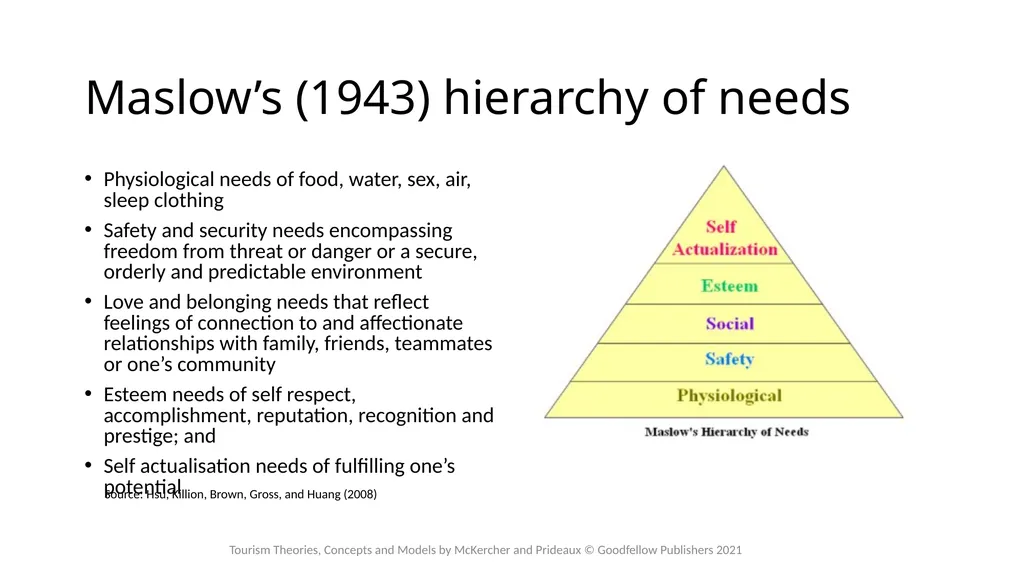
Maslow’s (1943) hierarchy of needs Physiological needs of food, water, sex, air, sleep clothing
Safety and security needs encompassing freedom from threat or danger or a secure, orderly and predictable environment
Love and belonging needs that reflect feelings of connection to and affectionate relationships with family, friends, teammates or one’s community
Esteem needs of self respect, accomplishment, reputation, recognition and prestige; and
Self actualisation needs of fulfilling one’s potential Source: Hsu, Killion, Brown, Gross, and Huang (2008) Tourism Theories, Concepts and Models by McKercher and Prideaux © Goodfellow Publishers 2021<br>
Safety and security needs encompassing freedom from threat or danger or a secure, orderly and predictable environment
Love and belonging needs that reflect feelings of connection to and affectionate relationships with family, friends, teammates or one’s community
Esteem needs of self respect, accomplishment, reputation, recognition and prestige; and
Self actualisation needs of fulfilling one’s potential Source: Hsu, Killion, Brown, Gross, and Huang (2008) Tourism Theories, Concepts and Models by McKercher and Prideaux © Goodfellow Publishers 2021<br>
07
Does Maslow work in tourism? Little evidence to support it
Needs are not necessarily hierarchical nor are they singular
Example of commercial adventure tourism - the drivers of participation may be physiological, social and esteem related, and in some cases self-actualisation may come into play
The same action may satisfy many needs simultaneously, defying simple categorisation
Eating may satisfy a physiological need if the person is hungry, a relationship need if dining with friends and relatives, a self-esteem need if eating at a fine dining restaurant or perhaps even a self-actualisation need if the person is a culinary tourist and has always wanted to eat a certain type of food in a certain destination
Some core tourism motives are not covered by the hierarchy or can be subsumed into multiple tiers
Novelty and escape/relaxation do not easily fit into the traditional hierarchy of needs
The causal link between need and behaviour is not as absolute as desired Tourism Theories, Concepts and Models by McKercher and Prideaux © Goodfellow Publishers 2021<br>
Needs are not necessarily hierarchical nor are they singular
Example of commercial adventure tourism - the drivers of participation may be physiological, social and esteem related, and in some cases self-actualisation may come into play
The same action may satisfy many needs simultaneously, defying simple categorisation
Eating may satisfy a physiological need if the person is hungry, a relationship need if dining with friends and relatives, a self-esteem need if eating at a fine dining restaurant or perhaps even a self-actualisation need if the person is a culinary tourist and has always wanted to eat a certain type of food in a certain destination
Some core tourism motives are not covered by the hierarchy or can be subsumed into multiple tiers
Novelty and escape/relaxation do not easily fit into the traditional hierarchy of needs
The causal link between need and behaviour is not as absolute as desired Tourism Theories, Concepts and Models by McKercher and Prideaux © Goodfellow Publishers 2021<br>
08
Dann’s (1977) Push–Pull model Arguably the best known and most ubiquitous model relating to motivations
Shows a link between drivers of travel and destination choice
Push factors are those factors that predispose tourists to travel
Pull factors are the features of the destination that attract tourists to certain places
While destinations may provide a range of products and services, the actual decision to visit a place is predicated on a prior need to travel
Push factors are the antecedent considerations before pull or destination factors can be considered. Tourism Theories, Concepts and Models by McKercher and Prideaux © Goodfellow Publishers 2021<br>
Shows a link between drivers of travel and destination choice
Push factors are those factors that predispose tourists to travel
Pull factors are the features of the destination that attract tourists to certain places
While destinations may provide a range of products and services, the actual decision to visit a place is predicated on a prior need to travel
Push factors are the antecedent considerations before pull or destination factors can be considered. Tourism Theories, Concepts and Models by McKercher and Prideaux © Goodfellow Publishers 2021<br>
09
Two push factors: Anomie and Ego-enhancement Anomie A state of disequilibrium from an anomic or socially disoriented society.
Desire to get away from it all or transcend the isolation of everyday life
Tourism provides an opportunity for stronger and more influential social interaction for those living in an isolated world, or conversely social isolation if living in a world where privacy is at a premium Ego-enhancement From time to time we need to have our ego boosted
One strategy is to travel where a tourist can go to a place where his/her social position is unknown and, consequently, can feel superior on that basis on such anonymity
Status can be gained when the person returns from the trip Tourism Theories, Concepts and Models by McKercher and Prideaux © Goodfellow Publishers 2021<br>
Desire to get away from it all or transcend the isolation of everyday life
Tourism provides an opportunity for stronger and more influential social interaction for those living in an isolated world, or conversely social isolation if living in a world where privacy is at a premium Ego-enhancement From time to time we need to have our ego boosted
One strategy is to travel where a tourist can go to a place where his/her social position is unknown and, consequently, can feel superior on that basis on such anonymity
Status can be gained when the person returns from the trip Tourism Theories, Concepts and Models by McKercher and Prideaux © Goodfellow Publishers 2021<br>
10
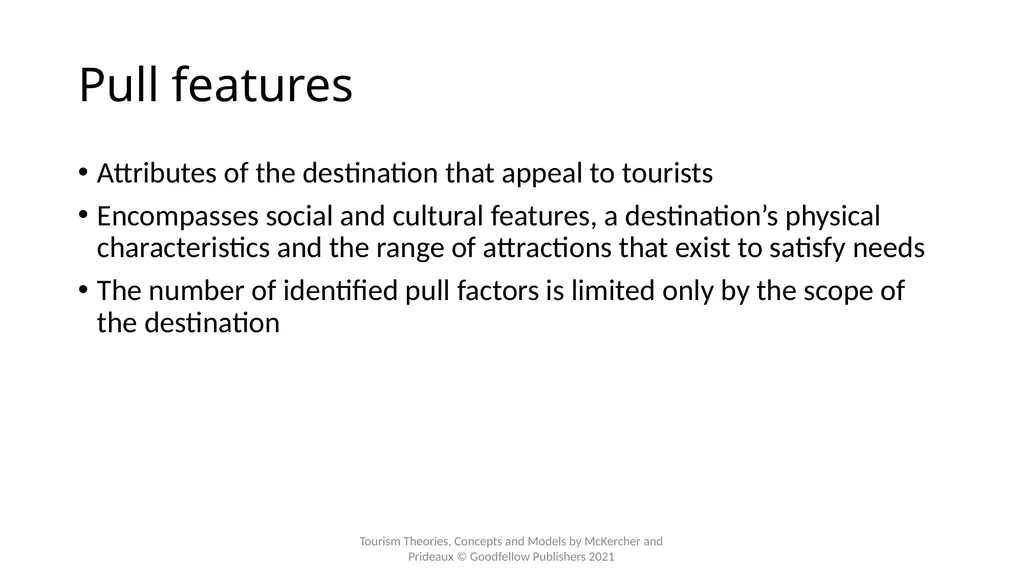
Pull features Attributes of the destination that appeal to tourists
Encompasses social and cultural features, a destination’s physical characteristics and the range of attractions that exist to satisfy needs
The number of identified pull factors is limited only by the scope of the destination Tourism Theories, Concepts and Models by McKercher and Prideaux © Goodfellow Publishers 2021<br>
Encompasses social and cultural features, a destination’s physical characteristics and the range of attractions that exist to satisfy needs
The number of identified pull factors is limited only by the scope of the destination Tourism Theories, Concepts and Models by McKercher and Prideaux © Goodfellow Publishers 2021<br>
11
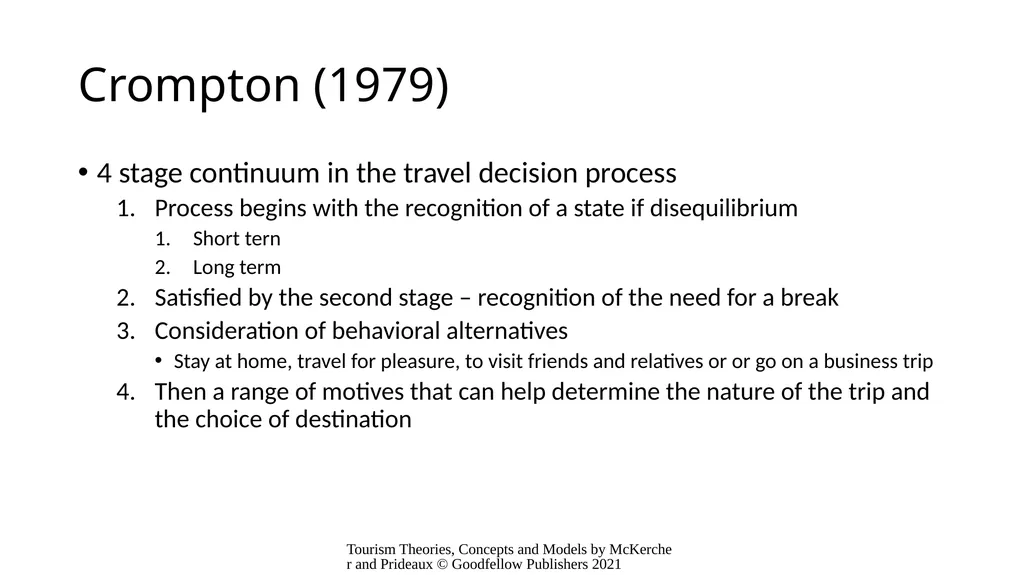
Crompton (1979) 4 stage continuum in the travel decision process
Process begins with the recognition of a state if disequilibrium
Short tern
Long term
Satisfied by the second stage – recognition of the need for a break
Consideration of behavioral alternatives
Stay at home, travel for pleasure, to visit friends and relatives or or go on a business trip
Then a range of motives that can help determine the nature of the trip and the choice of destination Tourism Theories, Concepts and Models by McKercher and Prideaux © Goodfellow Publishers 2021<br>
Process begins with the recognition of a state if disequilibrium
Short tern
Long term
Satisfied by the second stage – recognition of the need for a break
Consideration of behavioral alternatives
Stay at home, travel for pleasure, to visit friends and relatives or or go on a business trip
Then a range of motives that can help determine the nature of the trip and the choice of destination Tourism Theories, Concepts and Models by McKercher and Prideaux © Goodfellow Publishers 2021<br>
12
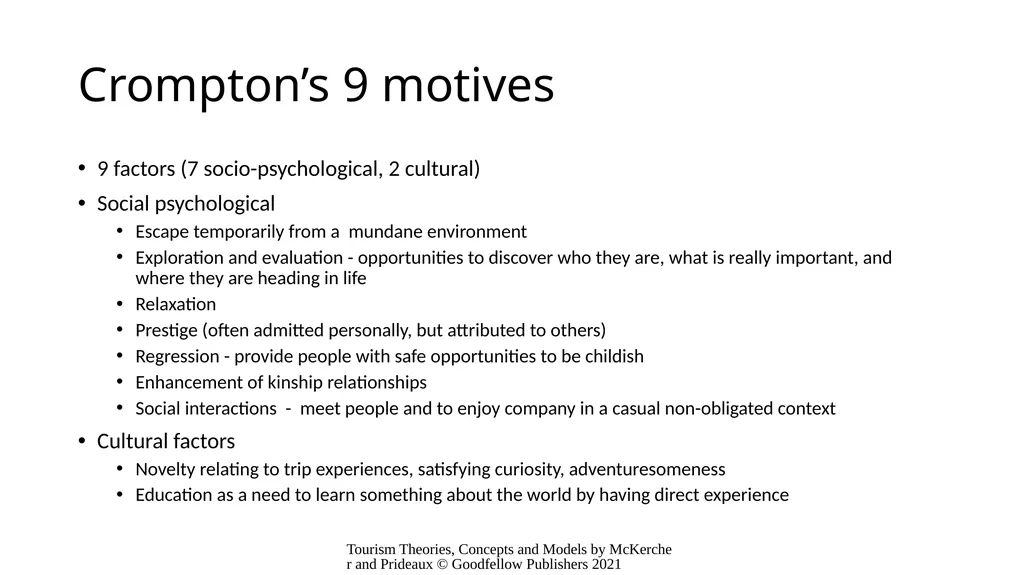
Crompton’s 9 motives 9 factors (7 socio-psychological, 2 cultural)
Social psychological
Escape temporarily from a mundane environment
Exploration and evaluation - opportunities to discover who they are, what is really important, and where they are heading in life
Relaxation
Prestige (often admitted personally, but attributed to others)
Regression - provide people with safe opportunities to be childish
Enhancement of kinship relationships
Social interactions - meet people and to enjoy company in a casual non-obligated context
Cultural factors
Novelty relating to trip experiences, satisfying curiosity, adventuresomeness
Education as a need to learn something about the world by having direct experience Tourism Theories, Concepts and Models by McKercher and Prideaux © Goodfellow Publishers 2021<br>
Social psychological
Escape temporarily from a mundane environment
Exploration and evaluation - opportunities to discover who they are, what is really important, and where they are heading in life
Relaxation
Prestige (often admitted personally, but attributed to others)
Regression - provide people with safe opportunities to be childish
Enhancement of kinship relationships
Social interactions - meet people and to enjoy company in a casual non-obligated context
Cultural factors
Novelty relating to trip experiences, satisfying curiosity, adventuresomeness
Education as a need to learn something about the world by having direct experience Tourism Theories, Concepts and Models by McKercher and Prideaux © Goodfellow Publishers 2021<br>
13
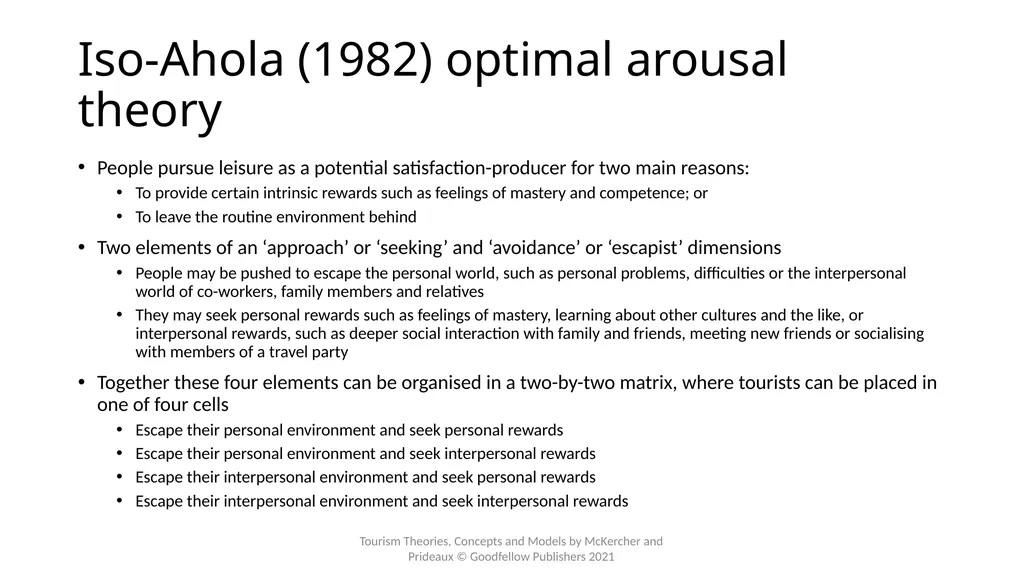
Iso-Ahola (1982) optimal arousal theory People pursue leisure as a potential satisfaction-producer for two main reasons:
To provide certain intrinsic rewards such as feelings of mastery and competence; or
To leave the routine environment behind
Two elements of an ‘approach’ or ‘seeking’ and ‘avoidance’ or ‘escapist’ dimensions
People may be pushed to escape the personal world, such as personal problems, difficulties or the interpersonal world of co-workers, family members and relatives
They may seek personal rewards such as feelings of mastery, learning about other cultures and the like, or interpersonal rewards, such as deeper social interaction with family and friends, meeting new friends or socialising with members of a travel party
Together these four elements can be organised in a two-by-two matrix, where tourists can be placed in one of four cells
Escape their personal environment and seek personal rewards
Escape their personal environment and seek interpersonal rewards
Escape their interpersonal environment and seek personal rewards
Escape their interpersonal environment and seek interpersonal rewards Tourism Theories, Concepts and Models by McKercher and Prideaux © Goodfellow Publishers 2021<br>
To provide certain intrinsic rewards such as feelings of mastery and competence; or
To leave the routine environment behind
Two elements of an ‘approach’ or ‘seeking’ and ‘avoidance’ or ‘escapist’ dimensions
People may be pushed to escape the personal world, such as personal problems, difficulties or the interpersonal world of co-workers, family members and relatives
They may seek personal rewards such as feelings of mastery, learning about other cultures and the like, or interpersonal rewards, such as deeper social interaction with family and friends, meeting new friends or socialising with members of a travel party
Together these four elements can be organised in a two-by-two matrix, where tourists can be placed in one of four cells
Escape their personal environment and seek personal rewards
Escape their personal environment and seek interpersonal rewards
Escape their interpersonal environment and seek personal rewards
Escape their interpersonal environment and seek interpersonal rewards Tourism Theories, Concepts and Models by McKercher and Prideaux © Goodfellow Publishers 2021<br>
14
Gutman’s (1982) means-end chain theory Practical framework to examine the push and pull relationship
‘Means’ = destination attributes
‘Ends’ = motivational forces
Can help to determine the destination attributes that attract tourists
Examines the relationships between these destination attributes and motivational forces
Customers do not purchase a product for its own sake, but
For the desired benefits that accrue or
To minimise undesired consequences
Products, and the attributes they possess, represent the “means” by which consumers obtain important consequences or benefits and reinforce important personal values or “ends” Tourism Theories, Concepts and Models by McKercher and Prideaux © Goodfellow Publishers 2021<br>
‘Means’ = destination attributes
‘Ends’ = motivational forces
Can help to determine the destination attributes that attract tourists
Examines the relationships between these destination attributes and motivational forces
Customers do not purchase a product for its own sake, but
For the desired benefits that accrue or
To minimise undesired consequences
Products, and the attributes they possess, represent the “means” by which consumers obtain important consequences or benefits and reinforce important personal values or “ends” Tourism Theories, Concepts and Models by McKercher and Prideaux © Goodfellow Publishers 2021<br>
15
3 elements The features or aspects of a product or service (physical or abstract)
Consequences (benefits accruing to users when they experience the product or service whether functional or psychosocial) and
Value as the highest level of end, and the most fundamental goal
Example: visit an area because it has nice beaches (product), with the consequence that someone can get a tan, looking good or feeling better. But as one digs deeper, the true value is one of self esteem and feeling better about oneself Tourism Theories, Concepts and Models by McKercher and Prideaux © Goodfellow Publishers 2021<br>
Consequences (benefits accruing to users when they experience the product or service whether functional or psychosocial) and
Value as the highest level of end, and the most fundamental goal
Example: visit an area because it has nice beaches (product), with the consequence that someone can get a tan, looking good or feeling better. But as one digs deeper, the true value is one of self esteem and feeling better about oneself Tourism Theories, Concepts and Models by McKercher and Prideaux © Goodfellow Publishers 2021<br>
16
Pearce’s travel career pattern (ladder) Current state of the art
Trip decisions are influenced by the mix of and the relative importance placed on different tiers of motives
Motives can be classified into three broad categories:
Core motives relating primarily to novelty, escape, relaxation and relationships
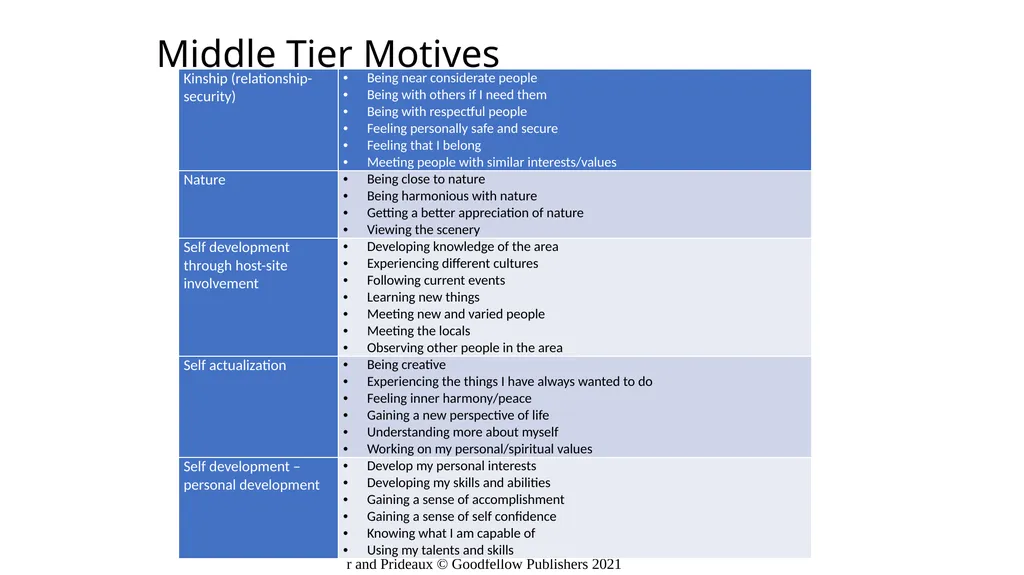
Mid-layer motives can include self-development, self-actualization and a range of other factors
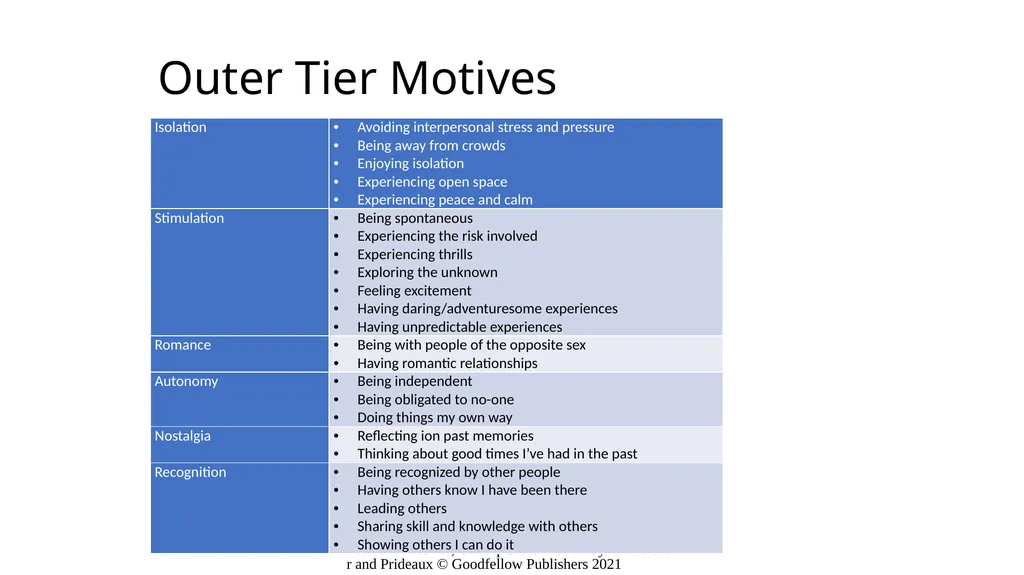
Outer-layer motives include such features as social status, romance, nostalgia, isolation and the like
Core motives represent the backbone or skeleton of all travel, but the extent to which they influence travel decisions depends on the relative importance individuals place on middle layer and outer layer motives Tourism Theories, Concepts and Models by McKercher and Prideaux © Goodfellow Publishers 2021<br>
Trip decisions are influenced by the mix of and the relative importance placed on different tiers of motives
Motives can be classified into three broad categories:
Core motives relating primarily to novelty, escape, relaxation and relationships
Mid-layer motives can include self-development, self-actualization and a range of other factors
Outer-layer motives include such features as social status, romance, nostalgia, isolation and the like
Core motives represent the backbone or skeleton of all travel, but the extent to which they influence travel decisions depends on the relative importance individuals place on middle layer and outer layer motives Tourism Theories, Concepts and Models by McKercher and Prideaux © Goodfellow Publishers 2021<br>
17
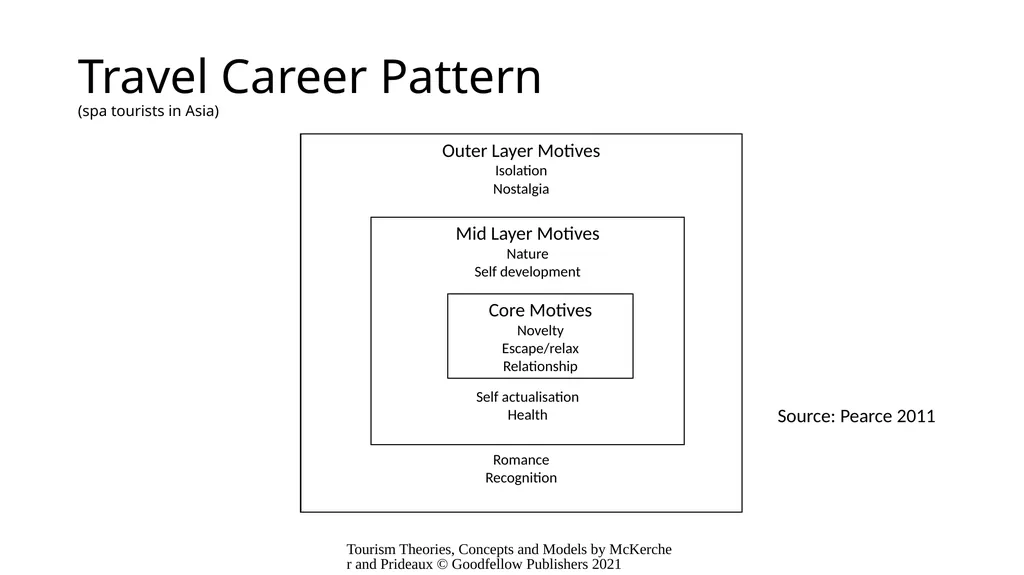
Travel Career Pattern
(spa tourists in Asia) Outer Layer Motives
Isolation
Nostalgia
Romance
Recognition Mid Layer Motives
Nature
Self development
Self actualisation
Health Core Motives
Novelty
Escape/relax
Relationship Source: Pearce 2011 Tourism Theories, Concepts and Models by McKercher and Prideaux © Goodfellow Publishers 2021<br>
Isolation
Nostalgia
Romance
Recognition Mid Layer Motives
Nature
Self development
Self actualisation
Health Core Motives
Novelty
Escape/relax
Relationship Source: Pearce 2011 Tourism Theories, Concepts and Models by McKercher and Prideaux © Goodfellow Publishers 2021<br>
18
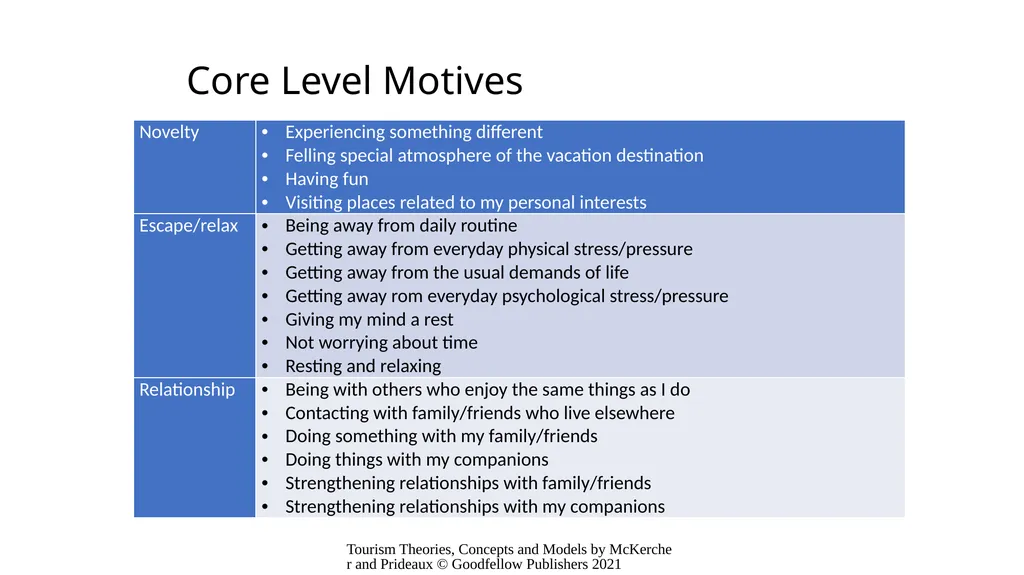
Core Level Motives Tourism Theories, Concepts and Models by McKercher and Prideaux © Goodfellow Publishers 2021<br>
19
Middle Tier Motives Tourism Theories, Concepts and Models by McKercher and Prideaux © Goodfellow Publishers 2021<br>
20
Outer Tier Motives Tourism Theories, Concepts and Models by McKercher and Prideaux © Goodfellow Publishers 2021<br>
21
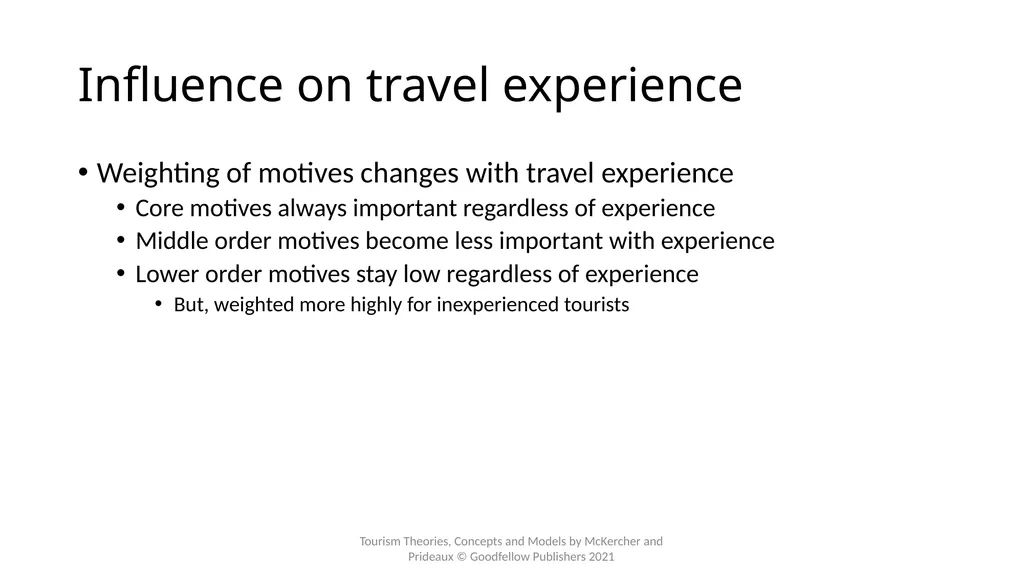
Influence on travel experience Weighting of motives changes with travel experience
Core motives always important regardless of experience
Middle order motives become less important with experience
Lower order motives stay low regardless of experience
But, weighted more highly for inexperienced tourists Tourism Theories, Concepts and Models by McKercher and Prideaux © Goodfellow Publishers 2021<br>
Core motives always important regardless of experience
Middle order motives become less important with experience
Lower order motives stay low regardless of experience
But, weighted more highly for inexperienced tourists Tourism Theories, Concepts and Models by McKercher and Prideaux © Goodfellow Publishers 2021<br>