
Chapter 12 Mission-Specific Competencies: Product
CM
Published · 40 slides · 0 views
1 / 1
Description
Chapter 12 Mission-Specific Competencies: Product Control Objectives: Operations Level Responders Assigned Mission-Specific Responsibilities (1 of 3) Describe and identify the control options available to operations levels responders. (NFPA
Related Topics
Share
Embed code
Download this presentation From Below
"Chapter 12 Mission-Specific Competencies: Product" is the property of its rightful owner. Permission is granted to download and print the materials on this website for personal, non-commercial use only, and to display it on your personal computer provided you do not modify the materials and that you retain all copyright notices contained in the materials. By downloading content from our website, you accept the terms of this agreement.
Presentation Transcript
01
Chapter 12 Mission-Specific Competencies: Product Control<br>
02
Objectives: Operations Level Responders Assigned Mission-Specific Responsibilities (1 of 3) Describe and identify the control options available to operations levels responders. (NFPA 6.6.3.1, p. 254–255)
Describe and identify the control options available for flammable liquid and flammable gas incidents. (NFPA 6.5.2.1(1)(2), p. 254–255)
Describe the purpose, equipment, and precautions associated with control options. (NFPA 6.6.3.1, 6.6.3.2, p. 255–267)<br>
Describe and identify the control options available for flammable liquid and flammable gas incidents. (NFPA 6.5.2.1(1)(2), p. 254–255)
Describe the purpose, equipment, and precautions associated with control options. (NFPA 6.6.3.1, 6.6.3.2, p. 255–267)<br>
03
Objectives: Operations Level Responders Assigned Mission-Specific Responsibilities (2 of 3) Describe the applicability and characteristics of aqueous film-forming foam, alcohol-resistant concentrates, fluoroprotein foams, protein foams, and high-expansion foams. (NFPA 6.6.4.1(1)(2), p. 265)
Identify the location and describe the use of emergency remote shut-off devices on MC 306/DOT 406, MC 307/DOT 407, and MC 331 cargo tanks containing flammable liquids or gases. (NFPA 6.6.4.1(4)(5), p. 262–263)<br>
Identify the location and describe the use of emergency remote shut-off devices on MC 306/DOT 406, MC 307/DOT 407, and MC 331 cargo tanks containing flammable liquids or gases. (NFPA 6.6.4.1(4)(5), p. 262–263)<br>
04
Objectives: Operations Level Responders Assigned Mission-Specific Responsibilities (3 of 3) Describe the recovery phase, and the transition from emergency to clean-up. (NFPA 6.6.4.2, p. 267–268)<br>
05
Introduction (1 of 3) Confinement
Process of attempting to keep hazardous material within immediate area of release
Damming or diking material, or suppressing vapor with appropriate type of foam<br>
Process of attempting to keep hazardous material within immediate area of release
Damming or diking material, or suppressing vapor with appropriate type of foam<br>
06
Introduction (2 of 3) Containment
Actions that stop the hazardous material from leaking or escaping container
Patching or plugging a breached container
Righting an overturned container to stop slow leak<br>
Actions that stop the hazardous material from leaking or escaping container
Patching or plugging a breached container
Righting an overturned container to stop slow leak<br>
07
Introduction (3 of 3) When considering control option, evaluate:
Maximum quantity of material that can be released
Likely duration of incident without intervention<br>
Maximum quantity of material that can be released
Likely duration of incident without intervention<br>
08
Control Options Sometimes no action is the safest course of action.
The situation may be extreme.
Responders cannot be properly protected.
Product will evaporate quickly, cool down, or solidify.<br>
The situation may be extreme.
Responders cannot be properly protected.
Product will evaporate quickly, cool down, or solidify.<br>
09
Absorption (1 of 2) Spongy material (e.g., soil or loose absorbents) or specially designed spill pads are used to soak up a liquid hazardous material.
Contaminated mixture of absorbent material and chemicals are collected and disposed of together.
Effective only on flat surfaces<br>
Contaminated mixture of absorbent material and chemicals are collected and disposed of together.
Effective only on flat surfaces<br>
10
Absorption (2 of 2) Process does not change chemical properties of substance; only collects substance for containment
Challenging because personnel must be in close proximity to spilled material
Adding material to a spilled product adds volume to the spill.<br>
Challenging because personnel must be in close proximity to spilled material
Adding material to a spilled product adds volume to the spill.<br>
11
Adsorption Contaminant adheres to surface of added material (e.g., silica or activated carbon) rather than combining with it.
This process can generate heat, which should be considered.<br>
This process can generate heat, which should be considered.<br>
12
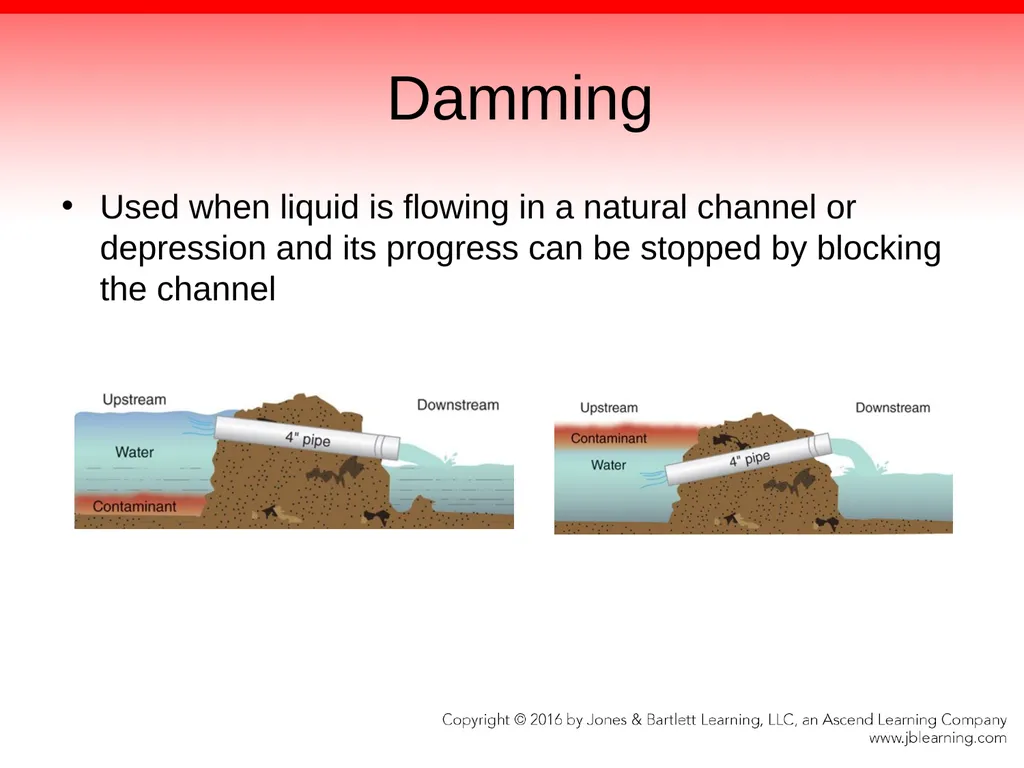
Damming Used when liquid is flowing in a natural channel or depression and its progress can be stopped by blocking the channel<br>
13
Complete Dam Placed across a small stream or ditch to completely stop flow of material through channel
Used only in areas where stream or ditch is dry and amount of material needed to be controlled is small<br>
Used only in areas where stream or ditch is dry and amount of material needed to be controlled is small<br>
14
Overflow Dam Used to contain materials heavier than water
Dam base is built up to level that holds back flow of water.
PVC pipe or hard suction hose is installed at a slight angle to allow water to flow “over” the released liquid.
Heavier material is trapped at low level at base of dam.<br>
Dam base is built up to level that holds back flow of water.
PVC pipe or hard suction hose is installed at a slight angle to allow water to flow “over” the released liquid.
Heavier material is trapped at low level at base of dam.<br>
15
Underflow Dam Used to contain materials lighter than water
Piping is installed near bottom of dam so water flows “under” dam.
Materials floating on the water accumulate at top of dam area.
Must have sufficient pipes and hoses to allow enough water to flow past dam without overflowing over top of dam<br>
Piping is installed near bottom of dam so water flows “under” dam.
Materials floating on the water accumulate at top of dam area.
Must have sufficient pipes and hoses to allow enough water to flow past dam without overflowing over top of dam<br>
16
Diking Placement of selected material, such as sand, dirt, loose absorbent, or concrete, to form a barrier that will keep a liquid hazardous material from entering an unwanted area or to hold material in specific location
Material used to control hazard must not react adversely with spilled material.<br>
Material used to control hazard must not react adversely with spilled material.<br>
17
Dilution Addition of water or another substance to weaken the strength or concentration of hazardous material (typically a corrosive)
Used only when identity and properties of hazardous material are known
Water applied to dilute hazardous material may simply increase total volume.
Take extreme caution.<br>
Used only when identity and properties of hazardous material are known
Water applied to dilute hazardous material may simply increase total volume.
Take extreme caution.<br>
18
Diversion To redirect flow of liquid away from an endangered area to an area where it will have less impact
Existing barriers may be effective way to divert liquids away from storm drains or other unwanted destinations.
Dirt berms, spill booms, plastic tarps filled with sand, dirt, or clay
Not as permanent as a dike; constructed quickly<br>
Existing barriers may be effective way to divert liquids away from storm drains or other unwanted destinations.
Dirt berms, spill booms, plastic tarps filled with sand, dirt, or clay
Not as permanent as a dike; constructed quickly<br>
19
Retention Creating a defined area to hold hazardous materials
Material is held until clean-up contractor can recover it.
Sometimes, diversion technique is required to guide spilled liquid into retention basin.<br>
Material is held until clean-up contractor can recover it.
Sometimes, diversion technique is required to guide spilled liquid into retention basin.<br>
20
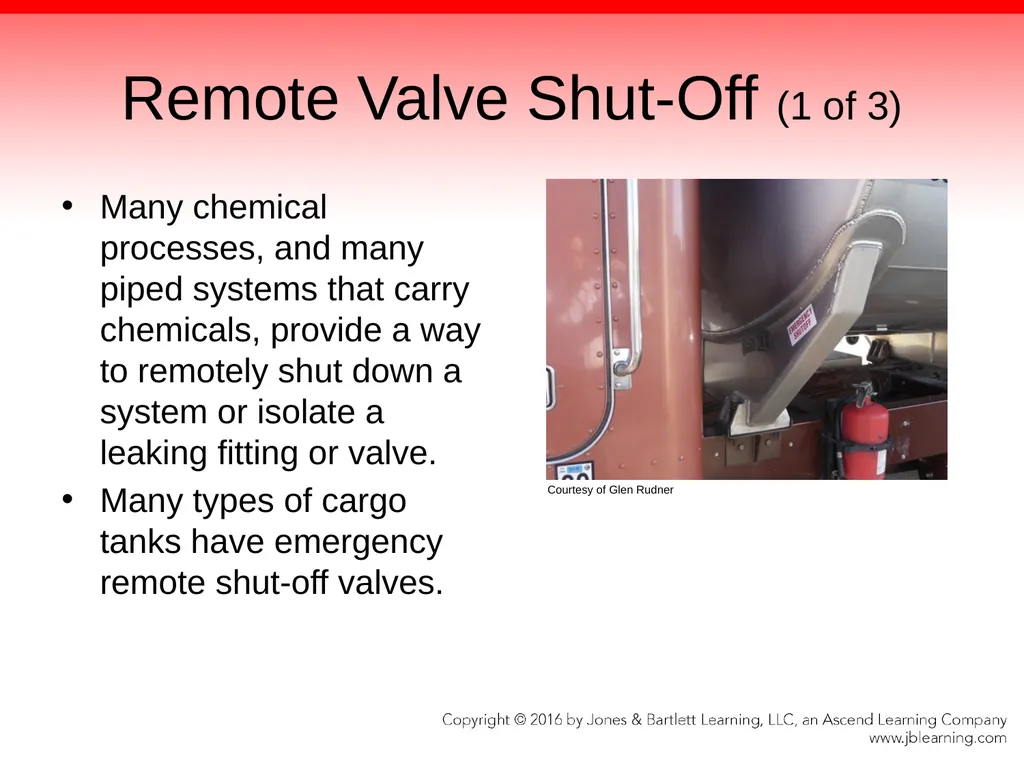
Remote Valve Shut-Off (1 of 3) Many chemical processes, and many piped systems that carry chemicals, provide a way to remotely shut down a system or isolate a leaking fitting or valve.
Many types of cargo tanks have emergency remote shut-off valves. Courtesy of Glen Rudner<br>
Many types of cargo tanks have emergency remote shut-off valves. Courtesy of Glen Rudner<br>
21
Remote Valve Shut-Off (2 of 3) MC306/DOT406 cargo tanks carry flammable and combustible liquids and Class B poisons.
Remote shut-off valves located at front of cargo tank on driver’s side or rear of cargo tank on passenger side
MC-307/DOT-407 cargo tanks carry chemicals transported at low pressure.
Outfitted with many safety features similar to those found on MC306/DOT406 cargo tanks<br>
Remote shut-off valves located at front of cargo tank on driver’s side or rear of cargo tank on passenger side
MC-307/DOT-407 cargo tanks carry chemicals transported at low pressure.
Outfitted with many safety features similar to those found on MC306/DOT406 cargo tanks<br>
22
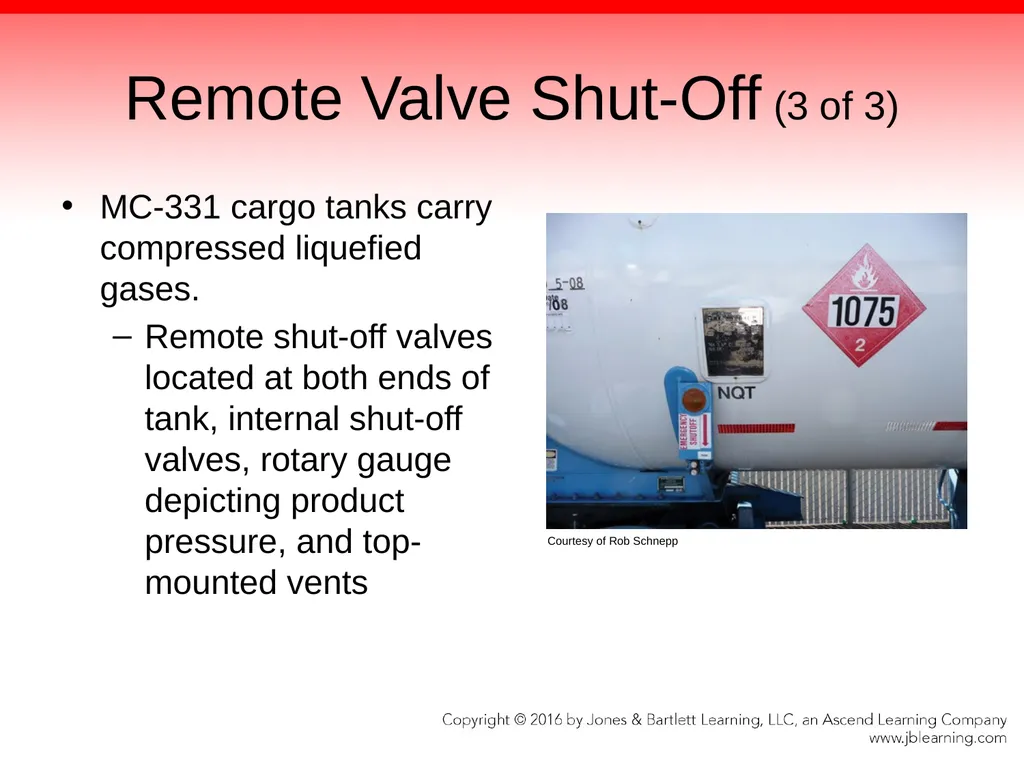
Remote Valve Shut-Off (3 of 3) MC-331 cargo tanks carry compressed liquefied gases.
Remote shut-off valves located at both ends of tank, internal shut-off valves, rotary gauge depicting product pressure, and top-mounted vents Courtesy of Rob Schnepp<br>
Remote shut-off valves located at both ends of tank, internal shut-off valves, rotary gauge depicting product pressure, and top-mounted vents Courtesy of Rob Schnepp<br>
23
Vapor Dispersion (1 of 2) Lowering concentration of vapors by spreading vapors out
Vapors can be dispersed with:
Hose streams set on fog patterns
Large displacement fans
Other types of mechanical ventilation found in fixed hazardous materials handling systems<br>
Vapors can be dispersed with:
Hose streams set on fog patterns
Large displacement fans
Other types of mechanical ventilation found in fixed hazardous materials handling systems<br>
24
Vapor Dispersion (2 of 2) Vapor dispersion with fans or fog stream should be attempted only after hazardous material is safely identified and in weather conditions that will promote diversion away from populated areas.<br>
25
Vapor Suppression Controlling fumes or vapors that are given off by certain materials, particularly flammable liquids, in an attempt to prevent their ignition
Hazardous material covered with foam or other material or temperature of material is reduced.
Responders must choose foam designed to work in certain situations.<br>
Hazardous material covered with foam or other material or temperature of material is reduced.
Responders must choose foam designed to work in certain situations.<br>
26
Aqueous Film-Forming Foam Used at 1%, 3%, or 6% concentration
Designed to form blanket over spilled flammable liquids to suppress vapors or on actively burning pools of flammable liquids
Usually biodegradable
Applied by in-line foam eductors, foam sprinkler systems, and portable or fixed foam proportioning systems<br>
Designed to form blanket over spilled flammable liquids to suppress vapors or on actively burning pools of flammable liquids
Usually biodegradable
Applied by in-line foam eductors, foam sprinkler systems, and portable or fixed foam proportioning systems<br>
27
Alcohol-Resistant Concentrates Properties similar to AFFF, but formulated so that alcohols and other polar solvents will not dissolve foam<br>
28
Fluoroprotein Foam Protein products mixed with synthetic fluorinated surfactants.
Used on fires or spills involving gasoline, oil, or similar products
Rapidly spread over fuel, ensuring fire knockdown and vapor suppression
Resistant to polar solvents such as alcohols, ketones, and ethers<br>
Used on fires or spills involving gasoline, oil, or similar products
Rapidly spread over fuel, ensuring fire knockdown and vapor suppression
Resistant to polar solvents such as alcohols, ketones, and ethers<br>
29
Protein Foam Made from hydrolyzed proteins along with stabilizers and preservatives
Stable and have good expansion properties
Resistant to reignition when used on Class B fires or spills involving nonpolar substances<br>
Stable and have good expansion properties
Resistant to reignition when used on Class B fires or spills involving nonpolar substances<br>
30
High-Expansion Foam Used when large volumes of foam required for spills or fires in warehouses, tank farms, and hazardous waste facilities
Expansion accomplished by pumping large volumes of air through small screen coated with foam solution.
“Dry” foam—due to large amount of air in the foam<br>
Expansion accomplished by pumping large volumes of air through small screen coated with foam solution.
“Dry” foam—due to large amount of air in the foam<br>
31
Foam Application (1 of 3) Foam concentrates (other than high-expansion foam) should be gently applied or bounced off another adjacent object so they flow down across liquid and do not directly upset burning surface.<br>
32
Foam Application (2 of 3) Rain-down method
Directing stream in air over material and letting foam gently fall onto surface of liquid
Roll-in method
Bouncing stream directly into front of spill area and allowing it to gently push forward into the pool<br>
Directing stream in air over material and letting foam gently fall onto surface of liquid
Roll-in method
Bouncing stream directly into front of spill area and allowing it to gently push forward into the pool<br>
33
Foam Application (3 of 3) Bounce-off method
Using object to deflect foam stream and letting it flow down onto burning surface<br>
Using object to deflect foam stream and letting it flow down onto burning surface<br>
34
Recovery Phase (1 of 3) When imminent danger to people, property, and environment has passed or is controlled, and clean-up begins
Local, state, and federal agencies involved
Cleaning up site
Determining responsible party
Implementing cost-recovery methods<br>
Local, state, and federal agencies involved
Cleaning up site
Determining responsible party
Implementing cost-recovery methods<br>
35
Recovery Phase (2 of 3) Can go on for days, weeks, or even months and may require large amounts of resources and equipment
Sometimes clear transition between emergency phase and clean-up phase
Decision made by incident commander<br>
Sometimes clear transition between emergency phase and clean-up phase
Decision made by incident commander<br>
36
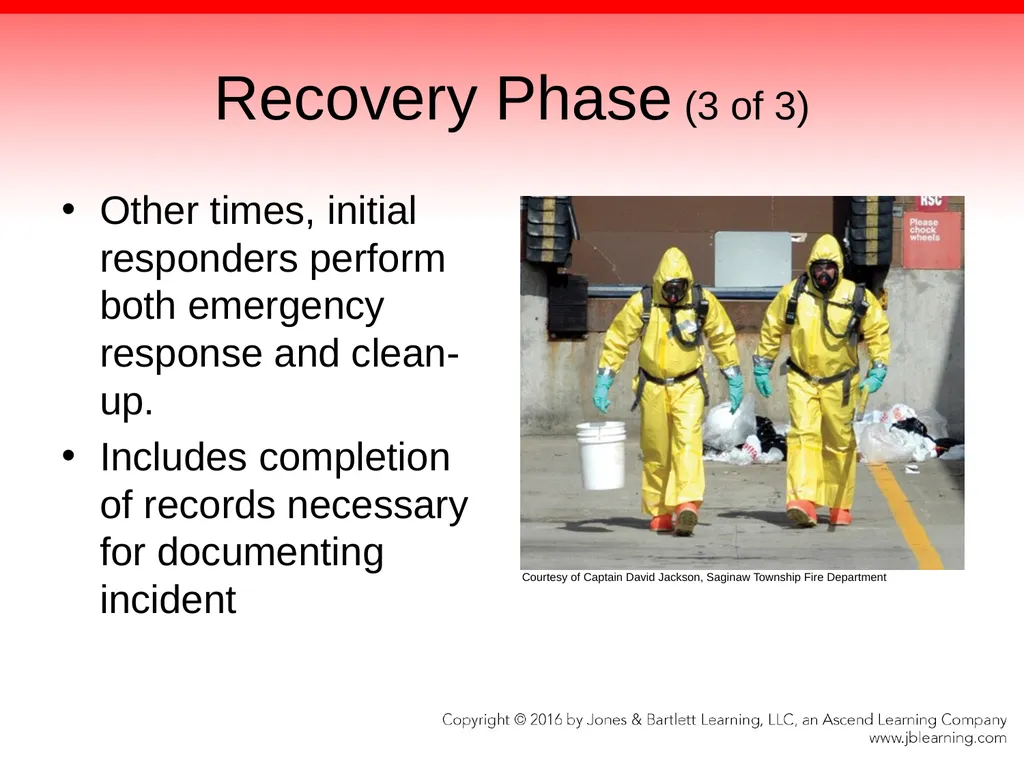
Recovery Phase (3 of 3) Other times, initial responders perform both emergency response and clean-up.
Includes completion of records necessary for documenting incident Courtesy of Captain David Jackson, Saginaw Township Fire Department<br>
Includes completion of records necessary for documenting incident Courtesy of Captain David Jackson, Saginaw Township Fire Department<br>
37
Summary (1 of 4) When considering a control option, a variety of factors must be evaluated, such as the maximum quantity of material that can be released and the likely duration of the incident if no intervention is made.
Sometimes the situation is so extreme, or the proposed action is so risky, that it may be prudent to create a safe perimeter and let the problem stabilize on its own.<br>
Sometimes the situation is so extreme, or the proposed action is so risky, that it may be prudent to create a safe perimeter and let the problem stabilize on its own.<br>
38
Summary (2 of 4) Control techniques or options generally aim to contain, redirect, or lower the concentration of the hazardous material involved and/or to prevent the ignition of flammable liquids or gases.
Responders can employ a variety of product-control options, such as absorption, diversion, damming, diking, or isolating a leak with remote shut-off valves.<br>
Responders can employ a variety of product-control options, such as absorption, diversion, damming, diking, or isolating a leak with remote shut-off valves.<br>
39
Summary (3 of 4) Special foams can help both in vapor suppression actions and in extinguishment of fires associated with flammable liquid releases.
Responders should be aware of the location of emergency shut-off valves at fixed facilities and on the various types of cargo tanks typically found in their response area.<br>
Responders should be aware of the location of emergency shut-off valves at fixed facilities and on the various types of cargo tanks typically found in their response area.<br>
40
Summary (4 of 4) The recovery phase may last for days or months and aims to return the exposure area to its original condition and return the facility or mode of transportation to the responsible party.<br>