Chapter 14 Personal care healthy behaviors Lesson 1 healthy skin, hair and nails Facts about skin: Largest organ of the body Produces perspiration to help keep body cool Main organ of the integumentary system Physical barrier between
"Chapter 14 Personal care & healthy behaviors" is the property of its rightful owner. Permission is granted to
download and print the materials on this website for personal, non-commercial use only, and to display it
on your personal computer provided you do not modify the materials and that you retain all copyright
notices contained in the materials. By downloading content from our website, you accept the terms of this
agreement.
Presentation Transcript
01
Chapter 14 Personal care & healthy behaviors<br>
02
Lesson 1 – healthy skin, hair and nails Facts about skin:
Largest organ of the body
Produces perspiration to help keep body cool
Main organ of the integumentary system
Physical barrier between the outside world and internal organs
1st line of defense against pathogens entering the body
Structure and Function of the Skin
Skin has 2 main layers
Epidermis – the outer, thinner layer of skin (living and dead cells)
Dermis – thicker layer under the epidermis (connective tissue, blood vessels, and nerves<br>
03
Lesson 1 - continued Melanin – a pigment that gives the skin, hair, and iris of the eye their color
People with fair skin are at risk for skin damage from UV radiation
Sebaceous glands – structures within the skin that produce an oily secretion called sebum
Main purpose of sebum is to keep the skin from drying out
Sweat glands – structures within the dermis that secrete perspiration through ducts to pores on the skin’s surface
Why do we sweat?
Healthy Skin
Wash your face every morning and evening with mild soap and water
Daily bathing helps remove and slow the growth of the bacteria that causes body odor<br>
04
Lesson 1 - continued Skin and the Sun
When skin is exposed to UV rays, melanin production is increased
List 2 ways to avoid sunburns:
Wear sunscreen
Wear protective clothing
Body Piercing and Tattooing
What are you at risk of contracting?
Hepatitis B
Hepatitis C
HIV
Skin Problems
Acne – pores become clogged, bacteria thrives in the trapped oil, most common among teens<br>
05
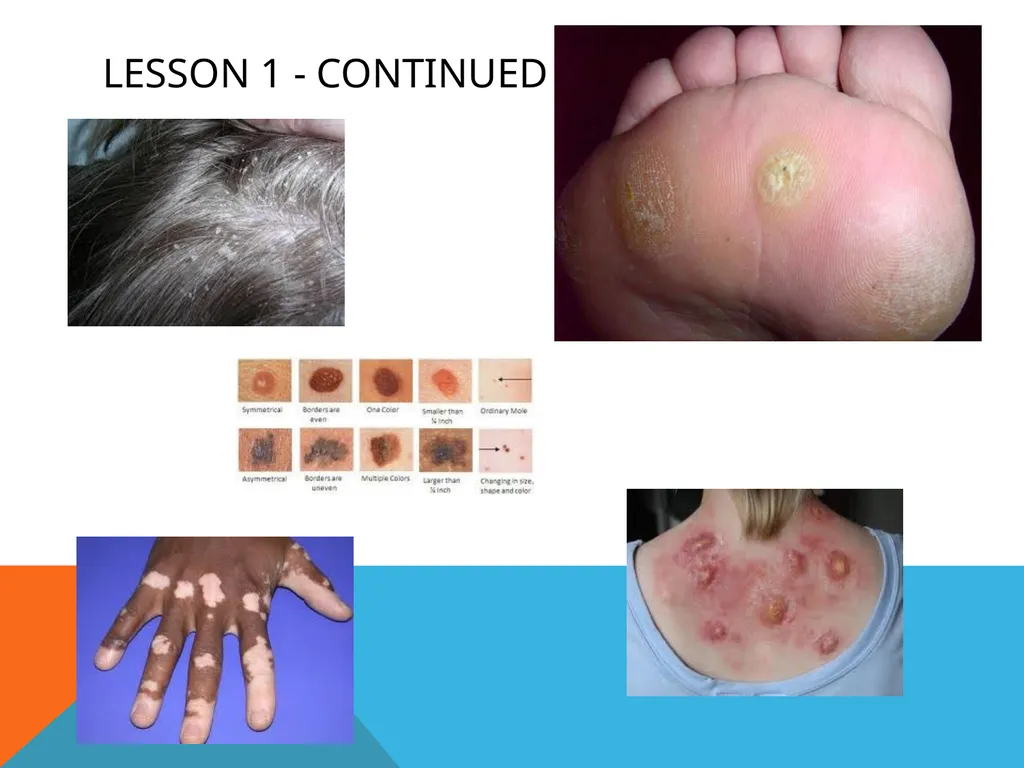
Lesson 1 - continued Warts – are caused by a virus
Usually non – cancerous
Can be acquired through contact with infected skin
Vitiligo – a condition in which patches of skin have lost all pigment
Boils – form when hair follicles become infected with bacteria
Moles – spots that contain extra melanin, most moles are harmless
Melanoma – the most serious form of skin cancer
Hair follicle – a structure that surrounds the root of a hair
Dandruff – a condition that can occur if the scalp becomes too dry<br>
06
Lesson 1 - continued<br>
07
Chapter 14 – Lesson 2 Caring for the Teeth and Mouth
Periodontium – the area immediately around the teeth
Good dental health includes:
Regular dental visits
Floss properly
Eat a well balanced diet including foods that contain phosphorus, calcium, and vitamin C
The tooth is made of 3 parts:
Crown
Neck
Root
Pulp – tissue that contains the blood vessels and nerves of a tooth
Plaque – a sticky colorless film that acts on sugar to form acids that destroy tooth enamel and irritate gums
Tooth decay occurs when the bacteria in plaque produces acids that destroy tooth enamel<br>
08
Lesson 2 - continued Problems of the Teeth and Mouth
Halitosis (bad breath) – can be caused by eating certain food, poor oral hygiene, smoking, bacteria on tongue, decayed teeth, or gum disease
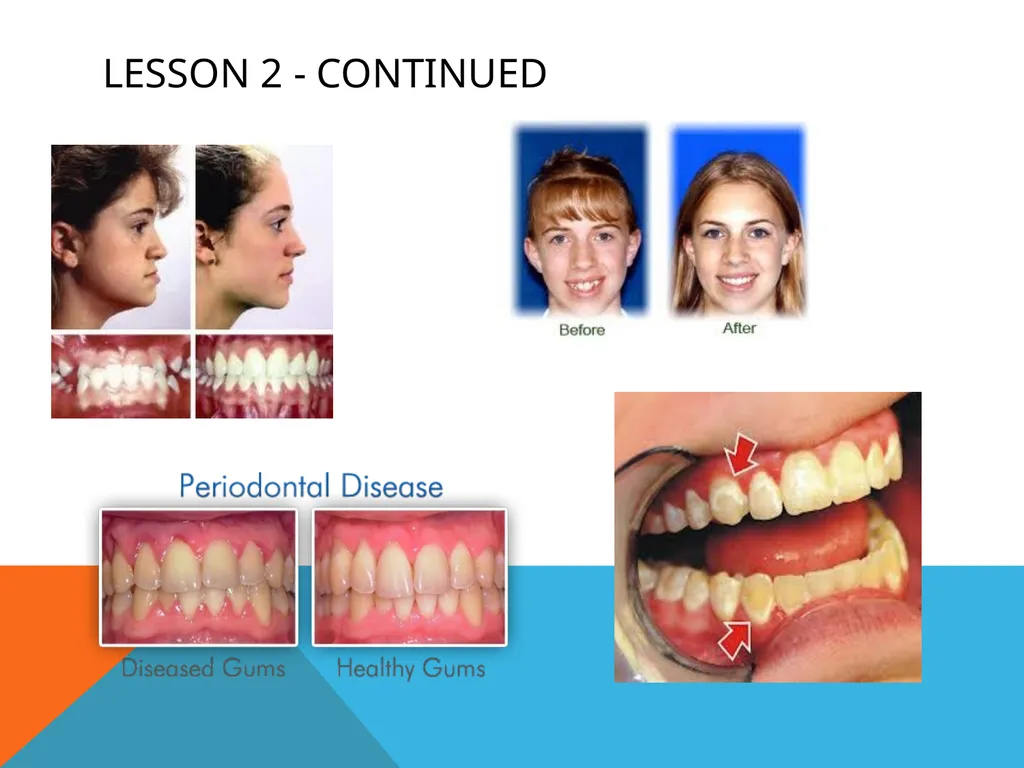
Peridontal disease – an inflammation of the peridontal structures (caused by bacteria) – gum disease
Tartar – hard crust-like substance formed when plaque hardens
Malocclusion – (bad bite) sometimes corrected by wearing braces
Oral cancer (cancer of the mouth) , bad breath, and receding gums are all side effects of tobacco use.<br>
09
Lesson 2 - continued<br>
10
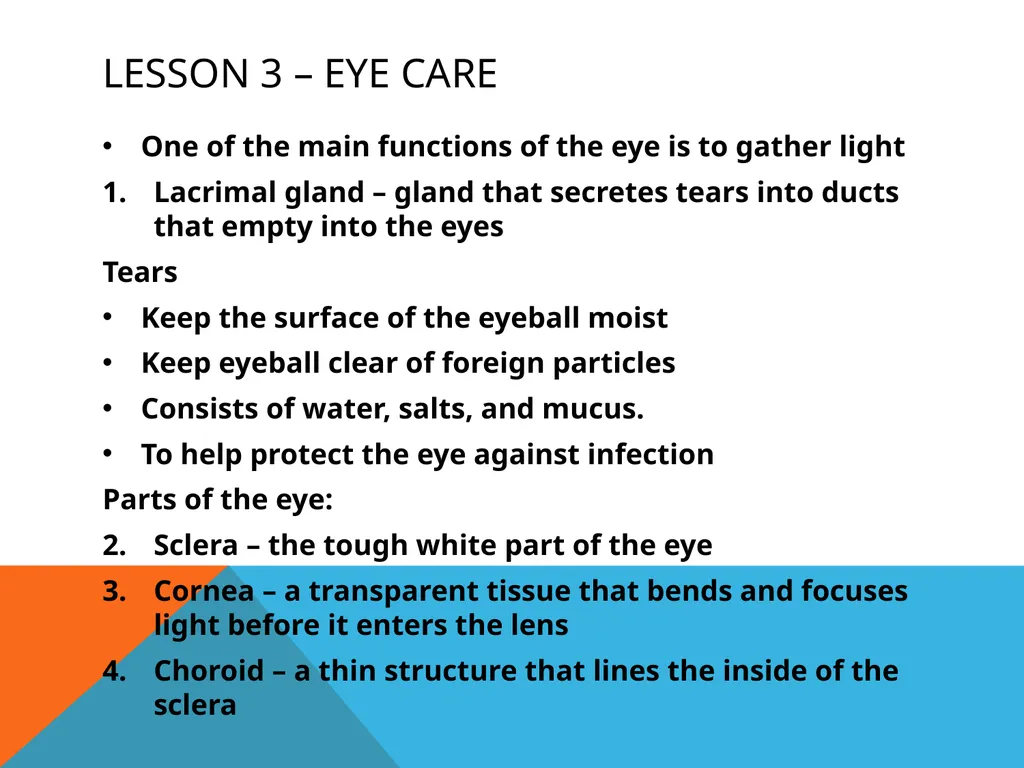
Lesson 3 – Eye Care One of the main functions of the eye is to gather light
Lacrimal gland – gland that secretes tears into ducts that empty into the eyes
Tears
Keep the surface of the eyeball moist
Keep eyeball clear of foreign particles
Consists of water, salts, and mucus.
To help protect the eye against infection
Parts of the eye:
Sclera – the tough white part of the eye
Cornea – a transparent tissue that bends and focuses light before it enters the lens
Choroid – a thin structure that lines the inside of the sclera<br>
11
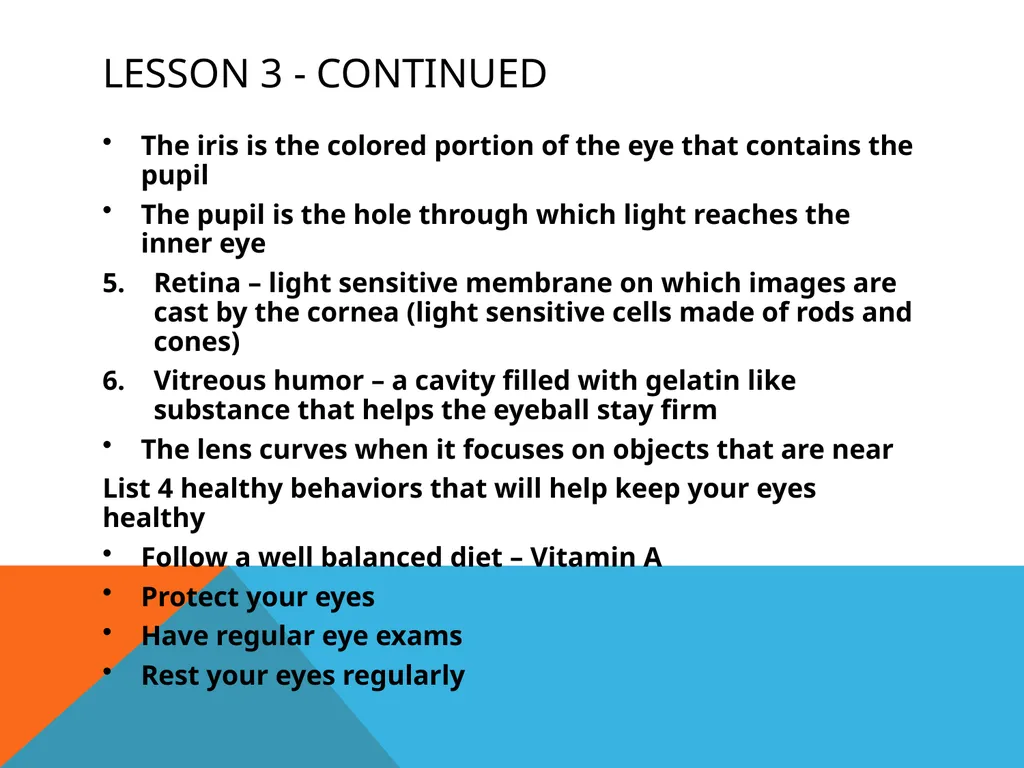
Lesson 3 - continued The iris is the colored portion of the eye that contains the pupil
The pupil is the hole through which light reaches the inner eye
Retina – light sensitive membrane on which images are cast by the cornea (light sensitive cells made of rods and cones)
Vitreous humor – a cavity filled with gelatin like substance that helps the eyeball stay firm
The lens curves when it focuses on objects that are near
List 4 healthy behaviors that will help keep your eyes healthy
Follow a well balanced diet – Vitamin A
Protect your eyes
Have regular eye exams
Rest your eyes regularly<br>
12
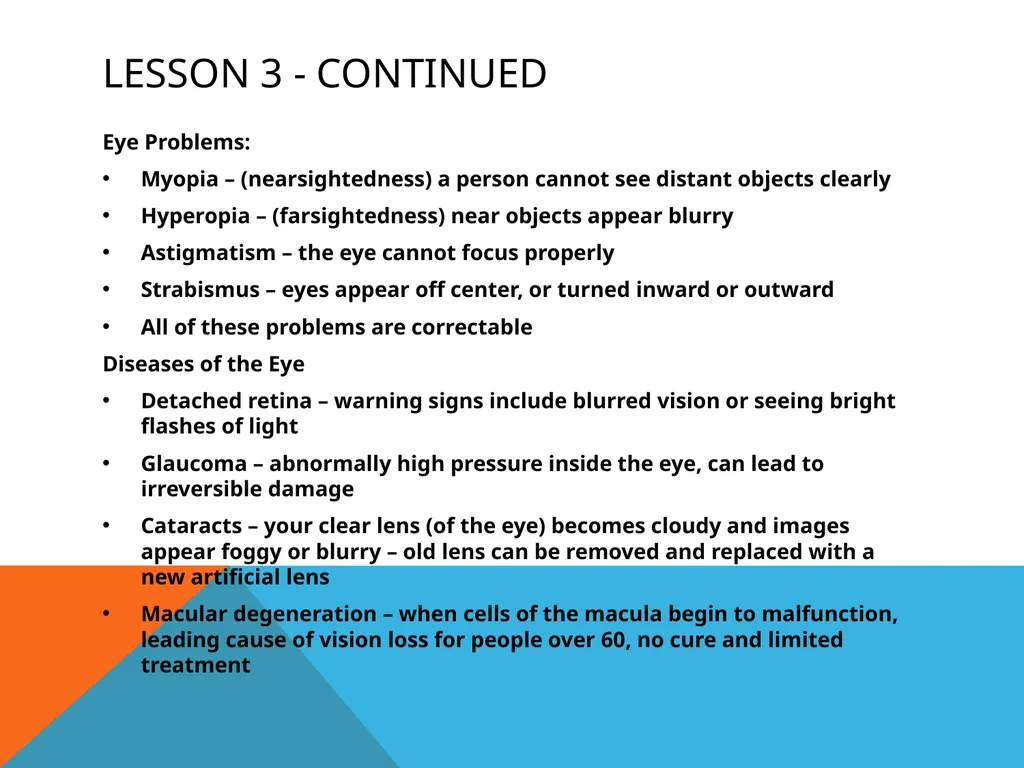
Lesson 3 - continued Eye Problems:
Myopia – (nearsightedness) a person cannot see distant objects clearly
Hyperopia – (farsightedness) near objects appear blurry
Astigmatism – the eye cannot focus properly
Strabismus – eyes appear off center, or turned inward or outward
All of these problems are correctable
Diseases of the Eye
Detached retina – warning signs include blurred vision or seeing bright flashes of light
Glaucoma – abnormally high pressure inside the eye, can lead to irreversible damage
Cataracts – your clear lens (of the eye) becomes cloudy and images appear foggy or blurry – old lens can be removed and replaced with a new artificial lens
Macular degeneration – when cells of the macula begin to malfunction, leading cause of vision loss for people over 60, no cure and limited treatment<br>
13
Lesson 3 - continued Sty – an inflamed swelling condition of a sebaceous gland near the eyelash
Conjunctivitis (pinkeye) – inflammation of the conjunctiva, a thin membrane that covers the sclera lining of the eyelids
Cones – allow humans to see in color<br>
14
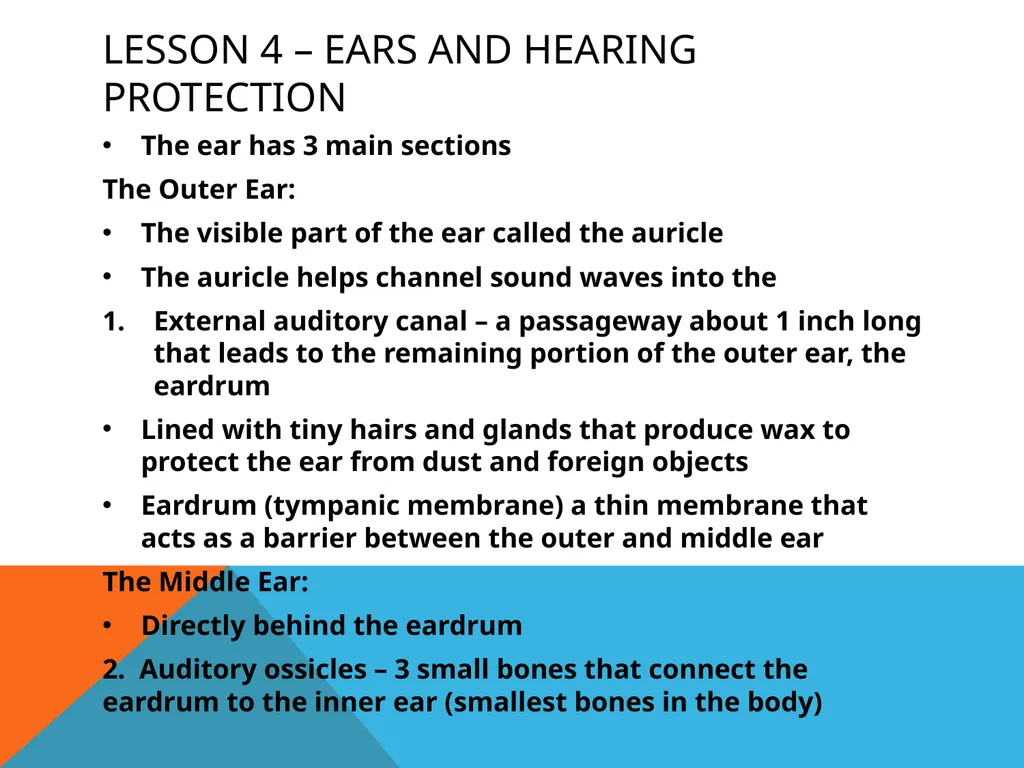
Lesson 4 – Ears and Hearing Protection The ear has 3 main sections
The Outer Ear:
The visible part of the ear called the auricle
The auricle helps channel sound waves into the
External auditory canal – a passageway about 1 inch long that leads to the remaining portion of the outer ear, the eardrum
Lined with tiny hairs and glands that produce wax to protect the ear from dust and foreign objects
Eardrum (tympanic membrane) a thin membrane that acts as a barrier between the outer and middle ear
The Middle Ear:
Directly behind the eardrum
2. Auditory ossicles – 3 small bones that connect the eardrum to the inner ear (smallest bones in the body)<br>
15
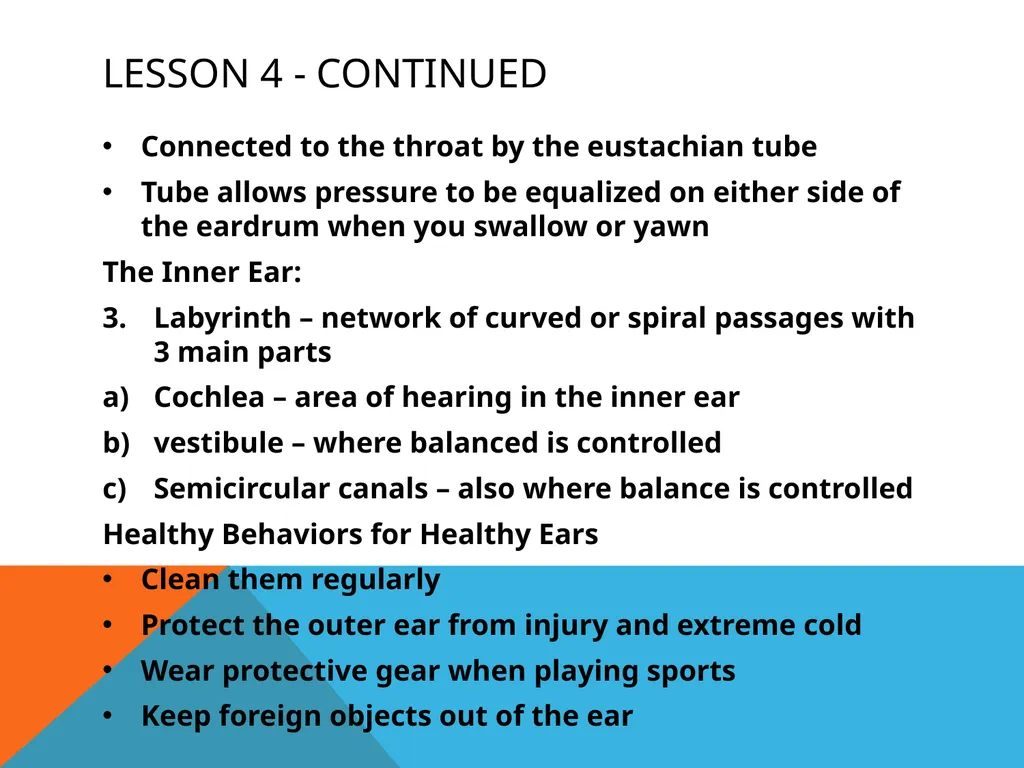
Lesson 4 - continued Connected to the throat by the eustachian tube
Tube allows pressure to be equalized on either side of the eardrum when you swallow or yawn
The Inner Ear:
Labyrinth – network of curved or spiral passages with 3 main parts
Cochlea – area of hearing in the inner ear
vestibule – where balanced is controlled
Semicircular canals – also where balance is controlled
Healthy Behaviors for Healthy Ears
Clean them regularly
Protect the outer ear from injury and extreme cold
Wear protective gear when playing sports
Keep foreign objects out of the ear<br>
16
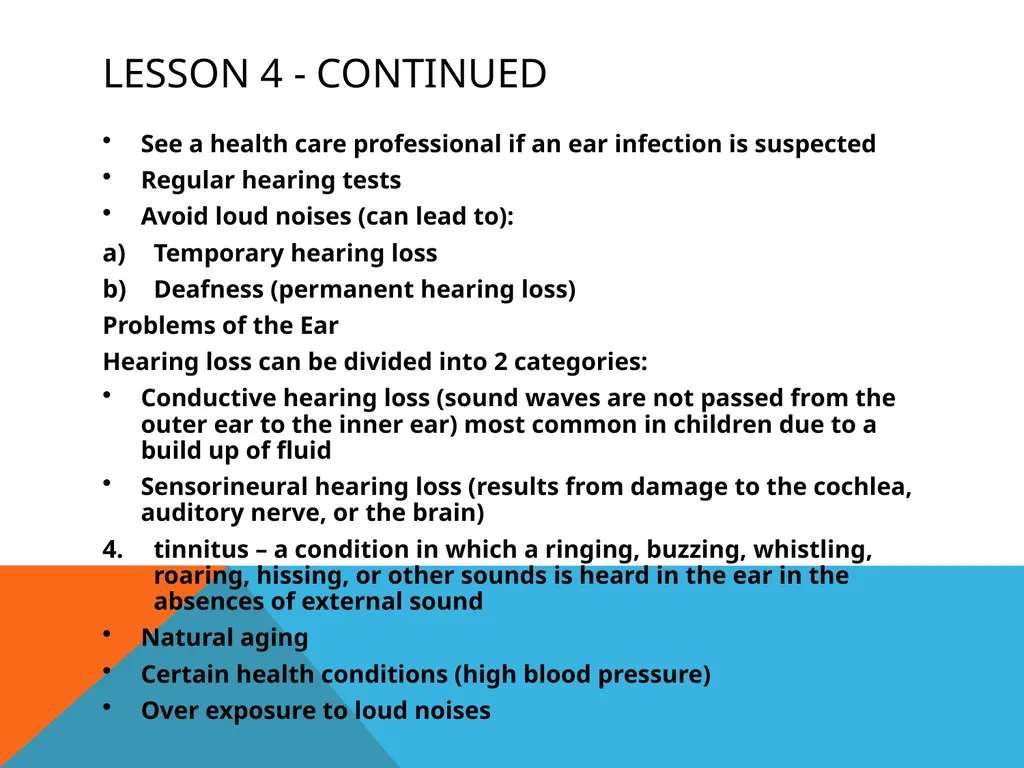
Lesson 4 - continued See a health care professional if an ear infection is suspected
Regular hearing tests
Avoid loud noises (can lead to):
Temporary hearing loss
Deafness (permanent hearing loss)
Problems of the Ear
Hearing loss can be divided into 2 categories:
Conductive hearing loss (sound waves are not passed from the outer ear to the inner ear) most common in children due to a build up of fluid
Sensorineural hearing loss (results from damage to the cochlea, auditory nerve, or the brain)
tinnitus – a condition in which a ringing, buzzing, whistling, roaring, hissing, or other sounds is heard in the ear in the absences of external sound
Natural aging
Certain health conditions (high blood pressure)
Over exposure to loud noises<br>
17
Lesson 4 - continued Protect Your Ears
Lower the volume of the noise
Wear ear plugs
Limit the length of time you are exposed to loud noise<br>