
CHAPTER 15 Basic Firing Operations Knowledge
Description: CHAPTER 15 Basic Firing Operations Knowledge Objectives Describe the purpose of conducting firing operations. Understand firing-operation permissions. Describe the term backfire. Describe the term burnout. Identify preplanning
Related Topics
Download Presentation
"CHAPTER 15 Basic Firing Operations Knowledge" is the property of its rightful owner. Permission is granted to download and print the materials on this website for personal, non-commercial use only, and to display it on your personal computer provided you do not modify the materials and that you retain all copyright notices contained in the materials. By downloading content from our website, you accept the terms of this agreement.
Presentation Transcript
slide1. CHAPTER 15 Basic Firing Operations<br>
slide2. Knowledge Objectives Describe the purpose of conducting firing operations.
Understand firing-operation permissions.
Describe the term backfire.
Describe the term burnout.
Identify preplanning considerations for firing operations.
Identify fuel, weather, and topography considerations for firing operations.
Describe general firing operations rules.<br>
slide3. Knowledge Objectives (cont.) Identify and describe common firing devices and their components:
Fusee
Drip torch
Flare launcher
Other firing equipment and field-expedient firing methods
Identify a go/no go checklist.
Describe different firing techniques:
Line firing
Strip firing
Flank firing
Ring firing<br>
slide4. Skills Objectives Light a fusee.
Operate a drip torch.
Operate a flare launcher.<br>
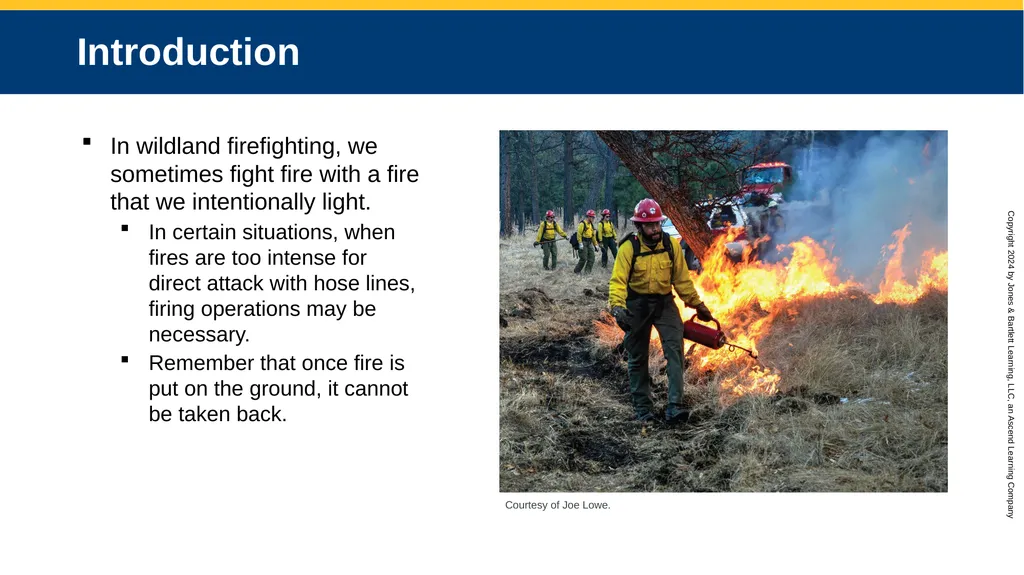
slide5. Introduction In wildland firefighting, we sometimes fight fire with a fire that we intentionally light.
In certain situations, when fires are too intense for direct attack with hose lines, firing operations may be necessary.
Remember that once fire is put on the ground, it cannot be taken back. Courtesy of Joe Lowe.<br>
slide6. Firing-Operation Permissions Some states have provisions in their government codes that address firing operations and who should perform them.
In many firefighting organizations in this country, it is necessary to acquire approval, through the chain of command, from the division supervisor before proceeding with a backfire or burnout operation.
Every firing operation should be run by one person who focuses his or her total attention on supervising the firing team.
Another consideration is the sociopolitical aspect related to firing operations.
In completing a successful firing operation, specific elements need to be in place.<br>
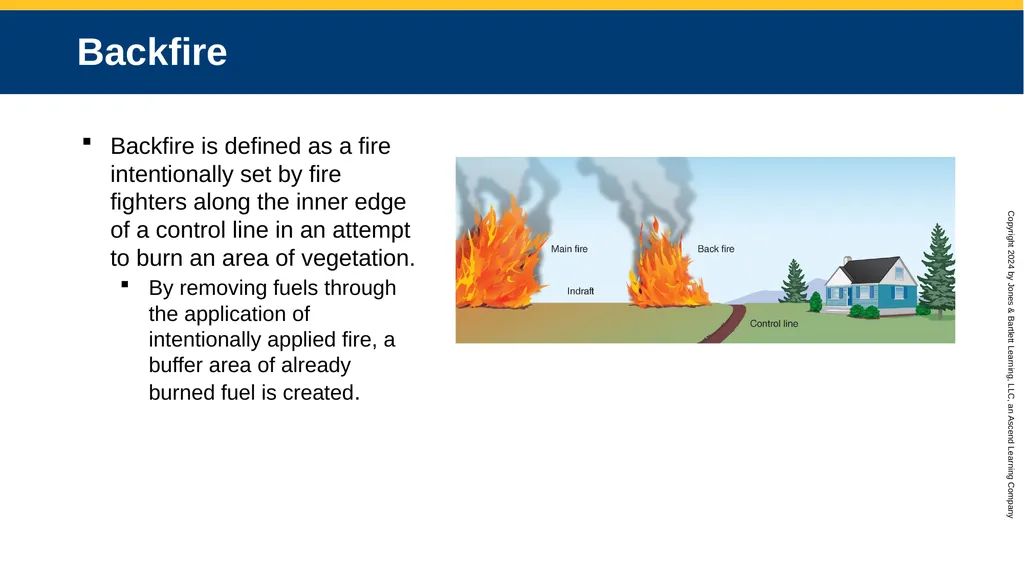
slide7. Backfire Backfire is defined as a fire intentionally set by fire fighters along the inner edge of a control line in an attempt to burn an area of vegetation.
By removing fuels through the application of intentionally applied fire, a buffer area of already burned fuel is created.<br>
slide8. Backfire (cont.) When we talk about the backfire being influenced by the main fire, we mean that an indraft effect takes place as the main fire approaches.
When you set a backfire, you must allow enough time (based on fuel factors, topography, weather, and fire behavior) for the backfire to develop and move away from the control line.
There is no firm set of rules as to when to light a backfire because timing is based on the fuels present, the topography, existing fire conditions, and the weather.<br>
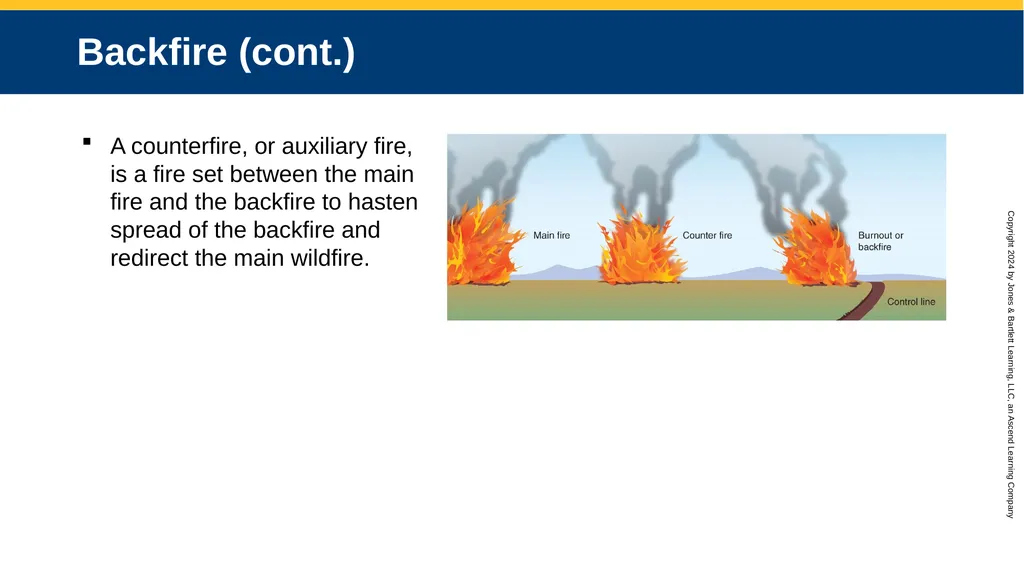
slide9. Backfire (cont.) A counterfire, or auxiliary fire, is a fire set between the main fire and the backfire to hasten spread of the backfire and redirect the main wildfire.<br>
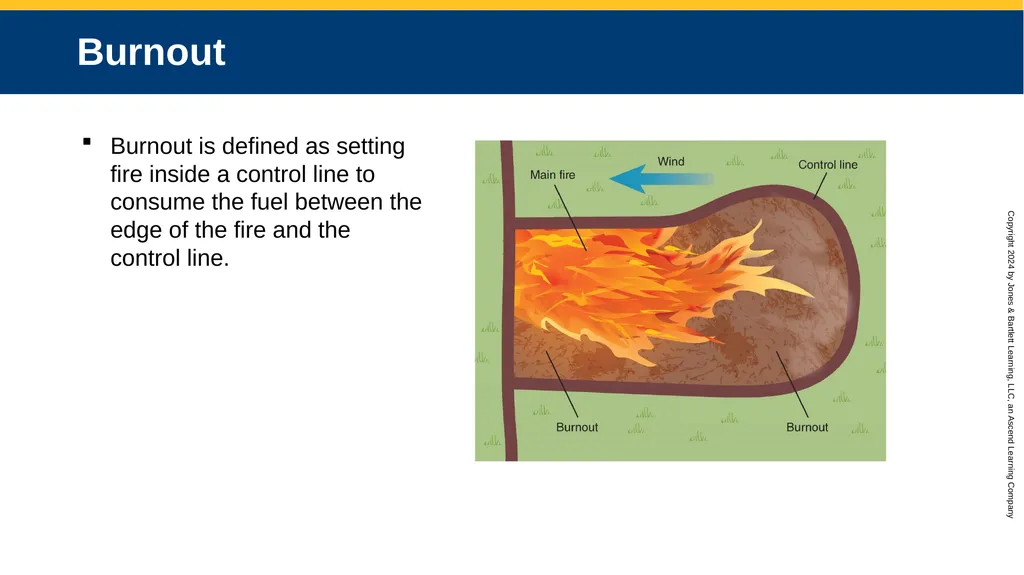
slide10. Burnout Burnout is defined as setting fire inside a control line to consume the fuel between the edge of the fire and the control line.<br>
slide11. Burnout (cont.) The control line is not complete until all fuels have been removed between the fire’s edge and the control line.
Handcrews also burnout as they simultaneously cut line from fingertip to fingertip because this reduces the total amount of line that needs to be constructed.
Burnout takes advantage of line-construction techniques by cutting across fingers and around concentrations of spot fires.<br>
slide12. Firing-Operation Preplanning Firing operations and prescribed burning should be organized and planned unless they are done as a result of an emergency.
A complete briefing should be given to the crews involved in the firing operation and appropriate assignments made.
Before the operation is started, objectives need to be defined regarding what is to be accomplished.
You will also need to consider the amount and type of supplies needed to complete the operation.<br>
slide13. Firing-Operation Preplanning (cont.) Discussion regarding safety zones and escape routes needs to take place before any fire is put on the ground.
The topographic map is used to show anticipated problem areas to the fire crews who will be doing the burning.
Before the firing operation begins, a decision should be made about the chain of command and what crews are in the division.
A small test fire should be set to evaluate fire behavior and controllability of your firing operation.
If these points are covered, the operation will go smoother, and the objectives will be met and accomplished safely.<br>
slide14. Fuel, Topography, and Weather Considerations Fuel, topography, and weather need to be evaluated before the firing operation begins.
These factors are the key to the intensity levels and flame lengths that will be created.
Light Fuels
Light fuels are easily ignited by the tools at hand and generally produce low-heat intensities on the fireline.
Medium Fuels
Medium fuels produce greater heat intensity and flame lengths than light fuels.<br>
slide15. Fuel, Topography, and Weather Considerations (cont.) Heavy Fuels
Heavy fuel types produce great fireline intensities and are a problem for fire crews.
Topography
Topographic features present some of the greatest obstacles to successful firing.<br>
slide16. Fuel, Topography, and Weather Considerations (cont.) Weather
Evaluated when planning the firing operation
When firing against the wind, it will take longer to complete the operation because the fire will spread at a slower rate.
When the firing operation is done from the fire’s flank, you should fire against the wind from a well-anchored point.
Other weather concerns to watch for include the following:
Be aware of any thunderstorm activity developing in the area.
Evaluate the smoke column.
Monitor high-level winds.
Monitor changes in humidity.
Watch for swirling wind currents (eddies) created by topographic changes.<br>
slide17. General Firing Operations Rules Review the following general rules to ensure an effective and safe firing operation.
Ultimately, LCES/ LACES must be in place at all times.
Other potential firing problems include the following:
Areas with lots of dead fuel mixed with live fuels
Areas with heavy fuel buildup
Power lines
Aerial retardant drops
Coordinate these so they do not interfere with the firing operation.
Any situation or environment that falls within the 10 standard fire orders and 18 watch outs<br>
slide18. Firing Devices Three commonly used firing devices are discussed in this section: the fusee, the drip torch, and the flare launcher.
These devices may be used in a firing operation, so you should become familiar with the characteristics of each.
Remember that you should always be wearing full personal protective equipment (PPE) and protective eyewear during firing operations.<br>
slide19. Firing Devices (cont.) Fusee
A fusee (sometimes called a backfire torch, a backfire fusee torch, or forest fire torch), is a colored flare designed to ignite backfires.
Note that fusees are very different from road flares.<br>
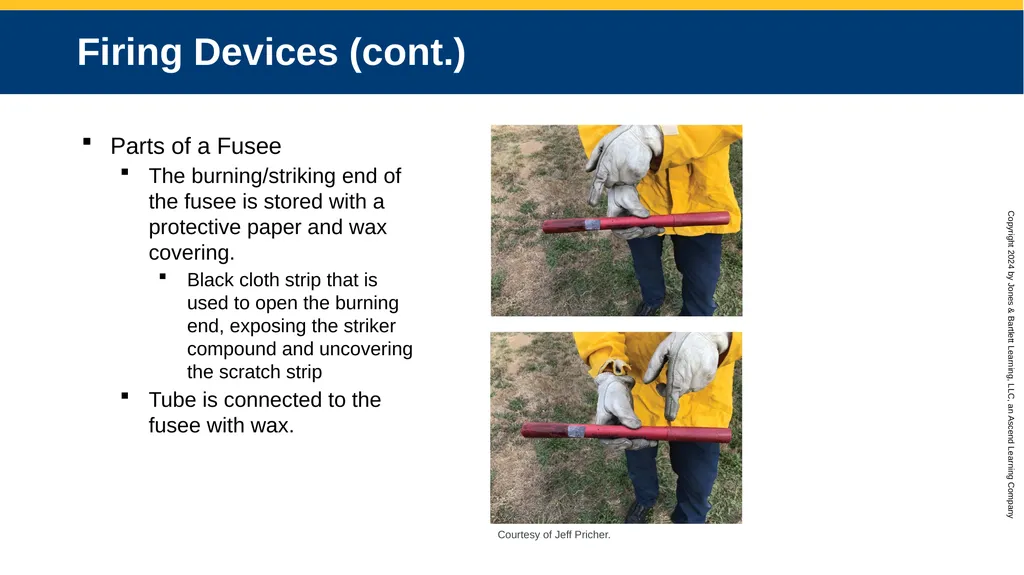
slide20. Firing Devices (cont.) Parts of a Fusee
The burning/striking end of the fusee is stored with a protective paper and wax covering.
Black cloth strip that is used to open the burning end, exposing the striker compound and uncovering the scratch strip
Tube is connected to the fusee with wax. Courtesy of Jeff Pricher.<br>
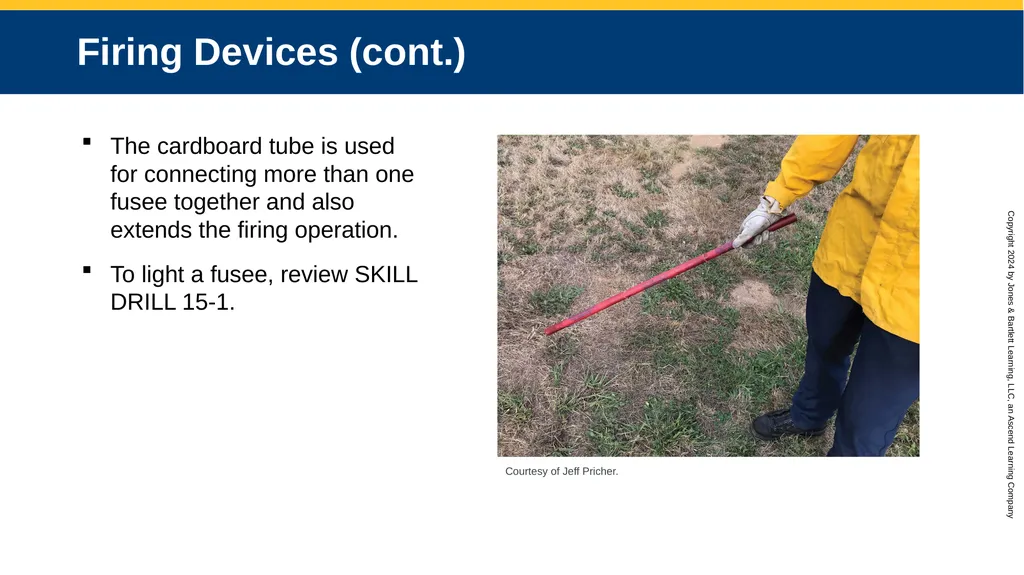
slide21. Firing Devices (cont.) The cardboard tube is used for connecting more than one fusee together and also extends the firing operation.
To light a fusee, review SKILL DRILL 15-1. Courtesy of Jeff Pricher.<br>
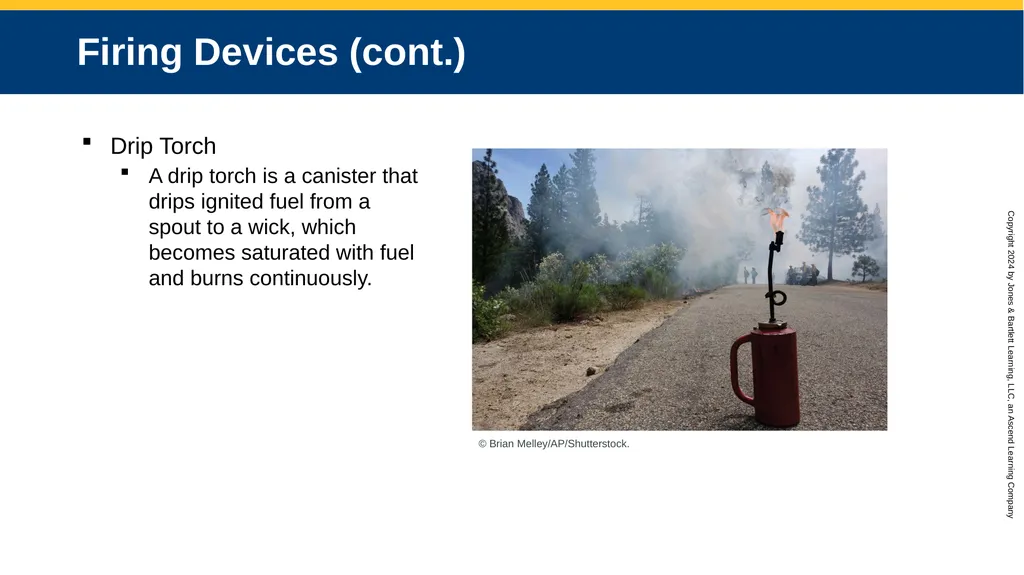
slide22. Firing Devices (cont.) Drip Torch
A drip torch is a canister that drips ignited fuel from a spout to a wick, which becomes saturated with fuel and burns continuously. © Brian Melley/AP/Shutterstock.<br>
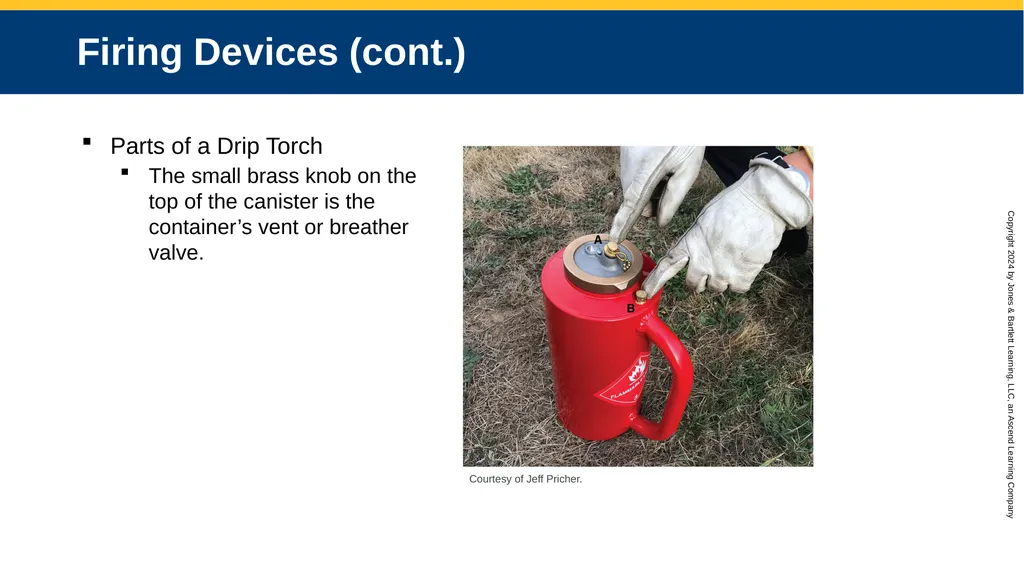
slide23. Firing Devices (cont.) Parts of a Drip Torch
The small brass knob on the top of the canister is the container’s vent or breather valve. Courtesy of Jeff Pricher.<br>
slide24. Firing Devices (cont.) Drip-Torch Care and Storage
If you will be taking a break from firing or are preparing the drip torch for storage, make sure to put out the flame on the drip torch.
Operating a Drip Torch
Hold the drip torch by the handle in an upright position until you are ready to use it.
Review SKILL DRILL 15-2.<br>
slide25. Firing Devices (cont.) Flare Launcher
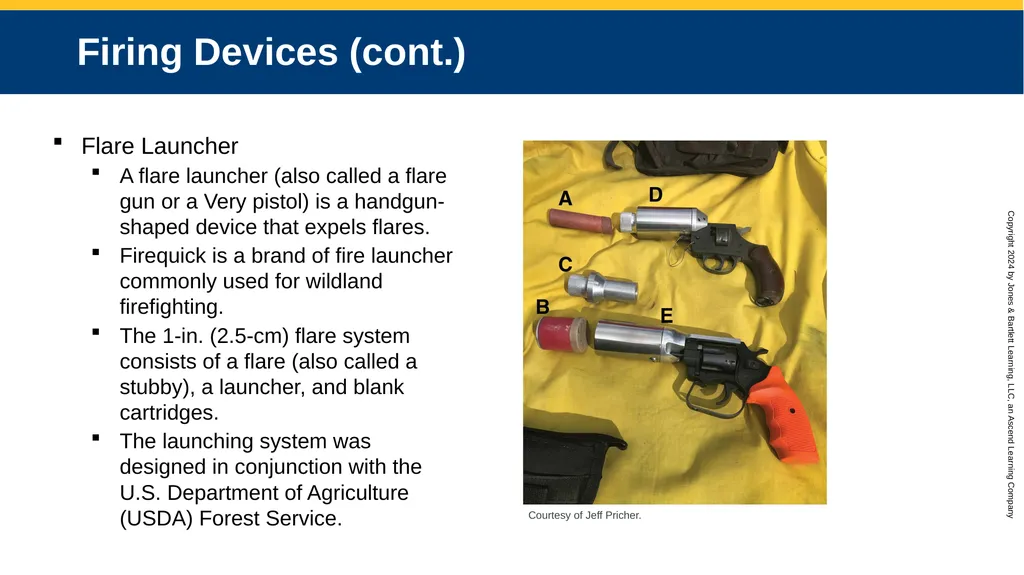
A flare launcher (also called a flare gun or a Very pistol) is a handgun-shaped device that expels flares.
Firequick is a brand of fire launcher commonly used for wildland firefighting.
The 1-in. (2.5-cm) flare system consists of a flare (also called a stubby), a launcher, and blank cartridges.
The launching system was designed in conjunction with the U.S. Department of Agriculture (USDA) Forest Service. Courtesy of Jeff Pricher.<br>
slide26. Firing Devices (cont.) Preparing the Flare Launcher for Use
Wipe down the launcher with an absorbent cloth, removing any excess oil and dirt.
With the launcher in the palm of your right hand and the barrel pointing away from you, replace the cylinder in the launcher, and insert the cylinder pin while pressing the pin release button.
Loading the Flare
Do not cock the hammer or place your finger inside the trigger guard while loading the flare.
Holding the launcher in one or both hands, point the launcher in the proper direction, and elevate the muzzle about 15 degrees or the angle for maximum range and ignition after the flare hits the ground.<br>
slide27. Firing Devices (cont.) Safety Precautions
Follow these safety precautions when using the flare launcher:
Ensure you initiate the firing of the device from a position that allows for a clear shot at your target.
Keep the launcher pointed away from personnel and equipment.
Notify all personnel in the immediate area that you will be firing a flare launcher.
Dispose of all spent cartridges.
Only qualified personnel should use this device.
Always wear ear and eye protection when using the launcher.
Launcher is not classified as a firearm by the BATF; however, the launcher should be treated as a firearm, and general firearm safety rules should be followed.<br>
slide28. Firing Devices (cont.) Safety Precautions (cont.)
Always treat the launcher as if it were loaded.
Always check the cylinder for cartridges when you first handle the launcher.
Never transport the launcher while it is loaded with cartridges.
Never point the launcher at anything you do not want to burn.
If you are planning to travel by air with a launcher, unload it and place it in a hard case in your checked baggage. Make sure you notify the ticket agent.<br>
slide29. Firing Devices (cont.) Unloading the Launcher
Place the right side of the launcher in the palm of your hand.
While pressing on the cylinder release button, remove the cylinder pin, allowing the cylinder to fall into your right hand.
Using the cylinder pin as a punch, remove the spent cartridges from the cylinder, and replace the cylinder in the launcher.<br>
slide30. Firing Devices (cont.) Maintenance
After each firing session, spray the launcher with gun oil or light machine oil, and return the launcher to its storage compartment.
Troubleshooting
The most common malfunction for the launcher is the sticking of the cylinder when attempting to fire a flare.<br>
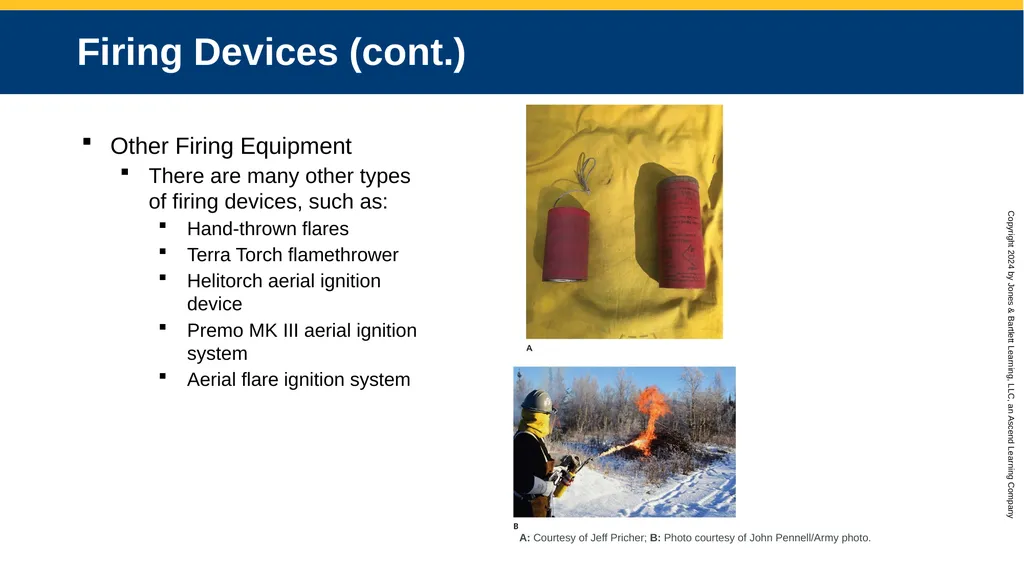
slide31. Firing Devices (cont.) Other Firing Equipment
There are many other types of firing devices, such as:
Hand-thrown flares
Terra Torch flamethrower
Helitorch aerial ignition device
Premo MK III aerial ignition system
Aerial flare ignition system A: Courtesy of Jeff Pricher; B: Photo courtesy of John Pennell/Army photo.<br>
slide32. Crew Assignments Firing teams do the actual lighting and must focus their attention on the actual firing operation.
They must also be aware of what is happening around them (LCES/LACES) and should be thinking about safety at all times.
Holding forces follow the firing personnel and protect them from injuries from the fire they are lighting.
Mop-up forces must remain behind to secure the line and do mop-up.<br>
slide33. Firing Techniques As a fire fighter who may be involved in firing operations, make sure that there is a firing plan and that the plan is known and understood by everyone.
Ensure that all elements of the plan have been put in place before putting fire on the ground.
Patience is a large component of firing operations.<br>
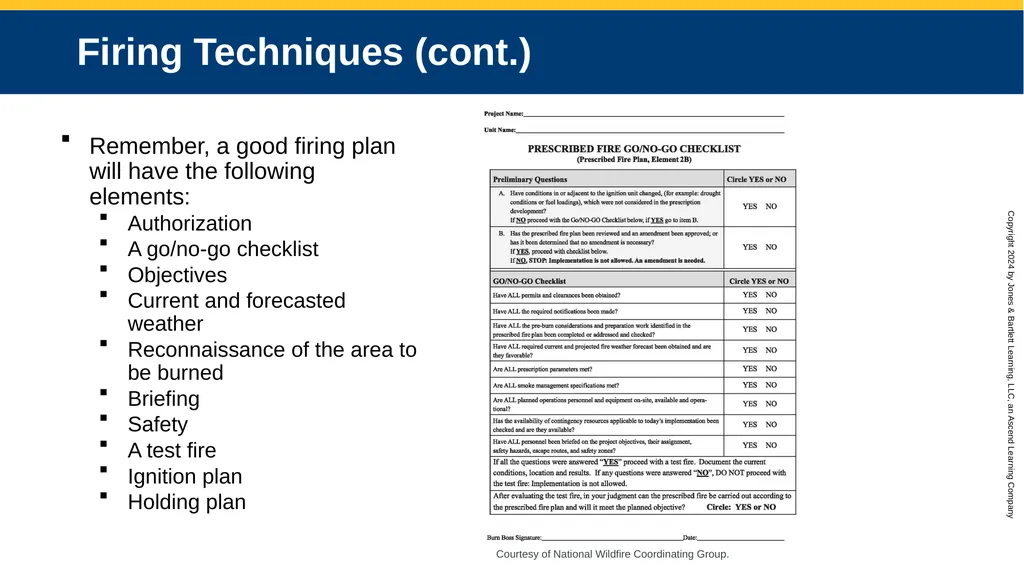
slide34. Firing Techniques (cont.) Remember, a good firing plan will have the following elements:
Authorization
A go/no-go checklist
Objectives
Current and forecasted weather
Reconnaissance of the area to be burned
Briefing
Safety
A test fire
Ignition plan
Holding plan Courtesy of National Wildfire Coordinating Group.<br>
slide35. Firing Techniques (cont.) There are several techniques used in firing operations.
Three most commonly used techniques are strip firing, flank firing, and ring firing.
Many of these techniques utilize the 1-2-3/3-2-1 firing pattern.
More details on these techniques and additional techniques, including dot firing, chevron firing, and concentric firing, are discussed in more detail in an NWCG S-219, Firing Operations class.<br>
slide36. Firing Techniques (cont.) Line Firing
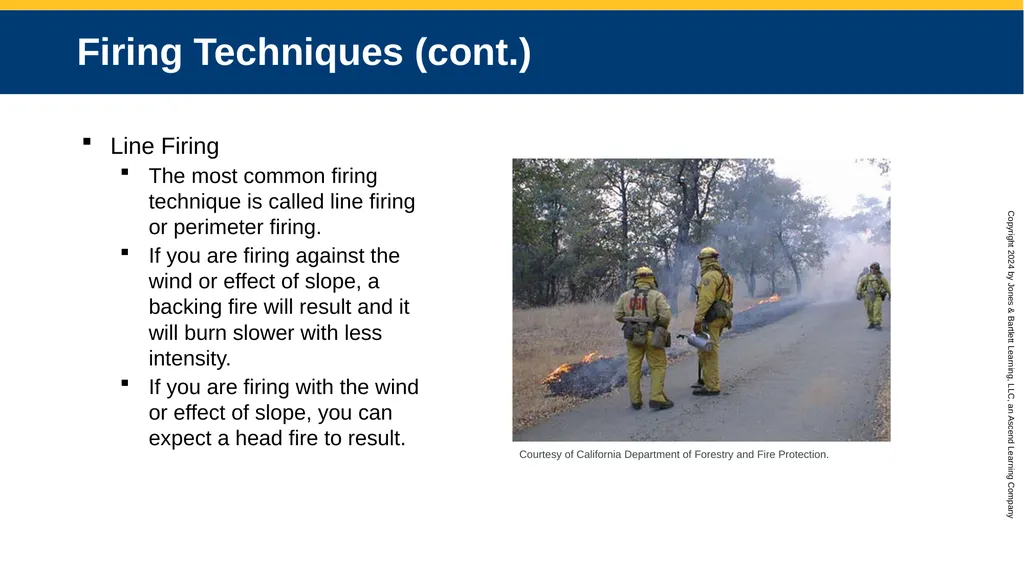
The most common firing technique is called line firing or perimeter firing.
If you are firing against the wind or effect of slope, a backing fire will result and it will burn slower with less intensity.
If you are firing with the wind or effect of slope, you can expect a head fire to result. Courtesy of California Department of Forestry and Fire Protection.<br>
slide37. Firing Techniques (cont.) Strip Firing
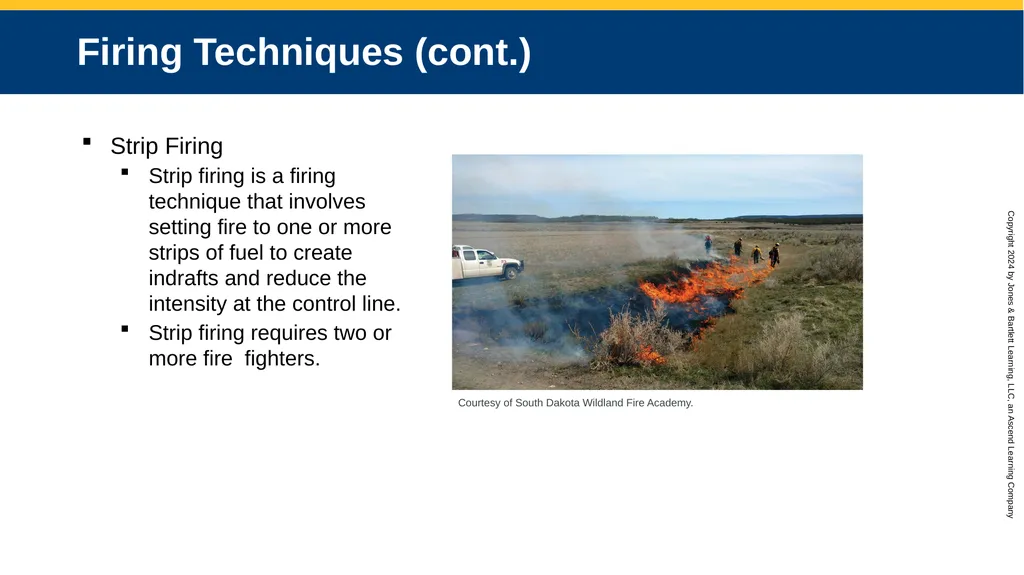
Strip firing is a firing technique that involves setting fire to one or more strips of fuel to create indrafts and reduce the intensity at the control line.
Strip firing requires two or more fire fighters. Courtesy of South Dakota Wildland Fire Academy.<br>
slide38. Firing Techniques (cont.) Strip Firing (cont.)
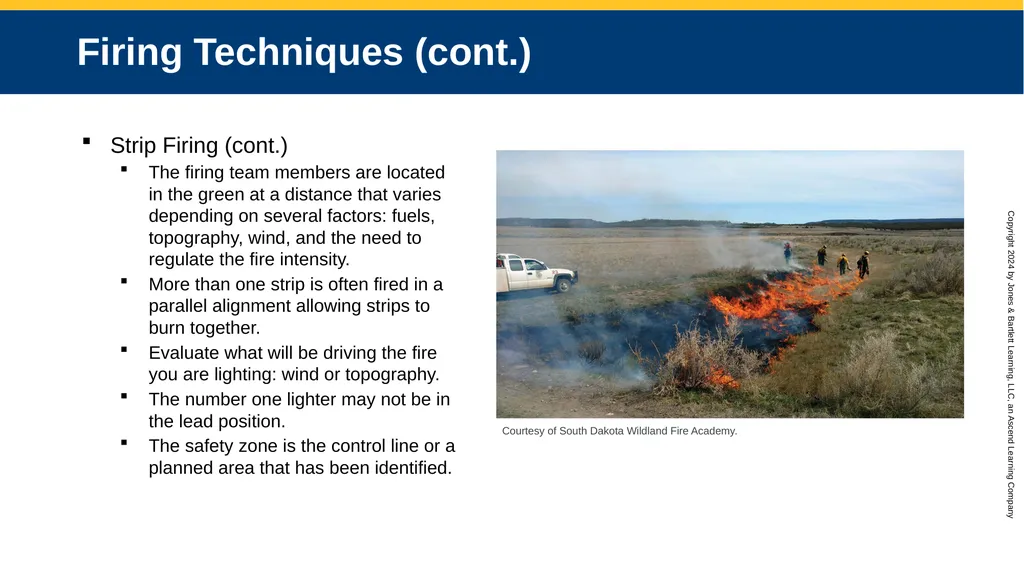
The firing team members are located in the green at a distance that varies depending on several factors: fuels, topography, wind, and the need to regulate the fire intensity.
More than one strip is often fired in a parallel alignment allowing strips to burn together.
Evaluate what will be driving the fire you are lighting: wind or topography.
The number one lighter may not be in the lead position.
The safety zone is the control line or a planned area that has been identified. Courtesy of South Dakota Wildland Fire Academy.<br>
slide39. Firing Techniques (cont.) 1-2-3/3-2-1 firing pattern
Strip firing utilizes this pattern.
1-2-3/3-2-1 firing pattern is a technique that requires several igniters.
Assigned to a number (1, 2, or 3)
Number 1 position is always located closest to the control line.
Wind and terrain will dictate whether the number 1 or the number 3 position is leading.
Igniters move parallel to the control line in a staggered fashion, igniting strips and letting them burn together to a termination point.<br>
slide40. Firing Techniques (cont.) 1-2-3/3-2-1 firing pattern (cont.)
Each igniter should have an escape route that is not going to be affected by any of the other igniters.
Igniters need to allow enough space so that their fires can’t grow together and become too intense.
Stay in visual contact and maintain safe spacing.
Must also move at the same speed.<br>
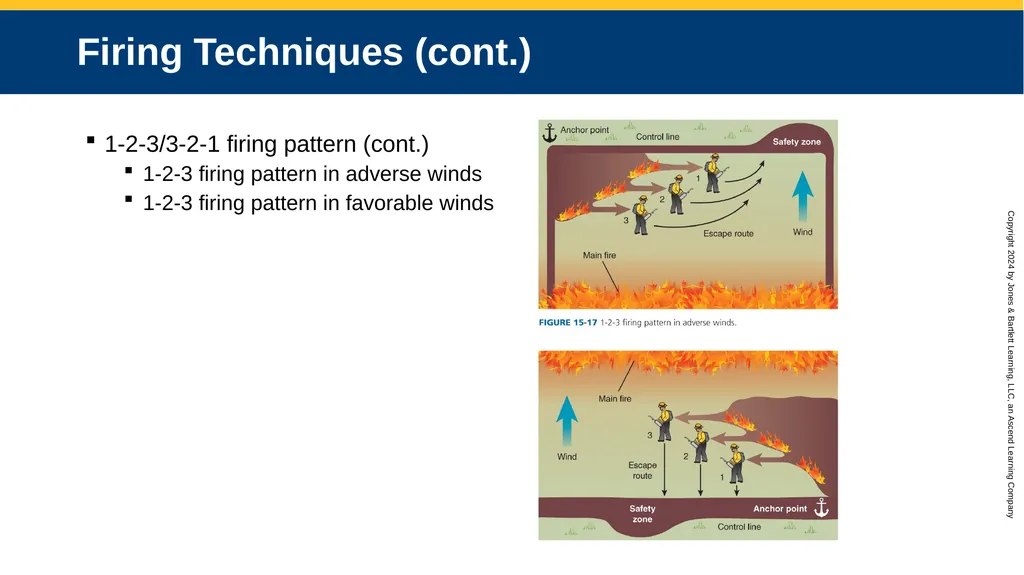
slide41. Firing Techniques (cont.) 1-2-3/3-2-1 firing pattern (cont.)
1-2-3 firing pattern in adverse winds
1-2-3 firing pattern in favorable winds<br>
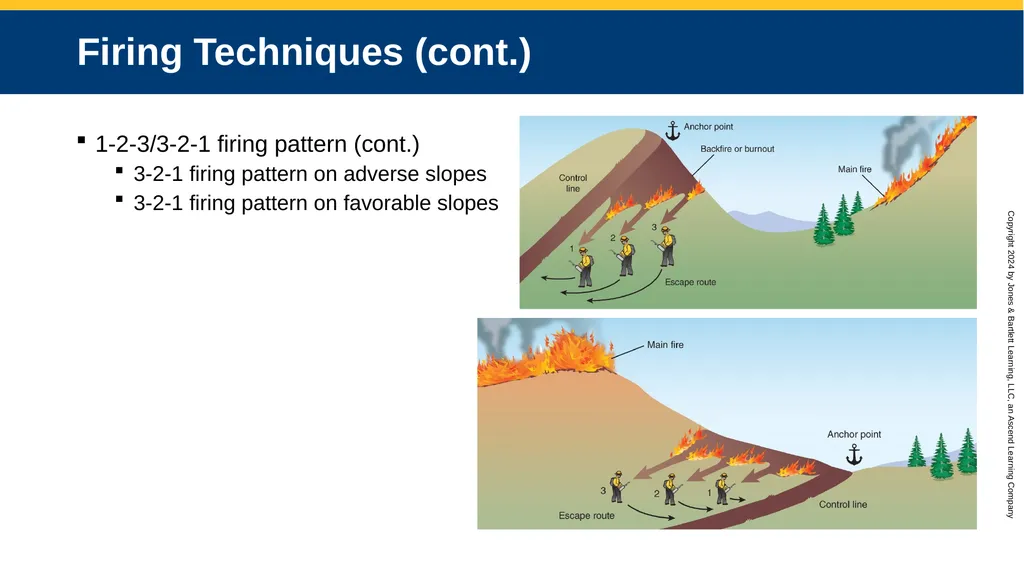
slide42. Firing Techniques (cont.) 1-2-3/3-2-1 firing pattern (cont.)
3-2-1 firing pattern on adverse slopes
3-2-1 firing pattern on favorable slopes<br>
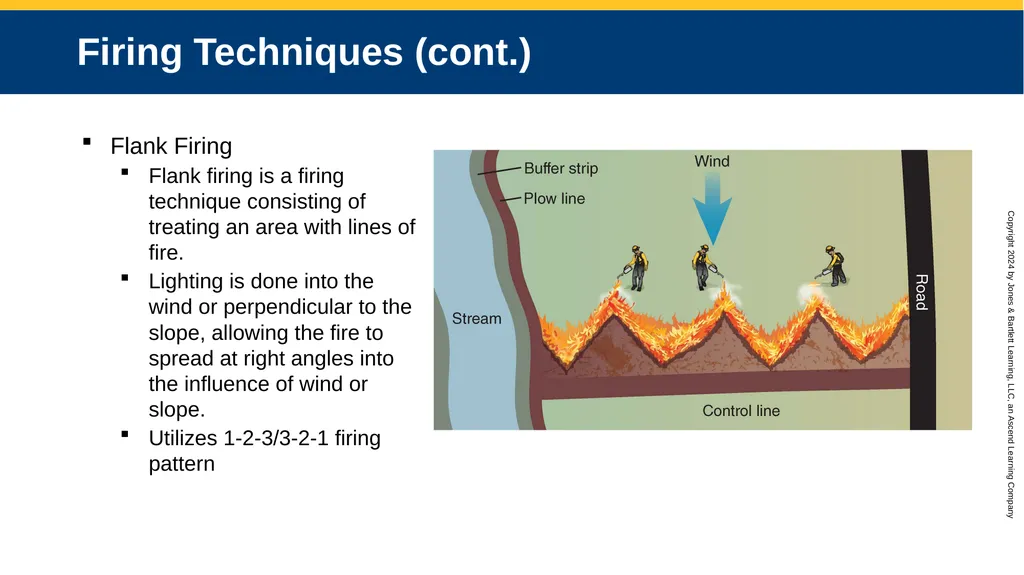
slide43. Firing Techniques (cont.) Flank Firing
Flank firing is a firing technique consisting of treating an area with lines of fire.
Lighting is done into the wind or perpendicular to the slope, allowing the fire to spread at right angles into the influence of wind or slope.
Utilizes 1-2-3/3-2-1 firing pattern<br>
slide44. Firing Techniques (cont.) Ring Firing
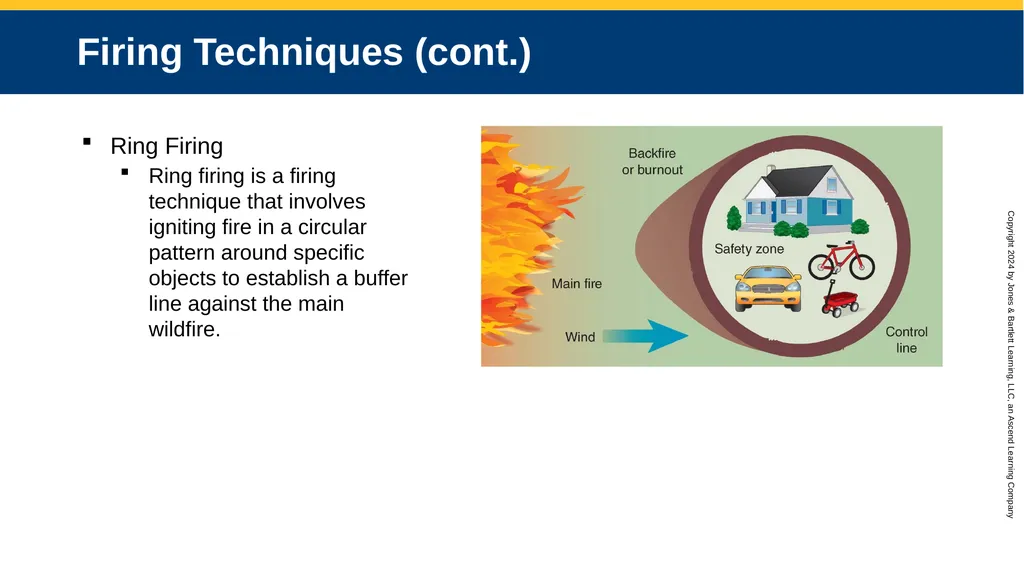
Ring firing is a firing technique that involves igniting fire in a circular pattern around specific objects to establish a buffer line against the main wildfire.<br>
slide45. Firing Techniques (cont.) Hands-On Training and Additional Skills
There are several other firing techniques not covered in this text, such as dot firing, chevron firing, and concentric firing.
Each year, the USDA Forest Service also conducts a fire school.
Excellent way to learn firing operations in addition to other wildland skills
Held annually at the Camp Pendleton Marine Base near Oceanside, California<br>
slide46. Summary<br>
slide47. Summary The 10 standard fire orders are designed to reduce fire fighter injuries and fatalities, and increase firefighting efficiency.
Often times in wildland firefighting, fires are intentionally lit in order to burn the fuel that would be used by the main fire. By removing fuels through these intentional firing operations, a buffer area is created. This area is expected to slow or stop the fire and/or change the direction of the fire’s convection column.
Backfiring is a tactic usually used only when other fire control methods are impractical. A backfire is a fire intentionally set along the inner edge of a control line in an attempt to burn a buffer area in the direction of the fire, stopping its progression.
Control lines are not complete until all fuels have been removed between the fire’s edge and the control line.<br>
slide48. Summary (cont.) Firing operations should be organized and planned, unless done in an emergency. Involved crews should be completely briefed and given appropriate assignments. All objectives need to be defined, as do time frames for completion of the operation.
Three commonly used firing devices are the fusee/backfire torch, the drip torch, and the flare launcher.
There are different crew assignments responsible for different parts of firing operations.
There are several techniques used in firing operations. Four commonly used techniques are line firing, strip firing, flank firing, and ring firing.<br>
slide2. Knowledge Objectives Describe the purpose of conducting firing operations.
Understand firing-operation permissions.
Describe the term backfire.
Describe the term burnout.
Identify preplanning considerations for firing operations.
Identify fuel, weather, and topography considerations for firing operations.
Describe general firing operations rules.<br>
slide3. Knowledge Objectives (cont.) Identify and describe common firing devices and their components:
Fusee
Drip torch
Flare launcher
Other firing equipment and field-expedient firing methods
Identify a go/no go checklist.
Describe different firing techniques:
Line firing
Strip firing
Flank firing
Ring firing<br>
slide4. Skills Objectives Light a fusee.
Operate a drip torch.
Operate a flare launcher.<br>
slide5. Introduction In wildland firefighting, we sometimes fight fire with a fire that we intentionally light.
In certain situations, when fires are too intense for direct attack with hose lines, firing operations may be necessary.
Remember that once fire is put on the ground, it cannot be taken back. Courtesy of Joe Lowe.<br>
slide6. Firing-Operation Permissions Some states have provisions in their government codes that address firing operations and who should perform them.
In many firefighting organizations in this country, it is necessary to acquire approval, through the chain of command, from the division supervisor before proceeding with a backfire or burnout operation.
Every firing operation should be run by one person who focuses his or her total attention on supervising the firing team.
Another consideration is the sociopolitical aspect related to firing operations.
In completing a successful firing operation, specific elements need to be in place.<br>
slide7. Backfire Backfire is defined as a fire intentionally set by fire fighters along the inner edge of a control line in an attempt to burn an area of vegetation.
By removing fuels through the application of intentionally applied fire, a buffer area of already burned fuel is created.<br>
slide8. Backfire (cont.) When we talk about the backfire being influenced by the main fire, we mean that an indraft effect takes place as the main fire approaches.
When you set a backfire, you must allow enough time (based on fuel factors, topography, weather, and fire behavior) for the backfire to develop and move away from the control line.
There is no firm set of rules as to when to light a backfire because timing is based on the fuels present, the topography, existing fire conditions, and the weather.<br>
slide9. Backfire (cont.) A counterfire, or auxiliary fire, is a fire set between the main fire and the backfire to hasten spread of the backfire and redirect the main wildfire.<br>
slide10. Burnout Burnout is defined as setting fire inside a control line to consume the fuel between the edge of the fire and the control line.<br>
slide11. Burnout (cont.) The control line is not complete until all fuels have been removed between the fire’s edge and the control line.
Handcrews also burnout as they simultaneously cut line from fingertip to fingertip because this reduces the total amount of line that needs to be constructed.
Burnout takes advantage of line-construction techniques by cutting across fingers and around concentrations of spot fires.<br>
slide12. Firing-Operation Preplanning Firing operations and prescribed burning should be organized and planned unless they are done as a result of an emergency.
A complete briefing should be given to the crews involved in the firing operation and appropriate assignments made.
Before the operation is started, objectives need to be defined regarding what is to be accomplished.
You will also need to consider the amount and type of supplies needed to complete the operation.<br>
slide13. Firing-Operation Preplanning (cont.) Discussion regarding safety zones and escape routes needs to take place before any fire is put on the ground.
The topographic map is used to show anticipated problem areas to the fire crews who will be doing the burning.
Before the firing operation begins, a decision should be made about the chain of command and what crews are in the division.
A small test fire should be set to evaluate fire behavior and controllability of your firing operation.
If these points are covered, the operation will go smoother, and the objectives will be met and accomplished safely.<br>
slide14. Fuel, Topography, and Weather Considerations Fuel, topography, and weather need to be evaluated before the firing operation begins.
These factors are the key to the intensity levels and flame lengths that will be created.
Light Fuels
Light fuels are easily ignited by the tools at hand and generally produce low-heat intensities on the fireline.
Medium Fuels
Medium fuels produce greater heat intensity and flame lengths than light fuels.<br>
slide15. Fuel, Topography, and Weather Considerations (cont.) Heavy Fuels
Heavy fuel types produce great fireline intensities and are a problem for fire crews.
Topography
Topographic features present some of the greatest obstacles to successful firing.<br>
slide16. Fuel, Topography, and Weather Considerations (cont.) Weather
Evaluated when planning the firing operation
When firing against the wind, it will take longer to complete the operation because the fire will spread at a slower rate.
When the firing operation is done from the fire’s flank, you should fire against the wind from a well-anchored point.
Other weather concerns to watch for include the following:
Be aware of any thunderstorm activity developing in the area.
Evaluate the smoke column.
Monitor high-level winds.
Monitor changes in humidity.
Watch for swirling wind currents (eddies) created by topographic changes.<br>
slide17. General Firing Operations Rules Review the following general rules to ensure an effective and safe firing operation.
Ultimately, LCES/ LACES must be in place at all times.
Other potential firing problems include the following:
Areas with lots of dead fuel mixed with live fuels
Areas with heavy fuel buildup
Power lines
Aerial retardant drops
Coordinate these so they do not interfere with the firing operation.
Any situation or environment that falls within the 10 standard fire orders and 18 watch outs<br>
slide18. Firing Devices Three commonly used firing devices are discussed in this section: the fusee, the drip torch, and the flare launcher.
These devices may be used in a firing operation, so you should become familiar with the characteristics of each.
Remember that you should always be wearing full personal protective equipment (PPE) and protective eyewear during firing operations.<br>
slide19. Firing Devices (cont.) Fusee
A fusee (sometimes called a backfire torch, a backfire fusee torch, or forest fire torch), is a colored flare designed to ignite backfires.
Note that fusees are very different from road flares.<br>
slide20. Firing Devices (cont.) Parts of a Fusee
The burning/striking end of the fusee is stored with a protective paper and wax covering.
Black cloth strip that is used to open the burning end, exposing the striker compound and uncovering the scratch strip
Tube is connected to the fusee with wax. Courtesy of Jeff Pricher.<br>
slide21. Firing Devices (cont.) The cardboard tube is used for connecting more than one fusee together and also extends the firing operation.
To light a fusee, review SKILL DRILL 15-1. Courtesy of Jeff Pricher.<br>
slide22. Firing Devices (cont.) Drip Torch
A drip torch is a canister that drips ignited fuel from a spout to a wick, which becomes saturated with fuel and burns continuously. © Brian Melley/AP/Shutterstock.<br>
slide23. Firing Devices (cont.) Parts of a Drip Torch
The small brass knob on the top of the canister is the container’s vent or breather valve. Courtesy of Jeff Pricher.<br>
slide24. Firing Devices (cont.) Drip-Torch Care and Storage
If you will be taking a break from firing or are preparing the drip torch for storage, make sure to put out the flame on the drip torch.
Operating a Drip Torch
Hold the drip torch by the handle in an upright position until you are ready to use it.
Review SKILL DRILL 15-2.<br>
slide25. Firing Devices (cont.) Flare Launcher
A flare launcher (also called a flare gun or a Very pistol) is a handgun-shaped device that expels flares.
Firequick is a brand of fire launcher commonly used for wildland firefighting.
The 1-in. (2.5-cm) flare system consists of a flare (also called a stubby), a launcher, and blank cartridges.
The launching system was designed in conjunction with the U.S. Department of Agriculture (USDA) Forest Service. Courtesy of Jeff Pricher.<br>
slide26. Firing Devices (cont.) Preparing the Flare Launcher for Use
Wipe down the launcher with an absorbent cloth, removing any excess oil and dirt.
With the launcher in the palm of your right hand and the barrel pointing away from you, replace the cylinder in the launcher, and insert the cylinder pin while pressing the pin release button.
Loading the Flare
Do not cock the hammer or place your finger inside the trigger guard while loading the flare.
Holding the launcher in one or both hands, point the launcher in the proper direction, and elevate the muzzle about 15 degrees or the angle for maximum range and ignition after the flare hits the ground.<br>
slide27. Firing Devices (cont.) Safety Precautions
Follow these safety precautions when using the flare launcher:
Ensure you initiate the firing of the device from a position that allows for a clear shot at your target.
Keep the launcher pointed away from personnel and equipment.
Notify all personnel in the immediate area that you will be firing a flare launcher.
Dispose of all spent cartridges.
Only qualified personnel should use this device.
Always wear ear and eye protection when using the launcher.
Launcher is not classified as a firearm by the BATF; however, the launcher should be treated as a firearm, and general firearm safety rules should be followed.<br>
slide28. Firing Devices (cont.) Safety Precautions (cont.)
Always treat the launcher as if it were loaded.
Always check the cylinder for cartridges when you first handle the launcher.
Never transport the launcher while it is loaded with cartridges.
Never point the launcher at anything you do not want to burn.
If you are planning to travel by air with a launcher, unload it and place it in a hard case in your checked baggage. Make sure you notify the ticket agent.<br>
slide29. Firing Devices (cont.) Unloading the Launcher
Place the right side of the launcher in the palm of your hand.
While pressing on the cylinder release button, remove the cylinder pin, allowing the cylinder to fall into your right hand.
Using the cylinder pin as a punch, remove the spent cartridges from the cylinder, and replace the cylinder in the launcher.<br>
slide30. Firing Devices (cont.) Maintenance
After each firing session, spray the launcher with gun oil or light machine oil, and return the launcher to its storage compartment.
Troubleshooting
The most common malfunction for the launcher is the sticking of the cylinder when attempting to fire a flare.<br>
slide31. Firing Devices (cont.) Other Firing Equipment
There are many other types of firing devices, such as:
Hand-thrown flares
Terra Torch flamethrower
Helitorch aerial ignition device
Premo MK III aerial ignition system
Aerial flare ignition system A: Courtesy of Jeff Pricher; B: Photo courtesy of John Pennell/Army photo.<br>
slide32. Crew Assignments Firing teams do the actual lighting and must focus their attention on the actual firing operation.
They must also be aware of what is happening around them (LCES/LACES) and should be thinking about safety at all times.
Holding forces follow the firing personnel and protect them from injuries from the fire they are lighting.
Mop-up forces must remain behind to secure the line and do mop-up.<br>
slide33. Firing Techniques As a fire fighter who may be involved in firing operations, make sure that there is a firing plan and that the plan is known and understood by everyone.
Ensure that all elements of the plan have been put in place before putting fire on the ground.
Patience is a large component of firing operations.<br>
slide34. Firing Techniques (cont.) Remember, a good firing plan will have the following elements:
Authorization
A go/no-go checklist
Objectives
Current and forecasted weather
Reconnaissance of the area to be burned
Briefing
Safety
A test fire
Ignition plan
Holding plan Courtesy of National Wildfire Coordinating Group.<br>
slide35. Firing Techniques (cont.) There are several techniques used in firing operations.
Three most commonly used techniques are strip firing, flank firing, and ring firing.
Many of these techniques utilize the 1-2-3/3-2-1 firing pattern.
More details on these techniques and additional techniques, including dot firing, chevron firing, and concentric firing, are discussed in more detail in an NWCG S-219, Firing Operations class.<br>
slide36. Firing Techniques (cont.) Line Firing
The most common firing technique is called line firing or perimeter firing.
If you are firing against the wind or effect of slope, a backing fire will result and it will burn slower with less intensity.
If you are firing with the wind or effect of slope, you can expect a head fire to result. Courtesy of California Department of Forestry and Fire Protection.<br>
slide37. Firing Techniques (cont.) Strip Firing
Strip firing is a firing technique that involves setting fire to one or more strips of fuel to create indrafts and reduce the intensity at the control line.
Strip firing requires two or more fire fighters. Courtesy of South Dakota Wildland Fire Academy.<br>
slide38. Firing Techniques (cont.) Strip Firing (cont.)
The firing team members are located in the green at a distance that varies depending on several factors: fuels, topography, wind, and the need to regulate the fire intensity.
More than one strip is often fired in a parallel alignment allowing strips to burn together.
Evaluate what will be driving the fire you are lighting: wind or topography.
The number one lighter may not be in the lead position.
The safety zone is the control line or a planned area that has been identified. Courtesy of South Dakota Wildland Fire Academy.<br>
slide39. Firing Techniques (cont.) 1-2-3/3-2-1 firing pattern
Strip firing utilizes this pattern.
1-2-3/3-2-1 firing pattern is a technique that requires several igniters.
Assigned to a number (1, 2, or 3)
Number 1 position is always located closest to the control line.
Wind and terrain will dictate whether the number 1 or the number 3 position is leading.
Igniters move parallel to the control line in a staggered fashion, igniting strips and letting them burn together to a termination point.<br>
slide40. Firing Techniques (cont.) 1-2-3/3-2-1 firing pattern (cont.)
Each igniter should have an escape route that is not going to be affected by any of the other igniters.
Igniters need to allow enough space so that their fires can’t grow together and become too intense.
Stay in visual contact and maintain safe spacing.
Must also move at the same speed.<br>
slide41. Firing Techniques (cont.) 1-2-3/3-2-1 firing pattern (cont.)
1-2-3 firing pattern in adverse winds
1-2-3 firing pattern in favorable winds<br>
slide42. Firing Techniques (cont.) 1-2-3/3-2-1 firing pattern (cont.)
3-2-1 firing pattern on adverse slopes
3-2-1 firing pattern on favorable slopes<br>
slide43. Firing Techniques (cont.) Flank Firing
Flank firing is a firing technique consisting of treating an area with lines of fire.
Lighting is done into the wind or perpendicular to the slope, allowing the fire to spread at right angles into the influence of wind or slope.
Utilizes 1-2-3/3-2-1 firing pattern<br>
slide44. Firing Techniques (cont.) Ring Firing
Ring firing is a firing technique that involves igniting fire in a circular pattern around specific objects to establish a buffer line against the main wildfire.<br>
slide45. Firing Techniques (cont.) Hands-On Training and Additional Skills
There are several other firing techniques not covered in this text, such as dot firing, chevron firing, and concentric firing.
Each year, the USDA Forest Service also conducts a fire school.
Excellent way to learn firing operations in addition to other wildland skills
Held annually at the Camp Pendleton Marine Base near Oceanside, California<br>
slide46. Summary<br>
slide47. Summary The 10 standard fire orders are designed to reduce fire fighter injuries and fatalities, and increase firefighting efficiency.
Often times in wildland firefighting, fires are intentionally lit in order to burn the fuel that would be used by the main fire. By removing fuels through these intentional firing operations, a buffer area is created. This area is expected to slow or stop the fire and/or change the direction of the fire’s convection column.
Backfiring is a tactic usually used only when other fire control methods are impractical. A backfire is a fire intentionally set along the inner edge of a control line in an attempt to burn a buffer area in the direction of the fire, stopping its progression.
Control lines are not complete until all fuels have been removed between the fire’s edge and the control line.<br>
slide48. Summary (cont.) Firing operations should be organized and planned, unless done in an emergency. Involved crews should be completely briefed and given appropriate assignments. All objectives need to be defined, as do time frames for completion of the operation.
Three commonly used firing devices are the fusee/backfire torch, the drip torch, and the flare launcher.
There are different crew assignments responsible for different parts of firing operations.
There are several techniques used in firing operations. Four commonly used techniques are line firing, strip firing, flank firing, and ring firing.<br>