
Chapter 15 Mission-Specific Competencies: Air
Description: Chapter 15 Mission-Specific Competencies: Air Monitoring and Sampling Objectives: Operations Level Responders Assigned Mission-Specific Responsibilities (1 of 2) Plan and implement air monitoring and sampling activities. (p. 325328) Select
Related Topics
Download Presentation
"Chapter 15 Mission-Specific Competencies: Air" is the property of its rightful owner. Permission is granted to download and print the materials on this website for personal, non-commercial use only, and to display it on your personal computer provided you do not modify the materials and that you retain all copyright notices contained in the materials. By downloading content from our website, you accept the terms of this agreement.
Presentation Transcript
slide1. Chapter 15 Mission-Specific Competencies: Air Monitoring and Sampling<br>
slide2. Objectives: Operations Level Responders Assigned Mission-Specific Responsibilities (1 of 2) Plan and implement air monitoring and sampling activities. (p. 325–328)
Select equipment suitable for detecting or monitoring solids, liquids, or gaseous hazardous materials/WMD. (NFPA 6.7.3.1, p. 314–315)
Describe the operation, capabilities and limitations, local monitoring procedures, field testing, and maintenance procedures associated with each detection/monitoring device. (NFPA 6.7.3.2, p. 321–325)<br>
slide3. Objectives: Operations Level Responders Assigned Mission-Specific Responsibilities (2 of 2) Describe the local procedure for responder decontamination as well as the decontamination procedures for detection/monitoring devices upon completing the air monitoring mission. (NFPA 6.7.3.3, 6.7.4.2, p. 318–319)<br>
slide4. Introduction (1 of 3) Each particular detection instrument serves a unique purpose.
No single detection and/or monitoring device can do it all.
For each machine, responders must understand:
Operating principles
Limitations
Benefits
Best approach for incorporating it<br>
slide5. Introduction (2 of 3) Features
Unique operating characteristics of machines that affect the user
Benefits
Reflect how device fits into operational plan and regional response activities<br>
slide6. Introduction (3 of 3) Responders must interpret information and make sound decisions based on that information.
Instruments must be checked and maintained on regular basis.<br>
slide7. Situational Awareness Focus and observation
Understanding visual cues
Orienting yourself and others to inputs
Making sound decisions based on inputs<br>
slide8. Calibration Setting or correcting a measuring device by adjusting it to match a known “source”
Calibration of gas detection device that uses electrochemical sensor or multiple sensors is done by challenging sensor with known concentration of calibration gas.<br>
slide9. Bump Test Quick field test to ensure meter is operating correctly
Device exposed to gas designed to elicit reading
Gas source removed and machine recovers to normal levels<br>
slide10. Reaction Time Period of time from when air sample is drawn into machine until machine processes sample and gives reading
Short as 1 or 2 seconds
Long as 30 to 60 seconds<br>
slide11. Recovery Time How much time it takes a detector or monitor to clear so a new reading can be taken
Affected by factors, including physical properties of sampled substance
Device “zeroed” when it begins its operational period in clean atmosphere by displaying normal values<br>
slide12. Relative Response Curve Accounts for different types of gases encountered, other than the one used for calibration<br>
slide13. Relative Response Factor Correlates difference between gas used to calibrate machine and gas actually being detected<br>
slide14. Detection and Monitoring Concepts (1 of 2) Vapors and gaseous chemicals move through an area.
Air currents, ventilation systems, and other influences create constantly changing environment.
Before monitoring inside a building, monitor the outside atmosphere.
Start from outer perimeter and work inward.<br>
slide15. Detection and Monitoring Concepts (2 of 2) Prior to entering building, monitor around the door.
After exposure, personnel, PPE, and detection and monitoring equipment need to be decontaminated.<br>
slide16. Detection and Monitoring Unknowns Several different devices may need to be used.
Detection/monitoring devices can be used to confirm what you suspect.
Ask questions about atmosphere:
Flammable?
Corrosive?
Radioactive?<br>
slide17. Photo-Ionization Detector (1 of 2) General survey instrument
Detects vaporous chemicals at very low levels
Uses ultraviolet light lamp to break down sample gas into electrically charged components (ions) and negatively charged electrons
Current amplified and displayed<br>
slide18. Photo-Ionization Detector (2 of 2) Does not identify material
Alerts to presence of something in the air, usually organic vapor or mist
Can pinpoint sources of small leaks<br>
slide19. Combustible Gas Indicator Also called flammable gas detector
Detects flammable and potentially explosive atmospheres
Detects at or below LEL/LFL
Highest level of danger: 100% of LEL/LFL
Must know flammable range of gas<br>
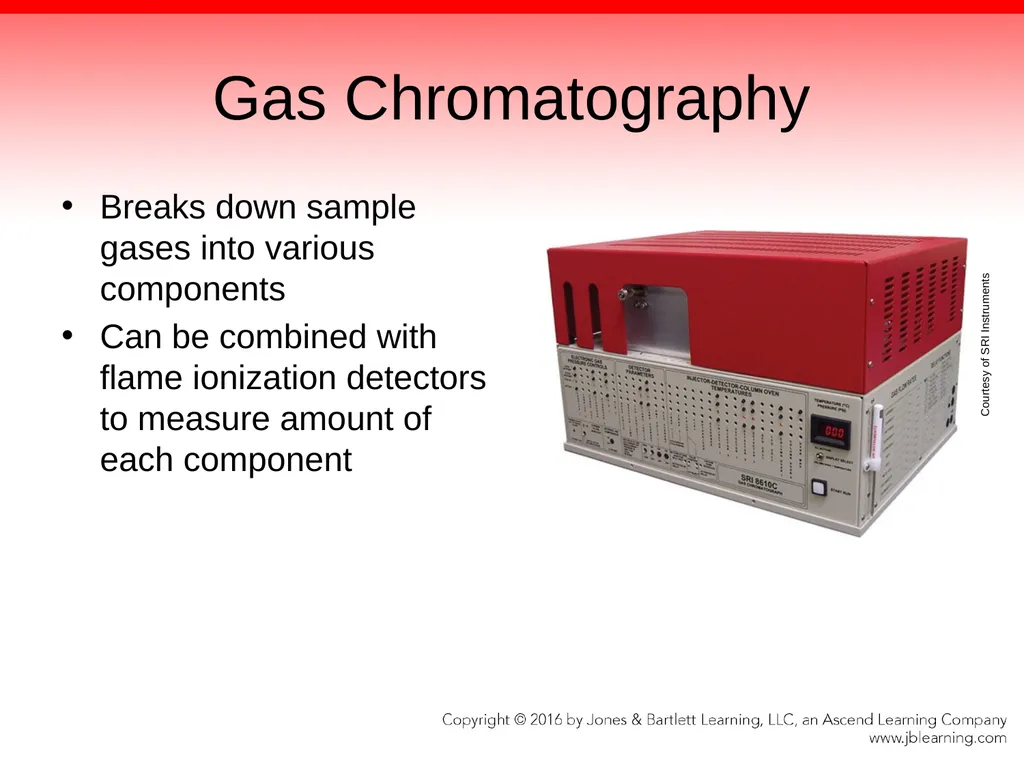
slide20. Gas Chromatography Breaks down sample gases into various components
Can be combined with flame ionization detectors to measure amount of each component Courtesy of SRI Instruments<br>
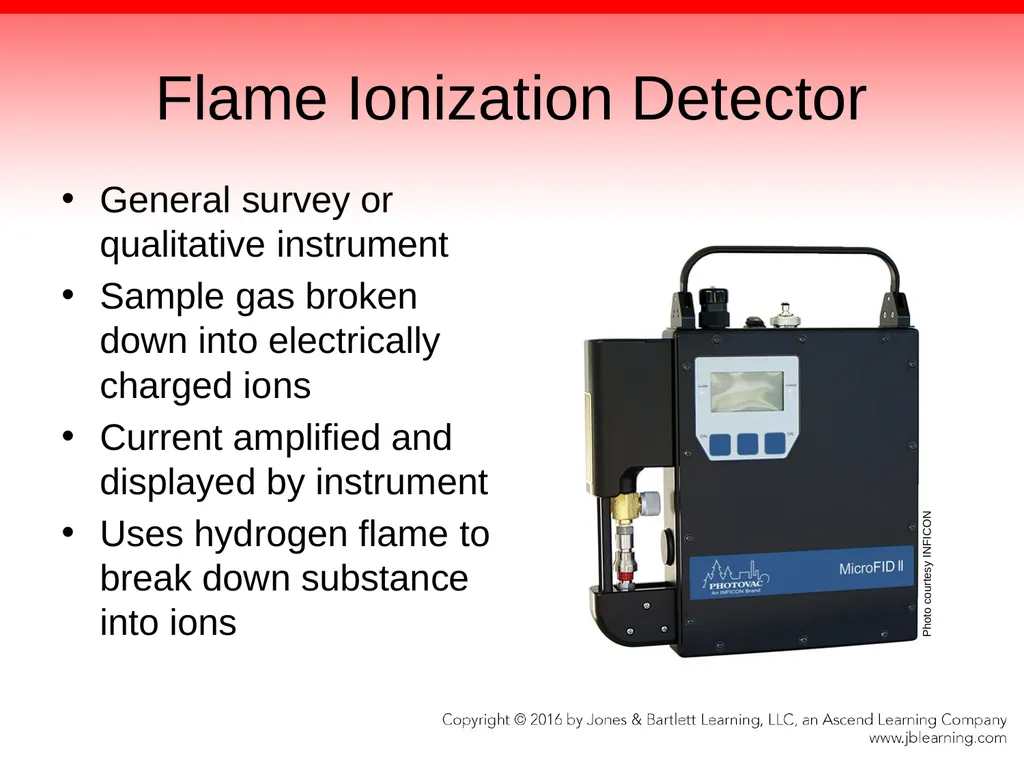
slide21. Flame Ionization Detector General survey or qualitative instrument
Sample gas broken down into electrically charged ions
Current amplified and displayed by instrument
Uses hydrogen flame to break down substance into ions Photo courtesy INFICON<br>
slide22. Oxygen Monitoring Device Measures amount of oxygen in air
Oxygen concentration less than 19.5% = oxygen-deficient atmosphere
Health risk
Oxygen concentration more than 23.5% = oxygen-enriched atmosphere
Elevated fire risk
Used in confined-space work<br>
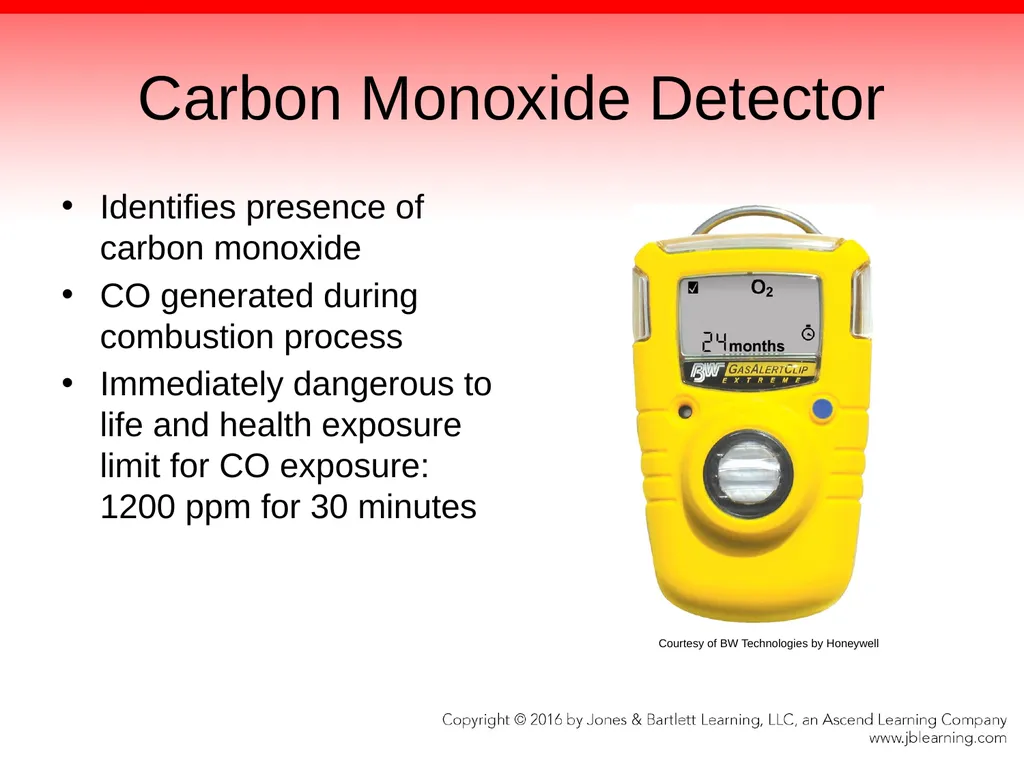
slide23. Carbon Monoxide Detector Identifies presence of carbon monoxide
CO generated during combustion process
Immediately dangerous to life and health exposure limit for CO exposure: 1200 ppm for 30 minutes Courtesy of BW Technologies by Honeywell<br>
slide24. Hydrogen Sulfide Monitor Used in confined space
Used extensively in petroleum manufacturing facilities
Hydrogen sulfide is by-product of decaying organic materials (“sewer gas”).
Flammable, heavier than air, blocks body cells from using oxygen
Has strong pungent odor at first<br>
slide25. Multi-gas Meter Can detect several hazards at once
Sensors for oxygen, carbon monoxide, hydrogen sulfide, flammable gas
Good for confined-space incidents
Electrochemical sensors detect presence of target gases.
Other gases may interfere with target gas, giving potentially false reading.<br>
slide26. Colorimetric Tubes (1 of 2) Identify known and unknown chemical vapors
Filled with reagents
Each reagent reacts to unique substance at particular concentration.
Tubes detect single substances and/or chemical families.<br>
slide27. Colorimetric Tubes (2 of 2) Pump draws air sample through tubes.
If contaminant is encountered, reagent changes color.
Numerical value on tube indicates level of contamination.<br>
slide28. pH Paper Chemical paper used to determine if substance is acid or base
Used to judge how aggressive a corrosive is
Acids have pH less than 7.
7 = neutral
Bases have pH greater than 7.
Chemicals with pH values of 2.5 or less or 12.5 or more are considered strong.<br>
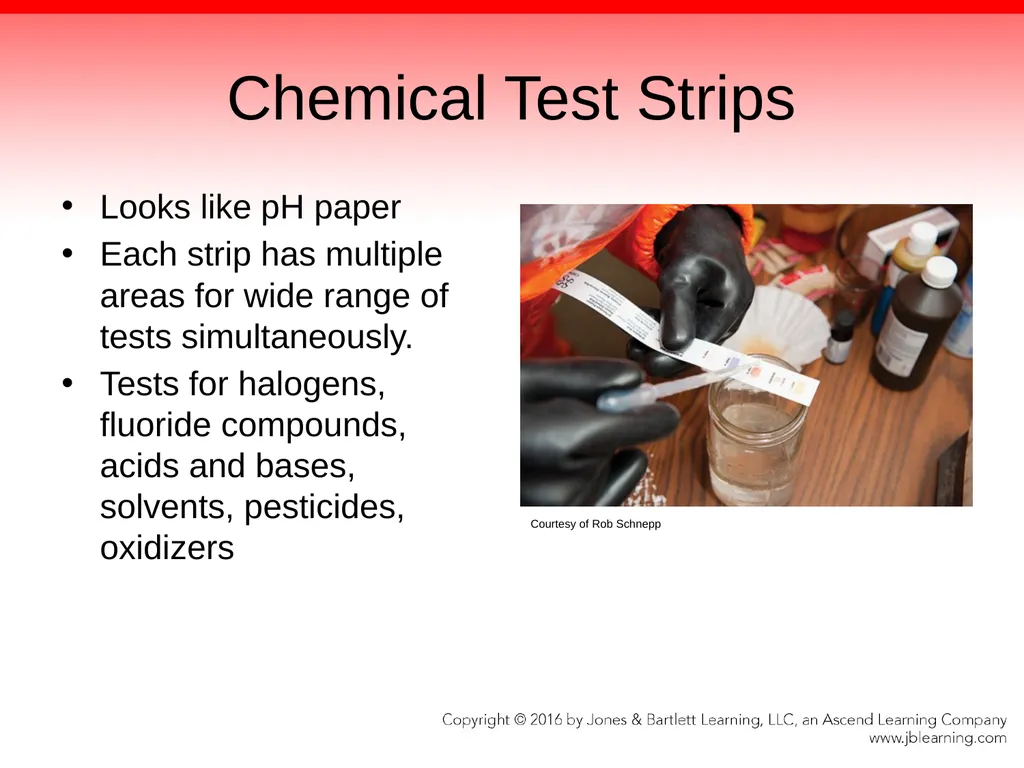
slide29. Chemical Test Strips Looks like pH paper
Each strip has multiple areas for wide range of tests simultaneously.
Tests for halogens, fluoride compounds, acids and bases, solvents, pesticides, oxidizers Courtesy of Rob Schnepp<br>
slide30. Specialized Detection Devices (1 of 3) Also called hazardous materials identifiers
Used to analyze substance and identify it by chemical name<br>
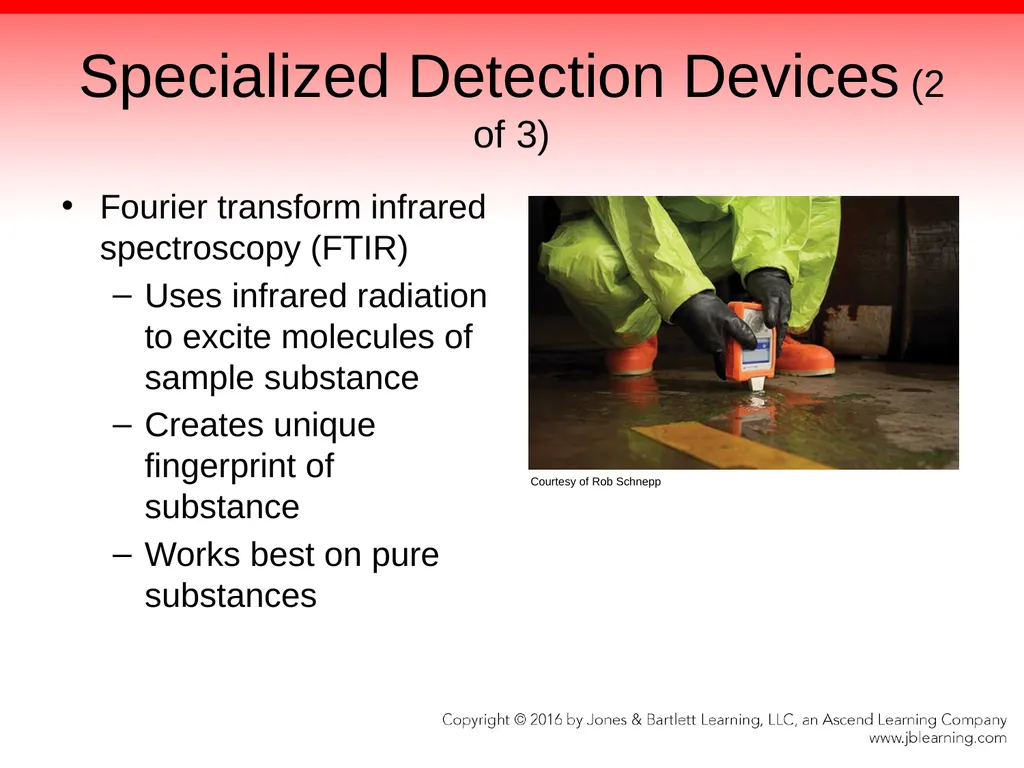
slide31. Specialized Detection Devices (2 of 3) Fourier transform infrared spectroscopy (FTIR)
Uses infrared radiation to excite molecules of sample substance
Creates unique fingerprint of substance
Works best on pure substances Courtesy of Rob Schnepp<br>
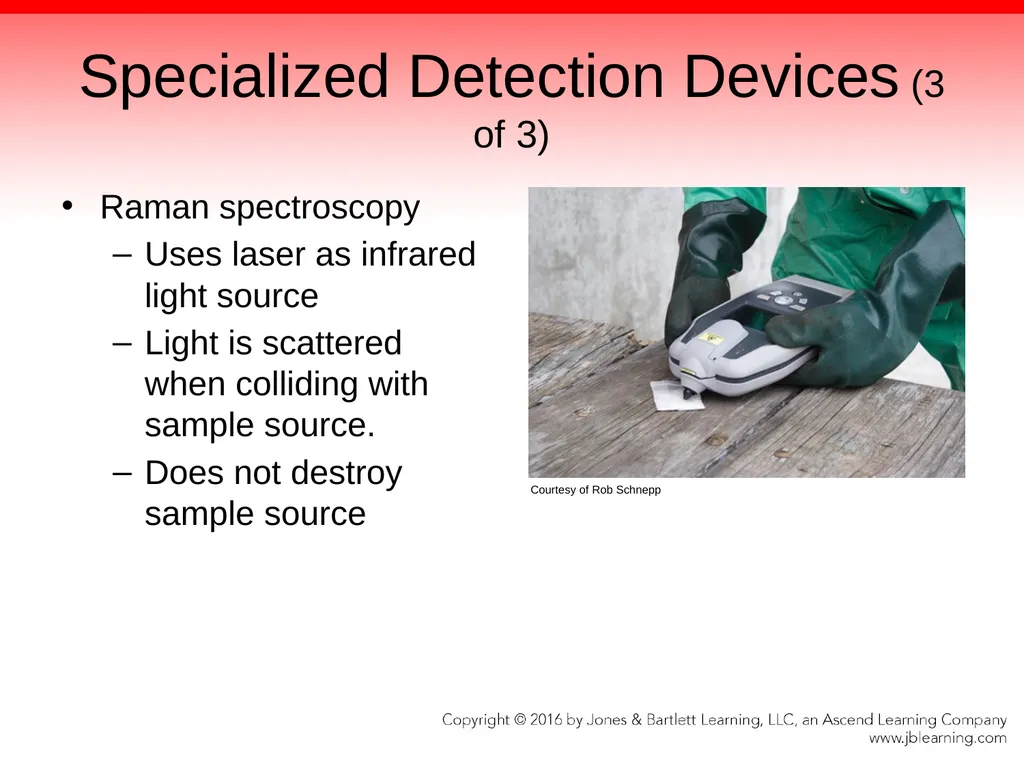
slide32. Specialized Detection Devices (3 of 3) Raman spectroscopy
Uses laser as infrared light source
Light is scattered when colliding with sample source.
Does not destroy sample source Courtesy of Rob Schnepp<br>
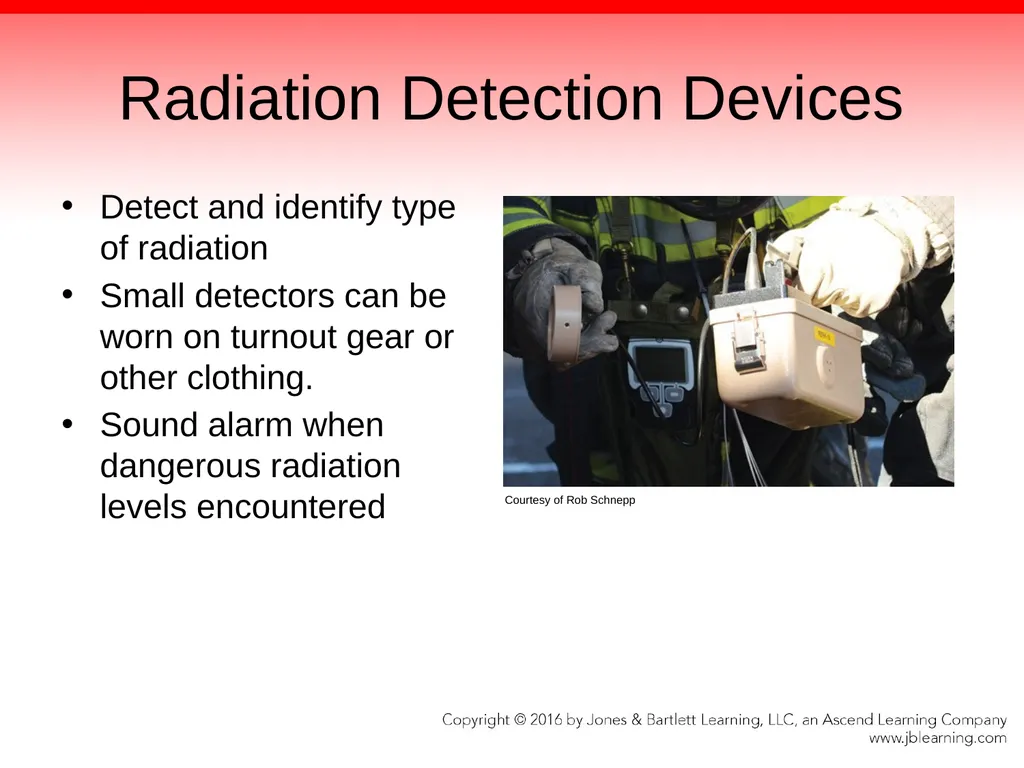
slide33. Radiation Detection Devices Detect and identify type of radiation
Small detectors can be worn on turnout gear or other clothing.
Sound alarm when dangerous radiation levels encountered Courtesy of Rob Schnepp<br>
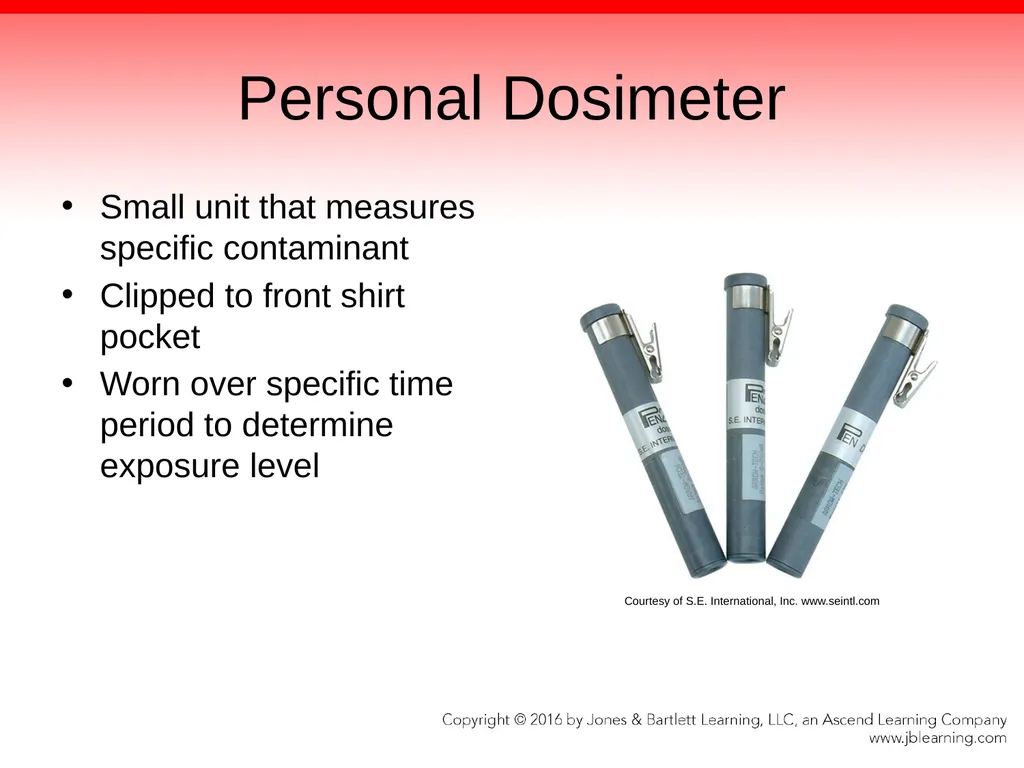
slide34. Personal Dosimeter Small unit that measures specific contaminant
Clipped to front shirt pocket
Worn over specific time period to determine exposure level Courtesy of S.E. International, Inc. www.seintl.com<br>
slide35. Summary (1 of 6) Detection and monitoring activities should be approached from a multisystem viewpoint. It is important to remember that a particular type of detector or monitoring device serves a unique purpose.
The nature of the incident, and the intent of the atmospheric monitoring mission, will drive which individual machine or combination of technologies is the most appropriate.<br>
slide36. Summary (2 of 6) Emergency responders must understand the operating principles of the detection/monitoring equipment, its limitations, the benefits of using the device, and the way in which the instrument fits into existing response procedures.<br>
slide37. Summary (3 of 6) All detection/monitoring instruments require a certain amount of maintenance and upkeep. When considering the purchase of such equipment, it is important to recognize the time, cost, and supplies that the instrument will require on an annual basis.
All machines have limitations—and responders must know these limitations prior to using any device at the scene of an emergency.<br>
slide38. Summary (4 of 6) An accurately calibrated machine ensures that the detection/monitoring is operating correctly and obtaining the proper readings.
A bump test is a quick field test carried out to ensure the meter is operating correctly prior to entering a contaminated atmosphere. Bump testing is recommended when doing daily checks, prior to using the device at an incident, and after using the meter.<br>
slide39. Summary (5 of 6) The recovery time of a particular device is a function of how much time it takes a detector/monitor to clear itself so that a new reading can be taken. Responders should know the recovery time of any instrument proposed for use at an incident.
Correction factors or relative response curves may be needed to obtain accurate readings with some detection/monitoring devices.<br>
slide40. Summary (6 of 6) The proper selection of PPE for a monitoring/detection mission is vital to responder safety.
Monitoring an unknown atmosphere is a complicated endeavor that requires the responder to use several different types of instruments, based on several different technologies, to safely determine the potential for airborne contamination.<br>
slide2. Objectives: Operations Level Responders Assigned Mission-Specific Responsibilities (1 of 2) Plan and implement air monitoring and sampling activities. (p. 325–328)
Select equipment suitable for detecting or monitoring solids, liquids, or gaseous hazardous materials/WMD. (NFPA 6.7.3.1, p. 314–315)
Describe the operation, capabilities and limitations, local monitoring procedures, field testing, and maintenance procedures associated with each detection/monitoring device. (NFPA 6.7.3.2, p. 321–325)<br>
slide3. Objectives: Operations Level Responders Assigned Mission-Specific Responsibilities (2 of 2) Describe the local procedure for responder decontamination as well as the decontamination procedures for detection/monitoring devices upon completing the air monitoring mission. (NFPA 6.7.3.3, 6.7.4.2, p. 318–319)<br>
slide4. Introduction (1 of 3) Each particular detection instrument serves a unique purpose.
No single detection and/or monitoring device can do it all.
For each machine, responders must understand:
Operating principles
Limitations
Benefits
Best approach for incorporating it<br>
slide5. Introduction (2 of 3) Features
Unique operating characteristics of machines that affect the user
Benefits
Reflect how device fits into operational plan and regional response activities<br>
slide6. Introduction (3 of 3) Responders must interpret information and make sound decisions based on that information.
Instruments must be checked and maintained on regular basis.<br>
slide7. Situational Awareness Focus and observation
Understanding visual cues
Orienting yourself and others to inputs
Making sound decisions based on inputs<br>
slide8. Calibration Setting or correcting a measuring device by adjusting it to match a known “source”
Calibration of gas detection device that uses electrochemical sensor or multiple sensors is done by challenging sensor with known concentration of calibration gas.<br>
slide9. Bump Test Quick field test to ensure meter is operating correctly
Device exposed to gas designed to elicit reading
Gas source removed and machine recovers to normal levels<br>
slide10. Reaction Time Period of time from when air sample is drawn into machine until machine processes sample and gives reading
Short as 1 or 2 seconds
Long as 30 to 60 seconds<br>
slide11. Recovery Time How much time it takes a detector or monitor to clear so a new reading can be taken
Affected by factors, including physical properties of sampled substance
Device “zeroed” when it begins its operational period in clean atmosphere by displaying normal values<br>
slide12. Relative Response Curve Accounts for different types of gases encountered, other than the one used for calibration<br>
slide13. Relative Response Factor Correlates difference between gas used to calibrate machine and gas actually being detected<br>
slide14. Detection and Monitoring Concepts (1 of 2) Vapors and gaseous chemicals move through an area.
Air currents, ventilation systems, and other influences create constantly changing environment.
Before monitoring inside a building, monitor the outside atmosphere.
Start from outer perimeter and work inward.<br>
slide15. Detection and Monitoring Concepts (2 of 2) Prior to entering building, monitor around the door.
After exposure, personnel, PPE, and detection and monitoring equipment need to be decontaminated.<br>
slide16. Detection and Monitoring Unknowns Several different devices may need to be used.
Detection/monitoring devices can be used to confirm what you suspect.
Ask questions about atmosphere:
Flammable?
Corrosive?
Radioactive?<br>
slide17. Photo-Ionization Detector (1 of 2) General survey instrument
Detects vaporous chemicals at very low levels
Uses ultraviolet light lamp to break down sample gas into electrically charged components (ions) and negatively charged electrons
Current amplified and displayed<br>
slide18. Photo-Ionization Detector (2 of 2) Does not identify material
Alerts to presence of something in the air, usually organic vapor or mist
Can pinpoint sources of small leaks<br>
slide19. Combustible Gas Indicator Also called flammable gas detector
Detects flammable and potentially explosive atmospheres
Detects at or below LEL/LFL
Highest level of danger: 100% of LEL/LFL
Must know flammable range of gas<br>
slide20. Gas Chromatography Breaks down sample gases into various components
Can be combined with flame ionization detectors to measure amount of each component Courtesy of SRI Instruments<br>
slide21. Flame Ionization Detector General survey or qualitative instrument
Sample gas broken down into electrically charged ions
Current amplified and displayed by instrument
Uses hydrogen flame to break down substance into ions Photo courtesy INFICON<br>
slide22. Oxygen Monitoring Device Measures amount of oxygen in air
Oxygen concentration less than 19.5% = oxygen-deficient atmosphere
Health risk
Oxygen concentration more than 23.5% = oxygen-enriched atmosphere
Elevated fire risk
Used in confined-space work<br>
slide23. Carbon Monoxide Detector Identifies presence of carbon monoxide
CO generated during combustion process
Immediately dangerous to life and health exposure limit for CO exposure: 1200 ppm for 30 minutes Courtesy of BW Technologies by Honeywell<br>
slide24. Hydrogen Sulfide Monitor Used in confined space
Used extensively in petroleum manufacturing facilities
Hydrogen sulfide is by-product of decaying organic materials (“sewer gas”).
Flammable, heavier than air, blocks body cells from using oxygen
Has strong pungent odor at first<br>
slide25. Multi-gas Meter Can detect several hazards at once
Sensors for oxygen, carbon monoxide, hydrogen sulfide, flammable gas
Good for confined-space incidents
Electrochemical sensors detect presence of target gases.
Other gases may interfere with target gas, giving potentially false reading.<br>
slide26. Colorimetric Tubes (1 of 2) Identify known and unknown chemical vapors
Filled with reagents
Each reagent reacts to unique substance at particular concentration.
Tubes detect single substances and/or chemical families.<br>
slide27. Colorimetric Tubes (2 of 2) Pump draws air sample through tubes.
If contaminant is encountered, reagent changes color.
Numerical value on tube indicates level of contamination.<br>
slide28. pH Paper Chemical paper used to determine if substance is acid or base
Used to judge how aggressive a corrosive is
Acids have pH less than 7.
7 = neutral
Bases have pH greater than 7.
Chemicals with pH values of 2.5 or less or 12.5 or more are considered strong.<br>
slide29. Chemical Test Strips Looks like pH paper
Each strip has multiple areas for wide range of tests simultaneously.
Tests for halogens, fluoride compounds, acids and bases, solvents, pesticides, oxidizers Courtesy of Rob Schnepp<br>
slide30. Specialized Detection Devices (1 of 3) Also called hazardous materials identifiers
Used to analyze substance and identify it by chemical name<br>
slide31. Specialized Detection Devices (2 of 3) Fourier transform infrared spectroscopy (FTIR)
Uses infrared radiation to excite molecules of sample substance
Creates unique fingerprint of substance
Works best on pure substances Courtesy of Rob Schnepp<br>
slide32. Specialized Detection Devices (3 of 3) Raman spectroscopy
Uses laser as infrared light source
Light is scattered when colliding with sample source.
Does not destroy sample source Courtesy of Rob Schnepp<br>
slide33. Radiation Detection Devices Detect and identify type of radiation
Small detectors can be worn on turnout gear or other clothing.
Sound alarm when dangerous radiation levels encountered Courtesy of Rob Schnepp<br>
slide34. Personal Dosimeter Small unit that measures specific contaminant
Clipped to front shirt pocket
Worn over specific time period to determine exposure level Courtesy of S.E. International, Inc. www.seintl.com<br>
slide35. Summary (1 of 6) Detection and monitoring activities should be approached from a multisystem viewpoint. It is important to remember that a particular type of detector or monitoring device serves a unique purpose.
The nature of the incident, and the intent of the atmospheric monitoring mission, will drive which individual machine or combination of technologies is the most appropriate.<br>
slide36. Summary (2 of 6) Emergency responders must understand the operating principles of the detection/monitoring equipment, its limitations, the benefits of using the device, and the way in which the instrument fits into existing response procedures.<br>
slide37. Summary (3 of 6) All detection/monitoring instruments require a certain amount of maintenance and upkeep. When considering the purchase of such equipment, it is important to recognize the time, cost, and supplies that the instrument will require on an annual basis.
All machines have limitations—and responders must know these limitations prior to using any device at the scene of an emergency.<br>
slide38. Summary (4 of 6) An accurately calibrated machine ensures that the detection/monitoring is operating correctly and obtaining the proper readings.
A bump test is a quick field test carried out to ensure the meter is operating correctly prior to entering a contaminated atmosphere. Bump testing is recommended when doing daily checks, prior to using the device at an incident, and after using the meter.<br>
slide39. Summary (5 of 6) The recovery time of a particular device is a function of how much time it takes a detector/monitor to clear itself so that a new reading can be taken. Responders should know the recovery time of any instrument proposed for use at an incident.
Correction factors or relative response curves may be needed to obtain accurate readings with some detection/monitoring devices.<br>
slide40. Summary (6 of 6) The proper selection of PPE for a monitoring/detection mission is vital to responder safety.
Monitoring an unknown atmosphere is a complicated endeavor that requires the responder to use several different types of instruments, based on several different technologies, to safely determine the potential for airborne contamination.<br>