
Chapter 16: Driving Apparatus Equipped With a
MT
Published · 100 slides · 0 views

1 / 1
Description
Chapter 16: Driving Apparatus Equipped With a Tiller Knowledge Objectives Describe the principles of tiller operation. Describe the methods of communication with the tiller apparatus driver. Describe the effects on vehicle control of
Related Topics
Share
Embed code
Download this presentation From Below
"Chapter 16: Driving Apparatus Equipped With a" is the property of its rightful owner. Permission is granted to download and print the materials on this website for personal, non-commercial use only, and to display it on your personal computer provided you do not modify the materials and that you retain all copyright notices contained in the materials. By downloading content from our website, you accept the terms of this agreement.
Presentation Transcript
01
Chapter 16: Driving Apparatus Equipped With a Tiller<br>
02
Knowledge Objectives Describe the principles of tiller operation.
Describe the methods of communication with the tiller apparatus driver.
Describe the effects on vehicle control of general steering reactions, night driving, and negotiating intersections.<br>
Describe the methods of communication with the tiller apparatus driver.
Describe the effects on vehicle control of general steering reactions, night driving, and negotiating intersections.<br>
03
Knowledge Objectives Describe the manufacturer operation limitations for tiller aerial devices.
Describe the capabilities and limitations of tiller aerial devices related to reach tip load, angle of inclination, and angle from chassis axis.
Describe the use of a tiller aerial device.<br>
Describe the capabilities and limitations of tiller aerial devices related to reach tip load, angle of inclination, and angle from chassis axis.
Describe the use of a tiller aerial device.<br>
04
Introduction Tractor-drawn tiller aerial has the most interesting configuration of all apparatus in the fire service.
Unique feature of requiring two drivers to operate the vehicle to get it from the firehouse to the incident and back again safely
Concept has been around for many years.<br>
Unique feature of requiring two drivers to operate the vehicle to get it from the firehouse to the incident and back again safely
Concept has been around for many years.<br>
05
Introduction As buildings expanded upward, fire service found it necessary to develop longer ladders.
Longer-frame apparatus were designed to transport ladders.
Length of these apparatus made it difficult to maneuver them through cities.
Allowing the rear wheels to turn and having a driver in the rear to steer these wheels gave the longer vehicles a reduced turning radius.<br>
Longer-frame apparatus were designed to transport ladders.
Length of these apparatus made it difficult to maneuver them through cities.
Allowing the rear wheels to turn and having a driver in the rear to steer these wheels gave the longer vehicles a reduced turning radius.<br>
06
Introduction Tiller aerial is a tractor-drawn vehicle with two operators.
Driver/operator must get the vehicle to all incidents while following all road laws and maintaining control of the vehicle.
Tiller operator controls trailer.
With assistance of tiller operator controlling the path of the trailer, the driver/operator maneuvers the vehicle in and out of traffic and around tight corners.<br>
07
Introduction Layouts of city streets can create challenges for emergency response drivers.
Traffic patterns along the streets will likely affect the response.
Major traffic thoroughfares may become congested during prime commuting hours.
Traffic islands placed down the middle of some major traffic arteries present obstacles to fire apparatus.<br>
Traffic patterns along the streets will likely affect the response.
Major traffic thoroughfares may become congested during prime commuting hours.
Traffic islands placed down the middle of some major traffic arteries present obstacles to fire apparatus.<br>
08
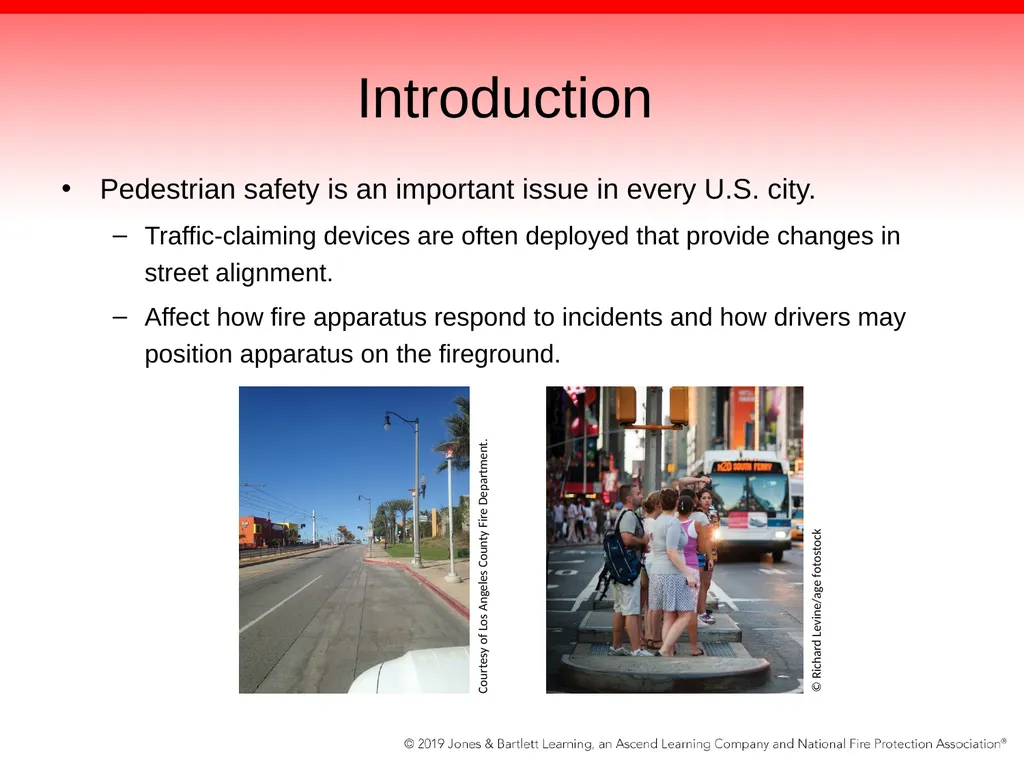
Introduction Pedestrian safety is an important issue in every U.S. city.
Traffic-claiming devices are often deployed that provide changes in street alignment.
Affect how fire apparatus respond to incidents and how drivers may position apparatus on the fireground. © Richard Levine/age fotostock Courtesy of Los Angeles County Fire Department.<br>
Traffic-claiming devices are often deployed that provide changes in street alignment.
Affect how fire apparatus respond to incidents and how drivers may position apparatus on the fireground. © Richard Levine/age fotostock Courtesy of Los Angeles County Fire Department.<br>
09
Safe Driving Number one priority when driving emergency vehicles is safety.
Apparatus operator is responsible for getting crew to the incident safely.
Reckless and aggressive driving puts individuals and other vehicles at risk.
Driver/operator’s inability to get the crew safely to an incident will prevent the crew from doing tasks required to mitigate the situation.<br>
Apparatus operator is responsible for getting crew to the incident safely.
Reckless and aggressive driving puts individuals and other vehicles at risk.
Driver/operator’s inability to get the crew safely to an incident will prevent the crew from doing tasks required to mitigate the situation.<br>
10
En Route Rapid response is essential for effective handling of emergencies, including limiting property damage and saving lives.
Many factors will determine the rate of speed at which the apparatus will travel.
Traffic congestion, weather, road conditions, apparatus condition, and experience of the driver/operator and tiller operator
Most efficient way to an incident is getting on the rig and out the firehouse in a timely manner.<br>
11
Turning at Intersections En route to an emergency, the most dangerous and most likely place for an accident to occur is the intersection.
Operator must use caution as the apparatus approaches busy and blind intersections.
Thought process and actions to safely stop a large fire apparatus will require more time and distance.<br>
Operator must use caution as the apparatus approaches busy and blind intersections.
Thought process and actions to safely stop a large fire apparatus will require more time and distance.<br>
12
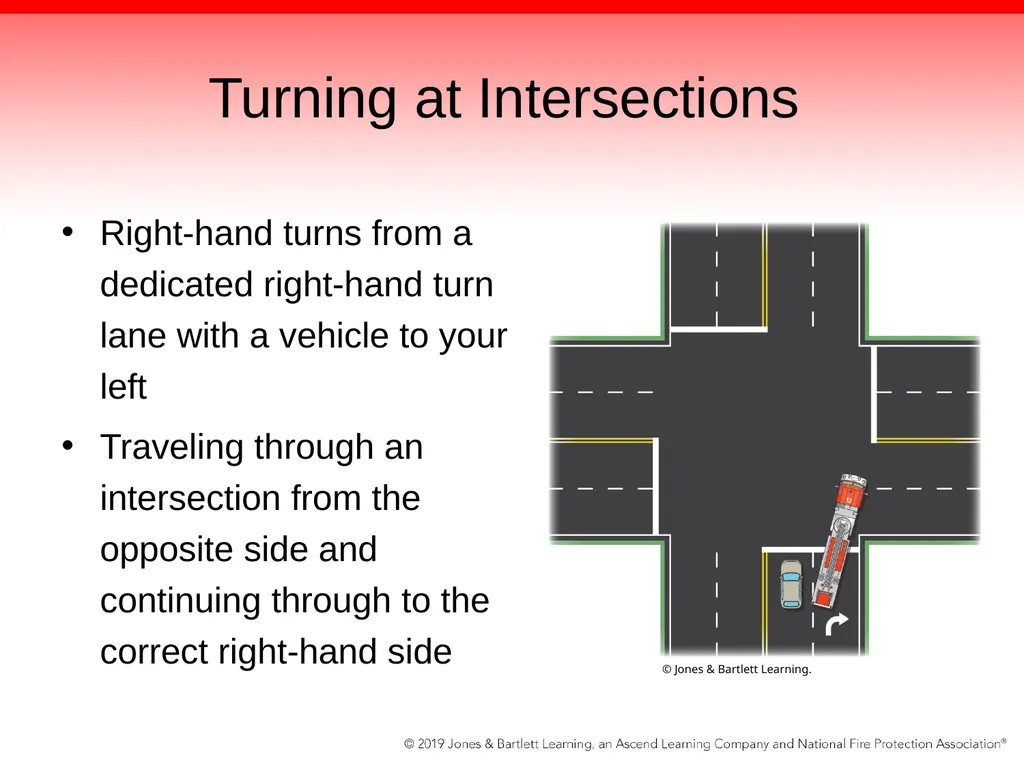
Turning at Intersections Right-hand turns from a dedicated right-hand turn lane with a vehicle to your left
Traveling through an intersection from the opposite side and continuing through to the correct right-hand side © Jones & Bartlett Learning.<br>
Traveling through an intersection from the opposite side and continuing through to the correct right-hand side © Jones & Bartlett Learning.<br>
13
Turning at Intersections Driver/operators must be on the lookout for other people and vehicles that are oblivious to their presence.
Bring the apparatus to a complete stop at red lights and ensure that the intersection is clear or cross traffic has stopped before proceeding<br>
Bring the apparatus to a complete stop at red lights and ensure that the intersection is clear or cross traffic has stopped before proceeding<br>
14
Turning at Intersections Major intersections will have multiple lanes with cross-traffic in opposite directions.
Bring apparatus to a complete stop.
Look both ways.
Proceed into intersection slowly when automobile drivers in the closest lane yield to the apparatus.
Do not expect all cars to automatically yield.
Continue to observe all lanes.<br>
Bring apparatus to a complete stop.
Look both ways.
Proceed into intersection slowly when automobile drivers in the closest lane yield to the apparatus.
Do not expect all cars to automatically yield.
Continue to observe all lanes.<br>
15
Communications Driver/operator must rely on the tiller operator to safely operate the apparatus.
Tiller operator must know what the driver/operator is doing so as to assist the driver/operator maintain control of the apparatus.
Good communication between driver/operator and tiller operator is essential.<br>
Tiller operator must know what the driver/operator is doing so as to assist the driver/operator maintain control of the apparatus.
Good communication between driver/operator and tiller operator is essential.<br>
16
Communications In older apparatus, a buzzer system was set up in the cab of the tractor and the tiller box.
Tap of a button created a sound/signal that allowed the driver and the tiller operator to communicate with each other.
One sound: stop
Two sounds: go
Three sounds: reverse<br>
Tap of a button created a sound/signal that allowed the driver and the tiller operator to communicate with each other.
One sound: stop
Two sounds: go
Three sounds: reverse<br>
17
Communications Signal could originate from either the driver/operator or the tiller operator.
Whoever received the signal acknowledged it by sending back the same signal.
The one-buzz “stop” signal did not require acknowledgment.
In all tiller-equipped apparatus (old and new), a turn signal indicator is also installed in the tiller box.<br>
Whoever received the signal acknowledged it by sending back the same signal.
The one-buzz “stop” signal did not require acknowledgment.
In all tiller-equipped apparatus (old and new), a turn signal indicator is also installed in the tiller box.<br>
18
Communications On modern apparatus or refurbished older rigs, headsets are installed for each riding position on the rig.
All fire fighters assigned to that rig for the shift should have access to a headset.
Allows all fire fighters to communicate with one another while they are on the apparatus<br>
All fire fighters assigned to that rig for the shift should have access to a headset.
Allows all fire fighters to communicate with one another while they are on the apparatus<br>
19
Communications Over many years, the roaring noise of the apparatus engine and high-pitched sound of the siren have damaged the hearing of many fire fighters.
Headsets give the fire fighters the ability to communicate in a noisy environment and protect their hearing.
Headsets must be used at all times when fire fighters are riding in the apparatus.<br>
Headsets give the fire fighters the ability to communicate in a noisy environment and protect their hearing.
Headsets must be used at all times when fire fighters are riding in the apparatus.<br>
20
Vehicle Control Driver/operator and tiller operator must work as a team to keep the tractor-drawn aerial under control.
Driver/operator is responsible for the tractor portion of the apparatus.
Tiller operator is responsible for the trailer end.
Effective communication between the two is of utmost importance.<br>
Driver/operator is responsible for the tractor portion of the apparatus.
Tiller operator is responsible for the trailer end.
Effective communication between the two is of utmost importance.<br>
21
Vehicle Control Driver/operator:
Has the responsibility of getting the crew to the incident safely and quickly
Must possess knowledge of the response area
Must determine the route
Dictates the speed of the vehicle based on the road conditions, weather, vehicle traffic, and road laws<br>
Has the responsibility of getting the crew to the incident safely and quickly
Must possess knowledge of the response area
Must determine the route
Dictates the speed of the vehicle based on the road conditions, weather, vehicle traffic, and road laws<br>
22
Vehicle Control Driver must keep the vehicle within the lane at all times, under all circumstances.
When the vehicle is going straight, the driver/operator should position the vehicle so that it is hugging the lane divider on the driver’s side.
Driver/operator must maintain awareness of everything around the vehicle during any movement.<br>
When the vehicle is going straight, the driver/operator should position the vehicle so that it is hugging the lane divider on the driver’s side.
Driver/operator must maintain awareness of everything around the vehicle during any movement.<br>
23
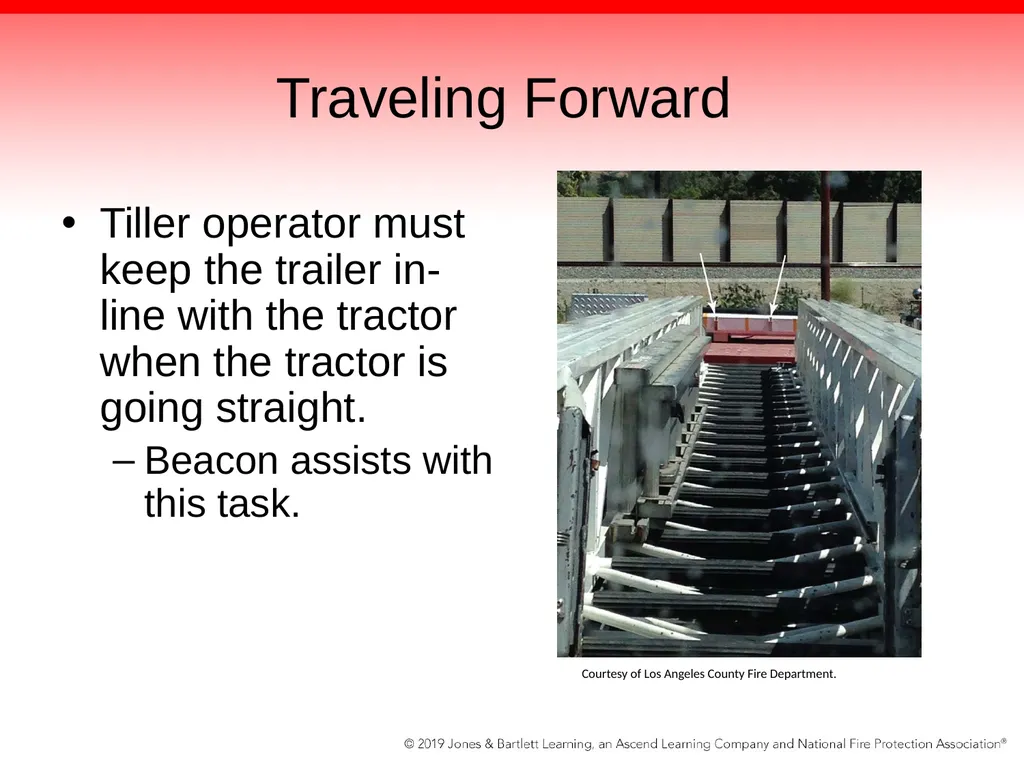
Traveling Forward Tiller operator must keep the trailer in-line with the tractor when the tractor is going straight.
Beacon assists with this task. Courtesy of Los Angeles County Fire Department.<br>
Beacon assists with this task. Courtesy of Los Angeles County Fire Department.<br>
24
Traveling Forward Tiller operator is also responsible for noticing obstructions on both sides of the trailer, anticipating upcoming traffic conditions, and maintaining awareness of situations behind the rear of the trailer.
Mistakes that tiller operators may make include over-steering, under-steering, and over-tillering.<br>
Mistakes that tiller operators may make include over-steering, under-steering, and over-tillering.<br>
25
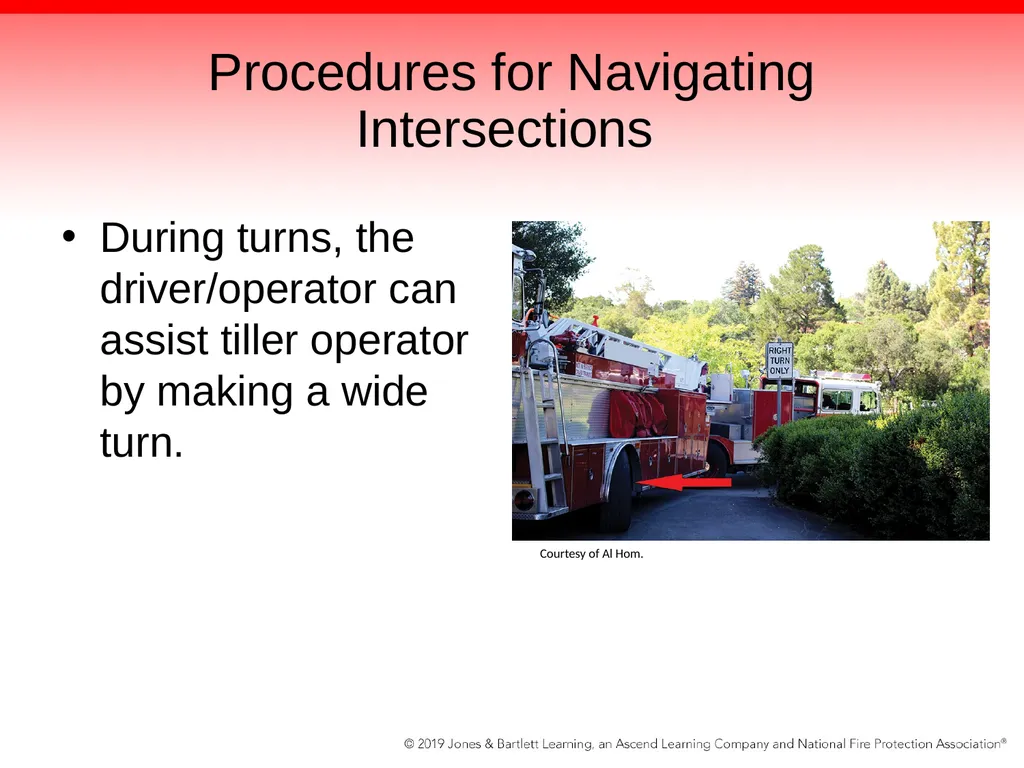
Procedures for Navigating Intersections During turns, the driver/operator can assist tiller operator by making a wide turn. Courtesy of Al Hom.<br>
26
Procedures for Navigating Intersections When streets are narrow or parked cars reduce the width of a street, the driver/operator and the tiller operator must work as a team to make a safe and complete turn.
Driver/operator will assist the tiller operator by driving out into the intersection as far as possible.<br>
Driver/operator will assist the tiller operator by driving out into the intersection as far as possible.<br>
27
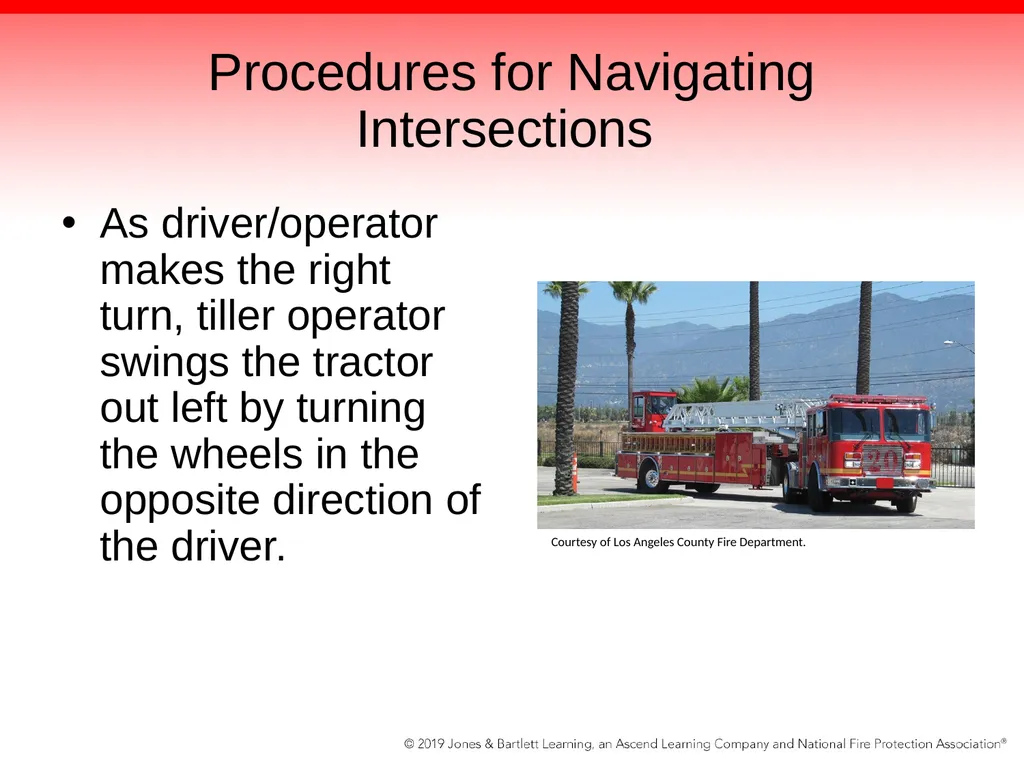
Procedures for Navigating Intersections As driver/operator makes the right turn, tiller operator swings the tractor out left by turning the wheels in the opposite direction of the driver. Courtesy of Los Angeles County Fire Department.<br>
28
Procedures for Navigating Intersections Tiller operator must look left to ensure the vehicle does not swing too far and strike anything.
Once the truck is halfway into the turn, the tiller operator begins to turn the steering wheel in the opposite direction to bring the trailer back in-line with the tractor.
If the tiller operator waits until the apparatus has completed the turn before turning the wheel back, the trailer will hit objects on the sidewalk or parked cars in adjacent lanes.<br>
29
Backing Up Driver/operator will make moves that civilians never make in a lifetime
Backing apparatus into firehouse
Reversing apparatus down an entire city block
At the firehouse, the driver/operator pulls the apparatus past the bay, with the entire apparatus moving past the firehouse doors.
Tiller operator swings trailer out and angles it toward the firehouse to create a shorter turning radius for the truck.<br>
30
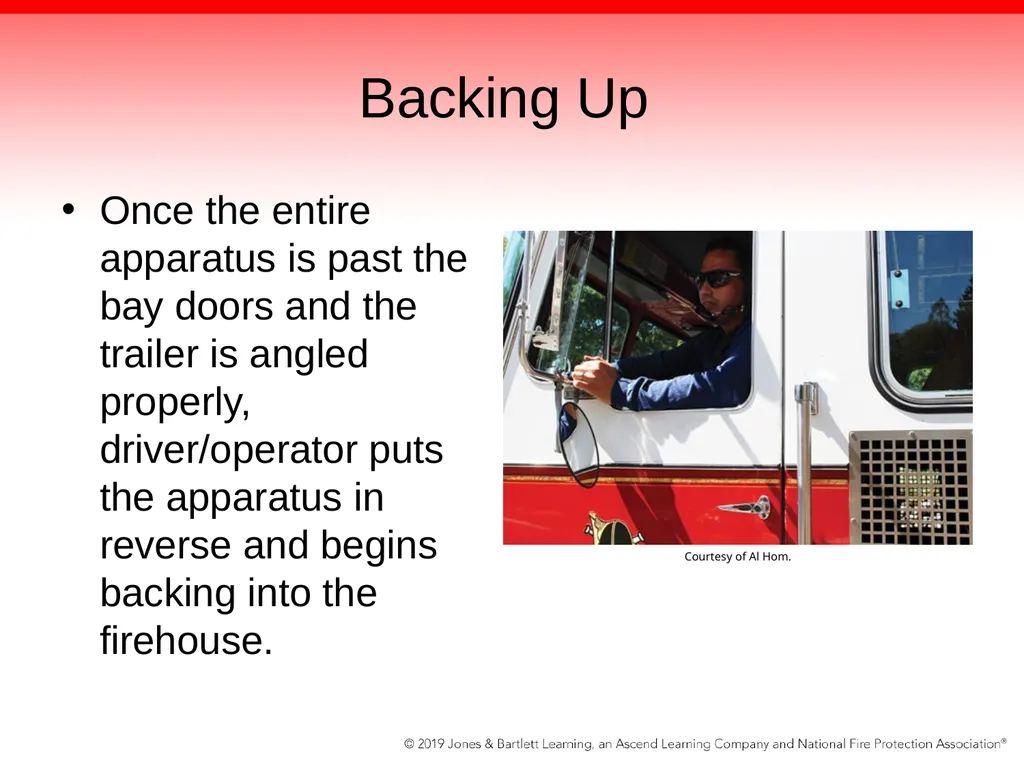
Backing Up Once the entire apparatus is past the bay doors and the trailer is angled properly, driver/operator puts the apparatus in reverse and begins backing into the firehouse. Courtesy of Al Hom.<br>
31
Backing Up The tiller operator looks left, right, and behind to control the trailer and guide it into the firehouse.
Once rear of the trailer and tiller box has cleared the sides of the apparatus door, the tiller operator can look up and locate the center of the apparatus door.
Tiller operator should line up the middle of the bedded aerial ladder with that vertical line as the driver is backing up.<br>
Once rear of the trailer and tiller box has cleared the sides of the apparatus door, the tiller operator can look up and locate the center of the apparatus door.
Tiller operator should line up the middle of the bedded aerial ladder with that vertical line as the driver is backing up.<br>
32
Backing Up Driver/operator focuses on backing the tractor and aligning the dual wheels with the common targets.
Painted guidelines on the sidewalk and apparatus floor
When it comes to backing a tractor-drawn aerial down a city block, the responsibilities are reversed.
While driver/operator still controls speed, tiller operator issues orders<br>
Painted guidelines on the sidewalk and apparatus floor
When it comes to backing a tractor-drawn aerial down a city block, the responsibilities are reversed.
While driver/operator still controls speed, tiller operator issues orders<br>
33
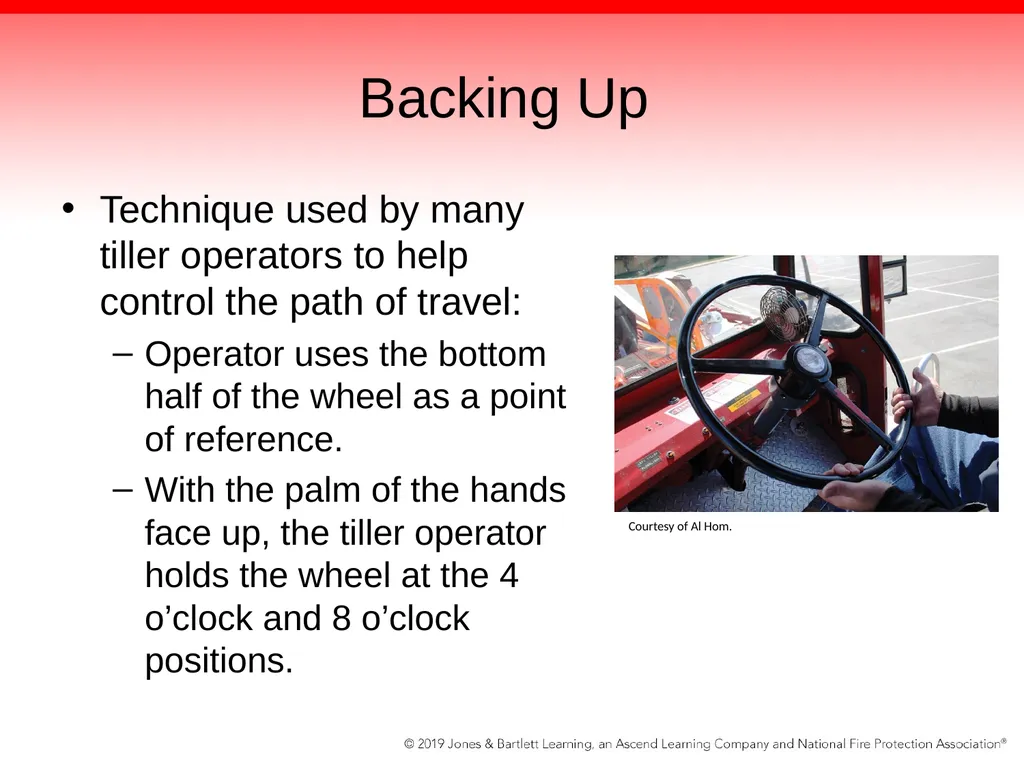
Backing Up Technique used by many tiller operators to help control the path of travel:
Operator uses the bottom half of the wheel as a point of reference.
With the palm of the hands face up, the tiller operator holds the wheel at the 4 o’clock and 8 o’clock positions. Courtesy of Al Hom.<br>
Operator uses the bottom half of the wheel as a point of reference.
With the palm of the hands face up, the tiller operator holds the wheel at the 4 o’clock and 8 o’clock positions. Courtesy of Al Hom.<br>
34
Backing Up As the operator holds onto the wheel, he or she points the thumbs in an outward position.
As the rig moves in reverse, the tiller operator controls the path of travel by letting the steering wheel slide through the hands.
Hand-over-hand steering is not used.
Thumbs can be used as a reference point to control the direction the apparatus is backing up
When the steering wheel is moved in the direction in which the thumb is pointed, the trailer will move in the same direction.<br>
35
Backing Up As the apparatus begins to back up, the tiller operator:
Gives the clearance signal
Communicates with the driver/ operator regarding any oncoming obstructions
Dictates the speed by telling the driver/operator, “Come on,” “Slow down,” or “STOP”<br>
Gives the clearance signal
Communicates with the driver/ operator regarding any oncoming obstructions
Dictates the speed by telling the driver/operator, “Come on,” “Slow down,” or “STOP”<br>
36
Backing Up When backing down a city street, if the apparatus is approaching an intersection, the tiller operator should communicate with the driver/operator.
The front-end driver/operator concentrates on the tractor as the tiller apparatus is backing down the street.
Anytime the apparatus is backing up, the officer and fire fighters who are not driving should work as spotters and walk alongside the moving rig.<br>
The front-end driver/operator concentrates on the tractor as the tiller apparatus is backing down the street.
Anytime the apparatus is backing up, the officer and fire fighters who are not driving should work as spotters and walk alongside the moving rig.<br>
37
Braking Driver/operator should always be ready to stop the truck to avoid hitting an object.
Be aware that a tillered apparatus is limited to a total weight of 80,000 pounds, similar to an 18-wheeler truck.
An 18-wheeler has at least five braking axles.
A tillered apparatus has only three braking axles.
The rear trailer axle is limited to 60% braking capacity because it is a turning axle.<br>
38
Night Driving Always attempt to keep the trailer in-line by using truck landmarks, such as the lights on the air-conditioning unit.
Driving in a darkened atmosphere provides less visibility, so good communication is crucial to safe operation.
To aid in night driving, ensure that the trailer’s curb lights and/or ground lights are used, if the apparatus is so equipped.<br>
Driving in a darkened atmosphere provides less visibility, so good communication is crucial to safe operation.
To aid in night driving, ensure that the trailer’s curb lights and/or ground lights are used, if the apparatus is so equipped.<br>
39
Principles of Tiller Operation One of the tasks a truck company must conduct on the fireground is laddering the fire building.
To utilize the aerial ladder, the truck must be parked in front of the fire building.<br>
To utilize the aerial ladder, the truck must be parked in front of the fire building.<br>
40
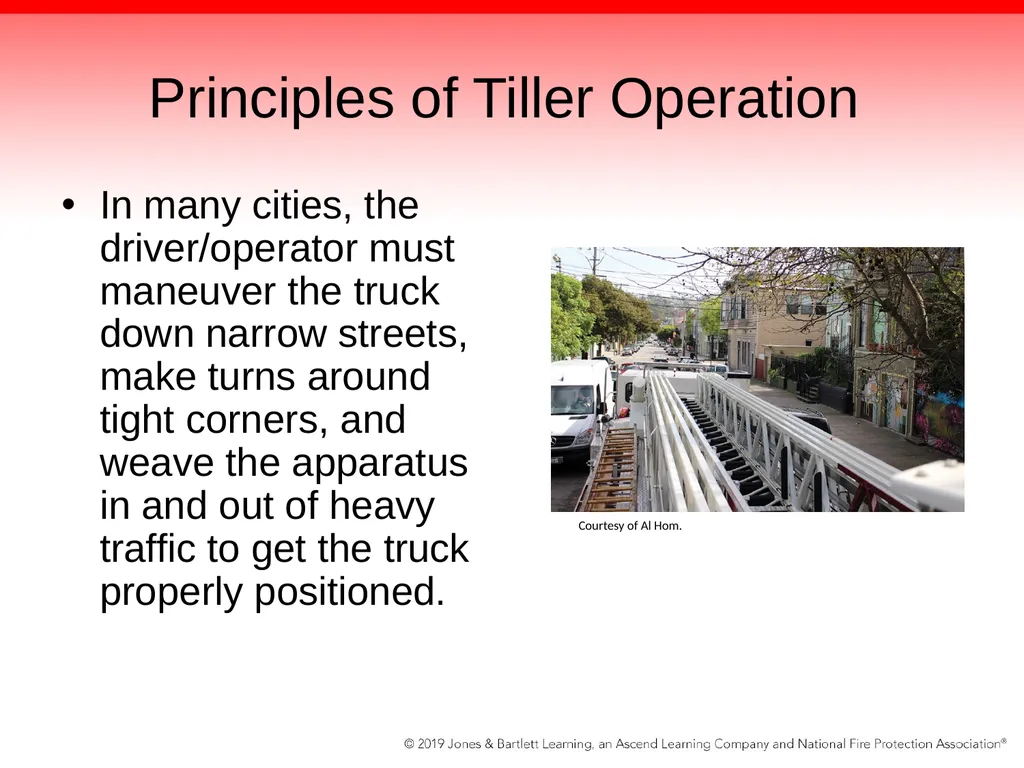
Principles of Tiller Operation In many cities, the driver/operator must maneuver the truck down narrow streets, make turns around tight corners, and weave the apparatus in and out of heavy traffic to get the truck properly positioned. Courtesy of Al Hom.<br>
41
Principles of Tiller Operation The tiller aerial ladder truck is equivalent in size to a semi big-rig or an 18-wheeler truck, but the semi big-rig has only one driver.
When the driver of an 18-wheeler has to make a delivery in a big city, he or she will most often travel the city’s main streets.
Emergency vehicles do not have this luxury.<br>
When the driver of an 18-wheeler has to make a delivery in a big city, he or she will most often travel the city’s main streets.
Emergency vehicles do not have this luxury.<br>
42
Principles of Tiller Operation Fire apparatus must have the ability to enter streets of all widths.
Driver/operators will encounter everyday challenges that require periodic street closures.
Traffic islands, public transit platforms, temporary street repair/construction sites, rush-hour traffic, events that require street closures<br>
Driver/operators will encounter everyday challenges that require periodic street closures.
Traffic islands, public transit platforms, temporary street repair/construction sites, rush-hour traffic, events that require street closures<br>
43
Principles of Tiller Operation Tiller operator sits in the rear tiller compartment (the tiller box) of the trailer.
Perched on top of the trailer behind the bedded aerial ladder
Tiller operator’s ability to control and steer the trailer enables the driver/operator to weave in and out of heavy traffic, negotiate narrow streets, and make tight turns.<br>
Perched on top of the trailer behind the bedded aerial ladder
Tiller operator’s ability to control and steer the trailer enables the driver/operator to weave in and out of heavy traffic, negotiate narrow streets, and make tight turns.<br>
44
Manufacturer Limitations All manufacturers list the limitations of their equipment regarding turning, braking, and weight limitations.
Read and follow all manufacturer-specified limitations and recommendations prior to operating the apparatus.
Know the maximum rotations of the tiller steering wheel and the different apparatus’ turning radii.<br>
Read and follow all manufacturer-specified limitations and recommendations prior to operating the apparatus.
Know the maximum rotations of the tiller steering wheel and the different apparatus’ turning radii.<br>
45
Maneuvering in Adverse Weather Secondary braking systems should be shut off or placed into the lowest setting.
Tiller axle braking is reduced to 60% capacity.
Speed should be reduced in adverse weather.
Always allow for additional time when stopping, due to the tiller’s lack of braking systems.<br>
Tiller axle braking is reduced to 60% capacity.
Speed should be reduced in adverse weather.
Always allow for additional time when stopping, due to the tiller’s lack of braking systems.<br>
46
Responsibilities Before the shift starts, the officer must assign a driver/operator and a tiller operator for the entire shift.
Driver/operator will be responsible for the tractor portion of the aerial truck.
Tiller operator will be responsible for the trailer (the body and the tiller section) of the truck.<br>
Driver/operator will be responsible for the tractor portion of the aerial truck.
Tiller operator will be responsible for the trailer (the body and the tiller section) of the truck.<br>
47
Responsibilities Ladder truck must be inspected at the beginning of every shift.
Check the tractor for passenger compartment cleanliness, fuel, emergency lights, head lights, rear lights, and air pressure.
Raise the cab and check the engine compartment for fluid levels, hoses, belts, and cleanliness.
Check tools and equipment stored in tractor compartments.
Walk around the rig to check the tires and look for any new body damage.<br>
48
Responsibilities Once tractor has been checked, driver/operator:
Visually inspects the aerial ladder, checking the fly sections and the bedded section first
Inspects the rungs, the beams, and the braces for any structural damage
Ensures that the lights at the tip of the aerial and the intercom system on the aerial ladder are in good working condition<br>
Visually inspects the aerial ladder, checking the fly sections and the bedded section first
Inspects the rungs, the beams, and the braces for any structural damage
Ensures that the lights at the tip of the aerial and the intercom system on the aerial ladder are in good working condition<br>
49
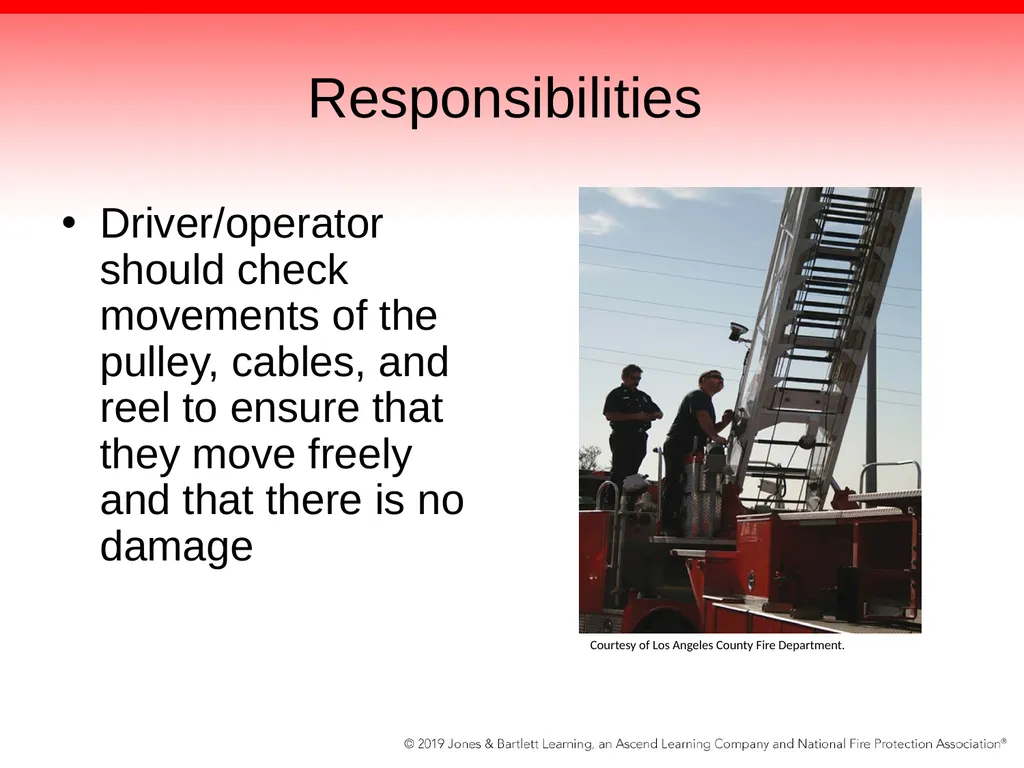
Responsibilities Driver/operator should check movements of the pulley, cables, and reel to ensure that they move freely and that there is no damage Courtesy of Los Angeles County Fire Department.<br>
50
Responsibilities Additional tasks include:
Visual ladder inspection
Fifth-wheel bearing clearance
Timed operational test
Hydraulic pressure test
Visual inspection of PTO and lines<br>
Visual ladder inspection
Fifth-wheel bearing clearance
Timed operational test
Hydraulic pressure test
Visual inspection of PTO and lines<br>
51
Responsibilities Daily inspection is a great time for new members of the department to learn about the operations of the aerial.
Skills to practice include:
Raising the ladder to specific lengths
Applying a feather touch at the control levers to eliminate sudden jerky movements of the aerial ladder<br>
Skills to practice include:
Raising the ladder to specific lengths
Applying a feather touch at the control levers to eliminate sudden jerky movements of the aerial ladder<br>
52
Responsibilities The tiller operator is responsible for the trailer.
At the beginning of the shift, the tiller operator should check the inventory and readiness of all the equipment situated in the trailer compartments.<br>
At the beginning of the shift, the tiller operator should check the inventory and readiness of all the equipment situated in the trailer compartments.<br>
53
New Driver/Operators Before a fire fighter can drive an aerial ladder truck, he or she should attend an orientation class and a hands-on driving class with driving obstacle course.
Course includes several stations that are set with orange plastic cones.
One station is designed to allow the driver/operator to drive the apparatus in the forward direction down a lane.<br>
Course includes several stations that are set with orange plastic cones.
One station is designed to allow the driver/operator to drive the apparatus in the forward direction down a lane.<br>
54
Driving Obstacle Course At the serpentine station, driver/operator and tiller operator must weave the apparatus in and around a set of evenly spaced cones.
Cones can be set up to simulate a ladder truck backing into a firehouse.
Once fire fighters get a feel for driving and tillering the apparatus, it is time to take the information learned in lectures and the obstacle course and apply it onto the streets.<br>
Cones can be set up to simulate a ladder truck backing into a firehouse.
Once fire fighters get a feel for driving and tillering the apparatus, it is time to take the information learned in lectures and the obstacle course and apply it onto the streets.<br>
55
Practical Driving Exercises The best time for new fire fighters to gain street experience operating both ends of tiller apparatus is during company drills.
Officer can take the company to a quiet street with no traffic or a huge outside parking lot, set up some cones, and have the driver/operator and the tiller operator practice serpentine moves going forward and backward.<br>
Officer can take the company to a quiet street with no traffic or a huge outside parking lot, set up some cones, and have the driver/operator and the tiller operator practice serpentine moves going forward and backward.<br>
56
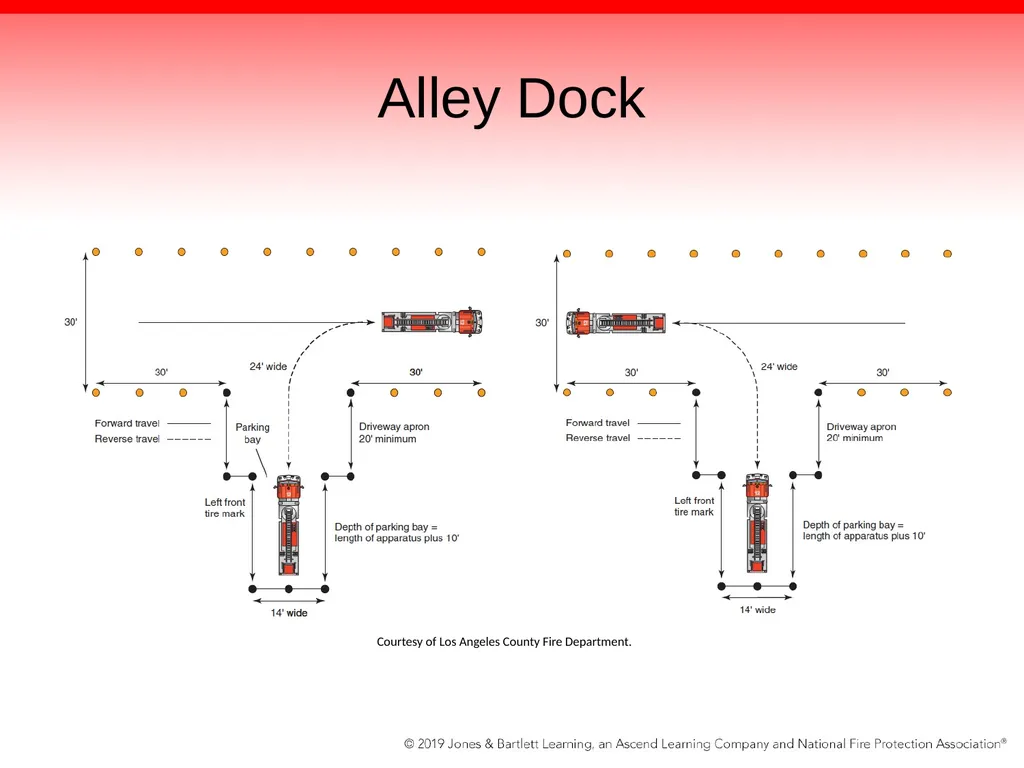
Alley Dock Tests ability to maneuver the apparatus backward from a nonrestricted to restricted area.
Boundary lines should simulate driving the apparatus forward on a street, stopping, and then backing it up into a driveway or alley.
Apparatus should be driven beyond the target area, stopped, then put into reverse and backed up until it is stopped at the rear boundary line.
Backup guides and spotters should be utilized during this drill.<br>
57
Alley Dock Courtesy of Los Angeles County Fire Department.<br>
58
Serpentine Course Tests the driver/operator and tiller/operator’s ability to maneuver the apparatus around obstacles from left to right
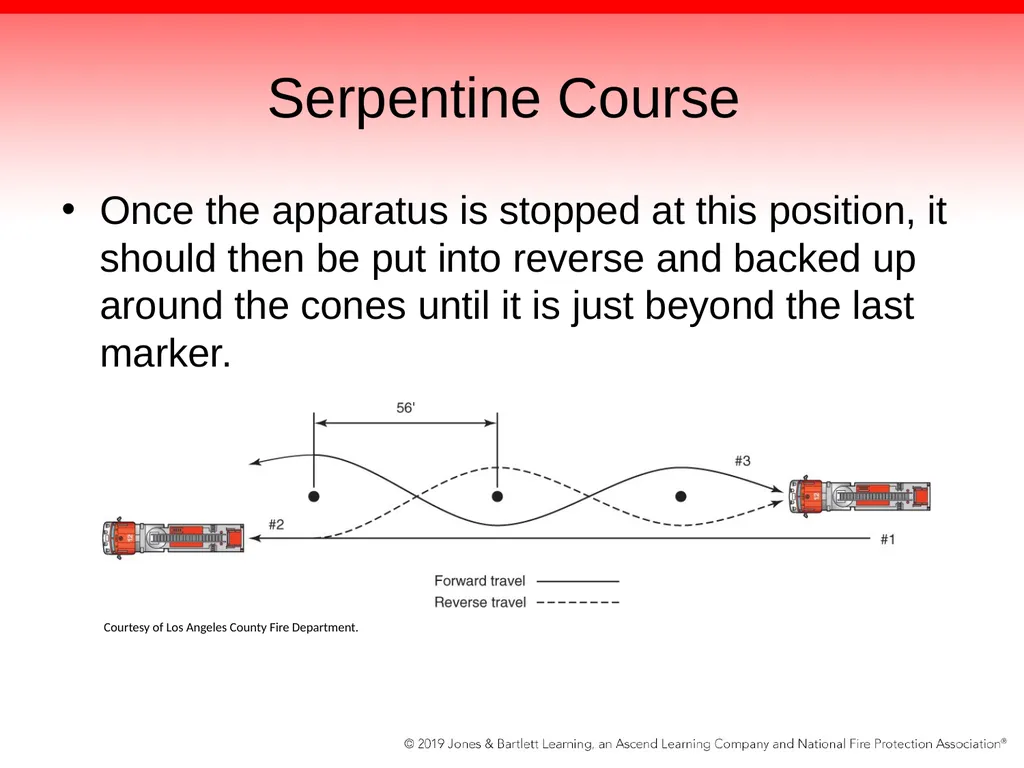
Tiller operator is required to maneuver the apparatus in one continuous motion around set cones while moving forward and then stop the apparatus just beyond the last marker.<br>
Tiller operator is required to maneuver the apparatus in one continuous motion around set cones while moving forward and then stop the apparatus just beyond the last marker.<br>
59
Serpentine Course Once the apparatus is stopped at this position, it should then be put into reverse and backed up around the cones until it is just beyond the last marker. Courtesy of Los Angeles County Fire Department.<br>
60
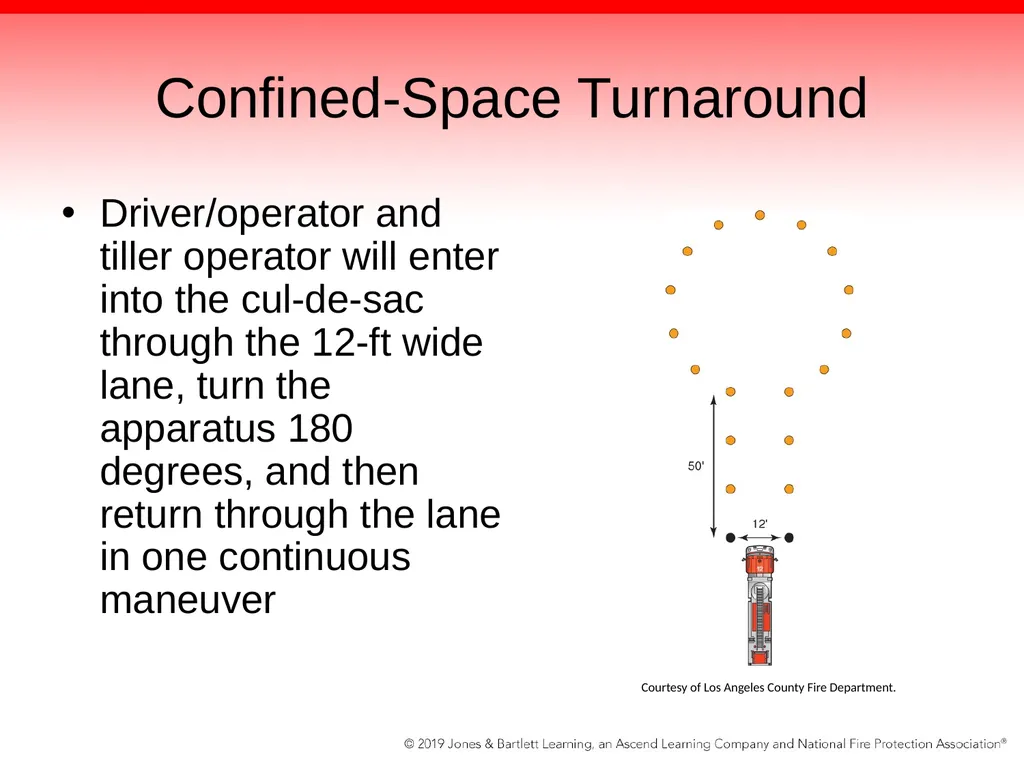
Confined-Space Turnaround Measures the driver/operator and tiller operator’s ability to turn the apparatus around in a restricted area, such as a cul-de-sac, without striking any obstacles
To set up this exercise with cones, establish a 50-ft lane that is 12 ft wide.
Designate the cul-de-sac at one end with a diameter that is the length of the apparatus being used plus two times its width.<br>
To set up this exercise with cones, establish a 50-ft lane that is 12 ft wide.
Designate the cul-de-sac at one end with a diameter that is the length of the apparatus being used plus two times its width.<br>
61
Confined-Space Turnaround Driver/operator and tiller operator will enter into the cul-de-sac through the 12-ft wide lane, turn the apparatus 180 degrees, and then return through the lane in one continuous maneuver Courtesy of Los Angeles County Fire Department.<br>
62
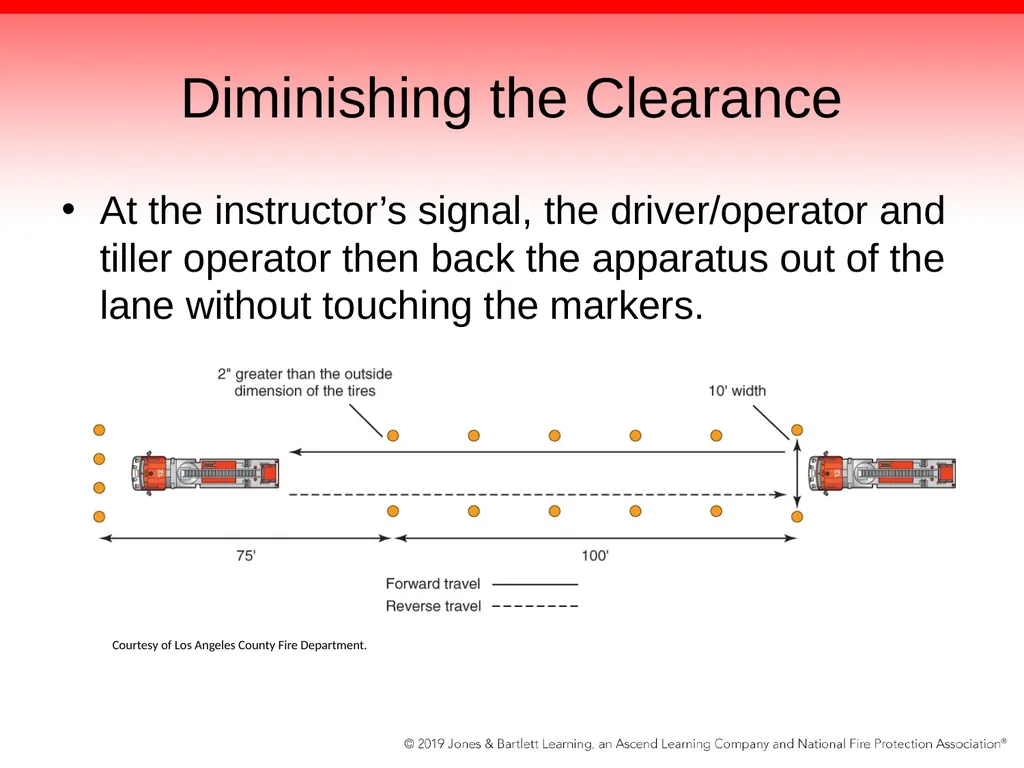
Diminishing the Clearance Teaches the driver/operator and tiller operator about depth perception and the handling characteristics of a tillered apparatus
Driver/operator must maneuver the apparatus in a diminishing straight line without touching the set cones.
Exercise measures a driver/operator’s ability to judge distances from the wheel to the object while steering the apparatus in a diminishing straight line.<br>
Driver/operator must maneuver the apparatus in a diminishing straight line without touching the set cones.
Exercise measures a driver/operator’s ability to judge distances from the wheel to the object while steering the apparatus in a diminishing straight line.<br>
63
Diminishing the Clearance At the instructor’s signal, the driver/operator and tiller operator then back the apparatus out of the lane without touching the markers. Courtesy of Los Angeles County Fire Department.<br>
64
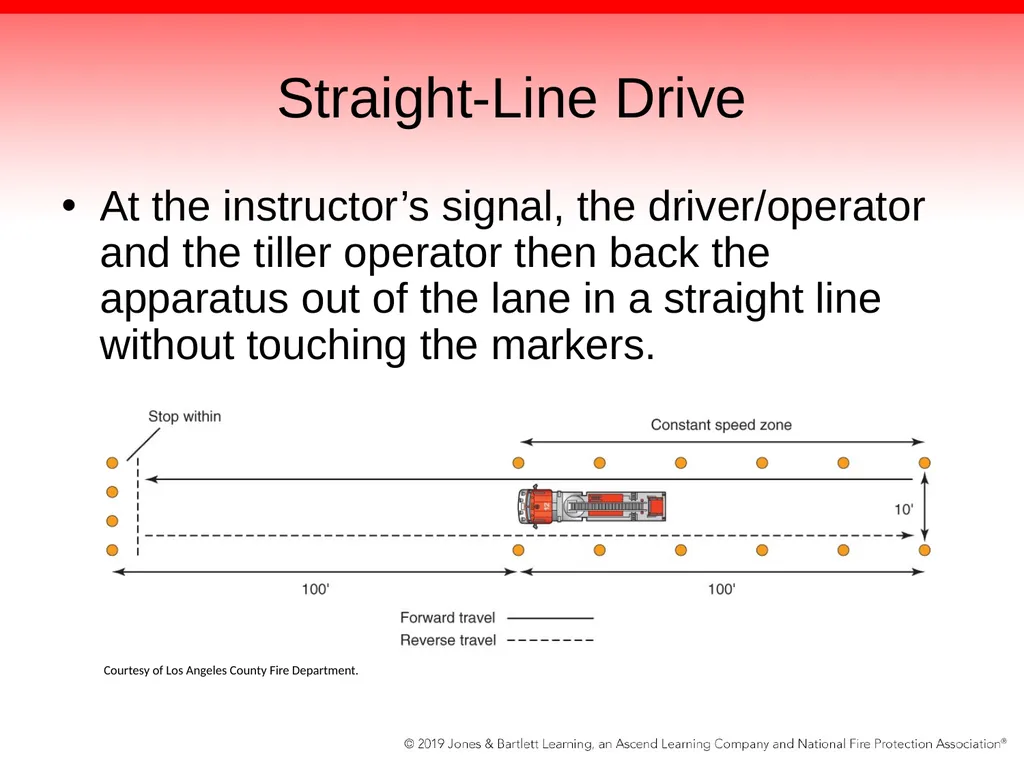
Straight-Line Drive Demonstrates to the driver/ operator and tiller operator the braking characteristics of the apparatus
Driver/operator and the tiller operator first drive forward between two rows of markers, then maneuver the apparatus through this lane without touching the markers, and finally stop the tillered apparatus within 6 inches of the set cones.<br>
Driver/operator and the tiller operator first drive forward between two rows of markers, then maneuver the apparatus through this lane without touching the markers, and finally stop the tillered apparatus within 6 inches of the set cones.<br>
65
Straight-Line Drive At the instructor’s signal, the driver/operator and the tiller operator then back the apparatus out of the lane in a straight line without touching the markers. Courtesy of Los Angeles County Fire Department.<br>
66
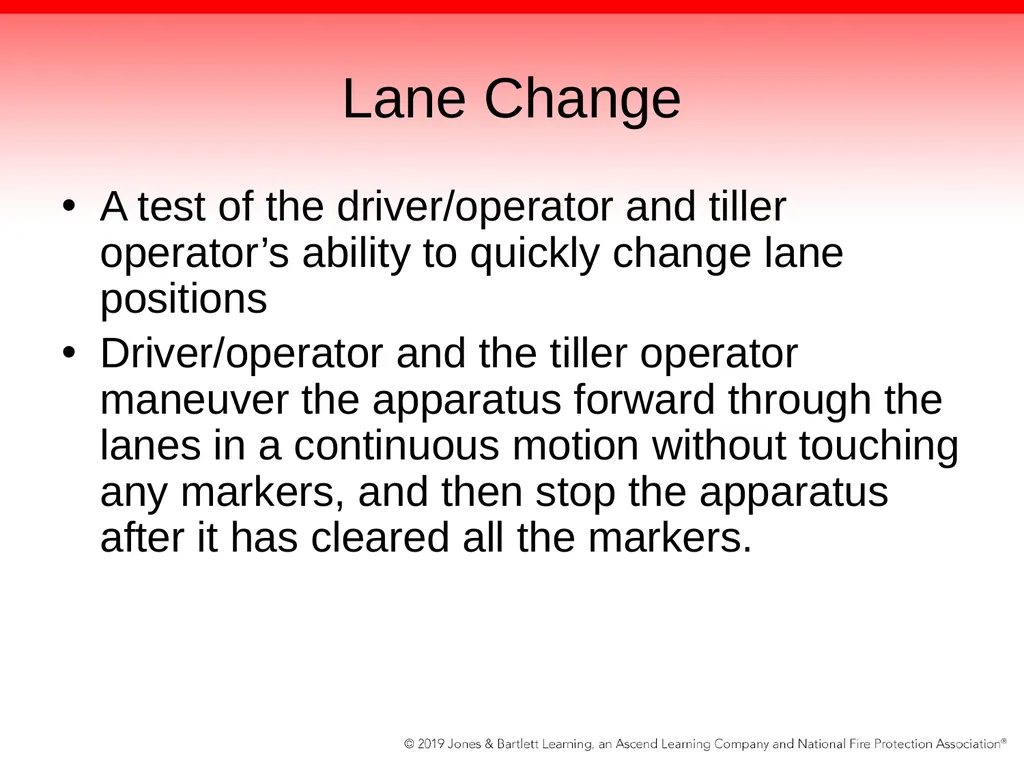
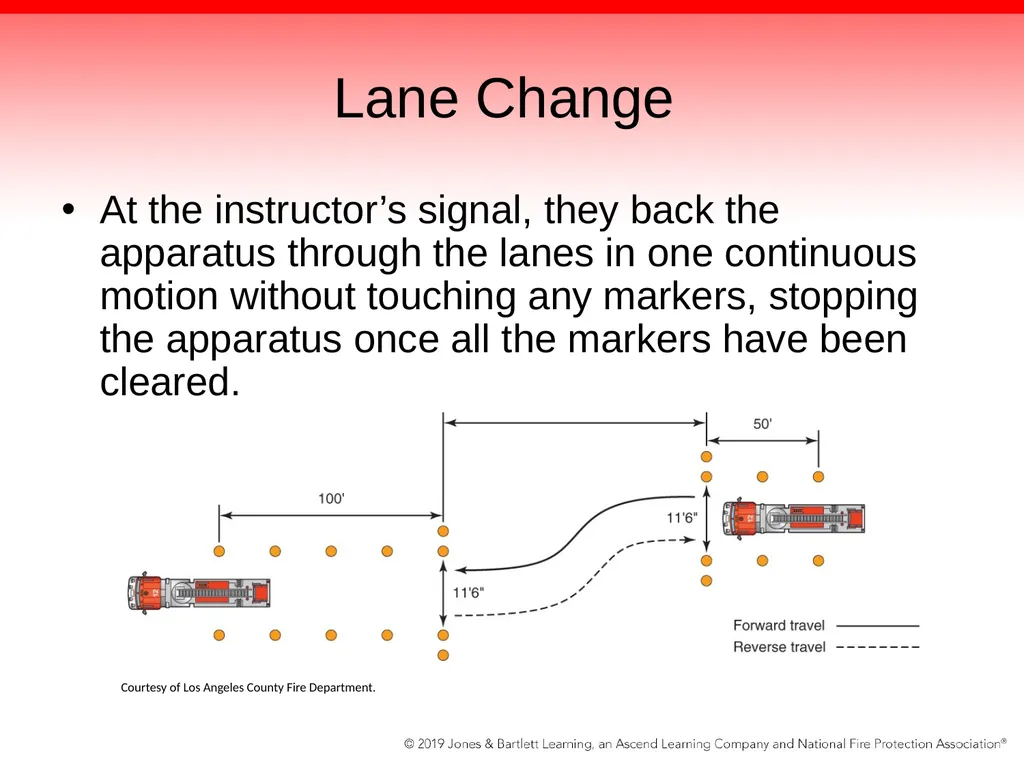
Lane Change A test of the driver/operator and tiller operator’s ability to quickly change lane positions
Driver/operator and the tiller operator maneuver the apparatus forward through the lanes in a continuous motion without touching any markers, and then stop the apparatus after it has cleared all the markers.<br>
Driver/operator and the tiller operator maneuver the apparatus forward through the lanes in a continuous motion without touching any markers, and then stop the apparatus after it has cleared all the markers.<br>
67
Lane Change At the instructor’s signal, they back the apparatus through the lanes in one continuous motion without touching any markers, stopping the apparatus once all the markers have been cleared. Courtesy of Los Angeles County Fire Department.<br>
68
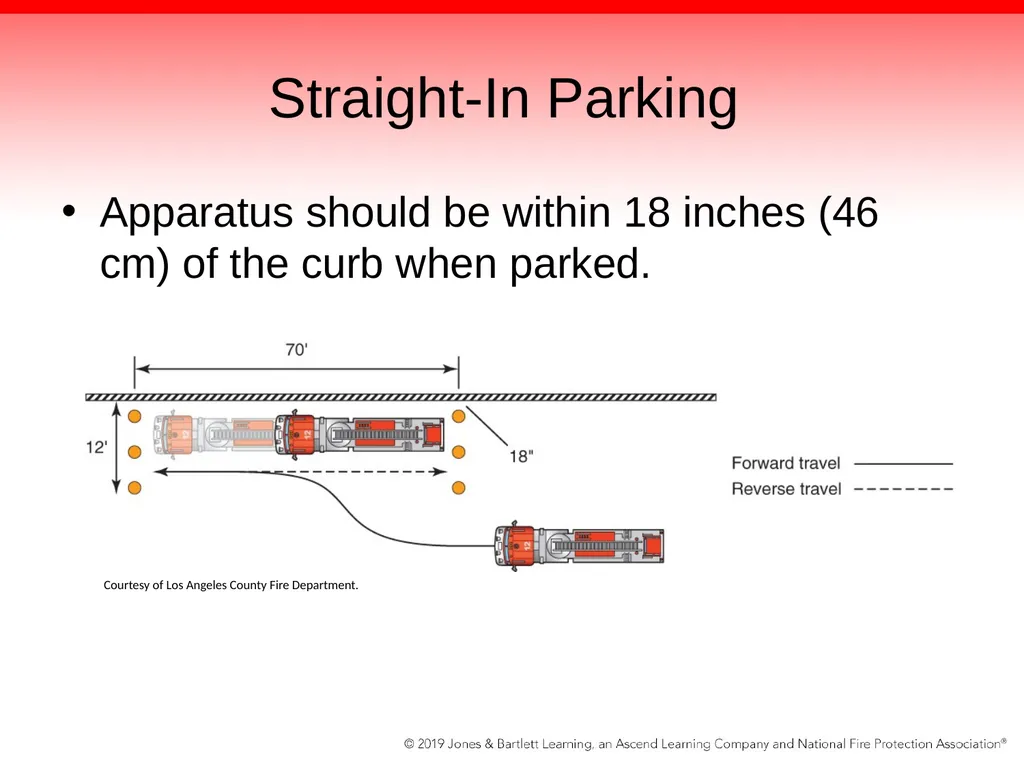
Straight-In Parking Allows the driver/operator and tiller operator to demonstrate their ability to park the apparatus safely in sites with limited space
Driver/operator and the tiller operator drive forward into the parking space using the “crabbing” technique.
They then back the apparatus in one continuous motion to align the apparatus along the curb line.<br>
Driver/operator and the tiller operator drive forward into the parking space using the “crabbing” technique.
They then back the apparatus in one continuous motion to align the apparatus along the curb line.<br>
69
Straight-In Parking Apparatus should be within 18 inches (46 cm) of the curb when parked. Courtesy of Los Angeles County Fire Department.<br>
70
Crossover Backing The crossover backing exercise is the reverse of the serpentine driving maneuver.<br>
71
The Learning Curve New fire fighters can drive or tiller the apparatus when the company is out of the firehouse during nonemergency situations.
Can operate the apparatus when the company must leave the firehouse for inspections, meal shopping, drills, and area orientation
May also drive or tiller the apparatus back to the firehouse after responding to emergencies<br>
Can operate the apparatus when the company must leave the firehouse for inspections, meal shopping, drills, and area orientation
May also drive or tiller the apparatus back to the firehouse after responding to emergencies<br>
72
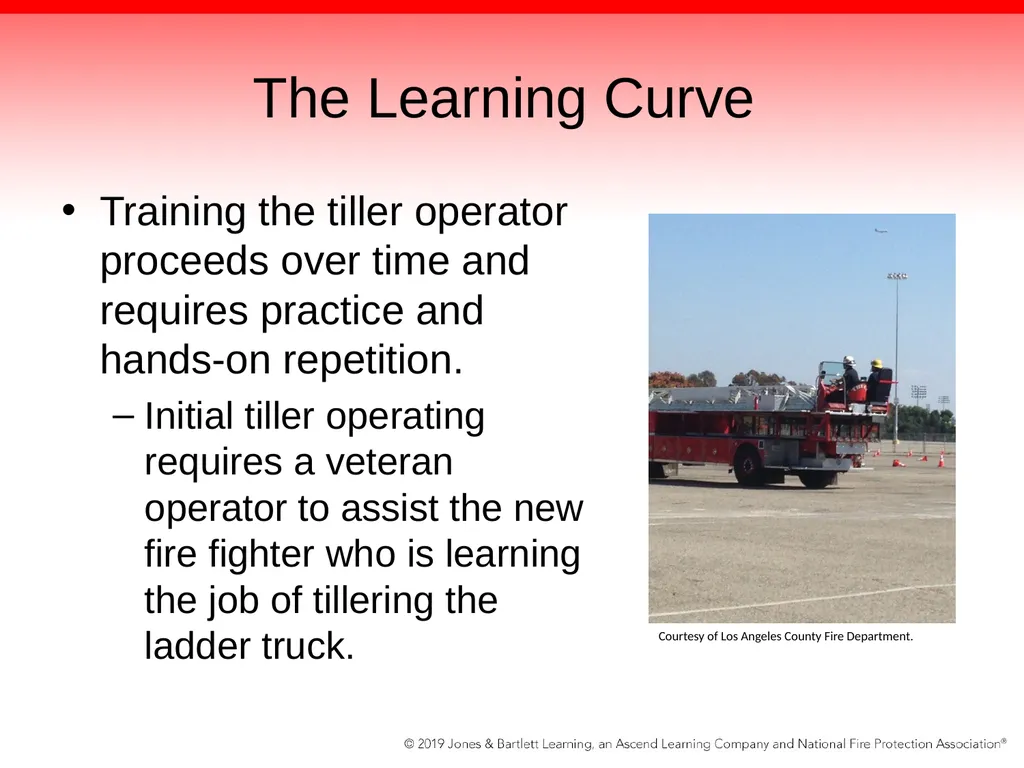
The Learning Curve Training the tiller operator proceeds over time and requires practice and hands-on repetition.
Initial tiller operating requires a veteran operator to assist the new fire fighter who is learning the job of tillering the ladder truck. Courtesy of Los Angeles County Fire Department.<br>
Initial tiller operating requires a veteran operator to assist the new fire fighter who is learning the job of tillering the ladder truck. Courtesy of Los Angeles County Fire Department.<br>
73
The Learning Curve Know your assigned district or neighborhood and become familiar with the obstacles that can affect rig placement.
As you survey the buildings in the area, identify those structures that you think would be extremely difficult and challenging to approach if they were to catch on fire.<br>
As you survey the buildings in the area, identify those structures that you think would be extremely difficult and challenging to approach if they were to catch on fire.<br>
74
The Learning Curve Take advantage of routine dispatches.
Offer great opportunities for driver/operators to familiarize themselves with apparatus placement
On the scene, position the rigs as if your company is arriving at a working fire.
Truck operator should become familiar with obstacles that might potentially affect the use of the aerial device at this address.<br>
75
The Learning Curve Building inspections offer another opportunity to familiarize yourself with good apparatus placement.
Check for any obstacles that might hinder engine and truck operations.
Discuss where the apparatus would be positioned if a fire call were to come in.<br>
Check for any obstacles that might hinder engine and truck operations.
Discuss where the apparatus would be positioned if a fire call were to come in.<br>
76
The Learning Curve Never assume you know where you are going.
Make sure you know the street, the cross streets, and the address of the incident before leaving the firehouse.
Ask the officer for verification and order of other apparatus responding to the scene.
Understand where other rigs are responding from.
Rigs will sometimes enter the same intersections within seconds while responding to the incident.<br>
77
The Learning Curve At the beginning of each shift, discuss neighborhood happenings that are occurring during the shift and may affect the response time or route.
Neighborhood block parties, parades, street festivals
If streets are closed, preplan the company’s response around those street closures.<br>
Neighborhood block parties, parades, street festivals
If streets are closed, preplan the company’s response around those street closures.<br>
78
When the Alarm Sounds Crew suits up and everybody gets onboard the apparatus, strapping on their seat belts and donning their headsets.
Teamwork between driver/operator and tiller operator begins with communication.
Tiller operator must be secure and ready in the tiller box for the rig to start.
Must press dead man switch in the tiller compartment before the driver/operator can start the apparatus<br>
Teamwork between driver/operator and tiller operator begins with communication.
Tiller operator must be secure and ready in the tiller box for the rig to start.
Must press dead man switch in the tiller compartment before the driver/operator can start the apparatus<br>
79
When the Alarm Sounds Driver/operator must know the preplanned route, the cross street for the reported incident, the responding companies from other firehouses, and traffic patterns.
Tiller operator must also know the response route so that he or she can anticipate any turns that the driver/operator may make to get to the incident.<br>
Tiller operator must also know the response route so that he or she can anticipate any turns that the driver/operator may make to get to the incident.<br>
80
When the Alarm Sounds Driver/operator must obey all traffic laws, operate the vehicle within safe speed limits, and always expect the unexpected.
Many civilian drivers are preoccupied while they are driving their personal vehicles.
Drivers may have their radios turned up, be talking on their cell phones, or be texting.
Very easy for civilian drivers to miss seeing fire apparatus responding with lights and sirens<br>
Many civilian drivers are preoccupied while they are driving their personal vehicles.
Drivers may have their radios turned up, be talking on their cell phones, or be texting.
Very easy for civilian drivers to miss seeing fire apparatus responding with lights and sirens<br>
81
When the Alarm Sounds When apparatus approaches an intersection against a stop sign or red light, driver/operator must bring rig to a complete stop before it can enter intersection.
After checking that the intersection is clear, driver/operator can proceed.
When the tiller approaches a major intersection with multiple traffic lanes crossing in both directions, the driver/operator must ensure that all traffic has come to a stop.<br>
After checking that the intersection is clear, driver/operator can proceed.
When the tiller approaches a major intersection with multiple traffic lanes crossing in both directions, the driver/operator must ensure that all traffic has come to a stop.<br>
82
Approaching the Incident In most cases, the engine company is the first company to show up on the scene.
Listen for the initial report and size-up of the first-due engine company.
As the ladder truck approaches the fire block, observe the actions of the engine crew.
Truck crew may not see fire or smoke.<br>
Listen for the initial report and size-up of the first-due engine company.
As the ladder truck approaches the fire block, observe the actions of the engine crew.
Truck crew may not see fire or smoke.<br>
83
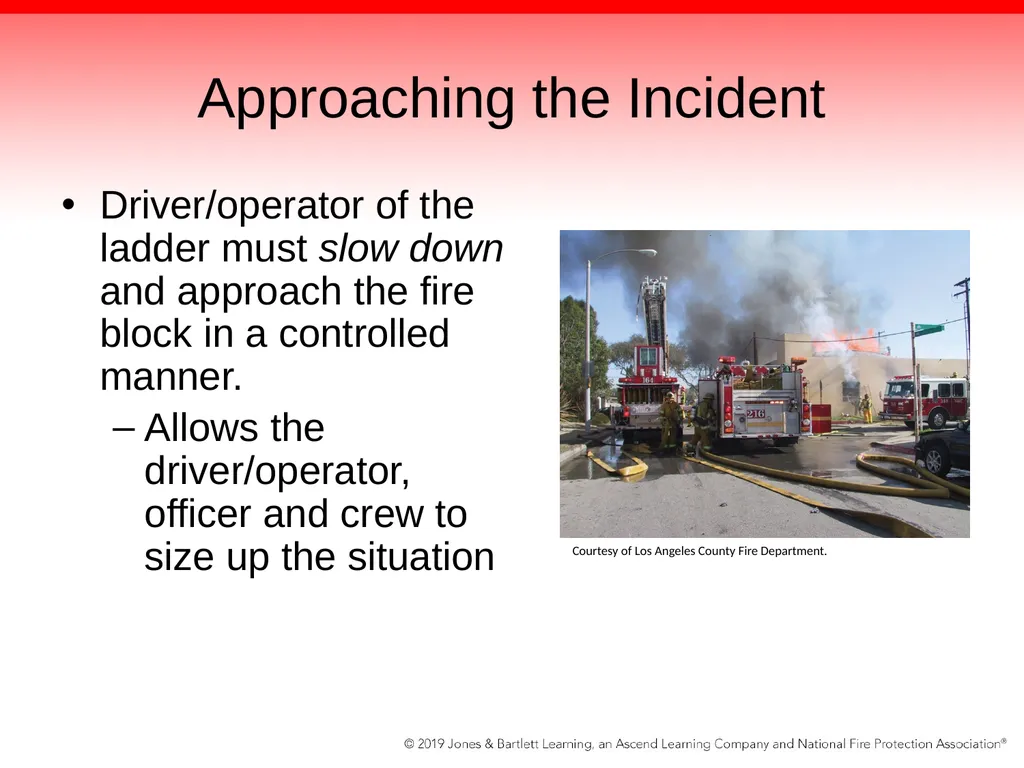
Approaching the Incident Driver/operator of the ladder must slow down and approach the fire block in a controlled manner.
Allows the driver/operator, officer and crew to size up the situation Courtesy of Los Angeles County Fire Department.<br>
Allows the driver/operator, officer and crew to size up the situation Courtesy of Los Angeles County Fire Department.<br>
84
Approaching the Incident Driver/operator must know the street address and recognize that odd- and even-numbered buildings are on opposite sides of the street.
Be aware of overhead obstructions, other fire apparatus, narrow streets, and parked cars.
When approaching driver/operator may (be asked to) hold a location outside the fire area due to many positioning factors<br>
Be aware of overhead obstructions, other fire apparatus, narrow streets, and parked cars.
When approaching driver/operator may (be asked to) hold a location outside the fire area due to many positioning factors<br>
85
Maneuvering and Positioning a Tiller Apparatus Initial positioning effort should be considered the only opportunity to place the apparatus.
Many factors must be considered in regard to aerial ladder placement.
Ladder truck must be placed in front of the incident building to utilize the aerial device.
Engine drivers and ladder truck driver/operators must work as a team to get all apparatus positioned appropriately.<br>
Many factors must be considered in regard to aerial ladder placement.
Ladder truck must be placed in front of the incident building to utilize the aerial device.
Engine drivers and ladder truck driver/operators must work as a team to get all apparatus positioned appropriately.<br>
86
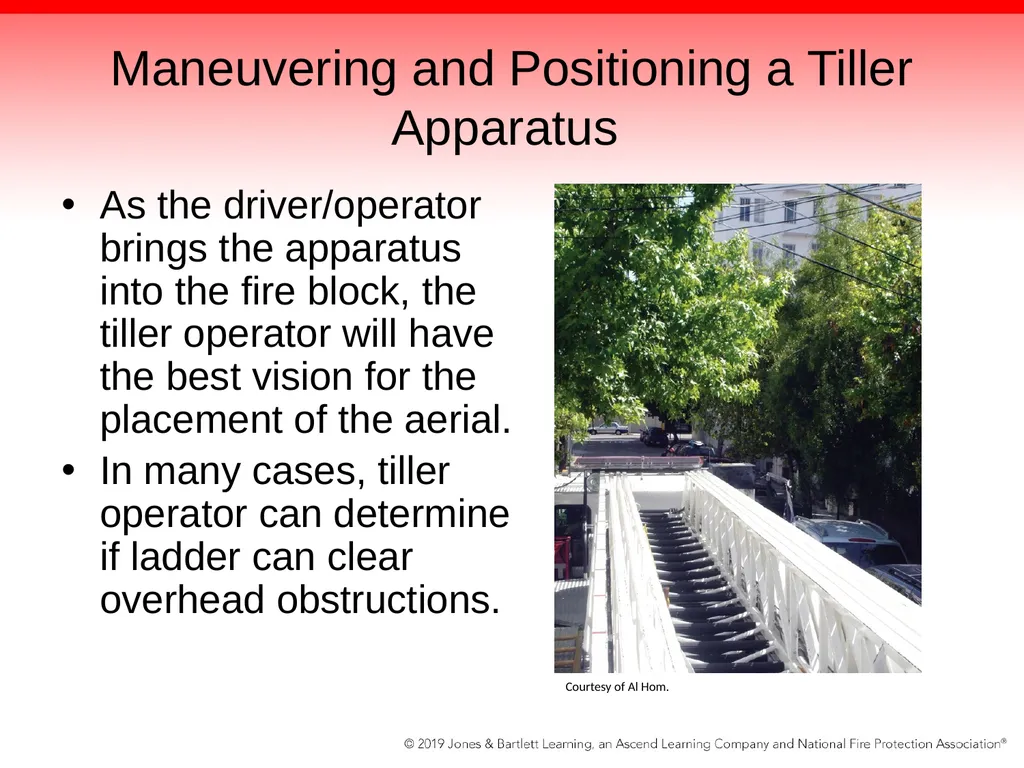
Maneuvering and Positioning a Tiller Apparatus As the driver/operator brings the apparatus into the fire block, the tiller operator will have the best vision for the placement of the aerial.
In many cases, tiller operator can determine if ladder can clear overhead obstructions. Courtesy of Al Hom.<br>
In many cases, tiller operator can determine if ladder can clear overhead obstructions. Courtesy of Al Hom.<br>
87
Maneuvering and Positioning a Tiller Apparatus In many older neighborhoods, overhead wires and power lines are still common.
Overhead wires will force the driver/operator to rotate the aerial device underneath the wires to get the ladder in position before it can be raised and extended.
Ideal distance from building is approx. 25-30 ft<br>
Overhead wires will force the driver/operator to rotate the aerial device underneath the wires to get the ladder in position before it can be raised and extended.
Ideal distance from building is approx. 25-30 ft<br>
88
Benefit of the Aerial Ladder Aerial device can be used for providing egress or rescue and is a major benefit when it comes to staffing and deployment of the crew.
It takes only one fire fighter to deploy the aerial on the fireground, freeing up other members of the truck crew to accomplish other tasks on the fireground.<br>
It takes only one fire fighter to deploy the aerial on the fireground, freeing up other members of the truck crew to accomplish other tasks on the fireground.<br>
89
Tactics May Determine the Placement IC may dictate where the ladder truck is to be placed and how the aerial is to be utilized.
Strategy depends on the specific conditions encountered.
When the strategy is offensive, many tactical decisions must be made.
Where no immediate rescue effort is required, the size of the building’s frontage may affect the aerial placement.<br>
Strategy depends on the specific conditions encountered.
When the strategy is offensive, many tactical decisions must be made.
Where no immediate rescue effort is required, the size of the building’s frontage may affect the aerial placement.<br>
90
Tactics May Determine the Placement Smoke, heat, and fire from the incident building could cause a dangerous exposure to the ladder and crew members.
With isolated buildings, survey all sides of the structure and ladder the least affected side.
In a city, homes may be attached to their neighbors at their sides.
Place the aerial so that it reaches the roof of one of the adjoining buildings.<br>
With isolated buildings, survey all sides of the structure and ladder the least affected side.
In a city, homes may be attached to their neighbors at their sides.
Place the aerial so that it reaches the roof of one of the adjoining buildings.<br>
91
Conditions Are Never Ideal No words can stress the importance of getting the aerial truck placed properly and utilizing the aerial ladder if needed.
These measures allow the crew to accomplish objectives of the truck company and make operations for the engine company much easier.
A misplaced truck can render the aerial ladder useless, block other incoming companies, and hamper the entire operation.<br>
These measures allow the crew to accomplish objectives of the truck company and make operations for the engine company much easier.
A misplaced truck can render the aerial ladder useless, block other incoming companies, and hamper the entire operation.<br>
92
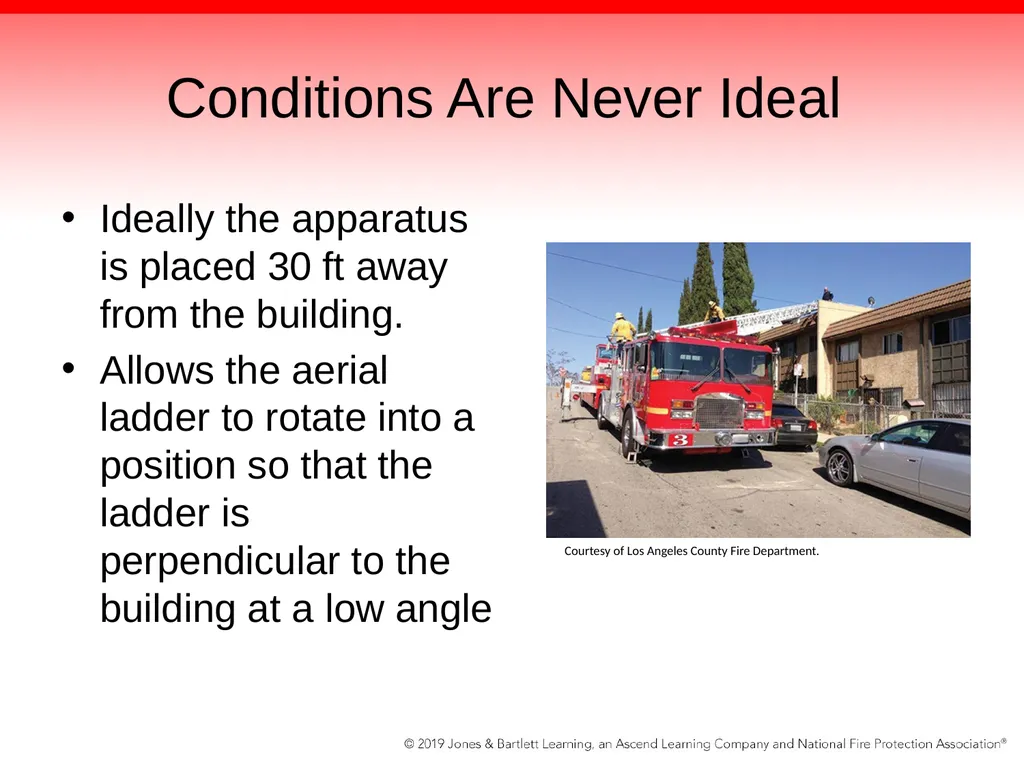
Conditions Are Never Ideal Ideally the apparatus is placed 30 ft away from the building.
Allows the aerial ladder to rotate into a position so that the ladder is perpendicular to the building at a low angle Courtesy of Los Angeles County Fire Department.<br>
Allows the aerial ladder to rotate into a position so that the ladder is perpendicular to the building at a low angle Courtesy of Los Angeles County Fire Department.<br>
93
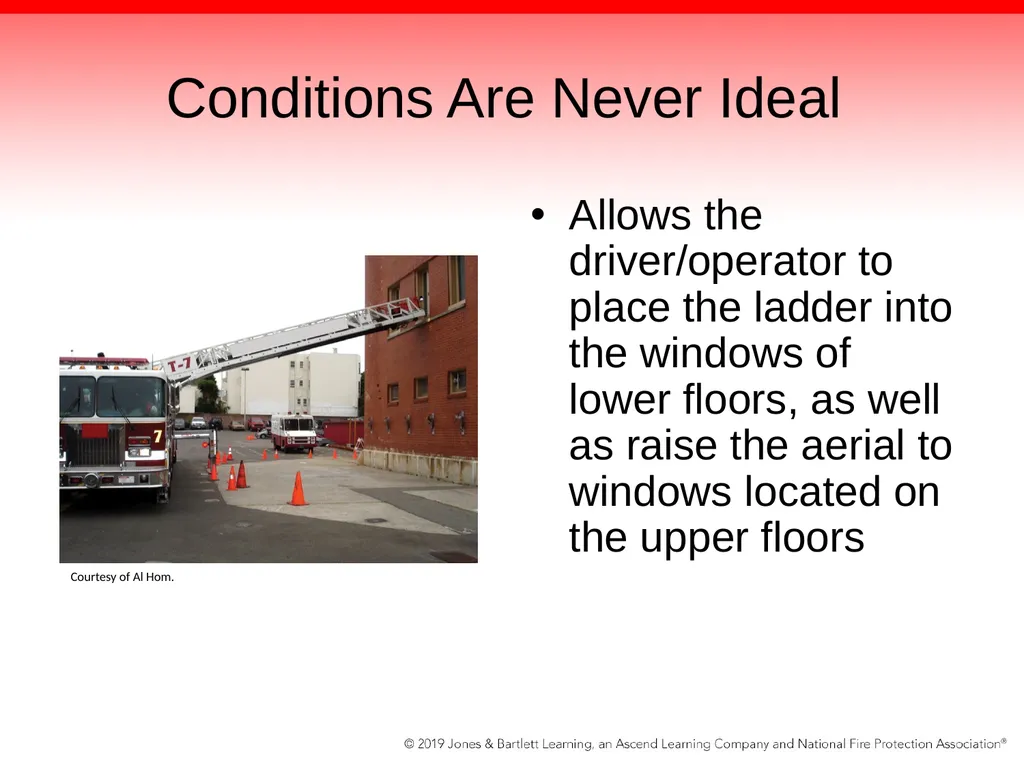
Conditions Are Never Ideal Allows the driver/operator to place the ladder into the windows of lower floors, as well as raise the aerial to windows located on the upper floors Courtesy of Al Hom.<br>
94
Conditions Are Never Ideal However, the fireground rarely presents ideal conditions.
Other instances may require creative ladder deployment.
Narrow streets
Overhead wires
Obstructions, such as trees<br>
Other instances may require creative ladder deployment.
Narrow streets
Overhead wires
Obstructions, such as trees<br>
95
Conditions Are Never Ideal In some situations, the truck may be the first apparatus on the scene.
If there is room to deploy the aerial, the driver/operator should immediately position the apparatus and deploy the aerial while leaving room for the incoming engine company.
If there is no room to deploy the aerial device, the driver/operator should consider placing the apparatus away from the building.<br>
96
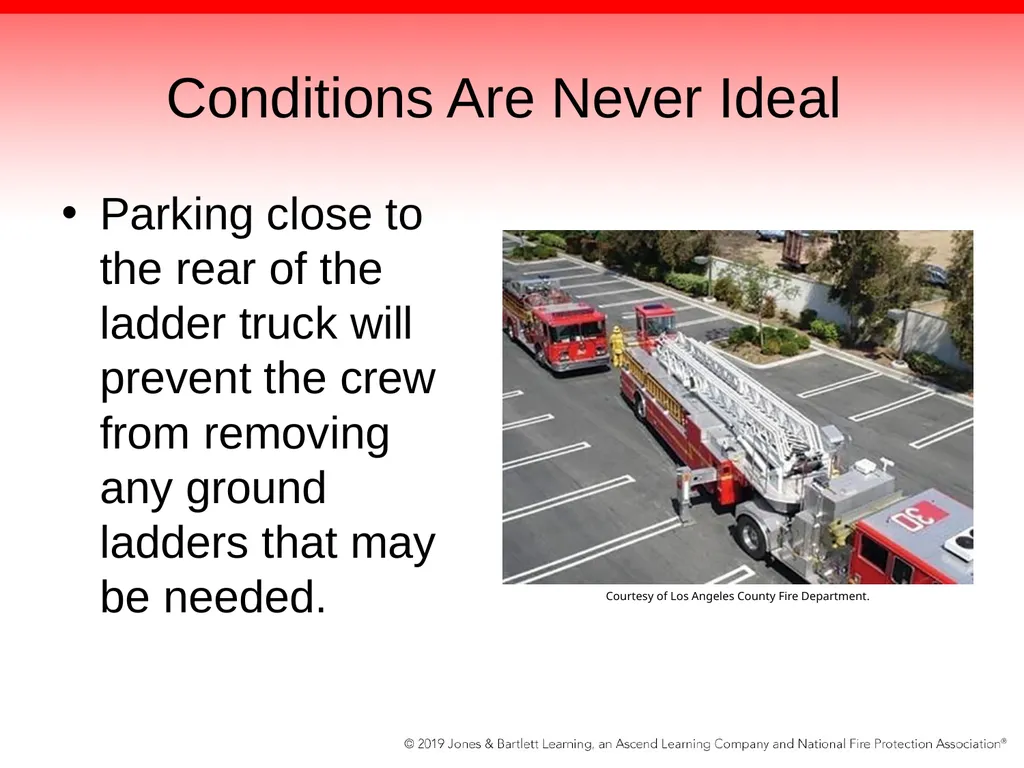
Conditions Are Never Ideal Parking close to the rear of the ladder truck will prevent the crew from removing any ground ladders that may be needed. Courtesy of Los Angeles County Fire Department.<br>
97
Summary Proper driver/operator and tiller operator signaling include audio communications, using turn signals, and using the beeper.
Smooth coordinated tillering operations are required when making a right-hand turn from a dedicated right-hand turn lane, backing up, maneuvering the apparatus around obstacles from left to right, and performing a confined space turn-around.<br>
Smooth coordinated tillering operations are required when making a right-hand turn from a dedicated right-hand turn lane, backing up, maneuvering the apparatus around obstacles from left to right, and performing a confined space turn-around.<br>
98
Summary Maneuvering the direction of the tiller wheels include planning your turn ahead of time and being set up for the turn in advance.
The tiller operator should always maintain the trailer portion of the apparatus in-line with the tractor unless involved in a driving maneuver.
The tiller operator should quickly bring the trailer back in-line after making turns to avoid over-steering.<br>
The tiller operator should always maintain the trailer portion of the apparatus in-line with the tractor unless involved in a driving maneuver.
The tiller operator should quickly bring the trailer back in-line after making turns to avoid over-steering.<br>
99
Summary The tiller operator should avoid over-tillering or any rough and jerky movements from unnecessarily turning the steering wheel.
The tiller operator needs to be continuously aware of the trailer overhang when making turns. The overhang of the trailer can work like a pendulum and strike objects if not careful.<br>
The tiller operator needs to be continuously aware of the trailer overhang when making turns. The overhang of the trailer can work like a pendulum and strike objects if not careful.<br>
100
Summary The tiller operator skill of negotiating right-handed turns from a dedicated right turn lane is difficult but can be mastered with practice.
The qualifications and certifications for tiller operator are determined by each fire department.<br>
The qualifications and certifications for tiller operator are determined by each fire department.<br>