
Chapter 16 Training and Development:
PC
Published · 30 slides · 0 views
1 / 1
Description
Chapter 16 Training and Development: Implementation and the Measurement of Outcomes Cascio Aguinis, Applied Psychology in Talent Management, 8e. SAGE Publishing, 2019. Learning Goals (1 of 3) 16-1: Classify training methods as
Related Topics
Share
Embed code
Download this presentation From Below
"Chapter 16 Training and Development:" is the property of its rightful owner. Permission is granted to download and print the materials on this website for personal, non-commercial use only, and to display it on your personal computer provided you do not modify the materials and that you retain all copyright notices contained in the materials. By downloading content from our website, you accept the terms of this agreement.
Presentation Transcript
01
Chapter 16
Training and Development: Implementation and the Measurement of Outcomes<br>
Training and Development: Implementation and the Measurement of Outcomes<br>
02
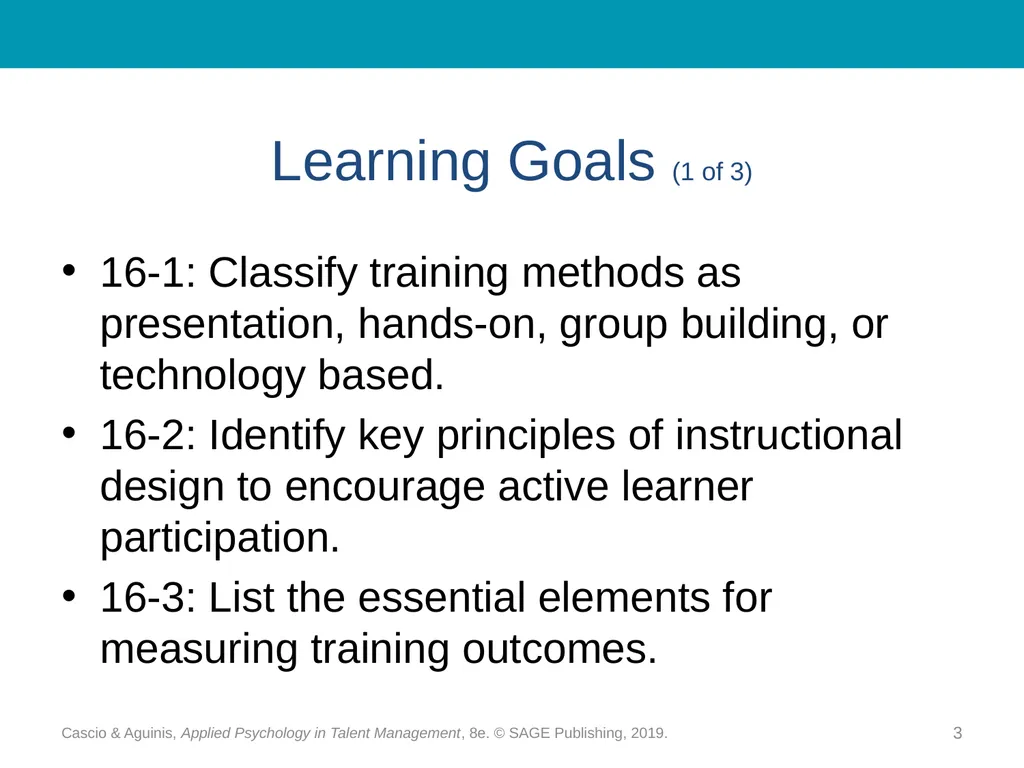
Cascio & Aguinis, Applied Psychology in Talent Management, 8e. © SAGE Publishing, 2019. Learning Goals (1 of 3) 16-1: Classify training methods as presentation, hands-on, group building, or technology based.
16-2: Identify key principles of instructional design to encourage active learner participation.
16-3: List the essential elements for measuring training outcomes. 3<br>
16-2: Identify key principles of instructional design to encourage active learner participation.
16-3: List the essential elements for measuring training outcomes. 3<br>
03
Cascio & Aguinis, Applied Psychology in Talent Management, 8e. © SAGE Publishing, 2019. Learning Goals (2 of 3) 16-4: Explain the advantages and disadvantages of ROI and utility analysis as methods for assessing the financial outcomes of learning and development activities.
16-5: Identify potential contaminants or threats to valid interpretations of findings from field research. 4<br>
16-5: Identify potential contaminants or threats to valid interpretations of findings from field research. 4<br>
04
Cascio & Aguinis, Applied Psychology in Talent Management, 8e. © SAGE Publishing, 2019. Learning Goals (3 of 3) 16-6: Distinguish experimental from quasi-experimental designs.
16-7: Describe the limitations of experimental and quasi-experimental designs.
16-8: In assessing the outcomes of training efforts, distinguish statistically significant effects from practically significant effects. 5<br>
16-7: Describe the limitations of experimental and quasi-experimental designs.
16-8: In assessing the outcomes of training efforts, distinguish statistically significant effects from practically significant effects. 5<br>
05
Cascio & Aguinis, Applied Psychology in Talent Management, 8e. © SAGE Publishing, 2019. Training Methods (1 of 2) Presentation methods
Lectures
Videos
Hands-on methods
On-the-job training
Self-directed learning
Apprenticeship
Simulations 6<br>
Lectures
Videos
Hands-on methods
On-the-job training
Self-directed learning
Apprenticeship
Simulations 6<br>
06
Cascio & Aguinis, Applied Psychology in Talent Management, 8e. © SAGE Publishing, 2019. Training Methods (2 of 2) Group-building methods
Adventure learning
Team training
Action learning
Organization development 7<br>
Adventure learning
Team training
Action learning
Organization development 7<br>
07
Cascio & Aguinis, Applied Psychology in Talent Management, 8e. © SAGE Publishing, 2019. Technology-Based Training (1 of 5) Technology-based training
E-learning
Webcasts or webinars
Podcasts
Mobile learning
Blended learning 8<br>
E-learning
Webcasts or webinars
Podcasts
Mobile learning
Blended learning 8<br>
08
Cascio & Aguinis, Applied Psychology in Talent Management, 8e. © SAGE Publishing, 2019. Technology-Based Training (2 of 5) Technology-based training
Wikis
Distance learning
Social media
Shared workspaces
RSS (real simple syndication) feeds 9<br>
Wikis
Distance learning
Social media
Shared workspaces
RSS (real simple syndication) feeds 9<br>
09
Cascio & Aguinis, Applied Psychology in Talent Management, 8e. © SAGE Publishing, 2019. Technology-Based Training (3 of 5) Technology-based training
Blogs
Micro-blogs or microsharing
Chat rooms and discussion boards
Massive, open, online courses (MOOCS)
Adaptive training 10<br>
Blogs
Micro-blogs or microsharing
Chat rooms and discussion boards
Massive, open, online courses (MOOCS)
Adaptive training 10<br>
10
Cascio & Aguinis, Applied Psychology in Talent Management, 8e. © SAGE Publishing, 2019. Technology-Based Training (4 of 5) Instructional design principles
Design information structure and presentation to reflect both meaningful organization of material and ease of use
Balance need for learner control with guidance to help learners make better choices about content and process 11<br>
Design information structure and presentation to reflect both meaningful organization of material and ease of use
Balance need for learner control with guidance to help learners make better choices about content and process 11<br>
11
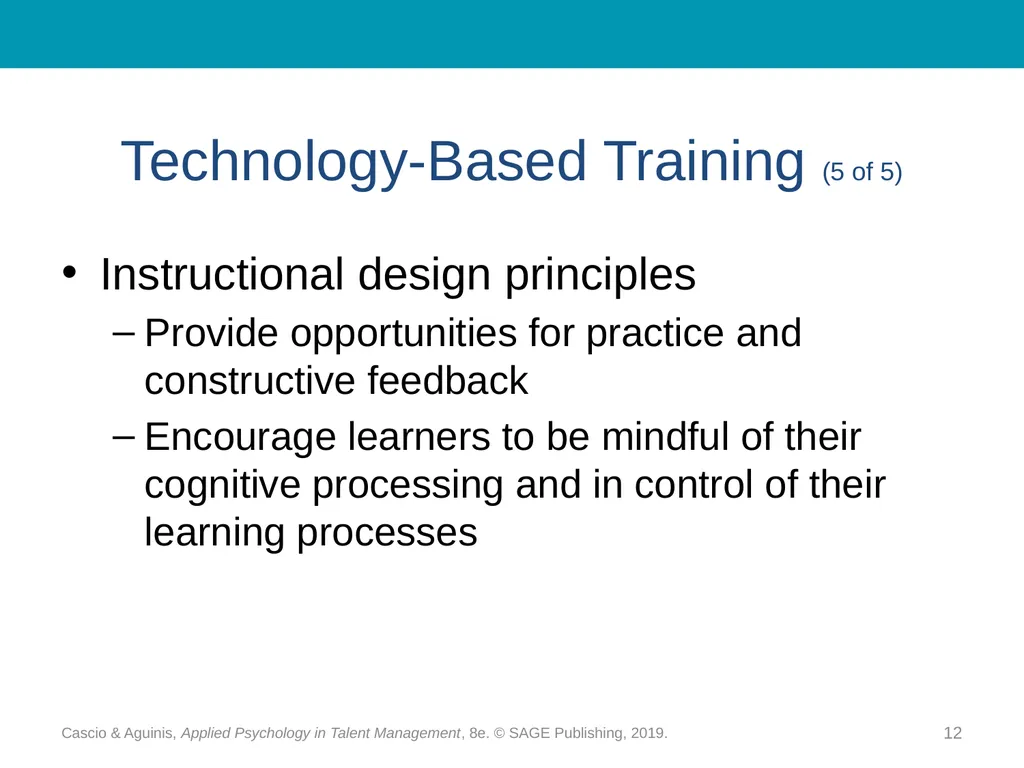
Cascio & Aguinis, Applied Psychology in Talent Management, 8e. © SAGE Publishing, 2019. Technology-Based Training (5 of 5) Instructional design principles
Provide opportunities for practice and constructive feedback
Encourage learners to be mindful of their cognitive processing and in control of their learning processes 12<br>
Provide opportunities for practice and constructive feedback
Encourage learners to be mindful of their cognitive processing and in control of their learning processes 12<br>
12
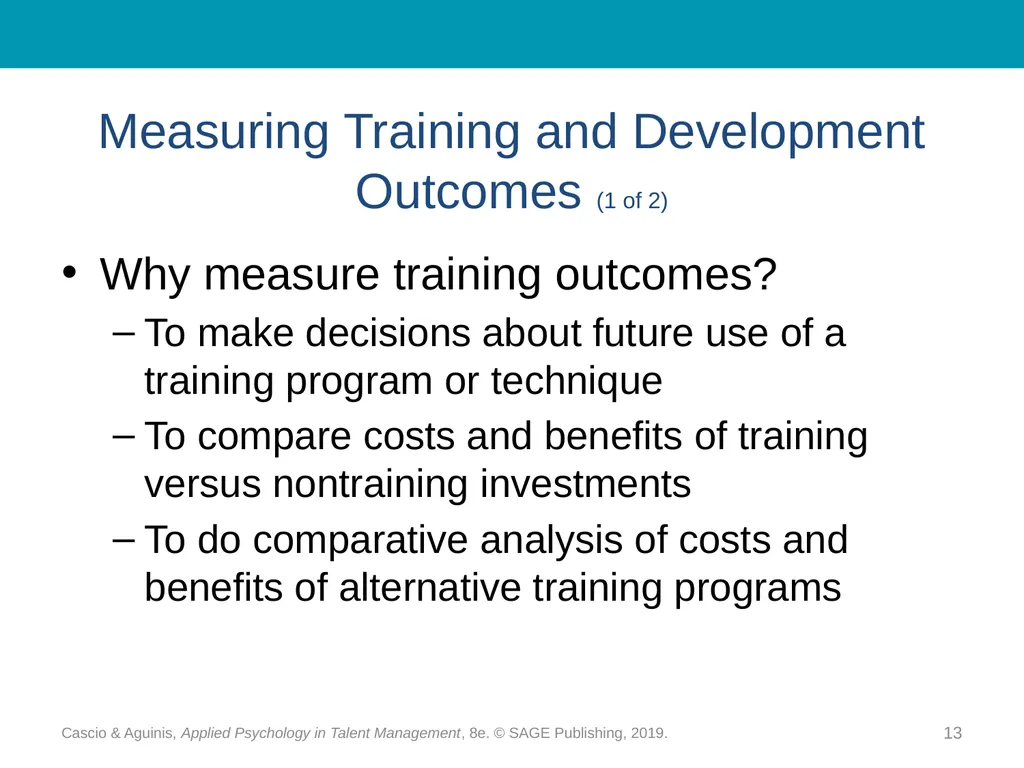
Cascio & Aguinis, Applied Psychology in Talent Management, 8e. © SAGE Publishing, 2019. Measuring Training and Development Outcomes (1 of 2) Why measure training outcomes?
To make decisions about future use of a training program or technique
To compare costs and benefits of training versus nontraining investments
To do comparative analysis of costs and benefits of alternative training programs 13<br>
To make decisions about future use of a training program or technique
To compare costs and benefits of training versus nontraining investments
To do comparative analysis of costs and benefits of alternative training programs 13<br>
13
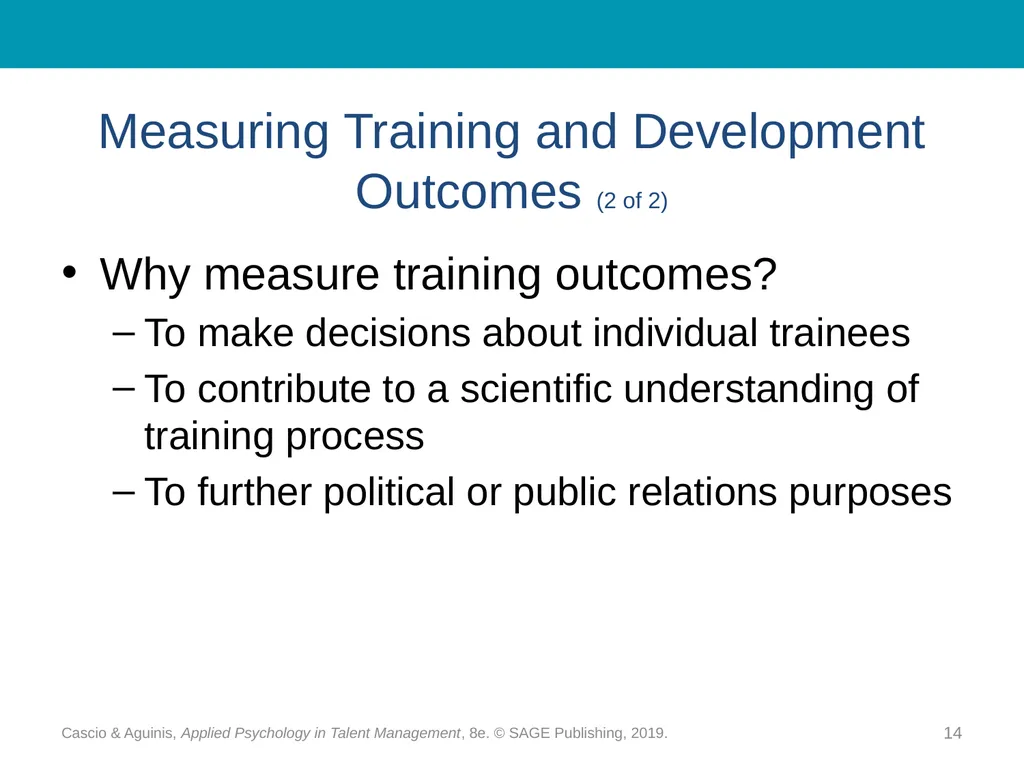
Cascio & Aguinis, Applied Psychology in Talent Management, 8e. © SAGE Publishing, 2019. Measuring Training and Development Outcomes (2 of 2) Why measure training outcomes?
To make decisions about individual trainees
To contribute to a scientific understanding of training process
To further political or public relations purposes 14<br>
To make decisions about individual trainees
To contribute to a scientific understanding of training process
To further political or public relations purposes 14<br>
14
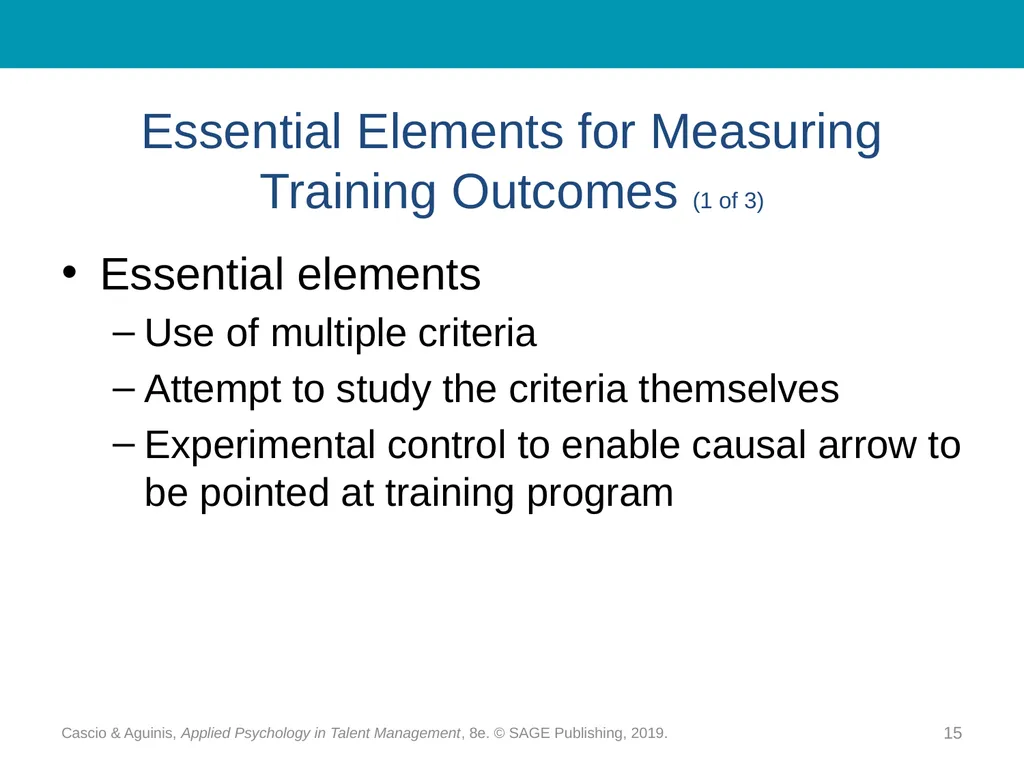
Cascio & Aguinis, Applied Psychology in Talent Management, 8e. © SAGE Publishing, 2019. Essential Elements for Measuring Training Outcomes (1 of 3) Essential elements
Use of multiple criteria
Attempt to study the criteria themselves
Experimental control to enable causal arrow to be pointed at training program 15<br>
Use of multiple criteria
Attempt to study the criteria themselves
Experimental control to enable causal arrow to be pointed at training program 15<br>
15
Cascio & Aguinis, Applied Psychology in Talent Management, 8e. © SAGE Publishing, 2019. Essential Elements for Measuring Training Outcomes (2 of 3) Essential elements
Provision for saying something about practical and theoretical significance of results
Thorough, logical analysis of process and content of training
Effort to deal with “systems” aspects of training impact 16<br>
Provision for saying something about practical and theoretical significance of results
Thorough, logical analysis of process and content of training
Effort to deal with “systems” aspects of training impact 16<br>
16
Cascio & Aguinis, Applied Psychology in Talent Management, 8e. © SAGE Publishing, 2019. Essential Elements for Measuring Training Outcomes (3 of 3) ROI
Program profits to invested capital
Advantage
Simple and widely accepted
Disadvantages
Much subjectivity
Fails to consider how investments work together as a portfolio 17<br>
Program profits to invested capital
Advantage
Simple and widely accepted
Disadvantages
Much subjectivity
Fails to consider how investments work together as a portfolio 17<br>
17
Cascio & Aguinis, Applied Psychology in Talent Management, 8e. © SAGE Publishing, 2019. Classical Experimental Design
(1 of 6) Experimental design
Plan or outline for conceptualizing relations among variables of research study
How to control research situation and how to analyze data
Used with either internal or external criteria 18<br>
Plan or outline for conceptualizing relations among variables of research study
How to control research situation and how to analyze data
Used with either internal or external criteria 18<br>
18
Cascio & Aguinis, Applied Psychology in Talent Management, 8e. © SAGE Publishing, 2019. Classical Experimental Design
(2 of 6) Contaminants or threats may affect:
Statistical-conclusion validity
Internal validity
Construct validity
External validity 19<br>
Statistical-conclusion validity
Internal validity
Construct validity
External validity 19<br>
19
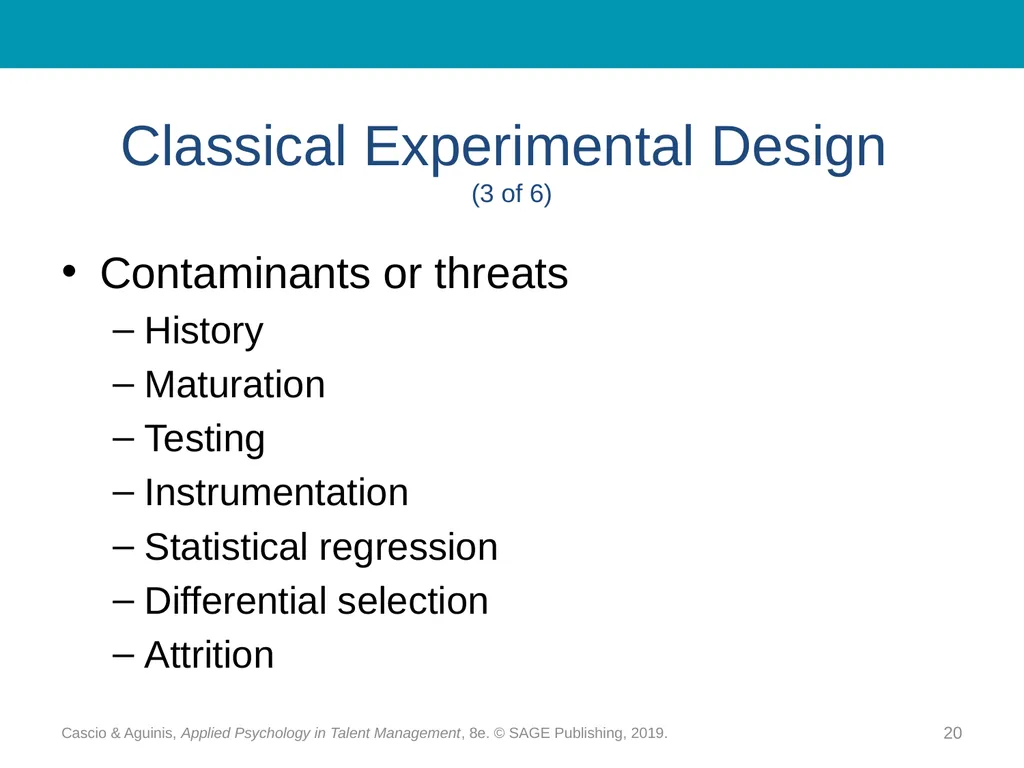
Cascio & Aguinis, Applied Psychology in Talent Management, 8e. © SAGE Publishing, 2019. Classical Experimental Design
(3 of 6) Contaminants or threats
History
Maturation
Testing
Instrumentation
Statistical regression
Differential selection
Attrition 20<br>
History
Maturation
Testing
Instrumentation
Statistical regression
Differential selection
Attrition 20<br>
20
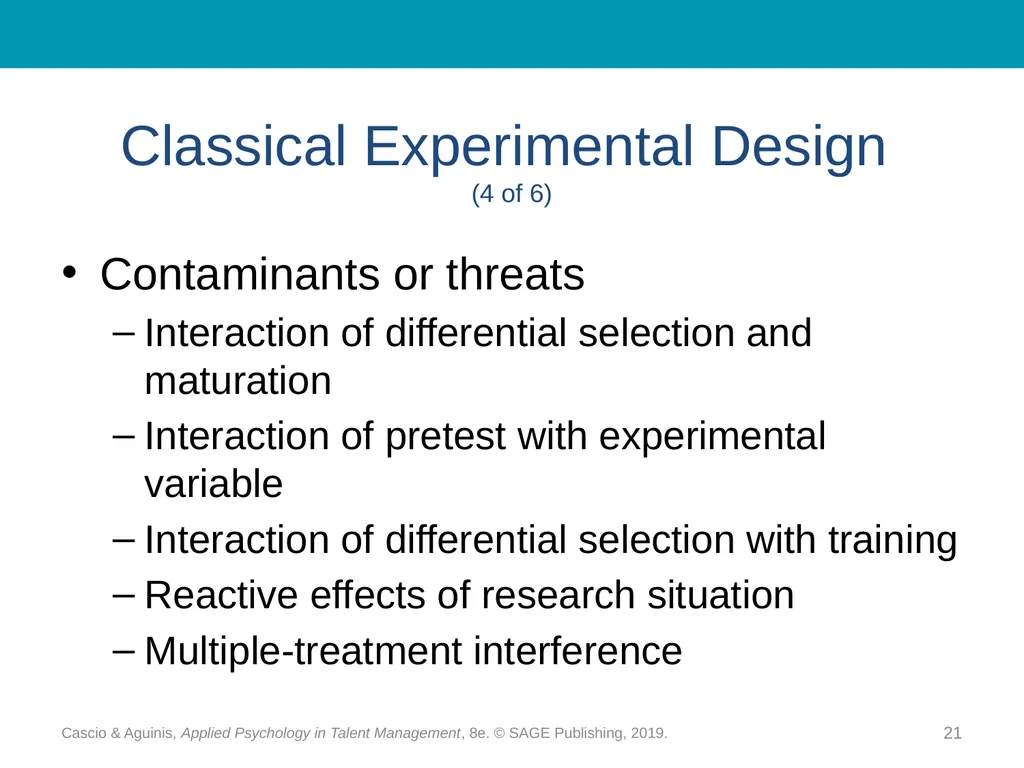
Cascio & Aguinis, Applied Psychology in Talent Management, 8e. © SAGE Publishing, 2019. Classical Experimental Design
(4 of 6) Contaminants or threats
Interaction of differential selection and maturation
Interaction of pretest with experimental variable
Interaction of differential selection with training
Reactive effects of research situation
Multiple-treatment interference 21<br>
Interaction of differential selection and maturation
Interaction of pretest with experimental variable
Interaction of differential selection with training
Reactive effects of research situation
Multiple-treatment interference 21<br>
21
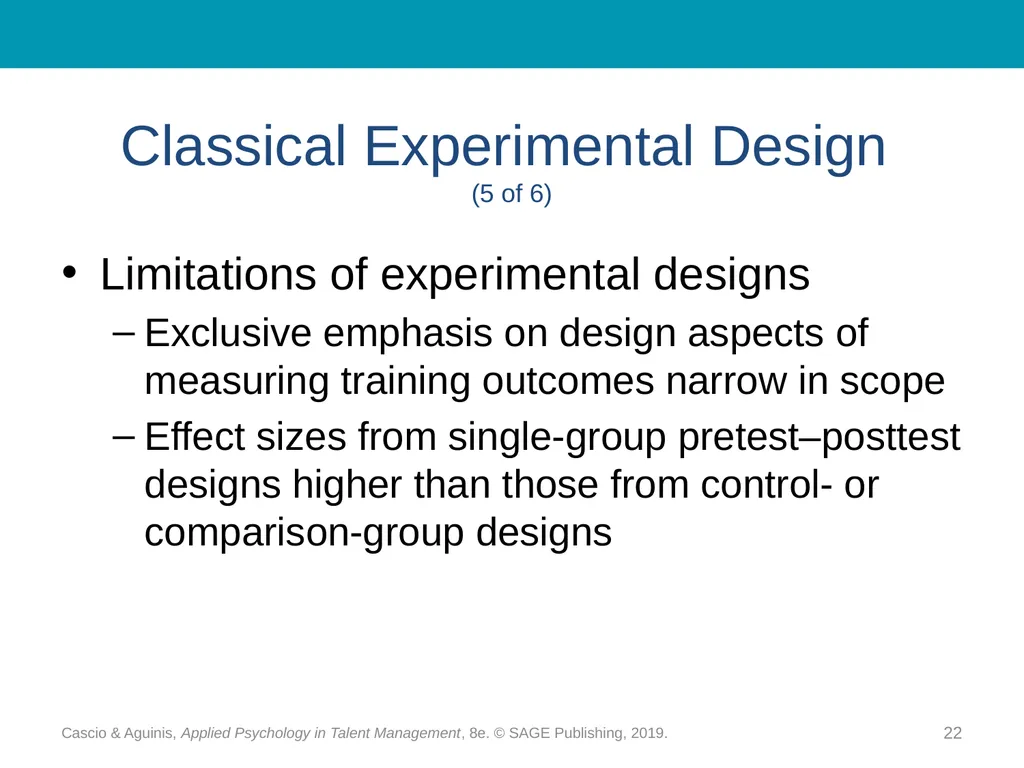
Cascio & Aguinis, Applied Psychology in Talent Management, 8e. © SAGE Publishing, 2019. Classical Experimental Design
(5 of 6) Limitations of experimental designs
Exclusive emphasis on design aspects of measuring training outcomes narrow in scope
Effect sizes from single-group pretest–posttest designs higher than those from control- or comparison-group designs 22<br>
Exclusive emphasis on design aspects of measuring training outcomes narrow in scope
Effect sizes from single-group pretest–posttest designs higher than those from control- or comparison-group designs 22<br>
22
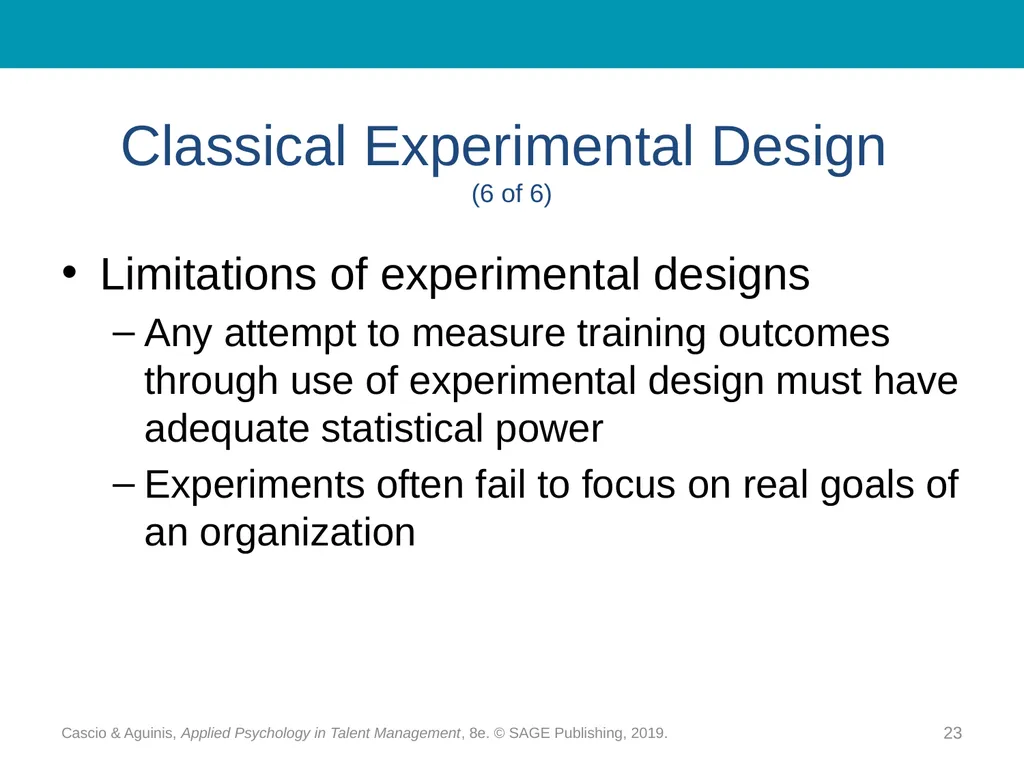
Cascio & Aguinis, Applied Psychology in Talent Management, 8e. © SAGE Publishing, 2019. Classical Experimental Design
(6 of 6) Limitations of experimental designs
Any attempt to measure training outcomes through use of experimental design must have adequate statistical power
Experiments often fail to focus on real goals of an organization 23<br>
Any attempt to measure training outcomes through use of experimental design must have adequate statistical power
Experiments often fail to focus on real goals of an organization 23<br>
23
Cascio & Aguinis, Applied Psychology in Talent Management, 8e. © SAGE Publishing, 2019. Quasi-Experimental Design (1 of 3) Strategies for overcoming deterrents to field experimentation:
Avoidance of jargon
Explaining randomization to lay managers
Transforming proprietary data
Using emerging technologies 24<br>
Avoidance of jargon
Explaining randomization to lay managers
Transforming proprietary data
Using emerging technologies 24<br>
24
Cascio & Aguinis, Applied Psychology in Talent Management, 8e. © SAGE Publishing, 2019. Quasi-Experimental Design (2 of 3) Quasi-experimental designs
Lack of randomly created, preexperimental equivalence, which degrades internal validity
Purpose of experiment: eliminate alternative hypotheses that might explain results 25<br>
Lack of randomly created, preexperimental equivalence, which degrades internal validity
Purpose of experiment: eliminate alternative hypotheses that might explain results 25<br>
25
Cascio & Aguinis, Applied Psychology in Talent Management, 8e. © SAGE Publishing, 2019. Quasi-Experimental Design (3 of 3) Quasi-experimental designs
Important to know which specific variables uncontrolled in a particular design
Where full control not possible, use most rigorous design possible 26<br>
Important to know which specific variables uncontrolled in a particular design
Where full control not possible, use most rigorous design possible 26<br>
26
Cascio & Aguinis, Applied Psychology in Talent Management, 8e. © SAGE Publishing, 2019. Statistical, Practical, and Theoretical Significance (1 of 2) Practical significance
Reflected in terms of effect sizes or measures of variance accounted for
Effects of training do make a difference to organizational goals 27<br>
Reflected in terms of effect sizes or measures of variance accounted for
Effects of training do make a difference to organizational goals 27<br>
27
Cascio & Aguinis, Applied Psychology in Talent Management, 8e. © SAGE Publishing, 2019. Statistical, Practical, and Theoretical Significance (2 of 2) Relationship between practical and theoretical significance
Systematic research to evaluate effects of independent variables likely to affect training outcomes 28<br>
Systematic research to evaluate effects of independent variables likely to affect training outcomes 28<br>
28
Cascio & Aguinis, Applied Psychology in Talent Management, 8e. © SAGE Publishing, 2019. Logical Analysis Process and content of training programs can enhance understanding of why results obtained
Qualitative and quantitative criteria important for understanding of training’s effects 29<br>
Qualitative and quantitative criteria important for understanding of training’s effects 29<br>
29
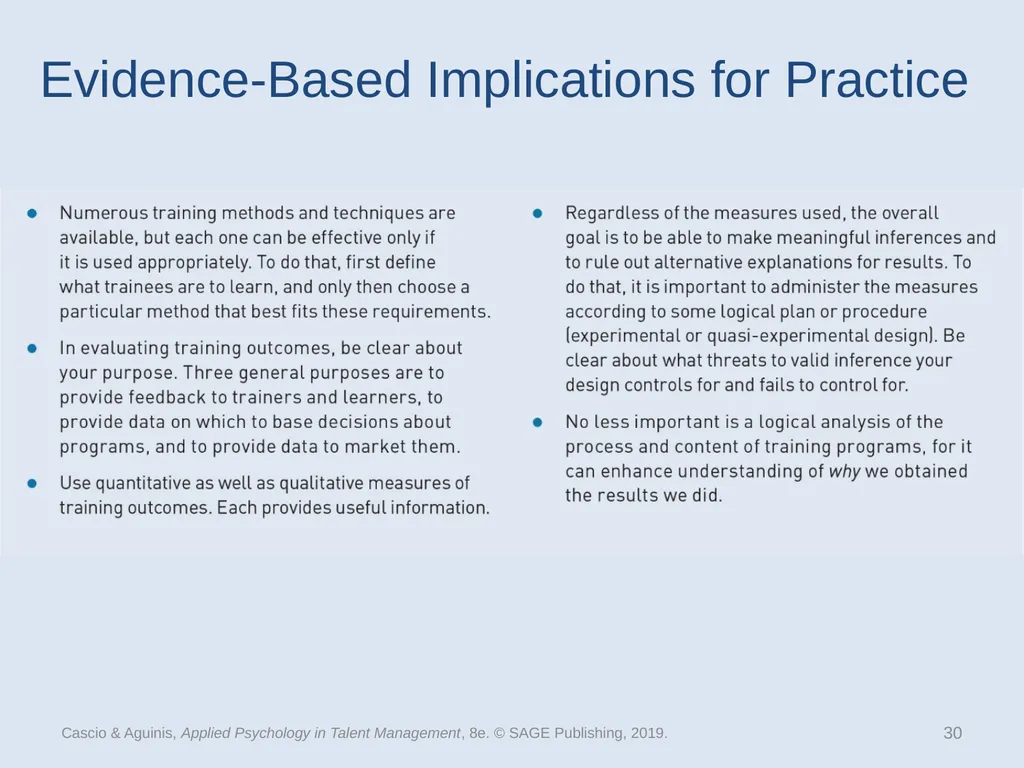
Cascio & Aguinis, Applied Psychology in Talent Management, 8e. © SAGE Publishing, 2019. 30 Evidence-Based Implications for Practice<br>