02
Objectives Discuss the strategic goals, tactical objectives, and firefighting considerations applicable to:
passenger cars, vans, and light-duty trucks,
large commercial trucks and semitrailers,
recreational vehicles,
heavy construction equipment, and
transportation vehicles and buses.<br>
04
Fires in Passenger Vehicles Overview
Consider the car’s unique features.
Doors
Hoods
Seat configuration
Battery location
Passenger devices
Engine type and location
Type of fuel
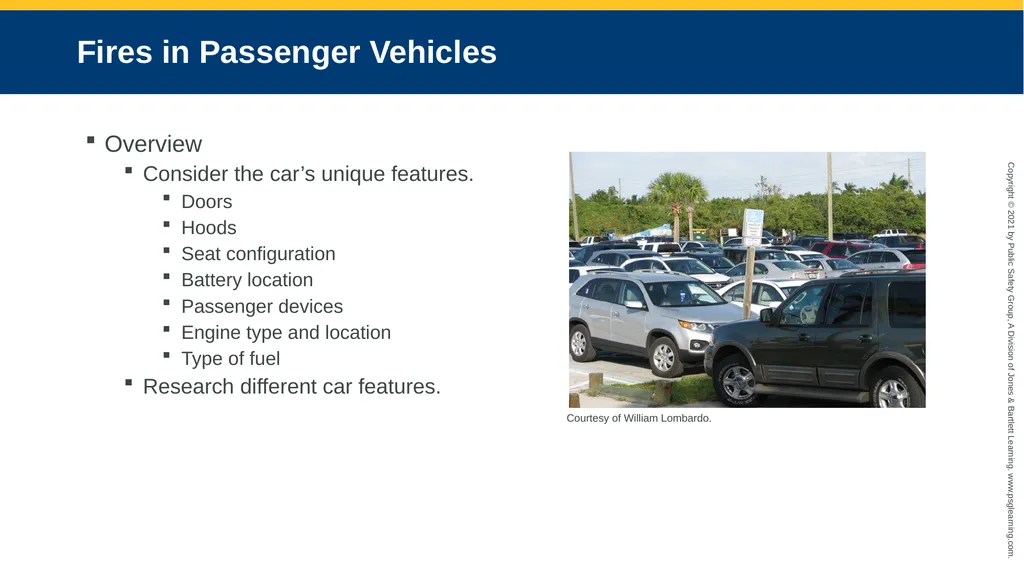
Research different car features. Courtesy of William Lombardo.<br>
05
Fires in Passenger Vehicles Hazards encountered
Vehicle components
Potentially hazardous components
Air bags and air bag systems
Other safety systems
Alternative fuels
LPG and CNG
Hybrid and electric
Emerging alternative fuels
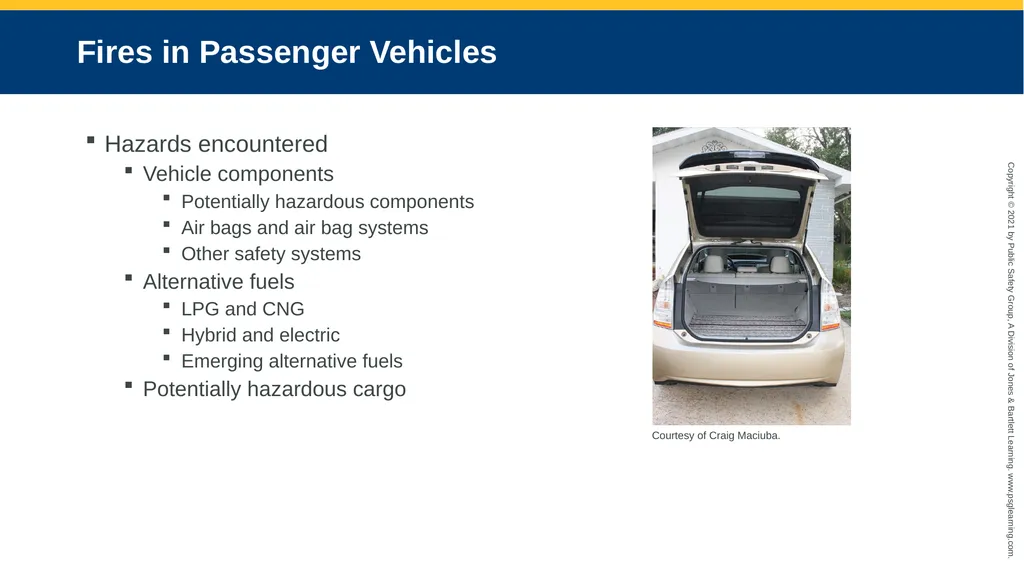
Potentially hazardous cargo Courtesy of Craig Maciuba.<br>
06
Fires in Passenger Vehicles Strategic goals and tactical objectives
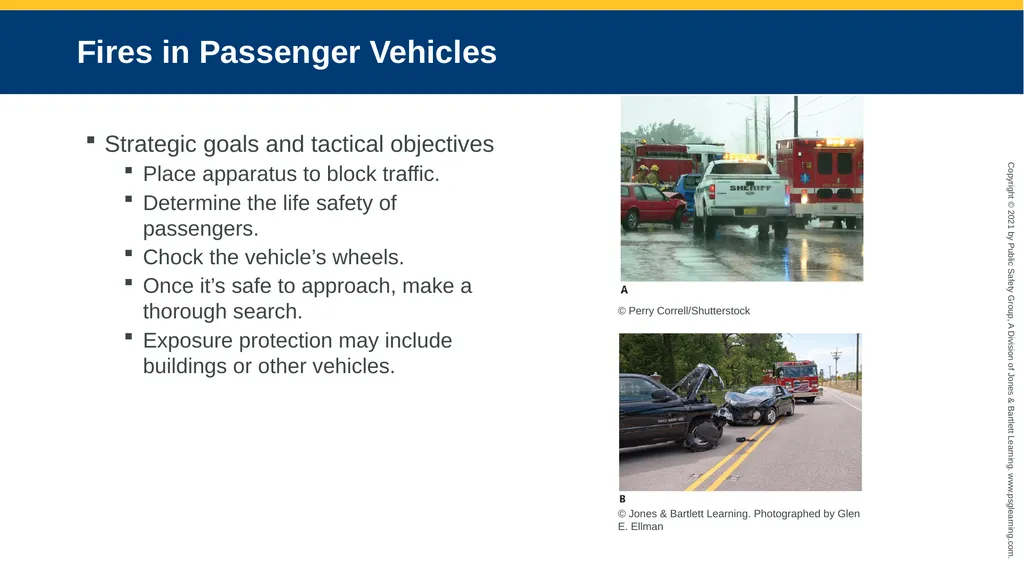
Place apparatus to block traffic.
Determine the life safety of passengers.
Chock the vehicle’s wheels.
Once it’s safe to approach, make a thorough search.
Exposure protection may include buildings or other vehicles. © Perry Correll/Shutterstock © Jones & Bartlett Learning. Photographed by Glen E. Ellman<br>
07
Fires in Passenger Vehicles Strategic goals and tactical objectives (cont’d)
Keep an engine fire from extending into the passenger compartment.
Water is the extinguishing agent of choice.
Breaking windows may be necessary.
Impact-resistant glass makes ventilation difficult.
Open all compartments.<br>
08
Fires in Passenger Vehicles Strategic goals and tactical objectives (cont’d)
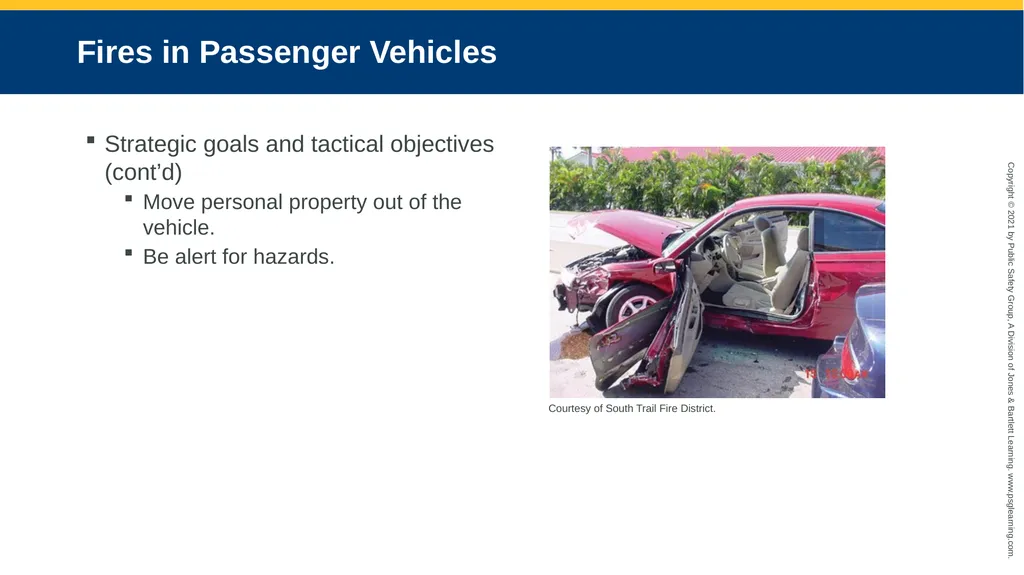
Move personal property out of the vehicle.
Be alert for hazards. Courtesy of South Trail Fire District.<br>
09
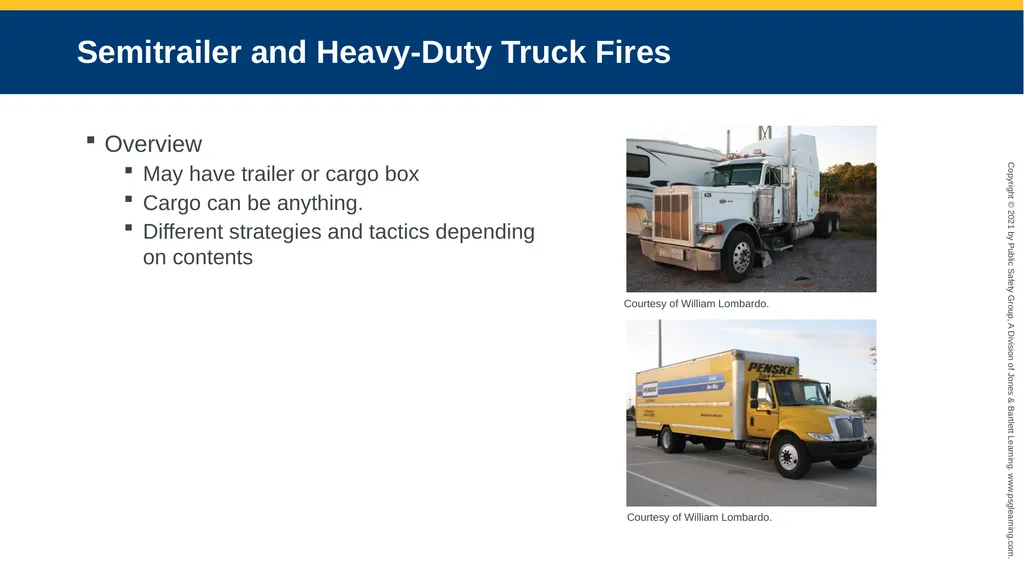
Semitrailer and Heavy-Duty Truck Fires Overview
May have trailer or cargo box
Cargo can be anything.
Different strategies and tactics depending on contents Courtesy of William Lombardo. Courtesy of William Lombardo.<br>
10
Semitrailer and Heavy-Duty Truck Fires Hazards encountered
Cargo
Inaccessibility of the cab
Material burning in the trailer
Saddle tanks Courtesy of William Lombardo Courtesy of William Lombardo.<br>
11
Semitrailer and Heavy-Duty Truck Fires Strategic goals and tactical objectives
Large amounts of cargo may be present.
Hose lines should protect the passenger compartment and sleeping area.
Evacuation will be based on likelihood of fire spread and danger to people.
Confinement is accomplished through extinguishment.<br>
12
Semitrailer and Heavy-Duty Truck Fires Strategic goals and tactical objectives (cont’d)
To ventilate: doors and windows, cut holes, PPV
Check all compartments for extension.
Off-load the products.
Salvage personal items and trailer contents.<br>
13
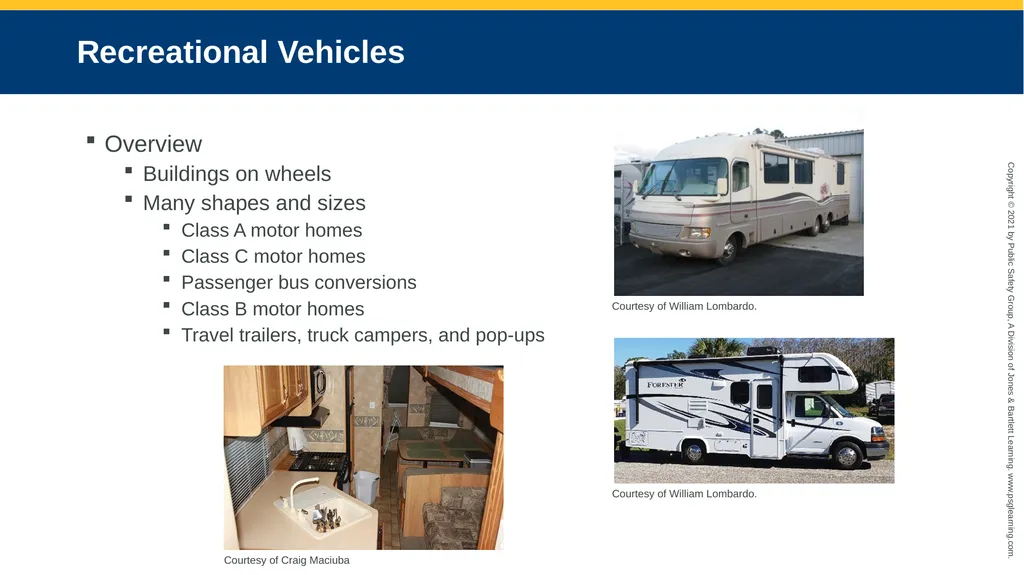
Recreational Vehicles Overview
Buildings on wheels
Many shapes and sizes
Class A motor homes
Class C motor homes
Passenger bus conversions
Class B motor homes
Travel trailers, truck campers, and pop-ups Courtesy of Craig Maciuba Courtesy of William Lombardo. Courtesy of William Lombardo.<br>
14
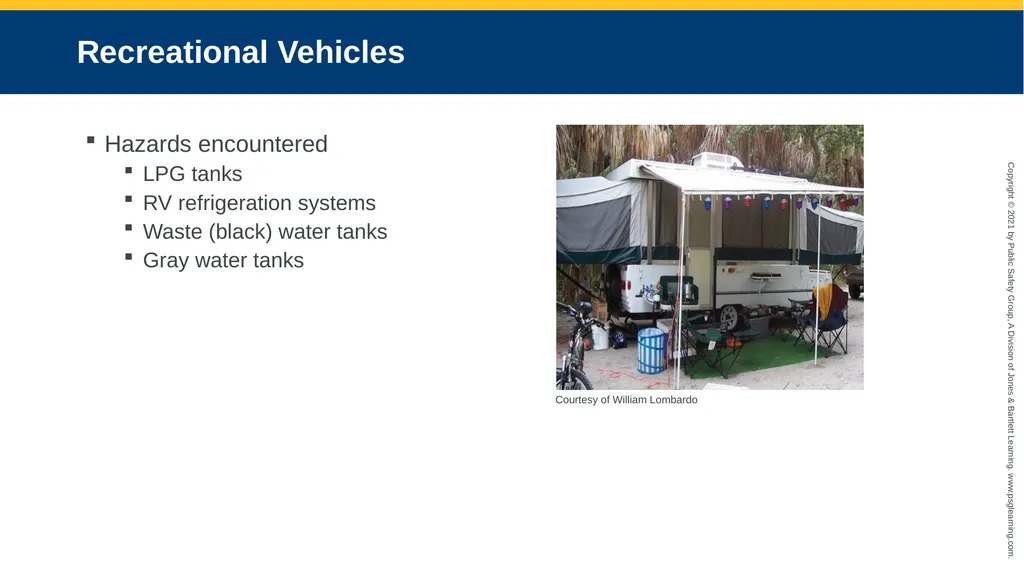
Recreational Vehicles Hazards encountered
LPG tanks
RV refrigeration systems
Waste (black) water tanks
Gray water tanks Courtesy of William Lombardo<br>
15
Recreational Vehicles Strategic goals and tactical objectives
Knowledge of how systems work
Rescue operations as soon as possible
Evacuate the unit and any nearby units that might be affected.
Consider separation of tow unit.
Remember the additional fire load.
Open all windows and roof vents.<br>
16
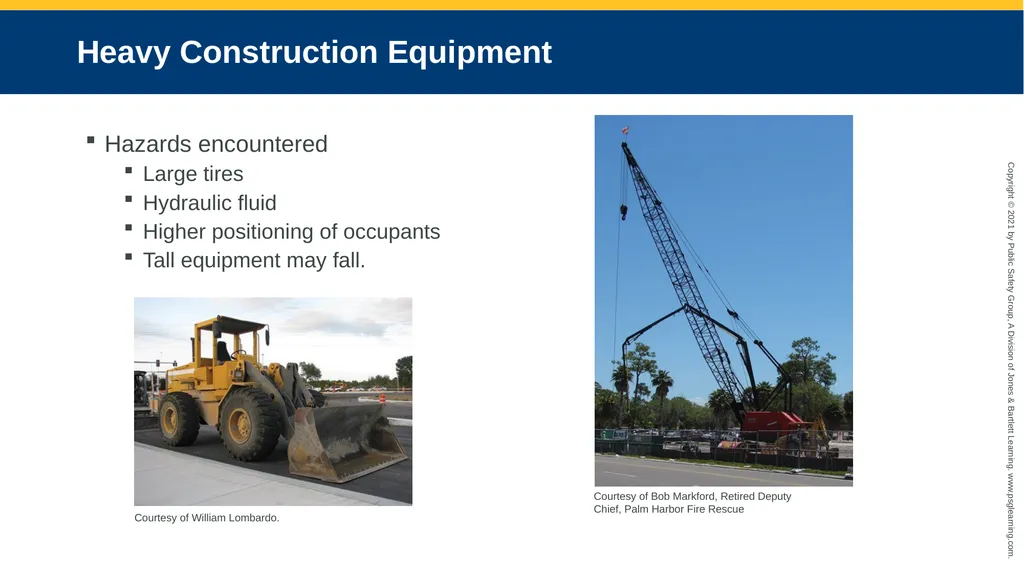
Heavy Construction Equipment Hazards encountered
Large tires
Hydraulic fluid
Higher positioning of occupants
Tall equipment may fall. Courtesy of William Lombardo. Courtesy of Bob Markford, Retired Deputy Chief, Palm Harbor Fire Rescue<br>
17
Heavy Construction Equipment Strategic goals and tactical objectives
Tires and hot hydraulic fluid under pressure present safety concerns.
Search and rescue is usually not an issue.
Consider evacuating surrounding areas.<br>
18
Transportation Vehicles and Buses Hazards encountered
Storage of human waste
Emergency escape window issues
Multiple large battery banks
Alternative fuel sources
Large tires that may explode<br>
19
Transportation Vehicles and Buses Strategic goals and tactical objectives
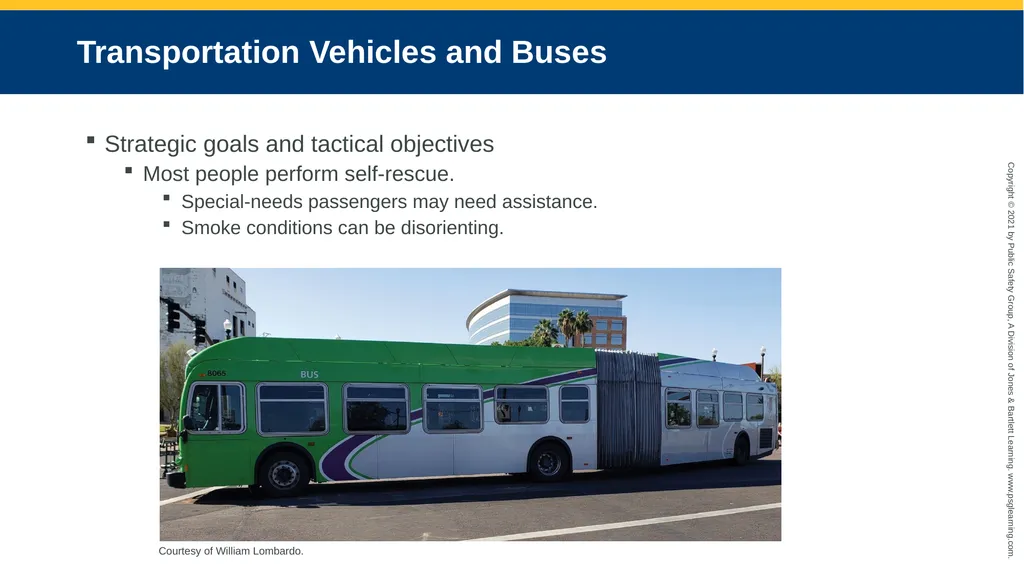
Most people perform self-rescue.
Special-needs passengers may need assistance.
Smoke conditions can be disorienting. Courtesy of William Lombardo.<br>
20
Transportation Vehicles and Buses Strategic goals and tactical objectives (cont’d)
Keep fire away from passengers.
Protect escape routes.
Use bus driver’s knowledge.<br>
21
Summary Typically, a single engine company is sent to a vehicle fire. The company officer takes on the role of the incident commander and is responsible for all strategic and tactical decisions at the incident.
It is important for fire fighters to possess thorough knowledge and understanding of how passenger vehicles, vans, and light-duty trucks operate.<br>
22
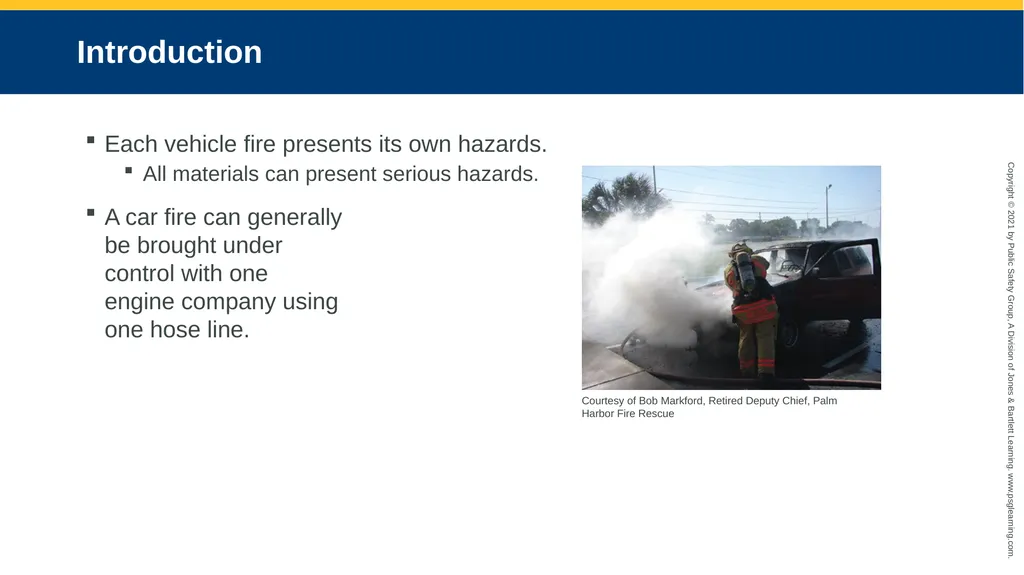
Summary The hazards of passenger cars, light-duty trucks, and vans can be broken down into three categories: vehicle components, alternative fuels, and hazardous cargo.
Since there are so many different types of passenger cars, light-duty trucks, and vans, general strategic goals and tactical objectives are applied to these vehicles.<br>
23
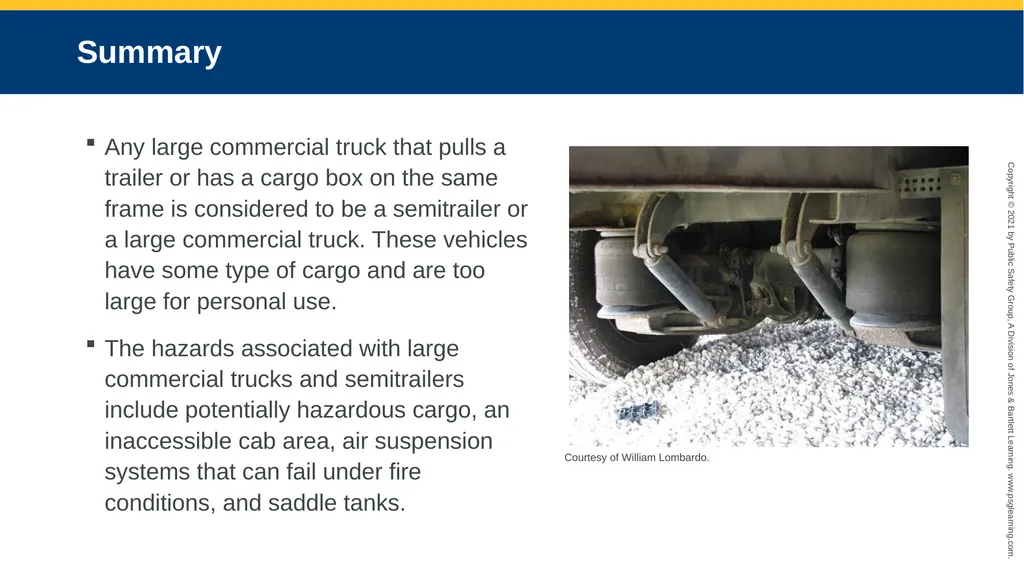
Summary Any large commercial truck that pulls a trailer or has a cargo box on the same frame is considered to be a semitrailer or a large commercial truck. These vehicles have some type of cargo and are too large for personal use.
The hazards associated with large commercial trucks and semitrailers include potentially hazardous cargo, an inaccessible cab area, air suspension systems that can fail under fire conditions, and saddle tanks. Courtesy of William Lombardo.<br>
24
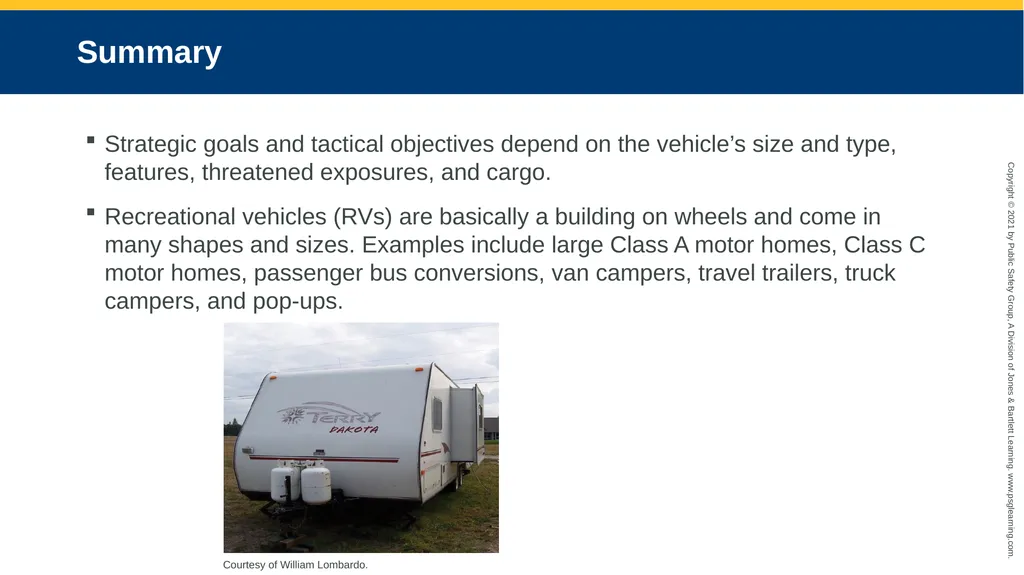
Summary Strategic goals and tactical objectives depend on the vehicle’s size and type, features, threatened exposures, and cargo.
Recreational vehicles (RVs) are basically a building on wheels and come in many shapes and sizes. Examples include large Class A motor homes, Class C motor homes, passenger bus conversions, van campers, travel trailers, truck campers, and pop-ups. Courtesy of William Lombardo.<br>
25
Summary Any of the hazards found in passenger cars and commercial trucks could also be found in RVs. RVs also contain hazards that would be found in any mobile home. LPG tanks, anhydrous ammonia, and waste and gray water tanks may be present.
The strategic goals and tactical objectives for RV fires are similar to those for passenger vehicle and commercial truck/semitrailer fires. The tactics and methods used depend on the size and configuration of the RV.<br>
26
Summary There are many types of heavy construction equipment, including front-end loaders, backhoes, cranes, tractors, graders, pavers, and rollers.
Special concerns of heavy construction equipment are very large tires, pressurized hydraulic fluids, and an inaccessible cockpit.
Because buses and transportation vehicles transport many passengers at one time, they have a much higher life safety hazard.<br>