
CHAPTER 17 Fire Suppression Knowledge Objectives
FD
Published · 110 slides · 0 views

1 / 1
Description
CHAPTER 17 Fire Suppression Knowledge Objectives Describe the objectives of a defensive operation. Describe the operations performed during a defensive operation. Describe the objectives of an offensive operation. Describe the operations
Related Topics
Share
Embed code
Download this presentation From Below
"CHAPTER 17 Fire Suppression Knowledge Objectives" is the property of its rightful owner. Permission is granted to download and print the materials on this website for personal, non-commercial use only, and to display it on your personal computer provided you do not modify the materials and that you retain all copyright notices contained in the materials. By downloading content from our website, you accept the terms of this agreement.
Presentation Transcript
01
CHAPTER 17 Fire Suppression<br>
02
Knowledge Objectives Describe the objectives of a defensive operation.
Describe the operations performed during a defensive operation.
Describe the objectives of an offensive operation.
Describe the operations performed during an offensive operation.
Describe the objectives of a transitional attack. Describe the operations performed during a transitional attack.<br>
Describe the operations performed during a defensive operation.
Describe the objectives of an offensive operation.
Describe the operations performed during an offensive operation.
Describe the objectives of a transitional attack. Describe the operations performed during a transitional attack.<br>
03
Knowledge Objectives Describe the characteristics of a solid stream.
Describe the characteristics of a straight stream.
Describe the characteristics of a fog stream.
Describe the objectives of a direct attack.
Describe the objectives of an indirect attack.
Describe the objectives of a combination attack.
Describe the techniques used to operate large handlines.<br>
Describe the characteristics of a straight stream.
Describe the characteristics of a fog stream.
Describe the objectives of a direct attack.
Describe the objectives of an indirect attack.
Describe the objectives of a combination attack.
Describe the techniques used to operate large handlines.<br>
04
Knowledge Objectives Describe the characteristics of a master stream appliance.
Describe the characteristics of a deck gun.
Describe the characteristics of a portable monitor.
Describe the characteristics of elevated master stream appliances.
Describe the characteristics of concealed-space fires.
Describe the characteristics of basement fires.<br>
Describe the characteristics of a deck gun.
Describe the characteristics of a portable monitor.
Describe the characteristics of elevated master stream appliances.
Describe the characteristics of concealed-space fires.
Describe the characteristics of basement fires.<br>
05
Knowledge Objectives Describe the tactics used to suppress basement fires.
Describe the characteristics of fires above ground level.
Describe the tactics used to suppress fires above ground level.
Describe the characteristics of attic fires. Describe the tactics used to suppress attic fires.<br>
Describe the characteristics of fires above ground level.
Describe the tactics used to suppress fires above ground level.
Describe the characteristics of attic fires. Describe the tactics used to suppress attic fires.<br>
06
Knowledge Objectives Describe the characteristics of fires in large buildings.
Describe the tactics used to suppress fires in large buildings.
Describe the characteristics of fires in buildings under construction, renovation, or demolition.
Describe the tactics used to suppress fires in buildings under construction, renovation, or demolition.<br>
Describe the tactics used to suppress fires in large buildings.
Describe the characteristics of fires in buildings under construction, renovation, or demolition.
Describe the tactics used to suppress fires in buildings under construction, renovation, or demolition.<br>
07
Knowledge Objectives Describe the characteristics of and tactics used to suppress fires in lumberyards.
Describe the characteristics of and tactics used to suppress fires in stacked or piled materials.
Describe the characteristics of and tactics used to suppress fires in trash containers.
Describe the characteristics of fires in confined spaces.
Describe the tactics used to protect exposures.<br>
Describe the characteristics of and tactics used to suppress fires in stacked or piled materials.
Describe the characteristics of and tactics used to suppress fires in trash containers.
Describe the characteristics of fires in confined spaces.
Describe the tactics used to protect exposures.<br>
08
Knowledge Objectives Describe the tactics used to suppress fires on buildings with solar photovoltaic systems.
Describe the characteristics of and the tactics used to suppress fires in chimneys.
Describe the characteristics of vehicle fires.
Describe the types of motor vehicles.
Describe the different types of alternative fuels that power motor vehicles.
Describe the tactics used to suppress vehicle fires.<br>
Describe the characteristics of and the tactics used to suppress fires in chimneys.
Describe the characteristics of vehicle fires.
Describe the types of motor vehicles.
Describe the different types of alternative fuels that power motor vehicles.
Describe the tactics used to suppress vehicle fires.<br>
09
Knowledge Objectives Describe the tactics used to suppress fires in the passenger area of a vehicle.
Describe the tactics used to suppress fires in the engine compartment of a vehicle.
Describe the tactics used to suppress fires in the trunk of a vehicle.
Describe how to overhaul a vehicle fire.<br>
Describe the tactics used to suppress fires in the engine compartment of a vehicle.
Describe the tactics used to suppress fires in the trunk of a vehicle.
Describe how to overhaul a vehicle fire.<br>
10
Knowledge Objectives Describe when gas service should be shut off.
Describe when the electrical service should be shut off.
Describe the hazards posed by electrical fires.
Describe the tactics used to suppress an electrical fire.
Describe when water service should be shut off.<br>
Describe when the electrical service should be shut off.
Describe the hazards posed by electrical fires.
Describe the tactics used to suppress an electrical fire.
Describe when water service should be shut off.<br>
11
Skills Objectives Perform a transitional attack.
Perform a direct attack.
Perform an indirect attack.
Perform a combination attack.
Perform the one-fire-fighter method for operating a large handline.
Perform the two-fire-fighter method for operating a large handline.
Operate a deck gun.<br>
Perform a direct attack.
Perform an indirect attack.
Perform a combination attack.
Perform the one-fire-fighter method for operating a large handline.
Perform the two-fire-fighter method for operating a large handline.
Operate a deck gun.<br>
12
Skills Objectives Deploy and operate a portable monitor.
Locate and suppress concealed-space fires.
Extinguish an outside trash fire or other outside Class A fire.
Extinguish a vehicle fire.
Shut off gas utilities.
Shut off electric utilities.<br>
Locate and suppress concealed-space fires.
Extinguish an outside trash fire or other outside Class A fire.
Extinguish a vehicle fire.
Shut off gas utilities.
Shut off electric utilities.<br>
13
Introduction Fire suppression
All of the tactics and tasks that are performed to achieve extinguishment of the fire.
Variety of methods
Remove fuel, oxygen, or heat from the combustion process.
Typically extinguish with water.<br>
All of the tactics and tasks that are performed to achieve extinguishment of the fire.
Variety of methods
Remove fuel, oxygen, or heat from the combustion process.
Typically extinguish with water.<br>
14
Defensive, Offensive, and Transitional Attack Operations Size-up is the process of initially evaluating an emergency situation.
Often conducted by the first-arriving company officer, who serves as the incident commander (IC) until a higher-ranking officer arrives
IC uses the size-up information to develop an IAP, including which type of fire suppression operation to use.<br>
Often conducted by the first-arriving company officer, who serves as the incident commander (IC) until a higher-ranking officer arrives
IC uses the size-up information to develop an IAP, including which type of fire suppression operation to use.<br>
15
Defensive, Offensive, and Transitional Attack Operations When fire fighters advance hose lines toward a building to attack a fire, the strategy is offensive.
Defensive operations are conducted from the exterior, or while moving away from the building or fire, by directing water streams toward the fire from a safe distance.
A transition attack is a brief exterior, indirect attack into the fire compartment to initiate cooling, followed by an interior attack to suppress the fire.<br>
Defensive operations are conducted from the exterior, or while moving away from the building or fire, by directing water streams toward the fire from a safe distance.
A transition attack is a brief exterior, indirect attack into the fire compartment to initiate cooling, followed by an interior attack to suppress the fire.<br>
16
Defensive, Offensive, and Transitional Attack Operations New fire fighters are not responsible for determining the type of fire attack to be used.
The fire attack is
Determined before operations begin
Continuously evaluated throughout the incident
Clearly communicated to and understood by everyone involved
Specific strategies and tactics are usually driven by fire fighter safety and victim survivability.<br>
The fire attack is
Determined before operations begin
Continuously evaluated throughout the incident
Clearly communicated to and understood by everyone involved
Specific strategies and tactics are usually driven by fire fighter safety and victim survivability.<br>
17
Defensive Operations Used when fire is too large to be controlled by offensive attack, or risk is too great to fire fighters.
Keep the fire from spreading
Typically conducted from the exterior
Large handlines and master streams more often used
Exposure protection should be a high priority.<br>
Keep the fire from spreading
Typically conducted from the exterior
Large handlines and master streams more often used
Exposure protection should be a high priority.<br>
18
Offensive Operations Expose fire fighters to heat and smoke.
Objective is for fire fighters to get close enough to the fire to apply extinguishing agents to burning surfaces.
Used when fire is not too large to be extinguished by applying water with handlines
Small handlines most often used
Causes least amount of property damage<br>
Objective is for fire fighters to get close enough to the fire to apply extinguishing agents to burning surfaces.
Used when fire is not too large to be extinguished by applying water with handlines
Small handlines most often used
Causes least amount of property damage<br>
19
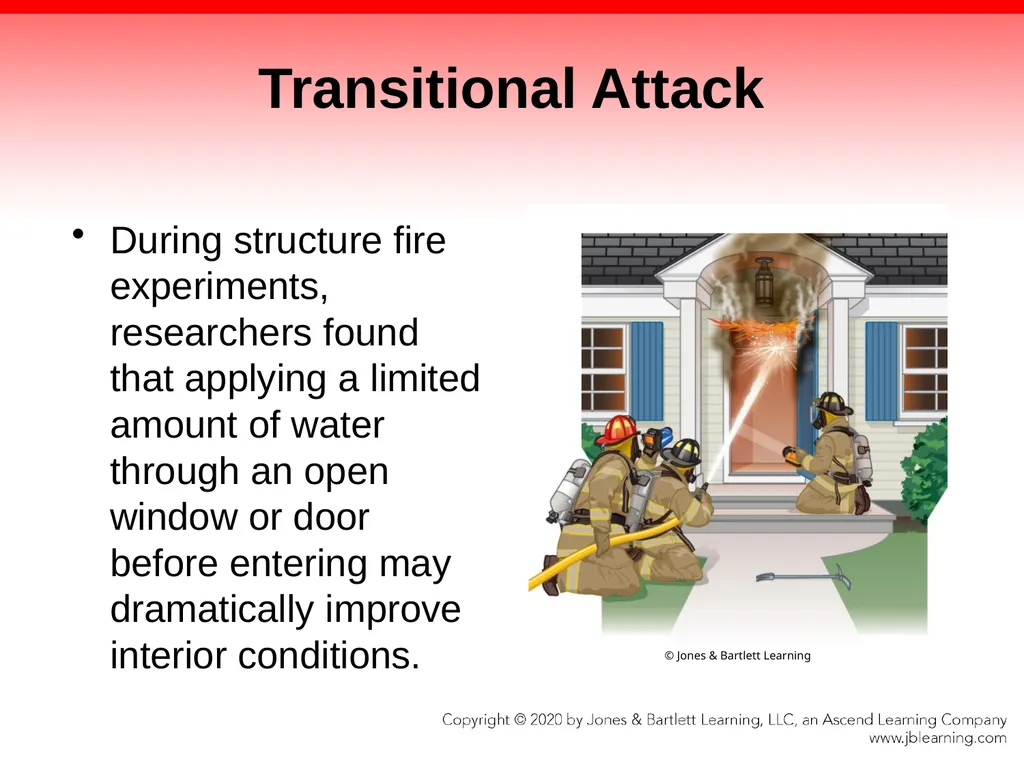
Transitional Attack During structure fire experiments, researchers found that applying a limited amount of water through an open window or door before entering may dramatically improve interior conditions. © Jones & Bartlett Learning<br>
20
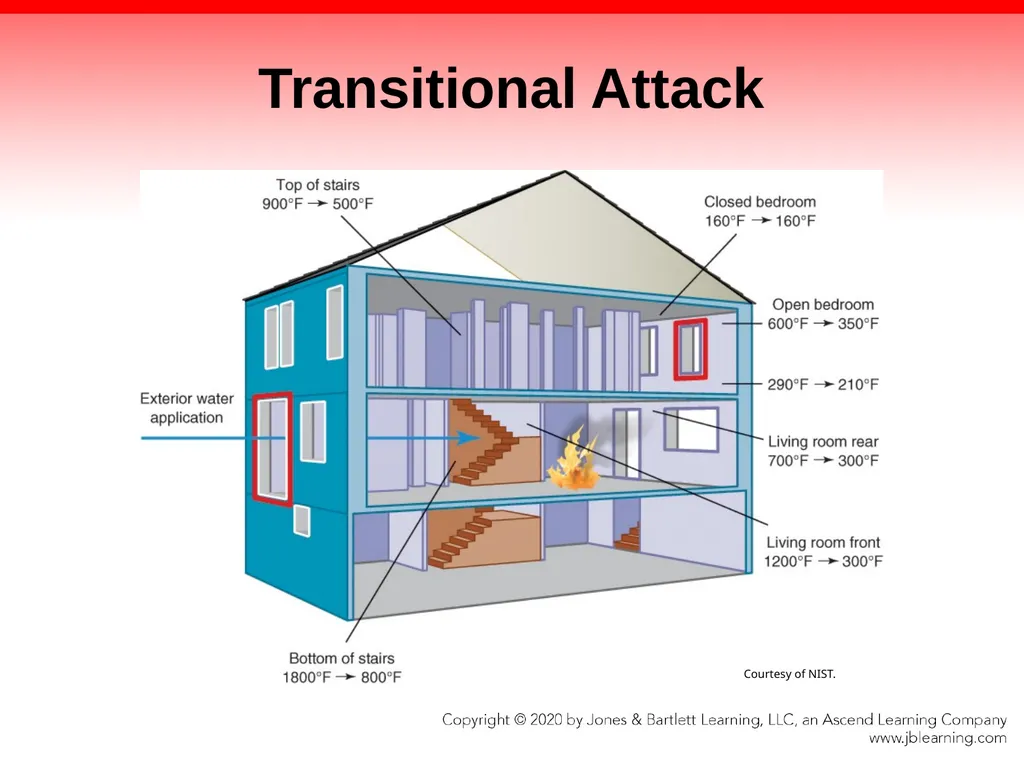
Transitional Attack Courtesy of NIST.<br>
21
Transitional Attack These experiments showed that an intentional, brief, offensive exterior attack reduced temperatures in other parts of the house at some distance from the fire, but it did not completely extinguish the fire.
It slowed the growth of the fire.
The effect of this offensive exterior is significant but short-lived.
Additional water must be applied to the seat of the fire.<br>
It slowed the growth of the fire.
The effect of this offensive exterior is significant but short-lived.
Additional water must be applied to the seat of the fire.<br>
22
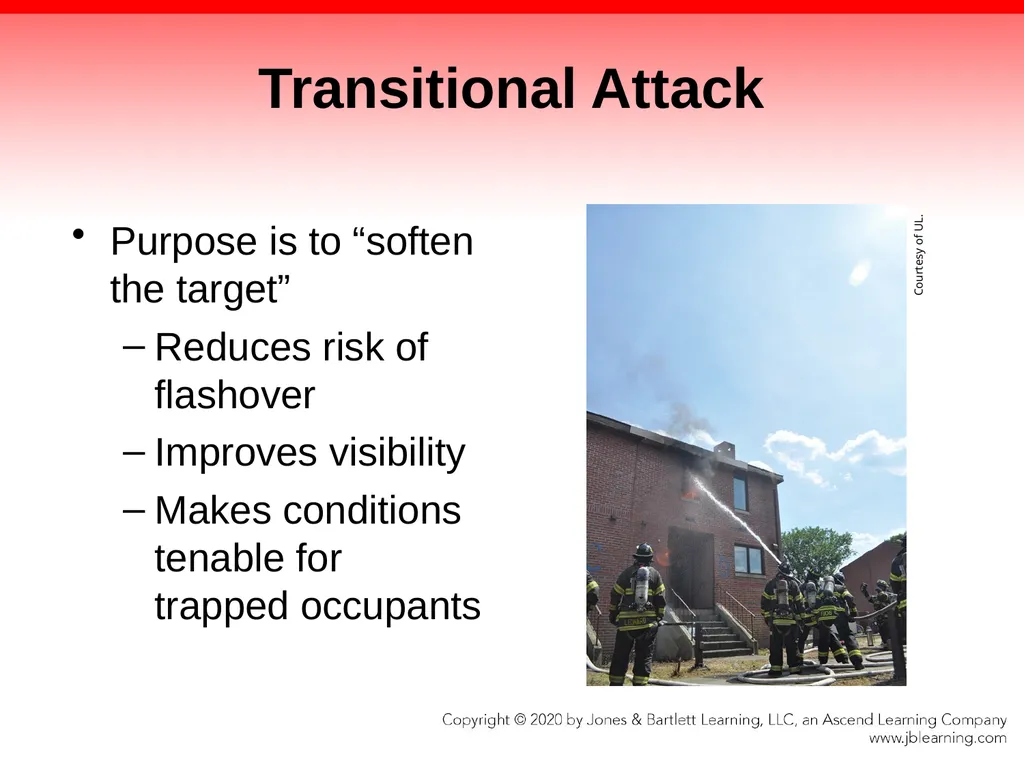
Transitional Attack Purpose is to “soften the target”
Reduces risk of flashover
Improves visibility
Makes conditions tenable for trapped occupants Courtesy of UL.<br>
Reduces risk of flashover
Improves visibility
Makes conditions tenable for trapped occupants Courtesy of UL.<br>
23
Operating Handlines Some of the most basic skills that must be mastered by every fire fighter involve the use of handlines to apply water onto a fire.
Fire fighters must learn how to advance and operate both large and small handlines, as well as master stream appliances.<br>
Fire fighters must learn how to advance and operate both large and small handlines, as well as master stream appliances.<br>
24
Operating Handlines Master streams
Operated from a fixed position
On the ground
On top of a fire apparatus
On an aerial ladder
On an elevated platform
Typically used for defensive operations
Can also be used to “blitz” a fire<br>
Operated from a fixed position
On the ground
On top of a fire apparatus
On an aerial ladder
On an elevated platform
Typically used for defensive operations
Can also be used to “blitz” a fire<br>
25
Fire Streams Different types of fire streams can be produced by different types of nozzles.
The nozzle defines the shape and direction of the water or extinguishing agent that is discharged onto the fire.
A fire stream can be produced with either a smooth-bore nozzle or an adjustable nozzle.
The nozzle operator must know which type of nozzle should be used in the specific situation at hand.<br>
The nozzle defines the shape and direction of the water or extinguishing agent that is discharged onto the fire.
A fire stream can be produced with either a smooth-bore nozzle or an adjustable nozzle.
The nozzle operator must know which type of nozzle should be used in the specific situation at hand.<br>
26
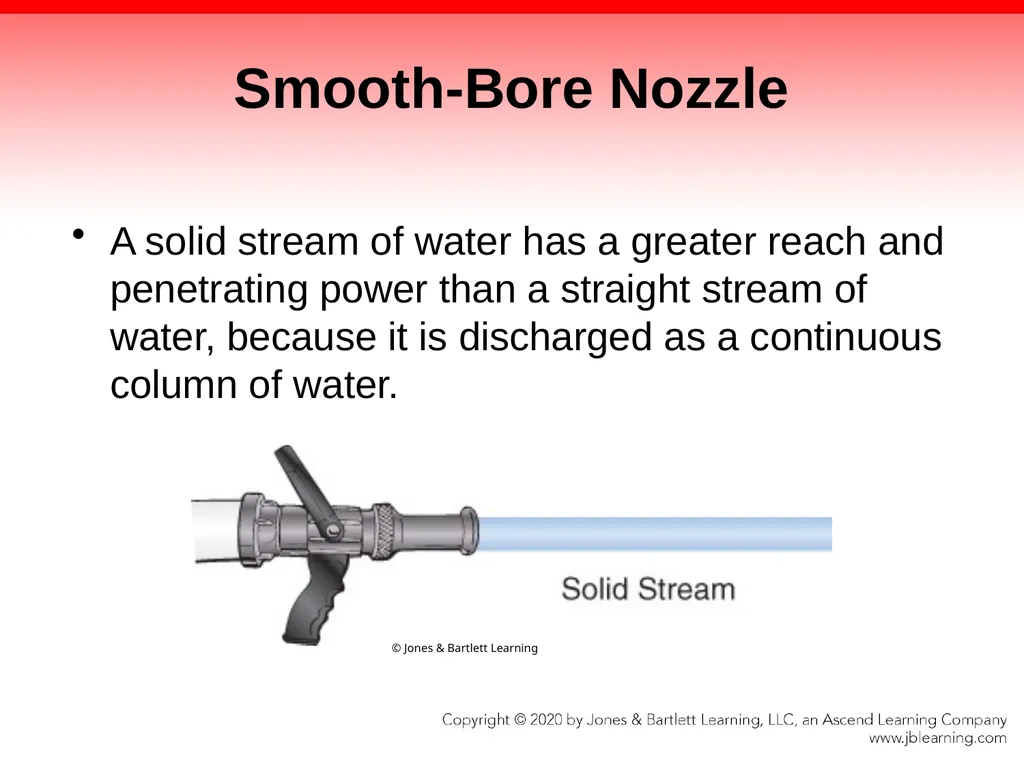
Smooth-Bore Nozzle A solid stream of water has a greater reach and penetrating power than a straight stream of water, because it is discharged as a continuous column of water. © Jones & Bartlett Learning<br>
27
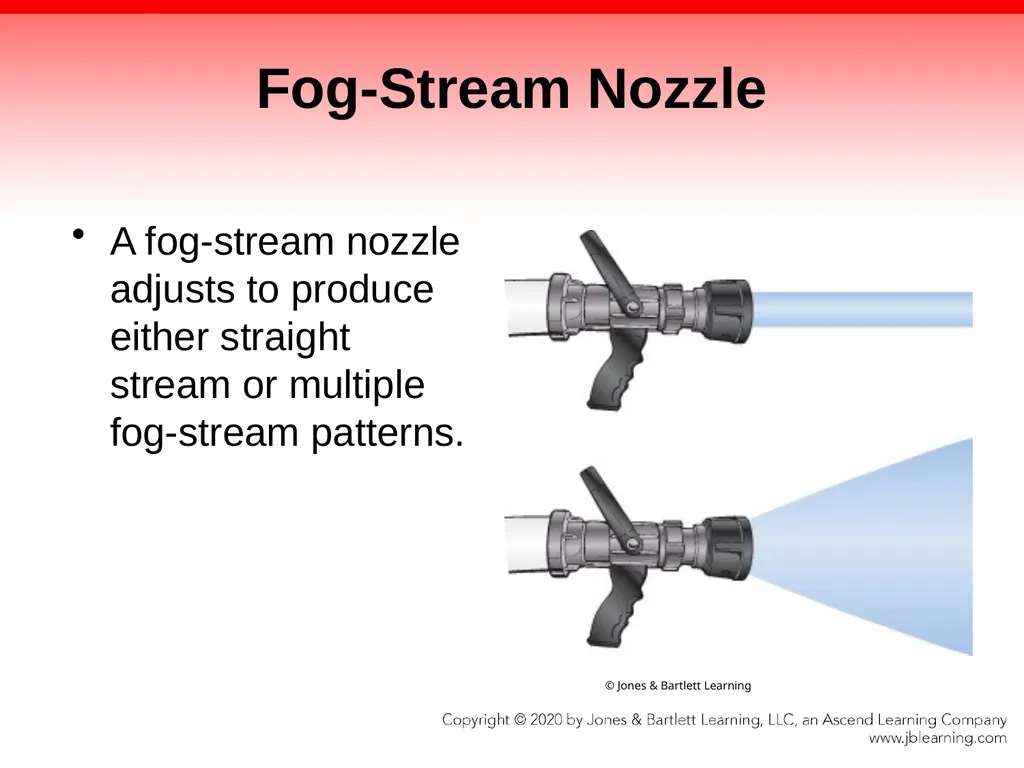
Fog-Stream Nozzle A fog-stream nozzle adjusts to produce either straight stream or multiple fog-stream patterns. © Jones & Bartlett Learning<br>
28
Straight Stream Has greater reach than fog stream
Keeps water concentrated in a small area
Created by the narrowest setting on a fog nozzle
Consists of highly concentrated droplets<br>
Keeps water concentrated in a small area
Created by the narrowest setting on a fog nozzle
Consists of highly concentrated droplets<br>
29
Fog Stream Divides water into droplets with large surface area
Absorbs heat very efficiently
Can lower heat levels very quickly
Usually adjustable from straight stream to narrow fog to a wide fog<br>
Absorbs heat very efficiently
Can lower heat levels very quickly
Usually adjustable from straight stream to narrow fog to a wide fog<br>
30
Points to Remember Air is moved along with the water.
Fog streams move large amounts of air.
Thermal balance may be disrupted, pushing hot fire gases onto fire fighters.
Straight and solid streams move little air in comparison with a fog stream.
Fewer concerns with displacement and disruption of thermal balance.<br>
Fog streams move large amounts of air.
Thermal balance may be disrupted, pushing hot fire gases onto fire fighters.
Straight and solid streams move little air in comparison with a fog stream.
Fewer concerns with displacement and disruption of thermal balance.<br>
31
Stream Placement Direct attack and indirect attack are two methods of discharging water onto a fire.
Combination attack performed in two stages.
Small handlines are typically used.<br>
Combination attack performed in two stages.
Small handlines are typically used.<br>
32
Direct Attack Effective means of fire suppression
Uses straight or solid stream to deliver water directly onto base of fire
Water controls burning surfaces until it is below its ignition temperature.<br>
Uses straight or solid stream to deliver water directly onto base of fire
Water controls burning surfaces until it is below its ignition temperature.<br>
33
Indirect Attack Used when area is ready to flash over
Can be accomplished from safer location (e.g., doorway or hallway) to reduce thermal exposure
Water aimed at ceiling
Uses straight or solid stream, flowing between 120 to 180 gpm, to cool everything quickly
Does not generate significant amounts of steam<br>
Can be accomplished from safer location (e.g., doorway or hallway) to reduce thermal exposure
Water aimed at ceiling
Uses straight or solid stream, flowing between 120 to 180 gpm, to cool everything quickly
Does not generate significant amounts of steam<br>
34
Combination Attack Employs both indirect and direct method in a sequential manner
Uses indirect attack from safest location to cool atmosphere, then direct attack to extinguish
Only use enough water to control the fire.
Operator should be given plenty of space to maneuver.<br>
Uses indirect attack from safest location to cool atmosphere, then direct attack to extinguish
Only use enough water to control the fire.
Operator should be given plenty of space to maneuver.<br>
35
Large Handlines Used for either offensive fire attacks or defensive operations
Can extinguish larger interior fires and have greater reach
More difficult to maneuver, particularly in tight quarters or around corners
The extra effort required to deploy such a line is balanced by the fire suppression capabilities.
Often used in defensive situations to direct a heavy stream from an exterior position<br>
Can extinguish larger interior fires and have greater reach
More difficult to maneuver, particularly in tight quarters or around corners
The extra effort required to deploy such a line is balanced by the fire suppression capabilities.
Often used in defensive situations to direct a heavy stream from an exterior position<br>
36
Large Handlines One-fire fighter method
Control hose by forming a large loop of hose about 2 ft (0.6 m) behind the nozzle.
To add more stability, lash the loop to the hose behind the nozzle where they cross.
Two-fire fighter method
One should act as the nozzle operator, while the other serves as a backup.
Second fire fighter can kneel on the hose to stabilize it against the ground.<br>
Control hose by forming a large loop of hose about 2 ft (0.6 m) behind the nozzle.
To add more stability, lash the loop to the hose behind the nozzle where they cross.
Two-fire fighter method
One should act as the nozzle operator, while the other serves as a backup.
Second fire fighter can kneel on the hose to stabilize it against the ground.<br>
37
Large Handlines If it is necessary to advance a flowing handline a short distance and only two fire fighters are available, be aware of the large reaction force exerted by the flowing water.
It is much easier to shut down the nozzle momentarily and move it to the new position than to relocate a flowing line.
If the line must be moved while water is flowing, both fire fighters must brace the hose against their bodies to keep it under control.<br>
It is much easier to shut down the nozzle momentarily and move it to the new position than to relocate a flowing line.
If the line must be moved while water is flowing, both fire fighters must brace the hose against their bodies to keep it under control.<br>
38
Master Stream Devices Used to produce high-volume water streams for large fires
Includes portable monitors, deck guns, ladder pipes, and other elevated stream devices
May be manually operated or by remote
Used mainly during defensive operations
Should never be directed into a building where fire fighters are inside<br>
Includes portable monitors, deck guns, ladder pipes, and other elevated stream devices
May be manually operated or by remote
Used mainly during defensive operations
Should never be directed into a building where fire fighters are inside<br>
39
Deck Guns A deck gun is permanently mounted on a vehicle and equipped with a piping system that delivers water to the device.
These devices are sometimes called turret pipes or wagon pipes.
If the vehicle is equipped with a pump, the driver/operator can usually open a valve to start the flow of water.
Sometimes a hose must be connected to a special inlet to deliver water to the deck gun.<br>
These devices are sometimes called turret pipes or wagon pipes.
If the vehicle is equipped with a pump, the driver/operator can usually open a valve to start the flow of water.
Sometimes a hose must be connected to a special inlet to deliver water to the deck gun.<br>
40
Portable Monitors A master stream device that can be positioned wherever one is needed
It is placed on the ground, and hose lines are then connected to supply the water.
Most come equipped with either one to three 2½-in. (65-mm) inlets or with one large-diameter hose inlet.
Some master stream devices can be used as deck guns or taken off the fire apparatus and used as a portable monitors.<br>
It is placed on the ground, and hose lines are then connected to supply the water.
Most come equipped with either one to three 2½-in. (65-mm) inlets or with one large-diameter hose inlet.
Some master stream devices can be used as deck guns or taken off the fire apparatus and used as a portable monitors.<br>
41
Portable Monitors Many are equipped with a strap or chain that must be secured to a fixed object to prevent the monitor from moving.
Pointed feet on the base also help.
If the stream is operated at a low angle, the reaction force will make the monitor unstable.
A safety lock is usually provided to prevent the monitor from being lowered past a safe angle.
Follow the manufacturer’s instructions and your department’s SOPs.<br>
Pointed feet on the base also help.
If the stream is operated at a low angle, the reaction force will make the monitor unstable.
A safety lock is usually provided to prevent the monitor from being lowered past a safe angle.
Follow the manufacturer’s instructions and your department’s SOPs.<br>
42
Elevated Master Streams Mounted on aerial ladders, aerial platforms, or special hydraulically operated booms.
A ladder pipe is an elevated stream device that is mounted at the tip of an aerial ladder or tower ladder.
Most newer aerial ladders and tower ladders are equipped with a fixed piping system to deliver water to a permanently mounted master stream device at the top.
Saves setup time<br>
A ladder pipe is an elevated stream device that is mounted at the tip of an aerial ladder or tower ladder.
Most newer aerial ladders and tower ladders are equipped with a fixed piping system to deliver water to a permanently mounted master stream device at the top.
Saves setup time<br>
43
Concealed-Space Fires Fires may burn in combustible void spaces behind walls and under walls and ceilings.
Must be found and extinguished to prevent from spreading<br>
Must be found and extinguished to prevent from spreading<br>
44
Basement Fires Can be hard to recognize
May spread to areas above
Many vertical voids originate and terminate in the basement.
Limited routes for entering and exiting
May be difficult to ventilate
May contain high volume of flammable materials
Important to complete a size-up before entering<br>
May spread to areas above
Many vertical voids originate and terminate in the basement.
Limited routes for entering and exiting
May be difficult to ventilate
May contain high volume of flammable materials
Important to complete a size-up before entering<br>
45
Basement Fires Water applied via interior stairs has a limited effect on cooling or extinguishing fire.
Fire fighters must look for alternative openings.
A small opening can be cut above the fire and a nozzle inserted to temporarily cool the basement compartment.
Identify any external openings, and advance a charged hose line to those openings<br>
Fire fighters must look for alternative openings.
A small opening can be cut above the fire and a nozzle inserted to temporarily cool the basement compartment.
Identify any external openings, and advance a charged hose line to those openings<br>
46
Fires Above Ground Level Protect vertical paths.
Keep fire from extending vertically.
Always look for secondary exit route.
Standpipe system typically used to supply water for hose lines.
Stage equipment one to two floors below the fire.<br>
Keep fire from extending vertically.
Always look for secondary exit route.
Standpipe system typically used to supply water for hose lines.
Stage equipment one to two floors below the fire.<br>
47
Attic Fires Large quantities of wood and possibly other flammable materials
Open air spaces and limited or absent fire stops
Convection currents and radiant heat contribute to the growth of the fire.
In modern construction, fresh air enters the attic space through vents mounted in the soffit.<br>
Open air spaces and limited or absent fire stops
Convection currents and radiant heat contribute to the growth of the fire.
In modern construction, fresh air enters the attic space through vents mounted in the soffit.<br>
48
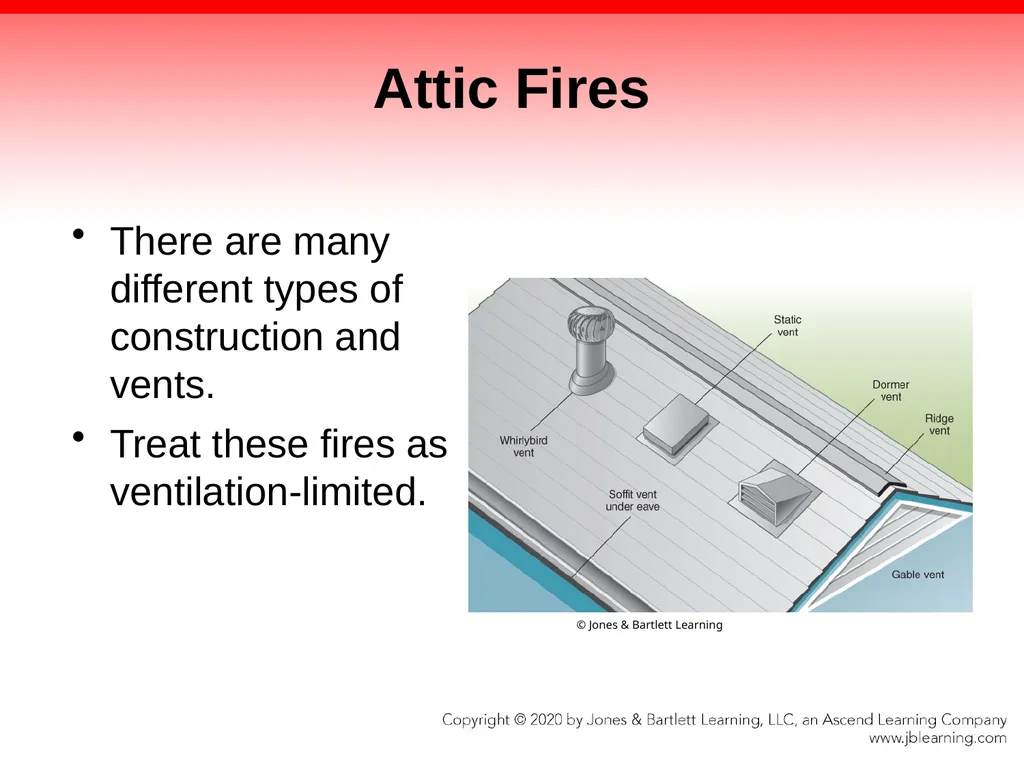
Attic Fires There are many different types of construction and vents.
Treat these fires as ventilation-limited. © Jones & Bartlett Learning<br>
Treat these fires as ventilation-limited. © Jones & Bartlett Learning<br>
49
Attic Fires When performing a transitional attack on an attic fire:
Quickly remove the soffit vents.
Use a straight-stream nozzle to spray a stream of water, directing water all the way along one side of the house.
Following this, ventilate the attic space and extinguish any remaining fire.
Understanding flow paths is an important step to understanding how to extinguish attic fires.<br>
Quickly remove the soffit vents.
Use a straight-stream nozzle to spray a stream of water, directing water all the way along one side of the house.
Following this, ventilate the attic space and extinguish any remaining fire.
Understanding flow paths is an important step to understanding how to extinguish attic fires.<br>
50
Fires in Large Buildings Large buildings have many different uses and layouts.
The fire protection for most large buildings is dependent on fire-resistive construction, fire detection, and automatic sprinkler systems.
Fire load varies greatly depending on building contents.
Fire fighters may become lost or disoriented.
Guidelines may be necessary.
A preincident plan can be essential.<br>
The fire protection for most large buildings is dependent on fire-resistive construction, fire detection, and automatic sprinkler systems.
Fire load varies greatly depending on building contents.
Fire fighters may become lost or disoriented.
Guidelines may be necessary.
A preincident plan can be essential.<br>
51
Fires in Buildings During Construction, Renovation, or Demolition Often have large quantities of exposed combustible materials
Often have unlimited oxygen supply.
Fire systems often not installed or are inoperable
Could be targeted by arsonists
If no life safety hazards, use defensive strategy.
Collapse zone should be established.<br>
Often have unlimited oxygen supply.
Fire systems often not installed or are inoperable
Could be targeted by arsonists
If no life safety hazards, use defensive strategy.
Collapse zone should be established.<br>
52
Fires in Lumberyards Prime candidate for defensive strategy
Contain large quantities of combustibles
Plenty of air supports combustion
Large quantities of radiant heat
Inadequate water supply
Lightweight building techniques
Protecting exposures is often the primary objective.
Establish a collapse zone.<br>
Contain large quantities of combustibles
Plenty of air supports combustion
Large quantities of radiant heat
Inadequate water supply
Lightweight building techniques
Protecting exposures is often the primary objective.
Establish a collapse zone.<br>
53
Fires in Stacked
or Piled Materials Materials may collapse without warning.
Approach cautiously.
Use mechanical equipment to move material.
Conventional fire attacks can often be used.
Water must penetrate stacked material.
Class foam and wetting agents can be applied.
Overhaul requires the materials to be separated.
Can be labor-intensive without machines<br>
Approach cautiously.
Use mechanical equipment to move material.
Conventional fire attacks can often be used.
Water must penetrate stacked material.
Class foam and wetting agents can be applied.
Overhaul requires the materials to be separated.
Can be labor-intensive without machines<br>
54
Trash Container
and Rubbish Fires Usually occur outside of a structure
Be vigilant about PPE and SCBA.
Difficult to justify any risk
Class A foam is useful for extinguishing this type of fire.
Some contain hazardous materials.
Can use deck gun to extinguish large fires<br>
Be vigilant about PPE and SCBA.
Difficult to justify any risk
Class A foam is useful for extinguishing this type of fire.
Some contain hazardous materials.
Can use deck gun to extinguish large fires<br>
55
Confined Spaces Fires in underground vaults and utility rooms, such as transformer vaults, are too dangerous to enter.
Summon the utility company and keep the area around manhole covers and other openings clear.
For emergencies in confined spaces, OSHA requires specially trained entry teams.
Do not enter a confined space unless you have been trained as a technical rescuer.<br>
Summon the utility company and keep the area around manhole covers and other openings clear.
For emergencies in confined spaces, OSHA requires specially trained entry teams.
Do not enter a confined space unless you have been trained as a technical rescuer.<br>
56
Protecting Exposures Prevents the spread of a fire to areas that are not already burning
A consideration at every fire; it becomes even more important with a large fire
In some cases, the best outcome is to stop the fire from spreading.<br>
A consideration at every fire; it becomes even more important with a large fire
In some cases, the best outcome is to stop the fire from spreading.<br>
57
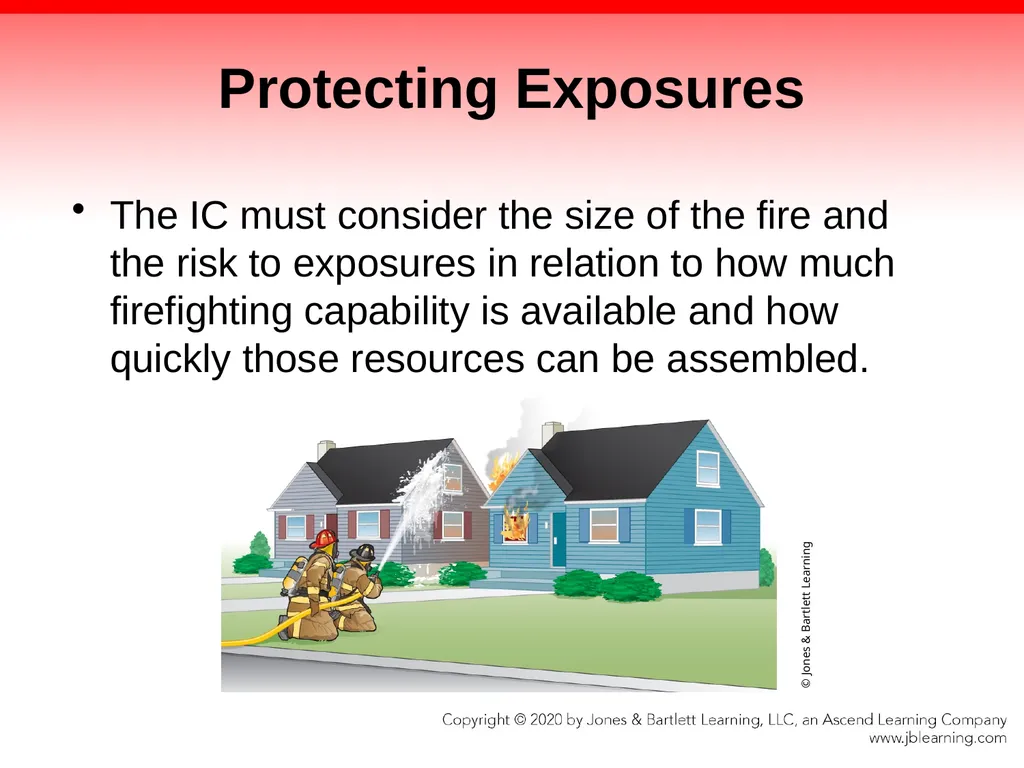
Protecting Exposures The IC must consider the size of the fire and the risk to exposures in relation to how much firefighting capability is available and how quickly those resources can be assembled. © Jones & Bartlett Learning<br>
58
Solar Photovoltaic Systems Generate electrical power from sunlight by converting particles of sunlight from light energy into electrical energy.
Usually mounted together to form solar panels
Usually, there is no single switch that will disable the whole system.
Assume that all components are energized and pose potential electrocution hazards.<br>
Usually mounted together to form solar panels
Usually, there is no single switch that will disable the whole system.
Assume that all components are energized and pose potential electrocution hazards.<br>
59
Solar Photovoltaic Systems Be alert for metal roofs that can conduct electrical hazards.
Fire damage or damage from tools may pose a shock or fire hazard.
Other hazards include fall and collapse hazards.
By understanding the hazards posed by photovoltaic (PV) systems and following your department’s SOPs, you should be able to operate safely around solar PV systems.<br>
Fire damage or damage from tools may pose a shock or fire hazard.
Other hazards include fall and collapse hazards.
By understanding the hazards posed by photovoltaic (PV) systems and following your department’s SOPs, you should be able to operate safely around solar PV systems.<br>
60
Chimney Fires Can present several challenges
Usually pass from floor to floor
Older chimneys decay over time
Creosote is highly combustible
When responding to a reported chimney fire
Look for smoke or flames coming from the top of the chimney.
Suspect that the fire has extended into void spaces or the attack.
Avoid using water.<br>
Usually pass from floor to floor
Older chimneys decay over time
Creosote is highly combustible
When responding to a reported chimney fire
Look for smoke or flames coming from the top of the chimney.
Suspect that the fire has extended into void spaces or the attack.
Avoid using water.<br>
61
Chimney Fires Dry-chemical extinguishers are often used.
If the fire is not severe, use salvage tarps to cover the floor and nearby contents.
It may be possible to discharge the extinguisher from the top of the chimney.
Use a thermal imaging device to check for hot spots behind the walls and in the attic.
It may be necessary to remove drywall or siding.
Chimney fires often rekindle.<br>
If the fire is not severe, use salvage tarps to cover the floor and nearby contents.
It may be possible to discharge the extinguisher from the top of the chimney.
Use a thermal imaging device to check for hot spots behind the walls and in the attic.
It may be necessary to remove drywall or siding.
Chimney fires often rekindle.<br>
62
Vehicle Fires One of the most common types of fire
Wear full SCBA.
Modern automobiles contain a variety of gas-filled pressurized cylinders and are constructed from hundreds of pounds of plastics.
Large quantities of toxic smoke and heat
Consider other hazards.
Perform risk-analysis assessment.
Do not risk lives of fire fighters.<br>
Wear full SCBA.
Modern automobiles contain a variety of gas-filled pressurized cylinders and are constructed from hundreds of pounds of plastics.
Large quantities of toxic smoke and heat
Consider other hazards.
Perform risk-analysis assessment.
Do not risk lives of fire fighters.<br>
63
Types of Vehicles: Conventional Conventional vehicles use internal combustion engines for power.
Burn gasoline or diesel fuel
Create a hazard if it leaks after an accident
Other hazards include short circuits, battery acid leaks, and combustibles
Electrical systems pose a minimal threat.<br>
Burn gasoline or diesel fuel
Create a hazard if it leaks after an accident
Other hazards include short circuits, battery acid leaks, and combustibles
Electrical systems pose a minimal threat.<br>
64
Types of Vehicles: Alternative Alternative-fuel vehicles use anything other than a petroleum-based motor fuel.
Propane
Natural gas
Methanol
Hydrogen
Electricity
Combination of electricity and fuel (hybrid)<br>
Propane
Natural gas
Methanol
Hydrogen
Electricity
Combination of electricity and fuel (hybrid)<br>
65
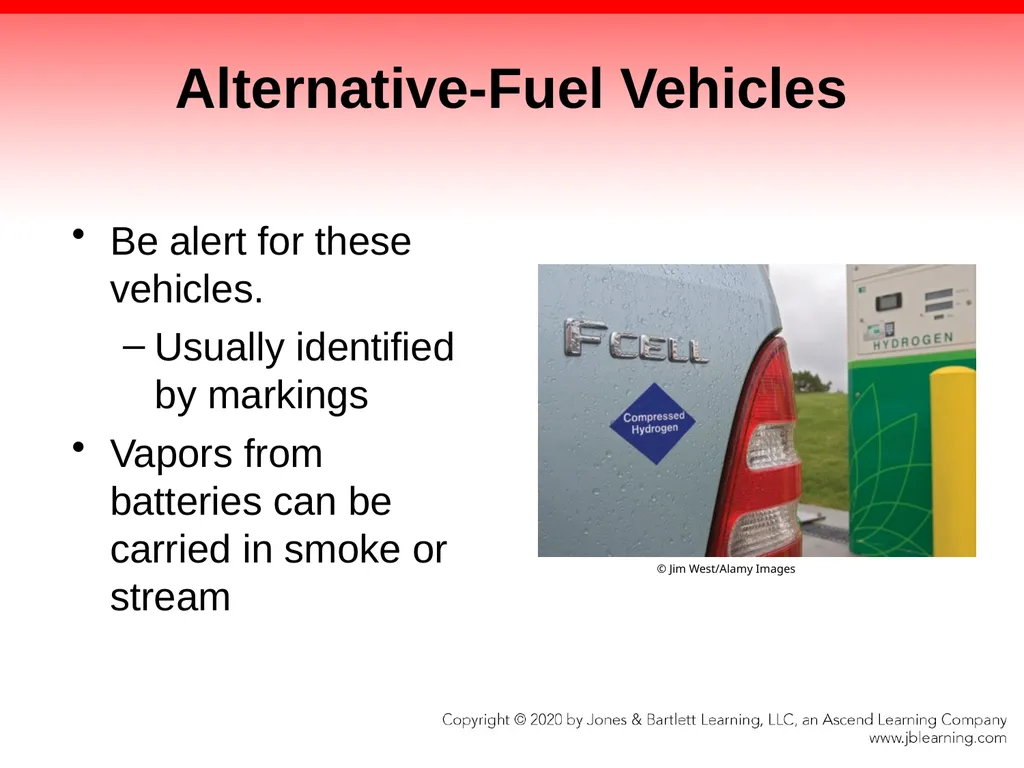
Alternative-Fuel Vehicles Be alert for these vehicles.
Usually identified by markings
Vapors from batteries can be carried in smoke or stream © Jim West/Alamy Images<br>
Usually identified by markings
Vapors from batteries can be carried in smoke or stream © Jim West/Alamy Images<br>
66
Battery Electric Vehicles Propelled solely by an electric motor powered by batteries
Must be recharged from an external source
Hazards include
Potential for electric shock or arcing
Off-gassing and delayed-reaction electrical fires
These vehicles use a high-voltage system in addition to the 12-volt system found in conventional vehicles.<br>
Must be recharged from an external source
Hazards include
Potential for electric shock or arcing
Off-gassing and delayed-reaction electrical fires
These vehicles use a high-voltage system in addition to the 12-volt system found in conventional vehicles.<br>
67
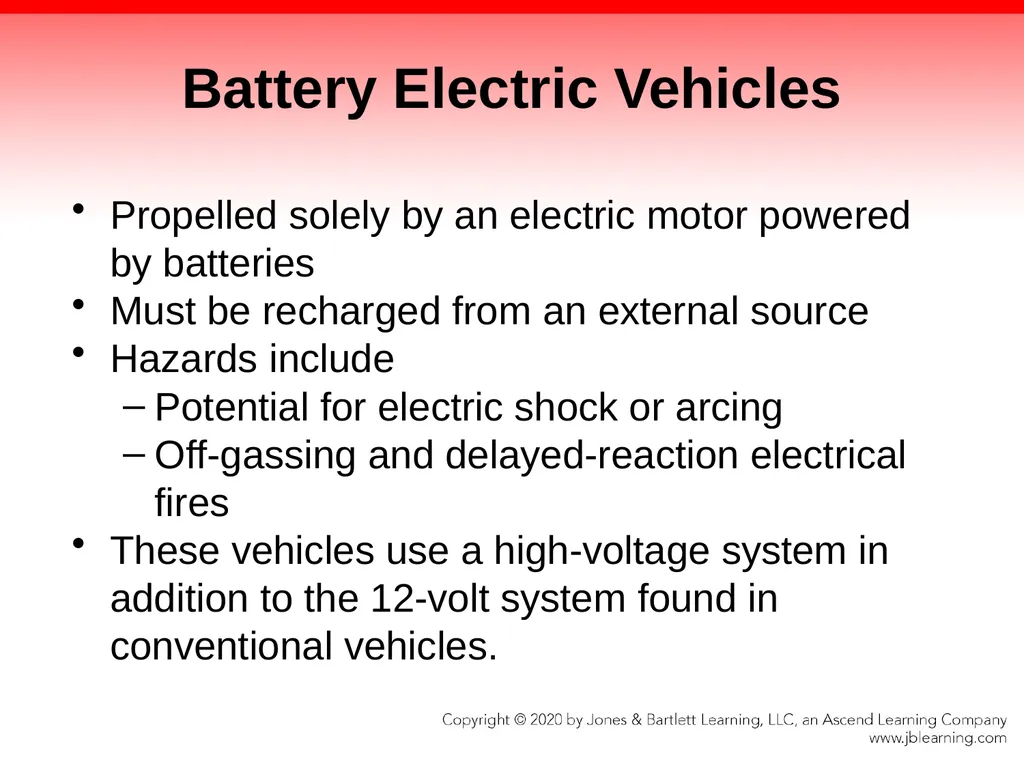
Hybrid Electric Vehicles Use both a battery-powered electric motor and liquid-fueled engine
Contain all of the same hazards as conventional vehicles, plus additional hazards linked to the electrical system. © Jones & Bartlett Learning<br>
Contain all of the same hazards as conventional vehicles, plus additional hazards linked to the electrical system. © Jones & Bartlett Learning<br>
68
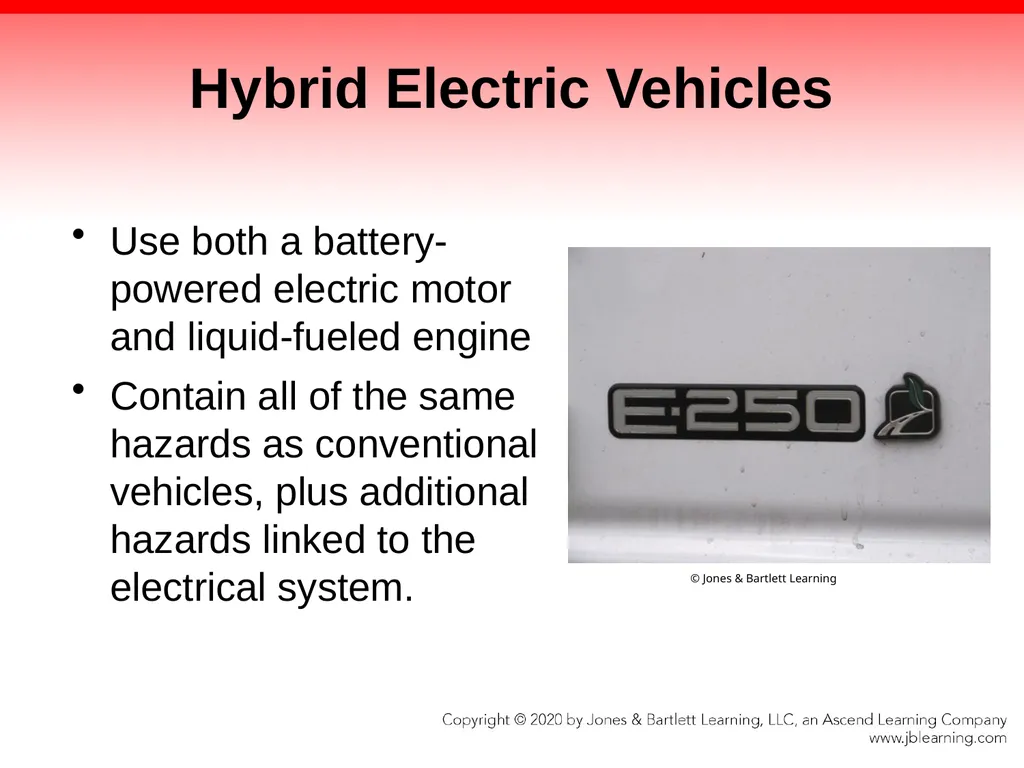
Alternative-Fuel Vehicles Batteries have higher voltage
Require training to disable electric system
Batteries may not be located in engine compartment
May be more than one battery © Jones & Bartlett Learning<br>
Require training to disable electric system
Batteries may not be located in engine compartment
May be more than one battery © Jones & Bartlett Learning<br>
69
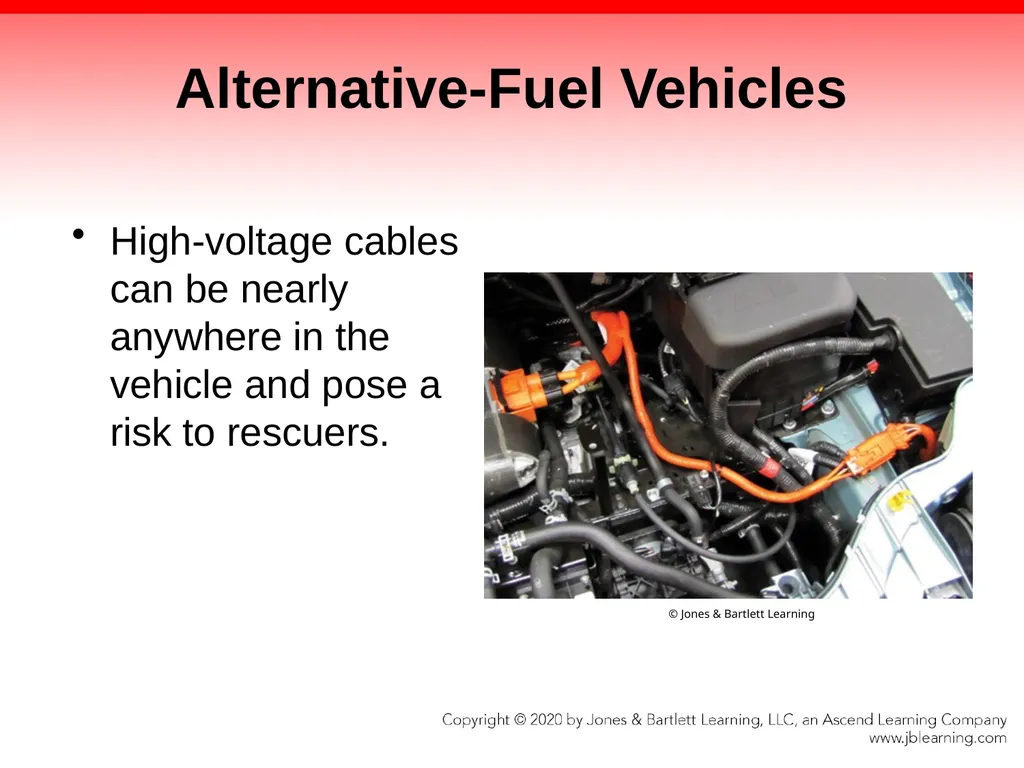
Alternative-Fuel Vehicles High-voltage cables can be nearly anywhere in the vehicle and pose a risk to rescuers. © Jones & Bartlett Learning<br>
70
Considerations
for Alternative-Fuel Vehicle Fires Don your PPE, including SCBA.
Apply chock blocks to the wheels to prevent the vehicle from moving forward or in reverse.
Determine whether the vehicle is a hybrid vehicle or an electric vehicle.
Locate the batteries and avoid direct contact.
Avoid cutting high-voltage cables.
These vehicles require more water to extinguish fires.<br>
Apply chock blocks to the wheels to prevent the vehicle from moving forward or in reverse.
Determine whether the vehicle is a hybrid vehicle or an electric vehicle.
Locate the batteries and avoid direct contact.
Avoid cutting high-voltage cables.
These vehicles require more water to extinguish fires.<br>
71
Considerations
for Alternative-Fuel Vehicle Fires Batteries can reheat and reignite for a long period after flames are extinguished.
Listen for popping sounds.
Store these vehicles at least 50 feet (15 m) from any exposures.
The components of these vehicles continue to change, and the design changes from one manufacturer to another.
Most manufacturers offer a wealth of information.<br>
Listen for popping sounds.
Store these vehicles at least 50 feet (15 m) from any exposures.
The components of these vehicles continue to change, and the design changes from one manufacturer to another.
Most manufacturers offer a wealth of information.<br>
72
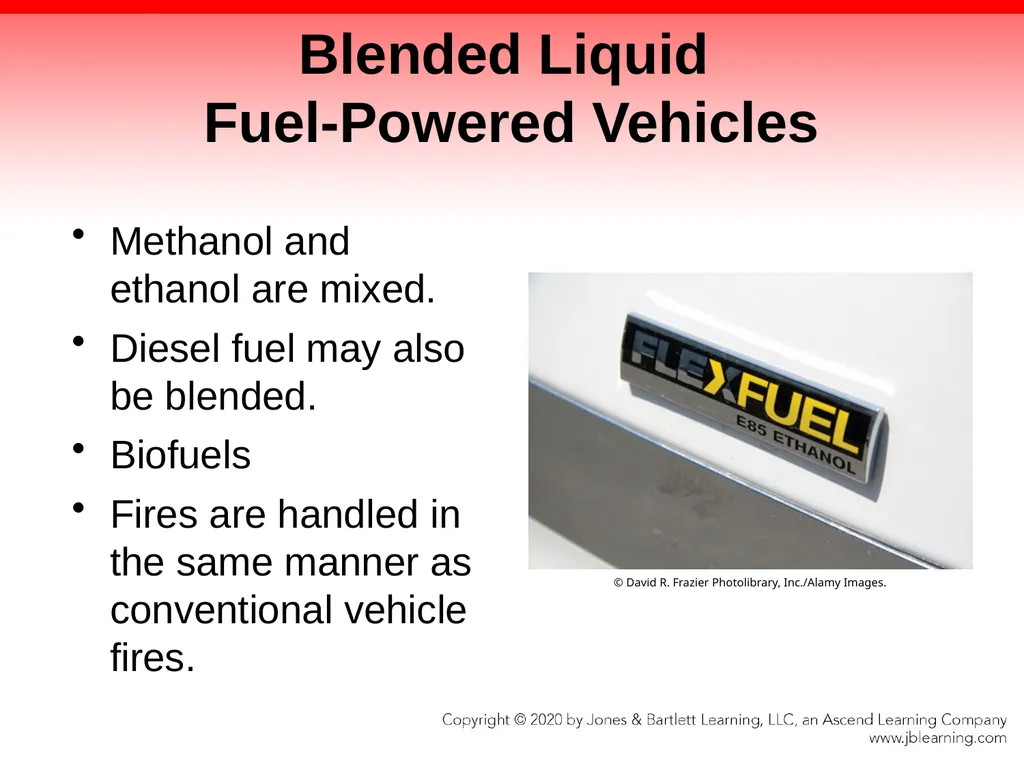
Blended Liquid
Fuel-Powered Vehicles Methanol and ethanol are mixed.
Diesel fuel may also be blended.
Biofuels
Fires are handled in the same manner as conventional vehicle fires. © David R. Frazier Photolibrary, Inc./Alamy Images.<br>
Diesel fuel may also be blended.
Biofuels
Fires are handled in the same manner as conventional vehicle fires. © David R. Frazier Photolibrary, Inc./Alamy Images.<br>
73
Compressed
Gas-Powered Vehicles Compressed natural gas (CNG)
Stored in steel, aluminum, or carbon fiber tanks
Usually located in trunk or roof
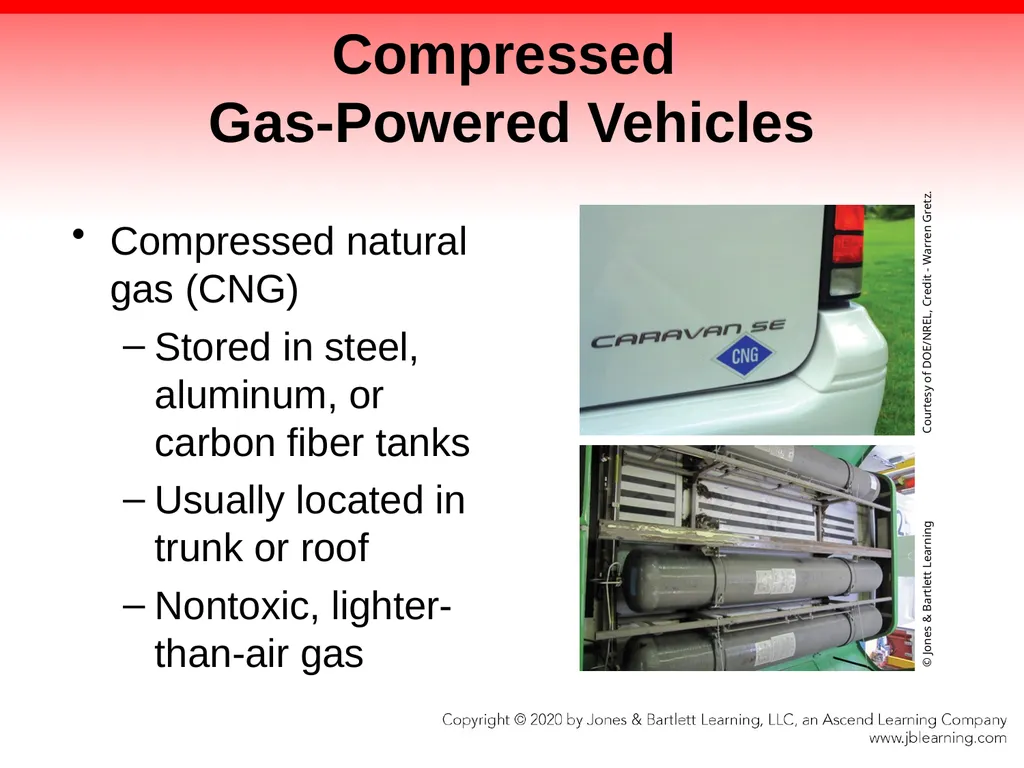
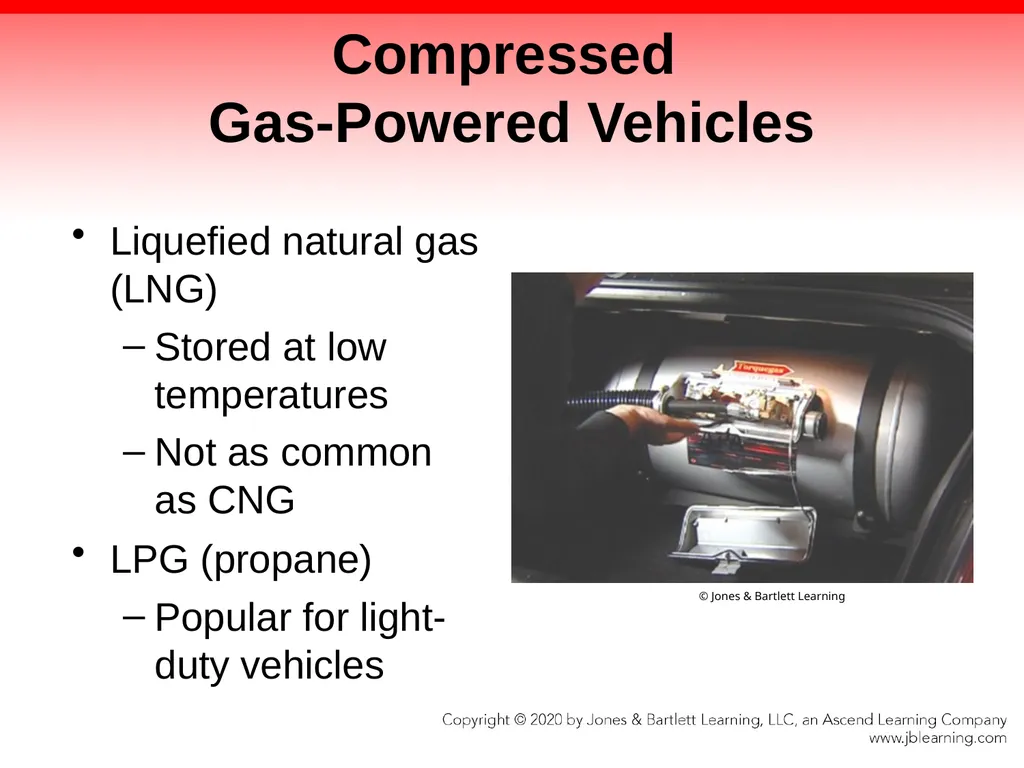
Nontoxic, lighter-than-air gas Courtesy of DOE/NREL, Credit - Warren Gretz. © Jones & Bartlett Learning<br>
Stored in steel, aluminum, or carbon fiber tanks
Usually located in trunk or roof
Nontoxic, lighter-than-air gas Courtesy of DOE/NREL, Credit - Warren Gretz. © Jones & Bartlett Learning<br>
74
Compressed
Gas-Powered Vehicles Liquefied natural gas (LNG)
Stored at low temperatures
Not as common as CNG
LPG (propane)
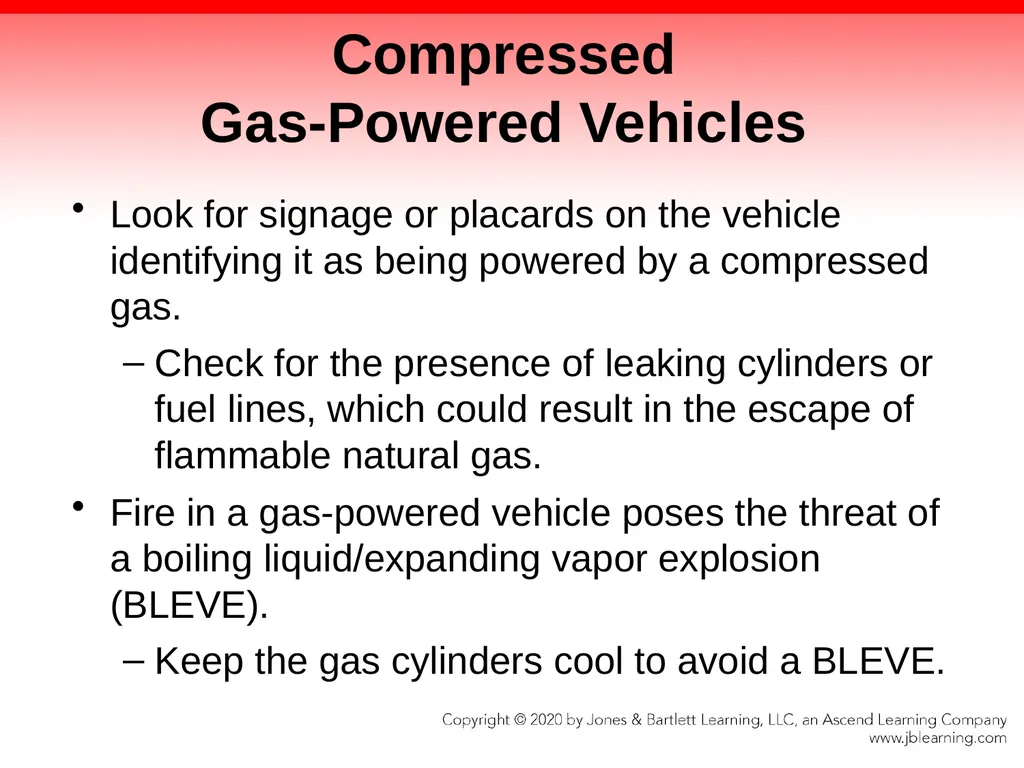
Popular for light-duty vehicles © Jones & Bartlett Learning<br>
Stored at low temperatures
Not as common as CNG
LPG (propane)
Popular for light-duty vehicles © Jones & Bartlett Learning<br>
75
Compressed
Gas-Powered Vehicles Look for signage or placards on the vehicle identifying it as being powered by a compressed gas.
Check for the presence of leaking cylinders or fuel lines, which could result in the escape of flammable natural gas.
Fire in a gas-powered vehicle poses the threat of a boiling liquid/expanding vapor explosion (BLEVE).
Keep the gas cylinders cool to avoid a BLEVE.<br>
Check for the presence of leaking cylinders or fuel lines, which could result in the escape of flammable natural gas.
Fire in a gas-powered vehicle poses the threat of a boiling liquid/expanding vapor explosion (BLEVE).
Keep the gas cylinders cool to avoid a BLEVE.<br>
76
Compressed
Gas-Powered Vehicles Fully involved fires in vehicles powered by compressed gas should be fought with a handline from a protected location or with an unmanned master stream to prevent injuries from exploding gas cylinders.
If LNG is leaking, avoid spraying a stream of water on the escaping liquid, as this action heats the very cold liquid and explodes.
It is acceptable to spray a fog stream on an escaping cloud of vapor, however.<br>
If LNG is leaking, avoid spraying a stream of water on the escaping liquid, as this action heats the very cold liquid and explodes.
It is acceptable to spray a fog stream on an escaping cloud of vapor, however.<br>
77
Fuel Cell-Powered Vehicles Fuel cells generate electricity through a chemical reaction to produce water and, in the process, produce electricity and heat.
Essentially electric vehicles
The major components needed for a fuel cell–powered vehicle are
Hydrogen gas storage tank
High-output battery
Group of fuel cells
Electric motor<br>
Essentially electric vehicles
The major components needed for a fuel cell–powered vehicle are
Hydrogen gas storage tank
High-output battery
Group of fuel cells
Electric motor<br>
78
Fuel Cell-Powered Vehicles The use of fuel cells is being advocated because they produce less pollution than internal combustion engines.
Expect to see more on the road.<br>
Expect to see more on the road.<br>
79
Responding to the Scene Traffic is one of the biggest hazards.
Drivers are easily distracted, which may lead to subsequent accidents.
Position the apparatus to block the burning vehicle at a safe distance away.
Work with law enforcement if necessary.
You are required to wear a brightly colored reflective safety vest anytime you are operating on a roadway.<br>
Drivers are easily distracted, which may lead to subsequent accidents.
Position the apparatus to block the burning vehicle at a safe distance away.
Work with law enforcement if necessary.
You are required to wear a brightly colored reflective safety vest anytime you are operating on a roadway.<br>
80
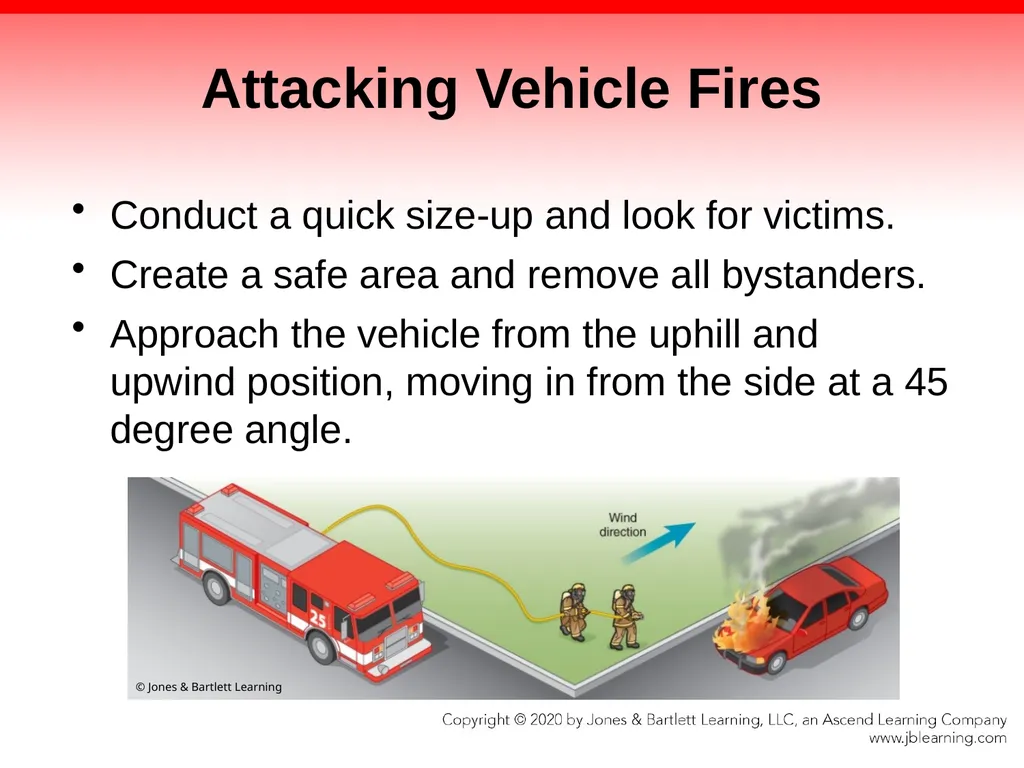
Attacking Vehicle Fires Conduct a quick size-up and look for victims.
Create a safe area and remove all bystanders.
Approach the vehicle from the uphill and upwind position, moving in from the side at a 45 degree angle. © Jones & Bartlett Learning<br>
Create a safe area and remove all bystanders.
Approach the vehicle from the uphill and upwind position, moving in from the side at a 45 degree angle. © Jones & Bartlett Learning<br>
81
Attacking Vehicle Fires Open the nozzle and sweep the bottom part of the vehicle using a horizontal motion.
Extinguish all visible fire while advancing toward the vehicle.
Sweep along the undercarriage.
Adjust the nozzle to a narrow fog pattern as you get closer, and widen the pattern as you approach.
The use of compressed air or Class B foam aids in fire suppression.<br>
Extinguish all visible fire while advancing toward the vehicle.
Sweep along the undercarriage.
Adjust the nozzle to a narrow fog pattern as you get closer, and widen the pattern as you approach.
The use of compressed air or Class B foam aids in fire suppression.<br>
82
Fire in the Passenger Area More visible and accessible than fires in the engine compartment or cargo area
If the doors won’t open, stand to the windward side and break out one or more windows.
Pay special attention to cooling areas, such as steering column and dashboard on passenger side.
Reduces chance for accidental deployment of supplemental restraint system (SRS)<br>
If the doors won’t open, stand to the windward side and break out one or more windows.
Pay special attention to cooling areas, such as steering column and dashboard on passenger side.
Reduces chance for accidental deployment of supplemental restraint system (SRS)<br>
83
Fire in the Engine Compartment Engine compartment filled with devices that use petroleum, plastics, and rubber
Batteries contain sulfuric acid.
Some vehicles have magnesium (Class D extinguishing agent required).
Gaining access to the fire can be a challenge.
Direct water into wheel wells and through the front grille.<br>
Batteries contain sulfuric acid.
Some vehicles have magnesium (Class D extinguishing agent required).
Gaining access to the fire can be a challenge.
Direct water into wheel wells and through the front grille.<br>
84
Fire in the Engine Compartment Fastest way to gain access to engine compartment is to pull hood-release lever.
Rarely works during a vehicle fire
Insert a pry bar along side of hood between edge of hood and fender.
Use plenty of water or foam to cool this area.
Disconnect power to vehicle by cutting battery cables if battery is not under hood.<br>
Rarely works during a vehicle fire
Insert a pry bar along side of hood between edge of hood and fender.
Use plenty of water or foam to cool this area.
Disconnect power to vehicle by cutting battery cables if battery is not under hood.<br>
85
Fire in the Cargo Area (Trunk) Initial access by knocking out a tail light
Use the pike of a Halligan tool to turn the lock cylinder in a clockwise fashion.
Charged hose line must be ready.
Fires in the rear of light rucks and vans must always be approached cautiously.<br>
Use the pike of a Halligan tool to turn the lock cylinder in a clockwise fashion.
Charged hose line must be ready.
Fires in the rear of light rucks and vans must always be approached cautiously.<br>
86
Overhauling Vehicle Fires Allow a few minutes for the steam and smoke to dissipate.
Remember that air bags can deploy without warning.
Be systematic and thorough; soak and remove smoldering upholstery.
Apply water over and under all parts of the engine compartment.
Use SCBA as long as smoke or fumes are present.<br>
Remember that air bags can deploy without warning.
Be systematic and thorough; soak and remove smoldering upholstery.
Apply water over and under all parts of the engine compartment.
Use SCBA as long as smoke or fumes are present.<br>
87
Shutting Off Building Utilities It is important shut off utilities as early as possible during fire suppression.
IC should identify the utilities and request that the companies respond to disconnect service.
If it is safe, fire fighters can turn these off before the utility company arrives.<br>
IC should identify the utilities and request that the companies respond to disconnect service.
If it is safe, fire fighters can turn these off before the utility company arrives.<br>
88
Shutting Off Gas Service Means by which gas is supplied must be located
Most residential gas supplies are delivered through a gas meter connected to an underground utility network or from a storage tank located outside the building.
After the service has been shut off, use a lockout tag.
Only a professional can reestablish the flow of gas to a structure.<br>
Most residential gas supplies are delivered through a gas meter connected to an underground utility network or from a storage tank located outside the building.
After the service has been shut off, use a lockout tag.
Only a professional can reestablish the flow of gas to a structure.<br>
89
Gas Fire Suppression Gaseous fuel that escapes from the system is called fugitive gas. It can travel between floors, inside walls or other void spaces, and even underground.
If the correct mixture of fuel and air comes into contact with an ignition source, it can explode.
If the gas has not ignited, immediately shut off the gas valve and evacuate the area.
If the gas is already burning, shut off the meter or main valve before fully extinguishing the fire.<br>
If the correct mixture of fuel and air comes into contact with an ignition source, it can explode.
If the gas has not ignited, immediately shut off the gas valve and evacuate the area.
If the gas is already burning, shut off the meter or main valve before fully extinguishing the fire.<br>
90
Shutting Off Electrical Service Greatest danger is electrocution
Only Class C extinguishers should be used on energized equipment.
Once electricity is disconnected, most are controlled as a Class A fire.
Turn off electricity on structure fires.
Never attempt to remove an electric meter to disconnect power.
Sometimes utility company is automatically notified.<br>
Only Class C extinguishers should be used on energized equipment.
Once electricity is disconnected, most are controlled as a Class A fire.
Turn off electricity on structure fires.
Never attempt to remove an electric meter to disconnect power.
Sometimes utility company is automatically notified.<br>
91
Electrical Fire Suppression Best approach is to wait until power is disconnected.
If immediate action is required, use Class C agents only.
For electronic equipment, use halons or CO2.
When power distribution lines or transformers are involved in a fire, special care must be taken.
Electrical current can flow back through water to a nozzle and electrocute fire fighters.<br>
If immediate action is required, use Class C agents only.
For electronic equipment, use halons or CO2.
When power distribution lines or transformers are involved in a fire, special care must be taken.
Electrical current can flow back through water to a nozzle and electrocute fire fighters.<br>
92
Electrical Fire Suppression Transformers may contain carcinogens.
Do not apply water to a burning transformer.
Fires in ground-mounted transformers can be extinguished with dry chemical agents after power has been disconnected.
Some very large transformers require foam for fire extinguishment.
Until the power is off, fire fighters can only protect exposures while taking care to avoid contamination.<br>
Do not apply water to a burning transformer.
Fires in ground-mounted transformers can be extinguished with dry chemical agents after power has been disconnected.
Some very large transformers require foam for fire extinguishment.
Until the power is off, fire fighters can only protect exposures while taking care to avoid contamination.<br>
93
Electrical Fire Suppression Underground power lines and transformers are often located in vaults beneath the surface.
Explosive gases can build up.
Never enter an underground electrical vault while the equipment is energized.
Even after the power has been disconnected, these vaults should be considered confined spaces containing potentially toxic gases, explosive atmospheres, or oxygen-deficient atmospheres.<br>
Explosive gases can build up.
Never enter an underground electrical vault while the equipment is energized.
Even after the power has been disconnected, these vaults should be considered confined spaces containing potentially toxic gases, explosive atmospheres, or oxygen-deficient atmospheres.<br>
94
Electrical Fire Suppression Large commercial and residential structures often have high-voltage electrical service connections and interior rooms containing transformers and distribution equipment.
Fire fighters must wear full PPE and SCBA owing to the inhalation hazard represented by the burning of the plastics and cooling liquids that are often used with equipment of this size.<br>
Fire fighters must wear full PPE and SCBA owing to the inhalation hazard represented by the burning of the plastics and cooling liquids that are often used with equipment of this size.<br>
95
Shutting off Water Service If a serious water leak has occurred inside the building, shutting off the water supply may help minimize damage.
Water service to a building can usually be shut off by closing one valve at the entry point.
This underground valve is located outside the building and can be operated with a special wrench or key.
In warmer climates, water supply valves are sometimes located above ground.<br>
Water service to a building can usually be shut off by closing one valve at the entry point.
This underground valve is located outside the building and can be operated with a special wrench or key.
In warmer climates, water supply valves are sometimes located above ground.<br>
96
Summary Fire suppression refers to all of the tactics and tasks performed on the fire scene to extinguish a fire.
All fire suppression methods are either offensive or defensive.
Offensive: Tasks performed while moving toward the fire or inside the fire structure
Defensive: Tasks typically performed outside the fire structure<br>
All fire suppression methods are either offensive or defensive.
Offensive: Tasks performed while moving toward the fire or inside the fire structure
Defensive: Tasks typically performed outside the fire structure<br>
97
Summary A combination attack involves both offensive and defensive suppression operations.
The IC constantly evaluates conditions to determine the type of attack that should be used. An offensive attack may be switched to a defensive attack if necessary and vice versa.
A fire fighter must be able to advance and operate a handline effectively to extinguish a fire.<br>
The IC constantly evaluates conditions to determine the type of attack that should be used. An offensive attack may be switched to a defensive attack if necessary and vice versa.
A fire fighter must be able to advance and operate a handline effectively to extinguish a fire.<br>
98
Summary Care should be taken not to have opposing handlines. Opposing handlines may harm fire fighters with water streams or debris.
The most frequently used sizes for interior fire attack are 1½- or 1¾-in. (38- or 45-mm) handlines.
Different types of fire streams are produced by different types of nozzles: fog stream, straight stream, and solid stream.<br>
The most frequently used sizes for interior fire attack are 1½- or 1¾-in. (38- or 45-mm) handlines.
Different types of fire streams are produced by different types of nozzles: fog stream, straight stream, and solid stream.<br>
99
Summary The most effective means of fire suppression in most situations is a direct attack, delivering water directly onto the base of the fire. The water cools the fuel to below its ignition temperature.
The objective of an indirect attack is to quickly remove as much heat as possible from the fire atmosphere. Such an approach is particularly effective at preventing flashover from occurring. The method of fire suppression should be used when a fire has produced a layer of hot gases.<br>
The objective of an indirect attack is to quickly remove as much heat as possible from the fire atmosphere. Such an approach is particularly effective at preventing flashover from occurring. The method of fire suppression should be used when a fire has produced a layer of hot gases.<br>
100
Summary A combination attack employs both indirect attack and direct attack methods in a sequential manner. This strategy should be used when a room’s interior has been heated to the point that it is nearing a flashover condition. Fire fighters first use an indirect attack method to cool the fire gases, then make a direct attack on the main body of the fire.
Large handlines can be used for either offensive or defensive operations.<br>
Large handlines can be used for either offensive or defensive operations.<br>
101
Summary Master stream appliances are used to produce high-volume water streams for large fires. Several types of master stream appliances exist, including portable monitors, deck guns, ladder pipes, and other elevated stream devices. Most master streams discharge between 350 and 1500 gpm of water.
Fires in ordinary and wood-frame construction can burn in combustible void spaces behind walls and under subfloors and ceilings.<br>
Fires in ordinary and wood-frame construction can burn in combustible void spaces behind walls and under subfloors and ceilings.<br>
102
Summary Fires in basements or below grade level can cause the floor on the ground level to collapse.
During an interior fire attack, protect stairways and other vertical openings between floors when fighting a fire in a multilevel structure. Handlines must be placed to keep the fire from extending vertically and to ensure that exit paths remain available to fire fighters and victims.<br>
During an interior fire attack, protect stairways and other vertical openings between floors when fighting a fire in a multilevel structure. Handlines must be placed to keep the fire from extending vertically and to ensure that exit paths remain available to fire fighters and victims.<br>
103
Summary Many large buildings have floor plans that can cause fire fighters to become lost or disoriented while working inside, particularly in low-visibility or zero-visibility conditions. Search rope may be necessary in these settings.
Buildings that are under construction, renovation, or demolition are all at increased risk for destruction by fire. They often have large quantities of combustible materials exposed, and lack fire-resistant features.<br>
Buildings that are under construction, renovation, or demolition are all at increased risk for destruction by fire. They often have large quantities of combustible materials exposed, and lack fire-resistant features.<br>
104
Summary A lumberyard fire will usually produce tremendous quantities of radiant heat and release burning embers that can cause the fire to spread quickly from stack to stack.
Fires in stacked materials should be approached cautiously. All fire fighters must remain outside potential collapse zones. Mechanical equipment should be used to move material that has been partially burned or water soaked.<br>
Fires in stacked materials should be approached cautiously. All fire fighters must remain outside potential collapse zones. Mechanical equipment should be used to move material that has been partially burned or water soaked.<br>
105
Summary Fires in trash containers may be fought with foam or a deck gun.
Fires in confined spaces such as utility rooms are too dangerous to enter. Fire fighters should summon the utility company and keep the area around manhole covers and other openings clear while awaiting arrival of utility personnel.<br>
Fires in confined spaces such as utility rooms are too dangerous to enter. Fire fighters should summon the utility company and keep the area around manhole covers and other openings clear while awaiting arrival of utility personnel.<br>
106
Summary Electrical shut-offs may not be adequately marked for a solar PV system; assume that all components of these systems are energized. Gloves and boots offer limited protection against electrical shock, especially when wet.
Use dry-chemical extinguishers to extinguish chimney fires when possible, not water. Extinguish the fire in the firebox and chimney.<br>
Use dry-chemical extinguishers to extinguish chimney fires when possible, not water. Extinguish the fire in the firebox and chimney.<br>
107
Summary Vehicle fires are one of the most common types of fires handled by fire departments. These fires may result from a variety of causes, including discarded smoking materials, electrical short circuits, friction, and ruptured fuel lines due to motor vehicle accidents (MVAs).
Many hazards related to vehicle fires are possible—traffic hazards, fuel, pressurized cylinders and containers that can explode, fire, and toxic smoke.<br>
Many hazards related to vehicle fires are possible—traffic hazards, fuel, pressurized cylinders and containers that can explode, fire, and toxic smoke.<br>
108
Summary Overhaul of vehicle fires is just as important as overhaul of structure fires. As soon as it is safe to approach the vehicle, chock the wheels to prevent the vehicle from moving. After all visible fire has been knocked down, allow a few minutes for the steam and smoke to dissipate before starting overhaul. As you overhaul the vehicle, be systematic and thorough.<br>
109
Summary Always be alert for signs that a burning vehicle could be powered by an alternative fuel, such as CNG, LNG, or LPG. Fully involved fires in vehicles powered by either type of fuel should be fought with an unmanned master stream to prevent injuries from exploding gas cylinders.
A fire in a gas-powered vehicle poses the threat of a BLEVE. In the event of a fire, keep the gas cylinders cool to avoid a BLEVE.<br>
A fire in a gas-powered vehicle poses the threat of a BLEVE. In the event of a fire, keep the gas cylinders cool to avoid a BLEVE.<br>
110
Summary The greatest danger with most fires involving electrical equipment is electrocution. Only Class C extinguishing agents should be used on energized equipment. All electrical equipment should be considered energized until the power company or a qualified electrical professional confirms that the power is off.
Once electrical service has been disconnected, most fires in electrical equipment can be controlled in the same way as Class A fires.<br>
Once electrical service has been disconnected, most fires in electrical equipment can be controlled in the same way as Class A fires.<br>