Chapter 2.1 Common Core A.CED.1 A.REI.3 Create equationsin one variable and use them to solve problems. Objectives To solve one-step equations in one variable. Ch 2.1 Notes Equivalent Equations are equations that have the same
"Chapter 2.1 Common Core – A.CED.1 & A.REI.3 Create" is the property of its rightful owner. Permission is granted to
download and print the materials on this website for personal, non-commercial use only, and to display it
on your personal computer provided you do not modify the materials and that you retain all copyright
notices contained in the materials. By downloading content from our website, you accept the terms of this
agreement.
Presentation Transcript
01
Chapter 2.1 Common Core – A.CED.1 & A.REI.3 Create equations…in one variable and use them to solve problems.
Objectives – To solve one-step equations in one variable.<br>
02
Ch 2.1 Notes Equivalent Equations – are equations that have the same solutions.
To solve equations you must isolate the variable by either adding, subtracting, multiplying, or dividing the same number to both sides of the equation.<br>
03
Chapter 2.2 Common Core – A.REI.3, A.CED.1, & A.REI.1 Solve linear equations and inequalities in one variable, including equations with coefficients represented by letters.
Objectives – To solve two-step equations in one variable.<br>
04
Ch 2.2 Notes To solve two-step equations you must get the variable all by itself and the get rid of any coefficients in front of the variable.<br>
05
Chapter 2.3 Common Core – A.CED.1 Create equations…in one variable and use them to solve problems.
Objectives – To solve multi-step equations in one variable.<br>
06
Ch 2.3 Notes To solve multi-step equations you must first combine like terms and then solve them like you did with two-step equations.<br>
07
Chapter 2.4 Common Core – A.CED.1, A.REI.1, & A.REI.3 Create equations…in one variable and use them to solve problems.
Objectives – To solve equations with variables on both sides. To identify equations that are identities of have no solution.<br>
08
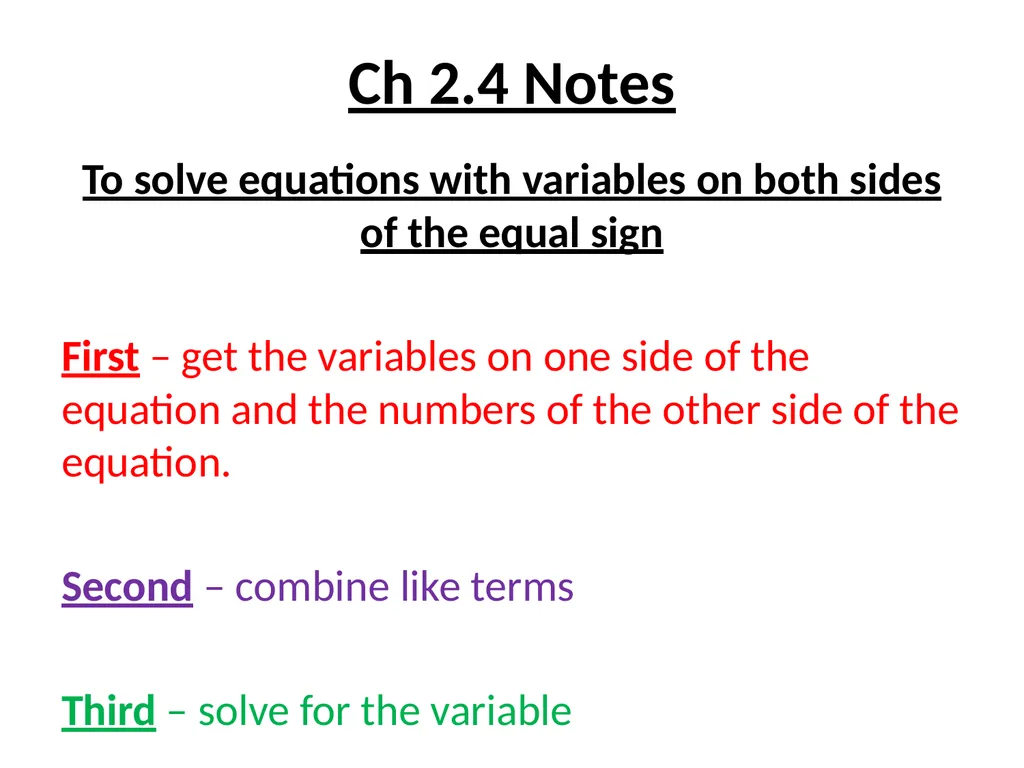
Ch 2.4 Notes To solve equations with variables on both sides of the equal sign
First – get the variables on one side of the equation and the numbers of the other side of the equation.
Second – combine like terms
Third – solve for the variable<br>
09
Chapter 2.5 Common Core – A.CED.4, N.Q.1, A.ED.1, A.REI.1, & A.REI.3 Rearrange formulas to highlight a quantity of interest, using the same reasoning as in solving equations.
Objectives – To rewrite and use literal equations and formulas.<br>
10
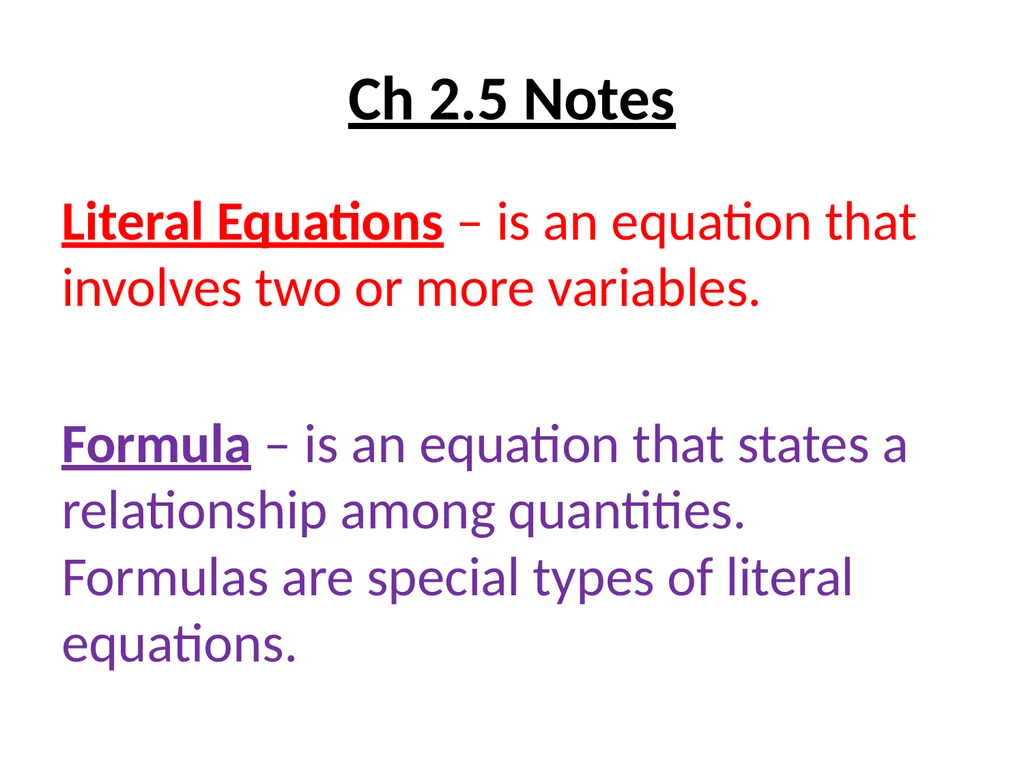
Ch 2.5 Notes Literal Equations – is an equation that involves two or more variables.
Formula – is an equation that states a relationship among quantities. Formulas are special types of literal equations.<br>
11
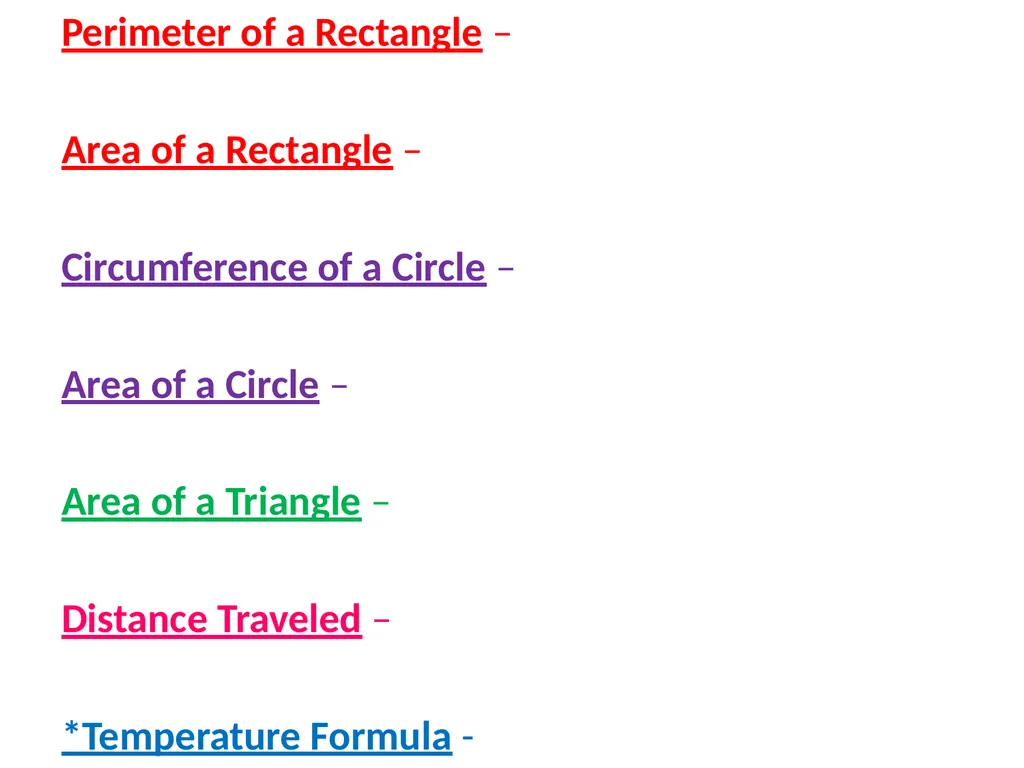
Perimeter of a Rectangle –
Area of a Rectangle –
Circumference of a Circle –
Area of a Circle –
Area of a Triangle –
Distance Traveled –
*Temperature Formula -<br>
12
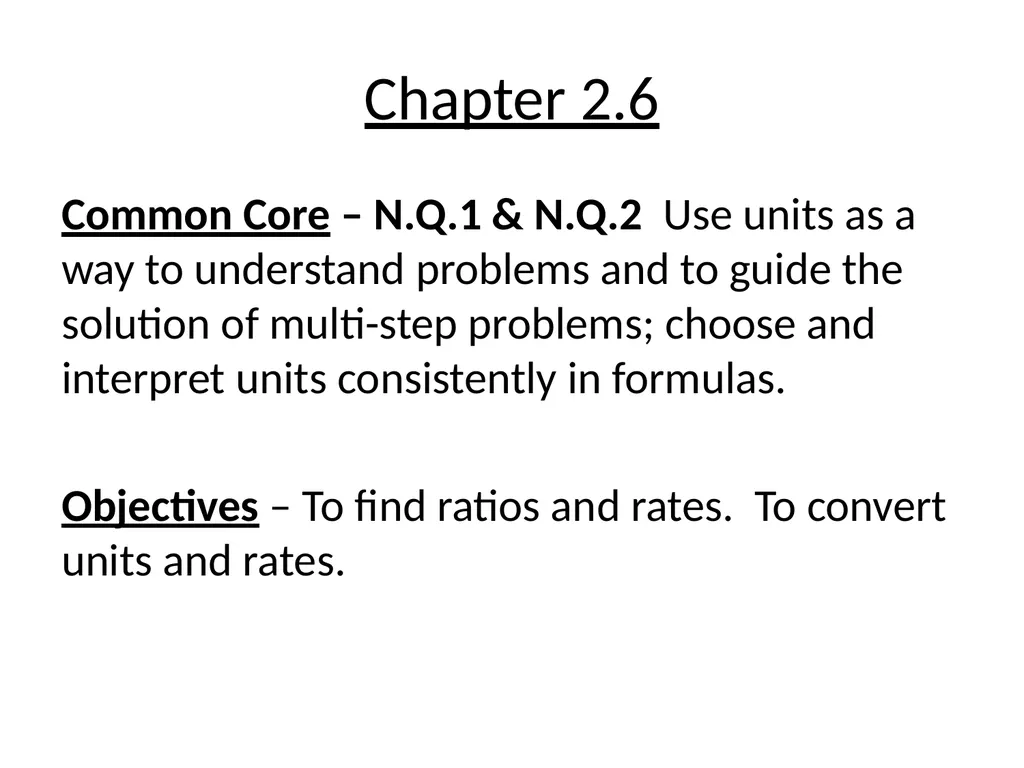
Chapter 2.6 Common Core – N.Q.1 & N.Q.2 Use units as a way to understand problems and to guide the solution of multi-step problems; choose and interpret units consistently in formulas.
Objectives – To find ratios and rates. To convert units and rates.<br>
13
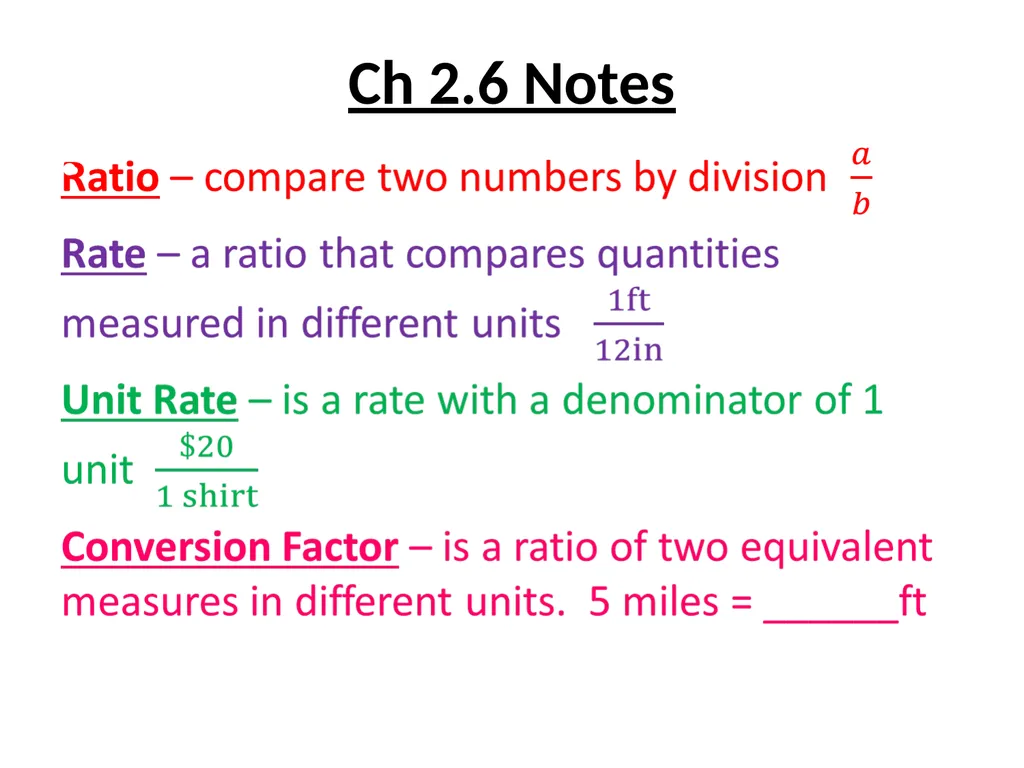
Ch 2.6 Notes<br>
14
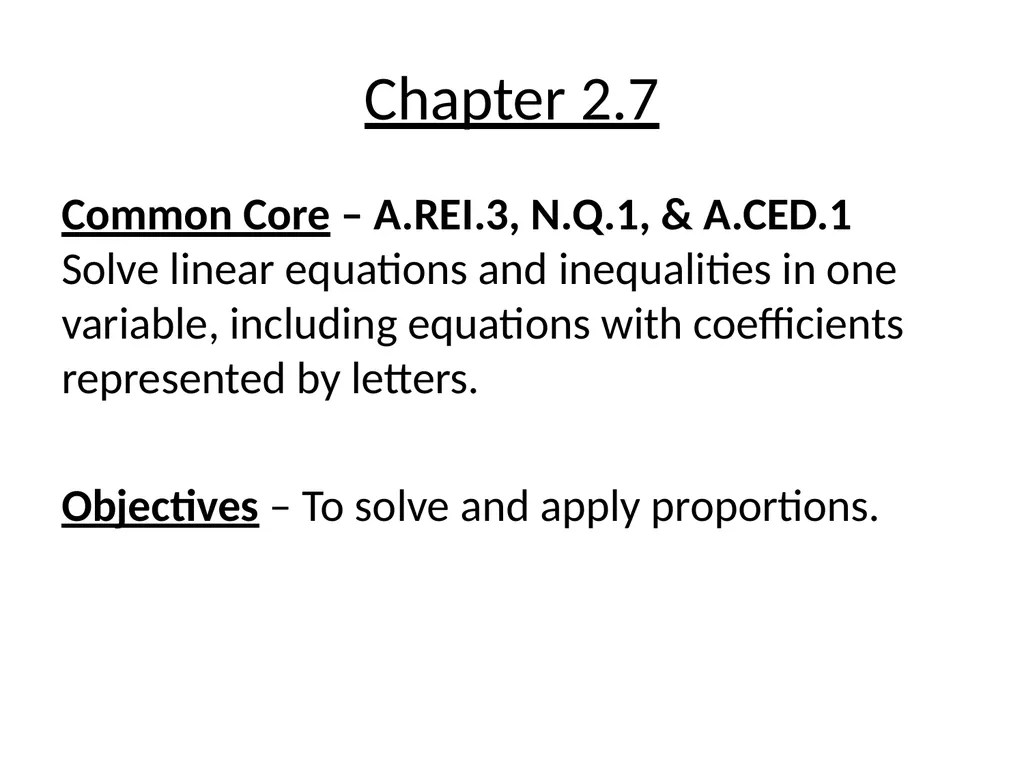
Chapter 2.7 Common Core – A.REI.3, N.Q.1, & A.CED.1 Solve linear equations and inequalities in one variable, including equations with coefficients represented by letters.
Objectives – To solve and apply proportions.<br>
15
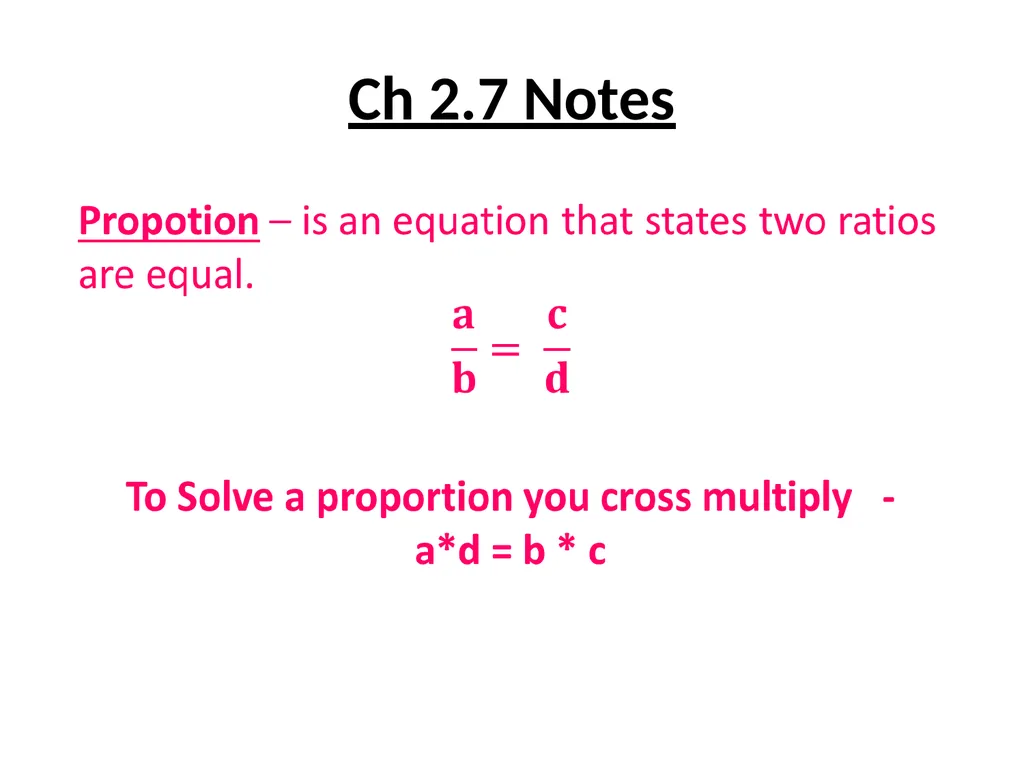
Ch 2.7 Notes<br>
16
Chapter 2.8 Common Core – A.CED.1 & A.REI.3 Create equations…in one variable and use them to solve problems.
Objectives – To find missing lengths in similar figures. To use similar figures when measuring indirectly.<br>
17
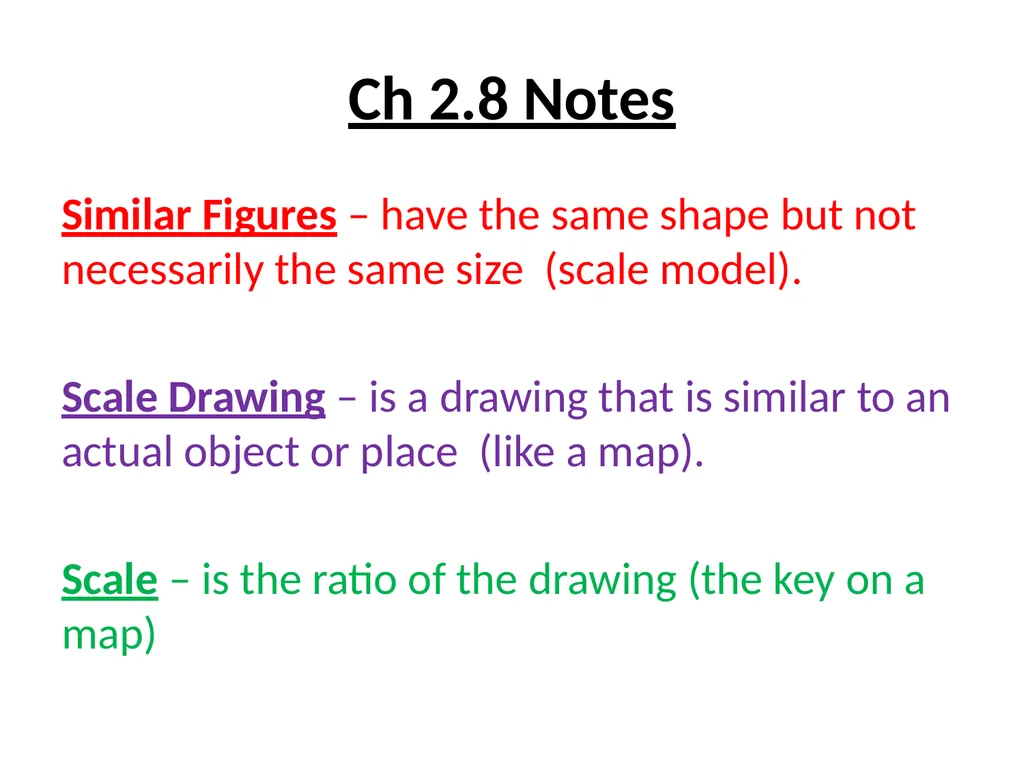
Ch 2.8 Notes Similar Figures – have the same shape but not necessarily the same size (scale model).
Scale Drawing – is a drawing that is similar to an actual object or place (like a map).
Scale – is the ratio of the drawing (the key on a map)<br>
18
Chapter 2.9 Common Core – N.Q.3 Choose a level of accuracy appropriate to limitations on measurement when reporting quantities.
Objectives – To solve percent problems using proportions. To solve percent problems using the percent equations.<br>
19
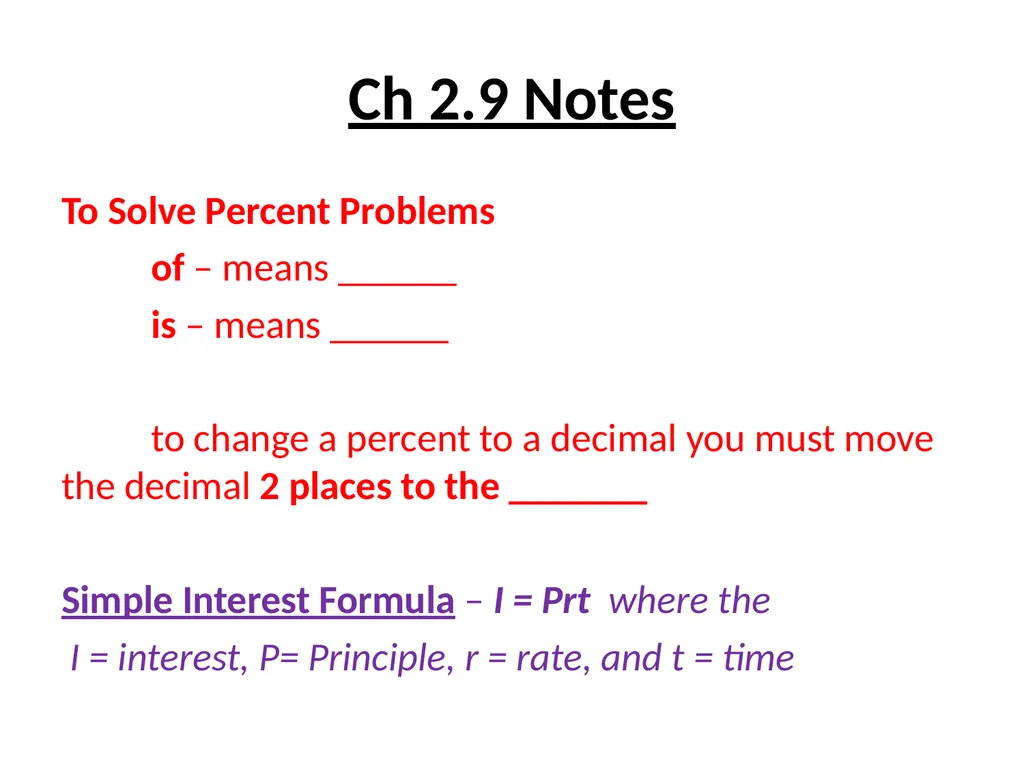
Ch 2.9 Notes To Solve Percent Problems
of – means ______
is – means ______
to change a percent to a decimal you must move the decimal 2 places to the _______
Simple Interest Formula – I = Prt where the
I = interest, P= Principle, r = rate, and t = time<br>
20
Chapter 2.10 Common Core – N.Q.3 Choose a level of accuracy appropriate to limitations on measurement when reporting quantities.
Objectives – To find percent change. To find the relative error in linear and nonlinear measurements.<br>