
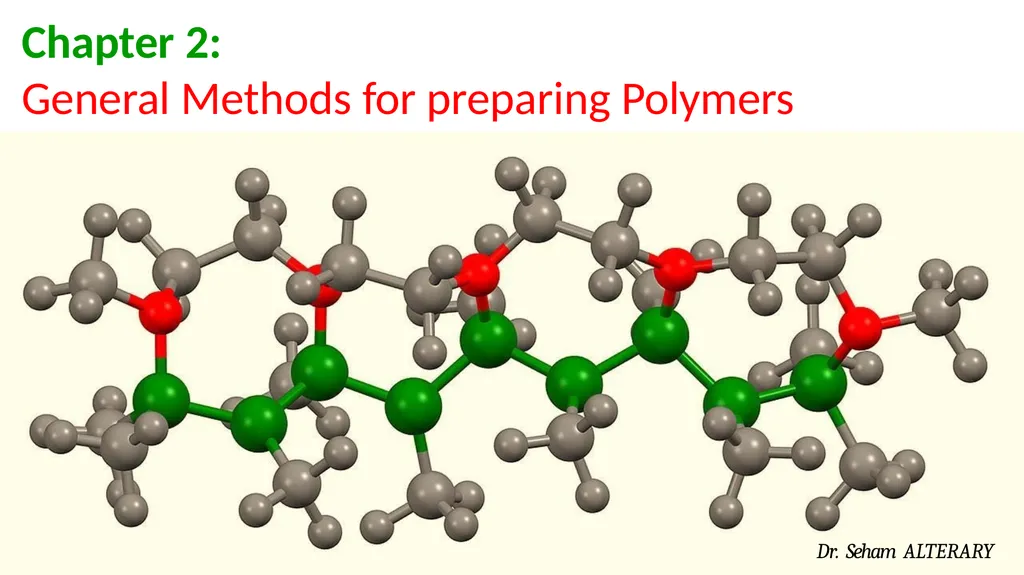
Chapter 2: General Methods for preparing Polymers
EM
Published · 156 slides · 0 views

1 / 1

Description
Chapter 2: General Methods for preparing Polymers Dr. Seham ALTERARY By the end of this Chapter You will be able to recognize Different types of polymerization mechanism Condensation polymerization Linear condensation polymers Cross-linked
Related Topics
Share
Embed code
Download this presentation From Below
"Chapter 2: General Methods for preparing Polymers" is the property of its rightful owner. Permission is granted to download and print the materials on this website for personal, non-commercial use only, and to display it on your personal computer provided you do not modify the materials and that you retain all copyright notices contained in the materials. By downloading content from our website, you accept the terms of this agreement.
Presentation Transcript
01
Chapter 2:
General Methods for preparing Polymers Dr. Seham ALTERARY<br>
General Methods for preparing Polymers Dr. Seham ALTERARY<br>
02
By the end of this Chapter You will be able to recognize
Different types of polymerization mechanism
Condensation polymerization
Linear condensation polymers
Cross-linked condensation polymers
Synthetic fibers
Addition polymerization<br>
Different types of polymerization mechanism
Condensation polymerization
Linear condensation polymers
Cross-linked condensation polymers
Synthetic fibers
Addition polymerization<br>
03
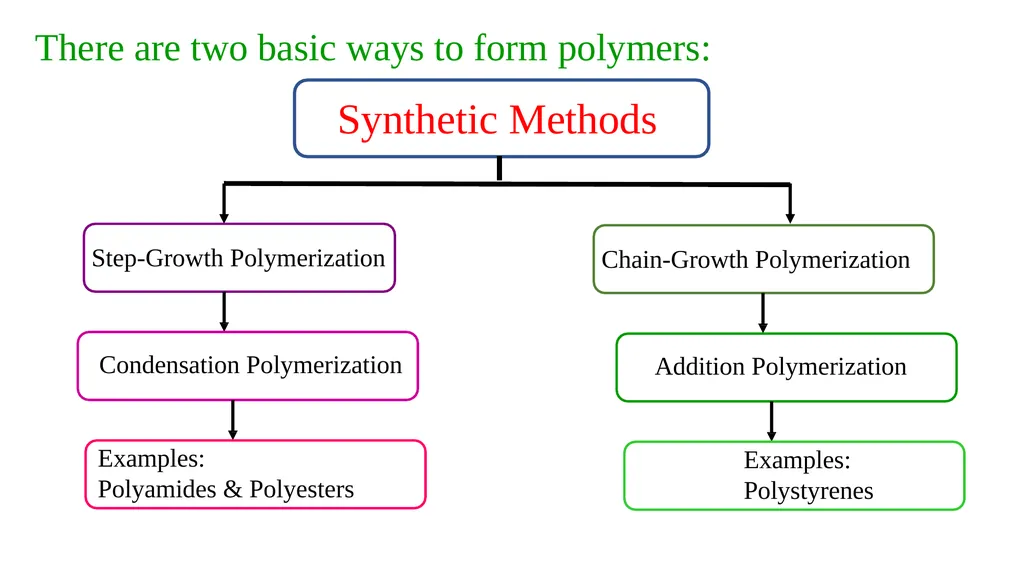
Synthetic Methods Step-Growth Polymerization Condensation Polymerization Examples:
Polyamides & Polyesters Chain-Growth Polymerization Addition Polymerization Examples:
Polystyrenes There are two basic ways to form polymers:<br>
Polyamides & Polyesters Chain-Growth Polymerization Addition Polymerization Examples:
Polystyrenes There are two basic ways to form polymers:<br>
04
A Step-Growth Polymerization is a stepwise reaction between bi-functional or multi-functional monomers in which a high-molecular-weight polymer is formed after a large number of steps.
Characteristics of Condensation Polymers
Condensation polymers form more slowly than addition polymers, often requiring heat, and they are generally lower in molecular weight.
The terminal functional groups on a chain remain active, so that groups of shorter chains combine into longer chains in the late stages of polymerization. 1. Condensation Polymerization<br>
05
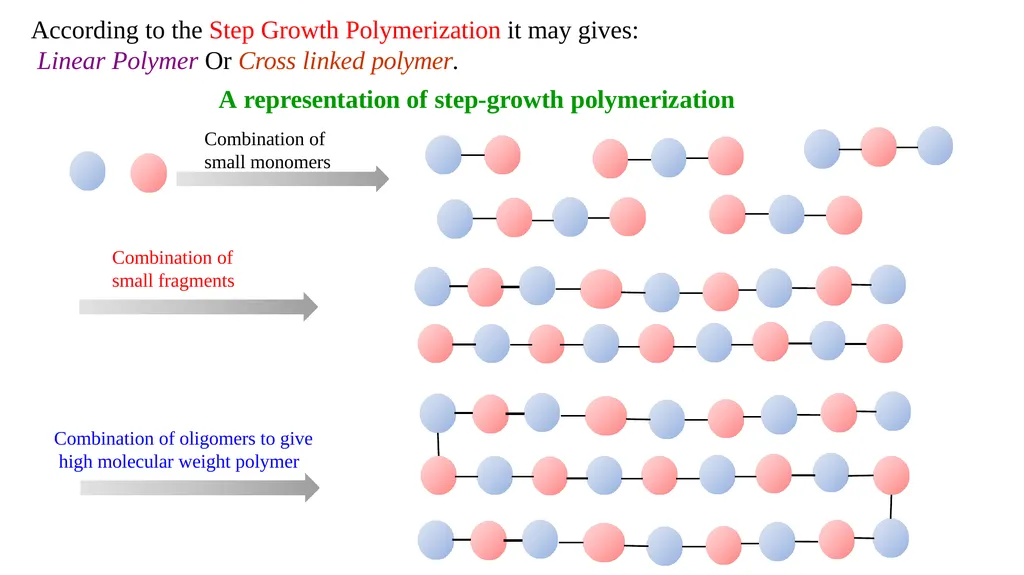
According to the Step Growth Polymerization it may gives:
Linear Polymer Or Cross linked polymer. A representation of step-growth polymerization
Combination of
small monomers Combination of
small fragments Combination of oligomers to give high molecular weight polymer<br>
Linear Polymer Or Cross linked polymer. A representation of step-growth polymerization
Combination of
small monomers Combination of
small fragments Combination of oligomers to give high molecular weight polymer<br>
06
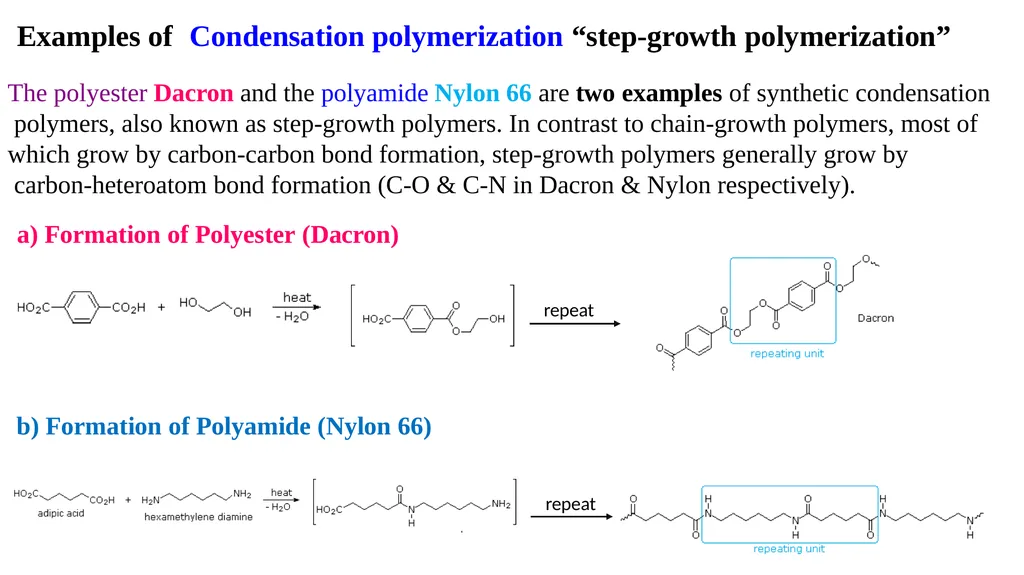
The polyester Dacron and the polyamide Nylon 66 are two examples of synthetic condensation polymers, also known as step-growth polymers. In contrast to chain-growth polymers, most of which grow by carbon-carbon bond formation, step-growth polymers generally grow by
carbon-heteroatom bond formation (C-O & C-N in Dacron & Nylon respectively).
a) Formation of Polyester (Dacron)
repeat Examples of Condensation polymerization “step-growth polymerization” b) Formation of Polyamide (Nylon 66)
repeat<br>
carbon-heteroatom bond formation (C-O & C-N in Dacron & Nylon respectively).
a) Formation of Polyester (Dacron)
repeat Examples of Condensation polymerization “step-growth polymerization” b) Formation of Polyamide (Nylon 66)
repeat<br>
07
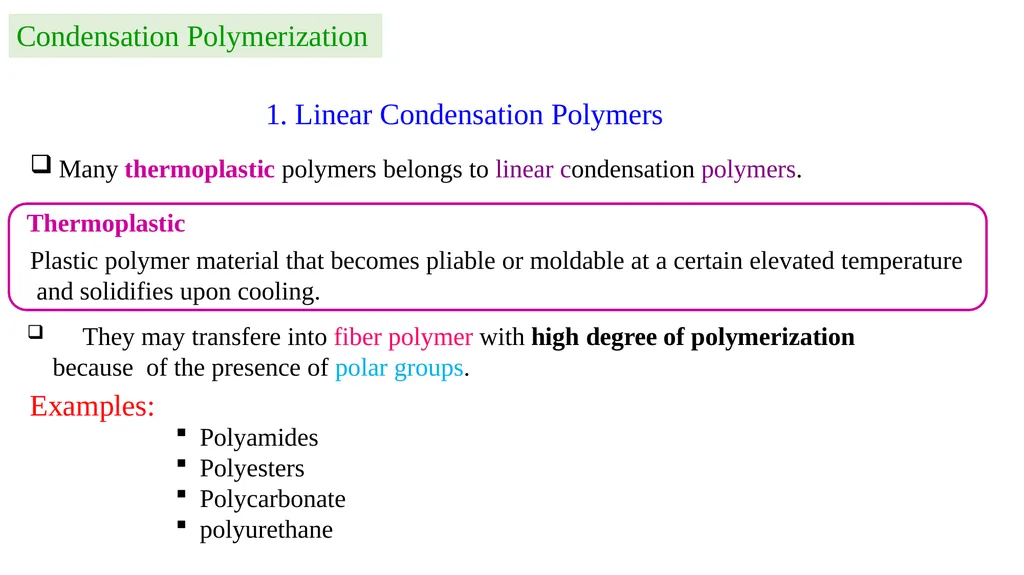
Condensation Polymerization 1. Linear Condensation Polymers
Many thermoplastic polymers belongs to linear condensation polymers.
Thermoplastic
Plastic polymer material that becomes pliable or moldable at a certain elevated temperature and solidifies upon cooling.
They may transfere into fiber polymer with high degree of polymerization because of the presence of polar groups.
Examples:
Polyamides
Polyesters
Polycarbonate
polyurethane<br>
08
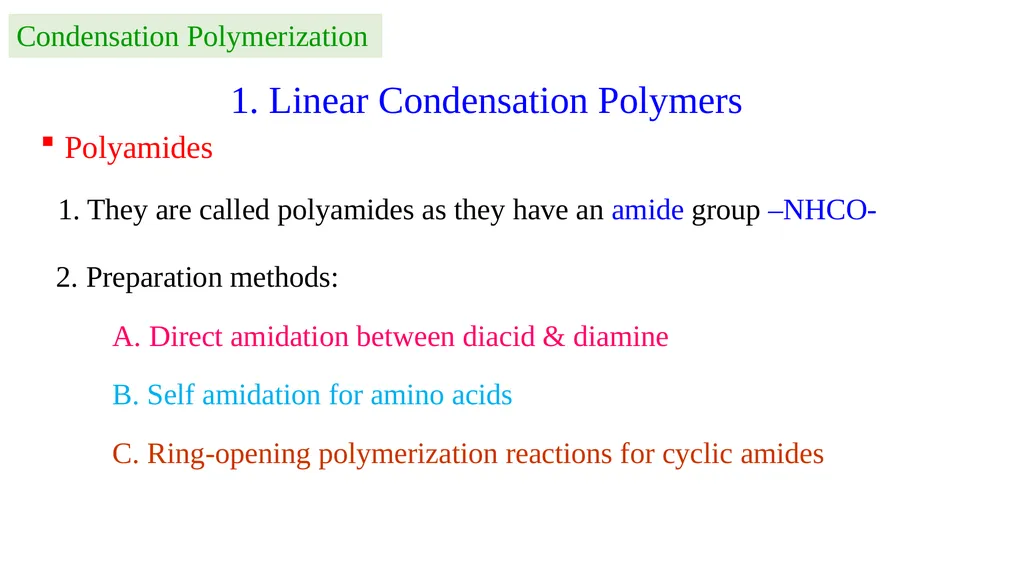
Condensation Polymerization 1. Linear Condensation Polymers Polyamides
They are called polyamides as they have an amide group –NHCO-
Preparation methods:
Direct amidation between diacid & diamine
Self amidation for amino acids
Ring-opening polymerization reactions for cyclic amides<br>
They are called polyamides as they have an amide group –NHCO-
Preparation methods:
Direct amidation between diacid & diamine
Self amidation for amino acids
Ring-opening polymerization reactions for cyclic amides<br>
09
Condensation Polymerization 1. Linear Condensation Polymers
Polyamides
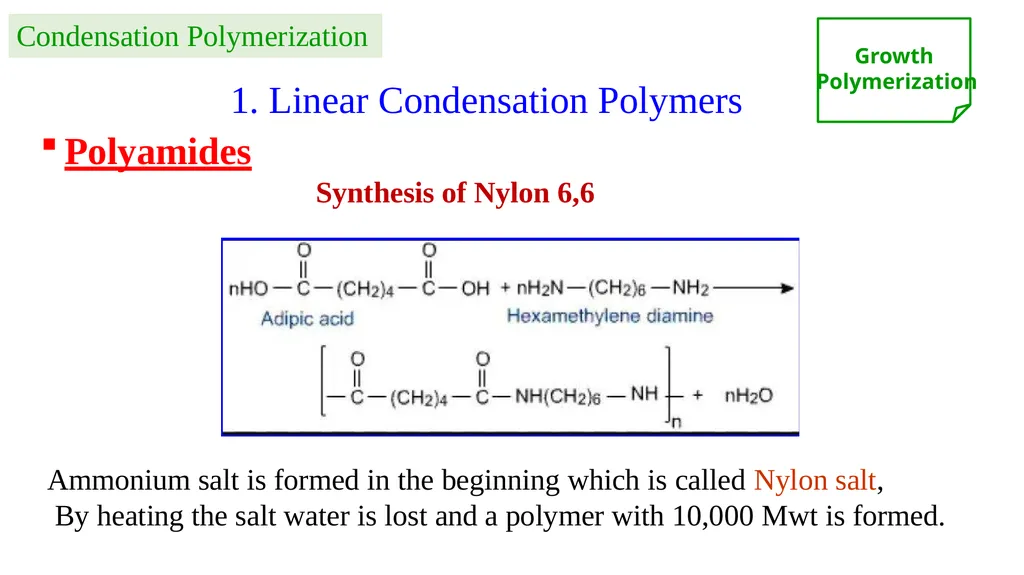
Synthesis of Nylon 6,6 Ammonium salt is formed in the beginning which is called Nylon salt,
By heating the salt water is lost and a polymer with 10,000 Mwt is formed. Growth
Polymerization<br>
Polyamides
Synthesis of Nylon 6,6 Ammonium salt is formed in the beginning which is called Nylon salt,
By heating the salt water is lost and a polymer with 10,000 Mwt is formed. Growth
Polymerization<br>
10
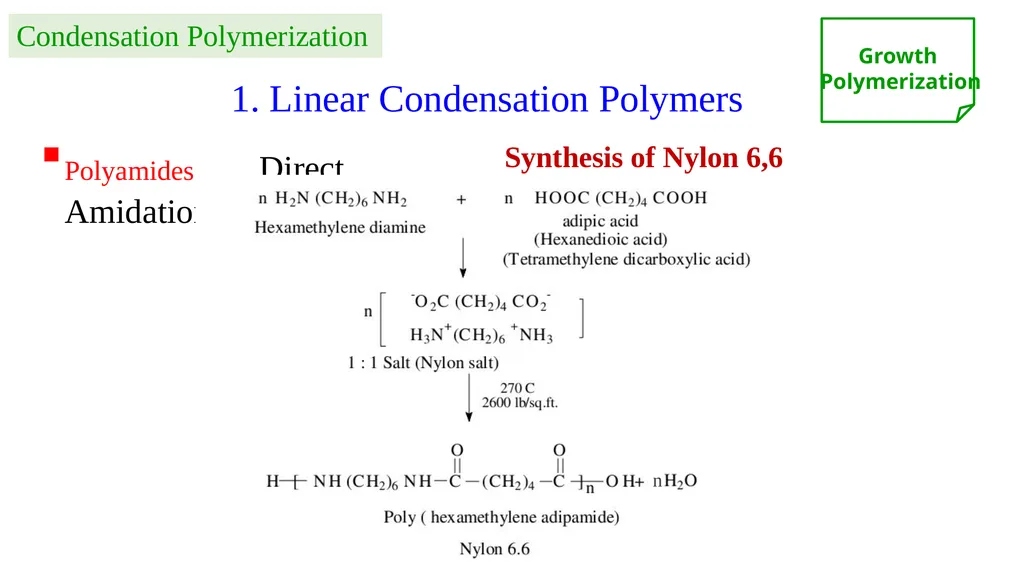
Condensation Polymerization 1. Linear Condensation Polymers Polyamides Direct Amidation Synthesis of Nylon 6,6 n Growth
Polymerization<br>
Polymerization<br>
11
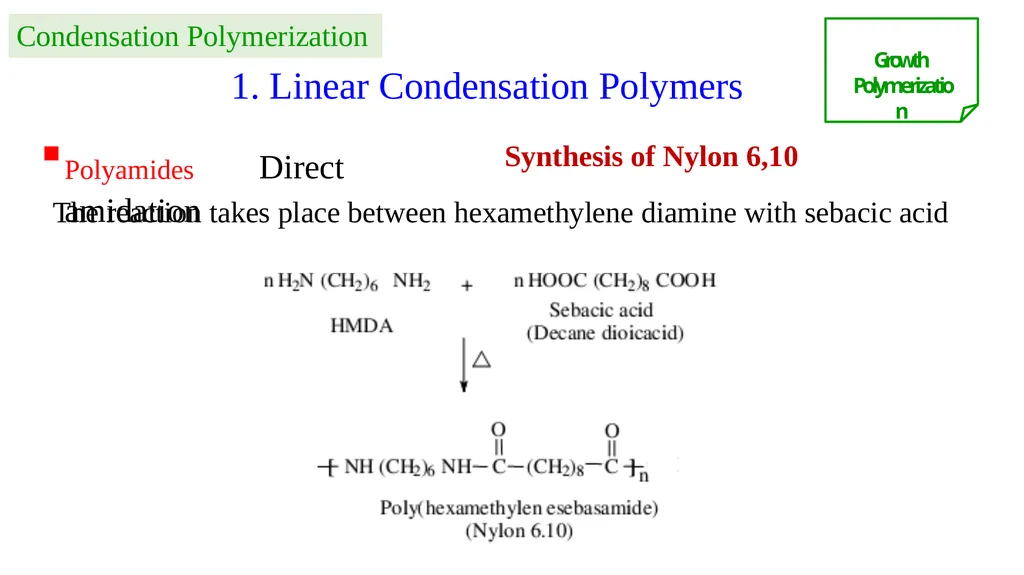
Condensation Polymerization 1. Linear Condensation Polymers Polyamides Direct amidation Synthesis of Nylon 6,10 The reaction takes place between hexamethylene diamine with sebacic acid Growth
Polymerization<br>
Polymerization<br>
12
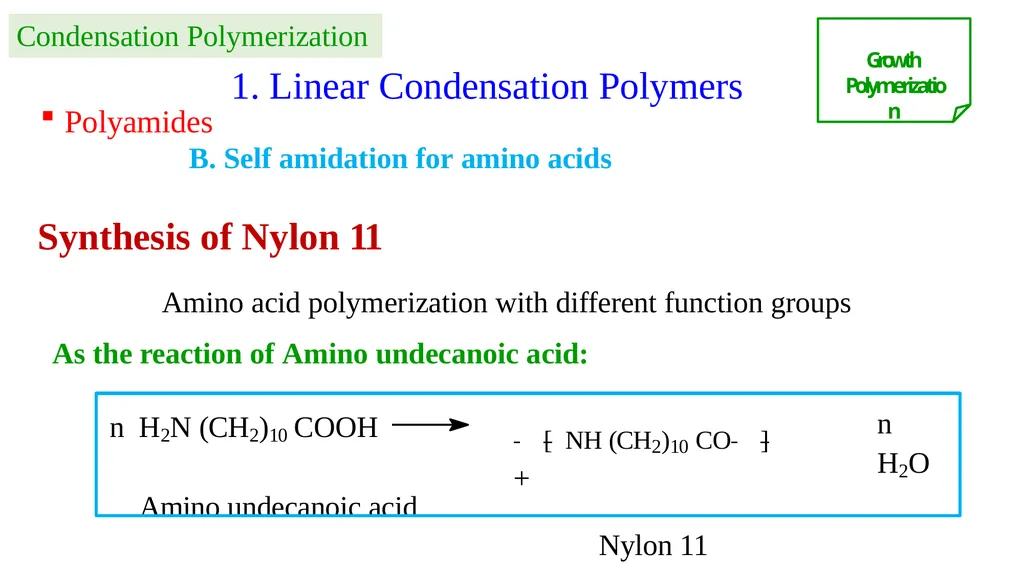
Condensation Polymerization 1. Linear Condensation Polymers n H2N (CH2)10 COOH
Amino undecanoic acid [ NH (CH2)10 CO ] +
Nylon 11 n H2O Growth
Polymerization Polyamides
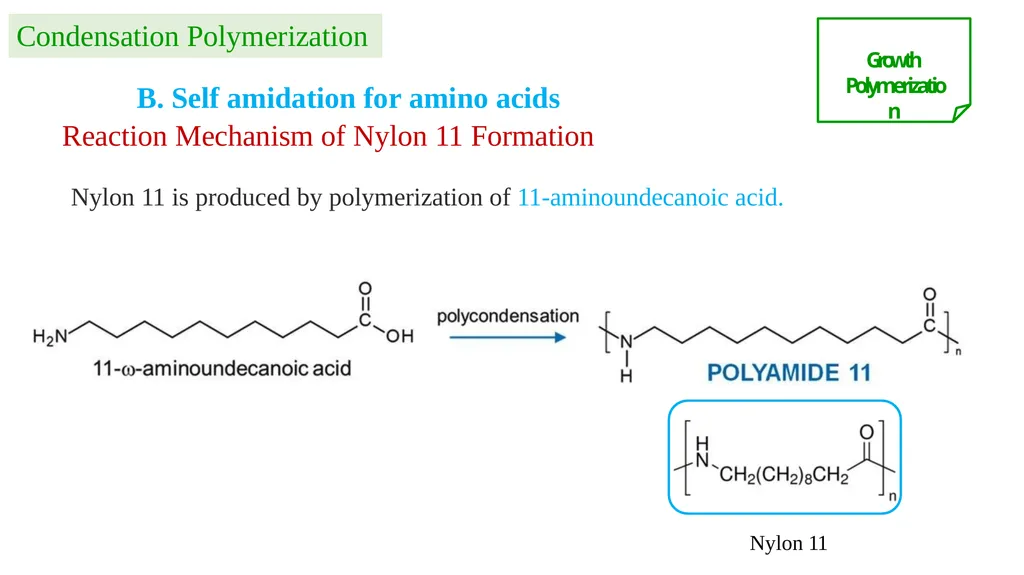
B. Self amidation for amino acids
Synthesis of Nylon 11
Amino acid polymerization with different function groups
As the reaction of Amino undecanoic acid:<br>
Amino undecanoic acid [ NH (CH2)10 CO ] +
Nylon 11 n H2O Growth
Polymerization Polyamides
B. Self amidation for amino acids
Synthesis of Nylon 11
Amino acid polymerization with different function groups
As the reaction of Amino undecanoic acid:<br>
13
B. Self amidation for amino acids
Reaction Mechanism of Nylon 11 Formation Condensation Polymerization Growth
Polymerization Nylon 11 is produced by polymerization of 11-aminoundecanoic acid. Nylon 11<br>
Reaction Mechanism of Nylon 11 Formation Condensation Polymerization Growth
Polymerization Nylon 11 is produced by polymerization of 11-aminoundecanoic acid. Nylon 11<br>
14
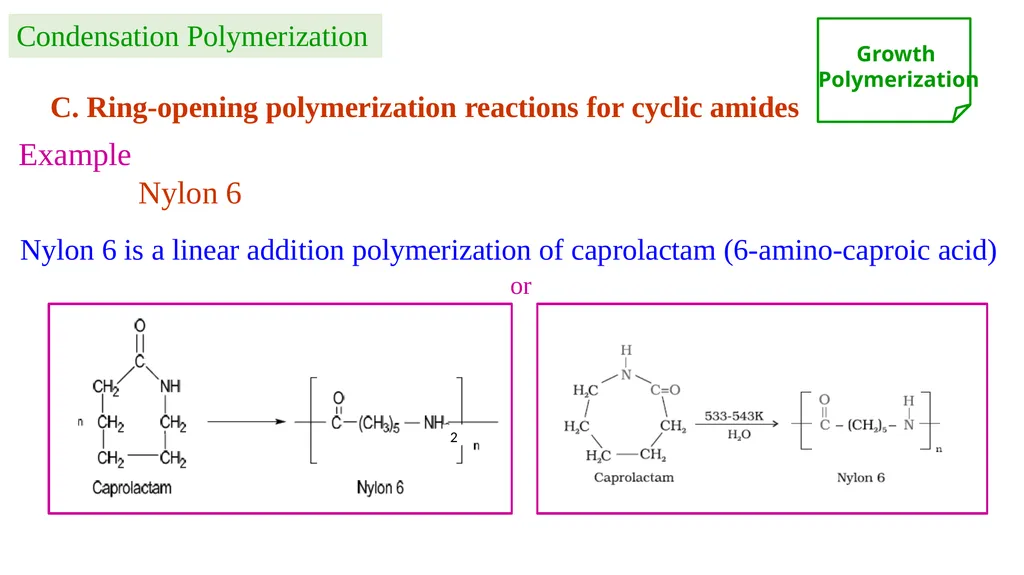
Condensation Polymerization C. Ring-opening polymerization reactions for cyclic amides
Example
Nylon 6 Nylon 6 is a linear addition polymerization of caprolactam (6-amino-caproic acid)
or 2 Growth
Polymerization<br>
Example
Nylon 6 Nylon 6 is a linear addition polymerization of caprolactam (6-amino-caproic acid)
or 2 Growth
Polymerization<br>
15
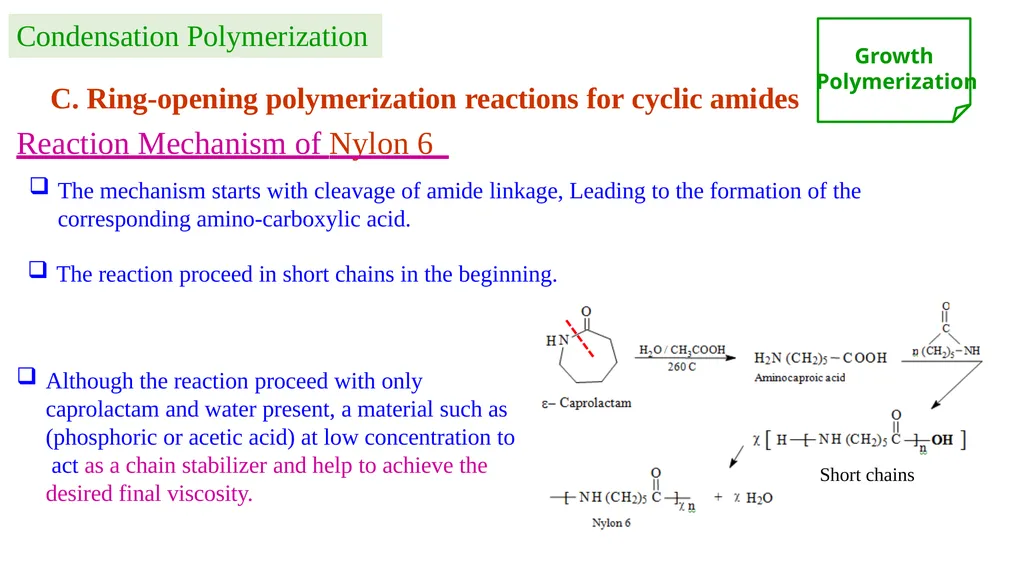
Short chains C. Ring-opening polymerization reactions for cyclic amides
Reaction Mechanism of Nylon 6 The mechanism starts with cleavage of amide linkage, Leading to the formation of the
corresponding amino-carboxylic acid.
The reaction proceed in short chains in the beginning. Condensation Polymerization Although the reaction proceed with only caprolactam and water present, a material such as (phosphoric or acetic acid) at low concentration to act as a chain stabilizer and help to achieve the desired final viscosity. Growth
Polymerization<br>
16
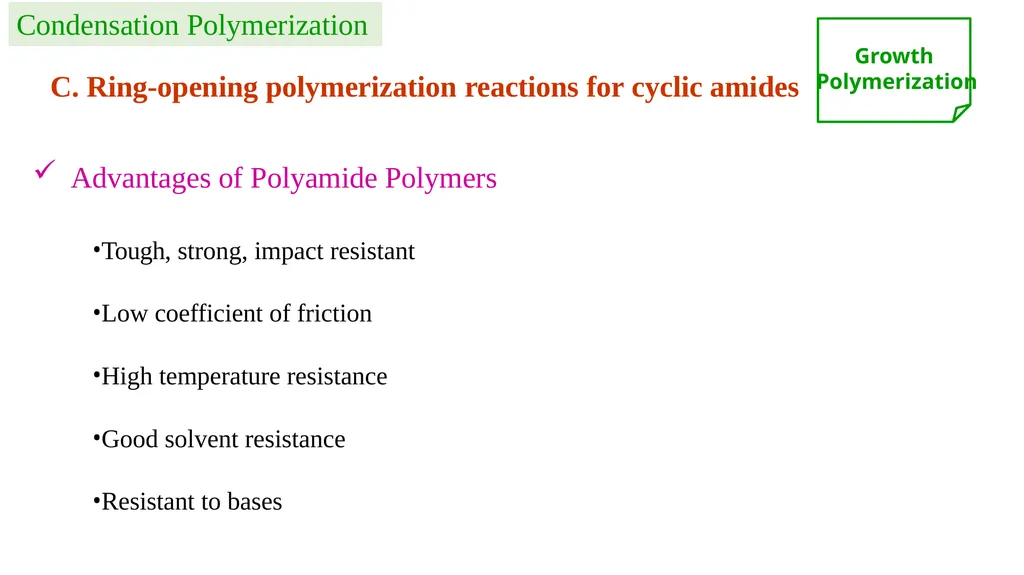
Condensation Polymerization C. Ring-opening polymerization reactions for cyclic amides Advantages of Polyamide Polymers
Tough, strong, impact resistant
Low coefficient of friction
High temperature resistance
Good solvent resistance
Resistant to bases Growth
Polymerization<br>
Tough, strong, impact resistant
Low coefficient of friction
High temperature resistance
Good solvent resistance
Resistant to bases Growth
Polymerization<br>
17
C. Ring-opening polymerization reactions for cyclic amides
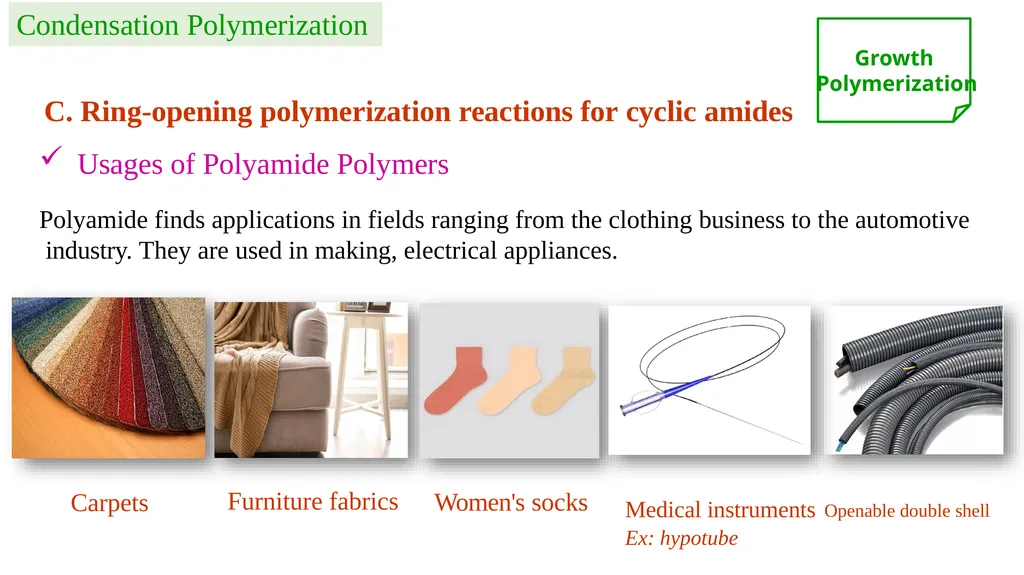
Usages of Polyamide Polymers Carpets Furniture fabrics Medical instruments Openable double shell
Ex: hypotube Women's socks Condensation Polymerization Polyamide finds applications in fields ranging from the clothing business to the automotive industry. They are used in making, electrical appliances. Growth
Polymerization<br>
18
Condensation Polymerization Polyesteres
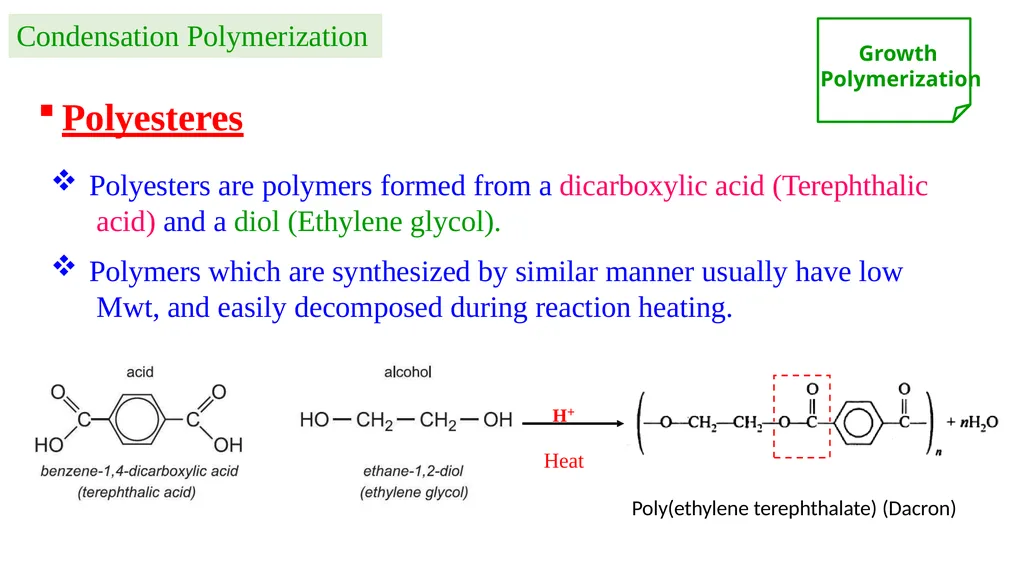
Polyesters are polymers formed from a dicarboxylic acid (Terephthalic acid) and a diol (Ethylene glycol).
Polymers which are synthesized by similar manner usually have low Mwt, and easily decomposed during reaction heating. H+
Heat
Poly(ethylene terephthalate) (Dacron) Growth
Polymerization<br>
Polyesters are polymers formed from a dicarboxylic acid (Terephthalic acid) and a diol (Ethylene glycol).
Polymers which are synthesized by similar manner usually have low Mwt, and easily decomposed during reaction heating. H+
Heat
Poly(ethylene terephthalate) (Dacron) Growth
Polymerization<br>
19
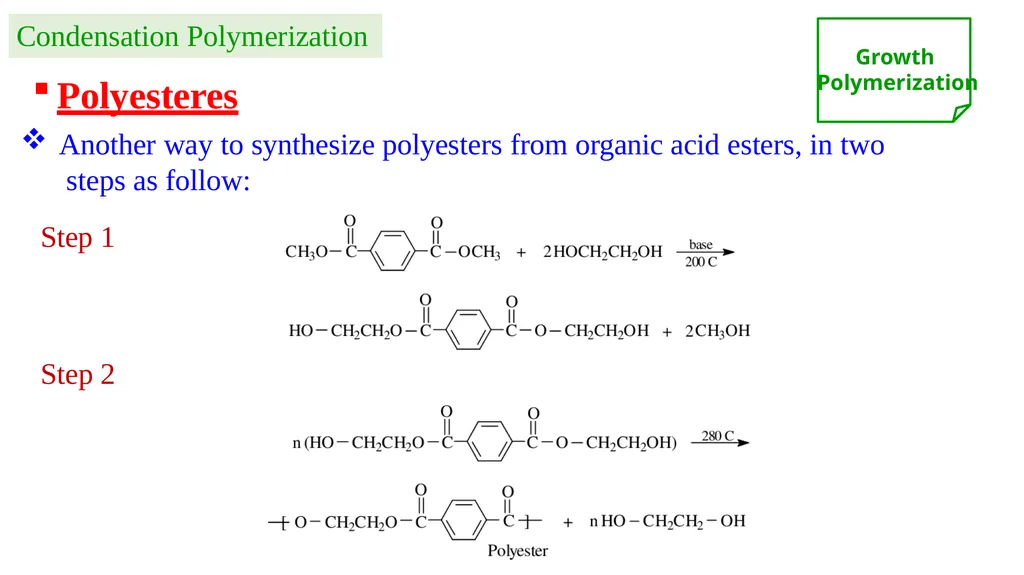
Polyesteres Condensation Polymerization Another way to synthesize polyesters from organic acid esters, in two steps as follow:
Step 1 Step 2 Growth
Polymerization<br>
Step 1 Step 2 Growth
Polymerization<br>
20
Usages of Polyesters Polyesteres Condensation Polymerization Polyester is used in the manufacturing of all kinds of clothes and home furnishings,
like bedspreads, sheets, pillows, carpets and even curtains.
PET: The most common use of polyester today is to make the plastic bottles that store our much beloved beverages. Shatterproof and cheap these bottles are an absolute boon to the beverages industry.
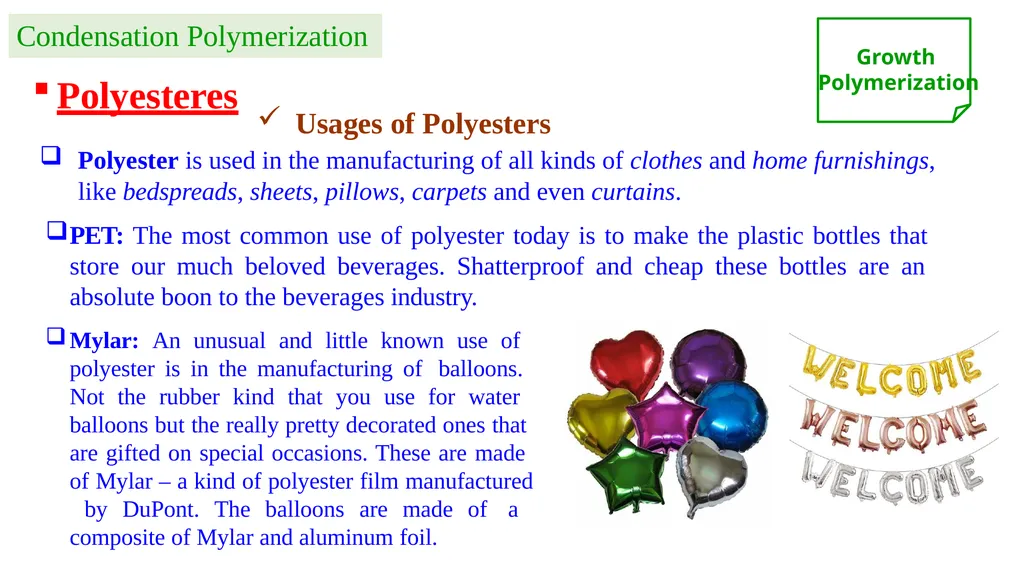
Mylar: An unusual and little known use of polyester is in the manufacturing of balloons. Not the rubber kind that you use for water balloons but the really pretty decorated ones that are gifted on special occasions. These are made of Mylar – a kind of polyester film manufactured by DuPont. The balloons are made of a composite of Mylar and aluminum foil. Growth
Polymerization<br>
21
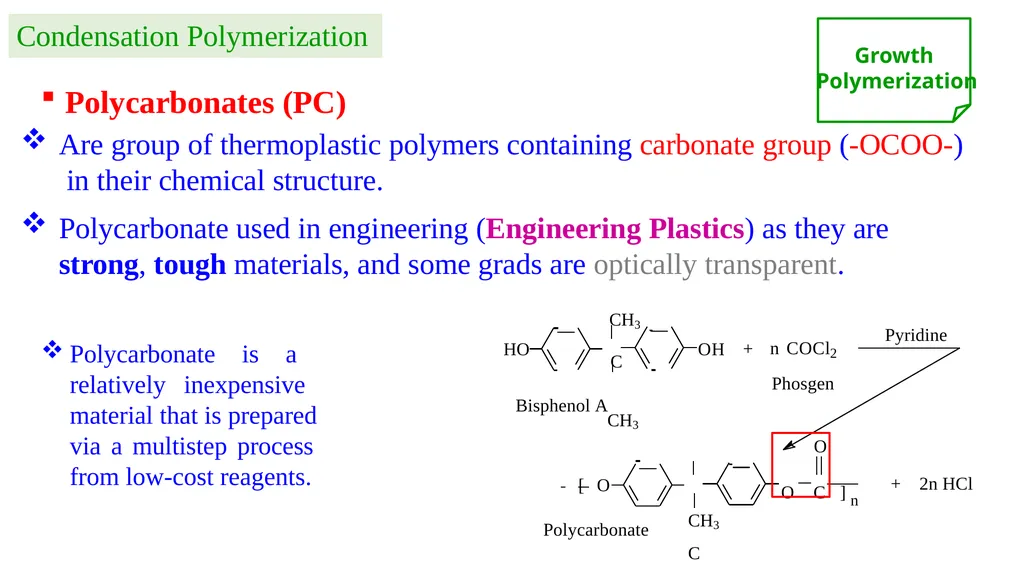
Polycarbonates (PC) Condensation Polymerization Polycarbonate Pyridine Phosgen Bisphenol A + + 2n HCl [ O n COCl 2 OH HO CH3 C CH3 CH3
C
CH3 O
O C ] n Are group of thermoplastic polymers containing carbonate group (-OCOO-) in their chemical structure.
Polycarbonate used in engineering (Engineering Plastics) as they are
strong, tough materials, and some grads are optically transparent. Polycarbonate is a relatively inexpensive material that is prepared via a multistep process from low-cost reagents. Growth
Polymerization<br>
22
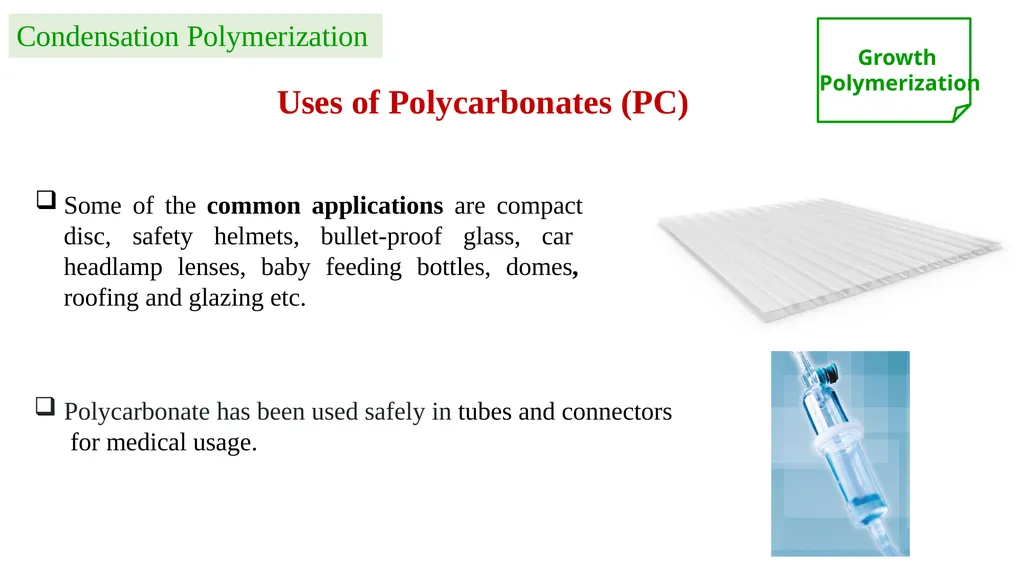
Condensation Polymerization Uses of Polycarbonates (PC) Some of the common applications are compact disc, safety helmets, bullet-proof glass, car headlamp lenses, baby feeding bottles, domes, roofing and glazing etc. Polycarbonate has been used safely in tubes and connectors for medical usage. Growth
Polymerization<br>
Polymerization<br>
23
Condensation Polymerization Polyurethane
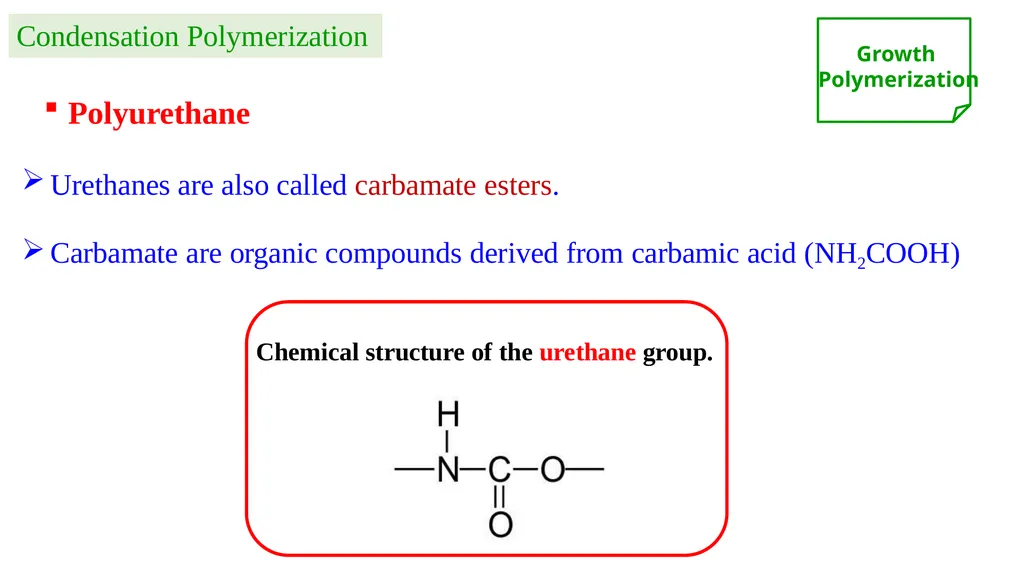
Urethanes are also called carbamate esters.
Carbamate are organic compounds derived from carbamic acid (NH2COOH)
Chemical structure of the urethane group. Growth
Polymerization<br>
Urethanes are also called carbamate esters.
Carbamate are organic compounds derived from carbamic acid (NH2COOH)
Chemical structure of the urethane group. Growth
Polymerization<br>
24
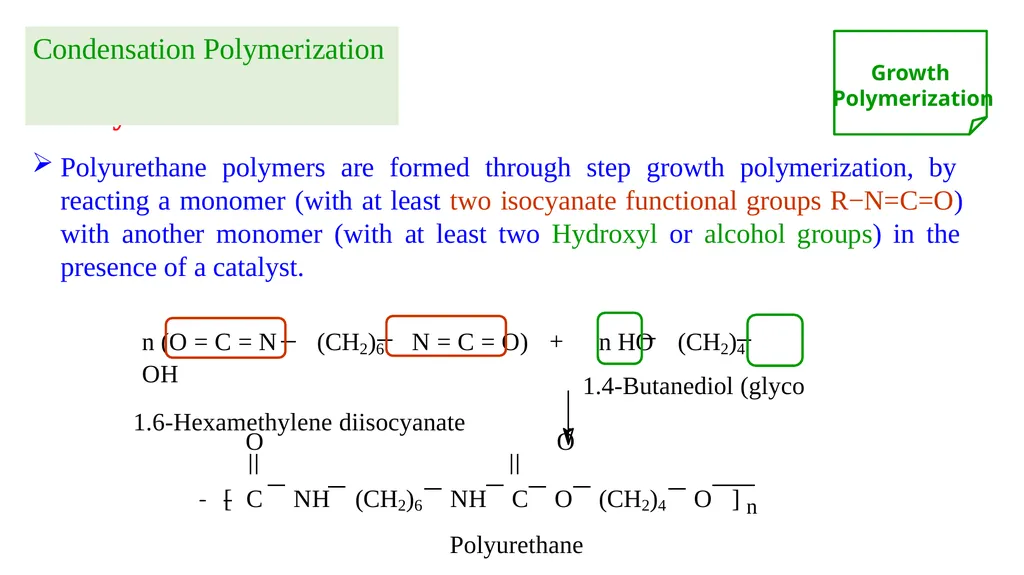
1.4-Butanediol (glyco + n (O = C = N (CH2)6 N = C = O) n HO (CH2)4 OH
1.6-Hexamethylene diisocyanate O O
[ C NH (CH2)6 NH C O (CH2)4 O ] n
Polyurethane Polyurethane Condensation Polymerization Polyurethane polymers are formed through step growth polymerization, by reacting a monomer (with at least two isocyanate functional groups R−N=C=O) with another monomer (with at least two Hydroxyl or alcohol groups) in the presence of a catalyst. Growth
Polymerization<br>
25
Polyurethane Condensation Polymerization Synthesis of Aromatic Polyurethane
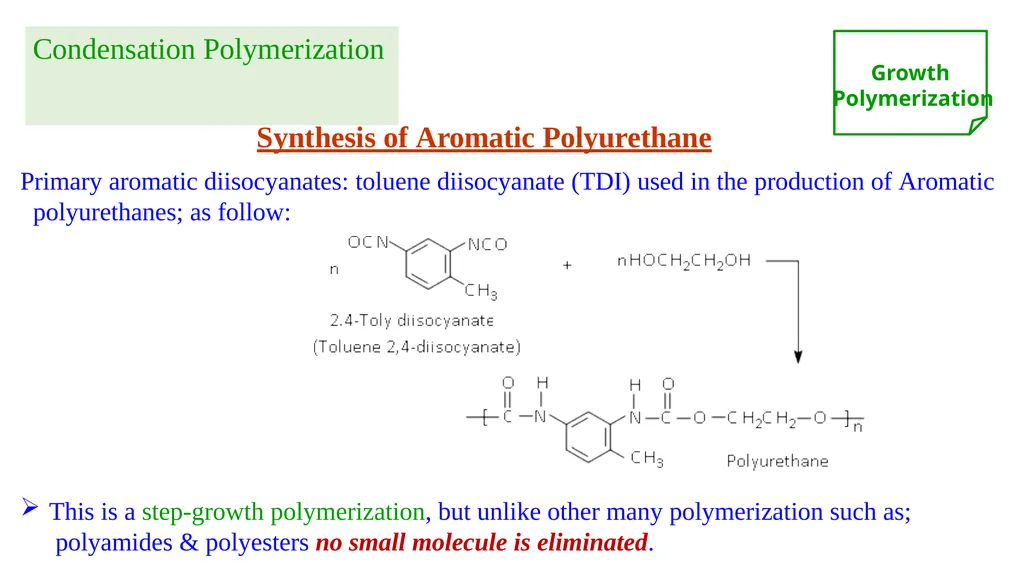
Primary aromatic diisocyanates: toluene diisocyanate (TDI) used in the production of Aromatic polyurethanes; as follow: This is a step-growth polymerization, but unlike other many polymerization such as; polyamides & polyesters no small molecule is eliminated. Growth
Polymerization<br>
Primary aromatic diisocyanates: toluene diisocyanate (TDI) used in the production of Aromatic polyurethanes; as follow: This is a step-growth polymerization, but unlike other many polymerization such as; polyamides & polyesters no small molecule is eliminated. Growth
Polymerization<br>
26
Applications & Uses of Polyurethane
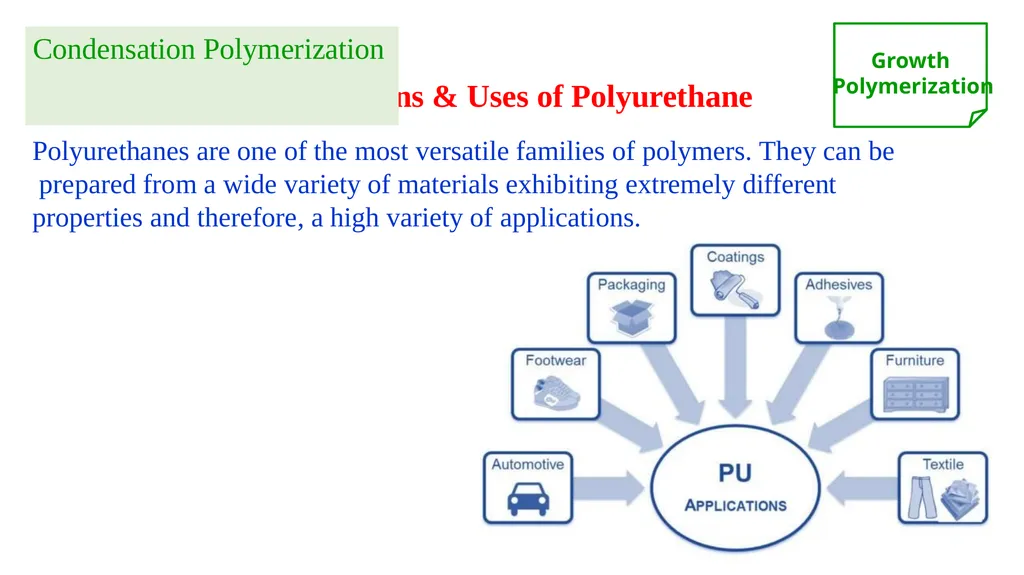
Polyurethanes are one of the most versatile families of polymers. They can be prepared from a wide variety of materials exhibiting extremely different properties and therefore, a high variety of applications. Condensation Polymerization Growth
Polymerization<br>
Polyurethanes are one of the most versatile families of polymers. They can be prepared from a wide variety of materials exhibiting extremely different properties and therefore, a high variety of applications. Condensation Polymerization Growth
Polymerization<br>
27
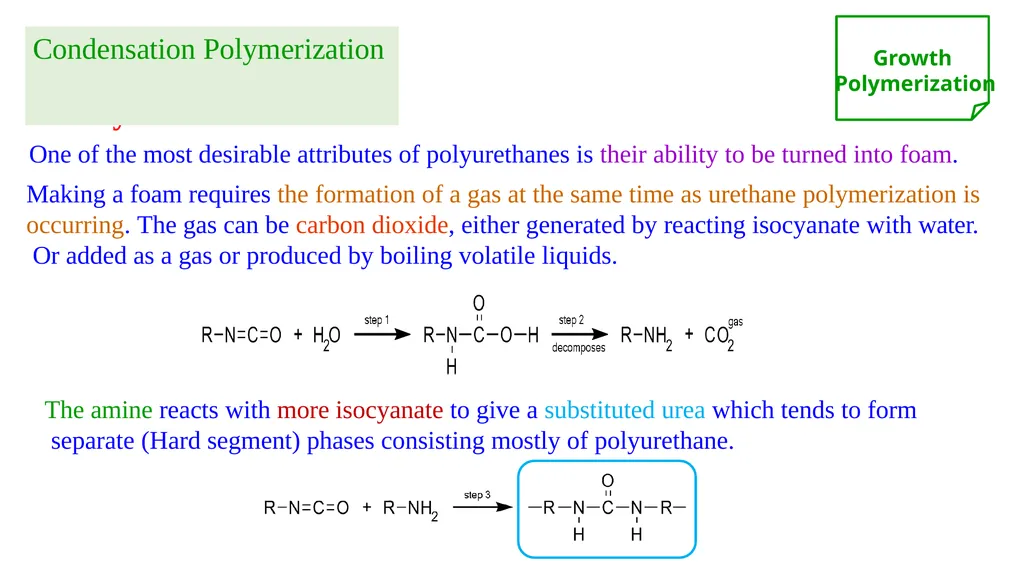
Polyurethane Foam Condensation Polymerization One of the most desirable attributes of polyurethanes is their ability to be turned into foam. Making a foam requires the formation of a gas at the same time as urethane polymerization is
occurring. The gas can be carbon dioxide, either generated by reacting isocyanate with water. Or added as a gas or produced by boiling volatile liquids. The amine reacts with more isocyanate to give a substituted urea which tends to form separate (Hard segment) phases consisting mostly of polyurethane. Growth
Polymerization<br>
28
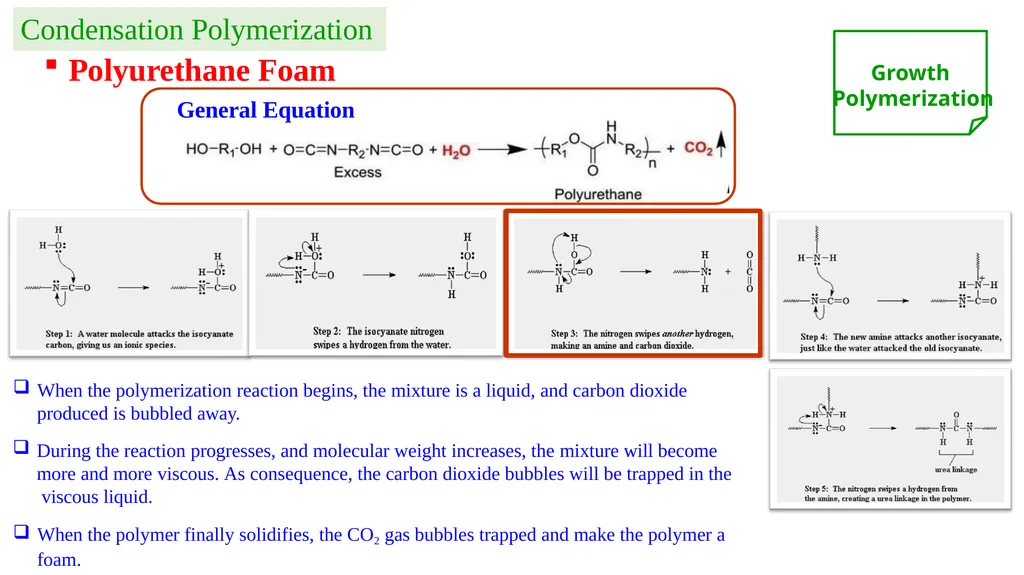
Polyurethane Foam Condensation Polymerization General Equation When the polymerization reaction begins, the mixture is a liquid, and carbon dioxide
produced is bubbled away.
During the reaction progresses, and molecular weight increases, the mixture will become more and more viscous. As consequence, the carbon dioxide bubbles will be trapped in the viscous liquid.
When the polymer finally solidifies, the CO2 gas bubbles trapped and make the polymer a foam. Growth
Polymerization<br>
29
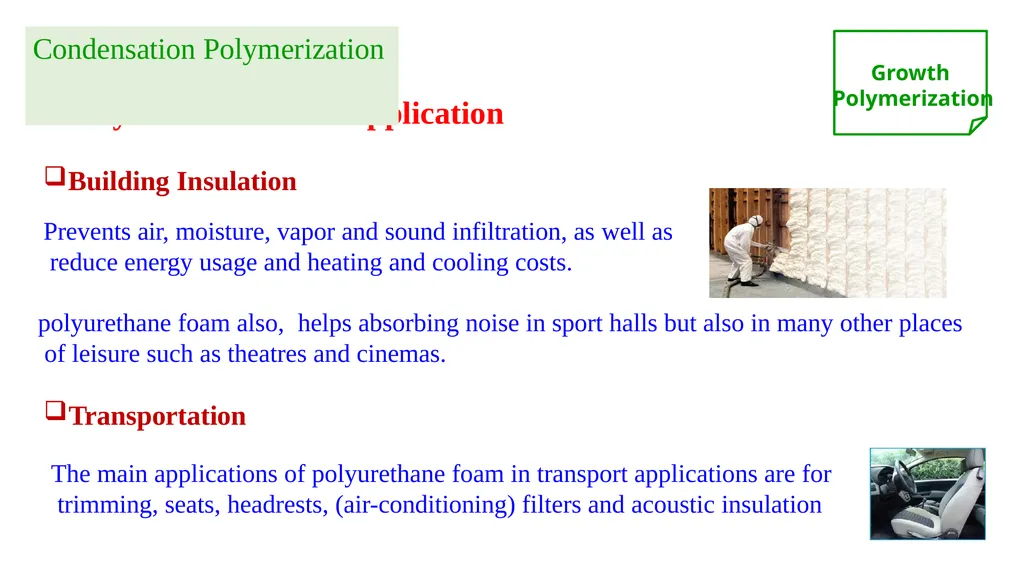
Polyurethane Foam Application Condensation Polymerization Building Insulation
Prevents air, moisture, vapor and sound infiltration, as well as reduce energy usage and heating and cooling costs.
polyurethane foam also, helps absorbing noise in sport halls but also in many other places of leisure such as theatres and cinemas.
Transportation
The main applications of polyurethane foam in transport applications are for trimming, seats, headrests, (air-conditioning) filters and acoustic insulation Growth
Polymerization<br>
30
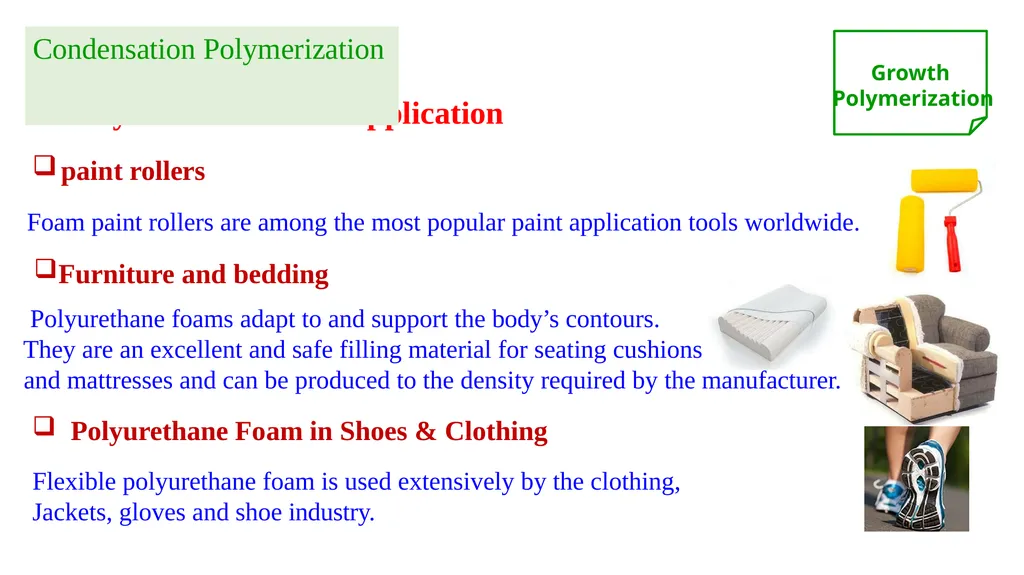
Foam paint rollers are among the most popular paint application tools worldwide.
Furniture and bedding
Polyurethane foams adapt to and support the body’s contours.
They are an excellent and safe filling material for seating cushions
and mattresses and can be produced to the density required by the manufacturer.
Polyurethane Foam in Shoes & Clothing
Flexible polyurethane foam is used extensively by the clothing,
Jackets, gloves and shoe industry. Polyurethane Foam Application
paint rollers Condensation Polymerization Growth
Polymerization<br>
31
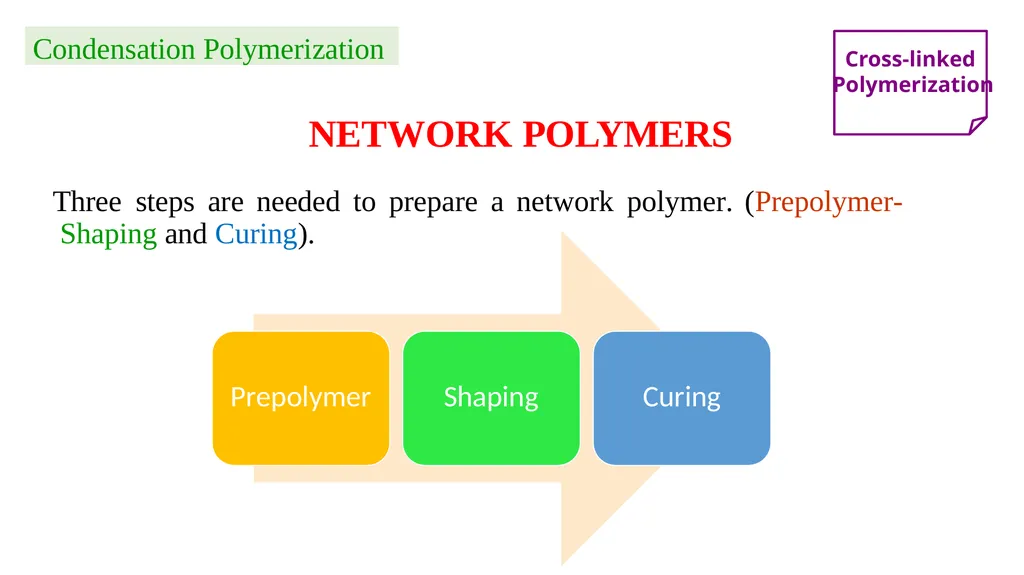
Condensation Polymerization NETWORK POLYMERS
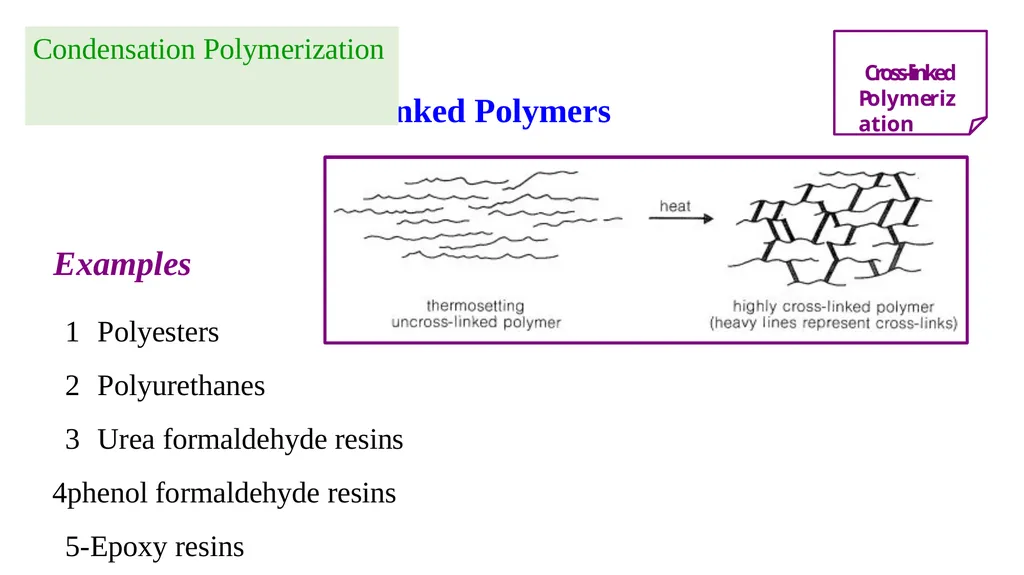
Three steps are needed to prepare a network polymer. (Prepolymer- Shaping and Curing). Prepolymer Shaping Curing Cross-linked
Polymerization<br>
Three steps are needed to prepare a network polymer. (Prepolymer- Shaping and Curing). Prepolymer Shaping Curing Cross-linked
Polymerization<br>
32
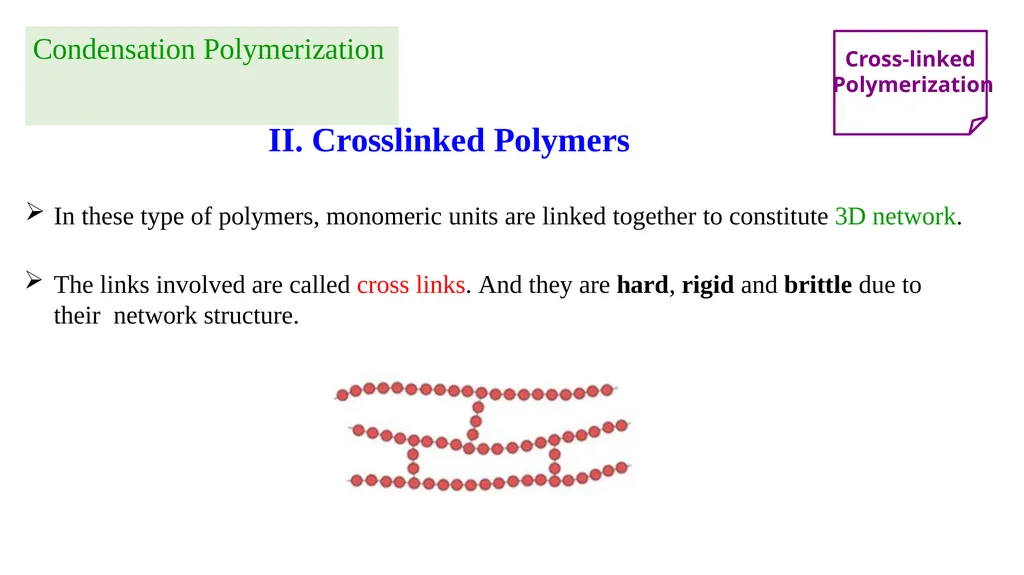
Condensation Polymerization II. Crosslinked Polymers
In these type of polymers, monomeric units are linked together to constitute 3D network.
The links involved are called cross links. And they are hard, rigid and brittle due to their network structure. Cross-linked
Polymerization<br>
In these type of polymers, monomeric units are linked together to constitute 3D network.
The links involved are called cross links. And they are hard, rigid and brittle due to their network structure. Cross-linked
Polymerization<br>
33
II. Crosslinked Polymers Condensation Polymerization Cross-linked Polymerization Examples
Polyesters
Polyurethanes
Urea formaldehyde resins
phenol formaldehyde resins 5-Epoxy resins<br>
Polyesters
Polyurethanes
Urea formaldehyde resins
phenol formaldehyde resins 5-Epoxy resins<br>
34
Condensation Polymerization II. Crosslinked Polymers
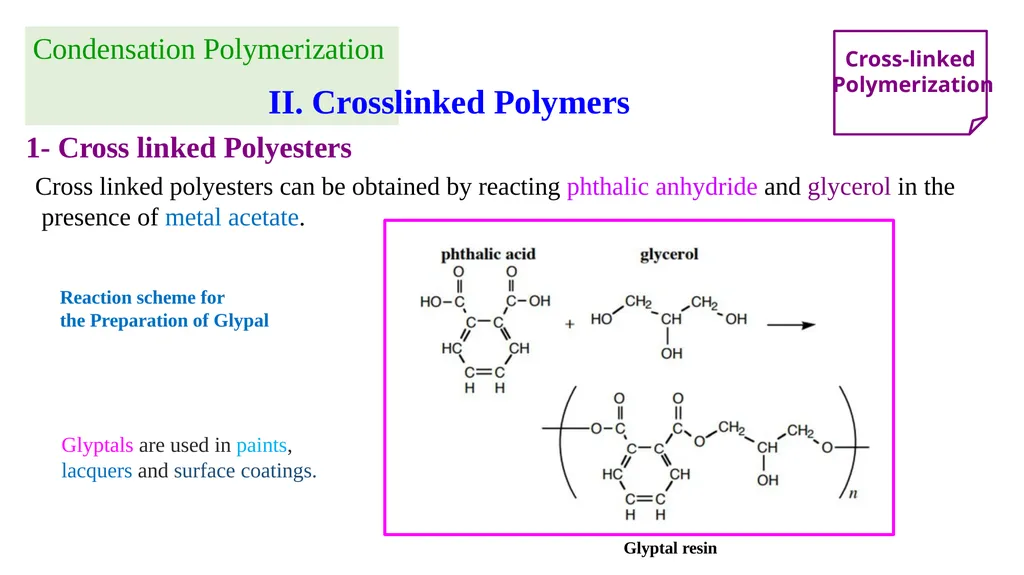
1- Cross linked Polyesters Glyptal resin Cross linked polyesters can be obtained by reacting phthalic anhydride and glycerol in the presence of metal acetate.
Reaction scheme for
the Preparation of Glypal Glyptals are used in paints,
lacquers and surface coatings. Cross-linked
Polymerization<br>
1- Cross linked Polyesters Glyptal resin Cross linked polyesters can be obtained by reacting phthalic anhydride and glycerol in the presence of metal acetate.
Reaction scheme for
the Preparation of Glypal Glyptals are used in paints,
lacquers and surface coatings. Cross-linked
Polymerization<br>
35
Condensation Polymerization II. Crosslinked Polymers
1- Cross linked Polyesters
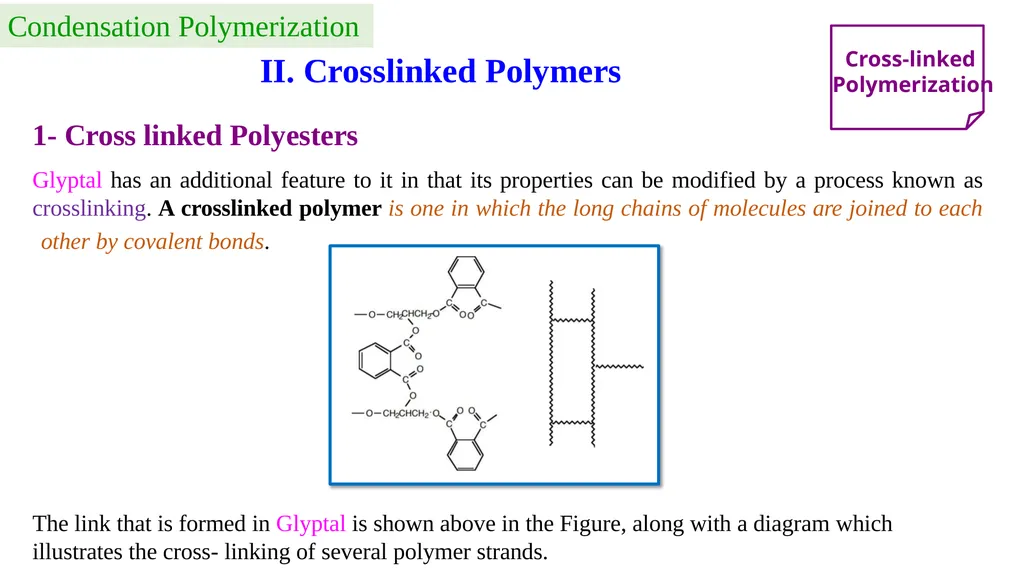
Glyptal has an additional feature to it in that its properties can be modified by a process known as crosslinking. A crosslinked polymer is one in which the long chains of molecules are joined to each other by covalent bonds. The link that is formed in Glyptal is shown above in the Figure, along with a diagram which
illustrates the cross- linking of several polymer strands. Cross-linked
Polymerization<br>
36
II. Crosslinked Polymers
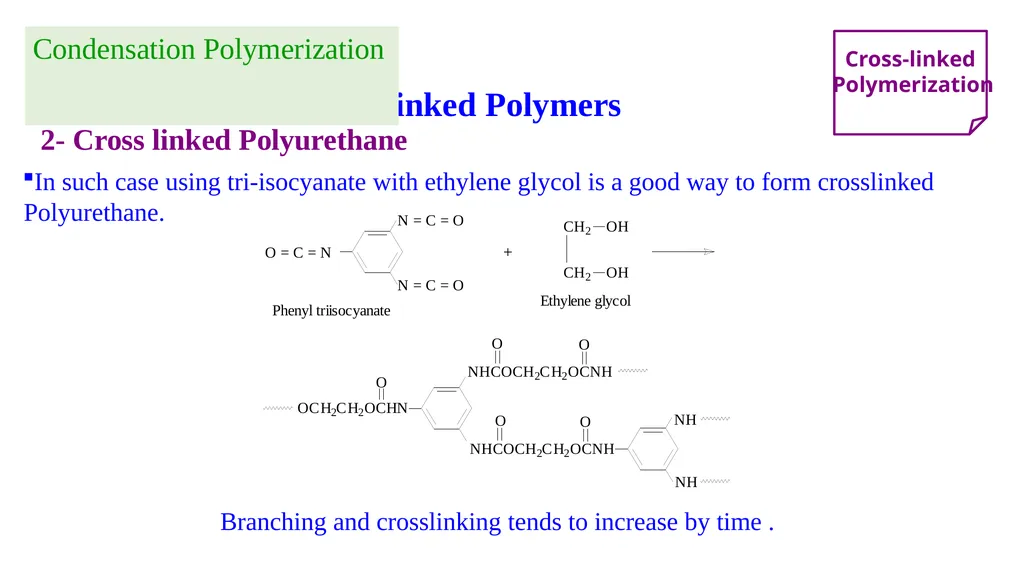
2- Cross linked Polyurethane Condensation Polymerization Branching and crosslinking tends to increase by time . In such case using tri-isocyanate with ethylene glycol is a good way to form crosslinked Polyurethane. Cross-linked
Polymerization<br>
2- Cross linked Polyurethane Condensation Polymerization Branching and crosslinking tends to increase by time . In such case using tri-isocyanate with ethylene glycol is a good way to form crosslinked Polyurethane. Cross-linked
Polymerization<br>
37
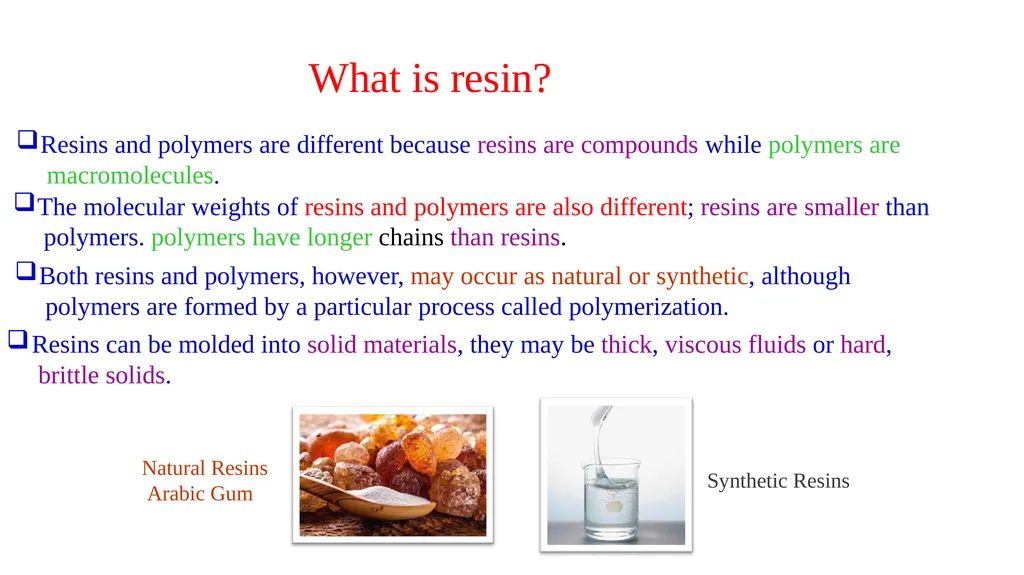
Resins and polymers are different because resins are compounds while polymers are macromolecules.
The molecular weights of resins and polymers are also different; resins are smaller than polymers. polymers have longer chains than resins.
Both resins and polymers, however, may occur as natural or synthetic, although polymers are formed by a particular process called polymerization.
Resins can be molded into solid materials, they may be thick, viscous fluids or hard, brittle solids. What is resin? Natural Resins Arabic Gum Synthetic Resins<br>
38
NETWORK POLYMERS
Formaldehyde prepared by polymerization in two stages.
Formation of a prepolymer of low molar mass.
Prepolymer is forced to flow under pressure to fill a heated mold in which cross linking takes place. ===> highly crosslinked rigid polymer in the shape at the mold.
Since formaldehyde is a difunctional the co-reactants must have a functionality, f > 2. Condensation Polymerization Cross-linked
Polymerization<br>
39
NETWORK POLYMERS
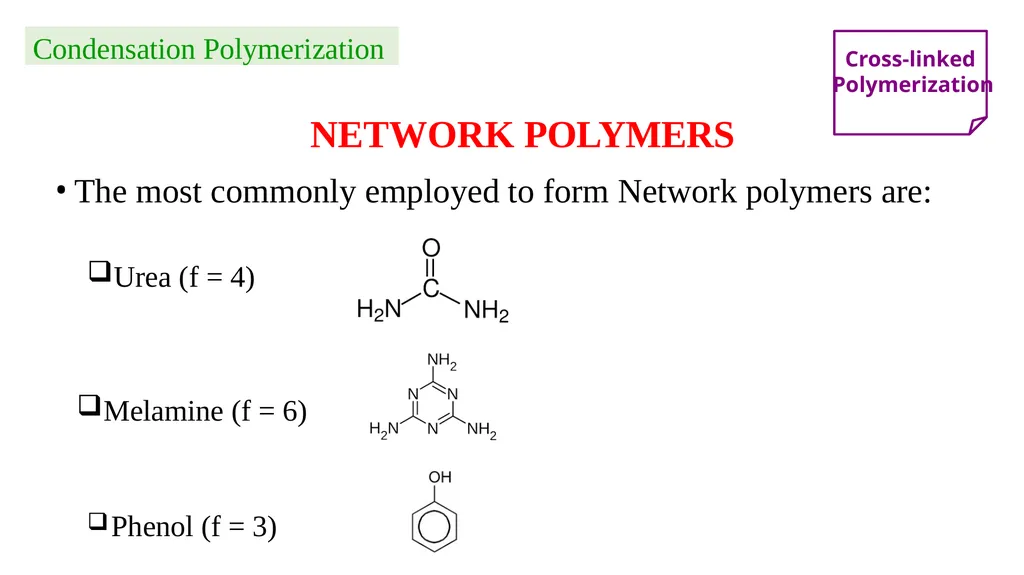
The most commonly employed to form Network polymers are: Condensation Polymerization Melamine (f = 6)
Phenol (f = 3) Urea (f = 4) Cross-linked
Polymerization<br>
The most commonly employed to form Network polymers are: Condensation Polymerization Melamine (f = 6)
Phenol (f = 3) Urea (f = 4) Cross-linked
Polymerization<br>
40
II. Crosslinked Polymers
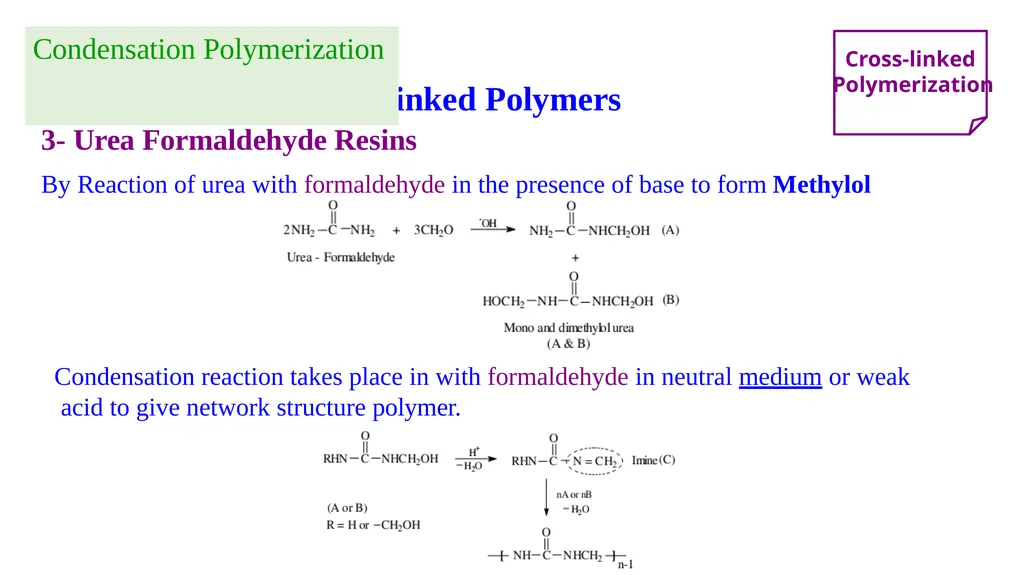
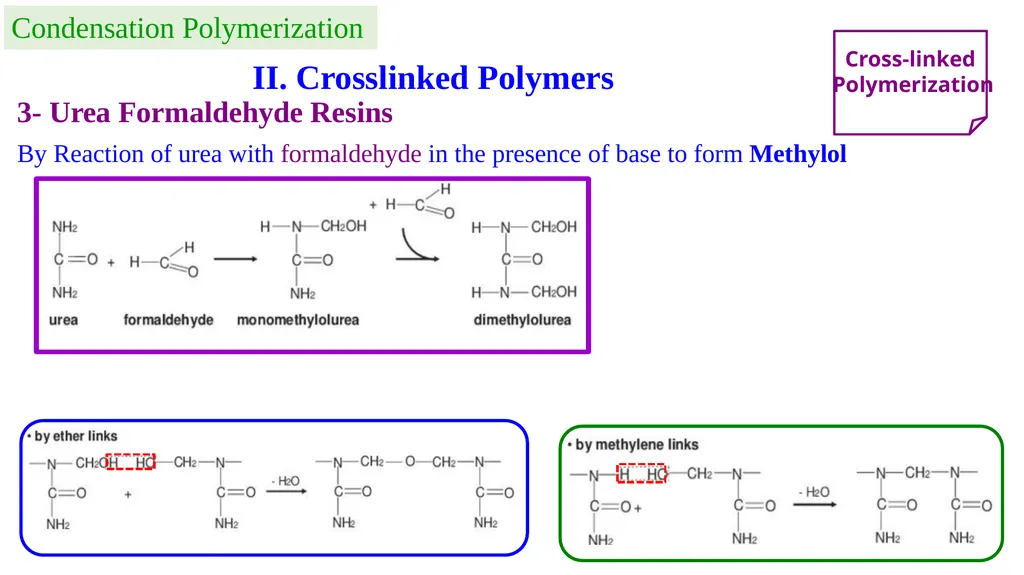
3- Urea Formaldehyde Resins Condensation Polymerization By Reaction of urea with formaldehyde in the presence of base to form Methylol Condensation reaction takes place in with formaldehyde in neutral medium or weak acid to give network structure polymer. Cross-linked
Polymerization<br>
3- Urea Formaldehyde Resins Condensation Polymerization By Reaction of urea with formaldehyde in the presence of base to form Methylol Condensation reaction takes place in with formaldehyde in neutral medium or weak acid to give network structure polymer. Cross-linked
Polymerization<br>
41
Condensation Polymerization II. Crosslinked Polymers
3- Urea Formaldehyde Resins
By Reaction of urea with formaldehyde in the presence of base to form Methylol Cross-linked
Polymerization<br>
3- Urea Formaldehyde Resins
By Reaction of urea with formaldehyde in the presence of base to form Methylol Cross-linked
Polymerization<br>
42
II. Crosslinked Polymers
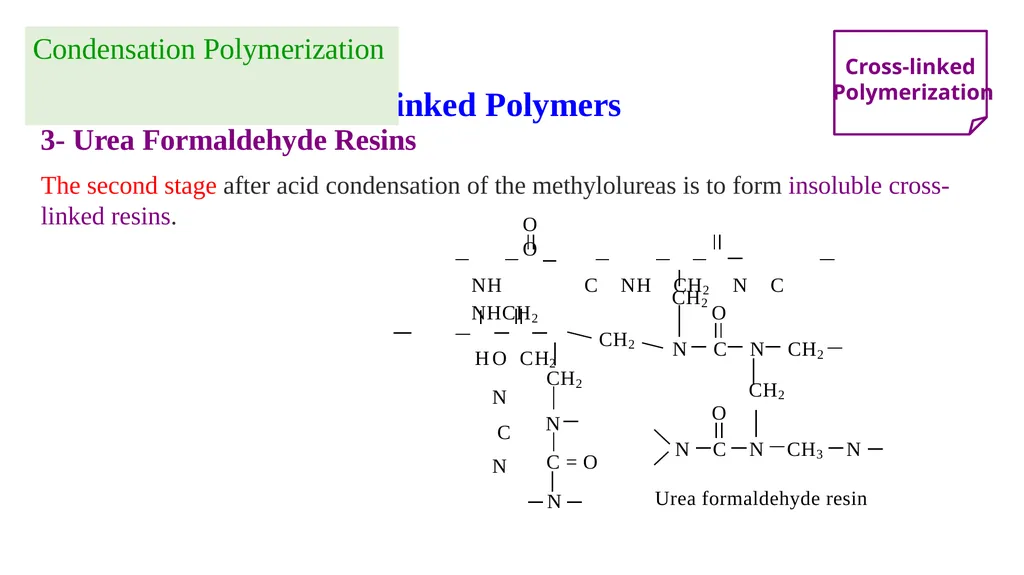
3- Urea Formaldehyde Resins Condensation Polymerization Urea formaldehyde resin CH2
N C = O
N CH2 N C N CH2 O CH2
O
N C N CH3 N CH2 O O
NH C NH CH2 N C NHCH2
H O CH2 N C N The second stage after acid condensation of the methylolureas is to form insoluble cross- linked resins. Cross-linked
Polymerization<br>
43
II. Crosslinked Polymers Condensation Polymerization 3- Urea Formaldehyde Resins Uses & Applications
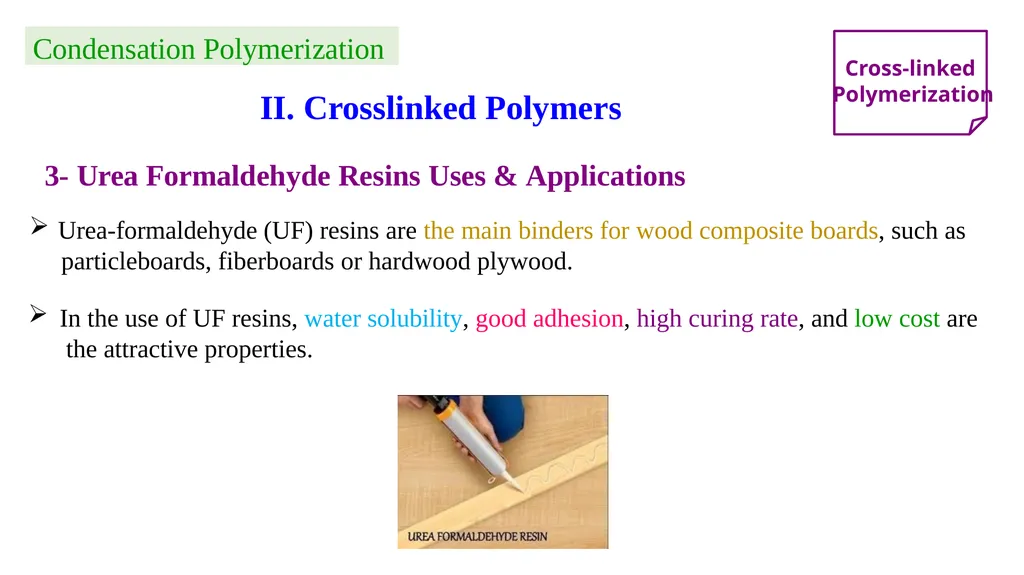
Urea-formaldehyde (UF) resins are the main binders for wood composite boards, such as
particleboards, fiberboards or hardwood plywood.
In the use of UF resins, water solubility, good adhesion, high curing rate, and low cost are the attractive properties. Cross-linked
Polymerization<br>
Urea-formaldehyde (UF) resins are the main binders for wood composite boards, such as
particleboards, fiberboards or hardwood plywood.
In the use of UF resins, water solubility, good adhesion, high curing rate, and low cost are the attractive properties. Cross-linked
Polymerization<br>
44
II. Crosslinked Polymers
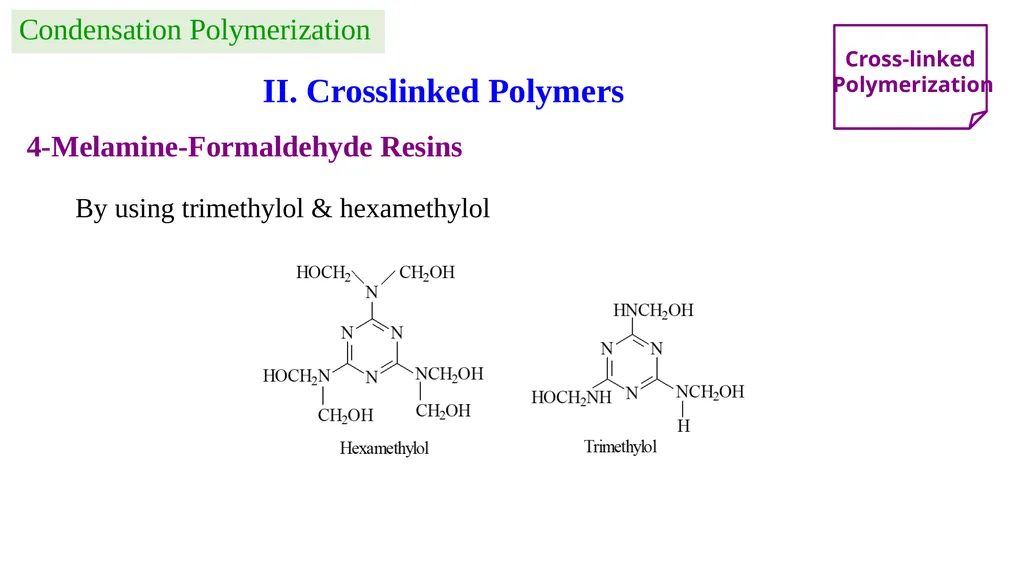
4-Melamine-Formaldehyde Resins By using trimethylol & hexamethylol Condensation Polymerization Cross-linked
Polymerization<br>
4-Melamine-Formaldehyde Resins By using trimethylol & hexamethylol Condensation Polymerization Cross-linked
Polymerization<br>
45
II. Crosslinked Polymers Condensation Polymerization Cross-linked Polymerization 4-Melamine-Formaldehyde Resins
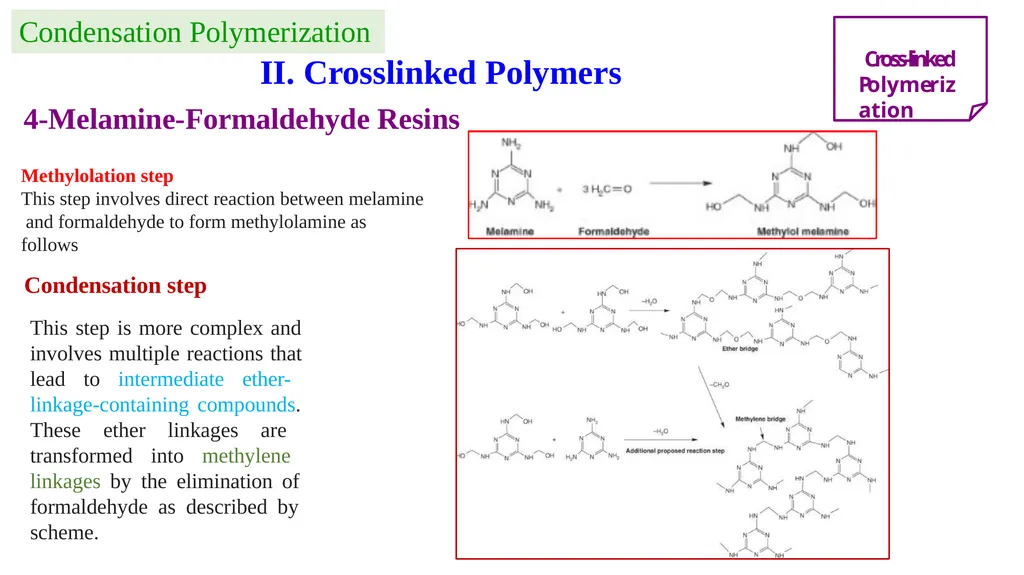
Methylolation step
This step involves direct reaction between melamine and formaldehyde to form methylolamine as follows
Condensation step
This step is more complex and involves multiple reactions that lead to intermediate ether- linkage-containing compounds. These ether linkages are transformed into methylene linkages by the elimination of formaldehyde as described by scheme.<br>
46
Condensation Polymerization II. Crosslinked Polymers
Melamine-Formaldehyde Resins
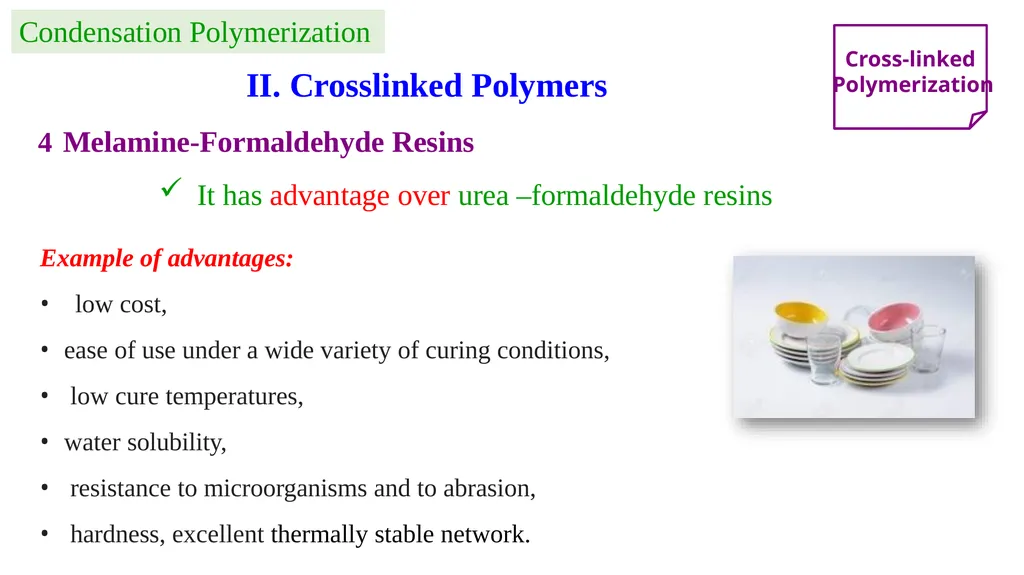
It has advantage over urea –formaldehyde resins Example of advantages:
low cost,
ease of use under a wide variety of curing conditions,
low cure temperatures,
water solubility,
resistance to microorganisms and to abrasion,
hardness, excellent thermally stable network. Cross-linked
Polymerization<br>
47
5-Phenol-Formaldehyde Resins
The OH of the phenol activates the O- & P- position of the ring.
Phenol formaldehyde are formed from the condensation of phenol
with formaldehyde in the presence of alkaline or acidic medium in two stages.
In the first stage
polymer is formed (low molecular weight resin, which can be fused or melt)
In the second stage
the resin is treated to form network polymer II. Crosslinked Polymers Condensation Polymerization Cross-linked
Polymerization<br>
48
II. Crosslinked Polymers
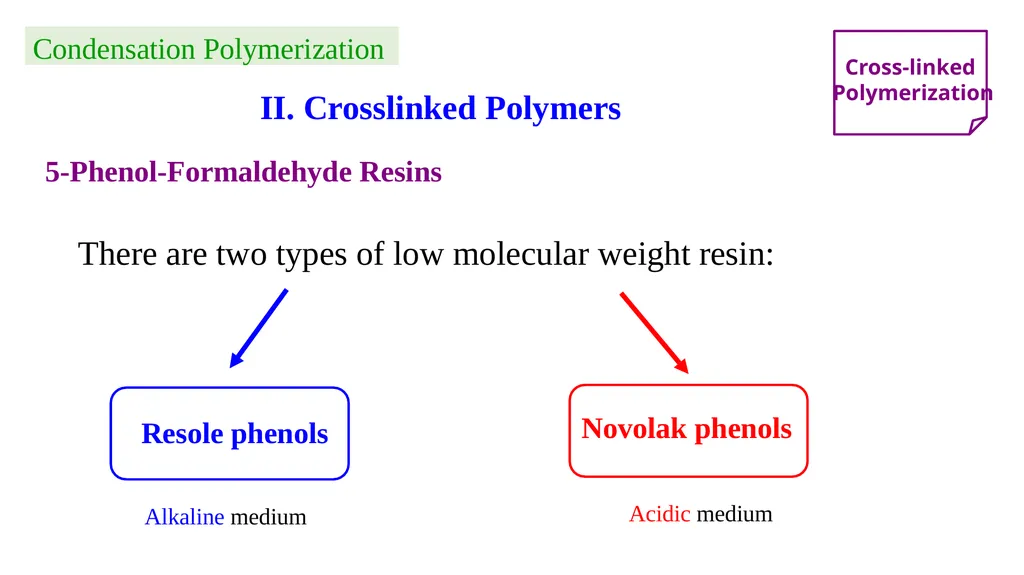
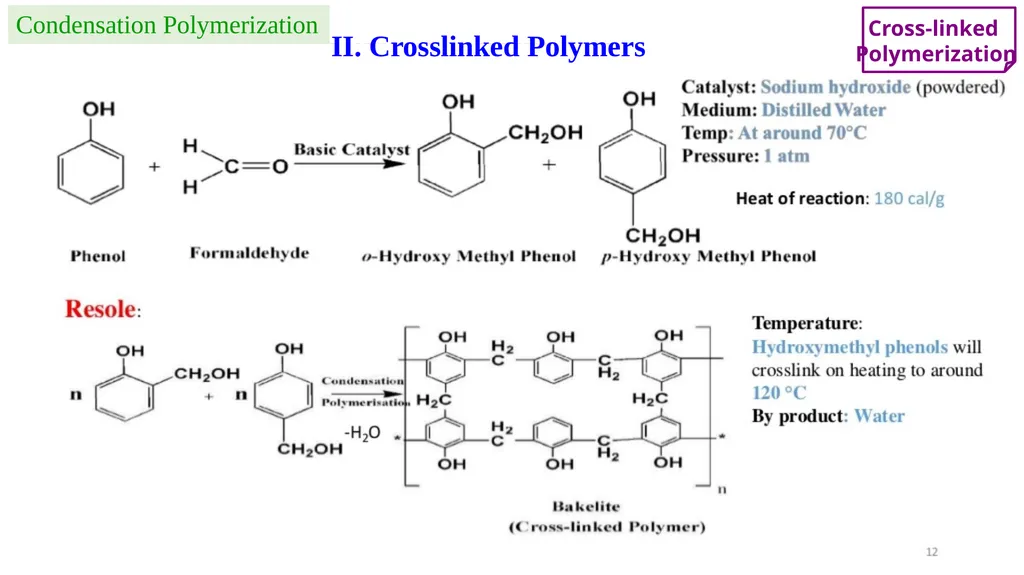
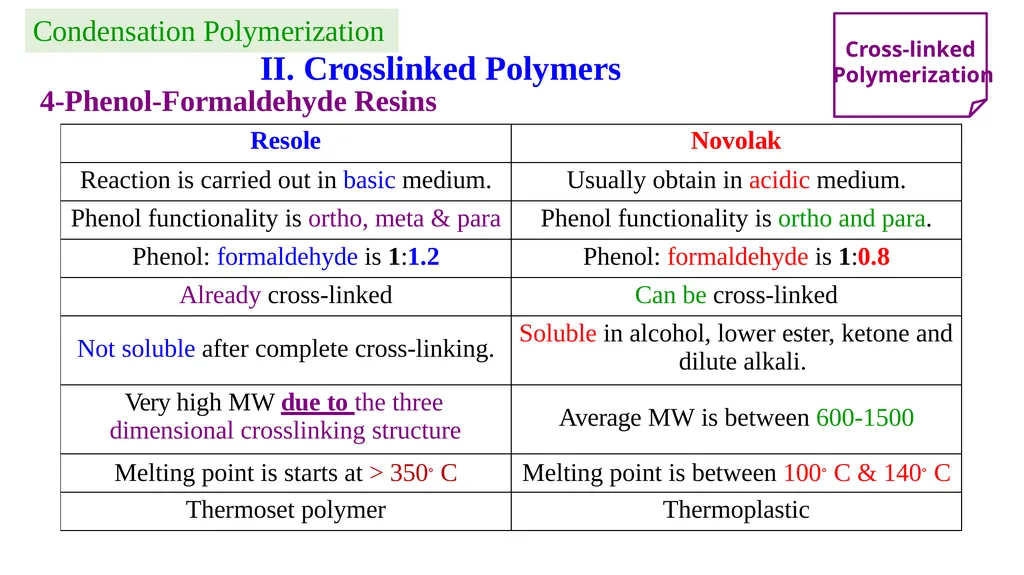
5-Phenol-Formaldehyde Resins Condensation Polymerization There are two types of low molecular weight resin: Resole phenols Novolak phenols Alkaline medium Acidic medium Cross-linked
Polymerization<br>
5-Phenol-Formaldehyde Resins Condensation Polymerization There are two types of low molecular weight resin: Resole phenols Novolak phenols Alkaline medium Acidic medium Cross-linked
Polymerization<br>
49
Condensation Polymerization II. Crosslinked Polymers
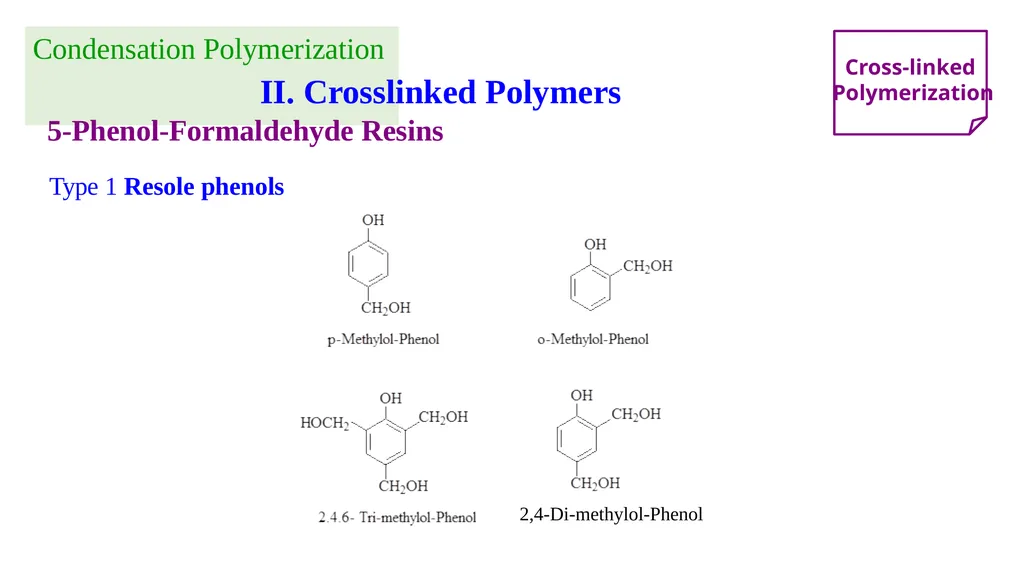
5-Phenol-Formaldehyde Resins
Type 1 Resole phenols 2,4-Di-methylol-Phenol Cross-linked
Polymerization<br>
5-Phenol-Formaldehyde Resins
Type 1 Resole phenols 2,4-Di-methylol-Phenol Cross-linked
Polymerization<br>
50
II. Crosslinked Polymers
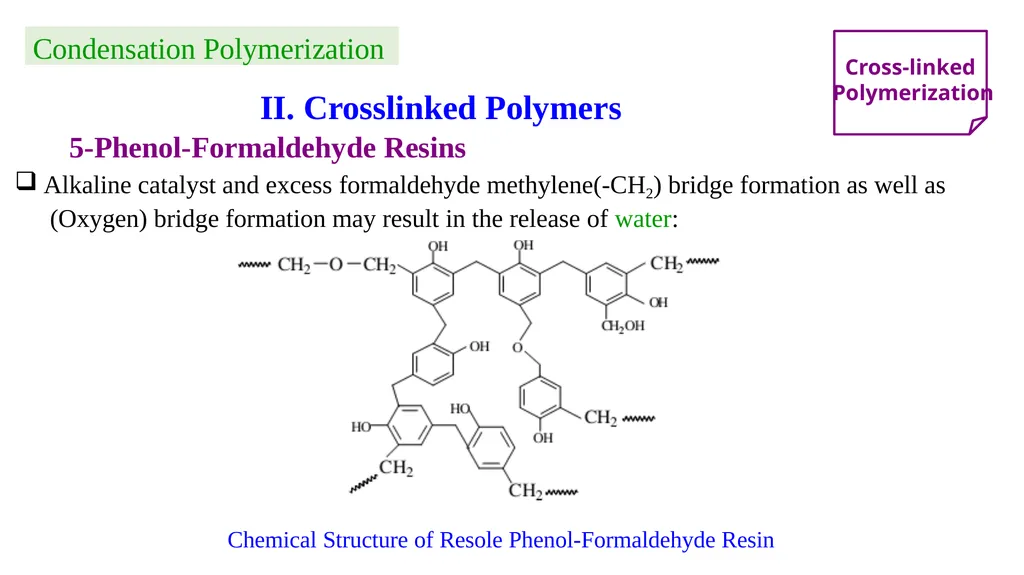
5-Phenol-Formaldehyde Resins Condensation Polymerization Alkaline catalyst and excess formaldehyde methylene(-CH2) bridge formation as well as (Oxygen) bridge formation may result in the release of water: Chemical Structure of Resole Phenol-Formaldehyde Resin Cross-linked
Polymerization<br>
5-Phenol-Formaldehyde Resins Condensation Polymerization Alkaline catalyst and excess formaldehyde methylene(-CH2) bridge formation as well as (Oxygen) bridge formation may result in the release of water: Chemical Structure of Resole Phenol-Formaldehyde Resin Cross-linked
Polymerization<br>
51
II. Crosslinked Polymers Condensation Polymerization Cross-linked
Polymerization<br>
Polymerization<br>
52
II. Crosslinked Polymers
5-Phenol-Formaldehyde Resins
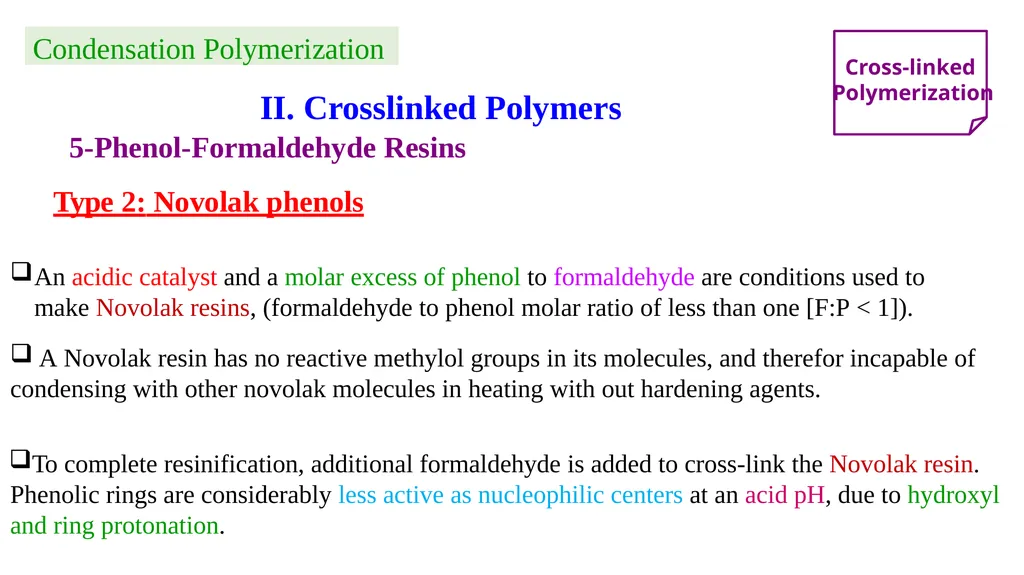
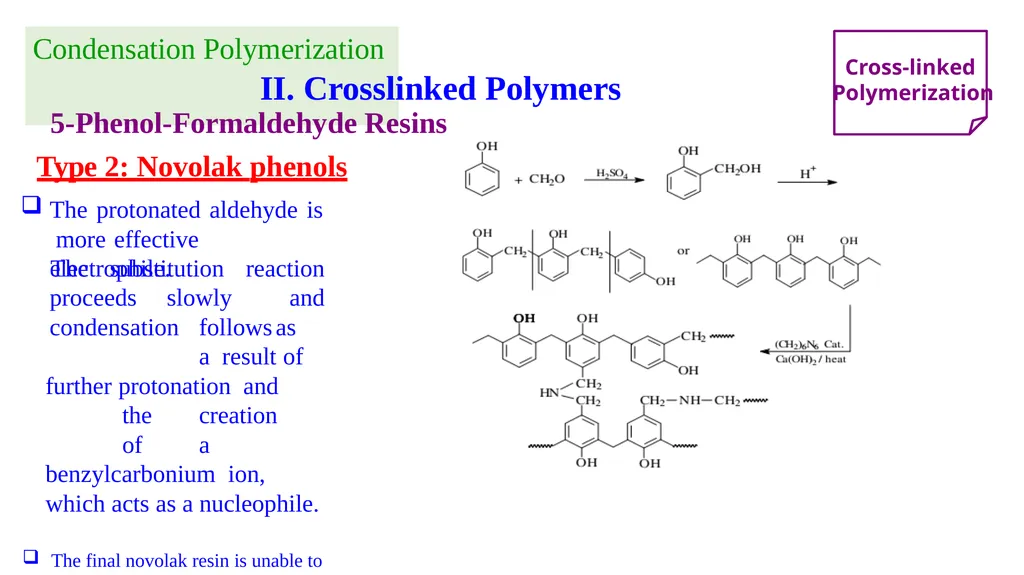
Type 2: Novolak phenols Condensation Polymerization An acidic catalyst and a molar excess of phenol to formaldehyde are conditions used to
make Novolak resins, (formaldehyde to phenol molar ratio of less than one [F:P < 1]).
A Novolak resin has no reactive methylol groups in its molecules, and therefor incapable of
condensing with other novolak molecules in heating with out hardening agents.
To complete resinification, additional formaldehyde is added to cross-link the Novolak resin. Phenolic rings are considerably less active as nucleophilic centers at an acid pH, due to hydroxyl and ring protonation. Cross-linked
Polymerization<br>
53
Condensation Polymerization II. Crosslinked Polymers
5-Phenol-Formaldehyde Resins
Type 2: Novolak phenols
The protonated aldehyde is more effective electrophile. proceeds slowly The substitution reaction
and condensation follows as a result of further protonation and the creation of a benzylcarbonium ion, which acts as a nucleophile.
The final novolak resin is unable to react further without the addition of a cross-linking agent.
The most common phenolic resin cross-linking agent (hardener) is hexamethylenetetramine, also known as hexamine, or HMTA. Cross-linked
Polymerization<br>
54
Condensation Polymerization II. Crosslinked Polymers
4-Phenol-Formaldehyde Resins Cross-linked
Polymerization<br>
4-Phenol-Formaldehyde Resins Cross-linked
Polymerization<br>
55
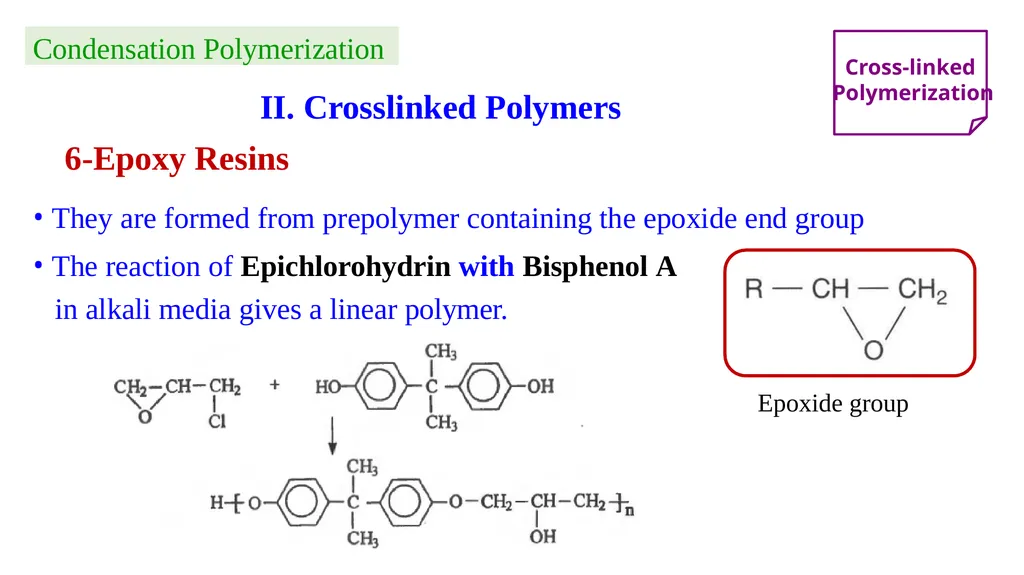
II. Crosslinked Polymers 6-Epoxy Resins They are formed from prepolymer containing the epoxide end group
The reaction of Epichlorohydrin with Bisphenol A
in alkali media gives a linear polymer.
Epoxide group Condensation Polymerization Cross-linked
Polymerization<br>
The reaction of Epichlorohydrin with Bisphenol A
in alkali media gives a linear polymer.
Epoxide group Condensation Polymerization Cross-linked
Polymerization<br>
56
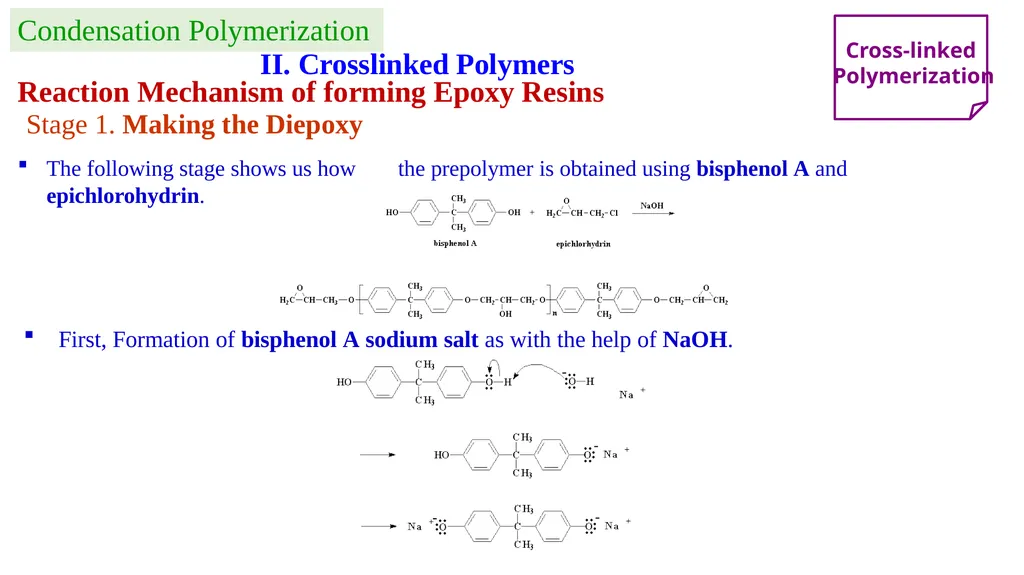
First, Formation of bisphenol A sodium salt as with the help of NaOH. The following stage shows us how the prepolymer is obtained using bisphenol A and epichlorohydrin. II. Crosslinked Polymers Condensation Polymerization Reaction Mechanism of forming Epoxy Resins
Stage 1. Making the Diepoxy Cross-linked
Polymerization<br>
Stage 1. Making the Diepoxy Cross-linked
Polymerization<br>
57
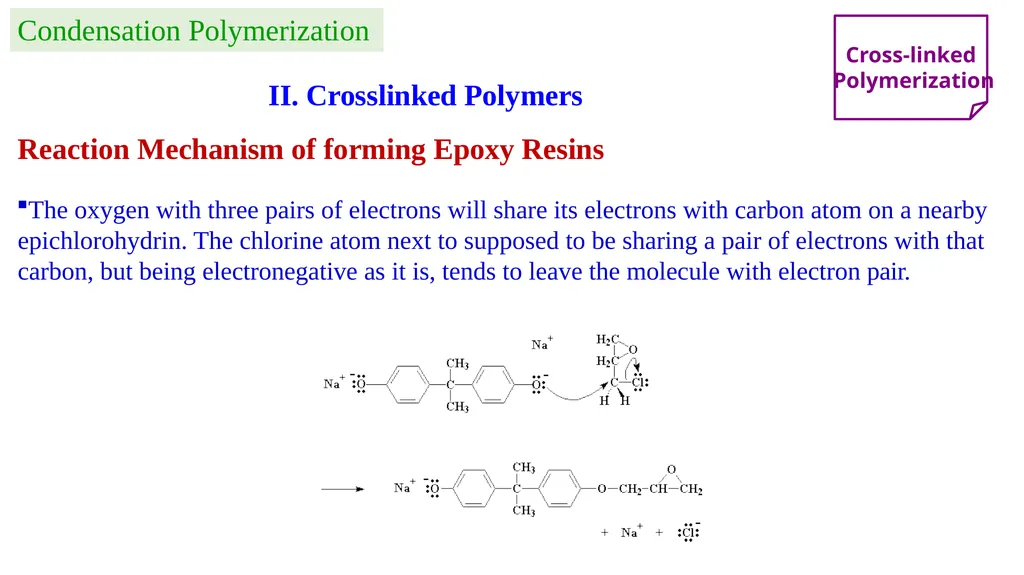
II. Crosslinked Polymers Reaction Mechanism of forming Epoxy Resins Condensation Polymerization The oxygen with three pairs of electrons will share its electrons with carbon atom on a nearby epichlorohydrin. The chlorine atom next to supposed to be sharing a pair of electrons with that carbon, but being electronegative as it is, tends to leave the molecule with electron pair. Cross-linked
Polymerization<br>
Polymerization<br>
58
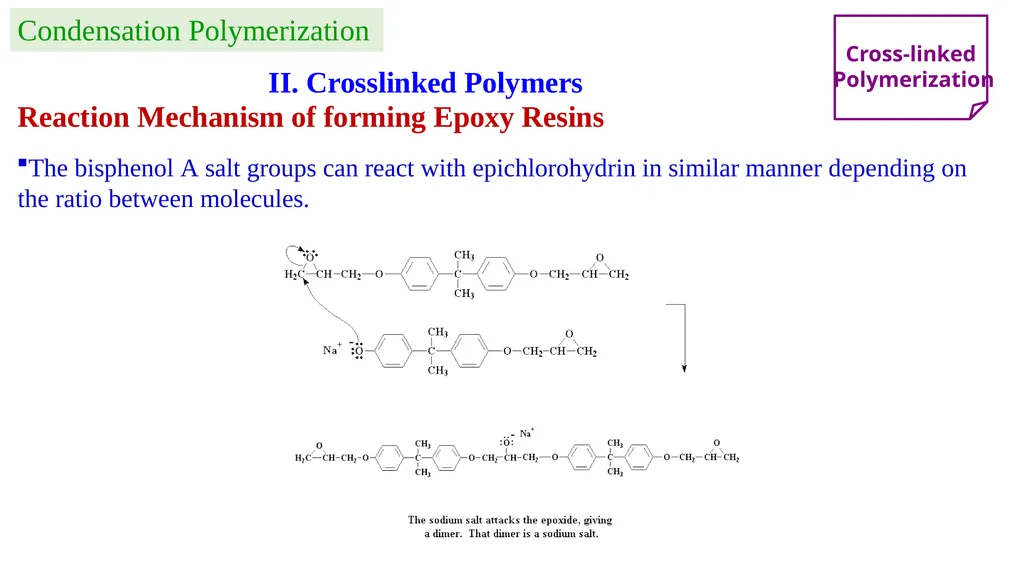
Condensation Polymerization II. Crosslinked Polymers Reaction Mechanism of forming Epoxy Resins The bisphenol A salt groups can react with epichlorohydrin in similar manner depending on the ratio between molecules. Cross-linked
Polymerization<br>
Polymerization<br>
59
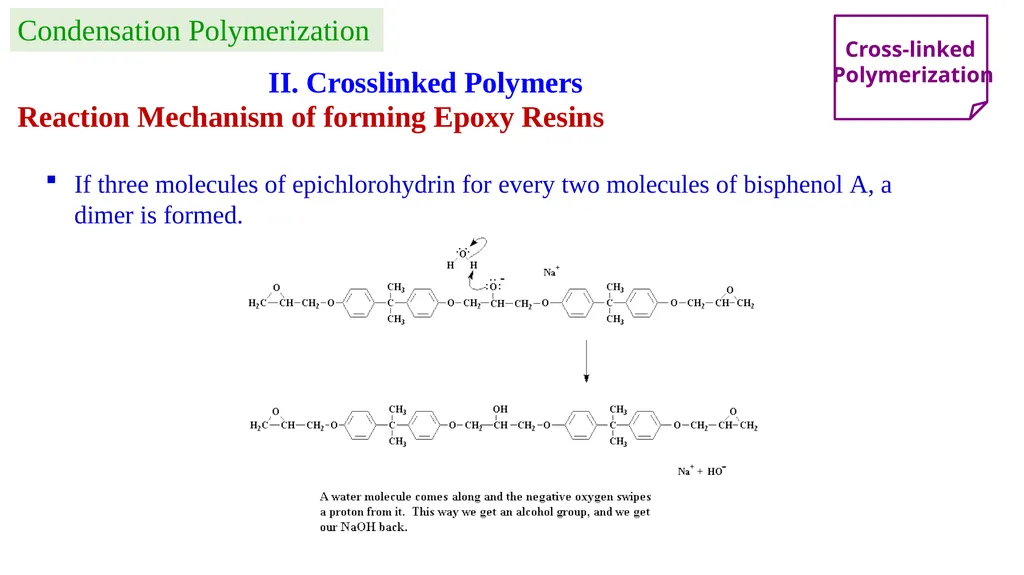
Condensation Polymerization II. Crosslinked Polymers Reaction Mechanism of forming Epoxy Resins If three molecules of epichlorohydrin for every two molecules of bisphenol A, a
dimer is formed. Cross-linked
Polymerization<br>
dimer is formed. Cross-linked
Polymerization<br>
60
II. Crosslinked Polymers Reaction Mechanism of forming Epoxy Resins
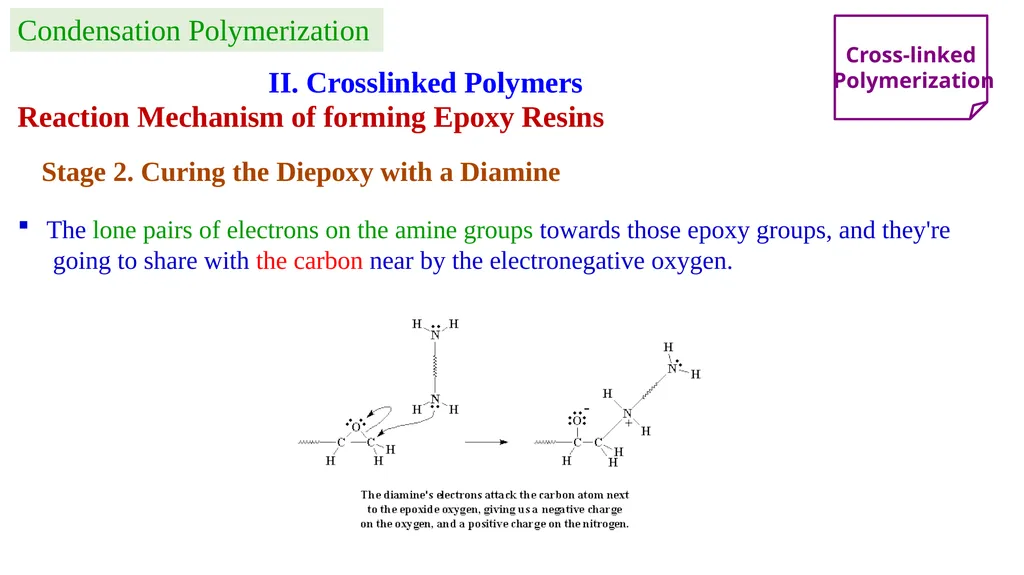
Stage 2. Curing the Diepoxy with a Diamine Condensation Polymerization The lone pairs of electrons on the amine groups towards those epoxy groups, and they're going to share with the carbon near by the electronegative oxygen. Cross-linked
Polymerization<br>
Stage 2. Curing the Diepoxy with a Diamine Condensation Polymerization The lone pairs of electrons on the amine groups towards those epoxy groups, and they're going to share with the carbon near by the electronegative oxygen. Cross-linked
Polymerization<br>
61
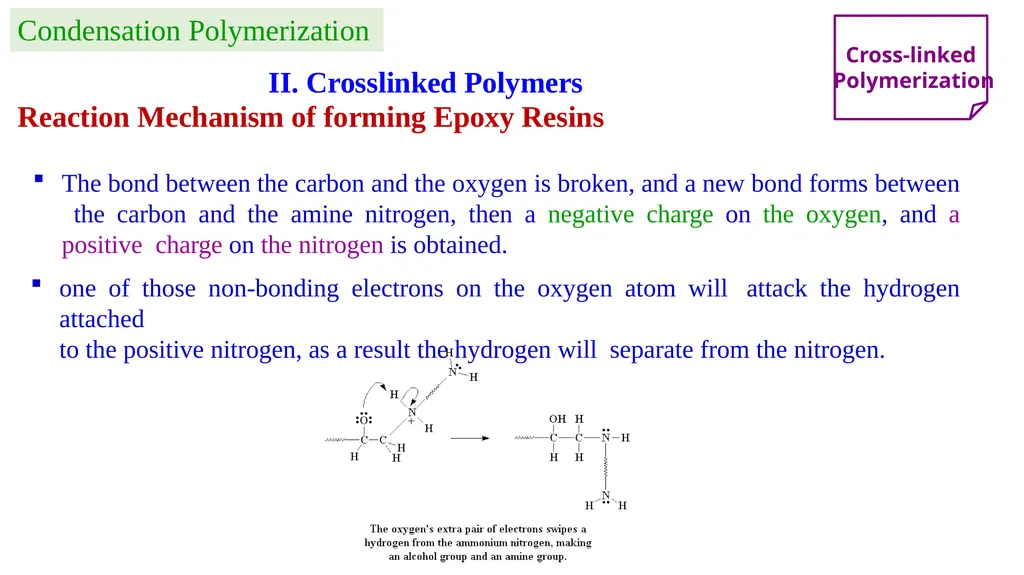
Condensation Polymerization II. Crosslinked Polymers Reaction Mechanism of forming Epoxy Resins The bond between the carbon and the oxygen is broken, and a new bond forms between the carbon and the amine nitrogen, then a negative charge on the oxygen, and a positive charge on the nitrogen is obtained.
one of those non-bonding electrons on the oxygen atom will attack the hydrogen attached
to the positive nitrogen, as a result the hydrogen will separate from the nitrogen. Cross-linked
Polymerization<br>
one of those non-bonding electrons on the oxygen atom will attack the hydrogen attached
to the positive nitrogen, as a result the hydrogen will separate from the nitrogen. Cross-linked
Polymerization<br>
62
Condensation Polymerization II. Crosslinked Polymers Reaction Mechanism of forming Epoxy Resins
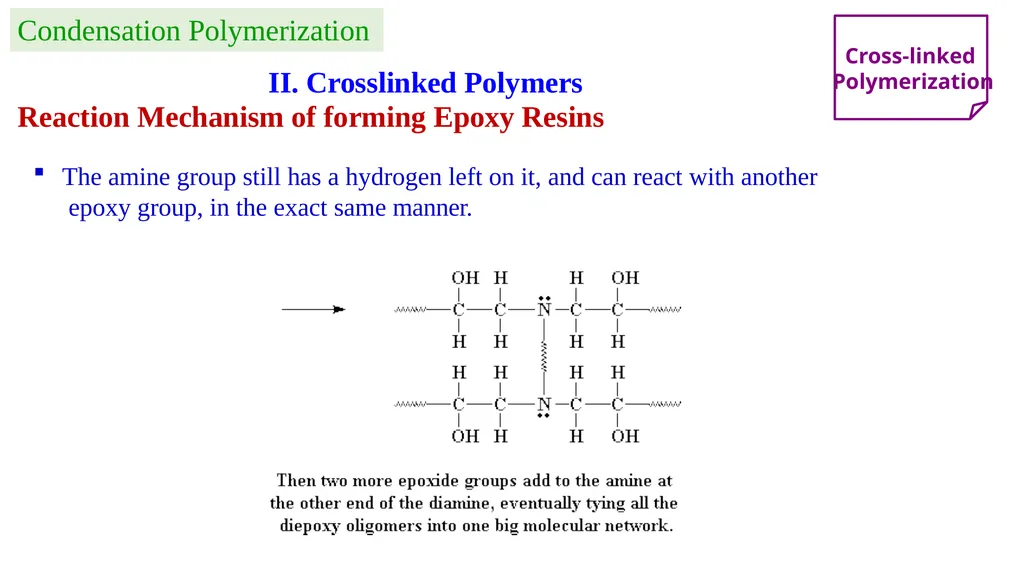
The amine group still has a hydrogen left on it, and can react with another epoxy group, in the exact same manner. Cross-linked
Polymerization<br>
The amine group still has a hydrogen left on it, and can react with another epoxy group, in the exact same manner. Cross-linked
Polymerization<br>
63
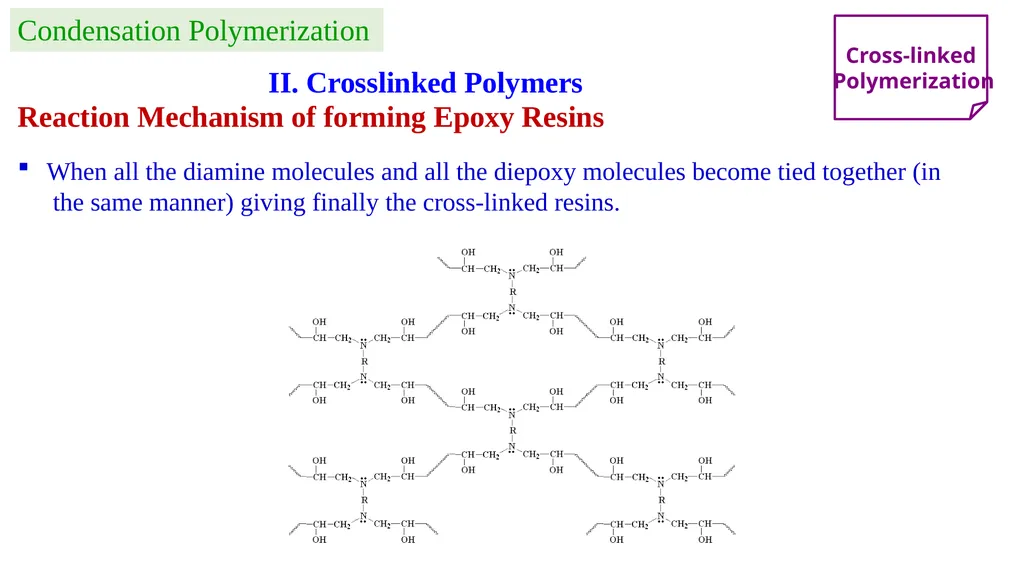
Condensation Polymerization II. Crosslinked Polymers Reaction Mechanism of forming Epoxy Resins When all the diamine molecules and all the diepoxy molecules become tied together (in the same manner) giving finally the cross-linked resins. Cross-linked
Polymerization<br>
Polymerization<br>
64
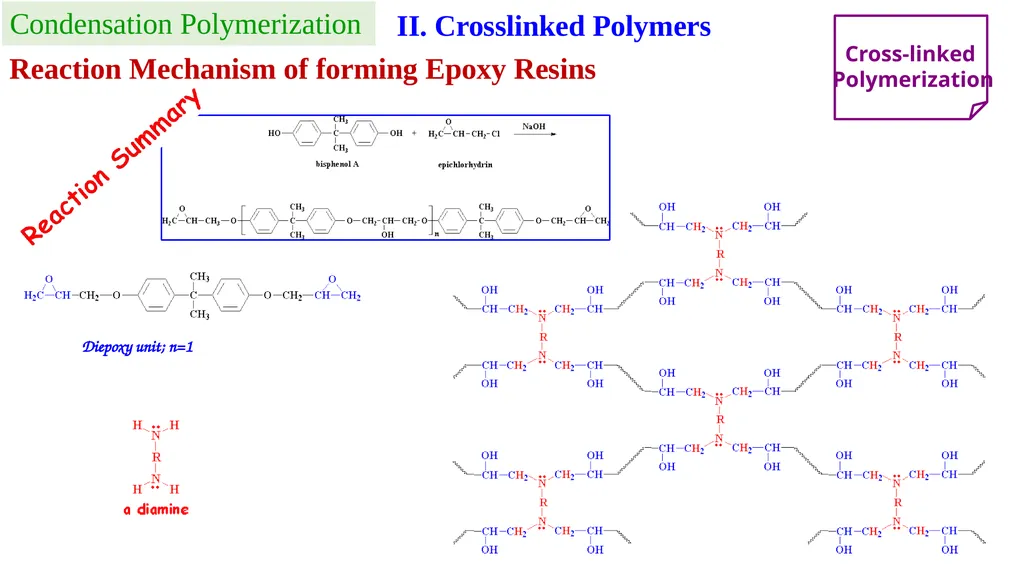
Diepoxy unit; n=1 Condensation Polymerization Reaction Mechanism of forming Epoxy Resins II. Crosslinked Polymers Cross-linked
Polymerization<br>
Polymerization<br>
65
III. Synthetic fibers Polymers
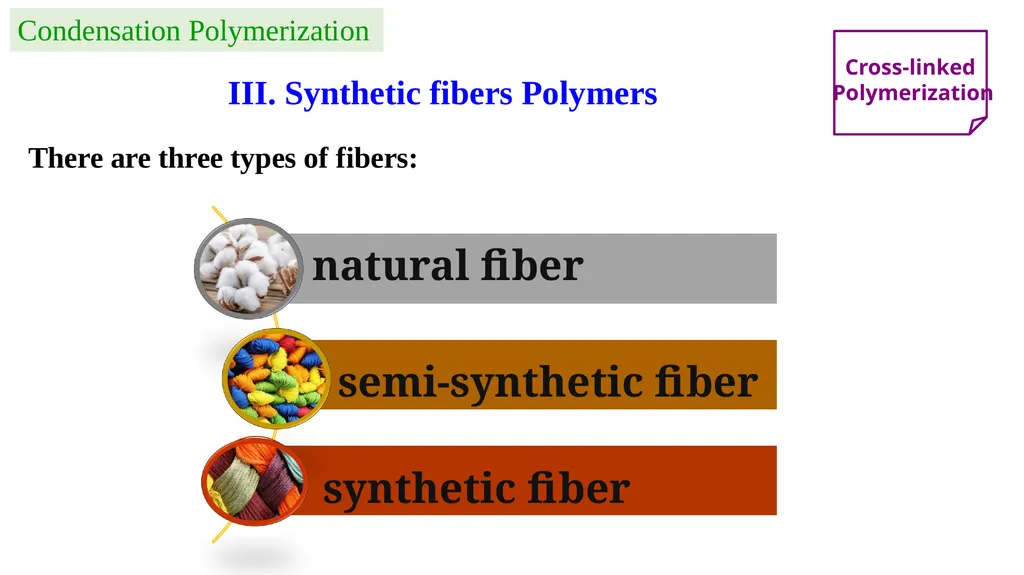
There are three types of fibers: Condensation Polymerization natural fiber
semi-synthetic fiber synthetic fiber Cross-linked
Polymerization<br>
There are three types of fibers: Condensation Polymerization natural fiber
semi-synthetic fiber synthetic fiber Cross-linked
Polymerization<br>
66
Synthetic fibers
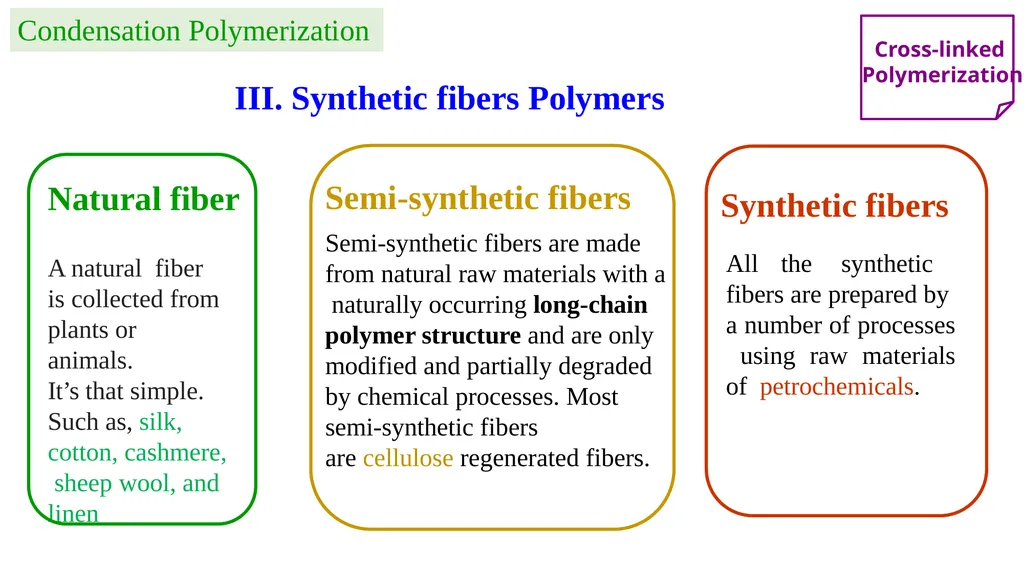
All the synthetic fibers are prepared by a number of processes using raw materials of petrochemicals. A natural fiber is collected from
plants or animals.
It’s that simple. Such as, silk, cotton, cashmere, sheep wool, and linen Semi-synthetic fibers
Semi-synthetic fibers are made from natural raw materials with a naturally occurring long-chain polymer structure and are only modified and partially degraded by chemical processes. Most semi-synthetic fibers
are cellulose regenerated fibers. III. Synthetic fibers Polymers Condensation Polymerization Natural fiber Cross-linked
Polymerization<br>
67
III. Synthetic fibers Polymers
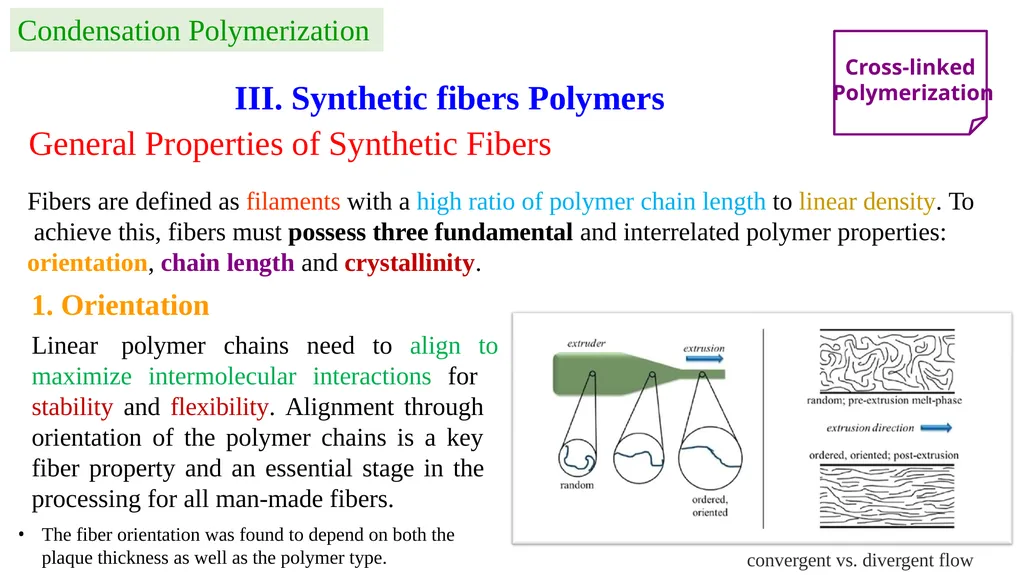
General Properties of Synthetic Fibers Condensation Polymerization Fibers are defined as filaments with a high ratio of polymer chain length to linear density. To achieve this, fibers must possess three fundamental and interrelated polymer properties: orientation, chain length and crystallinity.
1. Orientation
Linear polymer chains need to align to convergent vs. divergent flow maximize intermolecular interactions for stability and flexibility. Alignment through orientation of the polymer chains is a key fiber property and an essential stage in the processing for all man-made fibers.
The fiber orientation was found to depend on both the
plaque thickness as well as the polymer type. Cross-linked
Polymerization<br>
68
III. Synthetic fibers Polymers
General Properties of Synthetic Fibers
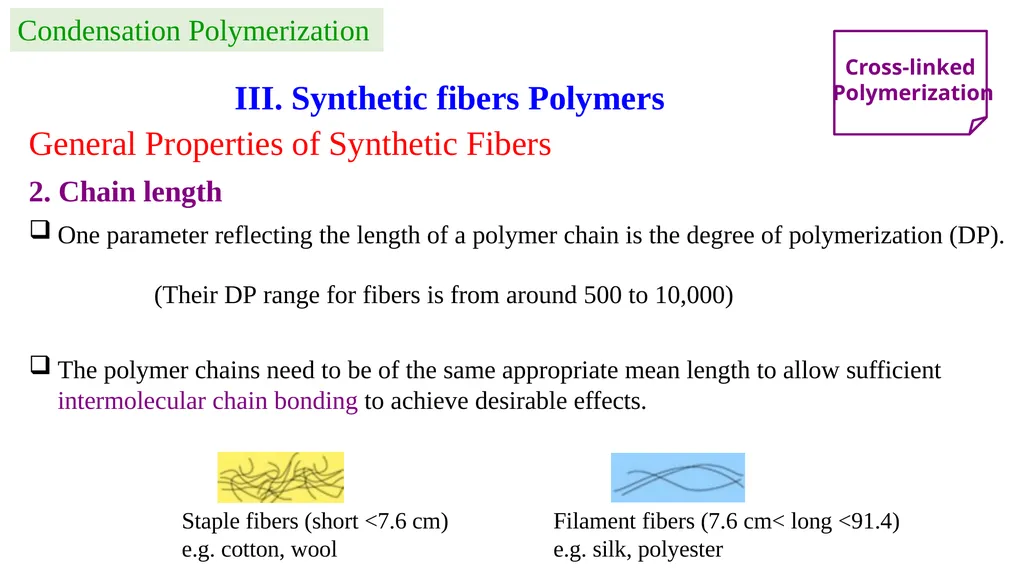
2. Chain length Condensation Polymerization One parameter reflecting the length of a polymer chain is the degree of polymerization (DP).
(Their DP range for fibers is from around 500 to 10,000)
The polymer chains need to be of the same appropriate mean length to allow sufficient
intermolecular chain bonding to achieve desirable effects. Staple fibers (short <7.6 cm)
e.g. cotton, wool Filament fibers (7.6 cm< long <91.4)
e.g. silk, polyester Cross-linked
Polymerization<br>
69
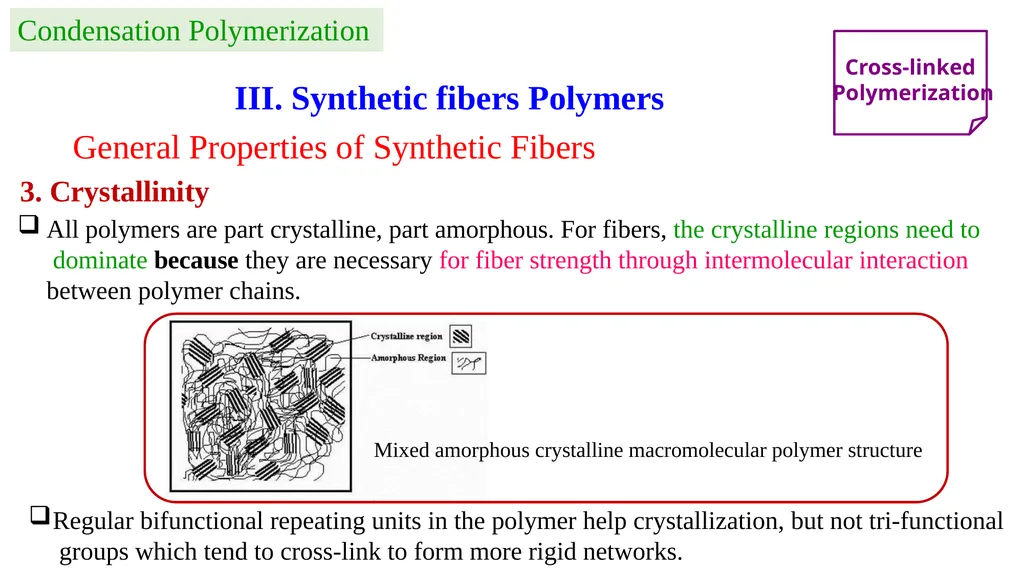
All polymers are part crystalline, part amorphous. For fibers, the crystalline regions need to dominate because they are necessary for fiber strength through intermolecular interaction between polymer chains. III. Synthetic fibers Polymers
General Properties of Synthetic Fibers
3. Crystallinity Condensation Polymerization Mixed amorphous crystalline macromolecular polymer structure
Regular bifunctional repeating units in the polymer help crystallization, but not tri-functional groups which tend to cross-link to form more rigid networks. Cross-linked
Polymerization<br>
70
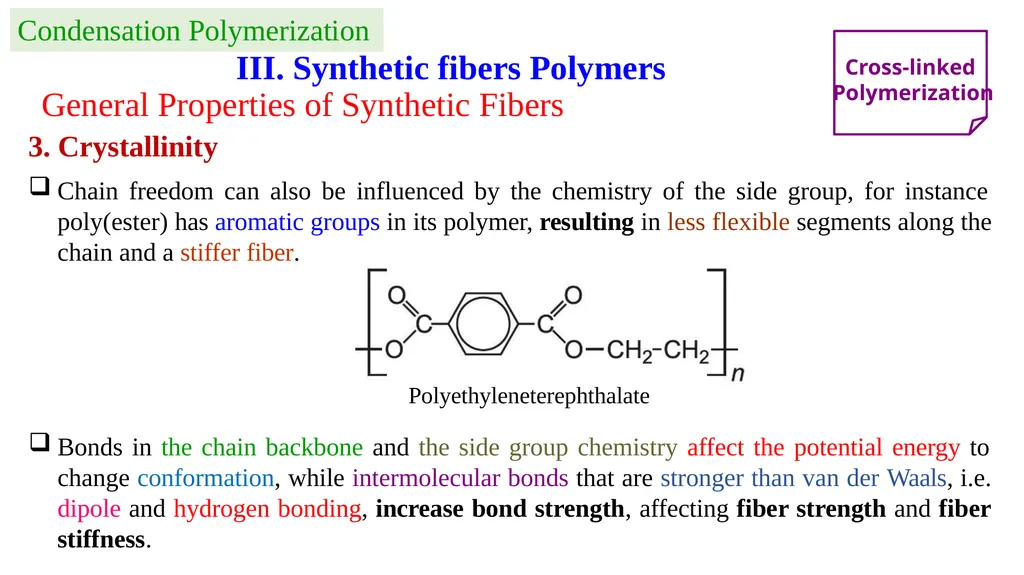
Chain freedom can also be influenced by the chemistry of the side group, for instance poly(ester) has aromatic groups in its polymer, resulting in less flexible segments along the chain and a stiffer fiber. Polyethyleneterephthalate
Bonds in the chain backbone and the side group chemistry affect the potential energy to change conformation, while intermolecular bonds that are stronger than van der Waals, i.e. dipole and hydrogen bonding, increase bond strength, affecting fiber strength and fiber stiffness. III. Synthetic fibers Polymers
General Properties of Synthetic Fibers
3. Crystallinity Condensation Polymerization Cross-linked
Polymerization<br>
71
Chapter 2: Part II
General Methods for preparing Polymers<br>
General Methods for preparing Polymers<br>
72
By the end of this Chapter You will be able to recognize
Addition polymerization
Through The following Reaction Types
Radical Polymerization
Ionic Polymerization
Anionic Polymerization
Cationic Polymerization
Ziegler-Natta polymerization
Ring Opening Polymerization
Modification of Polymerization<br>
Addition polymerization
Through The following Reaction Types
Radical Polymerization
Ionic Polymerization
Anionic Polymerization
Cationic Polymerization
Ziegler-Natta polymerization
Ring Opening Polymerization
Modification of Polymerization<br>
73
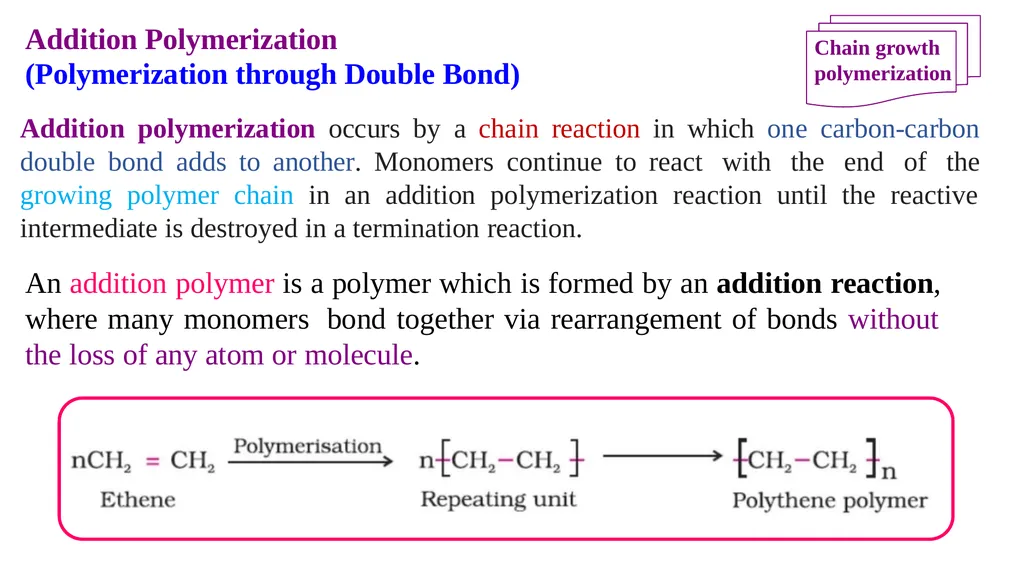
Addition Polymerization (Polymerization through Double Bond) Addition polymerization occurs by a chain reaction in which one carbon-carbon double bond adds to another. Monomers continue to react with the end of the growing polymer chain in an addition polymerization reaction until the reactive intermediate is destroyed in a termination reaction.
An addition polymer is a polymer which is formed by an addition reaction, where many monomers bond together via rearrangement of bonds without the loss of any atom or molecule. Chain growth polymerization<br>
An addition polymer is a polymer which is formed by an addition reaction, where many monomers bond together via rearrangement of bonds without the loss of any atom or molecule. Chain growth polymerization<br>
74
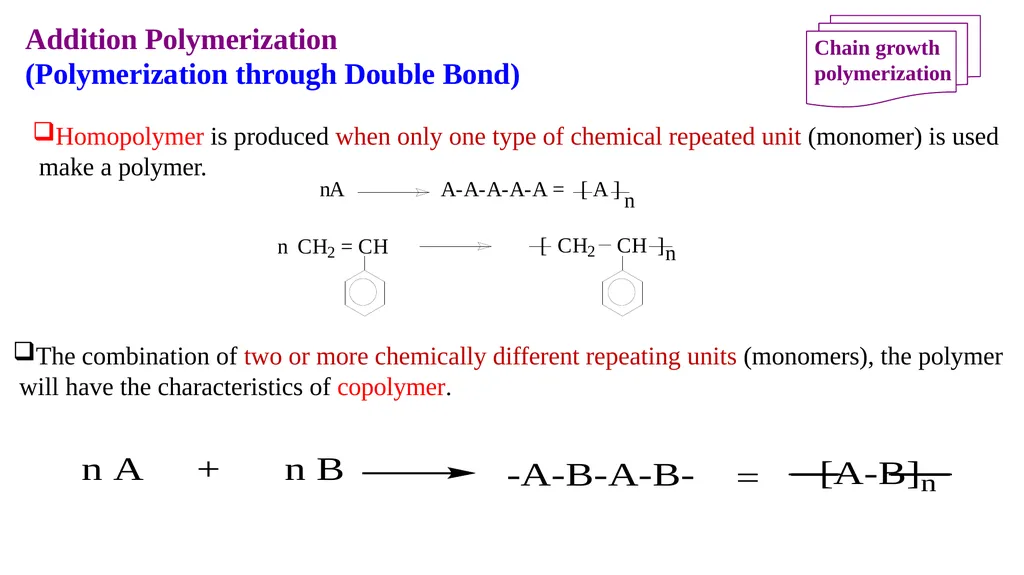
The combination of two or more chemically different repeating units (monomers), the polymer will have the characteristics of copolymer. Homopolymer is produced when only one type of chemical repeated unit (monomer) is used make a polymer. Addition Polymerization (Polymerization through Double Bond) Chain growth polymerization<br>
75
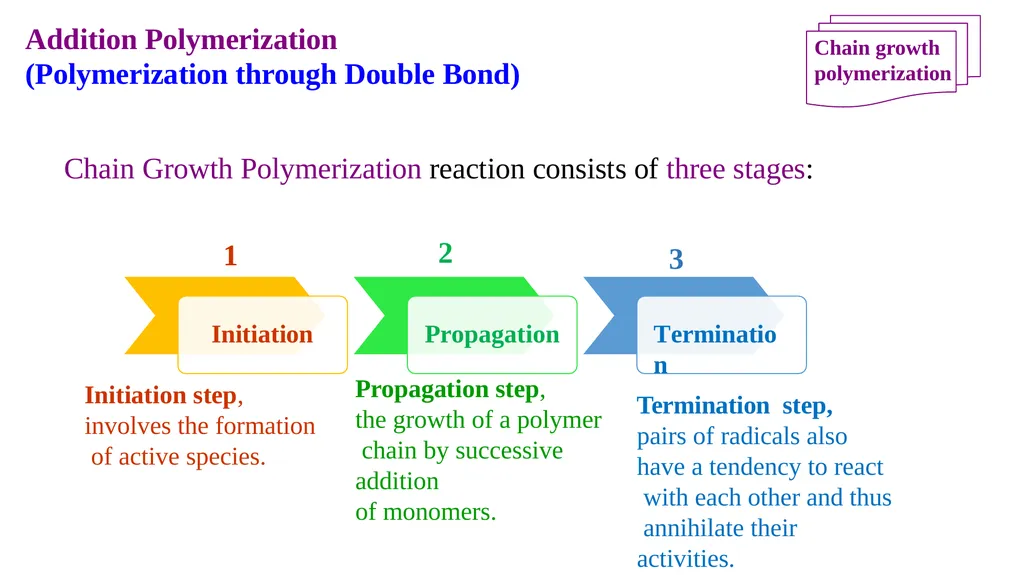
Chain Growth Polymerization reaction consists of three stages: Addition Polymerization (Polymerization through Double Bond) Chain growth polymerization Initiation Propagation Termination 1 2 3 Initiation step, involves the formation of active species. Propagation step,
the growth of a polymer chain by successive addition
of monomers. Termination step, pairs of radicals also have a tendency to react
with each other and thus annihilate their activities.<br>
the growth of a polymer chain by successive addition
of monomers. Termination step, pairs of radicals also have a tendency to react
with each other and thus annihilate their activities.<br>
76
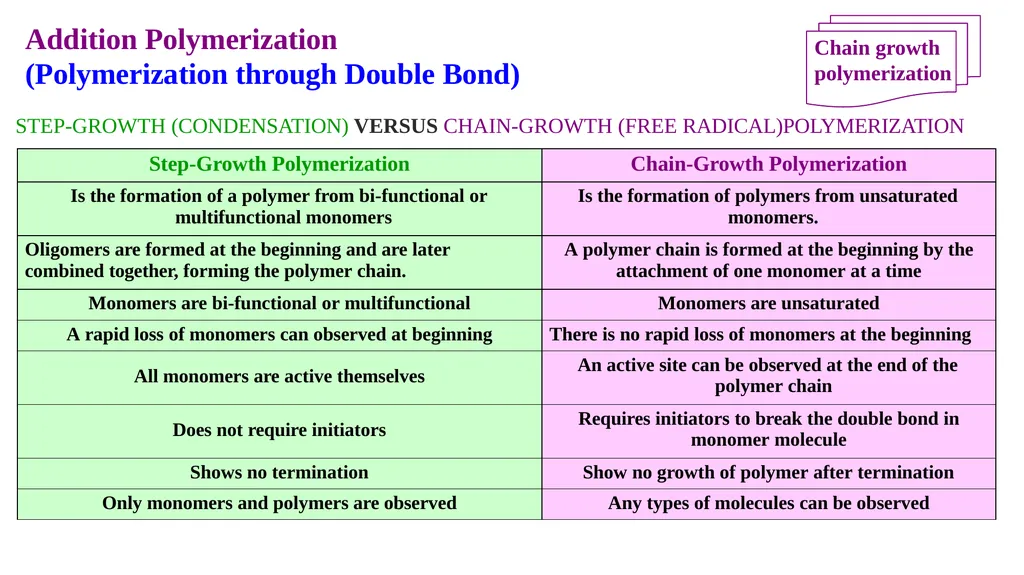
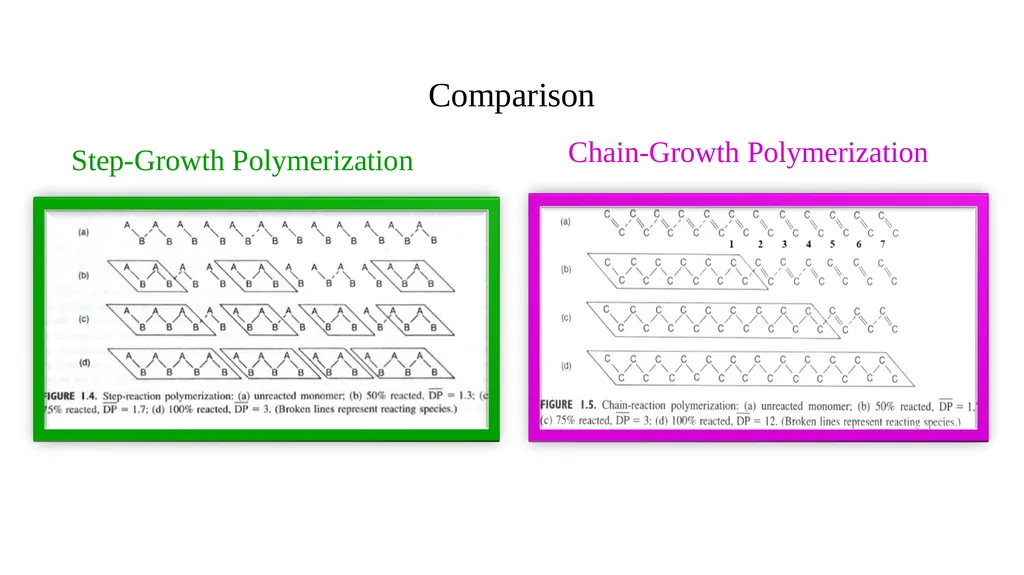
Addition Polymerization (Polymerization through Double Bond) Chain growth polymerization STEP-GROWTH (CONDENSATION) VERSUS CHAIN-GROWTH (FREE RADICAL)POLYMERIZATION<br>
77
Chain-Growth Polymerization Step-Growth Polymerization Comparison<br>
78
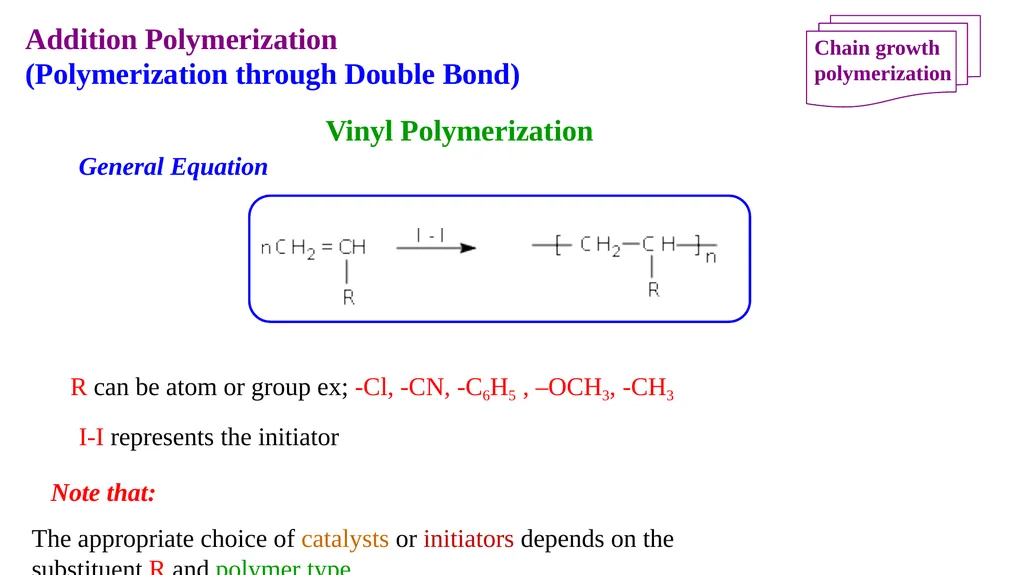
Addition Polymerization (Polymerization through Double Bond) Chain growth polymerization Vinyl Polymerization
General Equation R can be atom or group ex; -Cl, -CN, -C6H5 , –OCH3, -CH3 I-I represents the initiator
Note that:
The appropriate choice of catalysts or initiators depends on the substituent R and polymer type.<br>
General Equation R can be atom or group ex; -Cl, -CN, -C6H5 , –OCH3, -CH3 I-I represents the initiator
Note that:
The appropriate choice of catalysts or initiators depends on the substituent R and polymer type.<br>
79
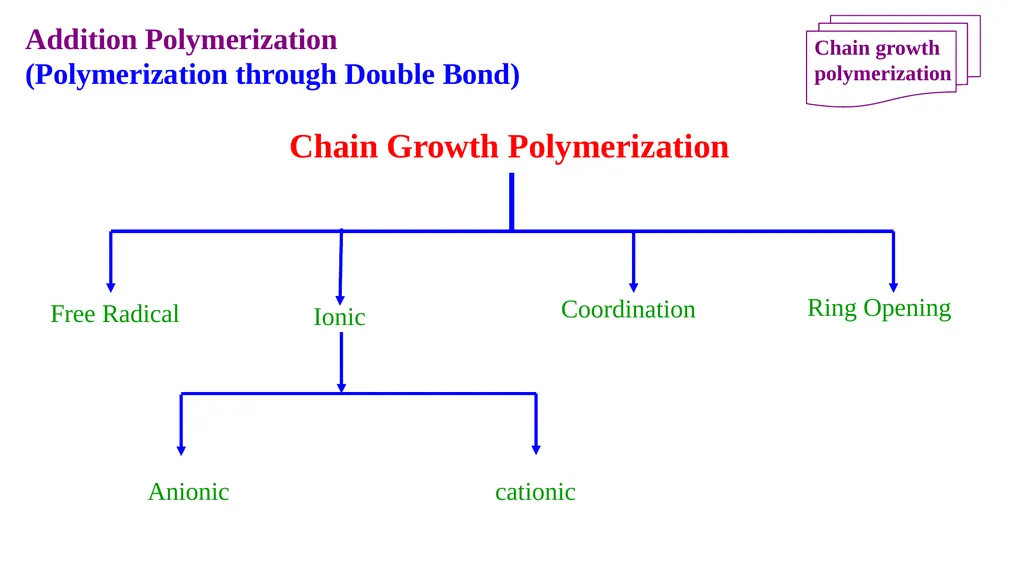
Addition Polymerization (Polymerization through Double Bond) Chain growth polymerization Chain Growth Polymerization Free Radical Ionic Ring Opening Coordination Anionic cationic<br>
80
Addition Polymerization (Polymerization through Double Bond) Chain growth polymerization Free Radical Polymerization
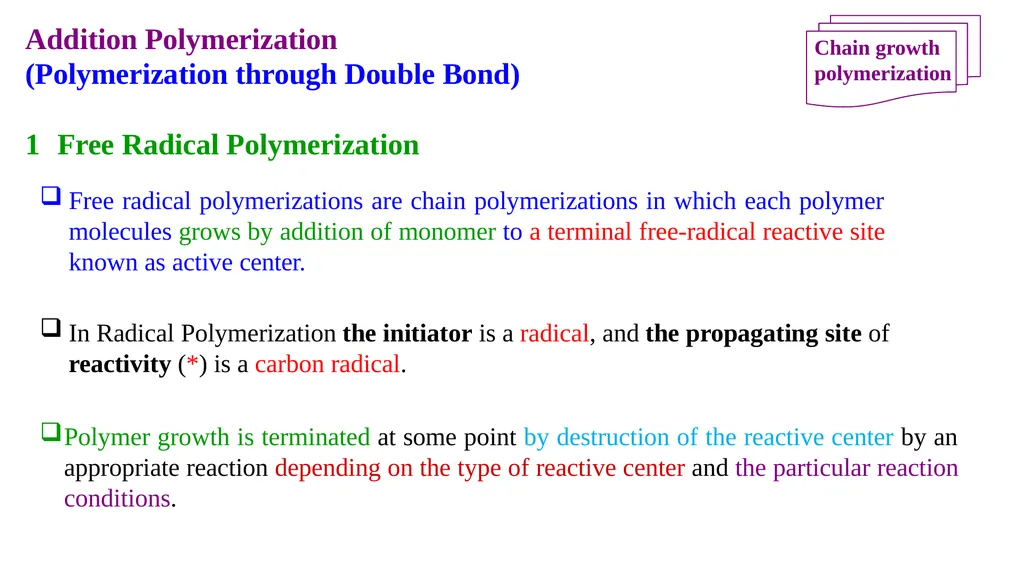
Free radical polymerizations are chain polymerizations in which each polymer molecules grows by addition of monomer to a terminal free-radical reactive site known as active center.
In Radical Polymerization the initiator is a radical, and the propagating site of
reactivity (*) is a carbon radical.
Polymer growth is terminated at some point by destruction of the reactive center by an appropriate reaction depending on the type of reactive center and the particular reaction conditions.<br>
81
Free Radical Polymerization
Initiators of Radical Chain Polymerization
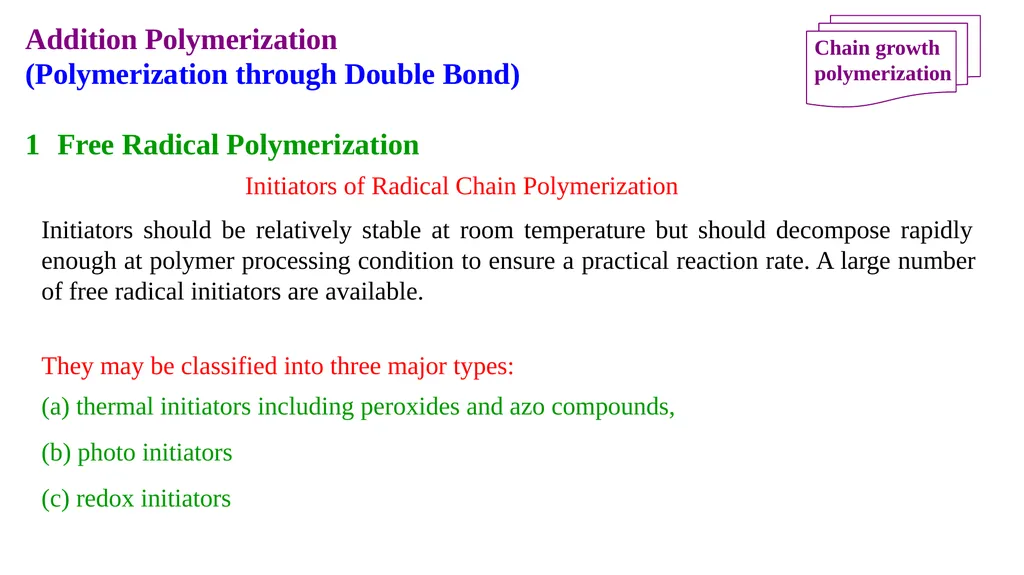
Initiators should be relatively stable at room temperature but should decompose rapidly enough at polymer processing condition to ensure a practical reaction rate. A large number of free radical initiators are available.
They may be classified into three major types:
thermal initiators including peroxides and azo compounds,
photo initiators
redox initiators Addition Polymerization (Polymerization through Double Bond) Chain growth polymerization<br>
82
Addition Polymerization (Polymerization through Double Bond)
Free Radical Polymerization
Types of initiators used
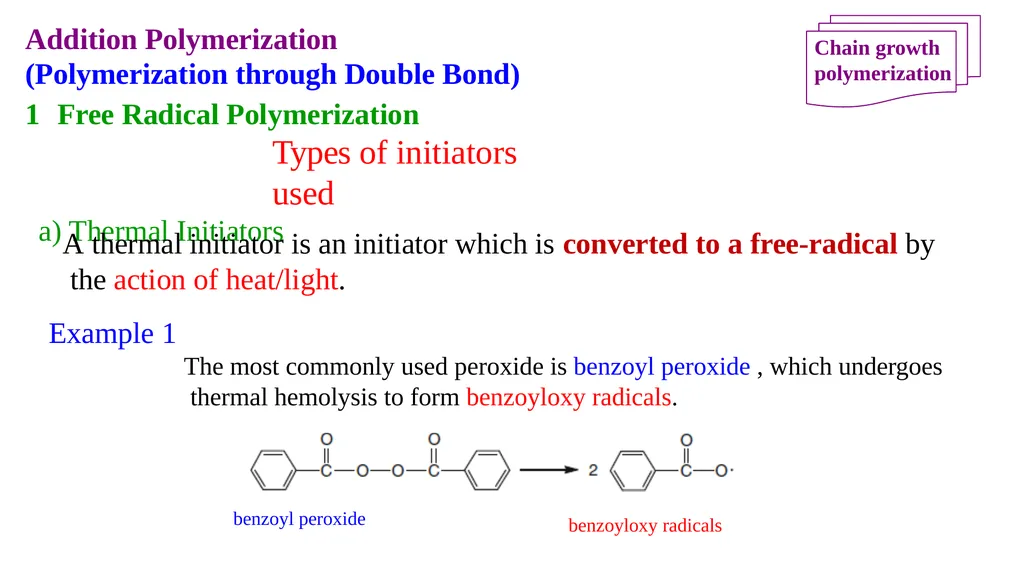
Thermal Initiators Chain growth polymerization A thermal initiator is an initiator which is converted to a free-radical by the action of heat/light.
Example 1
The most commonly used peroxide is benzoyl peroxide , which undergoes thermal hemolysis to form benzoyloxy radicals. benzoyl peroxide benzoyloxy radicals<br>
83
Chain growth polymerization a) Thermal Initiators Addition Polymerization (Polymerization through Double Bond)
1- Free Radical Polymerization
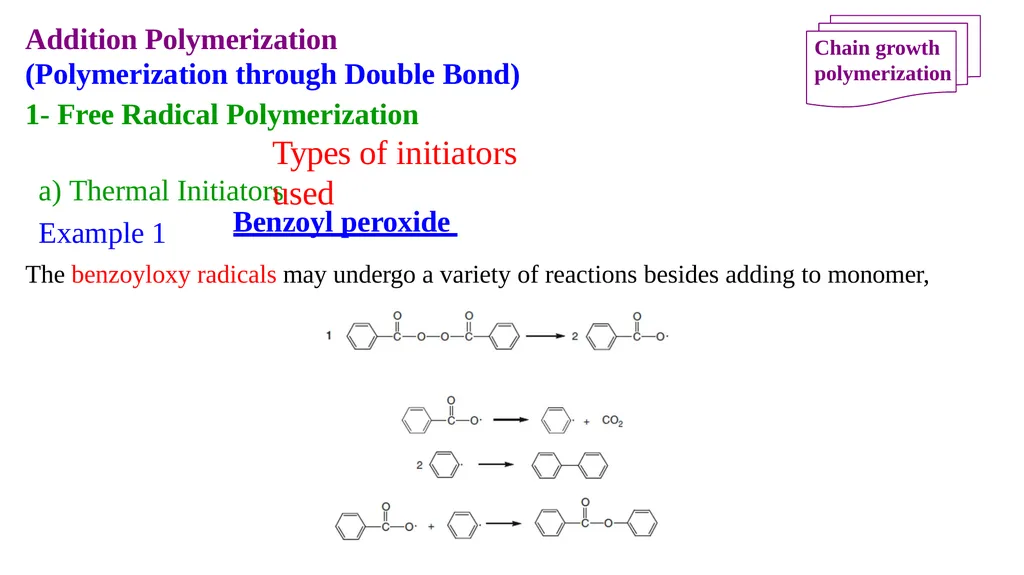
Types of initiators used Example 1 Benzoyl peroxide The benzoyloxy radicals may undergo a variety of reactions besides adding to monomer,<br>
1- Free Radical Polymerization
Types of initiators used Example 1 Benzoyl peroxide The benzoyloxy radicals may undergo a variety of reactions besides adding to monomer,<br>
84
Addition Polymerization (Polymerization through Double Bond) Chain growth polymerization Free Radical Polymerization
Types of initiators used
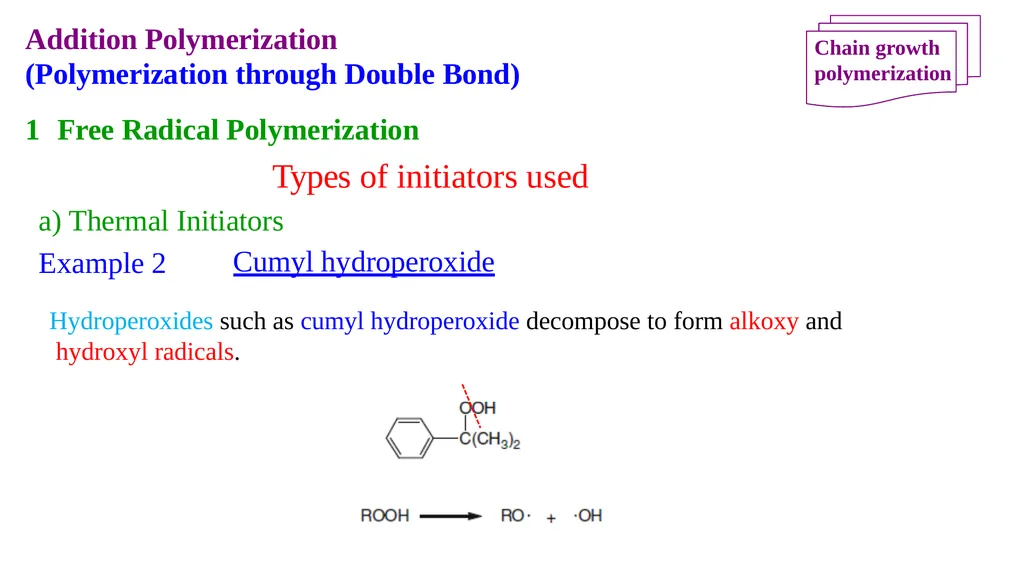
Thermal Initiators Hydroperoxides such as cumyl hydroperoxide decompose to form alkoxy and hydroxyl radicals. Example 2 Cumyl hydroperoxide<br>
Types of initiators used
Thermal Initiators Hydroperoxides such as cumyl hydroperoxide decompose to form alkoxy and hydroxyl radicals. Example 2 Cumyl hydroperoxide<br>
85
Addition Polymerization (Polymerization through Double Bond) Chain growth polymerization Free Radical Polymerization
Types of initiators used
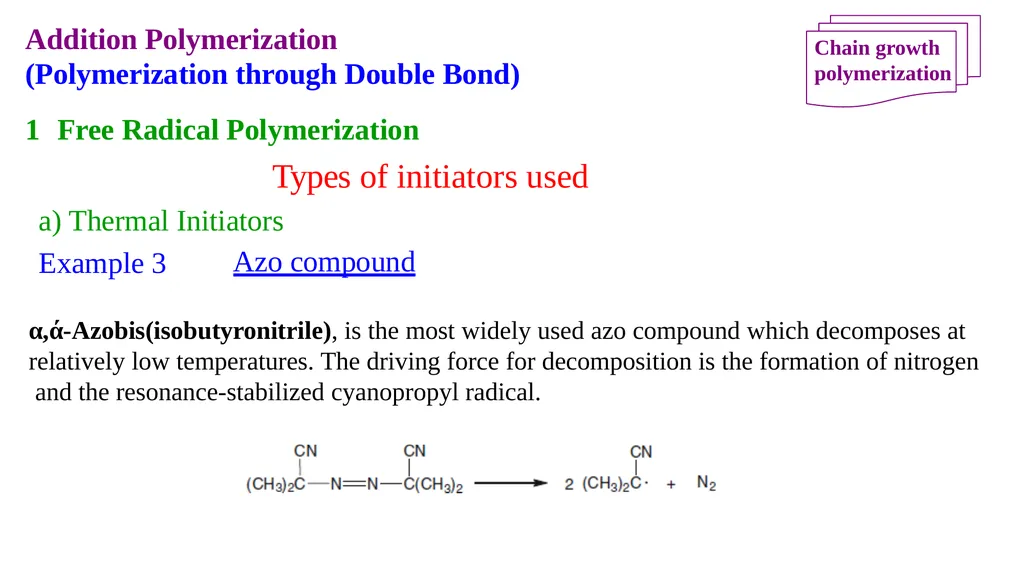
Thermal Initiators Example 3 Azo compound α,ά-Azobis(isobutyronitrile), is the most widely used azo compound which decomposes at relatively low temperatures. The driving force for decomposition is the formation of nitrogen and the resonance-stabilized cyanopropyl radical.<br>
86
Photo-initiators are molecules that absorb photons upon irradiation with light and form reactive species out of the excited state, which initiate consecutive reactions. The initiating species may be radicals, cations, or anions.
Radical photo-initiators are commercially available in large number from companies.
A photo-initiator should exhibit several properties, from which the most important are:
high absorption at the exposure wavelength and high molar extinction coefficient,
high quantum yield of formation of initiating species, and (iii) high reactivity of the radical towards the monomer. Addition Polymerization (Polymerization through Double Bond) Chain growth polymerization 1- Free Radical Polymerization b) Photo Initiators<br>
87
Addition Polymerization (Polymerization through Double Bond)
1- Free Radical Polymerization
Types of initiators used
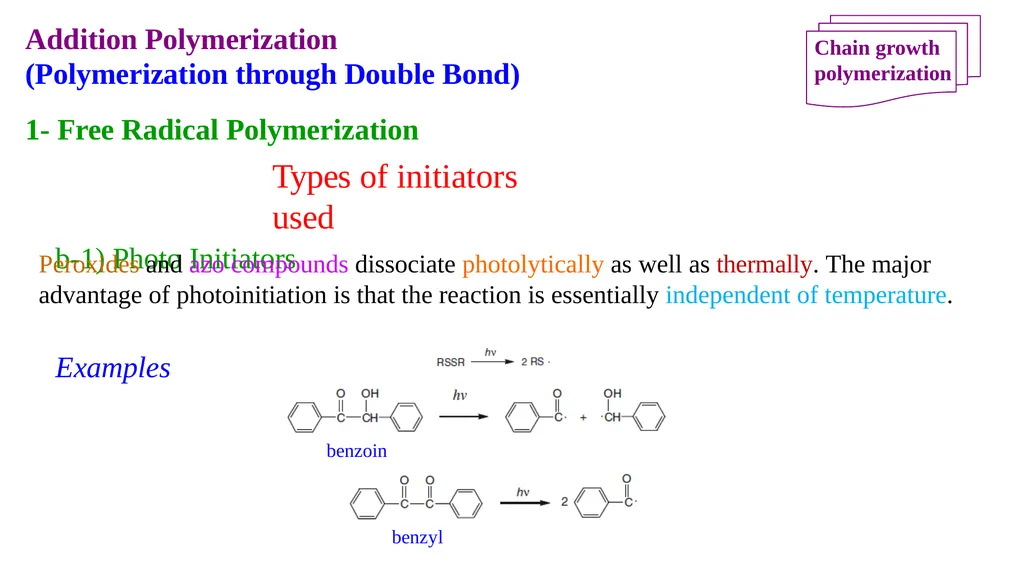
b-1) Photo Initiators Chain growth polymerization benzoin Peroxides and azo compounds dissociate photolytically as well as thermally. The major
advantage of photoinitiation is that the reaction is essentially independent of temperature.
Examples benzyl<br>
88
Addition Polymerization (Polymerization through Double Bond) Chain growth polymerization 1- Free Radical Polymerization
Types of initiators used
b-2) Photo Initiators
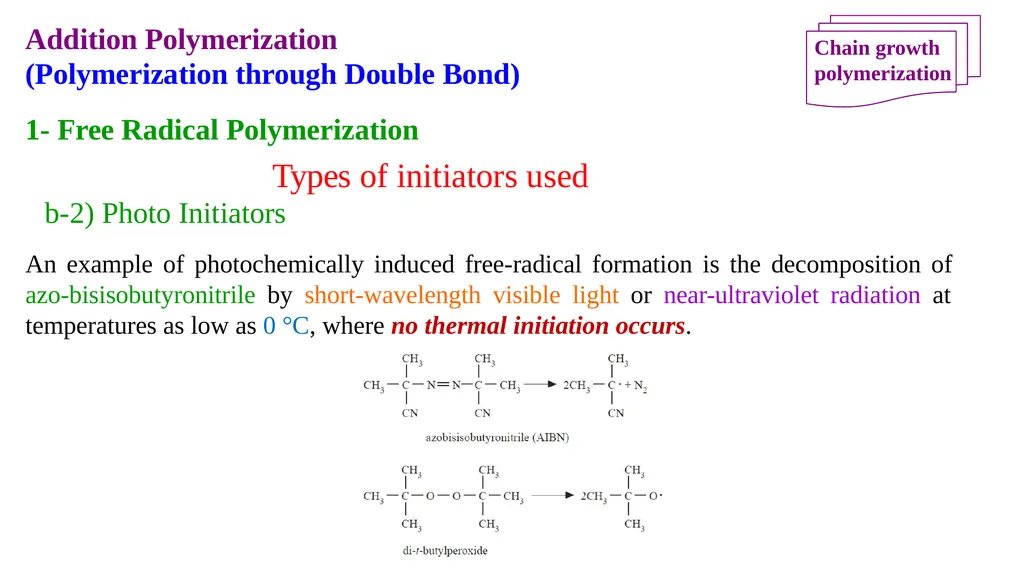
An example of photochemically induced free-radical formation is the decomposition of azo-bisisobutyronitrile by short-wavelength visible light or near-ultraviolet radiation at temperatures as low as 0 °C, where no thermal initiation occurs.<br>
Types of initiators used
b-2) Photo Initiators
An example of photochemically induced free-radical formation is the decomposition of azo-bisisobutyronitrile by short-wavelength visible light or near-ultraviolet radiation at temperatures as low as 0 °C, where no thermal initiation occurs.<br>
89
Addition Polymerization (Polymerization through Double Bond) Chain growth polymerization 1- Free Radical Polymerization c) Redox Initiators A very effective method of generating free radicals under mild conditions is by one-electron transfer reactions, the most effective of which is redox initiation. This method has found wide application for initiating polymerization reactions and has industrial importance, e.g. in low-temperature emulsion polymerizations.
This narrow range of dissociation energies limits the types of useful compounds to those containing fairly specific types of covalent bonds, for example, oxygen–oxygen, oxygen– nitrogen and sulfur– sulfur bonds.<br>
This narrow range of dissociation energies limits the types of useful compounds to those containing fairly specific types of covalent bonds, for example, oxygen–oxygen, oxygen– nitrogen and sulfur– sulfur bonds.<br>
90
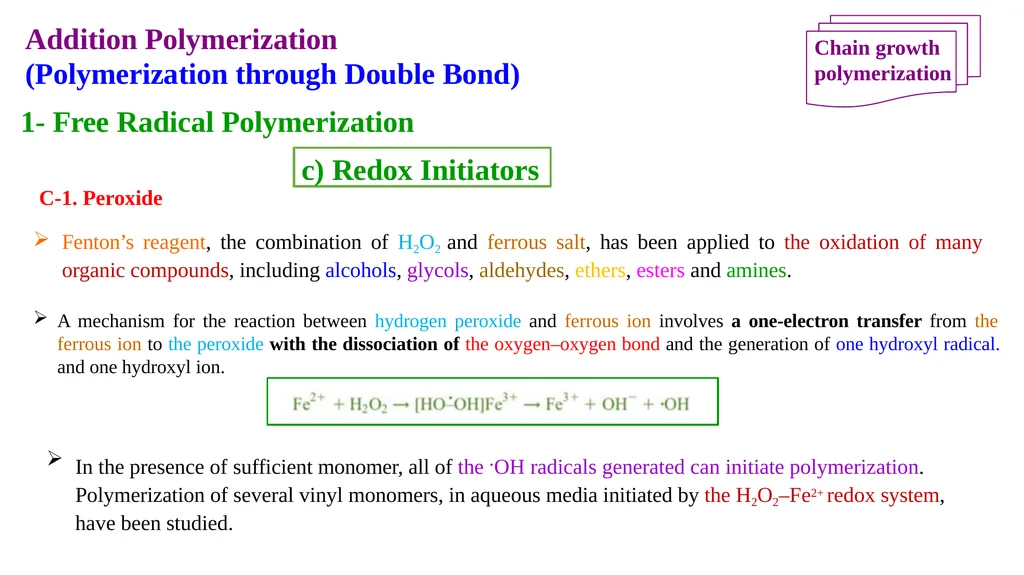
Addition Polymerization (Polymerization through Double Bond) Chain growth polymerization 1- Free Radical Polymerization c) Redox Initiators C-1. Peroxide
Fenton’s reagent, the combination of H2O2 and ferrous salt, has been applied to the oxidation of many
organic compounds, including alcohols, glycols, aldehydes, ethers, esters and amines.
A mechanism for the reaction between hydrogen peroxide and ferrous ion involves a one-electron transfer from the ferrous ion to the peroxide with the dissociation of the oxygen–oxygen bond and the generation of one hydroxyl radical. and one hydroxyl ion. In the presence of sufficient monomer, all of the .OH radicals generated can initiate polymerization. Polymerization of several vinyl monomers, in aqueous media initiated by the H2O2–Fe2+ redox system, have been studied.<br>
91
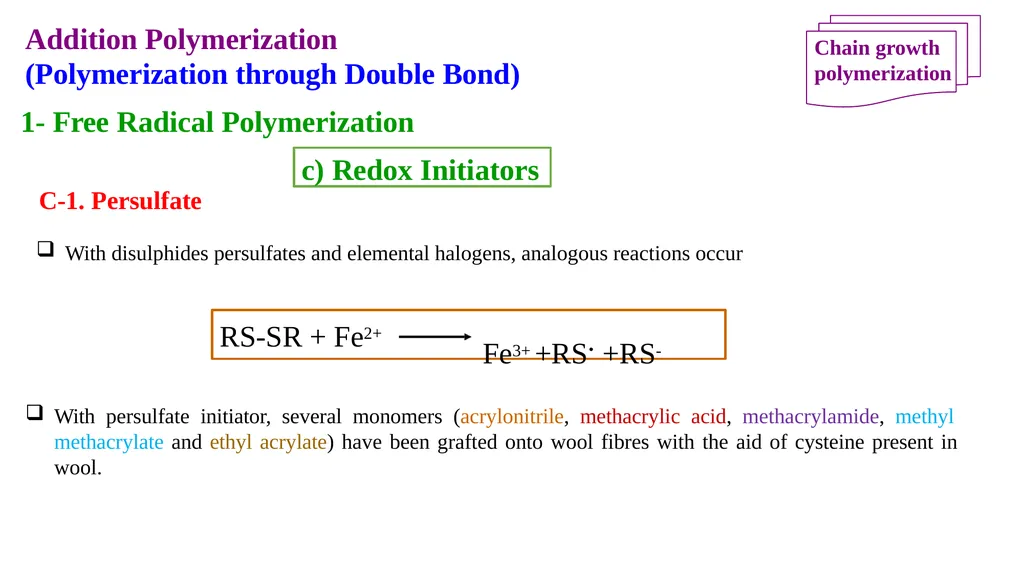
Addition Polymerization (Polymerization through Double Bond) Chain growth polymerization 1- Free Radical Polymerization c) Redox Initiators C-1. Persulfate
With disulphides persulfates and elemental halogens, analogous reactions occur With persulfate initiator, several monomers (acrylonitrile, methacrylic acid, methacrylamide, methyl methacrylate and ethyl acrylate) have been grafted onto wool fibres with the aid of cysteine present in wool. RS-SR + Fe2+ Fe3+ +RS. +RS-<br>
With disulphides persulfates and elemental halogens, analogous reactions occur With persulfate initiator, several monomers (acrylonitrile, methacrylic acid, methacrylamide, methyl methacrylate and ethyl acrylate) have been grafted onto wool fibres with the aid of cysteine present in wool. RS-SR + Fe2+ Fe3+ +RS. +RS-<br>
92
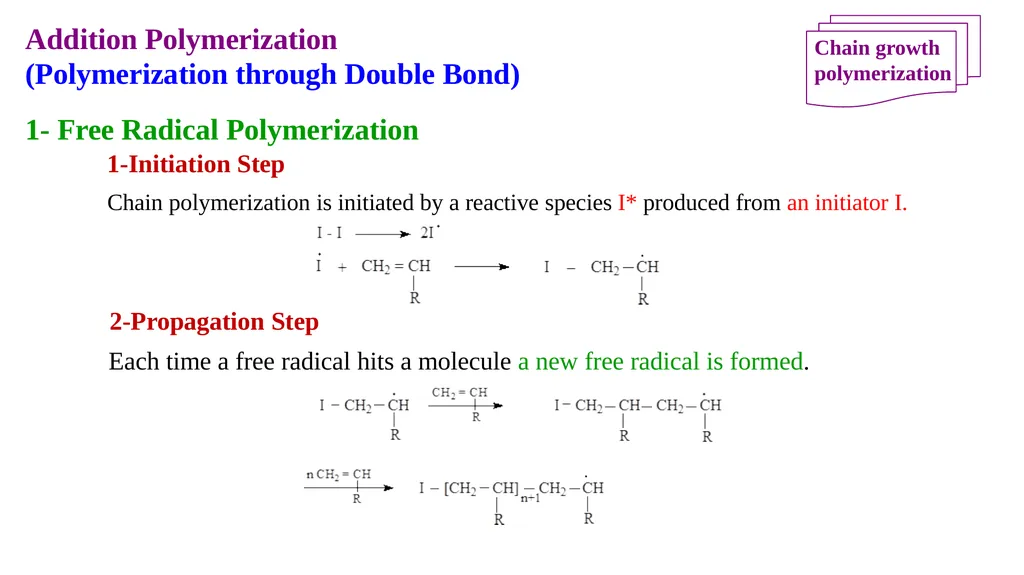
Addition Polymerization (Polymerization through Double Bond) Chain growth polymerization 1- Free Radical Polymerization
1-Initiation Step
Chain polymerization is initiated by a reactive species I* produced from an initiator I. 2-Propagation Step
Each time a free radical hits a molecule a new free radical is formed.<br>
1-Initiation Step
Chain polymerization is initiated by a reactive species I* produced from an initiator I. 2-Propagation Step
Each time a free radical hits a molecule a new free radical is formed.<br>
93
Addition Polymerization (Polymerization through Double Bond)
1- Free Radical Polymerization Chain growth polymerization 3-Termination Step
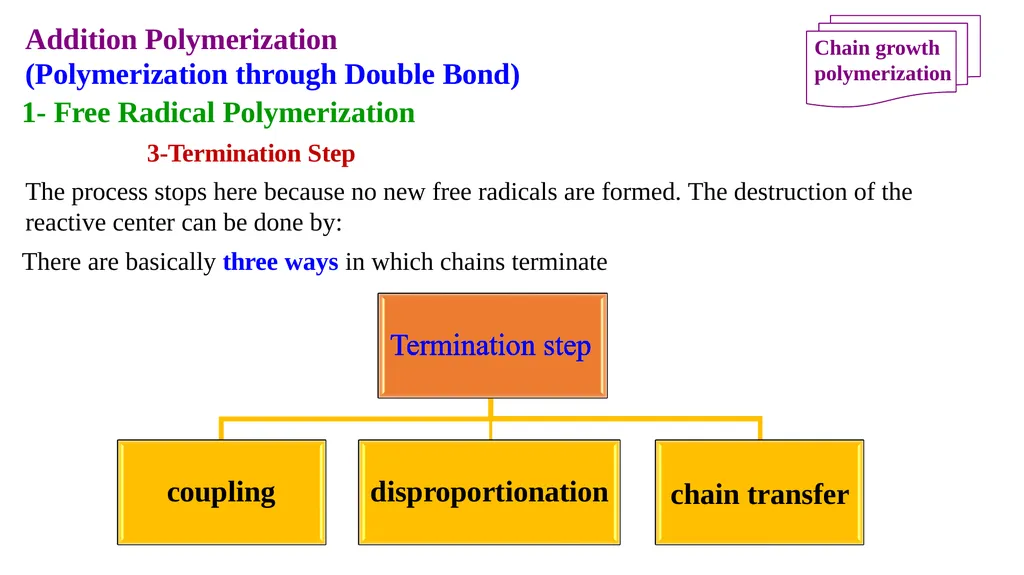
The process stops here because no new free radicals are formed. The destruction of the
reactive center can be done by:
There are basically three ways in which chains terminate coupling disproportionation chain transfer<br>
94
Addition Polymerization (Polymerization through Double Bond)
1- Free Radical Polymerization Chain growth polymerization 3-Termination Step
1. coupling
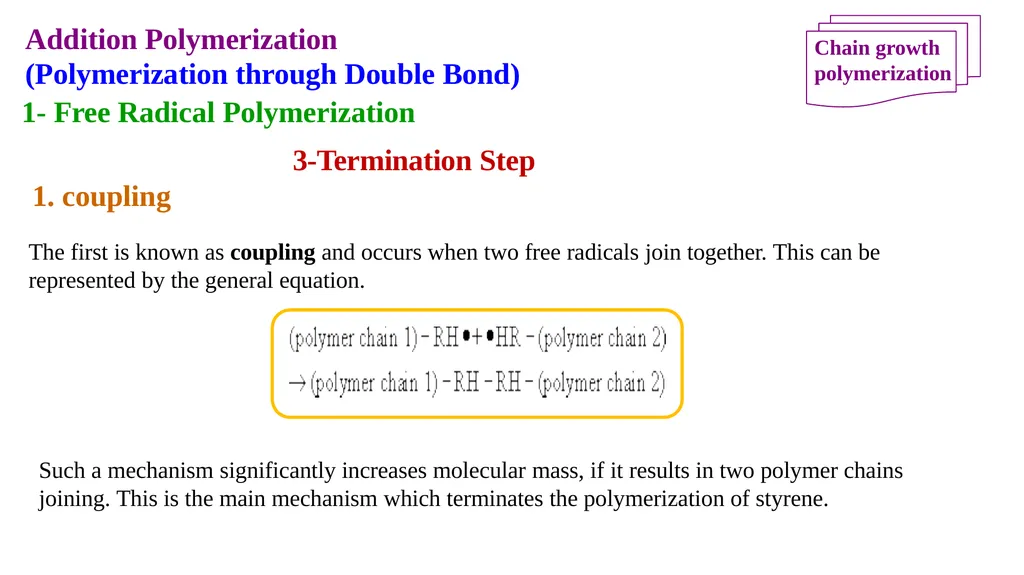
The first is known as coupling and occurs when two free radicals join together. This can be
represented by the general equation. Such a mechanism significantly increases molecular mass, if it results in two polymer chains
joining. This is the main mechanism which terminates the polymerization of styrene.<br>
95
Addition Polymerization (Polymerization through Double Bond)
1- Free Radical Polymerization Chain growth polymerization 3-Termination Step
2.Disproportionation
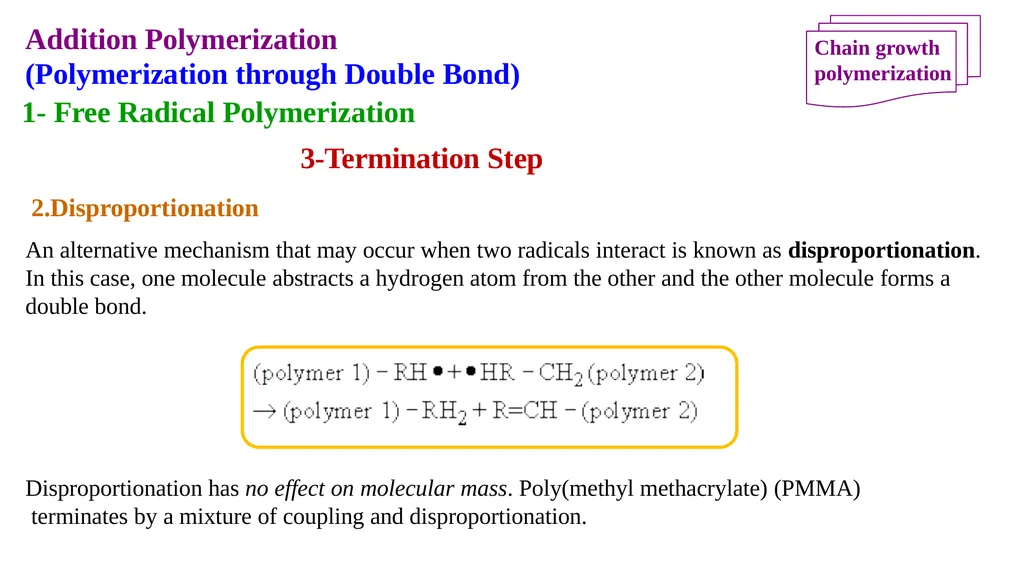
An alternative mechanism that may occur when two radicals interact is known as disproportionation. In this case, one molecule abstracts a hydrogen atom from the other and the other molecule forms a double bond. Disproportionation has no effect on molecular mass. Poly(methyl methacrylate) (PMMA) terminates by a mixture of coupling and disproportionation.<br>
96
Addition Polymerization (Polymerization through Double Bond)
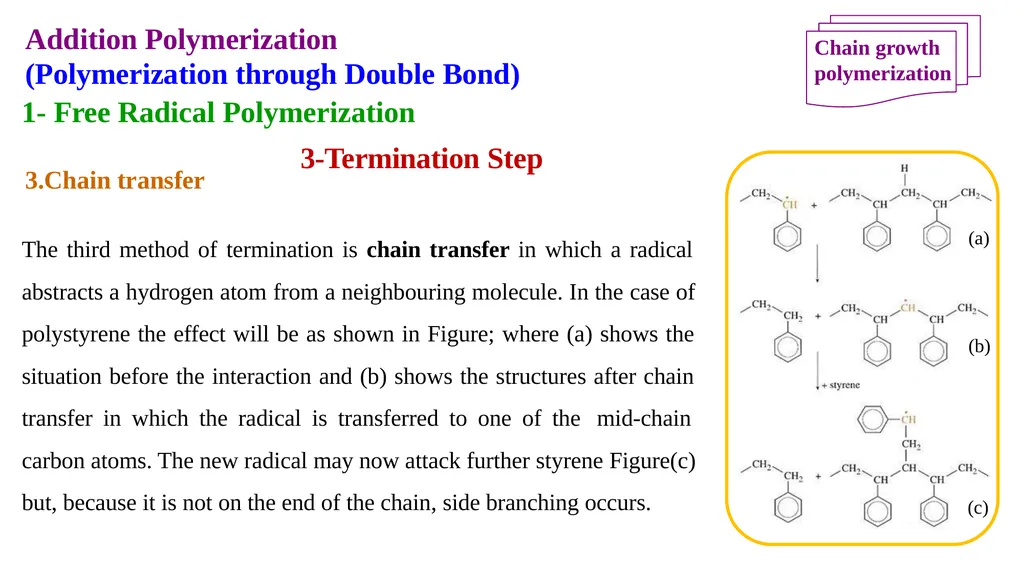
1- Free Radical Polymerization Chain growth polymerization 3-Termination Step The third method of termination is chain transfer in which a radical abstracts a hydrogen atom from a neighbouring molecule. In the case of polystyrene the effect will be as shown in Figure; where (a) shows the situation before the interaction and (b) shows the structures after chain transfer in which the radical is transferred to one of the mid-chain carbon atoms. The new radical may now attack further styrene Figure(c) but, because it is not on the end of the chain, side branching occurs. 3.Chain transfer (a) (b) (c)<br>
1- Free Radical Polymerization Chain growth polymerization 3-Termination Step The third method of termination is chain transfer in which a radical abstracts a hydrogen atom from a neighbouring molecule. In the case of polystyrene the effect will be as shown in Figure; where (a) shows the situation before the interaction and (b) shows the structures after chain transfer in which the radical is transferred to one of the mid-chain carbon atoms. The new radical may now attack further styrene Figure(c) but, because it is not on the end of the chain, side branching occurs. 3.Chain transfer (a) (b) (c)<br>
97
Addition Polymerization (Polymerization through Double Bond) Chain growth polymerization 1- Free Radical Polymerization
Examples
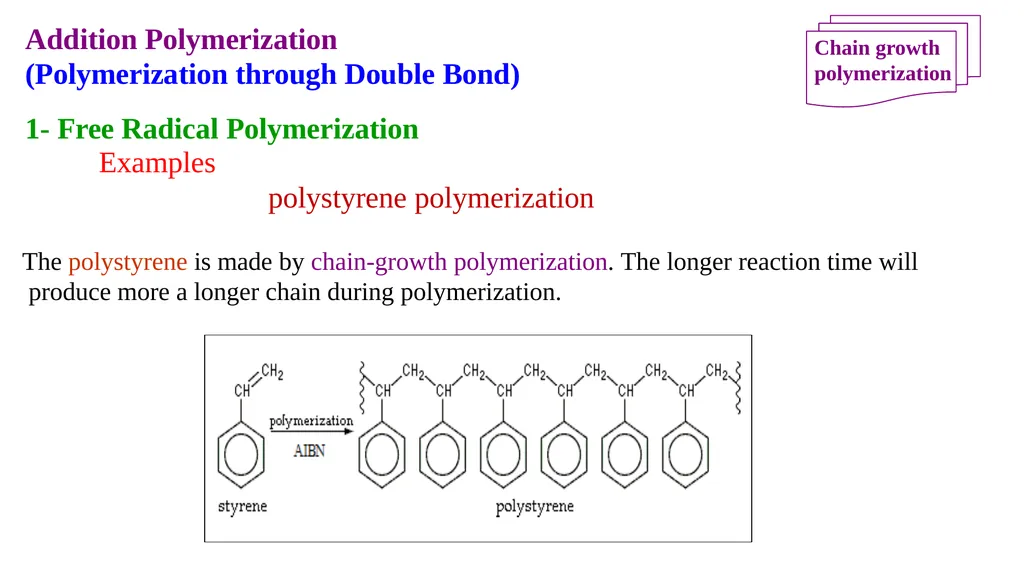
polystyrene polymerization
The polystyrene is made by chain-growth polymerization. The longer reaction time will produce more a longer chain during polymerization.<br>
Examples
polystyrene polymerization
The polystyrene is made by chain-growth polymerization. The longer reaction time will produce more a longer chain during polymerization.<br>
98
Addition Polymerization (Polymerization through Double Bond) Chain growth polymerization 1- Free Radical Polymerization
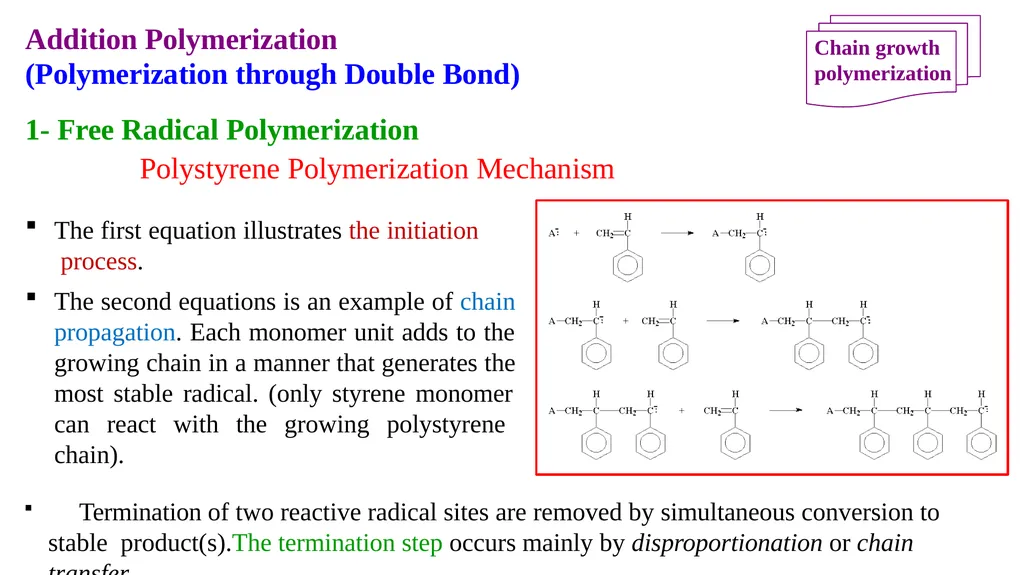
Polystyrene Polymerization Mechanism
The first equation illustrates the initiation process.
The second equations is an example of chain propagation. Each monomer unit adds to the growing chain in a manner that generates the most stable radical. (only styrene monomer can react with the growing polystyrene chain).
Termination of two reactive radical sites are removed by simultaneous conversion to stable product(s).The termination step occurs mainly by disproportionation or chain transfer.<br>
99
Addition Polymerization (Polymerization through Double Bond) Chain growth polymerization 1- Free Radical Polymerization
Examples
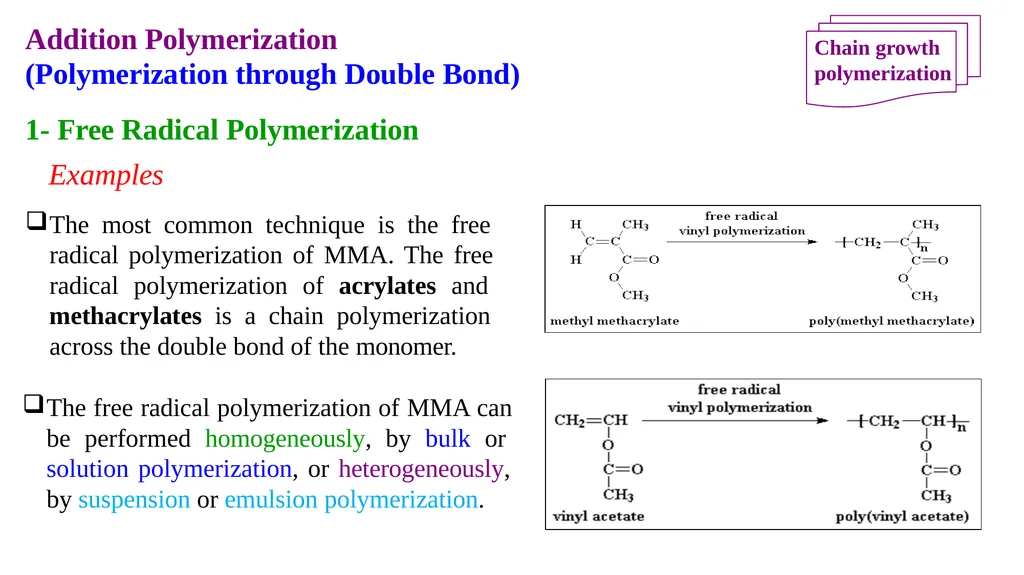
The most common technique is the free radical polymerization of MMA. The free radical polymerization of acrylates and methacrylates is a chain polymerization across the double bond of the monomer.
The free radical polymerization of MMA can be performed homogeneously, by bulk or solution polymerization, or heterogeneously, by suspension or emulsion polymerization.<br>
100
Addition Polymerization (Polymerization through Double Bond) Chain growth polymerization 1- Free Radical Polymerization
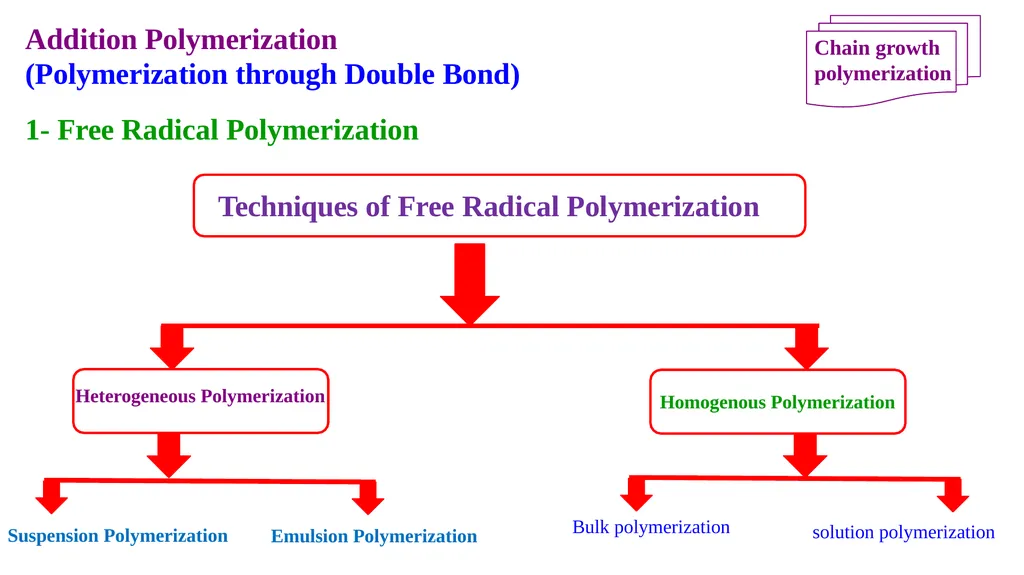
Techniques of Free Radical Polymerization Heterogeneous Polymerization Homogenous Polymerization Bulk polymerization solution polymerization Suspension Polymerization Emulsion Polymerization<br>
Techniques of Free Radical Polymerization Heterogeneous Polymerization Homogenous Polymerization Bulk polymerization solution polymerization Suspension Polymerization Emulsion Polymerization<br>
101
Addition Polymerization (Polymerization through Double Bond) Chain growth polymerization Homogenous Polymerization
Bulk polymerization
Mass or Block Polymerization: Polymerization of undiluted monomer.
Carried out by adding a soluble initiator to pure monomer in liquid state (solvent is not required).
It is usually adopted to produce polystyrene, polyvinyl chloride, polymethyl methacrylate and low density polyethylene.<br>
102
Addition Polymerization (Polymerization through Double Bond) Chain growth polymerization Homogenous Polymerization
Bulk polymerization<br>
Bulk polymerization<br>
103
Addition Polymerization (Polymerization through Double Bond) Chain growth polymerization Homogenous Polymerization
b) Solvent polymerization
Solution polymerization is a method of industrial polymerization. In this procedure, a monomer is dissolved in a non-reactive solvent that contains a catalyst.
The reaction results in a polymer which is also soluble in the chosen solvent.<br>
b) Solvent polymerization
Solution polymerization is a method of industrial polymerization. In this procedure, a monomer is dissolved in a non-reactive solvent that contains a catalyst.
The reaction results in a polymer which is also soluble in the chosen solvent.<br>
104
Addition Polymerization (Polymerization through Double Bond) I-Homogenous Polymerization
b) Solvent polymerization Chain growth polymerization<br>
b) Solvent polymerization Chain growth polymerization<br>
105
Addition Polymerization (Polymerization through Double Bond) Chain growth polymerization Heterogeneous Polymerization
Suspension Polymerization What means by suspension solutions?
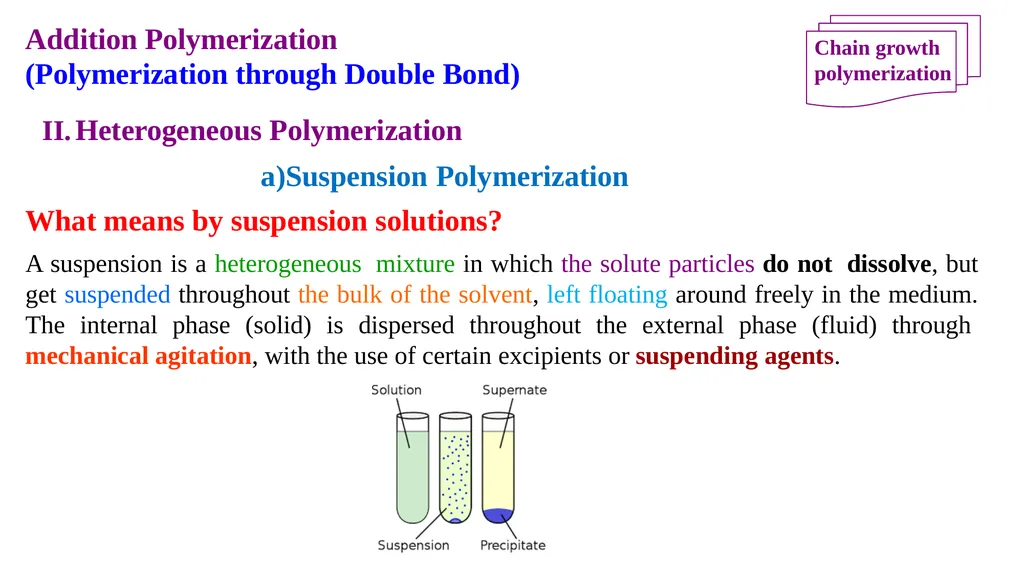
A suspension is a heterogeneous mixture in which the solute particles do not dissolve, but get suspended throughout the bulk of the solvent, left floating around freely in the medium. The internal phase (solid) is dispersed throughout the external phase (fluid) through mechanical agitation, with the use of certain excipients or suspending agents.<br>
106
Addition Polymerization (Polymerization through Double Bond) Heterogeneous Polymerization
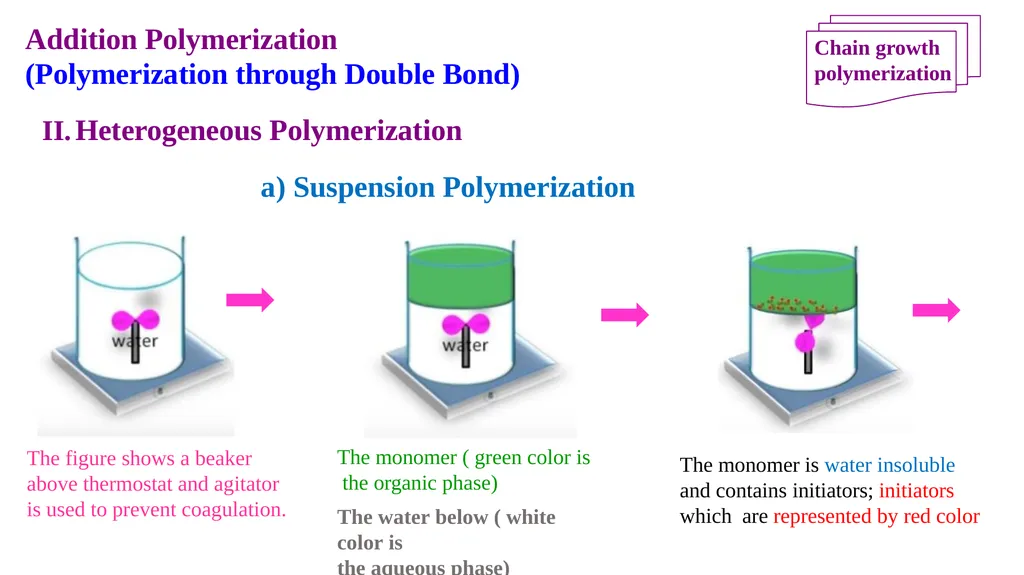
Suspension Polymerization Chain growth polymerization The figure shows a beaker above thermostat and agitator is used to prevent coagulation. The monomer ( green color is the organic phase)
The water below ( white color is
the aqueous phase) The monomer is water insoluble and contains initiators; initiators which are represented by red color<br>
107
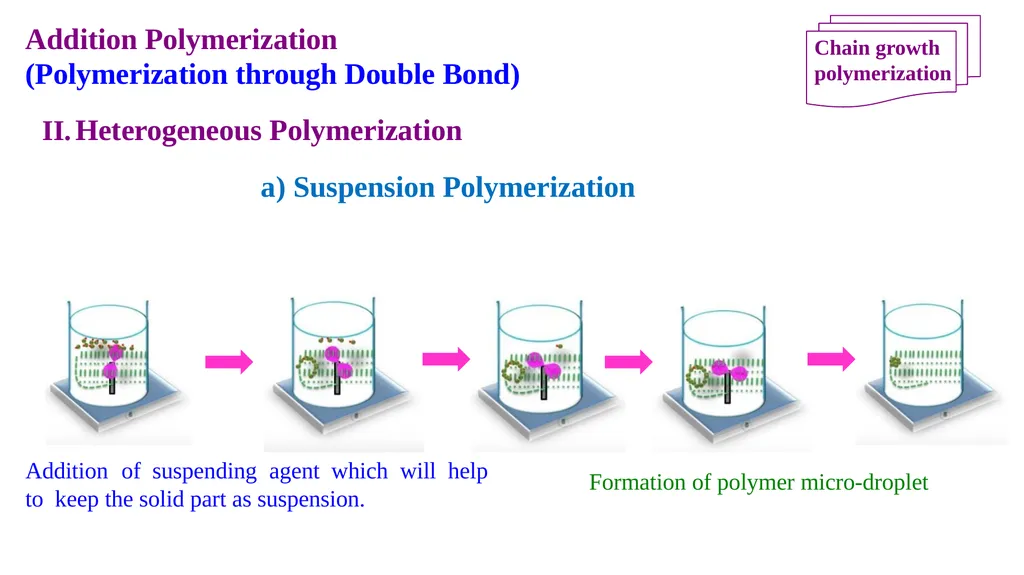
Addition of suspending agent which will help to keep the solid part as suspension. Addition Polymerization (Polymerization through Double Bond) Heterogeneous Polymerization
Suspension Polymerization Chain growth polymerization Formation of polymer micro-droplet<br>
Suspension Polymerization Chain growth polymerization Formation of polymer micro-droplet<br>
108
Addition Polymerization (Polymerization through Double Bond) Heterogeneous Polymerization
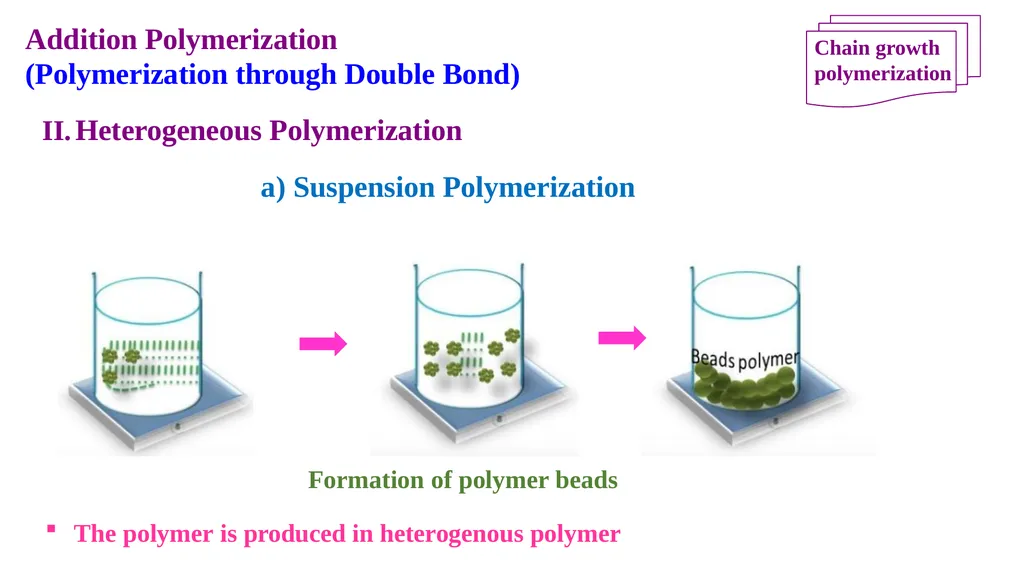
Suspension Polymerization Chain growth polymerization Formation of polymer beads
The polymer is produced in heterogenous polymer<br>
Suspension Polymerization Chain growth polymerization Formation of polymer beads
The polymer is produced in heterogenous polymer<br>
109
Addition Polymerization (Polymerization through Double Bond) Heterogeneous Polymerization
Suspension Polymerization Chain growth polymerization using water as solvent making suspension polymerization
technique an economic method
Product isolation is very easy and the products are very pure. This method is applicable only for water insoluble monomers.
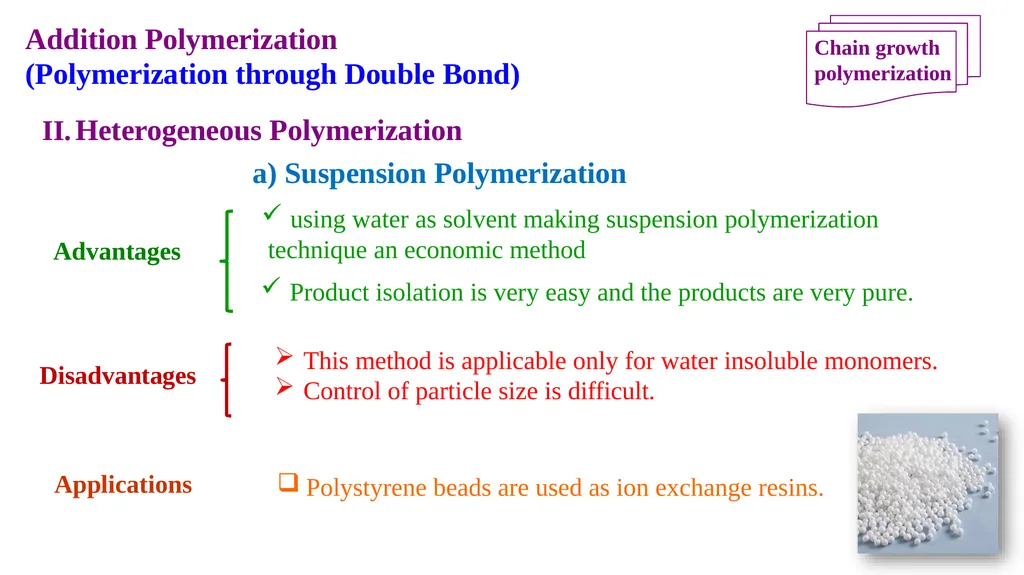
Control of particle size is difficult. Polystyrene beads are used as ion exchange resins. Advantages Disadvantages Applications<br>
110
Addition Polymerization (Polymerization through Double Bond) II-Heterogeneous Polymerization
b)Emulsion Polymerization
Emulsion Polymerization Process
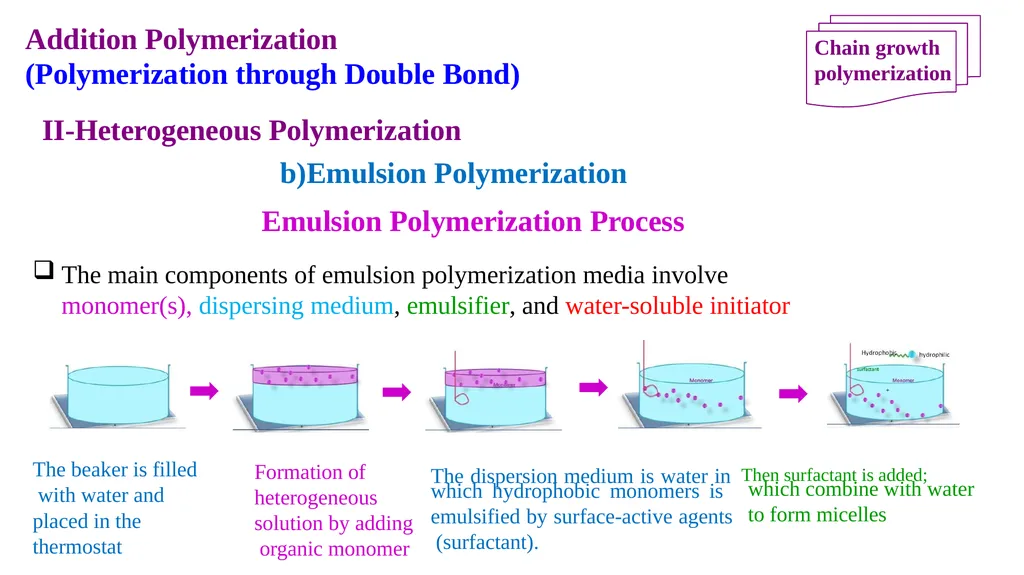
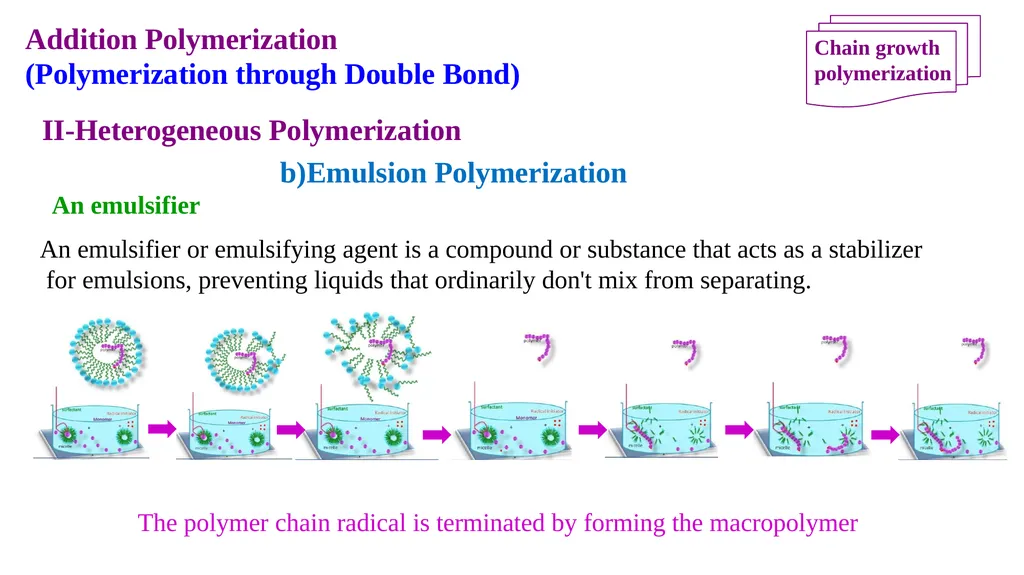
The main components of emulsion polymerization media involve
monomer(s), dispersing medium, emulsifier, and water-soluble initiator Chain growth polymerization The beaker is filled with water and
placed in the thermostat Formation of heterogeneous solution by adding organic monomer which combine with water
to form micelles The dispersion medium is water in Then surfactant is added; which hydrophobic monomers is emulsified by surface-active agents (surfactant).<br>
111
Addition Polymerization (Polymerization through Double Bond) Chain growth polymerization II-Heterogeneous Polymerization
b)Emulsion Polymerization
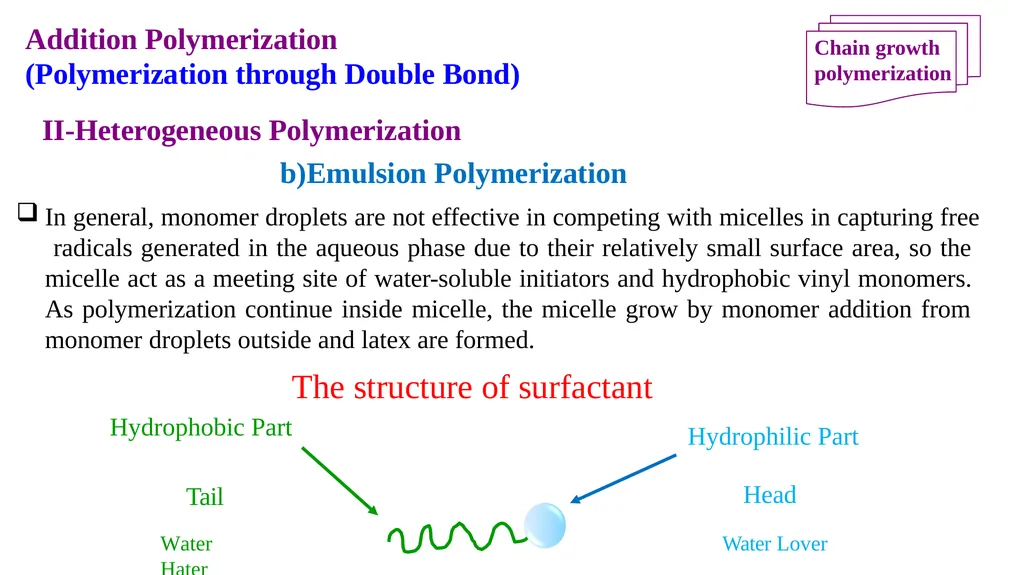
In general, monomer droplets are not effective in competing with micelles in capturing free radicals generated in the aqueous phase due to their relatively small surface area, so the micelle act as a meeting site of water-soluble initiators and hydrophobic vinyl monomers. As polymerization continue inside micelle, the micelle grow by monomer addition from monomer droplets outside and latex are formed.
The structure of surfactant Hydrophilic Part Hydrophobic Part Head
Water Lover Tail
Water Hater<br>
112
Addition Polymerization (Polymerization through Double Bond) Chain growth polymerization II-Heterogeneous Polymerization
b)Emulsion Polymerization
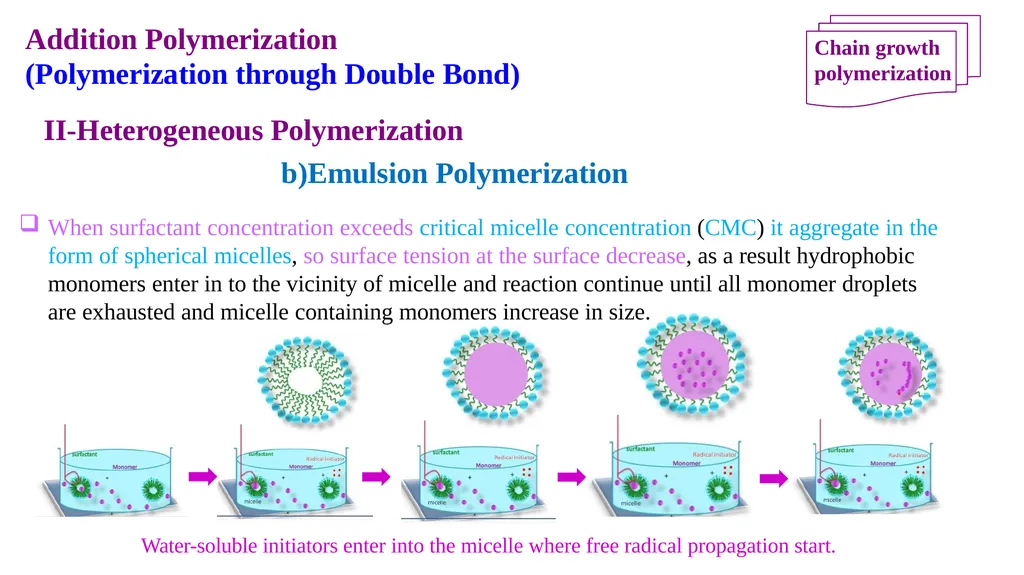
When surfactant concentration exceeds critical micelle concentration (CMC) it aggregate in the form of spherical micelles, so surface tension at the surface decrease, as a result hydrophobic monomers enter in to the vicinity of micelle and reaction continue until all monomer droplets are exhausted and micelle containing monomers increase in size. Water-soluble initiators enter into the micelle where free radical propagation start.<br>
113
Addition Polymerization (Polymerization through Double Bond) Chain growth polymerization II-Heterogeneous Polymerization
b)Emulsion Polymerization
An emulsifier
An emulsifier or emulsifying agent is a compound or substance that acts as a stabilizer for emulsions, preventing liquids that ordinarily don't mix from separating. The polymer chain radical is terminated by forming the macropolymer<br>
b)Emulsion Polymerization
An emulsifier
An emulsifier or emulsifying agent is a compound or substance that acts as a stabilizer for emulsions, preventing liquids that ordinarily don't mix from separating. The polymer chain radical is terminated by forming the macropolymer<br>
114
Disadvantages Applications Addition Polymerization (Polymerization through Double Bond) Chain growth polymerization II-Heterogeneous Polymerization
b)Emulsion Polymerization
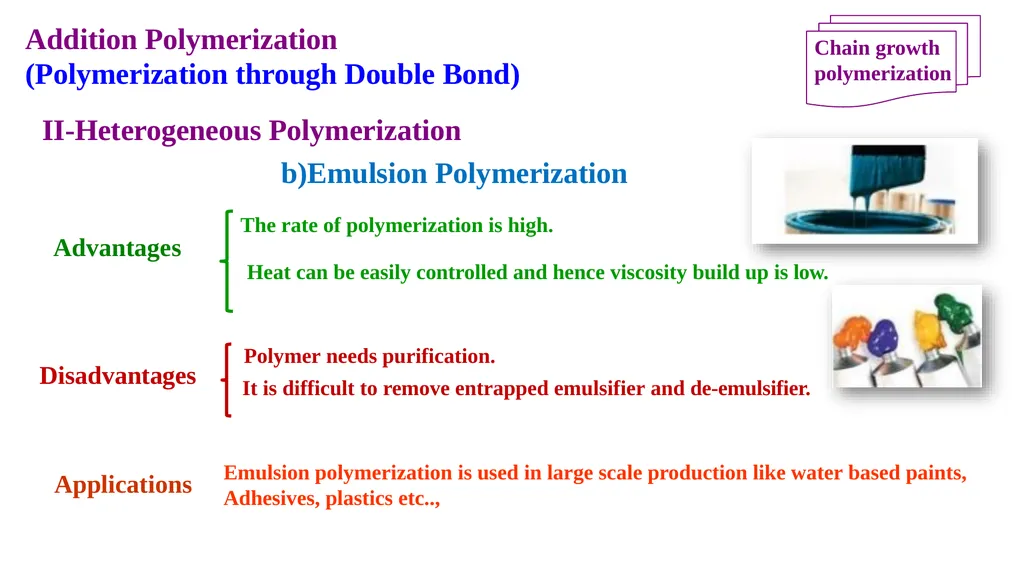
The rate of polymerization is high.
Advantages
Heat can be easily controlled and hence viscosity build up is low. Polymer needs purification.
It is difficult to remove entrapped emulsifier and de-emulsifier. Emulsion polymerization is used in large scale production like water based paints,
Adhesives, plastics etc..,<br>
115
2-Ionic polymerization
2-1.Anionic polymerization
Anionic addition polymerization is a form of chain-growth polymerization or addition
polymerization that involves the polymerization of monomers initiated with anions.
Negative molecules are used in this type of polymerization, in low boiling point solvents.
Strong bases are used in mono-vinyl polymerization with electron with drawn groups, which helps to stabilize the negative ions during the reaction.
Anionic polymers shows narrow molecular weight distribution such as; polystyrene
Examples
-CN and –COOCH3 Addition Polymerization Addition Polymerization (Polymerization through Double Bond)<br>
116
Addition Polymerization Addition Polymerization (Polymerization through Double Bond) 2-1.Anionic polymerization
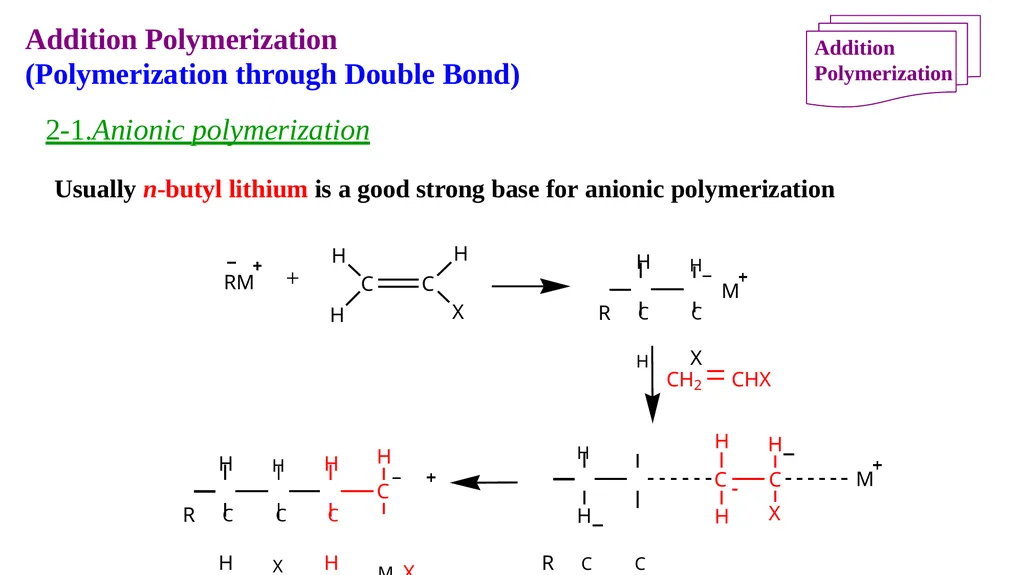
Usually n-butyl lithium is a good strong base for anionic polymerization H H X H C C RM + M H H
R C C
H X H H
R C C
H X CH2 CHX X H M H C C H H
C M X H H H
R C C C
H X H<br>
Usually n-butyl lithium is a good strong base for anionic polymerization H H X H C C RM + M H H
R C C
H X H H
R C C
H X CH2 CHX X H M H C C H H
C M X H H H
R C C C
H X H<br>
117
Addition Polymerization Addition Polymerization (Polymerization through Double Bond)
2-1.Anionic polymerization Example 1:
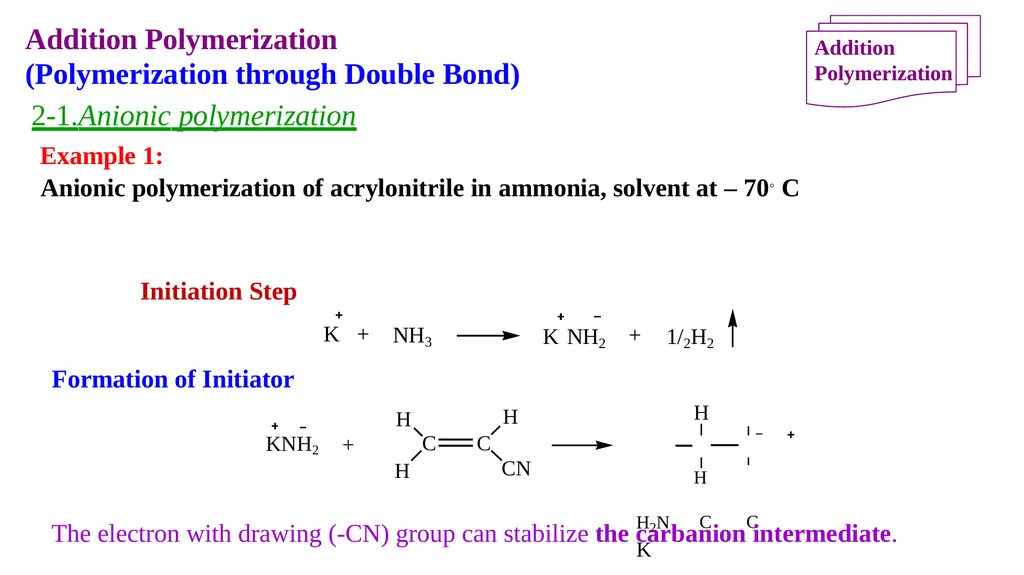
Anionic polymerization of acrylonitrile in ammonia, solvent at – 70◦ C
Initiation Step K + K NH2 NH3 + 1/2H2 H H CN H C C KNH2 + H H
H2N C C K
H CN Formation of Initiator The electron with drawing (-CN) group can stabilize the carbanion intermediate.<br>
2-1.Anionic polymerization Example 1:
Anionic polymerization of acrylonitrile in ammonia, solvent at – 70◦ C
Initiation Step K + K NH2 NH3 + 1/2H2 H H CN H C C KNH2 + H H
H2N C C K
H CN Formation of Initiator The electron with drawing (-CN) group can stabilize the carbanion intermediate.<br>
118
Addition Polymerization
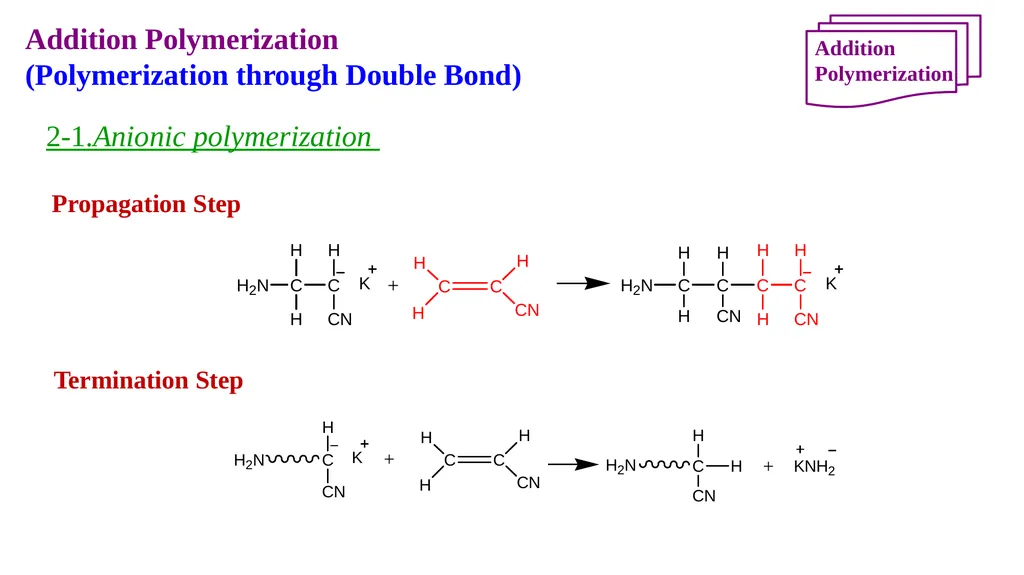
(Polymerization through Double Bond) Propagation Step Termination Step 2-1.Anionic polymerization<br>
(Polymerization through Double Bond) Propagation Step Termination Step 2-1.Anionic polymerization<br>
119
Addition Polymerization Addition Polymerization (Polymerization through Double Bond) 2-1.Anionic polymerization
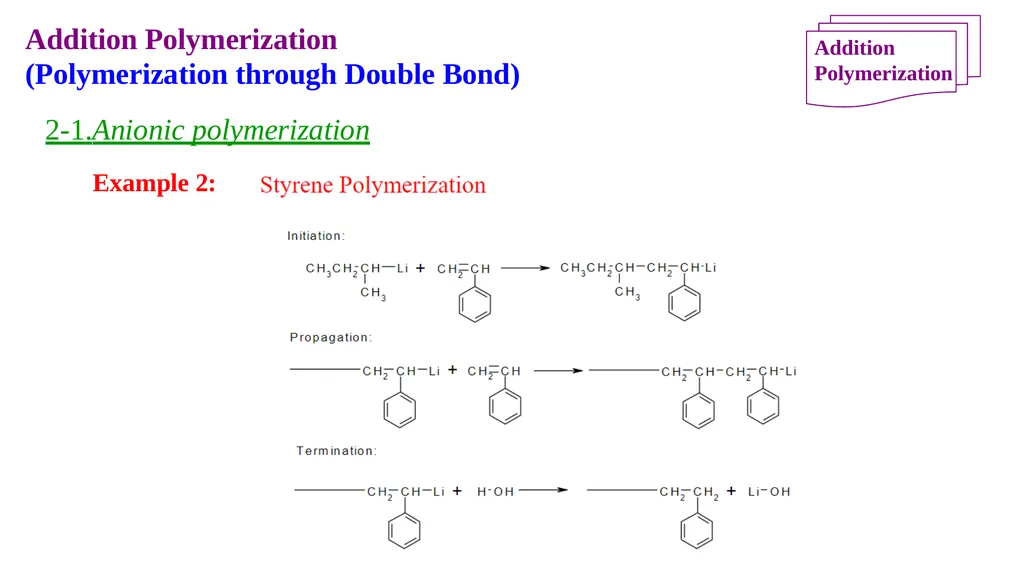
Example 2:<br>
Example 2:<br>
120
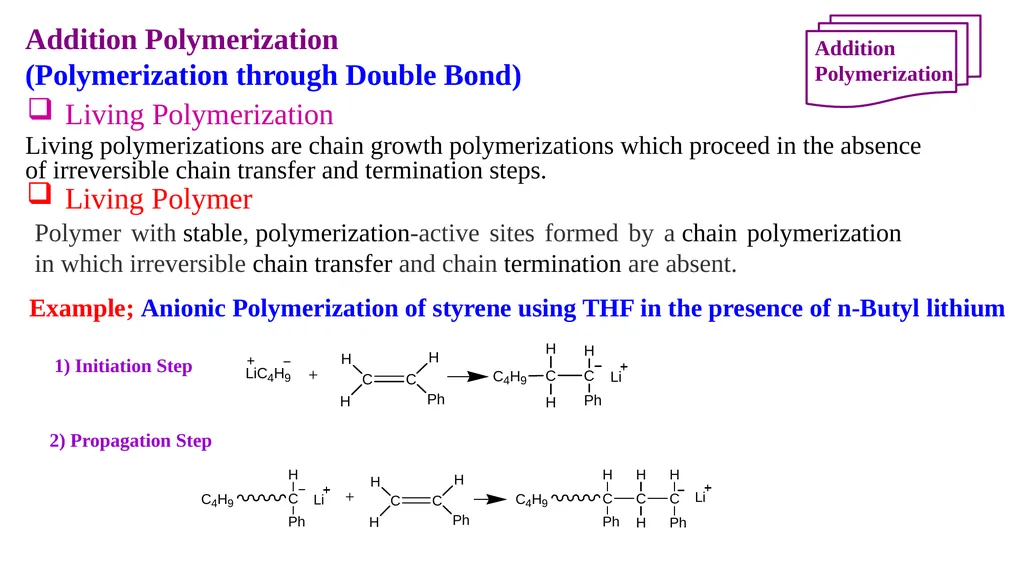
Polymer with stable, polymerization-active sites formed by a chain polymerization in which irreversible chain transfer and chain termination are absent. Living Polymer Addition Polymerization
(Polymerization through Double Bond) Living Polymerization Living polymerizations are chain growth polymerizations which proceed in the absence of irreversible chain transfer and termination steps. Example; Anionic Polymerization of styrene using THF in the presence of n-Butyl lithium 1) Initiation Step 2) Propagation Step<br>
(Polymerization through Double Bond) Living Polymerization Living polymerizations are chain growth polymerizations which proceed in the absence of irreversible chain transfer and termination steps. Example; Anionic Polymerization of styrene using THF in the presence of n-Butyl lithium 1) Initiation Step 2) Propagation Step<br>
121
Addition Polymerization Addition Polymerization (Polymerization through Double Bond) Living Polymerization
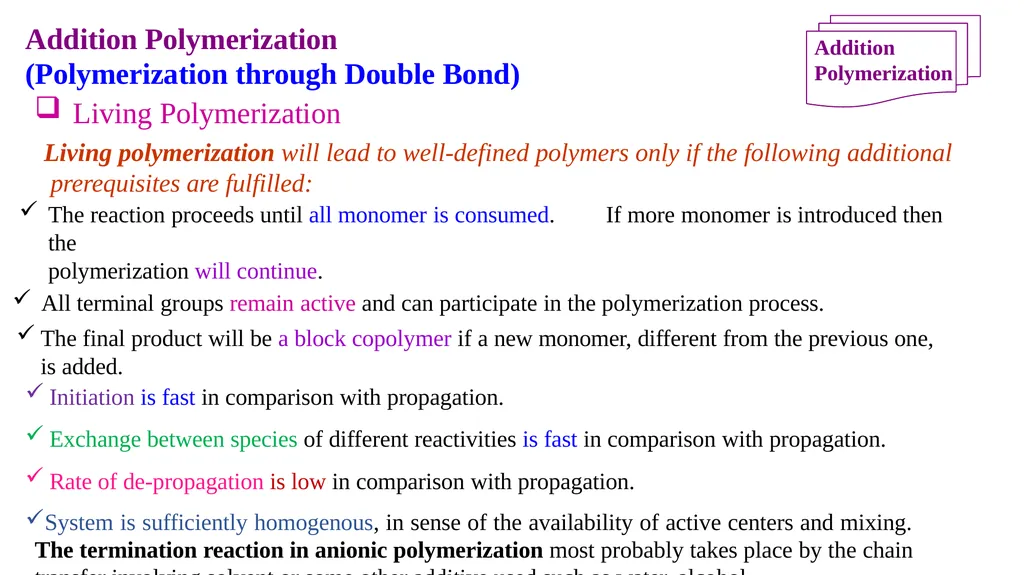
Living polymerization will lead to well-defined polymers only if the following additional prerequisites are fulfilled:
The reaction proceeds until all monomer is consumed. If more monomer is introduced then the
polymerization will continue.
All terminal groups remain active and can participate in the polymerization process.
The final product will be a block copolymer if a new monomer, different from the previous one, is added.
Initiation is fast in comparison with propagation.
Exchange between species of different reactivities is fast in comparison with propagation.
Rate of de-propagation is low in comparison with propagation.
System is sufficiently homogenous, in sense of the availability of active centers and mixing. The termination reaction in anionic polymerization most probably takes place by the chain transfer involving solvent or some other additive used such as water, alcohol.<br>
122
Addition Polymerization Addition Polymerization (Polymerization through Double Bond) 2-2.Cationic polymerization
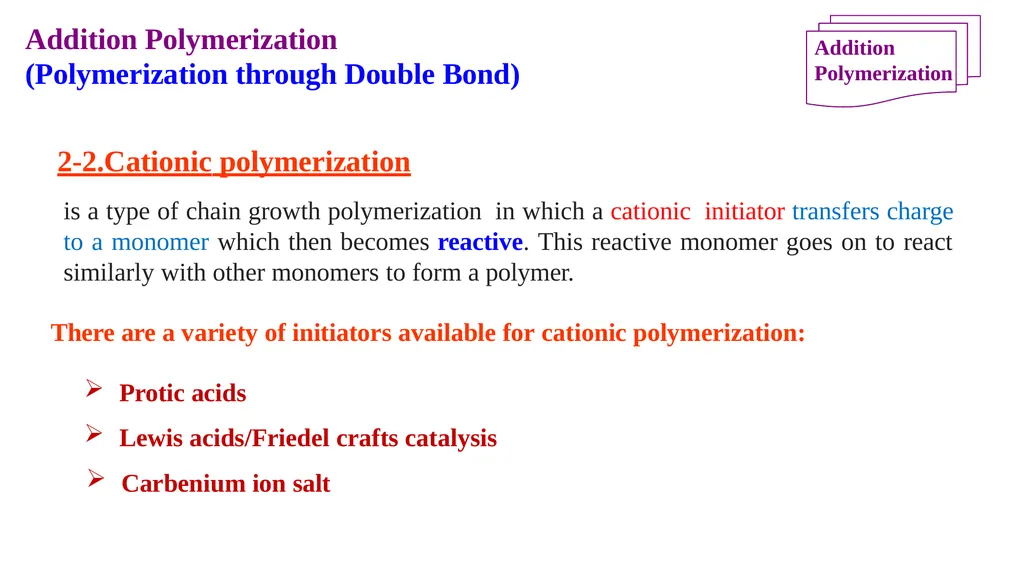
is a type of chain growth polymerization in which a cationic initiator transfers charge to a monomer which then becomes reactive. This reactive monomer goes on to react similarly with other monomers to form a polymer.
There are a variety of initiators available for cationic polymerization:
Protic acids
Lewis acids/Friedel crafts catalysis
Carbenium ion salt<br>
123
1- Protic Acids Initiator for cationic polymerization
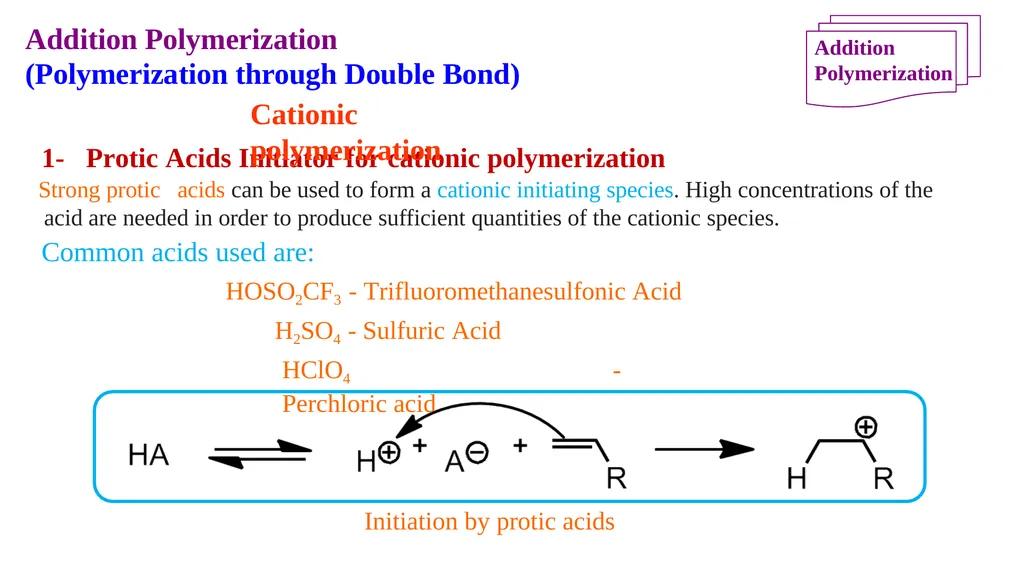
Strong protic acids can be used to form a cationic initiating species. High concentrations of the acid are needed in order to produce sufficient quantities of the cationic species.
Common acids used are:
HOSO2CF3 - Trifluoromethanesulfonic Acid H2SO4 - Sulfuric Acid
HClO4 -Perchloric acid Addition Polymerization Addition Polymerization (Polymerization through Double Bond)
Cationic polymerization Initiation by protic acids<br>
124
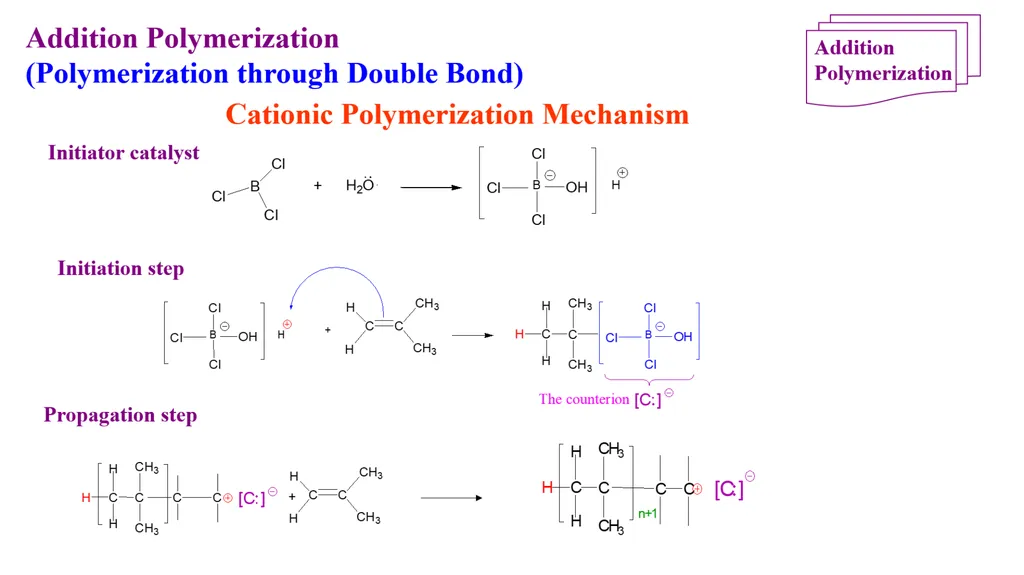
Addition Polymerization Addition Polymerization (Polymerization through Double Bond) The counterion (C-)
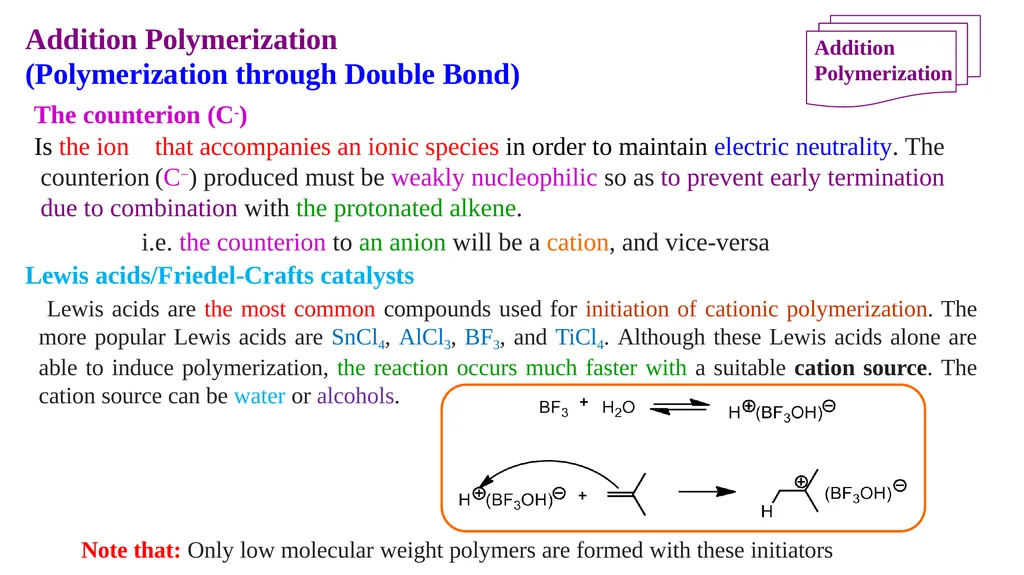
Is the ion that accompanies an ionic species in order to maintain electric neutrality. The counterion (C−) produced must be weakly nucleophilic so as to prevent early termination due to combination with the protonated alkene.
i.e. the counterion to an anion will be a cation, and vice-versa
Lewis acids/Friedel-Crafts catalysts
Lewis acids are the most common compounds used for initiation of cationic polymerization. The more popular Lewis acids are SnCl4, AlCl3, BF3, and TiCl4. Although these Lewis acids alone are able to induce polymerization, the reaction occurs much faster with a suitable cation source. The cation source can be water or alcohols. Note that: Only low molecular weight polymers are formed with these initiators<br>
125
Addition Polymerization Addition Polymerization (Polymerization through Double Bond) Cationic Polymerization Mechanism
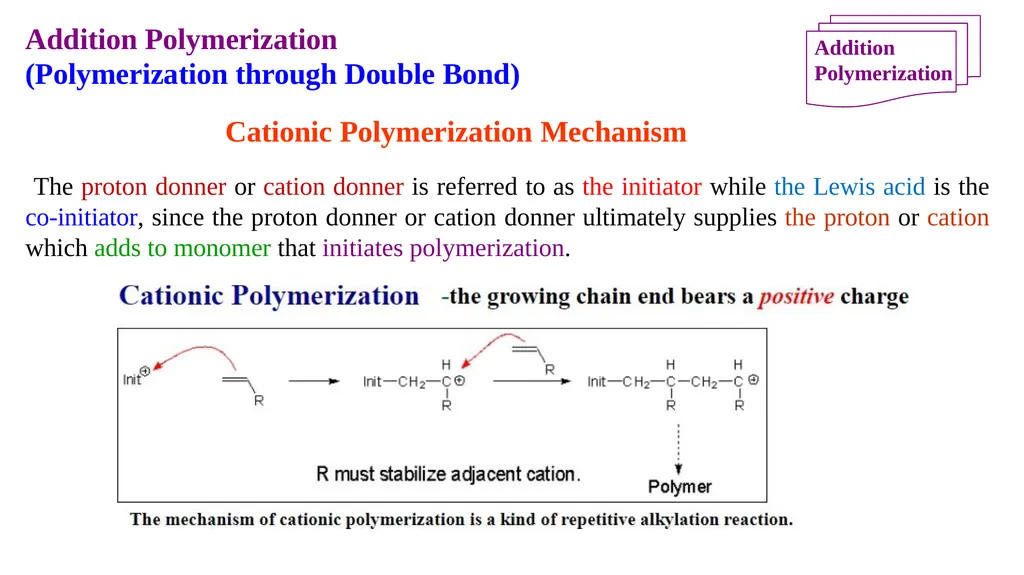
The proton donner or cation donner is referred to as the initiator while the Lewis acid is the co-initiator, since the proton donner or cation donner ultimately supplies the proton or cation which adds to monomer that initiates polymerization.<br>
The proton donner or cation donner is referred to as the initiator while the Lewis acid is the co-initiator, since the proton donner or cation donner ultimately supplies the proton or cation which adds to monomer that initiates polymerization.<br>
126
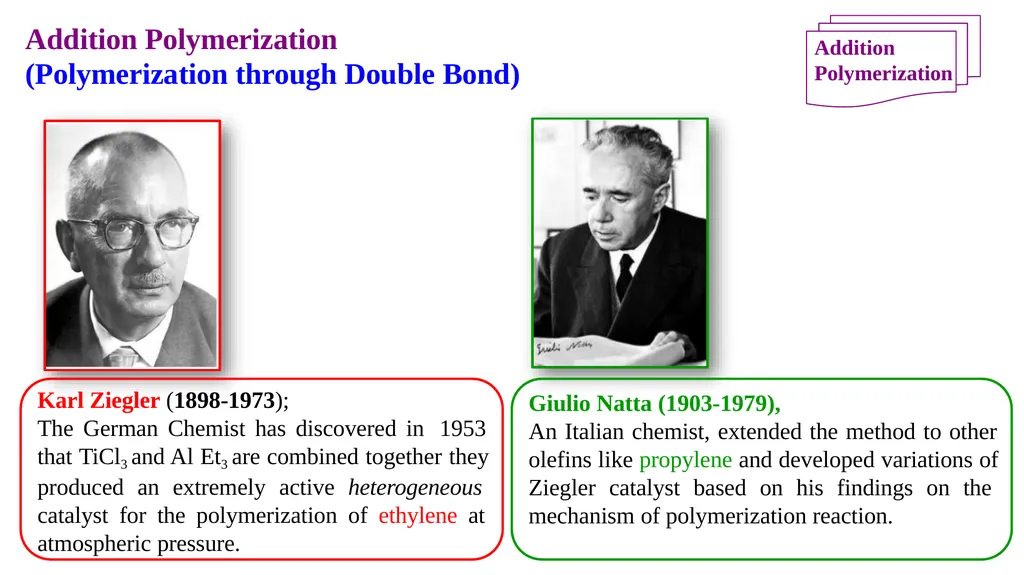
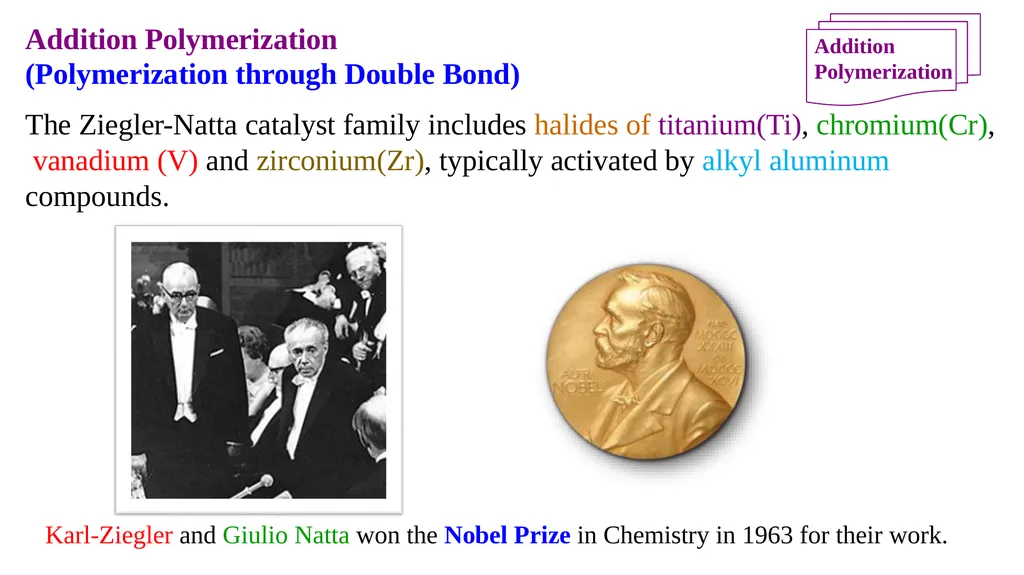
Addition Polymerization Addition Polymerization (Polymerization through Double Bond) Giulio Natta (1903-1979),
An Italian chemist, extended the method to other olefins like propylene and developed variations of Ziegler catalyst based on his findings on the mechanism of polymerization reaction. Karl Ziegler (1898-1973);
The German Chemist has discovered in 1953 that TiCl3 and Al Et3 are combined together they produced an extremely active heterogeneous catalyst for the polymerization of ethylene at atmospheric pressure.<br>
127
Addition
Polymerization Addition Polymerization (Polymerization through Double Bond) Karl-Ziegler and Giulio Natta won the Nobel Prize in Chemistry in 1963 for their work. The Ziegler-Natta catalyst family includes halides of titanium(Ti), chromium(Cr), vanadium (V) and zirconium(Zr), typically activated by alkyl aluminum compounds.<br>
Polymerization Addition Polymerization (Polymerization through Double Bond) Karl-Ziegler and Giulio Natta won the Nobel Prize in Chemistry in 1963 for their work. The Ziegler-Natta catalyst family includes halides of titanium(Ti), chromium(Cr), vanadium (V) and zirconium(Zr), typically activated by alkyl aluminum compounds.<br>
128
Coordination Polymerization Addition Polymerization
(Polymerization through Double Bond) Group III metallic compounds, such as;
AlEt3, AlEt2Cl, Al(OEt)Et2 Group IV transition metal halide, such as;
TiCl4, TiCl3, VCl4, ZrCl4, NiCl2, MnCl2 The Ziegler- Natta catalyst consists of: Co-Catalyst Catalyst<br>
(Polymerization through Double Bond) Group III metallic compounds, such as;
AlEt3, AlEt2Cl, Al(OEt)Et2 Group IV transition metal halide, such as;
TiCl4, TiCl3, VCl4, ZrCl4, NiCl2, MnCl2 The Ziegler- Natta catalyst consists of: Co-Catalyst Catalyst<br>
129
Addition Polymerization (Polymerization through Double Bond)
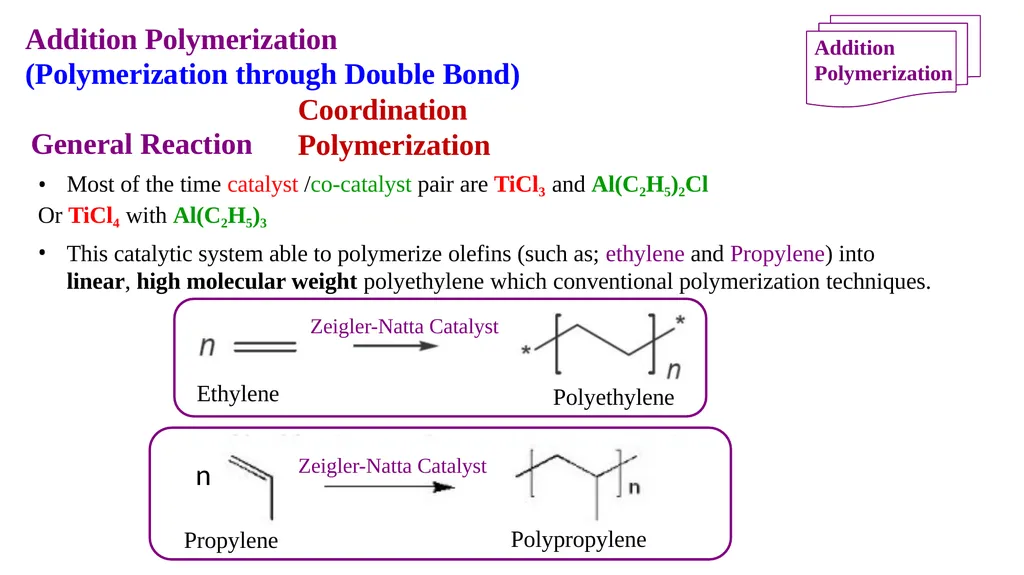
Coordination Polymerization Addition Polymerization Ethylene Polyethylene General Reaction
Most of the time catalyst /co-catalyst pair are TiCl3 and Al(C2H5)2Cl
Or TiCl4 with Al(C2H5)3
This catalytic system able to polymerize olefins (such as; ethylene and Propylene) into
linear, high molecular weight polyethylene which conventional polymerization techniques.
Zeigler-Natta Catalyst n Propylene Polypropylene Zeigler-Natta Catalyst<br>
130
Coordination Polymerization Addition Polymerization
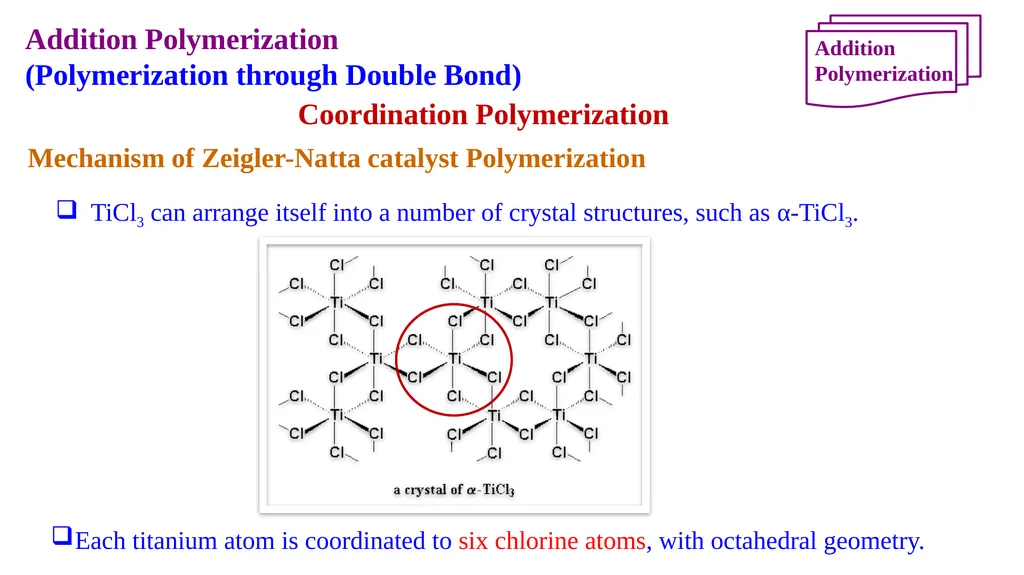
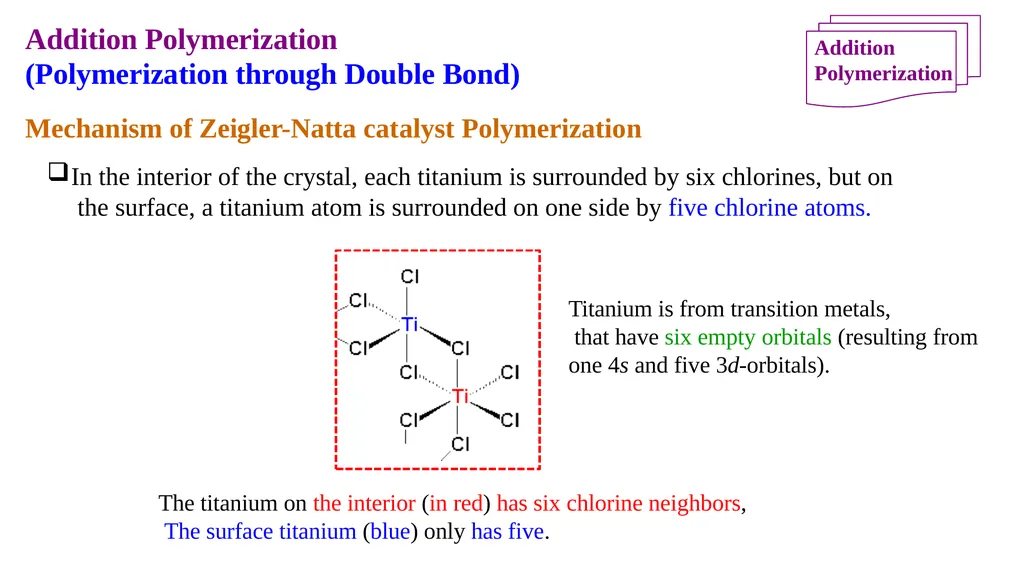
(Polymerization through Double Bond) TiCl3 can arrange itself into a number of crystal structures, such as α-TiCl3. Mechanism of Zeigler-Natta catalyst Polymerization Each titanium atom is coordinated to six chlorine atoms, with octahedral geometry.<br>
(Polymerization through Double Bond) TiCl3 can arrange itself into a number of crystal structures, such as α-TiCl3. Mechanism of Zeigler-Natta catalyst Polymerization Each titanium atom is coordinated to six chlorine atoms, with octahedral geometry.<br>
131
Addition Polymerization Addition Polymerization (Polymerization through Double Bond) Mechanism of Zeigler-Natta catalyst Polymerization
In the interior of the crystal, each titanium is surrounded by six chlorines, but on the surface, a titanium atom is surrounded on one side by five chlorine atoms. The titanium on the interior (in red) has six chlorine neighbors, The surface titanium (blue) only has five. Titanium is from transition metals,
that have six empty orbitals (resulting from
one 4s and five 3d-orbitals).<br>
132
Addition Polymerization Addition Polymerization (Polymerization through Double Bond) Mechanism of Zeigler-Natta catalyst Polymerization
1. Initiator catalyst
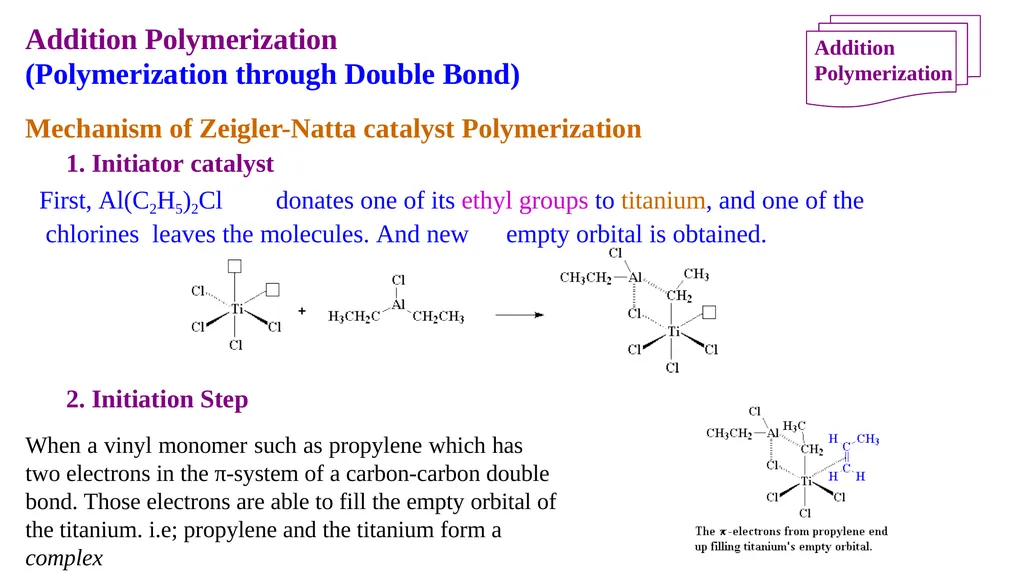
First, Al(C2H5)2Cl donates one of its ethyl groups to titanium, and one of the chlorines leaves the molecules. And new empty orbital is obtained. 2. Initiation Step
When a vinyl monomer such as propylene which has two electrons in the π-system of a carbon-carbon double bond. Those electrons are able to fill the empty orbital of
the titanium. i.e; propylene and the titanium form a complex<br>
133
Addition Polymerization Addition Polymerization (Polymerization through Double Bond) Mechanism of Zeigler-Natta catalyst Polymerization
3. Propagation Step
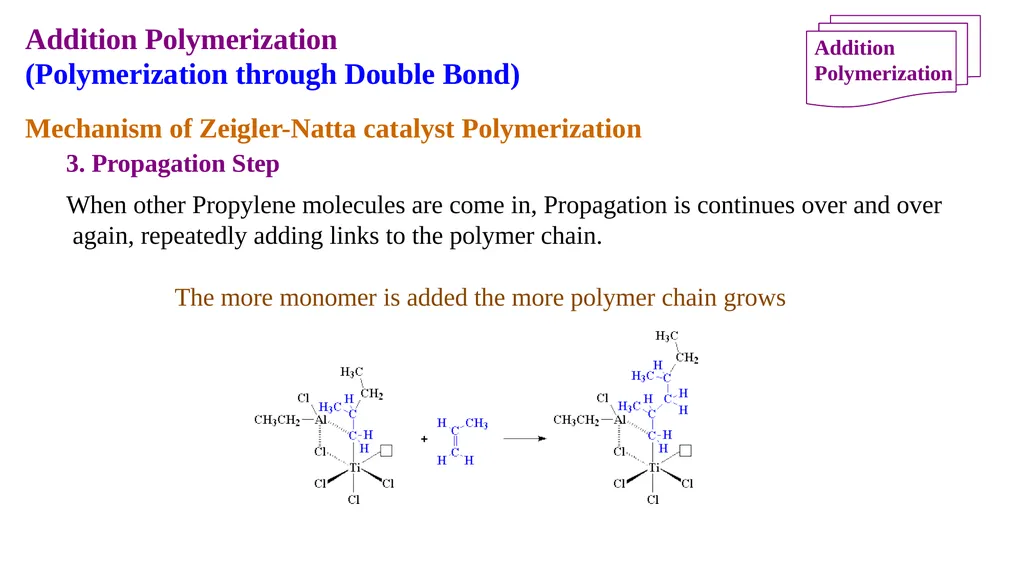
When other Propylene molecules are come in, Propagation is continues over and over again, repeatedly adding links to the polymer chain.
The more monomer is added the more polymer chain grows<br>
3. Propagation Step
When other Propylene molecules are come in, Propagation is continues over and over again, repeatedly adding links to the polymer chain.
The more monomer is added the more polymer chain grows<br>
134
Addition Polymerization Addition Polymerization (Polymerization through Double Bond) Mechanism of Zeigler-Natta catalyst Polymerization
Termination step
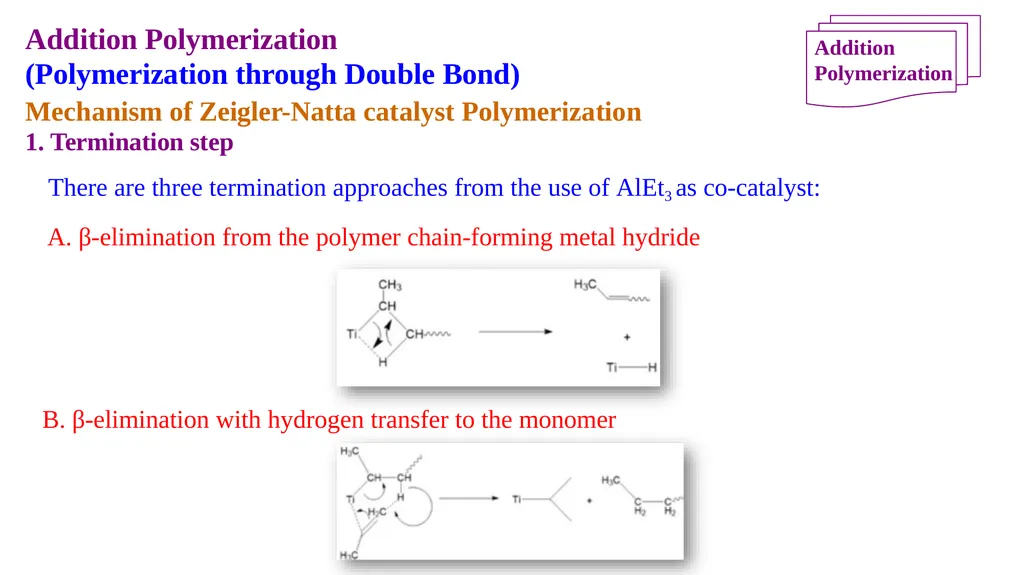
There are three termination approaches from the use of AlEt3 as co-catalyst:
A. β-elimination from the polymer chain-forming metal hydride B. β-elimination with hydrogen transfer to the monomer<br>
Termination step
There are three termination approaches from the use of AlEt3 as co-catalyst:
A. β-elimination from the polymer chain-forming metal hydride B. β-elimination with hydrogen transfer to the monomer<br>
135
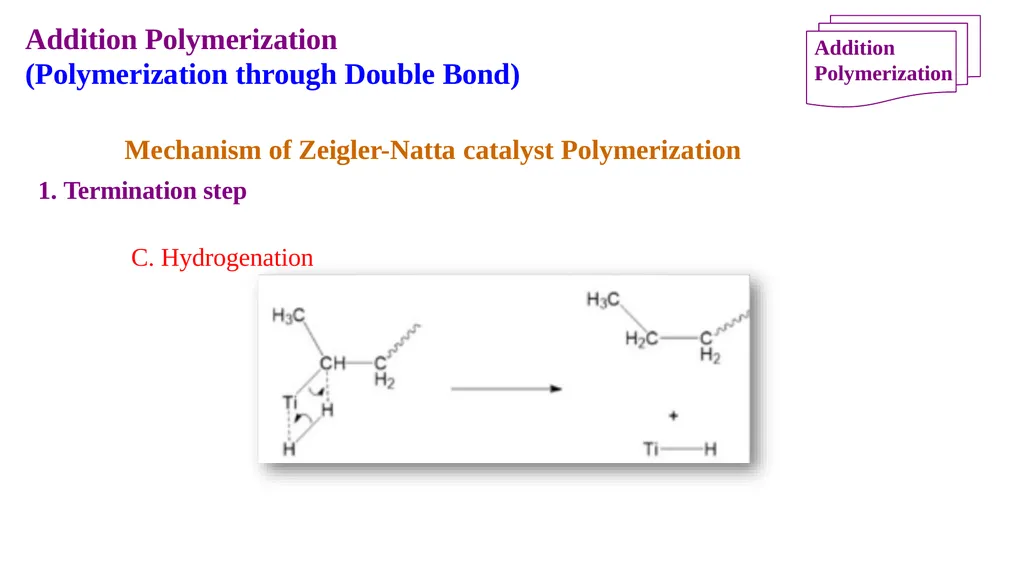
Mechanism of Zeigler-Natta catalyst Polymerization
1. Termination step
C. Hydrogenation Addition Polymerization Addition Polymerization (Polymerization through Double Bond)<br>
1. Termination step
C. Hydrogenation Addition Polymerization Addition Polymerization (Polymerization through Double Bond)<br>
136
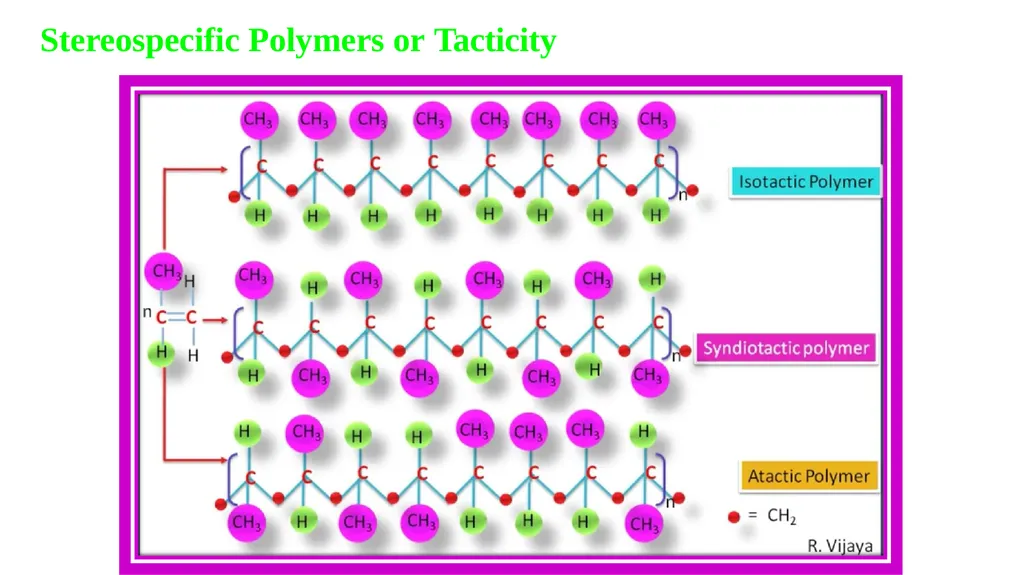
What means by Tacticity? Addition Polymerization Addition Polymerization (Polymerization through Double Bond) The term tacticity is derived from the Greek word “tacitikos”, means arrangement or order.
Is the relative stereochemistry of adjacent chiral centers within a macromolecule.
The practical significance of tacticity rests on the effects on the physical properties of the polymer .
A tactic macromolecule in the IUPAC definition is a macromolecule in which
essentially all the configurational (repeating) units are identical.<br>
137
Addition Polymerization Addition Polymerization (Polymerization through Double Bond) Stereospecific Polymers or Tacticity
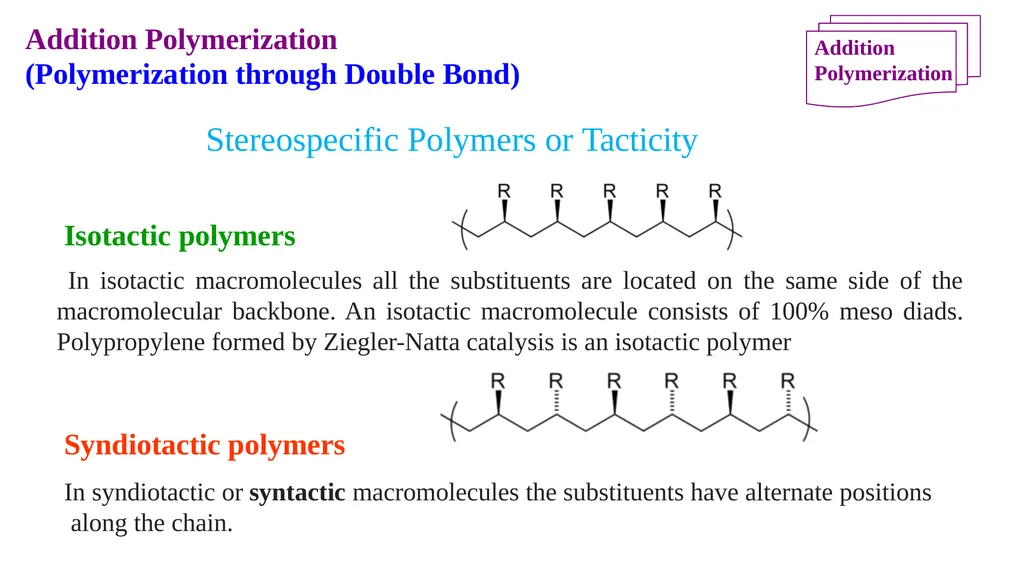
Isotactic polymers
In isotactic macromolecules all the substituents are located on the same side of the macromolecular backbone. An isotactic macromolecule consists of 100% meso diads. Polypropylene formed by Ziegler-Natta catalysis is an isotactic polymer
Syndiotactic polymers
In syndiotactic or syntactic macromolecules the substituents have alternate positions along the chain.<br>
138
Addition Polymerization Addition Polymerization (Polymerization through Double Bond) Stereospecific Polymers or Tacticity
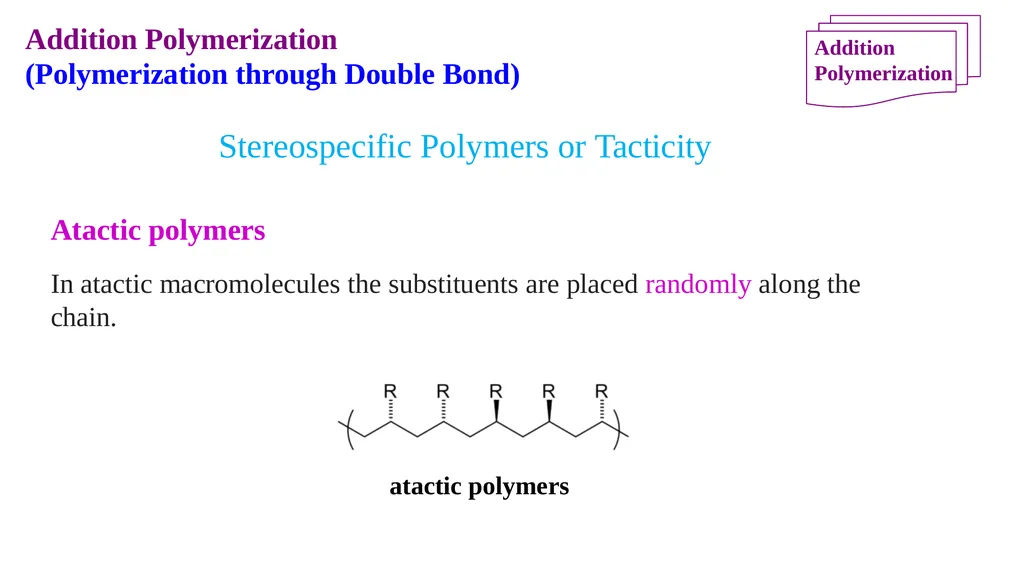
Atactic polymers
In atactic macromolecules the substituents are placed randomly along the chain. atactic polymers<br>
Atactic polymers
In atactic macromolecules the substituents are placed randomly along the chain. atactic polymers<br>
139
Stereospecific Polymers or Tacticity<br>
140
Addition Polymerization Ring-opening polymerization
Definition
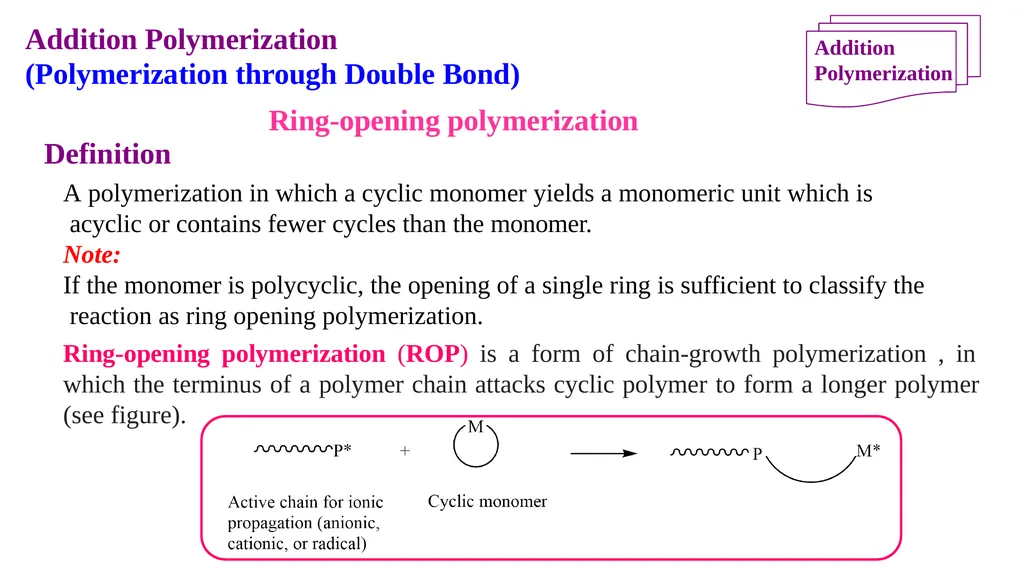
A polymerization in which a cyclic monomer yields a monomeric unit which is acyclic or contains fewer cycles than the monomer.
Note:
If the monomer is polycyclic, the opening of a single ring is sufficient to classify the reaction as ring opening polymerization.
Ring-opening polymerization (ROP) is a form of chain-growth polymerization , in which the terminus of a polymer chain attacks cyclic polymer to form a longer polymer (see figure). Addition Polymerization (Polymerization through Double Bond)<br>
141
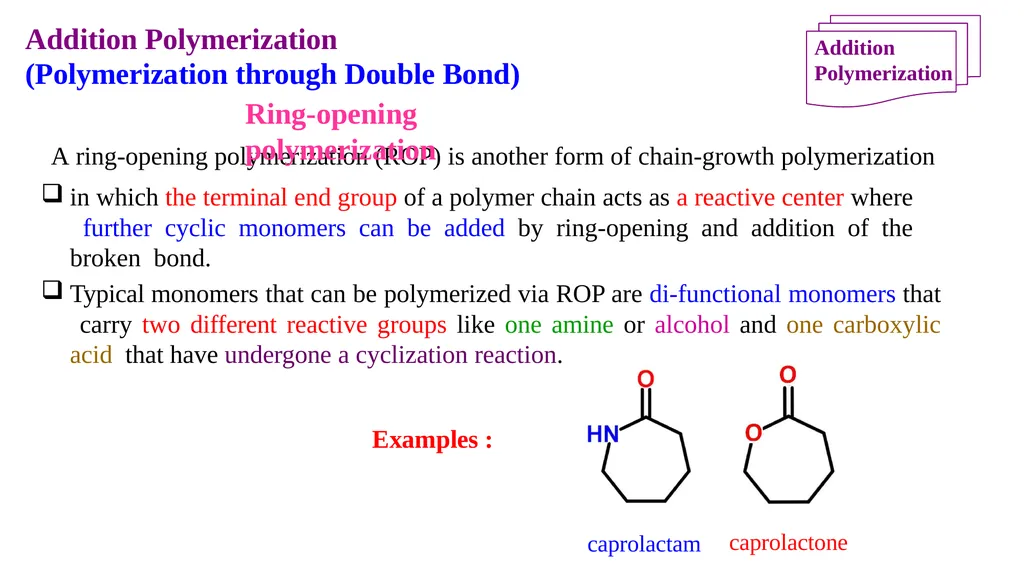
A ring-opening polymerization (ROP) is another form of chain-growth polymerization
in which the terminal end group of a polymer chain acts as a reactive center where further cyclic monomers can be added by ring-opening and addition of the broken bond.
Typical monomers that can be polymerized via ROP are di-functional monomers that carry two different reactive groups like one amine or alcohol and one carboxylic acid that have undergone a cyclization reaction.
Examples : caprolactam caprolactone Addition Polymerization (Polymerization through Double Bond)
Ring-opening polymerization Addition Polymerization<br>
142
Addition Polymerization (Polymerization through Double Bond)
Ring-opening polymerization
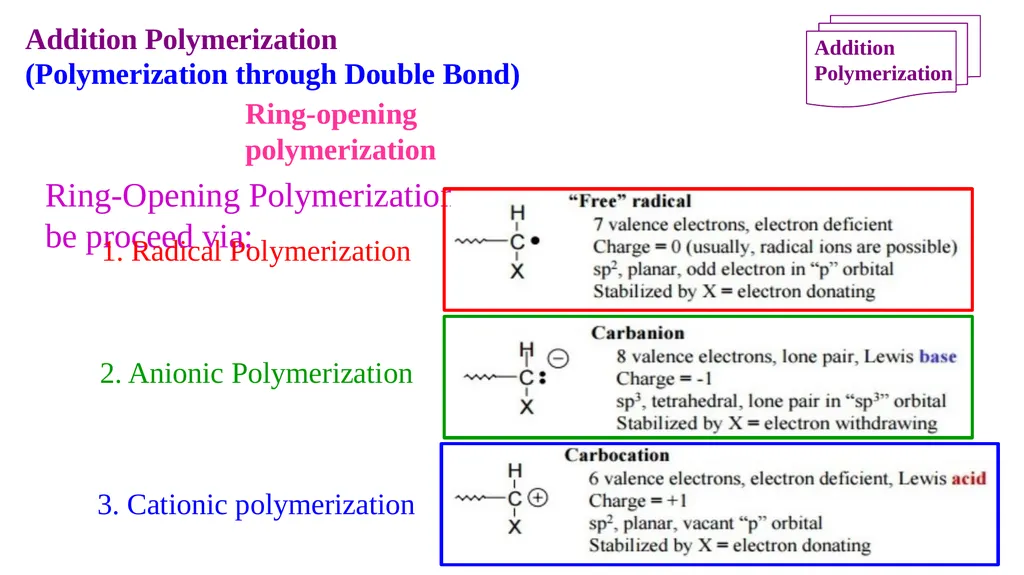
Ring-Opening Polymerization can be proceed via: Addition Polymerization 1. Radical Polymerization 2. Anionic Polymerization 3. Cationic polymerization<br>
Ring-opening polymerization
Ring-Opening Polymerization can be proceed via: Addition Polymerization 1. Radical Polymerization 2. Anionic Polymerization 3. Cationic polymerization<br>
143
Addition Polymerization Addition Polymerization (Polymerization through Double Bond) Cyclic Disulfide Ring-opening polymerization
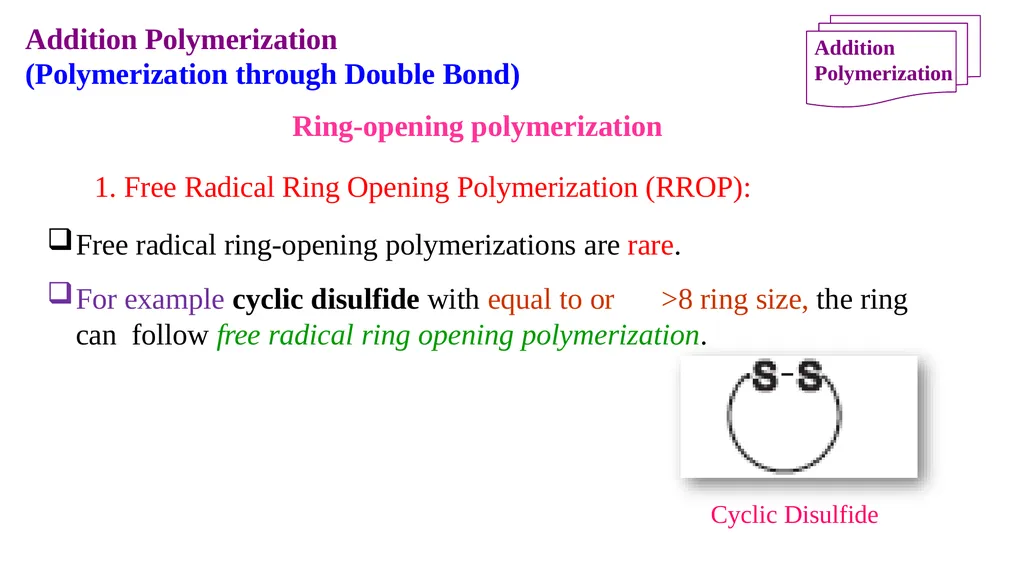
1. Free Radical Ring Opening Polymerization (RROP):
Free radical ring-opening polymerizations are rare.
For example cyclic disulfide with equal to or >8 ring size, the ring can follow free radical ring opening polymerization.<br>
1. Free Radical Ring Opening Polymerization (RROP):
Free radical ring-opening polymerizations are rare.
For example cyclic disulfide with equal to or >8 ring size, the ring can follow free radical ring opening polymerization.<br>
144
Addition Polymerization (Polymerization through Double Bond)
Ring-opening polymerization Addition Polymerization 2. Anionic Ring Opening Polymerization (AROP):
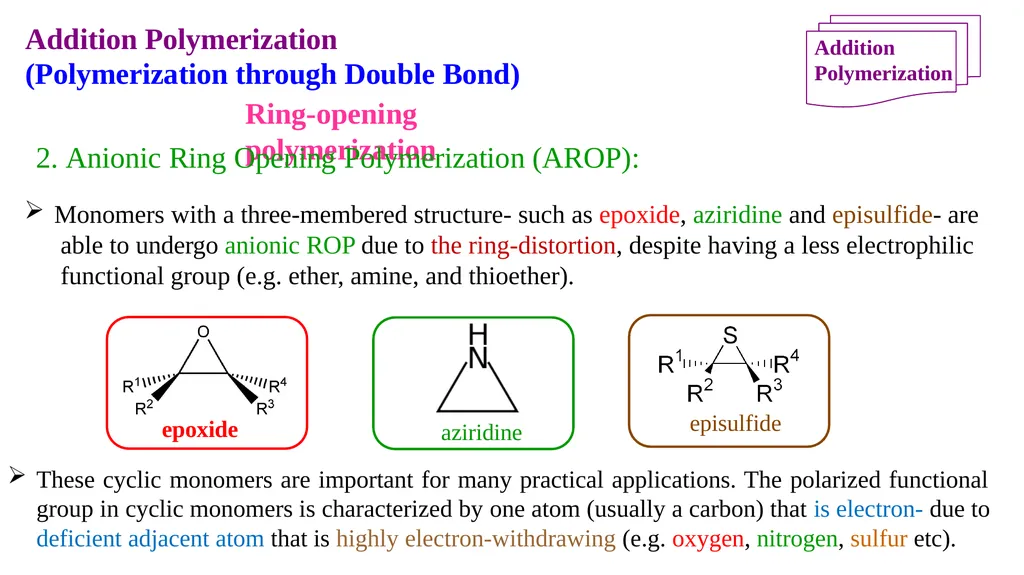
Monomers with a three-membered structure- such as epoxide, aziridine and episulfide- are able to undergo anionic ROP due to the ring-distortion, despite having a less electrophilic functional group (e.g. ether, amine, and thioether). These cyclic monomers are important for many practical applications. The polarized functional group in cyclic monomers is characterized by one atom (usually a carbon) that is electron- due to deficient adjacent atom that is highly electron-withdrawing (e.g. oxygen, nitrogen, sulfur etc). episulfide aziridine epoxide<br>
145
Addition Polymerization (Polymerization through Double Bond)
Ring-opening polymerization Addition Polymerization 2. Anionic Ring Opening Polymerization (AROP):
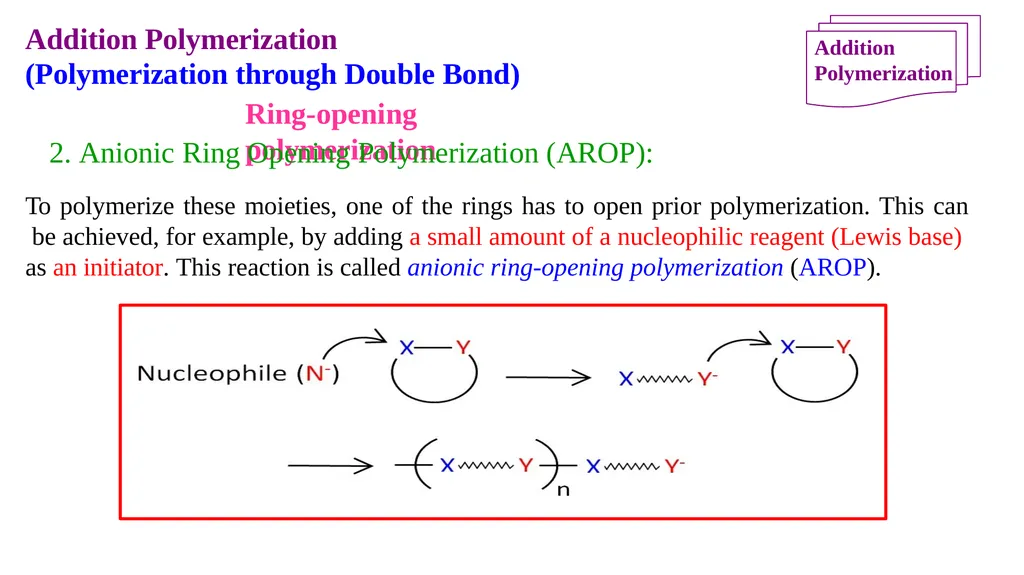
To polymerize these moieties, one of the rings has to open prior polymerization. This can be achieved, for example, by adding a small amount of a nucleophilic reagent (Lewis base) as an initiator. This reaction is called anionic ring-opening polymerization (AROP).<br>
146
Addition Polymerization Addition Polymerization (Polymerization through Double Bond) Cationic Ring-opening polymerization
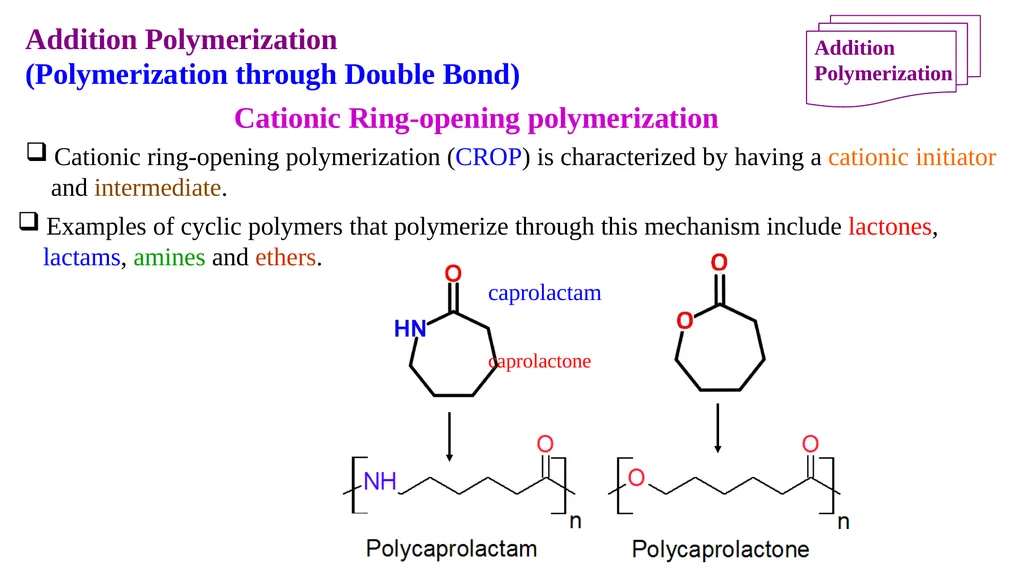
Cationic ring-opening polymerization (CROP) is characterized by having a cationic initiator
and intermediate.
Examples of cyclic polymers that polymerize through this mechanism include lactones,
lactams, amines and ethers.
caprolactam caprolactone<br>
Cationic ring-opening polymerization (CROP) is characterized by having a cationic initiator
and intermediate.
Examples of cyclic polymers that polymerize through this mechanism include lactones,
lactams, amines and ethers.
caprolactam caprolactone<br>
147
Addition Polymerization (Polymerization through Double Bond)
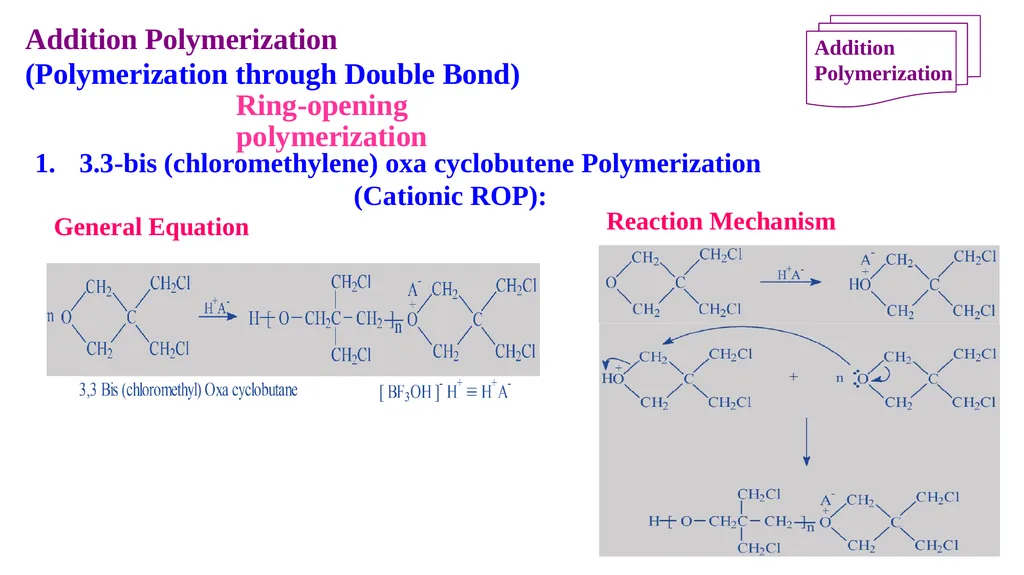
Ring-opening polymerization Addition Polymerization 1. 3.3-bis (chloromethylene) oxa cyclobutene Polymerization
(Cationic ROP): General Equation Reaction Mechanism<br>
Ring-opening polymerization Addition Polymerization 1. 3.3-bis (chloromethylene) oxa cyclobutene Polymerization
(Cationic ROP): General Equation Reaction Mechanism<br>
148
Ring-opening polymerization Addition Polymerization
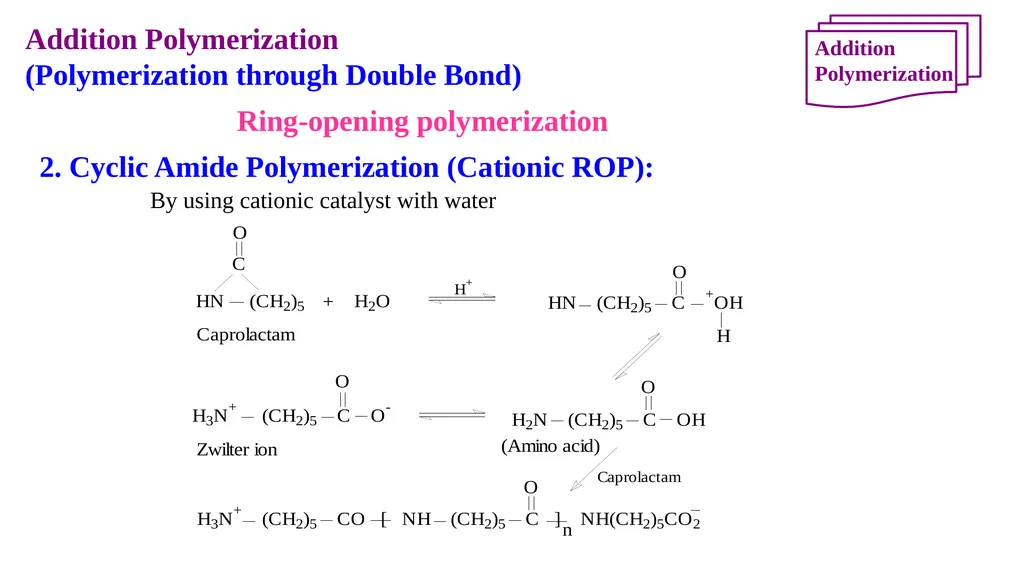
(Polymerization through Double Bond) 2. Cyclic Amide Polymerization (Cationic ROP): By using cationic catalyst with water<br>
(Polymerization through Double Bond) 2. Cyclic Amide Polymerization (Cationic ROP): By using cationic catalyst with water<br>
149
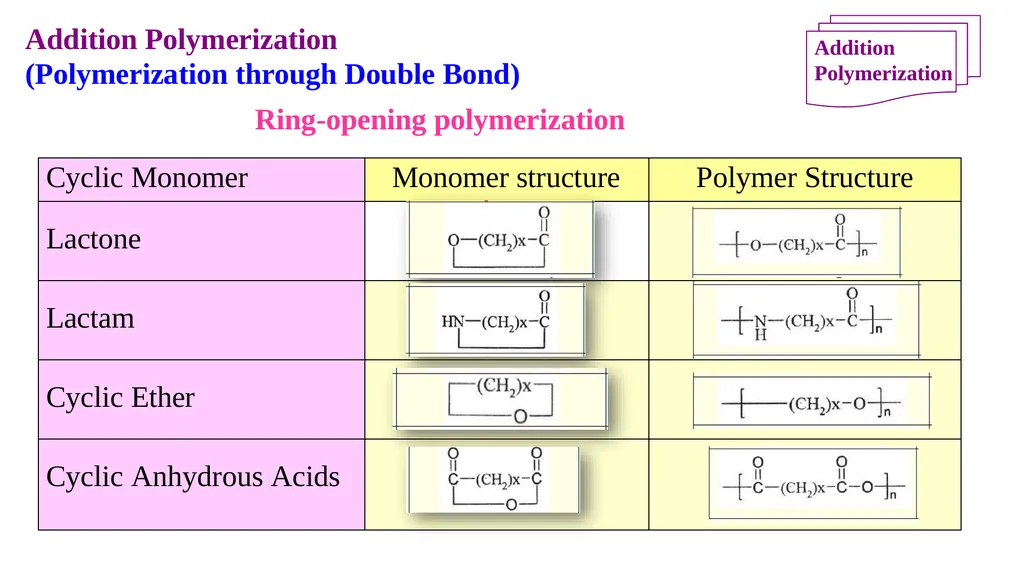
Ring-opening polymerization Addition Polymerization Addition Polymerization (Polymerization through Double Bond)<br>
150
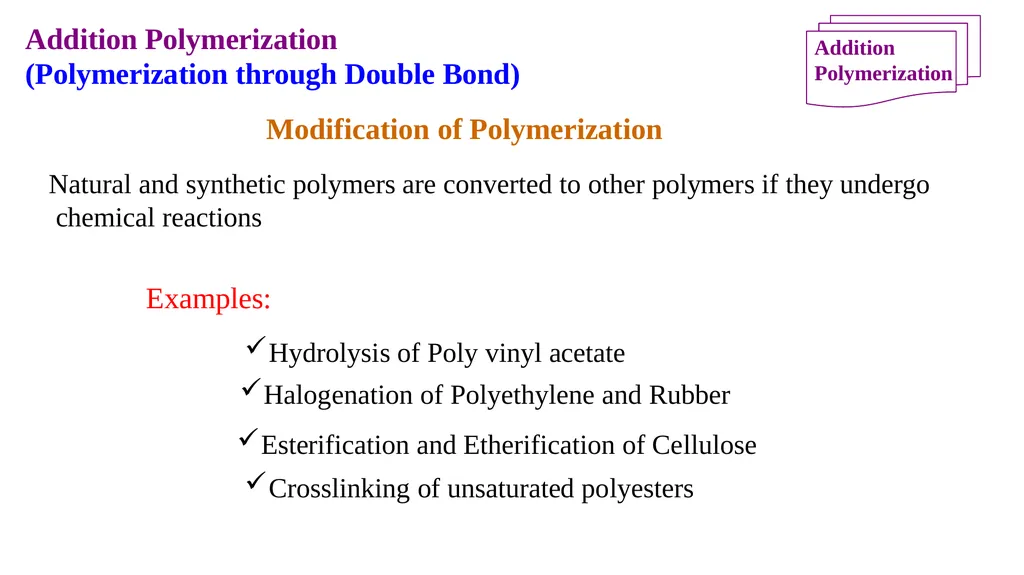
Modification of Polymerization
Natural and synthetic polymers are converted to other polymers if they undergo chemical reactions
Examples:
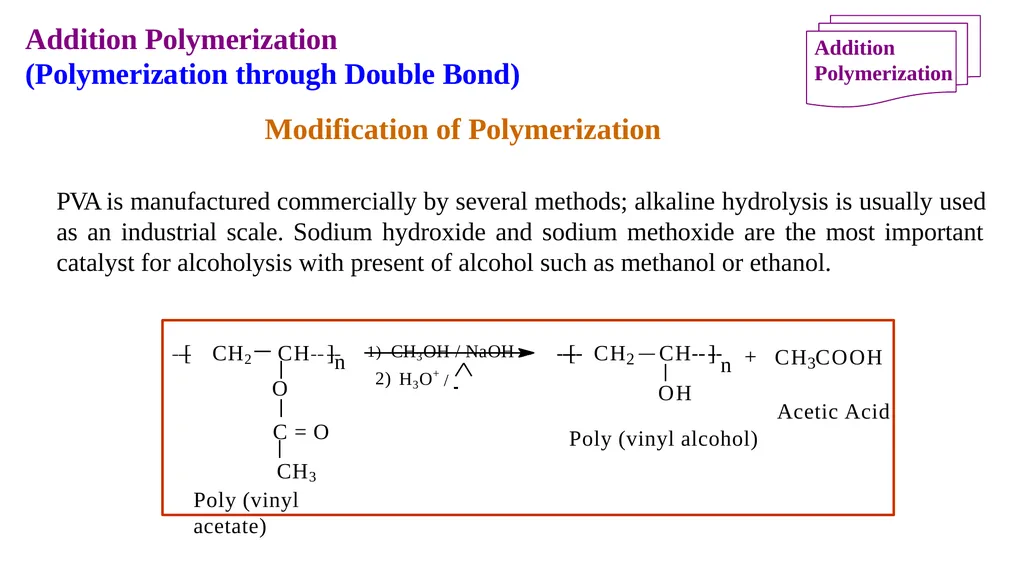
Hydrolysis of Poly vinyl acetate
Halogenation of Polyethylene and Rubber
Esterification and Etherification of Cellulose
Crosslinking of unsaturated polyesters Addition Polymerization Addition Polymerization (Polymerization through Double Bond)<br>
151
[ CH2 CH ] n n [ CH 2 CH ] OH 3 CH COOH 1) CH3OH / NaOH 2) + O
C = O CH3
Poly (vinyl acetate) Poly (vinyl alcohol) Acetic Acid H3O+ / Modification of Polymerization
PVA is manufactured commercially by several methods; alkaline hydrolysis is usually used as an industrial scale. Sodium hydroxide and sodium methoxide are the most important catalyst for alcoholysis with present of alcohol such as methanol or ethanol. Addition Polymerization Addition Polymerization (Polymerization through Double Bond)<br>
152
Poly (Vinyl alcohol) R = H or CH2CH2CH3 RCHO H2O CH R
Polyvinyl acetal OH O [ CH2CH
O CH2CHCH2CH ]m [ CH2 CH CH2CHCH2 CH ]m OH OH OH Modification of Polymerization
Poly (vinyl acetal) is formed when poly (vinyl acetal) interacts with aldehydes in aqueous medium and in the presence of acid as a catalyst as follows: Addition Polymerization Addition Polymerization (Polymerization through Double Bond)<br>