
CHAPTER 21 Wildland and Ground Cover Fires
CS
Published · 75 slides · 0 views

1 / 1





Description
CHAPTER 21 Wildland and Ground Cover Fires Knowledge Objectives Define the terms wildland fires and ground cover fires. Explain how the three elements of the wildland fire triangle affect each side of the fire triangle. Describe subsurface
Related Topics
Share
Embed code
Download this presentation From Below
"CHAPTER 21 Wildland and Ground Cover Fires" is the property of its rightful owner. Permission is granted to download and print the materials on this website for personal, non-commercial use only, and to display it on your personal computer provided you do not modify the materials and that you retain all copyright notices contained in the materials. By downloading content from our website, you accept the terms of this agreement.
Presentation Transcript
01
CHAPTER 21 Wildland and Ground Cover Fires<br>
02
Knowledge Objectives Define the terms wildland fires and ground cover fires.
Explain how the three elements of the wildland fire triangle affect each side of the fire triangle.
Describe subsurface fuels, surface fuels, and aerial fuels.
Explain the relationship between a fuel’s properties and the speed at which the fuel ignites and the ensuing fire spreads.<br>
Explain how the three elements of the wildland fire triangle affect each side of the fire triangle.
Describe subsurface fuels, surface fuels, and aerial fuels.
Explain the relationship between a fuel’s properties and the speed at which the fuel ignites and the ensuing fire spreads.<br>
03
Knowledge Objectives Describe how weather conditions and topography influence the growth of wildland fires.
Label the parts of a wildland fire.
Describe the methods and tools used to cool a fuel with water.
Describe the methods and tools used to remove a fuel from wildland fires.<br>
Label the parts of a wildland fire.
Describe the methods and tools used to cool a fuel with water.
Describe the methods and tools used to remove a fuel from wildland fires.<br>
04
Knowledge Objectives Describe the methods and tools used to smother wildland fires.
Itemize the characteristics of the fire apparatus used to suppress wildland fires.
Describe how a direct attack is mounted on wildland fires.
Describe how an indirect attack is mounted on wildland fires.<br>
Itemize the characteristics of the fire apparatus used to suppress wildland fires.
Describe how a direct attack is mounted on wildland fires.
Describe how an indirect attack is mounted on wildland fires.<br>
05
Knowledge Objectives Describe how a parallel attack is mounted on wildland fires.
Describe how the 10 standard firefighting orders can be used to prevent future fire fighter tragedies.
Describe how the 18 watch-out situations can be used to determine if an assignment is safe.
Describe the parts of the LCES (Lookouts, Communications, Escape Routes, and Safety Zones) mnemonic.<br>
Describe how the 10 standard firefighting orders can be used to prevent future fire fighter tragedies.
Describe how the 18 watch-out situations can be used to determine if an assignment is safe.
Describe the parts of the LCES (Lookouts, Communications, Escape Routes, and Safety Zones) mnemonic.<br>
06
Knowledge Objectives Describe the hazards associated with wildland and ground cover firefighting.
Describe the personal protective clothing and equipment needed for wildland firefighting.
Explain the problems created by the wildland/urban interface.<br>
Describe the personal protective clothing and equipment needed for wildland firefighting.
Explain the problems created by the wildland/urban interface.<br>
07
Skills Objectives Suppress a ground cover fire.
Deploy a fire shelter.<br>
Deploy a fire shelter.<br>
08
Introduction Wildland is land in an uncultivated, natural state.
Most fire departments are responsible for at least some wildland areas.
Defined by NFPA:
Unplanned and uncontrolled fires burning in vegetative fuel that sometimes includes structures
Some fire departments respond more often to wildland fires than structural ones.<br>
Most fire departments are responsible for at least some wildland areas.
Defined by NFPA:
Unplanned and uncontrolled fires burning in vegetative fuel that sometimes includes structures
Some fire departments respond more often to wildland fires than structural ones.<br>
09
Introduction Wildland/urban interface refers to where wildland meets human-made structures.
The incidence of these fires varies from season to season and from one year to the next.
The threat and intensity of wildland fires are closely tied to the moisture content of the vegetative fuels, the weather conditions, and topography.
Many calls involve small incidents, but some escalate into major incidents.<br>
The incidence of these fires varies from season to season and from one year to the next.
The threat and intensity of wildland fires are closely tied to the moisture content of the vegetative fuels, the weather conditions, and topography.
Many calls involve small incidents, but some escalate into major incidents.<br>
10
Introduction Wildland fires are sometimes referred to by different terms, including brush fires, forest fires, grass fires, ground cover fires, ground fires, natural cover fires, and wildfires.
All are properly classified as wildland fires.
Ground cover fires burn loose debris on the surface of the ground.
Vegetation such as grass, dead leaves, needles, and branches that have fallen from shrubs and trees.<br>
All are properly classified as wildland fires.
Ground cover fires burn loose debris on the surface of the ground.
Vegetation such as grass, dead leaves, needles, and branches that have fallen from shrubs and trees.<br>
11
Introduction Many structural fire fighters are called on to extinguish wildland/ground cover fires.
Fire fighters whose primary responsibility is suppressing wildland fires need to complete separate, comprehensive wildland training.
Each state has an agency designated to coordinate wildland firefighting.
Federal government agencies are also responsible for coordinating firefighting activities at large incidents.<br>
Fire fighters whose primary responsibility is suppressing wildland fires need to complete separate, comprehensive wildland training.
Each state has an agency designated to coordinate wildland firefighting.
Federal government agencies are also responsible for coordinating firefighting activities at large incidents.<br>
12
Wildland and Ground Fires and the Fire Triangle Wildland and ground fires require the same three elements as structural fires.
Conditions under which elements come together to produce a fire are different. © Jones & Bartlett Learning<br>
Conditions under which elements come together to produce a fire are different. © Jones & Bartlett Learning<br>
13
Fuel Primary fuel is area vegetation.
Some fuels ignite readily and burn rapidly when dry.
Vegetative fuels can be located:
Subsurface fuels
Surface fuels (slash)
Aerial fuels<br>
Some fuels ignite readily and burn rapidly when dry.
Vegetative fuels can be located:
Subsurface fuels
Surface fuels (slash)
Aerial fuels<br>
14
Other Fuel Characteristics Size and shape
Compactness
Continuity
Volume
Moisture level
Orientation<br>
Compactness
Continuity
Volume
Moisture level
Orientation<br>
15
Fine Fuels Have a large surface area relative to their volume, which causes them to ignite easily, burn quickly, and produce a lot of heat
Includes dried vegetation, such as twigs, leaves, needles, grass, moss, and light brush
Usually the main type of fuel present in ground cover fires
Aid the ignition of heavier fuels and cause fire to burn and spread with great intensity<br>
Includes dried vegetation, such as twigs, leaves, needles, grass, moss, and light brush
Usually the main type of fuel present in ground cover fires
Aid the ignition of heavier fuels and cause fire to burn and spread with great intensity<br>
16
Heavy Fuels Larger diameter than fine fuels
Includes large brush, heavy timber, stumps, branches, dead timber, and slash
Do not spread a fire as rapidly as fine fuels
Can burn with a high intensity<br>
Includes large brush, heavy timber, stumps, branches, dead timber, and slash
Do not spread a fire as rapidly as fine fuels
Can burn with a high intensity<br>
17
Other Fuel Characteristics Fuel compactness
Oxygen and heat cannot get to large surfaces in a short period.
Fuel continuity
Fuels touch each other.
Allows fire to spread from one area to the next.<br>
Oxygen and heat cannot get to large surfaces in a short period.
Fuel continuity
Fuels touch each other.
Allows fire to spread from one area to the next.<br>
18
Other Fuel Characteristics Fuel volume
Quantity of fuel available in an area
Influences growth and intensity of fire
Fuel moisture
High moisture will not ignite and burn as readily as low moisture.
Fuel orientation
Vertical position will catch fire and burn more readily.<br>
Quantity of fuel available in an area
Influences growth and intensity of fire
Fuel moisture
High moisture will not ignite and burn as readily as low moisture.
Fuel orientation
Vertical position will catch fire and burn more readily.<br>
19
Oxygen Not an important variable in the ignition or spread of wildland and ground fires.
Air movement influences the speed with which a fire moves.
Wind blowing on a wildland and ground fire brings more oxygen to the fire, speeds the process of combustion, and influences the direction the fire travels.<br>
Air movement influences the speed with which a fire moves.
Wind blowing on a wildland and ground fire brings more oxygen to the fire, speeds the process of combustion, and influences the direction the fire travels.<br>
20
Heat Sufficient heat must be applied to fuel in the presence of adequate oxygen to produce a fire.
Three categories of factors
Natural causes
Accidental causes
Intentional causes<br>
Three categories of factors
Natural causes
Accidental causes
Intentional causes<br>
21
Weather: Moisture Relative humidity
Ratio of the amount of water vapor present in the air compared with the maximum amount the air can hold at a given temperature
When low, vegetative fuels are more susceptible to ignition.
Varies with time of day and time of year<br>
Ratio of the amount of water vapor present in the air compared with the maximum amount the air can hold at a given temperature
When low, vegetative fuels are more susceptible to ignition.
Varies with time of day and time of year<br>
22
Weather: Moisture Precipitation
Helps increase the relative humidity
Absorbed by plants
When there is adequate precipitation, fire risk is lower.<br>
Helps increase the relative humidity
Absorbed by plants
When there is adequate precipitation, fire risk is lower.<br>
23
Wind Pushes the fire so that it comes in contact with additional fuels
Has ability to move a fire at great speed
Effect is similar to fanning a fire to help it burn more rapidly<br>
Has ability to move a fire at great speed
Effect is similar to fanning a fire to help it burn more rapidly<br>
24
Topography Changes of elevation in the land and the position of natural and manmade features
On flat land, heat rises into the air.
Preheats the fuels above the main body of the fire
Other features:
Natural barriers
Human-made barriers<br>
On flat land, heat rises into the air.
Preheats the fuels above the main body of the fire
Other features:
Natural barriers
Human-made barriers<br>
25
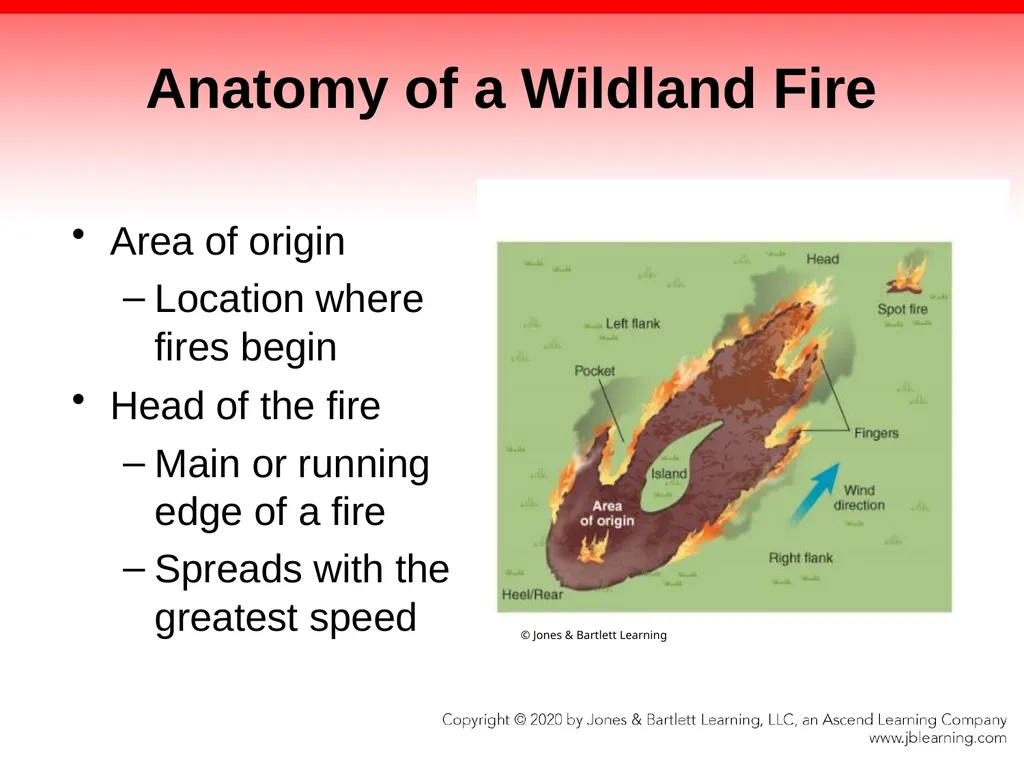
Anatomy of a Wildland Fire Area of origin
Location where fires begin
Head of the fire
Main or running edge of a fire
Spreads with the greatest speed © Jones & Bartlett Learning<br>
Location where fires begin
Head of the fire
Main or running edge of a fire
Spreads with the greatest speed © Jones & Bartlett Learning<br>
26
Anatomy of a Wildland Fire Heel or rear of the fire
Opposite the head, close to area of origin
Flank of the fire
Edge between the head and heel that runs parallel to the direction of fire spread
Finger
Narrow point of fire caused by a shift in wind or a change in topography
Can grow and produce a secondary direction of travel for the fire<br>
Opposite the head, close to area of origin
Flank of the fire
Edge between the head and heel that runs parallel to the direction of fire spread
Finger
Narrow point of fire caused by a shift in wind or a change in topography
Can grow and produce a secondary direction of travel for the fire<br>
27
Anatomy of a Wildland Fire Pocket
Unburned fuel surrounded by fire
Island
Unburned area surrounded by fire
Spot fire
New fire that starts outside the main fire<br>
Unburned fuel surrounded by fire
Island
Unburned area surrounded by fire
Spot fire
New fire that starts outside the main fire<br>
28
Anatomy of a Wildland Fire Green
Area of unburned fuels
Black
Areas that have already been burned
Often safer for fire fighters<br>
Area of unburned fuels
Black
Areas that have already been burned
Often safer for fire fighters<br>
29
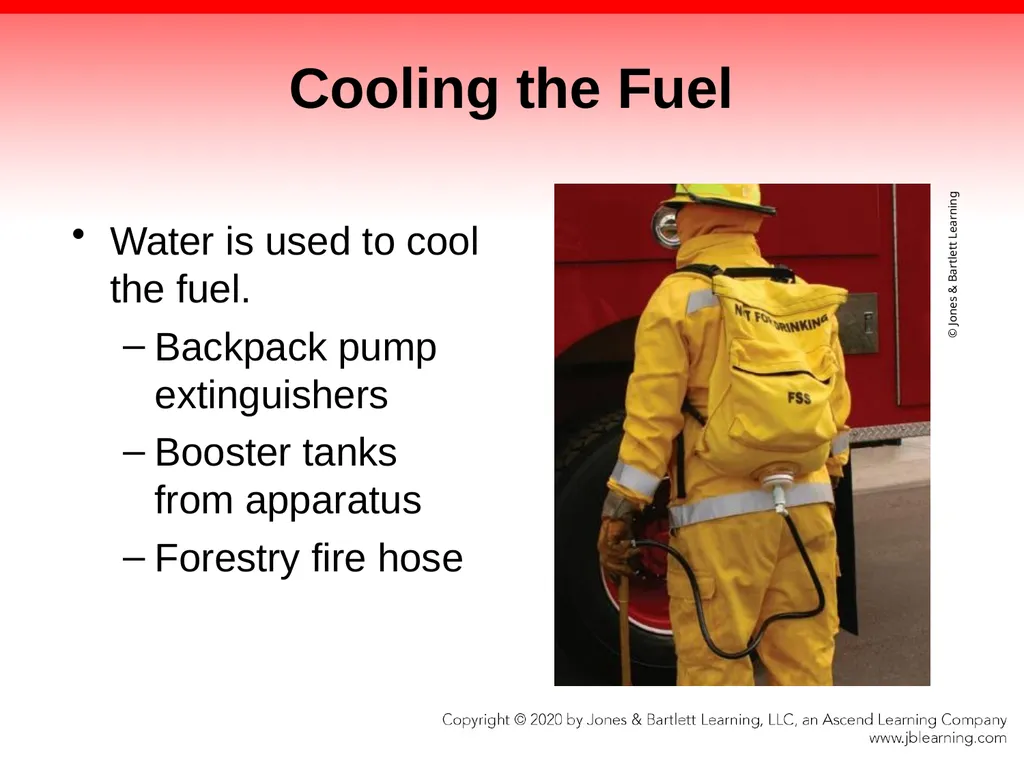
Cooling the Fuel Water is used to cool the fuel.
Backpack pump extinguishers
Booster tanks from apparatus
Forestry fire hose © Jones & Bartlett Learning<br>
Backpack pump extinguishers
Booster tanks from apparatus
Forestry fire hose © Jones & Bartlett Learning<br>
30
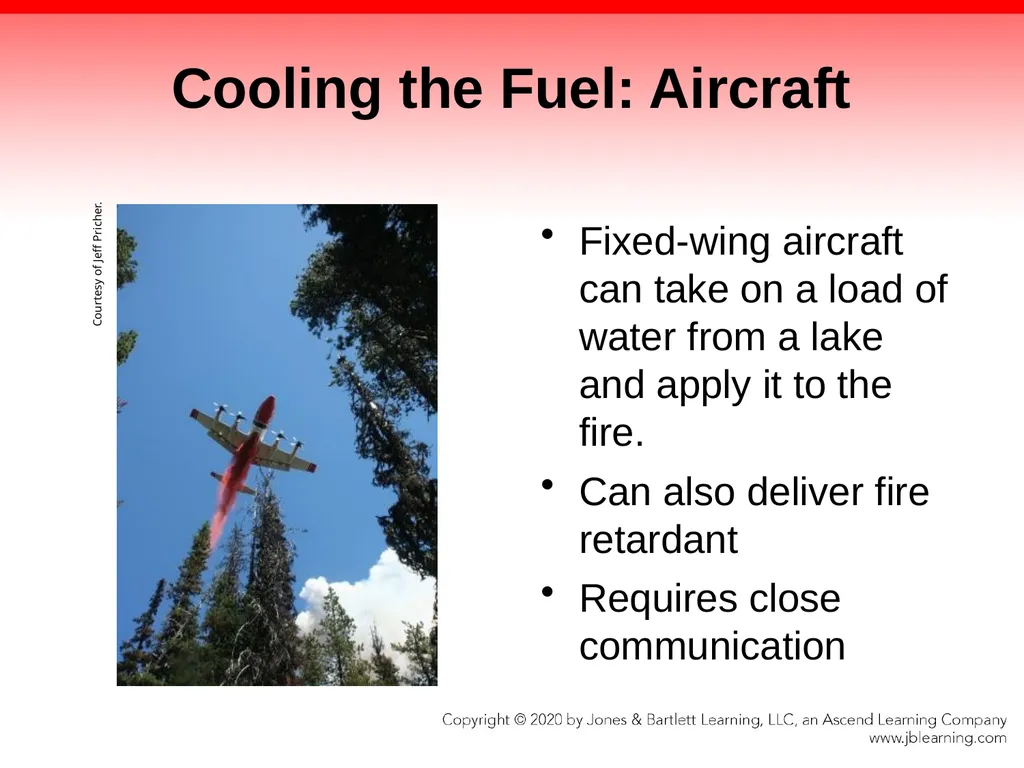
Cooling the Fuel: Aircraft Courtesy of Jeff Pricher. Fixed-wing aircraft can take on a load of water from a lake and apply it to the fire.
Can also deliver fire retardant
Requires close communication<br>
Can also deliver fire retardant
Requires close communication<br>
31
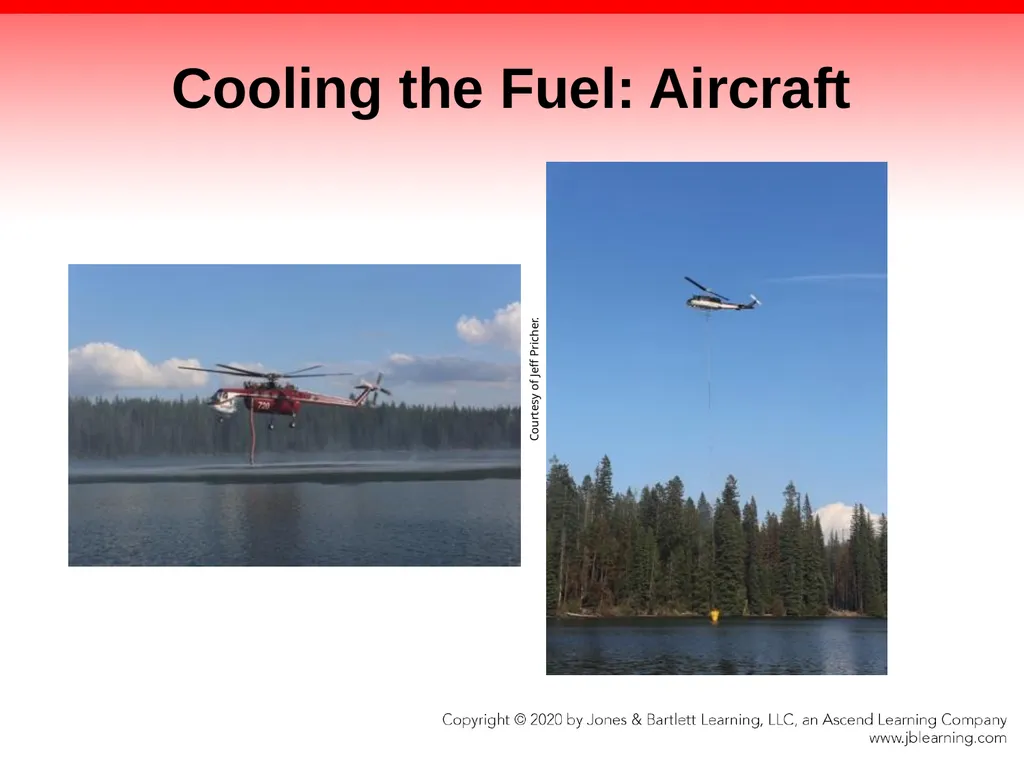
Cooling the Fuel: Aircraft Courtesy of Jeff Pricher.<br>
32
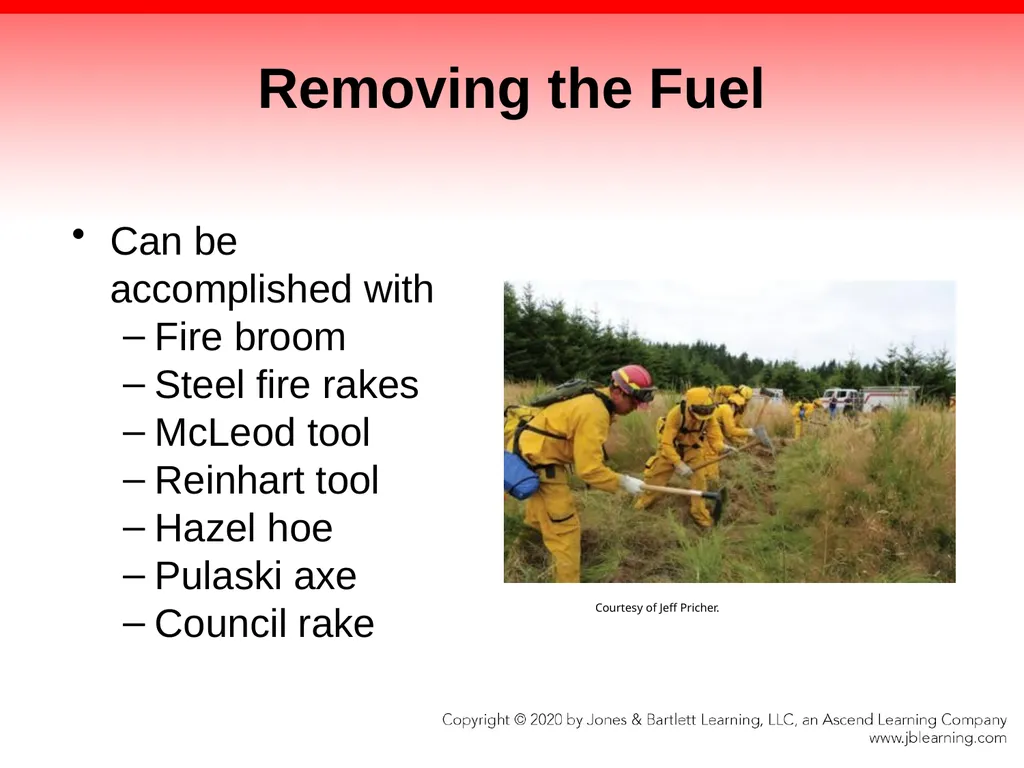
Removing the Fuel Can be accomplished with
Fire broom
Steel fire rakes
McLeod tool
Reinhart tool
Hazel hoe
Pulaski axe
Council rake Courtesy of Jeff Pricher.<br>
Fire broom
Steel fire rakes
McLeod tool
Reinhart tool
Hazel hoe
Pulaski axe
Council rake Courtesy of Jeff Pricher.<br>
33
Removing the Fuel Sometimes saws are used to remove heavy brush and trees from the fire.
Other powered equipment includes tractors, plows, and bulldozers.
Backfiring is another technique used to remove the fuel from a wildland fire.
Must be set at the right time and at the proper place to work correctly.
Should be set only by people with special training<br>
Other powered equipment includes tractors, plows, and bulldozers.
Backfiring is another technique used to remove the fuel from a wildland fire.
Must be set at the right time and at the proper place to work correctly.
Should be set only by people with special training<br>
34
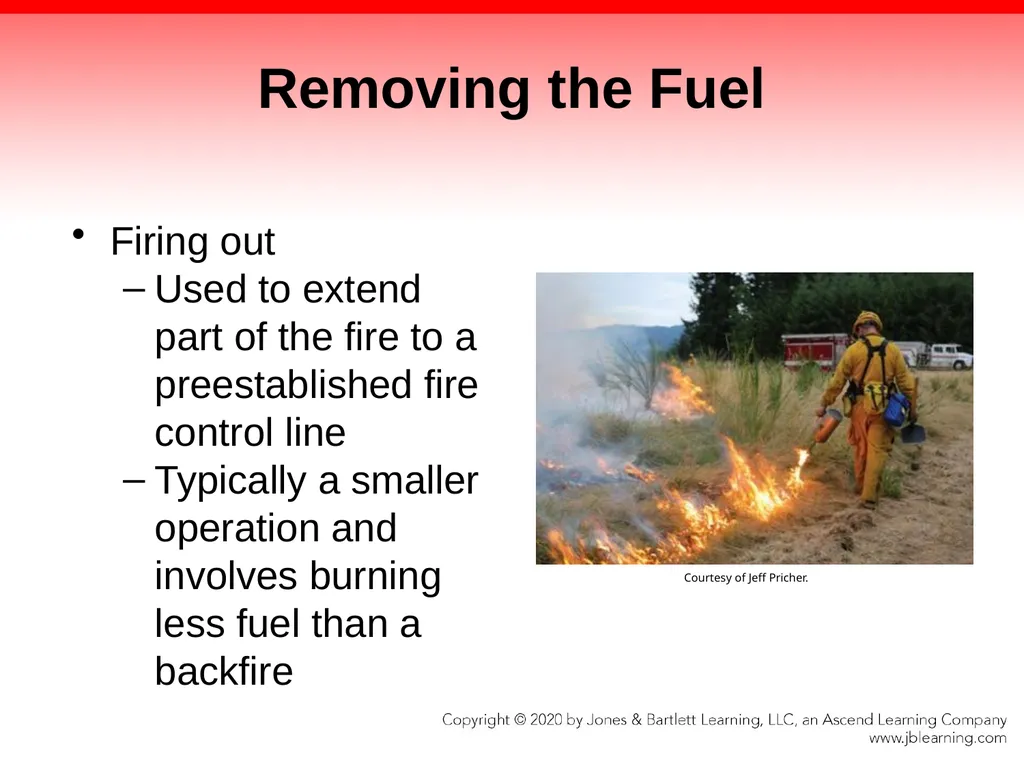
Removing the Fuel Firing out
Used to extend part of the fire to a preestablished fire control line
Typically a smaller operation and involves burning less fuel than a backfire Courtesy of Jeff Pricher.<br>
Used to extend part of the fire to a preestablished fire control line
Typically a smaller operation and involves burning less fuel than a backfire Courtesy of Jeff Pricher.<br>
35
Removing Oxygen Smothering
Most commonly used when overhauling the last remnants of a fire
Water and mineral soil are often thrown on smoldering vegetation to prevent flare-ups.
Not as useful during the more active phases of a fire<br>
Most commonly used when overhauling the last remnants of a fire
Water and mineral soil are often thrown on smoldering vegetation to prevent flare-ups.
Not as useful during the more active phases of a fire<br>
36
Removing Oxygen Compressed air foam systems (CAFS)
Combines foam concentrate, water, and compressed air to produce a foam
Sticks to fuel in the fire’s path
Extinguishes with less water
Reduces rekindling<br>
Combines foam concentrate, water, and compressed air to produce a foam
Sticks to fuel in the fire’s path
Extinguishes with less water
Reduces rekindling<br>
37
Fire Apparatus Used for Wildland Fires Structural fire apparatus
Commonly used by departments whose primary mission is structural firefighting
Carry enough water to mount an attack on small wildland fires
Do not have pump-and-roll capabilities
Do not possess off-road capabilities<br>
Commonly used by departments whose primary mission is structural firefighting
Carry enough water to mount an attack on small wildland fires
Do not have pump-and-roll capabilities
Do not possess off-road capabilities<br>
38
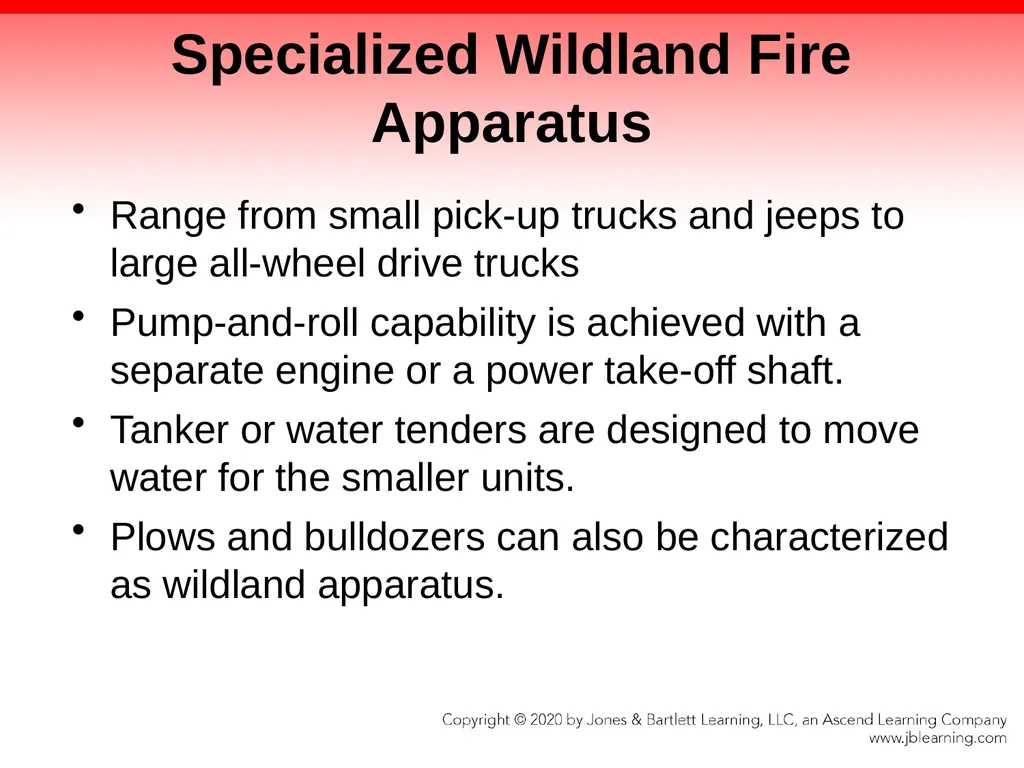
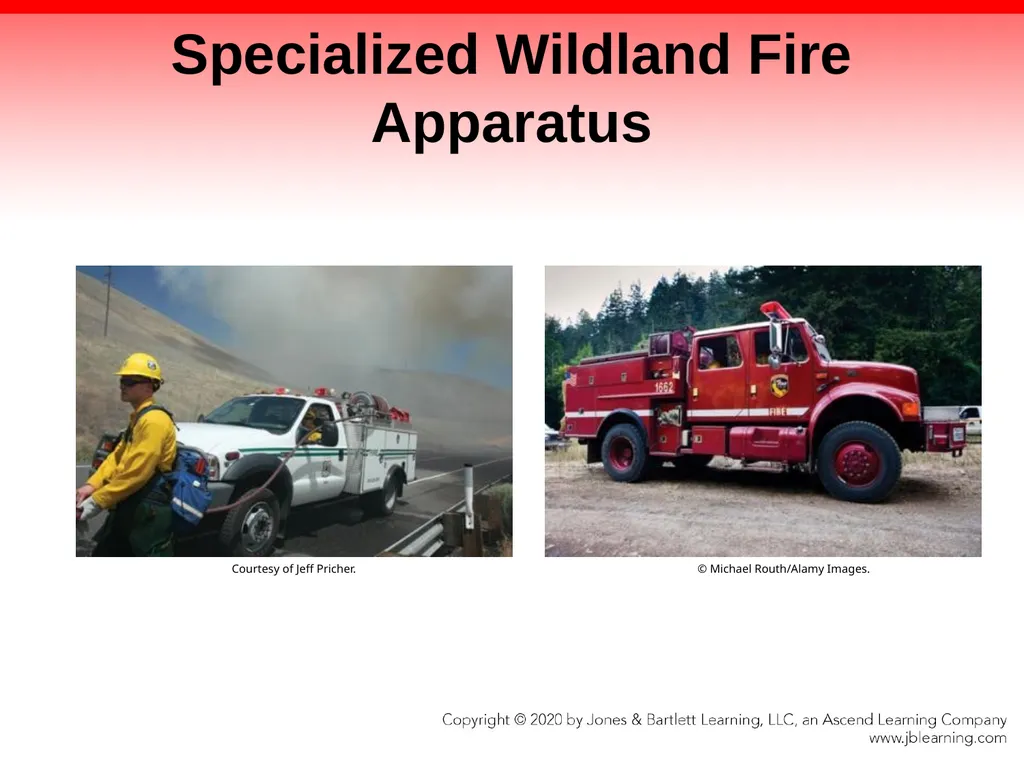
Specialized Wildland Fire Apparatus Range from small pick-up trucks and jeeps to large all-wheel drive trucks
Pump-and-roll capability is achieved with a separate engine or a power take-off shaft.
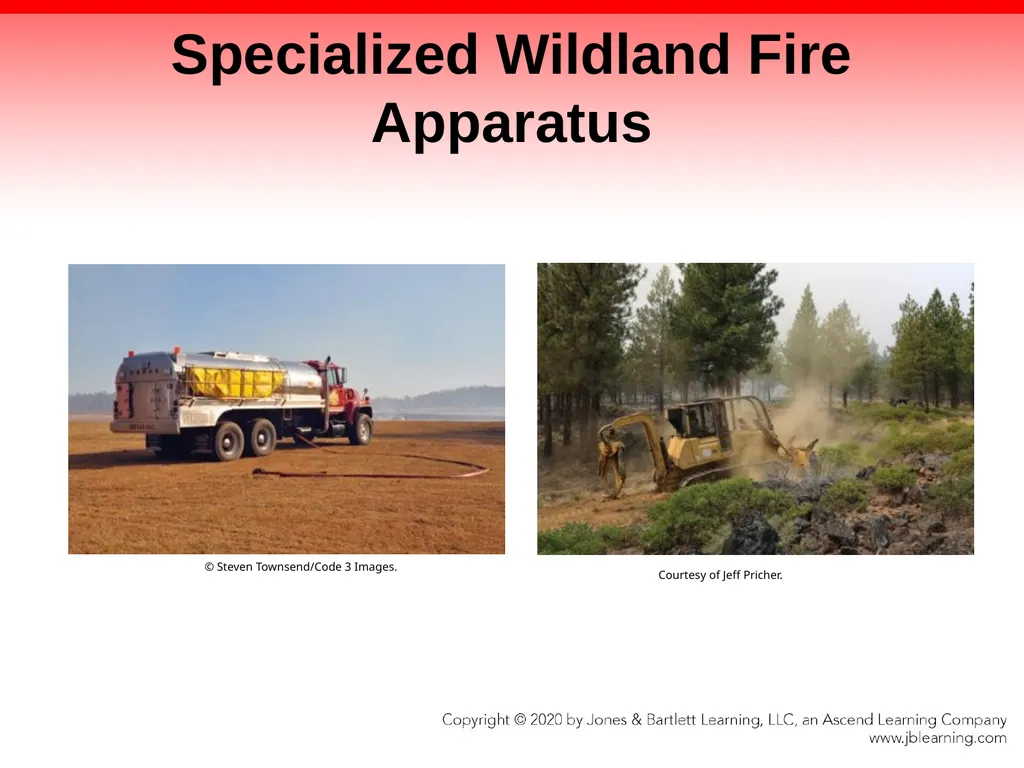
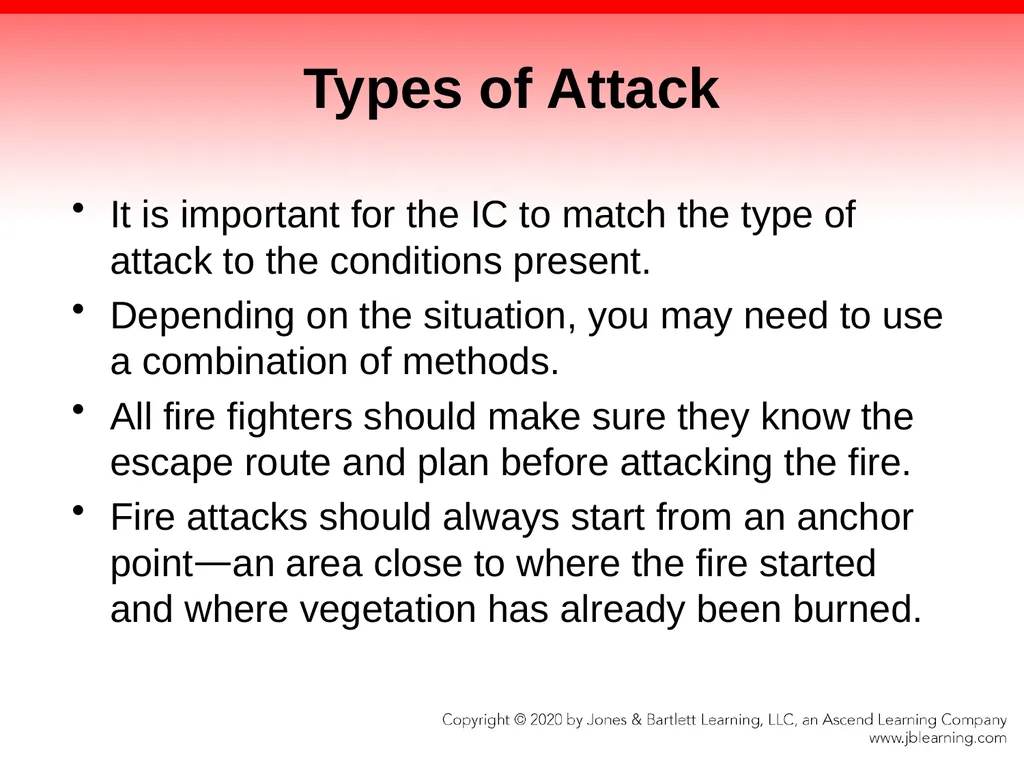
Tanker or water tenders are designed to move water for the smaller units.
Plows and bulldozers can also be characterized as wildland apparatus.<br>
Pump-and-roll capability is achieved with a separate engine or a power take-off shaft.
Tanker or water tenders are designed to move water for the smaller units.
Plows and bulldozers can also be characterized as wildland apparatus.<br>
39
Specialized Wildland Fire Apparatus Courtesy of Jeff Pricher. © Michael Routh/Alamy Images.<br>
40
Specialized Wildland Fire Apparatus © Steven Townsend/Code 3 Images. Courtesy of Jeff Pricher.<br>
41
Types of Attack It is important for the IC to match the type of attack to the conditions present.
Depending on the situation, you may need to use a combination of methods.
All fire fighters should make sure they know the escape route and plan before attacking the fire.
Fire attacks should always start from an anchor point⏤an area close to where the fire started and where vegetation has already been burned.<br>
Depending on the situation, you may need to use a combination of methods.
All fire fighters should make sure they know the escape route and plan before attacking the fire.
Fire attacks should always start from an anchor point⏤an area close to where the fire started and where vegetation has already been burned.<br>
42
Direct Attack Mounted by containing and extinguishing the fire at its burning edge
More often used on a small wildland fire
Dangerous to fire fighters because they must work in smoke and heat
Advantage is quick containment of fire<br>
More often used on a small wildland fire
Dangerous to fire fighters because they must work in smoke and heat
Advantage is quick containment of fire<br>
43
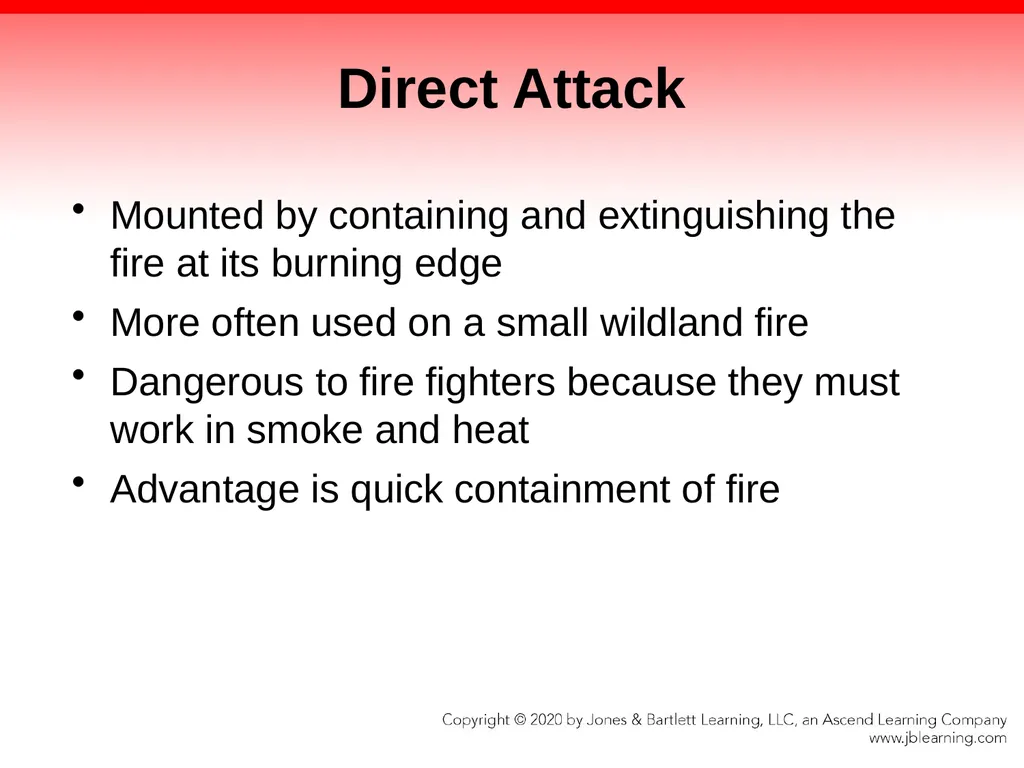
Anchor, Flank, and Pinch Attack Requires two or more teams of fire fighters.
Safest and most reliable method
Key is the establishment of two solid anchor points
Fire is “pinched” © Jones & Bartlett Learning<br>
Safest and most reliable method
Key is the establishment of two solid anchor points
Fire is “pinched” © Jones & Bartlett Learning<br>
44
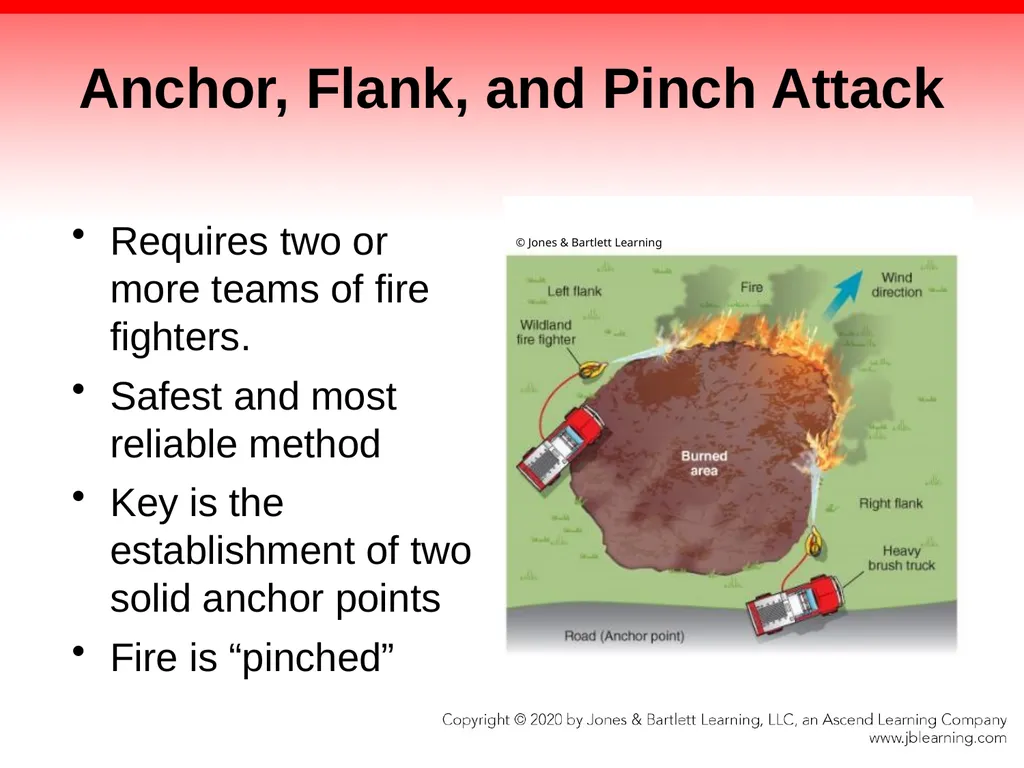
Flanking Attack Only requires one team
Starts at an anchor point and attacks along one flank
Attack is made on either flank, which is based on the flank with the greatest risk © Jones & Bartlett Learning<br>
Starts at an anchor point and attacks along one flank
Attack is made on either flank, which is based on the flank with the greatest risk © Jones & Bartlett Learning<br>
45
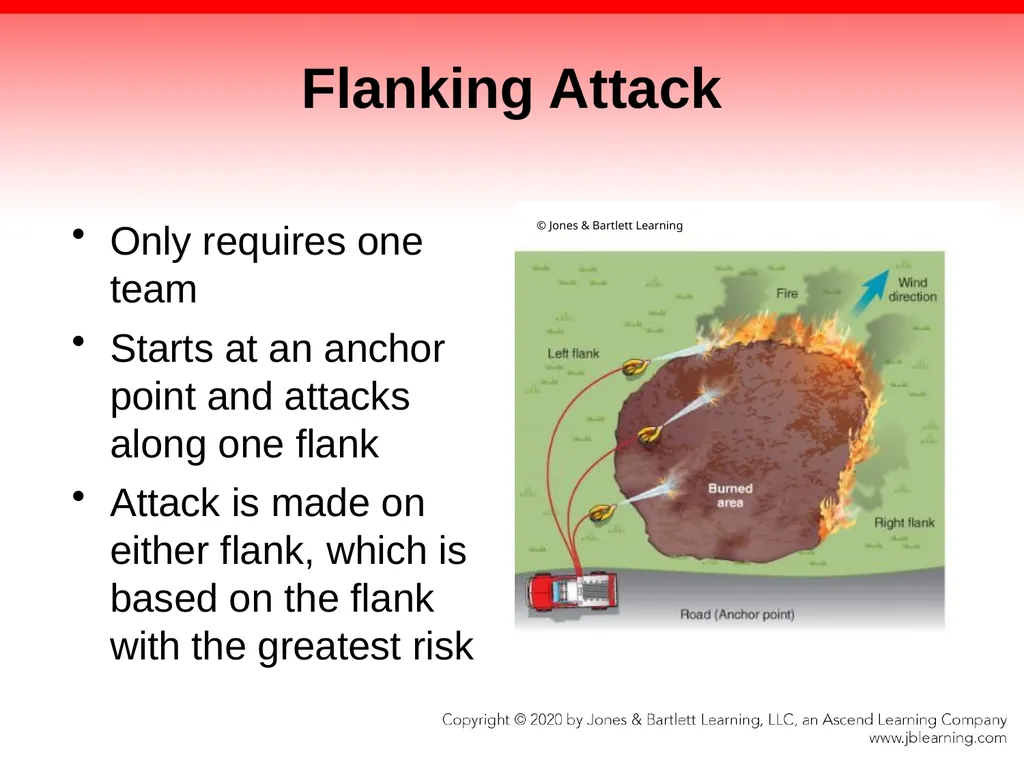
Indirect Attack Used for large fires that are too dangerous to approach directly
Mounted by building a fire line
Can be mounted with hand tools or machinery © Jones & Bartlett Learning<br>
Mounted by building a fire line
Can be mounted with hand tools or machinery © Jones & Bartlett Learning<br>
46
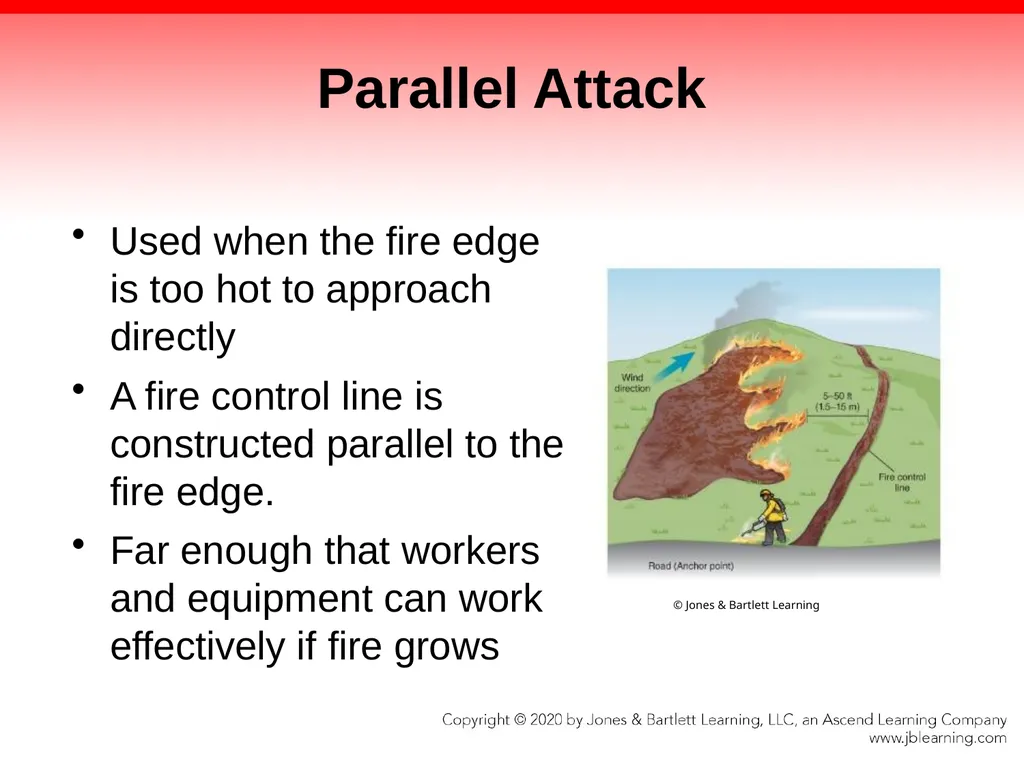
Parallel Attack Used when the fire edge is too hot to approach directly
A fire control line is constructed parallel to the fire edge.
Far enough that workers and equipment can work effectively if fire grows © Jones & Bartlett Learning<br>
A fire control line is constructed parallel to the fire edge.
Far enough that workers and equipment can work effectively if fire grows © Jones & Bartlett Learning<br>
47
Safety in Wildland Firefighting: 10 Standard Firefighting Orders Keep informed on fire weather conditions and forecasts.
Know what your fire is doing at all times.
Base actions on the behavior of the fire.
Identify escape routes and safety zones.<br>
Know what your fire is doing at all times.
Base actions on the behavior of the fire.
Identify escape routes and safety zones.<br>
48
Safety in Wildland Firefighting: 10 Standard Firefighting Orders Post lookouts when there is danger.
Be alert, calm, clear, and decisive.
Maintain prompt communications.
Give clear instructions and ensure they are understood.
Maintain control of your forces.
Fight fire aggressively, having provided for safety first.<br>
Be alert, calm, clear, and decisive.
Maintain prompt communications.
Give clear instructions and ensure they are understood.
Maintain control of your forces.
Fight fire aggressively, having provided for safety first.<br>
49
18 Watch-Out Situations 1. Fire not scouted and sized up
2. In country not seen in daylight
3. Safety zones and escape routes not identified
4. Unfamiliar with weather and local factors influencing fire behavior
5. Uninformed on strategy, tactics, and hazards
6. Instructions and assignments not clear<br>
2. In country not seen in daylight
3. Safety zones and escape routes not identified
4. Unfamiliar with weather and local factors influencing fire behavior
5. Uninformed on strategy, tactics, and hazards
6. Instructions and assignments not clear<br>
50
18 Watch-Out Situations 7. No communication link with crew members or supervisor
8. Constructing line without safe anchor point
9. Building fireline downhill with fire below
10. Attempting frontal assault on fire
11. Unburned fuel between you and the fire
12. Cannot see main fire and not in contact with anyone who can<br>
8. Constructing line without safe anchor point
9. Building fireline downhill with fire below
10. Attempting frontal assault on fire
11. Unburned fuel between you and the fire
12. Cannot see main fire and not in contact with anyone who can<br>
51
18 Watch-Out Situations 13. On a hillside where rolling material can ignite fuel below
14. Weather becoming hotter and drier
15. Wind increases or changes direction
16. Getting frequent spot fires across line
17. Terrain and fuels make escape to safety zones difficult
18. Taking a nap near the fireline<br>
14. Weather becoming hotter and drier
15. Wind increases or changes direction
16. Getting frequent spot fires across line
17. Terrain and fuels make escape to safety zones difficult
18. Taking a nap near the fireline<br>
52
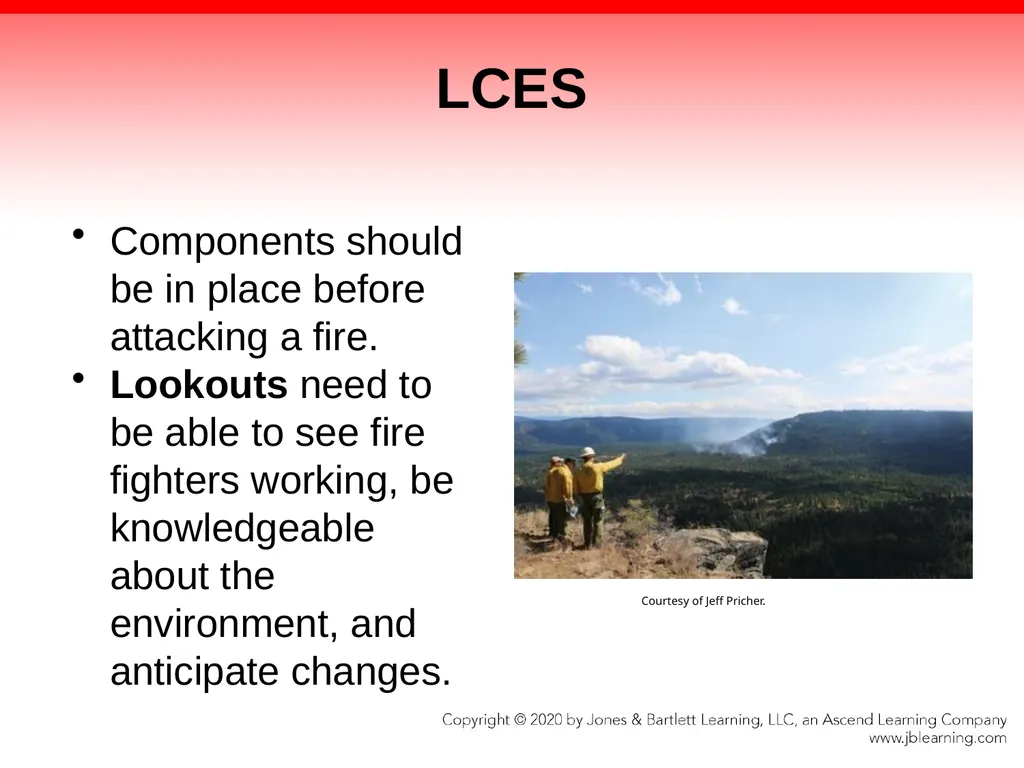
LCES Components should be in place before attacking a fire.
Lookouts need to be able to see fire fighters working, be knowledgeable about the environment, and anticipate changes. Courtesy of Jeff Pricher.<br>
Lookouts need to be able to see fire fighters working, be knowledgeable about the environment, and anticipate changes. Courtesy of Jeff Pricher.<br>
53
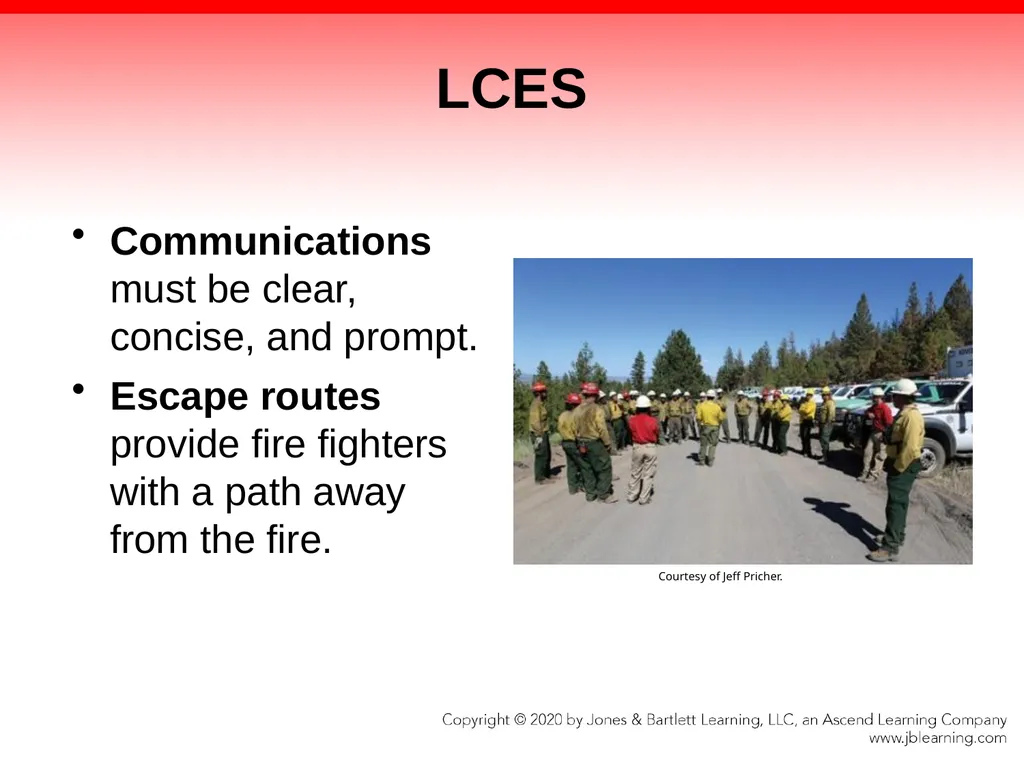
LCES Communications must be clear, concise, and prompt.
Escape routes provide fire fighters with a path away from the fire. Courtesy of Jeff Pricher.<br>
Escape routes provide fire fighters with a path away from the fire. Courtesy of Jeff Pricher.<br>
54
LCES Safety zones are preestablished areas of refuge.
Size is based on the behavior of the fire and location relative to the fire.
Choose an area that provides a separation of four times the flame height.
Adjust to account for wind, topography, and resources.
LACES is an adaptation of the mnemonic.
“A” could stand for anchor points, attitude, or awareness.<br>
Size is based on the behavior of the fire and location relative to the fire.
Choose an area that provides a separation of four times the flame height.
Adjust to account for wind, topography, and resources.
LACES is an adaptation of the mnemonic.
“A” could stand for anchor points, attitude, or awareness.<br>
55
Hazards of Wildland Firefighting Driving in rough terrain
Risk of rollover
Always wear seat belts.
Working in rough terrain
Risk of falls
Always carry tools with the sharp edge facing the ground, or use a tool guard.
Burns, smoke inhalation, dehydration, and heat stroke are also concerns.<br>
Risk of rollover
Always wear seat belts.
Working in rough terrain
Risk of falls
Always carry tools with the sharp edge facing the ground, or use a tool guard.
Burns, smoke inhalation, dehydration, and heat stroke are also concerns.<br>
56
Hazards of Wildland Firefighting Falling trees
Chainsaw use
Electrical hazards
Wires that drop on vegetation
Downed wires
Conductivity caused by smoke and heat
Dehydration
Take breaks<br>
Chainsaw use
Electrical hazards
Wires that drop on vegetation
Downed wires
Conductivity caused by smoke and heat
Dehydration
Take breaks<br>
57
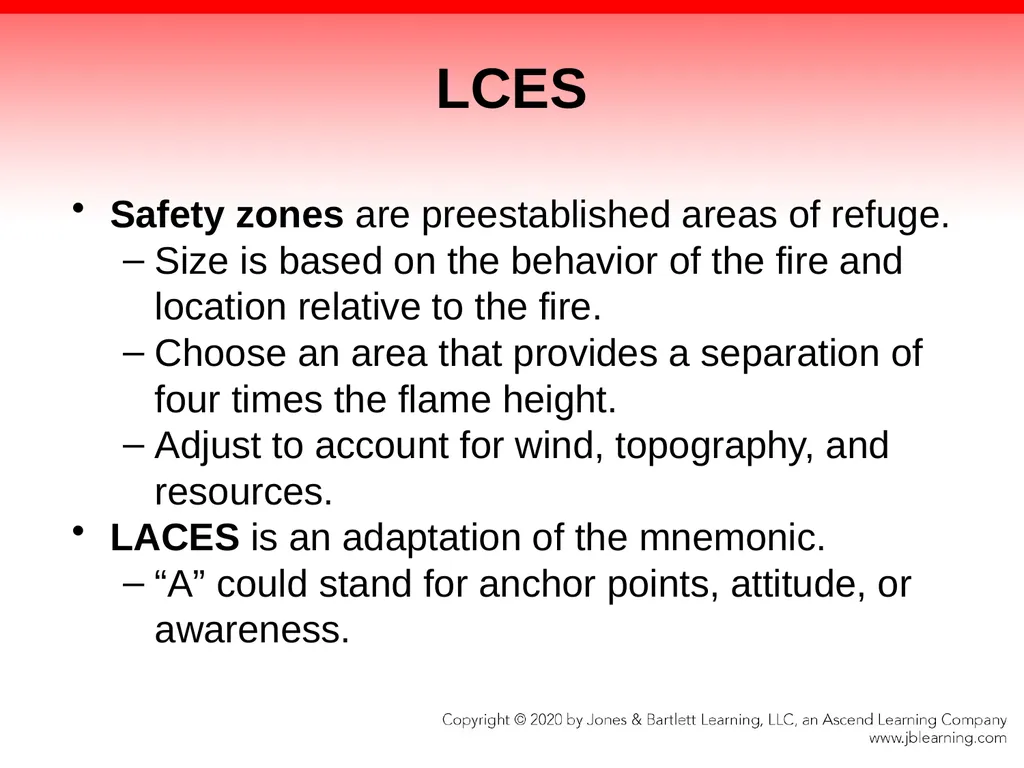
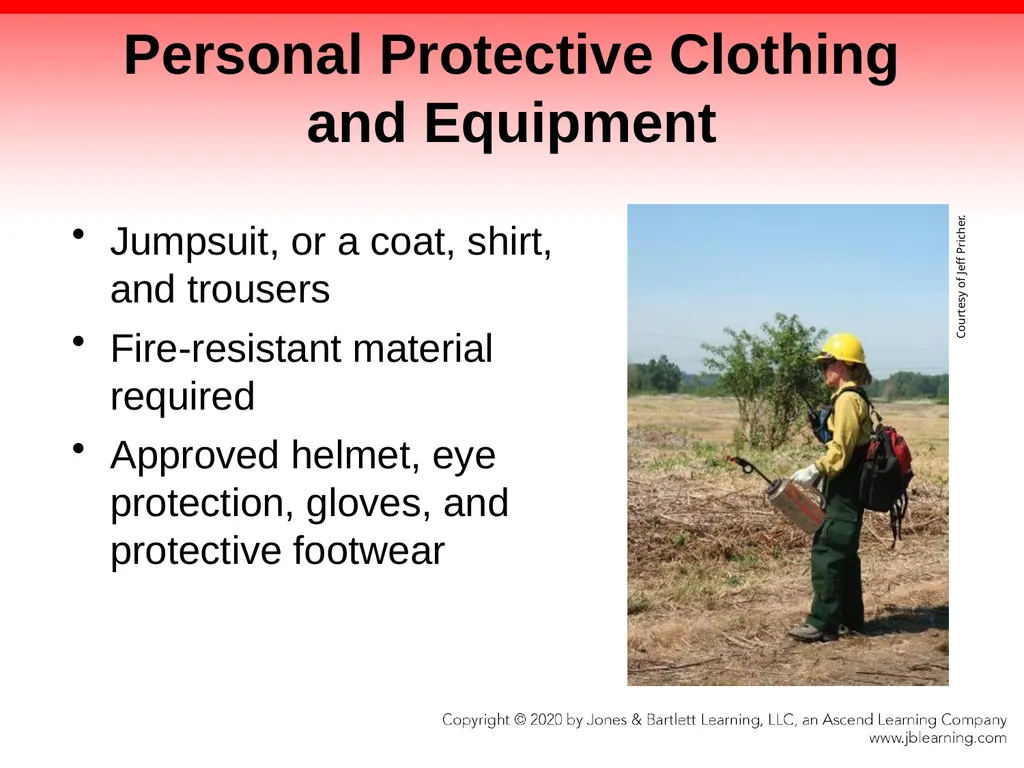
Personal Protective Clothing and Equipment Jumpsuit, or a coat, shirt, and trousers
Fire-resistant material required
Approved helmet, eye protection, gloves, and protective footwear Courtesy of Jeff Pricher.<br>
Fire-resistant material required
Approved helmet, eye protection, gloves, and protective footwear Courtesy of Jeff Pricher.<br>
58
Personal Protective Clothing and Equipment Respiratory protection is usually limited to a filter mask that filters small particles in smoke.
Should not be relied on beyond approved limits
Follow the standards of your department regarding PPE.
Fighting wildland fires in structural PPE for extended periods is not recommended.<br>
Should not be relied on beyond approved limits
Follow the standards of your department regarding PPE.
Fighting wildland fires in structural PPE for extended periods is not recommended.<br>
59
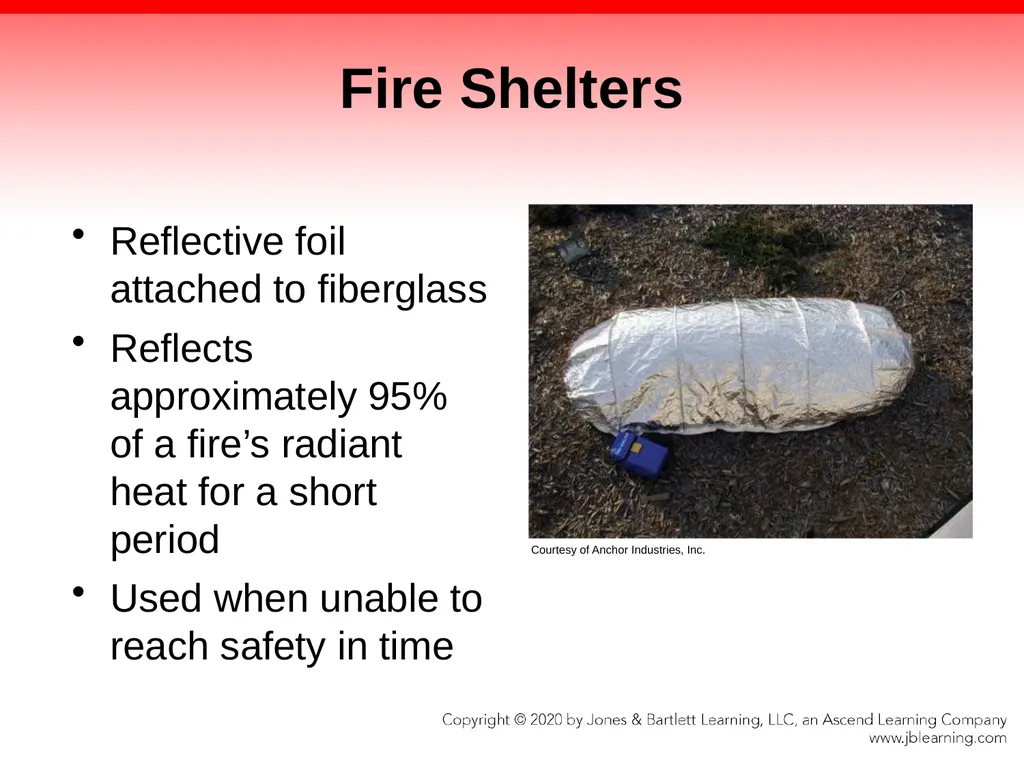
Fire Shelters Reflective foil attached to fiberglass
Reflects approximately 95% of a fire’s radiant heat for a short period
Used when unable to reach safety in time Courtesy of Anchor Industries, Inc.<br>
Reflects approximately 95% of a fire’s radiant heat for a short period
Used when unable to reach safety in time Courtesy of Anchor Industries, Inc.<br>
60
Wildland-Urban Interface Mixing of wildland with developed areas
Wildland fires can ignite buildings and become structure fires.
Presents a significant life safety hazard and huge property loss potential
Efforts geared at reducing loss should be directed at prevention.
Homeowners should maintain a defensible space around structures.<br>
Wildland fires can ignite buildings and become structure fires.
Presents a significant life safety hazard and huge property loss potential
Efforts geared at reducing loss should be directed at prevention.
Homeowners should maintain a defensible space around structures.<br>
61
Strategic Considerations Important for structural fire fighters to learn the basic principles of fighting wildland fires
Strategies are based on protecting structures, not containing and extinguishing the fire.
All structures in the fire path should be assigned a triage category:
Not threatened
Is threatened and needs protection
Threatened and cannot be protected<br>
Strategies are based on protecting structures, not containing and extinguishing the fire.
All structures in the fire path should be assigned a triage category:
Not threatened
Is threatened and needs protection
Threatened and cannot be protected<br>
62
Strategic Considerations Keep safety in mind.
Back in your apparatus.
Lay hose lines.
Seek static sources of water.
Keep your evolutions mobile and hose lines as short as possible.
Carefully monitor the movement of the fire.
Remain mobile and be ready for a quick exit.
Follow your department’s standard operating procedures (SOPs).<br>
Back in your apparatus.
Lay hose lines.
Seek static sources of water.
Keep your evolutions mobile and hose lines as short as possible.
Carefully monitor the movement of the fire.
Remain mobile and be ready for a quick exit.
Follow your department’s standard operating procedures (SOPs).<br>
63
Summary Wildland is land in an uncultivated natural state that is covered by timber, brush, or grass.
Wildland fires are unplanned fires burning in vegetative fuel that sometimes includes structures.
Ground cover fires are a type of wildland fire that burns loose debris on the surface of the ground. This debris includes vegetation, such as grass, dead leaves, needles, and branches that have fallen from shrubs and trees.<br>
Wildland fires are unplanned fires burning in vegetative fuel that sometimes includes structures.
Ground cover fires are a type of wildland fire that burns loose debris on the surface of the ground. This debris includes vegetation, such as grass, dead leaves, needles, and branches that have fallen from shrubs and trees.<br>
64
Summary Large wildland fires are handled by specialized agencies, such as the U.S. Forest Service.
The wildland fire triangle consists of fuel, oxygen, and heat. These three elements affect the intensity of the fire.
The primary fuel for wildland fires is vegetation, such as grasslands, brush, and trees. Vegetative fuels can be classified according to their location and include subsurface fuels, surface fuels, and aerial fuels.<br>
The wildland fire triangle consists of fuel, oxygen, and heat. These three elements affect the intensity of the fire.
The primary fuel for wildland fires is vegetation, such as grasslands, brush, and trees. Vegetative fuels can be classified according to their location and include subsurface fuels, surface fuels, and aerial fuels.<br>
65
Summary The size, shape, compactness, continuity, volume, moisture level, and orientation of a fuel influence how it burns. Fine fuels burn more quickly than heavy fuels and require less heat to reach their ignition temperature.
In wildland fires, air movement influences the speed and direction that the fire moves. Wind blowing on a wildland fire brings more oxygen to the fire and speeds the process of combustion.<br>
In wildland fires, air movement influences the speed and direction that the fire moves. Wind blowing on a wildland fire brings more oxygen to the fire and speeds the process of combustion.<br>
66
Summary Wildland and ground cover fires may be ignited by natural, accidental, and intentional causes.
Lightning is the source of almost all naturally caused wildland fires. Discarded smoking materials and campfires are common accidental causes.
The two most critical weather conditions that influence a wildland fire are moisture and wind. When the relative humidity is low, fire behavior increases. Wind can push the fire.<br>
Lightning is the source of almost all naturally caused wildland fires. Discarded smoking materials and campfires are common accidental causes.
The two most critical weather conditions that influence a wildland fire are moisture and wind. When the relative humidity is low, fire behavior increases. Wind can push the fire.<br>
67
Summary Topography can influence the spread of the fire and the speed of the fire. A wildland fire will spread more quickly over dry, flat land than over a river valley.
The location where the wildland fire begins is called the area of origin.
The most rapidly moving area of a wildland fire is called the head of the fire.<br>
The location where the wildland fire begins is called the area of origin.
The most rapidly moving area of a wildland fire is called the head of the fire.<br>
68
Summary As a wildland fire gets bigger, the area close to the area of origin is called the heel or rear of the fire.
The edge between the head and heel of the wildland fire is called the flank of the fire.
A long, narrow extension of fire that projects from the head of the fire is called a finger.
A pocket is an unburned area between a finger and the head of the wildland fire.<br>
The edge between the head and heel of the wildland fire is called the flank of the fire.
A long, narrow extension of fire that projects from the head of the fire is called a finger.
A pocket is an unburned area between a finger and the head of the wildland fire.<br>
69
Summary An area of land that is left untouched by the wildland fire, but is surrounded by burned land, is called an island.
A new fire that starts outside the perimeter of the main wildland fire is called a spot fire.
Green areas contain unburned fuels, whereas black areas have already been burned. Green areas are more likely to become involved in a wildland fire.<br>
A new fire that starts outside the perimeter of the main wildland fire is called a spot fire.
Green areas contain unburned fuels, whereas black areas have already been burned. Green areas are more likely to become involved in a wildland fire.<br>
70
Summary Wildland fires can be controlled and extinguished by cooling the fuel, by removing fuel from the fire, or by smothering the fire.
Backpack fire extinguishers may be effective against small wildland fires with light fuel loads. Water may also be applied by hose lines on special wildland fire trucks or by aircraft.<br>
Backpack fire extinguishers may be effective against small wildland fires with light fuel loads. Water may also be applied by hose lines on special wildland fire trucks or by aircraft.<br>
71
Summary Hand tools, such as rakes, and power tools, such as chainsaws, may be used to remove fuel from the fire. Setting a fire is another technique that can be used to remove the fuel from a wildland fire.
Compressed air foam systems or gel may be used to smother wildland fires.
Both structural fire apparatus and specialized wildland fire apparatus are used for wildland fire suppression.<br>
Compressed air foam systems or gel may be used to smother wildland fires.
Both structural fire apparatus and specialized wildland fire apparatus are used for wildland fire suppression.<br>
72
Summary Other types of wildland fire apparatus include tankers, tractors, plows, bulldozers, and aircraft.
All fire fighters should ensure that they know the escape route and escape plan before attacking a wildland fire.
The three general types of attacks used to contain and extinguish wildland fires are direct attack, indirect attack, and parallel attack.<br>
All fire fighters should ensure that they know the escape route and escape plan before attacking a wildland fire.
The three general types of attacks used to contain and extinguish wildland fires are direct attack, indirect attack, and parallel attack.<br>
73
Summary The 10 standard firefighting orders are meant to prevent fire fighter tragedies from occurring during wildland fires. They are broken into three categories: fire behavior, fireline safety, and organizational control.
The 18 watch-out situations can be used as a checklist to determine if an assignment is safe. If five or more of the situations are encountered, the fire fighter should reconsider engaging in the assignment.<br>
The 18 watch-out situations can be used as a checklist to determine if an assignment is safe. If five or more of the situations are encountered, the fire fighter should reconsider engaging in the assignment.<br>
74
Summary Ensuring the components of LCES/LACES are in place before attacking a wildland fire reduces the risk associated with wildland firefighting.
The hazards of wildland fires include fire apparatus rollovers, falls, burns, smoke inhalation, dehydration, and heat stroke.<br>
The hazards of wildland fires include fire apparatus rollovers, falls, burns, smoke inhalation, dehydration, and heat stroke.<br>
75
Summary The fire shelter is one of the most important pieces of PPE for wildland fire fighters. Fire shelters are designed to reflect 95 percent of a fire’s radiant heat for a short period of time.
The wildland/urban interface is the mixing of wildland and developed areas. Because many people live in the wildland/urban interface, fires in this zone present a significant risk to both lives and structures.<br>
The wildland/urban interface is the mixing of wildland and developed areas. Because many people live in the wildland/urban interface, fires in this zone present a significant risk to both lives and structures.<br>