Chapter 3: Islam and the Arab Empire Place and time: The Arab empire 600-1400 Islam began on the Arabian peninsula with the preaching of Muhammed early in the seventh century. By the time of Muhammads death, his followers, known as
"Chapter 3: Islam and the Arab Empire Place and" is the property of its rightful owner. Permission is granted to
download and print the materials on this website for personal, non-commercial use only, and to display it
on your personal computer provided you do not modify the materials and that you retain all copyright
notices contained in the materials. By downloading content from our website, you accept the terms of this
agreement.
Presentation Transcript
01
Chapter 3: Islam and the Arab Empire Place and time:
The Arab empire 600-1400
Islam began on the Arabian peninsula with the preaching of Muhammed early in the seventh century. By the time of Muhammad's death, his followers, known as Muslims, controlled much of the peninsula. A little more than a century later, Arab expansion extended from the Atlantic coasts of Spain and morrocoy, to the border of India.<br>
02
Lesson 1: The First Muslims The Arabs In the seventh century, a new force, the Arabs, arose in the Arabian Peninsula and spread their influence throughout Western Asia and beyond.
The Arabs were a Semitic-speaking people who lived in the Arabian Peninsula, a desert land sorely lacking in rivers and lakes.
Survival in such a harsh environment was difficult so the Arabs organized into tribes to help eachother. Each tribe was ruled by a sheikh, who was chosen from one of the leading families by a council of elders.<br>
03
The Arabs Continued Early Arabs were polytheistic, they believed in many Gods.
The Arabas recognized a supreme god named Allah (Allah is Arabic for “God”), but they also believed in other tribal gods.
Allah was symbolized by a sacred stone, and each tribe had its own stone.
All tribes, however, worshipped a massive black meteorite, the Black Stone, which had been placed in a central shrine called the Kaaba, located in the city of Makkah in the Arabian Peninsula.<br>
04
The Life and Teachings of Muhammed Muhammed was born in Makkah. He was orphaned at the age of five but later became a caravan manager and married a rich widow.
Muhammed was troubled by the gap between the generosity of most people and the greed of the wealthy elite so he began meditating in the hills during his adult years. During one of these visits, Muslims believe Muhammed received revelations from God. Revelations are a divine truth.
According to teachings, the messages were given to Muhammed by the angel Gabriel, this angel apparently told Muhammed to recite what he heard.
Out of these revelations, which were eventually written down, came the Quran, the holy book of Islam.
Islam means “peace through submission to the will of Allah”.<br>
05
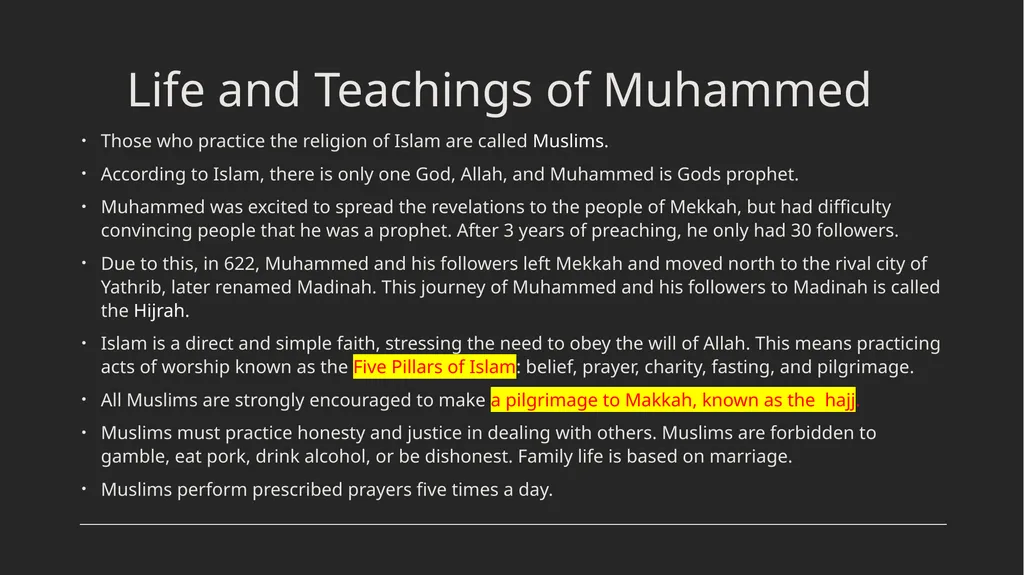
Life and Teachings of Muhammed Those who practice the religion of Islam are called Muslims.
According to Islam, there is only one God, Allah, and Muhammed is Gods prophet.
Muhammed was excited to spread the revelations to the people of Mekkah, but had difficulty convincing people that he was a prophet. After 3 years of preaching, he only had 30 followers.
Due to this, in 622, Muhammed and his followers left Mekkah and moved north to the rival city of Yathrib, later renamed Madinah. This journey of Muhammed and his followers to Madinah is called the Hijrah.
Islam is a direct and simple faith, stressing the need to obey the will of Allah. This means practicing acts of worship known as the Five Pillars of Islam: belief, prayer, charity, fasting, and pilgrimage.
All Muslims are strongly encouraged to make a pilgrimage to Makkah, known as the hajj.
Muslims must practice honesty and justice in dealing with others. Muslims are forbidden to gamble, eat pork, drink alcohol, or be dishonest. Family life is based on marriage.
Muslims perform prescribed prayers five times a day.<br>
06
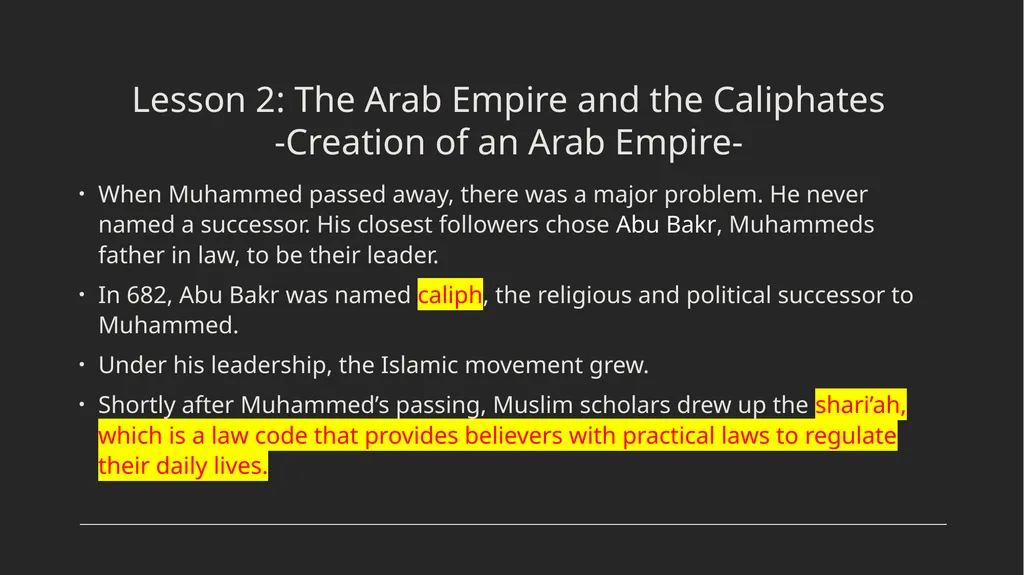
Lesson 2: The Arab Empire and the Caliphates -Creation of an Arab Empire- When Muhammed passed away, there was a major problem. He never named a successor. His closest followers chose Abu Bakr, Muhammeds father in law, to be their leader.
In 682, Abu Bakr was named caliph, the religious and political successor to Muhammed.
Under his leadership, the Islamic movement grew.
Shortly after Muhammed’s passing, Muslim scholars drew up the shari’ah, which is a law code that provides believers with practical laws to regulate their daily lives.<br>
07
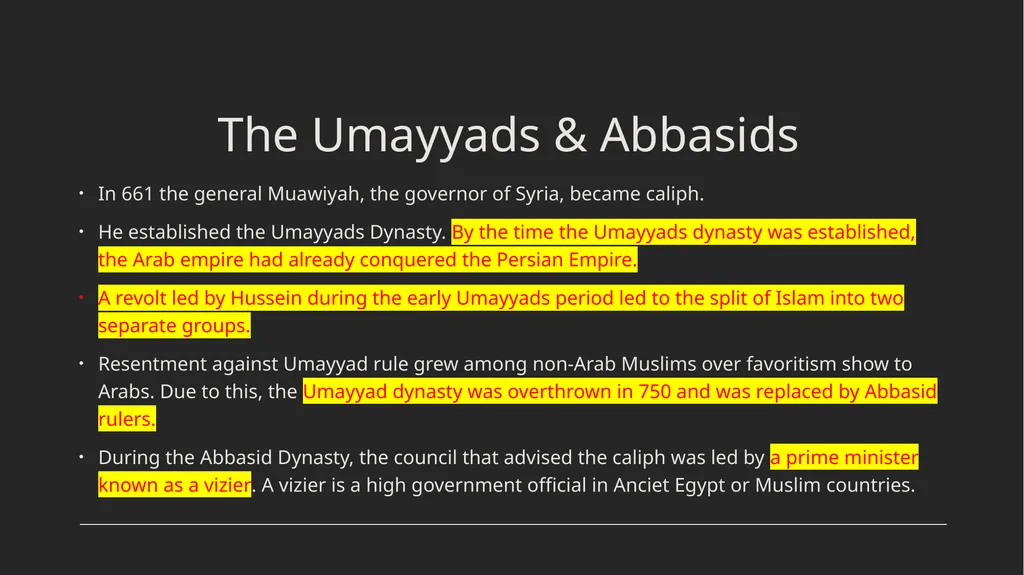
The Umayyads & Abbasids In 661 the general Muawiyah, the governor of Syria, became caliph.
He established the Umayyads Dynasty. By the time the Umayyads dynasty was established, the Arab empire had already conquered the Persian Empire.
A revolt led by Hussein during the early Umayyads period led to the split of Islam into two separate groups.
Resentment against Umayyad rule grew among non-Arab Muslims over favoritism show to Arabs. Due to this, the Umayyad dynasty was overthrown in 750 and was replaced by Abbasid rulers.
During the Abbasid Dynasty, the council that advised the caliph was led by a prime minister known as a vizier. A vizier is a high government official in Anciet Egypt or Muslim countries.<br>
08
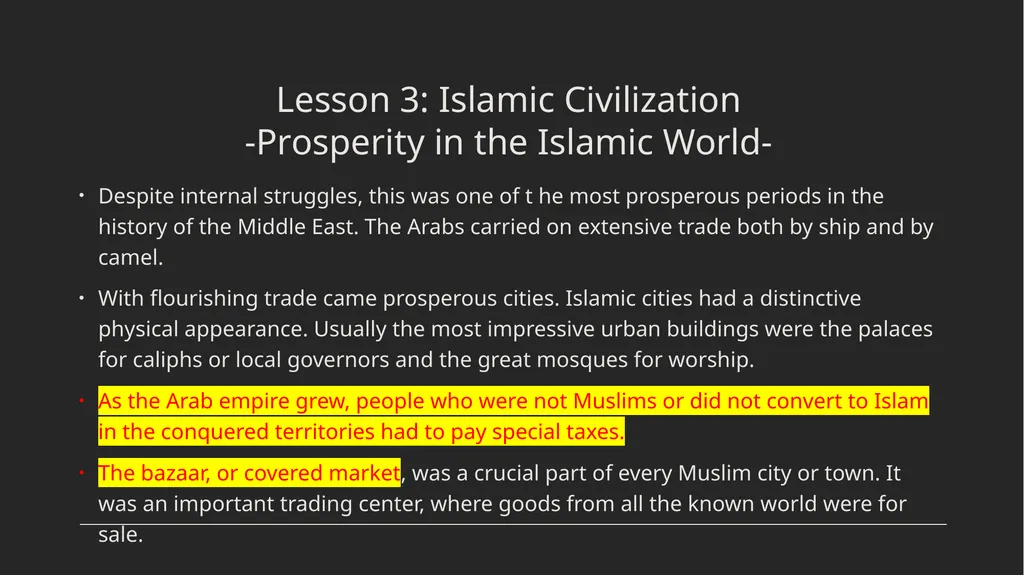
Lesson 3: Islamic Civilization -Prosperity in the Islamic World- Despite internal struggles, this was one of t he most prosperous periods in the history of the Middle East. The Arabs carried on extensive trade both by ship and by camel.
With flourishing trade came prosperous cities. Islamic cities had a distinctive physical appearance. Usually the most impressive urban buildings were the palaces for caliphs or local governors and the great mosques for worship.
As the Arab empire grew, people who were not Muslims or did not convert to Islam in the conquered territories had to pay special taxes.
The bazaar, or covered market, was a crucial part of every Muslim city or town. It was an important trading center, where goods from all the known world were for sale.<br>
09
Islamic Society To be a Muslim is not simply to worship Allah but also to live ones life according to Allah’s teachings as revealed in the Quran.
According to Islam, all Muslim people were created equal in the eyes of Allah.
The Quran granted women spiritual and social equality with men. Islamic teaching accounted for differences between men and women in the family and social order.
The Quran allowed Muslim men to have more than one wife, but no more than four. Most men, however, were unable to afford more than one because they were required to pay a dowry. A dowry is a gift of money or property paid at the time of marriage, either by the brides parents to their husbands or, by a husband to his wife.<br>
10
Philosophy, Science, History Philosophy- The Arabs were aware of Greek philosophy and were translating works by Plato and Aristotle in Arabic. One Arabic philosopher was Ibn-Rushd, he wrote commentary on virtually all of Aristotles surviving works. Europeans were able to read the works of Aristotle and other Greek philosophers through the achievement of Muslim Scholars.
Science- In astronomy, Muslims set up an observatory at Bagdhad to study the position of the stars. They also perfected an instrument called the astrolabe, an instrument used by sailors to determine their location. This instrument made it possible for Europeans to sail to the Americas.
History- Ibn-Khaldun, was the prominent Muslim historian of the age who believed in a cyclical view of history. He tried to find a scientific basis for the political and social factors that determine the course of history.<br>
11
Art and Architecture Art-Islamic art is a blend of Arab, Turkish, and Persian traditions. Most decorations on Islamic art consisted of Arabic letters, natural plants and abstract figures. These decorations were repeated over and over in geometric patterns called arabesques that completely covered the surfaces of objects.
Architecture- The best expression of Islamic architecture is found in the way of Muslim mosques which represent the spirit of Islam. In a mosque, there is a minaret which is a tower of a mosque from which the muezzin, or crier, calls the faithful to prayer five times a day.<br>