
Chapter 38 Burns Comprehensive Lecture National
AS
Published · 59 slides · 0 views
1 / 1

Description
Chapter 38 Burns Comprehensive Lecture National EMS Education Standard Competencies Trauma Integrates assessment findings with principles of epidemiology and pathophysiology to formulate a field impression to implement a comprehensive
Related Topics
Share
Embed code
Download this presentation From Below
"Chapter 38 Burns Comprehensive Lecture National" is the property of its rightful owner. Permission is granted to download and print the materials on this website for personal, non-commercial use only, and to display it on your personal computer provided you do not modify the materials and that you retain all copyright notices contained in the materials. By downloading content from our website, you accept the terms of this agreement.
Presentation Transcript
01
Chapter 38
Burns
Comprehensive Lecture<br>
Comprehensive Lecture<br>
02
National EMS Education Standard Competencies Trauma
Integrates assessment findings with principles of epidemiology and pathophysiology to formulate a field impression to implement a comprehensive treatment/disposition plan for an acutely injured patient.<br>
Integrates assessment findings with principles of epidemiology and pathophysiology to formulate a field impression to implement a comprehensive treatment/disposition plan for an acutely injured patient.<br>
03
Incident and Patterns of Burn Injury (1 of 6) Major Sources of Burns
Burns are a devastating form of trauma.
Associated with high mortality rates, lengthy rehabilitation, cosmetic disfigurement, and permanent physical disabilities.
Thermal burns
The majority of burns are thermal. These burns commonly result from flames, scalds, or contact with hot substances.<br>
Burns are a devastating form of trauma.
Associated with high mortality rates, lengthy rehabilitation, cosmetic disfigurement, and permanent physical disabilities.
Thermal burns
The majority of burns are thermal. These burns commonly result from flames, scalds, or contact with hot substances.<br>
04
Incident and Patterns of Burn Injury (2 of 6) Major Sources of Burns (cont.)
Chemical Burns
Chemical burns are caused by a substance capable of producing chemical changes in the skin. These chemical changes disrupt the protein structure of the skin, with or without the production of heat.<br>
Chemical Burns
Chemical burns are caused by a substance capable of producing chemical changes in the skin. These chemical changes disrupt the protein structure of the skin, with or without the production of heat.<br>
05
Incident and Patterns of Burn Injury (3 of 6) Major Sources of Burns (cont.)
Electrical Burns
Electrical injuries (including lightning injuries) result from direct contact with an electric current and can also result from the arcing of electricity between two contact points near the skin.<br>
Electrical Burns
Electrical injuries (including lightning injuries) result from direct contact with an electric current and can also result from the arcing of electricity between two contact points near the skin.<br>
06
Incident and Patterns of Burn Injury (4 of 6) Major Sources of Burns (cont.)
Radiation Burns
Radiation injury is caused by ionizing and nonionizing radiation (described later in this chapter). Burns may result from a high level of radiation exposure to a specific body area; however, radiation injuries make up a very small percentage of burn injuries.<br>
Radiation Burns
Radiation injury is caused by ionizing and nonionizing radiation (described later in this chapter). Burns may result from a high level of radiation exposure to a specific body area; however, radiation injuries make up a very small percentage of burn injuries.<br>
07
Incident and Patterns of Burn Injury (5 of 6) Local Response to Burn Injury
Burn injuries immediately destroy cells or so fully disrupt their metabolic functions that cellular death ensues.
Major thermal burns have three distinct zones of injury.<br>
Burn injuries immediately destroy cells or so fully disrupt their metabolic functions that cellular death ensues.
Major thermal burns have three distinct zones of injury.<br>
08
Incident and Patterns of Burn Injury (6 of 6) Systemic Response to Burn Injury
Systemic responses to major burn injury:
Pulmonary response
Gastrointestinal response
Musculoskeletal response
Neuroendocrine response
Metabolic response
Immune response
Emotional response<br>
Systemic responses to major burn injury:
Pulmonary response
Gastrointestinal response
Musculoskeletal response
Neuroendocrine response
Metabolic response
Immune response
Emotional response<br>
09
Classification of Burn Injury
(1 of 10) Depth of Burn Injury
Superficial Burns
A superficial burn is also known as a first-degree burn. These burns characteristically are painful, red, and dry and blanch with pressure.
Superficial burns usually occur after prolonged exposure to low-intensity heat or a short-duration flash exposure to a heat source. In these burns, only a superficial layer of epidermal cells is destroyed.<br>
Superficial Burns
A superficial burn is also known as a first-degree burn. These burns characteristically are painful, red, and dry and blanch with pressure.
Superficial burns usually occur after prolonged exposure to low-intensity heat or a short-duration flash exposure to a heat source. In these burns, only a superficial layer of epidermal cells is destroyed.<br>
10
Classification of Burn Injury
(2 of 10) Depth of Burn Injury (cont.)
Partial-Thickness Burns
A partial-thickness burn is also known as a second-degree burn.
Superficial partial thickness
Deep partial-thickness wounds.
The superficial partial-thickness injury is characterized by blisters and often is caused by skin contact with hot, but not boiling, water or other hot liquids, explosions producing flash burns, hot grease, and flame.<br>
Partial-Thickness Burns
A partial-thickness burn is also known as a second-degree burn.
Superficial partial thickness
Deep partial-thickness wounds.
The superficial partial-thickness injury is characterized by blisters and often is caused by skin contact with hot, but not boiling, water or other hot liquids, explosions producing flash burns, hot grease, and flame.<br>
11
Classification of Burn Injury
(3 of 10) Depth of Burn Injury (cont.)
Partial-Thickness Burns (cont.)
If the depth of the partial-thickness burn involves the reticular layer of the dermis, the burn is considered a deep partial-thickness burn. As in superficial partial-thickness burns, edema forms at the epidermal–dermal junction.<br>
Partial-Thickness Burns (cont.)
If the depth of the partial-thickness burn involves the reticular layer of the dermis, the burn is considered a deep partial-thickness burn. As in superficial partial-thickness burns, edema forms at the epidermal–dermal junction.<br>
12
Classification of Burn Injury
(4 of 10) Depth of Burn Injury (cont.)
Full-Thickness Burns
In a full-thickness burn (also known as a third-degree burn), the entire thickness of the epidermis and dermis is destroyed along with variable amounts of hypodermis (subcutaneous tissue) destruction
A skin graft is necessary for timely and proper healing.<br>
Full-Thickness Burns
In a full-thickness burn (also known as a third-degree burn), the entire thickness of the epidermis and dermis is destroyed along with variable amounts of hypodermis (subcutaneous tissue) destruction
A skin graft is necessary for timely and proper healing.<br>
13
Classification of Burn Injury
(5 of 10) Extent and Severity of Burn Injury
Rule of Nines
The rule of nines is commonly used in the prehospital setting. The measurement divides the total body surface area (TBSA) into segments that are multiples of 9%. This method provides a rough estimate of burn injury size and is most accurate for adults and children older than 10 years.<br>
Rule of Nines
The rule of nines is commonly used in the prehospital setting. The measurement divides the total body surface area (TBSA) into segments that are multiples of 9%. This method provides a rough estimate of burn injury size and is most accurate for adults and children older than 10 years.<br>
14
Classification of Burn Injury
(6 of 10) Extent and Severity of Burn Injury (cont.)
Lund and Browder Chart
The Lund and Browder chart is a more accurate method of determining the area of burn injury because it assigns specific numbers to each body part and allows for developmental changes in percentages of body surface area.<br>
Lund and Browder Chart
The Lund and Browder chart is a more accurate method of determining the area of burn injury because it assigns specific numbers to each body part and allows for developmental changes in percentages of body surface area.<br>
15
Classification of Burn Injury
(7 of 10) Extent and Severity of Burn Injury (cont.)
American Burn Association categorization
The American Burn Association has devised a method of categorizing burns to determine severity.
The method is based on the extent, depth, and location of burn injury; age of the patient; etiologic agents involved; presence of inhalation injury; and coexisting injuries or preexisting illness.
Using these criteria, burn injuries are categorized as major, moderate, and minor.<br>
American Burn Association categorization
The American Burn Association has devised a method of categorizing burns to determine severity.
The method is based on the extent, depth, and location of burn injury; age of the patient; etiologic agents involved; presence of inhalation injury; and coexisting injuries or preexisting illness.
Using these criteria, burn injuries are categorized as major, moderate, and minor.<br>
16
Classification of Burn Injury
(8 of 10) Burn Center Referral Criteria
According to the Committee on Trauma of the American College of Surgeons and the American Burn Association, burn injuries usually requiring referral to a burn center include the following:
Partial-thickness burns greater than 10% of TBSA
Burns that involve the face, hands, feet, genitalia, perineum, or major joints
Third-degree burns in any age group<br>
According to the Committee on Trauma of the American College of Surgeons and the American Burn Association, burn injuries usually requiring referral to a burn center include the following:
Partial-thickness burns greater than 10% of TBSA
Burns that involve the face, hands, feet, genitalia, perineum, or major joints
Third-degree burns in any age group<br>
17
Classification of Burn Injury
(9 of 10) Burn Center Referral Criteria (cont.)
Burn injuries usually requiring referral to a burn center include the following: (cont.)
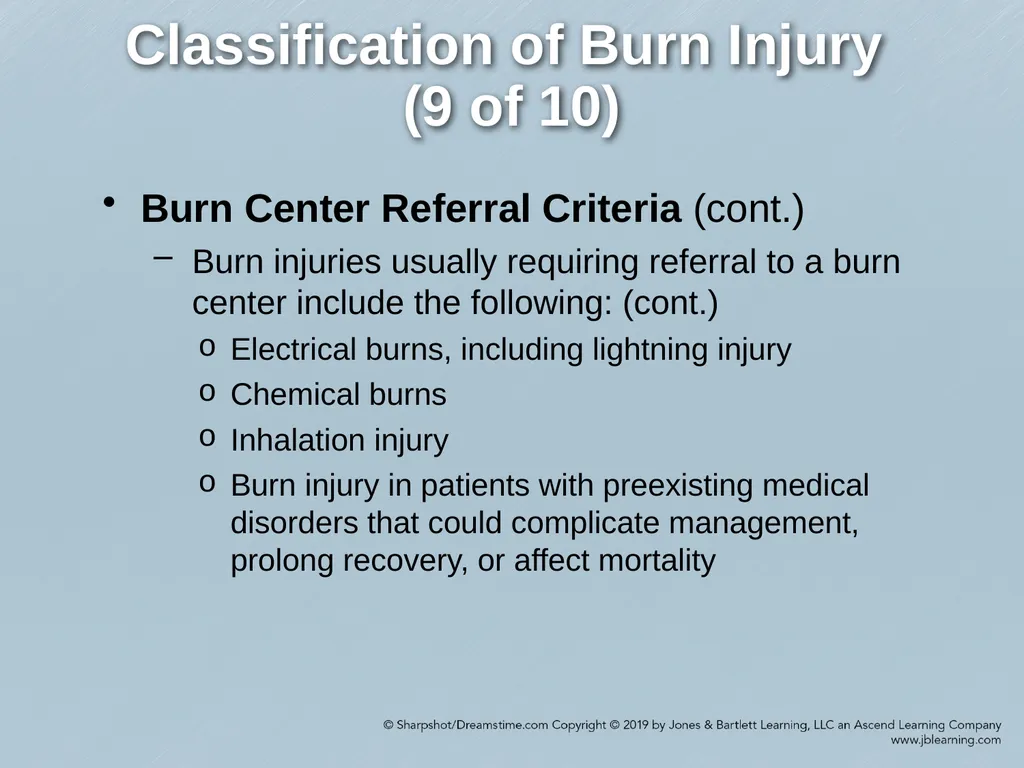
Electrical burns, including lightning injury
Chemical burns
Inhalation injury
Burn injury in patients with preexisting medical disorders that could complicate management, prolong recovery, or affect mortality<br>
Burn injuries usually requiring referral to a burn center include the following: (cont.)
Electrical burns, including lightning injury
Chemical burns
Inhalation injury
Burn injury in patients with preexisting medical disorders that could complicate management, prolong recovery, or affect mortality<br>
18
Classification of Burn Injury (10 of 10) Burn Center Referral Criteria (cont.)
Burn injuries usually requiring referral to a burn center include the following: (cont.)
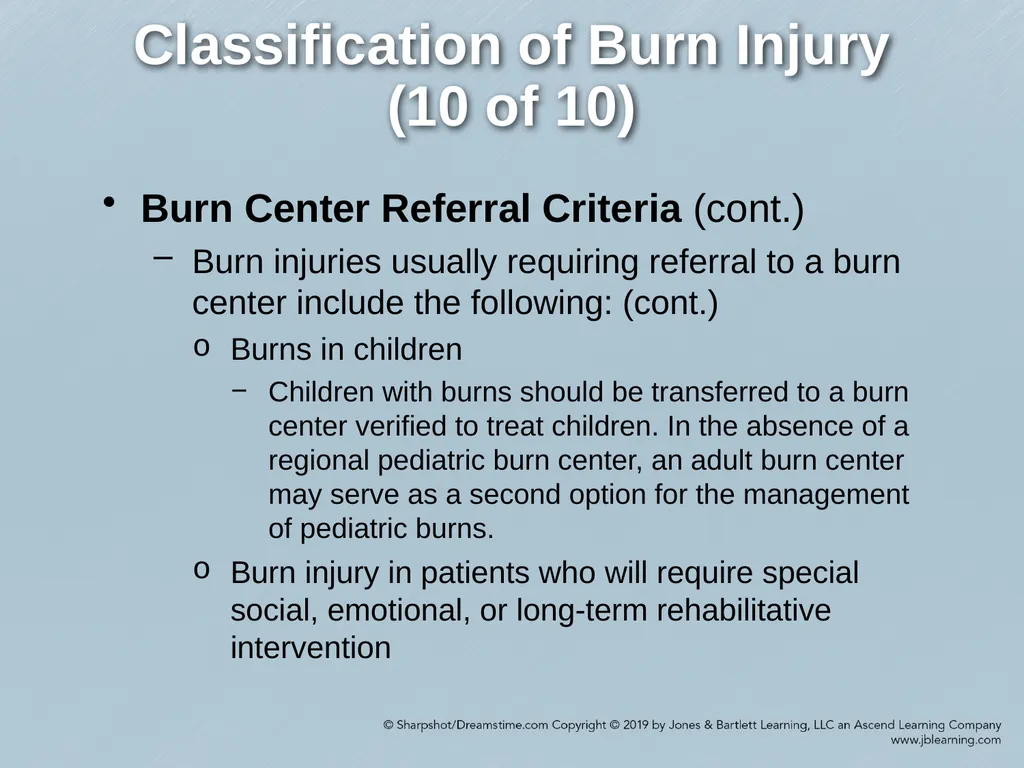
Burns in children
Children with burns should be transferred to a burn center verified to treat children. In the absence of a regional pediatric burn center, an adult burn center may serve as a second option for the management of pediatric burns.
Burn injury in patients who will require special social, emotional, or long-term rehabilitative intervention<br>
Burn injuries usually requiring referral to a burn center include the following: (cont.)
Burns in children
Children with burns should be transferred to a burn center verified to treat children. In the absence of a regional pediatric burn center, an adult burn center may serve as a second option for the management of pediatric burns.
Burn injury in patients who will require special social, emotional, or long-term rehabilitative intervention<br>
19
Pathophysiology of Burn Shock (1 of 2) Burn shock results from local and systemic responses to thermal trauma.
Hypovolemia results from fluid loss in the injured tissues and fluid that evaporates from the body because of the loss of the skin.<br>
Hypovolemia results from fluid loss in the injured tissues and fluid that evaporates from the body because of the loss of the skin.<br>
20
Pathophysiology of Burn Shock (2 of 2) Despite the compensatory effort of the body to retain sodium and water, sodium is lost, and potassium is released into the body’s extracellular fluid.
The blood becomes concentrated.<br>
The blood becomes concentrated.<br>
21
Assessment of the Burn Patient (1 of 5) Primary Survey
The evaluation of the patient’s airway is a major concern, particularly for the patient with an inhalation injury (described later in this chapter).
The paramedic should observe for stridor, facial burns, soot in the nose or mouth, singed facial or nasal hair, edema of the lips and oral cavity, coughing, inability to swallow secretions in the pharynx, hoarse voice, and circumferential burns around the neck or thorax.<br>
The evaluation of the patient’s airway is a major concern, particularly for the patient with an inhalation injury (described later in this chapter).
The paramedic should observe for stridor, facial burns, soot in the nose or mouth, singed facial or nasal hair, edema of the lips and oral cavity, coughing, inability to swallow secretions in the pharynx, hoarse voice, and circumferential burns around the neck or thorax.<br>
22
Assessment of the Burn Patient (2 of 5) Primary Survey (cont.)
When obtaining the patient history, the paramedic should ascertain the following information:
What is the patient’s chief complaint (e.g., pain and dyspnea)?
What were the circumstances of the injury?
Did the injury occur in an enclosed space?
Were explosive forces involved?
Were hazardous chemicals involved?
Is there related trauma?<br>
When obtaining the patient history, the paramedic should ascertain the following information:
What is the patient’s chief complaint (e.g., pain and dyspnea)?
What were the circumstances of the injury?
Did the injury occur in an enclosed space?
Were explosive forces involved?
Were hazardous chemicals involved?
Is there related trauma?<br>
23
Assessment of the Burn Patient (3 of 5) Primary Survey (cont.)
What was the source of the burning agent (e.g., flame, metal, liquid, and chemical)?
Does the patient have any significant medical history?
What medications does the patient take (including recent ingestion of illegal drugs or alcohol)?<br>
What was the source of the burning agent (e.g., flame, metal, liquid, and chemical)?
Does the patient have any significant medical history?
What medications does the patient take (including recent ingestion of illegal drugs or alcohol)?<br>
24
Assessment of the Burn Patient (4 of 5) Primary Survey (cont.)
Did the patient lose consciousness at any time? (If so, suspect inhalation injury.)
What is the patient’s status of tetanus immunization?<br>
Did the patient lose consciousness at any time? (If so, suspect inhalation injury.)
What is the patient’s status of tetanus immunization?<br>
25
Assessment of the Burn Patient (5 of 5) Physical Examination
At the start of the physical examination, the paramedic should obtain a full set of vital signs.
The paramedic should obtain a blood pressure measurement from an unburned extremity, if available.
If all extremities are burned, the paramedic may place sterile gauze under the blood pressure cuff and attempt to auscultate a blood pressure.<br>
At the start of the physical examination, the paramedic should obtain a full set of vital signs.
The paramedic should obtain a blood pressure measurement from an unburned extremity, if available.
If all extremities are burned, the paramedic may place sterile gauze under the blood pressure cuff and attempt to auscultate a blood pressure.<br>
26
General Principles in Burn Management (1 of 7) Stopping the Burning Process
The first step in managing any burn is to stop the burning process.
This step must be achieved with the safety of the emergency crew in mind because it often occurs in proximity to the source that caused the burn.
With superficial burns, the burning process can be terminated by cooling the local area with cool tap water.
Ice-cold water, ice, snow, or ointments should not be applied to the burn.<br>
The first step in managing any burn is to stop the burning process.
This step must be achieved with the safety of the emergency crew in mind because it often occurs in proximity to the source that caused the burn.
With superficial burns, the burning process can be terminated by cooling the local area with cool tap water.
Ice-cold water, ice, snow, or ointments should not be applied to the burn.<br>
27
General Principles in Burn Management (2 of 7) Airway, Oxygen, and Ventilation
The paramedic should evaluate the adequacy of airway and breathing in all burn patients. Humidified high-concentration oxygen should be given to any patient with severe burns. Breathing should be assisted as needed.<br>
The paramedic should evaluate the adequacy of airway and breathing in all burn patients. Humidified high-concentration oxygen should be given to any patient with severe burns. Breathing should be assisted as needed.<br>
28
General Principles in Burn Management (3 of 7) Circulation
The need for fluid resuscitation is based on the severity of the injury, the patient’s vital signs, and the transport time to the receiving medical facility.<br>
The need for fluid resuscitation is based on the severity of the injury, the patient’s vital signs, and the transport time to the receiving medical facility.<br>
29
General Principles in Burn Management (4 of 7) Fluid Replacement Formulae
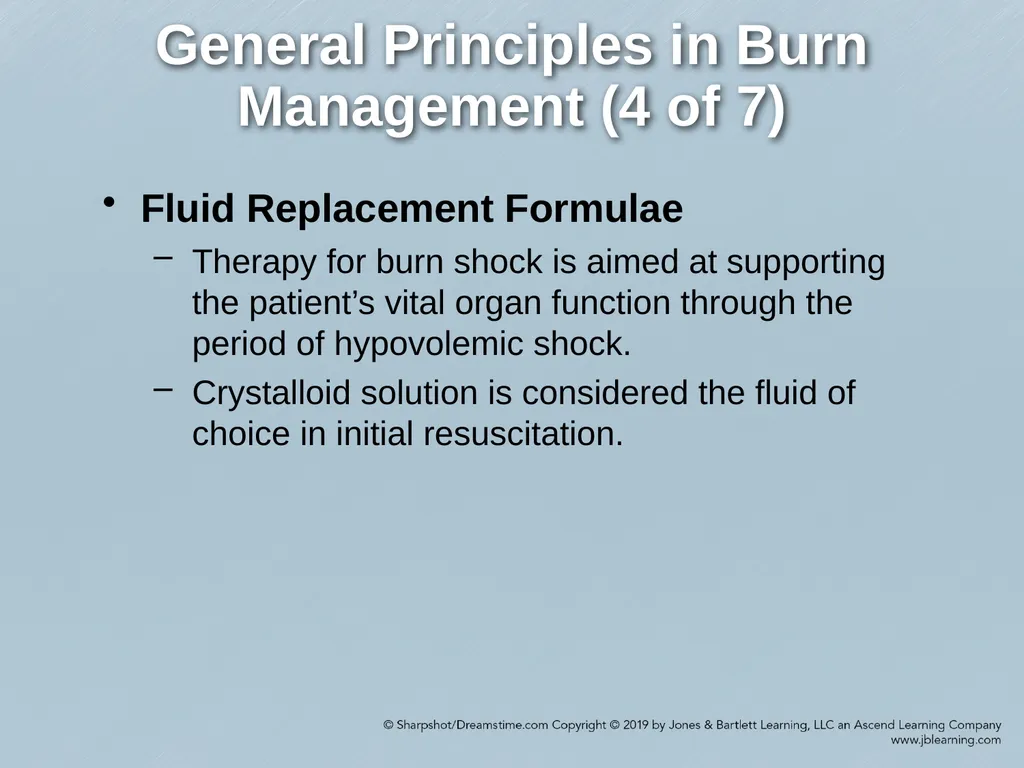
Therapy for burn shock is aimed at supporting the patient’s vital organ function through the period of hypovolemic shock.
Crystalloid solution is considered the fluid of choice in initial resuscitation.<br>
Therapy for burn shock is aimed at supporting the patient’s vital organ function through the period of hypovolemic shock.
Crystalloid solution is considered the fluid of choice in initial resuscitation.<br>
30
General Principles in Burn Management (5 of 7) Fluid Replacement Formulae (cont.)
Parkland Formula
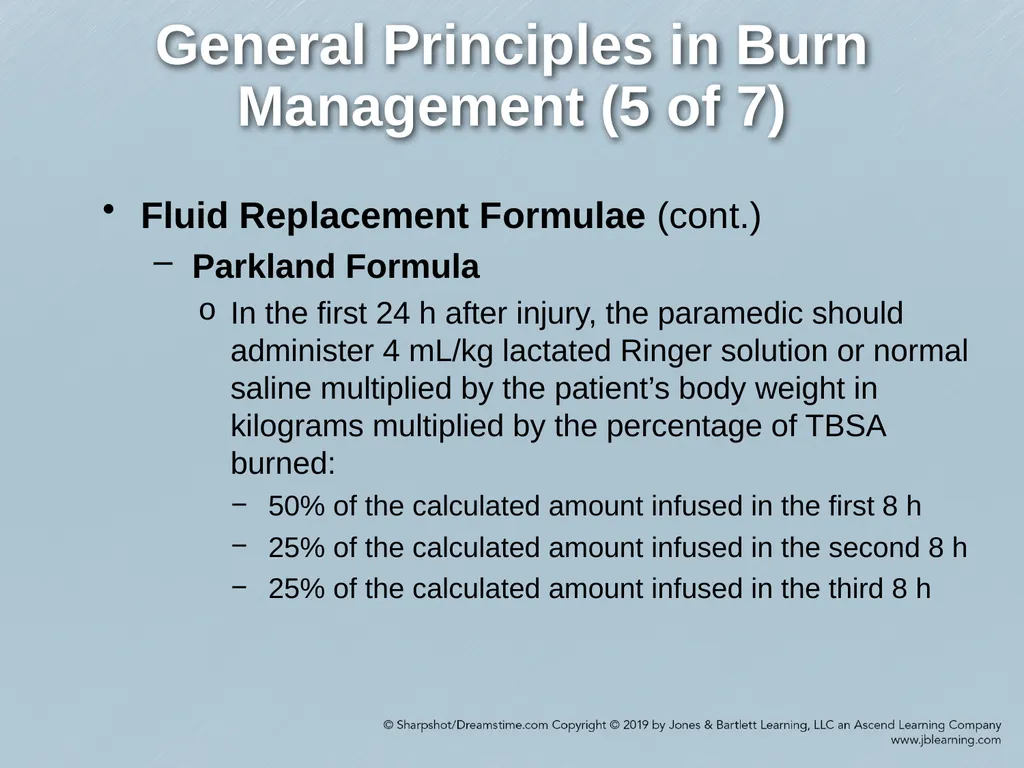
In the first 24 h after injury, the paramedic should administer 4 mL/kg lactated Ringer solution or normal saline multiplied by the patient’s body weight in kilograms multiplied by the percentage of TBSA burned:
50% of the calculated amount infused in the first 8 h
25% of the calculated amount infused in the second 8 h
25% of the calculated amount infused in the third 8 h<br>
Parkland Formula
In the first 24 h after injury, the paramedic should administer 4 mL/kg lactated Ringer solution or normal saline multiplied by the patient’s body weight in kilograms multiplied by the percentage of TBSA burned:
50% of the calculated amount infused in the first 8 h
25% of the calculated amount infused in the second 8 h
25% of the calculated amount infused in the third 8 h<br>
31
General Principles in Burn Management (6 of 7) Fluid Replacement Formulae (cont.)
Rule of 10
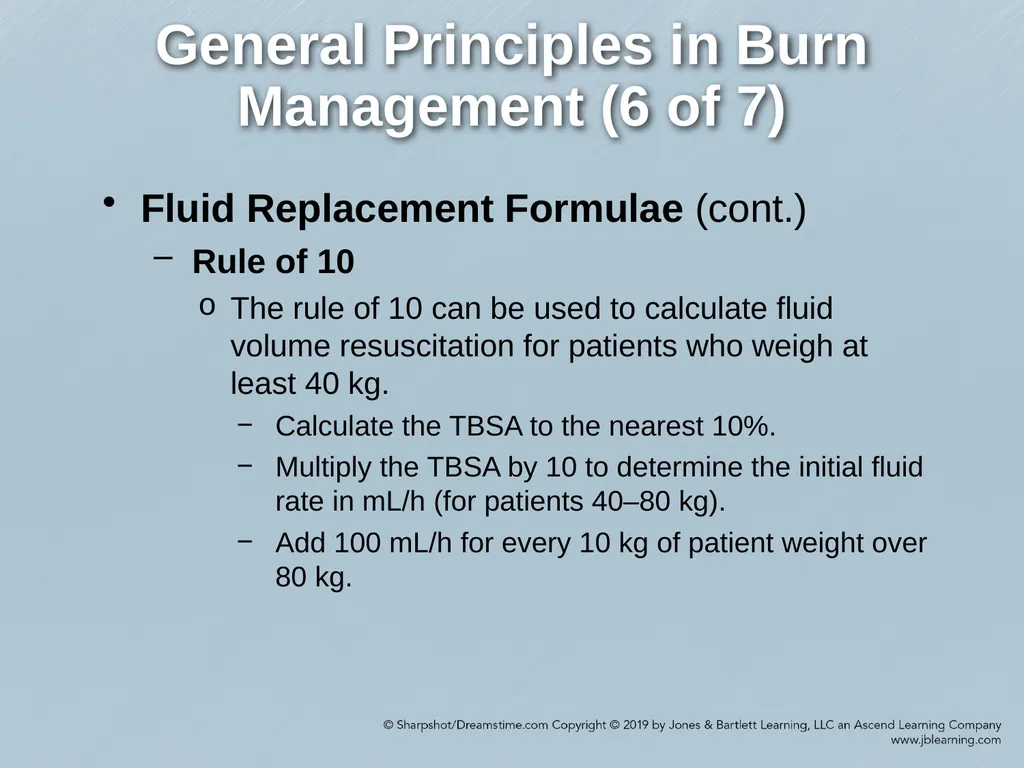
The rule of 10 can be used to calculate fluid volume resuscitation for patients who weigh at least 40 kg.
Calculate the TBSA to the nearest 10%.
Multiply the TBSA by 10 to determine the initial fluid rate in mL/h (for patients 40–80 kg).
Add 100 mL/h for every 10 kg of patient weight over 80 kg.<br>
Rule of 10
The rule of 10 can be used to calculate fluid volume resuscitation for patients who weigh at least 40 kg.
Calculate the TBSA to the nearest 10%.
Multiply the TBSA by 10 to determine the initial fluid rate in mL/h (for patients 40–80 kg).
Add 100 mL/h for every 10 kg of patient weight over 80 kg.<br>
32
General Principles in Burn Management (7 of 7) Special Considerations
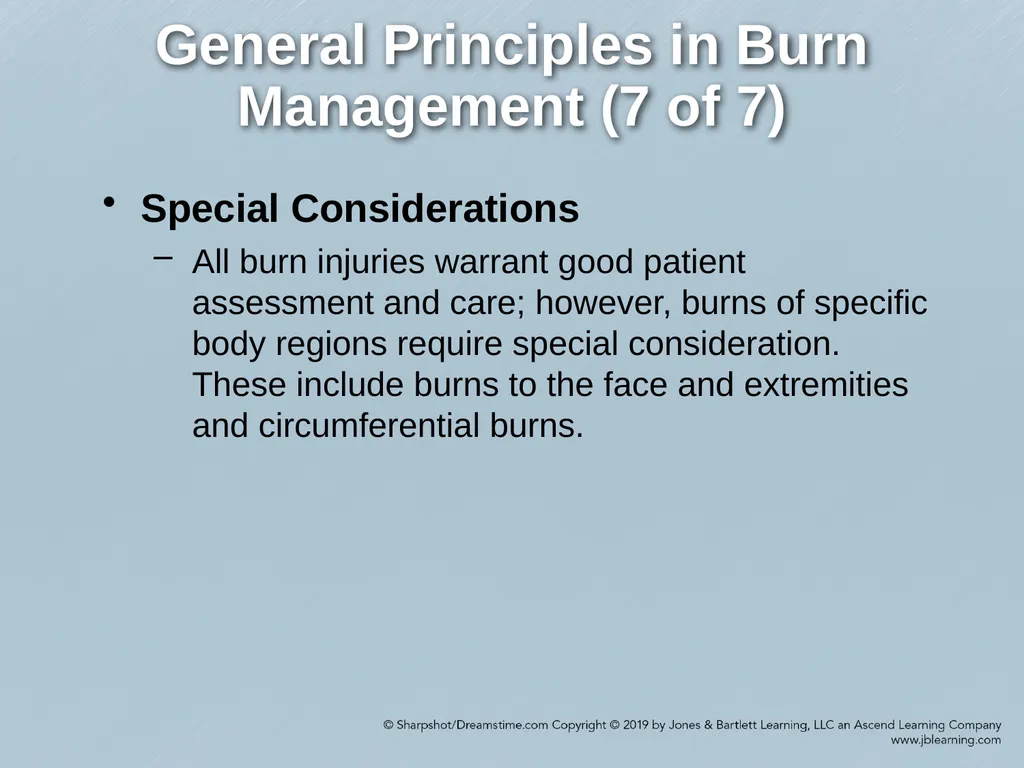
All burn injuries warrant good patient assessment and care; however, burns of specific body regions require special consideration. These include burns to the face and extremities and circumferential burns.<br>
All burn injuries warrant good patient assessment and care; however, burns of specific body regions require special consideration. These include burns to the face and extremities and circumferential burns.<br>
33
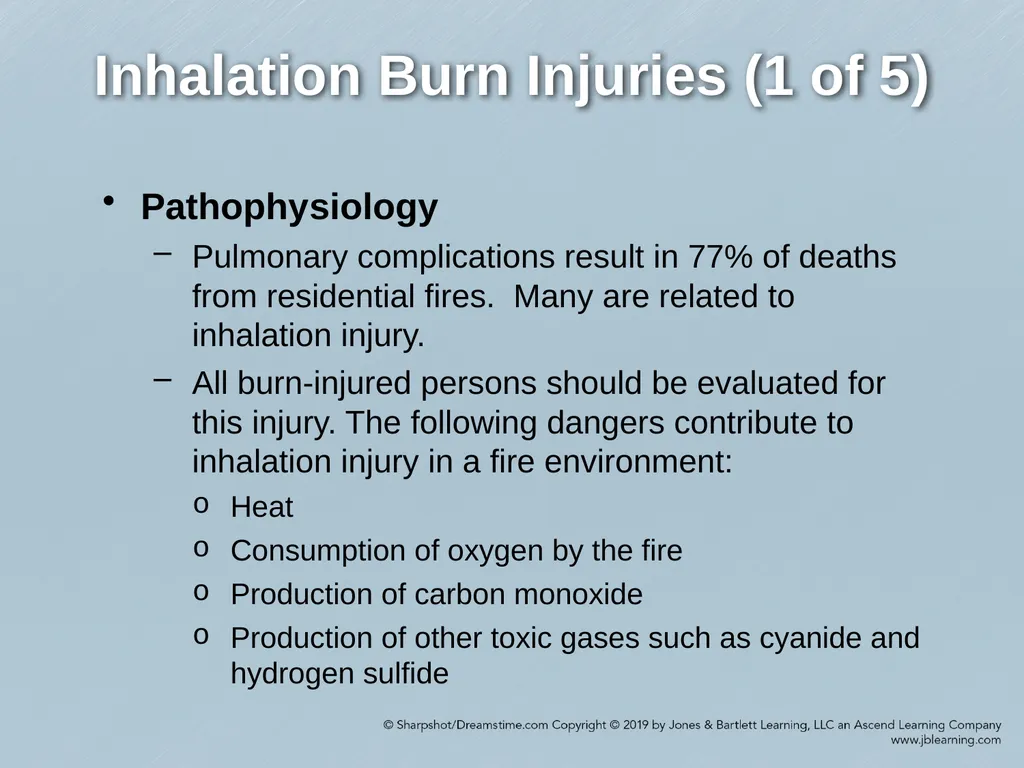
Inhalation Burn Injuries (1 of 5) Pathophysiology
Pulmonary complications result in 77% of deaths from residential fires. Many are related to inhalation injury.
All burn-injured persons should be evaluated for this injury. The following dangers contribute to inhalation injury in a fire environment:
Heat
Consumption of oxygen by the fire
Production of carbon monoxide
Production of other toxic gases such as cyanide and hydrogen sulfide<br>
Pulmonary complications result in 77% of deaths from residential fires. Many are related to inhalation injury.
All burn-injured persons should be evaluated for this injury. The following dangers contribute to inhalation injury in a fire environment:
Heat
Consumption of oxygen by the fire
Production of carbon monoxide
Production of other toxic gases such as cyanide and hydrogen sulfide<br>
34
Inhalation Burn Injuries (2 of 5) Pathophysiology (cont.)
Smoke inhalation and inhalation injury can produce a large number of complications.
For this text, these complications are classified as carbon monoxide poisoning, inhalation injury above the glottis (supraglottic), and inhalation injury below the glottis (infraglottic).<br>
Smoke inhalation and inhalation injury can produce a large number of complications.
For this text, these complications are classified as carbon monoxide poisoning, inhalation injury above the glottis (supraglottic), and inhalation injury below the glottis (infraglottic).<br>
35
Inhalation Burn Injuries (3 of 5) Carbon Monoxide Poisoning
Carbon monoxide is a colorless, odorless, tasteless gas produced by incomplete burning of carbon-containing fuels.<br>
Carbon monoxide is a colorless, odorless, tasteless gas produced by incomplete burning of carbon-containing fuels.<br>
36
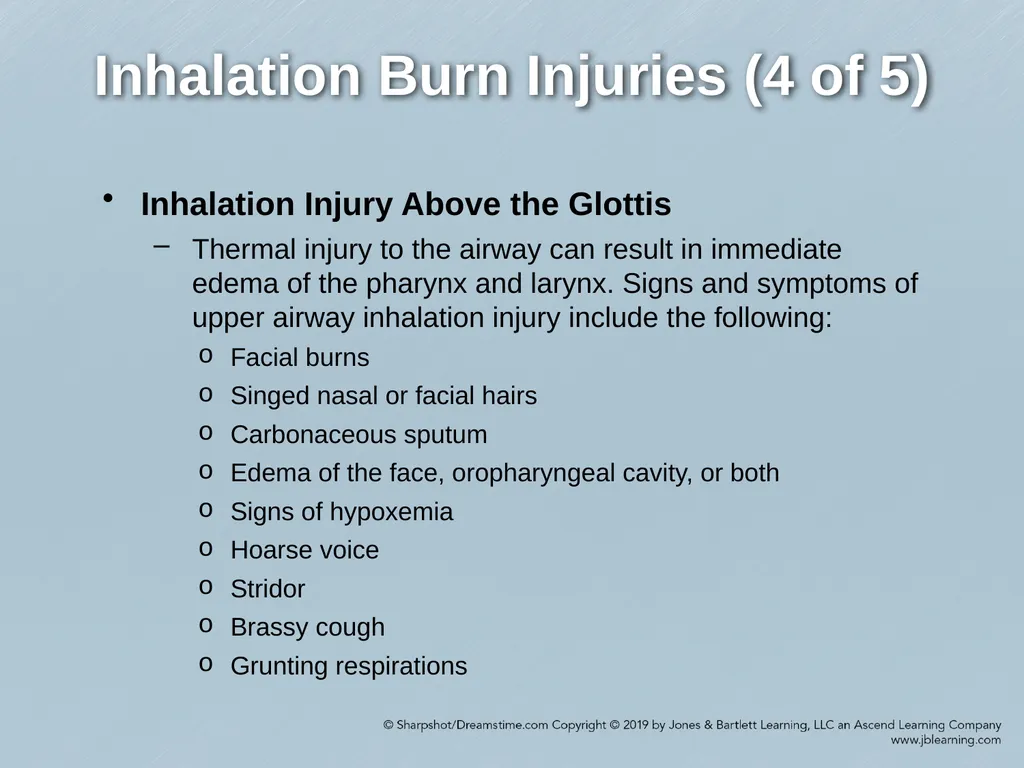
Inhalation Burn Injuries (4 of 5) Inhalation Injury Above the Glottis
Thermal injury to the airway can result in immediate edema of the pharynx and larynx. Signs and symptoms of upper airway inhalation injury include the following:
Facial burns
Singed nasal or facial hairs
Carbonaceous sputum
Edema of the face, oropharyngeal cavity, or both
Signs of hypoxemia
Hoarse voice
Stridor
Brassy cough
Grunting respirations<br>
Thermal injury to the airway can result in immediate edema of the pharynx and larynx. Signs and symptoms of upper airway inhalation injury include the following:
Facial burns
Singed nasal or facial hairs
Carbonaceous sputum
Edema of the face, oropharyngeal cavity, or both
Signs of hypoxemia
Hoarse voice
Stridor
Brassy cough
Grunting respirations<br>
37
Inhalation Burn Injuries (5 of 5) Inhalation Injury Below the Glottis
Signs and symptoms may begin several hours after the exposure and include the following:
Wheezes
Crackles or rhonchi
Productive cough
Signs of hypoxemia
Spasm of bronchi and bronchioles<br>
Signs and symptoms may begin several hours after the exposure and include the following:
Wheezes
Crackles or rhonchi
Productive cough
Signs of hypoxemia
Spasm of bronchi and bronchioles<br>
38
Chemical Burn Injuries (1 of 8) Assessment
When dealing with a chemical exposure, the paramedic should determine the following:
Type of chemical substance
Concentration of chemical substance
Volume of chemical substance
Mechanism of injury
Time of contamination
First aid administered before EMS (emergency medical services) arrival
Appearance
Pain<br>
When dealing with a chemical exposure, the paramedic should determine the following:
Type of chemical substance
Concentration of chemical substance
Volume of chemical substance
Mechanism of injury
Time of contamination
First aid administered before EMS (emergency medical services) arrival
Appearance
Pain<br>
39
Chemical Burn Injuries (2 of 8) Management
Treatment is directed at stopping the burning process, which can best be achieved by the following actions:
Remove all of the patient’s clothing, including shoes. Clothing can trap concentrated chemicals.
Brush off powdered chemicals.
Remove blisters that may contain chemicals.
Irrigate the affected area with copious amounts of water.<br>
Treatment is directed at stopping the burning process, which can best be achieved by the following actions:
Remove all of the patient’s clothing, including shoes. Clothing can trap concentrated chemicals.
Brush off powdered chemicals.
Remove blisters that may contain chemicals.
Irrigate the affected area with copious amounts of water.<br>
40
Chemical Burn Injuries (3 of 8) Management (cont.)
In otherwise stable patients, irrigation takes priority over transport. That is the case unless irrigation can be continued en route to the emergency department.
If a large body surface area is involved, a shower should be used for irrigation, if available.<br>
In otherwise stable patients, irrigation takes priority over transport. That is the case unless irrigation can be continued en route to the emergency department.
If a large body surface area is involved, a shower should be used for irrigation, if available.<br>
41
Chemical Burn Injuries (4 of 8) Management (cont.)
Chemical burn injury to the eyes
After removing patients from the contaminated area, management guidelines include flushing the eyes with water.
Use of antidotes or neutralizing agents
According to the American Burn Association, no agent has been found to be superior to water for treating most chemical burns.<br>
Chemical burn injury to the eyes
After removing patients from the contaminated area, management guidelines include flushing the eyes with water.
Use of antidotes or neutralizing agents
According to the American Burn Association, no agent has been found to be superior to water for treating most chemical burns.<br>
42
Chemical Burn Injuries (5 of 8) Specific Chemical Injuries
Petroleum
In the absence of flame, products such as gasoline and diesel fuel can cause significant chemical burns if prolonged contact occurs.<br>
Petroleum
In the absence of flame, products such as gasoline and diesel fuel can cause significant chemical burns if prolonged contact occurs.<br>
43
Chemical Burn Injuries (6 of 8) Specific Chemical Injuries (cont.)
Hydrofluoric Acid
The hydrogen ion and fluoride ion are damaging to tissue. Fluoride hinders several chemical reactions that are required for cell survival.
Irrigation of the exposed area with large amounts of water for 15 min should be started immediately.<br>
Hydrofluoric Acid
The hydrogen ion and fluoride ion are damaging to tissue. Fluoride hinders several chemical reactions that are required for cell survival.
Irrigation of the exposed area with large amounts of water for 15 min should be started immediately.<br>
44
Chemical Burn Injuries (7 of 8) Specific Chemical Injuries (cont.)
Phenol
Phenol (carbolic acid) is an aromatic hydrocarbon. Phenol is derived from coal tar and is used widely in industry as a disinfectant in cleaning agents.
Ammonia
Ammonia is a noxious, irritating gas. It is a strong alkali that is very soluble in water.
Ammonia is hazardous if introduced into the eye and may result in corneal burns, ulcers, tissue necrosis, and blindness.<br>
Phenol
Phenol (carbolic acid) is an aromatic hydrocarbon. Phenol is derived from coal tar and is used widely in industry as a disinfectant in cleaning agents.
Ammonia
Ammonia is a noxious, irritating gas. It is a strong alkali that is very soluble in water.
Ammonia is hazardous if introduced into the eye and may result in corneal burns, ulcers, tissue necrosis, and blindness.<br>
45
Chemical Burn Injuries (8 of 8) Specific Chemical Injuries (cont.)
Chlorine
Patients exposed to chlorine have signs and symptoms similar to those of ammonia exposure; however, they are more likely to have bronchiolar burns and develop wheezing.
Alkali metals
Physically removing the metal or covering it with oil minimizes the thermal injury.<br>
Chlorine
Patients exposed to chlorine have signs and symptoms similar to those of ammonia exposure; however, they are more likely to have bronchiolar burns and develop wheezing.
Alkali metals
Physically removing the metal or covering it with oil minimizes the thermal injury.<br>
46
Electrical Burn Injuries (1 of 7) Types of Electrical Injury
Direct-contact burns occur when electric current directly penetrates the resistance of the skin and underlying tissues.
Arc injuries occur when a person is close enough to a high-voltage source that the current between two contact points near the skin overcomes the resistance in the air, passing the current flow through the air to the bystander.
Flame and flash burn injuries can occur when the heat of electric current ignites a nearby combustible source.<br>
Direct-contact burns occur when electric current directly penetrates the resistance of the skin and underlying tissues.
Arc injuries occur when a person is close enough to a high-voltage source that the current between two contact points near the skin overcomes the resistance in the air, passing the current flow through the air to the bystander.
Flame and flash burn injuries can occur when the heat of electric current ignites a nearby combustible source.<br>
47
Electrical Burn Injuries (2 of 7) Effects of Electrical Injury
The skin is almost always the first point of contact with electric current. Direct contact and passage of the current through tissue may cause wide areas of coagulation necrosis.<br>
The skin is almost always the first point of contact with electric current. Direct contact and passage of the current through tissue may cause wide areas of coagulation necrosis.<br>
48
Electrical Burn Injuries (3 of 7) Assessment and Management
Primary Survey
The primary survey should proceed as it does for all other trauma patients.
The paramedic should take care to stabilize the cervical spine.
If the patient is not breathing, assisted ventilation should begin immediately.
The paramedic should perform intubation as soon as possible because apnea may persist for lengthy period.<br>
Primary Survey
The primary survey should proceed as it does for all other trauma patients.
The paramedic should take care to stabilize the cervical spine.
If the patient is not breathing, assisted ventilation should begin immediately.
The paramedic should perform intubation as soon as possible because apnea may persist for lengthy period.<br>
49
Electrical Burn Injuries (4 of 7) Assessment and Management (cont.)
Primary Survey (cont.)
If possible, a history of the event should be obtained that includes the following:
Patient’s chief complaint (e.g., injury and disorientation)
Source, voltage, and amperage of the electrical injury
Duration of contact
Level of consciousness before and after the injury
Significant medical history<br>
Primary Survey (cont.)
If possible, a history of the event should be obtained that includes the following:
Patient’s chief complaint (e.g., injury and disorientation)
Source, voltage, and amperage of the electrical injury
Duration of contact
Level of consciousness before and after the injury
Significant medical history<br>
50
Electrical Burn Injuries (5 of 7) Assessment and Management (cont.)
Primary Survey (cont.)
Physical Examination
The physical examination should be thorough. The paramedic should search for entrance and exit wounds, or any associated trauma.
Management
Early administration of fluids is vital for patients with severe electrical injury. Fluid administration helps to prevent hypovolemia and subsequent renal failure.<br>
Primary Survey (cont.)
Physical Examination
The physical examination should be thorough. The paramedic should search for entrance and exit wounds, or any associated trauma.
Management
Early administration of fluids is vital for patients with severe electrical injury. Fluid administration helps to prevent hypovolemia and subsequent renal failure.<br>
51
Electrical Burn Injuries (6 of 7) Lightning Injury
Lightning can deliver DC of up to 200,000 amp at a potential of 100 million or more volts, with temperatures up to 50,000°F (27,760°C), which is five times hotter than the surface of the Sun.<br>
Lightning can deliver DC of up to 200,000 amp at a potential of 100 million or more volts, with temperatures up to 50,000°F (27,760°C), which is five times hotter than the surface of the Sun.<br>
52
Electrical Burn Injuries (7 of 7) Lightning Injury (cont.)
Assessment and Management
Like all other emergency responses, scene safety is the first priority. If the electrical storm is still in progress, all patient care should take place in a sheltered area.
To prevent injury from subsequent lightning strikes, the paramedic crew should stay away from objects that project from the ground, such as trees, fences, and high buildings.<br>
Assessment and Management
Like all other emergency responses, scene safety is the first priority. If the electrical storm is still in progress, all patient care should take place in a sheltered area.
To prevent injury from subsequent lightning strikes, the paramedic crew should stay away from objects that project from the ground, such as trees, fences, and high buildings.<br>
53
Radiation Exposure (1 of 7) Characteristics of Ionizing Radiation
The most common radiation incidents involve sealed radioactive sources used in industrial radiography and nondestructive testing. People involved in these types of incidents rarely require emergency care.
Ionizing radiation results from energy released by atoms and travels in electromagnetic waves.
Gamma rays and X-rays are the most dangerous forms of penetrating radiation. They require lead shields for protection.<br>
The most common radiation incidents involve sealed radioactive sources used in industrial radiography and nondestructive testing. People involved in these types of incidents rarely require emergency care.
Ionizing radiation results from energy released by atoms and travels in electromagnetic waves.
Gamma rays and X-rays are the most dangerous forms of penetrating radiation. They require lead shields for protection.<br>
54
Radiation Exposure (2 of 7) Harmful Effects from Radiation Exposure
Nonionizing radiation includes radio waves and microwaves.
Doses of less than 100 rem usually do not cause significant acute problems.
Doses from 100 to 200 rem may cause symptoms, yet the doses are not life threatening.
When an exposure of 200 rem is neared, nausea, vomiting, and diarrhea begin within 24 h.<br>
Nonionizing radiation includes radio waves and microwaves.
Doses of less than 100 rem usually do not cause significant acute problems.
Doses from 100 to 200 rem may cause symptoms, yet the doses are not life threatening.
When an exposure of 200 rem is neared, nausea, vomiting, and diarrhea begin within 24 h.<br>
55
Radiation Exposure (3 of 7) Harmful Effects from Radiation Exposure (cont.)
After an exposure of 450 rem, cognitive impairment occurs.
Mortality is high with exposures of 600 rem or more.<br>
After an exposure of 450 rem, cognitive impairment occurs.
Mortality is high with exposures of 600 rem or more.<br>
56
Radiation Exposure (4 of 7) Emergency Response to Radiation Accidents
If the EMS crew has been advised that radioactive materials are present at an emergency scene, the team should approach the site with caution.<br>
If the EMS crew has been advised that radioactive materials are present at an emergency scene, the team should approach the site with caution.<br>
57
Radiation Exposure (5 of 7) Personal Protection from Radiation
Time
Distance
Shielding
Quantity<br>
Time
Distance
Shielding
Quantity<br>
58
Radiation Exposure (6 of 7) Emergency Care for Patients with Radiation Exposure
External contamination and radioactive materials can remain on the patient’s clothing and skin or in open wounds.
If this occurs, the rescuer should consult with medical direction and follow agency protocol. The effects of radiation exposure may be instant (e.g., burns) or delayed.<br>
External contamination and radioactive materials can remain on the patient’s clothing and skin or in open wounds.
If this occurs, the rescuer should consult with medical direction and follow agency protocol. The effects of radiation exposure may be instant (e.g., burns) or delayed.<br>
59
Radiation Exposure (7 of 7) Radiation Decontamination Procedures
Radiation emergencies involving patients may be defined in two ways: clean and dirty.
Clean means that the patient was exposed but not contaminated.
Dirty means that the patient was contaminated.<br>
Radiation emergencies involving patients may be defined in two ways: clean and dirty.
Clean means that the patient was exposed but not contaminated.
Dirty means that the patient was contaminated.<br>