
Chapter 4 New Variety Design and Product Profiling
KB
Published · 45 slides · 0 views
1 / 1
Description
Chapter 4 New Variety Design and Product Profiling Shimelis Hussein The Business of Plant Breeding: Market-led approaches to new variety design in Africa Chapter 4 New Variety Design and Product Profiling Shimelis Hussein Africa Centre for
Related Topics
Share
Embed code
Download this presentation From Below
"Chapter 4 New Variety Design and Product Profiling" is the property of its rightful owner. Permission is granted to download and print the materials on this website for personal, non-commercial use only, and to display it on your personal computer provided you do not modify the materials and that you retain all copyright notices contained in the materials. By downloading content from our website, you accept the terms of this agreement.
Presentation Transcript
01
Chapter 4
New Variety Design and Product Profiling
Shimelis Hussein The Business of Plant Breeding:
Market-led approaches to new variety design in Africa<br>
New Variety Design and Product Profiling
Shimelis Hussein The Business of Plant Breeding:
Market-led approaches to new variety design in Africa<br>
02
Chapter 4
New Variety Design and Product Profiling Shimelis Hussein
Africa Centre for Crop Improvement (ACCI)
University of KwaZulu-Natal
P/Bag X01, Scottsville 3209, Pietermaritzburg
South Africa<br>
Africa Centre for Crop Improvement (ACCI)
University of KwaZulu-Natal
P/Bag X01, Scottsville 3209, Pietermaritzburg
South Africa<br>
03
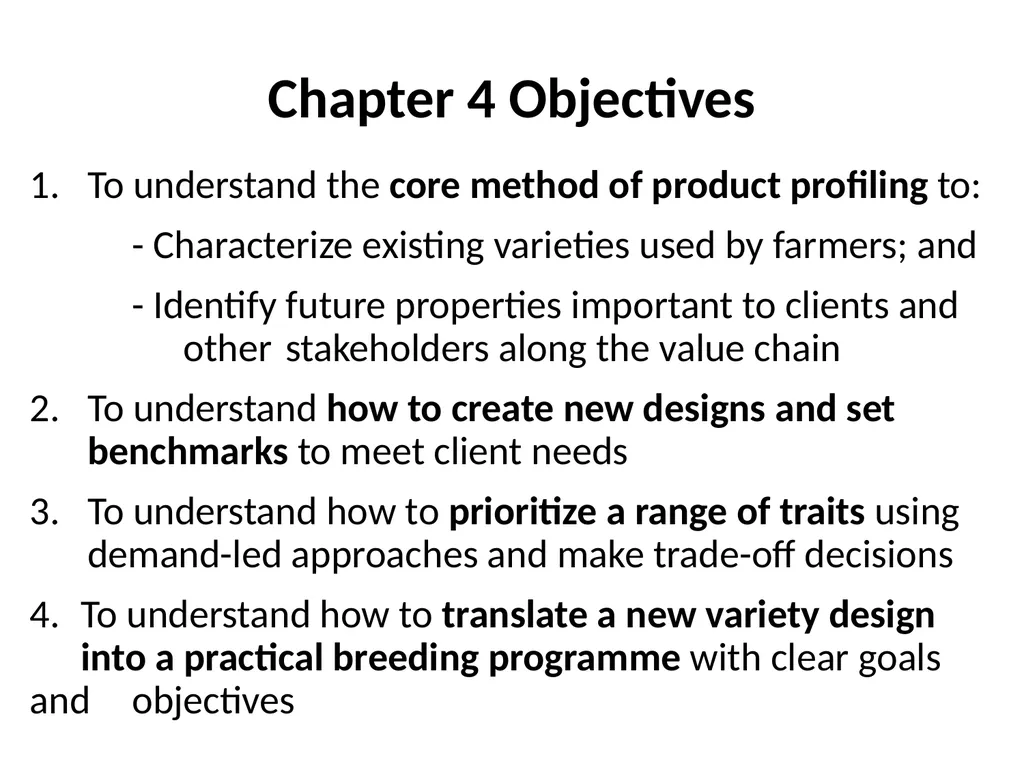
Chapter 4 Objectives To understand the core method of product profiling to:
- Characterize existing varieties used by farmers; and
- Identify future properties important to clients and other stakeholders along the value chain
To understand how to create new designs and set benchmarks to meet client needs
To understand how to prioritize a range of traits using demand-led approaches and make trade-off decisions
4. To understand how to translate a new variety design into a practical breeding programme with clear goals and objectives<br>
04
Chapter 4 Contents Introduction
New Variety Design and Product Profiling
Creating a Product Profile
Trait Prioritization
Setting External Performance Standards
Validating Variety Designs
Translating Product Profiles into Breeding Objectives
Conclusion<br>
New Variety Design and Product Profiling
Creating a Product Profile
Trait Prioritization
Setting External Performance Standards
Validating Variety Designs
Translating Product Profiles into Breeding Objectives
Conclusion<br>
05
1. INTRODUCTION Opening Group Discussion
How do you design your new varieties?
How do you decide the performance required from your new varieties?<br>
How do you design your new varieties?
How do you decide the performance required from your new varieties?<br>
06
2. NEW VARIETY DESIGN AND
PRODUCT PROFILING<br>
07
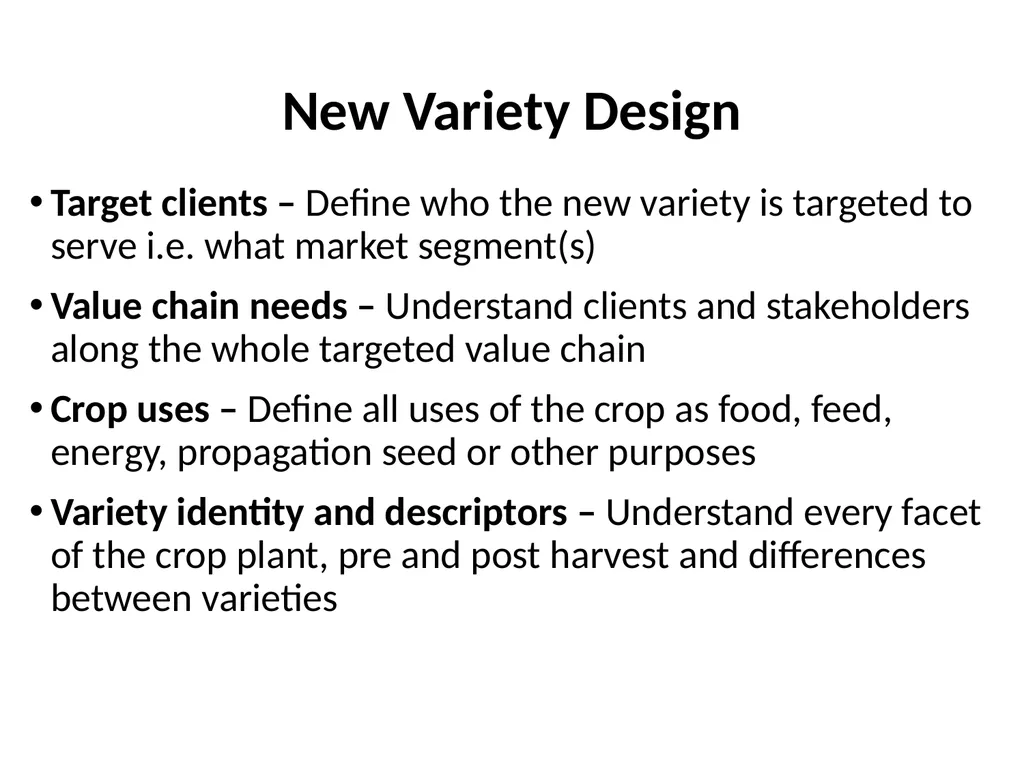
New Variety Design Target clients – Define who the new variety is targeted to serve i.e. what market segment(s)
Value chain needs – Understand clients and stakeholders along the whole targeted value chain
Crop uses – Define all uses of the crop as food, feed, energy, propagation seed or other purposes
Variety identity and descriptors – Understand every facet of the crop plant, pre and post harvest and differences between varieties<br>
08
New Variety Design Variety awareness and demand - Regular contact with clients and stakeholders. Involve them in decision-making and testing of new designs to create “product pull” and widespread use of the variety when it is registered
Product profiling - A “product profile” is the name given to the technical specification of a new variety. This design specification contains a detailed set of technical attributes or traits with quantitative measures
Trait prioritization – Determining the relative priority of different traits in a new variety design is an important and active process in demand-led variety design<br>
09
New Variety Design and Product Profiles Key messages
Up-to-date qualitative and quantitative market research data on clients’ needs are essential to make decisions
A key aspect in the design (often overlooked) is the cost and feasibility of seed multiplication
To understand and create an advocacy programme with government regulators to adapt current registration requirements to include new, market-led design features that offer additional benefits to farmers and consumers<br>
10
Client and Market Importance The core goal for a demand-led breeder is to create a new variety that meets a client demand by either:
- Improving design features within existing varieties, - or - Providing new benefits that will increase new varietal adoption.
The four main inputs required for new variety design are:
Market research
Variety performance
Traits required
Trait prioritization<br>
- Improving design features within existing varieties, - or - Providing new benefits that will increase new varietal adoption.
The four main inputs required for new variety design are:
Market research
Variety performance
Traits required
Trait prioritization<br>
11
Client and Market Importance A primary consideration in demand-led variety design is how to define the inherent and relative value of each trait within the product profile, by considering:
Technical and scientific feasibility — Trait combinations may be difficult or impossible to achieve due to fundamental physiological or genetic reasons
Legal considerations and freedom to operate — Access to germplasm and native traits that have intellectual property rights and are owned by others requires careful consideration
Skills and resources — Delivery requires the appropriate personnel, skills and resources to be available
Cost — The variety design must be affordable<br>
12
Individual Exercise List five traits that you are breeding for and who is benefiting.
Place the traits against the primary beneficiaries.<br>
Place the traits against the primary beneficiaries.<br>
13
3. CREATING A PRODUCT PROFILE<br>
14
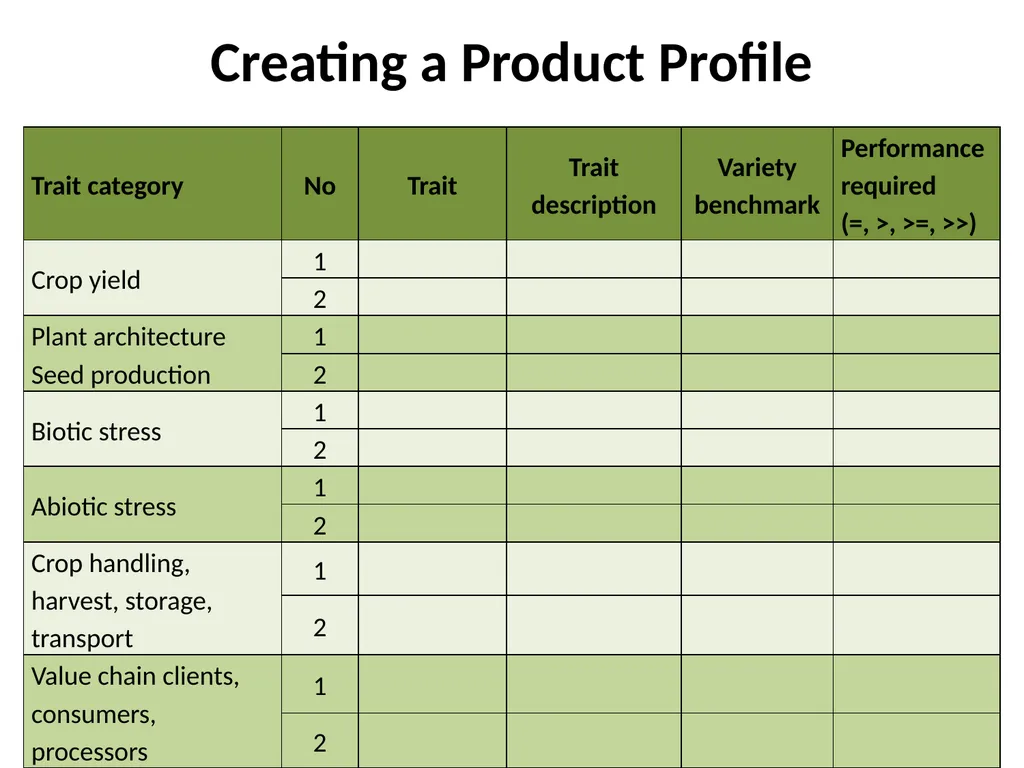
What is a Product Profile? The name given to the full range of technical attributes of a new variety with quantitative measures
Also called “ideotype” or “product specification”
The best product profiles always set a target benchmark for the required performance of each trait; by comparisons vs. the performance of existing varieties and/or expressed on a numeric or photographic scale
Trait descriptors/dictionaries are compiled and published by the CGIAR International Research Centres and national research intuitions<br>
15
Product Profile and New Variety Design A product profile is required for each prospective new variety that can be communicated to other breeders, scientists, managers and non-scientific stakeholders
International crop descriptors are a prerequisite to proceed
Each product characteristic required must be quantified and measurable vs. a target benchmark
The product profile needs to be tested with customers before major investments in a new breeding programme<br>
International crop descriptors are a prerequisite to proceed
Each product characteristic required must be quantified and measurable vs. a target benchmark
The product profile needs to be tested with customers before major investments in a new breeding programme<br>
16
Creating a Product Profile<br>
17
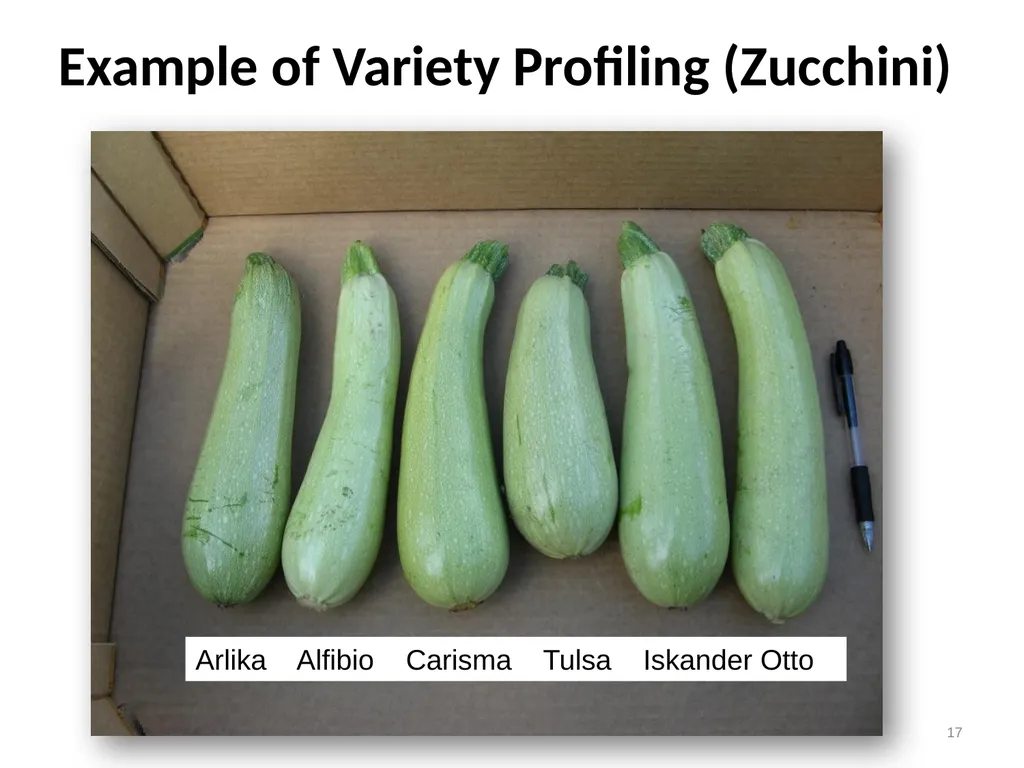
Example of Variety Profiling (Zucchini) 17 Arlika Alfibio Carisma Tulsa Iskander Otto<br>
18
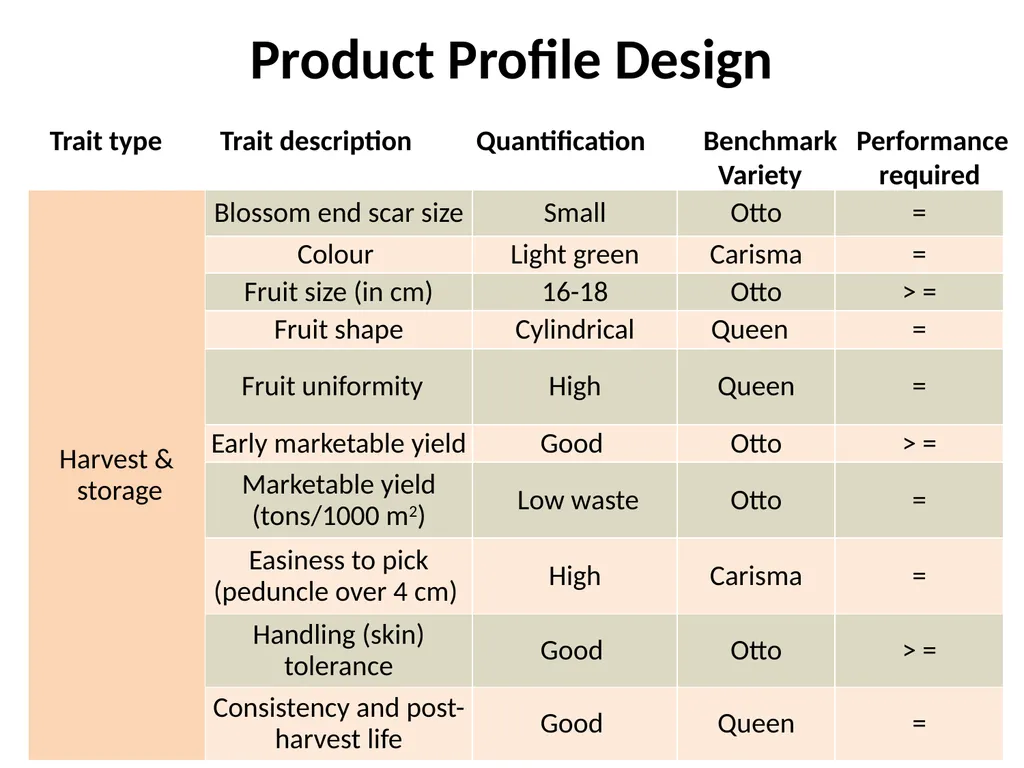
Product Profile Design Trait type Trait description Quantification Benchmark Performance
Variety required<br>
19
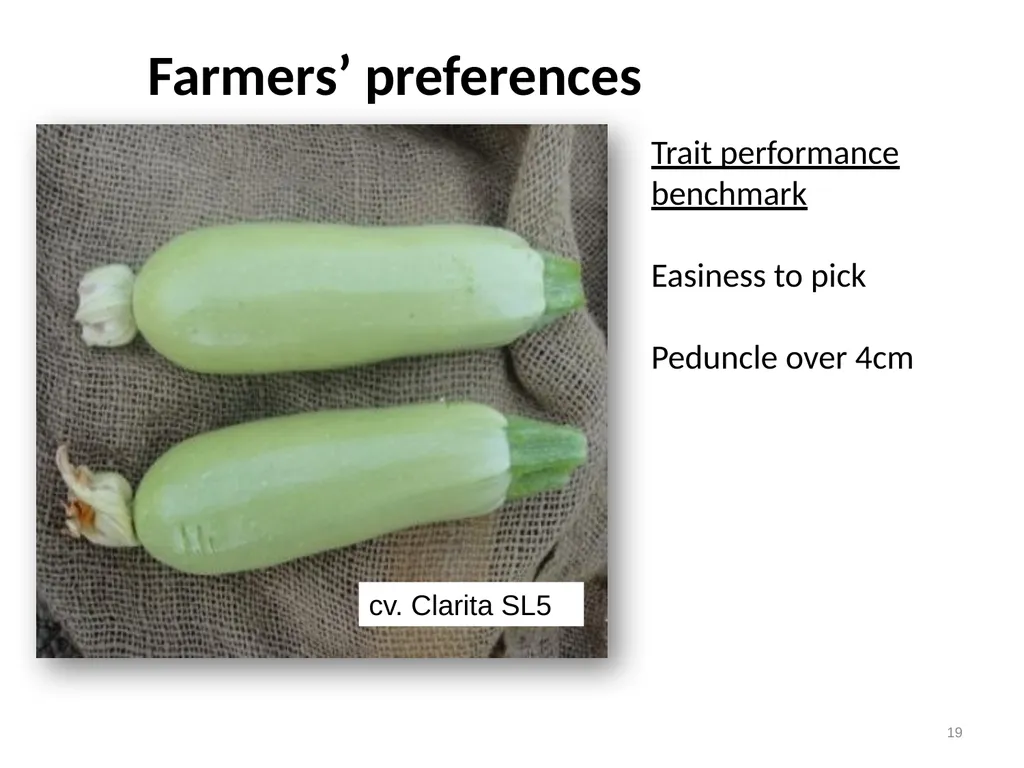
Farmers’ preferences 19 Trait performance
benchmark
Easiness to pick
Peduncle over 4cm cv. Clarita SL5 cv. Clarita SL5<br>
benchmark
Easiness to pick
Peduncle over 4cm cv. Clarita SL5 cv. Clarita SL5<br>
20
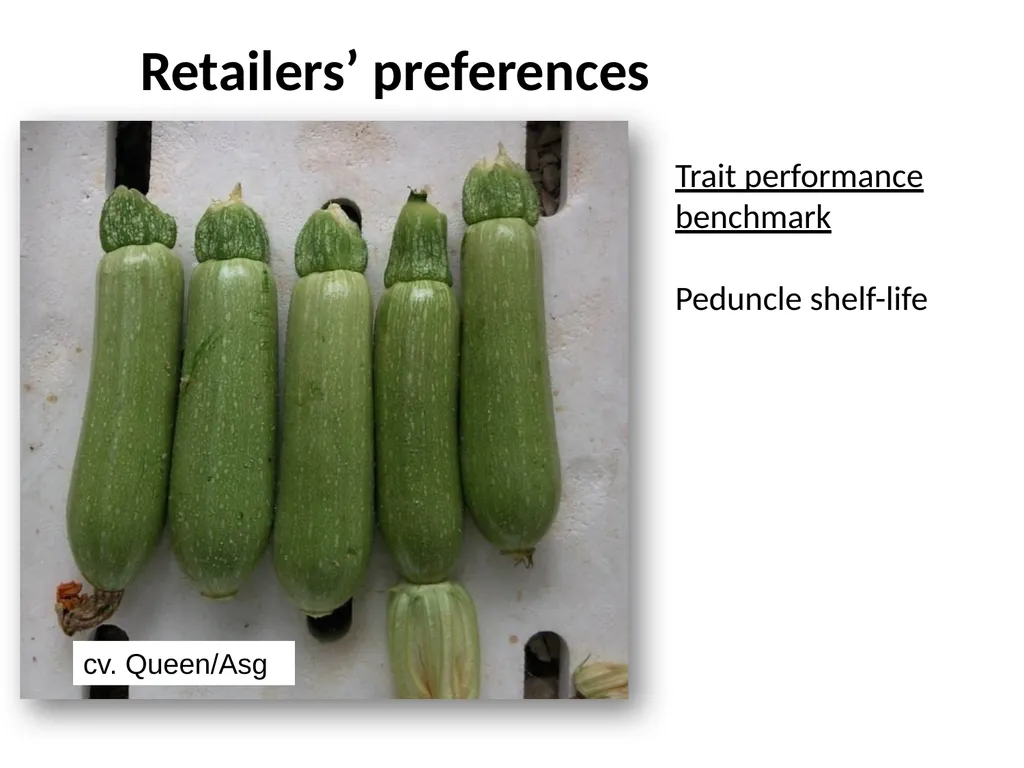
Retailers’ preferences Trait performance
benchmark
Peduncle shelf-life cv. Queen/Asg<br>
benchmark
Peduncle shelf-life cv. Queen/Asg<br>
21
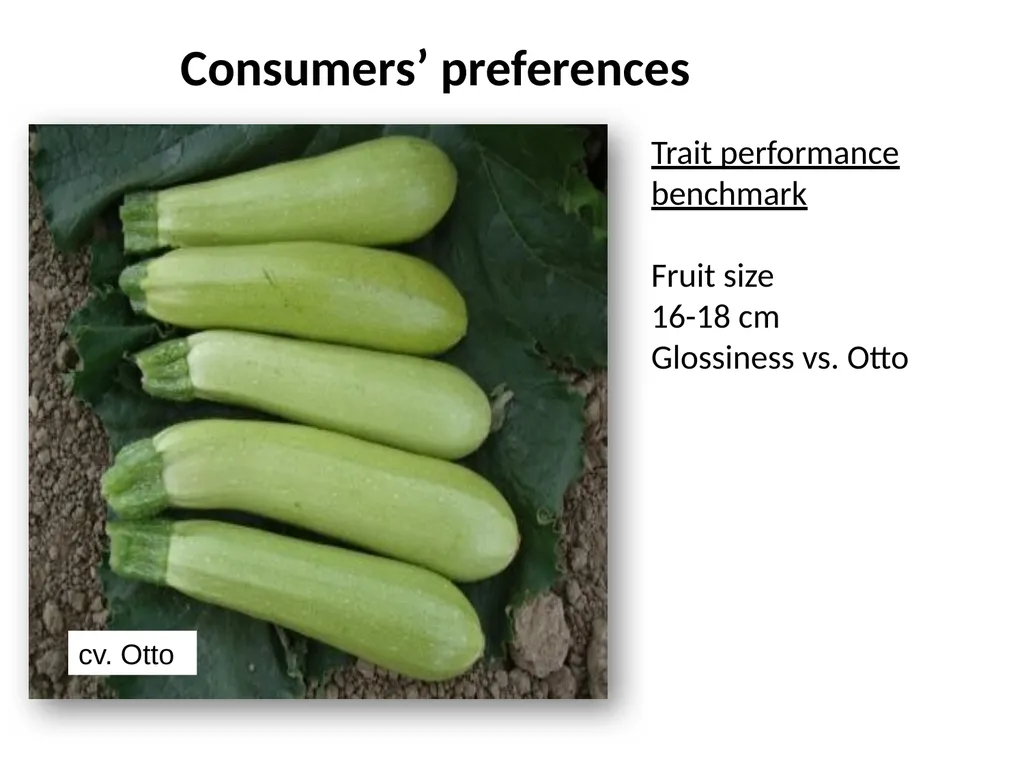
Consumers’ preferences Trait performance
benchmark
Fruit size
16-18 cm
Glossiness vs. Otto cv. Otto<br>
benchmark
Fruit size
16-18 cm
Glossiness vs. Otto cv. Otto<br>
22
4. Trait Prioritization<br>
23
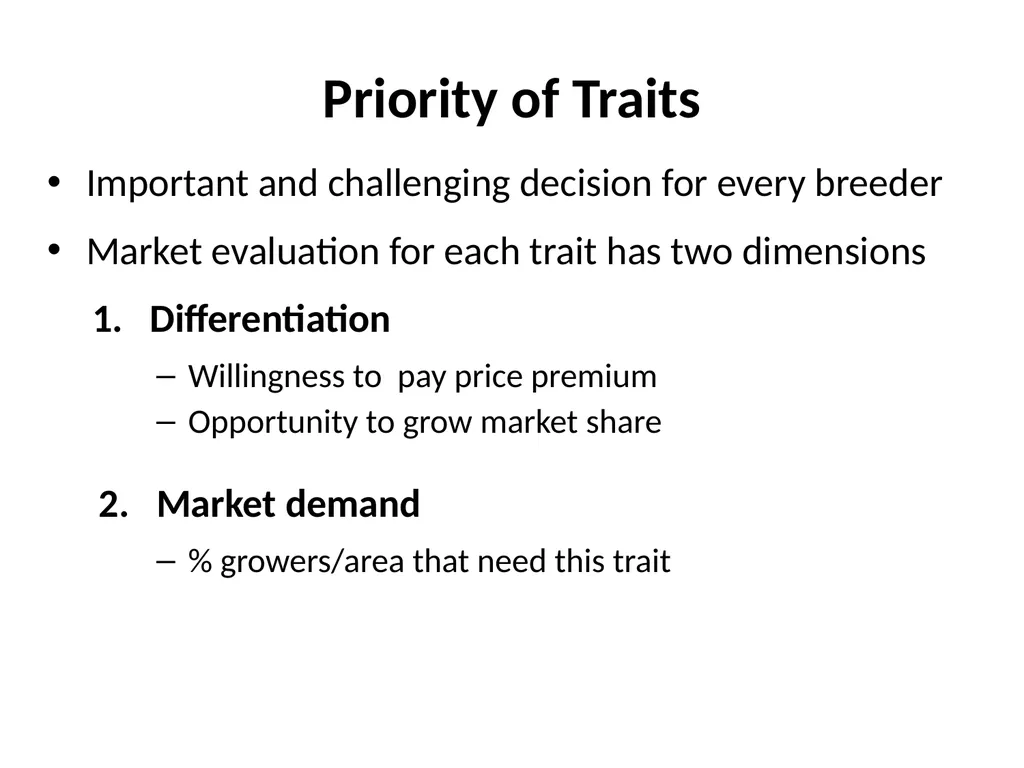
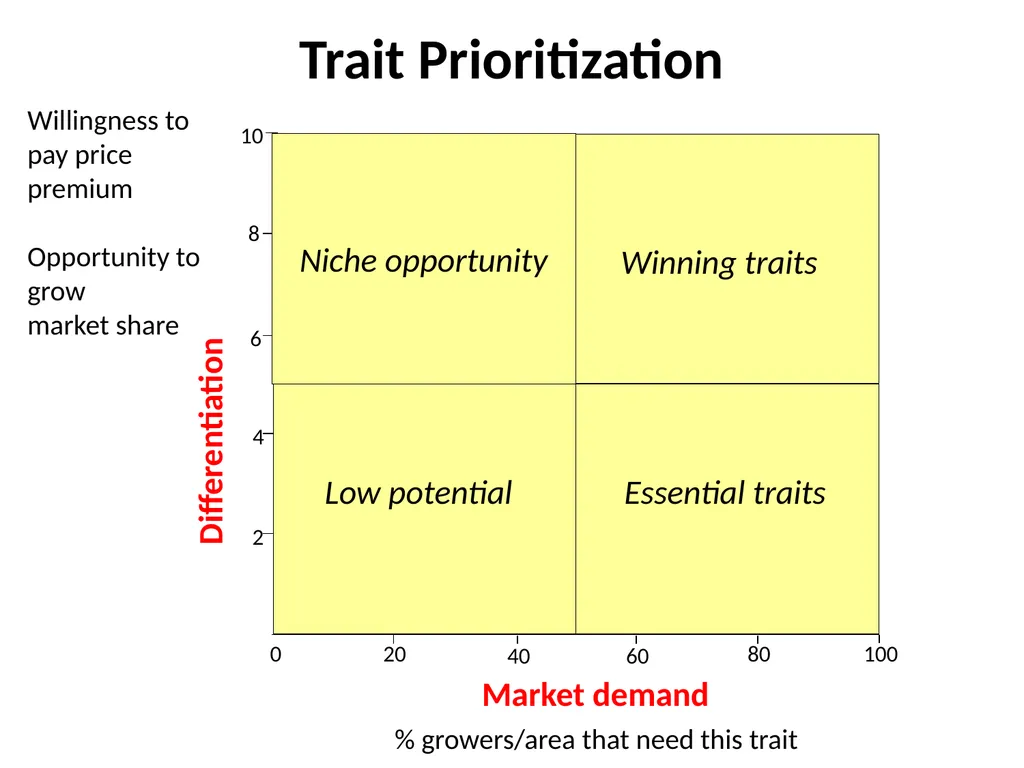
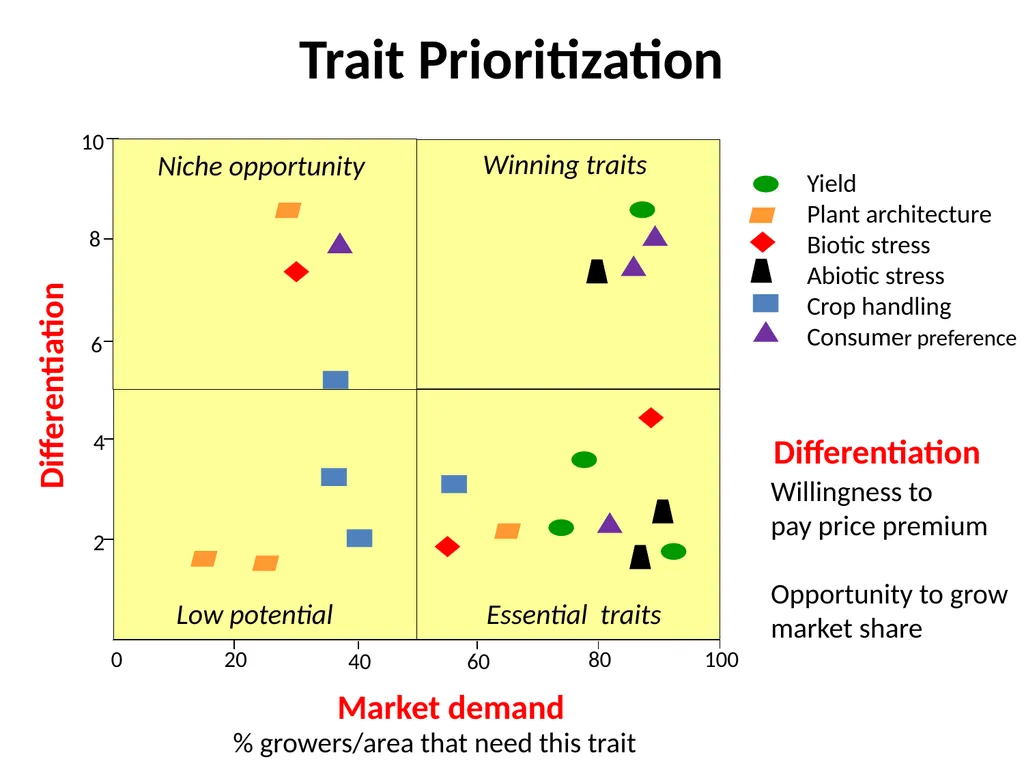
Priority of Traits Important and challenging decision for every breeder
Market evaluation for each trait has two dimensions
Differentiation
Willingness to pay price premium
Opportunity to grow market share
Market demand
% growers/area that need this trait<br>
Market evaluation for each trait has two dimensions
Differentiation
Willingness to pay price premium
Opportunity to grow market share
Market demand
% growers/area that need this trait<br>
24
Trait Prioritization % growers/area that need this trait Differentiation Market demand Willingness to
pay price premium
Opportunity to grow
market share<br>
Opportunity to grow
market share<br>
25
Niche opportunity % growers/area that need this trait Willingness to
pay price premium
Opportunity to grow
market share Differentiation Trait Prioritization<br>
Opportunity to grow
market share Differentiation Trait Prioritization<br>
26
5. Setting External (Non-Market) Performance Standards for a New Variety What are the non-market standards that you have to meet in order to get a new variety released and grown?<br>
27
Variety registration requirements: Dialogue with key officials re registration processes and time frame; markers for varietal identification, adoption, monitoring, performance assessment; requirements for new consumer-based traits e.g. nutritional quality
Advocacy: Create an advocacy programme for changes in registration to assess requirements for market-led traits
Seed production and scaling: Scaling up seed multiplication and what are the associated costs? Seed production costs decide commercial viability Setting Non-Market Standards<br>
Advocacy: Create an advocacy programme for changes in registration to assess requirements for market-led traits
Seed production and scaling: Scaling up seed multiplication and what are the associated costs? Seed production costs decide commercial viability Setting Non-Market Standards<br>
28
Considerations on External Standards of a New Variety Traits known and part of the official crop descriptors or creating a new variety with a very different phenotype
Minimum requirements set by the national testing agency or national variety releasing committee
Traits adhere to farmers or market or industry preferred requirements<br>
Minimum requirements set by the national testing agency or national variety releasing committee
Traits adhere to farmers or market or industry preferred requirements<br>
29
Considerations on External Standards of a New Variety The need for historic performance data (genotype x environment, stability analysis)
Field and laboratory evaluation protocols to make comparisons
Government interest and urgency for the new variety
Relative performance of a new variety vs the national list of recommended varieties<br>
Field and laboratory evaluation protocols to make comparisons
Government interest and urgency for the new variety
Relative performance of a new variety vs the national list of recommended varieties<br>
30
Variety registration, breeders' rights and control Variety registration requirements, breeders' rights and the way cultivars are commercialized differ across countries
Within a country the requirements may differ for different crops
A new variety has to be registered and should appear on the recommended list of cultivars
The new cultivar has to be an improvement over the benchmark using a set of variety descriptions<br>
Within a country the requirements may differ for different crops
A new variety has to be registered and should appear on the recommended list of cultivars
The new cultivar has to be an improvement over the benchmark using a set of variety descriptions<br>
31
Variety registration, breeders' rights and control Several countries (>73) are member of the International Union for the Protection of New Varieties of Plants (UPOV)
UPOV members agreed to acknowledge breeders' rights over a variety
UPOV stimulates breeders' rights at an international level
UPOV has issued a set of basic rules for the development of breeders' rights in the countries of its membership
A new cultivar, in order to obtain breeders' rights, must be:
D Distinguishable, from all other registered cultivars
U Uniform
S Stable, not changing during maintenance and multiplication
N Novel, innovative and should not be commercialized already
The DUSN criteria are established through the results of DUSN trials<br>
32
6. Validating New Variety Designs<br>
33
Validating New Variety Designs Ensure all new variety designs reflect conclusions from market research
Validate any revisions to the ideal design that may alter future demand with farmers and other value chain clients before investment in the breeding program
Identify factors that affect farmer variety preference and adoption and devise a strategy to manage and mitigate the risk factors limiting adoption<br>
34
Validating New Variety Designs Communication of the product profiles and best ways to display and win support for new variety design
Visioning of potential landscape changes is essential
Clarify with clients that new design still responds to market demand, after trade-off decisions made on ideal profile vs. feasibility of breeding the new variety
Engage with key stakeholders in the value chain during the whole timeline of variety development<br>
35
7. Translating Product Profiles into Breeding Objectives<br>
36
Translating Product Profiles into Breeding Objectives Product profile aligns with a set of measurable breeding goals and objectives
Successful demand-led variety design and development creates new varieties that are fit-for-purpose, high quality, and feasible
The breeding science and its technical and practical feasibilities depend on defined goals and objectives<br>
Successful demand-led variety design and development creates new varieties that are fit-for-purpose, high quality, and feasible
The breeding science and its technical and practical feasibilities depend on defined goals and objectives<br>
37
Translating Product Profiles into Breeding Objectives New varieties are highly innovative and require new combinations of traits
The new varieties are: Distinguishable (D), Uniform (U), Stable (S) and Novel (N) - meeting the DUSN trial requirements
Product profiles may require some revisions to increase the probability of delivery
Innovation and ease of delivery can be inversely correlated; Paradigm shifts may require supporting investigative science programs and pre-breeding activities<br>
38
Challenges in Demand-led Breeding Inadequately defined product profile
Poorly defined breeding goals, not supported by specific, measurable objectives
Performance standards either not set or not met<br>
Poorly defined breeding goals, not supported by specific, measurable objectives
Performance standards either not set or not met<br>
39
8. Conclusion How does demand-led design differ from current practice?
What are the implications for the role of the plant breeder ?<br>
What are the implications for the role of the plant breeder ?<br>
40
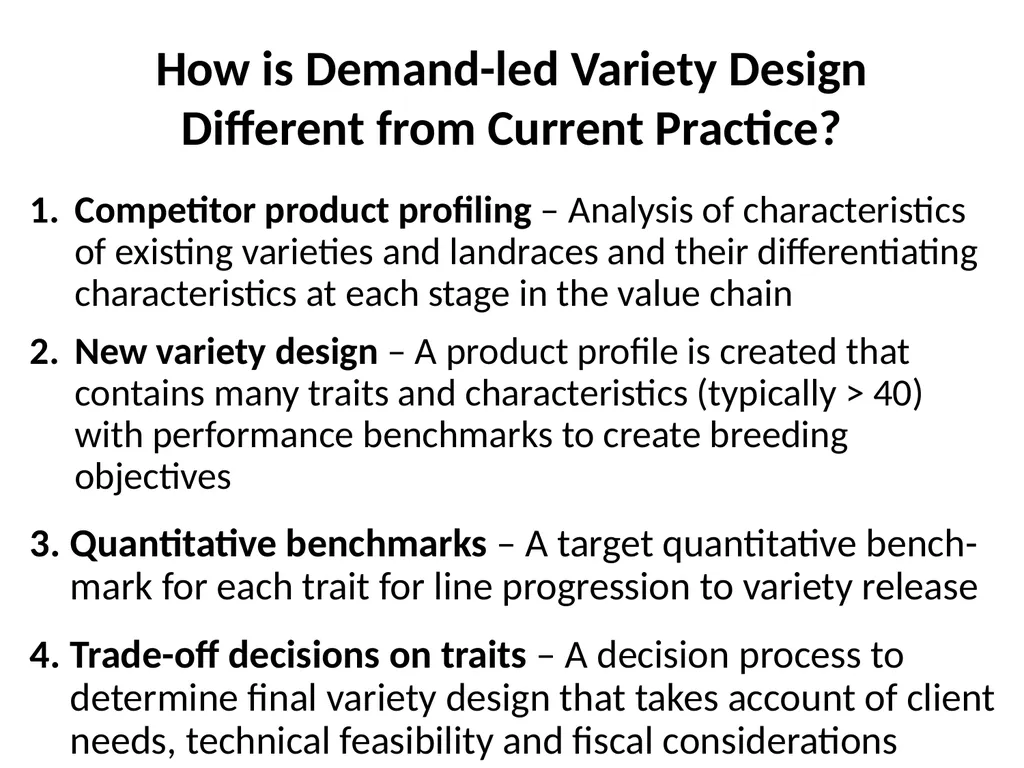
How is Demand-led Variety Design Different from Current Practice? Competitor product profiling – Analysis of characteristics of existing varieties and landraces and their differentiating characteristics at each stage in the value chain
New variety design – A product profile is created that contains many traits and characteristics (typically > 40) with performance benchmarks to create breeding objectives
Quantitative benchmarks – A target quantitative bench-mark for each trait for line progression to variety release
Trade-off decisions on traits – A decision process to determine final variety design that takes account of client needs, technical feasibility and fiscal considerations<br>
41
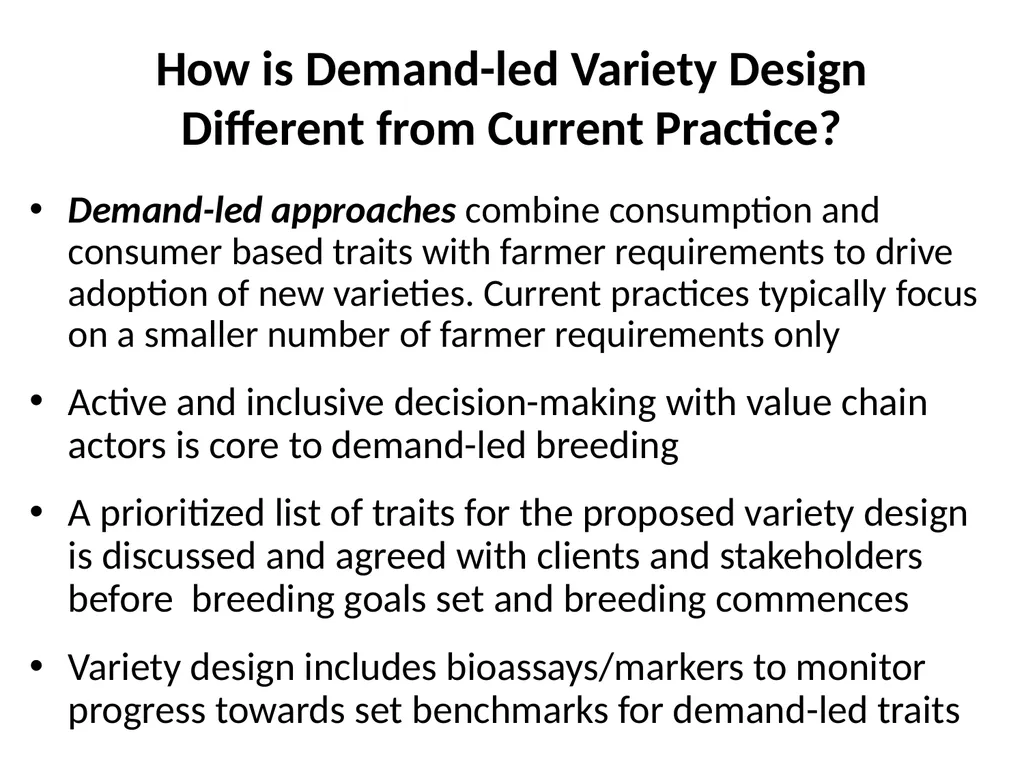
How is Demand-led Variety Design Different from Current Practice? Demand-led approaches combine consumption and consumer based traits with farmer requirements to drive adoption of new varieties. Current practices typically focus on a smaller number of farmer requirements only
Active and inclusive decision-making with value chain actors is core to demand-led breeding
A prioritized list of traits for the proposed variety design is discussed and agreed with clients and stakeholders before breeding goals set and breeding commences
Variety design includes bioassays/markers to monitor progress towards set benchmarks for demand-led traits<br>
42
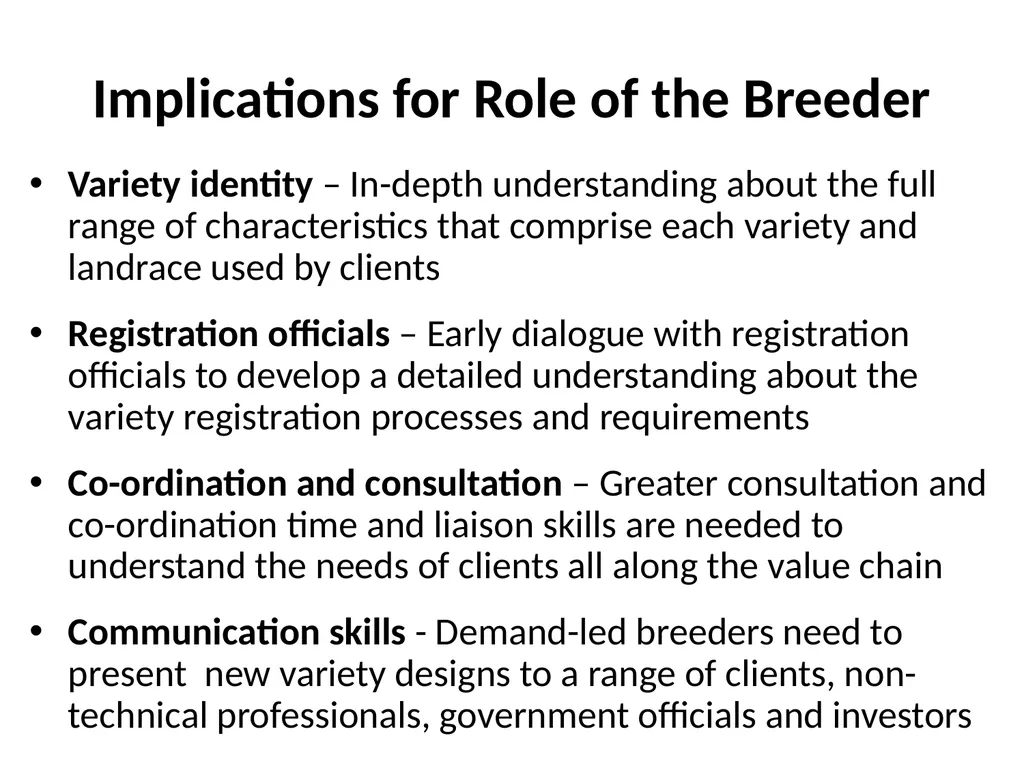
Implications for Role of the Breeder Variety identity – In-depth understanding about the full range of characteristics that comprise each variety and landrace used by clients
Registration officials – Early dialogue with registration officials to develop a detailed understanding about the variety registration processes and requirements
Co-ordination and consultation – Greater consultation and co-ordination time and liaison skills are needed to understand the needs of clients all along the value chain
Communication skills - Demand-led breeders need to present new variety designs to a range of clients, non-technical professionals, government officials and investors<br>
43
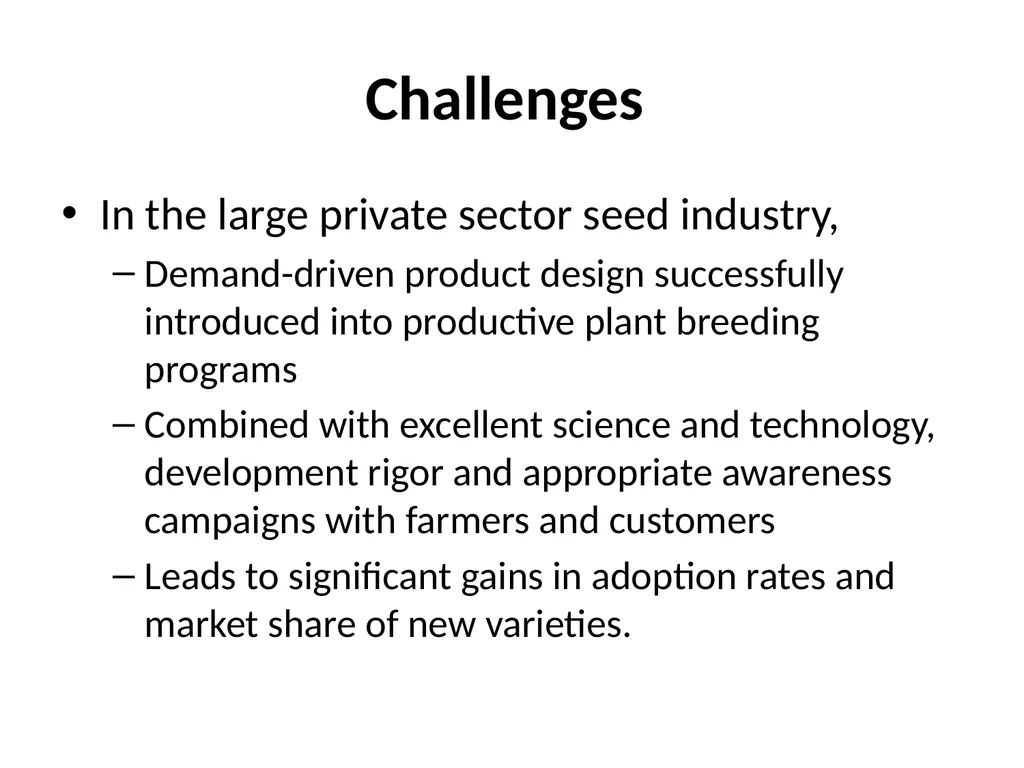
Challenges In the large private sector seed industry,
Demand-driven product design successfully introduced into productive plant breeding programs
Combined with excellent science and technology, development rigor and appropriate awareness campaigns with farmers and customers
Leads to significant gains in adoption rates and market share of new varieties.<br>
44
Challenges The challenge is finding cost-effective ways to tailor demand-led approaches to new variety design, product profiling and success criteria into public sector and small seed company breeding programs in developing countries
Need to harness skills and cooperation of the private sector; and better understand tropical crop value chains and market trends
Opportunities for new public and private sector partnerships to solve problems together<br>
Need to harness skills and cooperation of the private sector; and better understand tropical crop value chains and market trends
Opportunities for new public and private sector partnerships to solve problems together<br>
45
Chapter 4
New Variety Design and Product Profiling
Shimelis Hussein The Business of Plant Breeding:
Market-led approaches to new variety design in Africa<br>
New Variety Design and Product Profiling
Shimelis Hussein The Business of Plant Breeding:
Market-led approaches to new variety design in Africa<br>