
Chapter 4 Term Symboles Lecturers: 1- Dr. Majeed
SN
Published · 49 slides · 0 views

1 / 1


Description
Chapter 4 Term Symboles Lecturers: 1- Dr. Majeed Y. Y. Al-Luaibi 2- Dr. Faris A. J. Aldoghachi Ch.101 Semister 1 (2016-2017) 1s, 2s, 2p, 3s, 3p, 4s, 3d, 4p, 5s, 4d, 5p, 6s, 4f, 5d, 6p, 7s, 5f, 6d Example: Applying the aufbau principle
Related Topics
Share
Embed code
Download this presentation From Below
"Chapter 4 Term Symboles Lecturers: 1- Dr. Majeed" is the property of its rightful owner. Permission is granted to download and print the materials on this website for personal, non-commercial use only, and to display it on your personal computer provided you do not modify the materials and that you retain all copyright notices contained in the materials. By downloading content from our website, you accept the terms of this agreement.
Presentation Transcript
01
Chapter 4 Term Symboles Lecturers:
1- Dr. Majeed Y. Y. Al-Luaibi
2- Dr. Faris A. J. Aldoghachi Ch.101 Semister 1 (2016-2017)<br>
1- Dr. Majeed Y. Y. Al-Luaibi
2- Dr. Faris A. J. Aldoghachi Ch.101 Semister 1 (2016-2017)<br>
02
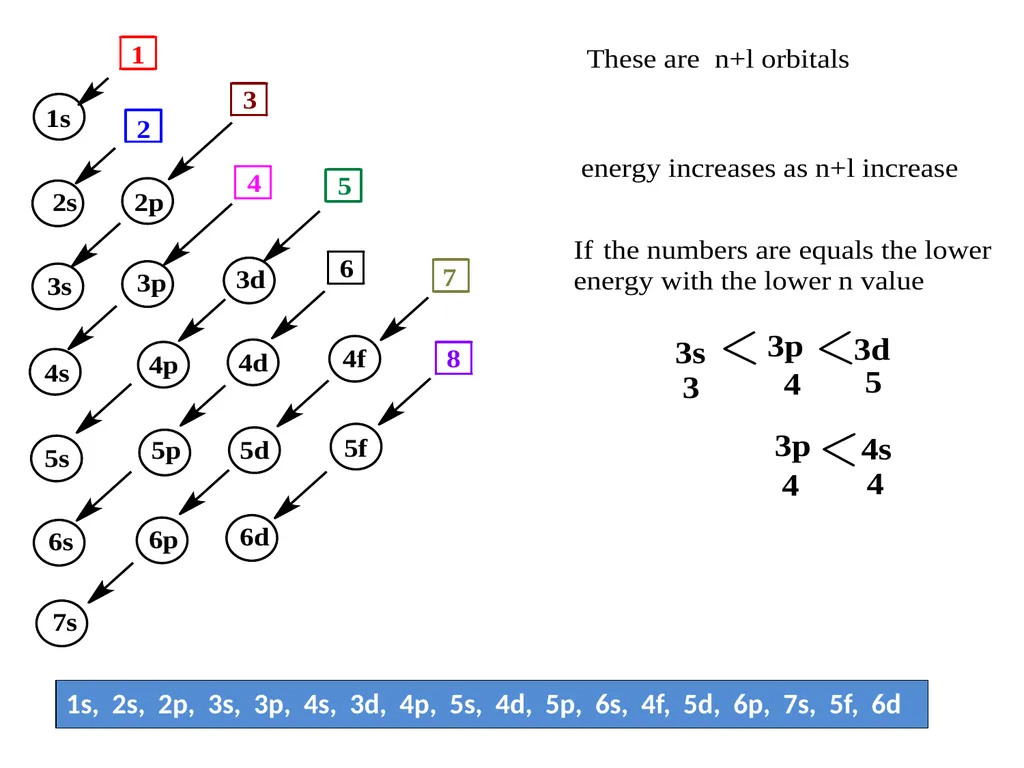
1s, 2s, 2p, 3s, 3p, 4s, 3d, 4p, 5s, 4d, 5p, 6s, 4f, 5d, 6p, 7s, 5f, 6d<br>
03
Example:
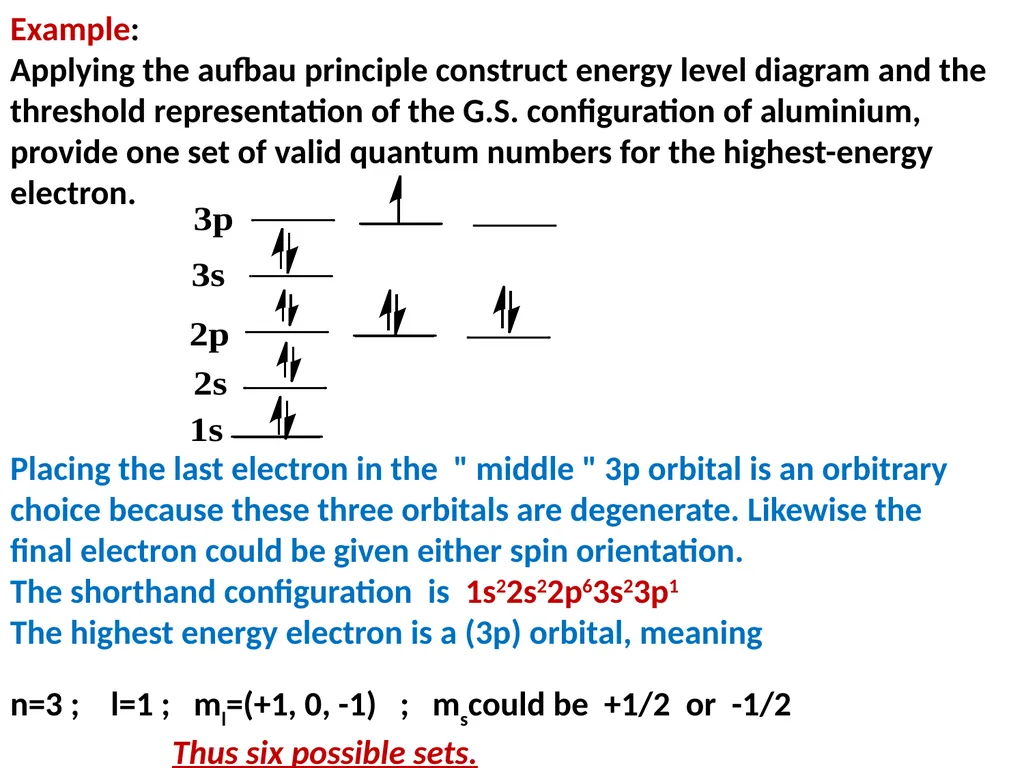
Applying the aufbau principle construct energy level diagram and the threshold representation of the G.S. configuration of aluminium, provide one set of valid quantum numbers for the highest-energy electron. Placing the last electron in the " middle " 3p orbital is an orbitrary choice because these three orbitals are degenerate. Likewise the final electron could be given either spin orientation.
The shorthand configuration is 1s22s22p63s23p1
The highest energy electron is a (3p) orbital, meaning n=3 ; l=1 ; ml=(+1, 0, -1) ; mscould be +1/2 or -1/2
Thus six possible sets.<br>
Applying the aufbau principle construct energy level diagram and the threshold representation of the G.S. configuration of aluminium, provide one set of valid quantum numbers for the highest-energy electron. Placing the last electron in the " middle " 3p orbital is an orbitrary choice because these three orbitals are degenerate. Likewise the final electron could be given either spin orientation.
The shorthand configuration is 1s22s22p63s23p1
The highest energy electron is a (3p) orbital, meaning n=3 ; l=1 ; ml=(+1, 0, -1) ; mscould be +1/2 or -1/2
Thus six possible sets.<br>
04
He ( 2 electrons) 1s2 [He]
Ne (10 electrons) [He] 2s2 2p6 [Ne]
Ar (18 electrons) [Ne] 3s2 3p6 [Ar]
Kr (36 electrons) [Ar] 4s2 3d10 4p6 [Kr]
Xe (54 electrons) [Kr] 5s2 4d10 5p6 [Xe]
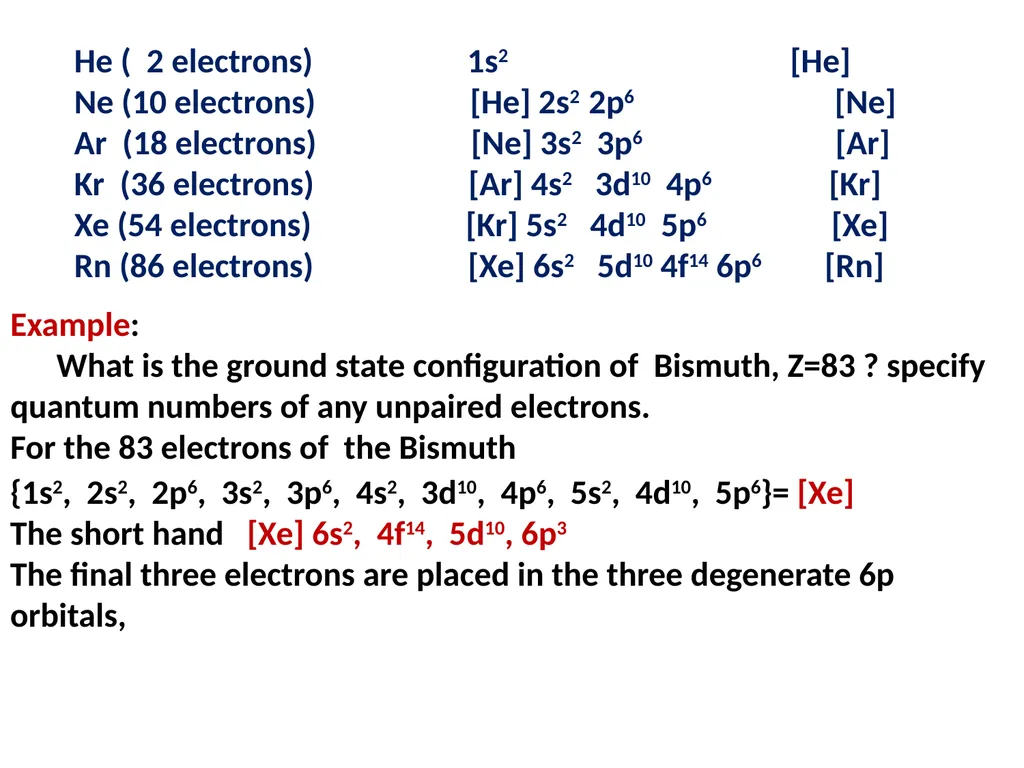
Rn (86 electrons) [Xe] 6s2 5d10 4f14 6p6 [Rn] Example:
What is the ground state configuration of Bismuth, Z=83 ? specify quantum numbers of any unpaired electrons.
For the 83 electrons of the Bismuth {1s2, 2s2, 2p6, 3s2, 3p6, 4s2, 3d10, 4p6, 5s2, 4d10, 5p6}= [Xe]
The short hand [Xe] 6s2, 4f14, 5d10, 6p3
The final three electrons are placed in the three degenerate 6p orbitals,<br>
Ne (10 electrons) [He] 2s2 2p6 [Ne]
Ar (18 electrons) [Ne] 3s2 3p6 [Ar]
Kr (36 electrons) [Ar] 4s2 3d10 4p6 [Kr]
Xe (54 electrons) [Kr] 5s2 4d10 5p6 [Xe]
Rn (86 electrons) [Xe] 6s2 5d10 4f14 6p6 [Rn] Example:
What is the ground state configuration of Bismuth, Z=83 ? specify quantum numbers of any unpaired electrons.
For the 83 electrons of the Bismuth {1s2, 2s2, 2p6, 3s2, 3p6, 4s2, 3d10, 4p6, 5s2, 4d10, 5p6}= [Xe]
The short hand [Xe] 6s2, 4f14, 5d10, 6p3
The final three electrons are placed in the three degenerate 6p orbitals,<br>
05
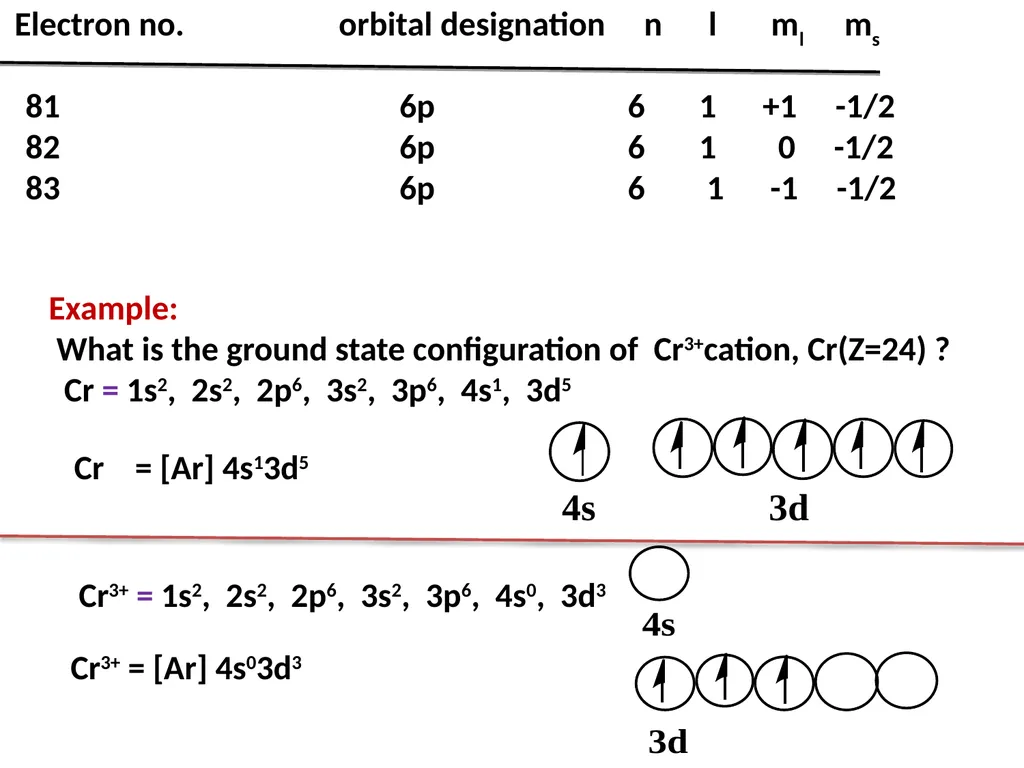
Electron no. orbital designation n l ml ms 81 6p 6 1 +1 -1/2
82 6p 6 1 0 -1/2
83 6p 6 1 -1 -1/2 Example:
What is the ground state configuration of Cr3+cation, Cr(Z=24) ?
Cr = 1s2, 2s2, 2p6, 3s2, 3p6, 4s1, 3d5 Cr = [Ar] 4s13d5 Cr3+ = [Ar] 4s03d3 Cr3+ = 1s2, 2s2, 2p6, 3s2, 3p6, 4s0, 3d3<br>
82 6p 6 1 0 -1/2
83 6p 6 1 -1 -1/2 Example:
What is the ground state configuration of Cr3+cation, Cr(Z=24) ?
Cr = 1s2, 2s2, 2p6, 3s2, 3p6, 4s1, 3d5 Cr = [Ar] 4s13d5 Cr3+ = [Ar] 4s03d3 Cr3+ = 1s2, 2s2, 2p6, 3s2, 3p6, 4s0, 3d3<br>
06
Example:
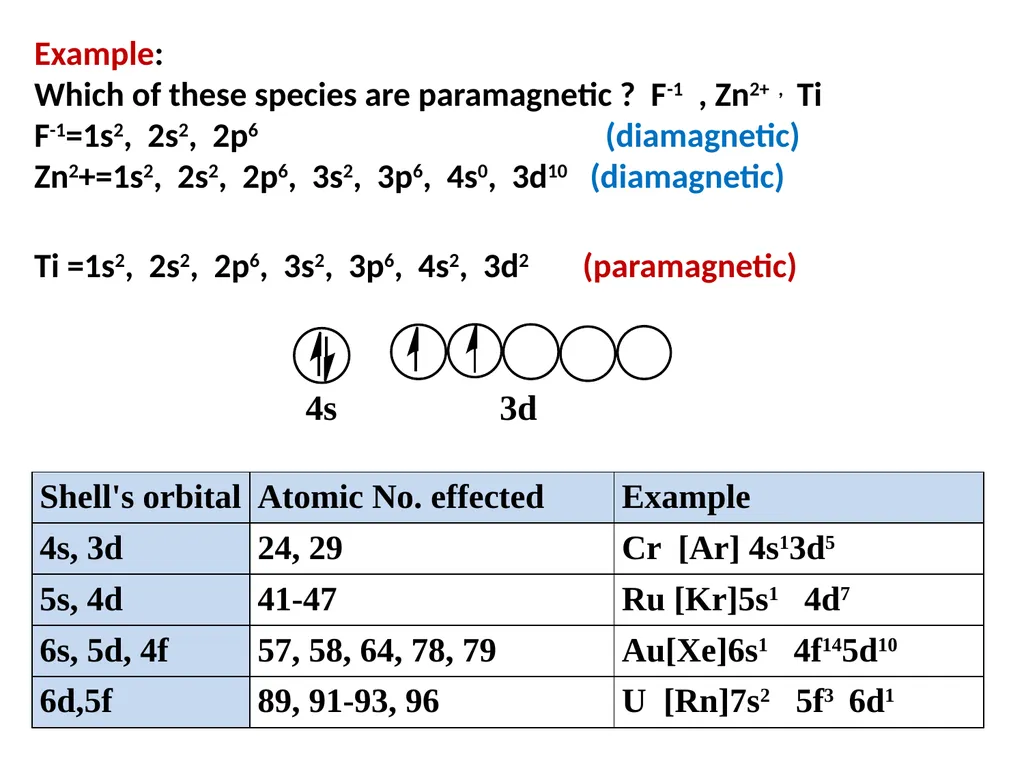
Which of these species are paramagnetic ? F-1 , Zn2+ , Ti
F-1=1s2, 2s2, 2p6 (diamagnetic)
Zn2+=1s2, 2s2, 2p6, 3s2, 3p6, 4s0, 3d10 (diamagnetic) Ti =1s2, 2s2, 2p6, 3s2, 3p6, 4s2, 3d2 (paramagnetic)<br>
Which of these species are paramagnetic ? F-1 , Zn2+ , Ti
F-1=1s2, 2s2, 2p6 (diamagnetic)
Zn2+=1s2, 2s2, 2p6, 3s2, 3p6, 4s0, 3d10 (diamagnetic) Ti =1s2, 2s2, 2p6, 3s2, 3p6, 4s2, 3d2 (paramagnetic)<br>
07
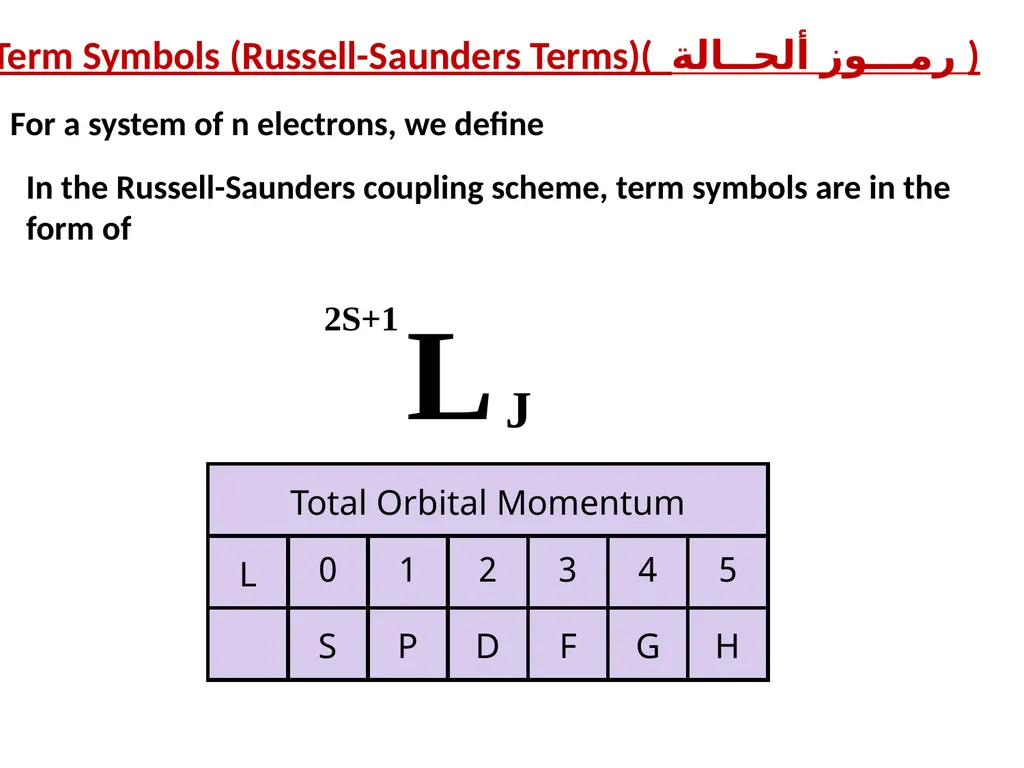
Term Symbols (Russell-Saunders Terms)( رمـــوز ألحــالة ) For a system of n electrons, we define In the Russell-Saunders coupling scheme, term symbols are in the form of<br>
08
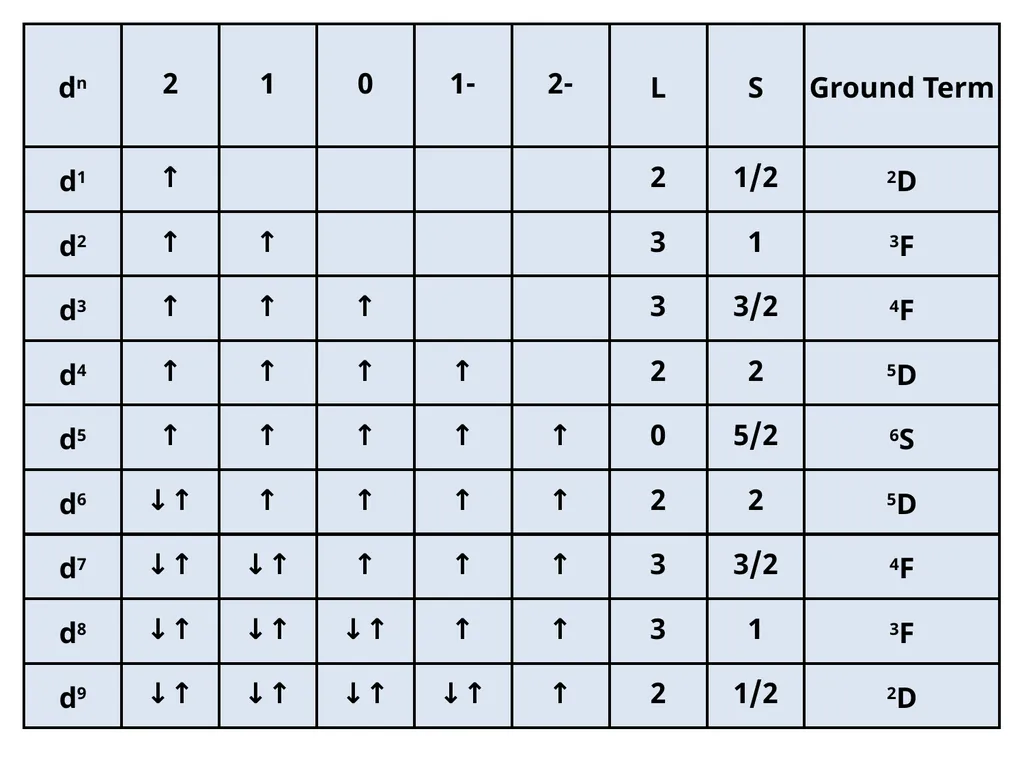
Ground state term symbol
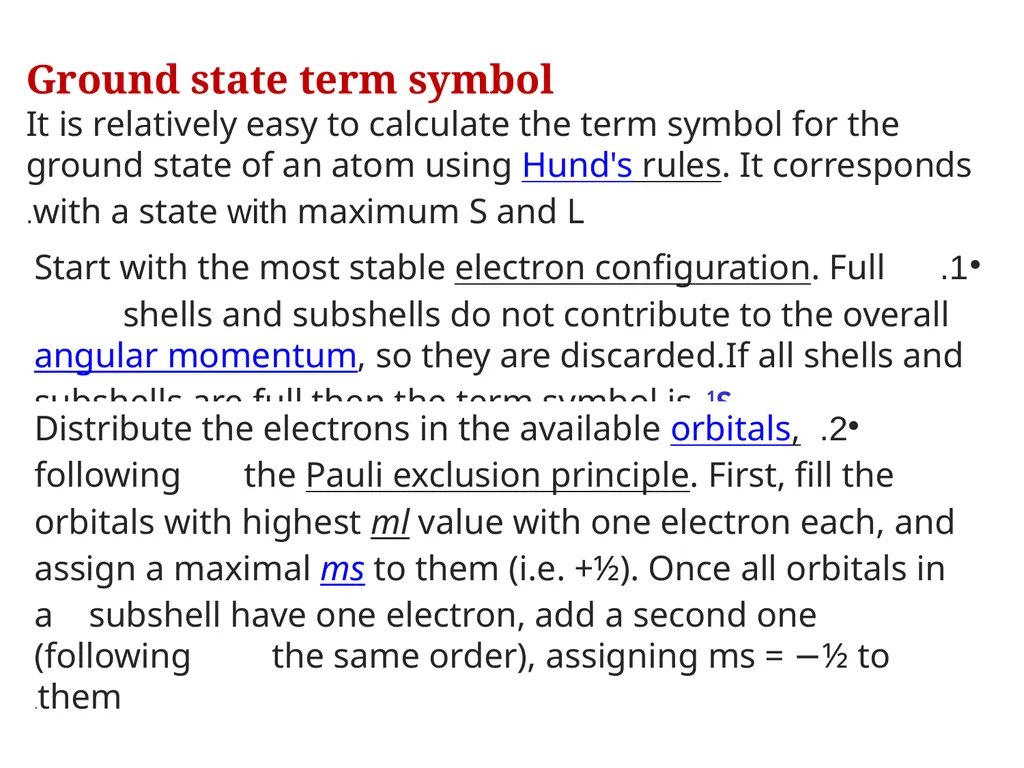
It is relatively easy to calculate the term symbol for the ground state of an atom using Hund's rules. It corresponds with a state with maximum S and L. 1. Start with the most stable electron configuration. Full shells and subshells do not contribute to the overall angular momentum, so they are discarded.If all shells and subshells are full then the term symbol is 1S0 2. Distribute the electrons in the available orbitals, following the Pauli exclusion principle. First, fill the orbitals with highest ml value with one electron each, and assign a maximal ms to them (i.e. +½). Once all orbitals in a subshell have one electron, add a second one (following the same order), assigning ms = −½ to them.<br>
It is relatively easy to calculate the term symbol for the ground state of an atom using Hund's rules. It corresponds with a state with maximum S and L. 1. Start with the most stable electron configuration. Full shells and subshells do not contribute to the overall angular momentum, so they are discarded.If all shells and subshells are full then the term symbol is 1S0 2. Distribute the electrons in the available orbitals, following the Pauli exclusion principle. First, fill the orbitals with highest ml value with one electron each, and assign a maximal ms to them (i.e. +½). Once all orbitals in a subshell have one electron, add a second one (following the same order), assigning ms = −½ to them.<br>
09
3. The overall S is calculated by adding the ms values for
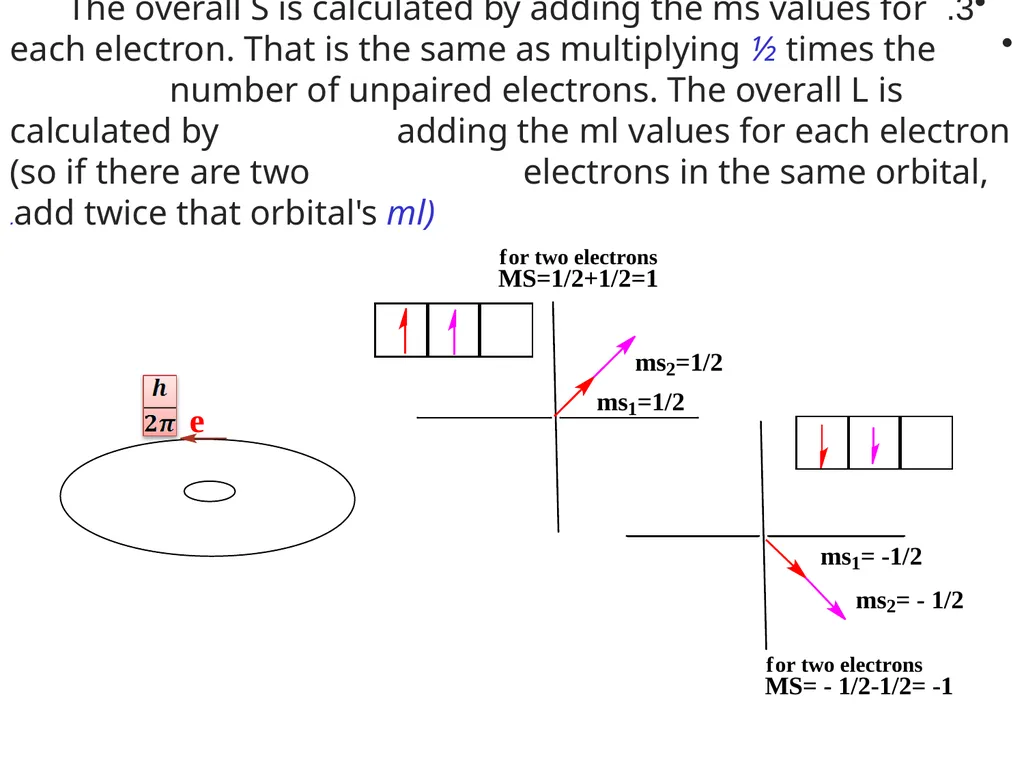
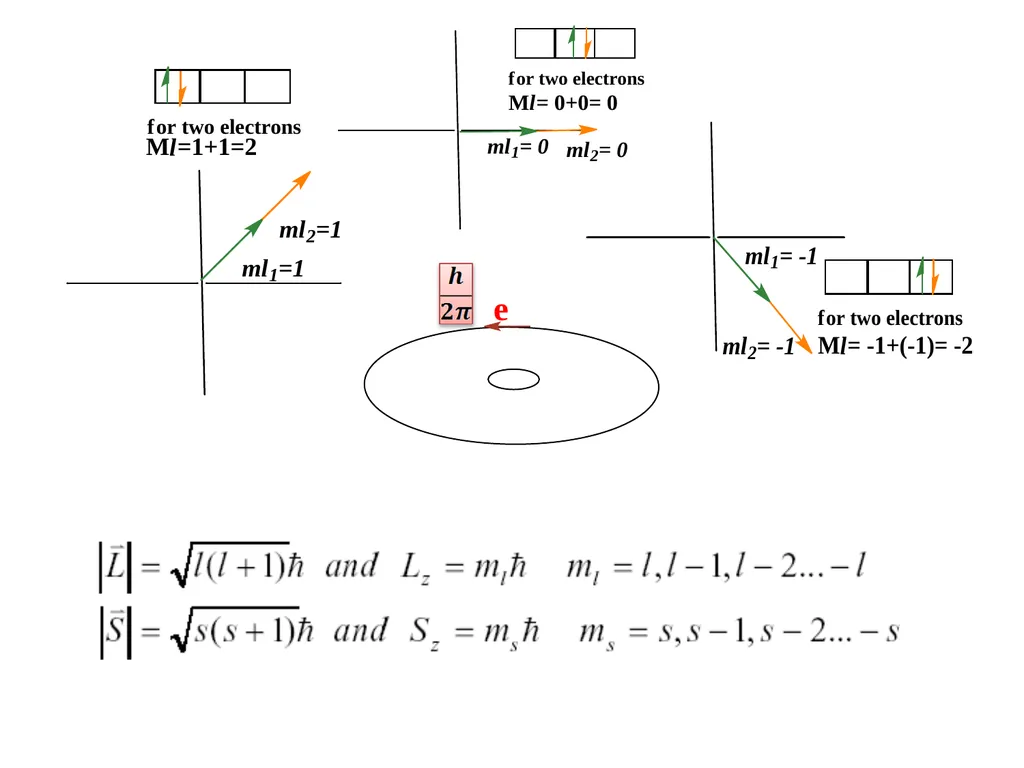
each electron. That is the same as multiplying ½ times the number of unpaired electrons. The overall L is calculated by adding the ml values for each electron (so if there are two electrons in the same orbital, add twice that orbital's ml).<br>
each electron. That is the same as multiplying ½ times the number of unpaired electrons. The overall L is calculated by adding the ml values for each electron (so if there are two electrons in the same orbital, add twice that orbital's ml).<br>
10
Here is a commonly used method to determine term symbols for an electron configuration. It requires a table of possibilities of different "micro states," which happened to be called "Slater's table".
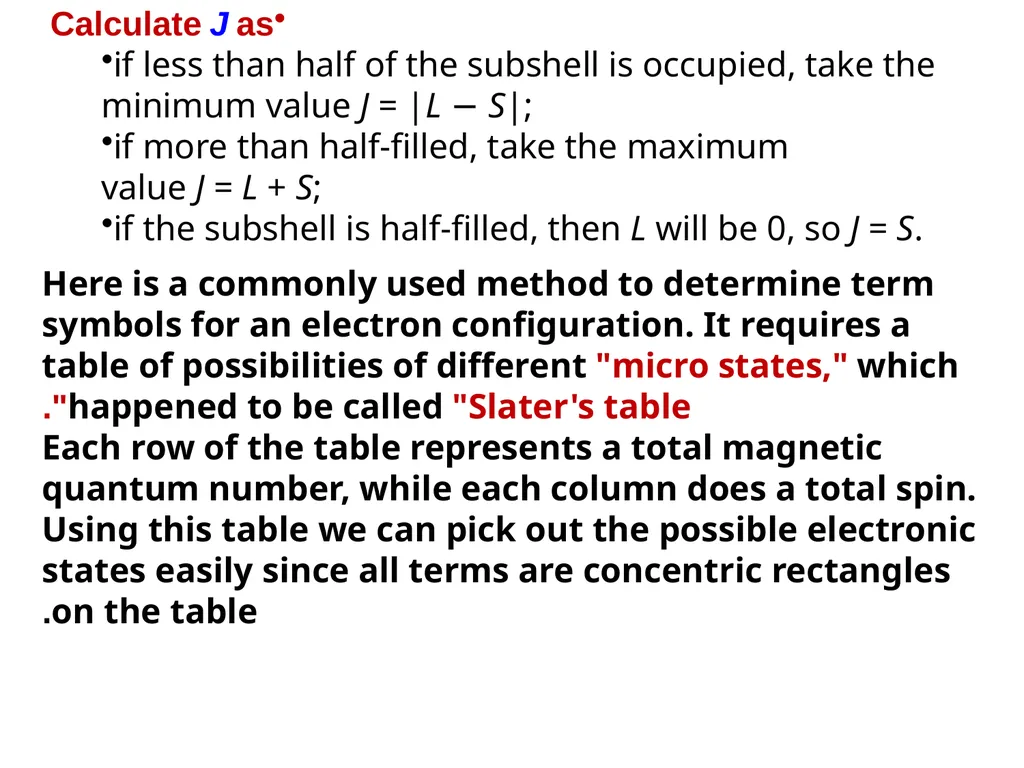
Each row of the table represents a total magnetic quantum number, while each column does a total spin. Using this table we can pick out the possible electronic states easily since all terms are concentric rectangles on the table. Calculate J as
if less than half of the subshell is occupied, take the minimum value J = |L − S|;
if more than half-filled, take the maximum value J = L + S;
if the subshell is half-filled, then L will be 0, so J = S.<br>
Each row of the table represents a total magnetic quantum number, while each column does a total spin. Using this table we can pick out the possible electronic states easily since all terms are concentric rectangles on the table. Calculate J as
if less than half of the subshell is occupied, take the minimum value J = |L − S|;
if more than half-filled, take the maximum value J = L + S;
if the subshell is half-filled, then L will be 0, so J = S.<br>
11
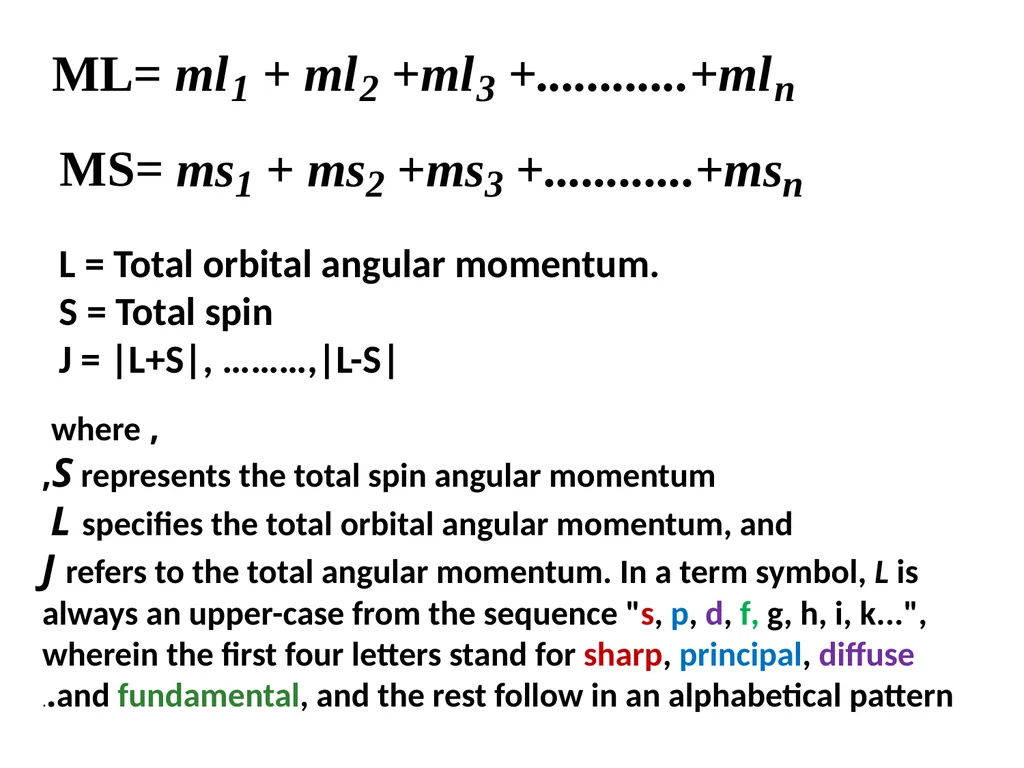
L = Total orbital angular momentum.
S = Total spin
J = |L+S|, ………,|L-S| , where
S represents the total spin angular momentum,
L specifies the total orbital angular momentum, and
J refers to the total angular momentum. In a term symbol, L is always an upper-case from the sequence "s, p, d, f, g, h, i, k...", wherein the first four letters stand for sharp, principal, diffuse and fundamental, and the rest follow in an alphabetical pattern..<br>
S = Total spin
J = |L+S|, ………,|L-S| , where
S represents the total spin angular momentum,
L specifies the total orbital angular momentum, and
J refers to the total angular momentum. In a term symbol, L is always an upper-case from the sequence "s, p, d, f, g, h, i, k...", wherein the first four letters stand for sharp, principal, diffuse and fundamental, and the rest follow in an alphabetical pattern..<br>
12
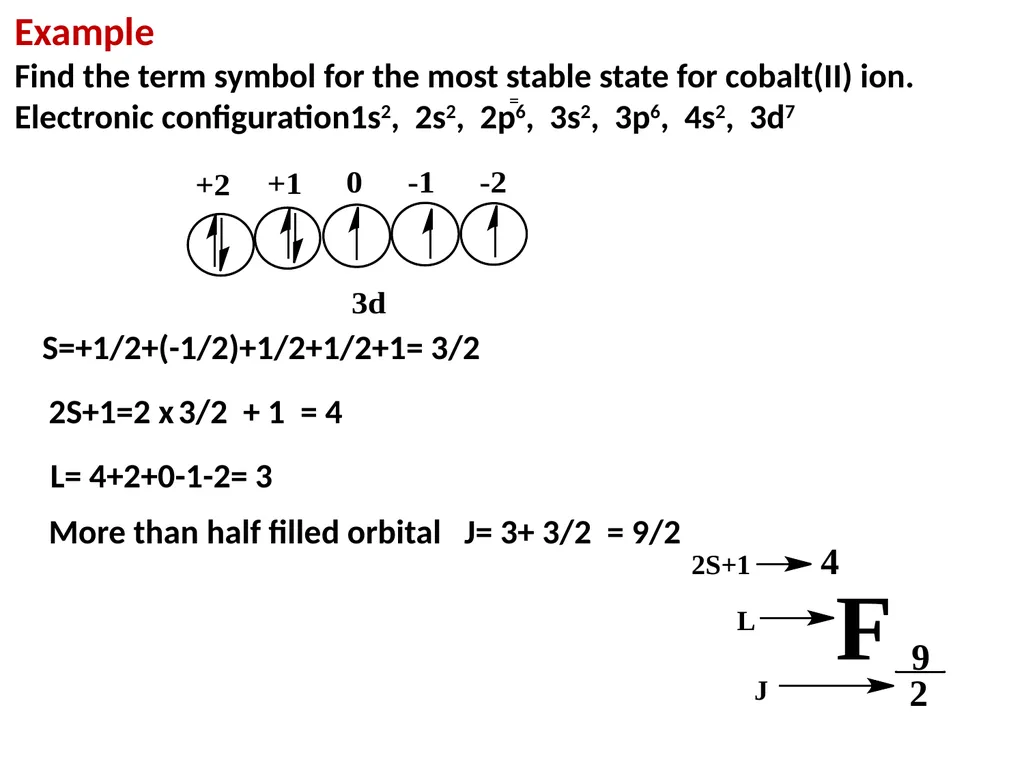
Example
Find the term symbol for the most stable state for cobalt(II) ion.
Electronic configuration1s2, 2s2, 2p6, 3s2, 3p6, 4s2, 3d7 S=+1/2+(-1/2)+1/2+1/2+1= 3/2 2S+1=2 x 3/2 + 1 = 4 L= 4+2+0-1-2= 3 More than half filled orbital J= 3+ 3/2 = 9/2 =<br>
Find the term symbol for the most stable state for cobalt(II) ion.
Electronic configuration1s2, 2s2, 2p6, 3s2, 3p6, 4s2, 3d7 S=+1/2+(-1/2)+1/2+1/2+1= 3/2 2S+1=2 x 3/2 + 1 = 4 L= 4+2+0-1-2= 3 More than half filled orbital J= 3+ 3/2 = 9/2 =<br>
13
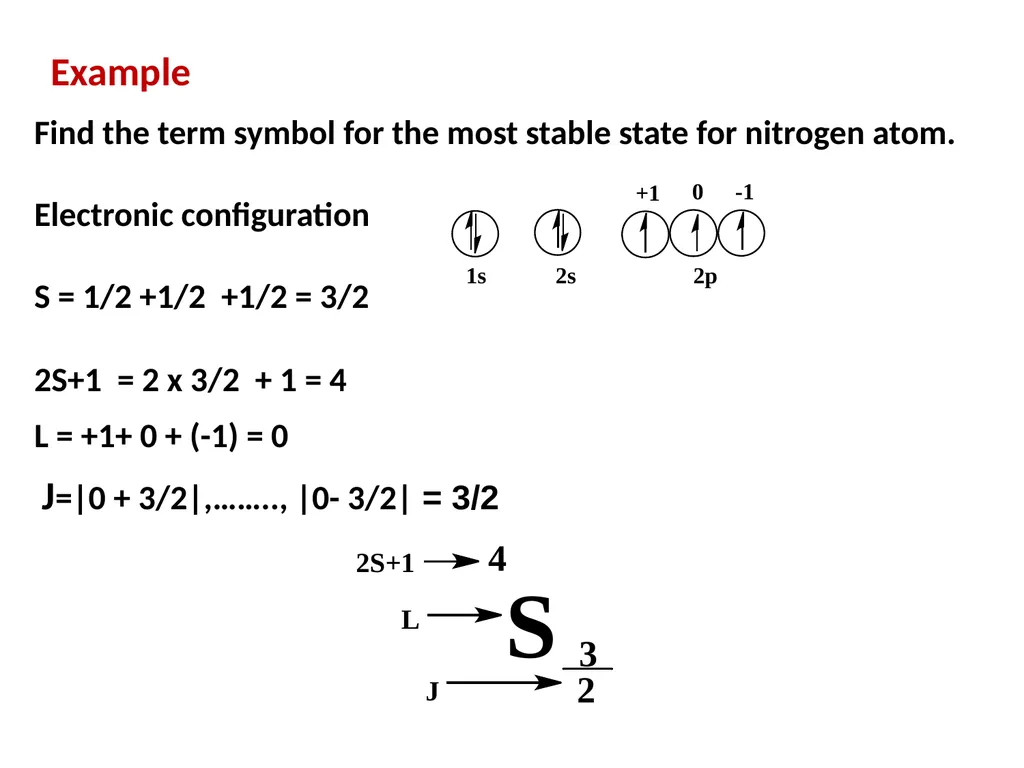
Example Find the term symbol for the most stable state for nitrogen atom.
Electronic configuration
S = 1/2 +1/2 +1/2 = 3/2 2S+1 = 2 x 3/2 + 1 = 4 L = +1+ 0 + (-1) = 0 J=|0 + 3/2|,…….., |0- 3/2| = 3/2<br>
Electronic configuration
S = 1/2 +1/2 +1/2 = 3/2 2S+1 = 2 x 3/2 + 1 = 4 L = +1+ 0 + (-1) = 0 J=|0 + 3/2|,…….., |0- 3/2| = 3/2<br>
14
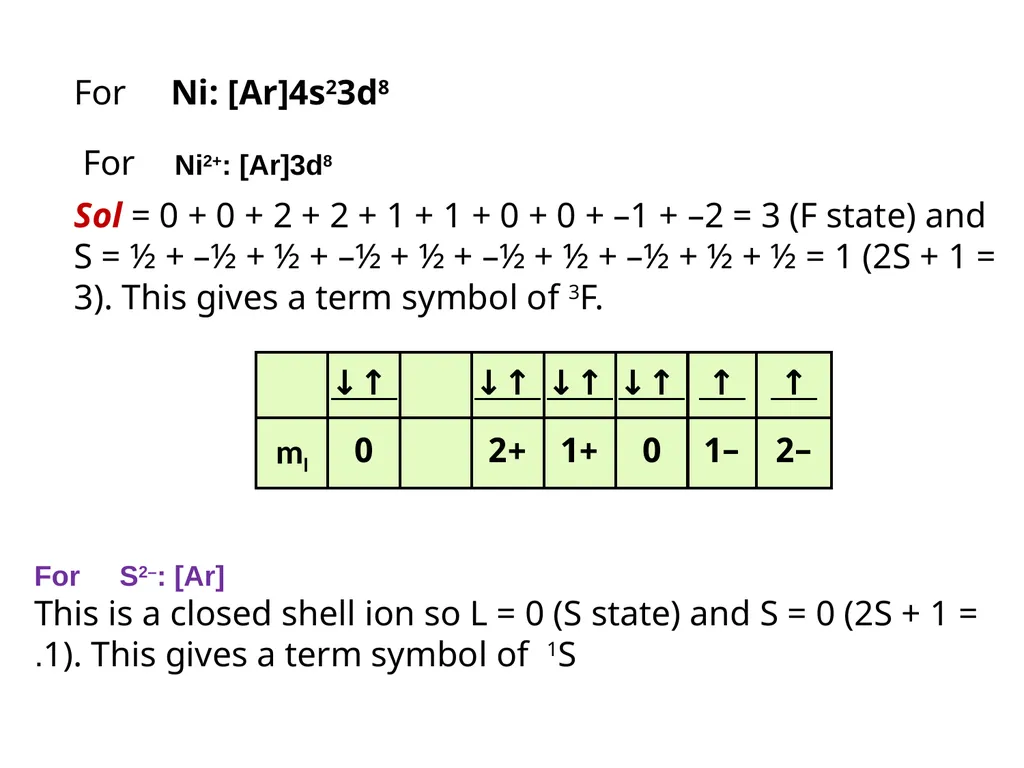
For Ni: [Ar]4s23d8
Sol = 0 + 0 + 2 + 2 + 1 + 1 + 0 + 0 + –1 + –2 = 3 (F state) and S = ½ + –½ + ½ + –½ + ½ + –½ + ½ + –½ + ½ + ½ = 1 (2S + 1 = 3). This gives a term symbol of 3F. For Ni2+: [Ar]3d8 For S2–: [Ar]
This is a closed shell ion so L = 0 (S state) and S = 0 (2S + 1 = 1). This gives a term symbol of 1S.<br>
Sol = 0 + 0 + 2 + 2 + 1 + 1 + 0 + 0 + –1 + –2 = 3 (F state) and S = ½ + –½ + ½ + –½ + ½ + –½ + ½ + –½ + ½ + ½ = 1 (2S + 1 = 3). This gives a term symbol of 3F. For Ni2+: [Ar]3d8 For S2–: [Ar]
This is a closed shell ion so L = 0 (S state) and S = 0 (2S + 1 = 1). This gives a term symbol of 1S.<br>
15
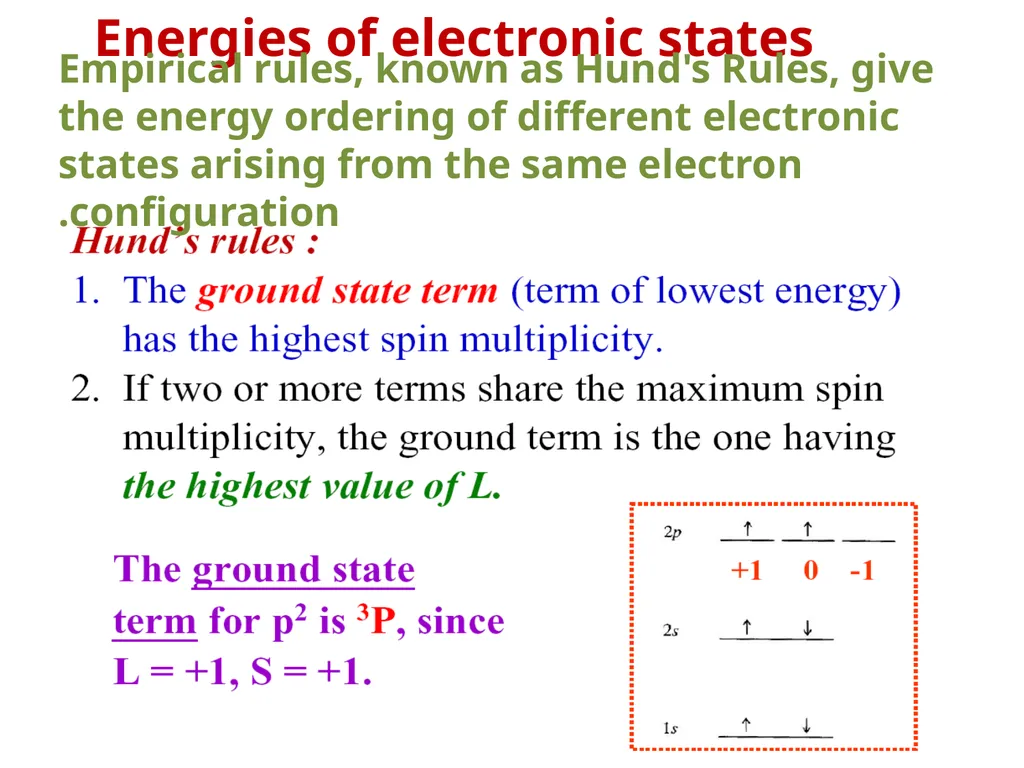
Energies of electronic states Empirical rules, known as Hund's Rules, give the energy ordering of different electronic states arising from the same electron configuration.<br>
16
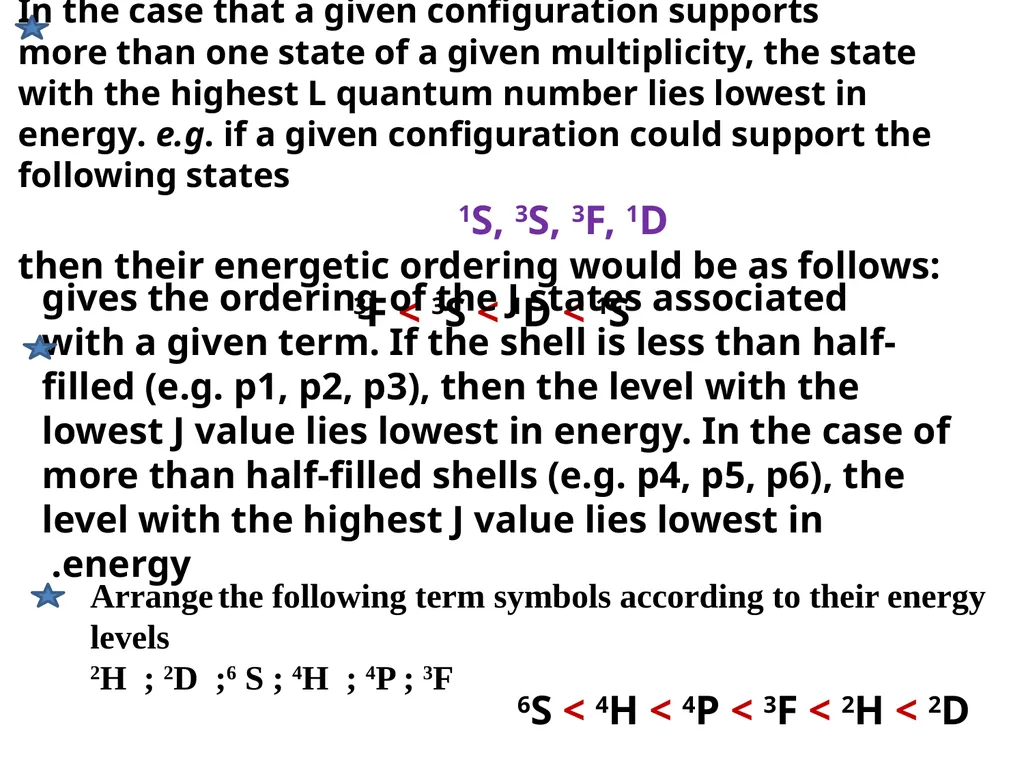
In the case that a given configuration supports more than one state of a given multiplicity, the state with the highest L quantum number lies lowest in energy. e.g. if a given configuration could support the following states
1S, 3S, 3F, 1D
then their energetic ordering would be as follows:
3F < 3S < 1D < 1S gives the ordering of the J states associated with a given term. If the shell is less than half-filled (e.g. p1, p2, p3), then the level with the lowest J value lies lowest in energy. In the case of more than half-filled shells (e.g. p4, p5, p6), the level with the highest J value lies lowest in energy. Arrange the following term symbols according to their energy levels
2H ; 2D ;6 S ; 4H ; 4P ; 3F 6S < 4H < 4P < 3F < 2H < 2D<br>
1S, 3S, 3F, 1D
then their energetic ordering would be as follows:
3F < 3S < 1D < 1S gives the ordering of the J states associated with a given term. If the shell is less than half-filled (e.g. p1, p2, p3), then the level with the lowest J value lies lowest in energy. In the case of more than half-filled shells (e.g. p4, p5, p6), the level with the highest J value lies lowest in energy. Arrange the following term symbols according to their energy levels
2H ; 2D ;6 S ; 4H ; 4P ; 3F 6S < 4H < 4P < 3F < 2H < 2D<br>
17
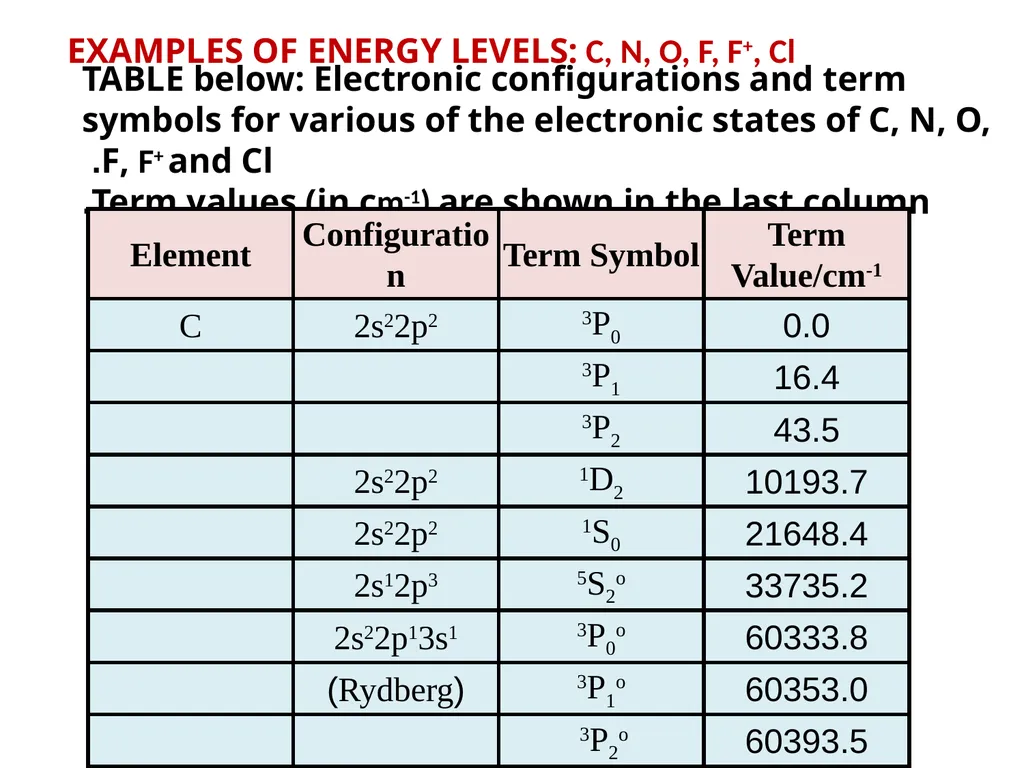
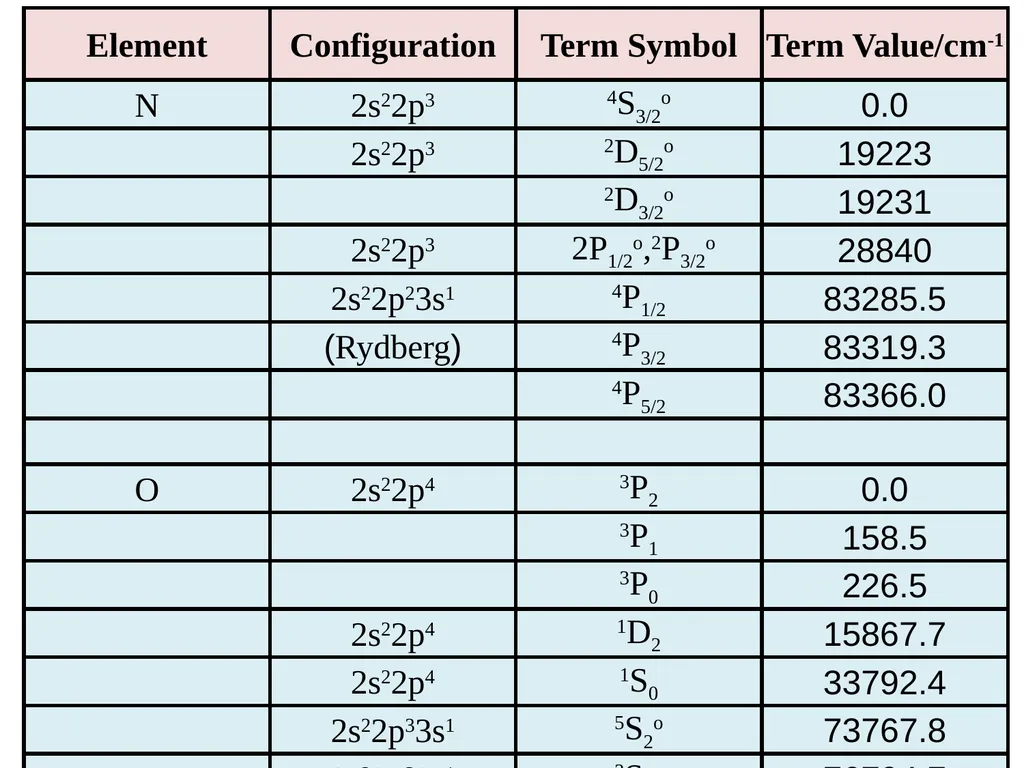
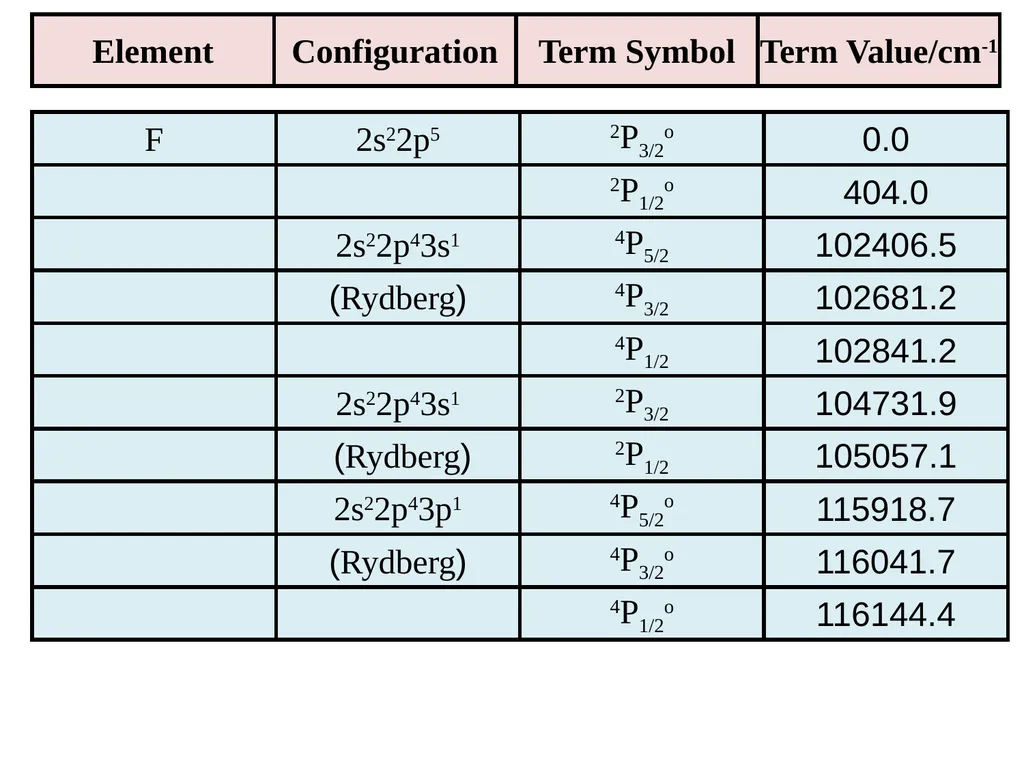
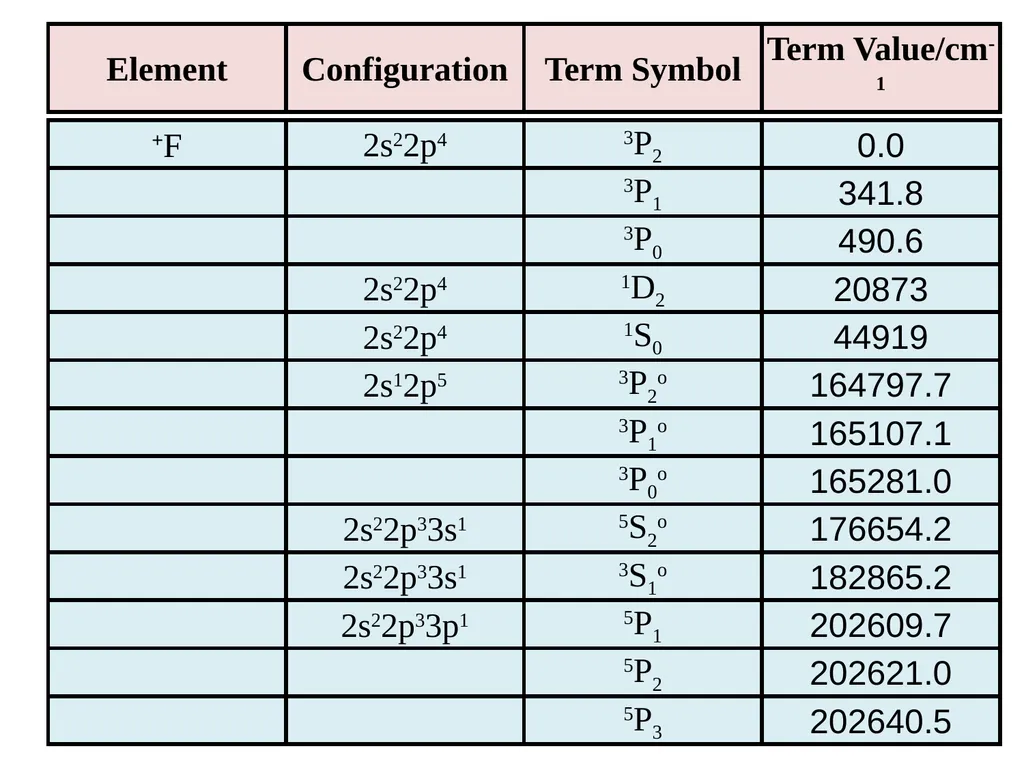
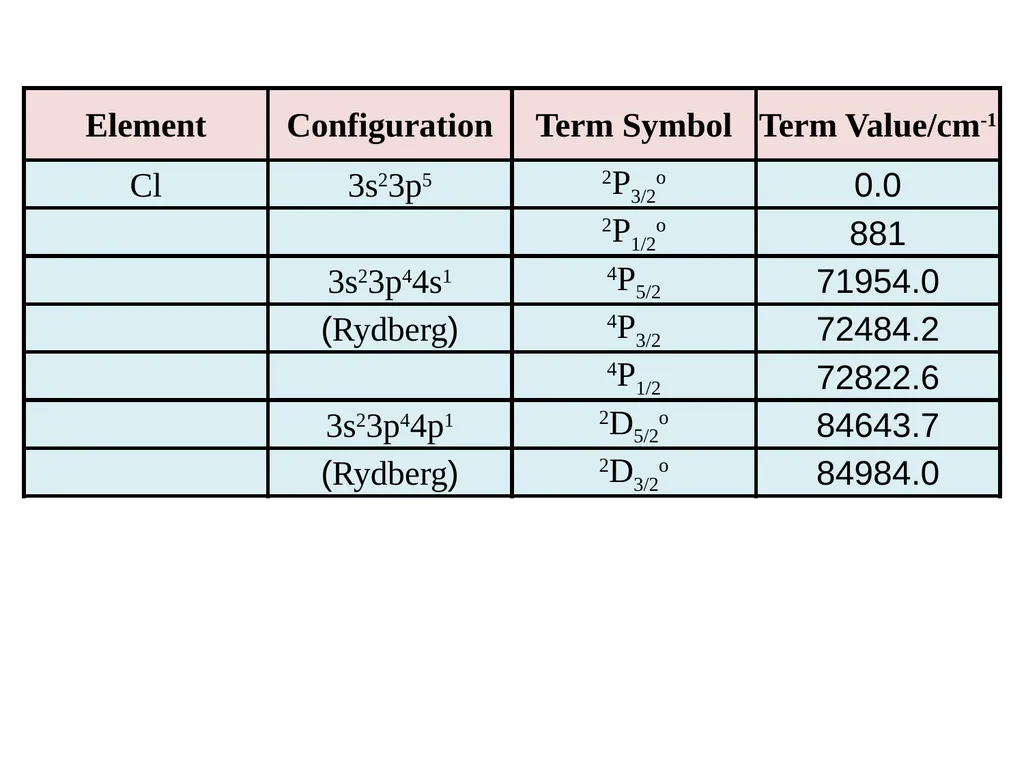
EXAMPLES OF ENERGY LEVELS: C, N, O, F, F+, Cl TABLE below: Electronic configurations and term symbols for various of the electronic states of C, N, O, F, F+ and Cl.
Term values (in cm-1) are shown in the last column.<br>
Term values (in cm-1) are shown in the last column.<br>
18
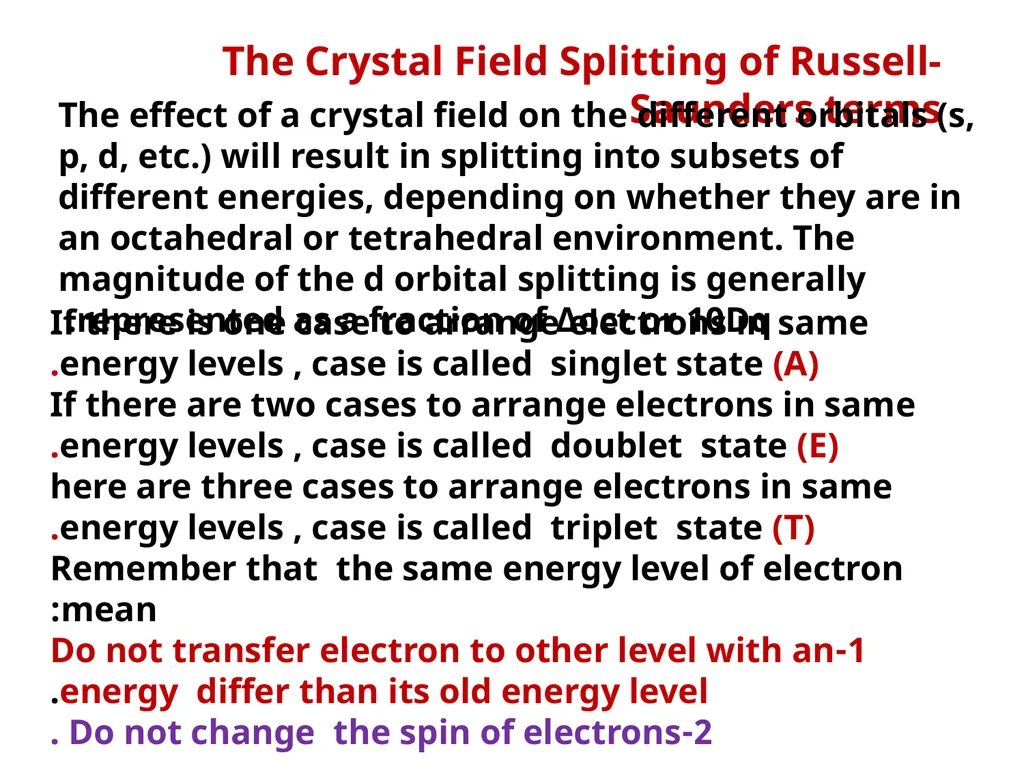
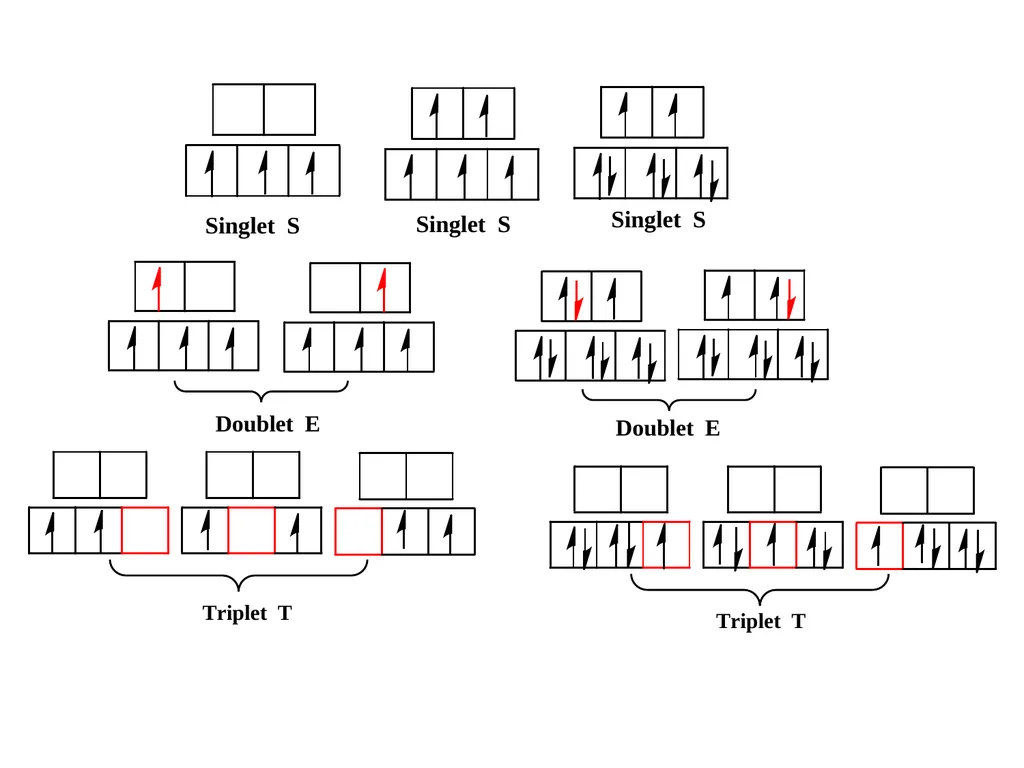
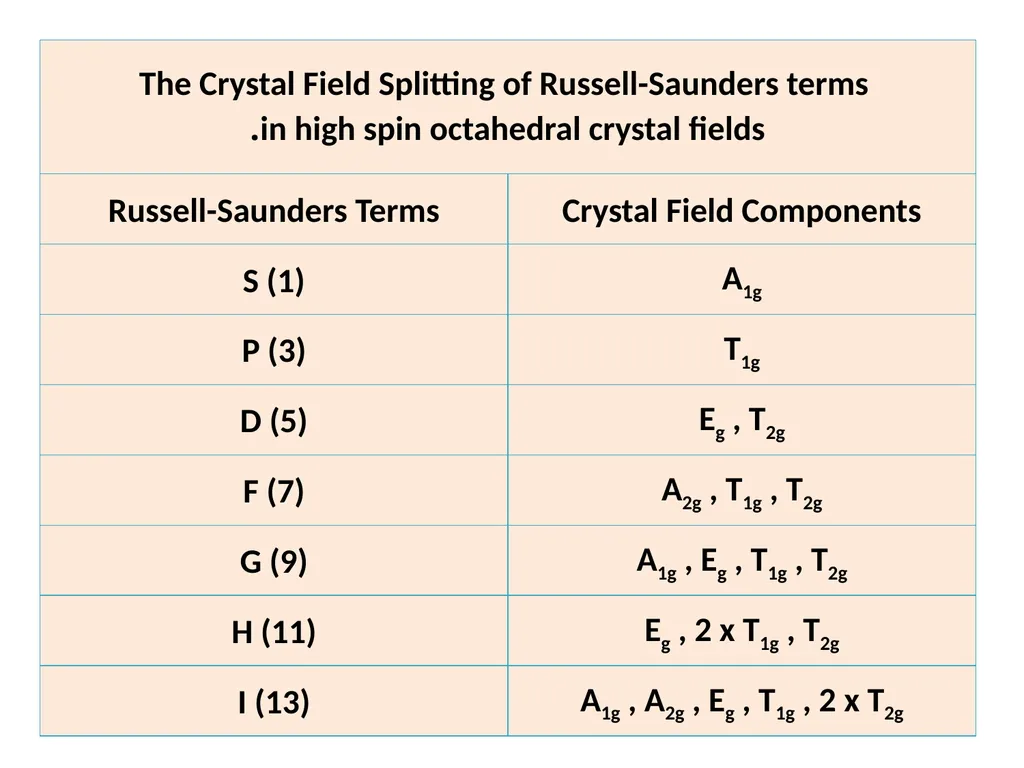
The Crystal Field Splitting of Russell-Saunders terms The effect of a crystal field on the different orbitals (s, p, d, etc.) will result in splitting into subsets of different energies, depending on whether they are in an octahedral or tetrahedral environment. The magnitude of the d orbital splitting is generally represented as a fraction of Δoct or 10Dq. If there is one case to arrange electrons in same energy levels , case is called singlet state (A).
If there are two cases to arrange electrons in same energy levels , case is called doublet state (E).
here are three cases to arrange electrons in same energy levels , case is called triplet state (T).
Remember that the same energy level of electron mean:
1-Do not transfer electron to other level with an energy differ than its old energy level.
2-Do not change the spin of electrons .<br>
If there are two cases to arrange electrons in same energy levels , case is called doublet state (E).
here are three cases to arrange electrons in same energy levels , case is called triplet state (T).
Remember that the same energy level of electron mean:
1-Do not transfer electron to other level with an energy differ than its old energy level.
2-Do not change the spin of electrons .<br>
19
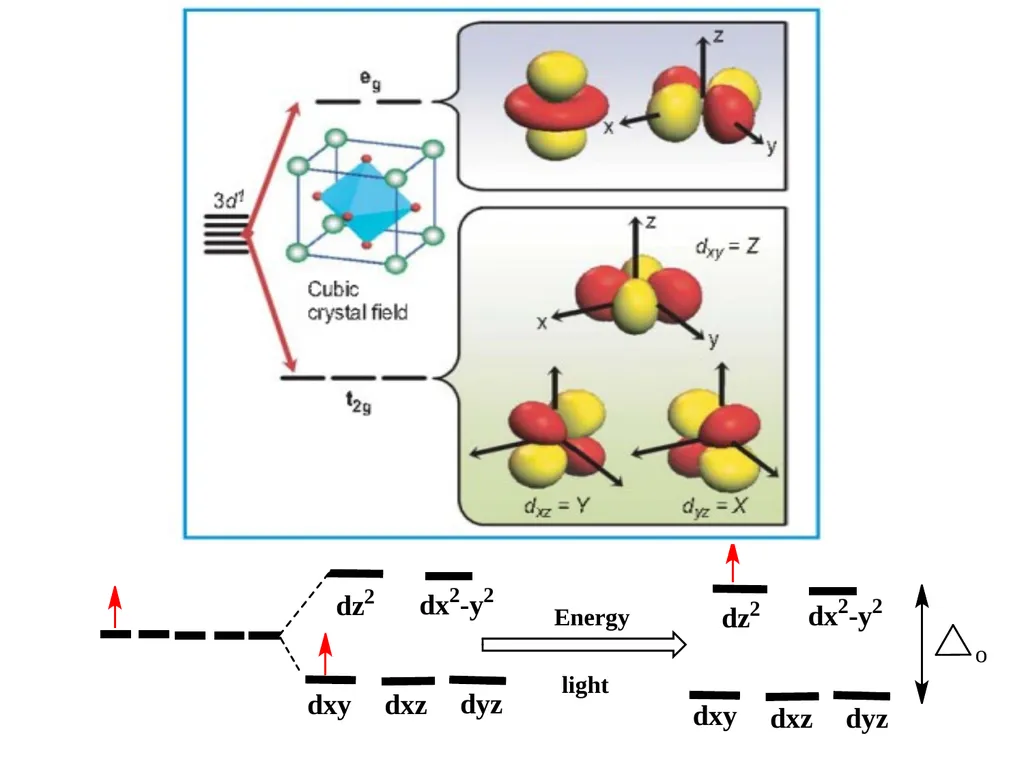
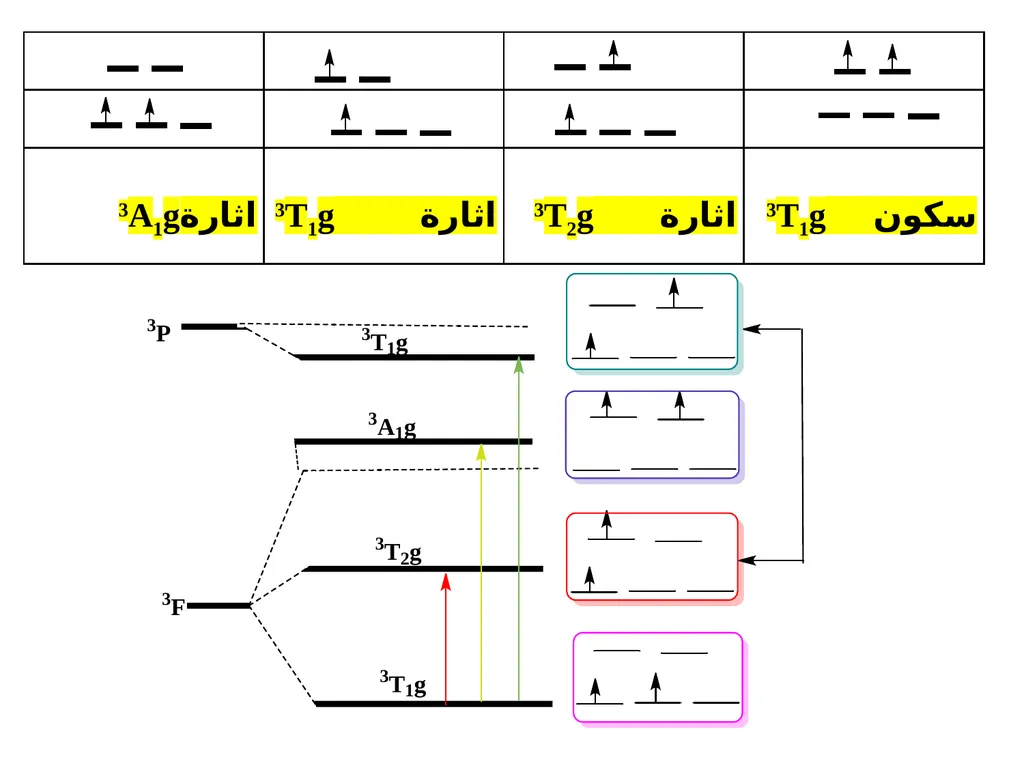
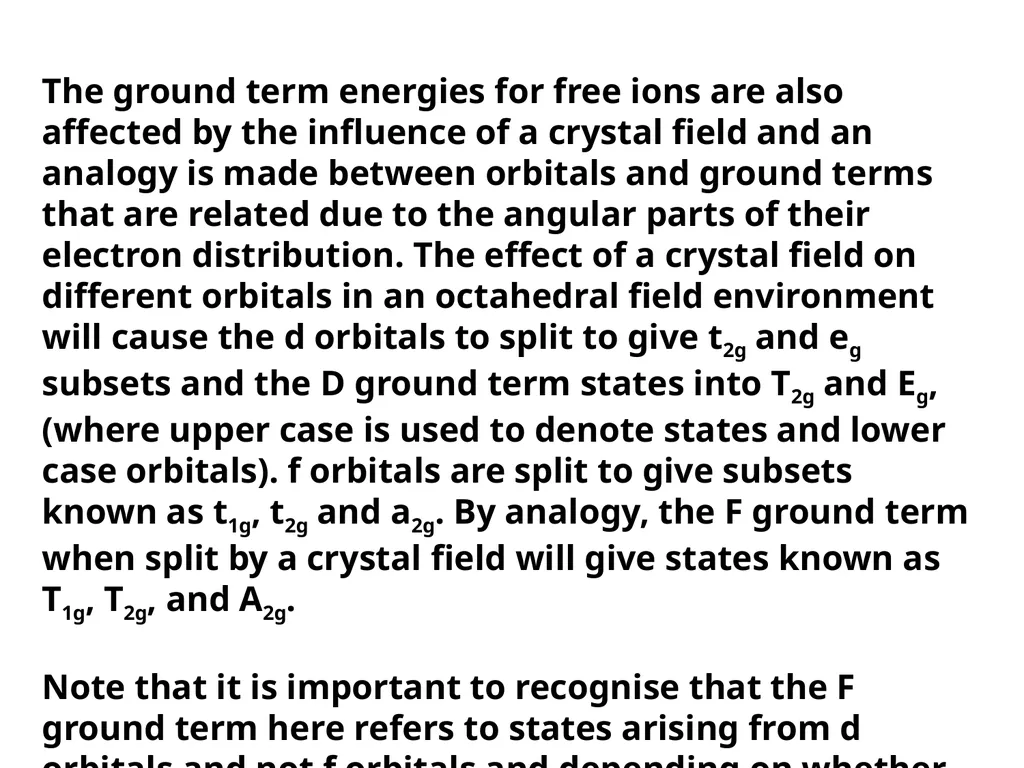
The ground term energies for free ions are also affected by the influence of a crystal field and an analogy is made between orbitals and ground terms that are related due to the angular parts of their electron distribution. The effect of a crystal field on different orbitals in an octahedral field environment will cause the d orbitals to split to give t2g and eg subsets and the D ground term states into T2g and Eg, (where upper case is used to denote states and lower case orbitals). f orbitals are split to give subsets known as t1g, t2g and a2g. By analogy, the F ground term when split by a crystal field will give states known as T1g, T2g, and A2g.
Note that it is important to recognise that the F ground term here refers to states arising from d orbitals and not f orbitals and depending on whether it is in an octahedral or tetrahedral environment the lowest term can be either A2g or T1g.<br>
20
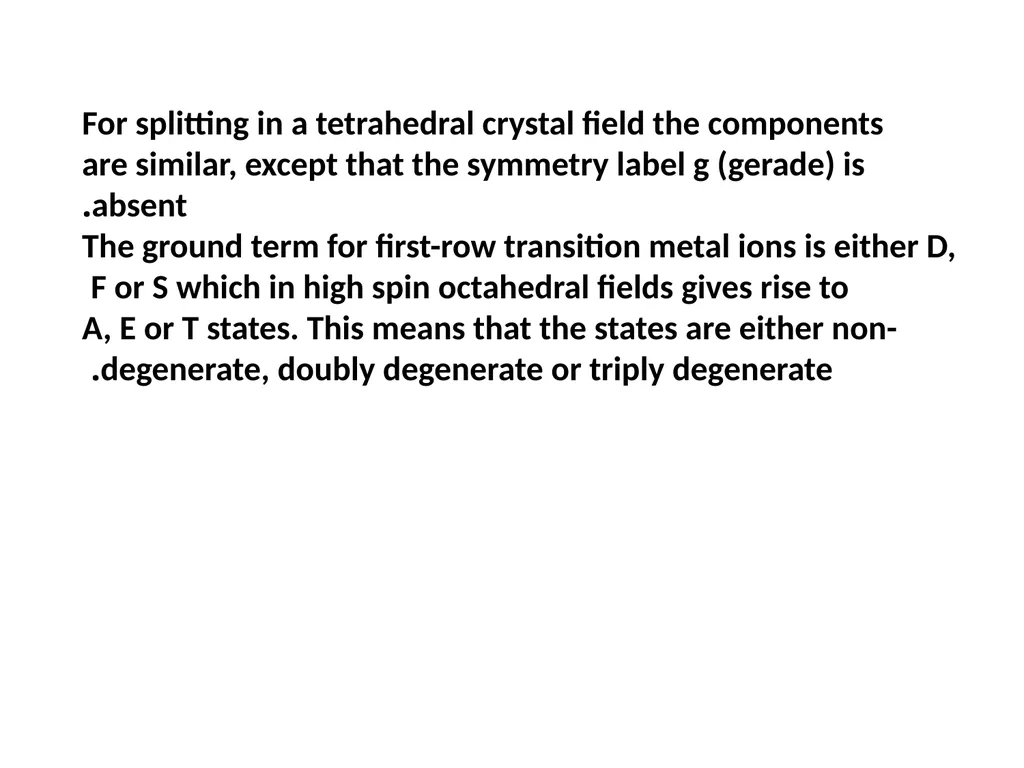
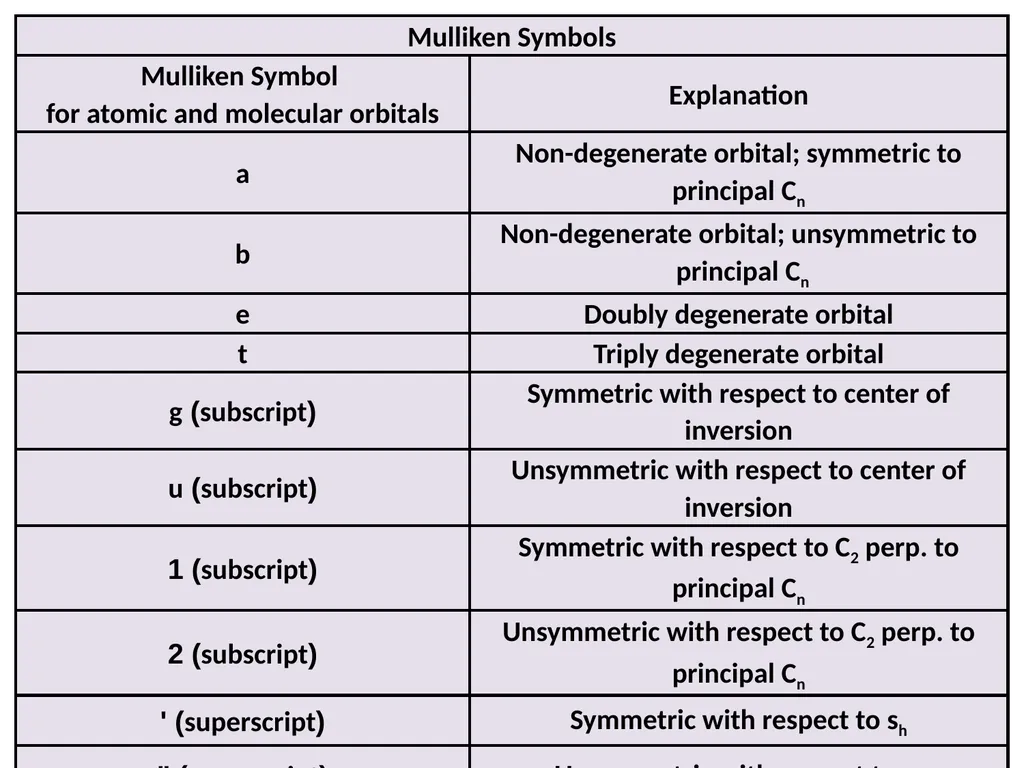
For splitting in a tetrahedral crystal field the components are similar, except that the symmetry label g (gerade) is absent.
The ground term for first-row transition metal ions is either D, F or S which in high spin octahedral fields gives rise to
A, E or T states. This means that the states are either non-degenerate, doubly degenerate or triply degenerate.<br>
The ground term for first-row transition metal ions is either D, F or S which in high spin octahedral fields gives rise to
A, E or T states. This means that the states are either non-degenerate, doubly degenerate or triply degenerate.<br>
21
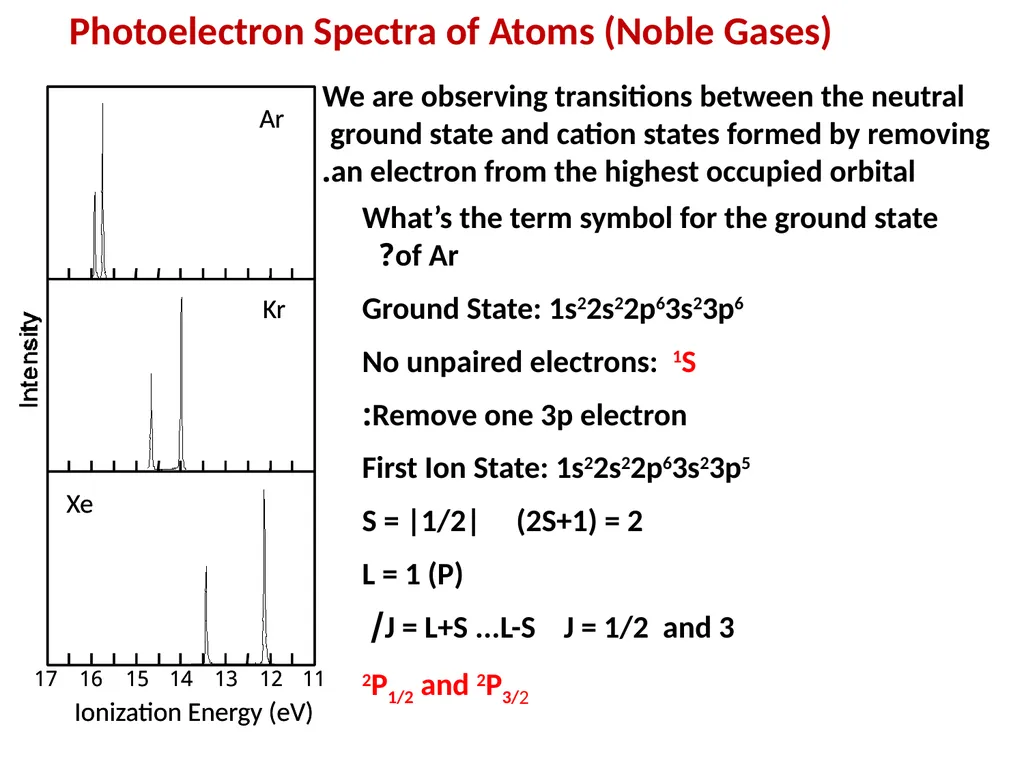
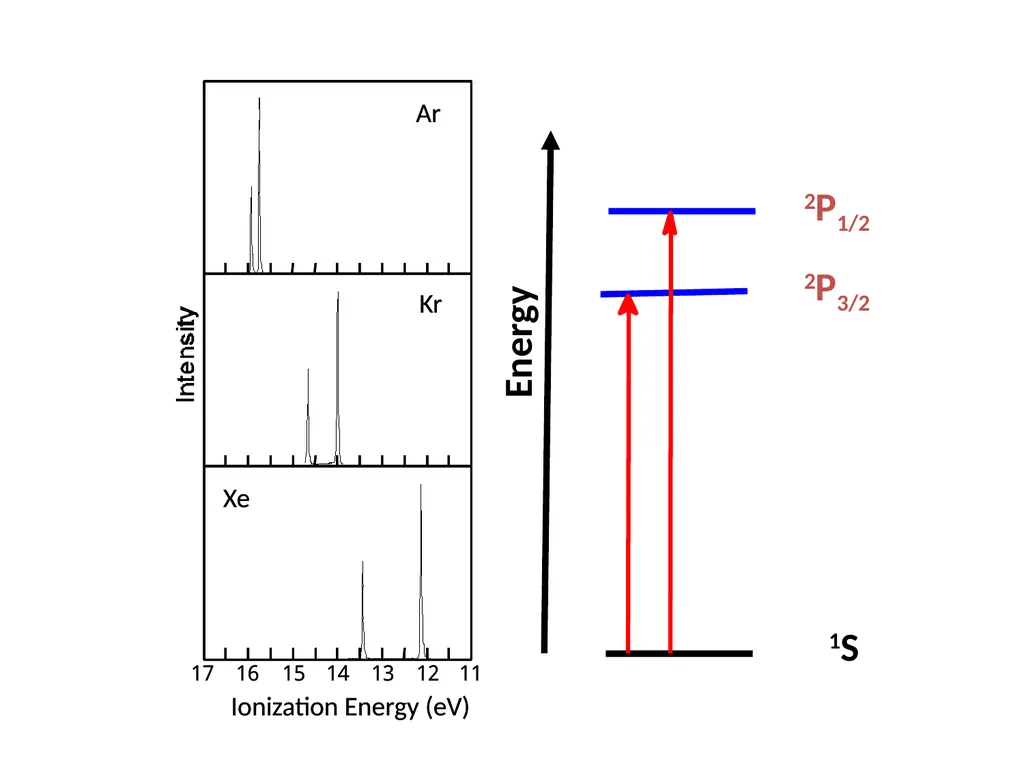
Photoelectron Spectra of Atoms (Noble Gases) We are observing transitions between the neutral
ground state and cation states formed by removing
an electron from the highest occupied orbital. What’s the term symbol for the ground state of Ar?
Ground State: 1s22s22p63s23p6
No unpaired electrons: 1S
Remove one 3p electron:
First Ion State: 1s22s22p63s23p5
S = |1/2| (2S+1) = 2
L = 1 (P)
J = L+S ...L-S J = 1/2 and 3/
2P1/2 and 2P3/2<br>
ground state and cation states formed by removing
an electron from the highest occupied orbital. What’s the term symbol for the ground state of Ar?
Ground State: 1s22s22p63s23p6
No unpaired electrons: 1S
Remove one 3p electron:
First Ion State: 1s22s22p63s23p5
S = |1/2| (2S+1) = 2
L = 1 (P)
J = L+S ...L-S J = 1/2 and 3/
2P1/2 and 2P3/2<br>
22
1S 2P3/2 2P1/2 Energy<br>
23
Example
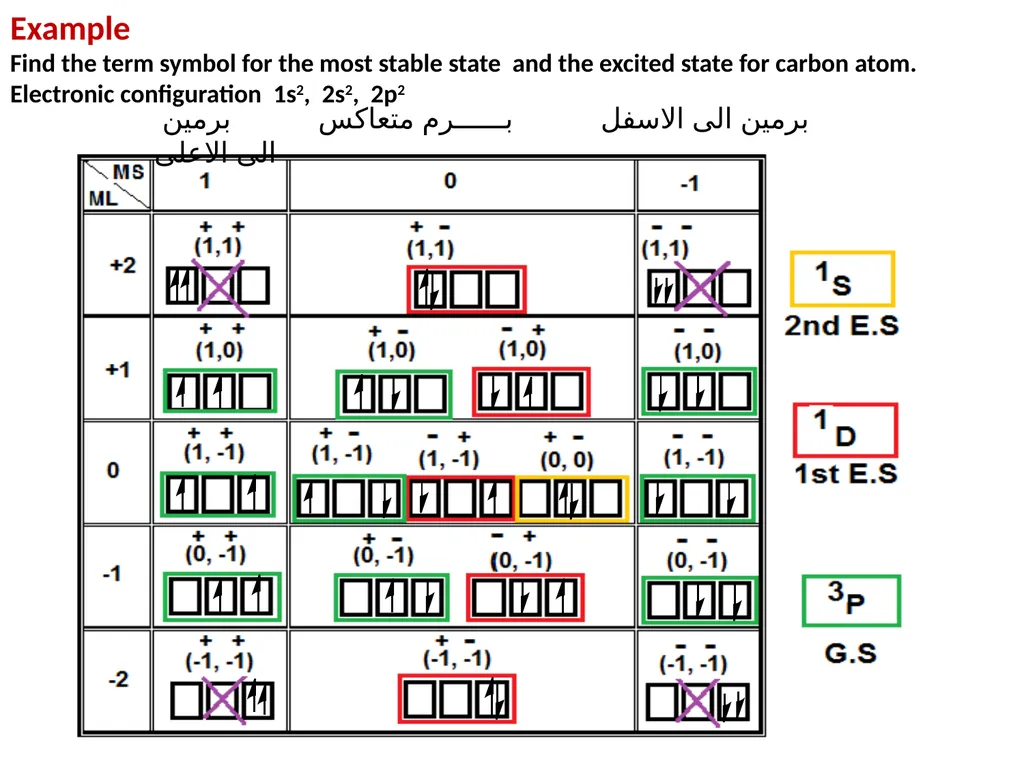
Find the term symbol for the most stable state and the excited state for carbon atom.
Electronic configuration 1s2, 2s2, 2p2 برمين الى الاسفل بــــــرم متعاكس برمين الى الاعلى<br>
Find the term symbol for the most stable state and the excited state for carbon atom.
Electronic configuration 1s2, 2s2, 2p2 برمين الى الاسفل بــــــرم متعاكس برمين الى الاعلى<br>
24
نختار أولا اعلى قيمة ل( L ) واعلى قيمة ترافقها من ( S )وهنا 1+, 1+
نستخرج( 2S+1 )( 2L+1 ) وهنا(3)x(3)=9 يعني تسعة حالات دقيقة مشتقة من هذه
الحالة .
نحذف من الجدول ثلاث حالات ( MS=1)وثلاث حلات عشوائية من MS=0))وثلاث حالات من
( MS=-1).
لما كان (2=L )و( S=1 ) اذن رمز الحالة ( 3P ).
نختار اعلى قيمة ل( L ) واعلى قيمة ترافقها من ( S )من القيم المتبقية بعد الحذف وهنا
(2=L )و ( S=0 ).
نستخرج( 2S+1 )( 2L+1 ) وهنا(5)x(5)=5 يعني خمس حالات دقيقة مشتقة من هذه الحالة .
نحذف من الجدول خمس حالات (MS=0).
لما كان (2=L )و( S=0 ) اذن رمز الحالة ( 1D ).
نختار اعلى قيمة ل( L ) واعلى قيمة ترافقها من ( S )من القيم المتبقية بعد الحذف وهنا
(0=L )و ( S=0 ).
اذن هنا حالة واحدة لما كان (0=L )و( S=0 ) اذن رمز الحالة ( 1S ).
يتم ترتيب الحالات حسب طاقاتها (الاقل طاقة ثم الاعلى) ]فالاوطأ طاقة هو الاعلى قيمة
( 2S+1 )واذا تساوت قيم التعددية فالاوطأ طاقة هو الاعلى قيمة ل( L ) .
اذن اصبح التسلسل<br>
نستخرج( 2S+1 )( 2L+1 ) وهنا(3)x(3)=9 يعني تسعة حالات دقيقة مشتقة من هذه
الحالة .
نحذف من الجدول ثلاث حالات ( MS=1)وثلاث حلات عشوائية من MS=0))وثلاث حالات من
( MS=-1).
لما كان (2=L )و( S=1 ) اذن رمز الحالة ( 3P ).
نختار اعلى قيمة ل( L ) واعلى قيمة ترافقها من ( S )من القيم المتبقية بعد الحذف وهنا
(2=L )و ( S=0 ).
نستخرج( 2S+1 )( 2L+1 ) وهنا(5)x(5)=5 يعني خمس حالات دقيقة مشتقة من هذه الحالة .
نحذف من الجدول خمس حالات (MS=0).
لما كان (2=L )و( S=0 ) اذن رمز الحالة ( 1D ).
نختار اعلى قيمة ل( L ) واعلى قيمة ترافقها من ( S )من القيم المتبقية بعد الحذف وهنا
(0=L )و ( S=0 ).
اذن هنا حالة واحدة لما كان (0=L )و( S=0 ) اذن رمز الحالة ( 1S ).
يتم ترتيب الحالات حسب طاقاتها (الاقل طاقة ثم الاعلى) ]فالاوطأ طاقة هو الاعلى قيمة
( 2S+1 )واذا تساوت قيم التعددية فالاوطأ طاقة هو الاعلى قيمة ل( L ) .
اذن اصبح التسلسل<br>
25
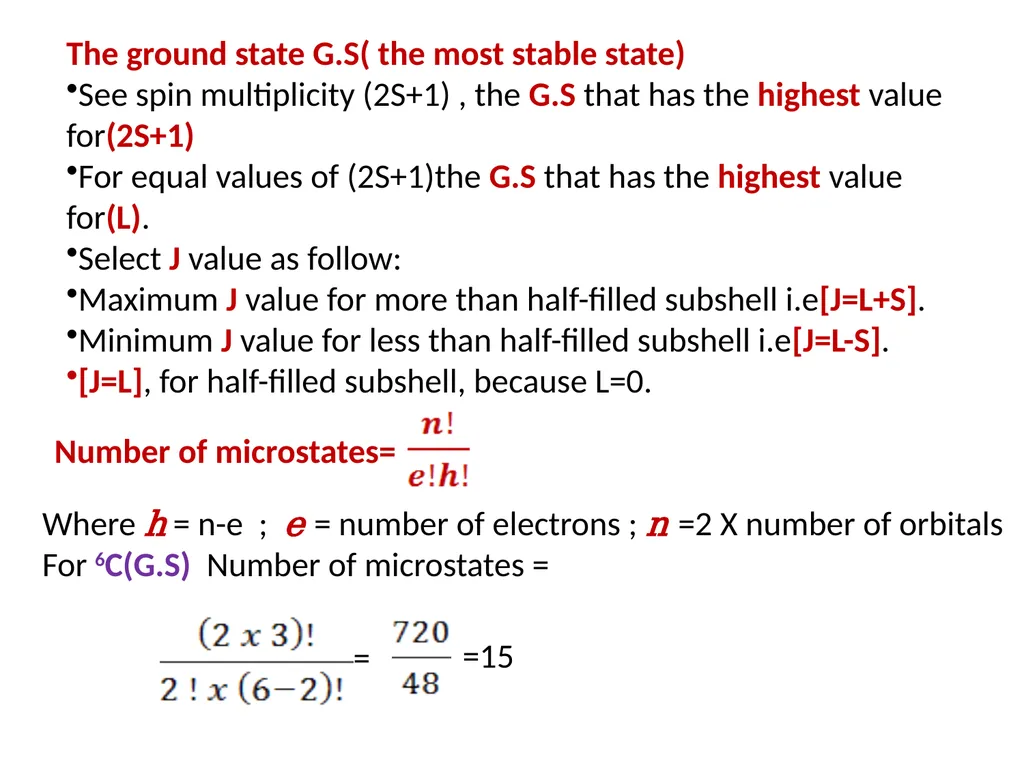
The ground state G.S( the most stable state)
See spin multiplicity (2S+1) , the G.S that has the highest value for(2S+1)
For equal values of (2S+1)the G.S that has the highest value for(L).
Select J value as follow:
Maximum J value for more than half-filled subshell i.e[J=L+S].
Minimum J value for less than half-filled subshell i.e[J=L-S].
[J=L], for half-filled subshell, because L=0. Number of microstates= Where h = n-e ; e = number of electrons ; n =2 X number of orbitals
For 6C(G.S) Number of microstates = = =15<br>
See spin multiplicity (2S+1) , the G.S that has the highest value for(2S+1)
For equal values of (2S+1)the G.S that has the highest value for(L).
Select J value as follow:
Maximum J value for more than half-filled subshell i.e[J=L+S].
Minimum J value for less than half-filled subshell i.e[J=L-S].
[J=L], for half-filled subshell, because L=0. Number of microstates= Where h = n-e ; e = number of electrons ; n =2 X number of orbitals
For 6C(G.S) Number of microstates = = =15<br>
26
Example
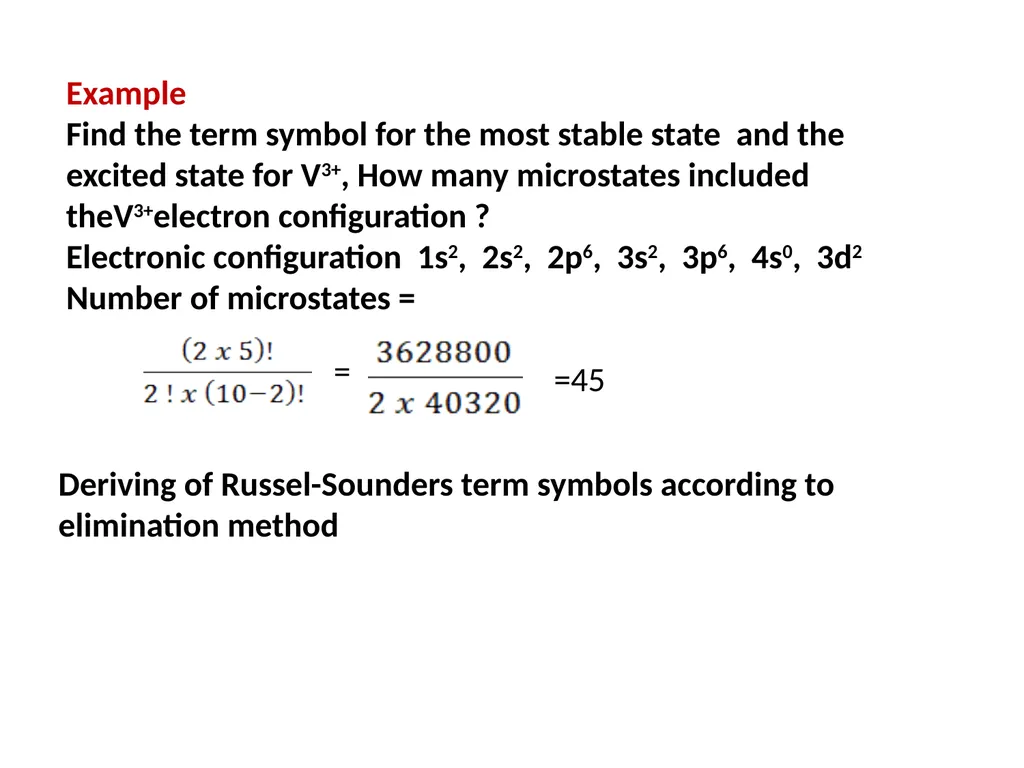
Find the term symbol for the most stable state and the excited state for V3+, How many microstates included theV3+electron configuration ?
Electronic configuration 1s2, 2s2, 2p6, 3s2, 3p6, 4s0, 3d2
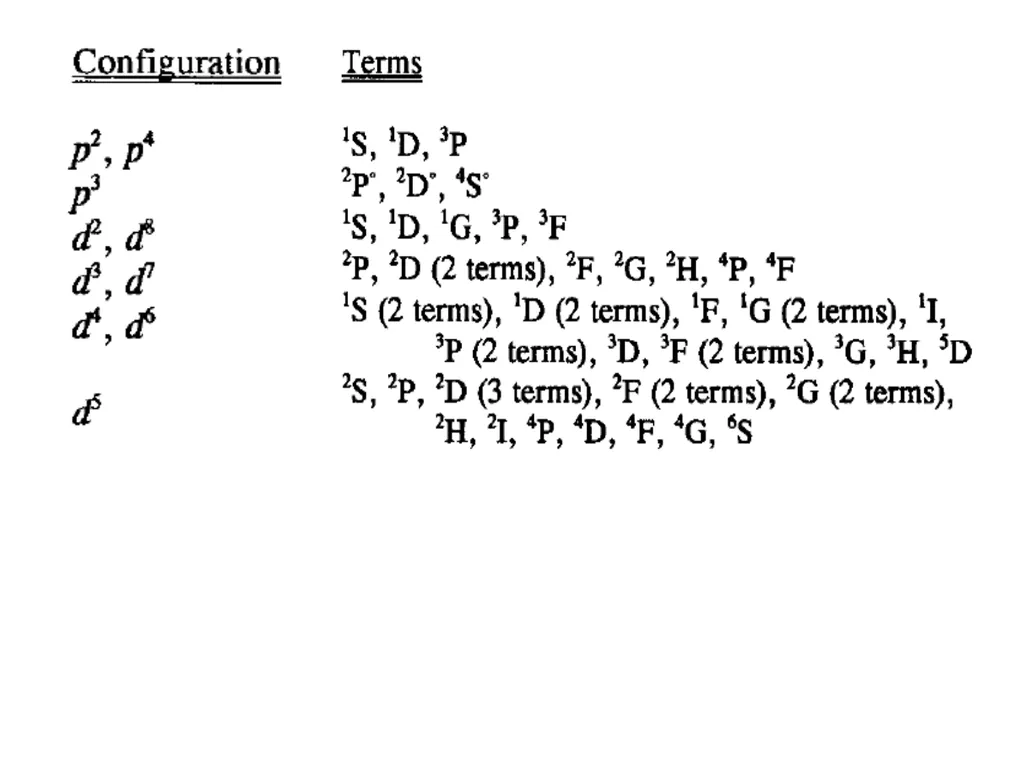
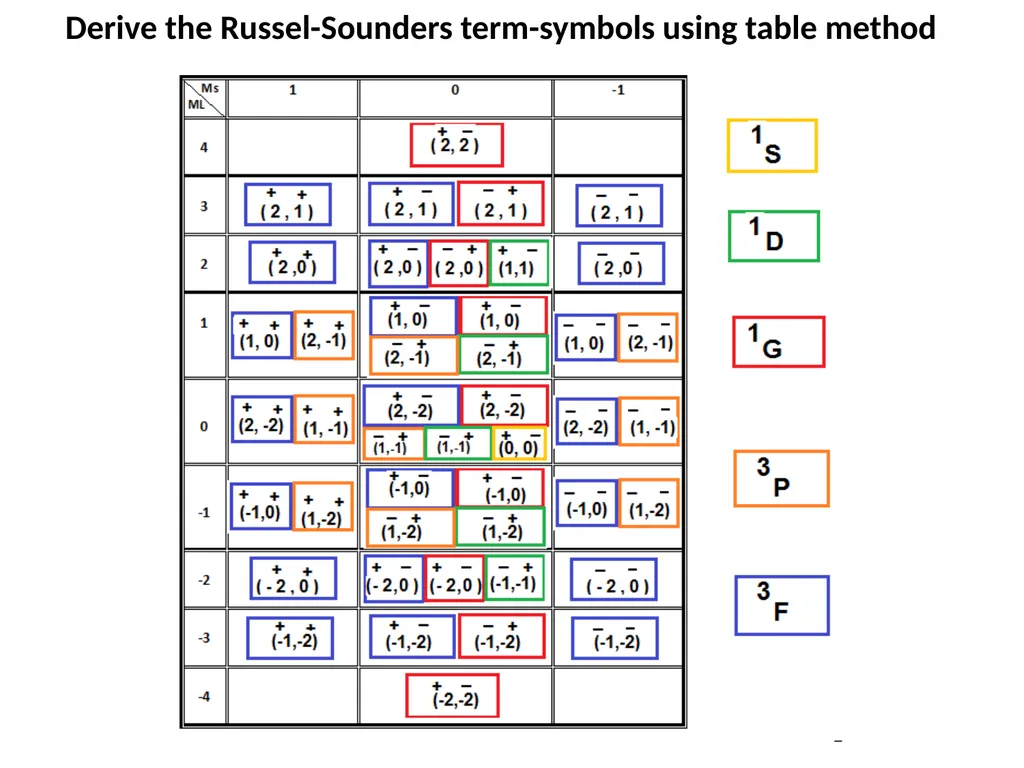
Number of microstates = = =45 Deriving of Russel-Sounders term symbols according to elimination method<br>
Find the term symbol for the most stable state and the excited state for V3+, How many microstates included theV3+electron configuration ?
Electronic configuration 1s2, 2s2, 2p6, 3s2, 3p6, 4s0, 3d2
Number of microstates = = =45 Deriving of Russel-Sounders term symbols according to elimination method<br>
27
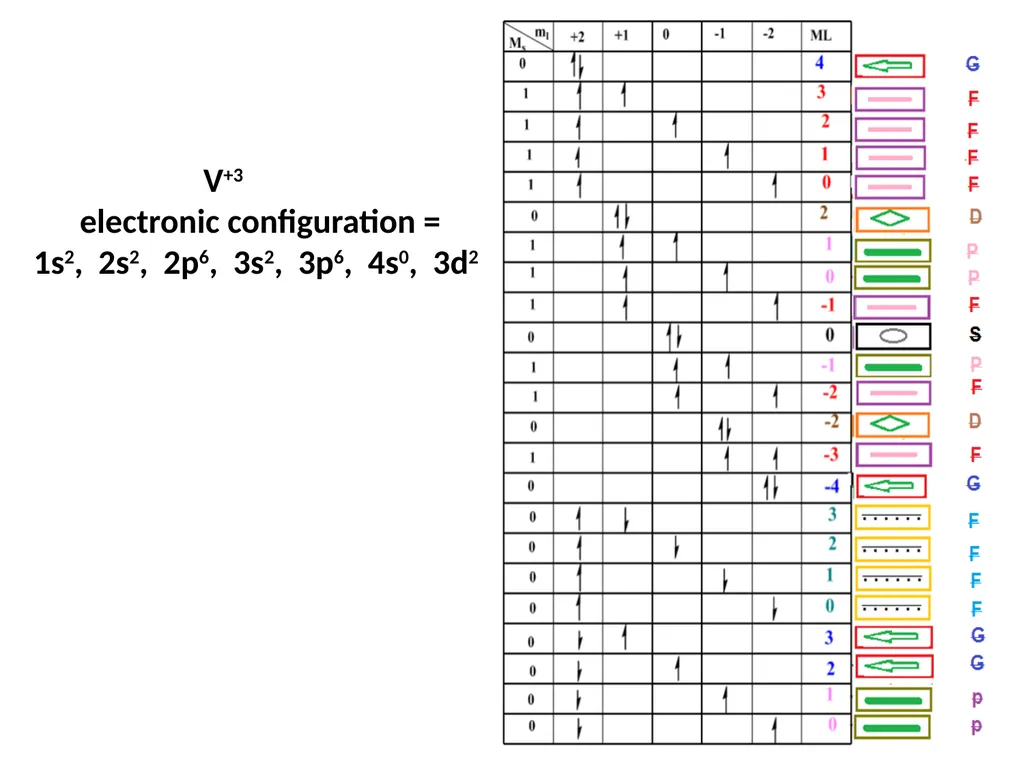
V+3
electronic configuration =
1s2, 2s2, 2p6, 3s2, 3p6, 4s0, 3d2<br>
electronic configuration =
1s2, 2s2, 2p6, 3s2, 3p6, 4s0, 3d2<br>
28
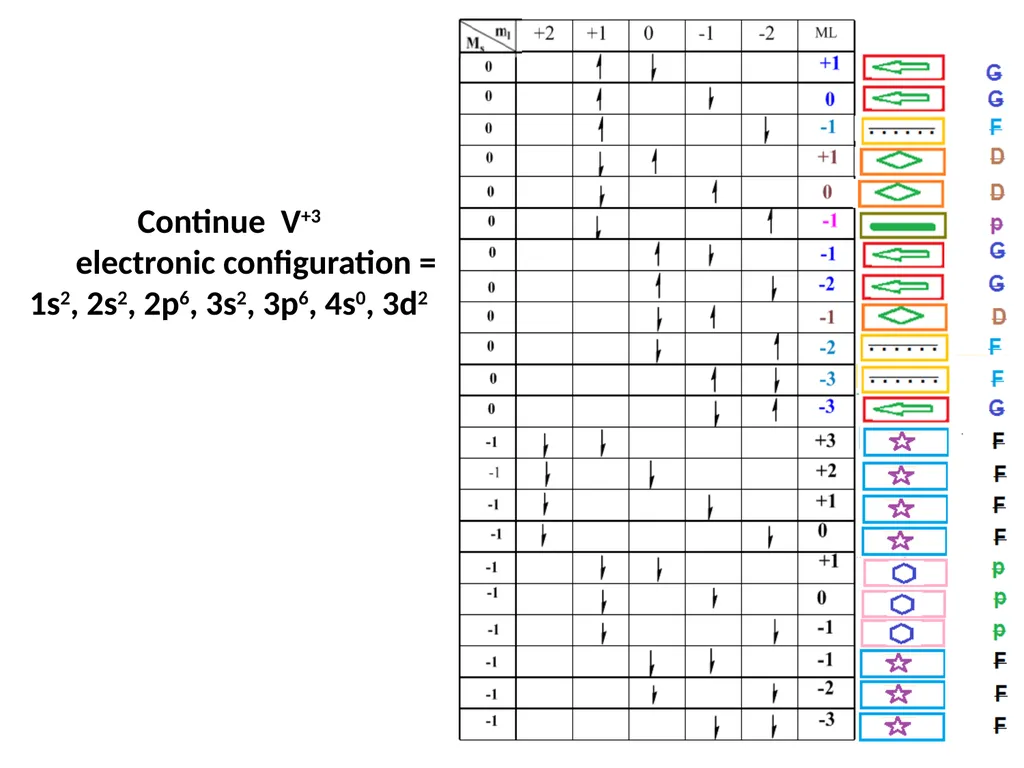
Continue V+3
electronic configuration =
1s2, 2s2, 2p6, 3s2, 3p6, 4s0, 3d2<br>
electronic configuration =
1s2, 2s2, 2p6, 3s2, 3p6, 4s0, 3d2<br>
29
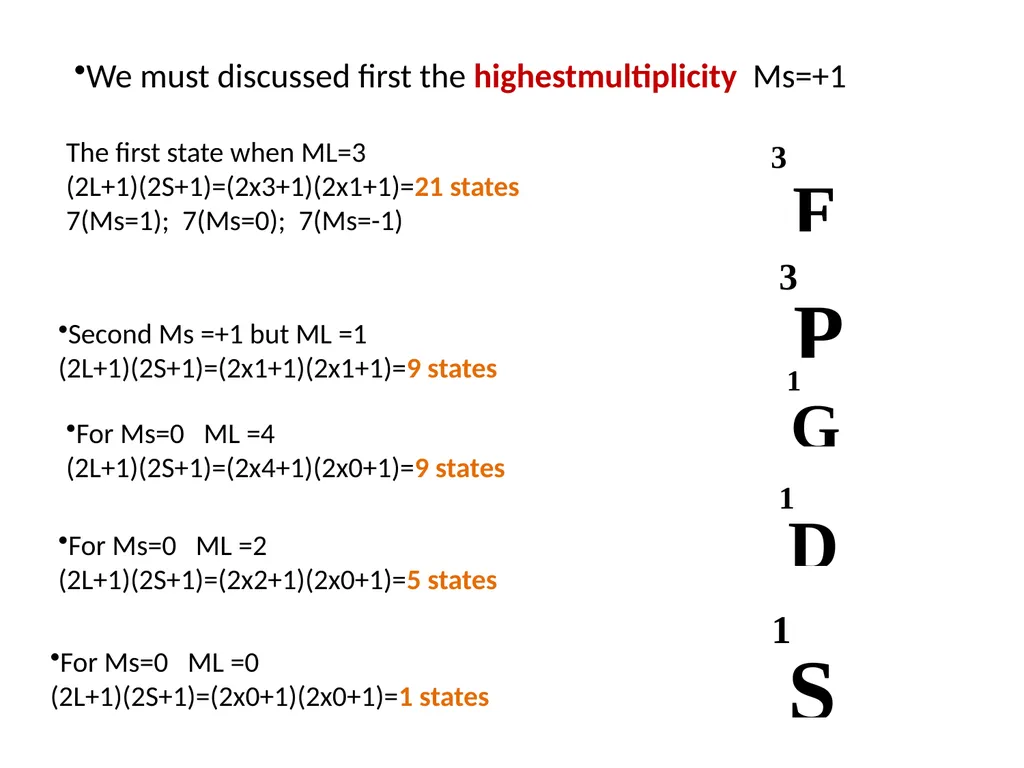
We must discussed first the highestmultiplicity Ms=+1 The first state when ML=3
(2L+1)(2S+1)=(2x3+1)(2x1+1)=21 states
7(Ms=1); 7(Ms=0); 7(Ms=-1) Second Ms =+1 but ML =1
(2L+1)(2S+1)=(2x1+1)(2x1+1)=9 states For Ms=0 ML =4
(2L+1)(2S+1)=(2x4+1)(2x0+1)=9 states For Ms=0 ML =2
(2L+1)(2S+1)=(2x2+1)(2x0+1)=5 states For Ms=0 ML =0
(2L+1)(2S+1)=(2x0+1)(2x0+1)=1 states<br>
(2L+1)(2S+1)=(2x3+1)(2x1+1)=21 states
7(Ms=1); 7(Ms=0); 7(Ms=-1) Second Ms =+1 but ML =1
(2L+1)(2S+1)=(2x1+1)(2x1+1)=9 states For Ms=0 ML =4
(2L+1)(2S+1)=(2x4+1)(2x0+1)=9 states For Ms=0 ML =2
(2L+1)(2S+1)=(2x2+1)(2x0+1)=5 states For Ms=0 ML =0
(2L+1)(2S+1)=(2x0+1)(2x0+1)=1 states<br>
30
The lowest energy , the most stable state, the state with the highest multiplicity (3F, 3P) , For equal multiplicities, the more stable-state is the state with greater L value ( 3F) and so on.<br>
31
Derive the Russel-Sounders term-symbols using table method<br>