04
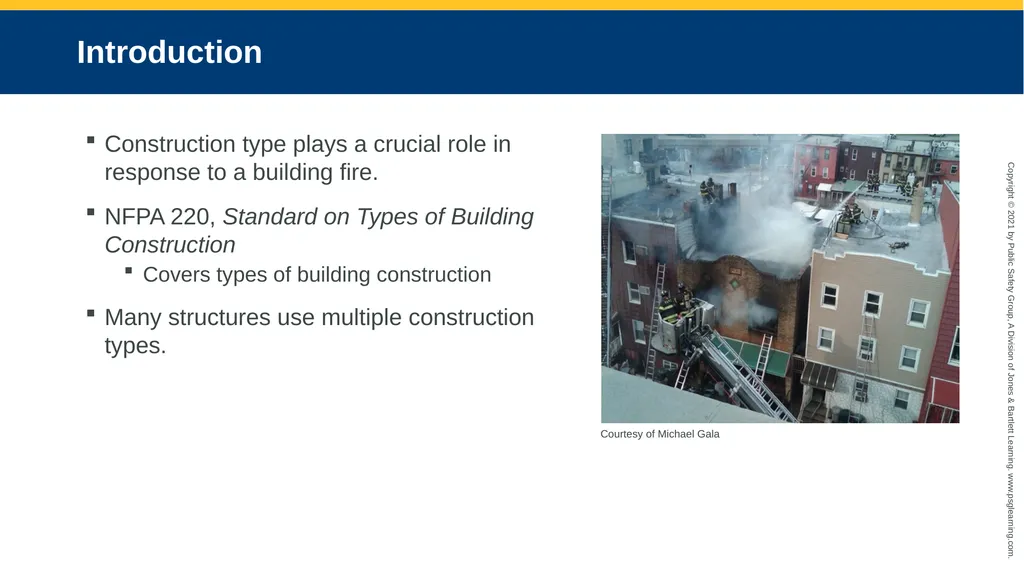
Introduction Construction type plays a crucial role in response to a building fire.
NFPA 220, Standard on Types of Building Construction
Covers types of building construction
Many structures use multiple construction types. Courtesy of Michael Gala<br>
05
Type V: Frame (Wood) Wood frame construction
Common throughout the country
Main structural materials are wooden.
Important points to remember:
Surface-to-mass ratio
Connection method<br>
06
Type V: Frame (Wood) Types of frame buildings
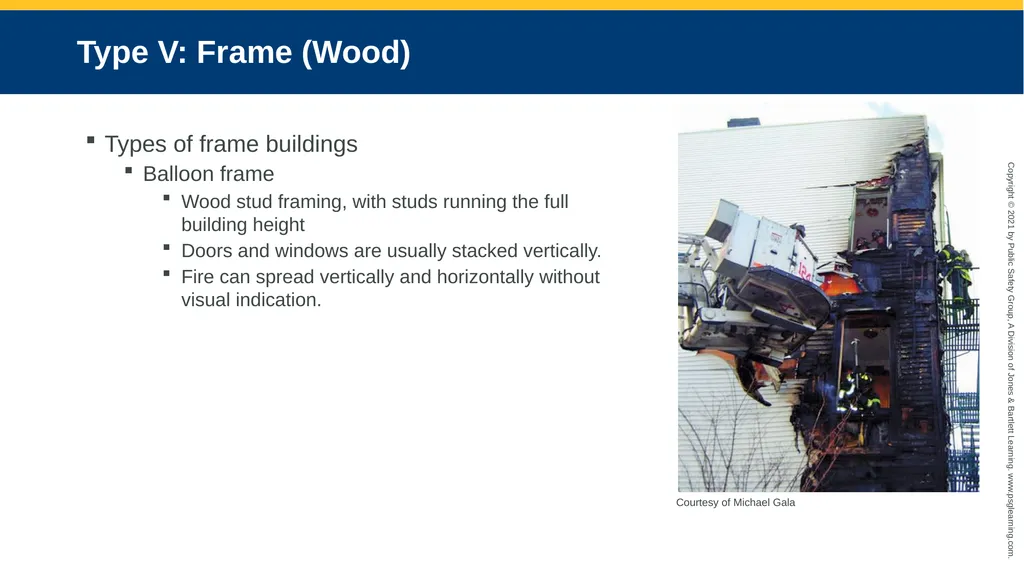
Balloon frame
Wood stud framing, with studs running the full building height
Doors and windows are usually stacked vertically.
Fire can spread vertically and horizontally without visual indication. Courtesy of Michael Gala<br>
07
Type V: Frame (Wood) Types of frame buildings (cont’d)
Platform frame
Most common frame construction used today
Wood stud framing is set on a foundation or slab and built to story height.
Firestopping between floors
Post and beam
Uses posts and beams to create load-bearing frame
Identified by exposed interior walls or preplans and inspections<br>
08
Type V: Frame (Wood) Types of frame buildings (cont’d)
Plank and beam
Uses larger beams than post and beam
Boards are laminated together.
Reduces concealed spaces
Truss frame
Engineered with entire structure in a unitized frame
Load-bearing stud walls and lightweight wood truss floors and roof<br>
09
Type V: Frame (Wood) Types of frame buildings (cont’d)
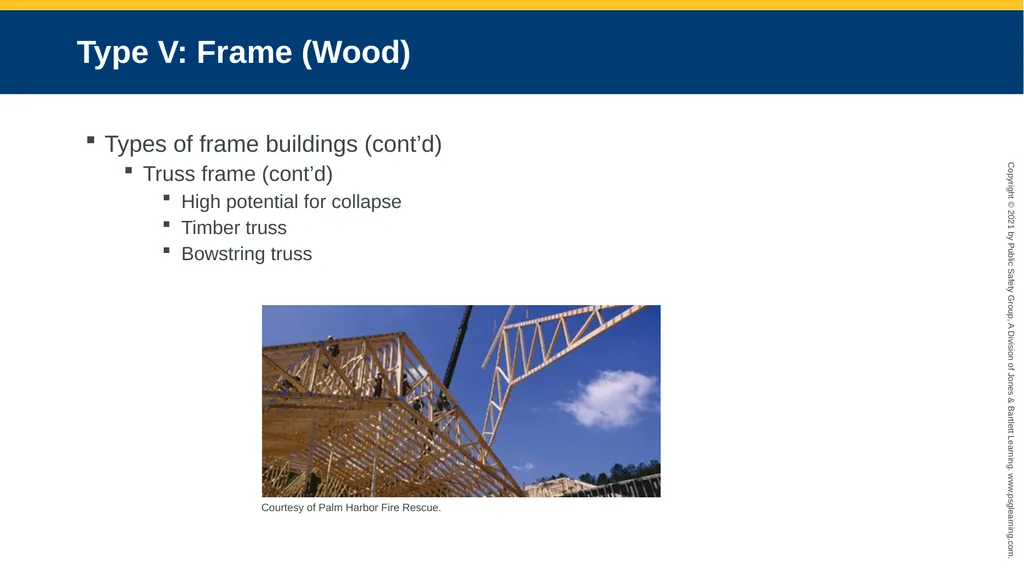
Truss frame (cont’d)
High potential for collapse
Timber truss
Bowstring truss Courtesy of Palm Harbor Fire Rescue.<br>
10
Type V: Frame (Wood) Variables in fire performance of wood
Condition of the wood
Old
Fungus and decay
Laminated wood
Defects
Loading
Truss construction
Fasteners<br>
11
Type V: Frame (Wood) Wood treatments
Treated to resist moisture, insects, and fire
Phosphates and sulfates
Deterioration causes brittle plywood and a high potential for collapse.<br>
12
Type V: Frame (Wood) Size matters.
Wood carries its load by mass.
Wood loses its mass when exposed to fire.
When the loss of mass is greater than the load it’s carrying, collapse occurs.<br>
13
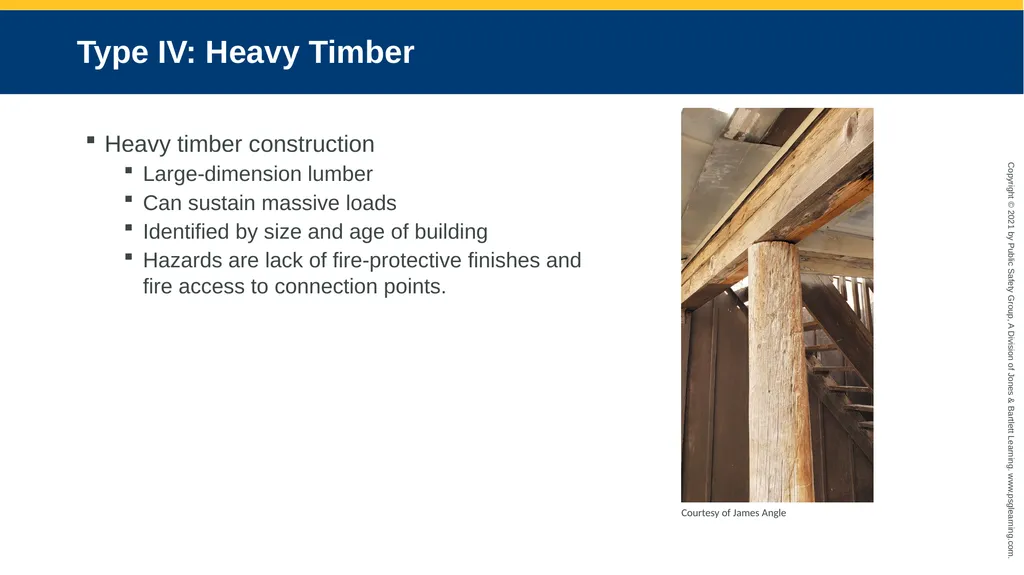
Type IV: Heavy Timber Heavy timber construction
Large-dimension lumber
Can sustain massive loads
Identified by size and age of building
Hazards are lack of fire-protective finishes and fire access to connection points. Courtesy of James Angle<br>
14
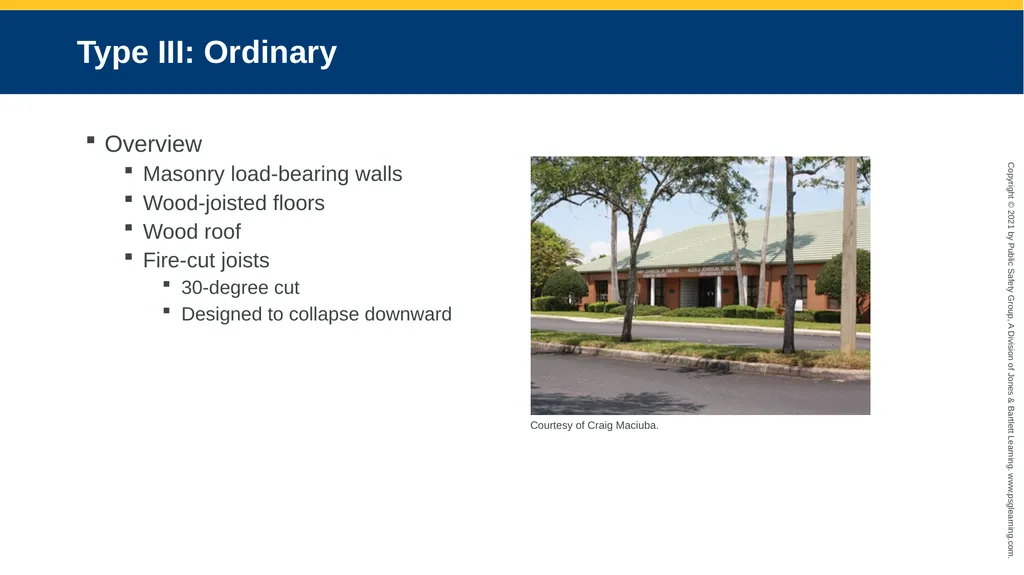
Type III: Ordinary Overview
Masonry load-bearing walls
Wood-joisted floors
Wood roof
Fire-cut joists
30-degree cut
Designed to collapse downward Courtesy of Craig Maciuba.<br>
15
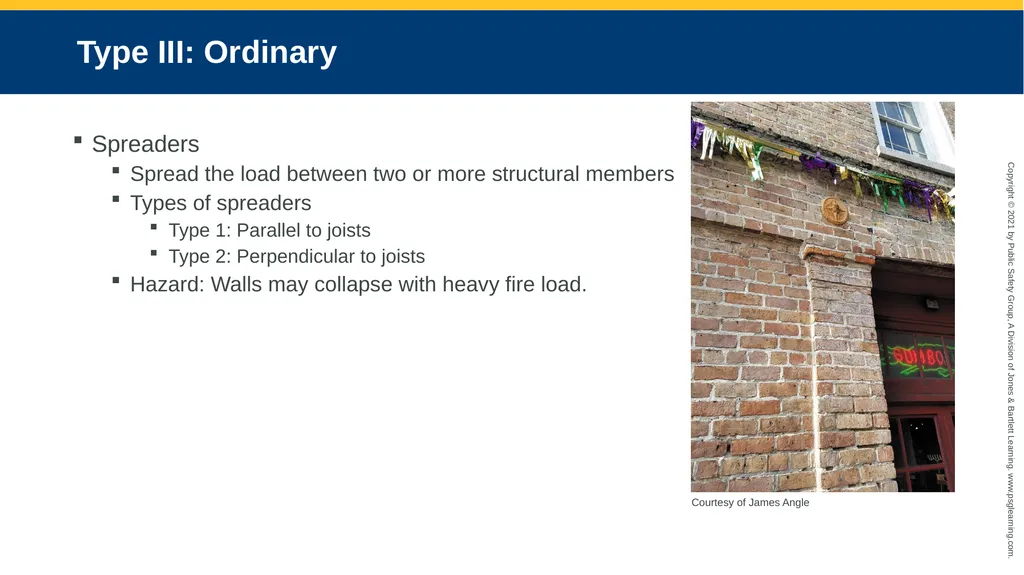
Type III: Ordinary Spreaders
Spread the load between two or more structural members
Types of spreaders
Type 1: Parallel to joists
Type 2: Perpendicular to joists
Hazard: Walls may collapse with heavy fire load. Courtesy of James Angle<br>
16
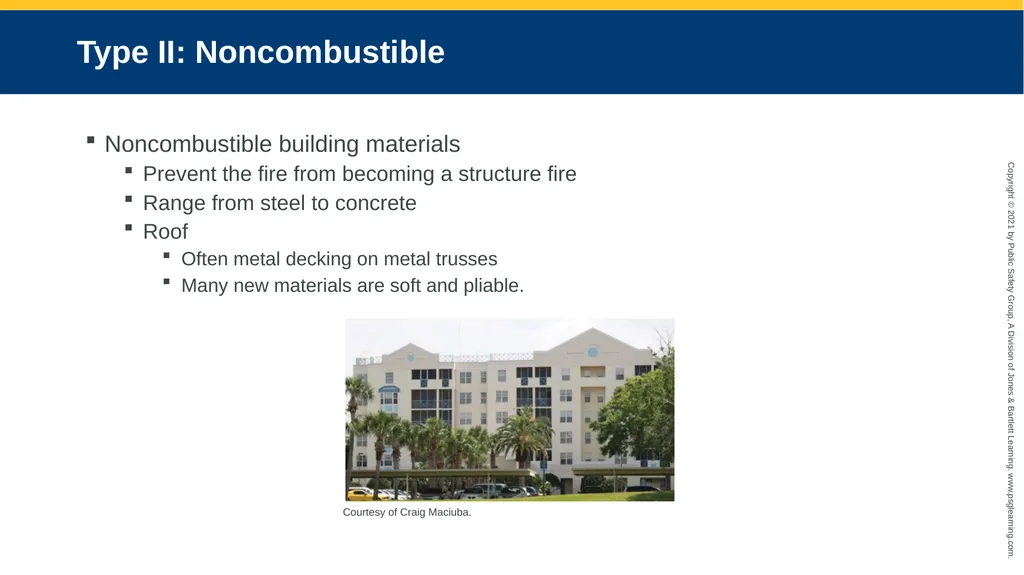
Type II: Noncombustible Noncombustible building materials
Prevent the fire from becoming a structure fire
Range from steel to concrete
Roof
Often metal decking on metal trusses
Many new materials are soft and pliable. Courtesy of Craig Maciuba.<br>
17
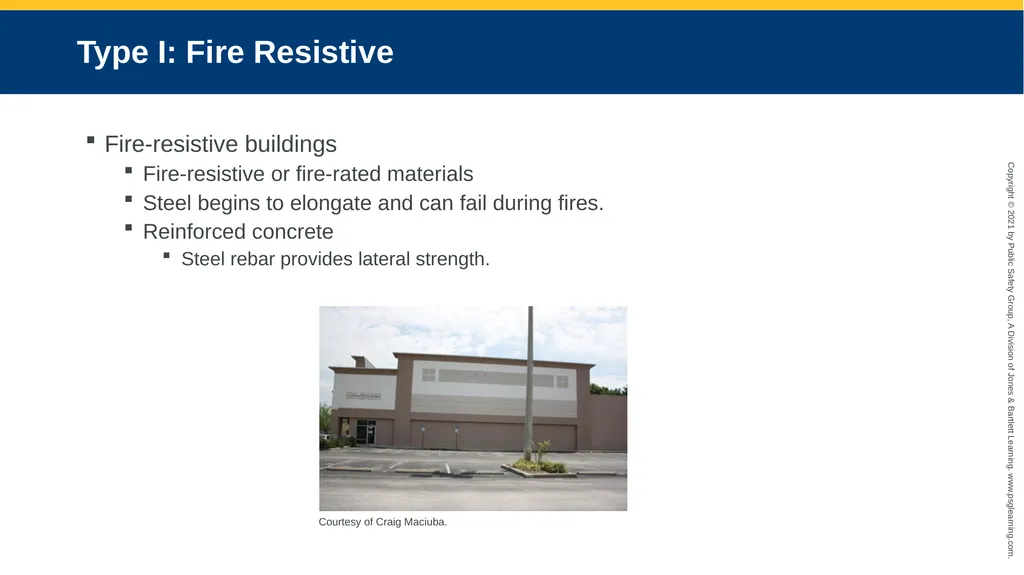
Type I: Fire Resistive Fire-resistive buildings
Fire-resistive or fire-rated materials
Steel begins to elongate and can fail during fires.
Reinforced concrete
Steel rebar provides lateral strength. Courtesy of Craig Maciuba.<br>
18
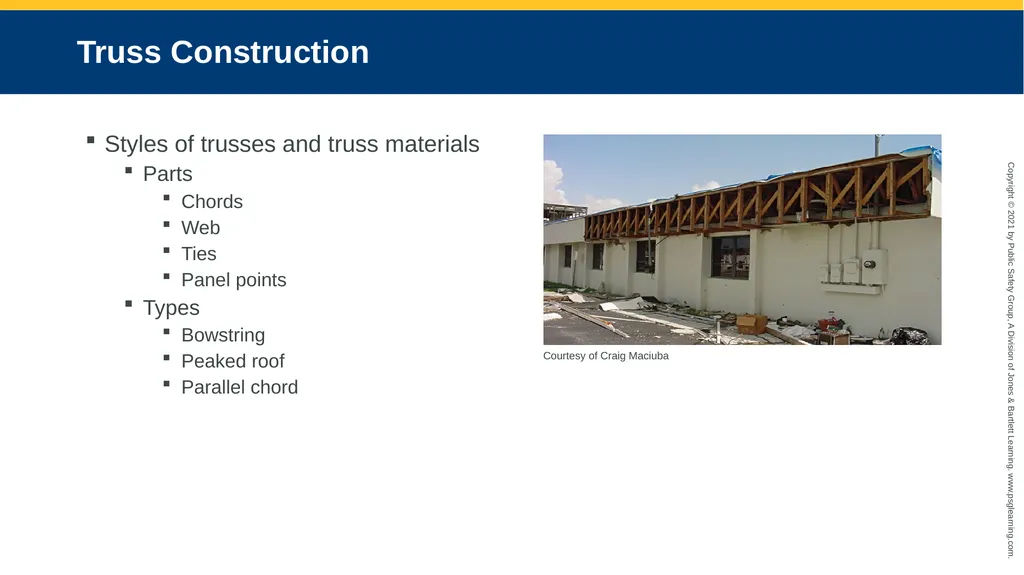
Truss Construction Styles of trusses and truss materials
Parts
Chords
Web
Ties
Panel points
Types
Bowstring
Peaked roof
Parallel chord Courtesy of Craig Maciuba<br>
19
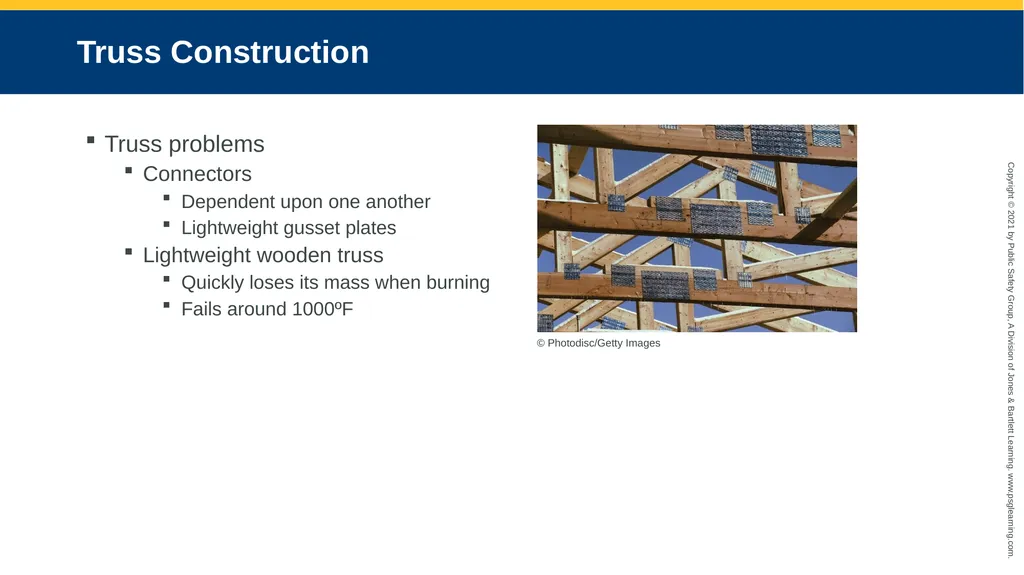
Truss Construction Truss problems
Connectors
Dependent upon one another
Lightweight gusset plates
Lightweight wooden truss
Quickly loses its mass when burning
Fails around 1000ºF © Photodisc/Getty Images<br>
20
New Technology in Building Construction New products and technologies
Engineered wood I-beam
Resembles a traditional I-beam
Relatively lightweight
Laminated beam
Less expensive
Can begin to delaminate<br>
21
Summary Every fire science student must learn how different loads, forces, materials, and structural elements affect the stability of each construction type when exposed to the effects of fire.
Type V (wood-frame) construction is very common.
Types of wood-frame buildings include balloon frame, platform frame, post and beam, plank and beam, and truss frame.<br>
22
Summary The condition of the wood plays a part in the structural integrity of a building.
Wood can be treated to resist moisture, insects, and fire; however, treatment can cause the wood to deteriorate in high humidity.
Wood carries load by its mass.
Heavy timber construction is commonly found in old industrial buildings.<br>
23
Summary Ordinary construction is composed of masonry load-bearing walls with wood-joisted floors and a wood roof.
A spreader is used to spread a load between two or more structural members.
The noncombustible construction method employs building materials that will not add to the fire development.<br>
24
Summary The fire-resistive building is built with steel, concrete, and other fire-resistive or fire-rated materials.
Trusses consist of lightweight building materials arranged in a group of triangles in which loads applied will be distributed throughout the other members.<br>
25
Summary The shortcoming of truss construction is the same as that we find with any construction method: the connectors.
Both the laminated beam and the engineered I-beam have helped the building industry span larger open distances with load-bearing ability at a lower cost.<br>