Chapter 5 Lesson 1 Describing Weather What is Weather? Weather is the atmospheric conditions, along with short-term changes, of a certain place at a certain time Weather can change quite rapidly, even within a few minutes, or a place can
"Chapter 5 Lesson 1 Describing Weather What is" is the property of its rightful owner. Permission is granted to
download and print the materials on this website for personal, non-commercial use only, and to display it
on your personal computer provided you do not modify the materials and that you retain all copyright
notices contained in the materials. By downloading content from our website, you accept the terms of this
agreement.
Presentation Transcript
01
Chapter 5 Lesson 1 Describing Weather<br>
02
What is Weather? Weather is the atmospheric conditions, along with short-term changes, of a certain place at a certain time
Weather can change quite rapidly, even within a few minutes, or a place can experience the same weather for a few days<br>
03
Weather Variables Many things play a role in determining the weather
Some weather variables include:
Temperature
Rainfall
Air pressure
Wind speed and direction
Humidity
Cloud coverage
Precipitation<br>
04
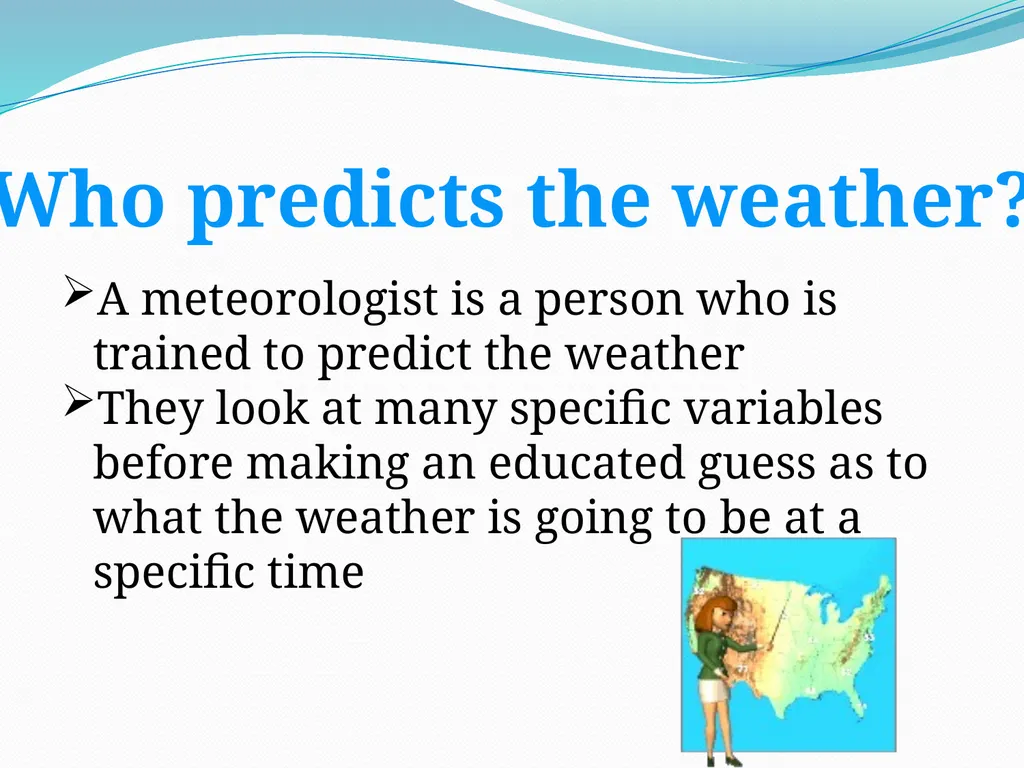
Who predicts the weather? A meteorologist is a person who is trained to predict the weather
They look at many specific variables before making an educated guess as to what the weather is going to be at a specific time<br>
05
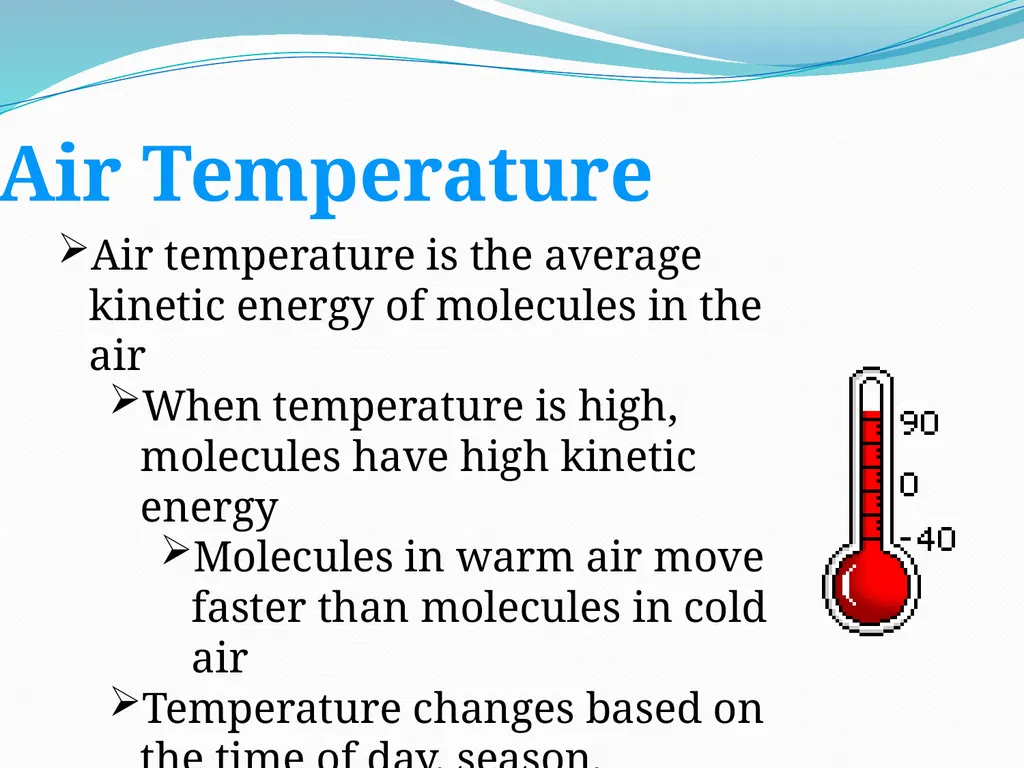
Air Temperature Air temperature is the average kinetic energy of molecules in the air
When temperature is high, molecules have high kinetic energy
Molecules in warm air move faster than molecules in cold air
Temperature changes based on the time of day, season, location, and altitude<br>
06
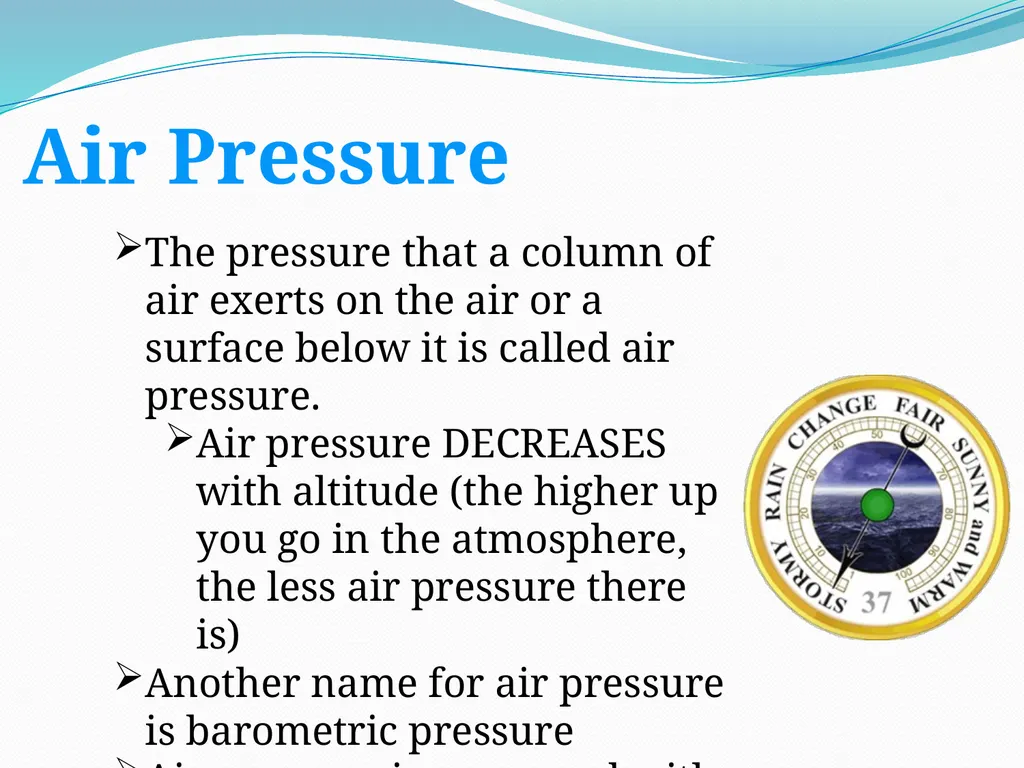
Air Pressure The pressure that a column of air exerts on the air or a surface below it is called air pressure.
Air pressure DECREASES with altitude (the higher up you go in the atmosphere, the less air pressure there is)
Another name for air pressure is barometric pressure
Air pressure is measured with a tool called a barometer<br>
07
Wind Air moves from areas of high pressure to areas of low pressure, creating wind.
Wind direction is the direction FROM which the wind is blowing
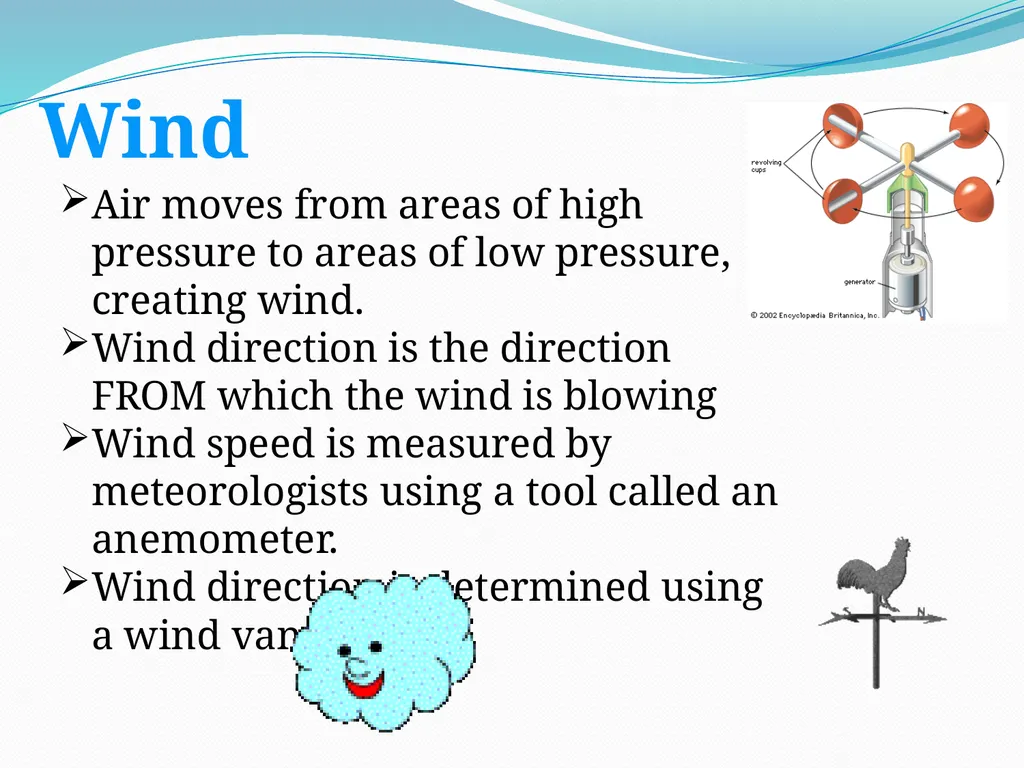
Wind speed is measured by meteorologists using a tool called an anemometer.
Wind direction is determined using a wind vane<br>
08
Humidity The amount of water vapor in the air is humidity
When humidity is high, there is more water vapor in the air
Humidity can make your skin feel sticky and your sweat may not evaporate as quickly as normal<br>
09
Relative Humidity Relative humidity is the amount of water vapor present in the air compared to the maximum amount of water vapor the air could have at a certain temperature
A good example to compare it to would be the amount of water a sponge can hold
At some point, the sponge can no longer hold any more water
Relative is measured using a psychrometer and is given as a percent
Air that has 100% relative humidity can not hold any more water or dew, otherwise rain will fall<br>
10
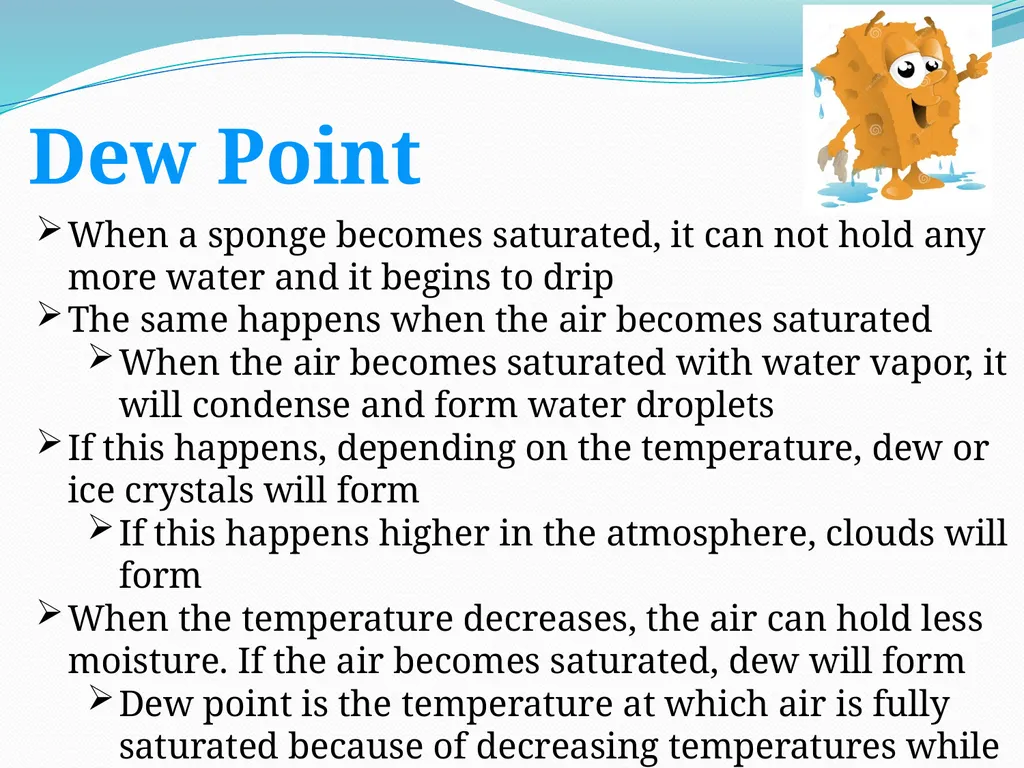
Dew Point When a sponge becomes saturated, it can not hold any more water and it begins to drip
The same happens when the air becomes saturated
When the air becomes saturated with water vapor, it will condense and form water droplets
If this happens, depending on the temperature, dew or ice crystals will form
If this happens higher in the atmosphere, clouds will form
When the temperature decreases, the air can hold less moisture. If the air becomes saturated, dew will form
Dew point is the temperature at which air is fully saturated because of decreasing temperatures while holding<br>
11
Clouds and Fog When air containing water vapor cools as it rises in the atmosphere and reaches its dew point, it condenses on small particles in the air and forms droplets
Surrounded by thousands of other droplets, these small droplets block and reflect light, making the visible as what we know as clouds
Clouds are water droplets or ice crystals suspended in the atmosphere
Different types of clouds form based on where they are located in the atmosphere
A cloud that is near Earth’s surface is known as fog
Fog is a suspension of water droplets or ice crystals close to or at Earth’s surface.
Fog reduces visibility, making it harder to drive<br>
12
Precipitation Remember that water droplets in clouds form around small solid particles in the atmosphere such as dust, salt, or smoke
Precipitation occurs when cloud droplets combine and become big enough to fall back to Earth’s surface
Precipitation is water, in liquid or solid form, that falls from the atmosphere
Examples of precipitation include rain, snow, sleet, and hail<br>
13
Rain is precipitation that reaches Earth’s surface in liquid form
Snow is precipitation that reaches Earth’s surface in solid, frozen crystal form
Sleet is when snow melts as it falls through a layer of warm air in the atmosphere and then re-freezes
Hail starts as a small piece of ice that is repeatedly lifted and dropped by an updraft within a cloud.
A layer of ice is added with each lifting Types of Precipitation<br>
14
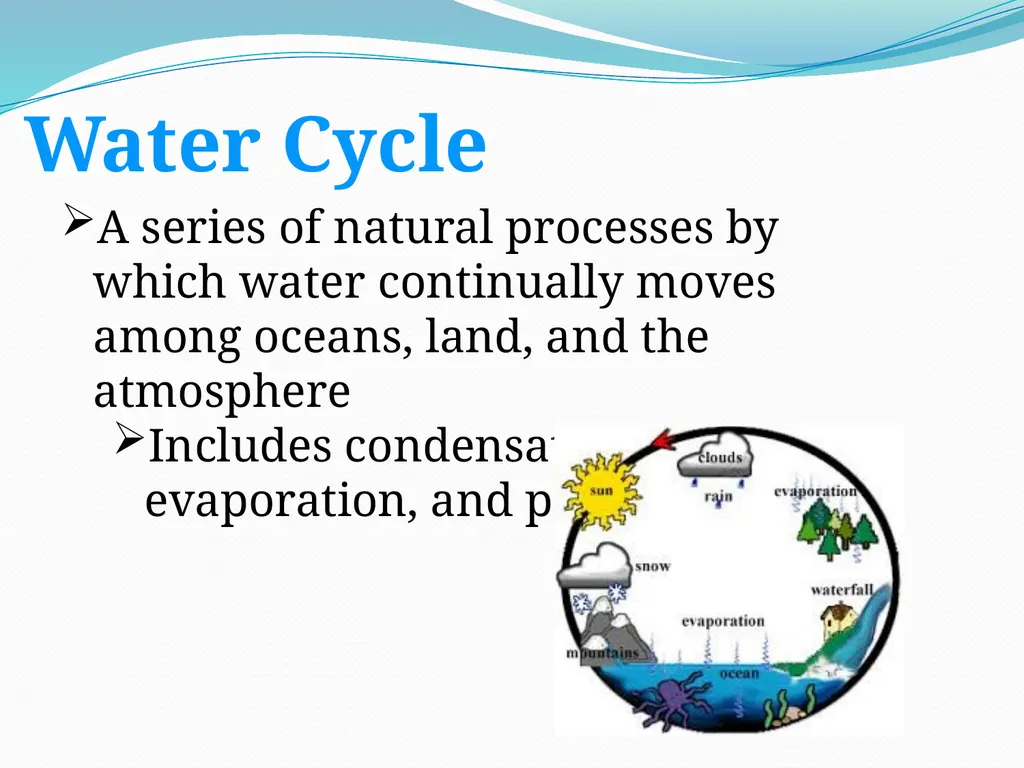
Water Cycle A series of natural processes by which water continually moves among oceans, land, and the atmosphere
Includes condensation, evaporation, and precipitation<br>
15
Which is NOT a standard weather variable?
Air pressure
Moon phase
Temperature
Wind speed<br>