
CHAPTER 5 Socializing the Individual Section 1:

Description: CHAPTER 5 Socializing the Individual Section 1: Personality Development Section 2: The Social Self Section 3: Agents of Socialization 1 Objectives: Identify the four main factors that affect the development of personality. Explain how
Related Topics
Download Presentation
"CHAPTER 5 Socializing the Individual Section 1:" is the property of its rightful owner. Permission is granted to download and print the materials on this website for personal, non-commercial use only, and to display it on your personal computer provided you do not modify the materials and that you retain all copyright notices contained in the materials. By downloading content from our website, you accept the terms of this agreement.
Presentation Transcript
slide1. CHAPTER 5
Socializing the Individual Section 1: Personality Development
Section 2: The Social Self
Section 3: Agents of Socialization 1<br>
slide2. Objectives: Identify the four main factors that affect the development of personality.
Explain how isolation in childhood affects development. 2 Section 1: Personality Development<br>
slide3. What is Personality?? The sum total of behaviors, attitudes, beliefs, and values that are characteristic of an individual.
Determines how we adjust to our environment, interacting with other people
At an older age, personality traits change at a slower rate.
However, development varies from individual to individual.<br>
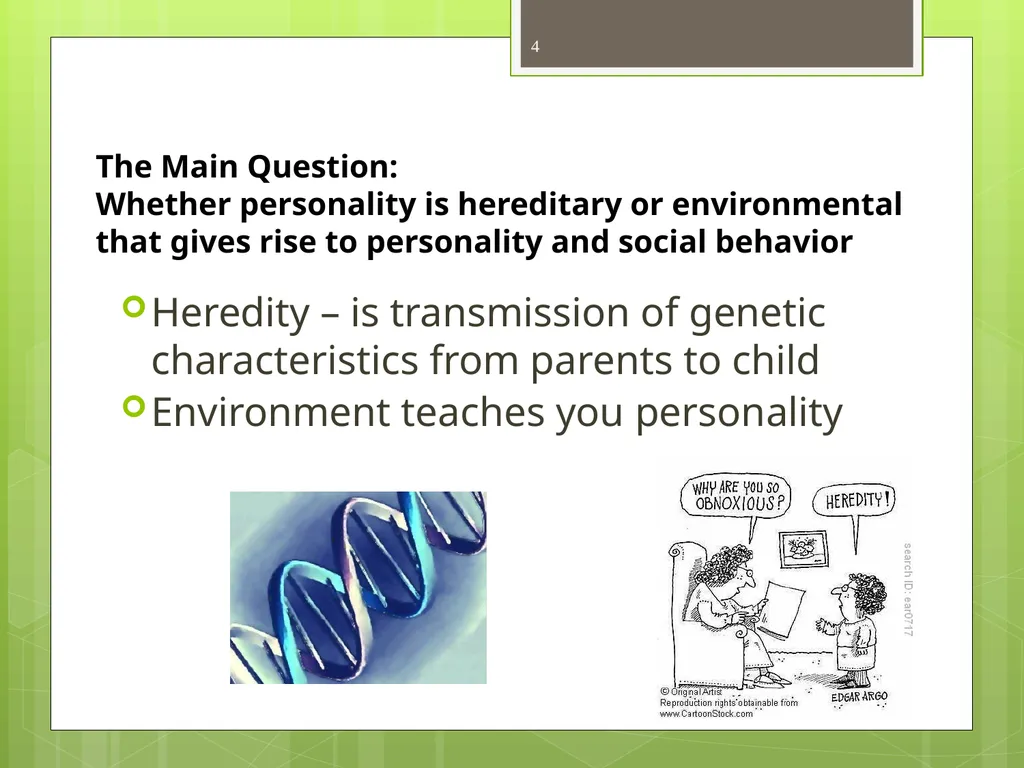
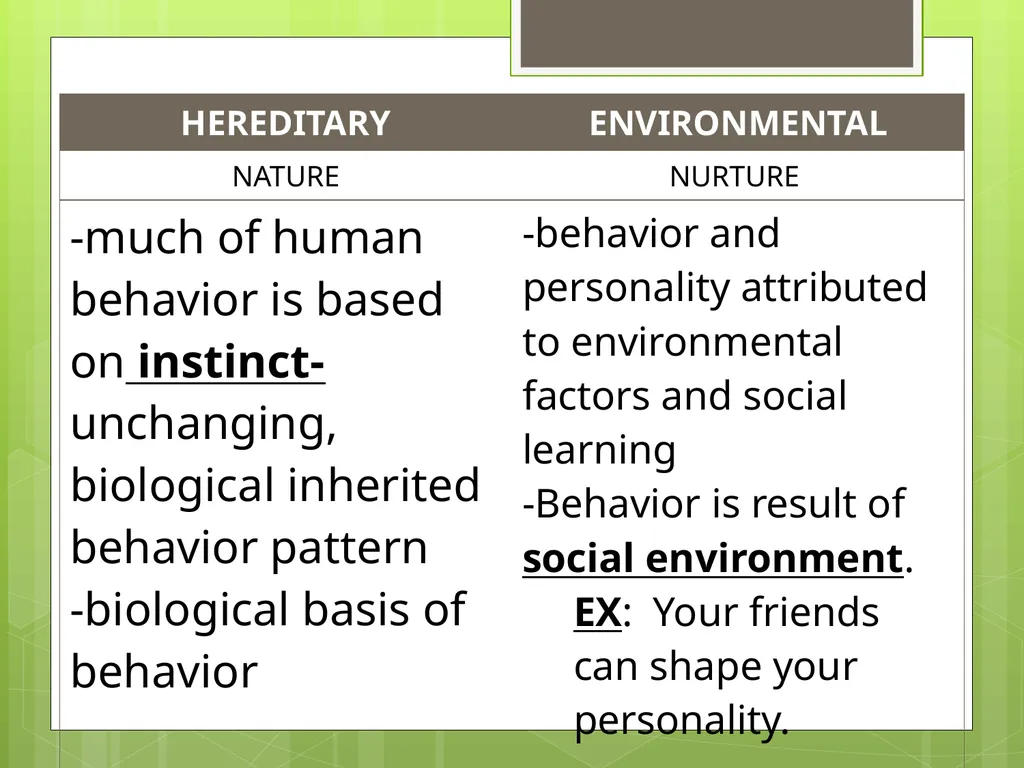
slide4. The Main Question: Whether personality is hereditary or environmental that gives rise to personality and social behavior Heredity – is transmission of genetic characteristics from parents to child
Environment teaches you personality 4<br>
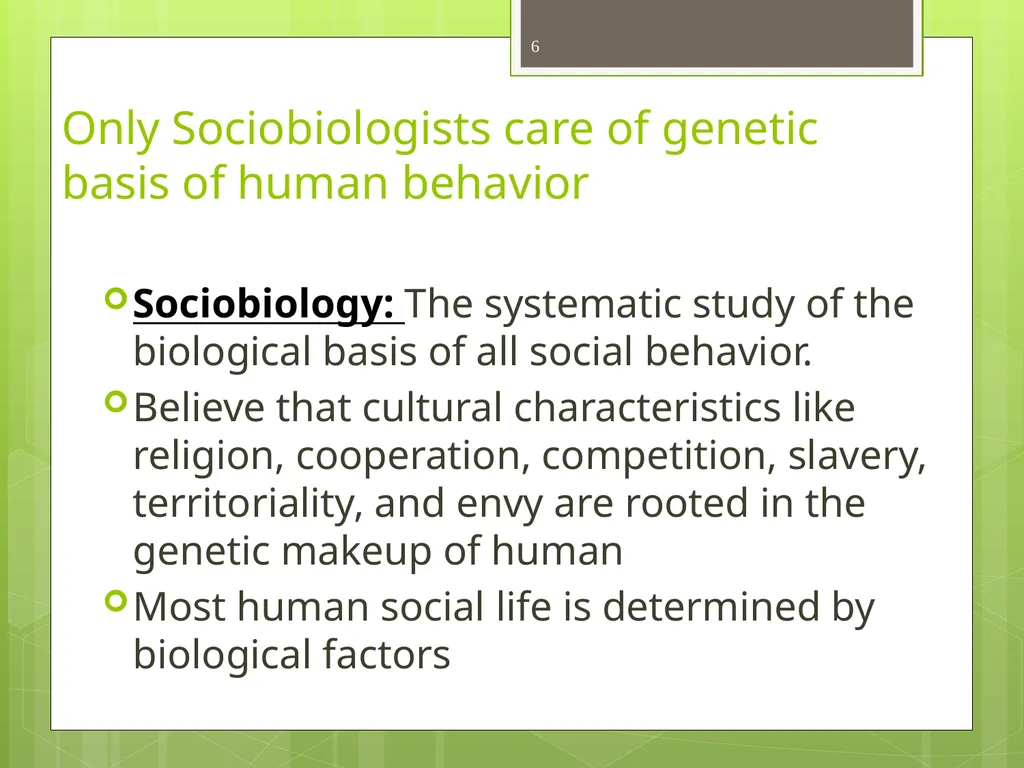
slide6. Only Sociobiologists care of genetic basis of human behavior Sociobiology: The systematic study of the biological basis of all social behavior.
Believe that cultural characteristics like religion, cooperation, competition, slavery, territoriality, and envy are rooted in the genetic makeup of human
Most human social life is determined by biological factors 6<br>
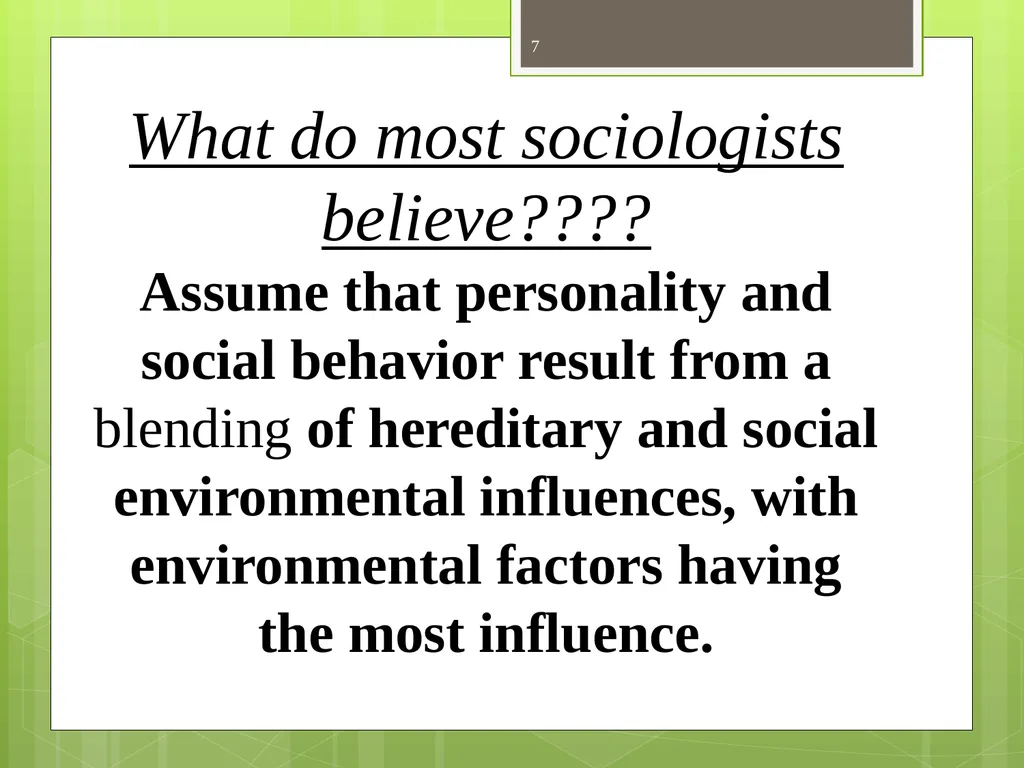
slide7. 7 What do most sociologists believe????
Assume that personality and social behavior result from a blending of hereditary and social environmental influences, with environmental factors having the most influence.<br>
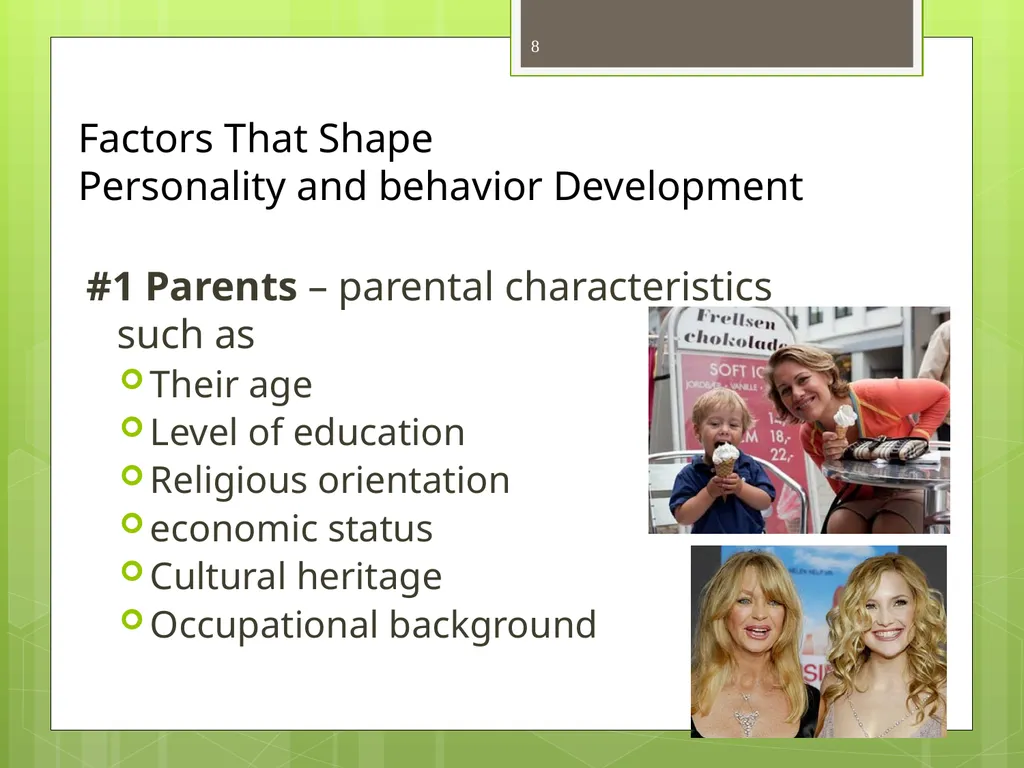
slide8. Factors That Shape Personality and behavior Development #1 Parents – parental characteristics such as
Their age
Level of education
Religious orientation
economic status
Cultural heritage
Occupational background 8<br>
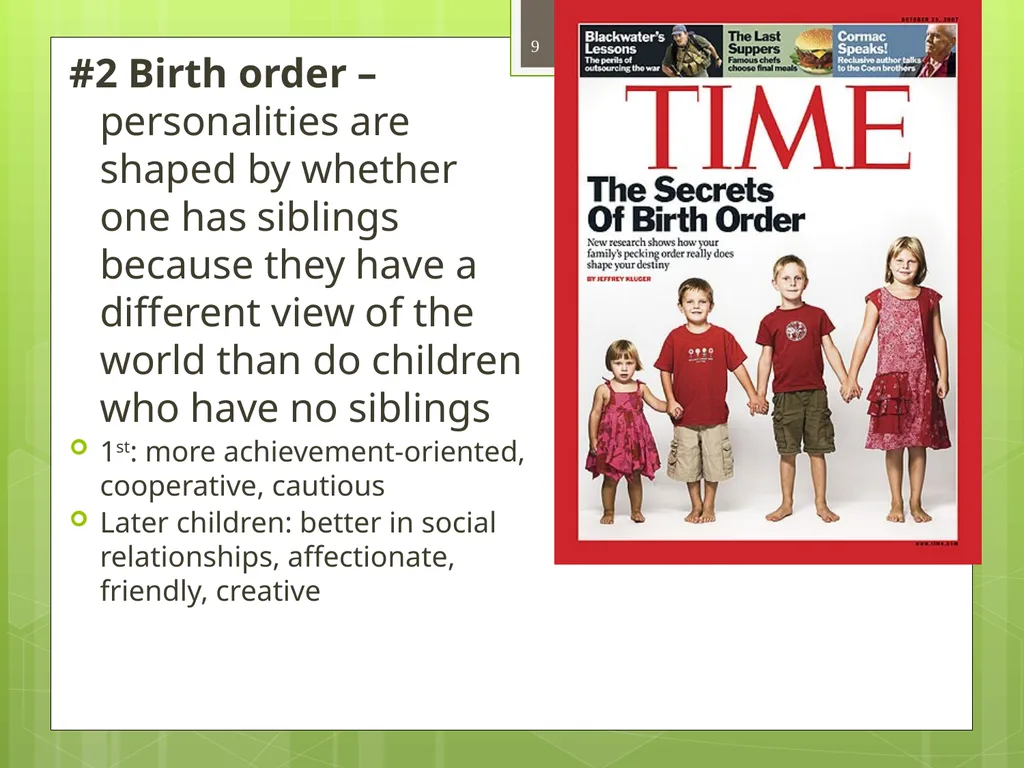
slide9. #2 Birth order – personalities are shaped by whether one has siblings because they have a different view of the world than do children who have no siblings
1st: more achievement-oriented, cooperative, cautious
Later children: better in social relationships, affectionate, friendly, creative 9<br>
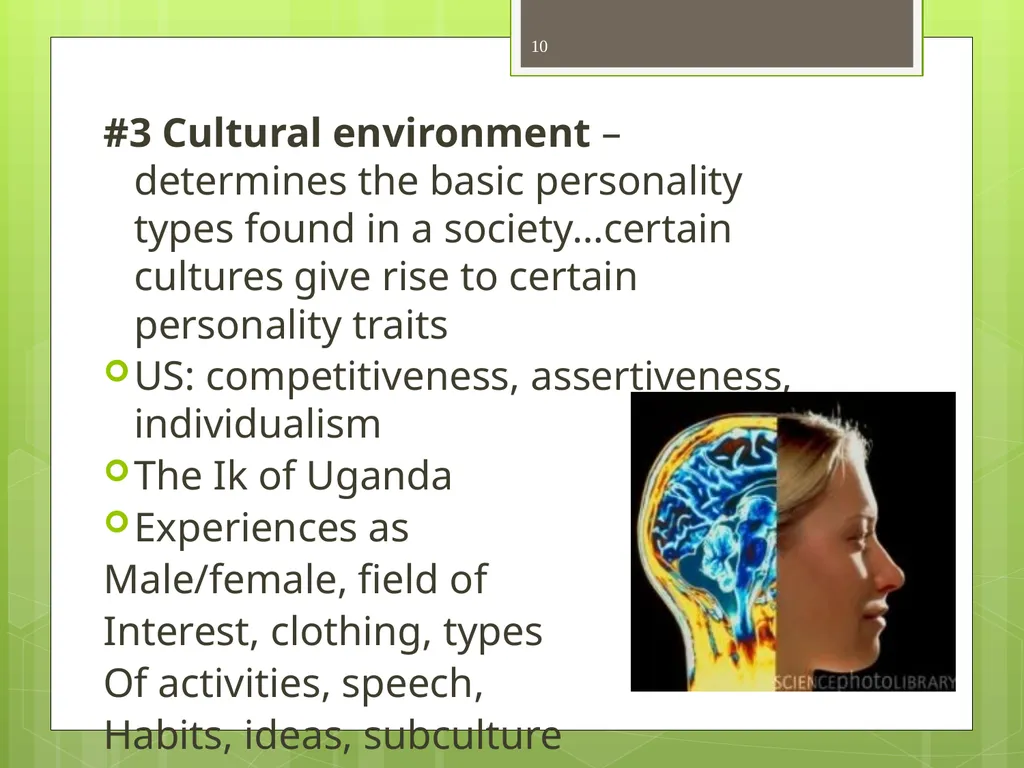
slide10. #3 Cultural environment – determines the basic personality types found in a society…certain cultures give rise to certain personality traits
US: competitiveness, assertiveness, individualism
The Ik of Uganda
Experiences as
Male/female, field of
Interest, clothing, types
Of activities, speech,
Habits, ideas, subculture 10<br>
slide11. #4 Heredity-
characteristics like physical traits
aptitudes (capacity to learn a particular skill or acquire a particular body of knowledge) like music or art
Inherit basic needs and capacities
Sets limits on individuals 11<br>
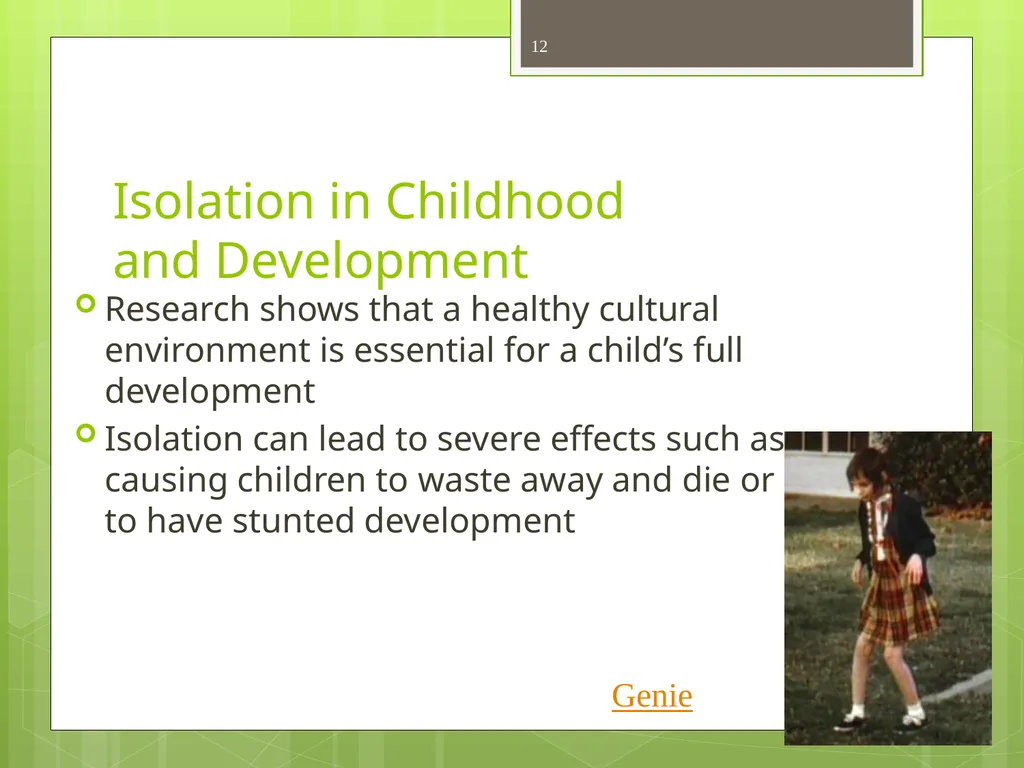
slide12. Isolation in Childhood and Development Research shows that a healthy cultural environment is essential for a child’s full development
Isolation can lead to severe effects such as causing children to waste away and die or to have stunted development 12 Genie<br>
slide13. 13 Isolation in Childhood:
Feral children:
Wild or untamed children.
Children isolated in their homes by parents/family members
Children had not reasoning ability or no manners, and no ability to control their bodily functions.
Few human characteristics<br>
slide14. 14 Anna:
Confined to an attic at 6 months old because her grandfather hated her for being illegitimate
Fed only enough milk to keep her alive; almost no human contact; not spoken to-held-bathed-or loved
Result: (age 6) Could not walk, talk, feed herself, expressionless face.
Later on: could eventually talk, feed herself, could talk in phrases…died at 11 years old with ability level of toddler<br>
slide15. 15 Isabelle:
She and her deaf mother confined to a dark closet because she was illegitimate
Result:
Used gestures to communicate
Did not learn to speak
Crawled on her hands and knees
Made grunting, animal-like sounds
Ate with hands
Later On…:
Able to overcome her early social deprivation due to the constant contact with her mother; learned to talk, reached level of social and mental development consistent with her age group after 2 years of training<br>
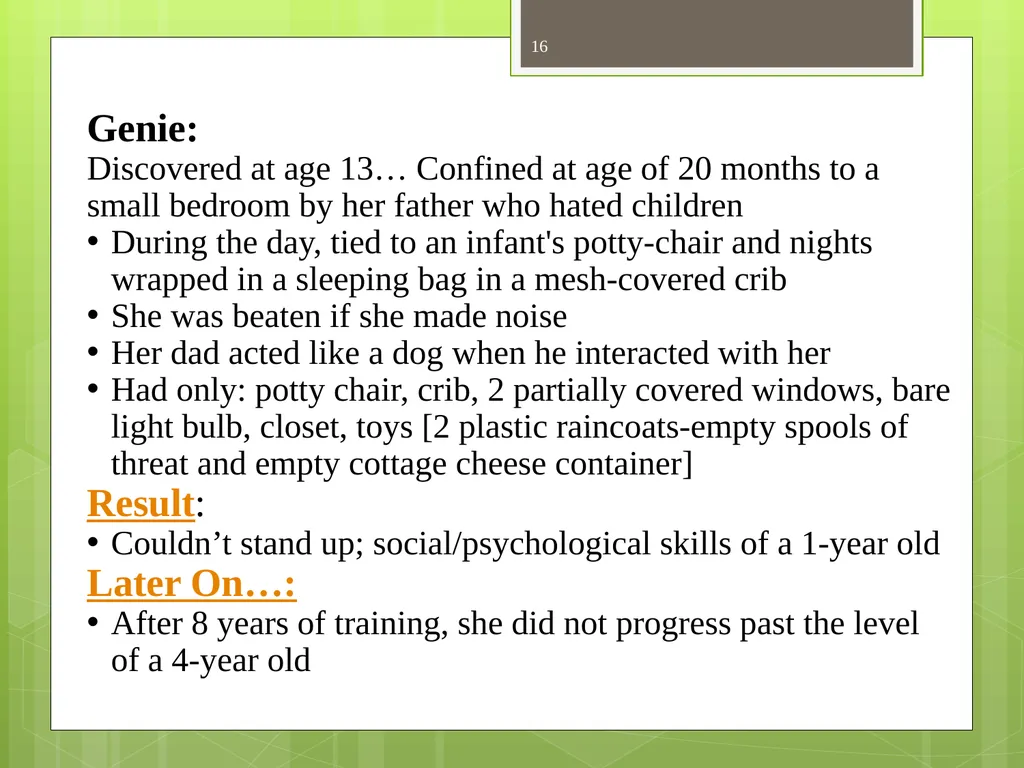
slide16. 16 Genie:
Discovered at age 13… Confined at age of 20 months to a small bedroom by her father who hated children
During the day, tied to an infant's potty-chair and nights wrapped in a sleeping bag in a mesh-covered crib
She was beaten if she made noise
Her dad acted like a dog when he interacted with her
Had only: potty chair, crib, 2 partially covered windows, bare light bulb, closet, toys [2 plastic raincoats-empty spools of threat and empty cottage cheese container]
Result:
Couldn’t stand up; social/psychological skills of a 1-year old
Later On…:
After 8 years of training, she did not progress past the level of a 4-year old<br>
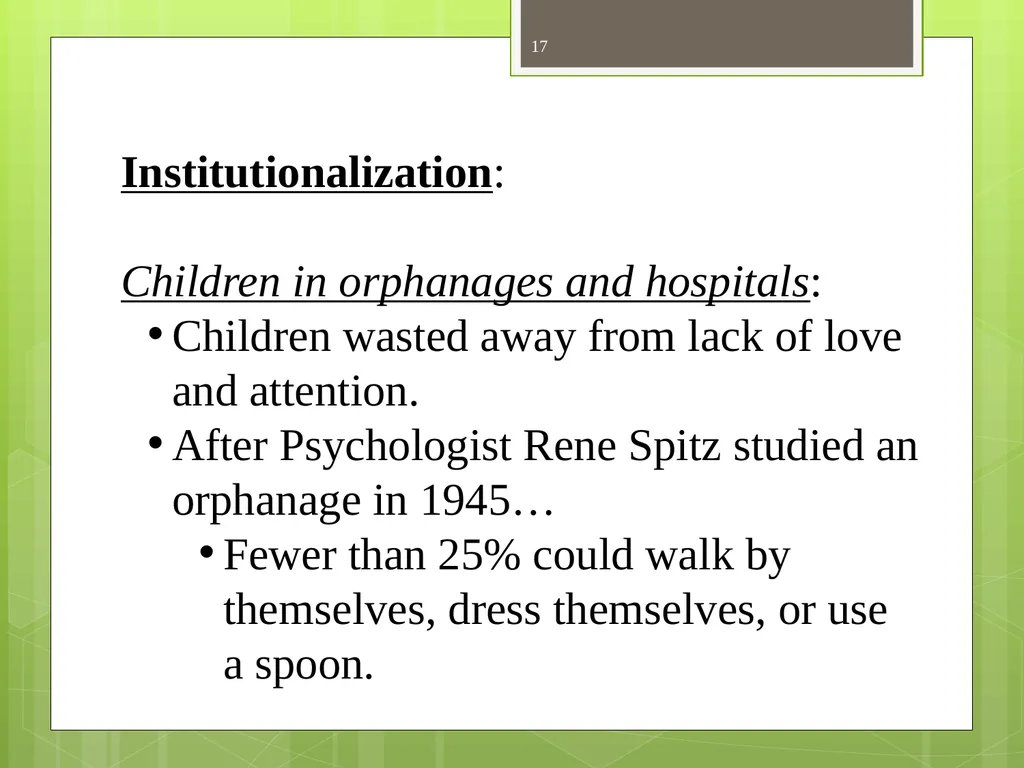
slide17. 17 Institutionalization:
Children in orphanages and hospitals:
Children wasted away from lack of love and attention.
After Psychologist Rene Spitz studied an orphanage in 1945…
Fewer than 25% could walk by themselves, dress themselves, or use a spoon.<br>
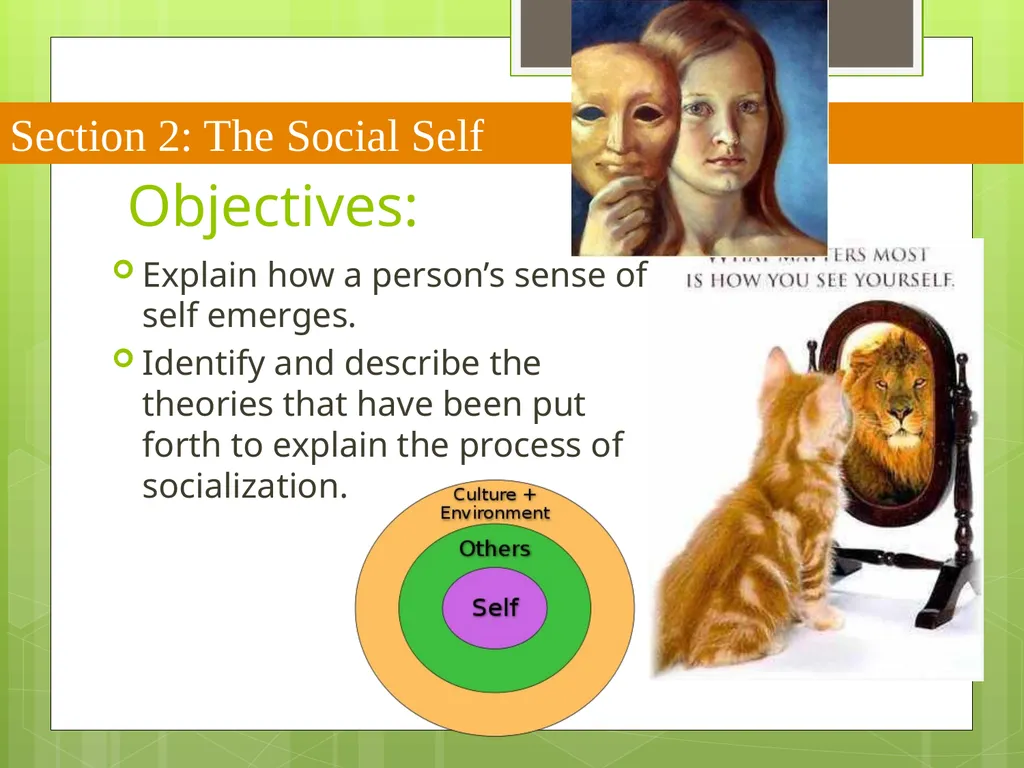
slide18. Objectives: Explain how a person’s sense of self emerges.
Identify and describe the theories that have been put forth to explain the process of socialization. Section 2: The Social Self<br>
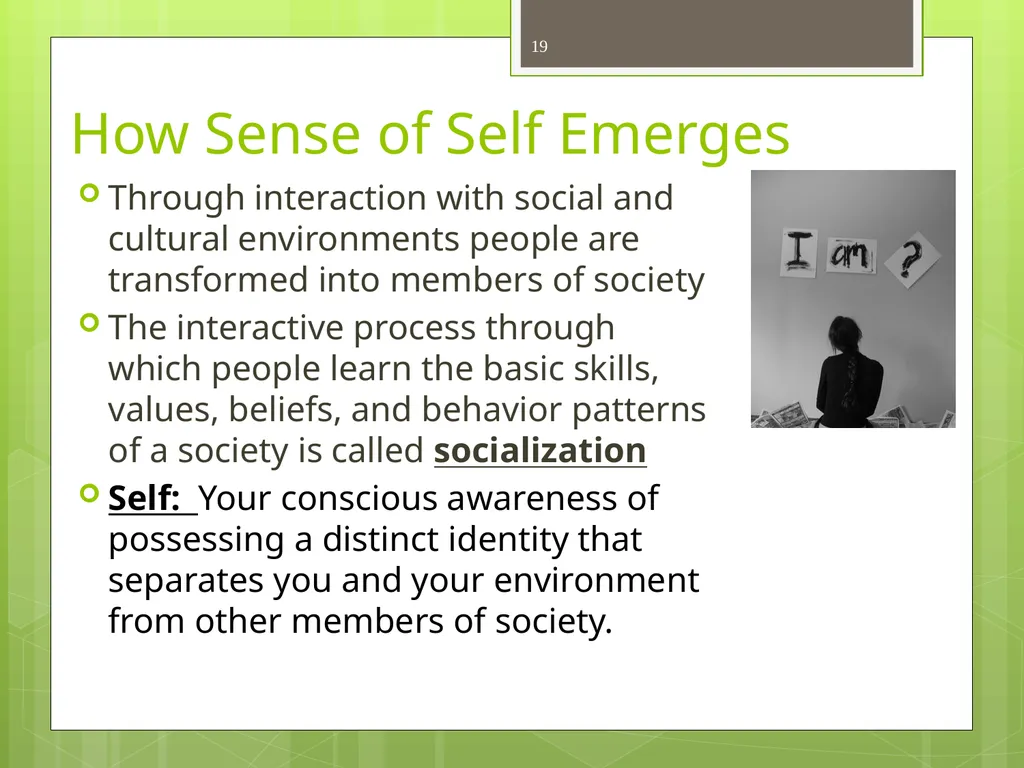
slide19. How Sense of Self Emerges Through interaction with social and cultural environments people are transformed into members of society
The interactive process through which people learn the basic skills, values, beliefs, and behavior patterns of a society is called socialization
Self: Your conscious awareness of possessing a distinct identity that separates you and your environment from other members of society. 19<br>
slide20. Three Theories of Socialization John Locke – The Tabula Rosa
Charles Horton Cooley – The Looking Glass Self
George Herbert Mead – Role-Taking 20<br>
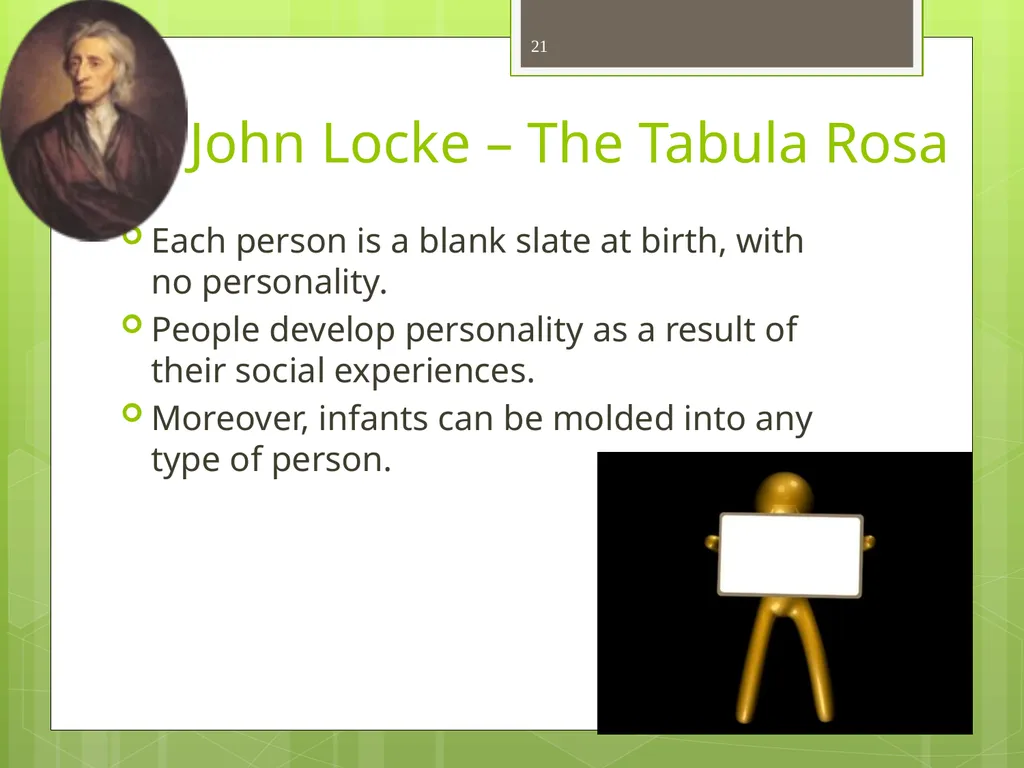
slide21. John Locke – The Tabula Rosa Each person is a blank slate at birth, with no personality.
People develop personality as a result of their social experiences.
Moreover, infants can be molded into any type of person. 21<br>
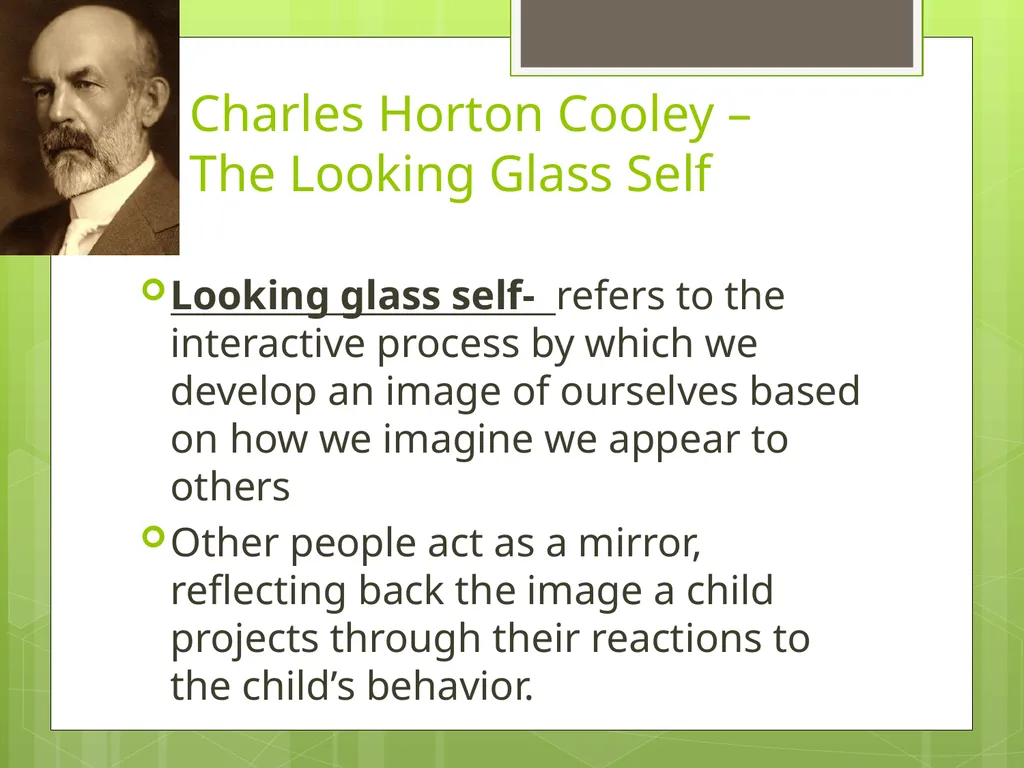
slide22. Charles Horton Cooley – The Looking Glass Self Looking glass self- refers to the interactive process by which we develop an image of ourselves based on how we imagine we appear to others
Other people act as a mirror, reflecting back the image a child projects through their reactions to the child’s behavior.<br>
slide23. Looking-glass self: 3 steps Imagine how we appear to others
Based on their reactions to us, we attempt to determine whether others view us as we view ourselves
We use our perceptions of how others judge us to develop feelings about ourselves 23<br>
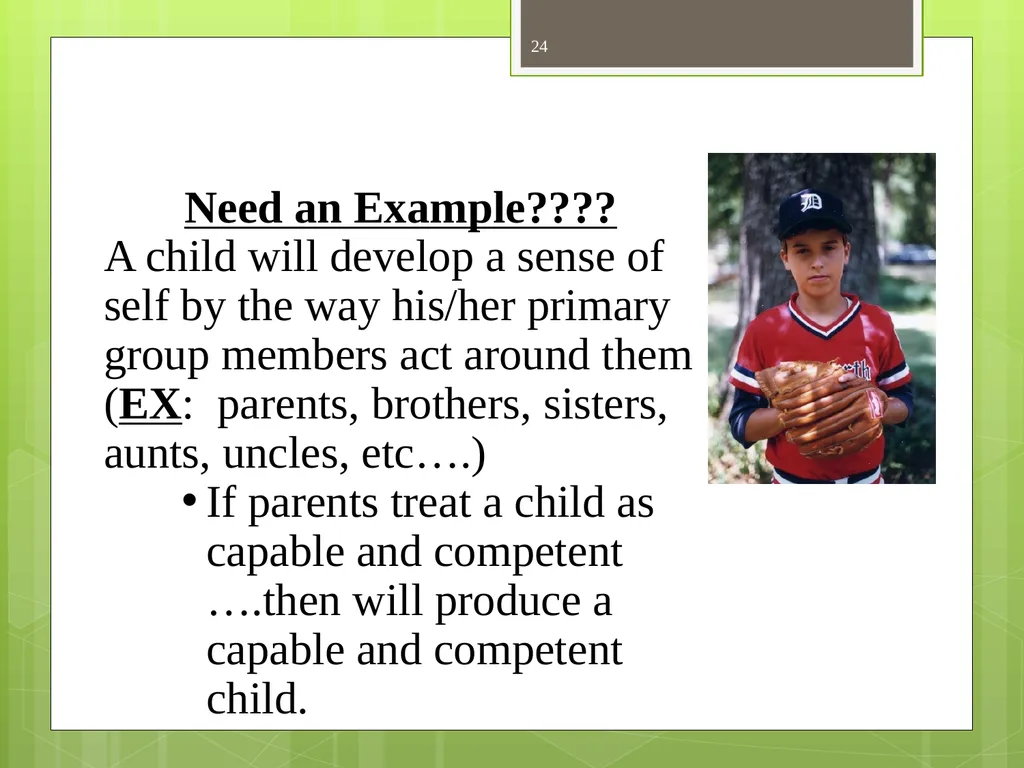
slide24. 24 Need an Example????
A child will develop a sense of self by the way his/her primary group members act around them (EX: parents, brothers, sisters, aunts, uncles, etc….)
If parents treat a child as capable and competent ….then will produce a capable and competent child.<br>
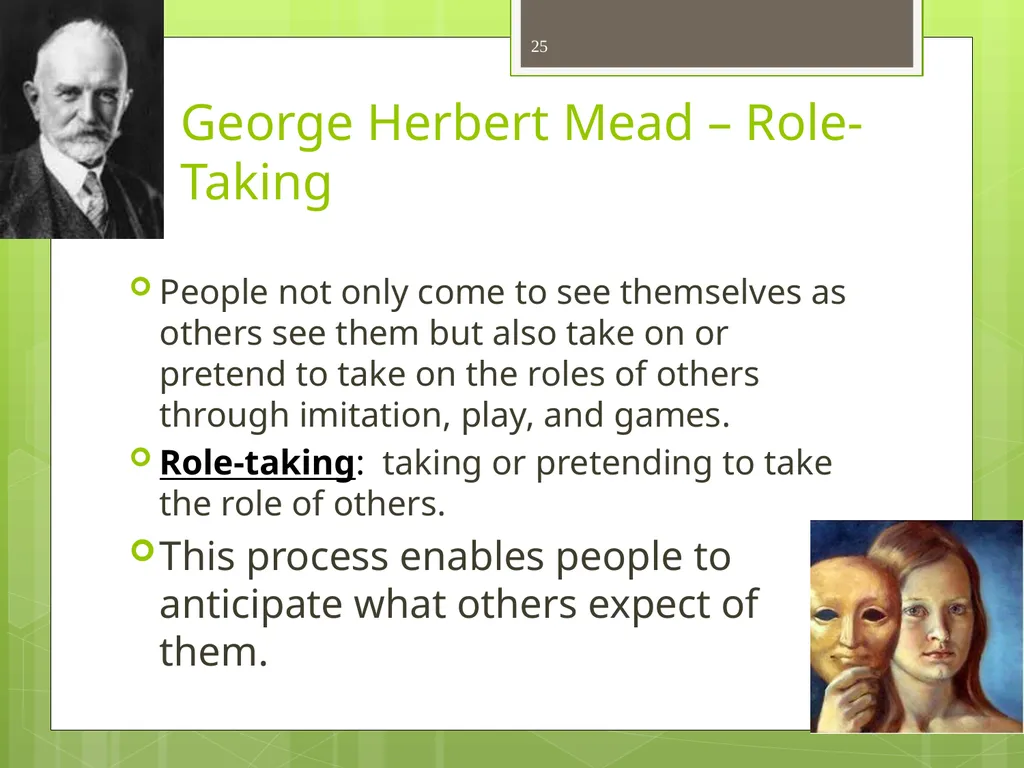
slide25. George Herbert Mead – Role-Taking People not only come to see themselves as others see them but also take on or pretend to take on the roles of others through imitation, play, and games.
Role-taking: taking or pretending to take the role of others.
This process enables people to anticipate what others expect of them. 25<br>
slide26. Through role-taking, we develop a sense of self that is made up of two parts
I: unsocialized, spontaneous, self-interested component of our personality and self-identity
Stronger when we are kids
Me: that part of our identity that is aware of the expectations and attitudes of society- our socialized self
Becomes stronger as you grow older
Both must exist to be well-rounded 26<br>
slide27. 27 Significant others:
Specific people, such as parents, brothers, sisters, other relatives, and friends, who have a direct influence on our socialization and we first internalize their expectations
Generalized other:
Internalized attitudes, expectations, and viewpoints of society that we use to guide our behavior and reinforce our sense of self.<br>
slide28. Objectives: Identify the most important agents of socialization in the United States.
Explain why family and education are important social institutions. 28 Section 3: Agents of Socialization<br>
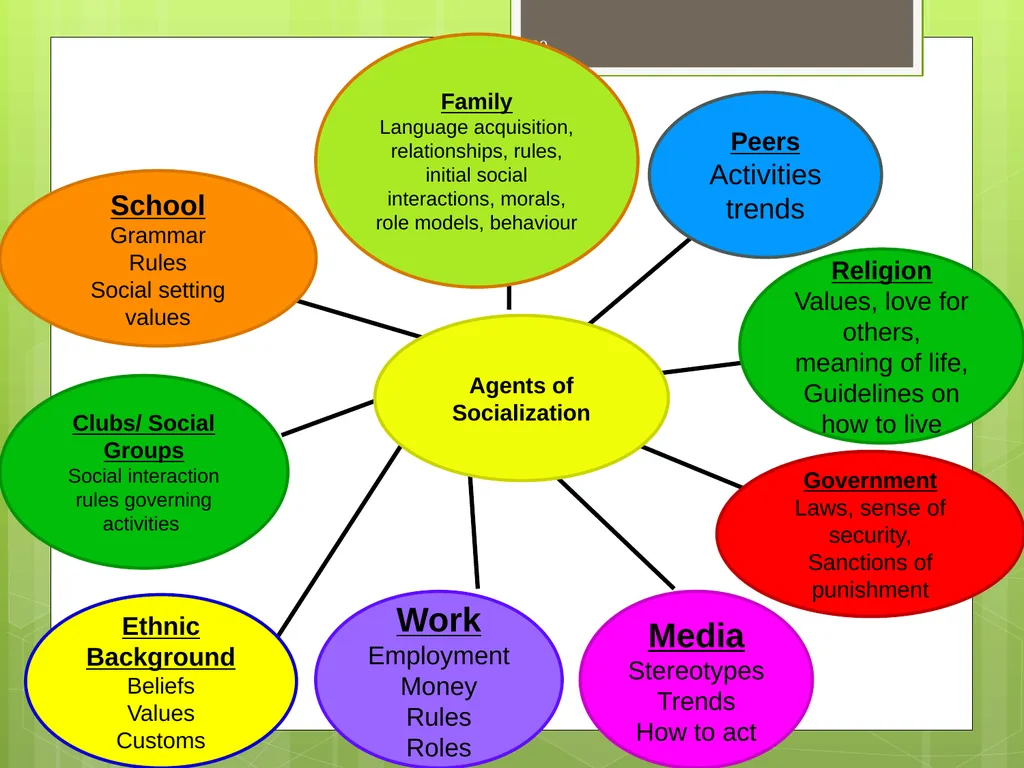
slide29. 29<br>
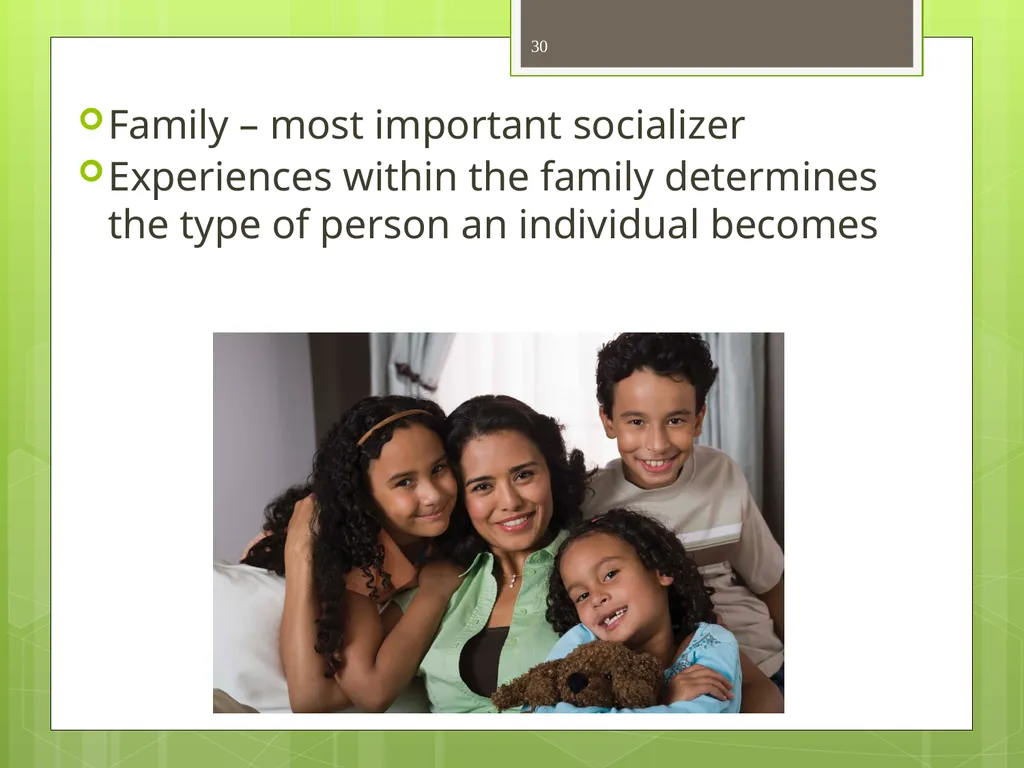
slide30. Family – most important socializer
Experiences within the family determines the type of person an individual becomes 30<br>
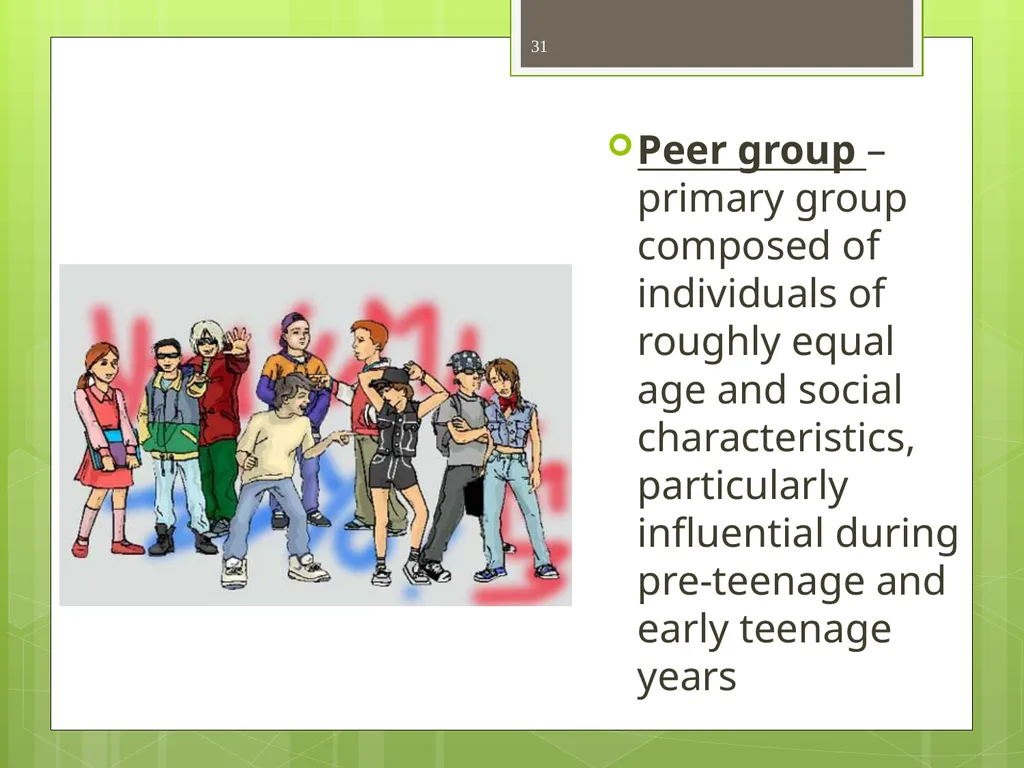
slide31. Peer group – primary group composed of individuals of roughly equal age and social characteristics, particularly influential during pre-teenage and early teenage years 31<br>
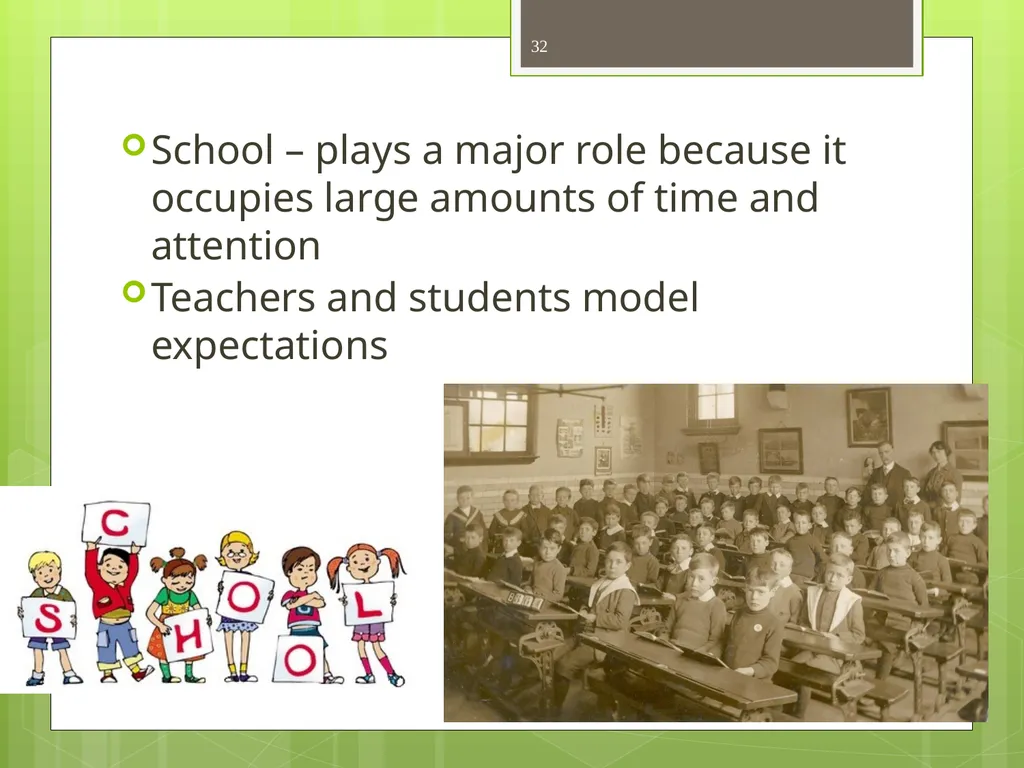
slide32. School – plays a major role because it occupies large amounts of time and attention
Teachers and students model expectations 32<br>
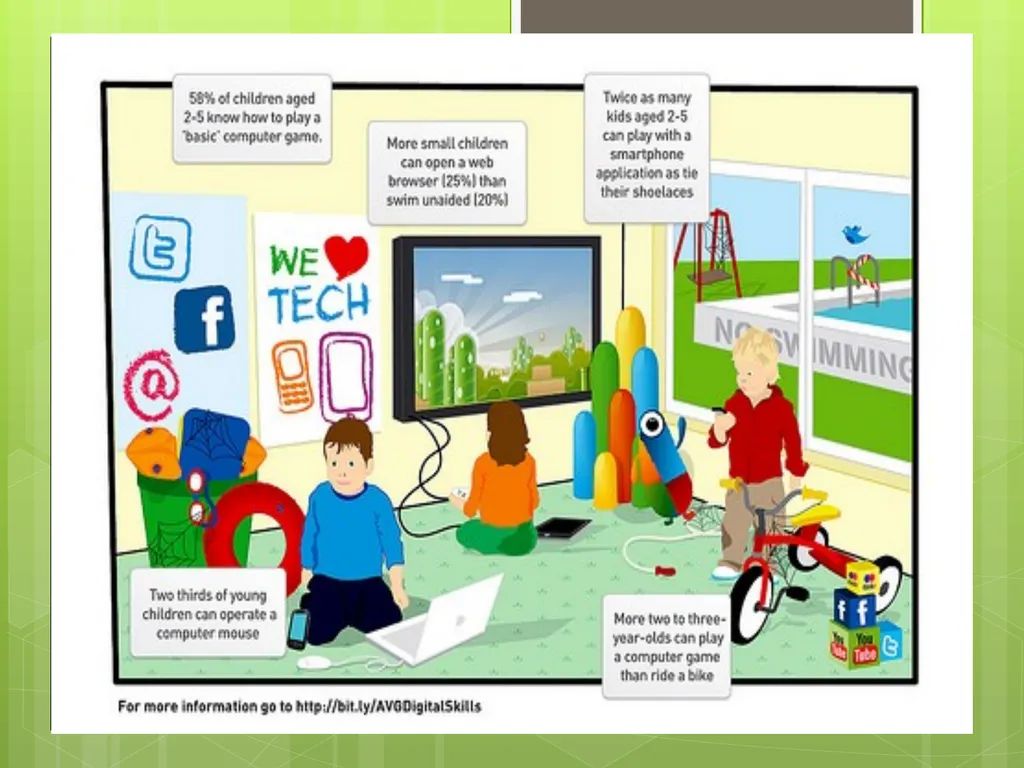
slide33. Mass media – books, films, the Internet, magazines, television, radio, films and other forms of communication that reach large audiences with no personal contact between the individuals sending the information and those that receive it 33<br>
slide34. Mass Media #s 98% of homes in U.S. have TVs.
(Average: More than 2 per home)
6-17 years old:
TV is the primary after-school activity!
Spend twice as much time watching TV than in school!
Violence in the Media:
By age 18…
Witnessed 200,000 fictional acts of violence
16,000 murders
Studies suggest that violence encourages viewers to act in aggressive ways and to see aggression as a valid way to solve problems. 34<br>
slide35. 35<br>
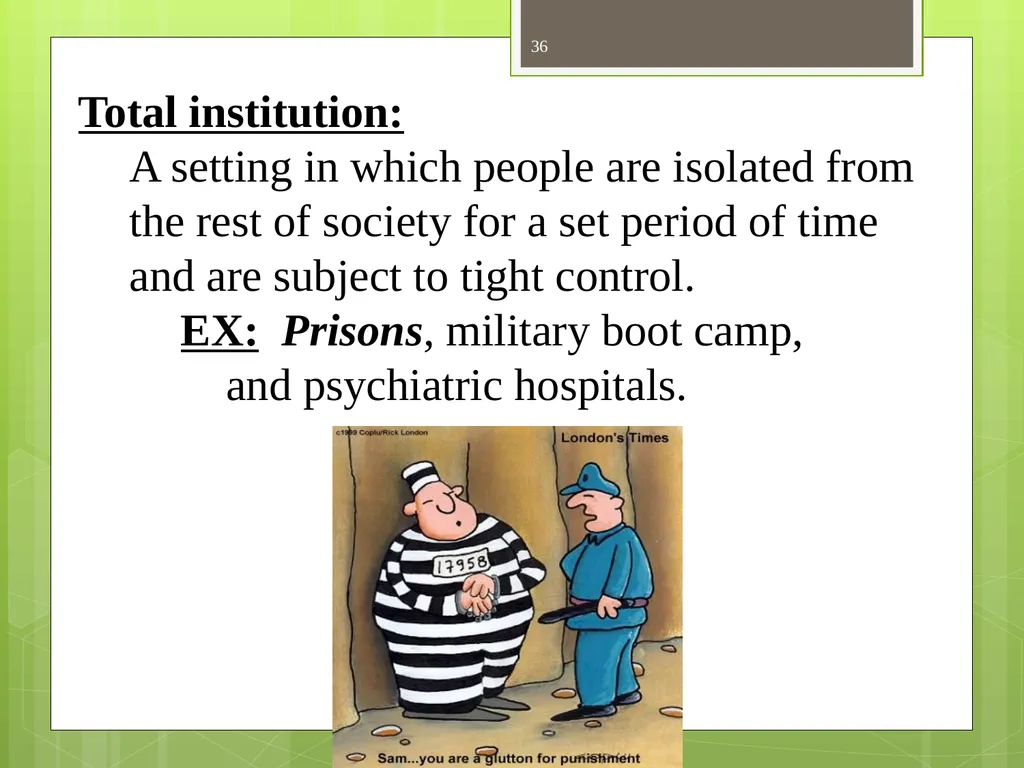
slide36. 36 Total institution:
A setting in which people are isolated from the rest of society for a set period of time and are subject to tight control.
EX: Prisons, military boot camp,
and psychiatric hospitals.<br>
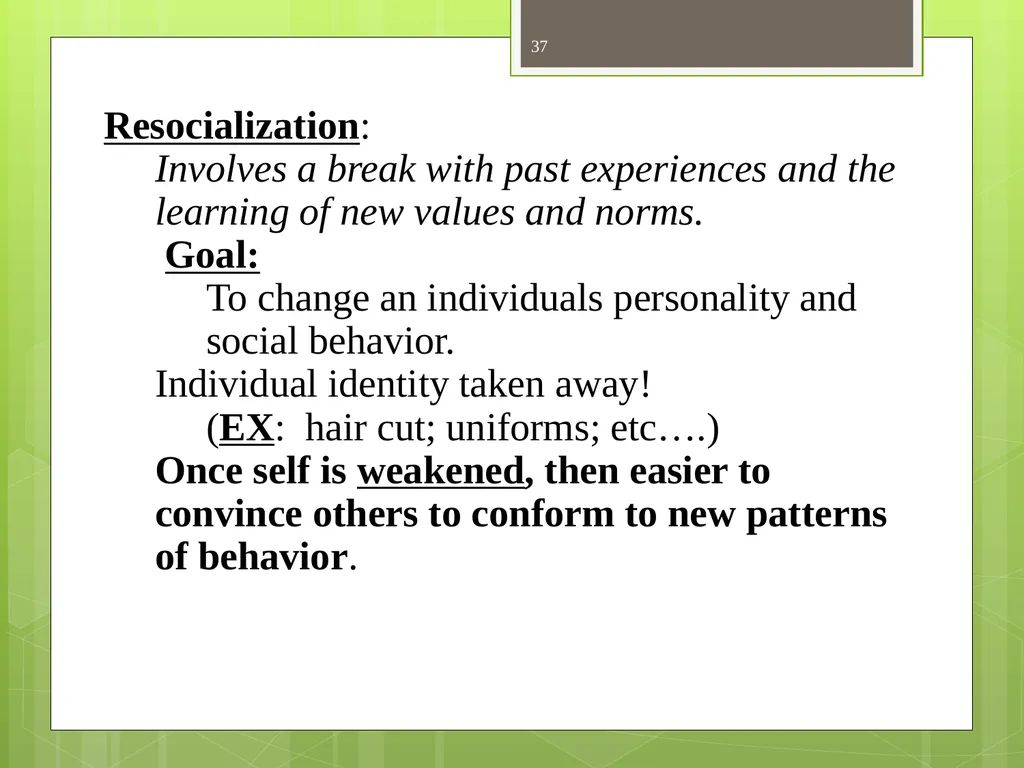
slide37. 37 Resocialization:
Involves a break with past experiences and the learning of new values and norms.
Goal:
To change an individuals personality and social behavior.
Individual identity taken away!
(EX: hair cut; uniforms; etc….)
Once self is weakened, then easier to convince others to conform to new patterns of behavior.<br>
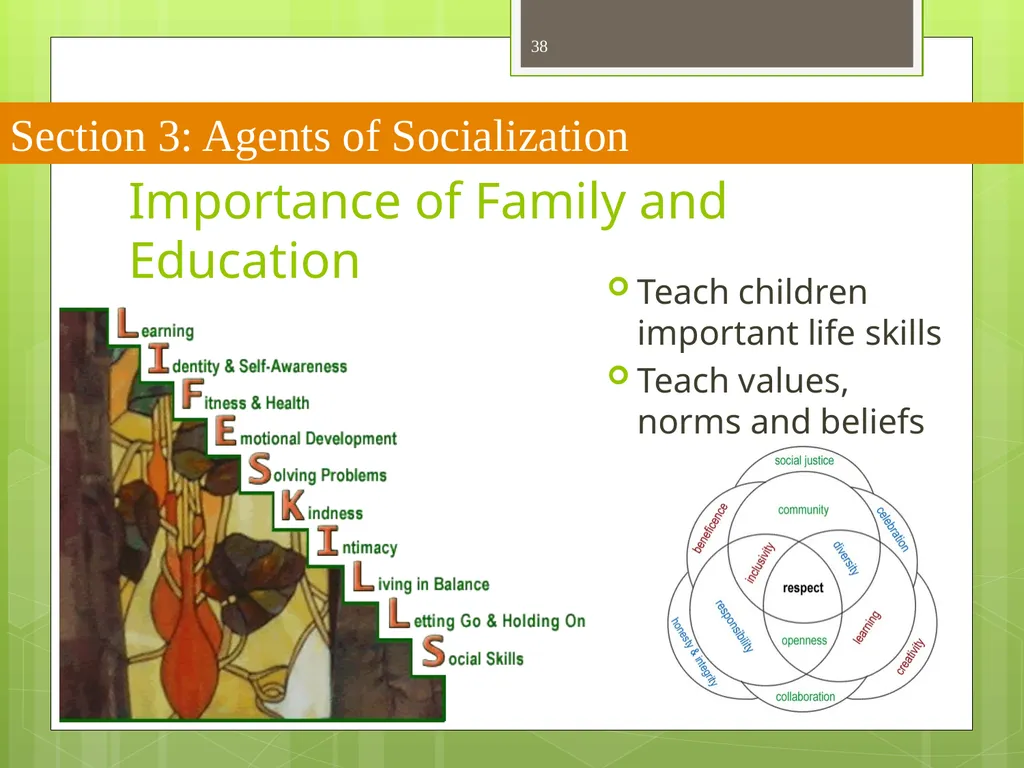
slide38. Importance of Family and Education Teach children important life skills
Teach values, norms and beliefs 38 Section 3: Agents of Socialization<br>
Section 2: The Social Self
Section 3: Agents of Socialization 1<br>
slide2. Objectives: Identify the four main factors that affect the development of personality.
Explain how isolation in childhood affects development. 2 Section 1: Personality Development<br>
slide3. What is Personality?? The sum total of behaviors, attitudes, beliefs, and values that are characteristic of an individual.
Determines how we adjust to our environment, interacting with other people
At an older age, personality traits change at a slower rate.
However, development varies from individual to individual.<br>
slide4. The Main Question: Whether personality is hereditary or environmental that gives rise to personality and social behavior Heredity – is transmission of genetic characteristics from parents to child
Environment teaches you personality 4<br>
slide6. Only Sociobiologists care of genetic basis of human behavior Sociobiology: The systematic study of the biological basis of all social behavior.
Believe that cultural characteristics like religion, cooperation, competition, slavery, territoriality, and envy are rooted in the genetic makeup of human
Most human social life is determined by biological factors 6<br>
slide7. 7 What do most sociologists believe????
Assume that personality and social behavior result from a blending of hereditary and social environmental influences, with environmental factors having the most influence.<br>
slide8. Factors That Shape Personality and behavior Development #1 Parents – parental characteristics such as
Their age
Level of education
Religious orientation
economic status
Cultural heritage
Occupational background 8<br>
slide9. #2 Birth order – personalities are shaped by whether one has siblings because they have a different view of the world than do children who have no siblings
1st: more achievement-oriented, cooperative, cautious
Later children: better in social relationships, affectionate, friendly, creative 9<br>
slide10. #3 Cultural environment – determines the basic personality types found in a society…certain cultures give rise to certain personality traits
US: competitiveness, assertiveness, individualism
The Ik of Uganda
Experiences as
Male/female, field of
Interest, clothing, types
Of activities, speech,
Habits, ideas, subculture 10<br>
slide11. #4 Heredity-
characteristics like physical traits
aptitudes (capacity to learn a particular skill or acquire a particular body of knowledge) like music or art
Inherit basic needs and capacities
Sets limits on individuals 11<br>
slide12. Isolation in Childhood and Development Research shows that a healthy cultural environment is essential for a child’s full development
Isolation can lead to severe effects such as causing children to waste away and die or to have stunted development 12 Genie<br>
slide13. 13 Isolation in Childhood:
Feral children:
Wild or untamed children.
Children isolated in their homes by parents/family members
Children had not reasoning ability or no manners, and no ability to control their bodily functions.
Few human characteristics<br>
slide14. 14 Anna:
Confined to an attic at 6 months old because her grandfather hated her for being illegitimate
Fed only enough milk to keep her alive; almost no human contact; not spoken to-held-bathed-or loved
Result: (age 6) Could not walk, talk, feed herself, expressionless face.
Later on: could eventually talk, feed herself, could talk in phrases…died at 11 years old with ability level of toddler<br>
slide15. 15 Isabelle:
She and her deaf mother confined to a dark closet because she was illegitimate
Result:
Used gestures to communicate
Did not learn to speak
Crawled on her hands and knees
Made grunting, animal-like sounds
Ate with hands
Later On…:
Able to overcome her early social deprivation due to the constant contact with her mother; learned to talk, reached level of social and mental development consistent with her age group after 2 years of training<br>
slide16. 16 Genie:
Discovered at age 13… Confined at age of 20 months to a small bedroom by her father who hated children
During the day, tied to an infant's potty-chair and nights wrapped in a sleeping bag in a mesh-covered crib
She was beaten if she made noise
Her dad acted like a dog when he interacted with her
Had only: potty chair, crib, 2 partially covered windows, bare light bulb, closet, toys [2 plastic raincoats-empty spools of threat and empty cottage cheese container]
Result:
Couldn’t stand up; social/psychological skills of a 1-year old
Later On…:
After 8 years of training, she did not progress past the level of a 4-year old<br>
slide17. 17 Institutionalization:
Children in orphanages and hospitals:
Children wasted away from lack of love and attention.
After Psychologist Rene Spitz studied an orphanage in 1945…
Fewer than 25% could walk by themselves, dress themselves, or use a spoon.<br>
slide18. Objectives: Explain how a person’s sense of self emerges.
Identify and describe the theories that have been put forth to explain the process of socialization. Section 2: The Social Self<br>
slide19. How Sense of Self Emerges Through interaction with social and cultural environments people are transformed into members of society
The interactive process through which people learn the basic skills, values, beliefs, and behavior patterns of a society is called socialization
Self: Your conscious awareness of possessing a distinct identity that separates you and your environment from other members of society. 19<br>
slide20. Three Theories of Socialization John Locke – The Tabula Rosa
Charles Horton Cooley – The Looking Glass Self
George Herbert Mead – Role-Taking 20<br>
slide21. John Locke – The Tabula Rosa Each person is a blank slate at birth, with no personality.
People develop personality as a result of their social experiences.
Moreover, infants can be molded into any type of person. 21<br>
slide22. Charles Horton Cooley – The Looking Glass Self Looking glass self- refers to the interactive process by which we develop an image of ourselves based on how we imagine we appear to others
Other people act as a mirror, reflecting back the image a child projects through their reactions to the child’s behavior.<br>
slide23. Looking-glass self: 3 steps Imagine how we appear to others
Based on their reactions to us, we attempt to determine whether others view us as we view ourselves
We use our perceptions of how others judge us to develop feelings about ourselves 23<br>
slide24. 24 Need an Example????
A child will develop a sense of self by the way his/her primary group members act around them (EX: parents, brothers, sisters, aunts, uncles, etc….)
If parents treat a child as capable and competent ….then will produce a capable and competent child.<br>
slide25. George Herbert Mead – Role-Taking People not only come to see themselves as others see them but also take on or pretend to take on the roles of others through imitation, play, and games.
Role-taking: taking or pretending to take the role of others.
This process enables people to anticipate what others expect of them. 25<br>
slide26. Through role-taking, we develop a sense of self that is made up of two parts
I: unsocialized, spontaneous, self-interested component of our personality and self-identity
Stronger when we are kids
Me: that part of our identity that is aware of the expectations and attitudes of society- our socialized self
Becomes stronger as you grow older
Both must exist to be well-rounded 26<br>
slide27. 27 Significant others:
Specific people, such as parents, brothers, sisters, other relatives, and friends, who have a direct influence on our socialization and we first internalize their expectations
Generalized other:
Internalized attitudes, expectations, and viewpoints of society that we use to guide our behavior and reinforce our sense of self.<br>
slide28. Objectives: Identify the most important agents of socialization in the United States.
Explain why family and education are important social institutions. 28 Section 3: Agents of Socialization<br>
slide29. 29<br>
slide30. Family – most important socializer
Experiences within the family determines the type of person an individual becomes 30<br>
slide31. Peer group – primary group composed of individuals of roughly equal age and social characteristics, particularly influential during pre-teenage and early teenage years 31<br>
slide32. School – plays a major role because it occupies large amounts of time and attention
Teachers and students model expectations 32<br>
slide33. Mass media – books, films, the Internet, magazines, television, radio, films and other forms of communication that reach large audiences with no personal contact between the individuals sending the information and those that receive it 33<br>
slide34. Mass Media #s 98% of homes in U.S. have TVs.
(Average: More than 2 per home)
6-17 years old:
TV is the primary after-school activity!
Spend twice as much time watching TV than in school!
Violence in the Media:
By age 18…
Witnessed 200,000 fictional acts of violence
16,000 murders
Studies suggest that violence encourages viewers to act in aggressive ways and to see aggression as a valid way to solve problems. 34<br>
slide35. 35<br>
slide36. 36 Total institution:
A setting in which people are isolated from the rest of society for a set period of time and are subject to tight control.
EX: Prisons, military boot camp,
and psychiatric hospitals.<br>
slide37. 37 Resocialization:
Involves a break with past experiences and the learning of new values and norms.
Goal:
To change an individuals personality and social behavior.
Individual identity taken away!
(EX: hair cut; uniforms; etc….)
Once self is weakened, then easier to convince others to conform to new patterns of behavior.<br>
slide38. Importance of Family and Education Teach children important life skills
Teach values, norms and beliefs 38 Section 3: Agents of Socialization<br>