
Chapter 5: Turn Taking Angela Cora Garcia, c2022;
LV
Published · 16 slides · 0 views

1 / 1
Description
Chapter 5: Turn Taking Angela Cora Garcia, c2022; slides to accompany Chapter 5 of An Introduction to Interaction: Understanding Talk in the Workplace and Everyday Life, Second Edition. Bloomsbury Press. (Note: Excerpt numbers will follow
Related Topics
Share
Embed code
Download this presentation From Below
"Chapter 5: Turn Taking Angela Cora Garcia, c2022;" is the property of its rightful owner. Permission is granted to download and print the materials on this website for personal, non-commercial use only, and to display it on your personal computer provided you do not modify the materials and that you retain all copyright notices contained in the materials. By downloading content from our website, you accept the terms of this agreement.
Presentation Transcript
01
Chapter 5: Turn Taking Angela Cora Garcia, c2022; slides to accompany Chapter 5 of An Introduction to Interaction: Understanding Talk in the Workplace and Everyday Life, Second Edition. Bloomsbury Press.
(Note: Excerpt numbers will follow the number they were given in the textbook chapter, to make it easier to refer back to that section of the chapter for more details.)<br>
(Note: Excerpt numbers will follow the number they were given in the textbook chapter, to make it easier to refer back to that section of the chapter for more details.)<br>
02
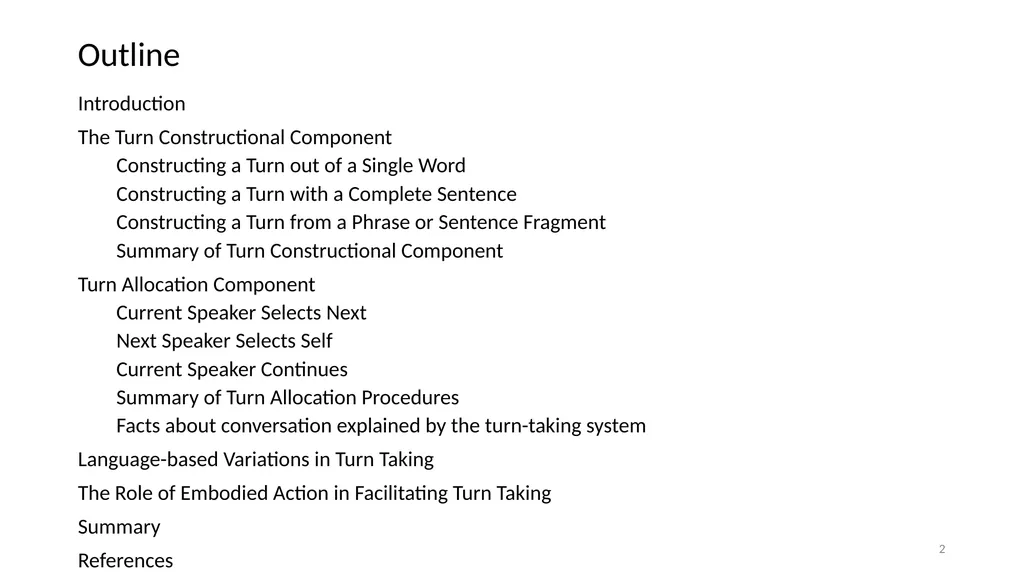
Outline Introduction
The Turn Constructional Component
Constructing a Turn out of a Single Word
Constructing a Turn with a Complete Sentence
Constructing a Turn from a Phrase or Sentence Fragment
Summary of Turn Constructional Component
Turn Allocation Component
Current Speaker Selects Next
Next Speaker Selects Self
Current Speaker Continues
Summary of Turn Allocation Procedures
Facts about conversation explained by the turn-taking system
Language-based Variations in Turn Taking
The Role of Embodied Action in Facilitating Turn Taking
Summary
References 2<br>
The Turn Constructional Component
Constructing a Turn out of a Single Word
Constructing a Turn with a Complete Sentence
Constructing a Turn from a Phrase or Sentence Fragment
Summary of Turn Constructional Component
Turn Allocation Component
Current Speaker Selects Next
Next Speaker Selects Self
Current Speaker Continues
Summary of Turn Allocation Procedures
Facts about conversation explained by the turn-taking system
Language-based Variations in Turn Taking
The Role of Embodied Action in Facilitating Turn Taking
Summary
References 2<br>
03
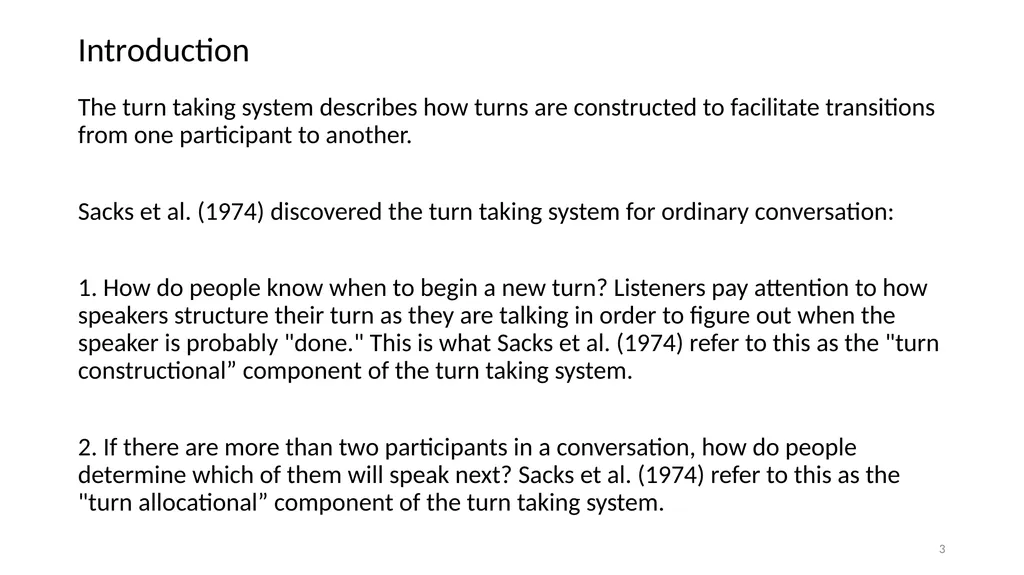
Introduction The turn taking system describes how turns are constructed to facilitate transitions from one participant to another.
Sacks et al. (1974) discovered the turn taking system for ordinary conversation:
1. How do people know when to begin a new turn? Listeners pay attention to how speakers structure their turn as they are talking in order to figure out when the speaker is probably "done." This is what Sacks et al. (1974) refer to this as the "turn constructional” component of the turn taking system.
2. If there are more than two participants in a conversation, how do people determine which of them will speak next? Sacks et al. (1974) refer to this as the "turn allocational” component of the turn taking system. 3<br>
Sacks et al. (1974) discovered the turn taking system for ordinary conversation:
1. How do people know when to begin a new turn? Listeners pay attention to how speakers structure their turn as they are talking in order to figure out when the speaker is probably "done." This is what Sacks et al. (1974) refer to this as the "turn constructional” component of the turn taking system.
2. If there are more than two participants in a conversation, how do people determine which of them will speak next? Sacks et al. (1974) refer to this as the "turn allocational” component of the turn taking system. 3<br>
04
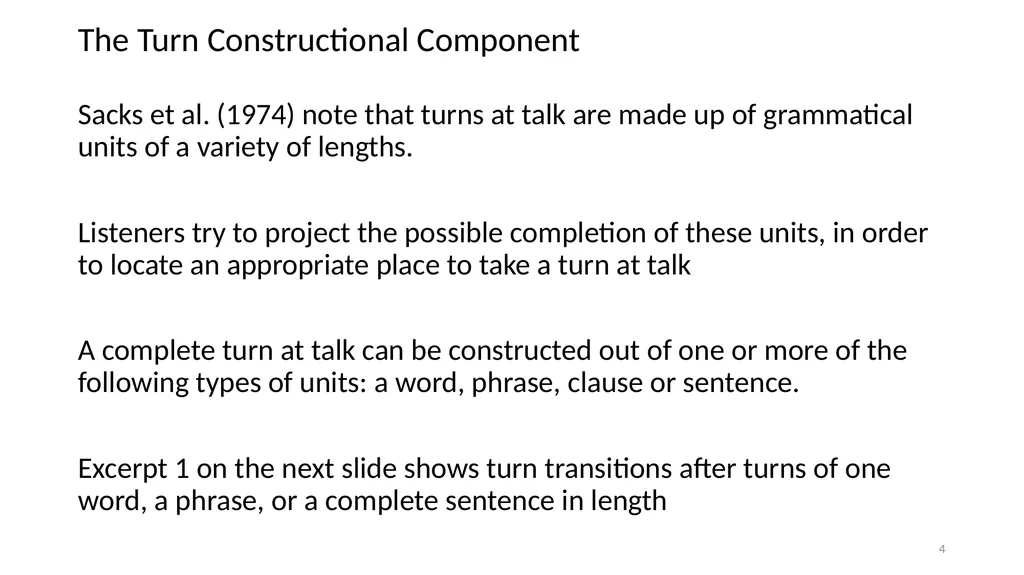
The Turn Constructional Component Sacks et al. (1974) note that turns at talk are made up of grammatical units of a variety of lengths.
Listeners try to project the possible completion of these units, in order to locate an appropriate place to take a turn at talk
A complete turn at talk can be constructed out of one or more of the following types of units: a word, phrase, clause or sentence.
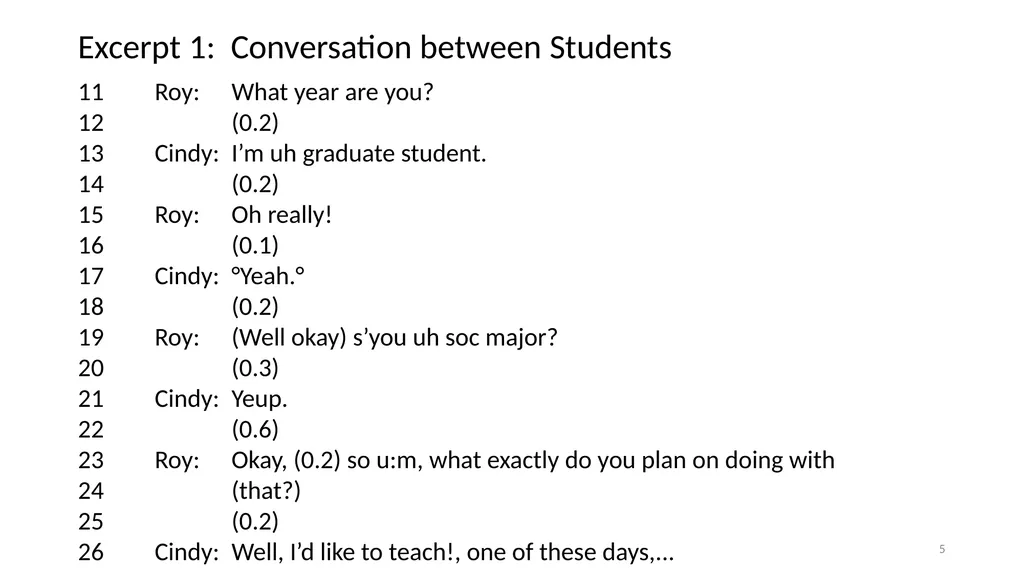
Excerpt 1 on the next slide shows turn transitions after turns of one word, a phrase, or a complete sentence in length 4<br>
Listeners try to project the possible completion of these units, in order to locate an appropriate place to take a turn at talk
A complete turn at talk can be constructed out of one or more of the following types of units: a word, phrase, clause or sentence.
Excerpt 1 on the next slide shows turn transitions after turns of one word, a phrase, or a complete sentence in length 4<br>
05
Excerpt 1: Conversation between Students 11 Roy: What year are you?
12 (0.2)
13 Cindy: I’m uh graduate student.
14 (0.2)
15 Roy: Oh really!
16 (0.1)
17 Cindy: °Yeah.°
18 (0.2)
19 Roy: (Well okay) s’you uh soc major?
20 (0.3)
21 Cindy: Yeup.
22 (0.6)
23 Roy: Okay, (0.2) so u:m, what exactly do you plan on doing with
24 (that?)
25 (0.2)
26 Cindy: Well, I’d like to teach!, one of these days,... 5<br>
12 (0.2)
13 Cindy: I’m uh graduate student.
14 (0.2)
15 Roy: Oh really!
16 (0.1)
17 Cindy: °Yeah.°
18 (0.2)
19 Roy: (Well okay) s’you uh soc major?
20 (0.3)
21 Cindy: Yeup.
22 (0.6)
23 Roy: Okay, (0.2) so u:m, what exactly do you plan on doing with
24 (that?)
25 (0.2)
26 Cindy: Well, I’d like to teach!, one of these days,... 5<br>
06
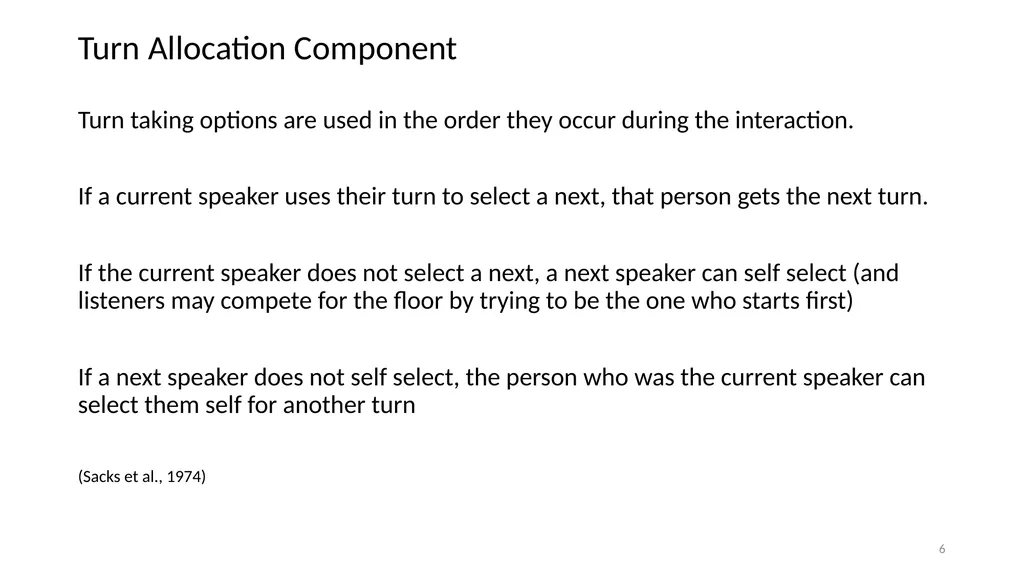
Turn Allocation Component Turn taking options are used in the order they occur during the interaction.
If a current speaker uses their turn to select a next, that person gets the next turn.
If the current speaker does not select a next, a next speaker can self select (and listeners may compete for the floor by trying to be the one who starts first)
If a next speaker does not self select, the person who was the current speaker can select them self for another turn
(Sacks et al., 1974) 6<br>
If a current speaker uses their turn to select a next, that person gets the next turn.
If the current speaker does not select a next, a next speaker can self select (and listeners may compete for the floor by trying to be the one who starts first)
If a next speaker does not self select, the person who was the current speaker can select them self for another turn
(Sacks et al., 1974) 6<br>
07
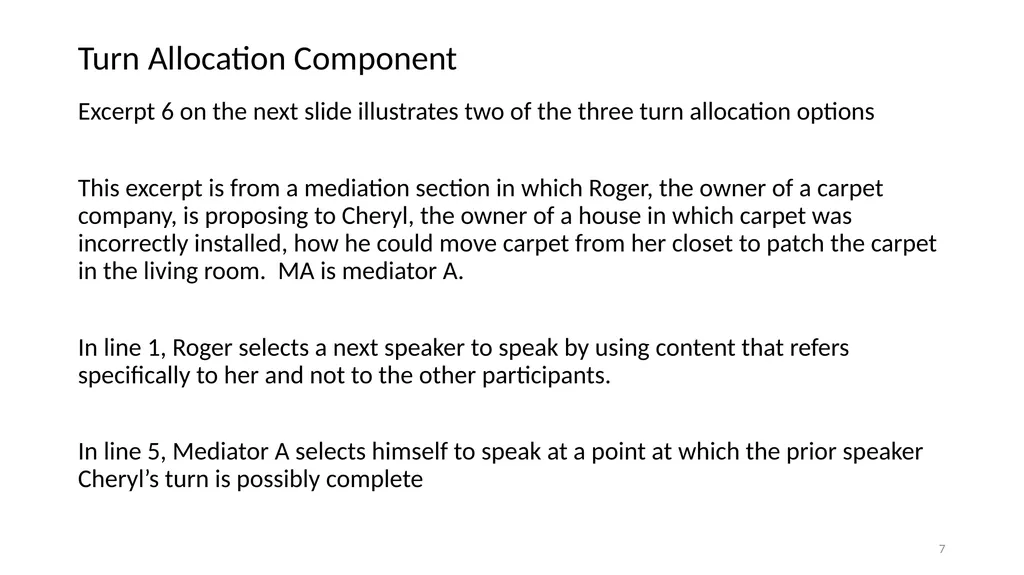
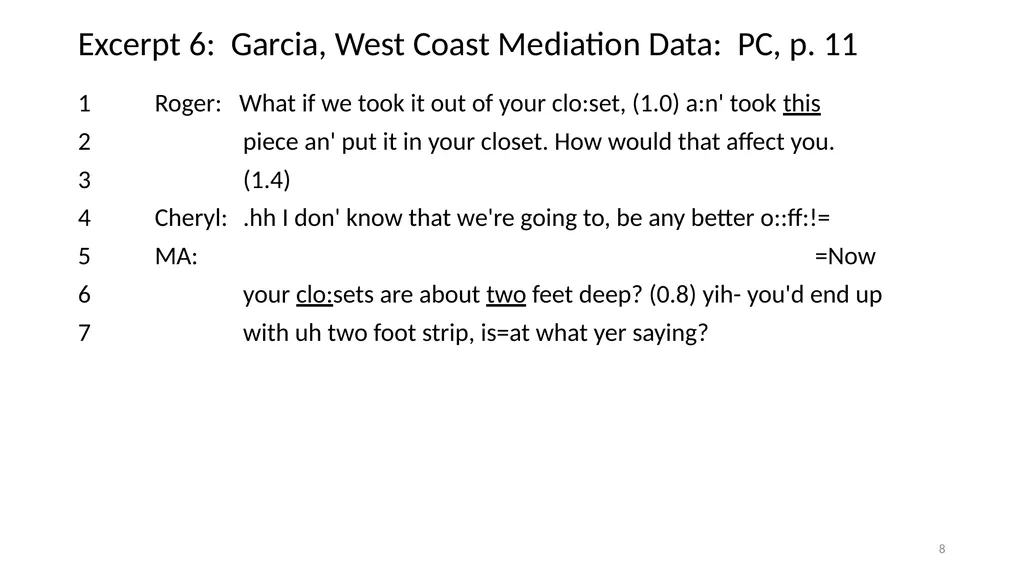
Turn Allocation Component Excerpt 6 on the next slide illustrates two of the three turn allocation options
This excerpt is from a mediation section in which Roger, the owner of a carpet company, is proposing to Cheryl, the owner of a house in which carpet was incorrectly installed, how he could move carpet from her closet to patch the carpet in the living room. MA is mediator A.
In line 1, Roger selects a next speaker to speak by using content that refers specifically to her and not to the other participants.
In line 5, Mediator A selects himself to speak at a point at which the prior speaker Cheryl’s turn is possibly complete 7<br>
This excerpt is from a mediation section in which Roger, the owner of a carpet company, is proposing to Cheryl, the owner of a house in which carpet was incorrectly installed, how he could move carpet from her closet to patch the carpet in the living room. MA is mediator A.
In line 1, Roger selects a next speaker to speak by using content that refers specifically to her and not to the other participants.
In line 5, Mediator A selects himself to speak at a point at which the prior speaker Cheryl’s turn is possibly complete 7<br>
08
Excerpt 6: Garcia, West Coast Mediation Data: PC, p. 11 1 Roger: What if we took it out of your clo:set, (1.0) a:n' took this
2 piece an' put it in your closet. How would that affect you.
3 (1.4)
4 Cheryl: .hh I don' know that we're going to, be any better o::ff:!=
5 MA: =Now
6 your clo:sets are about two feet deep? (0.8) yih- you'd end up
7 with uh two foot strip, is=at what yer saying? 8<br>
2 piece an' put it in your closet. How would that affect you.
3 (1.4)
4 Cheryl: .hh I don' know that we're going to, be any better o::ff:!=
5 MA: =Now
6 your clo:sets are about two feet deep? (0.8) yih- you'd end up
7 with uh two foot strip, is=at what yer saying? 8<br>
09
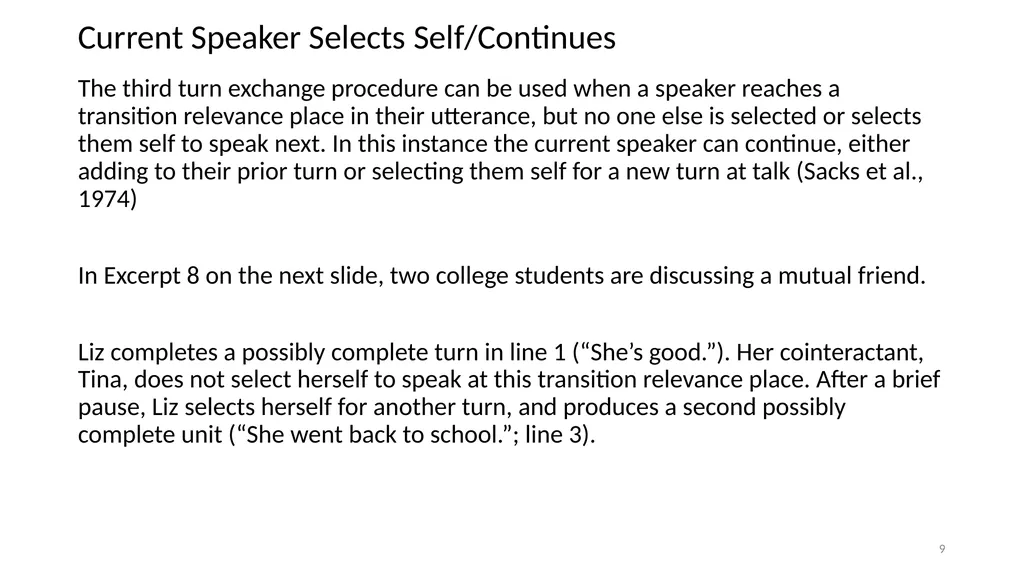
Current Speaker Selects Self/Continues The third turn exchange procedure can be used when a speaker reaches a transition relevance place in their utterance, but no one else is selected or selects them self to speak next. In this instance the current speaker can continue, either adding to their prior turn or selecting them self for a new turn at talk (Sacks et al., 1974)
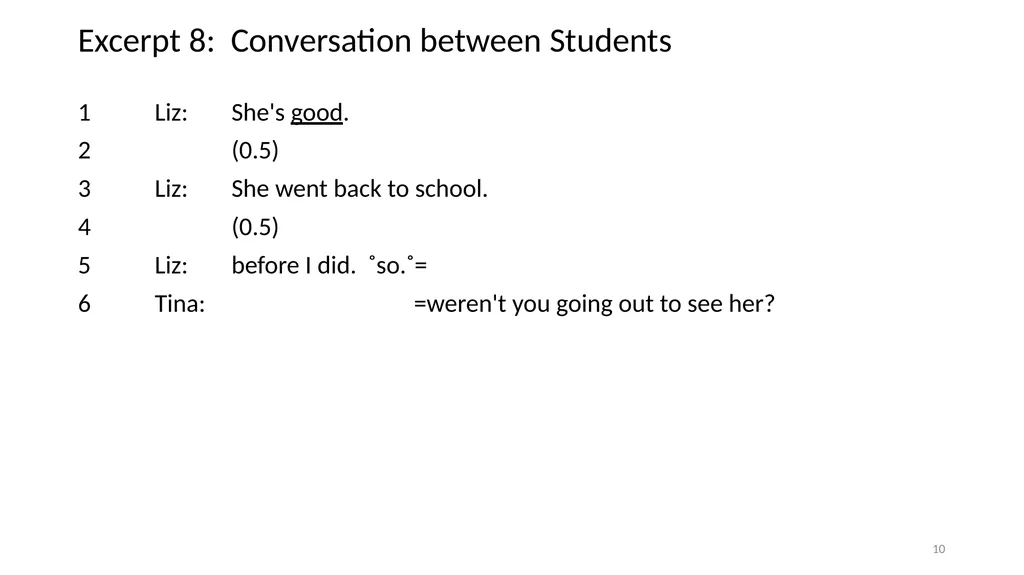
In Excerpt 8 on the next slide, two college students are discussing a mutual friend.
Liz completes a possibly complete turn in line 1 (“She’s good.”). Her cointeractant, Tina, does not select herself to speak at this transition relevance place. After a brief pause, Liz selects herself for another turn, and produces a second possibly complete unit (“She went back to school.”; line 3). 9<br>
In Excerpt 8 on the next slide, two college students are discussing a mutual friend.
Liz completes a possibly complete turn in line 1 (“She’s good.”). Her cointeractant, Tina, does not select herself to speak at this transition relevance place. After a brief pause, Liz selects herself for another turn, and produces a second possibly complete unit (“She went back to school.”; line 3). 9<br>
10
Excerpt 8: Conversation between Students 1 Liz: She's good.
2 (0.5)
3 Liz: She went back to school.
4 (0.5)
5 Liz: before I did. ˚so.˚=
6 Tina: =weren't you going out to see her? 10<br>
2 (0.5)
3 Liz: She went back to school.
4 (0.5)
5 Liz: before I did. ˚so.˚=
6 Tina: =weren't you going out to see her? 10<br>
11
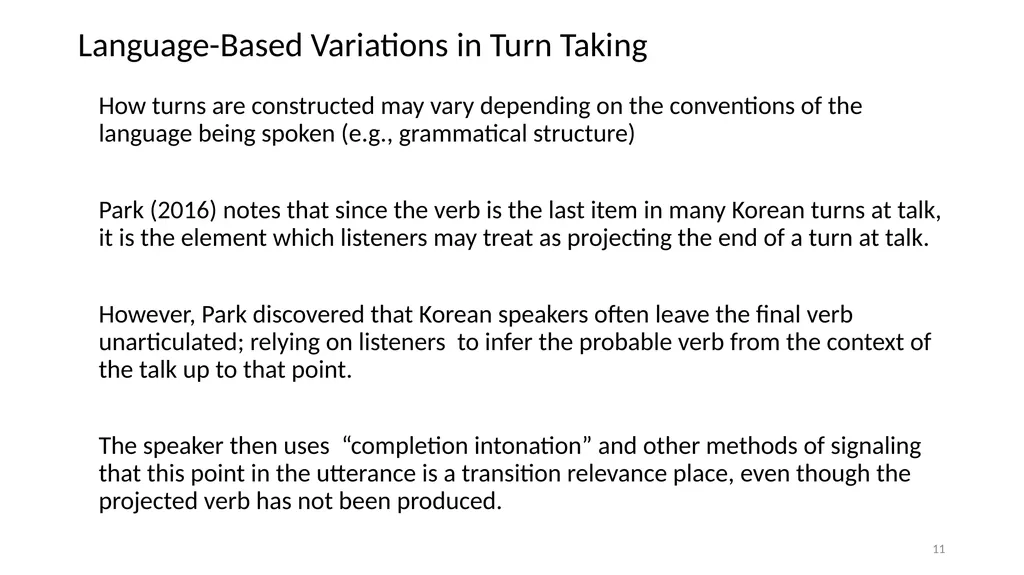
Language-Based Variations in Turn Taking How turns are constructed may vary depending on the conventions of the language being spoken (e.g., grammatical structure)
Park (2016) notes that since the verb is the last item in many Korean turns at talk, it is the element which listeners may treat as projecting the end of a turn at talk.
However, Park discovered that Korean speakers often leave the final verb unarticulated; relying on listeners to infer the probable verb from the context of the talk up to that point.
The speaker then uses “completion intonation” and other methods of signaling that this point in the utterance is a transition relevance place, even though the projected verb has not been produced. 11<br>
Park (2016) notes that since the verb is the last item in many Korean turns at talk, it is the element which listeners may treat as projecting the end of a turn at talk.
However, Park discovered that Korean speakers often leave the final verb unarticulated; relying on listeners to infer the probable verb from the context of the talk up to that point.
The speaker then uses “completion intonation” and other methods of signaling that this point in the utterance is a transition relevance place, even though the projected verb has not been produced. 11<br>
12
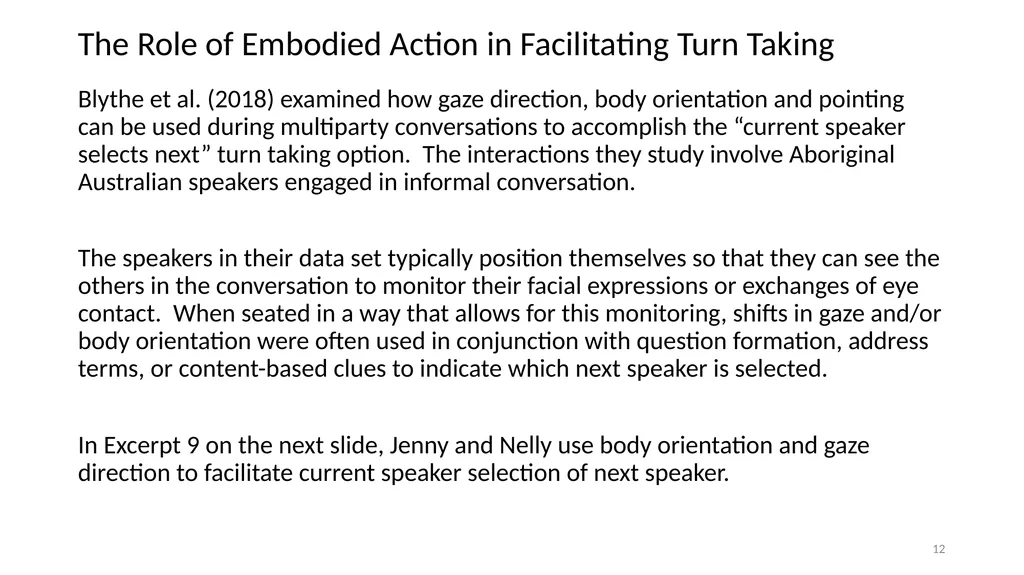
The Role of Embodied Action in Facilitating Turn Taking Blythe et al. (2018) examined how gaze direction, body orientation and pointing can be used during multiparty conversations to accomplish the “current speaker selects next” turn taking option. The interactions they study involve Aboriginal Australian speakers engaged in informal conversation.
The speakers in their data set typically position themselves so that they can see the others in the conversation to monitor their facial expressions or exchanges of eye contact. When seated in a way that allows for this monitoring, shifts in gaze and/or body orientation were often used in conjunction with question formation, address terms, or content-based clues to indicate which next speaker is selected.
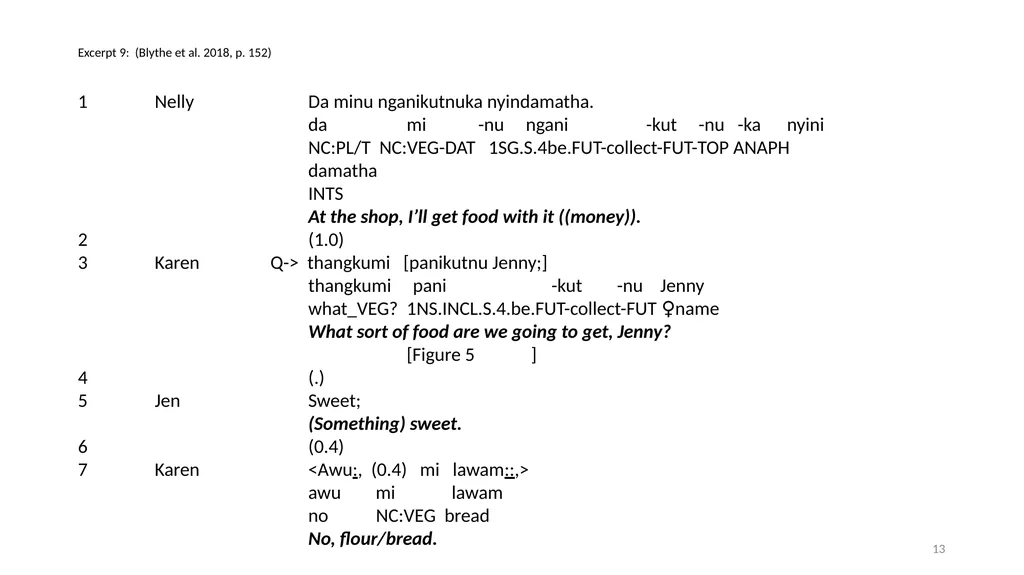
In Excerpt 9 on the next slide, Jenny and Nelly use body orientation and gaze direction to facilitate current speaker selection of next speaker. 12<br>
The speakers in their data set typically position themselves so that they can see the others in the conversation to monitor their facial expressions or exchanges of eye contact. When seated in a way that allows for this monitoring, shifts in gaze and/or body orientation were often used in conjunction with question formation, address terms, or content-based clues to indicate which next speaker is selected.
In Excerpt 9 on the next slide, Jenny and Nelly use body orientation and gaze direction to facilitate current speaker selection of next speaker. 12<br>
13
Excerpt 9: (Blythe et al. 2018, p. 152) 1 Nelly Da minu nganikutnuka nyindamatha.
da mi -nu ngani -kut -nu -ka nyini
NC:PL/T NC:VEG-DAT 1SG.S.4be.FUT-collect-FUT-TOP ANAPH
damatha
INTS
At the shop, I’ll get food with it ((money)).
2 (1.0) 3 Karen Q-> thangkumi [panikutnu Jenny;]
thangkumi pani -kut -nu Jenny
what_VEG? 1NS.INCL.S.4.be.FUT-collect-FUT ♀name
What sort of food are we going to get, Jenny?
[Figure 5 ]
4 (.)
5 Jen Sweet;
(Something) sweet.
6 (0.4)
7 Karen <Awu:, (0.4) mi lawam::,>
awu mi lawam
no NC:VEG bread
No, flour/bread. 13<br>
da mi -nu ngani -kut -nu -ka nyini
NC:PL/T NC:VEG-DAT 1SG.S.4be.FUT-collect-FUT-TOP ANAPH
damatha
INTS
At the shop, I’ll get food with it ((money)).
2 (1.0) 3 Karen Q-> thangkumi [panikutnu Jenny;]
thangkumi pani -kut -nu Jenny
what_VEG? 1NS.INCL.S.4.be.FUT-collect-FUT ♀name
What sort of food are we going to get, Jenny?
[Figure 5 ]
4 (.)
5 Jen Sweet;
(Something) sweet.
6 (0.4)
7 Karen <Awu:, (0.4) mi lawam::,>
awu mi lawam
no NC:VEG bread
No, flour/bread. 13<br>
14
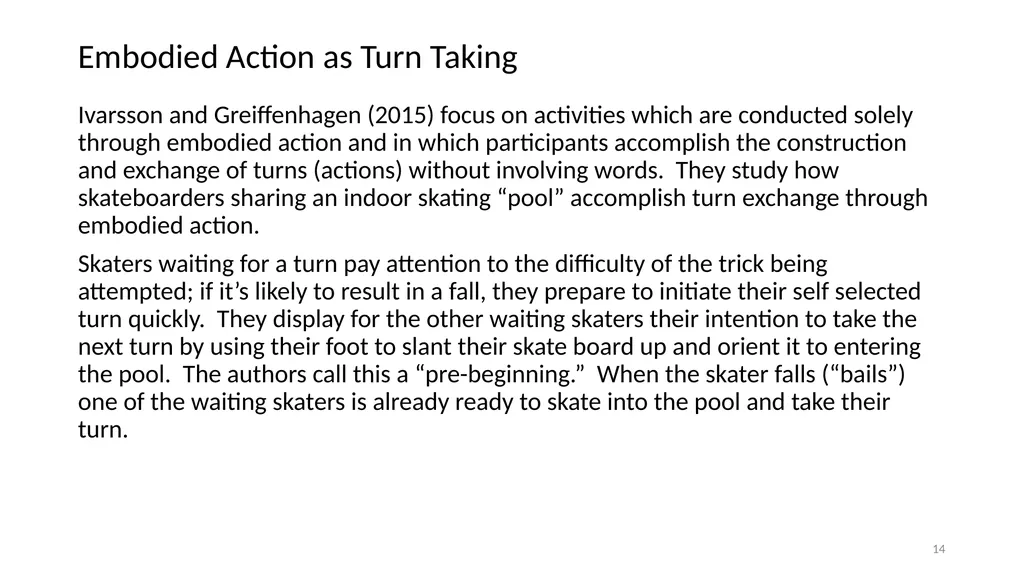
Embodied Action as Turn Taking Ivarsson and Greiffenhagen (2015) focus on activities which are conducted solely through embodied action and in which participants accomplish the construction and exchange of turns (actions) without involving words. They study how skateboarders sharing an indoor skating “pool” accomplish turn exchange through embodied action.
Skaters waiting for a turn pay attention to the difficulty of the trick being attempted; if it’s likely to result in a fall, they prepare to initiate their self selected turn quickly. They display for the other waiting skaters their intention to take the next turn by using their foot to slant their skate board up and orient it to entering the pool. The authors call this a “pre-beginning.” When the skater falls (“bails”) one of the waiting skaters is already ready to skate into the pool and take their turn. 14<br>
Skaters waiting for a turn pay attention to the difficulty of the trick being attempted; if it’s likely to result in a fall, they prepare to initiate their self selected turn quickly. They display for the other waiting skaters their intention to take the next turn by using their foot to slant their skate board up and orient it to entering the pool. The authors call this a “pre-beginning.” When the skater falls (“bails”) one of the waiting skaters is already ready to skate into the pool and take their turn. 14<br>
15
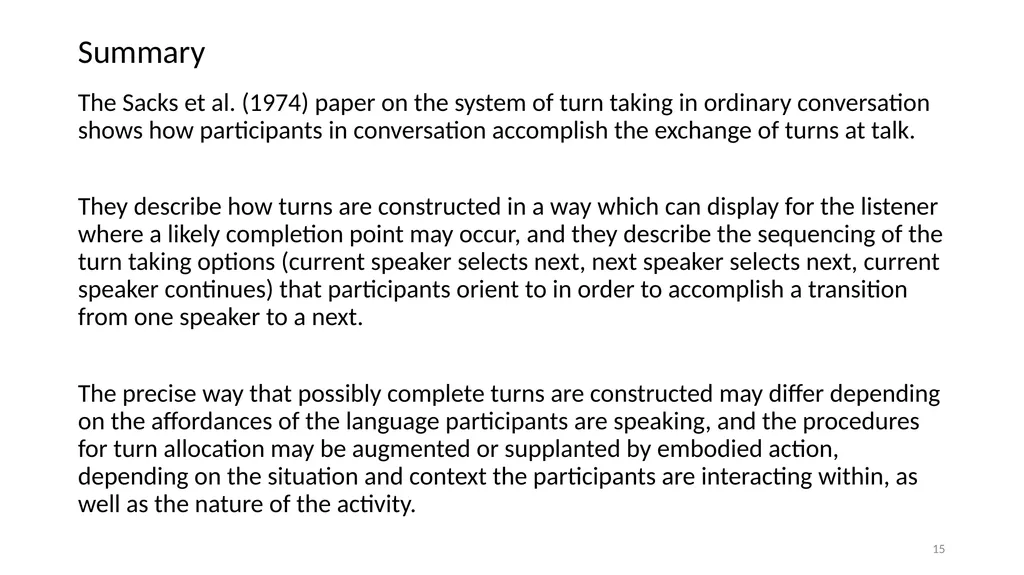
Summary The Sacks et al. (1974) paper on the system of turn taking in ordinary conversation shows how participants in conversation accomplish the exchange of turns at talk.
They describe how turns are constructed in a way which can display for the listener where a likely completion point may occur, and they describe the sequencing of the turn taking options (current speaker selects next, next speaker selects next, current speaker continues) that participants orient to in order to accomplish a transition from one speaker to a next.
The precise way that possibly complete turns are constructed may differ depending on the affordances of the language participants are speaking, and the procedures for turn allocation may be augmented or supplanted by embodied action, depending on the situation and context the participants are interacting within, as well as the nature of the activity. 15<br>
They describe how turns are constructed in a way which can display for the listener where a likely completion point may occur, and they describe the sequencing of the turn taking options (current speaker selects next, next speaker selects next, current speaker continues) that participants orient to in order to accomplish a transition from one speaker to a next.
The precise way that possibly complete turns are constructed may differ depending on the affordances of the language participants are speaking, and the procedures for turn allocation may be augmented or supplanted by embodied action, depending on the situation and context the participants are interacting within, as well as the nature of the activity. 15<br>
16
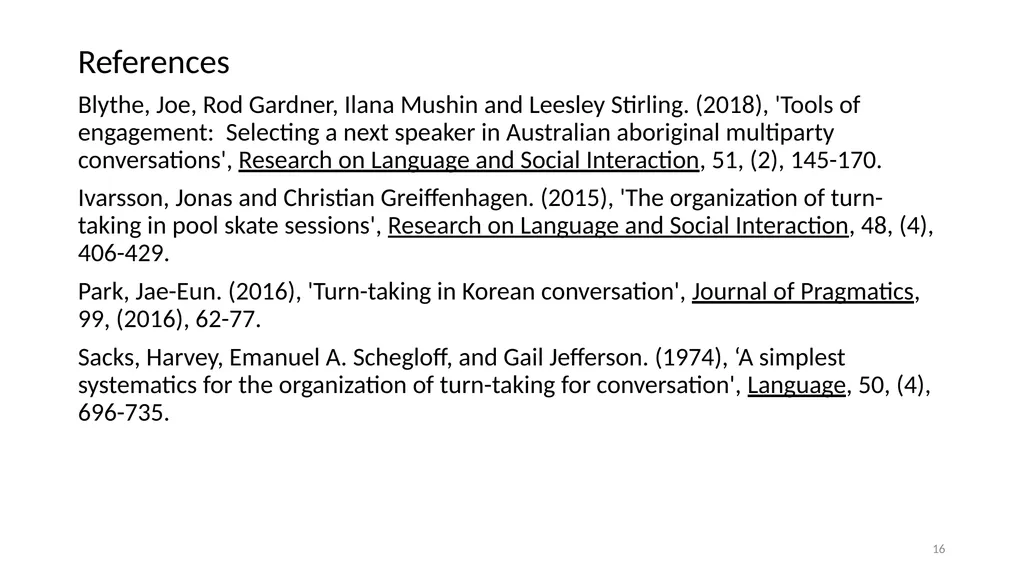
References Blythe, Joe, Rod Gardner, Ilana Mushin and Leesley Stirling. (2018), 'Tools of engagement: Selecting a next speaker in Australian aboriginal multiparty conversations', Research on Language and Social Interaction, 51, (2), 145-170.
Ivarsson, Jonas and Christian Greiffenhagen. (2015), 'The organization of turn-taking in pool skate sessions', Research on Language and Social Interaction, 48, (4), 406-429.
Park, Jae-Eun. (2016), 'Turn-taking in Korean conversation', Journal of Pragmatics, 99, (2016), 62-77.
Sacks, Harvey, Emanuel A. Schegloff, and Gail Jefferson. (1974), ‘A simplest systematics for the organization of turn-taking for conversation', Language, 50, (4), 696-735. 16<br>
Ivarsson, Jonas and Christian Greiffenhagen. (2015), 'The organization of turn-taking in pool skate sessions', Research on Language and Social Interaction, 48, (4), 406-429.
Park, Jae-Eun. (2016), 'Turn-taking in Korean conversation', Journal of Pragmatics, 99, (2016), 62-77.
Sacks, Harvey, Emanuel A. Schegloff, and Gail Jefferson. (1974), ‘A simplest systematics for the organization of turn-taking for conversation', Language, 50, (4), 696-735. 16<br>