
Chapter 6 Critical ethnography Dutta U. (2014).
BR
Published · 27 slides · 0 views
1 / 1
Description
Chapter 6 Critical ethnography Dutta U. (2014). In: Mills J and Birks M (eds) Qualitative methodologies: A practical guide. London: Sage Publications Learning objectives Outline the evolution of critical ethnography Discuss the
Related Topics
Share
Embed code
Download this presentation From Below
"Chapter 6 Critical ethnography Dutta U. (2014)." is the property of its rightful owner. Permission is granted to download and print the materials on this website for personal, non-commercial use only, and to display it on your personal computer provided you do not modify the materials and that you retain all copyright notices contained in the materials. By downloading content from our website, you accept the terms of this agreement.
Presentation Transcript
01
Chapter 6
Critical ethnography Dutta U. (2014). In: Mills J and Birks M (eds) Qualitative methodologies: A practical guide. London: Sage Publications<br>
02
Learning objectives Outline the evolution of critical ethnography
Discuss the philosophical assumptions underlying ethnographic approaches
Identify the links between epistemological positions and specific methods<br>
Discuss the philosophical assumptions underlying ethnographic approaches
Identify the links between epistemological positions and specific methods<br>
03
Learning objectives Describe the critical role of the ethnographer in the research process
Explore key ethical and validation issues in ethnographic research
Identify the range of methods available for data collection, analysis, and dissemination of ethnographic research<br>
Explore key ethical and validation issues in ethnographic research
Identify the range of methods available for data collection, analysis, and dissemination of ethnographic research<br>
04
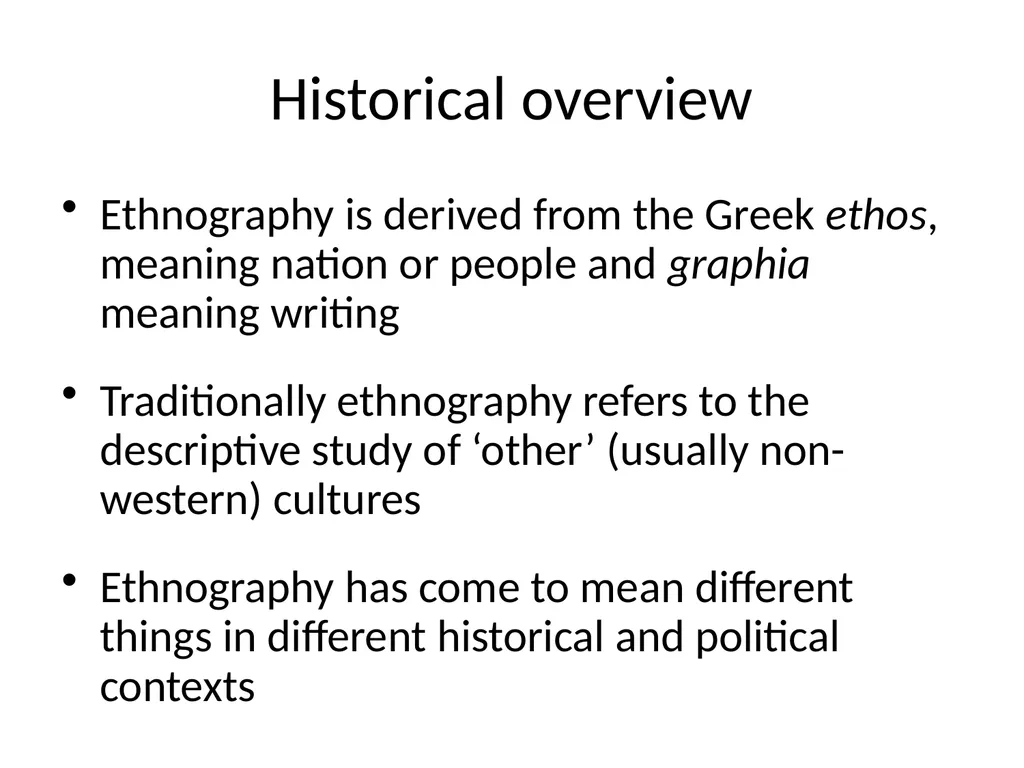
Historical overview Ethnography is derived from the Greek ethos, meaning nation or people and graphia meaning writing
Traditionally ethnography refers to the descriptive study of ‘other’ (usually non-western) cultures
Ethnography has come to mean different things in different historical and political contexts<br>
Traditionally ethnography refers to the descriptive study of ‘other’ (usually non-western) cultures
Ethnography has come to mean different things in different historical and political contexts<br>
05
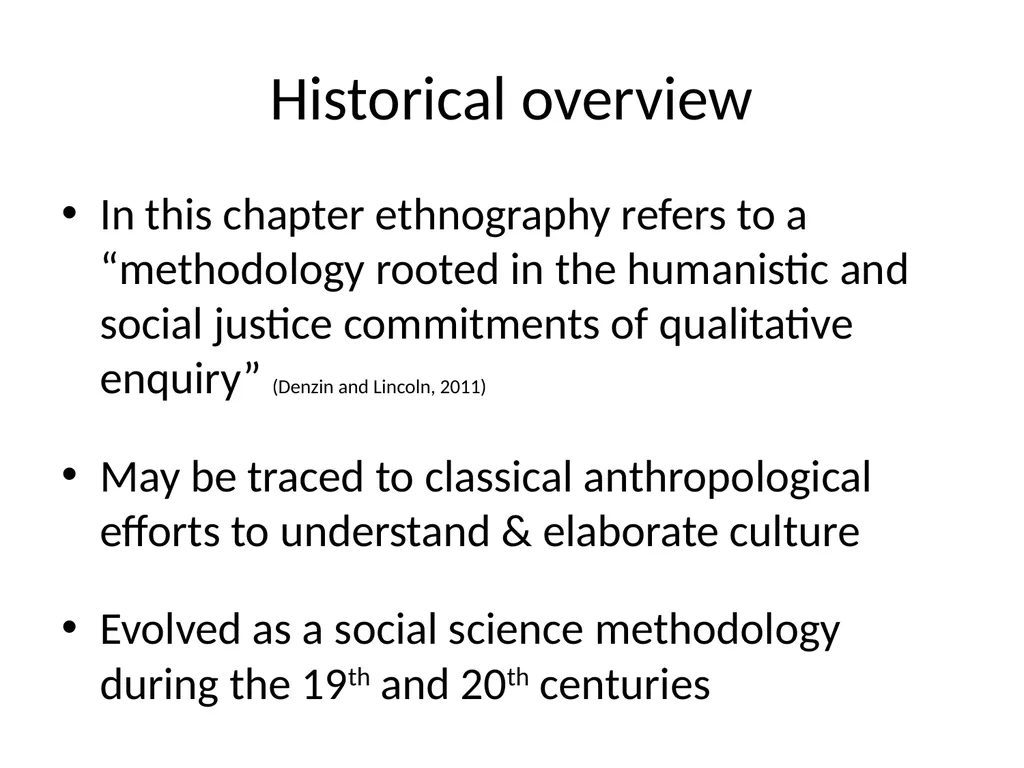
Historical overview In this chapter ethnography refers to a “methodology rooted in the humanistic and social justice commitments of qualitative enquiry” (Denzin and Lincoln, 2011)
May be traced to classical anthropological efforts to understand & elaborate culture
Evolved as a social science methodology during the 19th and 20th centuries<br>
May be traced to classical anthropological efforts to understand & elaborate culture
Evolved as a social science methodology during the 19th and 20th centuries<br>
06
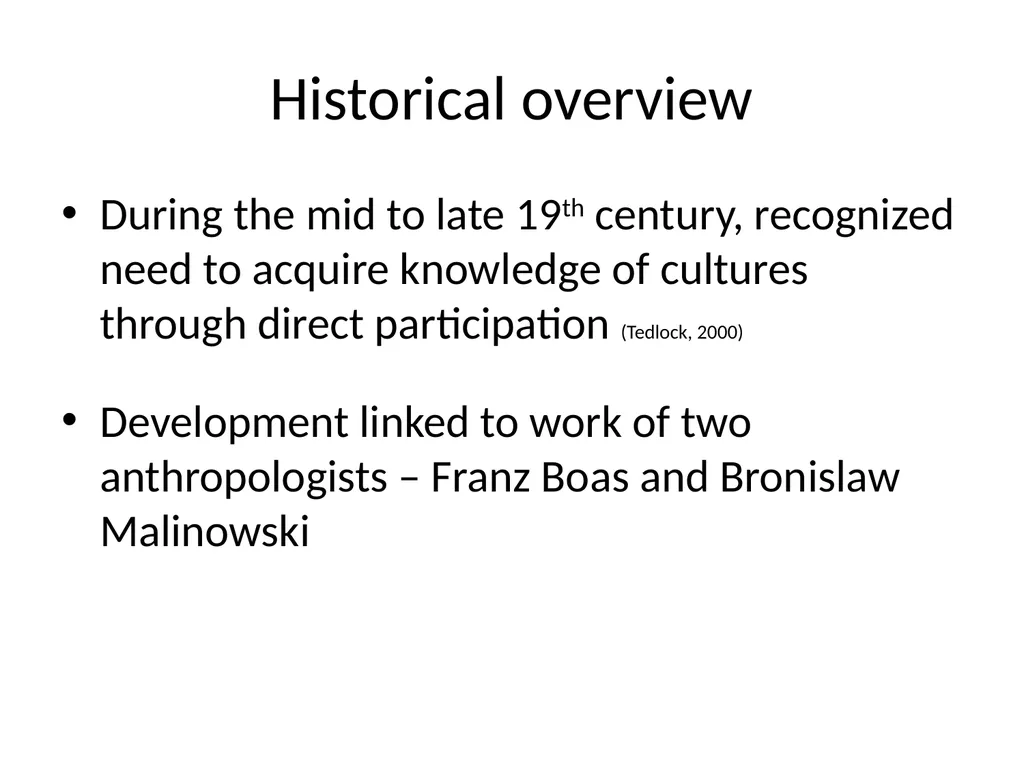
Historical overview During the mid to late 19th century, recognized need to acquire knowledge of cultures through direct participation (Tedlock, 2000)
Development linked to work of two anthropologists – Franz Boas and Bronislaw Malinowski<br>
Development linked to work of two anthropologists – Franz Boas and Bronislaw Malinowski<br>
07
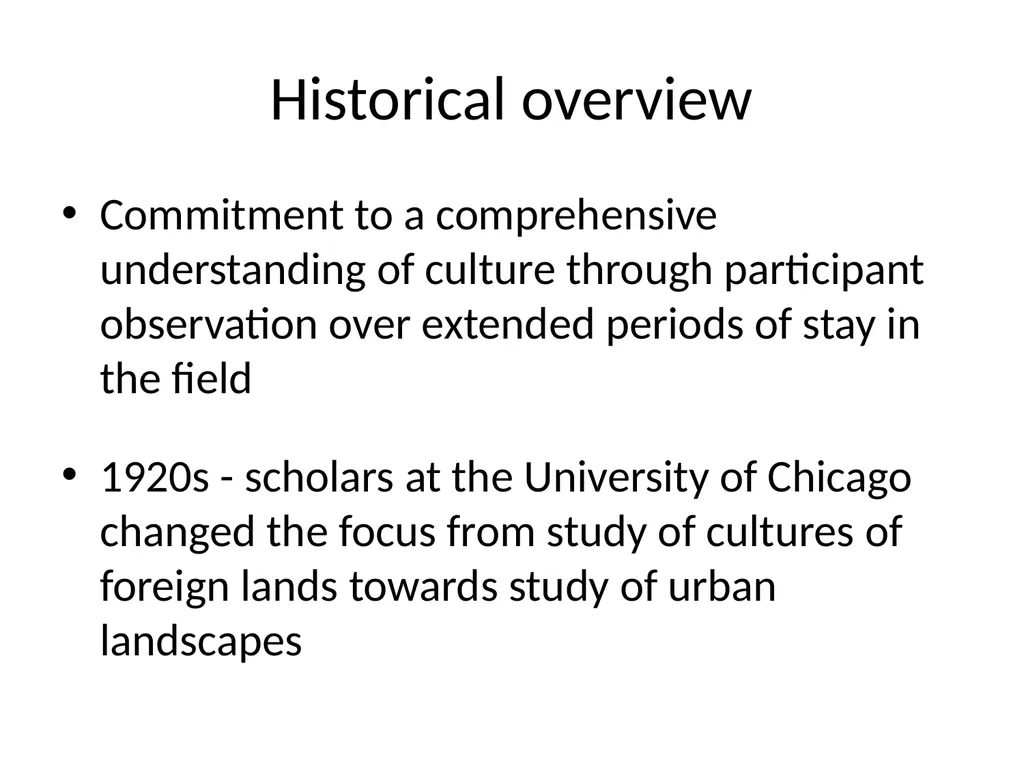
Historical overview Commitment to a comprehensive understanding of culture through participant observation over extended periods of stay in the field
1920s - scholars at the University of Chicago changed the focus from study of cultures of foreign lands towards study of urban landscapes<br>
1920s - scholars at the University of Chicago changed the focus from study of cultures of foreign lands towards study of urban landscapes<br>
08
Historical overview 1960s and 1970s - ethno methodologies and symbolic and interpretive anthropologies were two major influences on ethnography
1980s – ethnography became politicized with influence of feminist, critical, Indigenous and postmodern approaches<br>
1980s – ethnography became politicized with influence of feminist, critical, Indigenous and postmodern approaches<br>
09
Historical overview Distinct shift in ethnography toward studying existing social suffering and inequities
Contemporary moves in anthropology towards activist, civic and public agendas<br>
Contemporary moves in anthropology towards activist, civic and public agendas<br>
10
Philosophical underpinnings 19th century ethnography anchored in philosophy of realism (reality exists independent of the researcher) (Hammersley, 2002)
Aim was to produce accurate accounts of different cultures and communities
Social constructivism was a competing epistemology<br>
Aim was to produce accurate accounts of different cultures and communities
Social constructivism was a competing epistemology<br>
11
Philosophical underpinnings Social constructivism contended that the research product is co-constructed by the researcher and participants
Range of epistemologies reflected in variations of ethnographic approaches
Emergence of explicit social justice agendas such as critical, collaborative, performance and activist ethnography (Lassiter, 2005; Madison, 2005; Madison, 2012; Sanford, 2006; Tedlock, 2011)<br>
Range of epistemologies reflected in variations of ethnographic approaches
Emergence of explicit social justice agendas such as critical, collaborative, performance and activist ethnography (Lassiter, 2005; Madison, 2005; Madison, 2012; Sanford, 2006; Tedlock, 2011)<br>
12
Aligning philosophy and methodology with purpose Need to reflect on why you may choose ethnography
Need to reflect on which specific ethnographic approach may be the most suitable for your study
Ethnographic approaches include: critical ethnography, performance ethnography, collaborative ethnography, public and activist anthropology<br>
Need to reflect on which specific ethnographic approach may be the most suitable for your study
Ethnographic approaches include: critical ethnography, performance ethnography, collaborative ethnography, public and activist anthropology<br>
13
Aligning philosophy and methodology with purpose For example, you may feel an ethical responsibility to address processes of unfairness or injustice in a specific domain
Critical ethnography may therefore be the most appropriate methodological approach to your study<br>
Critical ethnography may therefore be the most appropriate methodological approach to your study<br>
14
Aligning philosophy and methodology with purpose Critical ethnography:
involves challenging institutions and regimes that limit choices, constrain resources and marginalize identities
is committed to the construction of knowledge from the perspective of those who are subjugated<br>
involves challenging institutions and regimes that limit choices, constrain resources and marginalize identities
is committed to the construction of knowledge from the perspective of those who are subjugated<br>
15
Positioning the researcher A cornerstone of ethnography is the researcher’s deep immersion in the community or context of the study
Need to continually examine and evaluate your role as researcher in relation to specific social contexts by asking “when, where, how am I?” (Trinh, 1991: 157)<br>
Need to continually examine and evaluate your role as researcher in relation to specific social contexts by asking “when, where, how am I?” (Trinh, 1991: 157)<br>
16
Positioning the researcher Need to take a reflexive stance
Think critically about how your identity as a researcher intersects with the research context
Need to be accountable for your research design, your position of authority and your ethical responsibilities relative to representation and interpretation<br>
Think critically about how your identity as a researcher intersects with the research context
Need to be accountable for your research design, your position of authority and your ethical responsibilities relative to representation and interpretation<br>
17
Data generation and collection Data is collected in the field and involves the researcher’s participation in a community or setting over an extended period of time
Sampling is usually criterion-based and purposeful i.e. participants are selected to provide the most information-rich data possible<br>
Sampling is usually criterion-based and purposeful i.e. participants are selected to provide the most information-rich data possible<br>
18
Data generation and collection Participants are recruited using snowball sampling and theoretical sampling
Snowball sampling - existing participants are used to recruit further participants
Theoretical sampling - selecting “incidents, slices of life, time periods or people on the basis of their potential manifestation or representation of important theoretical constructs” (Patton, 2002: 238)<br>
Snowball sampling - existing participants are used to recruit further participants
Theoretical sampling - selecting “incidents, slices of life, time periods or people on the basis of their potential manifestation or representation of important theoretical constructs” (Patton, 2002: 238)<br>
19
Data generation and collection Data generation and collection methods may include: formal and informal interviews, conversations, observations, surveys, focus groups, performances, collection of archival data
Data may be in the form of fieldnotes, interview transcripts, documents, artifacts and images<br>
Data may be in the form of fieldnotes, interview transcripts, documents, artifacts and images<br>
20
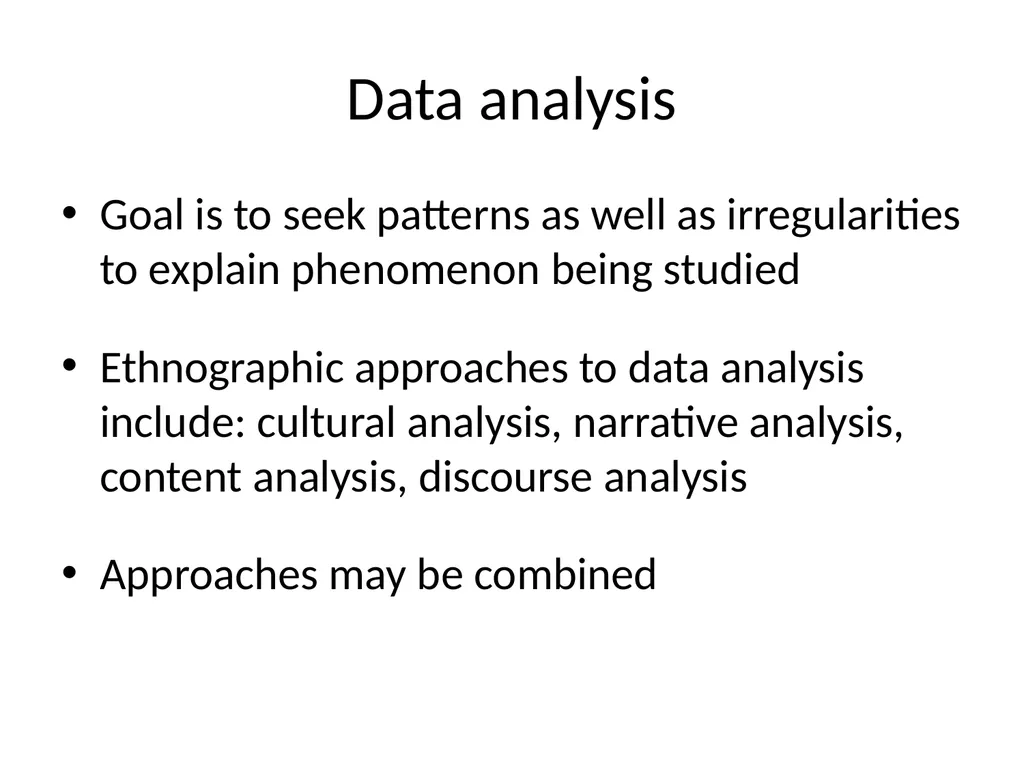
Data analysis Goal is to seek patterns as well as irregularities to explain phenomenon being studied
Ethnographic approaches to data analysis include: cultural analysis, narrative analysis, content analysis, discourse analysis
Approaches may be combined<br>
Ethnographic approaches to data analysis include: cultural analysis, narrative analysis, content analysis, discourse analysis
Approaches may be combined<br>
21
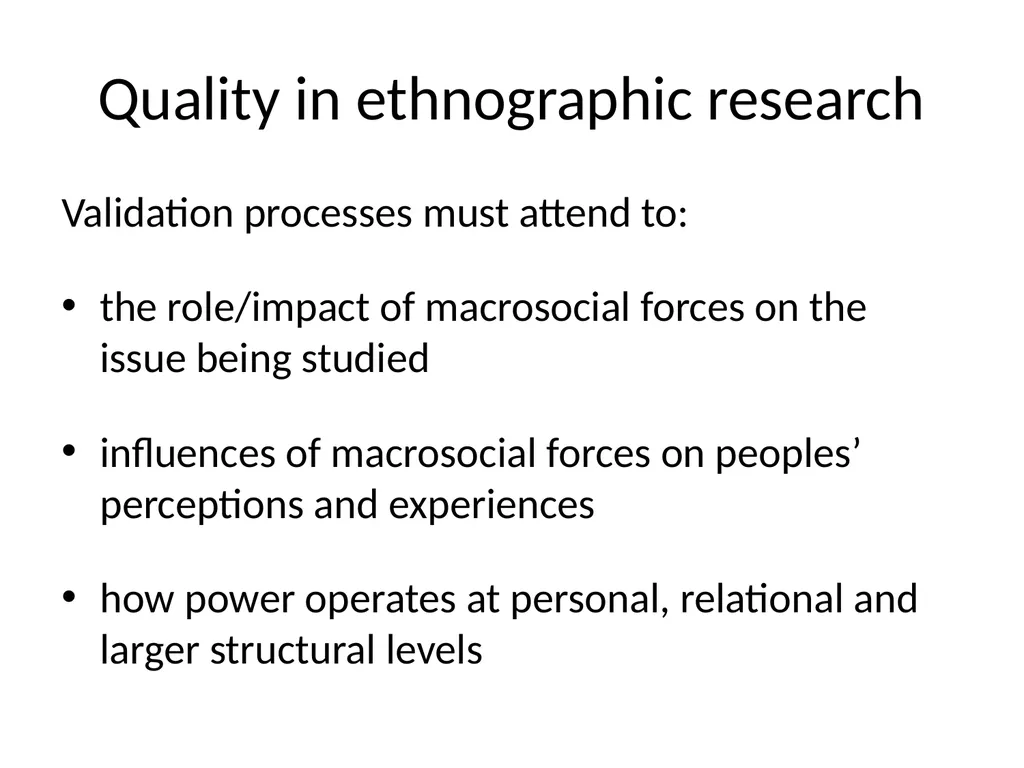
Quality in ethnographic research Validation processes must attend to:
the role/impact of macrosocial forces on the issue being studied
influences of macrosocial forces on peoples’ perceptions and experiences
how power operates at personal, relational and larger structural levels<br>
the role/impact of macrosocial forces on the issue being studied
influences of macrosocial forces on peoples’ perceptions and experiences
how power operates at personal, relational and larger structural levels<br>
22
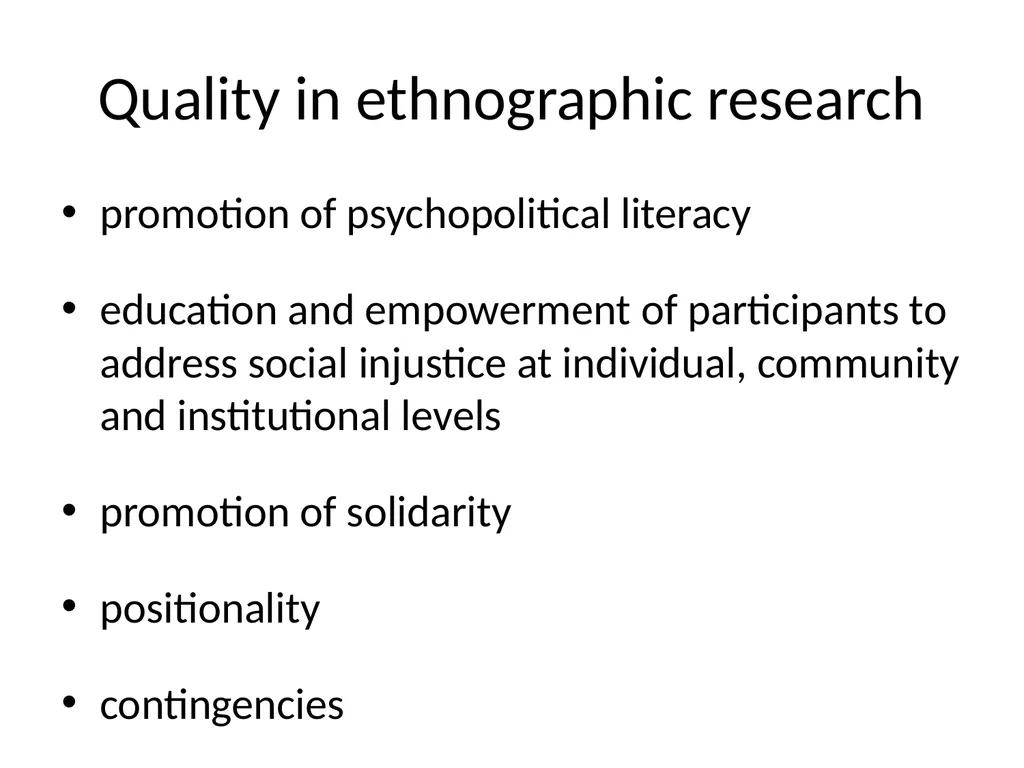
Quality in ethnographic research promotion of psychopolitical literacy
education and empowerment of participants to address social injustice at individual, community and institutional levels
promotion of solidarity
positionality
contingencies<br>
education and empowerment of participants to address social injustice at individual, community and institutional levels
promotion of solidarity
positionality
contingencies<br>
23
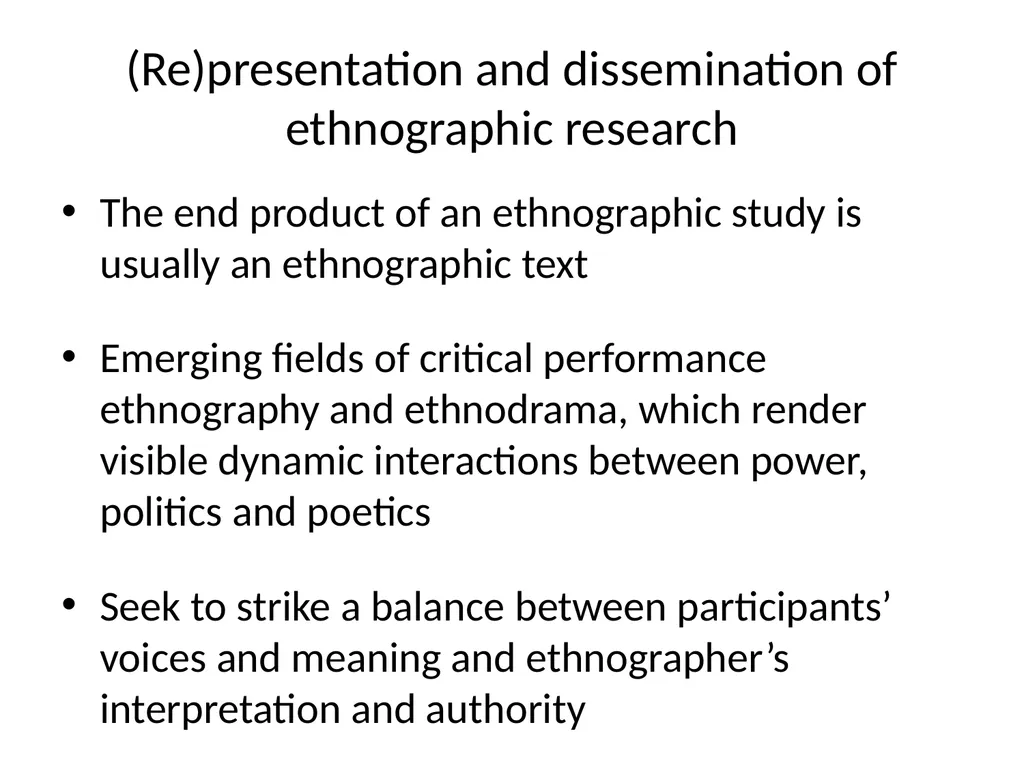
(Re)presentation and dissemination of ethnographic research The end product of an ethnographic study is usually an ethnographic text
Emerging fields of critical performance ethnography and ethnodrama, which render visible dynamic interactions between power, politics and poetics
Seek to strike a balance between participants’ voices and meaning and ethnographer’s interpretation and authority<br>
Emerging fields of critical performance ethnography and ethnodrama, which render visible dynamic interactions between power, politics and poetics
Seek to strike a balance between participants’ voices and meaning and ethnographer’s interpretation and authority<br>
24
(Re)presentation and dissemination of ethnographic research Differs from other research methods in so far as data analysis and production of ethnographic text are iteratively intertwined
Production of ethnographic text should reflect intersubjective and collaborative processes involved in fieldwork
Depending on findings, dissemination may take many forms, including non-academic avenues such as news media, local agencies, policy recommendations, grassroots activism<br>
Production of ethnographic text should reflect intersubjective and collaborative processes involved in fieldwork
Depending on findings, dissemination may take many forms, including non-academic avenues such as news media, local agencies, policy recommendations, grassroots activism<br>
25
Summary Importance of determining the appropriateness of using particular ethnographic approaches
The concerns of relatively small groups of ‘local’ people is of intrinsic value in ethnography
Ethical imperative to examine local or micropolitical contexts within macrosocial national, transnational and global formations<br>
The concerns of relatively small groups of ‘local’ people is of intrinsic value in ethnography
Ethical imperative to examine local or micropolitical contexts within macrosocial national, transnational and global formations<br>
26
References Denzin N and Lincoln Y. (2011) Introduction: The discipline and practice of qualitative research. In: Denzin N and Lincoln Y (eds) Handbook of Qualitative Research. 4th ed. Thousand Oaks: Sage Publications, Inc., 1–20.
Hammersley M. (2002) Ethnography and realism. In A. M Huberman and M Miles (eds). The Qualitative Researcher’s Companion. 1st ed. Thousand Oaks, California: Sage Publications, Inc., 65-80.
Lassiter L. (2005) The Chicago guide to collaborative ethnography: University of Chicago Press.
Madison D. (2005) Critical ethnography: Method, ethics, and performance, Thousand Oaks: Sage Publications.
Madison D. (2012) Critical ethnography: Method, ethics, and performance, Thousand Oaks: Sage Publications Inc.
Patton M. (2002) Qualitative Research & Evaluation Methods, Thousand Oaks: Sage Publications.<br>
Hammersley M. (2002) Ethnography and realism. In A. M Huberman and M Miles (eds). The Qualitative Researcher’s Companion. 1st ed. Thousand Oaks, California: Sage Publications, Inc., 65-80.
Lassiter L. (2005) The Chicago guide to collaborative ethnography: University of Chicago Press.
Madison D. (2005) Critical ethnography: Method, ethics, and performance, Thousand Oaks: Sage Publications.
Madison D. (2012) Critical ethnography: Method, ethics, and performance, Thousand Oaks: Sage Publications Inc.
Patton M. (2002) Qualitative Research & Evaluation Methods, Thousand Oaks: Sage Publications.<br>
27
References Sanford V. (2006) Introduction. Engaged Observer. In: Sanford V and Angel-Ajani A (eds) Anthropology, Advocacy, and Activism. Rutgers University Press, 1-18.
Tedlock B. (2000) Ethnography and ethnographic representation. In: Denzin N and Lincoln YS (eds) Handbook of Qualitative Research. 2nd ed. Thousand Oaks: Sage Publications Inc, 455-486.
Tedlock B. (2011) Braiding narrative ethnography with memoir and creative nonfiction. In: Denzin NK and Lincoln YS (eds) Handbook of Qualitative Research. 4 ed. Thousand Oaks: Sage Publications Inc, 331-340.
Trinh TM. (1991) When the moon waxes red: Representation, gender and cultural politics., New York: Routledge.<br>
Tedlock B. (2000) Ethnography and ethnographic representation. In: Denzin N and Lincoln YS (eds) Handbook of Qualitative Research. 2nd ed. Thousand Oaks: Sage Publications Inc, 455-486.
Tedlock B. (2011) Braiding narrative ethnography with memoir and creative nonfiction. In: Denzin NK and Lincoln YS (eds) Handbook of Qualitative Research. 4 ed. Thousand Oaks: Sage Publications Inc, 331-340.
Trinh TM. (1991) When the moon waxes red: Representation, gender and cultural politics., New York: Routledge.<br>