02
Cascio & Aguinis, Applied Psychology in Talent Management, 8e. © SAGE Publishing, 2019. Learning Goals Scales of measurement .
What type of data / when to use each
IRT for item analysis & CTT
Reliability Estimates –when to use each
test–retest, parallel forms, internal consistency, interrater reliability t
to assess different sources of error (e.g., time, items, raters). 3<br>
03
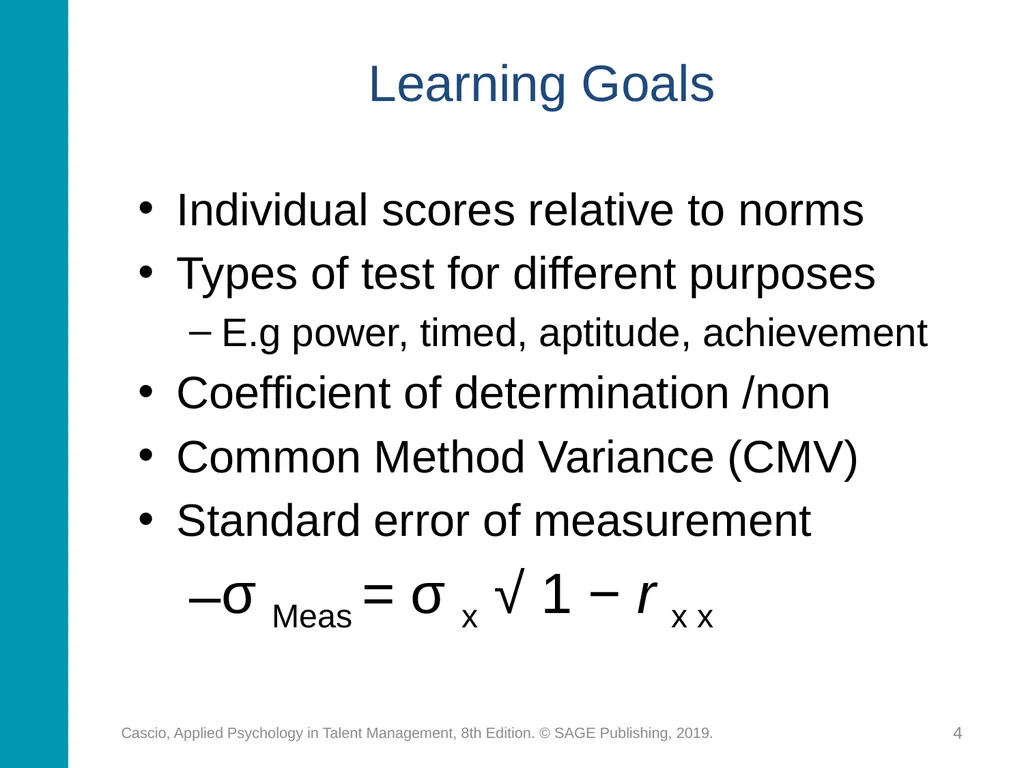
Learning Goals Individual scores relative to norms
Types of test for different purposes
E.g power, timed, aptitude, achievement
Coefficient of determination /non
Common Method Variance (CMV)
Standard error of measurement
σ Meas = σ x √ 1 − r x x Cascio, Applied Psychology in Talent Management, 8th Edition. © SAGE Publishing, 2019. 4<br>
04
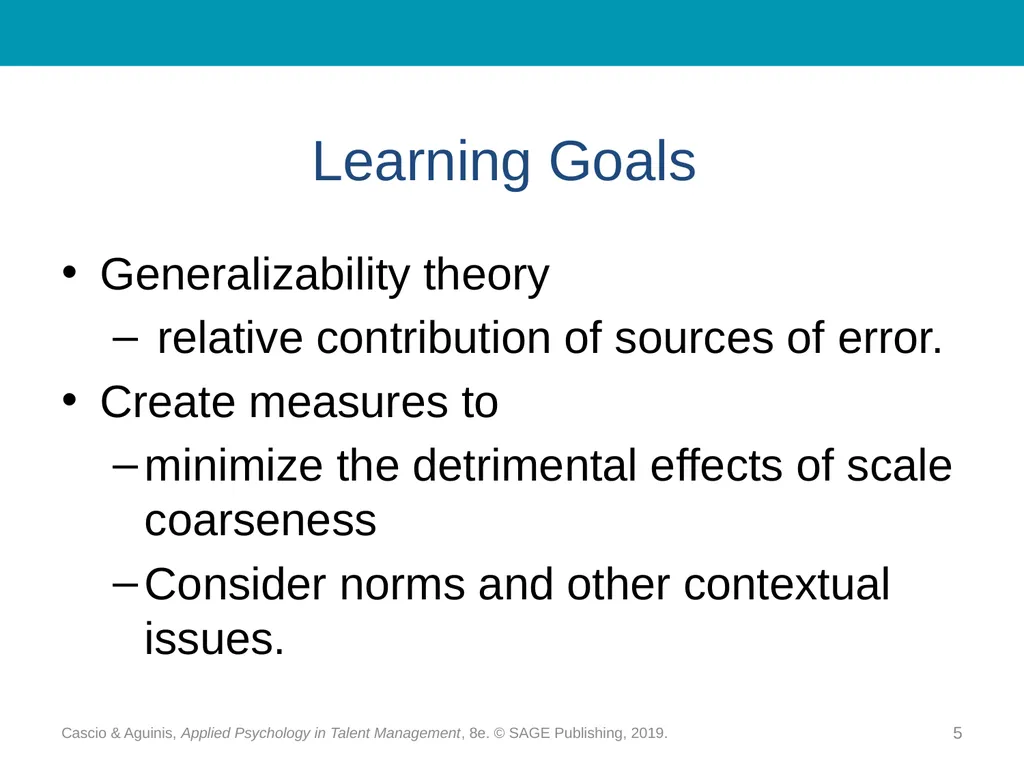
Cascio & Aguinis, Applied Psychology in Talent Management, 8e. © SAGE Publishing, 2019. Learning Goals Generalizability theory
relative contribution of sources of error.
Create measures to
minimize the detrimental effects of scale coarseness
Consider norms and other contextual issues. 5<br>
05
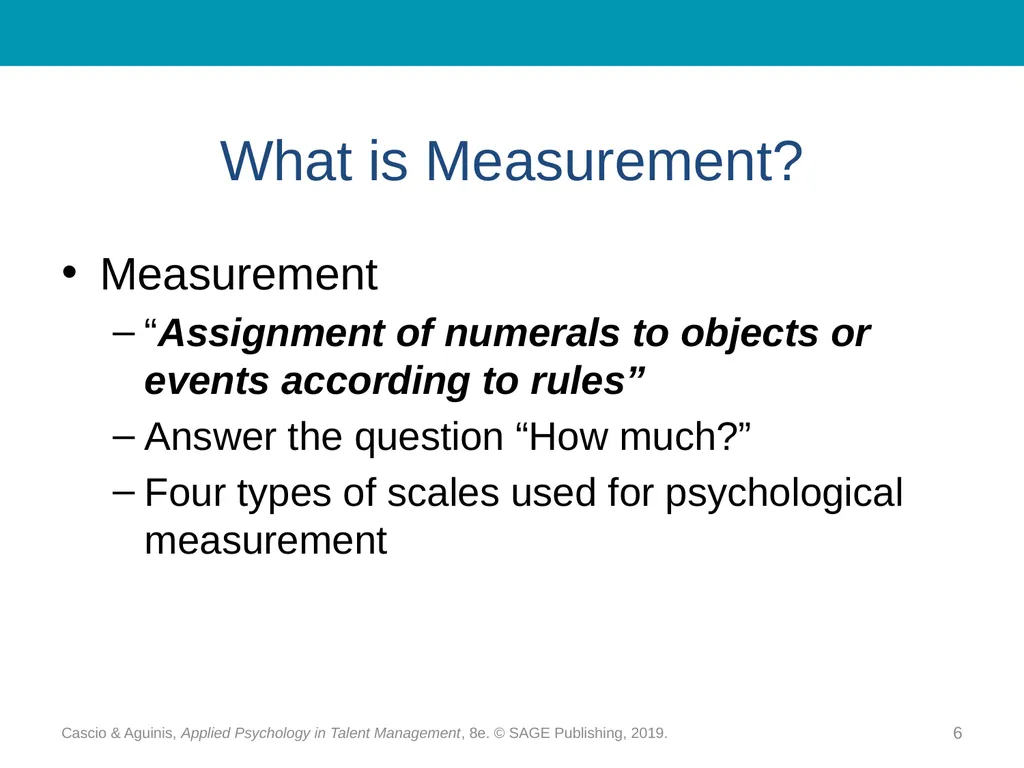
Cascio & Aguinis, Applied Psychology in Talent Management, 8e. © SAGE Publishing, 2019. What is Measurement? Measurement
“Assignment of numerals to objects or events according to rules”
Answer the question “How much?”
Four types of scales used for psychological measurement 6<br>
06
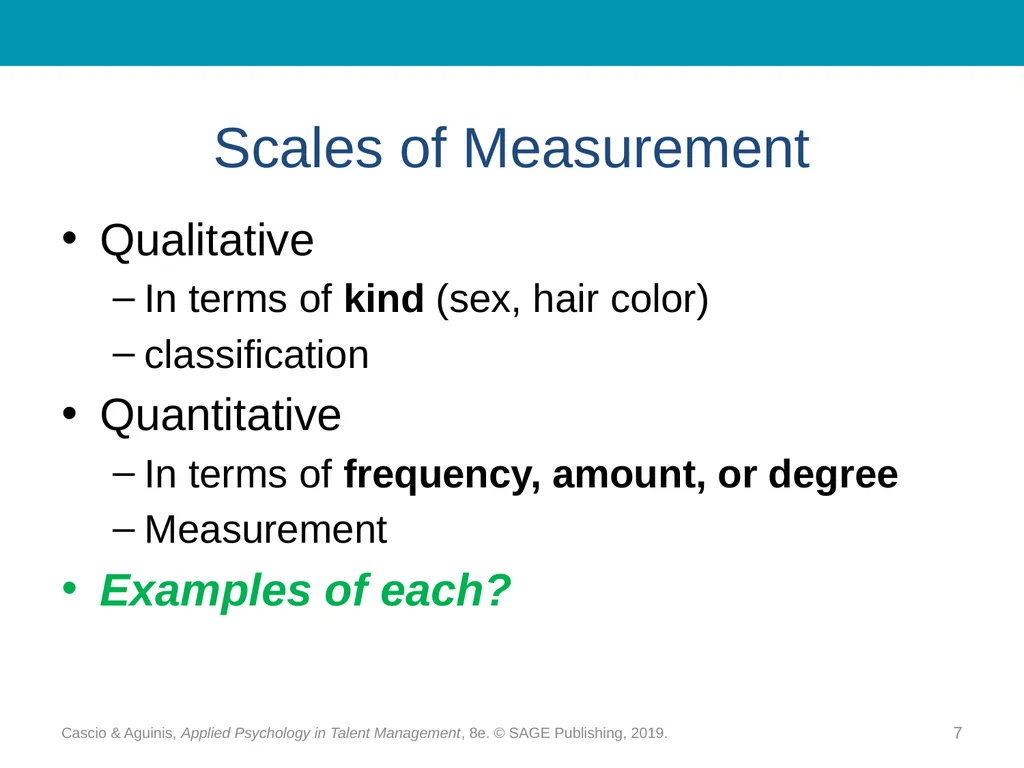
Cascio & Aguinis, Applied Psychology in Talent Management, 8e. © SAGE Publishing, 2019. Scales of Measurement Qualitative
In terms of kind (sex, hair color)
classification
Quantitative
In terms of frequency, amount, or degree
Measurement
Examples of each? 7<br>
07
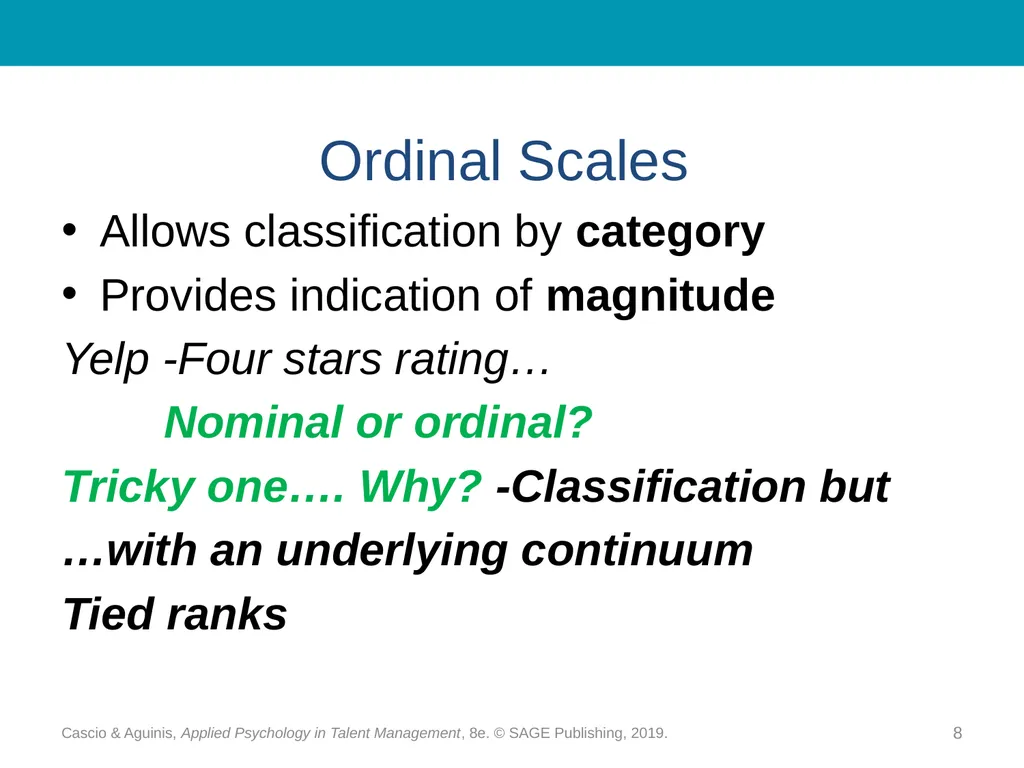
Cascio & Aguinis, Applied Psychology in Talent Management, 8e. © SAGE Publishing, 2019. Ordinal Scales Allows classification by category
Provides indication of magnitude
Yelp -Four stars rating…
Nominal or ordinal?
Tricky one…. Why? -Classification but
…with an underlying continuum
Tied ranks 8<br>
08
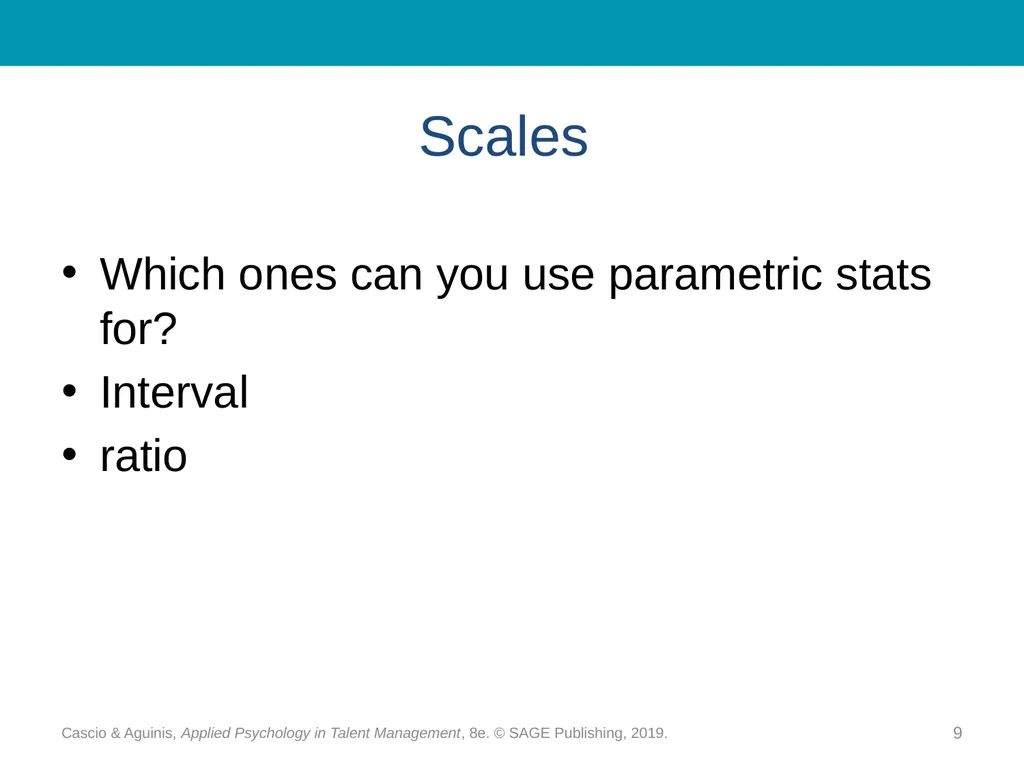
Cascio & Aguinis, Applied Psychology in Talent Management, 8e. © SAGE Publishing, 2019. Scales Which ones can you use parametric stats for?
Interval
ratio 9<br>
09
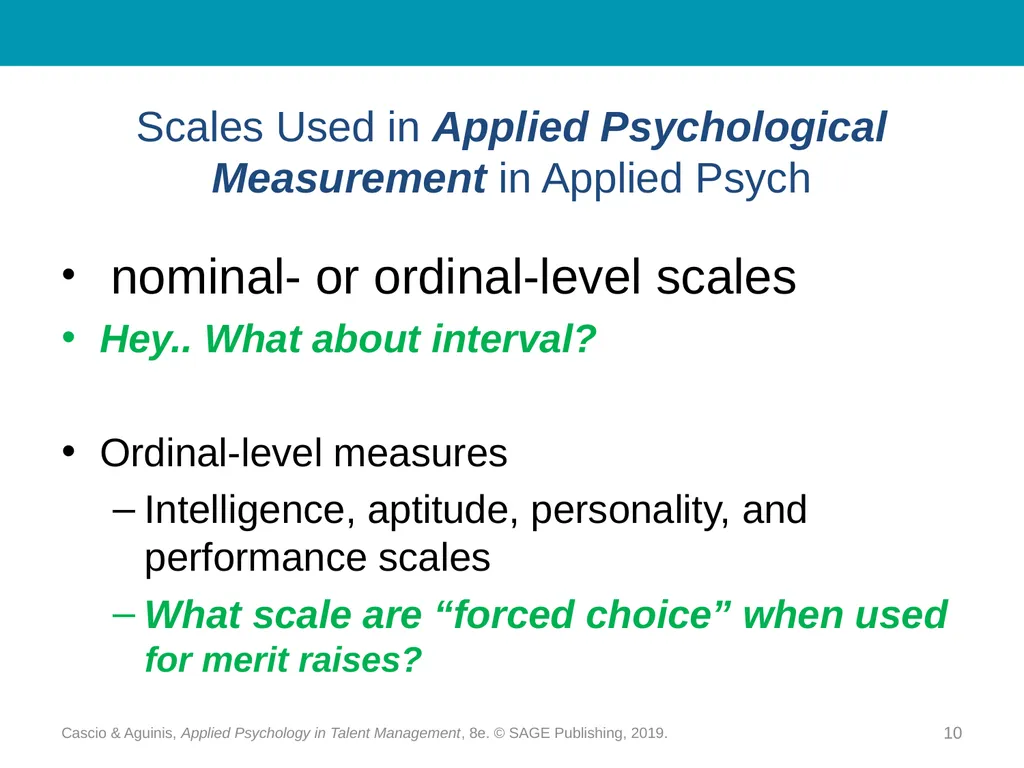
Cascio & Aguinis, Applied Psychology in Talent Management, 8e. © SAGE Publishing, 2019. Scales Used in Applied Psychological Measurement in Applied Psych nominal- or ordinal-level scales
Hey.. What about interval?
Ordinal-level measures
Intelligence, aptitude, personality, and performance scales
What scale are “forced choice” when used for merit raises? 10<br>
10
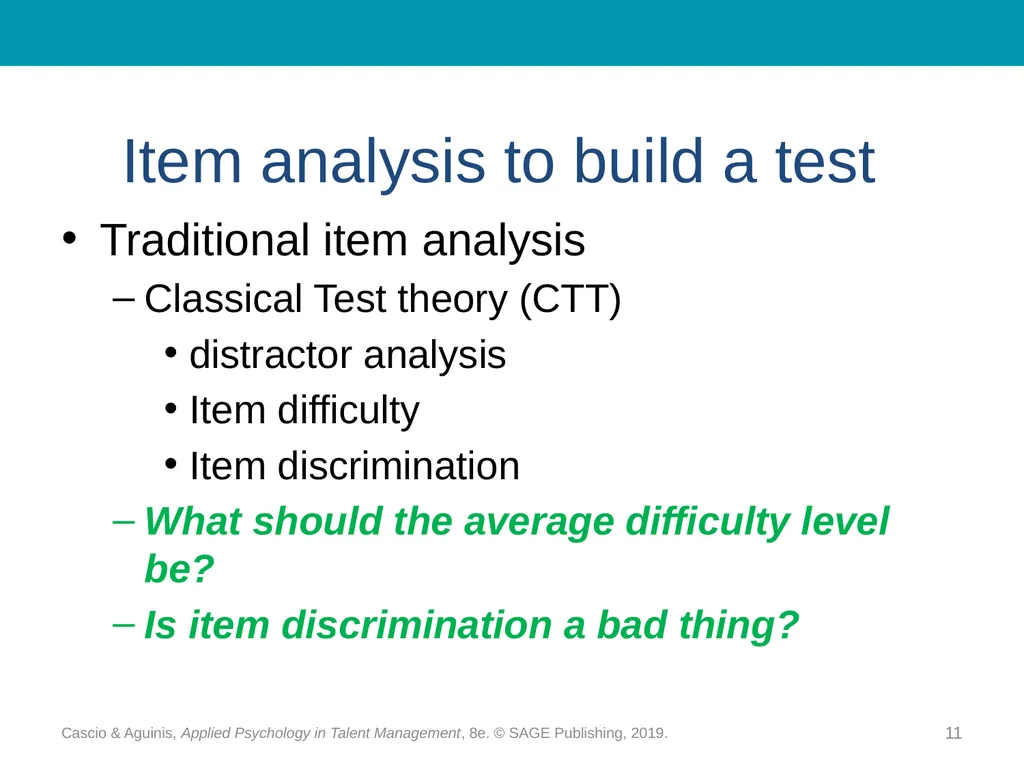
Cascio & Aguinis, Applied Psychology in Talent Management, 8e. © SAGE Publishing, 2019. Item analysis to build a test Traditional item analysis
Classical Test theory (CTT)
distractor analysis
Item difficulty
Item discrimination
What should the average difficulty level be?
Is item discrimination a bad thing? 11<br>
11
Cascio & Aguinis, Applied Psychology in Talent Management, 8e. © SAGE Publishing, 2019. Item analysis to build a test (2 of 3) IRT Item response theory
Quickly assess test taker’s ability
Doesn’t’ waste time on easy items
Avoids embarrassment for the less able
Easy to assess group differences (or bias) 12<br>
12
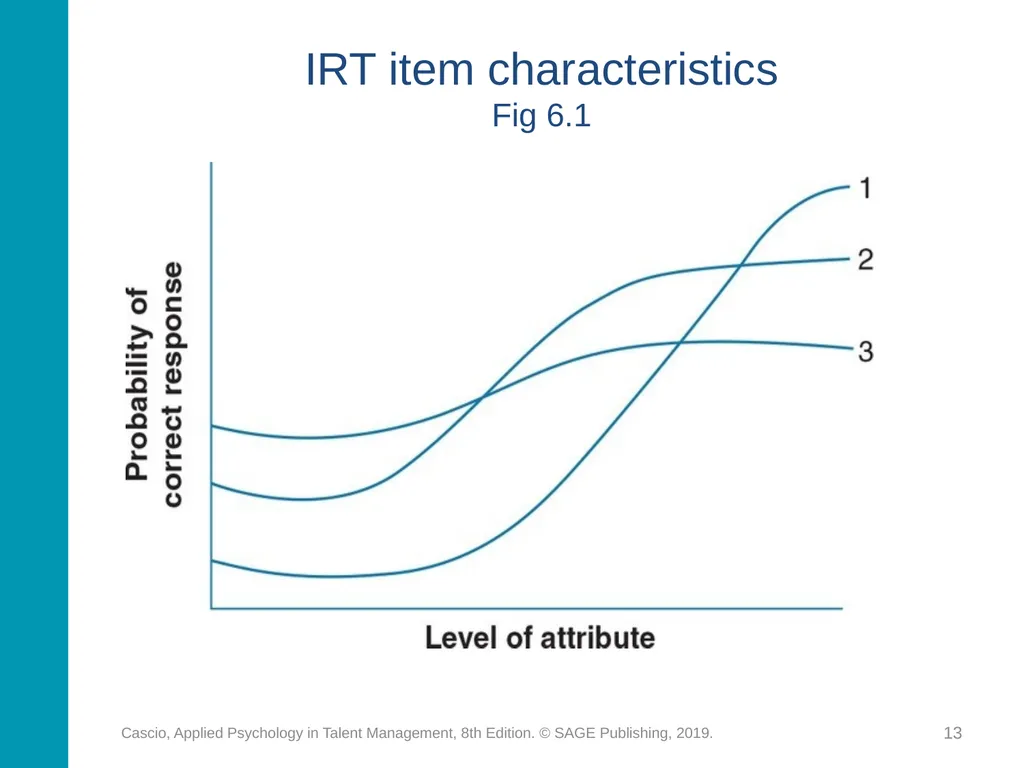
IRT item characteristics�Fig 6.1 Cascio, Applied Psychology in Talent Management, 8th Edition. © SAGE Publishing, 2019. 13<br>
13
Cascio & Aguinis, Applied Psychology in Talent Management, 8e. © SAGE Publishing, 2019. Reliability as Consistency Reliability of a measurement procedure
Freedom from unsystematic errors of measurement
Measurement errors reduce reliability 14<br>
14
Cascio & Aguinis, Applied Psychology in Talent Management, 8e. © SAGE Publishing, 2019. Estimation of Reliability�Know these Test–retest
Parallel (or alternate) forms
Internal consistency (alpha coefficient)
Split-half reliability estimates
Stability and equivalence
Inter-rater reliability
Intra-rater reliability 15<br>
15
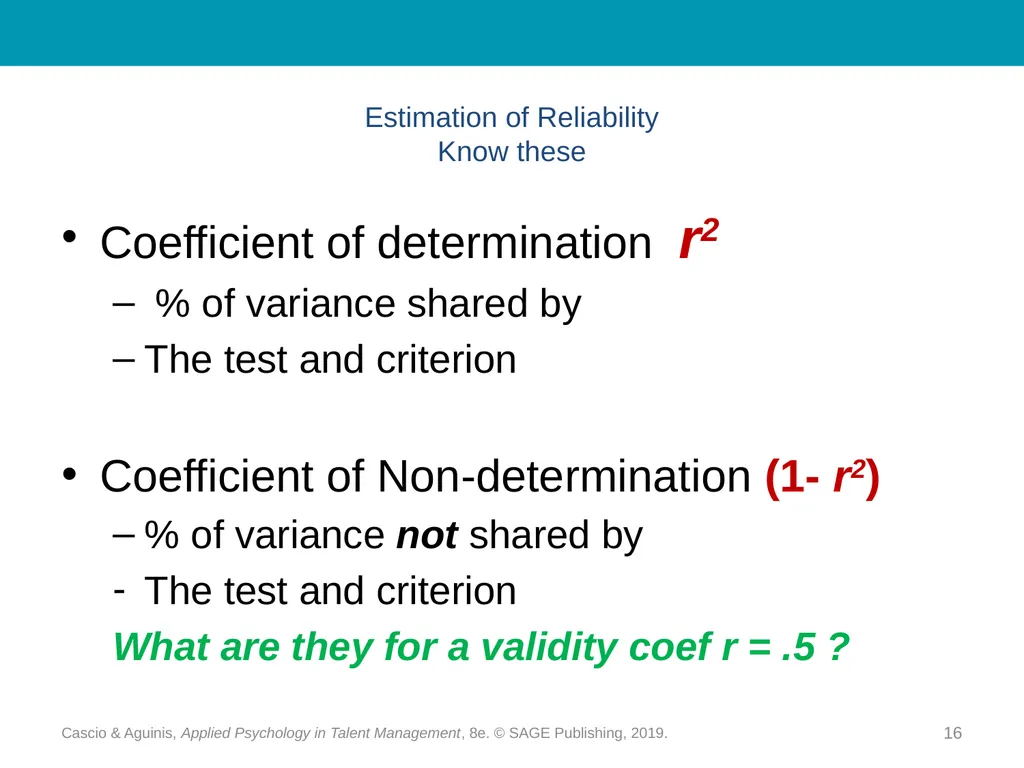
Cascio & Aguinis, Applied Psychology in Talent Management, 8e. © SAGE Publishing, 2019. Estimation of Reliability�Know these Coefficient of determination r2
% of variance shared by
The test and criterion
Coefficient of Non-determination (1- r2)
% of variance not shared by
The test and criterion
What are they for a validity coef r = .5 ? 16<br>
16
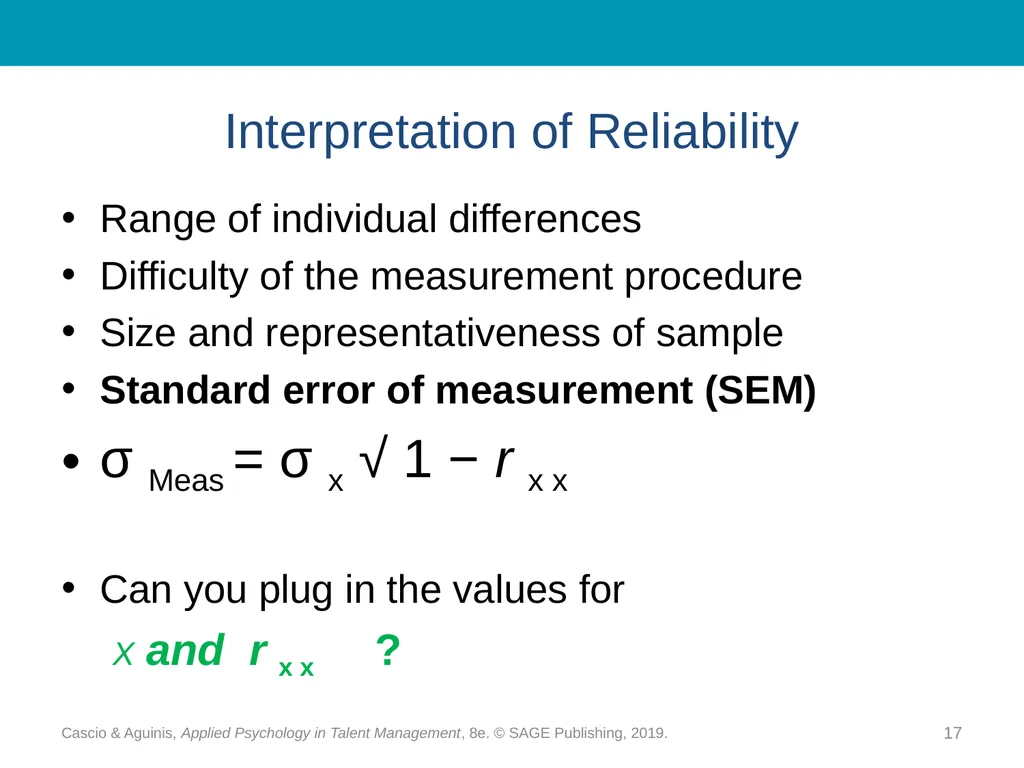
Cascio & Aguinis, Applied Psychology in Talent Management, 8e. © SAGE Publishing, 2019. Interpretation of Reliability Range of individual differences
Difficulty of the measurement procedure
Size and representativeness of sample
Standard error of measurement (SEM)
σ Meas = σ x √ 1 − r x x
Can you plug in the values for
X and r x x ? 17<br>
17
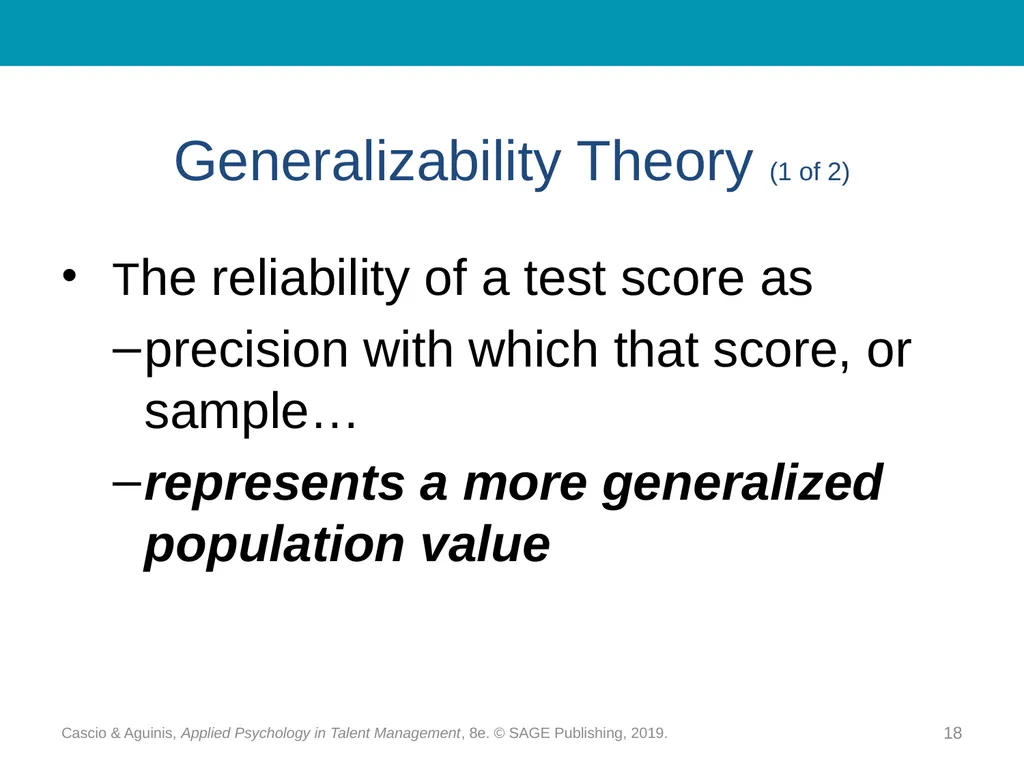
Cascio & Aguinis, Applied Psychology in Talent Management, 8e. © SAGE Publishing, 2019. Generalizability Theory (1 of 2) The reliability of a test score as
precision with which that score, or sample…
represents a more generalized population value 18<br>
18
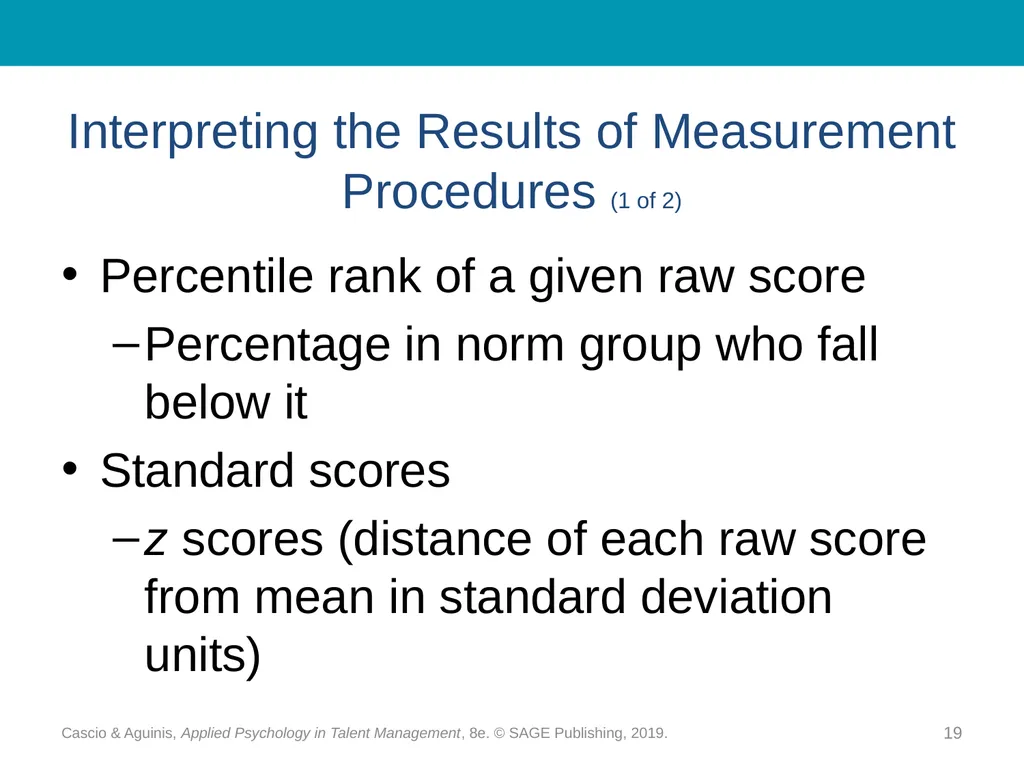
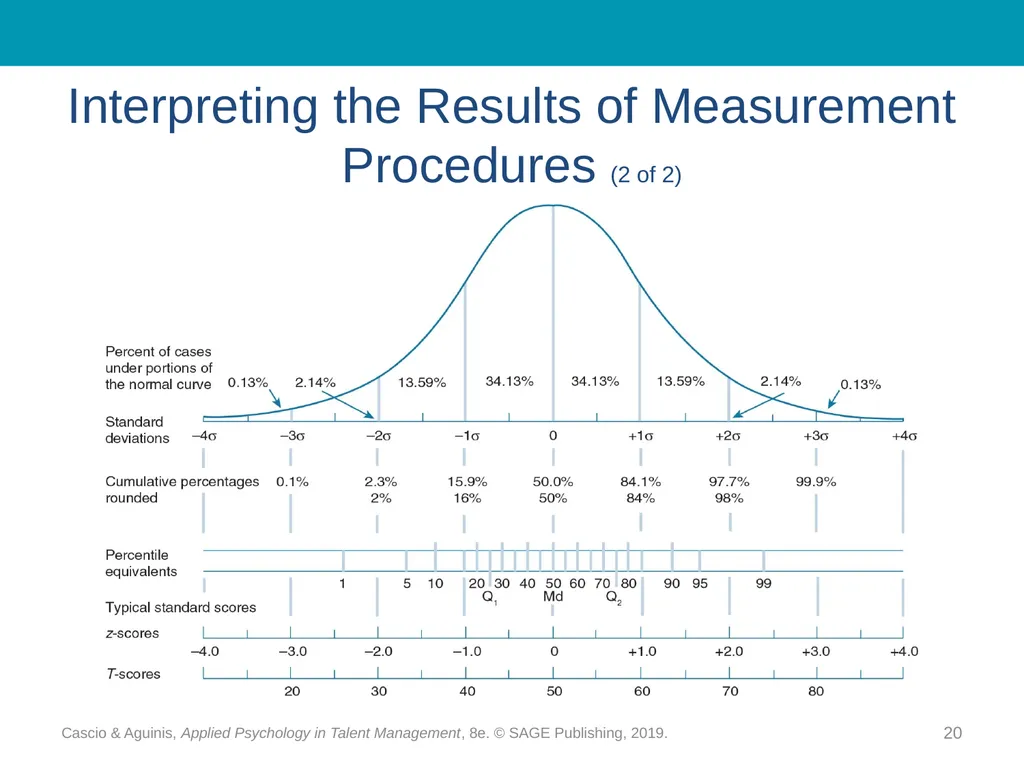
Cascio & Aguinis, Applied Psychology in Talent Management, 8e. © SAGE Publishing, 2019. Interpreting the Results of Measurement Procedures (1 of 2) Percentile rank of a given raw score
Percentage in norm group who fall below it
Standard scores
z scores (distance of each raw score from mean in standard deviation units) 19<br>
19
Cascio & Aguinis, Applied Psychology in Talent Management, 8e. © SAGE Publishing, 2019. Interpreting the Results of Measurement Procedures (2 of 2) 20<br>