
Chapter 6 Medical and Legal Issues Comprehensive
PC
Published · 64 slides · 0 views

1 / 1

Description
Chapter 6 Medical and Legal Issues Comprehensive Lecture National EMS Education Standard Competencies Preparatory Integrates comprehensive knowledge of the EMS system, safetywell-being of the paramedic, and medicallegal and ethical issues
Related Topics
Share
Embed code
Download this presentation From Below
"Chapter 6 Medical and Legal Issues Comprehensive" is the property of its rightful owner. Permission is granted to download and print the materials on this website for personal, non-commercial use only, and to display it on your personal computer provided you do not modify the materials and that you retain all copyright notices contained in the materials. By downloading content from our website, you accept the terms of this agreement.
Presentation Transcript
01
Chapter 6
Medical and Legal Issues
Comprehensive Lecture<br>
Comprehensive Lecture<br>
02
National EMS Education Standard Competencies Preparatory
Integrates comprehensive knowledge of the EMS system, safety/well-being of the paramedic, and medical/legal and ethical issues which is intended to improve the health of EMS personnel, patients, and the community.<br>
Integrates comprehensive knowledge of the EMS system, safety/well-being of the paramedic, and medical/legal and ethical issues which is intended to improve the health of EMS personnel, patients, and the community.<br>
03
Legal Duties and Responsibilities The paramedic’s legal duties are to the patient, the employer, the medical director, and the public.
Ethical responsibilities include responding with respect to the physical and emotional needs of patients, critically reviewing one’s performance, and respecting confidentiality.
Failure to perform EMS duties properly can result in civil or criminal liability.<br>
Ethical responsibilities include responding with respect to the physical and emotional needs of patients, critically reviewing one’s performance, and respecting confidentiality.
Failure to perform EMS duties properly can result in civil or criminal liability.<br>
04
The United States Legal System (1 of 13) Structure of the legal system in the US is composed of five types of law:
Legislation
Administrative law
Common law
Criminal law
Civil law<br>
Legislation
Administrative law
Common law
Criminal law
Civil law<br>
05
The United States Legal System (2 of 13) How Laws Affect the Paramedic
Scope of Practice
The range of duties and skills that paramedics are allowed and expected to perform when necessary
Defines the boundaries between the paramedic and layperson as well as the boundaries between professionals.
The physician is legally responsible for overseeing the medical practice of the paramedic.<br>
Scope of Practice
The range of duties and skills that paramedics are allowed and expected to perform when necessary
Defines the boundaries between the paramedic and layperson as well as the boundaries between professionals.
The physician is legally responsible for overseeing the medical practice of the paramedic.<br>
06
The United States Legal System (3 of 13) How Laws Affect the Paramedic (cont.)
Medical Practice Act Legislation:
Designates restricted acts and prohibits certain tasks from being performed by nonphysicians
Authorizes physicians to oversee and supervise certain tasks performed by nonphysicians
Provides for the authorization and the withdrawal of dependent practice<br>
Medical Practice Act Legislation:
Designates restricted acts and prohibits certain tasks from being performed by nonphysicians
Authorizes physicians to oversee and supervise certain tasks performed by nonphysicians
Provides for the authorization and the withdrawal of dependent practice<br>
07
The United States Legal System (4 of 13) How Laws Affect the Paramedic (cont.)
Licensure
Legal process of occupational regulation in which a government agency grants permission for a person who meets established qualifications to engage in a profession.
Certification
Granted by a training entity, a governmental body, or a nongovernmental certifying agency or professional association.<br>
Licensure
Legal process of occupational regulation in which a government agency grants permission for a person who meets established qualifications to engage in a profession.
Certification
Granted by a training entity, a governmental body, or a nongovernmental certifying agency or professional association.<br>
08
The United States Legal System (5 of 13) How Laws Affect the Paramedic (cont.)
Motor Vehicle Laws
Usually define the standards for equipping and operating emergency vehicles.<br>
Motor Vehicle Laws
Usually define the standards for equipping and operating emergency vehicles.<br>
09
The United States Legal System (6 of 13) How Laws Affect the Paramedic (cont.)
Mandatory Reporting:
A practice through which paramedics may be required by law to report certain cases
Applies to cases involving abuse or neglect of children (all states) or older adults (most states), and may also apply to cases involving gunshot wounds, stab wounds, animal bites, and some communicable diseases.<br>
Mandatory Reporting:
A practice through which paramedics may be required by law to report certain cases
Applies to cases involving abuse or neglect of children (all states) or older adults (most states), and may also apply to cases involving gunshot wounds, stab wounds, animal bites, and some communicable diseases.<br>
10
The United States Legal System (7 of 13) How Laws Affect the Paramedic (cont.)
Many mandatory reporting statutes provide immunity for the person who reports the situation and these statutes prohibit lawsuits against people who file reports.<br>
Many mandatory reporting statutes provide immunity for the person who reports the situation and these statutes prohibit lawsuits against people who file reports.<br>
11
The United States Legal System (8 of 13) How Laws Affect the Paramedic (cont.)
Some state and federal regulations provide legal protection for the paramedic.
Part G of the Ryan White Comprehensive AIDS Resources Emergency Act—requires that emergency responders be advised if they have been exposed to certain infectious disease
Immunity—the actions for which government agencies can be held liable because of negligent acts of their employees are limited<br>
Some state and federal regulations provide legal protection for the paramedic.
Part G of the Ryan White Comprehensive AIDS Resources Emergency Act—requires that emergency responders be advised if they have been exposed to certain infectious disease
Immunity—the actions for which government agencies can be held liable because of negligent acts of their employees are limited<br>
12
The United States Legal System (9 of 13) How Laws Affect the Paramedic (cont.)
Good Samaritan laws:
A person who gives emergency first aid in good faith, without expecting to be paid, and in a manner that another person with similar training would, is covered
These laws do not protect health care workers from acts of gross negligence, reckless disregard, or willful or wanton misconduct, and generally do not apply to paid, on-duty EMS personnel<br>
Good Samaritan laws:
A person who gives emergency first aid in good faith, without expecting to be paid, and in a manner that another person with similar training would, is covered
These laws do not protect health care workers from acts of gross negligence, reckless disregard, or willful or wanton misconduct, and generally do not apply to paid, on-duty EMS personnel<br>
13
The United States Legal System (10 of 13) How Laws Affect the Paramedic (cont.)
To deter crimes against paramedics, some localities have enacted ordinances that make it illegal to harm or threaten to harm EMS crews or to obstruct patient care.<br>
To deter crimes against paramedics, some localities have enacted ordinances that make it illegal to harm or threaten to harm EMS crews or to obstruct patient care.<br>
14
The United States Legal System (11 of 13) The Legal Process
Malpractice Lawsuit
Begins with an incident in which the plaintiff perceives that he or she has been injured as a result of negligent patient care
The plaintiff hires an attorney who conducts a case investigation to determine the merit of the complaint<br>
Malpractice Lawsuit
Begins with an incident in which the plaintiff perceives that he or she has been injured as a result of negligent patient care
The plaintiff hires an attorney who conducts a case investigation to determine the merit of the complaint<br>
15
The United States Legal System (12 of 13) The Legal Process (cont.)
Discovery—the exchange of documents and the taking of depositions and interrogatives.
After discovery, the case is settled out of court, dismissed or adjudicated, or goes to trial.
In a trial, each party presents its side of the case, and based on the evidence and expert opinions, a judge or jury determines liability and any damages to be awarded to the plaintiff, if any.<br>
Discovery—the exchange of documents and the taking of depositions and interrogatives.
After discovery, the case is settled out of court, dismissed or adjudicated, or goes to trial.
In a trial, each party presents its side of the case, and based on the evidence and expert opinions, a judge or jury determines liability and any damages to be awarded to the plaintiff, if any.<br>
16
The United States Legal System (13 of 13) The Legal Process (cont.)
Settlement may occur at any stage during the litigation.
After the settlement, the case is dismissed.<br>
Settlement may occur at any stage during the litigation.
After the settlement, the case is dismissed.<br>
17
Legal Accountability of the Paramedic (1 of 14) Paramedics should provide a level of care and transport consistent with their education, training, and local protocol.
If paramedics fail to meet these responsibilities, the result may be legal liability.<br>
If paramedics fail to meet these responsibilities, the result may be legal liability.<br>
18
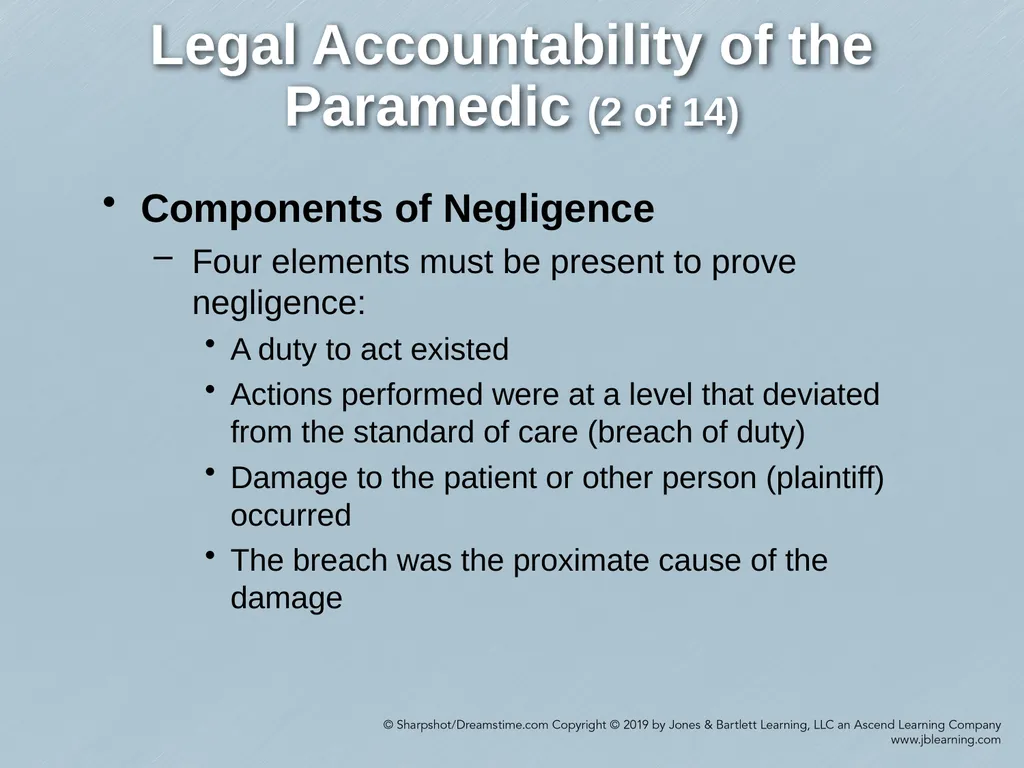
Legal Accountability of the Paramedic (2 of 14) Components of Negligence
Four elements must be present to prove negligence:
A duty to act existed
Actions performed were at a level that deviated from the standard of care (breach of duty)
Damage to the patient or other person (plaintiff) occurred
The breach was the proximate cause of the damage<br>
Four elements must be present to prove negligence:
A duty to act existed
Actions performed were at a level that deviated from the standard of care (breach of duty)
Damage to the patient or other person (plaintiff) occurred
The breach was the proximate cause of the damage<br>
19
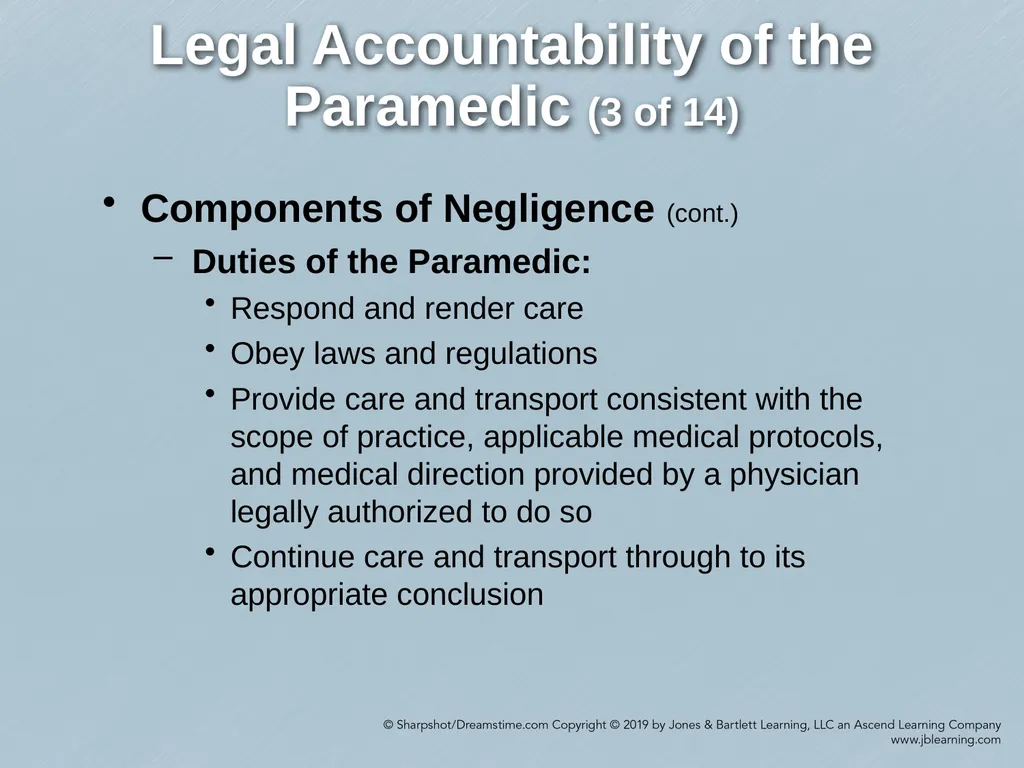
Legal Accountability of the Paramedic (3 of 14) Components of Negligence (cont.)
Duties of the Paramedic:
Respond and render care
Obey laws and regulations
Provide care and transport consistent with the scope of practice, applicable medical protocols, and medical direction provided by a physician legally authorized to do so
Continue care and transport through to its appropriate conclusion<br>
Duties of the Paramedic:
Respond and render care
Obey laws and regulations
Provide care and transport consistent with the scope of practice, applicable medical protocols, and medical direction provided by a physician legally authorized to do so
Continue care and transport through to its appropriate conclusion<br>
20
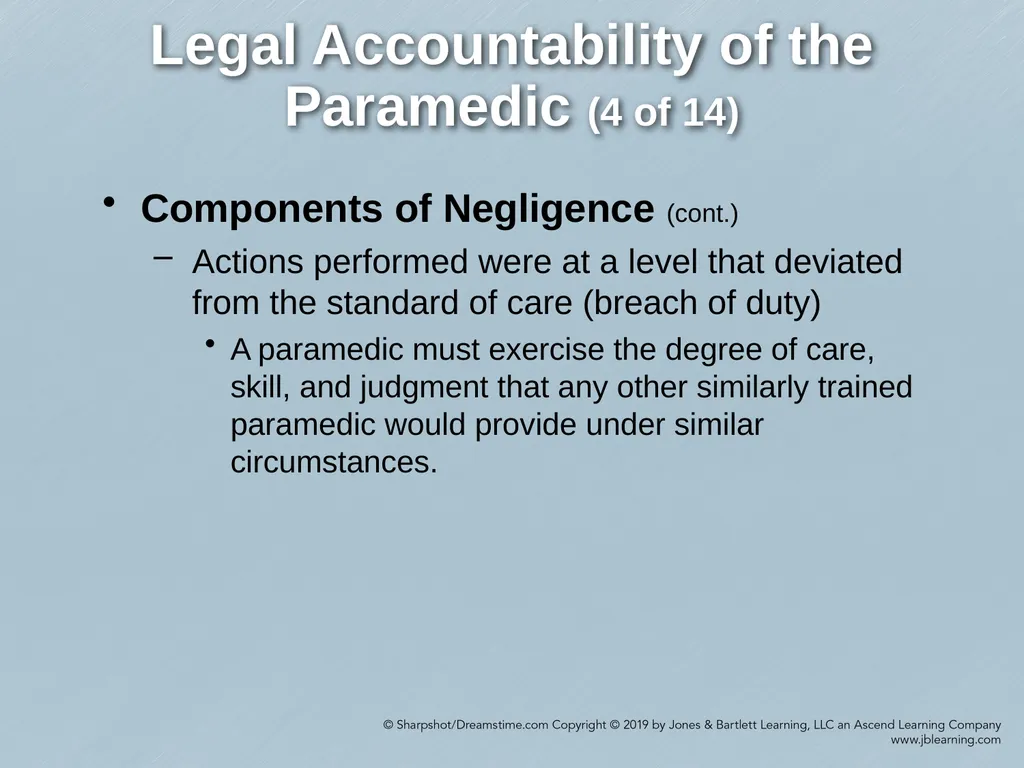
Legal Accountability of the Paramedic (4 of 14) Components of Negligence (cont.)
Actions performed were at a level that deviated from the standard of care (breach of duty)
A paramedic must exercise the degree of care, skill, and judgment that any other similarly trained paramedic would provide under similar circumstances.<br>
Actions performed were at a level that deviated from the standard of care (breach of duty)
A paramedic must exercise the degree of care, skill, and judgment that any other similarly trained paramedic would provide under similar circumstances.<br>
21
Legal Accountability of the Paramedic (5 of 14) Components of Negligence (cont.)
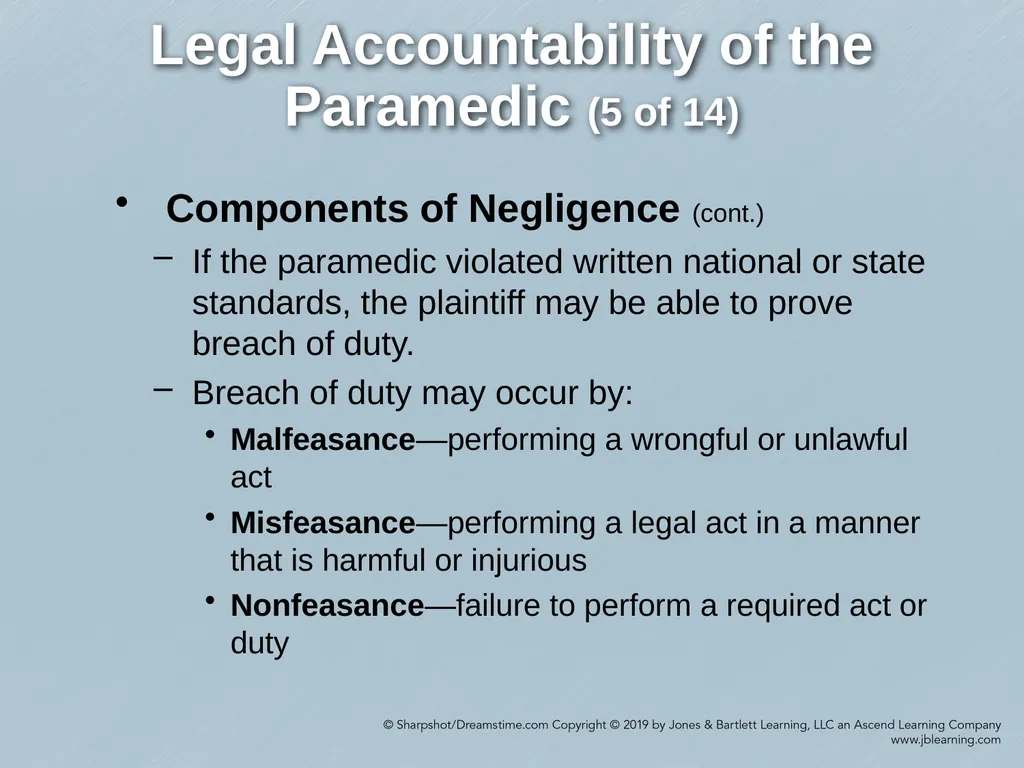
If the paramedic violated written national or state standards, the plaintiff may be able to prove breach of duty.
Breach of duty may occur by:
Malfeasance—performing a wrongful or unlawful act
Misfeasance—performing a legal act in a manner that is harmful or injurious
Nonfeasance—failure to perform a required act or duty<br>
If the paramedic violated written national or state standards, the plaintiff may be able to prove breach of duty.
Breach of duty may occur by:
Malfeasance—performing a wrongful or unlawful act
Misfeasance—performing a legal act in a manner that is harmful or injurious
Nonfeasance—failure to perform a required act or duty<br>
22
Legal Accountability of the Paramedic (6 of 14) Components of Negligence (cont.)
Proof of Damage—proof that the plaintiff suffered compensable damages.
Compensable damages may include: medical expenses, lost earnings, conscious pain and suffering, permanent disability, and wrongful death.
Punitive damages may be awarded in excess of compensable damages and reflect the reckless disregard for human life in which the defendant engaged.<br>
Proof of Damage—proof that the plaintiff suffered compensable damages.
Compensable damages may include: medical expenses, lost earnings, conscious pain and suffering, permanent disability, and wrongful death.
Punitive damages may be awarded in excess of compensable damages and reflect the reckless disregard for human life in which the defendant engaged.<br>
23
Legal Accountability of the Paramedic (7 of 14) Components of Negligence (cont.)
Proximate Cause
Negligent act or lack of action caused the injury or made an existing injury worse.
Plaintiff must prove that the injury or further harm was foreseeable ty the paramedic.<br>
Proximate Cause
Negligent act or lack of action caused the injury or made an existing injury worse.
Plaintiff must prove that the injury or further harm was foreseeable ty the paramedic.<br>
24
Legal Accountability of the Paramedic (8 of 14) Defenses to Negligence Claims
Good Samaritan Laws
Generally do not protect EMS personnel from acts of gross negligence, reckless disregard, or willful or wanton misconduct
May provide coverage for paid or volunteer EMS personnel
Government Immunity
May protect only the government agency, not EMS personnel<br>
Good Samaritan Laws
Generally do not protect EMS personnel from acts of gross negligence, reckless disregard, or willful or wanton misconduct
May provide coverage for paid or volunteer EMS personnel
Government Immunity
May protect only the government agency, not EMS personnel<br>
25
Legal Accountability of the Paramedic (9 of 14) Defenses to Negligence Claims (cont.)
Statute of Limitations
Limits the number of years after an incident during which a lawsuit can be filed
Is set by law and may differ for cases involving adults and children<br>
Statute of Limitations
Limits the number of years after an incident during which a lawsuit can be filed
Is set by law and may differ for cases involving adults and children<br>
26
Legal Accountability of the Paramedic (10 of 14) Defenses to Negligence Claims (cont.)
Contributory Negligence
Plaintiff may be found to have contributed to his or her own injury
Damages awarded may be reduced or eliminated based on the plaintiff’s contribution to the injury<br>
Contributory Negligence
Plaintiff may be found to have contributed to his or her own injury
Damages awarded may be reduced or eliminated based on the plaintiff’s contribution to the injury<br>
27
Legal Accountability of the Paramedic (11 of 14) Defenses to Negligence Claims (cont.)
All practicing active health care professionals should have adequate liability insurance.
Medical malpractice insurance offers coverage for legal defense and potential judgments against the policyholder.
Malpractice insurance falls into two groups:
Primary policies—personal policies
Umbrella policies—carried by employers of paramedics<br>
All practicing active health care professionals should have adequate liability insurance.
Medical malpractice insurance offers coverage for legal defense and potential judgments against the policyholder.
Malpractice insurance falls into two groups:
Primary policies—personal policies
Umbrella policies—carried by employers of paramedics<br>
28
Legal Accountability of the Paramedic (12 of 14) Defenses to Negligence Claims (cont.)
Several liability concerns are unique to prehospital care: liability of the medical director, liability for “borrowed servants,” and civil rights.
The medical director is responsible for:
Providing appropriate supervision and oversight
Setting standards and protocols that are consistent with current standards of care
Training and remedial education for paramedics<br>
Several liability concerns are unique to prehospital care: liability of the medical director, liability for “borrowed servants,” and civil rights.
The medical director is responsible for:
Providing appropriate supervision and oversight
Setting standards and protocols that are consistent with current standards of care
Training and remedial education for paramedics<br>
29
Legal Accountability of the Paramedic (13 of 14) Defenses to Negligence Claims (cont.)
The borrowed servant legal doctrine—when a person has control over someone else’s employee, he or she should be responsible for that person’s acts even though no employer–employee relationship exists
Civil rights law—makes it illegal to discriminate by reason of race, color, sex, religion, national origin, and, in the case of health care, ability to pay<br>
The borrowed servant legal doctrine—when a person has control over someone else’s employee, he or she should be responsible for that person’s acts even though no employer–employee relationship exists
Civil rights law—makes it illegal to discriminate by reason of race, color, sex, religion, national origin, and, in the case of health care, ability to pay<br>
30
Legal Accountability of the Paramedic (14 of 14) Protection Against Negligence Claims
The best protections against litigation claims are those associated with excellence in the paramedic role:
Education, training, continuing education, and skills retention
Appropriate quality improvement
Appropriate medical direction
Accurate, thorough documentation
Professional attitude and demeanor<br>
The best protections against litigation claims are those associated with excellence in the paramedic role:
Education, training, continuing education, and skills retention
Appropriate quality improvement
Appropriate medical direction
Accurate, thorough documentation
Professional attitude and demeanor<br>
31
Paramedic−Patient Relationships (1 of 17) Confidentiality
Paramedics have a legal and ethical duty to protect a patient’s privacy.
Liability claims may arise when information is released with malicious intent or reckless disregard.<br>
Paramedics have a legal and ethical duty to protect a patient’s privacy.
Liability claims may arise when information is released with malicious intent or reckless disregard.<br>
32
Paramedic−Patient Relationships (2 of 17) Confidentiality (cont.)
Potential liability exists in cases in which protected health information (PHI) is released to people who are not legally entitled to the information.
Confidential information generally includes:
A patient’s history
Assessment findings
Any treatment rendered<br>
Potential liability exists in cases in which protected health information (PHI) is released to people who are not legally entitled to the information.
Confidential information generally includes:
A patient’s history
Assessment findings
Any treatment rendered<br>
33
Paramedic−Patient Relationships (3 of 17) Confidentiality (cont.)
The release of confidential information for purposes other than treatment, payment, or ambulance service operations requires written permission from the patient or legal guardian.<br>
The release of confidential information for purposes other than treatment, payment, or ambulance service operations requires written permission from the patient or legal guardian.<br>
34
Paramedic−Patient Relationships (4 of 17) Confidentiality (cont.)
Exceptions to this rule include:
Federal, state, or local law that requires release of information
Certain public health activities
Judicial and administrative proceedings, per court order
Military, national defense and security, and other special government functions
Efforts to avert a serious threat to the health and safety of a person or the public at large
Organ procurement / transplantation organizations<br>
Exceptions to this rule include:
Federal, state, or local law that requires release of information
Certain public health activities
Judicial and administrative proceedings, per court order
Military, national defense and security, and other special government functions
Efforts to avert a serious threat to the health and safety of a person or the public at large
Organ procurement / transplantation organizations<br>
35
Paramedic−Patient Relationships (5 of 17) Confidentiality (cont.)
Improper release of confidential information or the release of inaccurate information can result in civil liability.
Invasion of privacy—release of details about a patient’s private life that might expose the person to ridicule, notoriety, or embarrassment.
Defamation—statement made about a person’s character or behavior that is either untrue or made without legal privilege or the person’s consent.<br>
Improper release of confidential information or the release of inaccurate information can result in civil liability.
Invasion of privacy—release of details about a patient’s private life that might expose the person to ridicule, notoriety, or embarrassment.
Defamation—statement made about a person’s character or behavior that is either untrue or made without legal privilege or the person’s consent.<br>
36
Paramedic−Patient Relationships (6 of 17) Consent
To give consent, the patient must be of legal age and must be able to make a reasoned decision about the following:
Nature of the illness or injury
Treatment recommended
Risks and dangers of treatment
Alternative treatments and associated risks
Dangers of refusing treatment (including transport)<br>
To give consent, the patient must be of legal age and must be able to make a reasoned decision about the following:
Nature of the illness or injury
Treatment recommended
Risks and dangers of treatment
Alternative treatments and associated risks
Dangers of refusing treatment (including transport)<br>
37
Paramedic−Patient Relationships (7 of 17) Consent (cont.)
Types of consent include:
Informed consent
Expressed consent
Implied consent
Involuntary consent<br>
Types of consent include:
Informed consent
Expressed consent
Implied consent
Involuntary consent<br>
38
Paramedic−Patient Relationships (8 of 17) Consent (cont.)
Situations may arise in which obtaining consent for treatment is difficult:
Minors
Adults who lack competence
Patients in an institution
Prisoners
In these cases, consent may need to be obtained from a parent, legal guardian, or representative of a state agency.<br>
Situations may arise in which obtaining consent for treatment is difficult:
Minors
Adults who lack competence
Patients in an institution
Prisoners
In these cases, consent may need to be obtained from a parent, legal guardian, or representative of a state agency.<br>
39
Paramedic−Patient Relationships (9 of 17) Consent (cont.)
All minors may be treated and transported using implied consent in specific situations:
Child’s life or health is in danger due to the emergency condition
Legal guardian is not available or not able to give consent
Treatment and transport cannot be safely delayed until consent can be obtained
Treatment addresses only the immediately life-threatening condition<br>
All minors may be treated and transported using implied consent in specific situations:
Child’s life or health is in danger due to the emergency condition
Legal guardian is not available or not able to give consent
Treatment and transport cannot be safely delayed until consent can be obtained
Treatment addresses only the immediately life-threatening condition<br>
40
Paramedic−Patient Relationships (10 of 17) Consent (cont.)
Situations in which minors are permitted to seek medical care without parental consent:
Emancipation
The mature minor exception
Exceptions based on specific medical conditions
Mental health services
Treatment for drug and alcohol addiction
Pregnancy, contraception, sexually transmitted diseases<br>
Situations in which minors are permitted to seek medical care without parental consent:
Emancipation
The mature minor exception
Exceptions based on specific medical conditions
Mental health services
Treatment for drug and alcohol addiction
Pregnancy, contraception, sexually transmitted diseases<br>
41
Paramedic−Patient Relationships (11 of 17) Consent (cont.)
Adults without decision-making capacity due to disease, injury, or mental illness may not be able legally to give or refuse consent.
In these cases, the emergency doctrine of treating and transporting without consent should be applied.<br>
Adults without decision-making capacity due to disease, injury, or mental illness may not be able legally to give or refuse consent.
In these cases, the emergency doctrine of treating and transporting without consent should be applied.<br>
42
Paramedic−Patient Relationships (12 of 17) Consent (cont.)
In cases of incarceration or detention, the court or law enforcement agency that has the patient in custody may authorize treatment and provide consent through the emergency doctrine.<br>
In cases of incarceration or detention, the court or law enforcement agency that has the patient in custody may authorize treatment and provide consent through the emergency doctrine.<br>
43
Paramedic−Patient Relationships (13 of 17) Consent (cont.)
An adult with decision-making capacity has the right to refuse medical care, even if the choice could result in death or permanent disability.
The paramedic may be required to obtain a “release of liability.”
Signed by the patient and a disinterested witness.
Note the refusal of care or of transport, or both, and an acknowledgment that risks of refusal have been explained and understood.<br>
An adult with decision-making capacity has the right to refuse medical care, even if the choice could result in death or permanent disability.
The paramedic may be required to obtain a “release of liability.”
Signed by the patient and a disinterested witness.
Note the refusal of care or of transport, or both, and an acknowledgment that risks of refusal have been explained and understood.<br>
44
Paramedic−Patient Relationships (14 of 17) Consent (cont.)
Other key legal issues related to consent:
Abandonment
False imprisonment
Assault
Battery<br>
Other key legal issues related to consent:
Abandonment
False imprisonment
Assault
Battery<br>
45
Paramedic−Patient Relationships (15 of 17) Use of Force
Most law enforcement agencies have the authority to place a patient in protective custody, thereby permitting some patients to be treated.
EMS personnel should become involved in restraining patients only when:
This measure can be done safely
There is reason to suspect that patients are a threat to themselves or others<br>
Most law enforcement agencies have the authority to place a patient in protective custody, thereby permitting some patients to be treated.
EMS personnel should become involved in restraining patients only when:
This measure can be done safely
There is reason to suspect that patients are a threat to themselves or others<br>
46
Paramedic−Patient Relationships (16 of 17) Transport
In most states, operators of emergency vehicles usually are given right-of-way privileges, allowing the driver to:
Travel slightly faster than the posted speed
Safely enter and pass through intersections on a red light
Park in unauthorized areas<br>
In most states, operators of emergency vehicles usually are given right-of-way privileges, allowing the driver to:
Travel slightly faster than the posted speed
Safely enter and pass through intersections on a red light
Park in unauthorized areas<br>
47
Paramedic−Patient Relationships (17 of 17) Transport (cont.)
The choice of hospital to which the patient is taken should be based on:
The patient’s needs
The hospital’s capabilities
The patient’s hospital preference (if possible)
In emergencies involving a threat to life or limb, payer protocols should not be a factor in providing patient care or transport to the closest appropriate facility.<br>
The choice of hospital to which the patient is taken should be based on:
The patient’s needs
The hospital’s capabilities
The patient’s hospital preference (if possible)
In emergencies involving a threat to life or limb, payer protocols should not be a factor in providing patient care or transport to the closest appropriate facility.<br>
48
Resuscitation Issues (1 of 11) Resuscitation issues that relate directly to EMS include withholding or stopping resuscitation, advance directives, and potential organ donation.
Informed adult patients with decision-making capacity have the right to refuse medical care, including cardiopulmonary resuscitation (CPR).<br>
Informed adult patients with decision-making capacity have the right to refuse medical care, including cardiopulmonary resuscitation (CPR).<br>
49
Resuscitation Issues (2 of 11) Consent for Resuscitation (cont.)
Patients who are pulseless should be resuscitated (unless directed otherwise by a physician) until one of the following occurs:
Restoration of effective, spontaneous circulation and ventilation
Transfer of care to a senior emergency medical professional
Presence of reliable criteria indicating irreversible death
Authorization from medical direction or by prior medical protocol for termination of resuscitation<br>
Patients who are pulseless should be resuscitated (unless directed otherwise by a physician) until one of the following occurs:
Restoration of effective, spontaneous circulation and ventilation
Transfer of care to a senior emergency medical professional
Presence of reliable criteria indicating irreversible death
Authorization from medical direction or by prior medical protocol for termination of resuscitation<br>
50
Resuscitation Issues (3 of 11) Withholding Resuscitation
As a rule, CPR should be withheld in the following circumstances:
Performing CPR would cause risk of harm or death to the rescuer
Obvious signs of clinical death, such as rigor mortis or dependent lividity
A valid advance directive or a valid DNR order is present<br>
As a rule, CPR should be withheld in the following circumstances:
Performing CPR would cause risk of harm or death to the rescuer
Obvious signs of clinical death, such as rigor mortis or dependent lividity
A valid advance directive or a valid DNR order is present<br>
51
Resuscitation Issues (4 of 11) Withholding Resuscitation (cont.)
Determination of death in the field is confirmed by the following signs:
No spontaneous electrical activity in the heart, as confirmed by an electrocardiogram in several leads
No spontaneous respirations
Absent cough and gag reflex
No spontaneous movement
No response to painful stimuli
Fixed and midpoint pupils<br>
Determination of death in the field is confirmed by the following signs:
No spontaneous electrical activity in the heart, as confirmed by an electrocardiogram in several leads
No spontaneous respirations
Absent cough and gag reflex
No spontaneous movement
No response to painful stimuli
Fixed and midpoint pupils<br>
52
Resuscitation Issues (5 of 11) Withholding Resuscitation (cont.)
When paramedics encounter an apparent death in the field, they should take the following steps:
Contact medical direction and follow established state and local protocols
Document any observations or unusual findings at the scene
Disturb the scene as little as possible
Provide emotional support to surviving family members at the scene<br>
When paramedics encounter an apparent death in the field, they should take the following steps:
Contact medical direction and follow established state and local protocols
Document any observations or unusual findings at the scene
Disturb the scene as little as possible
Provide emotional support to surviving family members at the scene<br>
53
Resuscitation Issues (6 of 11) Termination of Resuscitation
The determination to stop resuscitation in the prehospital setting should only be made if:
Airway management has been successfully performed
Vascular access has been achieved, and appropriate medications have been administered
Persistent asystole or agonal ECG patterns are present, and no reversible causes have been identified<br>
The determination to stop resuscitation in the prehospital setting should only be made if:
Airway management has been successfully performed
Vascular access has been achieved, and appropriate medications have been administered
Persistent asystole or agonal ECG patterns are present, and no reversible causes have been identified<br>
54
Resuscitation Issues (7 of 11) Advance Directives
Advance directives inform health care personnel of a patient’s wishes in the event the person becomes incapacitated and unable to convey these wishes directly.
Examples of advanced directives:
Durable power of attorney for health care
DNR order
Some states allow living wills, the right to die with dignity, and physician orders for life-sustaining treatment (POLST).<br>
Advance directives inform health care personnel of a patient’s wishes in the event the person becomes incapacitated and unable to convey these wishes directly.
Examples of advanced directives:
Durable power of attorney for health care
DNR order
Some states allow living wills, the right to die with dignity, and physician orders for life-sustaining treatment (POLST).<br>
55
Resuscitation Issues (8 of 11) Advance Directives (cont.)
In situations in which the EMS crew may be dispatched to a dying patient who has asked not to be resuscitated, the crew should contact medical direction immediately so that decisions can be made about the patient’s care.<br>
In situations in which the EMS crew may be dispatched to a dying patient who has asked not to be resuscitated, the crew should contact medical direction immediately so that decisions can be made about the patient’s care.<br>
56
Resuscitation Issues (9 of 11) Potential Organ Donation
Paramedics can play a key role in the evaluation of potential donors by:
Identifying appropriate patients
Establishing communication with medical direction
Providing emergency care to help maintain viable organs<br>
Paramedics can play a key role in the evaluation of potential donors by:
Identifying appropriate patients
Establishing communication with medical direction
Providing emergency care to help maintain viable organs<br>
57
Resuscitation Issues (10 of 11) Potential Organ Donation (cont.)
Once the patient has been identified as a potential donor, paramedics should contact medical direction and the proper organ procurement agencies should be notified.
The paramedic should thoroughly record all:
Patient care activities
Vital signs assessments
Scene observations that may affect the agency’s evaluation of the potential donor<br>
Once the patient has been identified as a potential donor, paramedics should contact medical direction and the proper organ procurement agencies should be notified.
The paramedic should thoroughly record all:
Patient care activities
Vital signs assessments
Scene observations that may affect the agency’s evaluation of the potential donor<br>
58
Resuscitation Issues (11 of 11) Potential Organ Donation (cont.)
There are two groups of donors:
Living donors
May donate a kidney or a single lobe of the liver or lung
Deceased donors
May donate the heart, liver, kidneys, lungs, pancreas, intestines, hands, faces, corneas, and various tissues
Must meet the criteria for brain death
The donor’s heartbeat and circulation must be maintained until the vial organs have been harvested<br>
There are two groups of donors:
Living donors
May donate a kidney or a single lobe of the liver or lung
Deceased donors
May donate the heart, liver, kidneys, lungs, pancreas, intestines, hands, faces, corneas, and various tissues
Must meet the criteria for brain death
The donor’s heartbeat and circulation must be maintained until the vial organs have been harvested<br>
59
Crime Scene Responsibilities
(1 of 3) Roles
Paramedics play two important roles in the management of crime and other incident scenes:
Provide patient care
Help preserve evidence at the scene when possible<br>
Paramedics play two important roles in the management of crime and other incident scenes:
Provide patient care
Help preserve evidence at the scene when possible<br>
60
Crime Scene Responsibilities
(2 of 3) Safety
Personal safety is the first priority in any emergency response, but especially in crime scenes.
When responding to a crime scene, paramedics should be in direct radio communication with law enforcement officials at the scene.<br>
Personal safety is the first priority in any emergency response, but especially in crime scenes.
When responding to a crime scene, paramedics should be in direct radio communication with law enforcement officials at the scene.<br>
61
Crime Scene Responsibilities
(3 of 3) The paramedic should observe and document the overall scene and make an effort to protect potential evidence.
Approach the scene only after it has been made reasonably safe by law enforcement.
Maintain constant radio contact with the police or dispatch.
Survey and assess the scene before approaching the patient.<br>
Approach the scene only after it has been made reasonably safe by law enforcement.
Maintain constant radio contact with the police or dispatch.
Survey and assess the scene before approaching the patient.<br>
62
Documentation (1 of 3) An important function of the PCR is providing a legal record of the patient care delivered in the field.
The paramedic’s record of an emergency call is one of the first items reviewed in the case of a lawsuit for negligence or malpractice.<br>
The paramedic’s record of an emergency call is one of the first items reviewed in the case of a lawsuit for negligence or malpractice.<br>
63
Documentation (2 of 3) Characteristics of an effective written or electronic PCR include:
Promptly completed
Thoroughly completed
Objectively completed
Accurately completed
Protected to maintain confidentiality<br>
Promptly completed
Thoroughly completed
Objectively completed
Accurately completed
Protected to maintain confidentiality<br>
64
Documentation (3 of 3) All patient care records must be maintained in a secure location at least for the duration of the statute of limitations.
This statute varies by state, but ranges from 2 to 6 years for personal injury or malpractice lawsuits.<br>
This statute varies by state, but ranges from 2 to 6 years for personal injury or malpractice lawsuits.<br>