
Chapter 6: Norms College binge drinking: a social
EM
Published · 53 slides · 0 views

1 / 1




Description
Chapter 6: Norms College binge drinking: a social problem? 2 College binge drinking: a social problem? 3 When young people enter college, their alcohol intake levels increase. 60 of students in 7 English universities meet criteria for
Related Topics
Share
Embed code
Download this presentation From Below
"Chapter 6: Norms College binge drinking: a social" is the property of its rightful owner. Permission is granted to download and print the materials on this website for personal, non-commercial use only, and to display it on your personal computer provided you do not modify the materials and that you retain all copyright notices contained in the materials. By downloading content from our website, you accept the terms of this agreement.
Presentation Transcript
01
Chapter 6:
Norms<br>
02
College binge drinking: a social problem? 2<br>
03
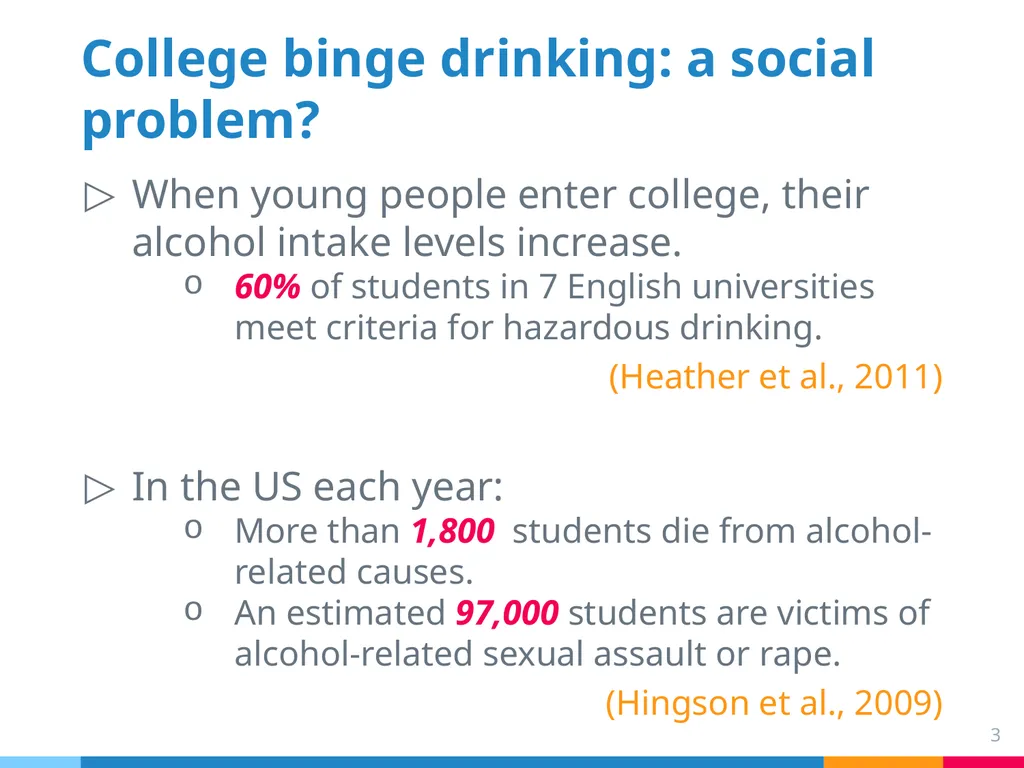
College binge drinking: a social problem? 3 When young people enter college, their alcohol intake levels increase.
60% of students in 7 English universities meet criteria for hazardous drinking.
(Heather et al., 2011)
In the US each year:
More than 1,800 students die from alcohol-related causes.
An estimated 97,000 students are victims of alcohol-related sexual assault or rape.
(Hingson et al., 2009)<br>
60% of students in 7 English universities meet criteria for hazardous drinking.
(Heather et al., 2011)
In the US each year:
More than 1,800 students die from alcohol-related causes.
An estimated 97,000 students are victims of alcohol-related sexual assault or rape.
(Hingson et al., 2009)<br>
04
How would you explain the fact that binge drinking is common among university students? 4 Thinking like a Sociologist<br>
05
What are social norms? 5<br>
06
What are social norms? 6 Social norms are ubiquitous in social life
'do not arrive late for an appointment'
'you must not swear'
'do not jump the line at the register'
‘do the dishes every day’
‘don’t interrupt someone when he is speaking’
‘don’t steal’
No consensus about the definition of social norms<br>
'do not arrive late for an appointment'
'you must not swear'
'do not jump the line at the register'
‘do the dishes every day’
‘don’t interrupt someone when he is speaking’
‘don’t steal’
No consensus about the definition of social norms<br>
07
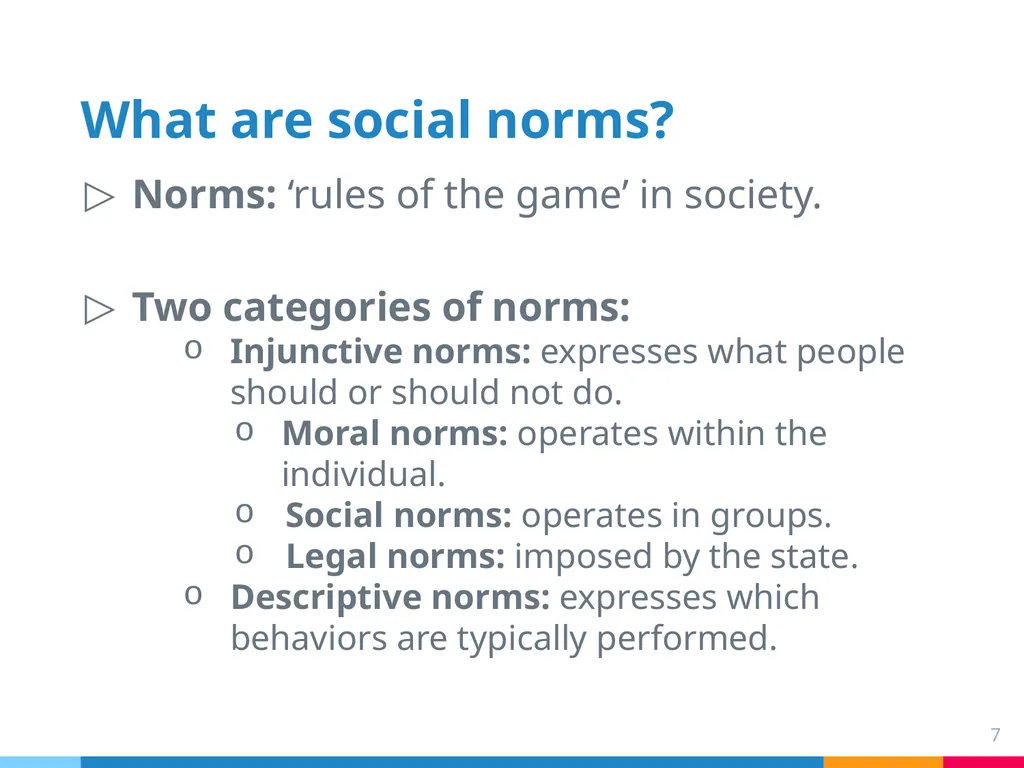
What are social norms? 7 Norms: ‘rules of the game’ in society.
Two categories of norms:
Injunctive norms: expresses what people should or should not do.
Moral norms: operates within the individual.
Social norms: operates in groups.
Legal norms: imposed by the state.
Descriptive norms: expresses which behaviors are typically performed.<br>
Two categories of norms:
Injunctive norms: expresses what people should or should not do.
Moral norms: operates within the individual.
Social norms: operates in groups.
Legal norms: imposed by the state.
Descriptive norms: expresses which behaviors are typically performed.<br>
08
What are social norms? 8<br>
09
Social control theory 9<br>
10
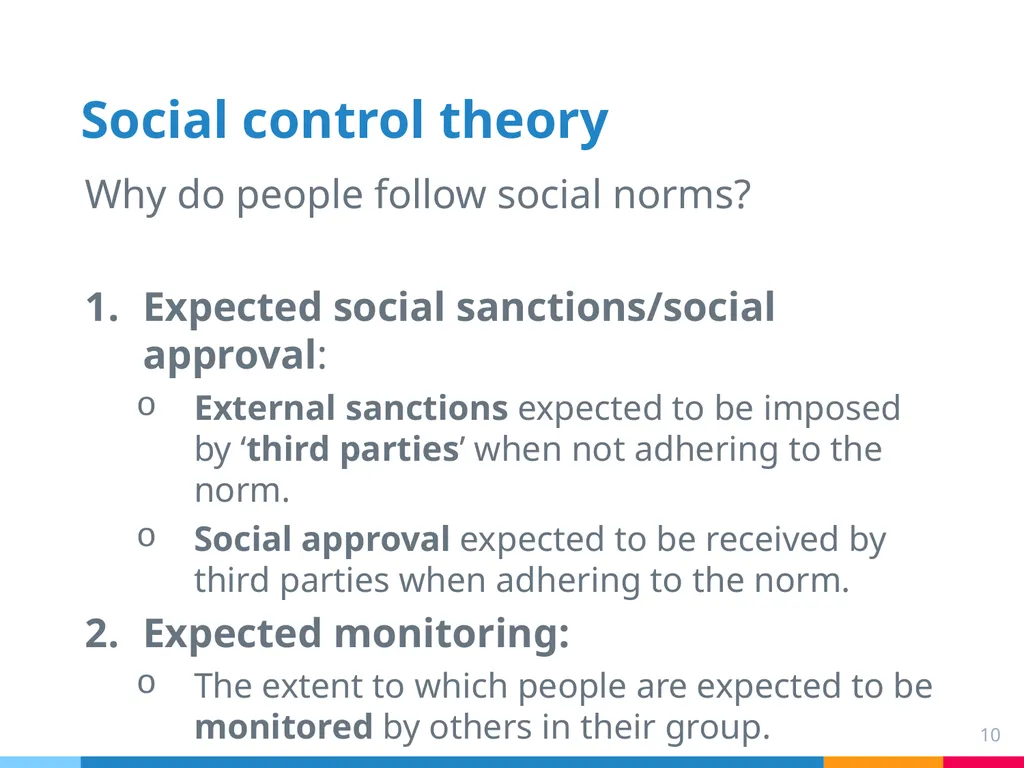
Social control theory 10 Why do people follow social norms?
Expected social sanctions/social approval:
External sanctions expected to be imposed by ‘third parties’ when not adhering to the norm.
Social approval expected to be received by third parties when adhering to the norm.
Expected monitoring:
The extent to which people are expected to be monitored by others in their group.<br>
Expected social sanctions/social approval:
External sanctions expected to be imposed by ‘third parties’ when not adhering to the norm.
Social approval expected to be received by third parties when adhering to the norm.
Expected monitoring:
The extent to which people are expected to be monitored by others in their group.<br>
11
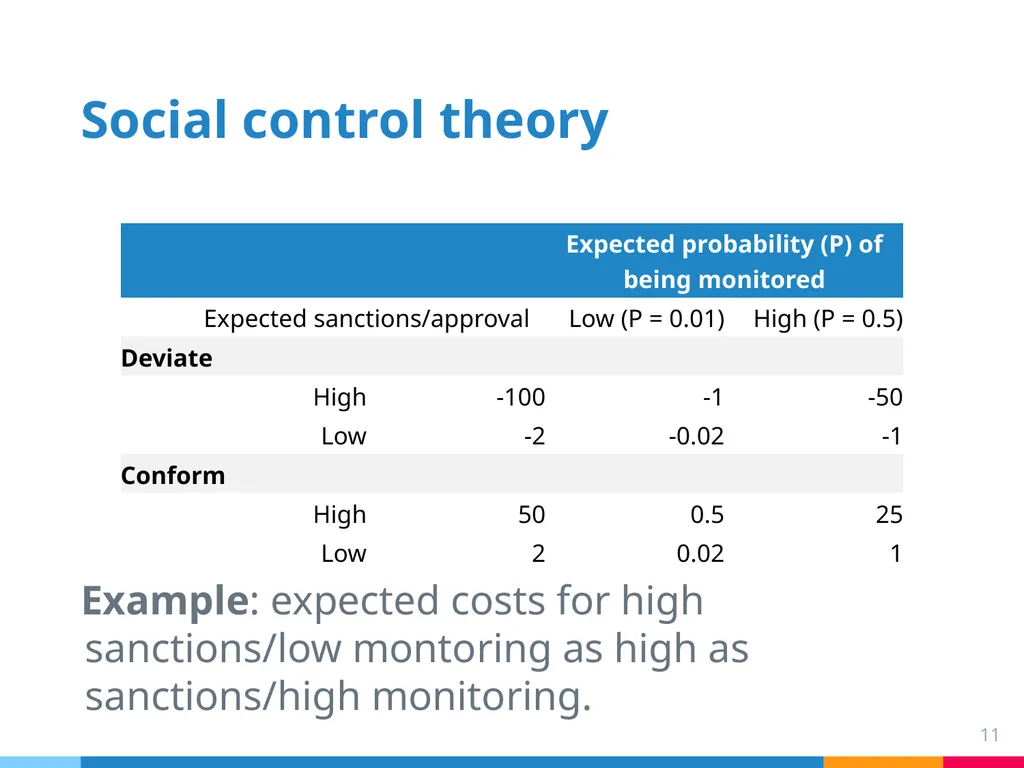
Social control theory 11 Example: expected costs for high sanctions/low montoring as high as sanctions/high monitoring.<br>
12
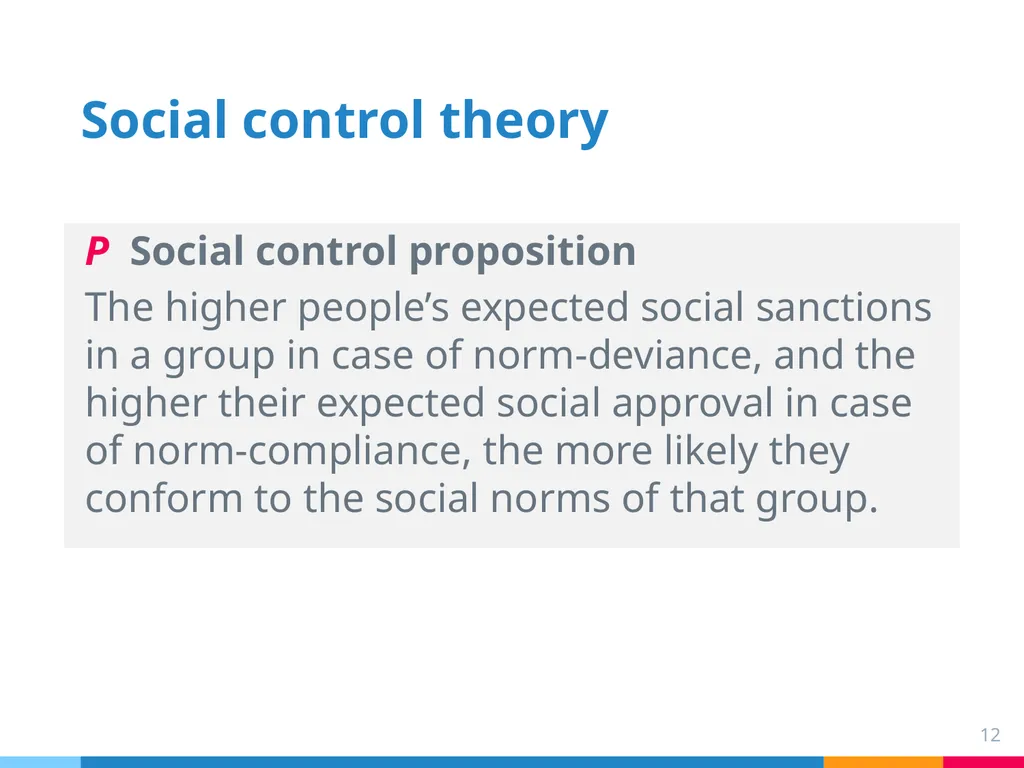
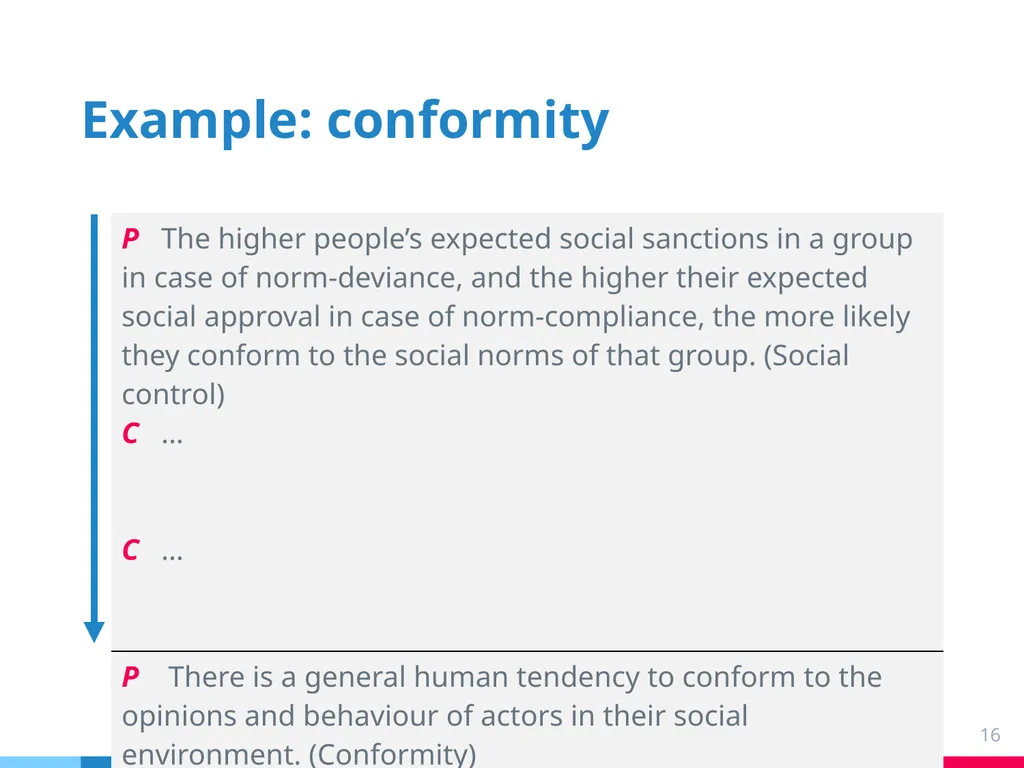
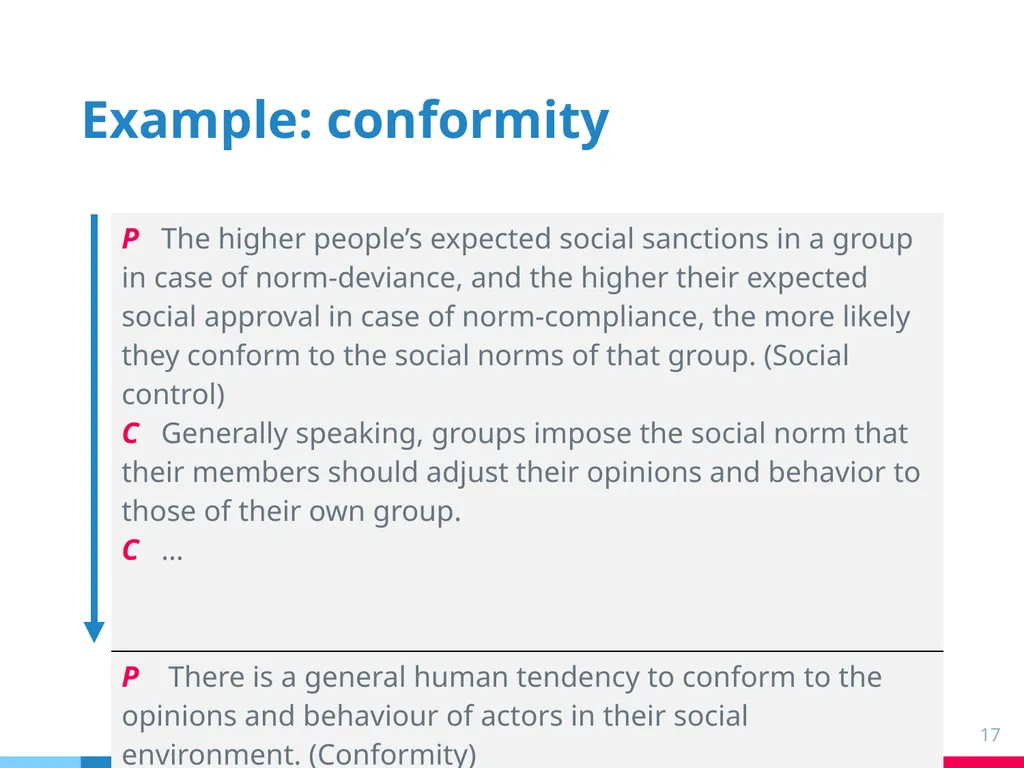
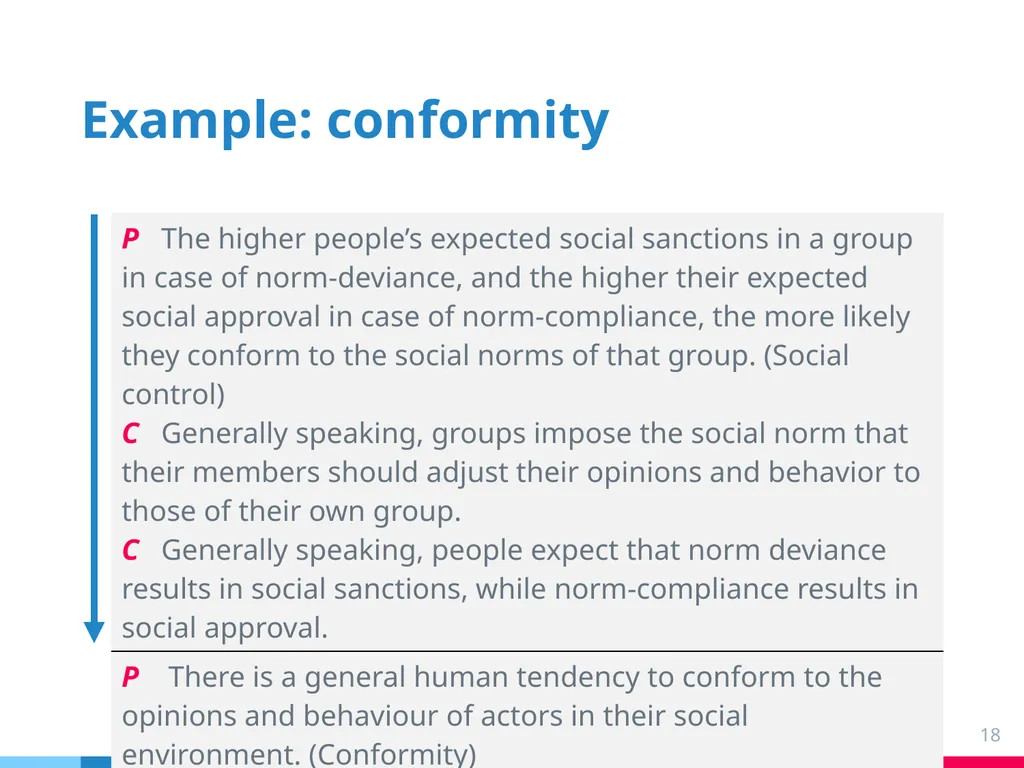
Social control theory 12 P Social control proposition
The higher people’s expected social sanctions in a group in case of norm-deviance, and the higher their expected social approval in case of norm-compliance, the more likely they conform to the social norms of that group.<br>
The higher people’s expected social sanctions in a group in case of norm-deviance, and the higher their expected social approval in case of norm-compliance, the more likely they conform to the social norms of that group.<br>
13
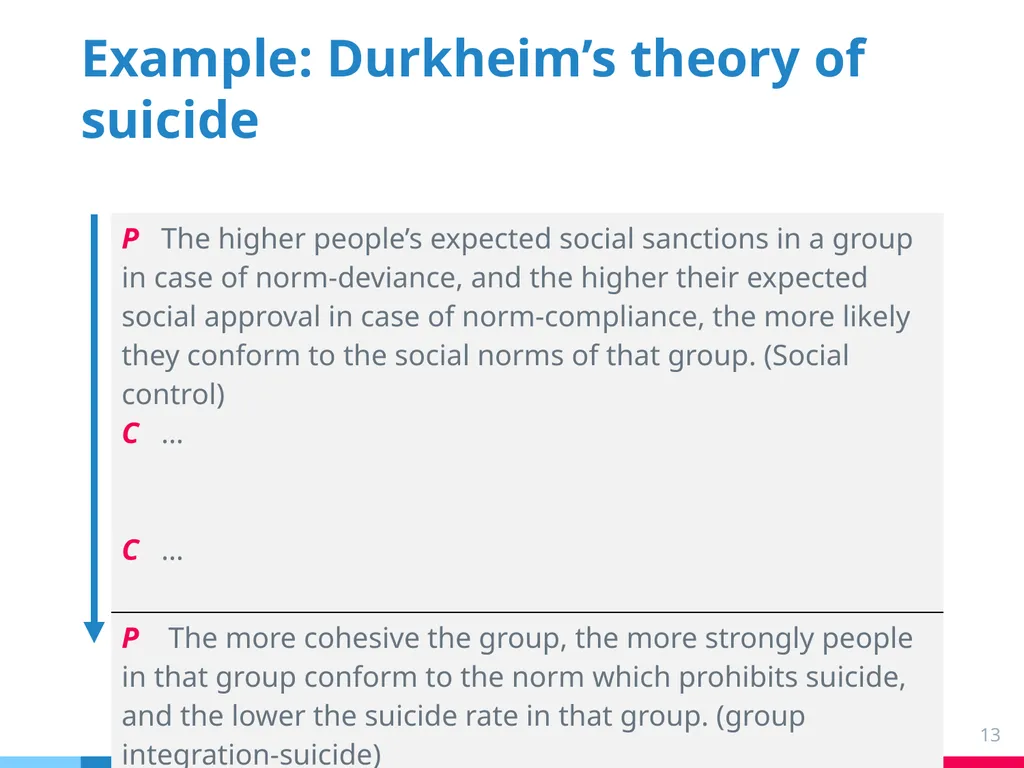
Example: Durkheim’s theory of suicide 13<br>
14
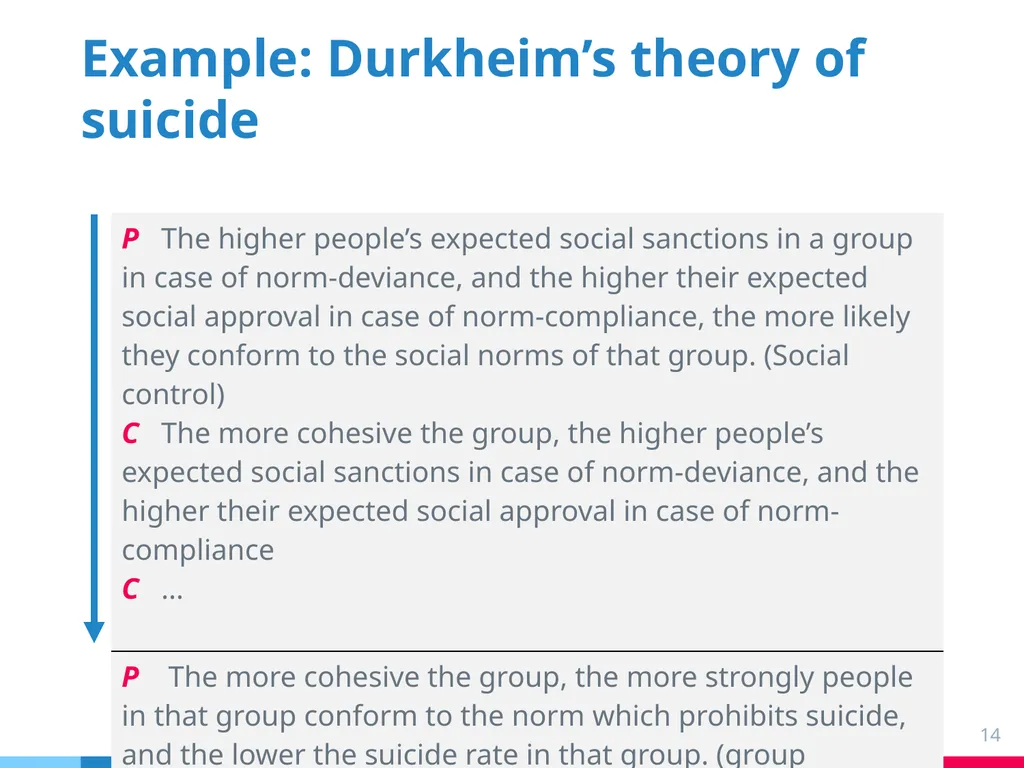
Example: Durkheim’s theory of suicide 14<br>
15
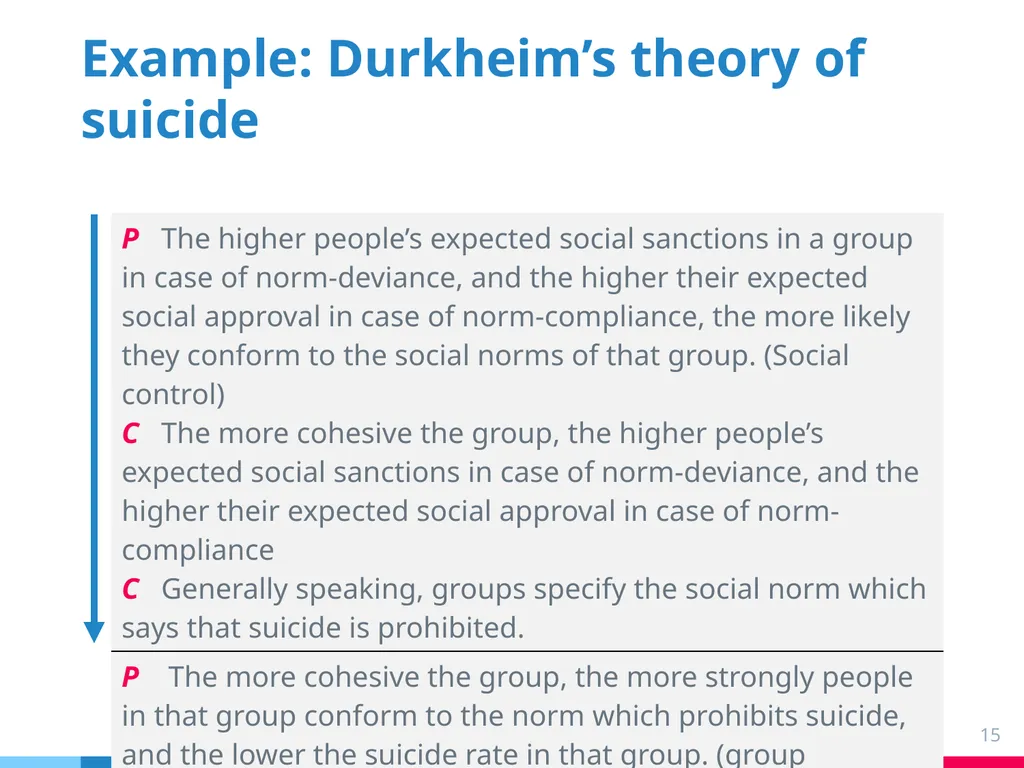
Example: Durkheim’s theory of suicide 15<br>
16
Example: conformity 16<br>
17
Example: conformity 17<br>
18
Example: conformity 18<br>
19
Internalized norms 19<br>
20
Internalized norms 20 People sometimes (though not always) comply to the social norms of their group, even in the absence of any social control.
Sociological puzzle
Why do people stick to social norms when they could deviate from that norm without risk and thus do whatever they prefer to do?<br>
Sociological puzzle
Why do people stick to social norms when they could deviate from that norm without risk and thus do whatever they prefer to do?<br>
21
Why would you think this happens? 21 Thinking like a sociologist<br>
22
Internalized norms 22 Internalized norms (moral norms): When people are repeatedly exposed to a social norm, it becomes part of people’s intrinsic set of prescribed set of things one ‘should’ do.
Can also become part of one’s personal preferences and values.
Internal sanctions: when people deviate from an internalized norm, they ‘sanction’ themselves, by feeling guilty or shame.<br>
Can also become part of one’s personal preferences and values.
Internal sanctions: when people deviate from an internalized norm, they ‘sanction’ themselves, by feeling guilty or shame.<br>
23
Internalized norms 23 Habitus: behavioral dispositions that remain largely unconscious and which impact behaviour in an automatic way.
What you are inclined to do automatically, is therefore your habitus.
(Bourdieu, 1984)<br>
What you are inclined to do automatically, is therefore your habitus.
(Bourdieu, 1984)<br>
24
Legal norms 24<br>
25
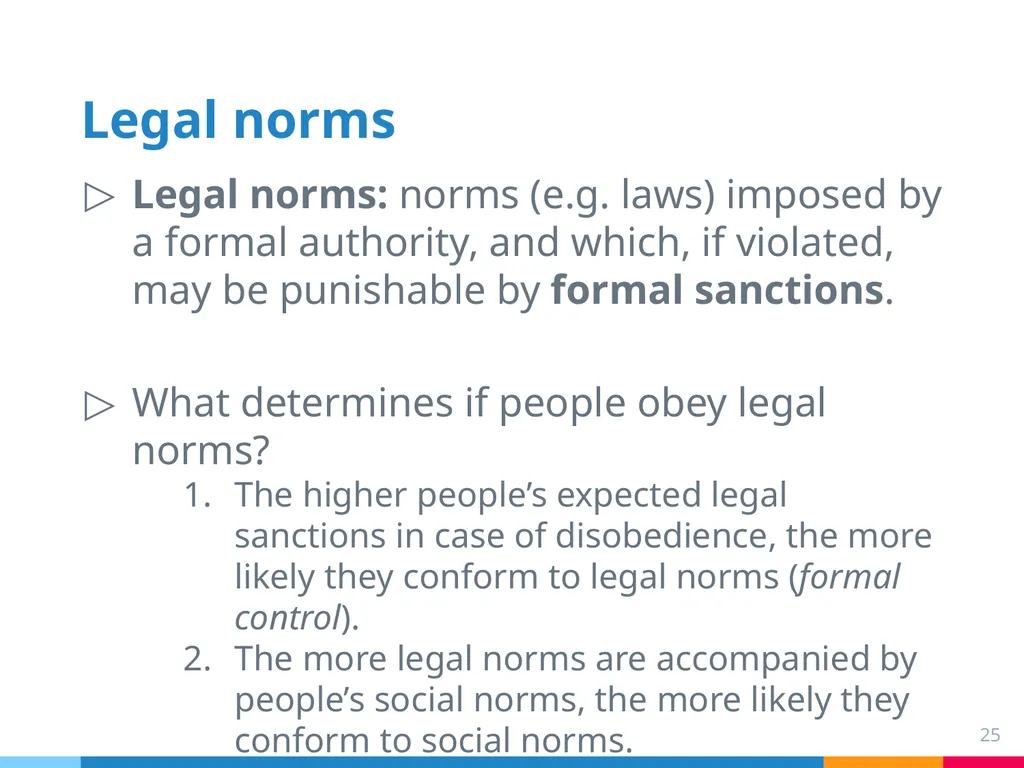
Legal norms 25 Legal norms: norms (e.g. laws) imposed by a formal authority, and which, if violated, may be punishable by formal sanctions.
What determines if people obey legal norms?
The higher people’s expected legal sanctions in case of disobedience, the more likely they conform to legal norms (formal control).
The more legal norms are accompanied by people’s social norms, the more likely they conform to social norms.<br>
What determines if people obey legal norms?
The higher people’s expected legal sanctions in case of disobedience, the more likely they conform to legal norms (formal control).
The more legal norms are accompanied by people’s social norms, the more likely they conform to social norms.<br>
26
Why do norms emerge? 26<br>
27
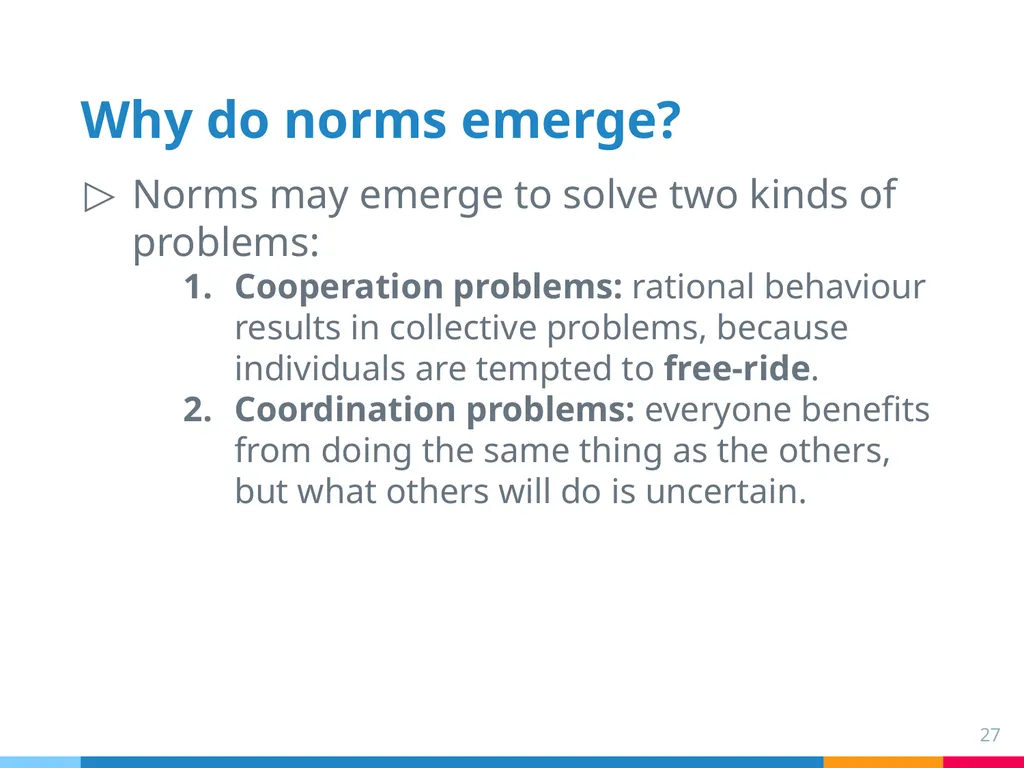
Norms may emerge to solve two kinds of problems:
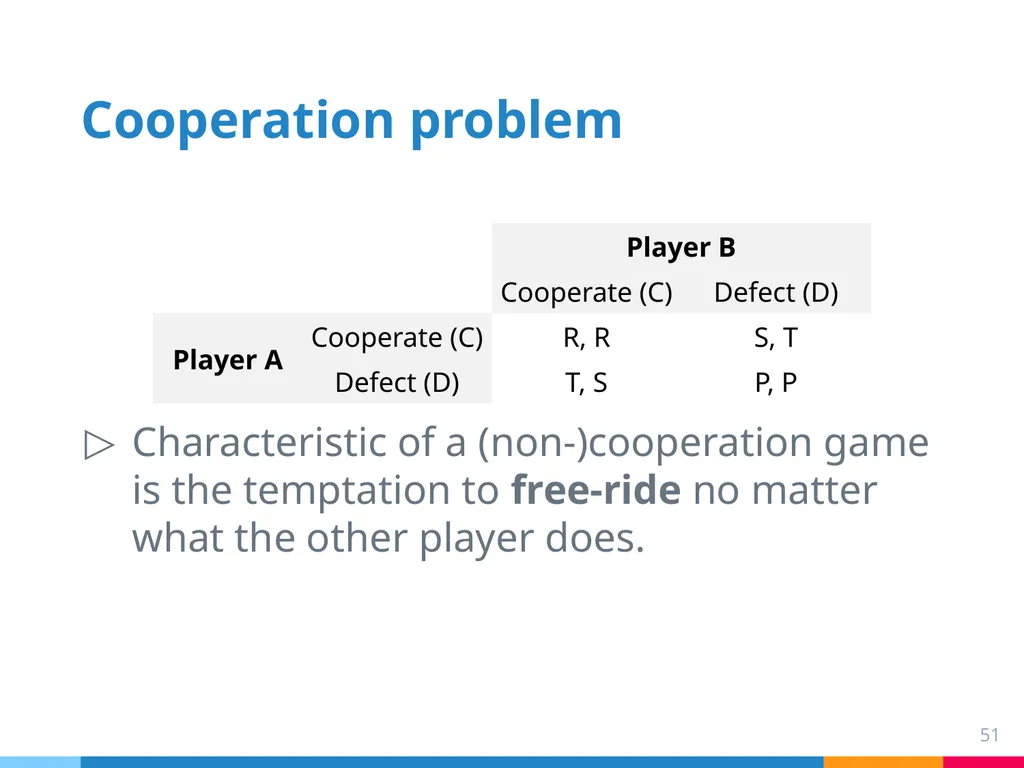
Cooperation problems: rational behaviour results in collective problems, because individuals are tempted to free-ride.
Coordination problems: everyone benefits from doing the same thing as the others, but what others will do is uncertain. Why do norms emerge? 27<br>
Cooperation problems: rational behaviour results in collective problems, because individuals are tempted to free-ride.
Coordination problems: everyone benefits from doing the same thing as the others, but what others will do is uncertain. Why do norms emerge? 27<br>
28
‘Always relax’ is the dominant strategy: a strategy that is favorable to choose irrespective of what the other student will do.
As the other student will act in the same way, the collective outcome is not the most desirable collective outcome. Cooperation problem 28<br>
As the other student will act in the same way, the collective outcome is not the most desirable collective outcome. Cooperation problem 28<br>
29
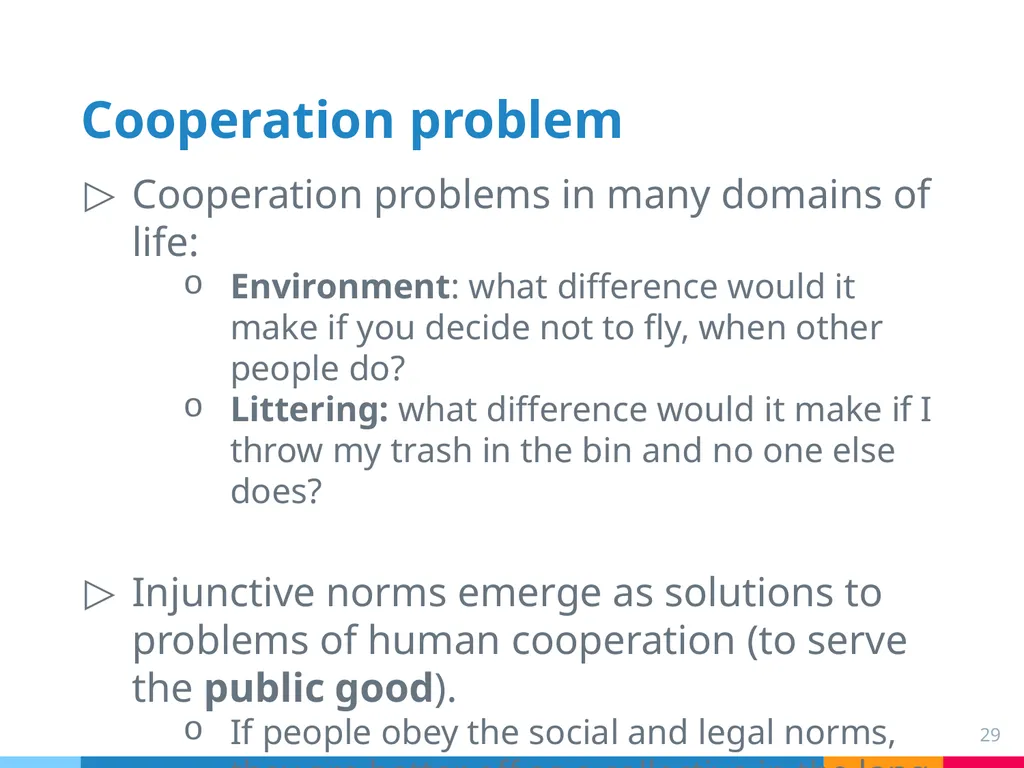
Cooperation problem 29 Cooperation problems in many domains of life:
Environment: what difference would it make if you decide not to fly, when other people do?
Littering: what difference would it make if I throw my trash in the bin and no one else does?
Injunctive norms emerge as solutions to problems of human cooperation (to serve the public good).
If people obey the social and legal norms, they are better off as a collective in the long run.<br>
Environment: what difference would it make if you decide not to fly, when other people do?
Littering: what difference would it make if I throw my trash in the bin and no one else does?
Injunctive norms emerge as solutions to problems of human cooperation (to serve the public good).
If people obey the social and legal norms, they are better off as a collective in the long run.<br>
30
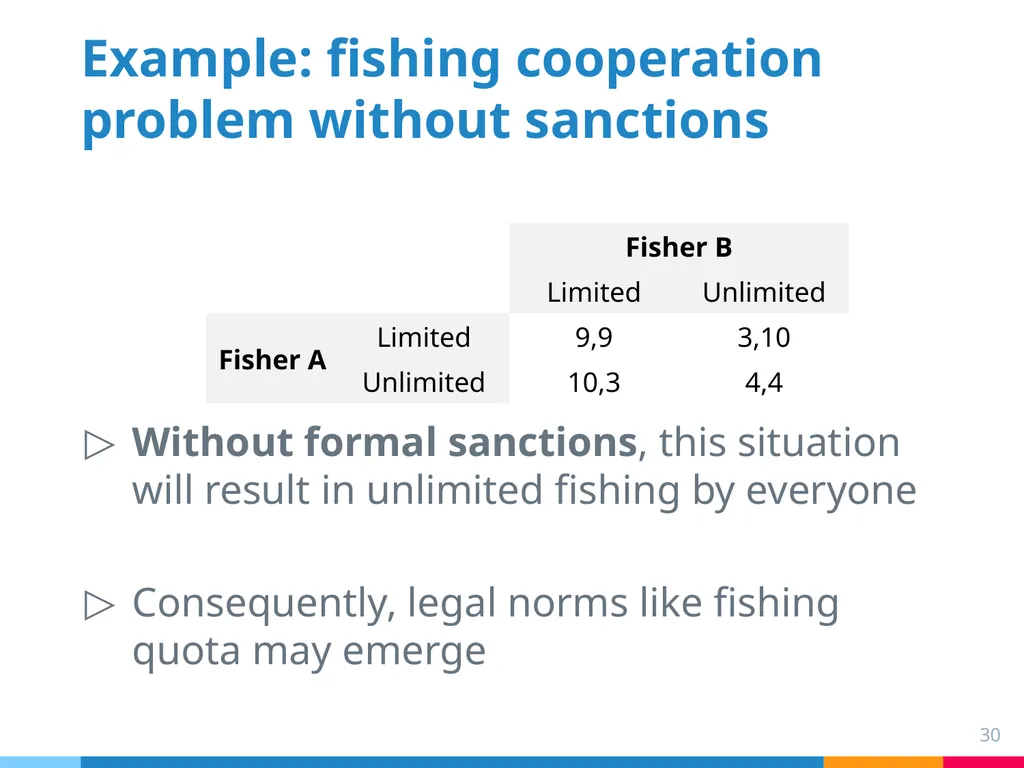
Without formal sanctions, this situation will result in unlimited fishing by everyone
Consequently, legal norms like fishing quota may emerge Example: fishing cooperation problem without sanctions 30<br>
Consequently, legal norms like fishing quota may emerge Example: fishing cooperation problem without sanctions 30<br>
31
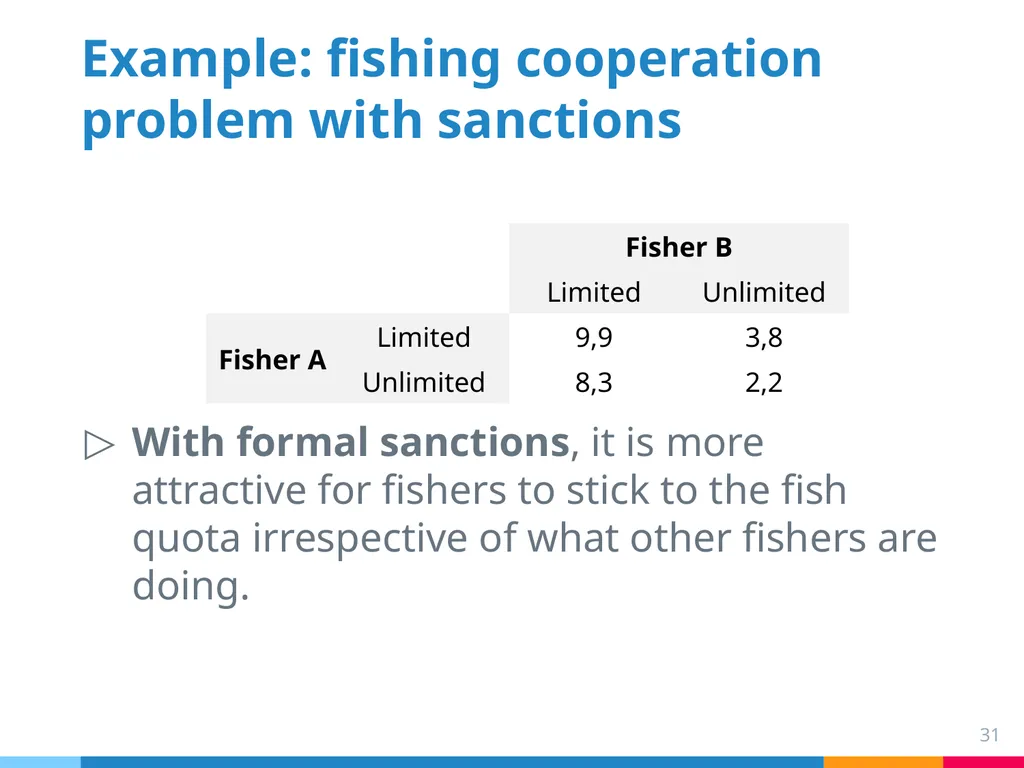
With formal sanctions, it is more attractive for fishers to stick to the fish quota irrespective of what other fishers are doing. Example: fishing cooperation problem with sanctions 31<br>
32
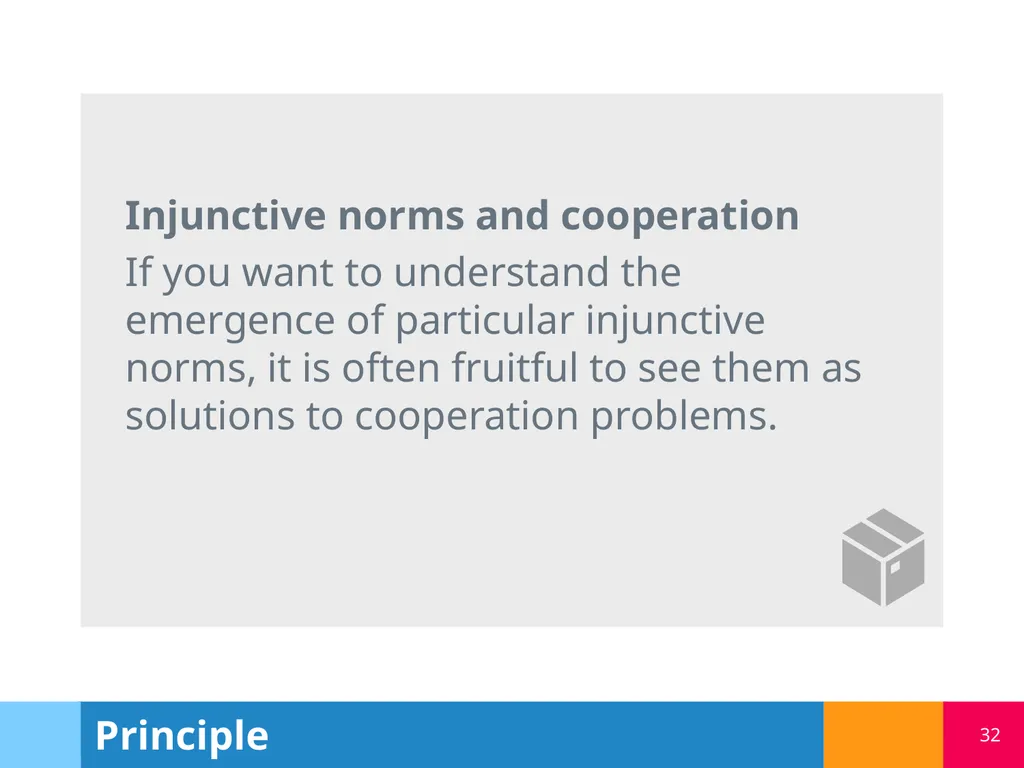
Injunctive norms and cooperation
If you want to understand the emergence of particular injunctive norms, it is often fruitful to see them as solutions to cooperation problems. 32 Principle<br>
If you want to understand the emergence of particular injunctive norms, it is often fruitful to see them as solutions to cooperation problems. 32 Principle<br>
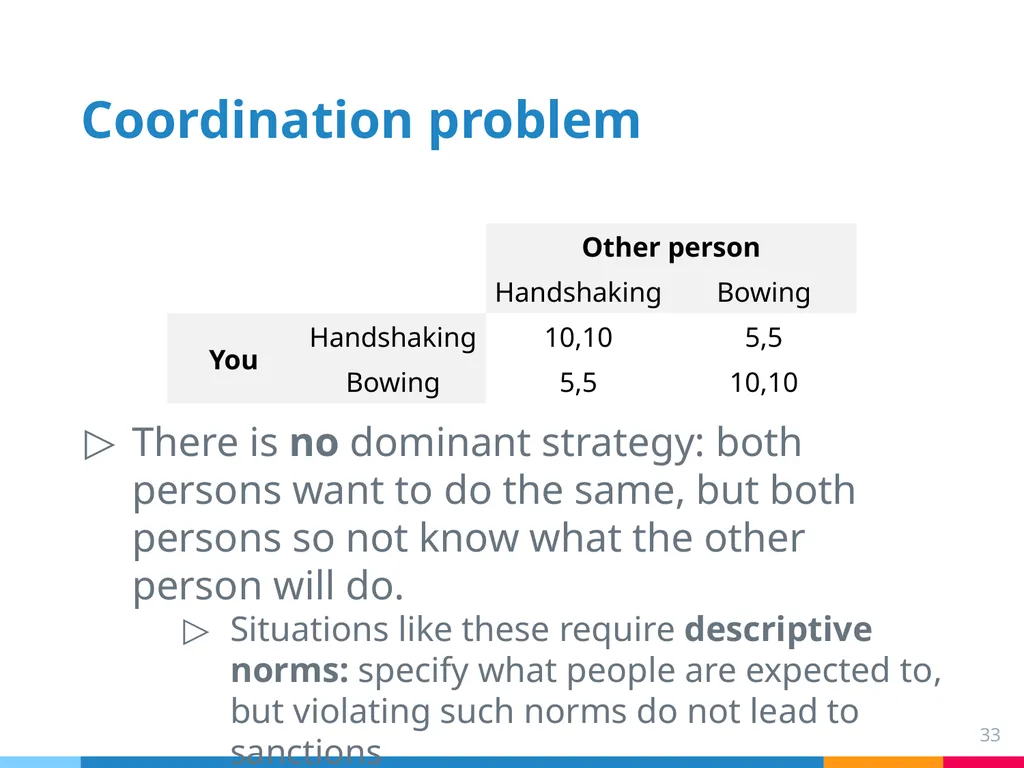
33
There is no dominant strategy: both persons want to do the same, but both persons so not know what the other person will do.
Situations like these require descriptive norms: specify what people are expected to, but violating such norms do not lead to sanctions Coordination problem 33<br>
Situations like these require descriptive norms: specify what people are expected to, but violating such norms do not lead to sanctions Coordination problem 33<br>
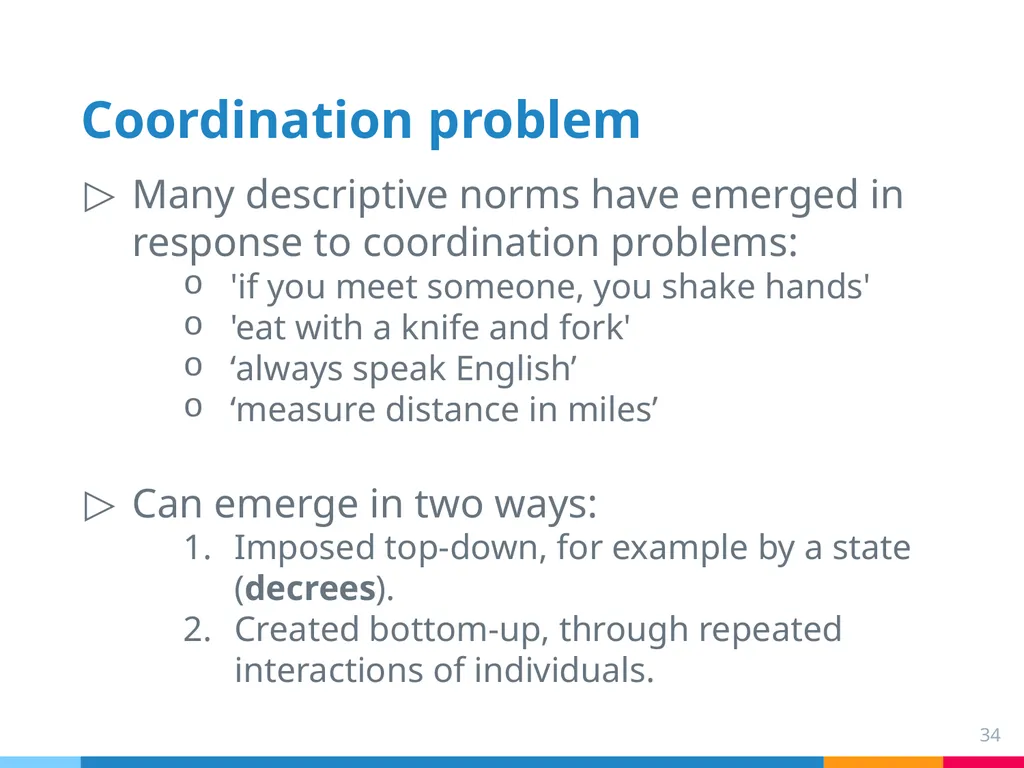
34
Coordination problem 34 Many descriptive norms have emerged in response to coordination problems:
'if you meet someone, you shake hands'
'eat with a knife and fork'
‘always speak English’
‘measure distance in miles’
Can emerge in two ways:
Imposed top-down, for example by a state (decrees).
Created bottom-up, through repeated interactions of individuals.<br>
'if you meet someone, you shake hands'
'eat with a knife and fork'
‘always speak English’
‘measure distance in miles’
Can emerge in two ways:
Imposed top-down, for example by a state (decrees).
Created bottom-up, through repeated interactions of individuals.<br>
35
Descriptive norms and coordination
If you want to understand the emergence of particular descriptive norms, it is often fruitful to see them as solutions to coordination problems. 35<br>
If you want to understand the emergence of particular descriptive norms, it is often fruitful to see them as solutions to coordination problems. 35<br>
36
Cultural maladaptation and norm change 36<br>
37
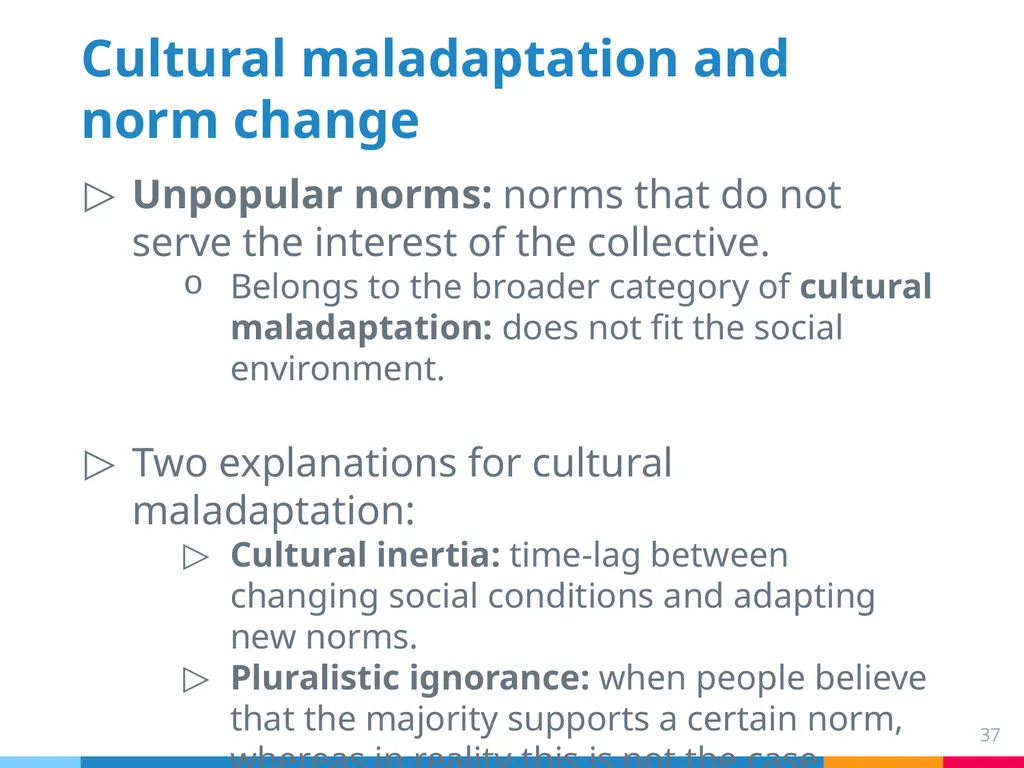
Cultural maladaptation and norm change 37 Unpopular norms: norms that do not serve the interest of the collective.
Belongs to the broader category of cultural maladaptation: does not fit the social environment.
Two explanations for cultural maladaptation:
Cultural inertia: time-lag between changing social conditions and adapting new norms.
Pluralistic ignorance: when people believe that the majority supports a certain norm, whereas in reality this is not the case.<br>
Belongs to the broader category of cultural maladaptation: does not fit the social environment.
Two explanations for cultural maladaptation:
Cultural inertia: time-lag between changing social conditions and adapting new norms.
Pluralistic ignorance: when people believe that the majority supports a certain norm, whereas in reality this is not the case.<br>
38
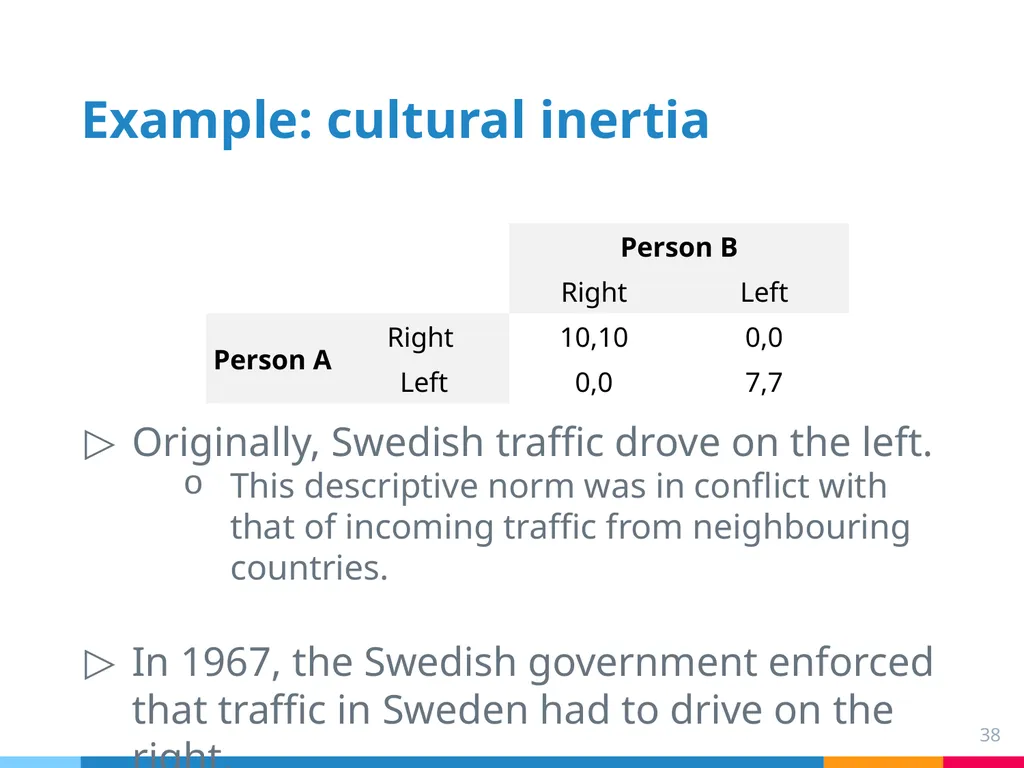
Example: cultural inertia 38 Originally, Swedish traffic drove on the left.
This descriptive norm was in conflict with that of incoming traffic from neighbouring countries.
In 1967, the Swedish government enforced that traffic in Sweden had to drive on the right.<br>
This descriptive norm was in conflict with that of incoming traffic from neighbouring countries.
In 1967, the Swedish government enforced that traffic in Sweden had to drive on the right.<br>
39
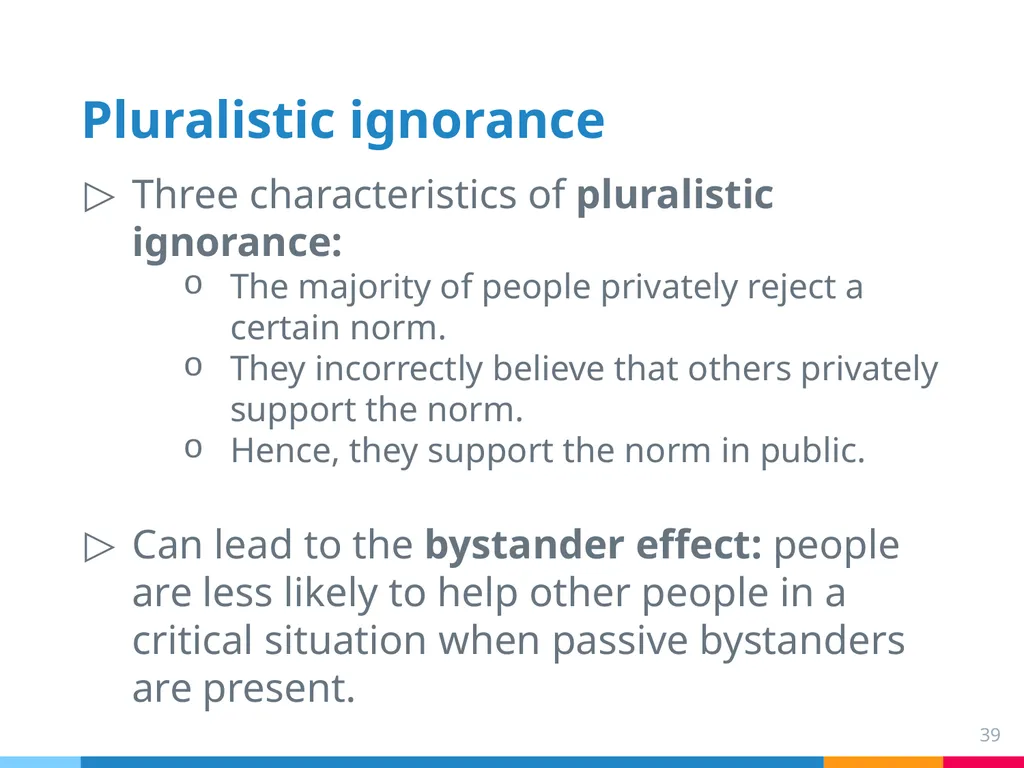
Pluralistic ignorance 39 Three characteristics of pluralistic ignorance:
The majority of people privately reject a certain norm.
They incorrectly believe that others privately support the norm.
Hence, they support the norm in public.
Can lead to the bystander effect: people are less likely to help other people in a critical situation when passive bystanders are present.
(Darley & Latane, 1968)<br>
The majority of people privately reject a certain norm.
They incorrectly believe that others privately support the norm.
Hence, they support the norm in public.
Can lead to the bystander effect: people are less likely to help other people in a critical situation when passive bystanders are present.
(Darley & Latane, 1968)<br>
40
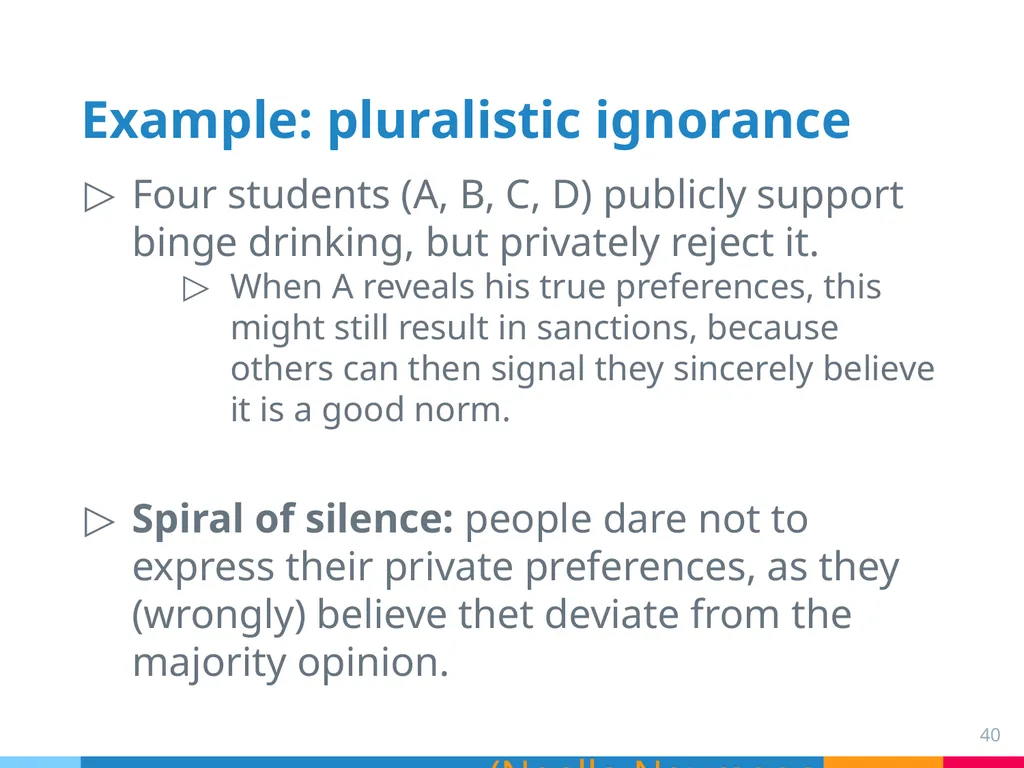
Example: pluralistic ignorance 40 Four students (A, B, C, D) publicly support binge drinking, but privately reject it.
When A reveals his true preferences, this might still result in sanctions, because others can then signal they sincerely believe it is a good norm.
Spiral of silence: people dare not to express their private preferences, as they (wrongly) believe thet deviate from the majority opinion.
(Noelle-Neumann, 1993)<br>
When A reveals his true preferences, this might still result in sanctions, because others can then signal they sincerely believe it is a good norm.
Spiral of silence: people dare not to express their private preferences, as they (wrongly) believe thet deviate from the majority opinion.
(Noelle-Neumann, 1993)<br>
41
The dynamics of group distinction 41<br>
42
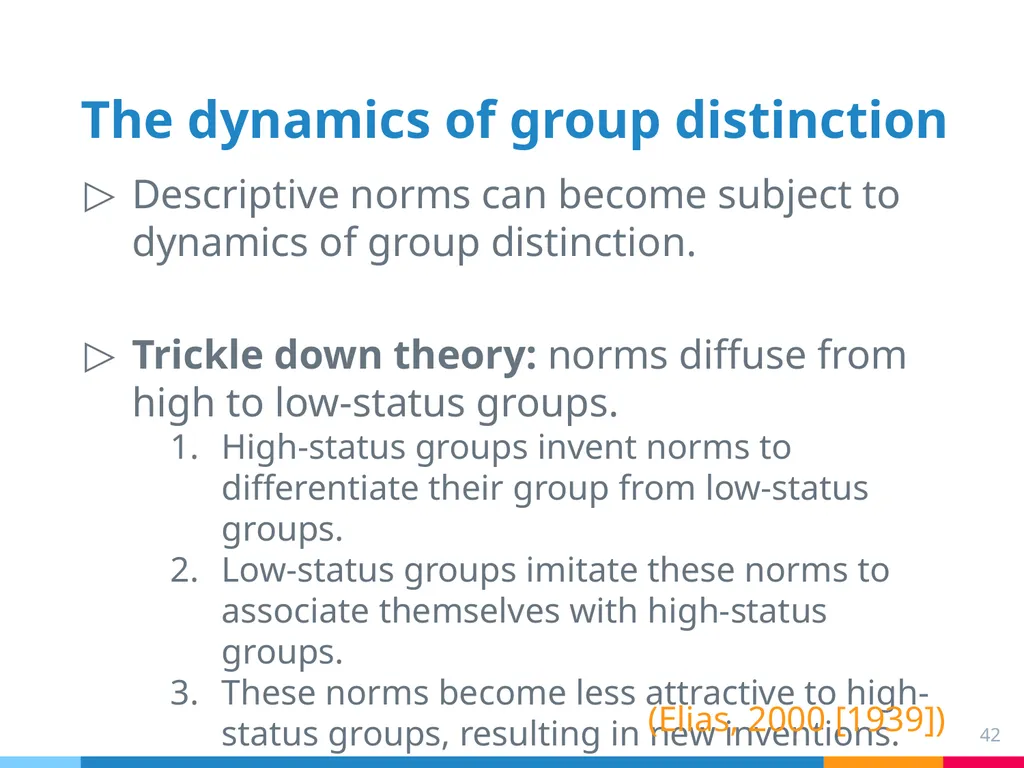
The dynamics of group distinction 42 Descriptive norms can become subject to dynamics of group distinction.
Trickle down theory: norms diffuse from high to low-status groups.
High-status groups invent norms to differentiate their group from low-status groups.
Low-status groups imitate these norms to associate themselves with high-status groups.
These norms become less attractive to high-status groups, resulting in new inventions. (Elias, 2000 [1939])<br>
Trickle down theory: norms diffuse from high to low-status groups.
High-status groups invent norms to differentiate their group from low-status groups.
Low-status groups imitate these norms to associate themselves with high-status groups.
These norms become less attractive to high-status groups, resulting in new inventions. (Elias, 2000 [1939])<br>
43
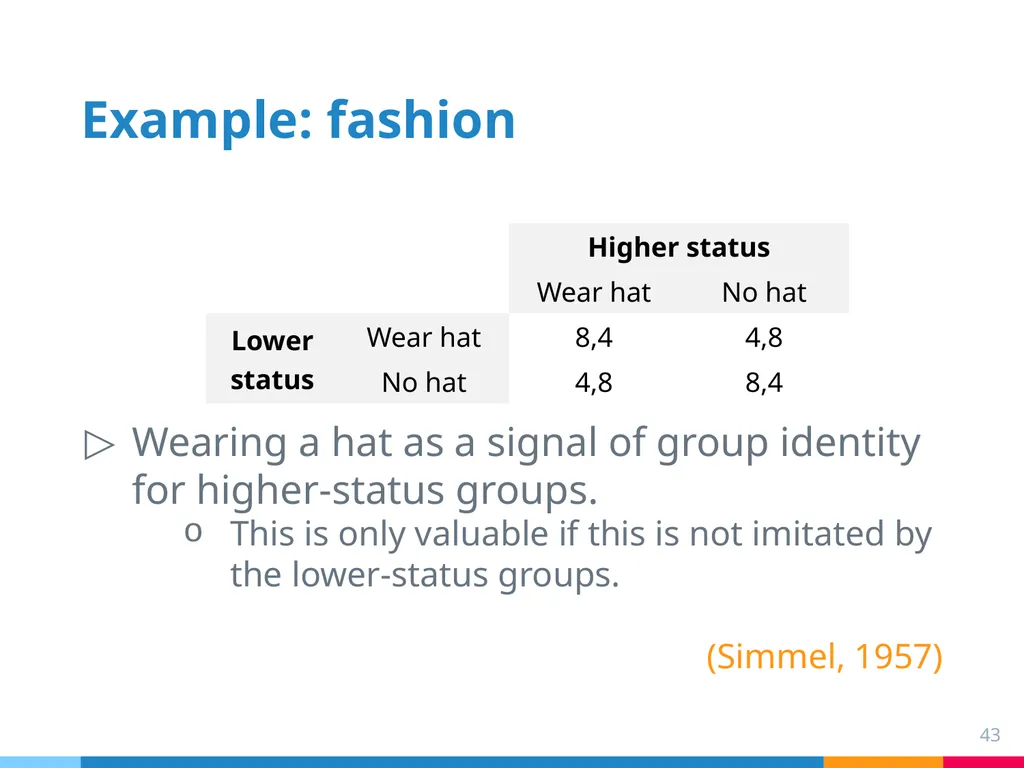
Example: fashion 43 Wearing a hat as a signal of group identity for higher-status groups.
This is only valuable if this is not imitated by the lower-status groups.
(Simmel, 1957)<br>
This is only valuable if this is not imitated by the lower-status groups.
(Simmel, 1957)<br>
44
Online appendix: using game theory to understand norms 44<br>
45
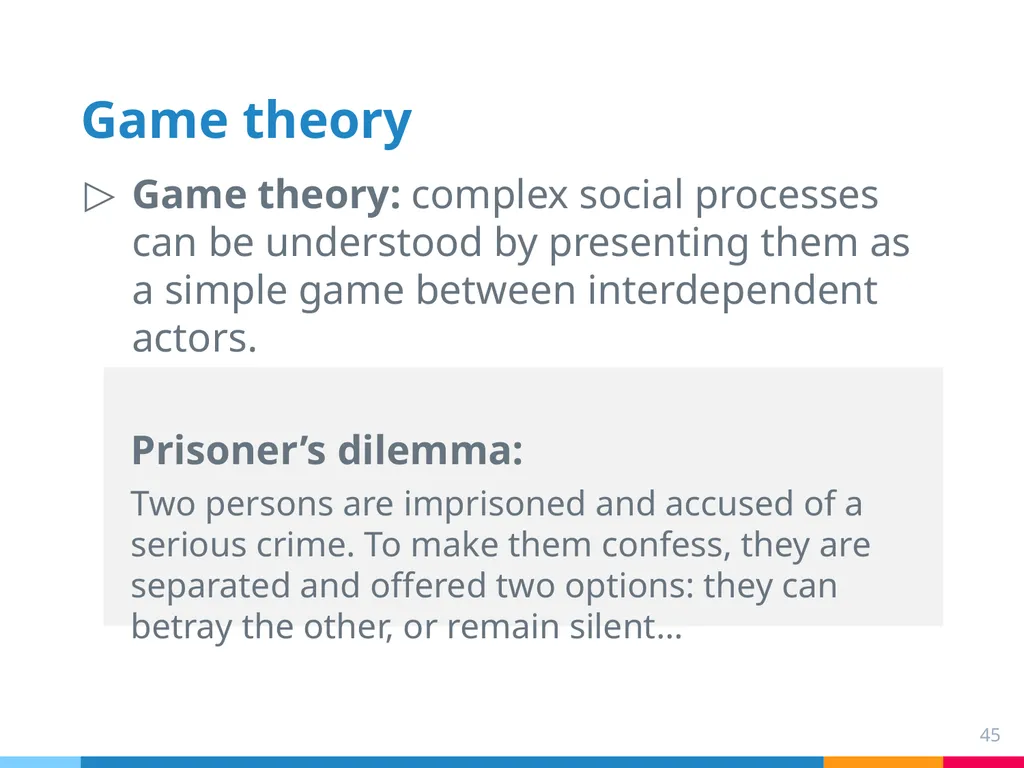
Game theory: complex social processes can be understood by presenting them as a simple game between interdependent actors.
Prisoner’s dilemma:
Two persons are imprisoned and accused of a serious crime. To make them confess, they are separated and offered two options: they can betray the other, or remain silent… Game theory 45<br>
Prisoner’s dilemma:
Two persons are imprisoned and accused of a serious crime. To make them confess, they are separated and offered two options: they can betray the other, or remain silent… Game theory 45<br>
46
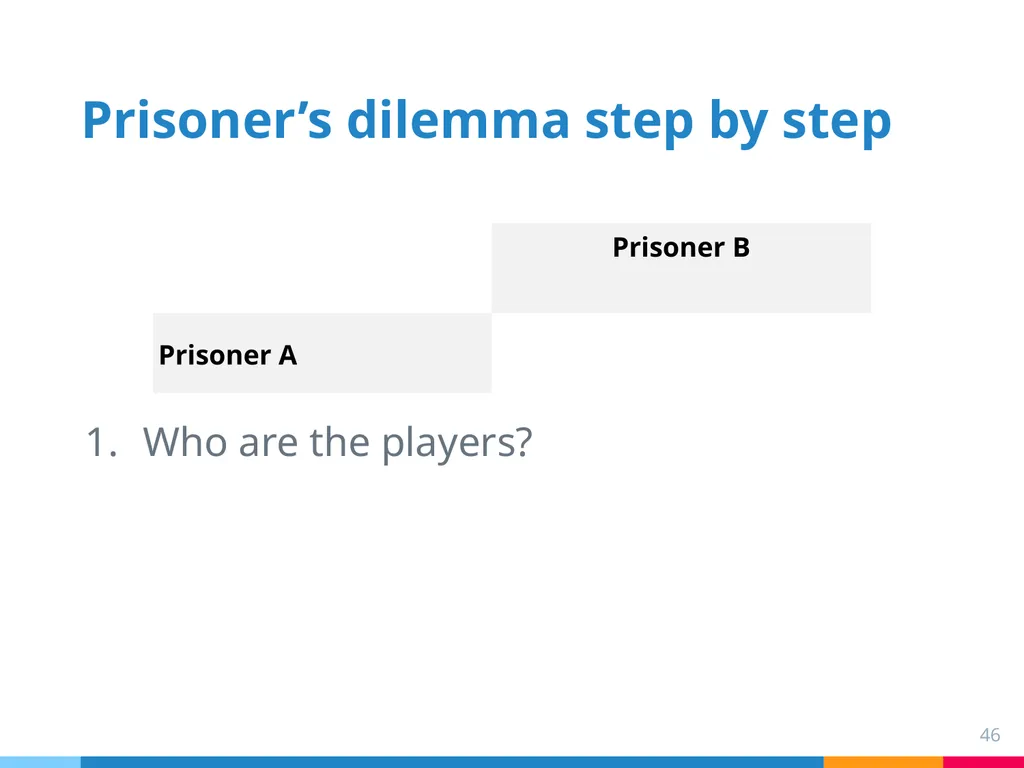
Prisoner’s dilemma step by step 46 Who are the players?<br>
47
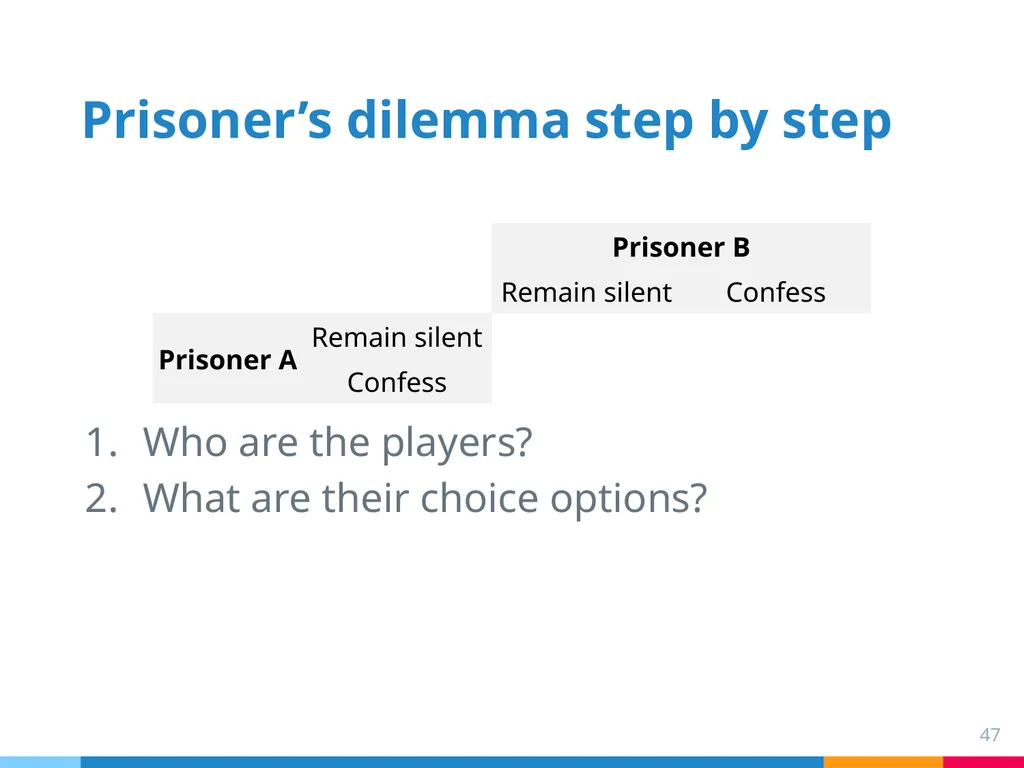
Prisoner’s dilemma step by step 47 Who are the players?
What are their choice options?<br>
What are their choice options?<br>
48
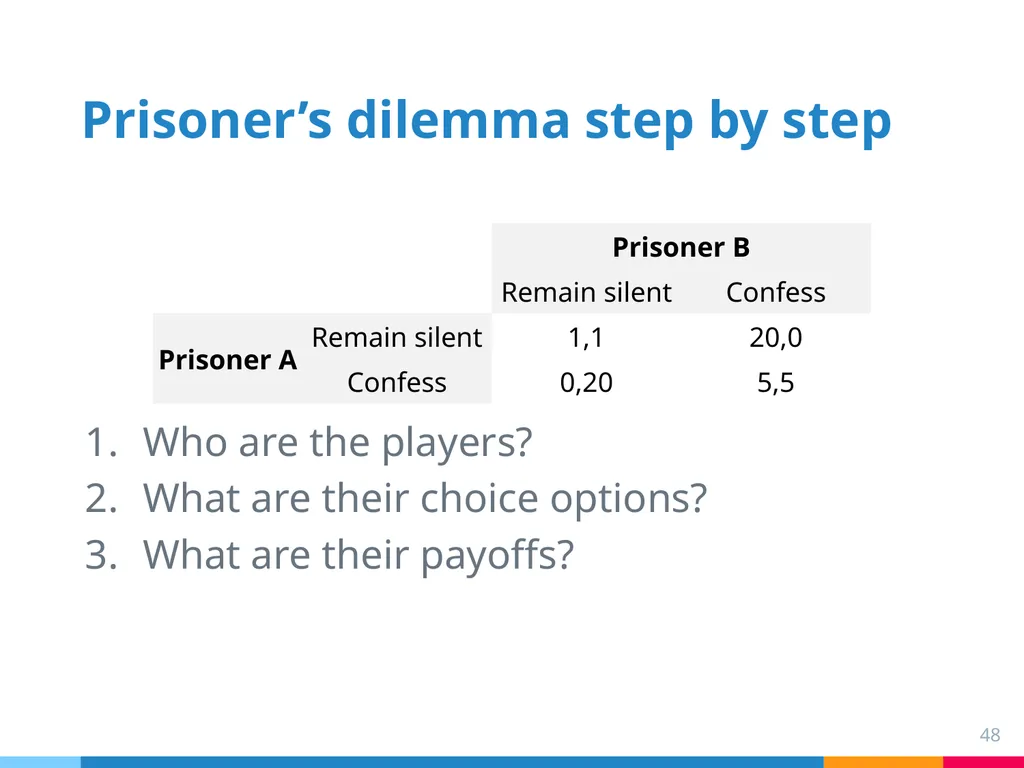
Prisoner’s dilemma step by step 48 Who are the players?
What are their choice options?
What are their payoffs?<br>
What are their choice options?
What are their payoffs?<br>
49
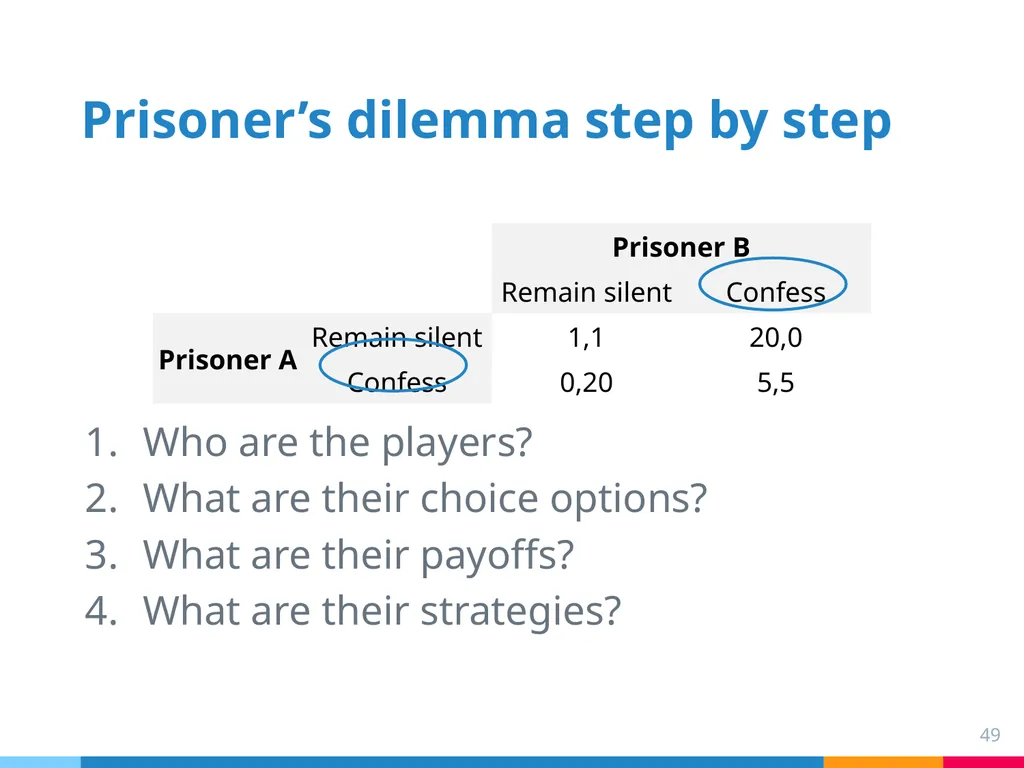
Prisoner’s dilemma step by step 49 Who are the players?
What are their choice options?
What are their payoffs?
What are their strategies?<br>
What are their choice options?
What are their payoffs?
What are their strategies?<br>
50
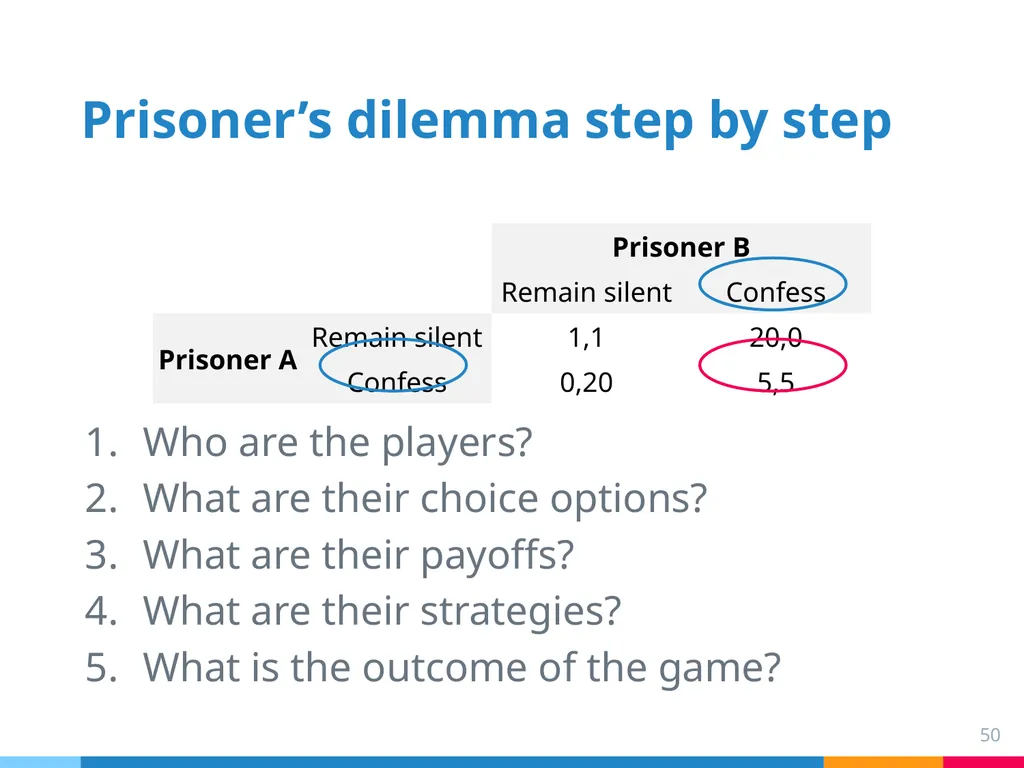
Prisoner’s dilemma step by step 50 Who are the players?
What are their choice options?
What are their payoffs?
What are their strategies?
What is the outcome of the game?<br>
What are their choice options?
What are their payoffs?
What are their strategies?
What is the outcome of the game?<br>
51
Cooperation problem 51 Characteristic of a (non-)cooperation game is the temptation to free-ride no matter what the other player does.<br>
52
Bourdieu, P. (1984). Distinction: A social critique of the judgement of taste. Cambridge, MA: Harvard University Press.
Darley, J. M., & Latane, B. (1968). Bystander intervention in emergencies: Diffusion of responsibility. Journal of Personality and Social Psychology, 8(4, Pt.1), 377-383.
Elias, N. (2000 [1939]). The civilizing process: Sociogenetic and psychogenetic investigations (2nd ed.). Oxford, United Kingdom: Blackwell Publishers
Heather, N., Partington, S., Partington, E., Longstaff, F., Allsop, S., Jankowski, M., . . . St Clair Gibson, A. (2011). Alcohol use disorders and hazardous drinking among undergraduates at english universities. Alcohol and Alcoholism, 46(3), 270-277. References 52<br>
Darley, J. M., & Latane, B. (1968). Bystander intervention in emergencies: Diffusion of responsibility. Journal of Personality and Social Psychology, 8(4, Pt.1), 377-383.
Elias, N. (2000 [1939]). The civilizing process: Sociogenetic and psychogenetic investigations (2nd ed.). Oxford, United Kingdom: Blackwell Publishers
Heather, N., Partington, S., Partington, E., Longstaff, F., Allsop, S., Jankowski, M., . . . St Clair Gibson, A. (2011). Alcohol use disorders and hazardous drinking among undergraduates at english universities. Alcohol and Alcoholism, 46(3), 270-277. References 52<br>
53
Hingson, R. W., Heeren, T., Zakocs, R. C., Kopstein, A., & Wechsler, H. (2002). Magnitude of alcohol-related mortality and morbidity among US college students ages 18-24. Journal of Studies on Alcohol, 63(2), 136-144.
Noelle-Neumann, E. (1993). The spiral of silence: Public opinion, our social skin (2nd ed.). Chicago, IL: University of Chicago Press.
Simmel, G. (1957). Fashion. American Journal of Sociology, 62(6), 541-558. References 53<br>
Noelle-Neumann, E. (1993). The spiral of silence: Public opinion, our social skin (2nd ed.). Chicago, IL: University of Chicago Press.
Simmel, G. (1957). Fashion. American Journal of Sociology, 62(6), 541-558. References 53<br>