
Chapter 7: Text Analytics, Text Mining, and


Description: Chapter 7: Text Analytics, Text Mining, and Sentiment Analysis Business Intelligence and Analytics: Systems for Decision Support (10th Edition) Learning Objectives Describe text mining and understand the need for text mining Differentiate
Related Topics
Download Presentation
"Chapter 7: Text Analytics, Text Mining, and" is the property of its rightful owner. Permission is granted to download and print the materials on this website for personal, non-commercial use only, and to display it on your personal computer provided you do not modify the materials and that you retain all copyright notices contained in the materials. By downloading content from our website, you accept the terms of this agreement.
Presentation Transcript
slide1. Chapter 7:
Text Analytics, Text Mining, and Sentiment Analysis Business Intelligence and Analytics: Systems for Decision Support
(10th Edition)<br>
slide2. Learning Objectives Describe text mining and understand the need for text mining
Differentiate between text mining, Web mining, and data mining
Understand the different application areas for text mining
Know the process of carrying out a text mining project
Understand the different methods to introduce structure to text-based data (Continued…)<br>
slide3. Learning Objectives Describe sentiment analysis
Develop familiarity with popular applications of sentiment analysis
Learn the common methods for sentiment analysis
Become familiar with speech analytics as it relates to sentiment analysis<br>
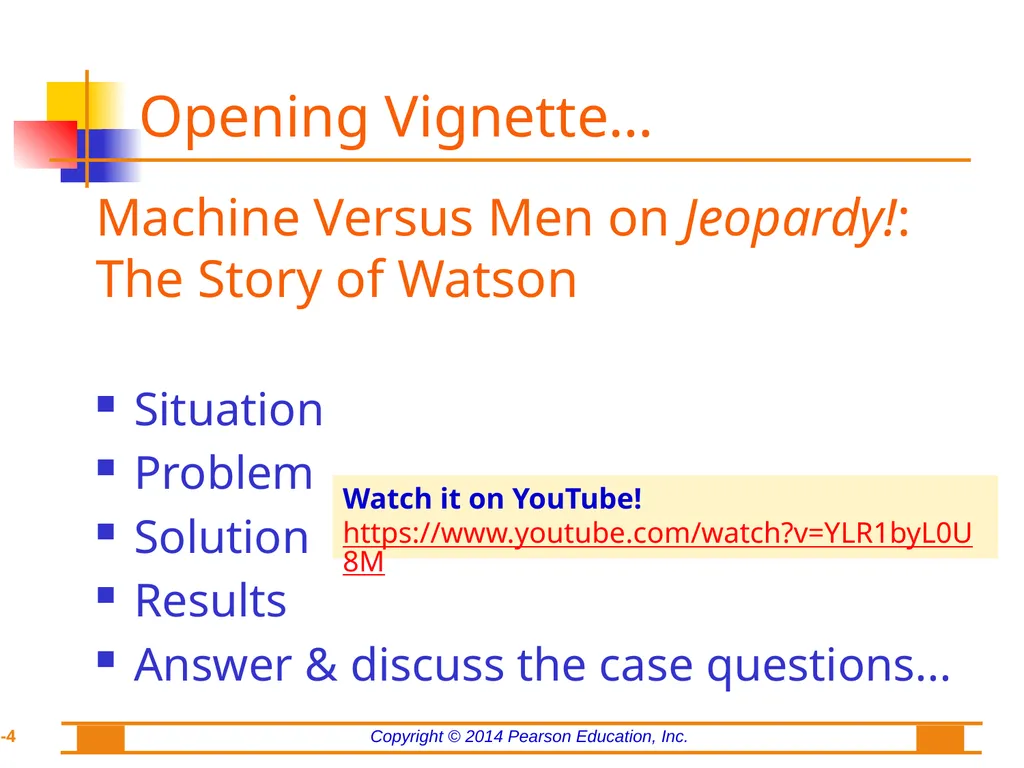
slide4. Opening Vignette… Machine Versus Men on Jeopardy!: The Story of Watson
Situation
Problem
Solution
Results
Answer & discuss the case questions... Watch it on YouTube!
https://www.youtube.com/watch?v=YLR1byL0U8M<br>
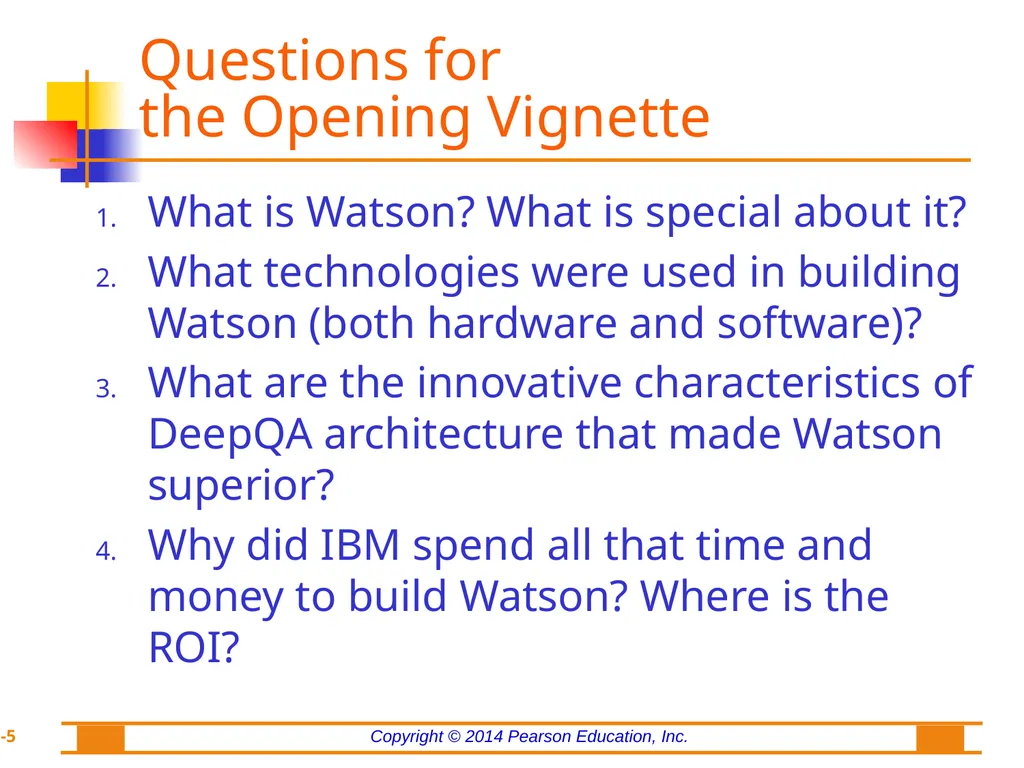
slide5. Questions for the Opening Vignette What is Watson? What is special about it?
What technologies were used in building Watson (both hardware and software)?
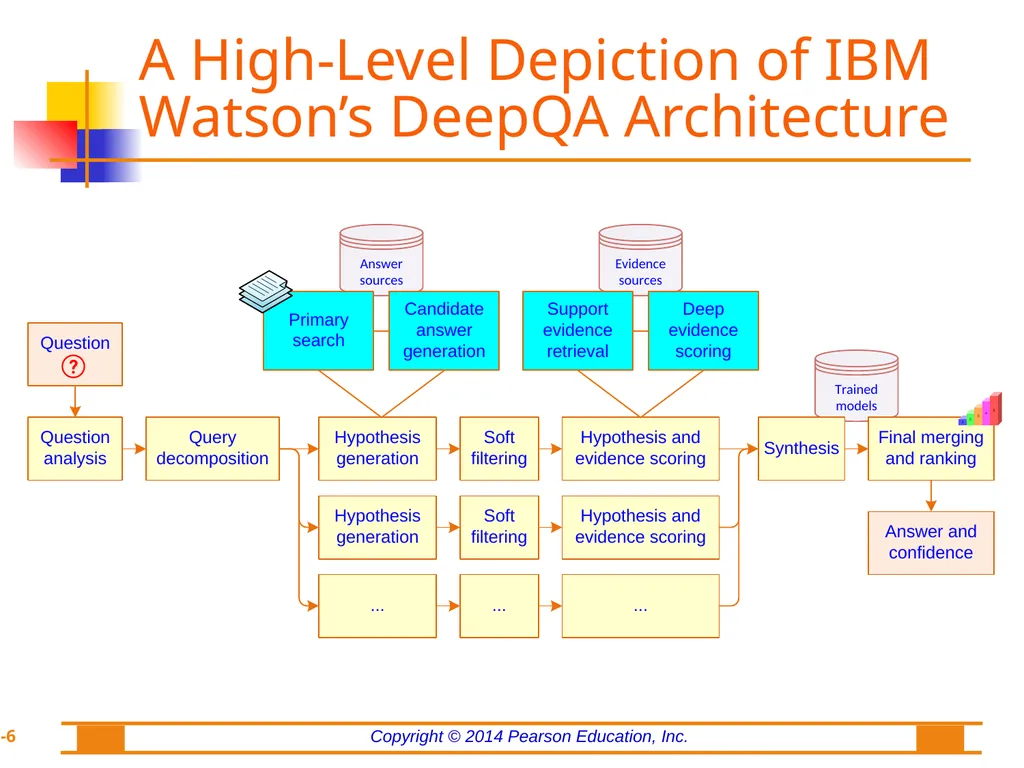
What are the innovative characteristics of DeepQA architecture that made Watson superior?
Why did IBM spend all that time and money to build Watson? Where is the ROI?<br>
slide6. A High-Level Depiction of IBM Watson’s DeepQA Architecture<br>
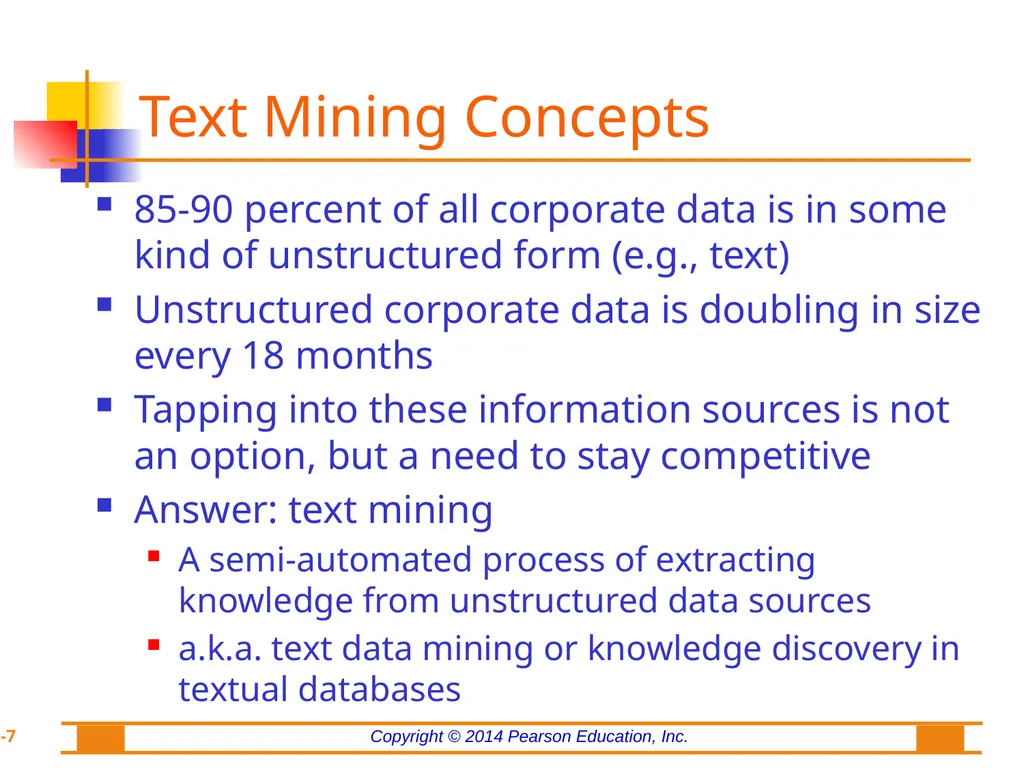
slide7. Text Mining Concepts 85-90 percent of all corporate data is in some kind of unstructured form (e.g., text)
Unstructured corporate data is doubling in size every 18 months
Tapping into these information sources is not an option, but a need to stay competitive
Answer: text mining
A semi-automated process of extracting knowledge from unstructured data sources
a.k.a. text data mining or knowledge discovery in textual databases<br>
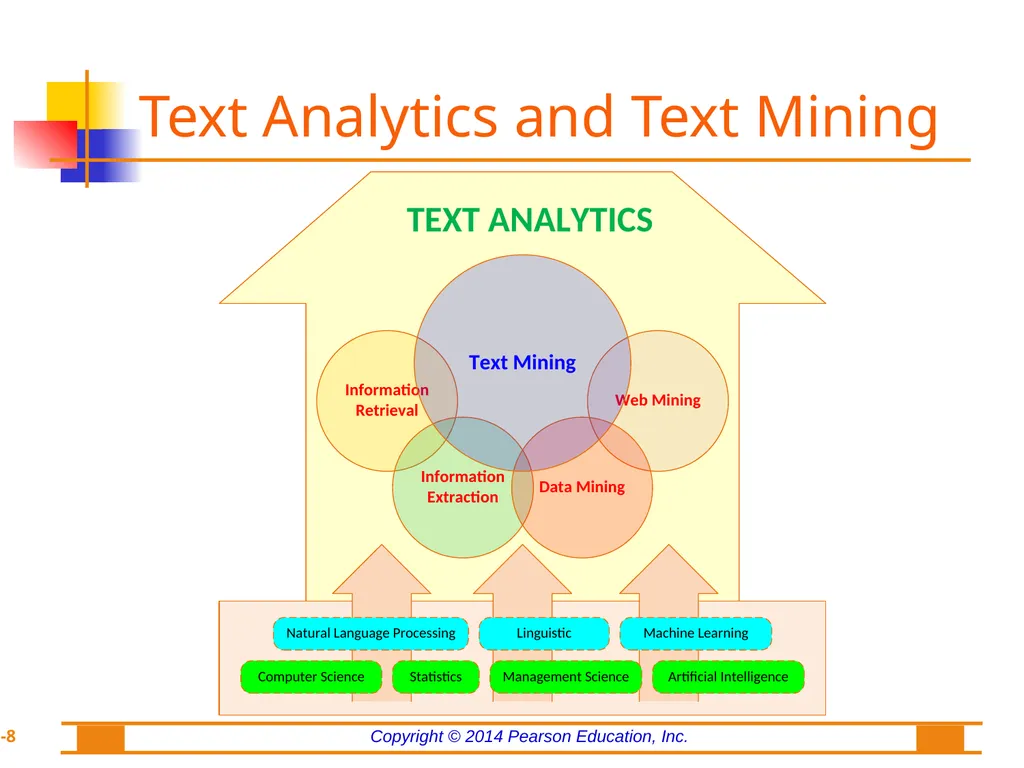
slide8. Text Analytics and Text Mining<br>
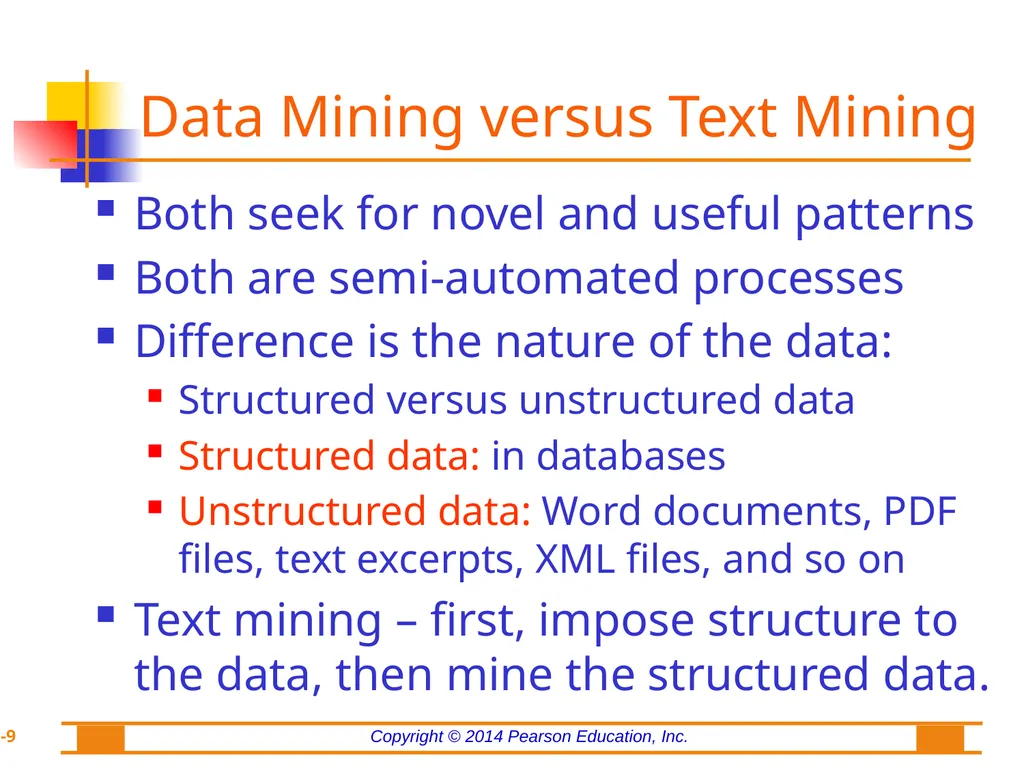
slide9. Data Mining versus Text Mining Both seek for novel and useful patterns
Both are semi-automated processes
Difference is the nature of the data:
Structured versus unstructured data
Structured data: in databases
Unstructured data: Word documents, PDF files, text excerpts, XML files, and so on
Text mining – first, impose structure to the data, then mine the structured data.<br>
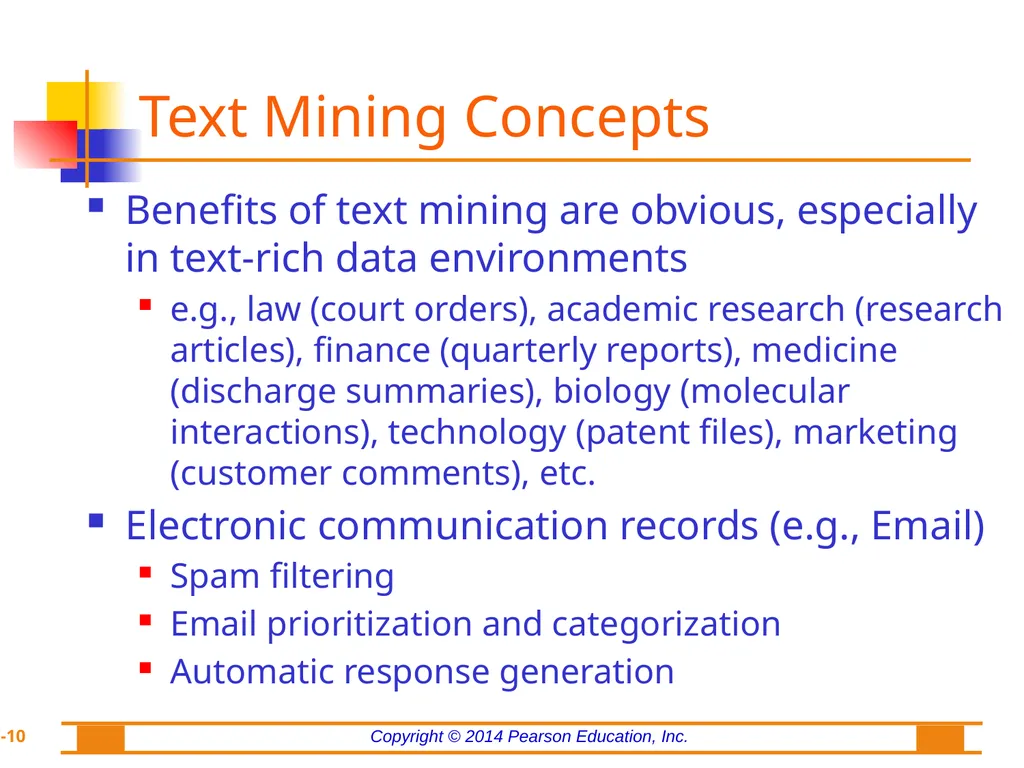
slide10. Text Mining Concepts Benefits of text mining are obvious, especially in text-rich data environments
e.g., law (court orders), academic research (research articles), finance (quarterly reports), medicine (discharge summaries), biology (molecular interactions), technology (patent files), marketing (customer comments), etc.
Electronic communication records (e.g., Email)
Spam filtering
Email prioritization and categorization
Automatic response generation<br>
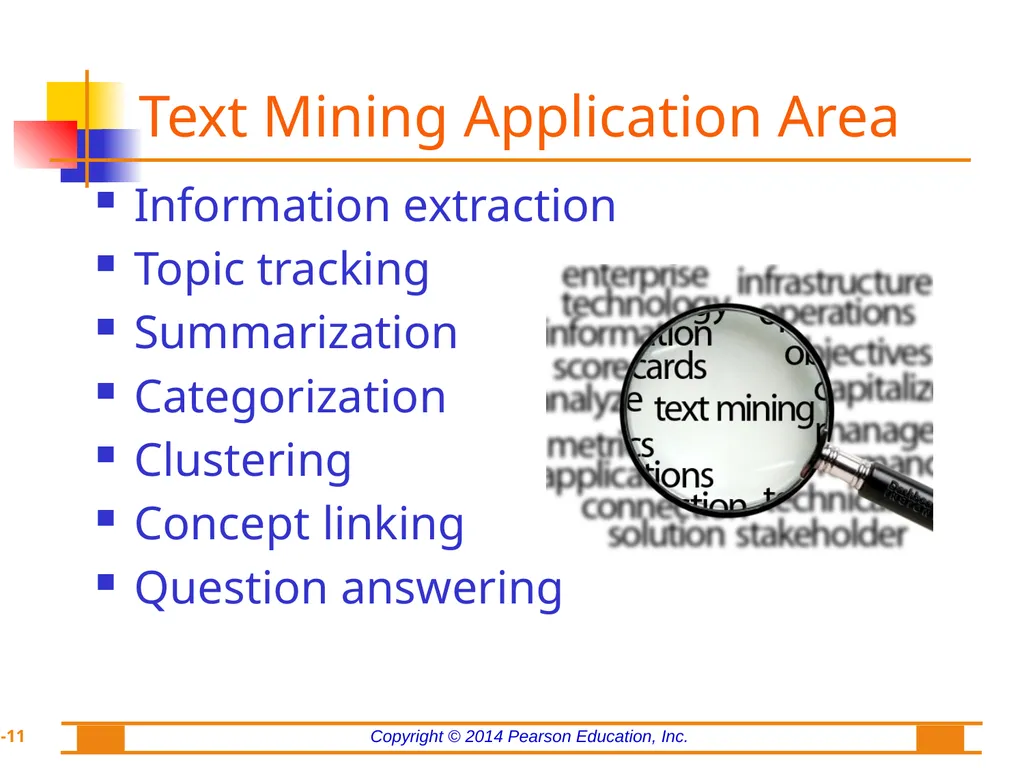
slide11. Text Mining Application Area Information extraction
Topic tracking
Summarization
Categorization
Clustering
Concept linking
Question answering<br>
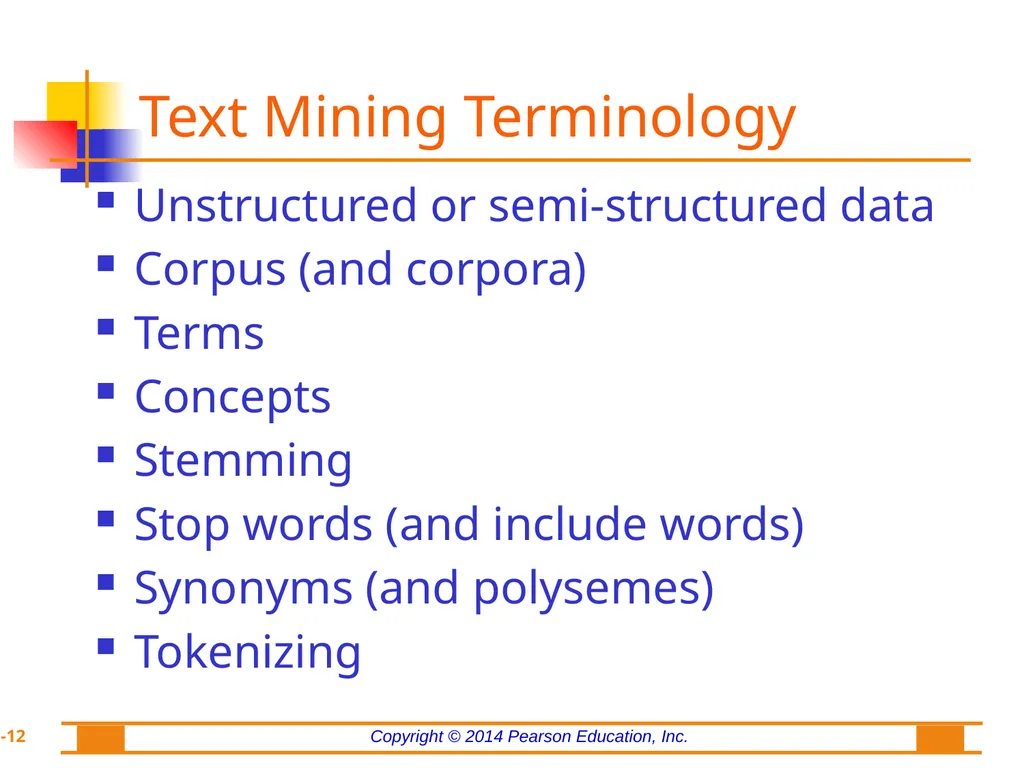
slide12. Text Mining Terminology Unstructured or semi-structured data
Corpus (and corpora)
Terms
Concepts
Stemming
Stop words (and include words)
Synonyms (and polysemes)
Tokenizing<br>
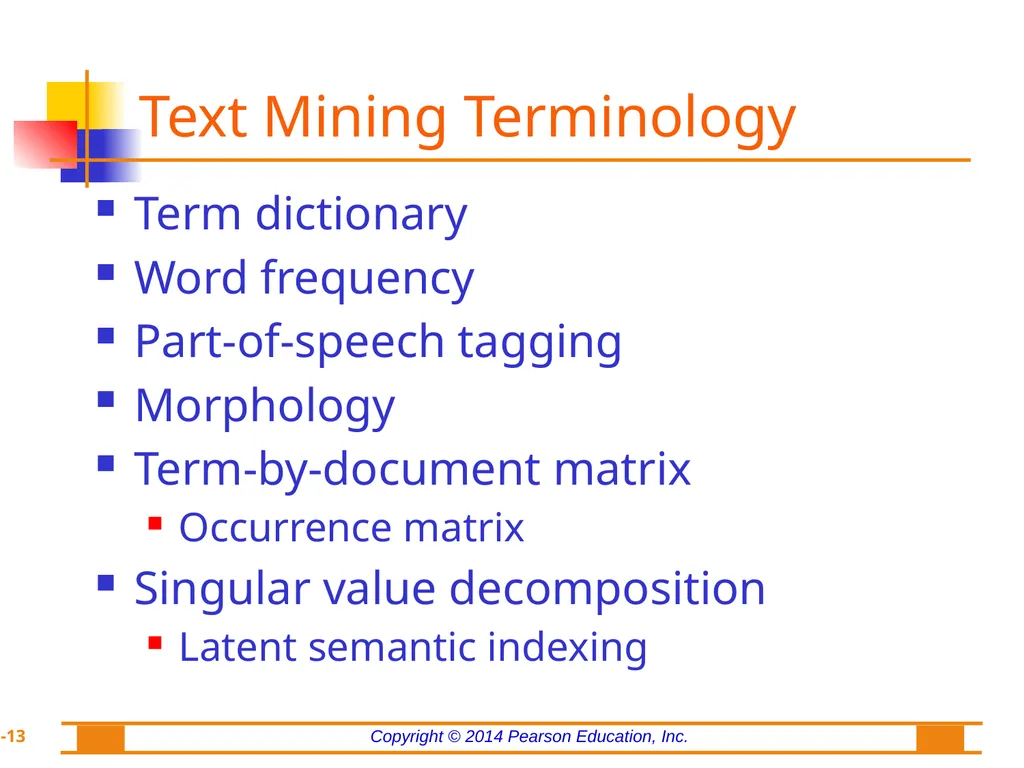
slide13. Text Mining Terminology Term dictionary
Word frequency
Part-of-speech tagging
Morphology
Term-by-document matrix
Occurrence matrix
Singular value decomposition
Latent semantic indexing<br>
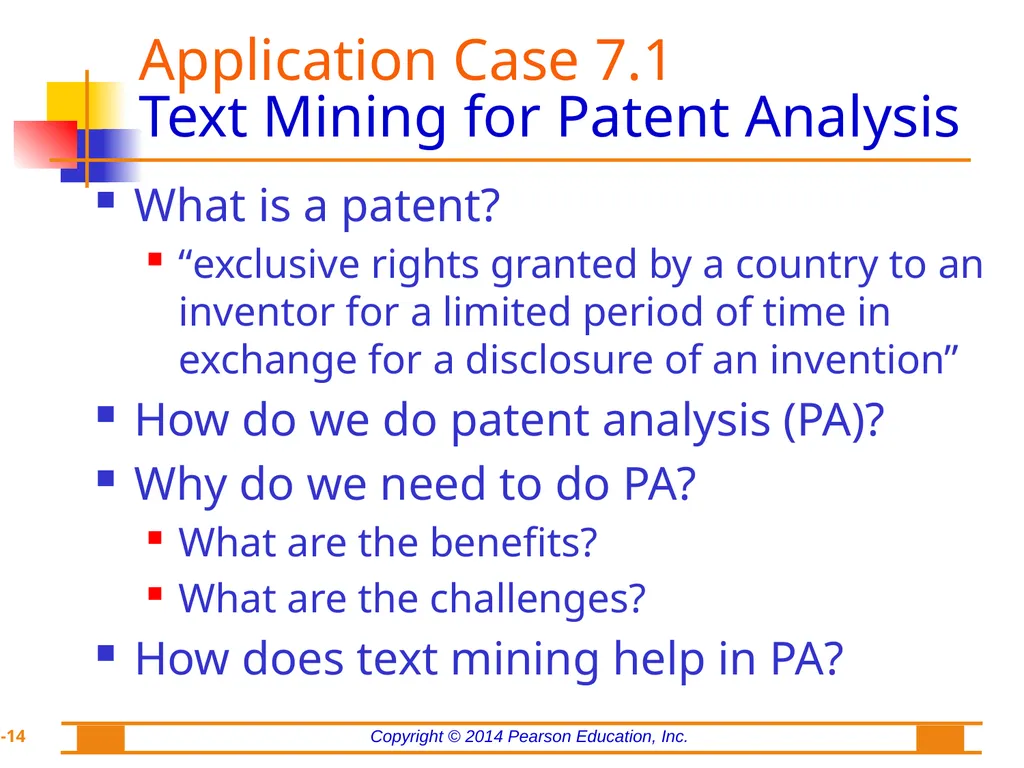
slide14. Application Case 7.1 Text Mining for Patent Analysis What is a patent?
“exclusive rights granted by a country to an inventor for a limited period of time in exchange for a disclosure of an invention”
How do we do patent analysis (PA)?
Why do we need to do PA?
What are the benefits?
What are the challenges?
How does text mining help in PA?<br>
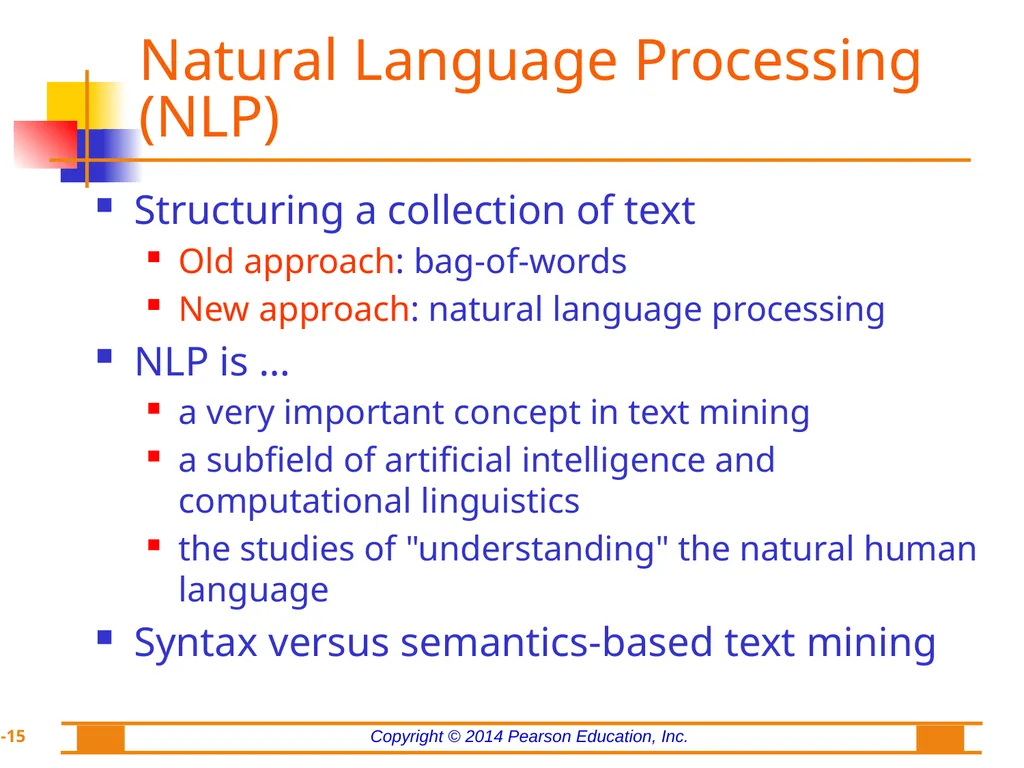
slide15. Natural Language Processing (NLP) Structuring a collection of text
Old approach: bag-of-words
New approach: natural language processing
NLP is …
a very important concept in text mining
a subfield of artificial intelligence and computational linguistics
the studies of "understanding" the natural human language
Syntax versus semantics-based text mining<br>
slide16. Natural Language Processing (NLP) What is “Understanding” ?
Human understands, what about computers?
Natural language is vague, context driven
True understanding requires extensive knowledge of a topic
Can/will computers ever understand natural language the same/accurate way we do?<br>
slide17. Natural Language Processing (NLP) Challenges in NLP
Part-of-speech tagging
Text segmentation
Word sense disambiguation
Syntax ambiguity
Imperfect or irregular input
Speech acts
Dream of AI community
to have algorithms that are capable of automatically reading and obtaining knowledge from text<br>
slide18. Natural Language Processing (NLP) WordNet
A laboriously hand-coded database of English words, their definitions, sets of synonyms, and various semantic relations between synonym sets.
A major resource for NLP.
Need automation to be completed.
Sentiment Analysis
A technique used to detect favorable and unfavorable opinions toward specific products and services
SentiWordNet<br>
slide19. Application Case 7.2 Text Mining Improves Hong Kong Government’s Ability to Anticipate and Address Public Complaints
Questions for Discussion
How did the Hong Kong government use text mining to better serve its constituents?
What were the challenges, the proposed solution, and the obtained results?<br>
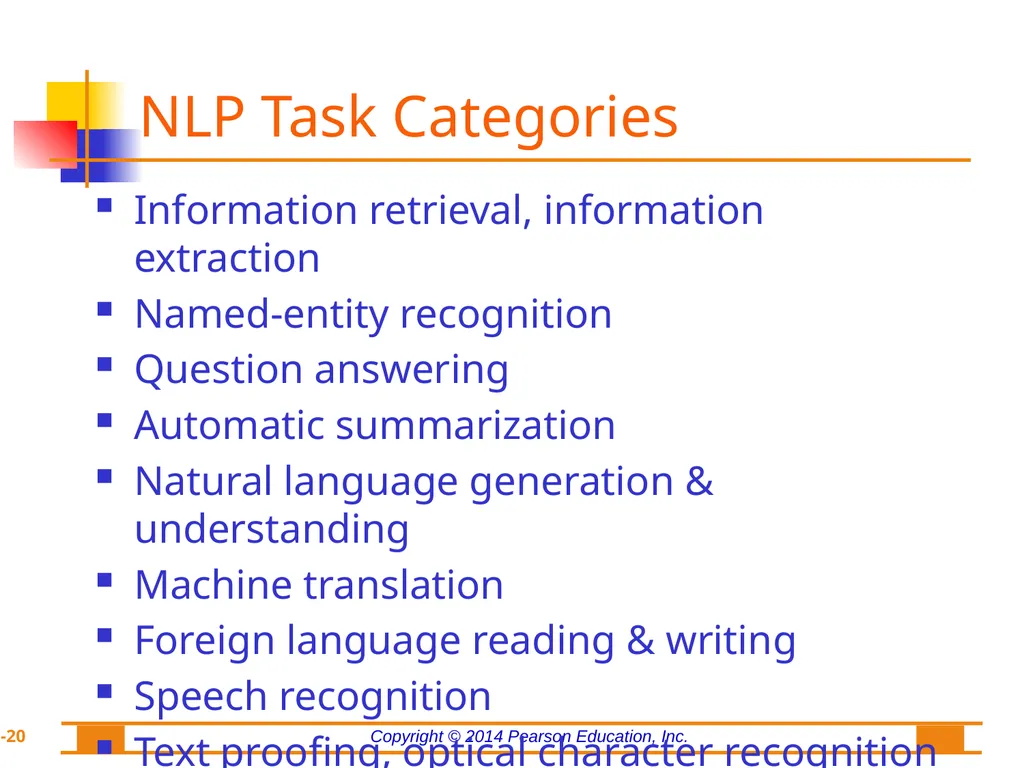
slide20. NLP Task Categories Information retrieval, information extraction
Named-entity recognition
Question answering
Automatic summarization
Natural language generation & understanding
Machine translation
Foreign language reading & writing
Speech recognition
Text proofing, optical character recognition<br>
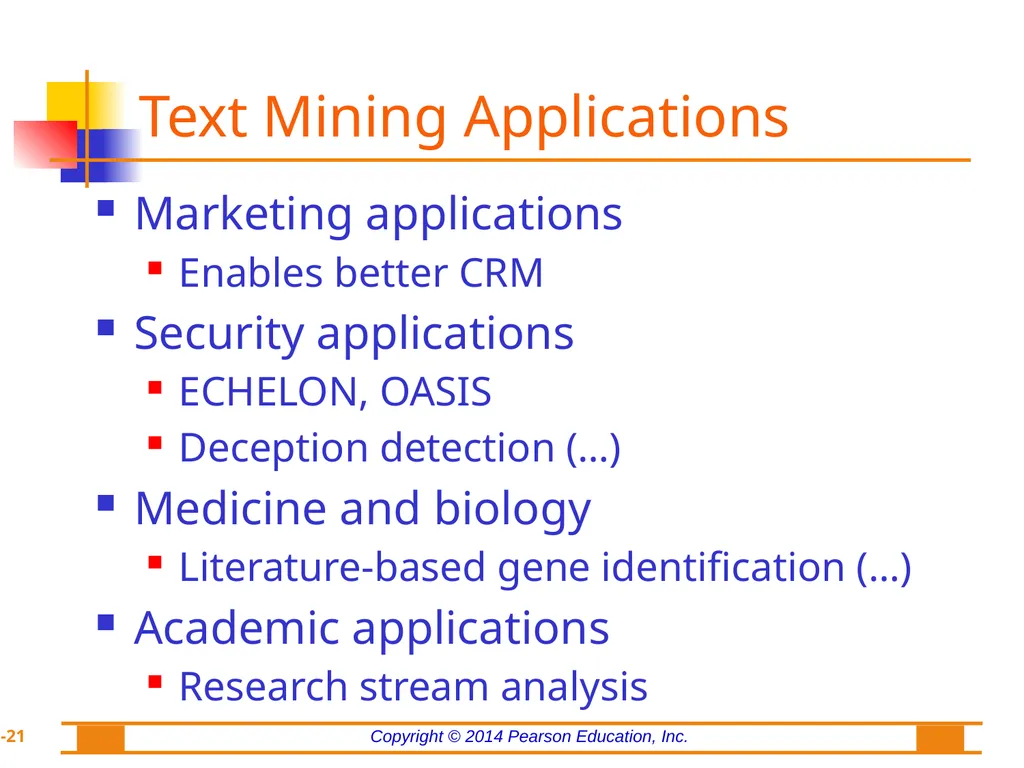
slide21. Text Mining Applications Marketing applications
Enables better CRM
Security applications
ECHELON, OASIS
Deception detection (…)
Medicine and biology
Literature-based gene identification (…)
Academic applications
Research stream analysis<br>
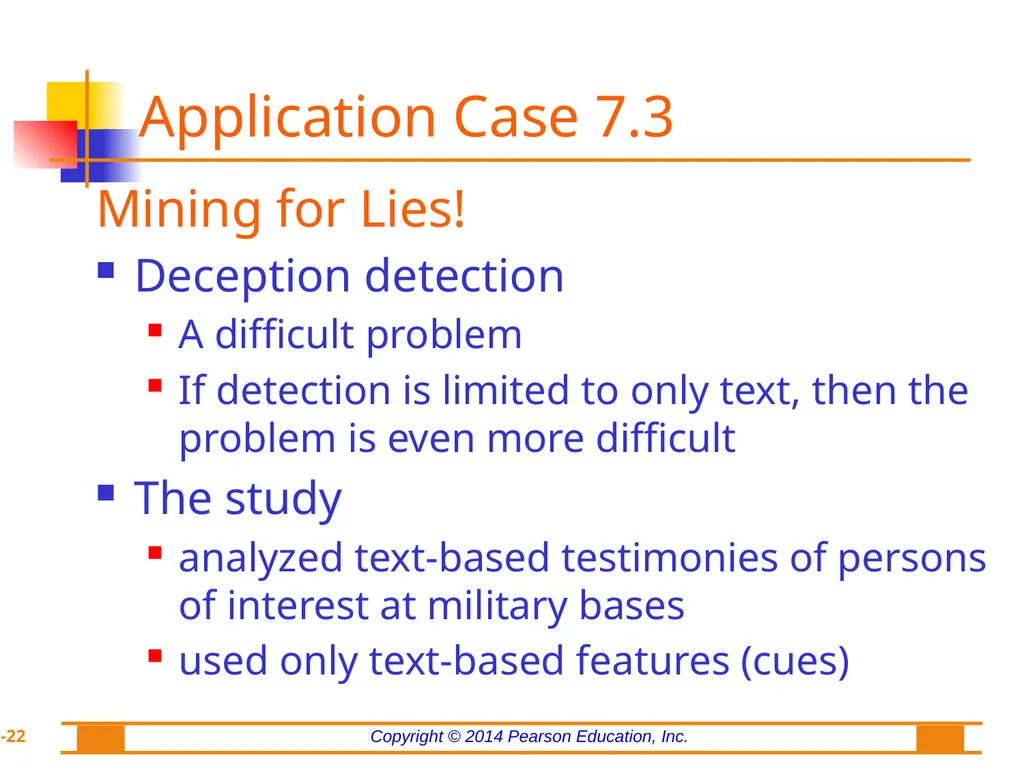
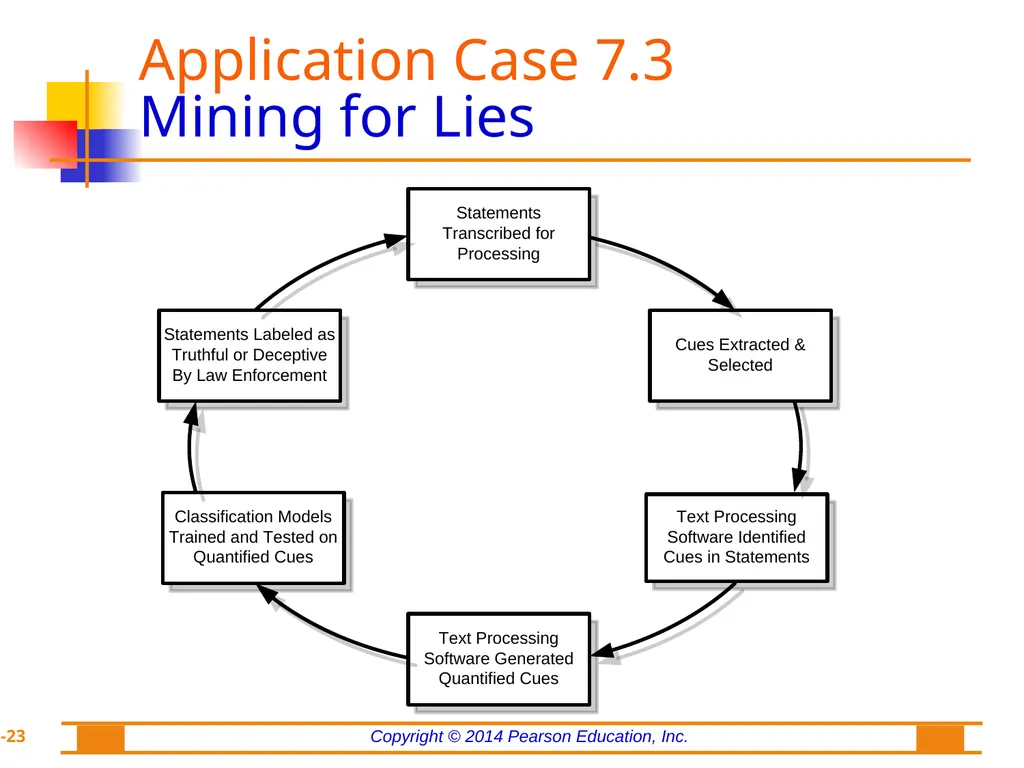
slide22. Application Case 7.3 Mining for Lies!
Deception detection
A difficult problem
If detection is limited to only text, then the problem is even more difficult
The study
analyzed text-based testimonies of persons of interest at military bases
used only text-based features (cues)<br>
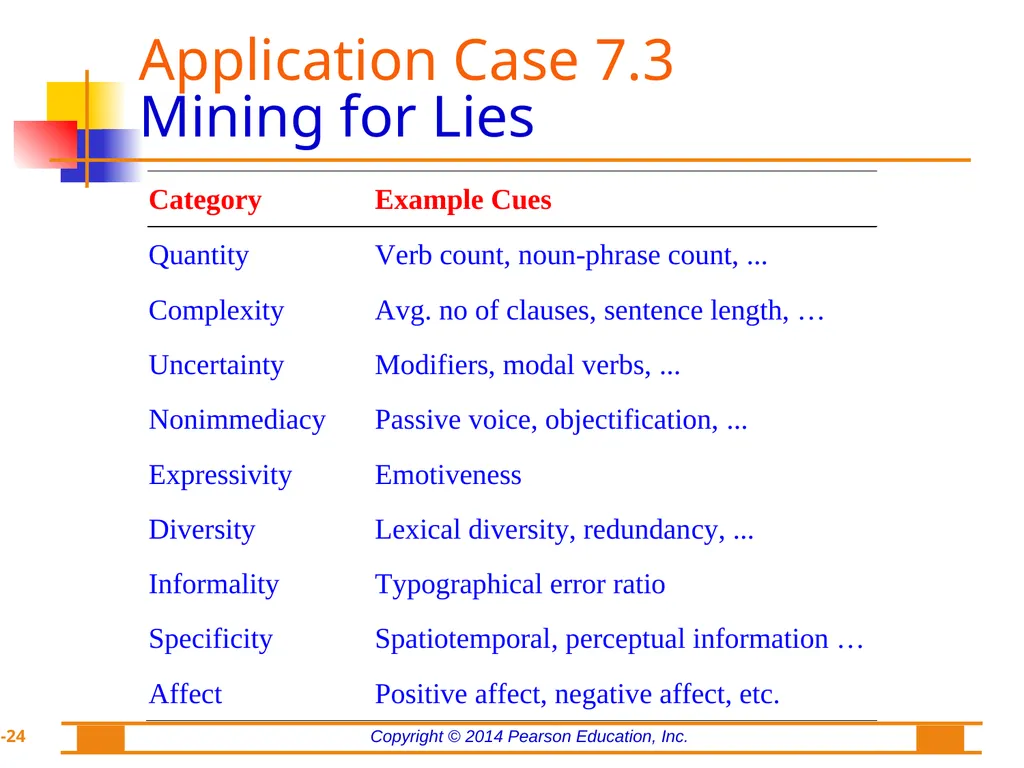
slide23. Application Case 7.3 Mining for Lies<br>
slide24. Application Case 7.3 Mining for Lies<br>
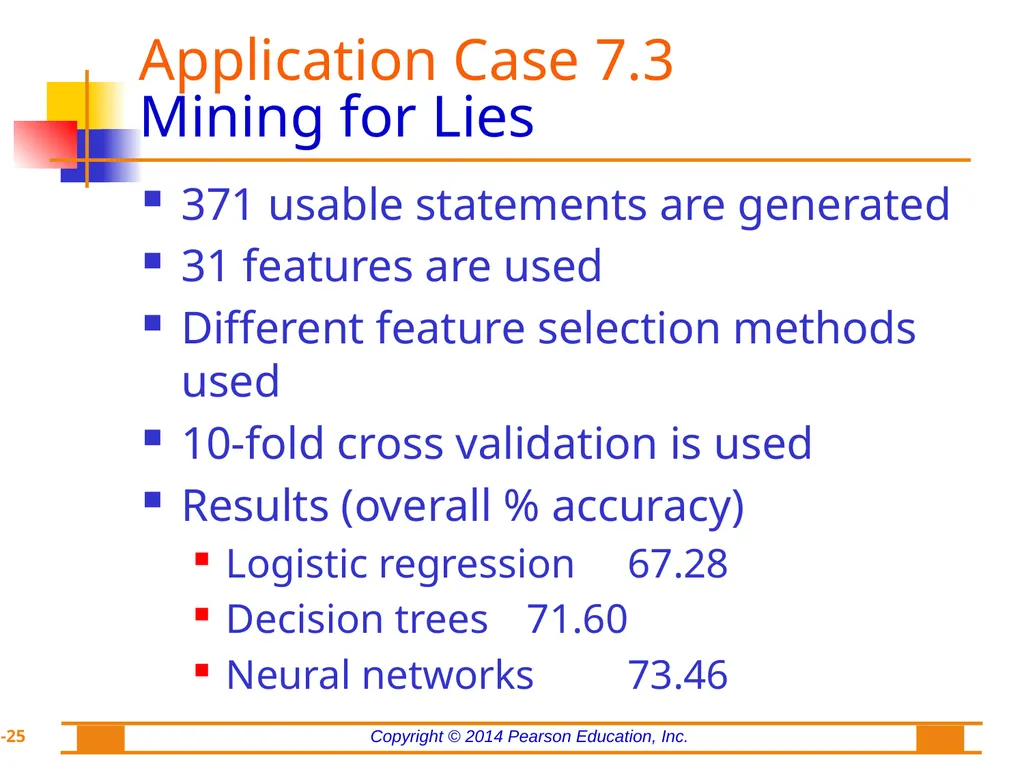
slide25. Application Case 7.3 Mining for Lies 371 usable statements are generated
31 features are used
Different feature selection methods used
10-fold cross validation is used
Results (overall % accuracy)
Logistic regression 67.28
Decision trees 71.60
Neural networks 73.46<br>
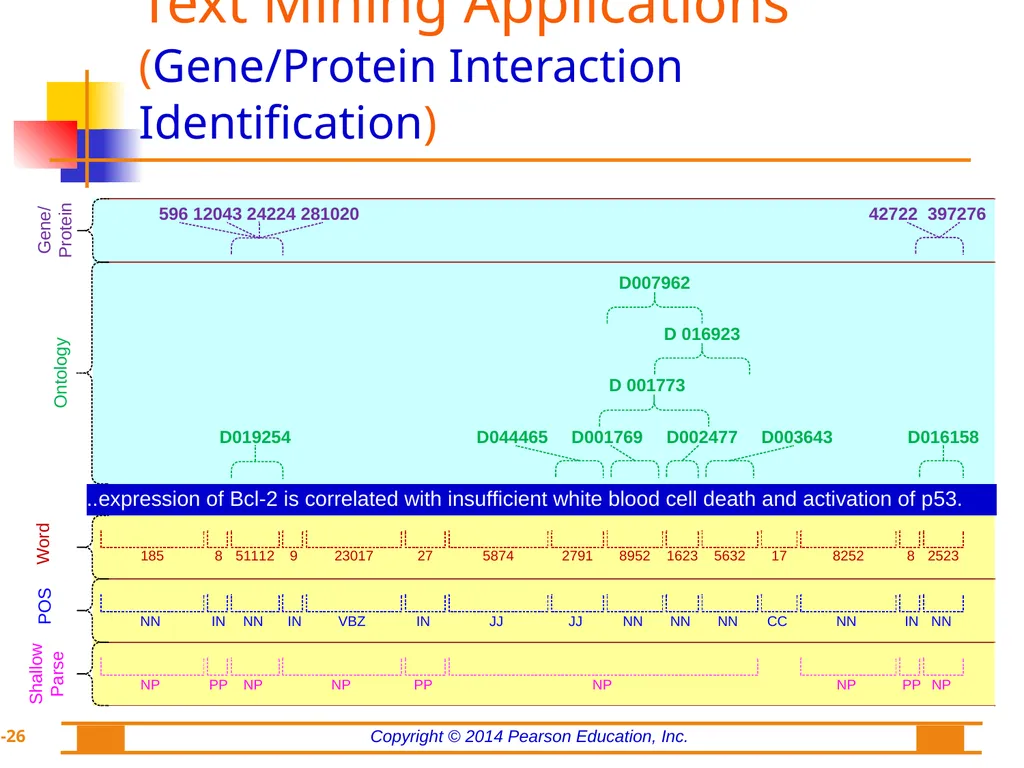
slide26. Text Mining Applications (Gene/Protein Interaction Identification)<br>
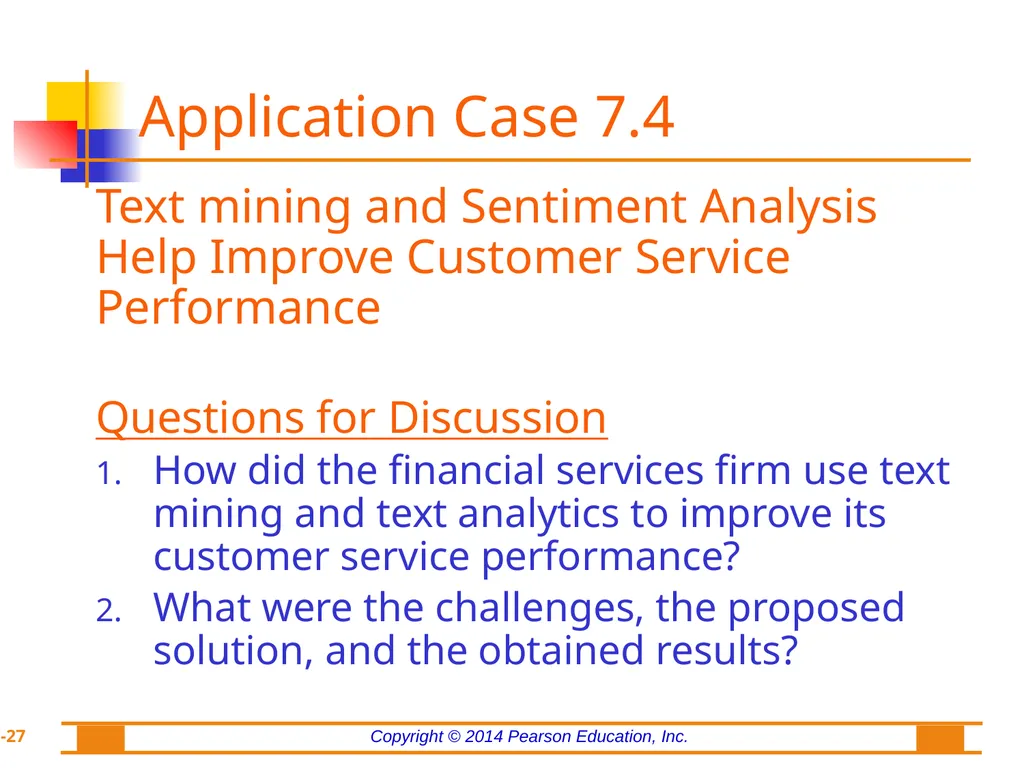
slide27. Application Case 7.4 Text mining and Sentiment Analysis Help Improve Customer Service Performance
Questions for Discussion
How did the financial services firm use text mining and text analytics to improve its customer service performance?
What were the challenges, the proposed solution, and the obtained results?<br>
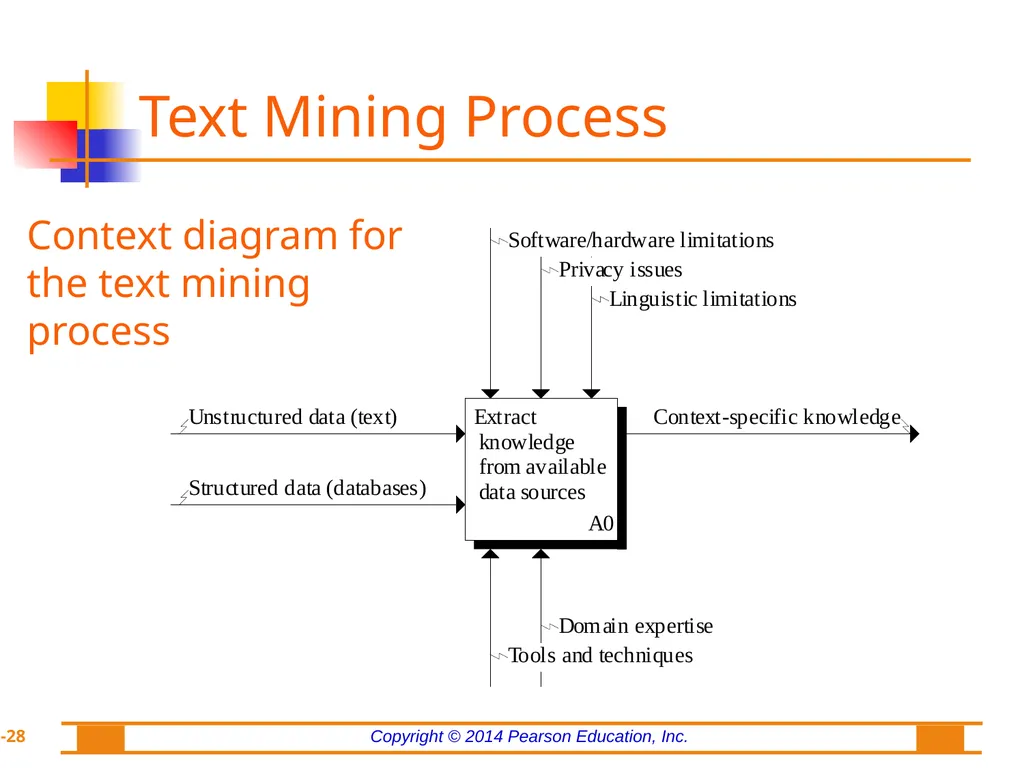
slide28. Text Mining Process Context diagram for the text mining process<br>
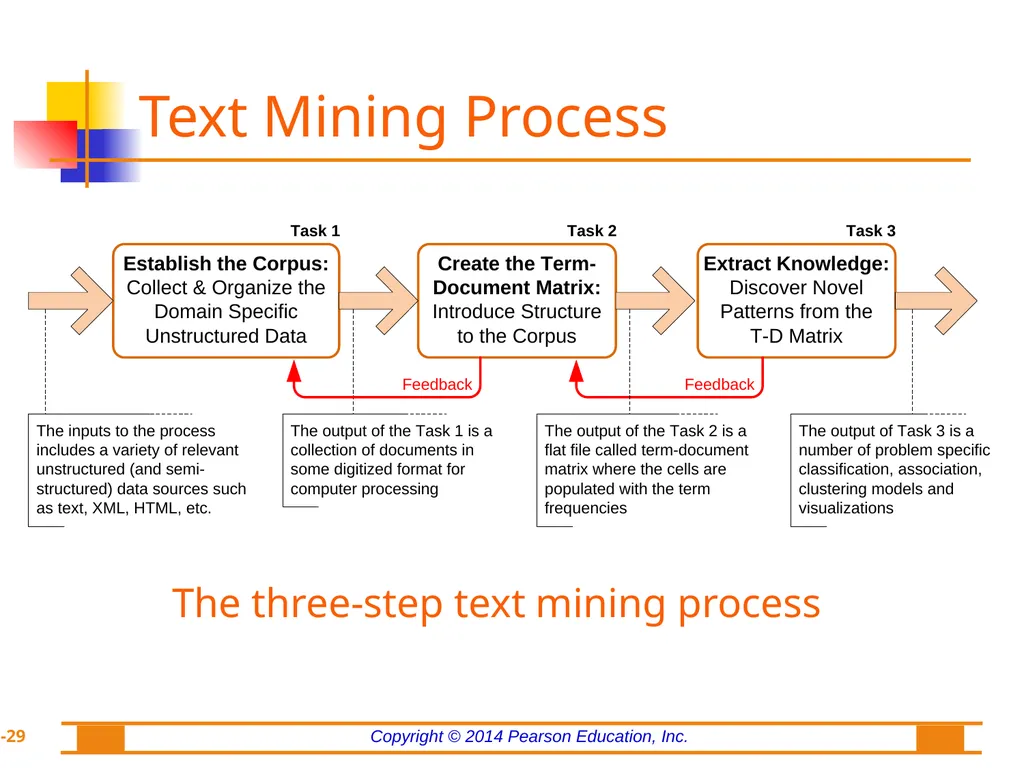
slide29. Text Mining Process The three-step text mining process<br>
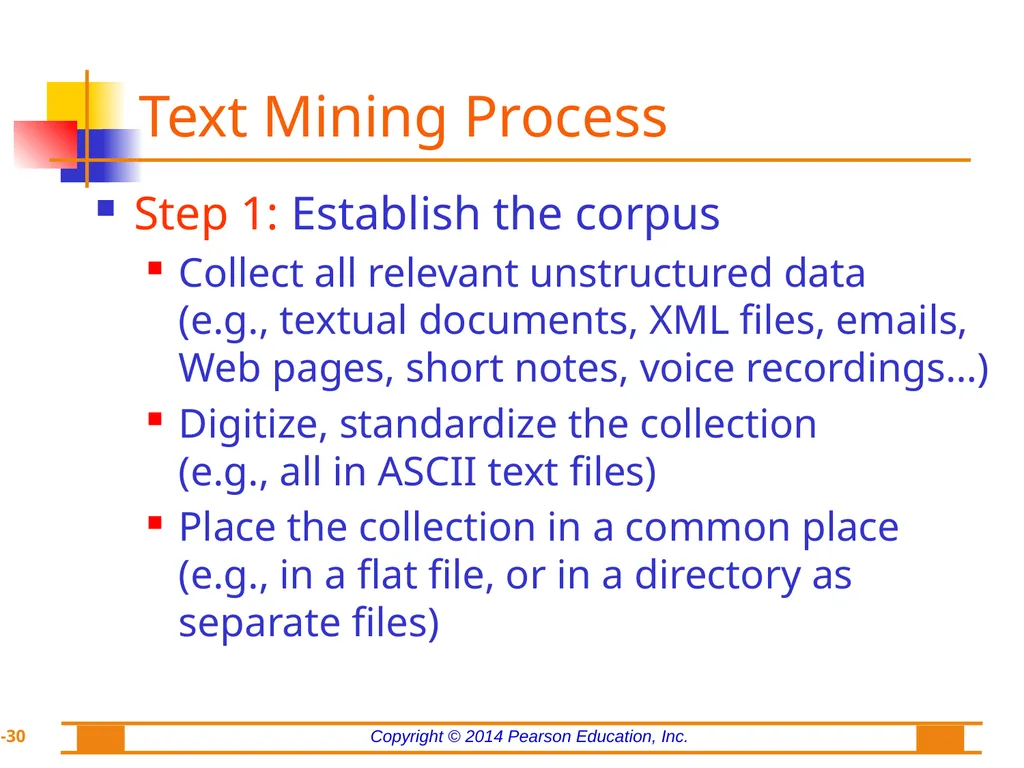
slide30. Text Mining Process Step 1: Establish the corpus
Collect all relevant unstructured data (e.g., textual documents, XML files, emails, Web pages, short notes, voice recordings…)
Digitize, standardize the collection (e.g., all in ASCII text files)
Place the collection in a common place (e.g., in a flat file, or in a directory as separate files)<br>
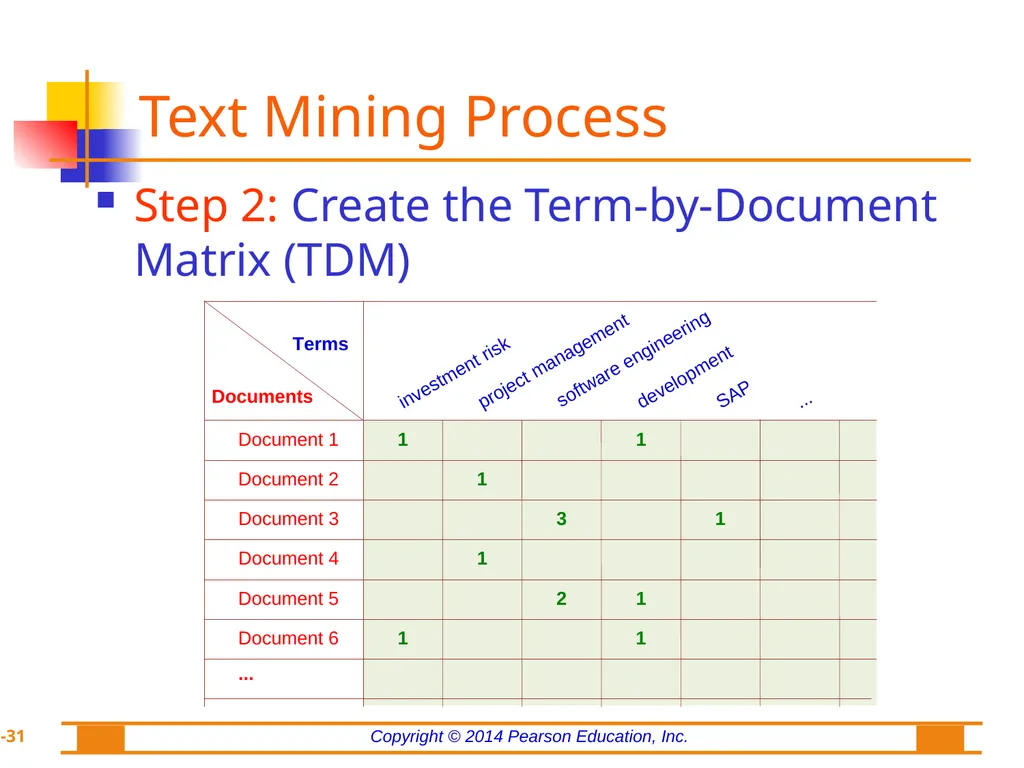
slide31. Text Mining Process Step 2: Create the Term-by-Document Matrix (TDM)<br>
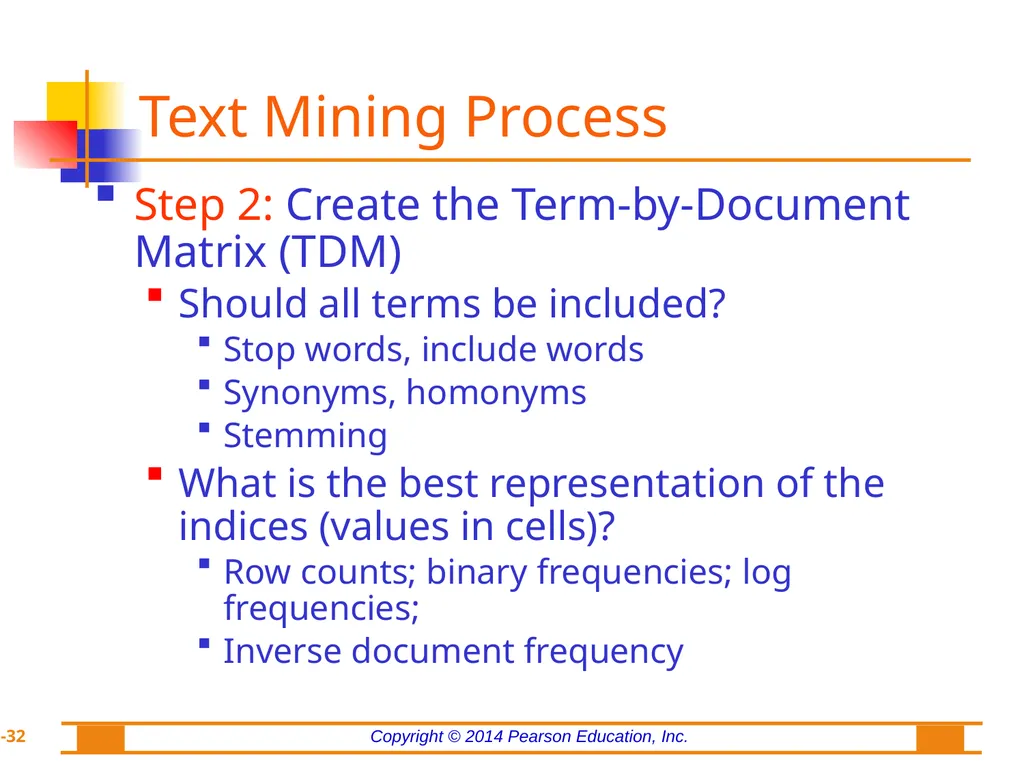
slide32. Text Mining Process Step 2: Create the Term-by-Document Matrix (TDM)
Should all terms be included?
Stop words, include words
Synonyms, homonyms
Stemming
What is the best representation of the indices (values in cells)?
Row counts; binary frequencies; log frequencies;
Inverse document frequency<br>
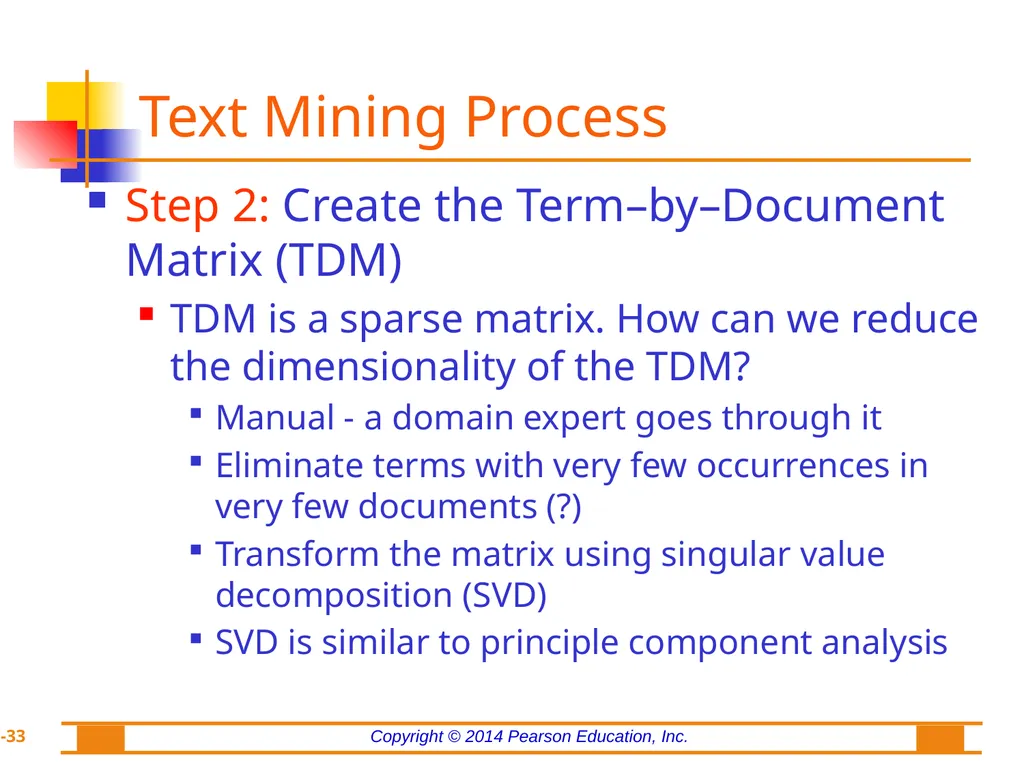
slide33. Text Mining Process Step 2: Create the Term–by–Document Matrix (TDM)
TDM is a sparse matrix. How can we reduce the dimensionality of the TDM?
Manual - a domain expert goes through it
Eliminate terms with very few occurrences in very few documents (?)
Transform the matrix using singular value decomposition (SVD)
SVD is similar to principle component analysis<br>
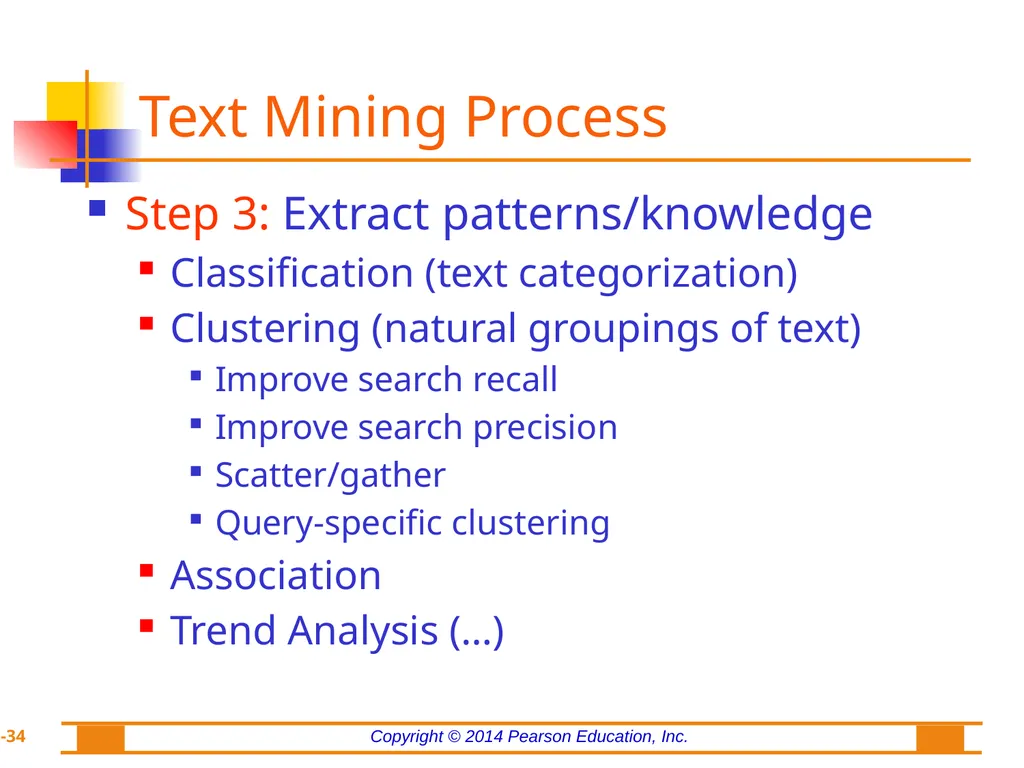
slide34. Text Mining Process Step 3: Extract patterns/knowledge
Classification (text categorization)
Clustering (natural groupings of text)
Improve search recall
Improve search precision
Scatter/gather
Query-specific clustering
Association
Trend Analysis (…)<br>
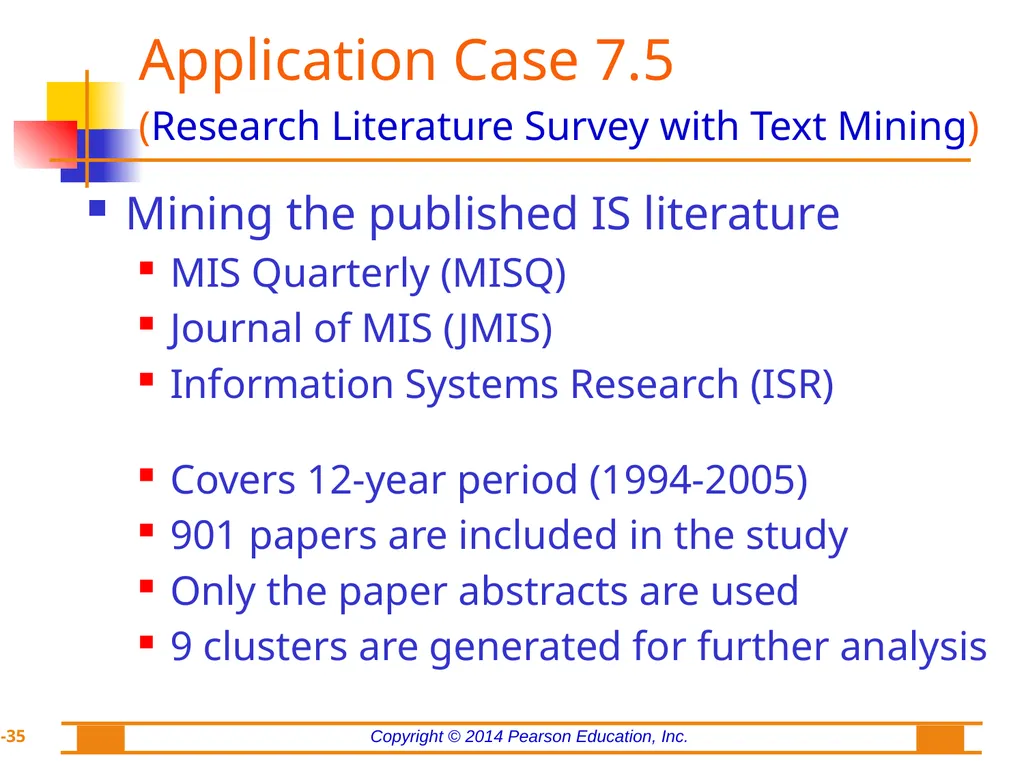
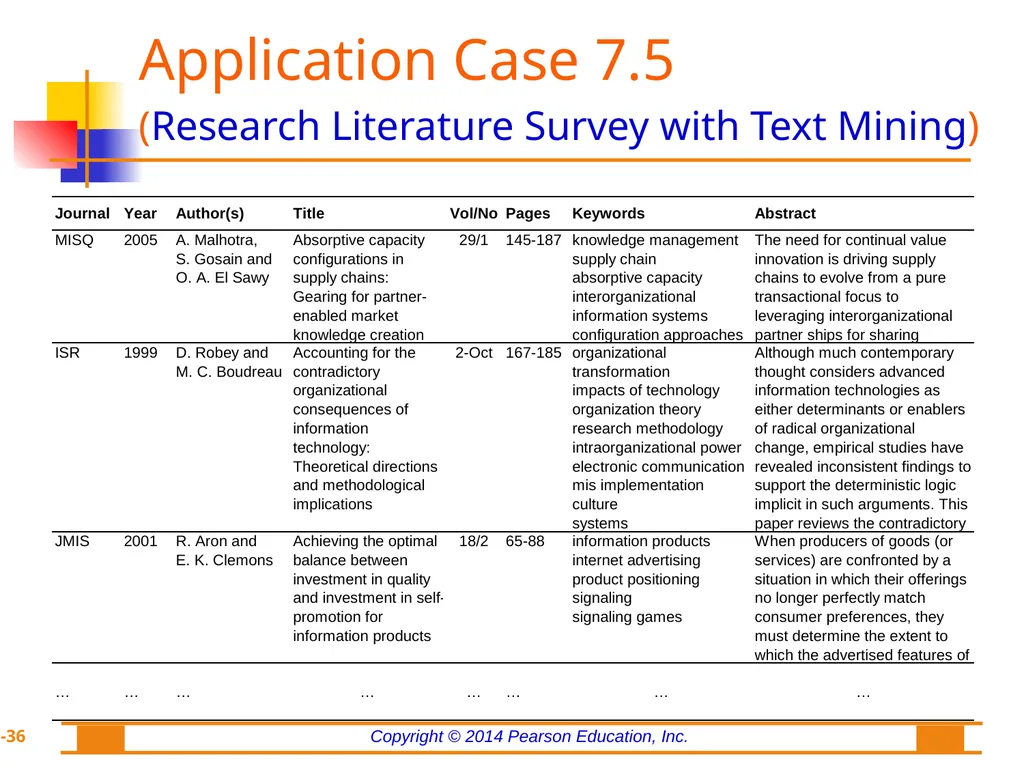
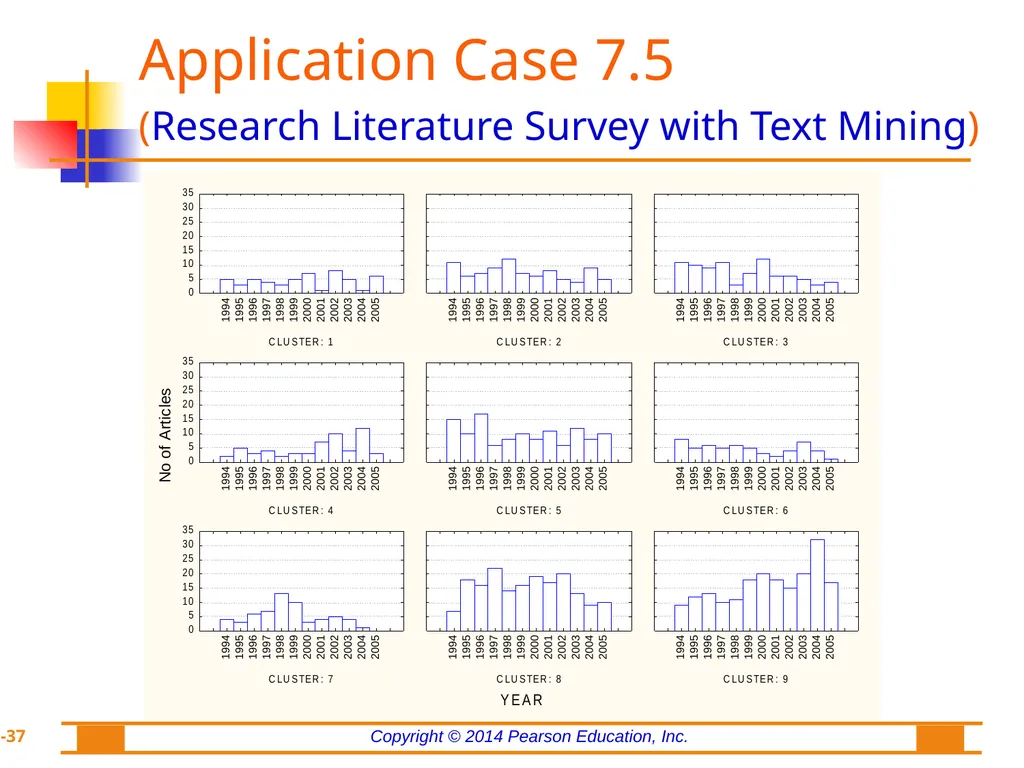
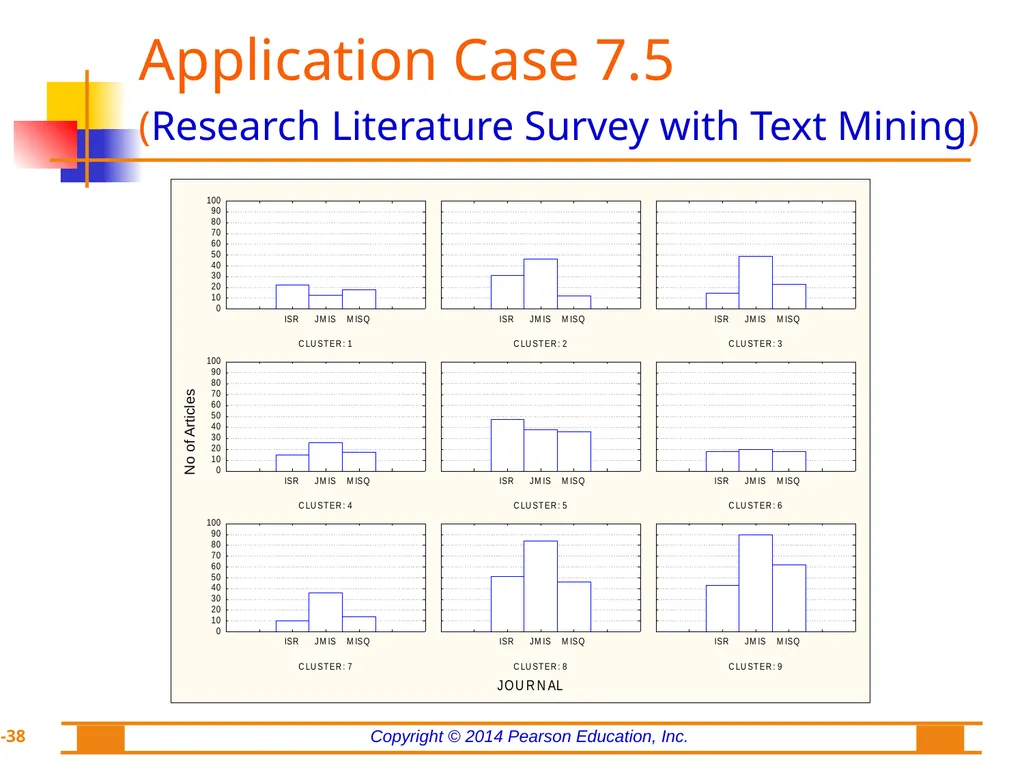
slide35. Application Case 7.5 (Research Literature Survey with Text Mining) Mining the published IS literature
MIS Quarterly (MISQ)
Journal of MIS (JMIS)
Information Systems Research (ISR)
Covers 12-year period (1994-2005)
901 papers are included in the study
Only the paper abstracts are used
9 clusters are generated for further analysis<br>
slide36. Application Case 7.5 (Research Literature Survey with Text Mining)<br>
slide37. Application Case 7.5 (Research Literature Survey with Text Mining)<br>
slide38. Application Case 7.5 (Research Literature Survey with Text Mining)<br>
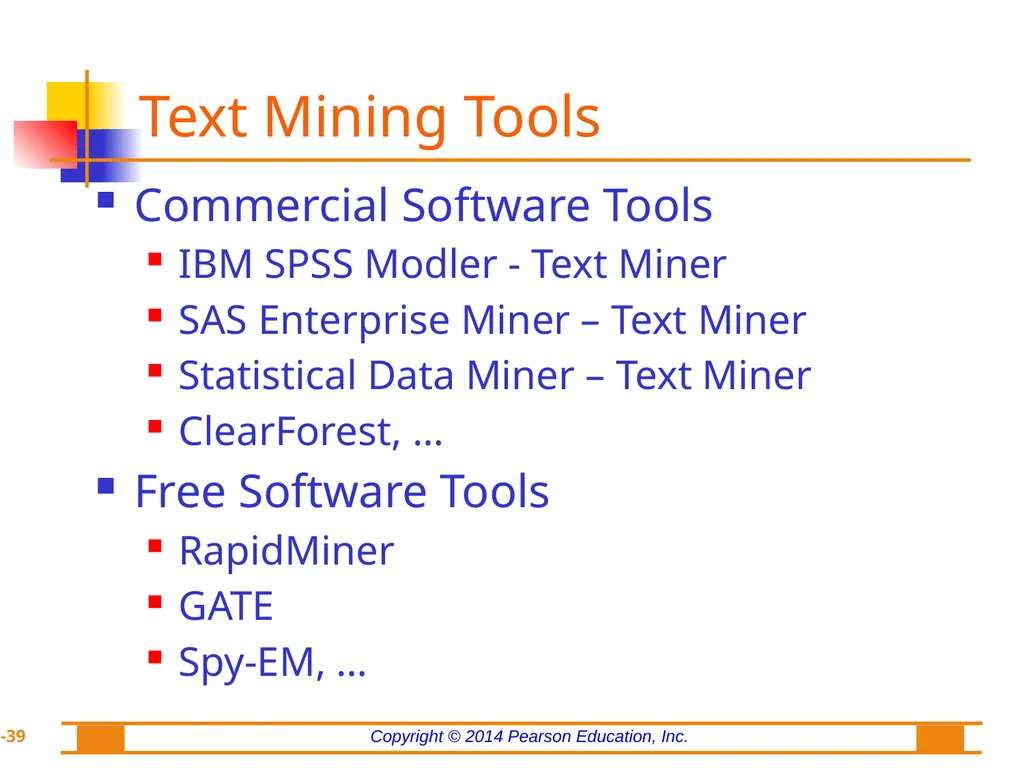
slide39. Text Mining Tools Commercial Software Tools
IBM SPSS Modler - Text Miner
SAS Enterprise Miner – Text Miner
Statistical Data Miner – Text Miner
ClearForest, …
Free Software Tools
RapidMiner
GATE
Spy-EM, …<br>
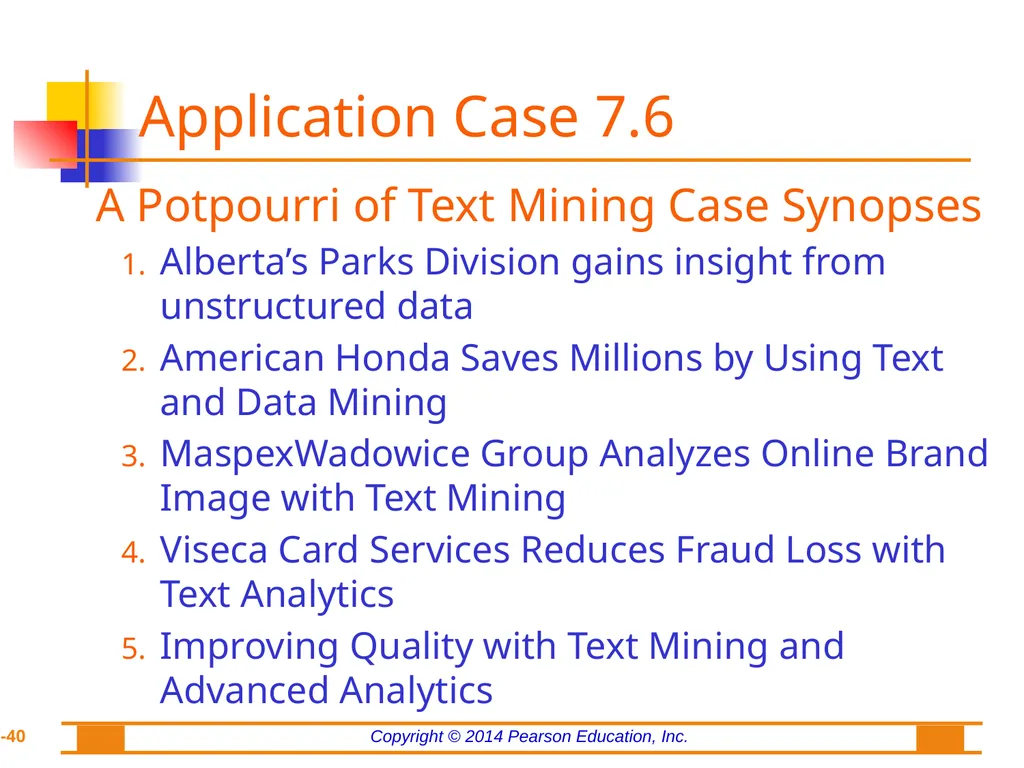
slide40. Application Case 7.6 A Potpourri of Text Mining Case Synopses
Alberta’s Parks Division gains insight from unstructured data
American Honda Saves Millions by Using Text and Data Mining
MaspexWadowice Group Analyzes Online Brand Image with Text Mining
Viseca Card Services Reduces Fraud Loss with Text Analytics
Improving Quality with Text Mining and Advanced Analytics<br>
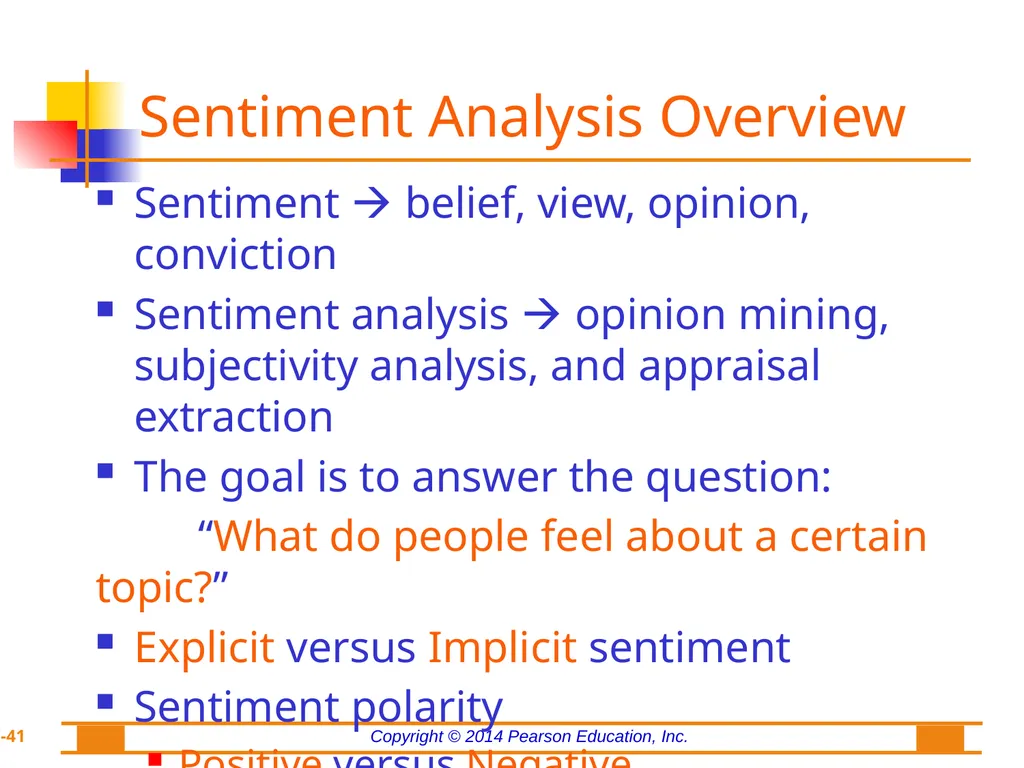
slide41. Sentiment Analysis Overview Sentiment belief, view, opinion, conviction
Sentiment analysis opinion mining, subjectivity analysis, and appraisal extraction
The goal is to answer the question:
“What do people feel about a certain topic?”
Explicit versus Implicit sentiment
Sentiment polarity
Positive versus Negative
… versus Neutral?<br>
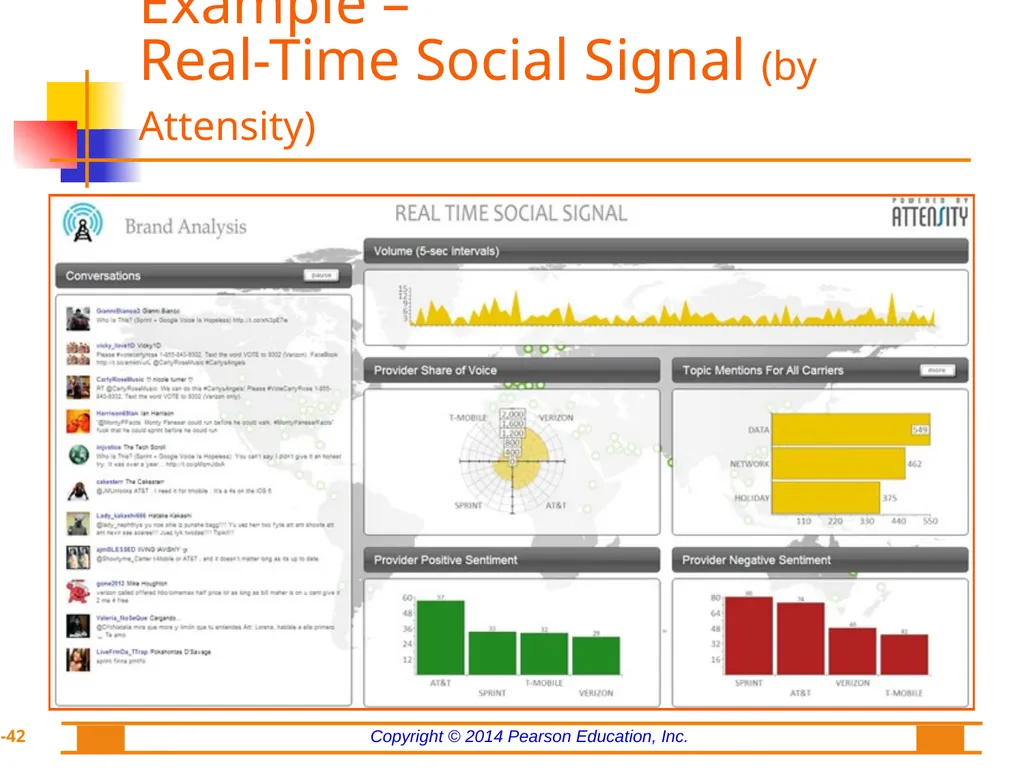
slide42. Example – Real-Time Social Signal (by Attensity)<br>
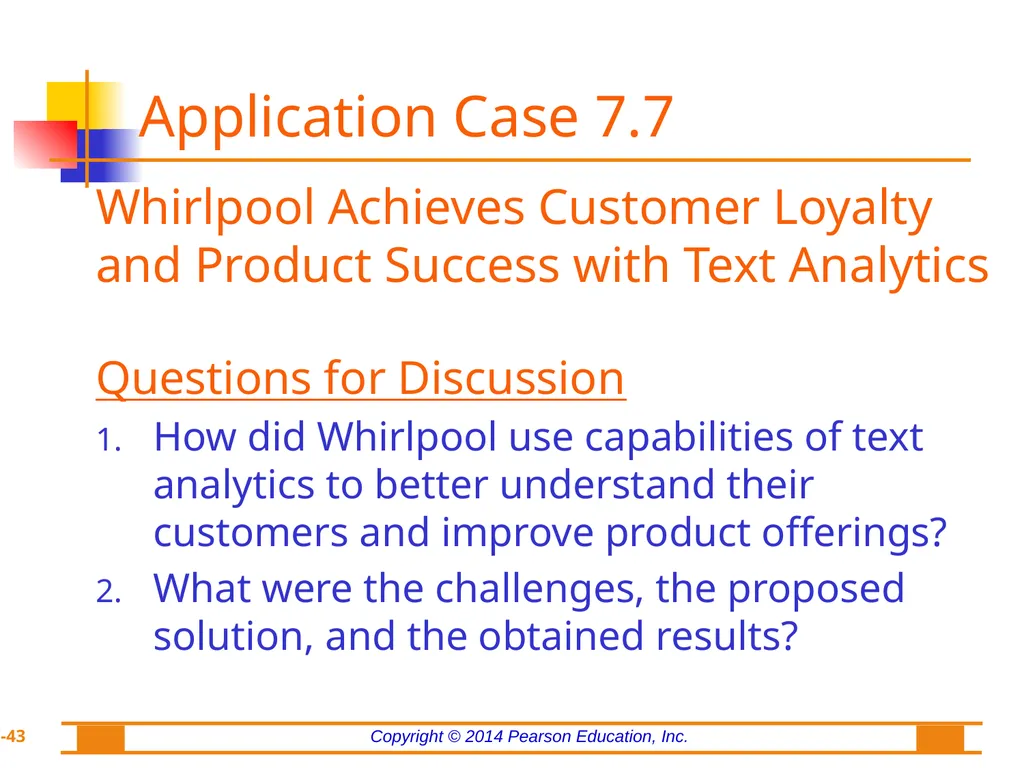
slide43. Application Case 7.7 Whirlpool Achieves Customer Loyalty and Product Success with Text Analytics
Questions for Discussion
How did Whirlpool use capabilities of text analytics to better understand their customers and improve product offerings?
What were the challenges, the proposed solution, and the obtained results?<br>
slide44. Sentiment Analysis Applications Voice of the customer (VOC)
Voice of the Market (VOM)
Voice of the Employee (VOE)
Brand Management
Financial Markets
Politics
Government Intelligence
… others<br>
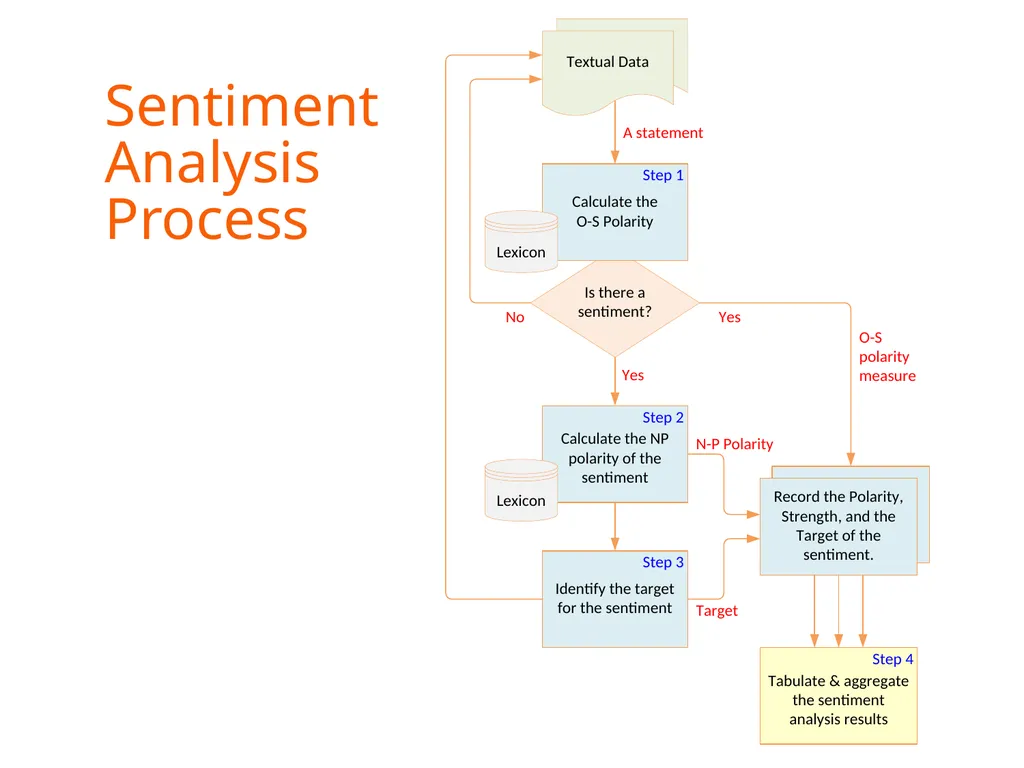
slide45. Sentiment Analysis Process<br>
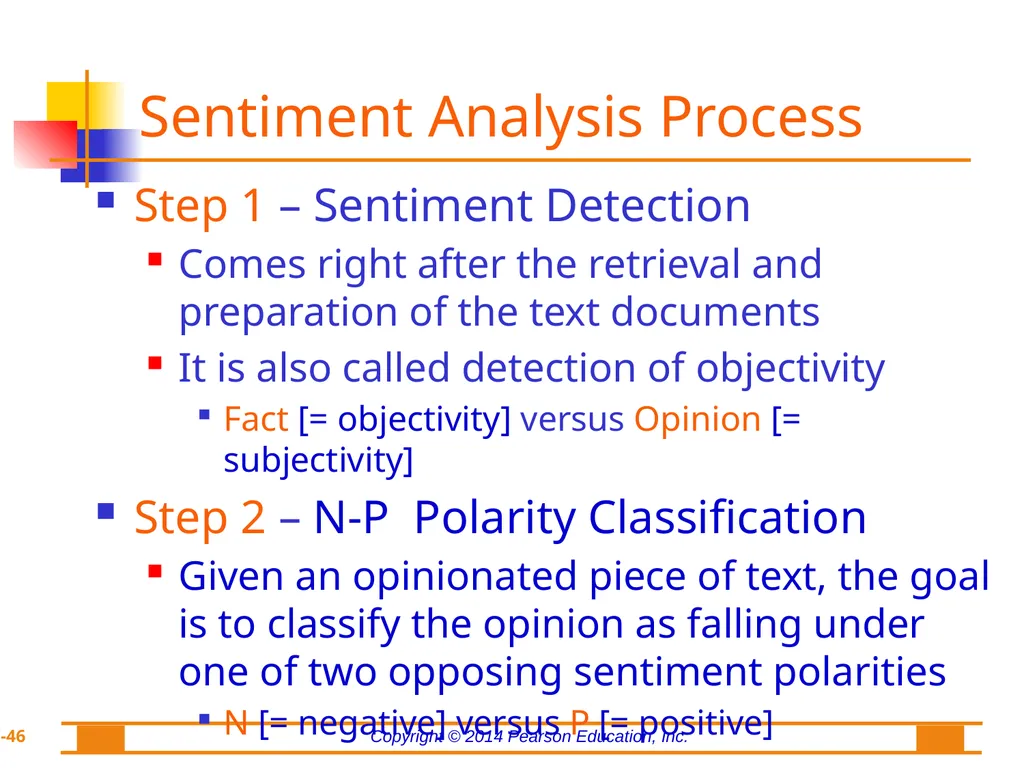
slide46. Sentiment Analysis Process Step 1 – Sentiment Detection
Comes right after the retrieval and preparation of the text documents
It is also called detection of objectivity
Fact [= objectivity] versus Opinion [= subjectivity]
Step 2 – N-P Polarity Classification
Given an opinionated piece of text, the goal is to classify the opinion as falling under one of two opposing sentiment polarities
N [= negative] versus P [= positive]<br>
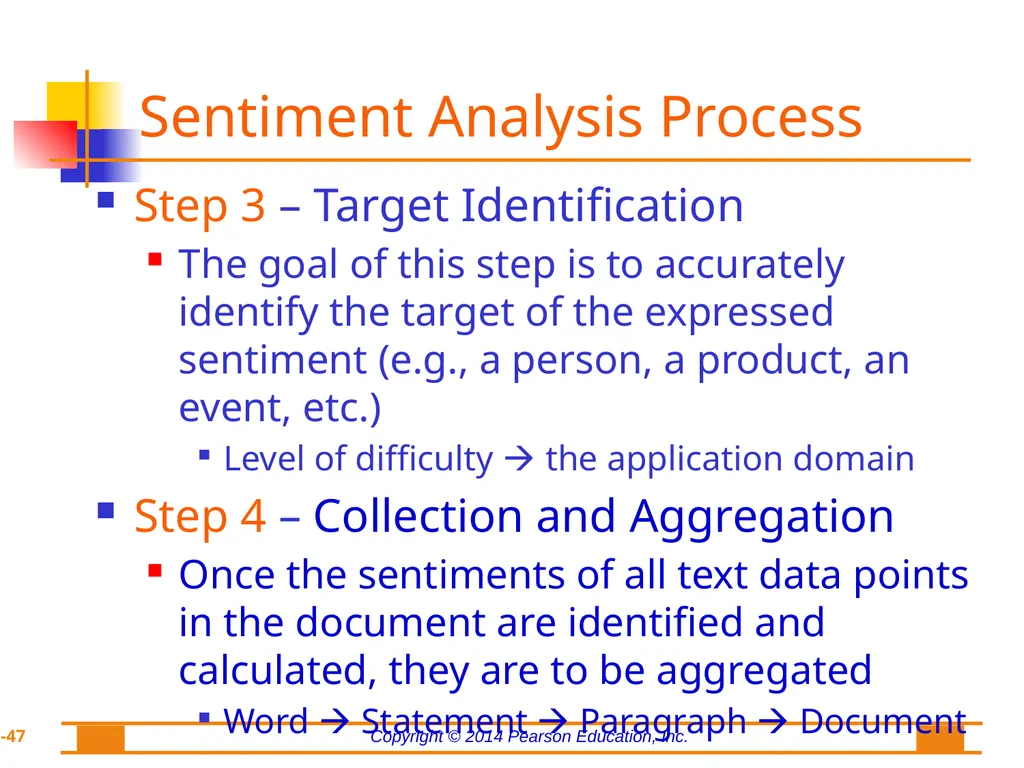
slide47. Sentiment Analysis Process Step 3 – Target Identification
The goal of this step is to accurately identify the target of the expressed sentiment (e.g., a person, a product, an event, etc.)
Level of difficulty the application domain
Step 4 – Collection and Aggregation
Once the sentiments of all text data points in the document are identified and calculated, they are to be aggregated
Word Statement Paragraph Document<br>
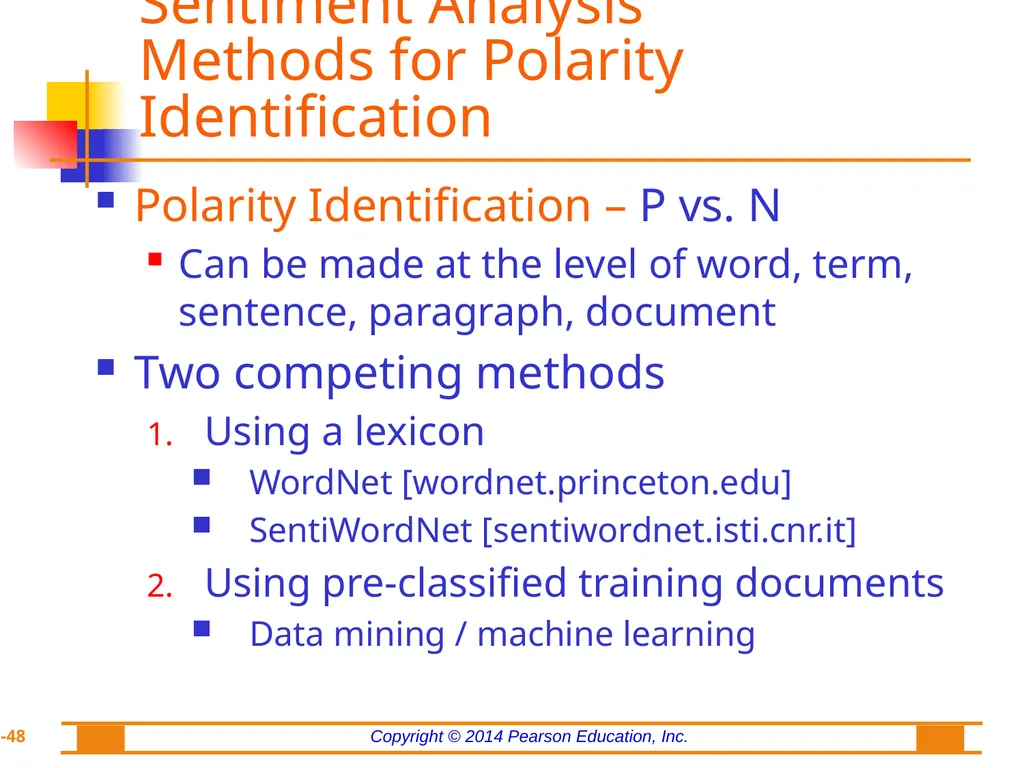
slide48. Sentiment Analysis Methods for Polarity Identification Polarity Identification – P vs. N
Can be made at the level of word, term, sentence, paragraph, document
Two competing methods
Using a lexicon
WordNet [wordnet.princeton.edu]
SentiWordNet [sentiwordnet.isti.cnr.it]
Using pre-classified training documents
Data mining / machine learning<br>
slide49. P-N Polarity and S-O Polarity<br>
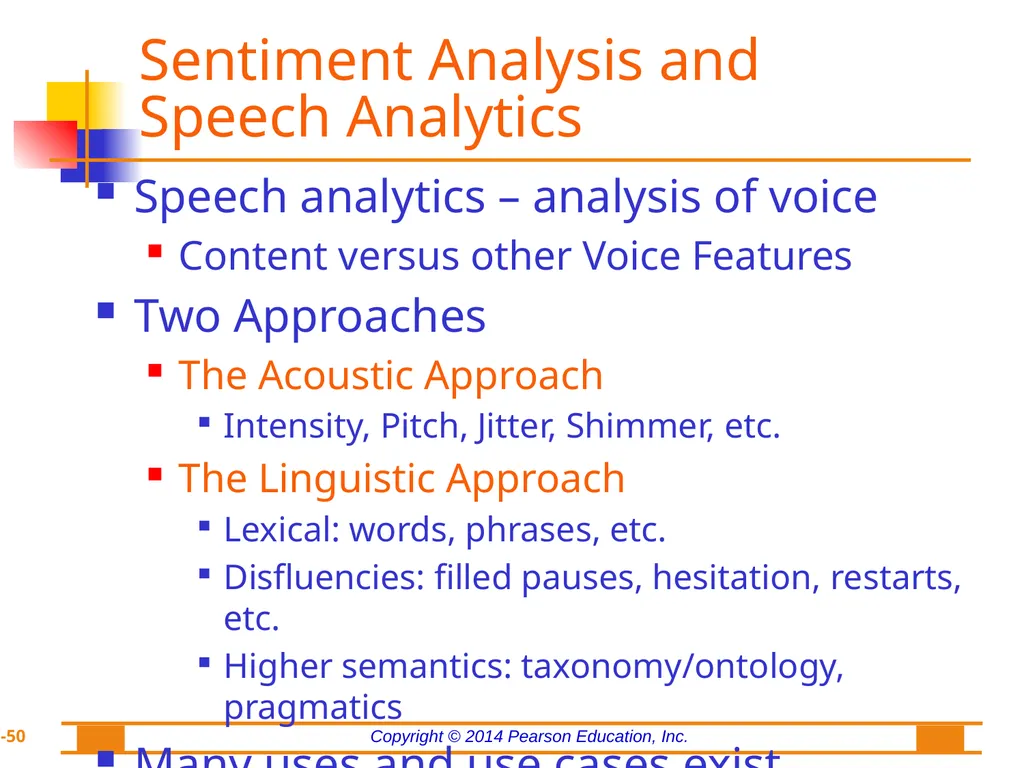
slide50. Sentiment Analysis and Speech Analytics Speech analytics – analysis of voice
Content versus other Voice Features
Two Approaches
The Acoustic Approach
Intensity, Pitch, Jitter, Shimmer, etc.
The Linguistic Approach
Lexical: words, phrases, etc.
Disfluencies: filled pauses, hesitation, restarts, etc.
Higher semantics: taxonomy/ontology, pragmatics
Many uses and use cases exist<br>
slide51. Application Case 7.8 Cutting Through the Confusion: Blue Cross Blue Shield of North Carolina Uses Nexidia’s Speech Analytics to Ease Member Experience in Healthcare
Questions for Discussion
For a large company like BCBSNC with a lot of customers, what does “listening to customer” mean?
What were the challenges, the proposed solution, and the obtained results for BCBSNC?<br>
slide52. End of the Chapter Questions, comments<br>
slide53. All rights reserved. No part of this publication may be reproduced, stored in a retrieval system, or transmitted, in any form or by any means, electronic, mechanical, photocopying, recording, or otherwise, without the prior written permission of the publisher. Printed in the United States of America.<br>
Text Analytics, Text Mining, and Sentiment Analysis Business Intelligence and Analytics: Systems for Decision Support
(10th Edition)<br>
slide2. Learning Objectives Describe text mining and understand the need for text mining
Differentiate between text mining, Web mining, and data mining
Understand the different application areas for text mining
Know the process of carrying out a text mining project
Understand the different methods to introduce structure to text-based data (Continued…)<br>
slide3. Learning Objectives Describe sentiment analysis
Develop familiarity with popular applications of sentiment analysis
Learn the common methods for sentiment analysis
Become familiar with speech analytics as it relates to sentiment analysis<br>
slide4. Opening Vignette… Machine Versus Men on Jeopardy!: The Story of Watson
Situation
Problem
Solution
Results
Answer & discuss the case questions... Watch it on YouTube!
https://www.youtube.com/watch?v=YLR1byL0U8M<br>
slide5. Questions for the Opening Vignette What is Watson? What is special about it?
What technologies were used in building Watson (both hardware and software)?
What are the innovative characteristics of DeepQA architecture that made Watson superior?
Why did IBM spend all that time and money to build Watson? Where is the ROI?<br>
slide6. A High-Level Depiction of IBM Watson’s DeepQA Architecture<br>
slide7. Text Mining Concepts 85-90 percent of all corporate data is in some kind of unstructured form (e.g., text)
Unstructured corporate data is doubling in size every 18 months
Tapping into these information sources is not an option, but a need to stay competitive
Answer: text mining
A semi-automated process of extracting knowledge from unstructured data sources
a.k.a. text data mining or knowledge discovery in textual databases<br>
slide8. Text Analytics and Text Mining<br>
slide9. Data Mining versus Text Mining Both seek for novel and useful patterns
Both are semi-automated processes
Difference is the nature of the data:
Structured versus unstructured data
Structured data: in databases
Unstructured data: Word documents, PDF files, text excerpts, XML files, and so on
Text mining – first, impose structure to the data, then mine the structured data.<br>
slide10. Text Mining Concepts Benefits of text mining are obvious, especially in text-rich data environments
e.g., law (court orders), academic research (research articles), finance (quarterly reports), medicine (discharge summaries), biology (molecular interactions), technology (patent files), marketing (customer comments), etc.
Electronic communication records (e.g., Email)
Spam filtering
Email prioritization and categorization
Automatic response generation<br>
slide11. Text Mining Application Area Information extraction
Topic tracking
Summarization
Categorization
Clustering
Concept linking
Question answering<br>
slide12. Text Mining Terminology Unstructured or semi-structured data
Corpus (and corpora)
Terms
Concepts
Stemming
Stop words (and include words)
Synonyms (and polysemes)
Tokenizing<br>
slide13. Text Mining Terminology Term dictionary
Word frequency
Part-of-speech tagging
Morphology
Term-by-document matrix
Occurrence matrix
Singular value decomposition
Latent semantic indexing<br>
slide14. Application Case 7.1 Text Mining for Patent Analysis What is a patent?
“exclusive rights granted by a country to an inventor for a limited period of time in exchange for a disclosure of an invention”
How do we do patent analysis (PA)?
Why do we need to do PA?
What are the benefits?
What are the challenges?
How does text mining help in PA?<br>
slide15. Natural Language Processing (NLP) Structuring a collection of text
Old approach: bag-of-words
New approach: natural language processing
NLP is …
a very important concept in text mining
a subfield of artificial intelligence and computational linguistics
the studies of "understanding" the natural human language
Syntax versus semantics-based text mining<br>
slide16. Natural Language Processing (NLP) What is “Understanding” ?
Human understands, what about computers?
Natural language is vague, context driven
True understanding requires extensive knowledge of a topic
Can/will computers ever understand natural language the same/accurate way we do?<br>
slide17. Natural Language Processing (NLP) Challenges in NLP
Part-of-speech tagging
Text segmentation
Word sense disambiguation
Syntax ambiguity
Imperfect or irregular input
Speech acts
Dream of AI community
to have algorithms that are capable of automatically reading and obtaining knowledge from text<br>
slide18. Natural Language Processing (NLP) WordNet
A laboriously hand-coded database of English words, their definitions, sets of synonyms, and various semantic relations between synonym sets.
A major resource for NLP.
Need automation to be completed.
Sentiment Analysis
A technique used to detect favorable and unfavorable opinions toward specific products and services
SentiWordNet<br>
slide19. Application Case 7.2 Text Mining Improves Hong Kong Government’s Ability to Anticipate and Address Public Complaints
Questions for Discussion
How did the Hong Kong government use text mining to better serve its constituents?
What were the challenges, the proposed solution, and the obtained results?<br>
slide20. NLP Task Categories Information retrieval, information extraction
Named-entity recognition
Question answering
Automatic summarization
Natural language generation & understanding
Machine translation
Foreign language reading & writing
Speech recognition
Text proofing, optical character recognition<br>
slide21. Text Mining Applications Marketing applications
Enables better CRM
Security applications
ECHELON, OASIS
Deception detection (…)
Medicine and biology
Literature-based gene identification (…)
Academic applications
Research stream analysis<br>
slide22. Application Case 7.3 Mining for Lies!
Deception detection
A difficult problem
If detection is limited to only text, then the problem is even more difficult
The study
analyzed text-based testimonies of persons of interest at military bases
used only text-based features (cues)<br>
slide23. Application Case 7.3 Mining for Lies<br>
slide24. Application Case 7.3 Mining for Lies<br>
slide25. Application Case 7.3 Mining for Lies 371 usable statements are generated
31 features are used
Different feature selection methods used
10-fold cross validation is used
Results (overall % accuracy)
Logistic regression 67.28
Decision trees 71.60
Neural networks 73.46<br>
slide26. Text Mining Applications (Gene/Protein Interaction Identification)<br>
slide27. Application Case 7.4 Text mining and Sentiment Analysis Help Improve Customer Service Performance
Questions for Discussion
How did the financial services firm use text mining and text analytics to improve its customer service performance?
What were the challenges, the proposed solution, and the obtained results?<br>
slide28. Text Mining Process Context diagram for the text mining process<br>
slide29. Text Mining Process The three-step text mining process<br>
slide30. Text Mining Process Step 1: Establish the corpus
Collect all relevant unstructured data (e.g., textual documents, XML files, emails, Web pages, short notes, voice recordings…)
Digitize, standardize the collection (e.g., all in ASCII text files)
Place the collection in a common place (e.g., in a flat file, or in a directory as separate files)<br>
slide31. Text Mining Process Step 2: Create the Term-by-Document Matrix (TDM)<br>
slide32. Text Mining Process Step 2: Create the Term-by-Document Matrix (TDM)
Should all terms be included?
Stop words, include words
Synonyms, homonyms
Stemming
What is the best representation of the indices (values in cells)?
Row counts; binary frequencies; log frequencies;
Inverse document frequency<br>
slide33. Text Mining Process Step 2: Create the Term–by–Document Matrix (TDM)
TDM is a sparse matrix. How can we reduce the dimensionality of the TDM?
Manual - a domain expert goes through it
Eliminate terms with very few occurrences in very few documents (?)
Transform the matrix using singular value decomposition (SVD)
SVD is similar to principle component analysis<br>
slide34. Text Mining Process Step 3: Extract patterns/knowledge
Classification (text categorization)
Clustering (natural groupings of text)
Improve search recall
Improve search precision
Scatter/gather
Query-specific clustering
Association
Trend Analysis (…)<br>
slide35. Application Case 7.5 (Research Literature Survey with Text Mining) Mining the published IS literature
MIS Quarterly (MISQ)
Journal of MIS (JMIS)
Information Systems Research (ISR)
Covers 12-year period (1994-2005)
901 papers are included in the study
Only the paper abstracts are used
9 clusters are generated for further analysis<br>
slide36. Application Case 7.5 (Research Literature Survey with Text Mining)<br>
slide37. Application Case 7.5 (Research Literature Survey with Text Mining)<br>
slide38. Application Case 7.5 (Research Literature Survey with Text Mining)<br>
slide39. Text Mining Tools Commercial Software Tools
IBM SPSS Modler - Text Miner
SAS Enterprise Miner – Text Miner
Statistical Data Miner – Text Miner
ClearForest, …
Free Software Tools
RapidMiner
GATE
Spy-EM, …<br>
slide40. Application Case 7.6 A Potpourri of Text Mining Case Synopses
Alberta’s Parks Division gains insight from unstructured data
American Honda Saves Millions by Using Text and Data Mining
MaspexWadowice Group Analyzes Online Brand Image with Text Mining
Viseca Card Services Reduces Fraud Loss with Text Analytics
Improving Quality with Text Mining and Advanced Analytics<br>
slide41. Sentiment Analysis Overview Sentiment belief, view, opinion, conviction
Sentiment analysis opinion mining, subjectivity analysis, and appraisal extraction
The goal is to answer the question:
“What do people feel about a certain topic?”
Explicit versus Implicit sentiment
Sentiment polarity
Positive versus Negative
… versus Neutral?<br>
slide42. Example – Real-Time Social Signal (by Attensity)<br>
slide43. Application Case 7.7 Whirlpool Achieves Customer Loyalty and Product Success with Text Analytics
Questions for Discussion
How did Whirlpool use capabilities of text analytics to better understand their customers and improve product offerings?
What were the challenges, the proposed solution, and the obtained results?<br>
slide44. Sentiment Analysis Applications Voice of the customer (VOC)
Voice of the Market (VOM)
Voice of the Employee (VOE)
Brand Management
Financial Markets
Politics
Government Intelligence
… others<br>
slide45. Sentiment Analysis Process<br>
slide46. Sentiment Analysis Process Step 1 – Sentiment Detection
Comes right after the retrieval and preparation of the text documents
It is also called detection of objectivity
Fact [= objectivity] versus Opinion [= subjectivity]
Step 2 – N-P Polarity Classification
Given an opinionated piece of text, the goal is to classify the opinion as falling under one of two opposing sentiment polarities
N [= negative] versus P [= positive]<br>
slide47. Sentiment Analysis Process Step 3 – Target Identification
The goal of this step is to accurately identify the target of the expressed sentiment (e.g., a person, a product, an event, etc.)
Level of difficulty the application domain
Step 4 – Collection and Aggregation
Once the sentiments of all text data points in the document are identified and calculated, they are to be aggregated
Word Statement Paragraph Document<br>
slide48. Sentiment Analysis Methods for Polarity Identification Polarity Identification – P vs. N
Can be made at the level of word, term, sentence, paragraph, document
Two competing methods
Using a lexicon
WordNet [wordnet.princeton.edu]
SentiWordNet [sentiwordnet.isti.cnr.it]
Using pre-classified training documents
Data mining / machine learning<br>
slide49. P-N Polarity and S-O Polarity<br>
slide50. Sentiment Analysis and Speech Analytics Speech analytics – analysis of voice
Content versus other Voice Features
Two Approaches
The Acoustic Approach
Intensity, Pitch, Jitter, Shimmer, etc.
The Linguistic Approach
Lexical: words, phrases, etc.
Disfluencies: filled pauses, hesitation, restarts, etc.
Higher semantics: taxonomy/ontology, pragmatics
Many uses and use cases exist<br>
slide51. Application Case 7.8 Cutting Through the Confusion: Blue Cross Blue Shield of North Carolina Uses Nexidia’s Speech Analytics to Ease Member Experience in Healthcare
Questions for Discussion
For a large company like BCBSNC with a lot of customers, what does “listening to customer” mean?
What were the challenges, the proposed solution, and the obtained results for BCBSNC?<br>
slide52. End of the Chapter Questions, comments<br>
slide53. All rights reserved. No part of this publication may be reproduced, stored in a retrieval system, or transmitted, in any form or by any means, electronic, mechanical, photocopying, recording, or otherwise, without the prior written permission of the publisher. Printed in the United States of America.<br>