
Chapter 8: Complex Data Types Outline
Description: Chapter 8: Complex Data Types Outline Semi-Structured Data Object Orientation Textual Data Spatial Data Semi-Structured Data Many applications require storage of complex data, whose schema changes often The relational models requirement of
Related Topics
Download Presentation
"Chapter 8: Complex Data Types Outline" is the property of its rightful owner. Permission is granted to download and print the materials on this website for personal, non-commercial use only, and to display it on your personal computer provided you do not modify the materials and that you retain all copyright notices contained in the materials. By downloading content from our website, you accept the terms of this agreement.
Presentation Transcript
slide1. Chapter 8: Complex Data Types<br>
slide2. Outline Semi-Structured Data
Object Orientation
Textual Data
Spatial Data<br>
slide3. Semi-Structured Data Many applications require storage of complex data, whose schema changes often
The relational model’s requirement of atomic data types may be an overkill
E.g., storing set of interests as a set-valued attribute of a user profile may be simpler than normalizing it
Data exchange can benefit greatly from semi-structured data
Exchange can be between applications, or between back-end and front-end of an application
Web-services are widely used today, with complex data fetched to the front-end and displayed using a mobile app or JavaScript
JSON and XML are widely used semi-structured data models<br>
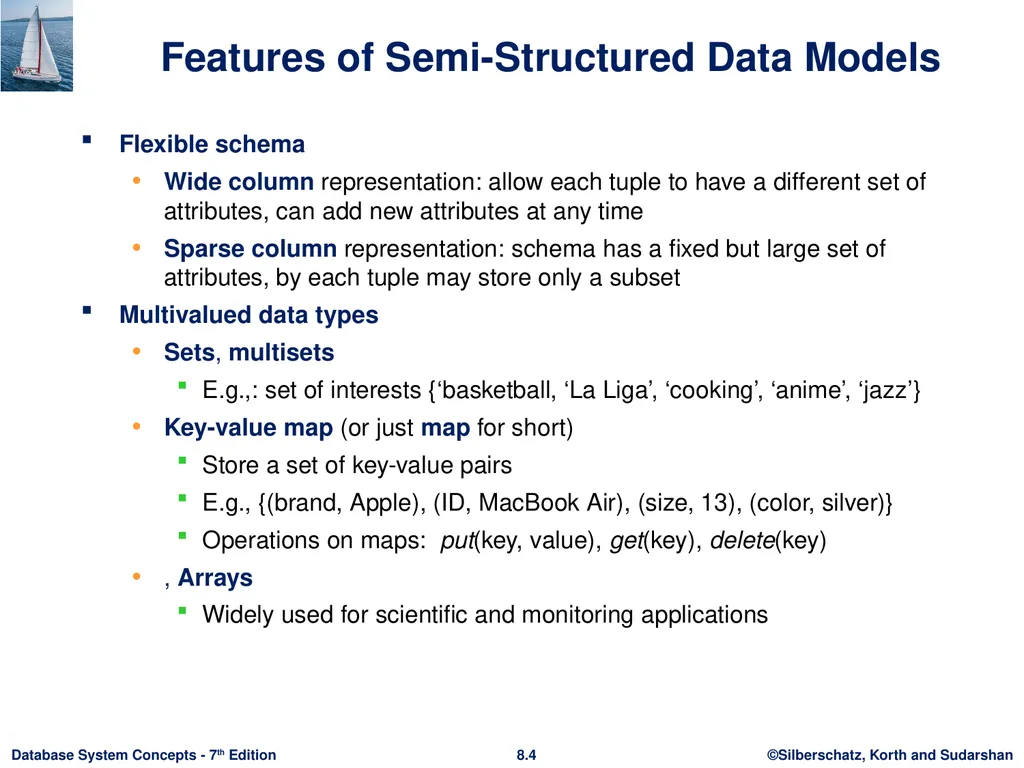
slide4. Features of Semi-Structured Data Models Flexible schema
Wide column representation: allow each tuple to have a different set of attributes, can add new attributes at any time
Sparse column representation: schema has a fixed but large set of attributes, by each tuple may store only a subset
Multivalued data types
Sets, multisets
E.g.,: set of interests {‘basketball, ‘La Liga’, ‘cooking’, ‘anime’, ‘jazz’}
Key-value map (or just map for short)
Store a set of key-value pairs
E.g., {(brand, Apple), (ID, MacBook Air), (size, 13), (color, silver)}
Operations on maps: put(key, value), get(key), delete(key)
, Arrays
Widely used for scientific and monitoring applications<br>
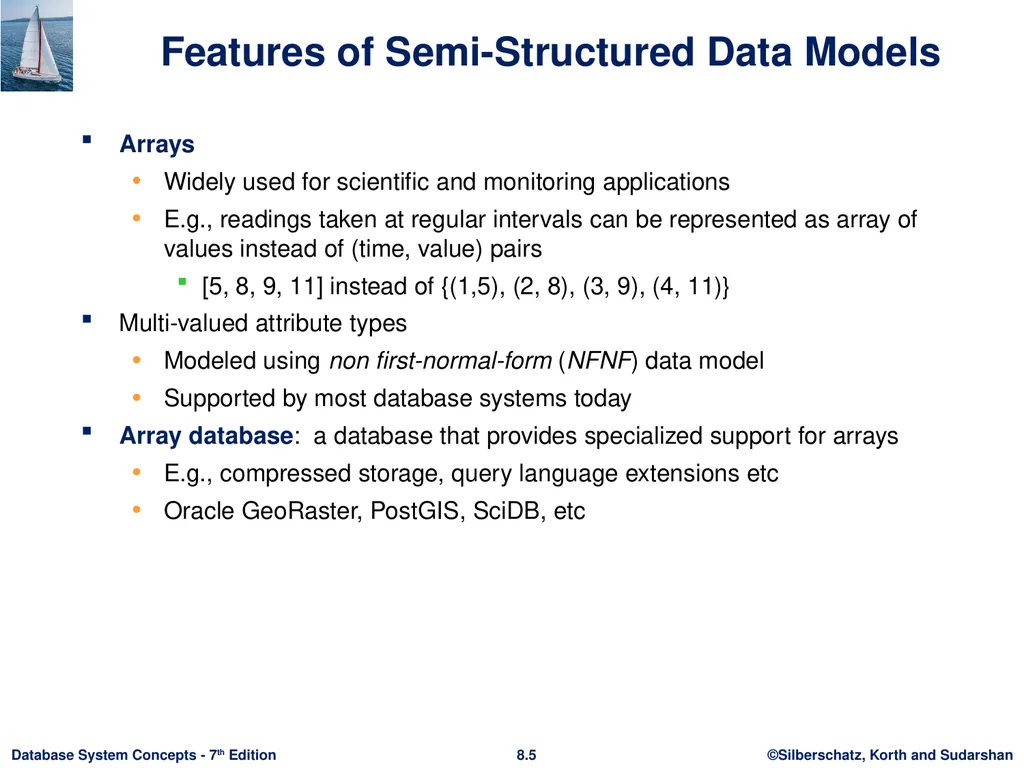
slide5. Features of Semi-Structured Data Models Arrays
Widely used for scientific and monitoring applications
E.g., readings taken at regular intervals can be represented as array of values instead of (time, value) pairs
[5, 8, 9, 11] instead of {(1,5), (2, 8), (3, 9), (4, 11)}
Multi-valued attribute types
Modeled using non first-normal-form (NFNF) data model
Supported by most database systems today
Array database: a database that provides specialized support for arrays
E.g., compressed storage, query language extensions etc
Oracle GeoRaster, PostGIS, SciDB, etc<br>
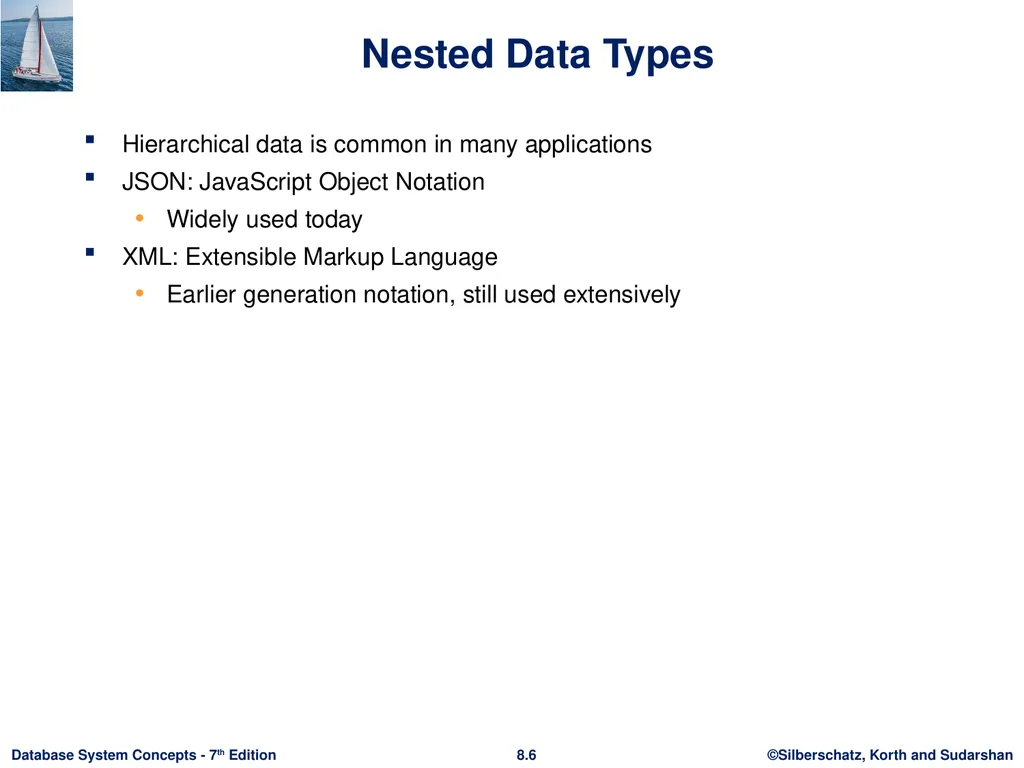
slide6. Nested Data Types Hierarchical data is common in many applications
JSON: JavaScript Object Notation
Widely used today
XML: Extensible Markup Language
Earlier generation notation, still used extensively<br>
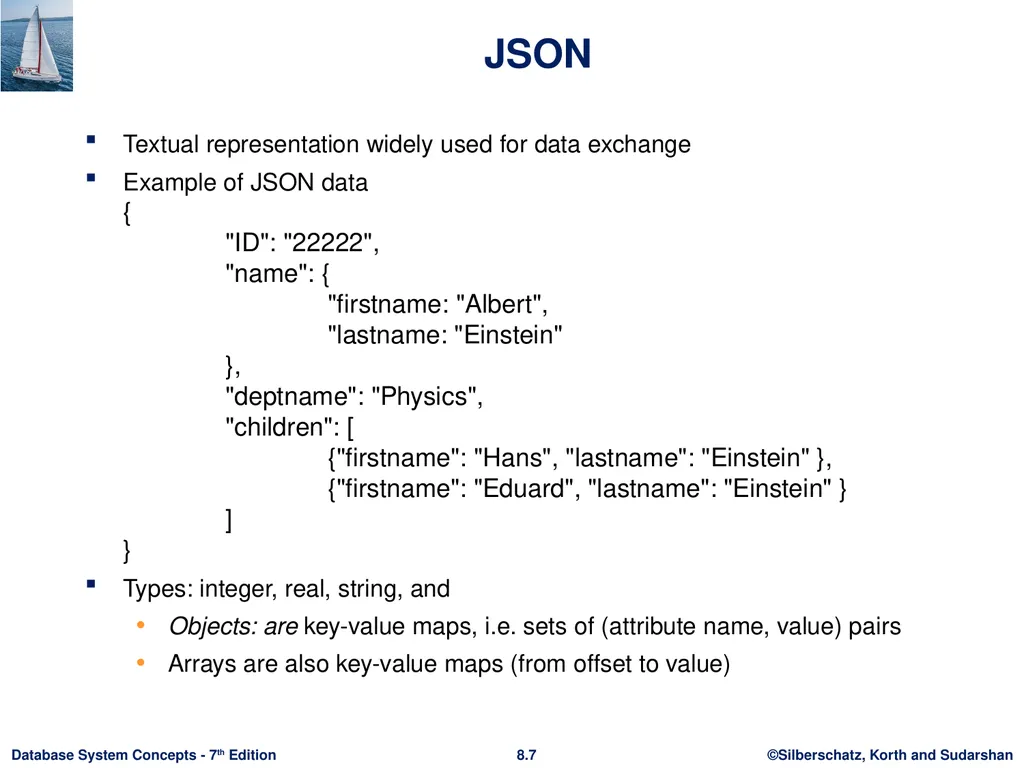
slide7. JSON Textual representation widely used for data exchange
Example of JSON data { "ID": "22222", "name": { "firstname: "Albert", "lastname: "Einstein" }, "deptname": "Physics", "children": [ {"firstname": "Hans", "lastname": "Einstein" }, {"firstname": "Eduard", "lastname": "Einstein" } ] }
Types: integer, real, string, and
Objects: are key-value maps, i.e. sets of (attribute name, value) pairs
Arrays are also key-value maps (from offset to value)<br>
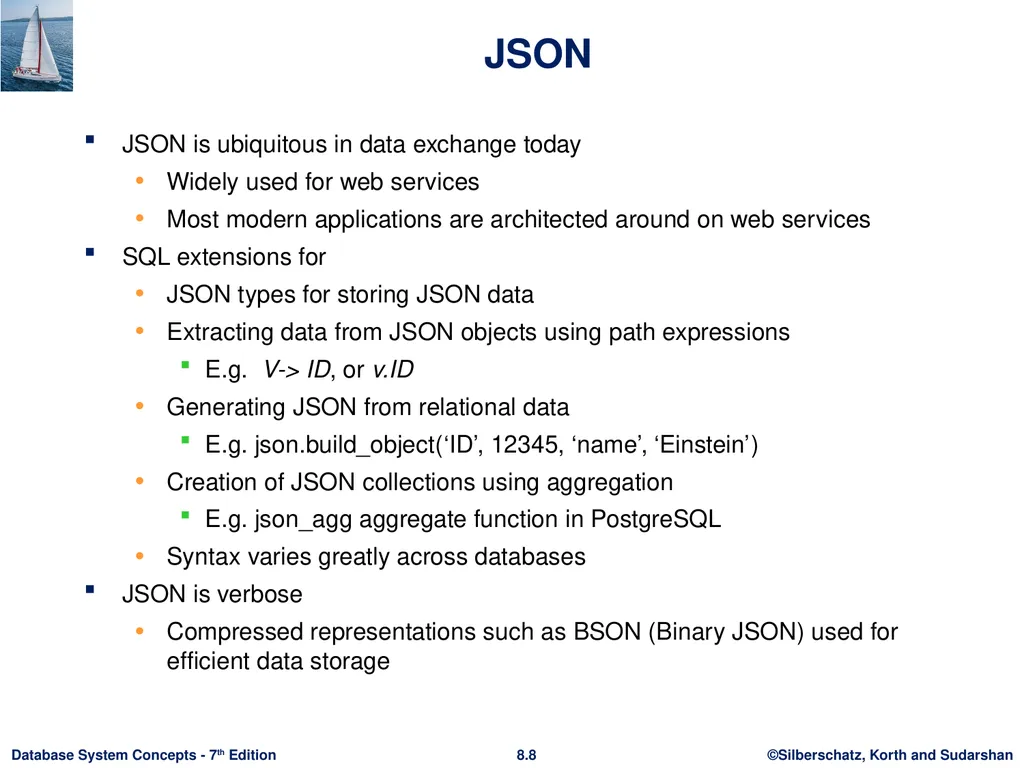
slide8. JSON JSON is ubiquitous in data exchange today
Widely used for web services
Most modern applications are architected around on web services
SQL extensions for
JSON types for storing JSON data
Extracting data from JSON objects using path expressions
E.g. V-> ID, or v.ID
Generating JSON from relational data
E.g. json.build_object(‘ID’, 12345, ‘name’, ‘Einstein’)
Creation of JSON collections using aggregation
E.g. json_agg aggregate function in PostgreSQL
Syntax varies greatly across databases
JSON is verbose
Compressed representations such as BSON (Binary JSON) used for efficient data storage<br>
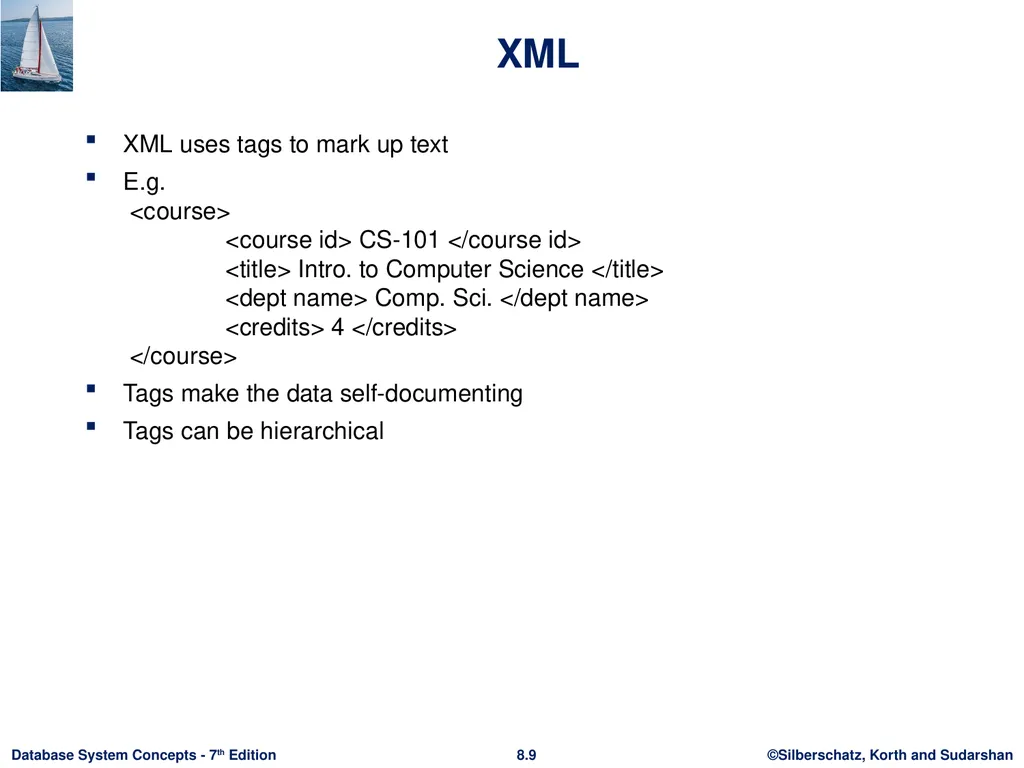
slide9. XML XML uses tags to mark up text
E.g. <course> <course id> CS-101 </course id> <title> Intro. to Computer Science </title> <dept name> Comp. Sci. </dept name> <credits> 4 </credits> </course>
Tags make the data self-documenting
Tags can be hierarchical<br>
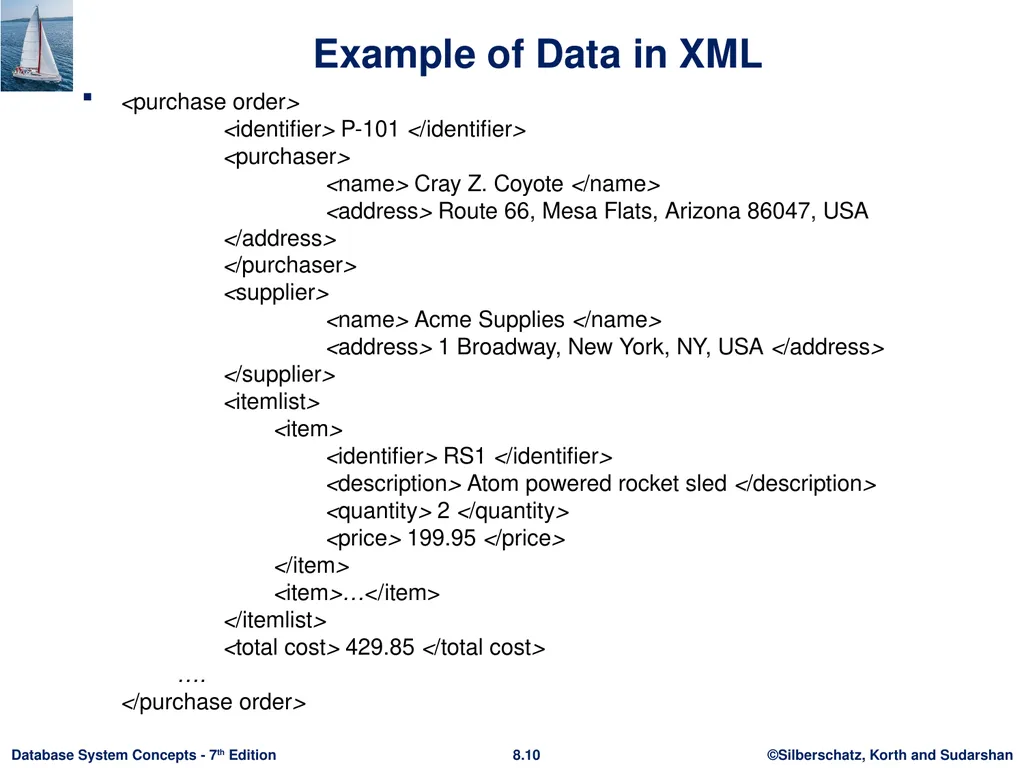
slide10. Example of Data in XML <purchase order> <identifier> P-101 </identifier> <purchaser> <name> Cray Z. Coyote </name> <address> Route 66, Mesa Flats, Arizona 86047, USA </address> </purchaser> <supplier> <name> Acme Supplies </name> <address> 1 Broadway, New York, NY, USA </address> </supplier> <itemlist> <item> <identifier> RS1 </identifier> <description> Atom powered rocket sled </description> <quantity> 2 </quantity> <price> 199.95 </price> </item> <item>…</item> </itemlist> <total cost> 429.85 </total cost> …. </purchase order><br>
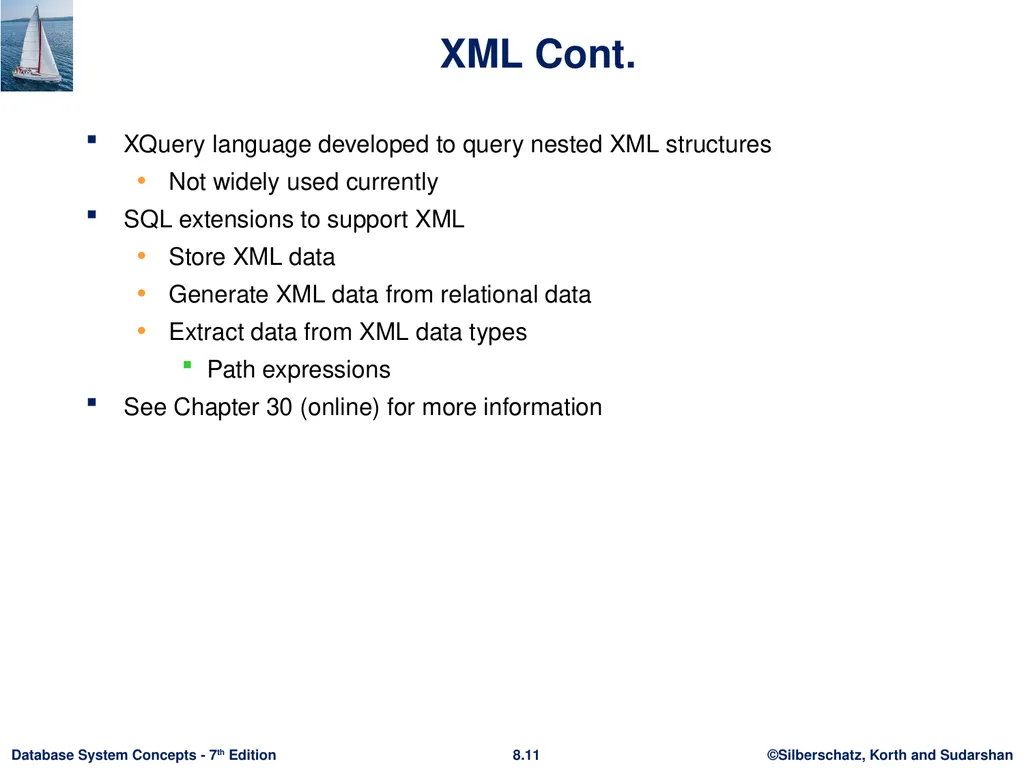
slide11. XML Cont. XQuery language developed to query nested XML structures
Not widely used currently
SQL extensions to support XML
Store XML data
Generate XML data from relational data
Extract data from XML data types
Path expressions
See Chapter 30 (online) for more information<br>
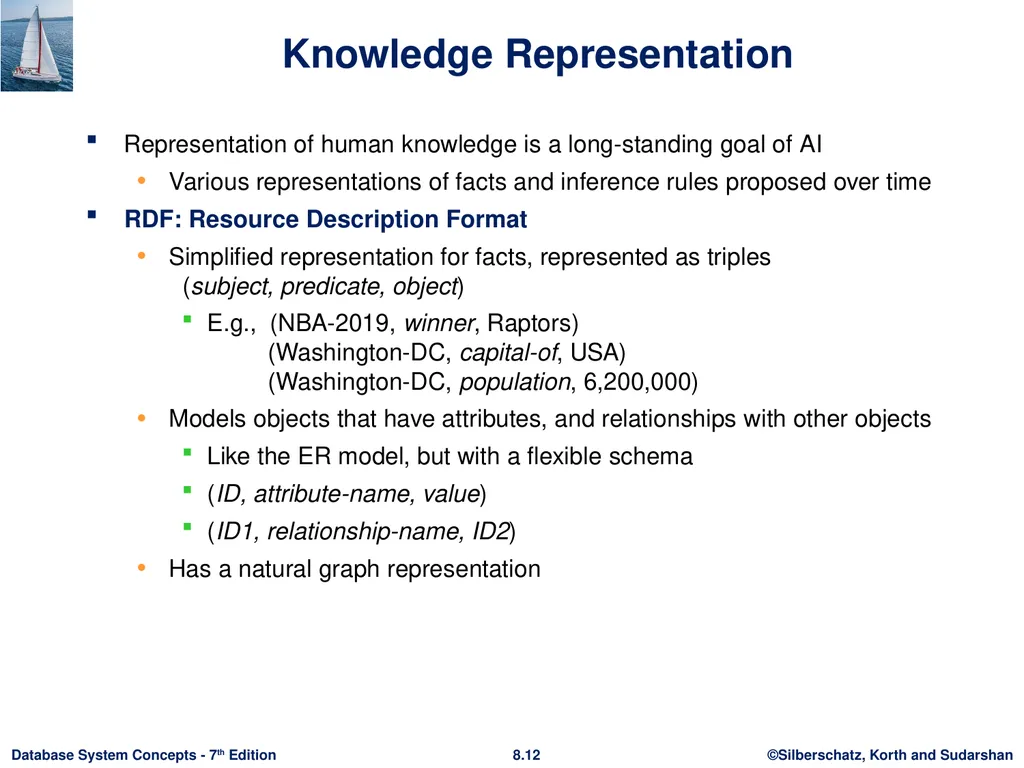
slide12. Knowledge Representation Representation of human knowledge is a long-standing goal of AI
Various representations of facts and inference rules proposed over time
RDF: Resource Description Format
Simplified representation for facts, represented as triples (subject, predicate, object)
E.g., (NBA-2019, winner, Raptors) (Washington-DC, capital-of, USA) (Washington-DC, population, 6,200,000)
Models objects that have attributes, and relationships with other objects
Like the ER model, but with a flexible schema
(ID, attribute-name, value)
(ID1, relationship-name, ID2)
Has a natural graph representation<br>
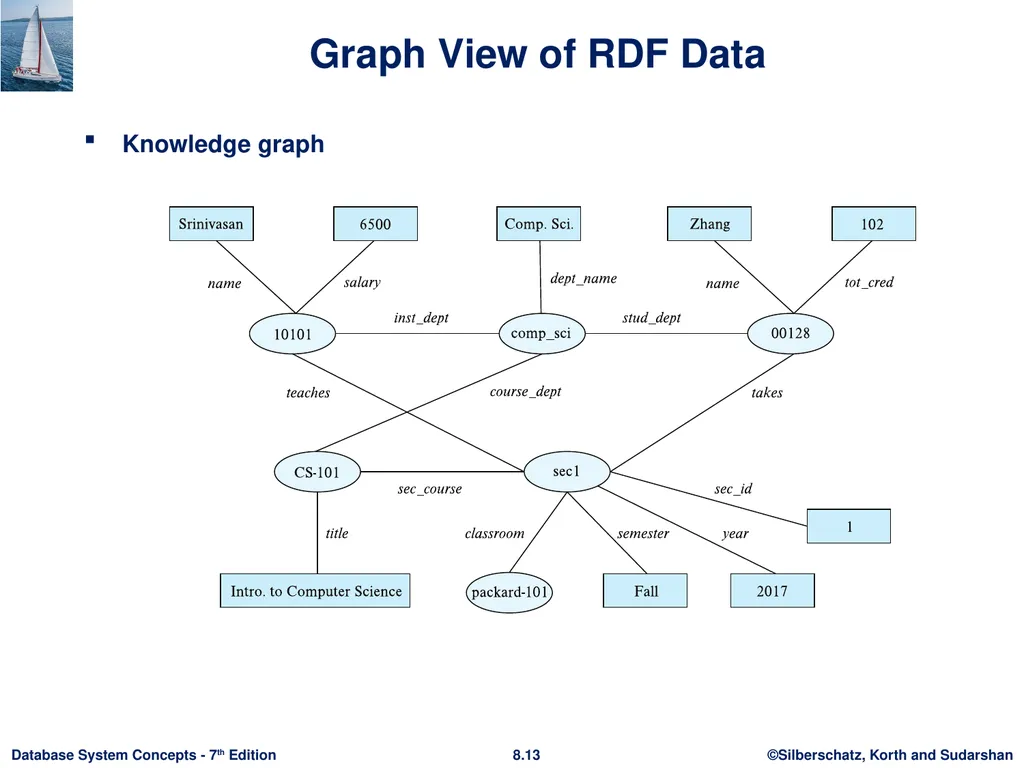
slide13. Graph View of RDF Data Knowledge graph<br>
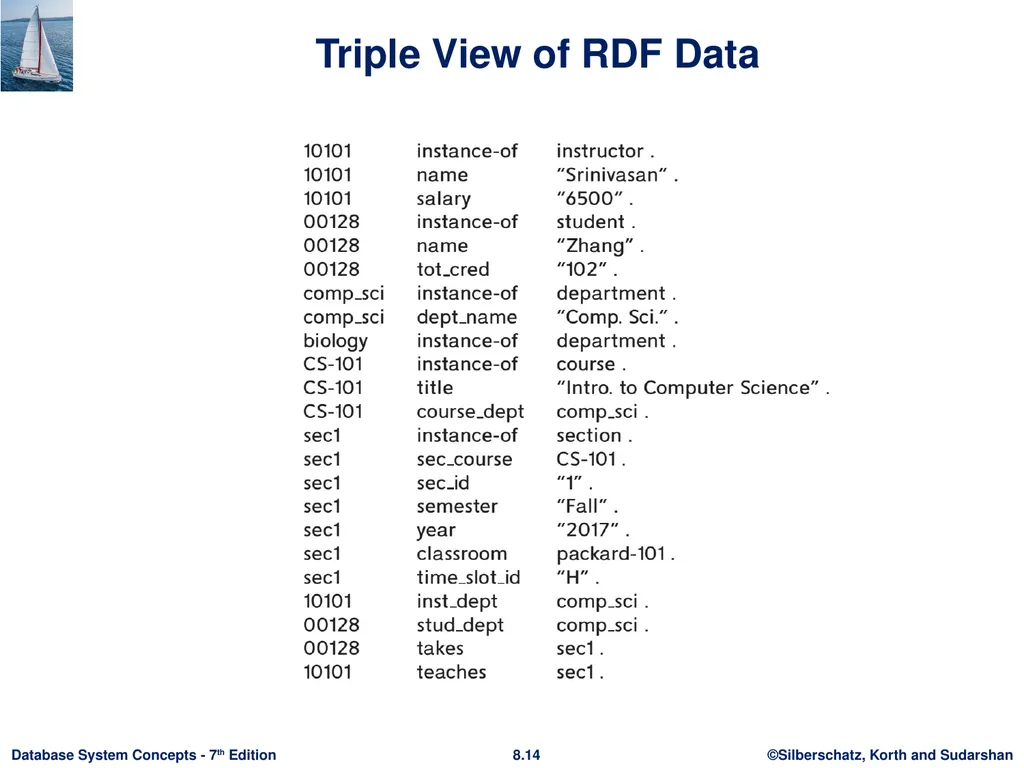
slide14. Triple View of RDF Data<br>
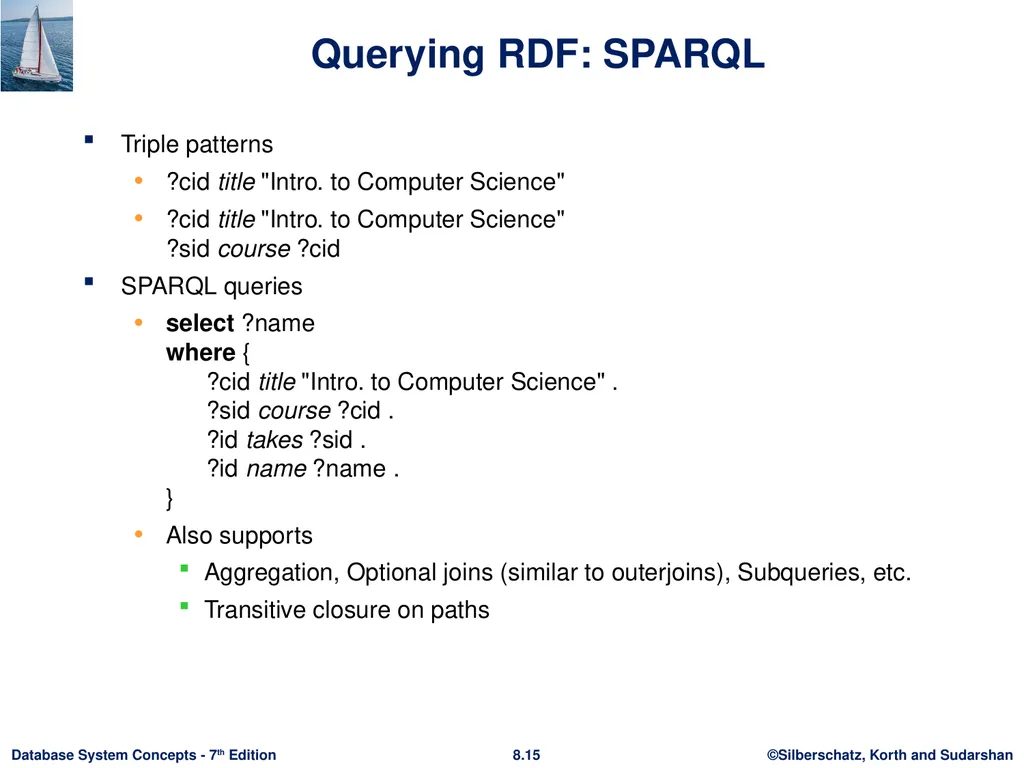
slide15. Querying RDF: SPARQL Triple patterns
?cid title "Intro. to Computer Science"
?cid title "Intro. to Computer Science" ?sid course ?cid
SPARQL queries
select ?name where { ?cid title "Intro. to Computer Science" . ?sid course ?cid . ?id takes ?sid . ?id name ?name . }
Also supports
Aggregation, Optional joins (similar to outerjoins), Subqueries, etc.
Transitive closure on paths<br>
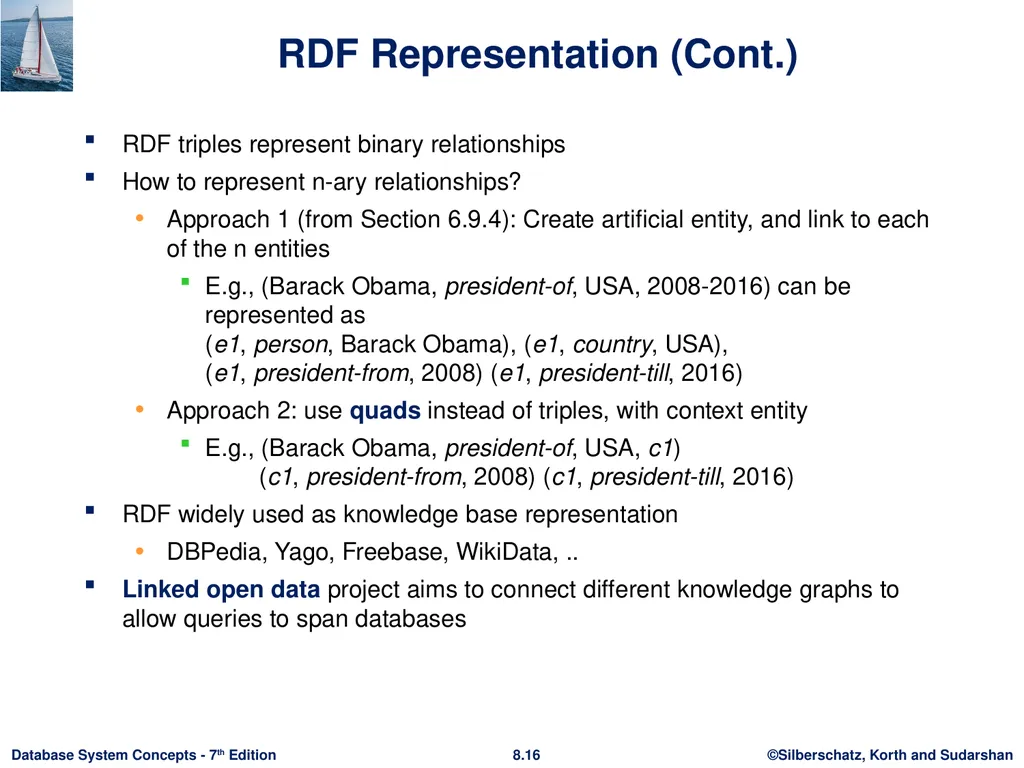
slide16. RDF Representation (Cont.) RDF triples represent binary relationships
How to represent n-ary relationships?
Approach 1 (from Section 6.9.4): Create artificial entity, and link to each of the n entities
E.g., (Barack Obama, president-of, USA, 2008-2016) can be represented as (e1, person, Barack Obama), (e1, country, USA), (e1, president-from, 2008) (e1, president-till, 2016)
Approach 2: use quads instead of triples, with context entity
E.g., (Barack Obama, president-of, USA, c1) (c1, president-from, 2008) (c1, president-till, 2016)
RDF widely used as knowledge base representation
DBPedia, Yago, Freebase, WikiData, ..
Linked open data project aims to connect different knowledge graphs to allow queries to span databases<br>
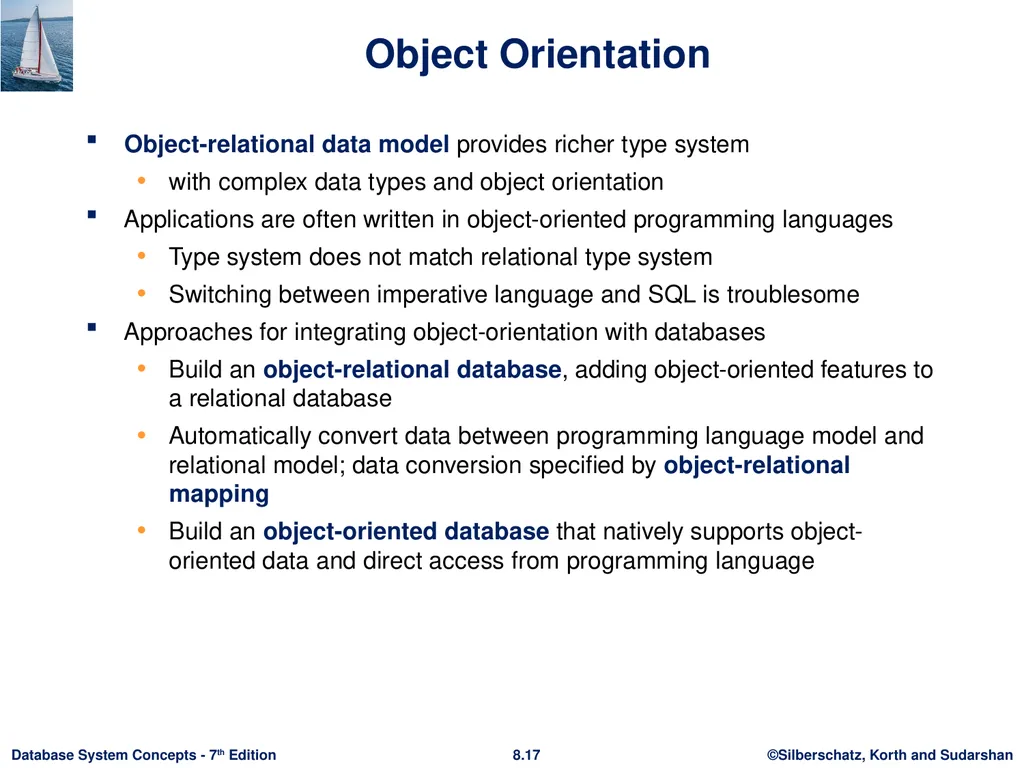
slide17. Object Orientation Object-relational data model provides richer type system
with complex data types and object orientation
Applications are often written in object-oriented programming languages
Type system does not match relational type system
Switching between imperative language and SQL is troublesome
Approaches for integrating object-orientation with databases
Build an object-relational database, adding object-oriented features to a relational database
Automatically convert data between programming language model and relational model; data conversion specified by object-relational mapping
Build an object-oriented database that natively supports object-oriented data and direct access from programming language<br>
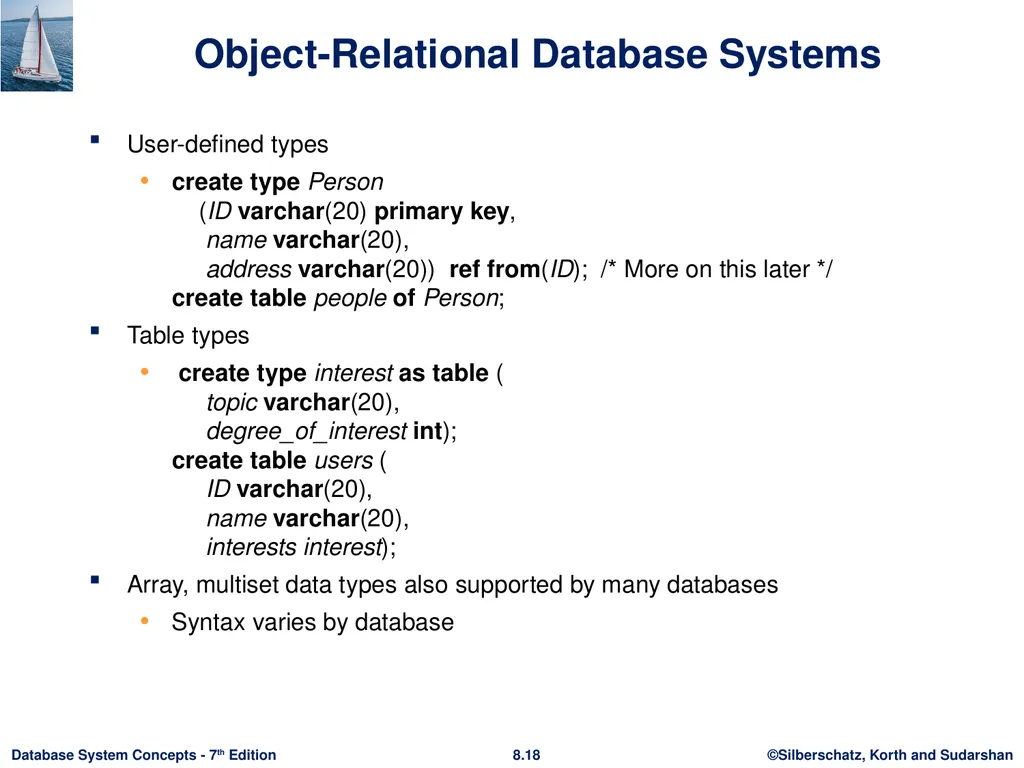
slide18. Object-Relational Database Systems User-defined types
create type Person (ID varchar(20) primary key, name varchar(20), address varchar(20)) ref from(ID); /* More on this later */ create table people of Person;
Table types
create type interest as table ( topic varchar(20), degree_of_interest int); create table users ( ID varchar(20), name varchar(20), interests interest);
Array, multiset data types also supported by many databases
Syntax varies by database<br>
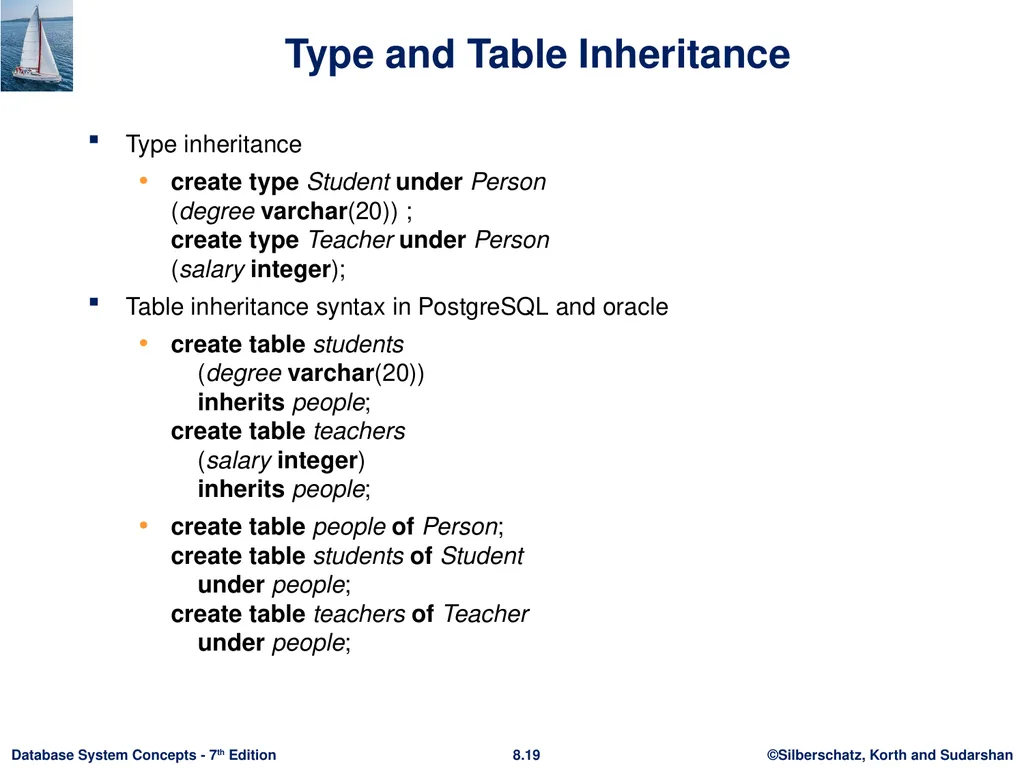
slide19. Type and Table Inheritance Type inheritance
create type Student under Person (degree varchar(20)) ; create type Teacher under Person (salary integer);
Table inheritance syntax in PostgreSQL and oracle
create table students (degree varchar(20)) inherits people; create table teachers (salary integer) inherits people;
create table people of Person; create table students of Student under people; create table teachers of Teacher under people;<br>
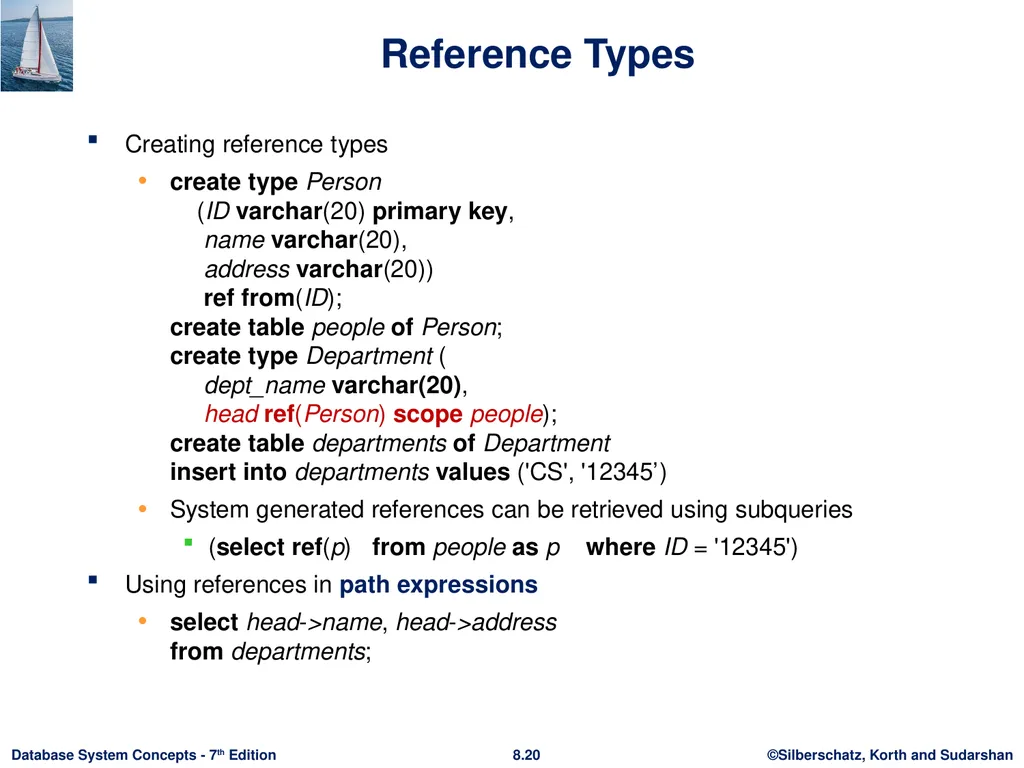
slide20. Reference Types Creating reference types
create type Person (ID varchar(20) primary key, name varchar(20), address varchar(20)) ref from(ID); create table people of Person; create type Department ( dept_name varchar(20), head ref(Person) scope people); create table departments of Department insert into departments values ('CS', '12345’)
System generated references can be retrieved using subqueries
(select ref(p) from people as p where ID = '12345')
Using references in path expressions
select head->name, head->address from departments;<br>
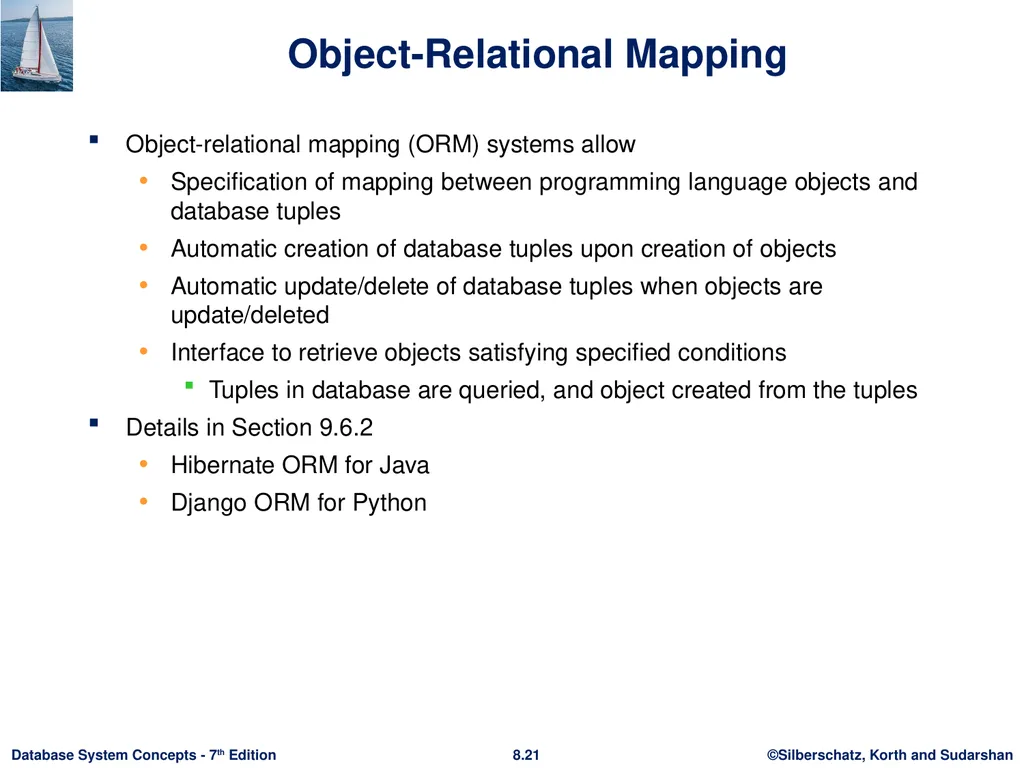
slide21. Object-Relational Mapping Object-relational mapping (ORM) systems allow
Specification of mapping between programming language objects and database tuples
Automatic creation of database tuples upon creation of objects
Automatic update/delete of database tuples when objects are update/deleted
Interface to retrieve objects satisfying specified conditions
Tuples in database are queried, and object created from the tuples
Details in Section 9.6.2
Hibernate ORM for Java
Django ORM for Python<br>
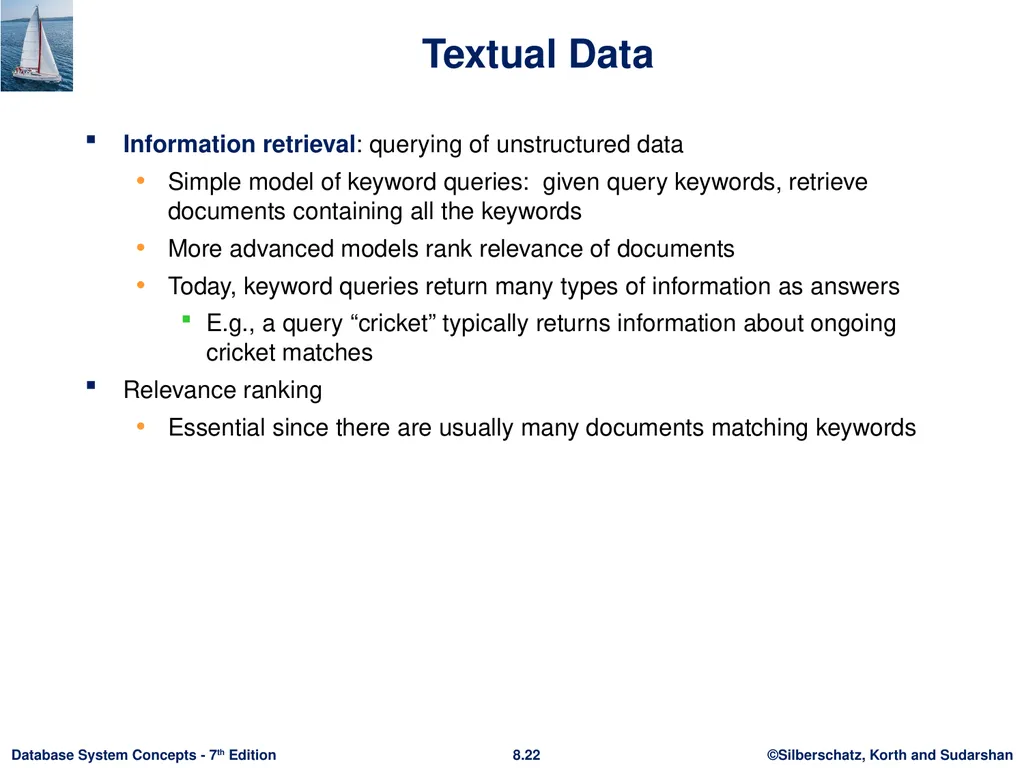
slide22. Textual Data Information retrieval: querying of unstructured data
Simple model of keyword queries: given query keywords, retrieve documents containing all the keywords
More advanced models rank relevance of documents
Today, keyword queries return many types of information as answers
E.g., a query “cricket” typically returns information about ongoing cricket matches
Relevance ranking
Essential since there are usually many documents matching keywords<br>
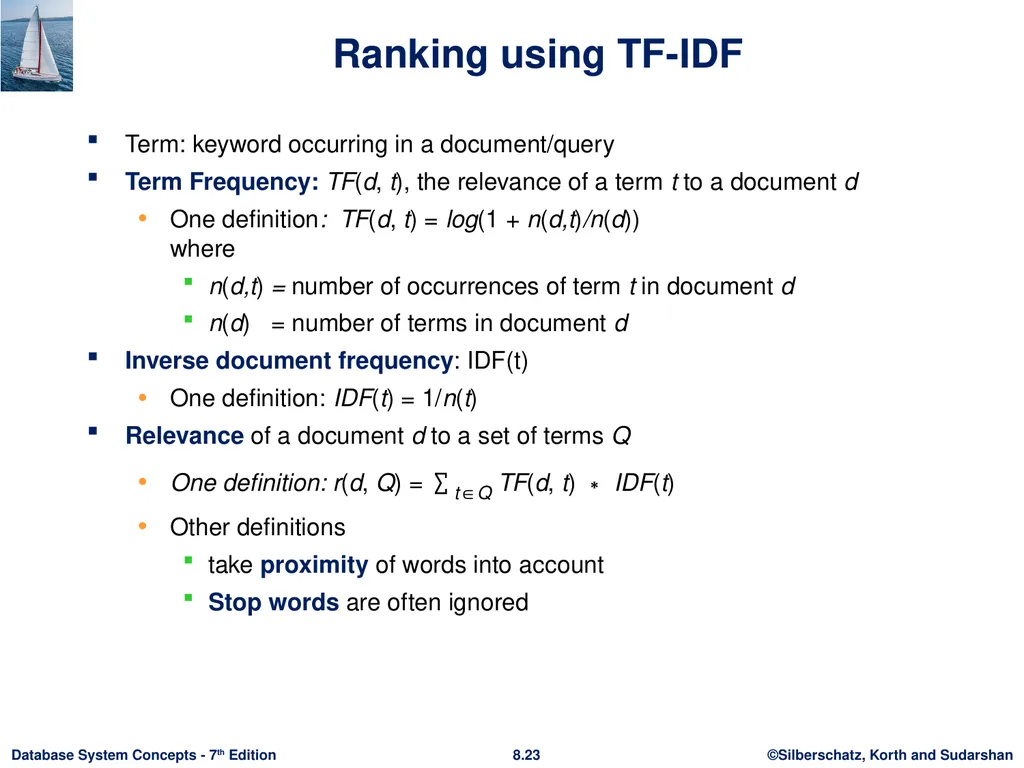
slide23. Ranking using TF-IDF Term: keyword occurring in a document/query
Term Frequency: TF(d, t), the relevance of a term t to a document d
One definition: TF(d, t) = log(1 + n(d,t)/n(d)) where
n(d,t) = number of occurrences of term t in document d
n(d) = number of terms in document d
Inverse document frequency: IDF(t)
One definition: IDF(t) = 1/n(t)
Relevance of a document d to a set of terms Q
One definition: r(d, Q) = ∑t∈Q TF(d, t) ∗ IDF(t)
Other definitions
take proximity of words into account
Stop words are often ignored<br>
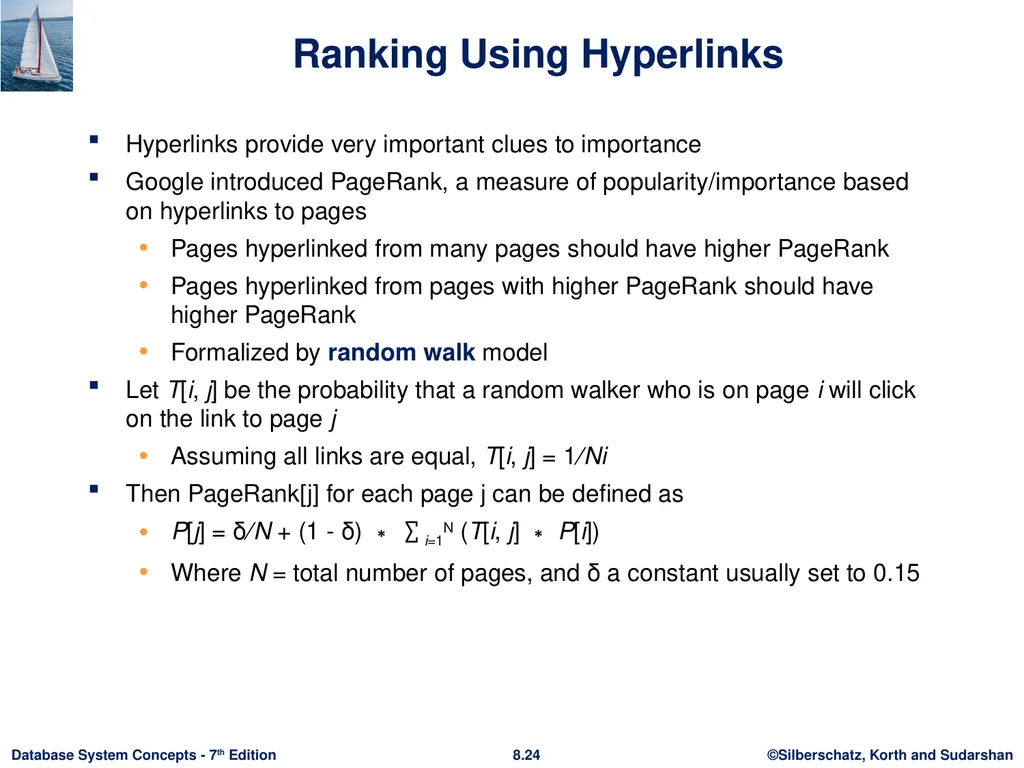
slide24. Ranking Using Hyperlinks Hyperlinks provide very important clues to importance
Google introduced PageRank, a measure of popularity/importance based on hyperlinks to pages
Pages hyperlinked from many pages should have higher PageRank
Pages hyperlinked from pages with higher PageRank should have higher PageRank
Formalized by random walk model
Let T[i, j] be the probability that a random walker who is on page i will click on the link to page j
Assuming all links are equal, T[i, j] = 1∕Ni
Then PageRank[j] for each page j can be defined as
P[j] = δ∕N + (1 - δ) ∗ ∑i=1N (T[i, j] ∗ P[i])
Where N = total number of pages, and δ a constant usually set to 0.15<br>
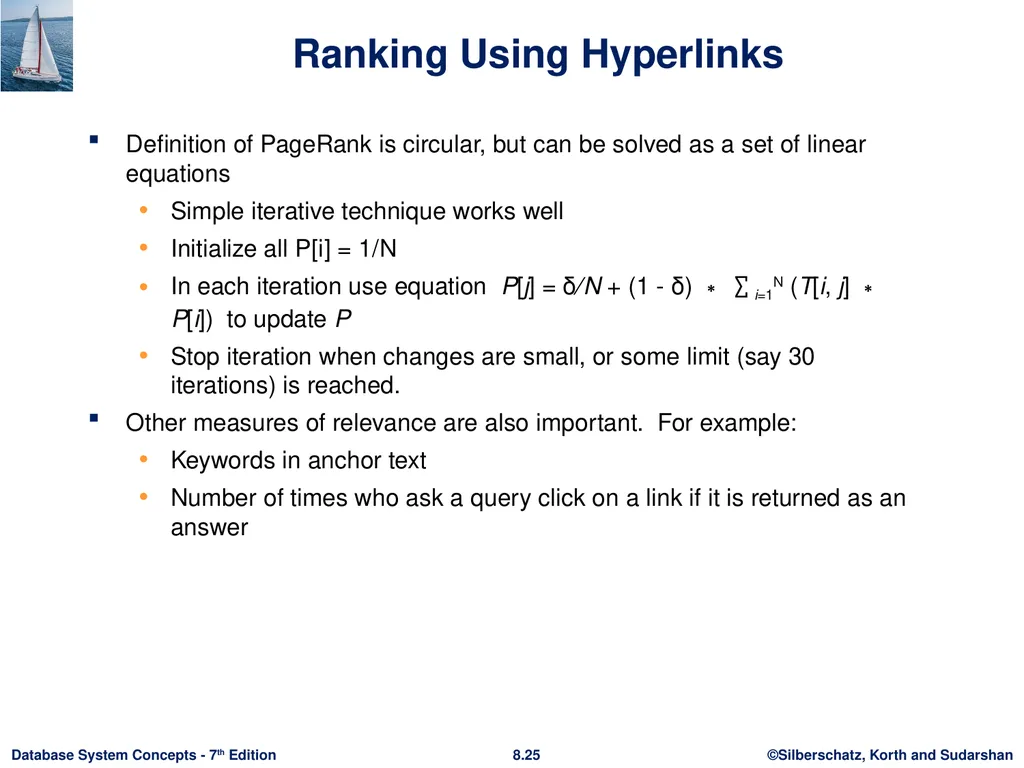
slide25. Ranking Using Hyperlinks Definition of PageRank is circular, but can be solved as a set of linear equations
Simple iterative technique works well
Initialize all P[i] = 1/N
In each iteration use equation P[j] = δ∕N + (1 - δ) ∗ ∑i=1N (T[i, j] ∗ P[i]) to update P
Stop iteration when changes are small, or some limit (say 30 iterations) is reached.
Other measures of relevance are also important. For example:
Keywords in anchor text
Number of times who ask a query click on a link if it is returned as an answer<br>
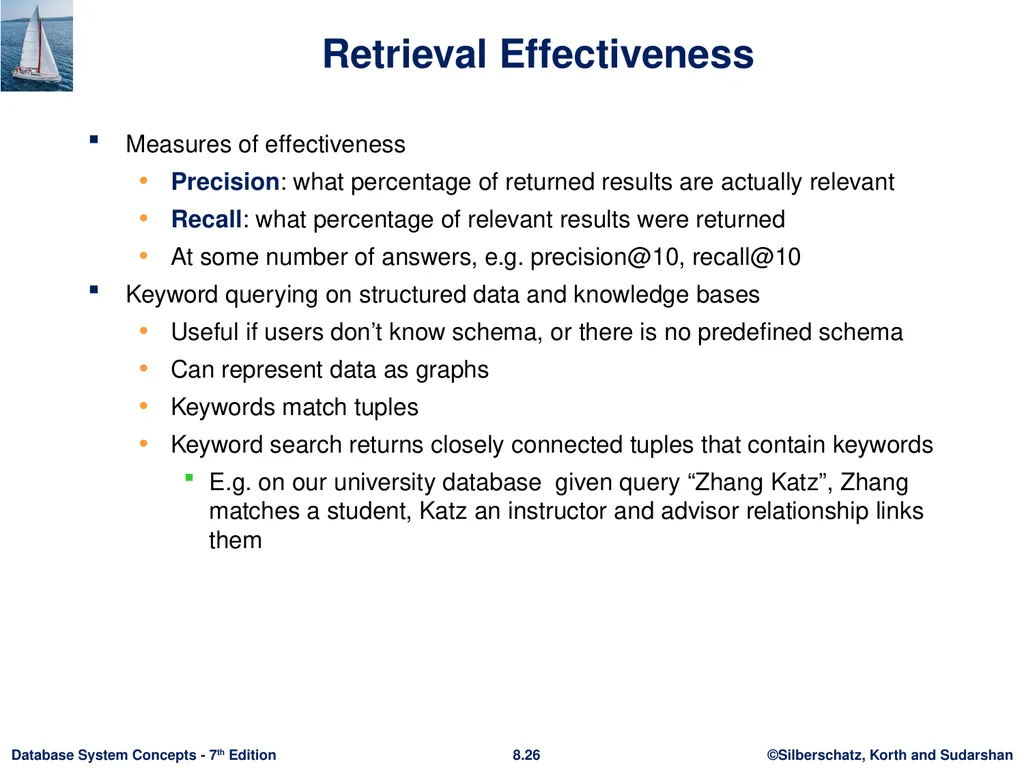
slide26. Retrieval Effectiveness Measures of effectiveness
Precision: what percentage of returned results are actually relevant
Recall: what percentage of relevant results were returned
At some number of answers, e.g. precision@10, recall@10
Keyword querying on structured data and knowledge bases
Useful if users don’t know schema, or there is no predefined schema
Can represent data as graphs
Keywords match tuples
Keyword search returns closely connected tuples that contain keywords
E.g. on our university database given query “Zhang Katz”, Zhang matches a student, Katz an instructor and advisor relationship links them<br>
slide27. Spatial Data<br>
slide28. Spatial Data Spatial databases store information related to spatial locations, and support efficient storage, indexing and querying of spatial data.
Geographic data -- road maps, land-usage maps, topographic elevation maps, political maps showing boundaries, land-ownership maps, and so on.
Geographic information systems are special-purpose databases tailored for storing geographic data.
Round-earth coordinate system may be used
(Latitude, longitude, elevation)
Geometric data: design information about how objects are constructed . For example, designs of buildings, aircraft, layouts of integrated-circuits.
2 or 3 dimensional Euclidean space with (X, Y, Z) coordinates<br>
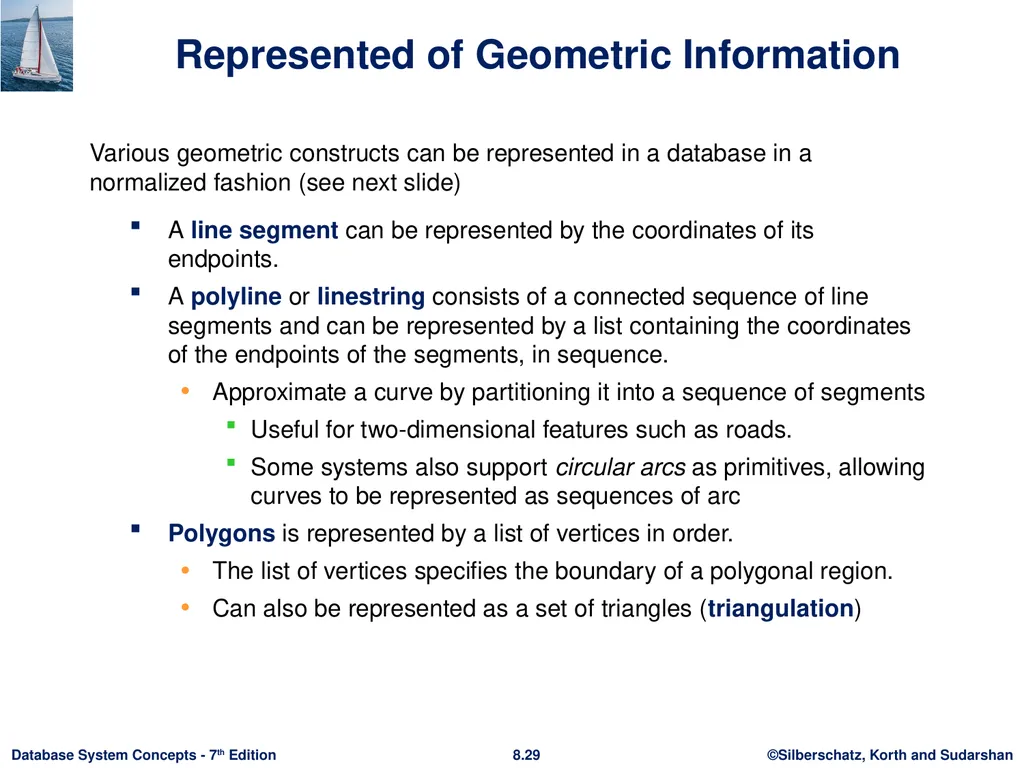
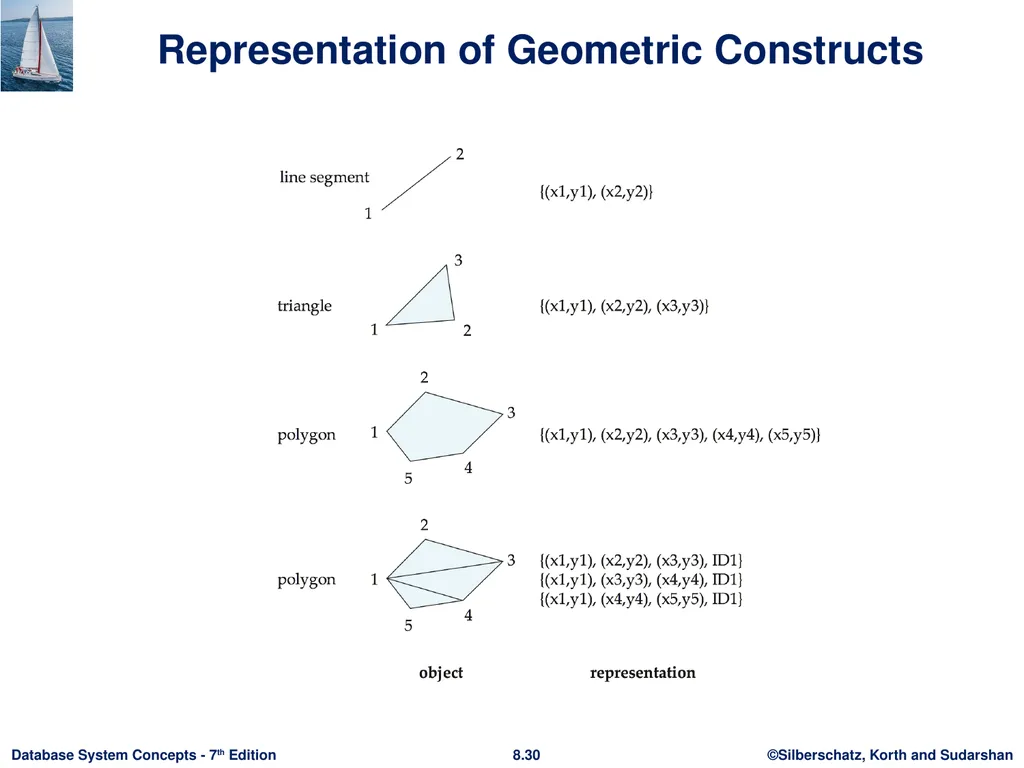
slide29. Represented of Geometric Information A line segment can be represented by the coordinates of its endpoints.
A polyline or linestring consists of a connected sequence of line segments and can be represented by a list containing the coordinates of the endpoints of the segments, in sequence.
Approximate a curve by partitioning it into a sequence of segments
Useful for two-dimensional features such as roads.
Some systems also support circular arcs as primitives, allowing curves to be represented as sequences of arc
Polygons is represented by a list of vertices in order.
The list of vertices specifies the boundary of a polygonal region.
Can also be represented as a set of triangles (triangulation) Various geometric constructs can be represented in a database in a normalized fashion (see next slide)<br>
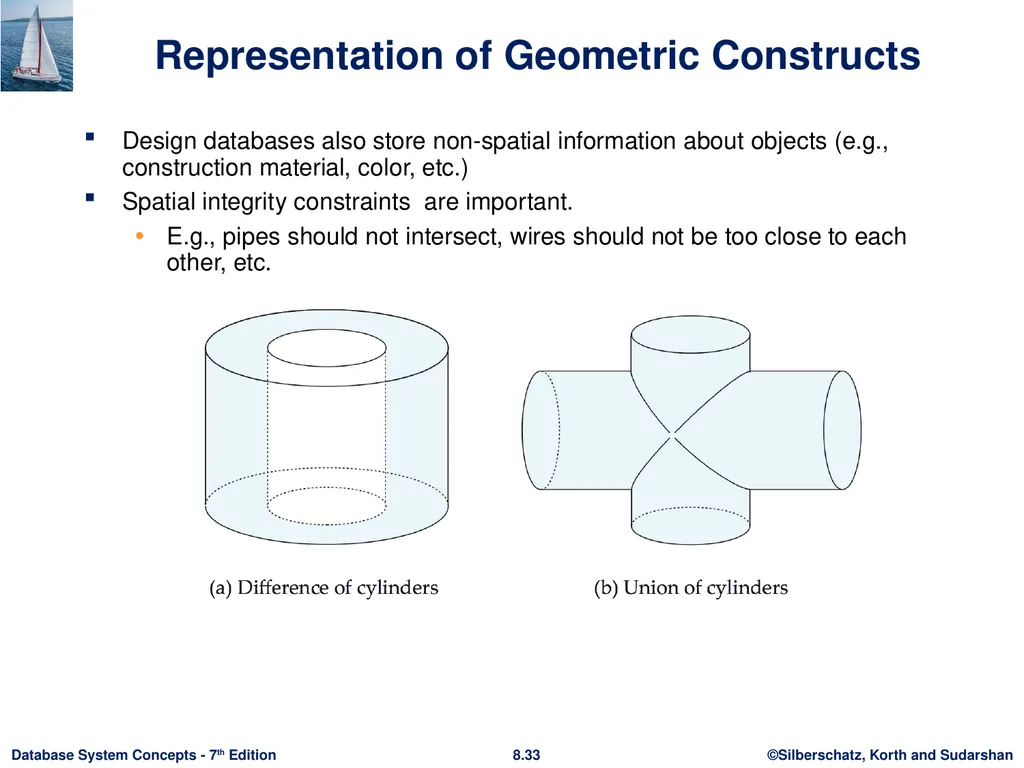
slide30. Representation of Geometric Constructs<br>
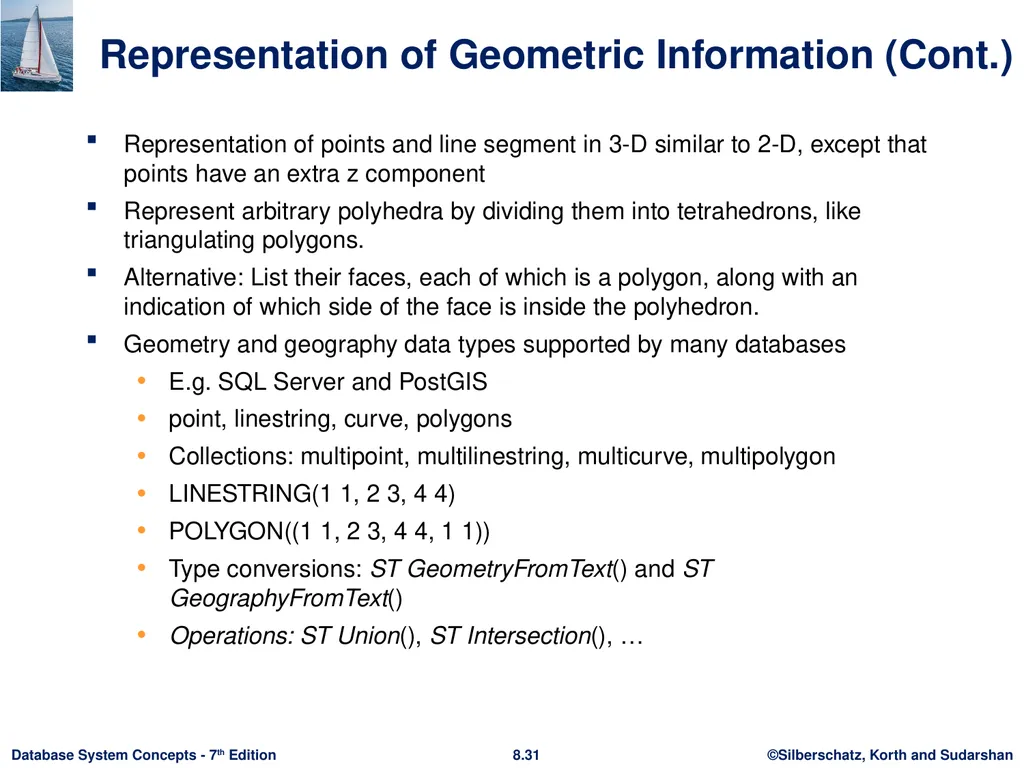
slide31. Representation of Geometric Information (Cont.) Representation of points and line segment in 3-D similar to 2-D, except that points have an extra z component
Represent arbitrary polyhedra by dividing them into tetrahedrons, like triangulating polygons.
Alternative: List their faces, each of which is a polygon, along with an indication of which side of the face is inside the polyhedron.
Geometry and geography data types supported by many databases
E.g. SQL Server and PostGIS
point, linestring, curve, polygons
Collections: multipoint, multilinestring, multicurve, multipolygon
LINESTRING(1 1, 2 3, 4 4)
POLYGON((1 1, 2 3, 4 4, 1 1))
Type conversions: ST GeometryFromText() and ST GeographyFromText()
Operations: ST Union(), ST Intersection(), …<br>
slide32. Design Databases Represent design components as objects (generally geometric objects); the connections between the objects indicate how the design is structured.
Simple two-dimensional objects: points, lines, triangles, rectangles, polygons.
Complex two-dimensional objects: formed from simple objects via union, intersection, and difference operations.
Complex three-dimensional objects: formed from simpler objects such as spheres, cylinders, and cuboids, by union, intersection, and difference operations.
Wireframe models represent three-dimensional surfaces as a set of simpler objects.<br>
slide33. Representation of Geometric Constructs Design databases also store non-spatial information about objects (e.g., construction material, color, etc.)
Spatial integrity constraints are important.
E.g., pipes should not intersect, wires should not be too close to each other, etc.<br>
slide34. Geographic Data Raster data consist of bit maps or pixel maps, in two or more dimensions.
Example 2-D raster image: satellite image of cloud cover, where each pixel stores the cloud visibility in a particular area.
Additional dimensions might include the temperature at different altitudes at different regions, or measurements taken at different points in time.
Design databases generally do not store raster data.<br>
slide35. Geographic Data (Cont.) Vector data are constructed from basic geometric objects: points, line segments, triangles, and other polygons in two dimensions, and cylinders, spheres, cuboids, and other polyhedrons in three dimensions.
Vector format often used to represent map data.
Roads can be considered as two-dimensional and represented by lines and curves.
Some features, such as rivers, may be represented either as complex curves or as complex polygons, depending on whether their width is relevant.
Features such as regions and lakes can be depicted as polygons.<br>
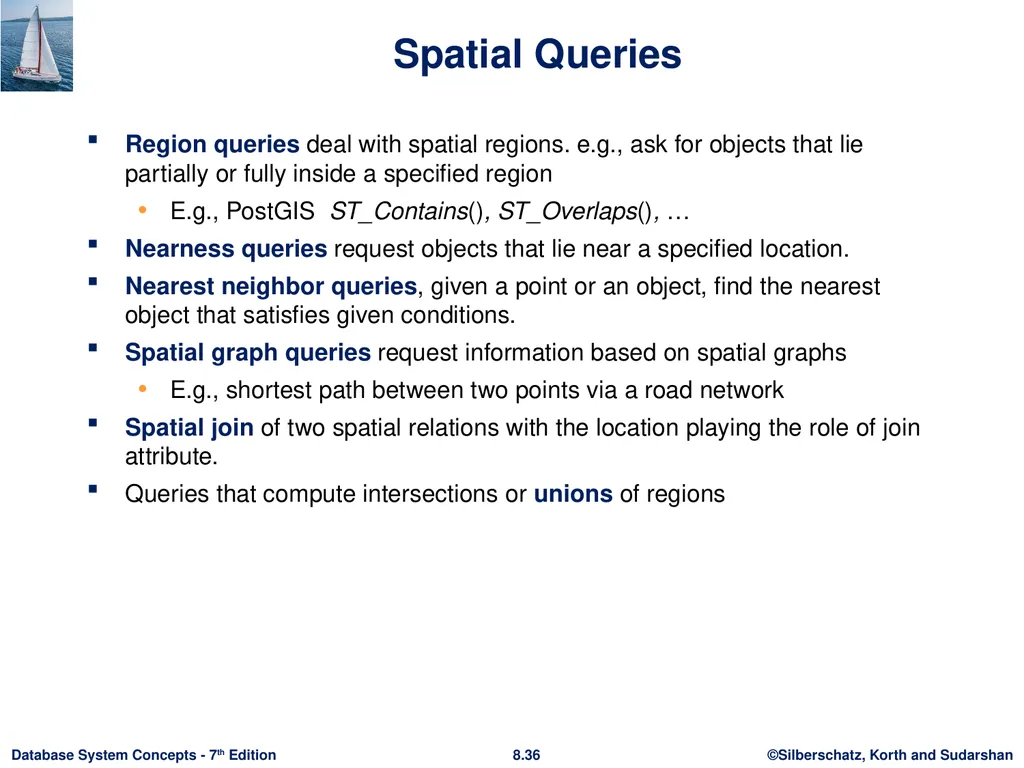
slide36. Spatial Queries Region queries deal with spatial regions. e.g., ask for objects that lie partially or fully inside a specified region
E.g., PostGIS ST_Contains(), ST_Overlaps(), …
Nearness queries request objects that lie near a specified location.
Nearest neighbor queries, given a point or an object, find the nearest object that satisfies given conditions.
Spatial graph queries request information based on spatial graphs
E.g., shortest path between two points via a road network
Spatial join of two spatial relations with the location playing the role of join attribute.
Queries that compute intersections or unions of regions<br>
slide37. End of Chapter 8<br>
slide2. Outline Semi-Structured Data
Object Orientation
Textual Data
Spatial Data<br>
slide3. Semi-Structured Data Many applications require storage of complex data, whose schema changes often
The relational model’s requirement of atomic data types may be an overkill
E.g., storing set of interests as a set-valued attribute of a user profile may be simpler than normalizing it
Data exchange can benefit greatly from semi-structured data
Exchange can be between applications, or between back-end and front-end of an application
Web-services are widely used today, with complex data fetched to the front-end and displayed using a mobile app or JavaScript
JSON and XML are widely used semi-structured data models<br>
slide4. Features of Semi-Structured Data Models Flexible schema
Wide column representation: allow each tuple to have a different set of attributes, can add new attributes at any time
Sparse column representation: schema has a fixed but large set of attributes, by each tuple may store only a subset
Multivalued data types
Sets, multisets
E.g.,: set of interests {‘basketball, ‘La Liga’, ‘cooking’, ‘anime’, ‘jazz’}
Key-value map (or just map for short)
Store a set of key-value pairs
E.g., {(brand, Apple), (ID, MacBook Air), (size, 13), (color, silver)}
Operations on maps: put(key, value), get(key), delete(key)
, Arrays
Widely used for scientific and monitoring applications<br>
slide5. Features of Semi-Structured Data Models Arrays
Widely used for scientific and monitoring applications
E.g., readings taken at regular intervals can be represented as array of values instead of (time, value) pairs
[5, 8, 9, 11] instead of {(1,5), (2, 8), (3, 9), (4, 11)}
Multi-valued attribute types
Modeled using non first-normal-form (NFNF) data model
Supported by most database systems today
Array database: a database that provides specialized support for arrays
E.g., compressed storage, query language extensions etc
Oracle GeoRaster, PostGIS, SciDB, etc<br>
slide6. Nested Data Types Hierarchical data is common in many applications
JSON: JavaScript Object Notation
Widely used today
XML: Extensible Markup Language
Earlier generation notation, still used extensively<br>
slide7. JSON Textual representation widely used for data exchange
Example of JSON data { "ID": "22222", "name": { "firstname: "Albert", "lastname: "Einstein" }, "deptname": "Physics", "children": [ {"firstname": "Hans", "lastname": "Einstein" }, {"firstname": "Eduard", "lastname": "Einstein" } ] }
Types: integer, real, string, and
Objects: are key-value maps, i.e. sets of (attribute name, value) pairs
Arrays are also key-value maps (from offset to value)<br>
slide8. JSON JSON is ubiquitous in data exchange today
Widely used for web services
Most modern applications are architected around on web services
SQL extensions for
JSON types for storing JSON data
Extracting data from JSON objects using path expressions
E.g. V-> ID, or v.ID
Generating JSON from relational data
E.g. json.build_object(‘ID’, 12345, ‘name’, ‘Einstein’)
Creation of JSON collections using aggregation
E.g. json_agg aggregate function in PostgreSQL
Syntax varies greatly across databases
JSON is verbose
Compressed representations such as BSON (Binary JSON) used for efficient data storage<br>
slide9. XML XML uses tags to mark up text
E.g. <course> <course id> CS-101 </course id> <title> Intro. to Computer Science </title> <dept name> Comp. Sci. </dept name> <credits> 4 </credits> </course>
Tags make the data self-documenting
Tags can be hierarchical<br>
slide10. Example of Data in XML <purchase order> <identifier> P-101 </identifier> <purchaser> <name> Cray Z. Coyote </name> <address> Route 66, Mesa Flats, Arizona 86047, USA </address> </purchaser> <supplier> <name> Acme Supplies </name> <address> 1 Broadway, New York, NY, USA </address> </supplier> <itemlist> <item> <identifier> RS1 </identifier> <description> Atom powered rocket sled </description> <quantity> 2 </quantity> <price> 199.95 </price> </item> <item>…</item> </itemlist> <total cost> 429.85 </total cost> …. </purchase order><br>
slide11. XML Cont. XQuery language developed to query nested XML structures
Not widely used currently
SQL extensions to support XML
Store XML data
Generate XML data from relational data
Extract data from XML data types
Path expressions
See Chapter 30 (online) for more information<br>
slide12. Knowledge Representation Representation of human knowledge is a long-standing goal of AI
Various representations of facts and inference rules proposed over time
RDF: Resource Description Format
Simplified representation for facts, represented as triples (subject, predicate, object)
E.g., (NBA-2019, winner, Raptors) (Washington-DC, capital-of, USA) (Washington-DC, population, 6,200,000)
Models objects that have attributes, and relationships with other objects
Like the ER model, but with a flexible schema
(ID, attribute-name, value)
(ID1, relationship-name, ID2)
Has a natural graph representation<br>
slide13. Graph View of RDF Data Knowledge graph<br>
slide14. Triple View of RDF Data<br>
slide15. Querying RDF: SPARQL Triple patterns
?cid title "Intro. to Computer Science"
?cid title "Intro. to Computer Science" ?sid course ?cid
SPARQL queries
select ?name where { ?cid title "Intro. to Computer Science" . ?sid course ?cid . ?id takes ?sid . ?id name ?name . }
Also supports
Aggregation, Optional joins (similar to outerjoins), Subqueries, etc.
Transitive closure on paths<br>
slide16. RDF Representation (Cont.) RDF triples represent binary relationships
How to represent n-ary relationships?
Approach 1 (from Section 6.9.4): Create artificial entity, and link to each of the n entities
E.g., (Barack Obama, president-of, USA, 2008-2016) can be represented as (e1, person, Barack Obama), (e1, country, USA), (e1, president-from, 2008) (e1, president-till, 2016)
Approach 2: use quads instead of triples, with context entity
E.g., (Barack Obama, president-of, USA, c1) (c1, president-from, 2008) (c1, president-till, 2016)
RDF widely used as knowledge base representation
DBPedia, Yago, Freebase, WikiData, ..
Linked open data project aims to connect different knowledge graphs to allow queries to span databases<br>
slide17. Object Orientation Object-relational data model provides richer type system
with complex data types and object orientation
Applications are often written in object-oriented programming languages
Type system does not match relational type system
Switching between imperative language and SQL is troublesome
Approaches for integrating object-orientation with databases
Build an object-relational database, adding object-oriented features to a relational database
Automatically convert data between programming language model and relational model; data conversion specified by object-relational mapping
Build an object-oriented database that natively supports object-oriented data and direct access from programming language<br>
slide18. Object-Relational Database Systems User-defined types
create type Person (ID varchar(20) primary key, name varchar(20), address varchar(20)) ref from(ID); /* More on this later */ create table people of Person;
Table types
create type interest as table ( topic varchar(20), degree_of_interest int); create table users ( ID varchar(20), name varchar(20), interests interest);
Array, multiset data types also supported by many databases
Syntax varies by database<br>
slide19. Type and Table Inheritance Type inheritance
create type Student under Person (degree varchar(20)) ; create type Teacher under Person (salary integer);
Table inheritance syntax in PostgreSQL and oracle
create table students (degree varchar(20)) inherits people; create table teachers (salary integer) inherits people;
create table people of Person; create table students of Student under people; create table teachers of Teacher under people;<br>
slide20. Reference Types Creating reference types
create type Person (ID varchar(20) primary key, name varchar(20), address varchar(20)) ref from(ID); create table people of Person; create type Department ( dept_name varchar(20), head ref(Person) scope people); create table departments of Department insert into departments values ('CS', '12345’)
System generated references can be retrieved using subqueries
(select ref(p) from people as p where ID = '12345')
Using references in path expressions
select head->name, head->address from departments;<br>
slide21. Object-Relational Mapping Object-relational mapping (ORM) systems allow
Specification of mapping between programming language objects and database tuples
Automatic creation of database tuples upon creation of objects
Automatic update/delete of database tuples when objects are update/deleted
Interface to retrieve objects satisfying specified conditions
Tuples in database are queried, and object created from the tuples
Details in Section 9.6.2
Hibernate ORM for Java
Django ORM for Python<br>
slide22. Textual Data Information retrieval: querying of unstructured data
Simple model of keyword queries: given query keywords, retrieve documents containing all the keywords
More advanced models rank relevance of documents
Today, keyword queries return many types of information as answers
E.g., a query “cricket” typically returns information about ongoing cricket matches
Relevance ranking
Essential since there are usually many documents matching keywords<br>
slide23. Ranking using TF-IDF Term: keyword occurring in a document/query
Term Frequency: TF(d, t), the relevance of a term t to a document d
One definition: TF(d, t) = log(1 + n(d,t)/n(d)) where
n(d,t) = number of occurrences of term t in document d
n(d) = number of terms in document d
Inverse document frequency: IDF(t)
One definition: IDF(t) = 1/n(t)
Relevance of a document d to a set of terms Q
One definition: r(d, Q) = ∑t∈Q TF(d, t) ∗ IDF(t)
Other definitions
take proximity of words into account
Stop words are often ignored<br>
slide24. Ranking Using Hyperlinks Hyperlinks provide very important clues to importance
Google introduced PageRank, a measure of popularity/importance based on hyperlinks to pages
Pages hyperlinked from many pages should have higher PageRank
Pages hyperlinked from pages with higher PageRank should have higher PageRank
Formalized by random walk model
Let T[i, j] be the probability that a random walker who is on page i will click on the link to page j
Assuming all links are equal, T[i, j] = 1∕Ni
Then PageRank[j] for each page j can be defined as
P[j] = δ∕N + (1 - δ) ∗ ∑i=1N (T[i, j] ∗ P[i])
Where N = total number of pages, and δ a constant usually set to 0.15<br>
slide25. Ranking Using Hyperlinks Definition of PageRank is circular, but can be solved as a set of linear equations
Simple iterative technique works well
Initialize all P[i] = 1/N
In each iteration use equation P[j] = δ∕N + (1 - δ) ∗ ∑i=1N (T[i, j] ∗ P[i]) to update P
Stop iteration when changes are small, or some limit (say 30 iterations) is reached.
Other measures of relevance are also important. For example:
Keywords in anchor text
Number of times who ask a query click on a link if it is returned as an answer<br>
slide26. Retrieval Effectiveness Measures of effectiveness
Precision: what percentage of returned results are actually relevant
Recall: what percentage of relevant results were returned
At some number of answers, e.g. precision@10, recall@10
Keyword querying on structured data and knowledge bases
Useful if users don’t know schema, or there is no predefined schema
Can represent data as graphs
Keywords match tuples
Keyword search returns closely connected tuples that contain keywords
E.g. on our university database given query “Zhang Katz”, Zhang matches a student, Katz an instructor and advisor relationship links them<br>
slide27. Spatial Data<br>
slide28. Spatial Data Spatial databases store information related to spatial locations, and support efficient storage, indexing and querying of spatial data.
Geographic data -- road maps, land-usage maps, topographic elevation maps, political maps showing boundaries, land-ownership maps, and so on.
Geographic information systems are special-purpose databases tailored for storing geographic data.
Round-earth coordinate system may be used
(Latitude, longitude, elevation)
Geometric data: design information about how objects are constructed . For example, designs of buildings, aircraft, layouts of integrated-circuits.
2 or 3 dimensional Euclidean space with (X, Y, Z) coordinates<br>
slide29. Represented of Geometric Information A line segment can be represented by the coordinates of its endpoints.
A polyline or linestring consists of a connected sequence of line segments and can be represented by a list containing the coordinates of the endpoints of the segments, in sequence.
Approximate a curve by partitioning it into a sequence of segments
Useful for two-dimensional features such as roads.
Some systems also support circular arcs as primitives, allowing curves to be represented as sequences of arc
Polygons is represented by a list of vertices in order.
The list of vertices specifies the boundary of a polygonal region.
Can also be represented as a set of triangles (triangulation) Various geometric constructs can be represented in a database in a normalized fashion (see next slide)<br>
slide30. Representation of Geometric Constructs<br>
slide31. Representation of Geometric Information (Cont.) Representation of points and line segment in 3-D similar to 2-D, except that points have an extra z component
Represent arbitrary polyhedra by dividing them into tetrahedrons, like triangulating polygons.
Alternative: List their faces, each of which is a polygon, along with an indication of which side of the face is inside the polyhedron.
Geometry and geography data types supported by many databases
E.g. SQL Server and PostGIS
point, linestring, curve, polygons
Collections: multipoint, multilinestring, multicurve, multipolygon
LINESTRING(1 1, 2 3, 4 4)
POLYGON((1 1, 2 3, 4 4, 1 1))
Type conversions: ST GeometryFromText() and ST GeographyFromText()
Operations: ST Union(), ST Intersection(), …<br>
slide32. Design Databases Represent design components as objects (generally geometric objects); the connections between the objects indicate how the design is structured.
Simple two-dimensional objects: points, lines, triangles, rectangles, polygons.
Complex two-dimensional objects: formed from simple objects via union, intersection, and difference operations.
Complex three-dimensional objects: formed from simpler objects such as spheres, cylinders, and cuboids, by union, intersection, and difference operations.
Wireframe models represent three-dimensional surfaces as a set of simpler objects.<br>
slide33. Representation of Geometric Constructs Design databases also store non-spatial information about objects (e.g., construction material, color, etc.)
Spatial integrity constraints are important.
E.g., pipes should not intersect, wires should not be too close to each other, etc.<br>
slide34. Geographic Data Raster data consist of bit maps or pixel maps, in two or more dimensions.
Example 2-D raster image: satellite image of cloud cover, where each pixel stores the cloud visibility in a particular area.
Additional dimensions might include the temperature at different altitudes at different regions, or measurements taken at different points in time.
Design databases generally do not store raster data.<br>
slide35. Geographic Data (Cont.) Vector data are constructed from basic geometric objects: points, line segments, triangles, and other polygons in two dimensions, and cylinders, spheres, cuboids, and other polyhedrons in three dimensions.
Vector format often used to represent map data.
Roads can be considered as two-dimensional and represented by lines and curves.
Some features, such as rivers, may be represented either as complex curves or as complex polygons, depending on whether their width is relevant.
Features such as regions and lakes can be depicted as polygons.<br>
slide36. Spatial Queries Region queries deal with spatial regions. e.g., ask for objects that lie partially or fully inside a specified region
E.g., PostGIS ST_Contains(), ST_Overlaps(), …
Nearness queries request objects that lie near a specified location.
Nearest neighbor queries, given a point or an object, find the nearest object that satisfies given conditions.
Spatial graph queries request information based on spatial graphs
E.g., shortest path between two points via a road network
Spatial join of two spatial relations with the location playing the role of join attribute.
Queries that compute intersections or unions of regions<br>
slide37. End of Chapter 8<br>