
Chapter 9 Mission-Specific Competencies: Technical
TG
Published · 34 slides · 0 views
1 / 1
Description
Chapter 9 Mission-Specific Competencies: Technical Decontamination Objectives: Operations Level Responders Assigned Mission-Specific Responsibilities (1 of 4) Plan a response by selecting a technical decontamination process that will
Related Topics
Share
Embed code
Download this presentation From Below
"Chapter 9 Mission-Specific Competencies: Technical" is the property of its rightful owner. Permission is granted to download and print the materials on this website for personal, non-commercial use only, and to display it on your personal computer provided you do not modify the materials and that you retain all copyright notices contained in the materials. By downloading content from our website, you accept the terms of this agreement.
Presentation Transcript
01
Chapter 9 Mission-Specific Competencies: Technical Decontamination<br>
02
Objectives: Operations Level Responders Assigned Mission-Specific Responsibilities (1 of 4) Plan a response by selecting a technical decontamination process that will minimize the hazard. (NFPA 6.4.1.2.2, p. 206–211)
Identify the personal protective equipment required to support technical decontamination at hazardous materials/WMD incidents based on local procedures. (NFPA 6.4.3.1, p. 213)<br>
Identify the personal protective equipment required to support technical decontamination at hazardous materials/WMD incidents based on local procedures. (NFPA 6.4.3.1, p. 213)<br>
03
Objectives: Operations Level Responders Assigned Mission-Specific Responsibilities (2 of 4) Identify and describe the limitations and advantages of technical decontamination operations and the technical decontamination methods. (NFPA 6.4.3.2(1)(2), p. 208–211)
Identify resources for determining the correct technical decontamination procedure in a hazardous materials/WMD incident. (NFPA 6.4.3.2(3), p. 206–213)
Identify the supplies and equipment needed for technical decontamination. (NFPA 6.4.3.2(4), p. 213)<br>
Identify resources for determining the correct technical decontamination procedure in a hazardous materials/WMD incident. (NFPA 6.4.3.2(3), p. 206–213)
Identify the supplies and equipment needed for technical decontamination. (NFPA 6.4.3.2(4), p. 213)<br>
04
Objectives: Operations Level Responders Assigned Mission-Specific Responsibilities (3 of 4) Identify tools, equipment, and procedures for processing evidence during technical decontamination. (NFPA 6.4.3.2(5), p. 206–211)
Identify the role of the operations level responder assigned to technical decontamination. (NFPA 6.4.4.1(1), p. 206–215)
Identify procedures, equipment and safety precautions for handling tools, equipment weapons, criminal suspects, and law enforcement canines brought to the decontamination corridor. (NFPA 6.4.3.2(6), p. 206–207)<br>
Identify the role of the operations level responder assigned to technical decontamination. (NFPA 6.4.4.1(1), p. 206–215)
Identify procedures, equipment and safety precautions for handling tools, equipment weapons, criminal suspects, and law enforcement canines brought to the decontamination corridor. (NFPA 6.4.3.2(6), p. 206–207)<br>
05
Objectives: Operations Level Responders Assigned Mission-Specific Responsibilities (4 of 4) Identify procedures for evaluating the effectiveness of technical decontamination. (NFPA 6.2.5.1, p. 215)
Identify the importance, steps, and requirements of maintaining records. (NFPA 6.2.6.1, p. 215)<br>
Identify the importance, steps, and requirements of maintaining records. (NFPA 6.2.6.1, p. 215)<br>
06
Introduction (1 of 3) Decontamination is a process-driven activity.
Emergency decontamination
Used for potentially life-threatening situations to rapidly remove contaminant from a person
Goal: reduce effect of exposure and get victim clean enough to receive medical care<br>
Emergency decontamination
Used for potentially life-threatening situations to rapidly remove contaminant from a person
Goal: reduce effect of exposure and get victim clean enough to receive medical care<br>
07
Introduction (2 of 3) Mass decontamination
Emergency decontamination on a large number of people
Goal: remove contaminants as quickly as possible to reduce impact of exposure
Technical decontamination
Goal: reduce or eliminate contamination from responder PPE prior to removing it
Water-based process: using scrub brushes, catch basin, cleaning solution<br>
Emergency decontamination on a large number of people
Goal: remove contaminants as quickly as possible to reduce impact of exposure
Technical decontamination
Goal: reduce or eliminate contamination from responder PPE prior to removing it
Water-based process: using scrub brushes, catch basin, cleaning solution<br>
08
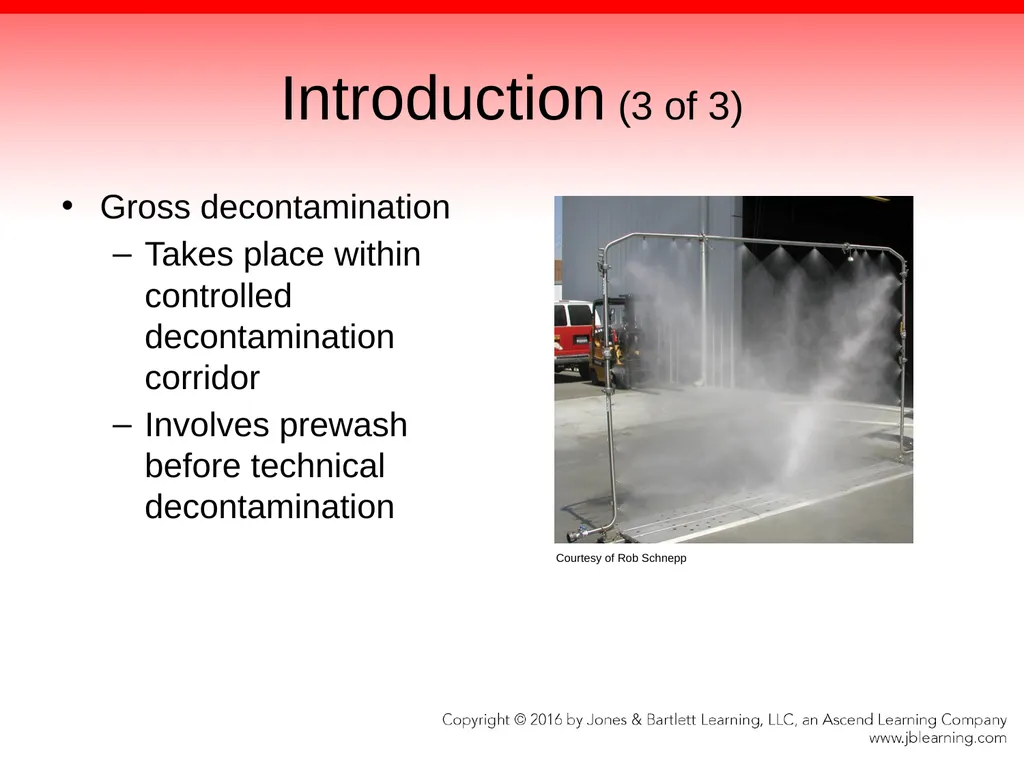
Introduction (3 of 3) Gross decontamination
Takes place within controlled decontamination corridor
Involves prewash before technical decontamination Courtesy of Rob Schnepp<br>
Takes place within controlled decontamination corridor
Involves prewash before technical decontamination Courtesy of Rob Schnepp<br>
09
Technical Decontamination The planned and systematic process of reducing contamination to a level that is as low as reasonably achievable (ASLARA)
Multiple personnel (decontamination team) use brushes to scrub and wash person or object.
May involve water or special cleaning solution
Dry decontamination
Removing all PPE and placing directly into bags for disposal<br>
Multiple personnel (decontamination team) use brushes to scrub and wash person or object.
May involve water or special cleaning solution
Dry decontamination
Removing all PPE and placing directly into bags for disposal<br>
10
Absorption Spongy material (soil, sawdust, or synthetic absorbents) mixed with liquid hazardous material
Used for decontaminating equipment and property
Material becomes hazardous once in contact with contaminant and must be disposed of properly.<br>
Used for decontaminating equipment and property
Material becomes hazardous once in contact with contaminant and must be disposed of properly.<br>
11
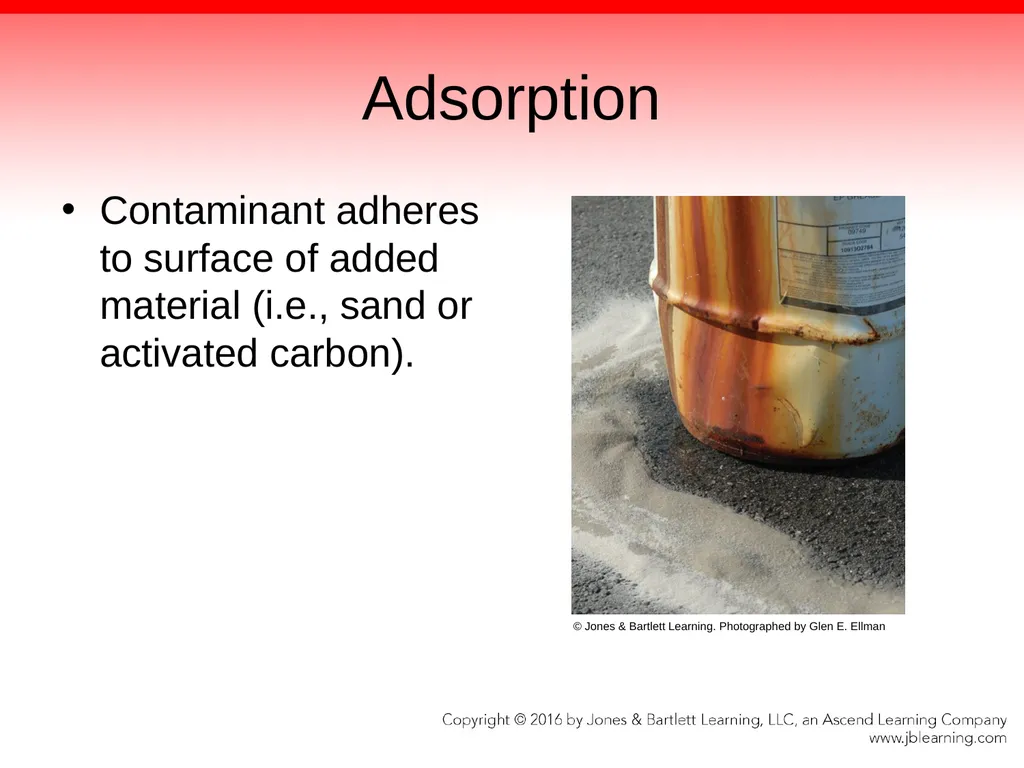
Adsorption Contaminant adheres to surface of added material (i.e., sand or activated carbon). © Jones & Bartlett Learning. Photographed by Glen E. Ellman<br>
12
Vacuuming Removal of dust, particles, and some liquids by sucking them up into container
Filtering system prevents material from entering atmosphere.
HEPA vacuum cleaner
For removing hazardous dusts, powders, or fibers that are 0.3 micron or larger<br>
Filtering system prevents material from entering atmosphere.
HEPA vacuum cleaner
For removing hazardous dusts, powders, or fibers that are 0.3 micron or larger<br>
13
Washing For removing oily substances and solvents from responder PPE, tools, and equipment
Soap and water; scrubbed with brush or sponge and rinsed with water<br>
Soap and water; scrubbed with brush or sponge and rinsed with water<br>
14
Dilution Uses plain water to fully rinse contaminated person or object to weaken concentration of hazard
Fast and economical
Larger the volume of water used, more hazardous waste generated<br>
Fast and economical
Larger the volume of water used, more hazardous waste generated<br>
15
Disinfection To destroy disease-carrying microorganisms, excluding spores<br>
16
Evaporation Natural form of chemical degradation
Safe, noninvasive way to allow chemical substance to stabilize without intervention<br>
Safe, noninvasive way to allow chemical substance to stabilize without intervention<br>
17
Neutralization Used when corrosivity of acid or base needs to be reduced
Weak base neutralizes strong acid; weak acid neutralizes strong base
Never used for skin decontamination<br>
Weak base neutralizes strong acid; weak acid neutralizes strong base
Never used for skin decontamination<br>
18
Solidification Chemical process that causes hazardous liquid to become solid
Commercial products available
Makes material easier to handle<br>
Commercial products available
Makes material easier to handle<br>
19
Sterilization Used for biological agents
Heat, chemical, radiation
To kill microorganisms, including spores
Not for responders
For environmental decontamination and for tools and equipment<br>
Heat, chemical, radiation
To kill microorganisms, including spores
Not for responders
For environmental decontamination and for tools and equipment<br>
20
Isolation and Disposal Two-step process for items that cannot be completely decontaminated
Contaminated items removed and isolated in designated area
Items are:
Segregated into logical groupings and tagged
Placed into suitable container such as bag, barrel, or bucket
Then legally transported to approved treatment, storage, or disposal facility<br>
Contaminated items removed and isolated in designated area
Items are:
Segregated into logical groupings and tagged
Placed into suitable container such as bag, barrel, or bucket
Then legally transported to approved treatment, storage, or disposal facility<br>
21
The Technical Decontamination Process (1 of 3) Process should take place within predesignated decontamination corridor within the warm zone.
Corridor is set up and staffed prior to entry team making access and going to work in hot zone.
Warm zone becomes “warm” upon commencement of decontamination process.
Prior to contaminated responders passing through, the corridor is considered cold.<br>
Corridor is set up and staffed prior to entry team making access and going to work in hot zone.
Warm zone becomes “warm” upon commencement of decontamination process.
Prior to contaminated responders passing through, the corridor is considered cold.<br>
22
The Technical Decontamination Process (2 of 3) Clearly marked, easily seen, readily accessible point to corridor
Clearly marked exit
Several stations inside decontamination corridor<br>
Clearly marked exit
Several stations inside decontamination corridor<br>
23
The Technical Decontamination Process (3 of 3) Stations should include:
Collection basins
Portable sprayers
Sponges
Buckets
Long-handled scrub brushes
Tarps<br>
Collection basins
Portable sprayers
Sponges
Buckets
Long-handled scrub brushes
Tarps<br>
24
Performing Technical Decontamination (1 of 4) Process starts before entry team enters hot zone.
Pre-entry briefing
Location of decon corridor
Process to be used
How decon team will communicate
Notify decontamination team that responders are en route.<br>
Pre-entry briefing
Location of decon corridor
Process to be used
How decon team will communicate
Notify decontamination team that responders are en route.<br>
25
Performing Technical Decontamination (2 of 4) Decide which responder begins process first.
Responders should place contaminated hand tools or other equipment in tool drop area near entrance of corridor.
Entry team proceeds into decontamination corridor for gross decontamination, if required.
One to three wash-and-rinse stations
One contaminated responder allowed in wash-and-rinse station at a time<br>
Responders should place contaminated hand tools or other equipment in tool drop area near entrance of corridor.
Entry team proceeds into decontamination corridor for gross decontamination, if required.
One to three wash-and-rinse stations
One contaminated responder allowed in wash-and-rinse station at a time<br>
26
Performing Technical Decontamination (3 of 4) After protective equipment is scrubbed and rinsed, it can be removed from responder.
SCBA face piece, air-purifying respirators, or PAPR face piece should remain in place as long as possible.
PPE should be rolled or folded back so contaminated side contacts only itself.
Outer chemical gloves are removed from responders.<br>
SCBA face piece, air-purifying respirators, or PAPR face piece should remain in place as long as possible.
PPE should be rolled or folded back so contaminated side contacts only itself.
Outer chemical gloves are removed from responders.<br>
27
Performing Technical Decontamination (4 of 4) Responder proceeds toward cold zone end of corridor to area where helmets, face pieces, and other ancillary equipment are removed and placed in separate area or plastic bag.
Removes and discards inner gloves
Exits decontamination area and enters cold zone for showers and new clothes
Proceeds to medical station for evaluation<br>
Removes and discards inner gloves
Exits decontamination area and enters cold zone for showers and new clothes
Proceeds to medical station for evaluation<br>
28
Evaluating Effectiveness Check for effectiveness of decontamination using method that offers most accurate results.
pH paper to check for corrosive residue
Photo ionization detector to check for residual organic compounds
Radiation detectors to ensure there is no radiation contamination on responder<br>
pH paper to check for corrosive residue
Photo ionization detector to check for residual organic compounds
Radiation detectors to ensure there is no radiation contamination on responder<br>
29
Reports and Documentation Name of all persons processed through decontamination corridor
Information on released substance
Potential for health effects of accidental exposure
Actions taken to limit exposure
Detailed description of decontamination activities
Any breaches or failures of PPE noted during decontamination<br>
Information on released substance
Potential for health effects of accidental exposure
Actions taken to limit exposure
Detailed description of decontamination activities
Any breaches or failures of PPE noted during decontamination<br>
30
Summary (1 of 5) Decontamination is the physical and/or chemical process of reducing and preventing the spread of contaminants from people, animals, the environment, or equipment involved at hazardous materials/weapons of mass destruction (WMD) incidents.<br>
31
Summary (2 of 5) Decontamination efforts should be matched to the known or anticipated physical and chemical properties of the released substance.<br>
32
Summary (3 of 5) The three major categories of decontamination are emergency decontamination, mass decontamination, and technical decontamination. Gross decontamination takes place within a controlled decontamination corridor and generally consists of a prewash before technical decontamination takes place.<br>
33
Summary (4 of 5) The decontamination corridor is a controlled area in the warm zone, for which access is limited to only those persons who have entered the hot zone or who are participating in decontamination.<br>
34
Summary (5 of 5) Responders may employ any number of technical decontamination methods for personnel, tools, and equipment, including absorption, adsorption, washing, dilution, and neutralization. It is up to the responder to match the best decontamination method with the physical and chemical characteristics of the contaminant.<br>