
Chapter 9: Project Human Resource Management
GB
Published · 64 slides · 0 views
1 / 1






Description
Chapter 9: Project Human Resource Management Information Technology Project Management, Eighth Edition Note: See the text itself for full citations. Learning Objectives, Part 1 Explain the importance of good human resource management on
Related Topics
Share
Embed code
Download this presentation From Below
"Chapter 9: Project Human Resource Management" is the property of its rightful owner. Permission is granted to download and print the materials on this website for personal, non-commercial use only, and to display it on your personal computer provided you do not modify the materials and that you retain all copyright notices contained in the materials. By downloading content from our website, you accept the terms of this agreement.
Presentation Transcript
01
Chapter 9:
Project Human Resource Management Information Technology Project Management, Eighth Edition Note: See the text itself for full citations.<br>
02
Learning Objectives, Part 1 Explain the importance of good human resource management on projects, including the current state of the global IT workforce and future implications for it
Define project human resource management and understand its processes
Summarize key concepts for managing people by understanding theories of motivation, influence, and power; how people and teams can become more effective; emotional intelligence; and leadership Information Technology Project Management, Eighth Edition 2<br>
Define project human resource management and understand its processes
Summarize key concepts for managing people by understanding theories of motivation, influence, and power; how people and teams can become more effective; emotional intelligence; and leadership Information Technology Project Management, Eighth Edition 2<br>
03
Learning Objectives, Part 2 Discuss human resource management planning and be able to create a human resource plan, project organizational chart, responsibility assignment matrix, and resource histogram
Understand important issues involved in project staff acquisition and explain the concepts of resource assignments, resource loading, and resource leveling
Assist in team development with training, team-building activities, and reward systems
Explain and apply several tools and techniques to help manage a project team and summarize general advice on managing teams
Describe how project management software can assist in project human resource management Information Technology Project Management, Eighth Edition 3<br>
Understand important issues involved in project staff acquisition and explain the concepts of resource assignments, resource loading, and resource leveling
Assist in team development with training, team-building activities, and reward systems
Explain and apply several tools and techniques to help manage a project team and summarize general advice on managing teams
Describe how project management software can assist in project human resource management Information Technology Project Management, Eighth Edition 3<br>
04
The Importance of Human Resource Management Many corporate executives have said, “People are our most important asset”
People determine the success and failure of organizations and projects Information Technology Project Management, Eighth Edition 4<br>
People determine the success and failure of organizations and projects Information Technology Project Management, Eighth Edition 4<br>
05
The Global IT Workforce Although there have been ups and downs in the IT labor market, there will always be a need for good IT workers
By the end of 2014, there were almost 3 billion Internet users and 2.3 billion mobile-broadband subscriptions
By 2020, ICT spending is projected to grow to nearly $5 trillion
Project management was number two on Computerworld’s hottest skill list for 2015
PMI estimates demand for 15.7 million project management jobs from 2010 to 2020 Information Technology Project Management, Eighth Edition 5<br>
By the end of 2014, there were almost 3 billion Internet users and 2.3 billion mobile-broadband subscriptions
By 2020, ICT spending is projected to grow to nearly $5 trillion
Project management was number two on Computerworld’s hottest skill list for 2015
PMI estimates demand for 15.7 million project management jobs from 2010 to 2020 Information Technology Project Management, Eighth Edition 5<br>
06
Implications for the Future of IT Human Resource Management Proactive organizations are addressing workforce needs by
improving benefits
redefining work hours and incentives
finding future workers Information Technology Project Management, Eighth Edition 6<br>
improving benefits
redefining work hours and incentives
finding future workers Information Technology Project Management, Eighth Edition 6<br>
07
Global Issues In 2013 Yahoo’s CEO issued a memo stating that employees could no longer work from home, causing quite a stir throughout the world
Diebold’s CEO took the opposite approach and started recruiting employees who wanted to work from home, luring the best and brightest workers from Yahoo and other companies cutting back on telecommuting
The Huffington Post believes that telecommuting has won, and even Yahoo has softened its stance Information Technology Project Management, Eighth Edition 7<br>
Diebold’s CEO took the opposite approach and started recruiting employees who wanted to work from home, luring the best and brightest workers from Yahoo and other companies cutting back on telecommuting
The Huffington Post believes that telecommuting has won, and even Yahoo has softened its stance Information Technology Project Management, Eighth Edition 7<br>
08
What Went Wrong? A 2014 report by CompTIA found a gap between skills that employers wanted and what they actually found in the IT workforce
68 percent of IT firms report having a very challenging time finding new staff
58 percent of businesses are concerned about the quality and quantity of IT talent available for hire
The number one strategy to handle understaffing is requiring workers to put in more hours Information Technology Project Management, Eighth Edition 8<br>
68 percent of IT firms report having a very challenging time finding new staff
58 percent of businesses are concerned about the quality and quantity of IT talent available for hire
The number one strategy to handle understaffing is requiring workers to put in more hours Information Technology Project Management, Eighth Edition 8<br>
09
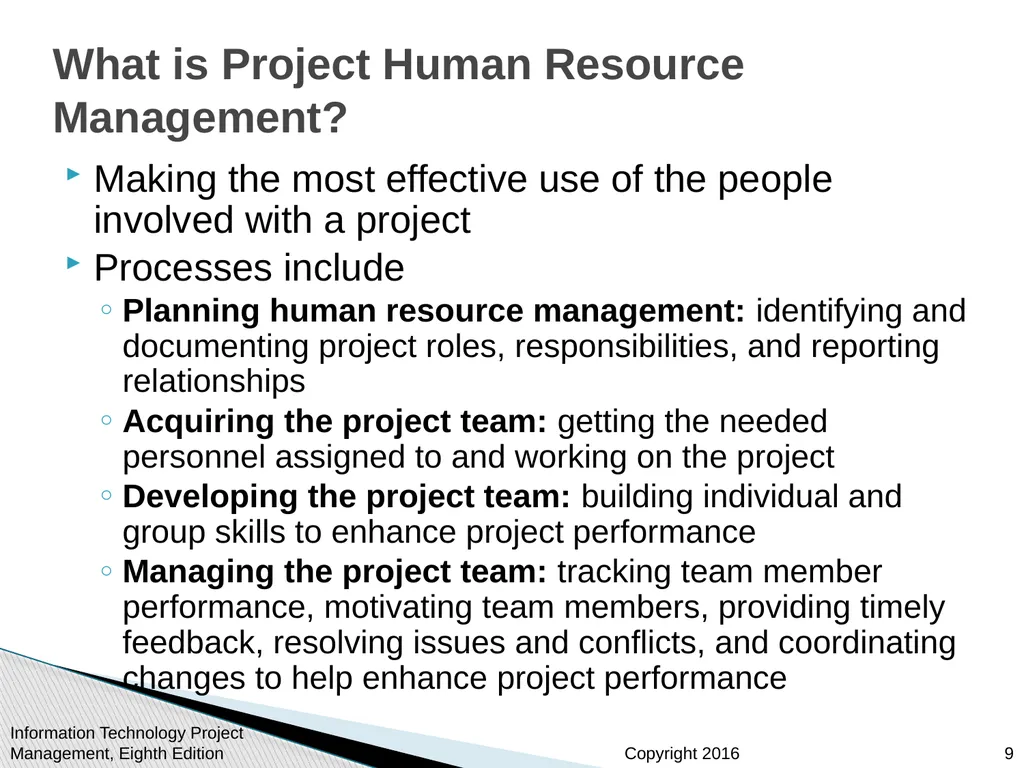
What is Project Human Resource Management? Making the most effective use of the people involved with a project
Processes include
Planning human resource management: identifying and documenting project roles, responsibilities, and reporting relationships
Acquiring the project team: getting the needed personnel assigned to and working on the project
Developing the project team: building individual and group skills to enhance project performance
Managing the project team: tracking team member performance, motivating team members, providing timely feedback, resolving issues and conflicts, and coordinating changes to help enhance project performance Information Technology Project Management, Eighth Edition 9<br>
Processes include
Planning human resource management: identifying and documenting project roles, responsibilities, and reporting relationships
Acquiring the project team: getting the needed personnel assigned to and working on the project
Developing the project team: building individual and group skills to enhance project performance
Managing the project team: tracking team member performance, motivating team members, providing timely feedback, resolving issues and conflicts, and coordinating changes to help enhance project performance Information Technology Project Management, Eighth Edition 9<br>
10
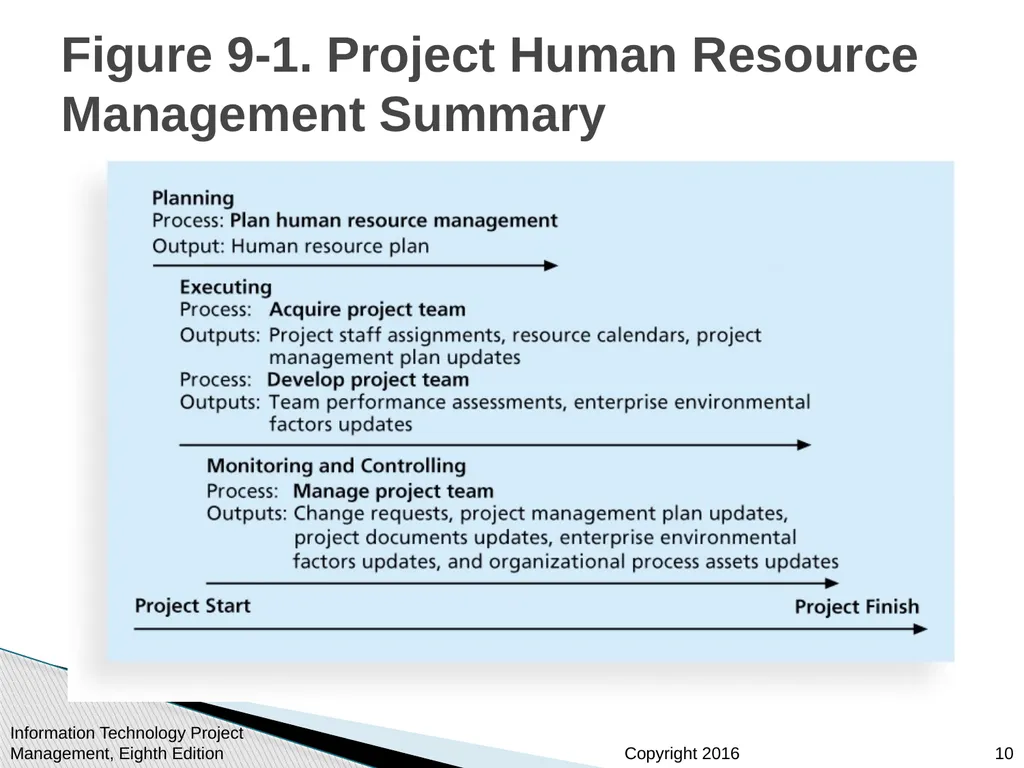
Figure 9-1. Project Human Resource Management Summary Information Technology Project Management, Eighth Edition 10<br>
11
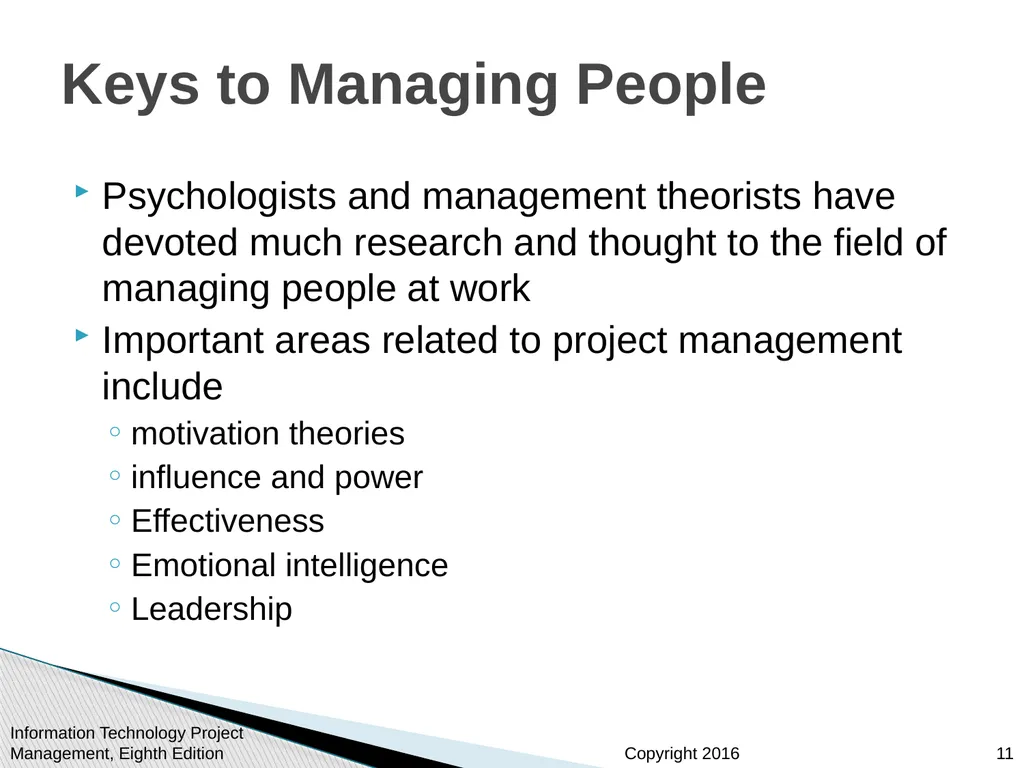
Keys to Managing People Psychologists and management theorists have devoted much research and thought to the field of managing people at work
Important areas related to project management include
motivation theories
influence and power
Effectiveness
Emotional intelligence
Leadership Information Technology Project Management, Eighth Edition 11<br>
Important areas related to project management include
motivation theories
influence and power
Effectiveness
Emotional intelligence
Leadership Information Technology Project Management, Eighth Edition 11<br>
12
Intrinsic and Extrinsic Motivation Intrinsic motivation causes people to participate in an activity for their own enjoyment
Extrinsic motivation causes people to do something for a reward or to avoid a penalty
For example, some children take piano lessons for intrinsic motivation (they enjoy it) while others take them for extrinsic motivation (to get a reward or avoid punishment) Information Technology Project Management, Eighth Edition 12<br>
Extrinsic motivation causes people to do something for a reward or to avoid a penalty
For example, some children take piano lessons for intrinsic motivation (they enjoy it) while others take them for extrinsic motivation (to get a reward or avoid punishment) Information Technology Project Management, Eighth Edition 12<br>
13
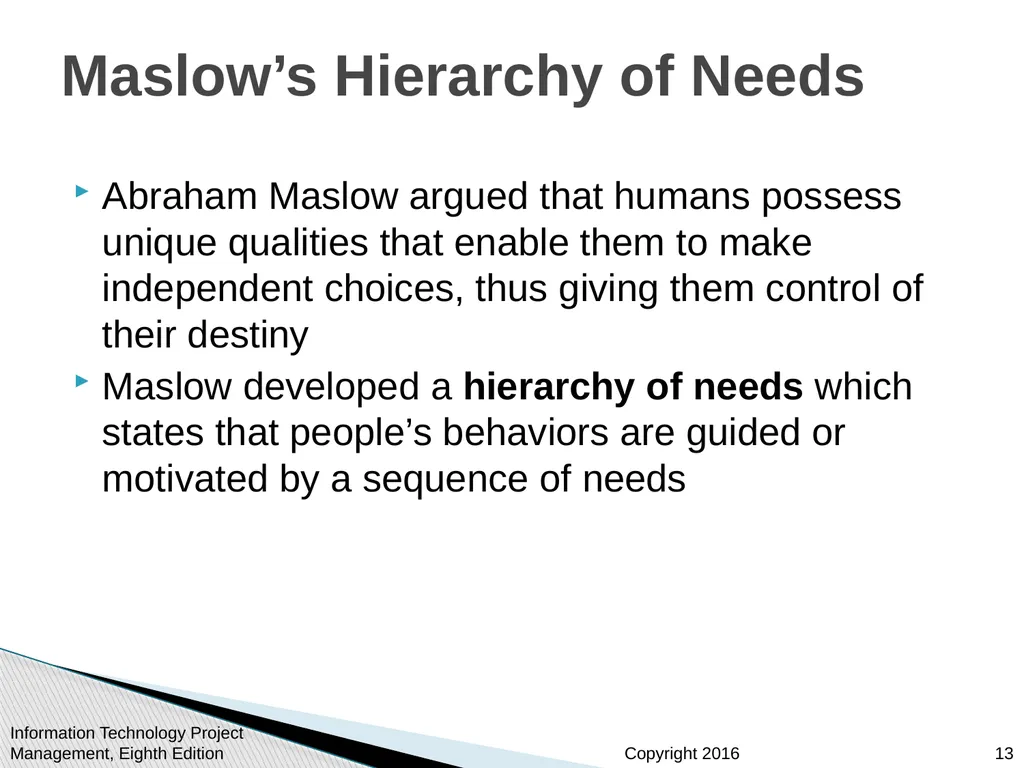
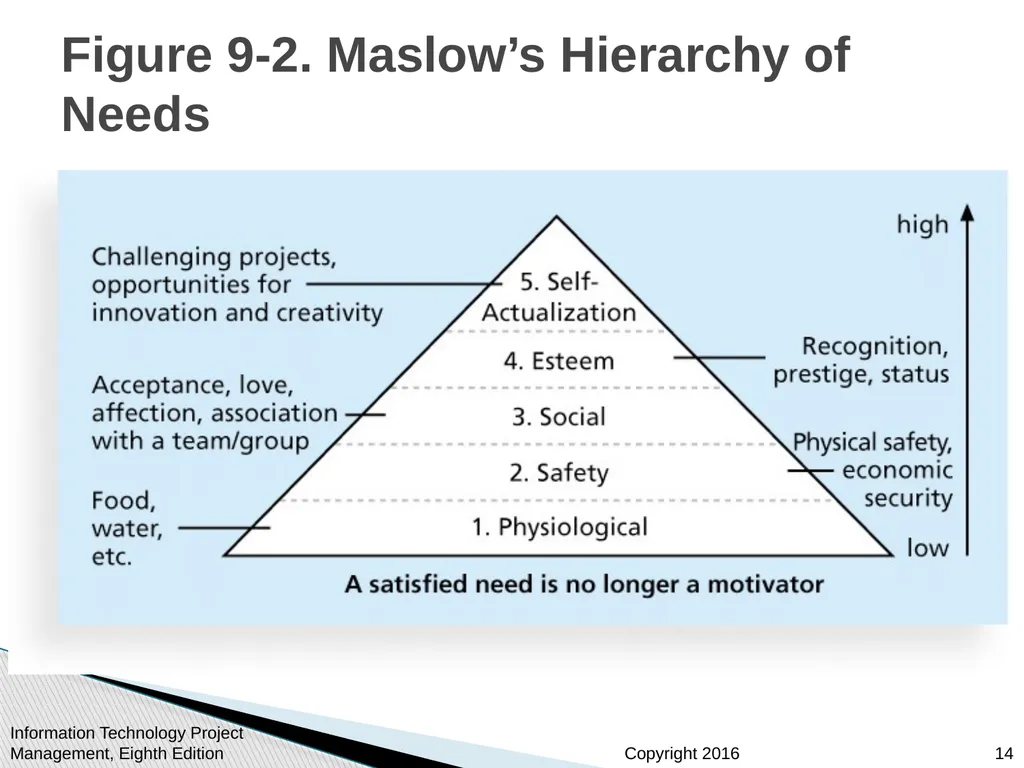
Maslow’s Hierarchy of Needs Abraham Maslow argued that humans possess unique qualities that enable them to make independent choices, thus giving them control of their destiny
Maslow developed a hierarchy of needs which states that people’s behaviors are guided or motivated by a sequence of needs Information Technology Project Management, Eighth Edition 13<br>
Maslow developed a hierarchy of needs which states that people’s behaviors are guided or motivated by a sequence of needs Information Technology Project Management, Eighth Edition 13<br>
14
Figure 9-2. Maslow’s Hierarchy of Needs Information Technology Project Management, Eighth Edition 14<br>
15
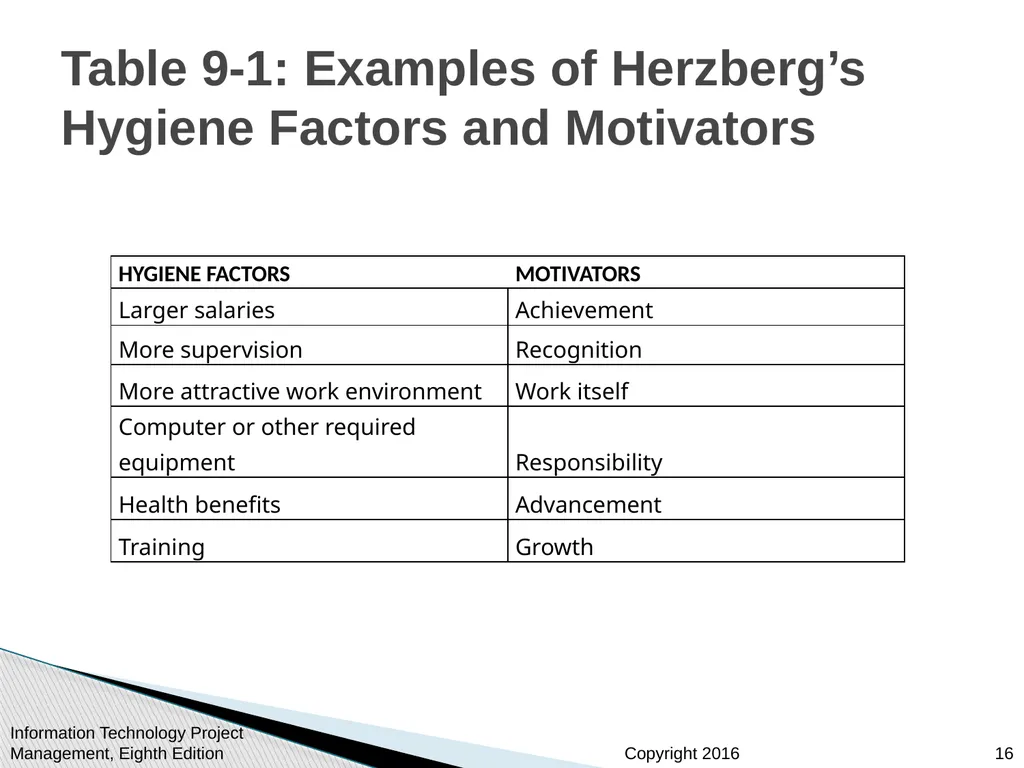
Herzberg’s Motivational and Hygiene Factors Frederick Herzberg wrote several famous books and articles about worker motivation. He distinguished between
motivational factors: achievement, recognition, the work itself, responsibility, advancement, and growth, which produce job satisfaction
hygiene factors: cause dissatisfaction if not present, but do not motivate workers to do more. Examples include larger salaries, more supervision, and a more attractive work environment Information Technology Project Management, Eighth Edition 15<br>
motivational factors: achievement, recognition, the work itself, responsibility, advancement, and growth, which produce job satisfaction
hygiene factors: cause dissatisfaction if not present, but do not motivate workers to do more. Examples include larger salaries, more supervision, and a more attractive work environment Information Technology Project Management, Eighth Edition 15<br>
16
Table 9-1: Examples of Herzberg’s Hygiene Factors and Motivators Information Technology Project Management, Eighth Edition 16<br>
17
Media Snapshot RSA Animate used its popular whiteboard drawing technique to summarize key points from Pink’s book in a YouTube video called “Drive: The surprising truth about what motivates us”
Pink suggests that managers focus on the following three motivators:
Autonomy
Mastery
Purpose Information Technology Project Management, Eighth Edition 17<br>
Pink suggests that managers focus on the following three motivators:
Autonomy
Mastery
Purpose Information Technology Project Management, Eighth Edition 17<br>
18
McClelland’s Acquired-Needs Theory Specific needs are acquired or learned over time and shaped by life experiences, including:
Achievement (nAch): Achievers like challenging projects with achievable goals and lots of feedback
Affiliation (nAff): People with high nAff desire harmonious relationships and need to feel accepted by others, so managers should try to create a cooperative work environment for them
Power: (nPow): People with a need for power desire either personal power (not good) or institutional power (good for the organization). Provide institutional power seekers with management opportunities Information Technology Project Management, Eighth Edition 18<br>
Achievement (nAch): Achievers like challenging projects with achievable goals and lots of feedback
Affiliation (nAff): People with high nAff desire harmonious relationships and need to feel accepted by others, so managers should try to create a cooperative work environment for them
Power: (nPow): People with a need for power desire either personal power (not good) or institutional power (good for the organization). Provide institutional power seekers with management opportunities Information Technology Project Management, Eighth Edition 18<br>
19
McGregor’s Theory X and Y Douglas McGregor popularized the human relations approach to management in the 1960s
Theory X: assumes workers dislike and avoid work, so managers must use coercion, threats and various control schemes to get workers to meet objectives
Theory Y: assumes individuals consider work as natural as play or rest and enjoy the satisfaction of esteem and self-actualization needs
Theory Z: introduced in 1981 by William Ouchi and is based on the Japanese approach to motivating workers, emphasizing trust, quality, collective decision making, and cultural values Information Technology Project Management, Eighth Edition 19<br>
Theory X: assumes workers dislike and avoid work, so managers must use coercion, threats and various control schemes to get workers to meet objectives
Theory Y: assumes individuals consider work as natural as play or rest and enjoy the satisfaction of esteem and self-actualization needs
Theory Z: introduced in 1981 by William Ouchi and is based on the Japanese approach to motivating workers, emphasizing trust, quality, collective decision making, and cultural values Information Technology Project Management, Eighth Edition 19<br>
20
Thamhain and Wilemon’s Ways to Have Influence on Projects, Part 1 Authority: the legitimate hierarchical right to issue orders
Assignment: the project manager's perceived ability to influence a worker's later work assignments
Budget: the project manager's perceived ability to authorize others' use of discretionary funds
Promotion: the ability to improve a worker's position
Money: the ability to increase a worker's pay and benefits Information Technology Project Management, Eighth Edition 20<br>
Assignment: the project manager's perceived ability to influence a worker's later work assignments
Budget: the project manager's perceived ability to authorize others' use of discretionary funds
Promotion: the ability to improve a worker's position
Money: the ability to increase a worker's pay and benefits Information Technology Project Management, Eighth Edition 20<br>
21
Thamhain and Wilemon’s Ways to Have Influence on Projects, Part 2 Penalty: the project manager's ability to cause punishment
Work challenge: the ability to assign work that capitalizes on a worker's enjoyment of doing a particular task
Expertise: the project manager's perceived special knowledge that others deem important
Friendship: the ability to establish friendly personal relationships between the project manager and others Information Technology Project Management, Eighth Edition 21<br>
Work challenge: the ability to assign work that capitalizes on a worker's enjoyment of doing a particular task
Expertise: the project manager's perceived special knowledge that others deem important
Friendship: the ability to establish friendly personal relationships between the project manager and others Information Technology Project Management, Eighth Edition 21<br>
22
Ways to Influence that Help and Hurt Projects Projects are more likely to succeed when project managers influence with
expertise
work challenge
Projects are more likely to fail when project managers rely too heavily on
authority
money
penalty Information Technology Project Management, Eighth Edition 22<br>
expertise
work challenge
Projects are more likely to fail when project managers rely too heavily on
authority
money
penalty Information Technology Project Management, Eighth Edition 22<br>
23
Power Power is the potential ability to influence behavior to get people to do things they would not otherwise do
Types of power include
Coercive
Legitimate
Expert
Reward
Referent Information Technology Project Management, Eighth Edition 23<br>
Types of power include
Coercive
Legitimate
Expert
Reward
Referent Information Technology Project Management, Eighth Edition 23<br>
24
Covey and Improving Effectiveness Project managers can apply Covey’s 7 habits to improve effectiveness on projects
Be proactive
Begin with the end in mind
Put first things first
Think win/win
Seek first to understand, then to be understood
Synergize
Sharpen the saw Information Technology Project Management, Eighth Edition 24<br>
Be proactive
Begin with the end in mind
Put first things first
Think win/win
Seek first to understand, then to be understood
Synergize
Sharpen the saw Information Technology Project Management, Eighth Edition 24<br>
25
Empathic Listening and Rapport Good project managers are empathic listeners - they listen with the intent to understand
Before you can communicate with others, you have to have rapport – a relation of harmony, conformity, accord, or affinity
Mirroring is the matching of certain behaviors of the other person, a technique to help establish rapport
IT professionals need to develop empathic listening and other people skills to improve relationships with users and other stakeholders Information Technology Project Management, Eighth Edition 25<br>
Before you can communicate with others, you have to have rapport – a relation of harmony, conformity, accord, or affinity
Mirroring is the matching of certain behaviors of the other person, a technique to help establish rapport
IT professionals need to develop empathic listening and other people skills to improve relationships with users and other stakeholders Information Technology Project Management, Eighth Edition 25<br>
26
Emotional Intelligence Howard Gardner’s book Frames of Mind: The Theory of Multiple Intelligences introduced the concept of using more than one way to think of and measure human intelligence
Emotional intelligence (EI) is knowing and managing one’s own emotions and understanding the emotions of others for improved performance
71 percent of U.S. hiring managers say they value EI more than IQ Information Technology Project Management, Eighth Edition 26<br>
Emotional intelligence (EI) is knowing and managing one’s own emotions and understanding the emotions of others for improved performance
71 percent of U.S. hiring managers say they value EI more than IQ Information Technology Project Management, Eighth Edition 26<br>
27
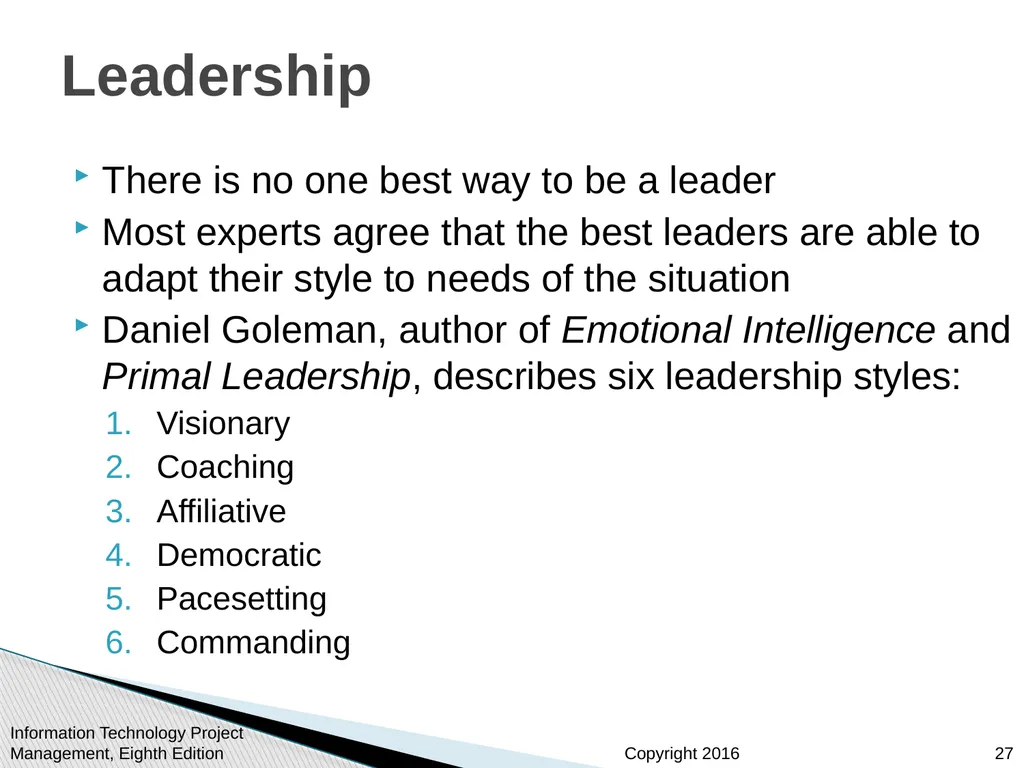
Leadership There is no one best way to be a leader
Most experts agree that the best leaders are able to adapt their style to needs of the situation
Daniel Goleman, author of Emotional Intelligence and Primal Leadership, describes six leadership styles:
Visionary
Coaching
Affiliative
Democratic
Pacesetting
Commanding Information Technology Project Management, Eighth Edition 27<br>
Most experts agree that the best leaders are able to adapt their style to needs of the situation
Daniel Goleman, author of Emotional Intelligence and Primal Leadership, describes six leadership styles:
Visionary
Coaching
Affiliative
Democratic
Pacesetting
Commanding Information Technology Project Management, Eighth Edition 27<br>
28
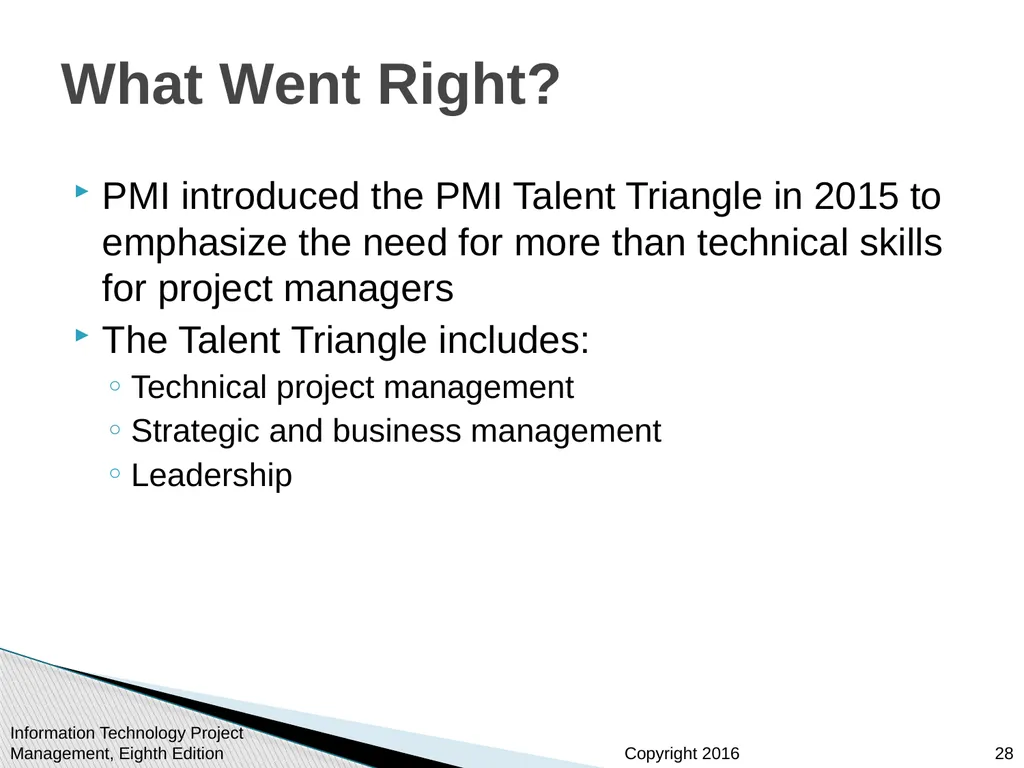
What Went Right? PMI introduced the PMI Talent Triangle in 2015 to emphasize the need for more than technical skills for project managers
The Talent Triangle includes:
Technical project management
Strategic and business management
Leadership Information Technology Project Management, Eighth Edition 28<br>
The Talent Triangle includes:
Technical project management
Strategic and business management
Leadership Information Technology Project Management, Eighth Edition 28<br>
29
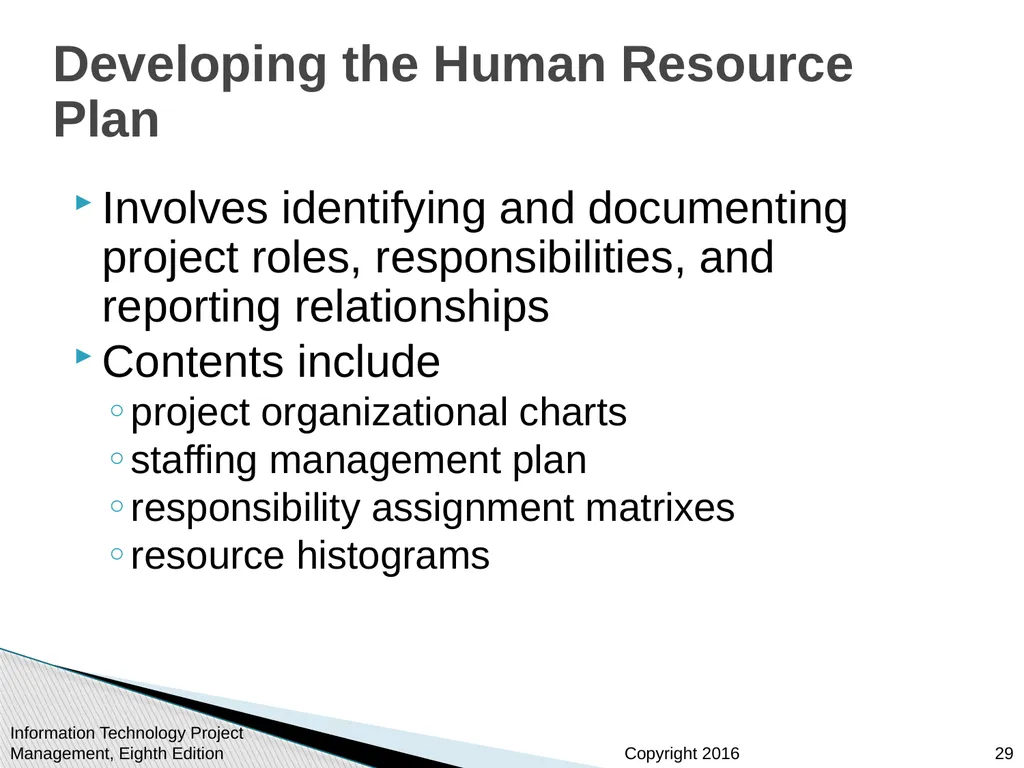
Developing the Human Resource Plan Involves identifying and documenting project roles, responsibilities, and reporting relationships
Contents include
project organizational charts
staffing management plan
responsibility assignment matrixes
resource histograms Information Technology Project Management, Eighth Edition 29<br>
Contents include
project organizational charts
staffing management plan
responsibility assignment matrixes
resource histograms Information Technology Project Management, Eighth Edition 29<br>
30
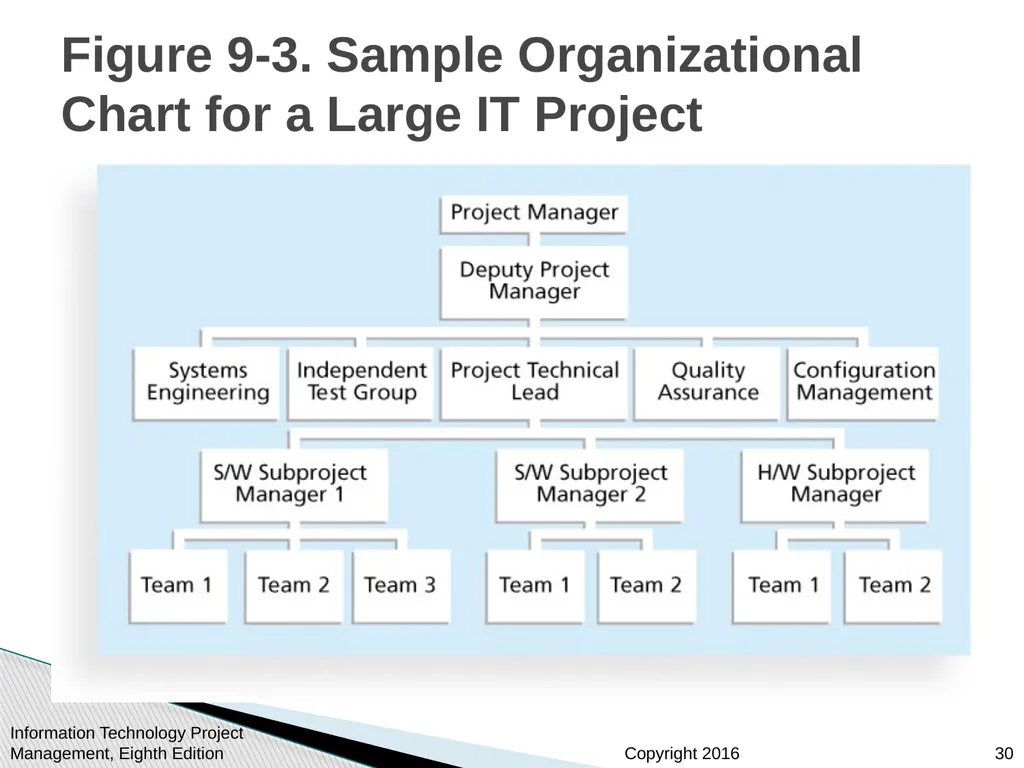
Figure 9-3. Sample Organizational Chart for a Large IT Project Information Technology Project Management, Eighth Edition 30<br>
31
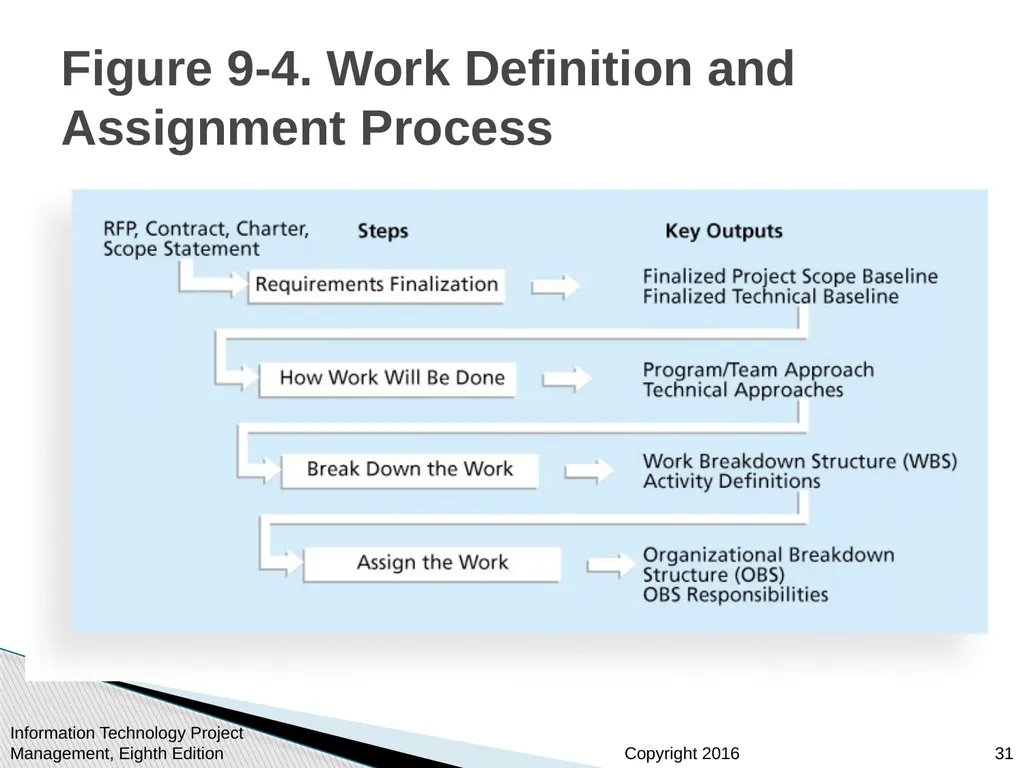
Figure 9-4. Work Definition and Assignment Process Information Technology Project Management, Eighth Edition 31<br>
32
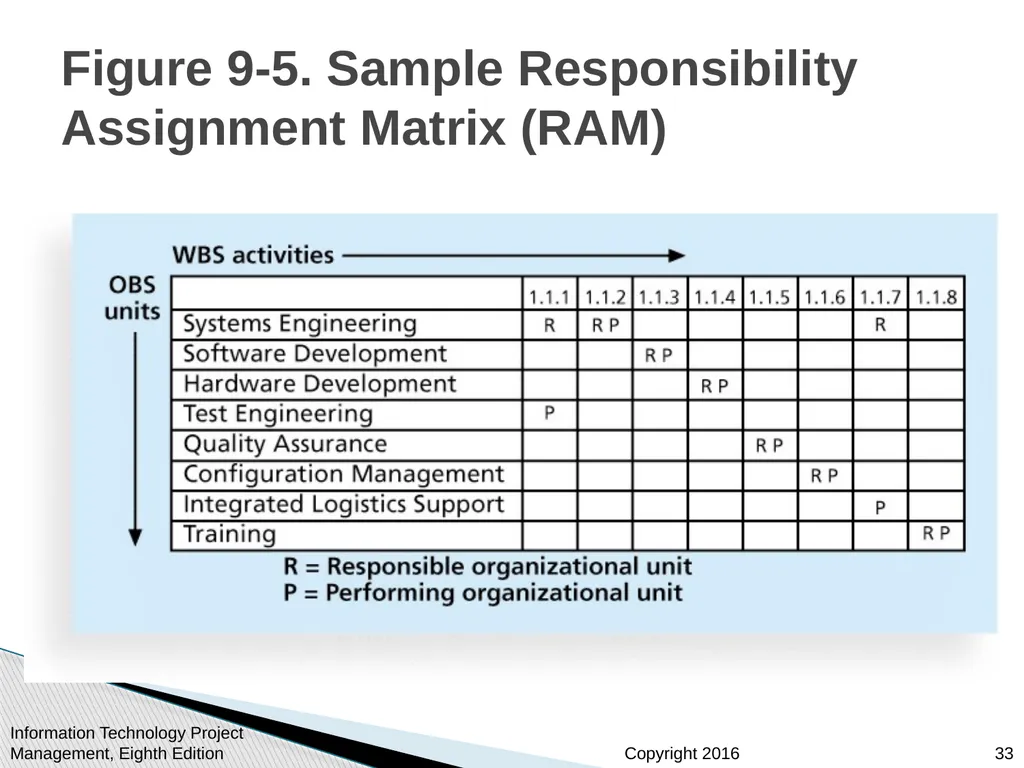
Responsibility Assignment Matrices A responsibility assignment matrix (RAM) is a matrix that maps the work of the project as described in the WBS to the people responsible for performing the work as described in the OBS
Can be created in different ways to meet unique project needs Information Technology Project Management, Eighth Edition 32<br>
Can be created in different ways to meet unique project needs Information Technology Project Management, Eighth Edition 32<br>
33
Figure 9-5. Sample Responsibility Assignment Matrix (RAM) Information Technology Project Management, Eighth Edition 33<br>
34
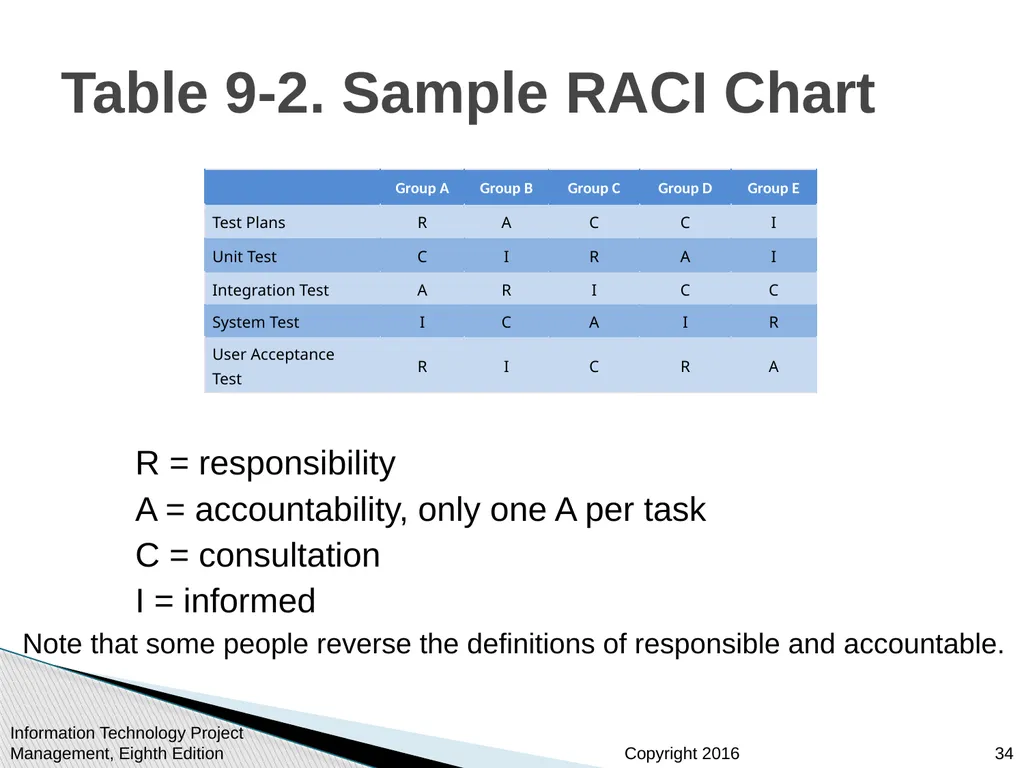
Table 9-2. Sample RACI Chart R = responsibility
A = accountability, only one A per task
C = consultation
I = informed
Note that some people reverse the definitions of responsible and accountable. Information Technology Project Management, Eighth Edition 34<br>
A = accountability, only one A per task
C = consultation
I = informed
Note that some people reverse the definitions of responsible and accountable. Information Technology Project Management, Eighth Edition 34<br>
35
Staffing Management Plans and Resource Histograms A staffing management plan describes when and how people will be added to and taken off the project team
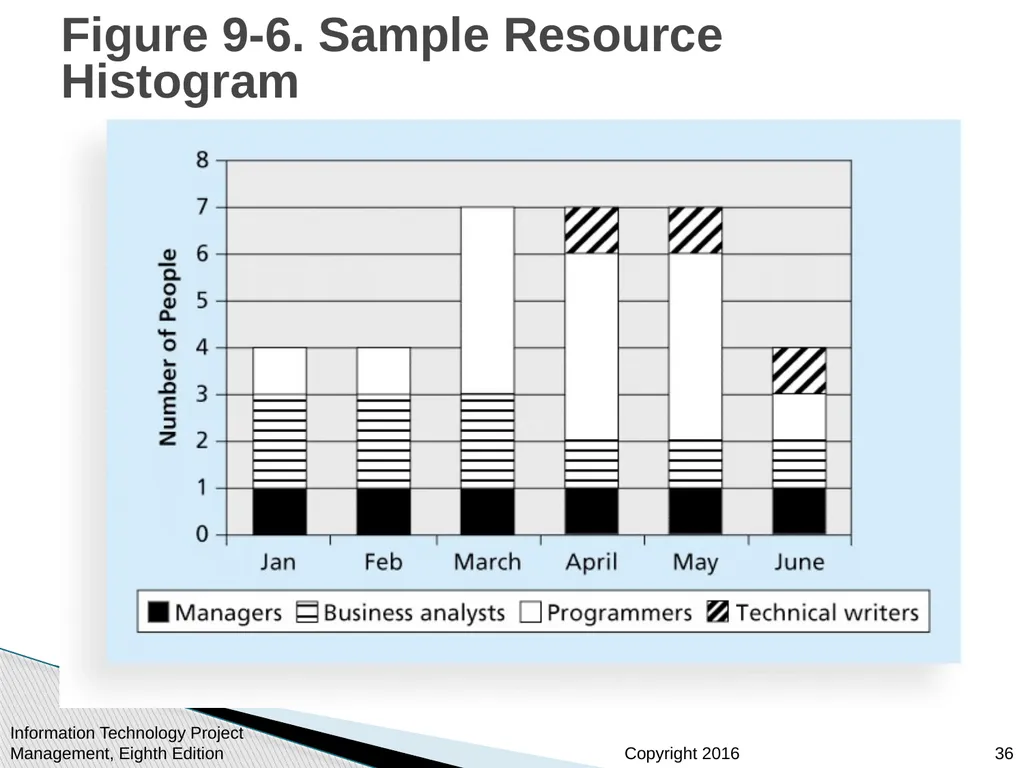
A resource histogram is a column chart that shows the number of resources assigned to a project over time Information Technology Project Management, Eighth Edition 35<br>
A resource histogram is a column chart that shows the number of resources assigned to a project over time Information Technology Project Management, Eighth Edition 35<br>
36
Figure 9-6. Sample Resource Histogram Information Technology Project Management, Eighth Edition 36<br>
37
Acquiring the Project Team Acquiring qualified people for teams is crucial
The project manager who is the smartest person on the team has done a poor job of recruiting!
It’s important to assign the appropriate type and number of people to work on projects at the appropriate times Information Technology Project Management, Eighth Edition 37<br>
The project manager who is the smartest person on the team has done a poor job of recruiting!
It’s important to assign the appropriate type and number of people to work on projects at the appropriate times Information Technology Project Management, Eighth Edition 37<br>
38
Resource Assignment Staffing plans and good hiring procedures are important, as are incentives for recruiting and retention
Some companies give their employees one dollar for every hour a new person they helped hire works
Some organizations allow people to work from home as an incentive
Enrollment in U.S. computer science and engineering programs has dropped almost in half since 2000, and one-third of U.S. workers were over the age of 50 by 2010
CIO’s researchers suggest that organizations rethink hiring practices and incentives to hire and retain IT talent Information Technology Project Management, Eighth Edition 38<br>
Some companies give their employees one dollar for every hour a new person they helped hire works
Some organizations allow people to work from home as an incentive
Enrollment in U.S. computer science and engineering programs has dropped almost in half since 2000, and one-third of U.S. workers were over the age of 50 by 2010
CIO’s researchers suggest that organizations rethink hiring practices and incentives to hire and retain IT talent Information Technology Project Management, Eighth Edition 38<br>
39
Best Practice Best practices can be applied to include the best places for people to work
For example, Fortune Magazine lists the “100 Best Companies to Work For” in the United States every year, with Google taking the honors for the sixth time in 2015
Working Mothers Magazine lists the best companies in the U.S. for women based on benefits for working families
The Timesonline (www.timesonline.co.uk) provides the Sunday Times list of the 100 Best Companies to Work For, a key benchmark against which UK companies can judge their Best Practice performance as employers Information Technology Project Management, Eighth Edition 39<br>
For example, Fortune Magazine lists the “100 Best Companies to Work For” in the United States every year, with Google taking the honors for the sixth time in 2015
Working Mothers Magazine lists the best companies in the U.S. for women based on benefits for working families
The Timesonline (www.timesonline.co.uk) provides the Sunday Times list of the 100 Best Companies to Work For, a key benchmark against which UK companies can judge their Best Practice performance as employers Information Technology Project Management, Eighth Edition 39<br>
40
Resource Loading Resource loading refers to the amount of individual resources an existing schedule requires during specific time periods
Helps project managers develop a general understanding of the demands a project will make on the organization’s resources and individual people’s schedules
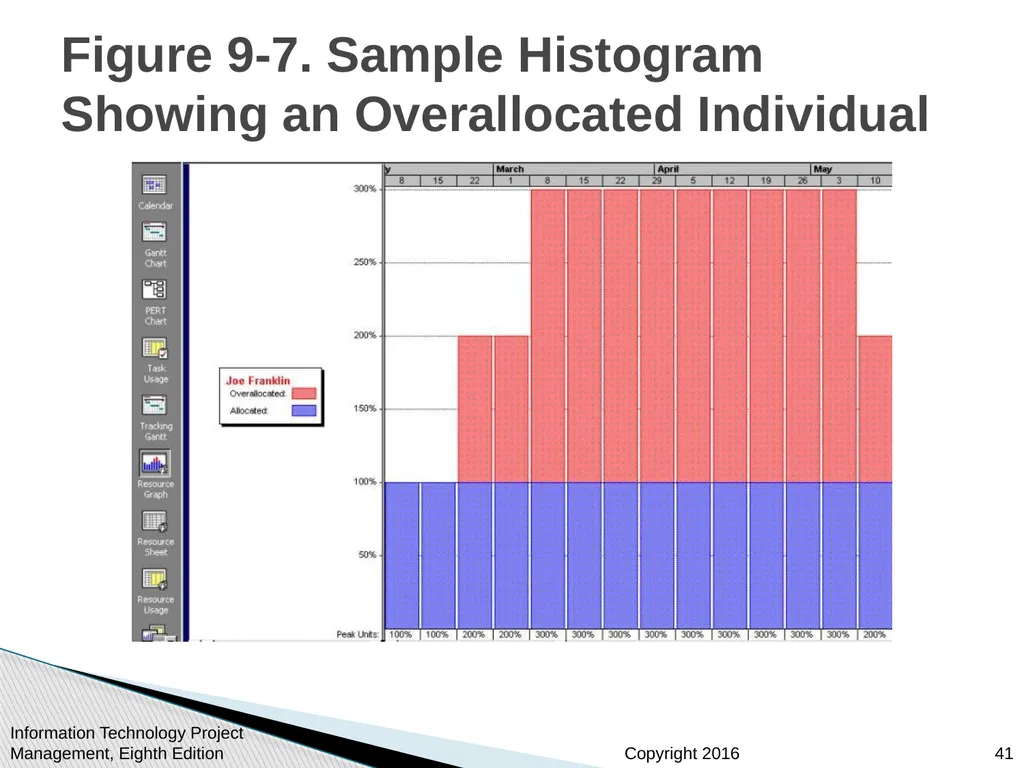
Overallocation means more resources than are available are assigned to perform work at a given time Information Technology Project Management, Eighth Edition 40<br>
Helps project managers develop a general understanding of the demands a project will make on the organization’s resources and individual people’s schedules
Overallocation means more resources than are available are assigned to perform work at a given time Information Technology Project Management, Eighth Edition 40<br>
41
Figure 9-7. Sample Histogram Showing an Overallocated Individual Information Technology Project Management, Eighth Edition 41<br>
42
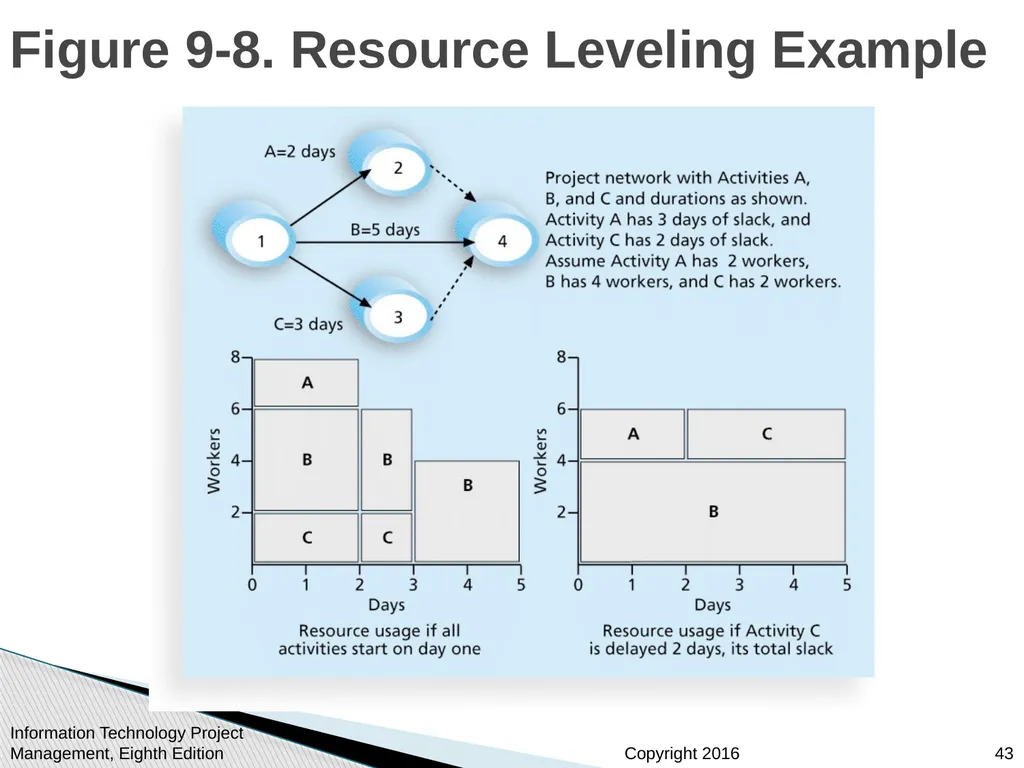
Resource Leveling Resource leveling is a technique for resolving resource conflicts by delaying tasks
The main purpose of resource leveling is to create a smoother distribution of resource usage and reduce overallocation Information Technology Project Management, Eighth Edition 42<br>
The main purpose of resource leveling is to create a smoother distribution of resource usage and reduce overallocation Information Technology Project Management, Eighth Edition 42<br>
43
Figure 9-8. Resource Leveling Example Information Technology Project Management, Eighth Edition 43<br>
44
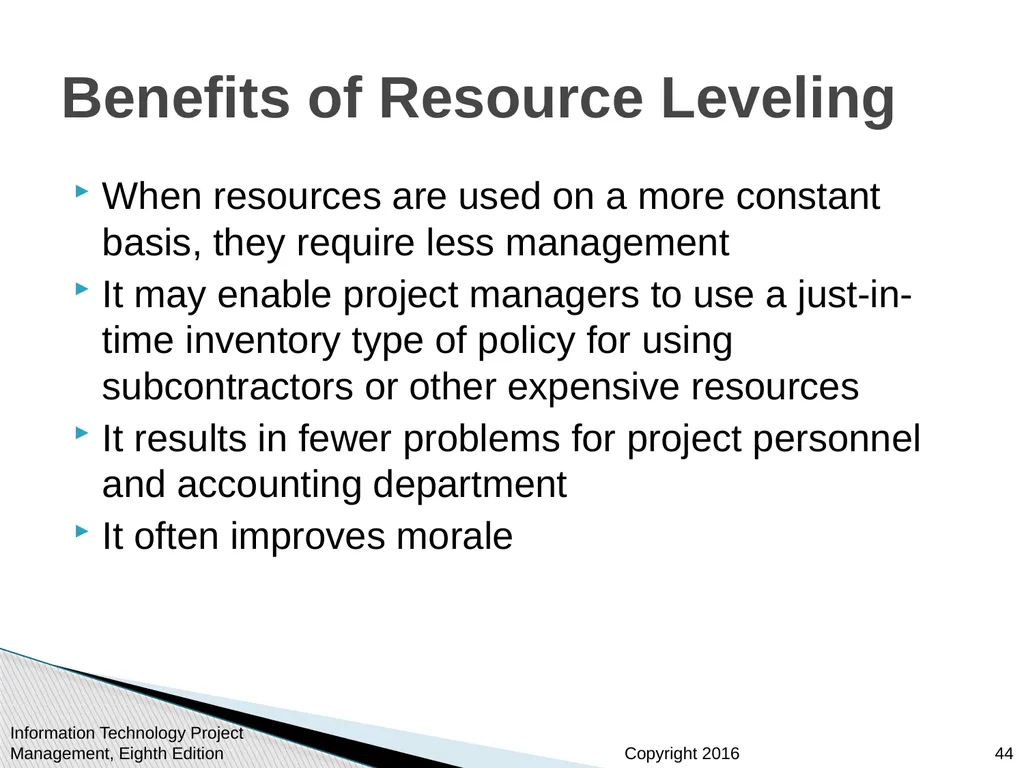
Benefits of Resource Leveling When resources are used on a more constant basis, they require less management
It may enable project managers to use a just-in-time inventory type of policy for using subcontractors or other expensive resources
It results in fewer problems for project personnel and accounting department
It often improves morale Information Technology Project Management, Eighth Edition 44<br>
It may enable project managers to use a just-in-time inventory type of policy for using subcontractors or other expensive resources
It results in fewer problems for project personnel and accounting department
It often improves morale Information Technology Project Management, Eighth Edition 44<br>
45
Developing the Project Team The main goal of team development is to help people work together more effectively to improve project performance
It takes teamwork to successfully complete most projects Information Technology Project Management, Eighth Edition 45<br>
It takes teamwork to successfully complete most projects Information Technology Project Management, Eighth Edition 45<br>
46
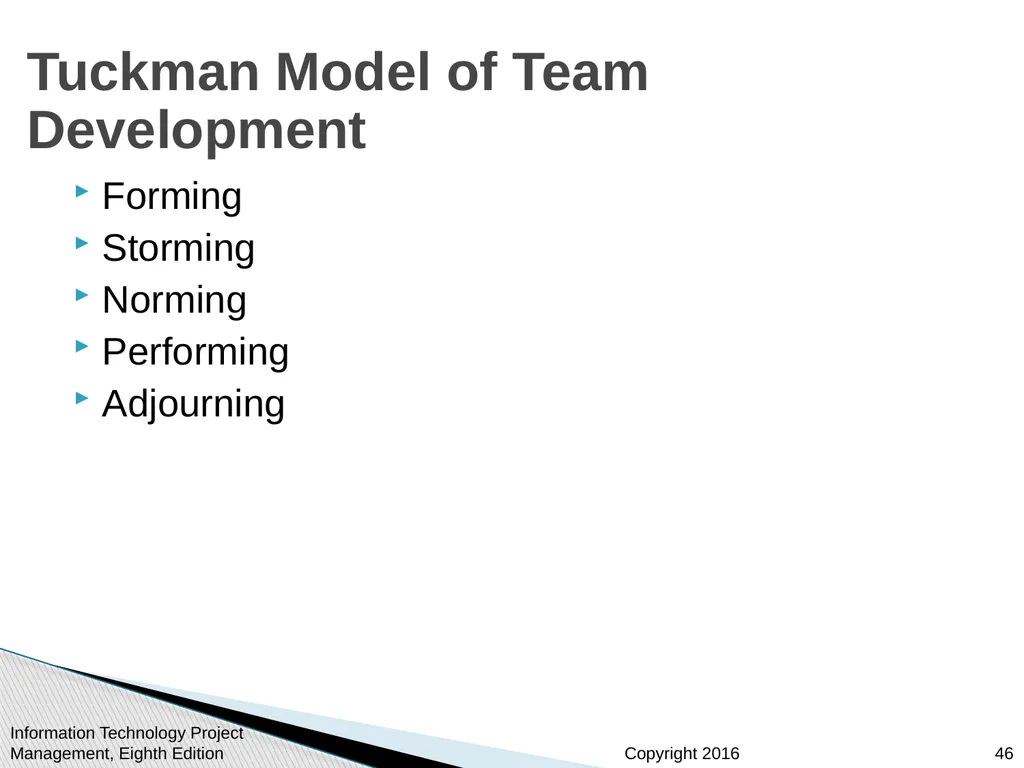
Tuckman Model of Team Development Forming
Storming
Norming
Performing
Adjourning Information Technology Project Management, Eighth Edition 46<br>
Storming
Norming
Performing
Adjourning Information Technology Project Management, Eighth Edition 46<br>
47
Training Training can help people understand themselves, each other, and how to work better in teams
Team building activities include
physical challenges
psychological preference indicator tools Information Technology Project Management, Eighth Edition 47<br>
Team building activities include
physical challenges
psychological preference indicator tools Information Technology Project Management, Eighth Edition 47<br>
48
Meyers-Briggs Type Indicator (MBTI) MBTI is a popular tool for determining personality preferences and helping teammates understand each other
Four dimensions include:
Extrovert/Introvert (E/I)
Sensation/Intuition (S/N)
Thinking/Feeling (T/F)
Judgment/Perception (J/P)
NTs or rationals are attracted to technology fields
IT people vary most from the general population in not being extroverted or sensing Information Technology Project Management, Eighth Edition 48<br>
Four dimensions include:
Extrovert/Introvert (E/I)
Sensation/Intuition (S/N)
Thinking/Feeling (T/F)
Judgment/Perception (J/P)
NTs or rationals are attracted to technology fields
IT people vary most from the general population in not being extroverted or sensing Information Technology Project Management, Eighth Edition 48<br>
49
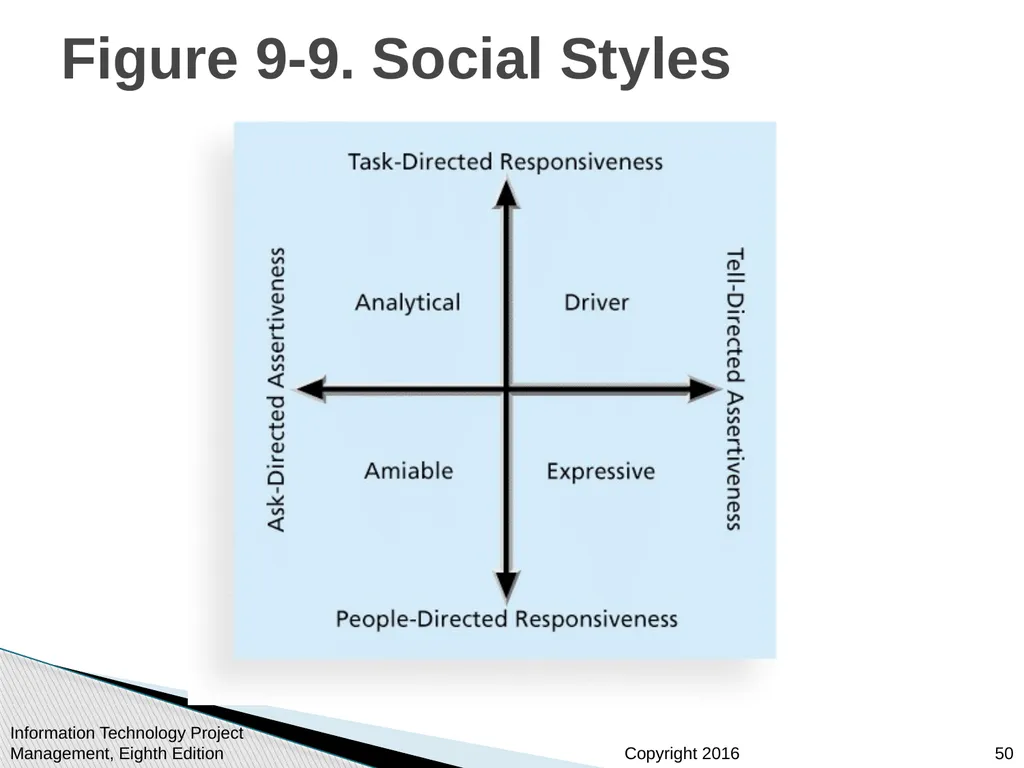
Social Styles Profile People are perceived as behaving primarily in one of four zones, based on their assertiveness and responsiveness:
Drivers
Expressives
Analyticals
Amiables
People on opposite corners (drivers and amiables, analyticals and expressives) may have difficulties getting along Information Technology Project Management, Eighth Edition 49<br>
Drivers
Expressives
Analyticals
Amiables
People on opposite corners (drivers and amiables, analyticals and expressives) may have difficulties getting along Information Technology Project Management, Eighth Edition 49<br>
50
Figure 9-9. Social Styles Information Technology Project Management, Eighth Edition 50<br>
51
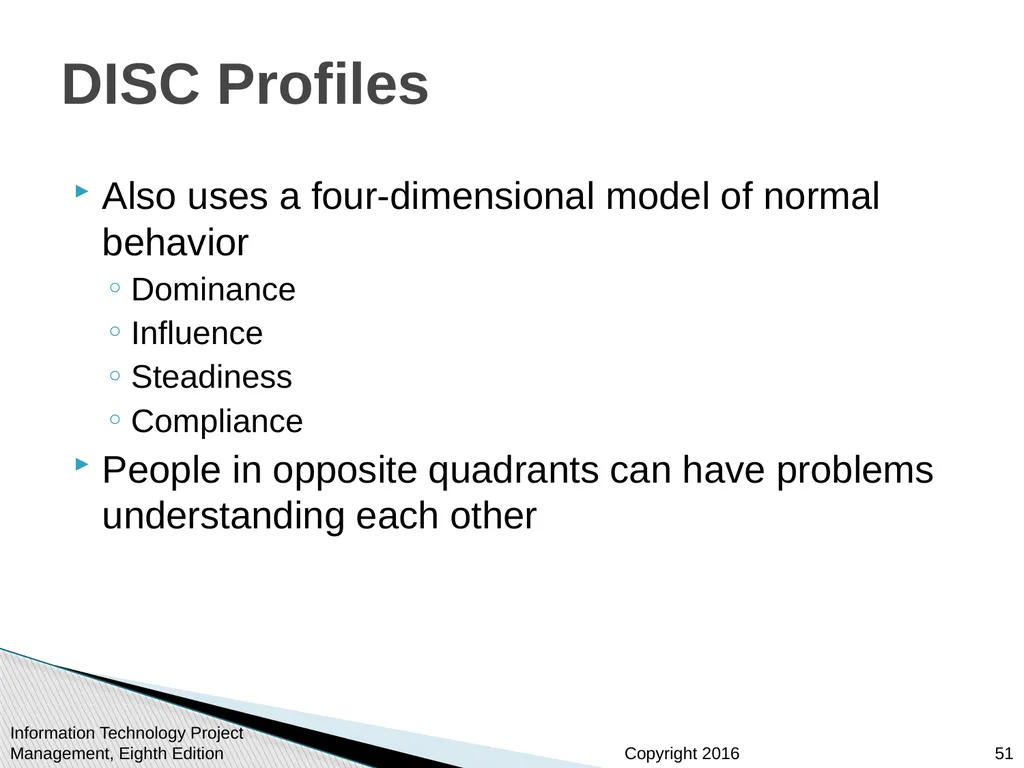
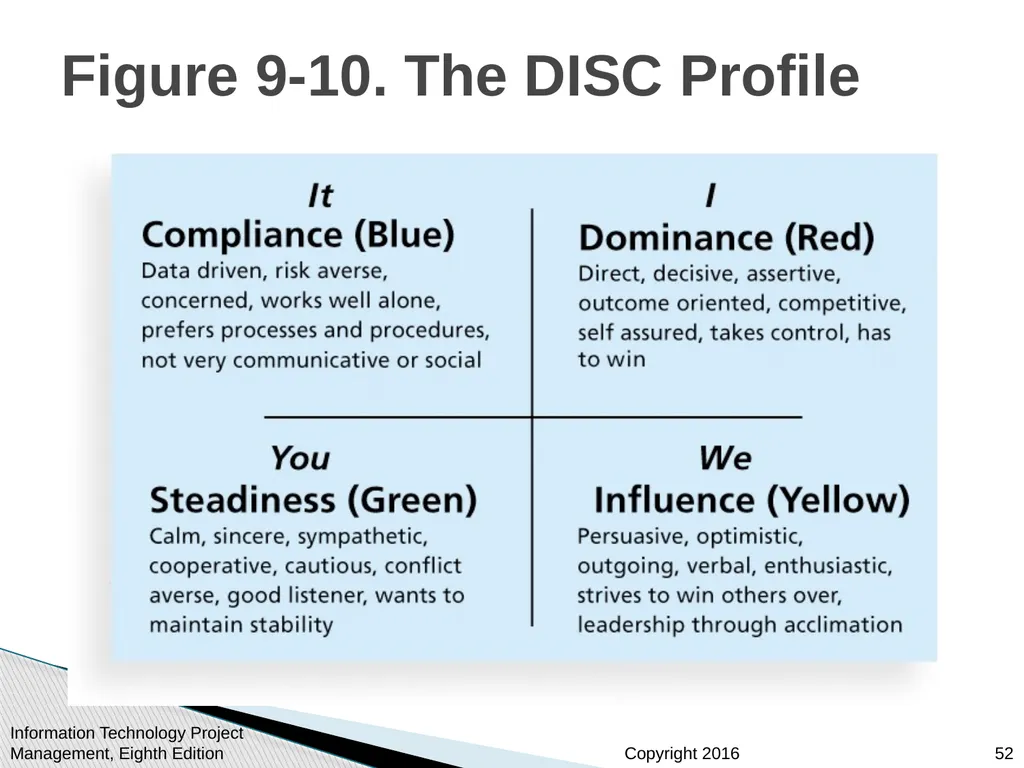
DISC Profiles Also uses a four-dimensional model of normal behavior
Dominance
Influence
Steadiness
Compliance
People in opposite quadrants can have problems understanding each other Information Technology Project Management, Eighth Edition 51<br>
Dominance
Influence
Steadiness
Compliance
People in opposite quadrants can have problems understanding each other Information Technology Project Management, Eighth Edition 51<br>
52
Figure 9-10. The DISC Profile Information Technology Project Management, Eighth Edition 52<br>
53
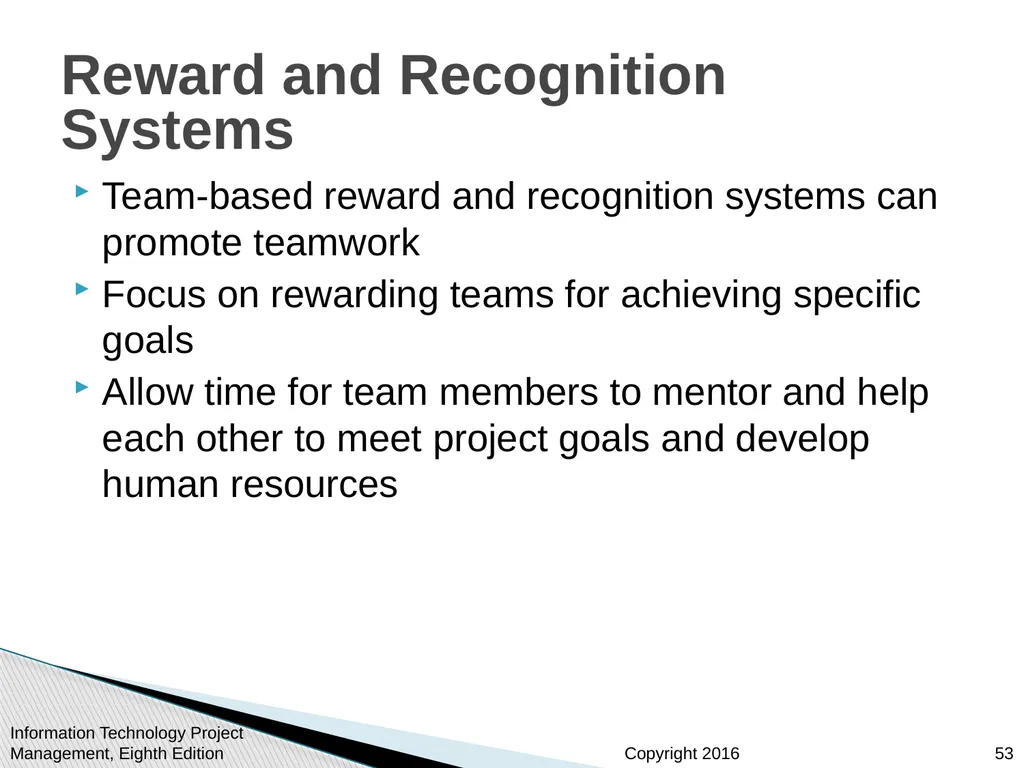
Reward and Recognition Systems Team-based reward and recognition systems can promote teamwork
Focus on rewarding teams for achieving specific goals
Allow time for team members to mentor and help each other to meet project goals and develop human resources Information Technology Project Management, Eighth Edition 53<br>
Focus on rewarding teams for achieving specific goals
Allow time for team members to mentor and help each other to meet project goals and develop human resources Information Technology Project Management, Eighth Edition 53<br>
54
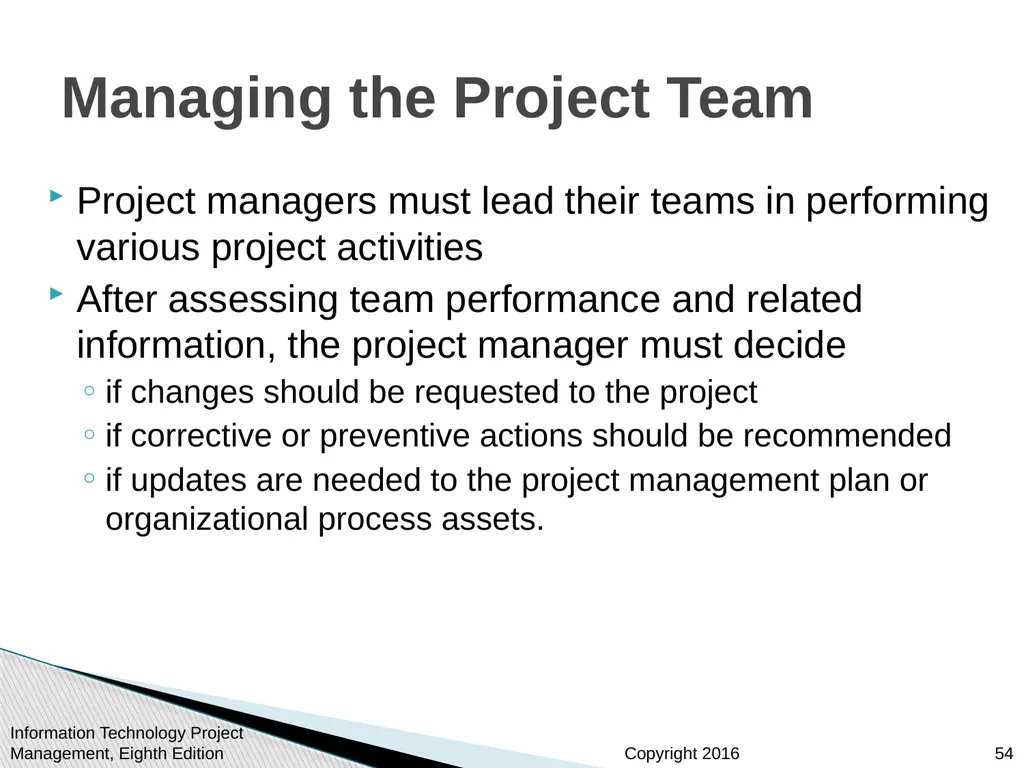
Managing the Project Team Project managers must lead their teams in performing various project activities
After assessing team performance and related information, the project manager must decide
if changes should be requested to the project
if corrective or preventive actions should be recommended
if updates are needed to the project management plan or organizational process assets. Information Technology Project Management, Eighth Edition 54<br>
After assessing team performance and related information, the project manager must decide
if changes should be requested to the project
if corrective or preventive actions should be recommended
if updates are needed to the project management plan or organizational process assets. Information Technology Project Management, Eighth Edition 54<br>
55
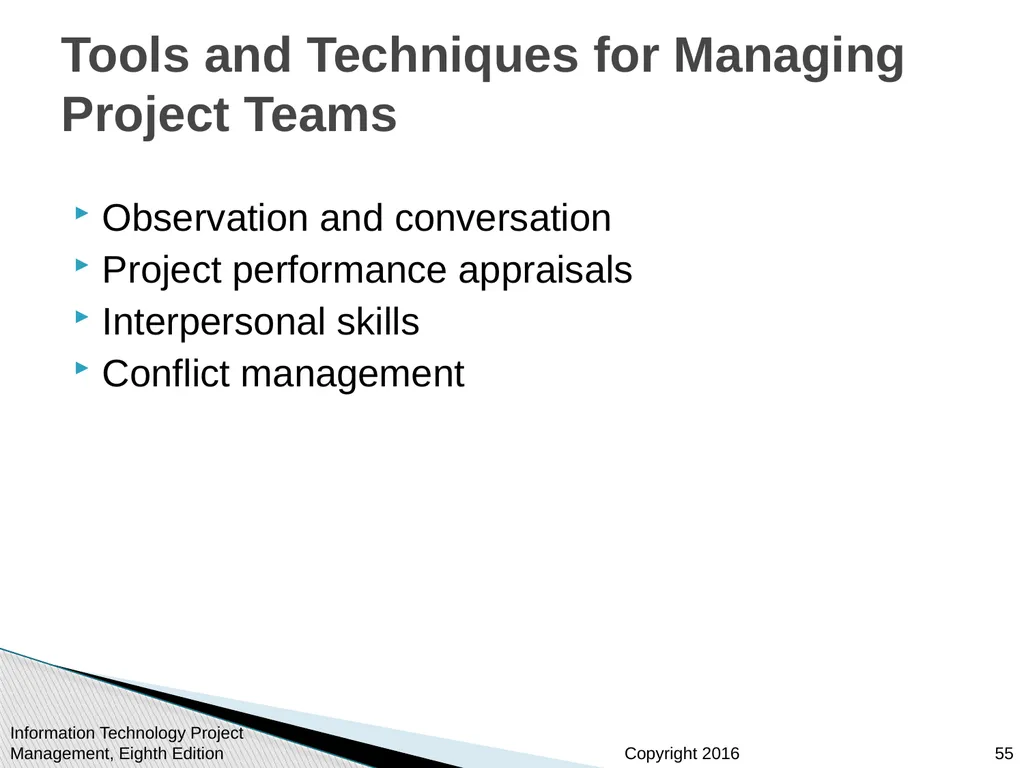
Tools and Techniques for Managing Project Teams Observation and conversation
Project performance appraisals
Interpersonal skills
Conflict management Information Technology Project Management, Eighth Edition 55<br>
Project performance appraisals
Interpersonal skills
Conflict management Information Technology Project Management, Eighth Edition 55<br>
56
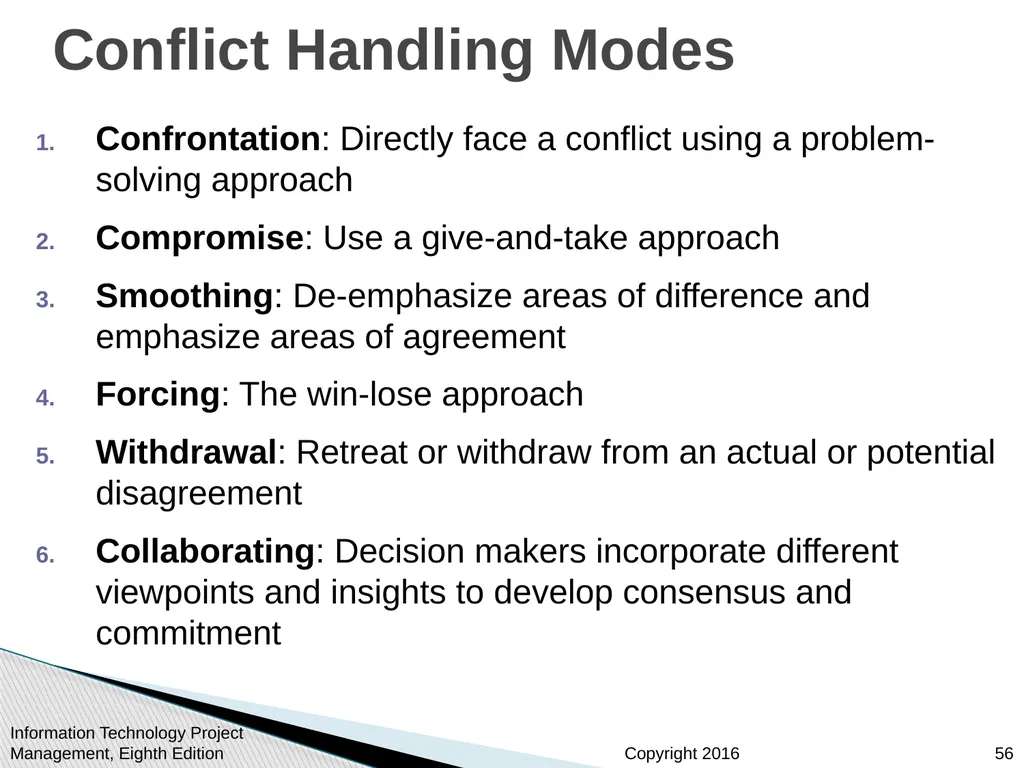
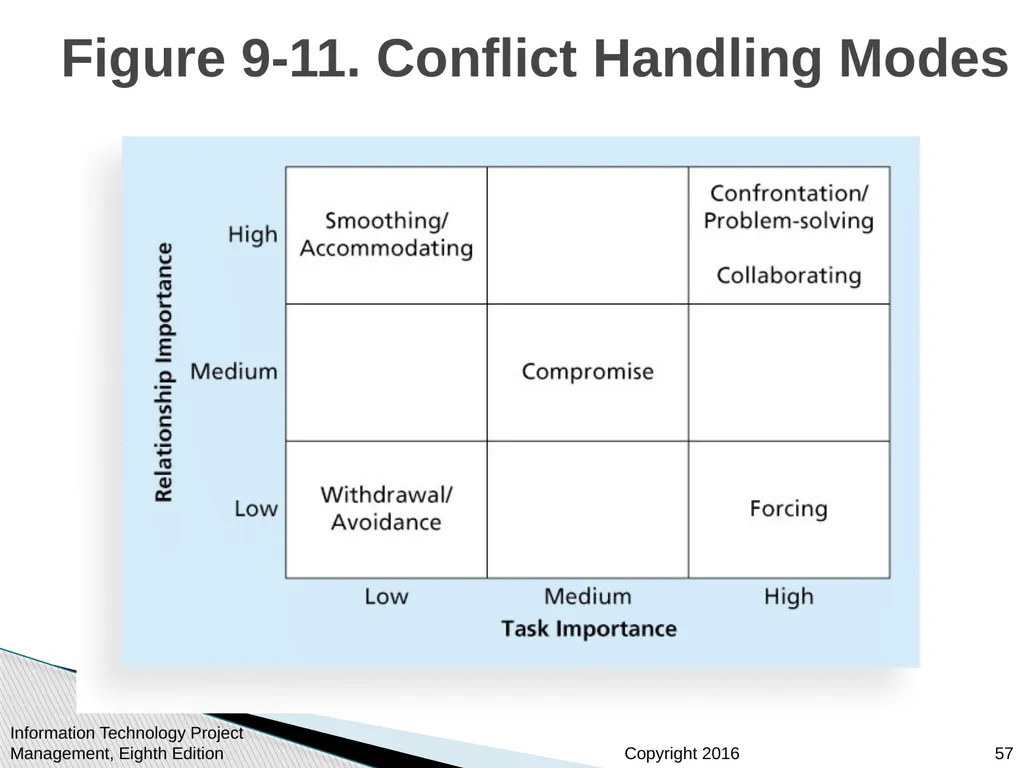
Conflict Handling Modes Confrontation: Directly face a conflict using a problem-solving approach
Compromise: Use a give-and-take approach
Smoothing: De-emphasize areas of difference and emphasize areas of agreement
Forcing: The win-lose approach
Withdrawal: Retreat or withdraw from an actual or potential disagreement
Collaborating: Decision makers incorporate different viewpoints and insights to develop consensus and commitment Information Technology Project Management, Eighth Edition 56<br>
Compromise: Use a give-and-take approach
Smoothing: De-emphasize areas of difference and emphasize areas of agreement
Forcing: The win-lose approach
Withdrawal: Retreat or withdraw from an actual or potential disagreement
Collaborating: Decision makers incorporate different viewpoints and insights to develop consensus and commitment Information Technology Project Management, Eighth Edition 56<br>
57
Figure 9-11. Conflict Handling Modes Information Technology Project Management, Eighth Edition 57<br>
58
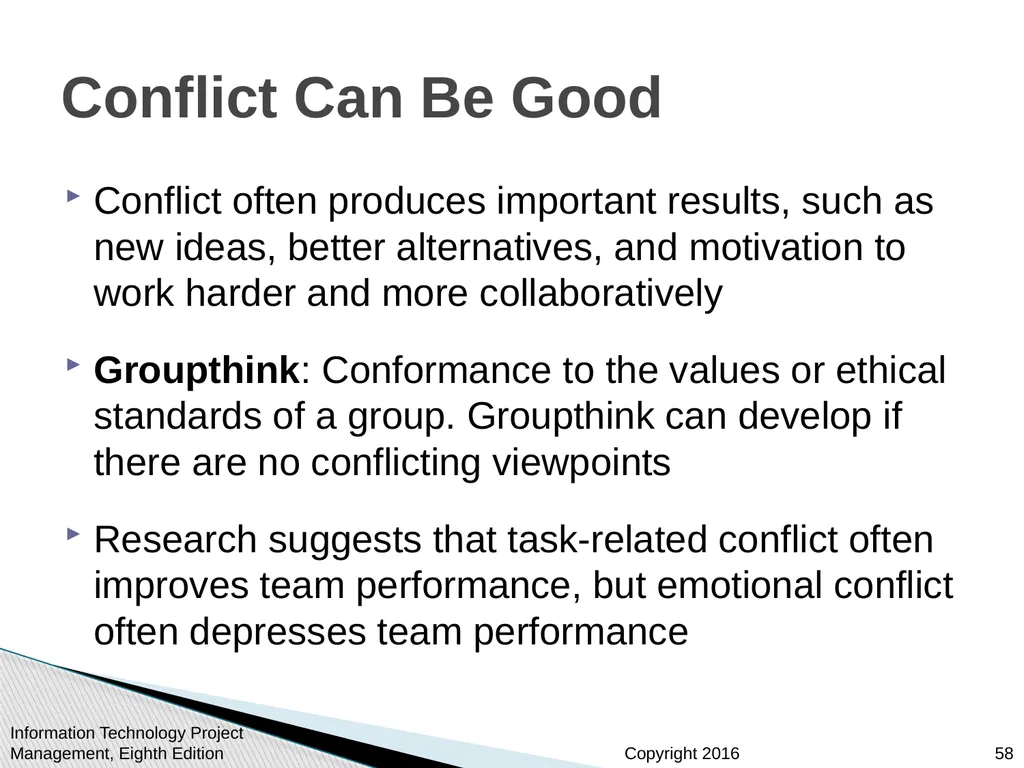
Conflict Can Be Good Conflict often produces important results, such as new ideas, better alternatives, and motivation to work harder and more collaboratively
Groupthink: Conformance to the values or ethical standards of a group. Groupthink can develop if there are no conflicting viewpoints
Research suggests that task-related conflict often improves team performance, but emotional conflict often depresses team performance Information Technology Project Management, Eighth Edition 58<br>
Groupthink: Conformance to the values or ethical standards of a group. Groupthink can develop if there are no conflicting viewpoints
Research suggests that task-related conflict often improves team performance, but emotional conflict often depresses team performance Information Technology Project Management, Eighth Edition 58<br>
59
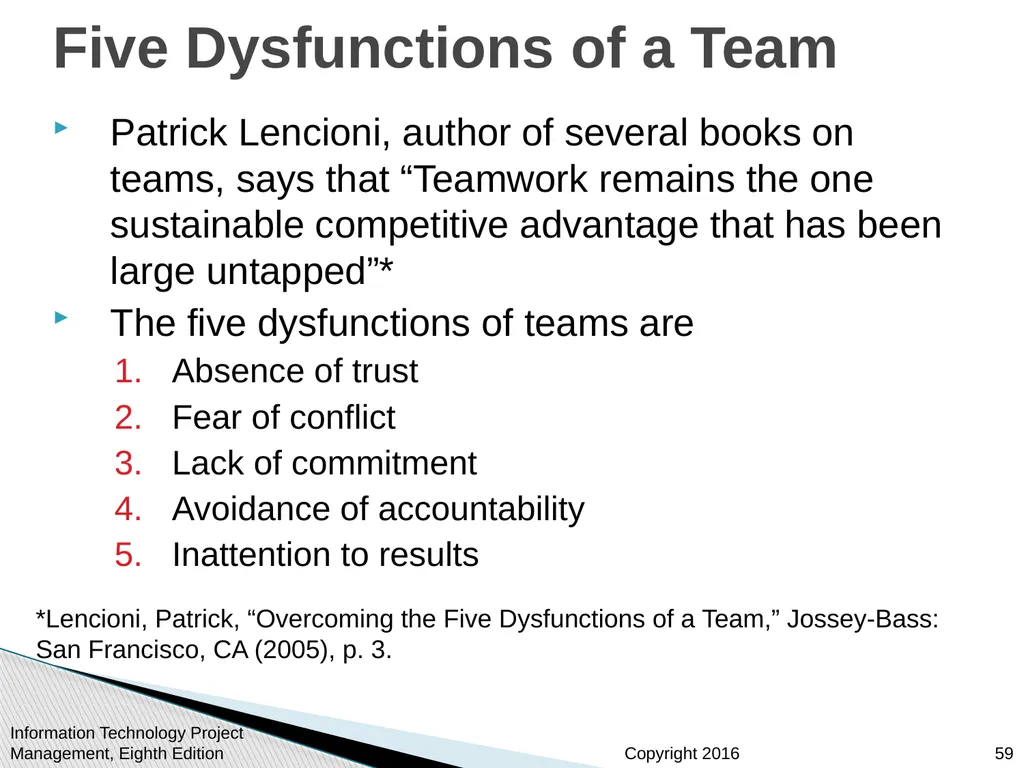
Five Dysfunctions of a Team Patrick Lencioni, author of several books on teams, says that “Teamwork remains the one sustainable competitive advantage that has been large untapped”*
The five dysfunctions of teams are
Absence of trust
Fear of conflict
Lack of commitment
Avoidance of accountability
Inattention to results *Lencioni, Patrick, “Overcoming the Five Dysfunctions of a Team,” Jossey-Bass: San Francisco, CA (2005), p. 3. Information Technology Project Management, Eighth Edition 59<br>
The five dysfunctions of teams are
Absence of trust
Fear of conflict
Lack of commitment
Avoidance of accountability
Inattention to results *Lencioni, Patrick, “Overcoming the Five Dysfunctions of a Team,” Jossey-Bass: San Francisco, CA (2005), p. 3. Information Technology Project Management, Eighth Edition 59<br>
60
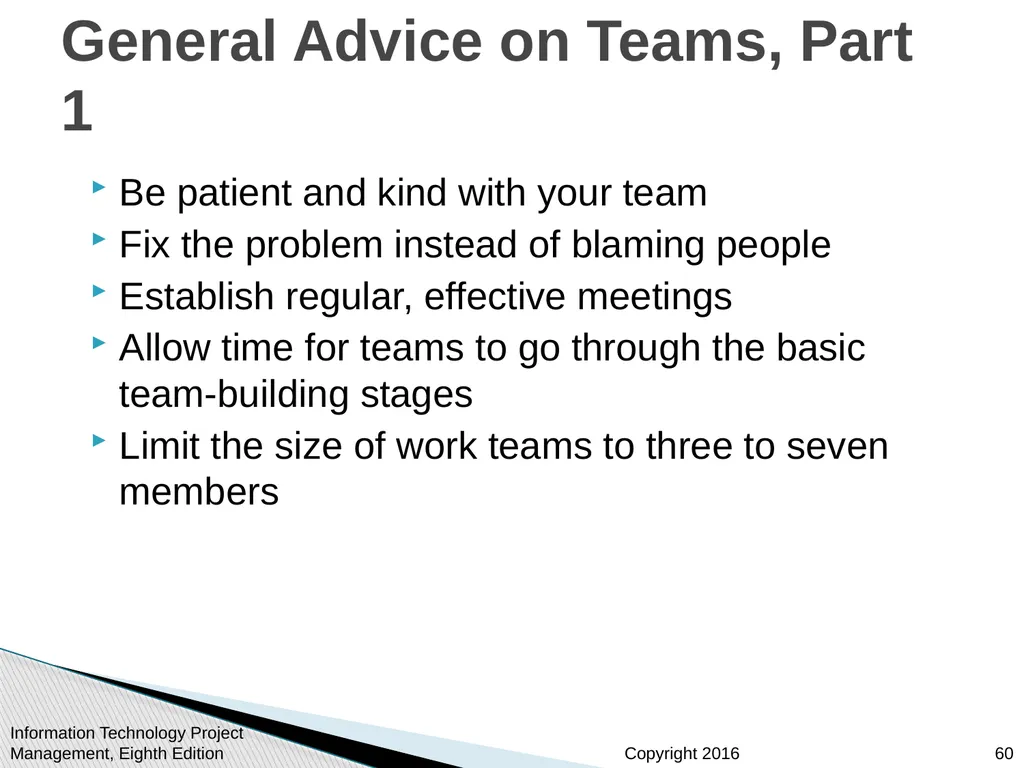
General Advice on Teams, Part 1 Be patient and kind with your team
Fix the problem instead of blaming people
Establish regular, effective meetings
Allow time for teams to go through the basic team-building stages
Limit the size of work teams to three to seven members Information Technology Project Management, Eighth Edition 60<br>
Fix the problem instead of blaming people
Establish regular, effective meetings
Allow time for teams to go through the basic team-building stages
Limit the size of work teams to three to seven members Information Technology Project Management, Eighth Edition 60<br>
61
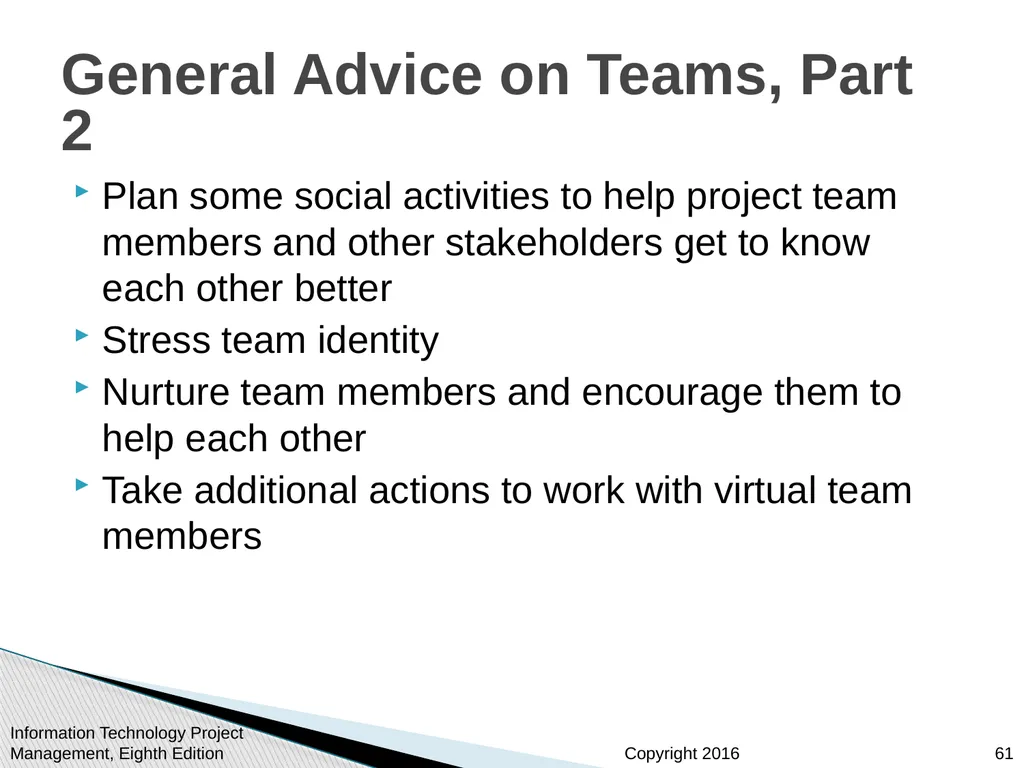
General Advice on Teams, Part 2 Plan some social activities to help project team members and other stakeholders get to know each other better
Stress team identity
Nurture team members and encourage them to help each other
Take additional actions to work with virtual team members Information Technology Project Management, Eighth Edition 61<br>
Stress team identity
Nurture team members and encourage them to help each other
Take additional actions to work with virtual team members Information Technology Project Management, Eighth Edition 61<br>
62
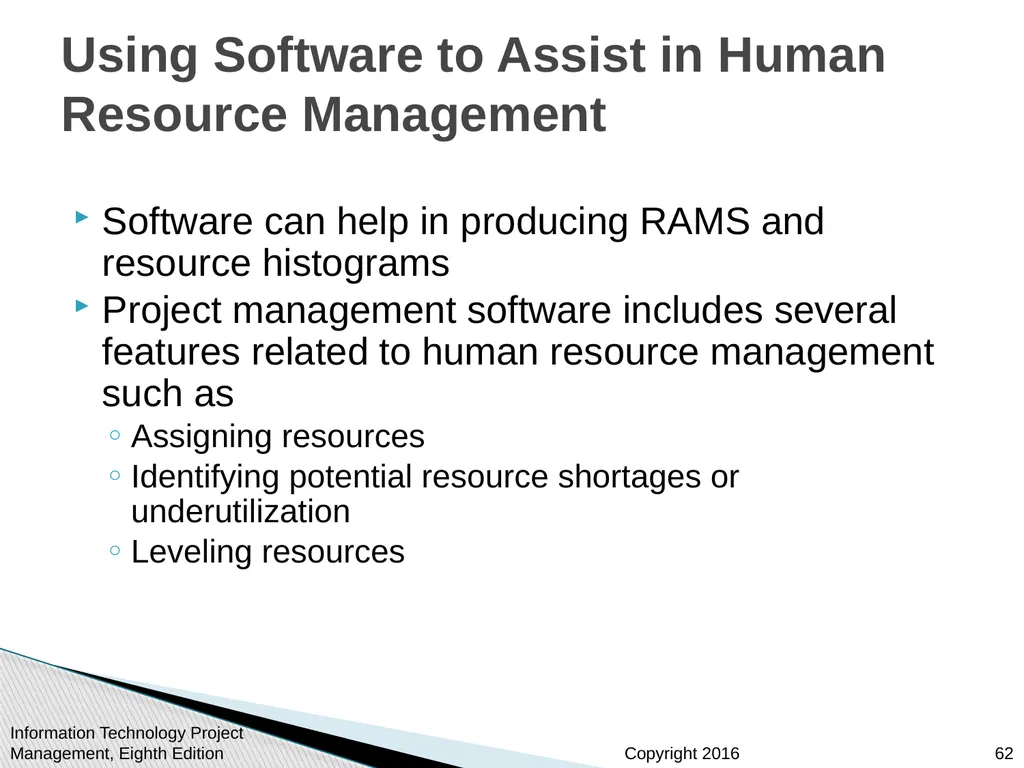
Using Software to Assist in Human Resource Management Software can help in producing RAMS and resource histograms
Project management software includes several features related to human resource management such as
Assigning resources
Identifying potential resource shortages or underutilization
Leveling resources Information Technology Project Management, Eighth Edition 62<br>
Project management software includes several features related to human resource management such as
Assigning resources
Identifying potential resource shortages or underutilization
Leveling resources Information Technology Project Management, Eighth Edition 62<br>
63
Project Resource Management Involves Much More Than Using Software Project managers must
Treat people with consideration and respect
Understand what motivates them
Communicate carefully with them
Focus on your goal of enabling project team members to deliver their best work Information Technology Project Management, Eighth Edition 63<br>
Treat people with consideration and respect
Understand what motivates them
Communicate carefully with them
Focus on your goal of enabling project team members to deliver their best work Information Technology Project Management, Eighth Edition 63<br>
64
Chapter Summary Project human resource management includes the processes required to make the most effective use of the people involved with a project
Main processes include
Plan human resource management
Acquire project team
Develop project team
Manage project team Information Technology Project Management, Eighth Edition 64<br>
Main processes include
Plan human resource management
Acquire project team
Develop project team
Manage project team Information Technology Project Management, Eighth Edition 64<br>