
Chapter 9: Project Resource Management Note: See
CP
Published · 41 slides · 0 views
1 / 1




Description
Chapter 9: Project Resource Management Note: See the text itself for full citations. Information Technology Project Management, ninth Edition Many corporate executives have said, People are our most important asset People determine the
Related Topics
Share
Embed code
Download this presentation From Below
"Chapter 9: Project Resource Management Note: See" is the property of its rightful owner. Permission is granted to download and print the materials on this website for personal, non-commercial use only, and to display it on your personal computer provided you do not modify the materials and that you retain all copyright notices contained in the materials. By downloading content from our website, you accept the terms of this agreement.
Presentation Transcript
01
Chapter 9:
Project
Resource Management Note: See the text itself for full citations. Information Technology Project Management, ninth Edition<br>
02
Many corporate executives have said, “People are our most important asset”
People determine the success and failure of organizations and projects The Importance of Human Resource Management 2<br>
People determine the success and failure of organizations and projects The Importance of Human Resource Management 2<br>
03
Although there have been ups and downs in the IT labor market, there will always be a need for good IT workers
The number of jobs available to IT professionals is expected to increase by 12 percent by 2024. “While job seekers will offer an array of technical skills, employers are typically looking for a more balanced employee who also possesses soft skills that are not readily apparent on a resume. The Global IT Workforce 3<br>
The number of jobs available to IT professionals is expected to increase by 12 percent by 2024. “While job seekers will offer an array of technical skills, employers are typically looking for a more balanced employee who also possesses soft skills that are not readily apparent on a resume. The Global IT Workforce 3<br>
04
If organizations want to implement IT projects successfully, they need to understand the importance of project resource management and make effective use of people.
Proactive organizations are addressing workforce needs by
improving benefits
redefining work hours and incentives
finding future workers Implications for the Future of IT Human Resource Management 4<br>
Proactive organizations are addressing workforce needs by
improving benefits
redefining work hours and incentives
finding future workers Implications for the Future of IT Human Resource Management 4<br>
05
Google, the winner of Fortune’s 100 Best Companies award multiple times in recent years, provides employees with free gourmet meals, on-site doctors, a swimming spa and corporate gym, beach volleyball, Foosball, video games, pool tables, ping-pong, roller hockey, and weekly Thank Goodness It’s Friday (TGIF) parties! Google built a large, outdoor sports complex in 2011 to help keep its employees in shape. The company also provides indoor recreation with bowling alleys and a dance studio, and offers a generous amount of leave for new parents (regardless of gender, including dads, domestic partners, adoptive parents, and surrogate parents)—12 weeks of fully paid “baby bonding” plus $500.* With an average of 130 applicants per hire, it’s almost ten times harder to get a job at Google than it is to get into Harvard. 5<br>
06
The processes required for Making the most effective use of the human and physical resources (facilities, equipment, materials, supplies, etc.) involved with a project.
Human resource management includes all project stakeholders: sponsors, customers, project team members, support staff, suppliers supporting the project, and so on. Physical resources include facilities, equipment, materials, and supplies. What is Project Resource Management? 6<br>
Human resource management includes all project stakeholders: sponsors, customers, project team members, support staff, suppliers supporting the project, and so on. Physical resources include facilities, equipment, materials, and supplies. What is Project Resource Management? 6<br>
07
Planning resource management involves deciding how to estimate, acquire, manage, and use project resources. The main outputs are a resource management plan, team charter, and project documents updates.
Estimating activity resources involves estimating human and physical resources needed to complete project work. Outputs include resource requirements, basis of estimates, a resource breakdown structure, and project documents updates.
Acquiring resources includes obtaining team members, facilities, equipment, materials, supplies, and other resources as needed. Outputs include physical and project team assignments, resource calendars, change requests, and updates to several documents. Project Resource Management Processes 7<br>
Estimating activity resources involves estimating human and physical resources needed to complete project work. Outputs include resource requirements, basis of estimates, a resource breakdown structure, and project documents updates.
Acquiring resources includes obtaining team members, facilities, equipment, materials, supplies, and other resources as needed. Outputs include physical and project team assignments, resource calendars, change requests, and updates to several documents. Project Resource Management Processes 7<br>
08
4. Developing the project team involves building individual and group skills to enhance project performance. Team-building skills are often a challenge for many project managers. The main outputs of this process are team performance assessments, change requests, and updates to several documents.
5. Managing the project team involves tracking team member performance, motivating team members, providing timely feedback, resolving issues and conflicts, and coordinating changes to help enhance project performance. Outputs of this process include change requests, project management plan updates, project documents updates, and organizational process assets updates.
6. Controlling resources ensures that a project’s physical resources are available as planned, monitoring the planned versus actual resource utilization, and taking corrective action when needed. Outputs include work performance information, change requests, and updates to the project management plan and project documents. Project Human Resource Management Processes 8<br>
5. Managing the project team involves tracking team member performance, motivating team members, providing timely feedback, resolving issues and conflicts, and coordinating changes to help enhance project performance. Outputs of this process include change requests, project management plan updates, project documents updates, and organizational process assets updates.
6. Controlling resources ensures that a project’s physical resources are available as planned, monitoring the planned versus actual resource utilization, and taking corrective action when needed. Outputs include work performance information, change requests, and updates to the project management plan and project documents. Project Human Resource Management Processes 8<br>
09
Psychologists and management theorists have devoted much research and thought to the field of managing people at work
Important areas related to project management include
motivation theories
influence and power
Effectiveness
Leadership
Emotional intellegence. Keys to Managing People 9<br>
Important areas related to project management include
motivation theories
influence and power
Effectiveness
Leadership
Emotional intellegence. Keys to Managing People 9<br>
10
Intrinsic motivation causes people to participate in an activity for their own enjoyment
Extrinsic motivation causes people to do something for a reward or to avoid a penalty
For example, some children take piano lessons for intrinsic motivation (they enjoy it) while others take them for extrinsic motivation (to get a reward or avoid punishment) Intrinsic and Extrinsic Motivation 10<br>
Extrinsic motivation causes people to do something for a reward or to avoid a penalty
For example, some children take piano lessons for intrinsic motivation (they enjoy it) while others take them for extrinsic motivation (to get a reward or avoid punishment) Intrinsic and Extrinsic Motivation 10<br>
11
To develop a resource management plan for a project, you must identify and document project resources, roles, responsibilities, skills, and reporting relationships.
The project resource management plan can be separated into a human resource management plan and a physical resource management plan.
The human resource plan often includes an organizational chart for the project, detailed information on roles and responsibilities, and a staffing management plan. In addition, project teams can create a team charter to provide guidance on how they will operate.
Contents include
project organizational charts
staffing management plan
responsibility assignment matrixes
resource histograms 1. Developing the Management Resource Plan 11<br>
The project resource management plan can be separated into a human resource management plan and a physical resource management plan.
The human resource plan often includes an organizational chart for the project, detailed information on roles and responsibilities, and a staffing management plan. In addition, project teams can create a team charter to provide guidance on how they will operate.
Contents include
project organizational charts
staffing management plan
responsibility assignment matrixes
resource histograms 1. Developing the Management Resource Plan 11<br>
12
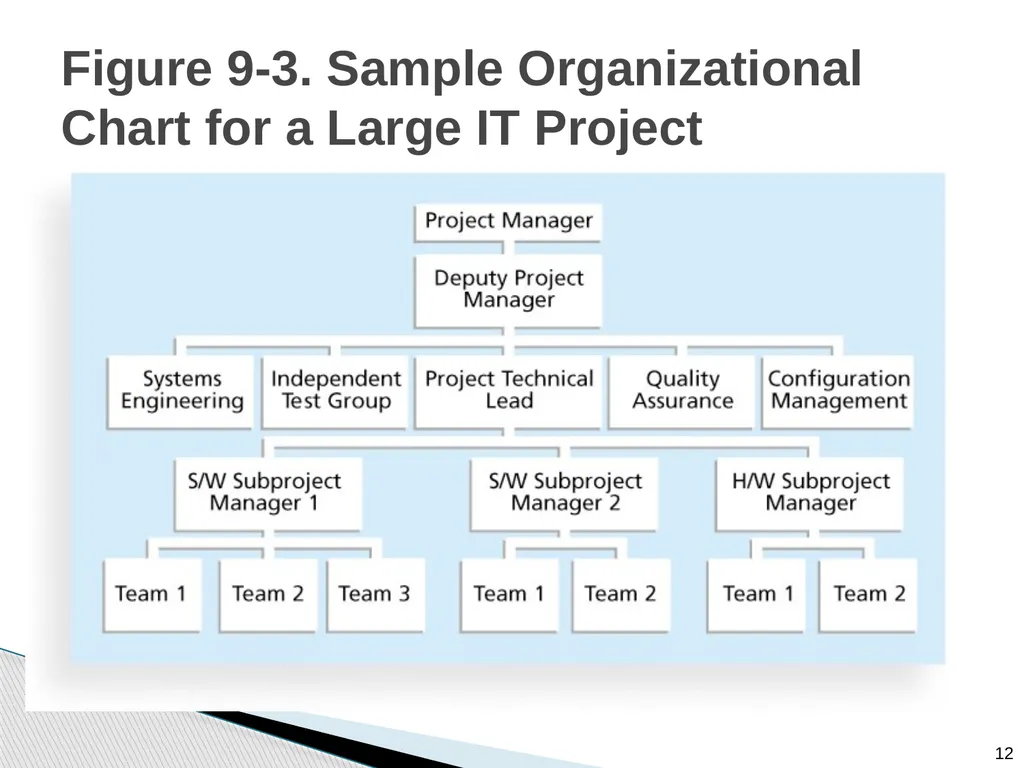
Figure 9-3. Sample Organizational Chart for a Large IT Project 12<br>
13
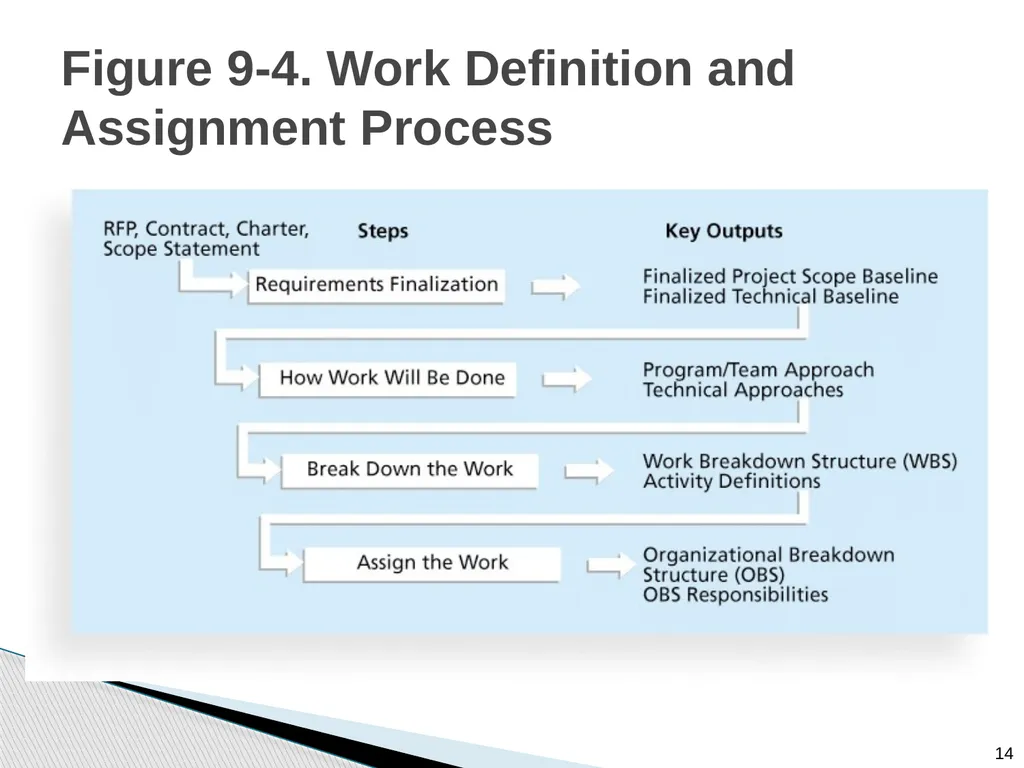
In addition to defining an organizational structure for a project, it is also important to follow a work definition and assignment process. Figure 9-4 provides a framework for defining and assigning work that consists of four steps:
Finalizing the project requirements
Defining how the work will be accomplished
Breaking down the work into manageable elements
Assigning work responsibilities
The work definition and assignment process is carried out during the proposal and startup phases of a project. Note that the process is iterative, often taking more than one pass. 1.1 work definition and assignment process 13<br>
Finalizing the project requirements
Defining how the work will be accomplished
Breaking down the work into manageable elements
Assigning work responsibilities
The work definition and assignment process is carried out during the proposal and startup phases of a project. Note that the process is iterative, often taking more than one pass. 1.1 work definition and assignment process 13<br>
14
Figure 9-4. Work Definition and Assignment Process 14<br>
15
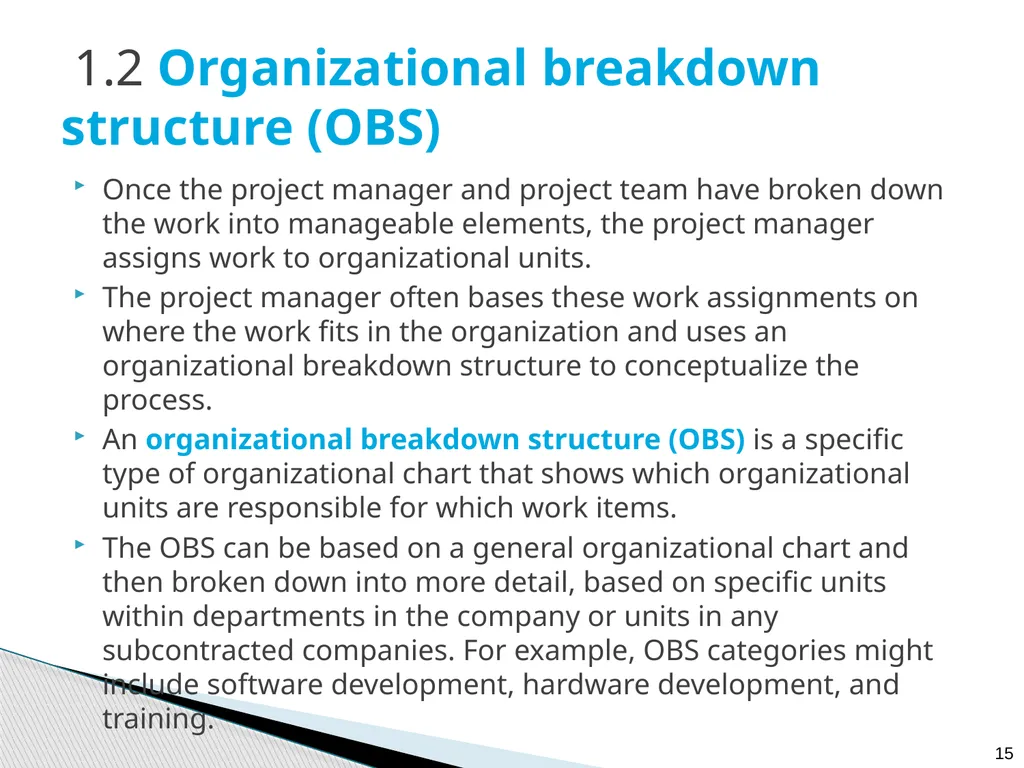
Once the project manager and project team have broken down the work into manageable elements, the project manager assigns work to organizational units.
The project manager often bases these work assignments on where the work fits in the organization and uses an organizational breakdown structure to conceptualize the process.
An organizational breakdown structure (OBS) is a specific type of organizational chart that shows which organizational units are responsible for which work items.
The OBS can be based on a general organizational chart and then broken down into more detail, based on specific units within departments in the company or units in any subcontracted companies. For example, OBS categories might include software development, hardware development, and training. 1.2 Organizational breakdown structure (OBS) 15<br>
The project manager often bases these work assignments on where the work fits in the organization and uses an organizational breakdown structure to conceptualize the process.
An organizational breakdown structure (OBS) is a specific type of organizational chart that shows which organizational units are responsible for which work items.
The OBS can be based on a general organizational chart and then broken down into more detail, based on specific units within departments in the company or units in any subcontracted companies. For example, OBS categories might include software development, hardware development, and training. 1.2 Organizational breakdown structure (OBS) 15<br>
16
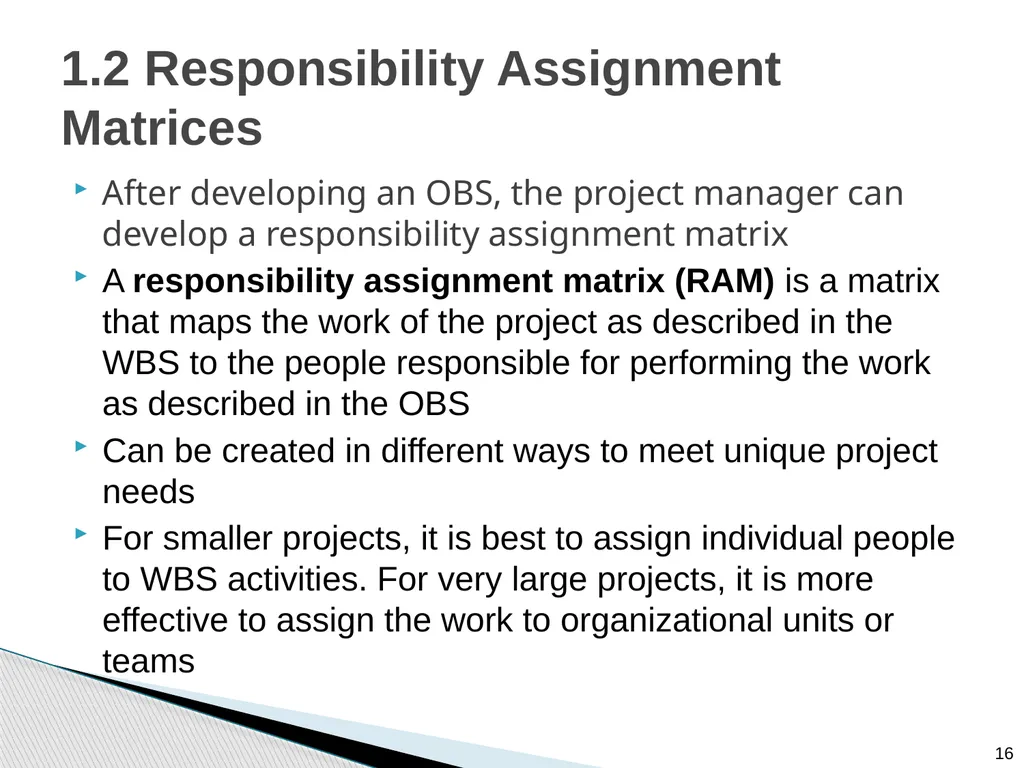
After developing an OBS, the project manager can develop a responsibility assignment matrix
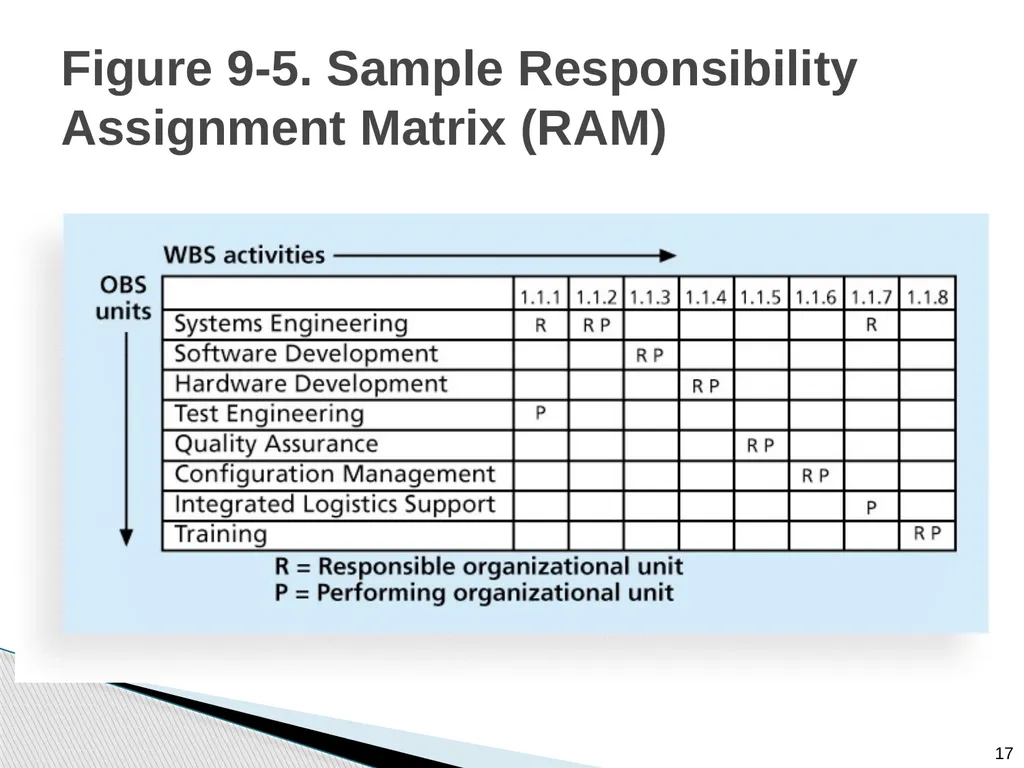
A responsibility assignment matrix (RAM) is a matrix that maps the work of the project as described in the WBS to the people responsible for performing the work as described in the OBS
Can be created in different ways to meet unique project needs
For smaller projects, it is best to assign individual people to WBS activities. For very large projects, it is more effective to assign the work to organizational units or teams 1.2 Responsibility Assignment Matrices 16<br>
A responsibility assignment matrix (RAM) is a matrix that maps the work of the project as described in the WBS to the people responsible for performing the work as described in the OBS
Can be created in different ways to meet unique project needs
For smaller projects, it is best to assign individual people to WBS activities. For very large projects, it is more effective to assign the work to organizational units or teams 1.2 Responsibility Assignment Matrices 16<br>
17
Figure 9-5. Sample Responsibility Assignment Matrix (RAM) 17<br>
18
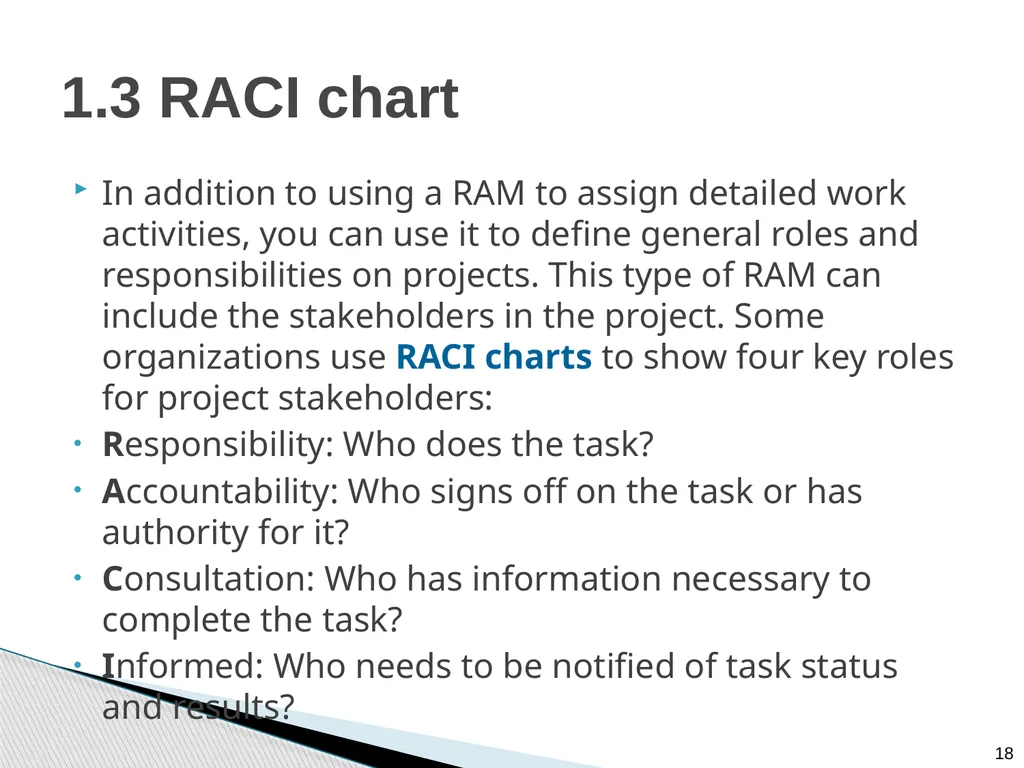
In addition to using a RAM to assign detailed work activities, you can use it to define general roles and responsibilities on projects. This type of RAM can include the stakeholders in the project. Some organizations use RACI charts to show four key roles for project stakeholders:
Responsibility: Who does the task?
Accountability: Who signs off on the task or has authority for it?
Consultation: Who has information necessary to complete the task?
Informed: Who needs to be notified of task status and results? 1.3 RACI chart 18<br>
Responsibility: Who does the task?
Accountability: Who signs off on the task or has authority for it?
Consultation: Who has information necessary to complete the task?
Informed: Who needs to be notified of task status and results? 1.3 RACI chart 18<br>
19
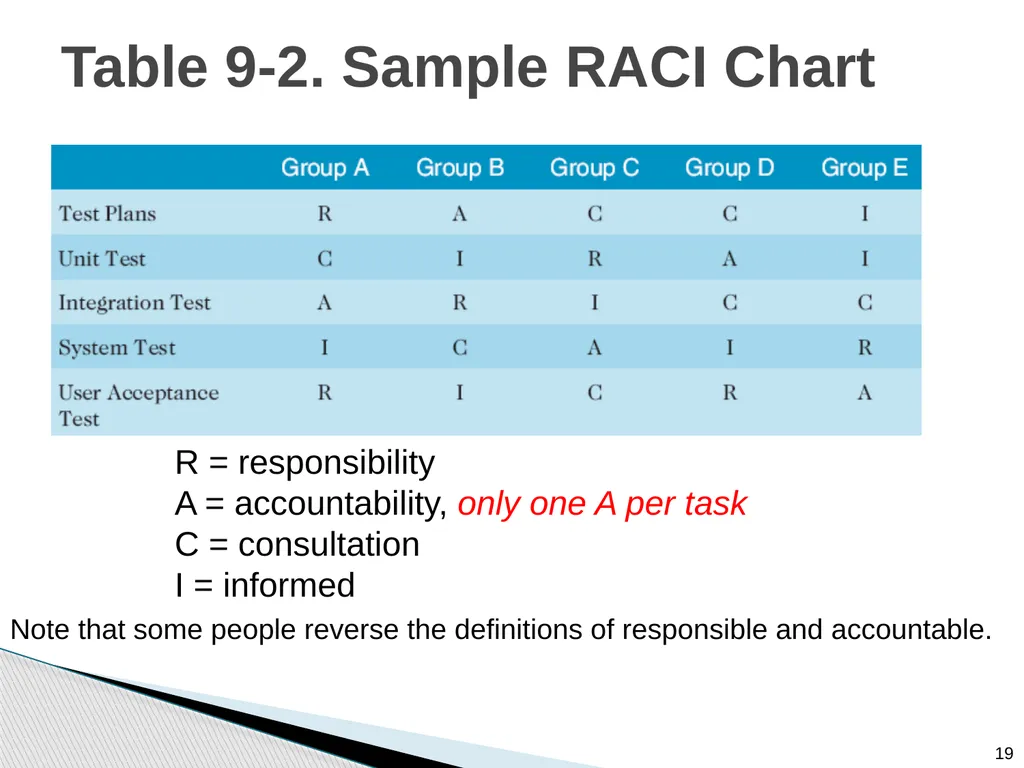
Table 9-2. Sample RACI Chart 19 R = responsibility
A = accountability, only one A per task
C = consultation
I = informed Note that some people reverse the definitions of responsible and accountable.<br>
A = accountability, only one A per task
C = consultation
I = informed Note that some people reverse the definitions of responsible and accountable.<br>
20
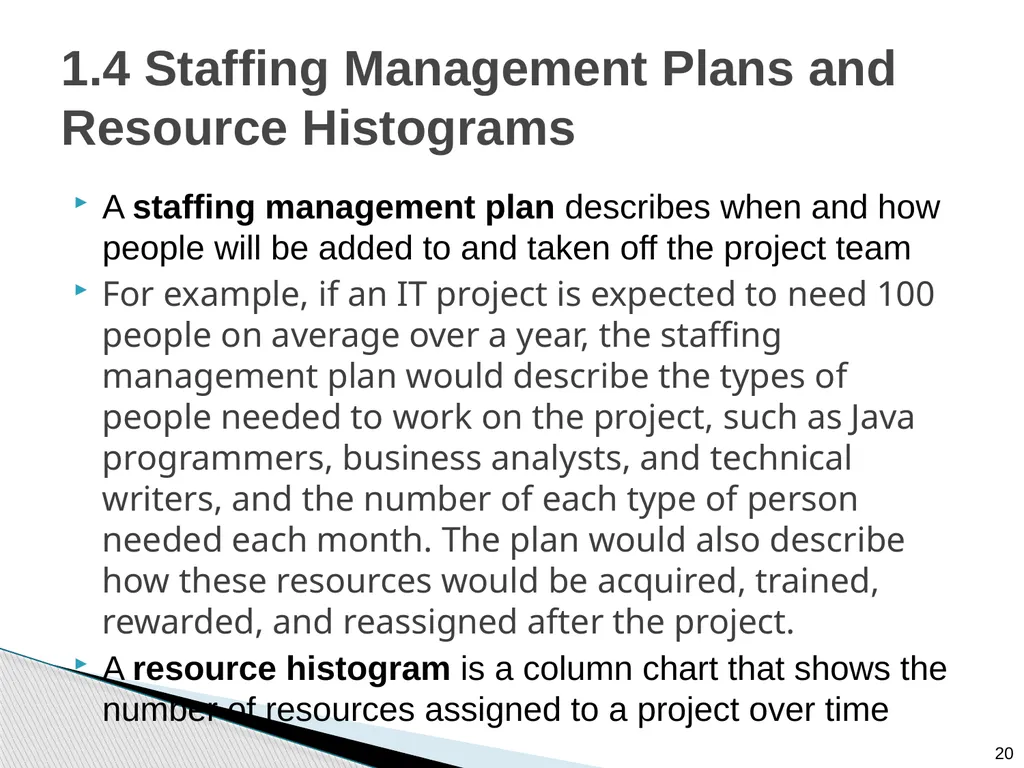
A staffing management plan describes when and how people will be added to and taken off the project team
For example, if an IT project is expected to need 100 people on average over a year, the staffing management plan would describe the types of people needed to work on the project, such as Java programmers, business analysts, and technical writers, and the number of each type of person needed each month. The plan would also describe how these resources would be acquired, trained, rewarded, and reassigned after the project.
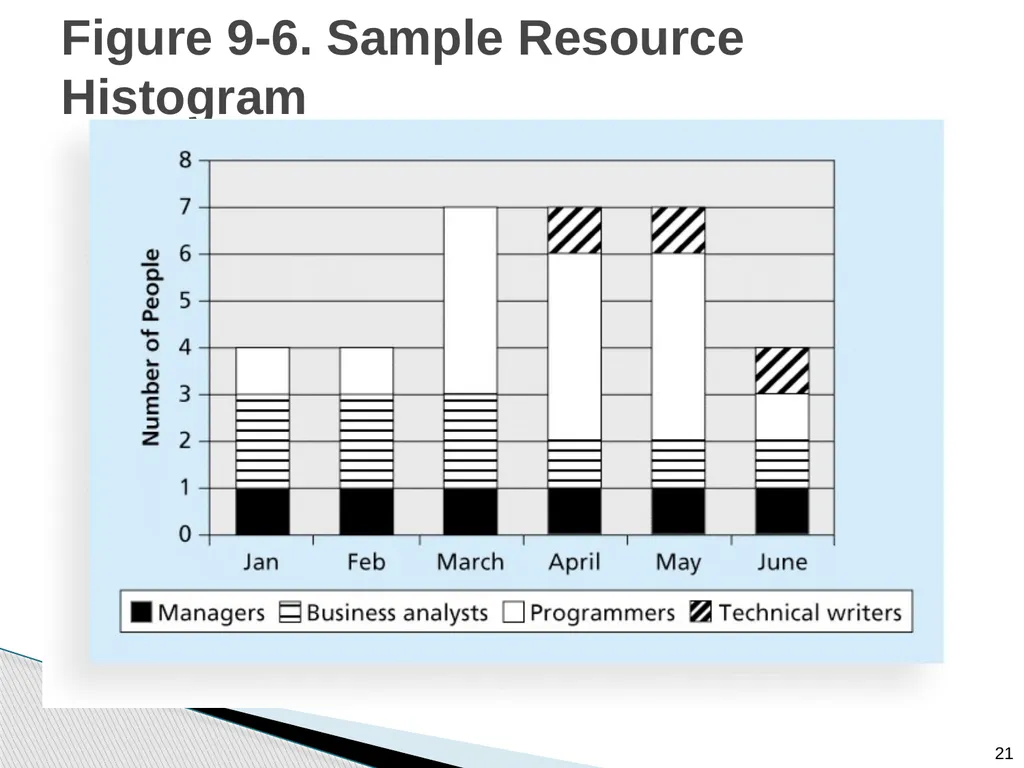
A resource histogram is a column chart that shows the number of resources assigned to a project over time 1.4 Staffing Management Plans and Resource Histograms 20<br>
For example, if an IT project is expected to need 100 people on average over a year, the staffing management plan would describe the types of people needed to work on the project, such as Java programmers, business analysts, and technical writers, and the number of each type of person needed each month. The plan would also describe how these resources would be acquired, trained, rewarded, and reassigned after the project.
A resource histogram is a column chart that shows the number of resources assigned to a project over time 1.4 Staffing Management Plans and Resource Histograms 20<br>
21
Figure 9-6. Sample Resource Histogram 21<br>
22
Many companies believe in using team charters to help promote teamwork and clarify team communications. (Note that some organizations and previous editions of this text use the term team contract instead of team charter.
Contents of the team charter, according to PMI, may include the following:
Team values
Communication guidelines
Decision-making criteria and process
Conflict resolution process
Meeting guidelines
Team agreements 1.4 Team Charters 22<br>
Contents of the team charter, according to PMI, may include the following:
Team values
Communication guidelines
Decision-making criteria and process
Conflict resolution process
Meeting guidelines
Team agreements 1.4 Team Charters 22<br>
23
The people who help determine what resources are necessary must have experience and expertise in similar projects and with the organization performing the project.
Important questions to answer when estimating activity resources include the following:
How difficult will specific activities be on this project?
What is the organization’s history in doing similar activities? Has the organization done similar tasks before? What level of personnel did the work?
Does the organization have people, equipment, and materials that are capable and available for performing the work? Could any organizational policies affect the availability of resources?
Does the organization need to acquire more resources to accomplish the work? Would it make sense to outsource some of the work? Will outsourcing increase or decrease the amount of resources needed and when they will be available? 2. Estimating Activity Resources 23<br>
Important questions to answer when estimating activity resources include the following:
How difficult will specific activities be on this project?
What is the organization’s history in doing similar activities? Has the organization done similar tasks before? What level of personnel did the work?
Does the organization have people, equipment, and materials that are capable and available for performing the work? Could any organizational policies affect the availability of resources?
Does the organization need to acquire more resources to accomplish the work? Would it make sense to outsource some of the work? Will outsourcing increase or decrease the amount of resources needed and when they will be available? 2. Estimating Activity Resources 23<br>
24
The main outputs of the resource estimating process include a list of activity resource requirements, a basis of estimates, a resource breakdown structure, and project documents updates.
A resource breakdown structure is a hierarchical structure that identifies the project’s resources by category and type. Resource categories might include analysts, programmers, and testers. This information would be helpful in determining resource costs, acquiring resources, and so on. 2. Estimating Activity Resources 24<br>
A resource breakdown structure is a hierarchical structure that identifies the project’s resources by category and type. Resource categories might include analysts, programmers, and testers. This information would be helpful in determining resource costs, acquiring resources, and so on. 2. Estimating Activity Resources 24<br>
25
Today, many organizations again face a shortage of IT staff. Regardless of the current job market, however, acquiring qualified IT professionals is critical.
In addition to recruiting team members, it is also important to acquire the necessary physical resources (facilities, equipment, supplies, and so on) and provide the right type of resources at the right time and place. 3. Acquiring resources 25<br>
In addition to recruiting team members, it is also important to acquire the necessary physical resources (facilities, equipment, supplies, and so on) and provide the right type of resources at the right time and place. 3. Acquiring resources 25<br>
26
Organizations that do a good job of staff acquisition have good staffing plans. These plans describe the number and type of people who are currently in the organization and the number and type of people anticipated to be needed for the project based on current and upcoming activities.
An important component of staffing plans is maintaining a complete and accurate inventory of employees’ skills. If there is a mismatch between the current mix of people’s skills and needs of the organization, it is the project manager’s job to work with top management, human resource managers, and other people in the organization to address staffing and training needs.
Staffing plans and good hiring procedures are important, as are incentives for recruiting and retention
Some companies give their employees one dollar for every hour a new person they helped hire works
Some organizations allow people to work from home as an incentive 3.1Resource Assignment 26<br>
An important component of staffing plans is maintaining a complete and accurate inventory of employees’ skills. If there is a mismatch between the current mix of people’s skills and needs of the organization, it is the project manager’s job to work with top management, human resource managers, and other people in the organization to address staffing and training needs.
Staffing plans and good hiring procedures are important, as are incentives for recruiting and retention
Some companies give their employees one dollar for every hour a new person they helped hire works
Some organizations allow people to work from home as an incentive 3.1Resource Assignment 26<br>
27
Resource loading refers to the amount of individual resources that an existing schedule requires during specific time periods.
Project managers often use resource histograms, like the one shown in Figure 9-6, to depict period-by-period variations in resource loading. A resource histogram can be very helpful in determining resource needs or in identifying staffing problems.
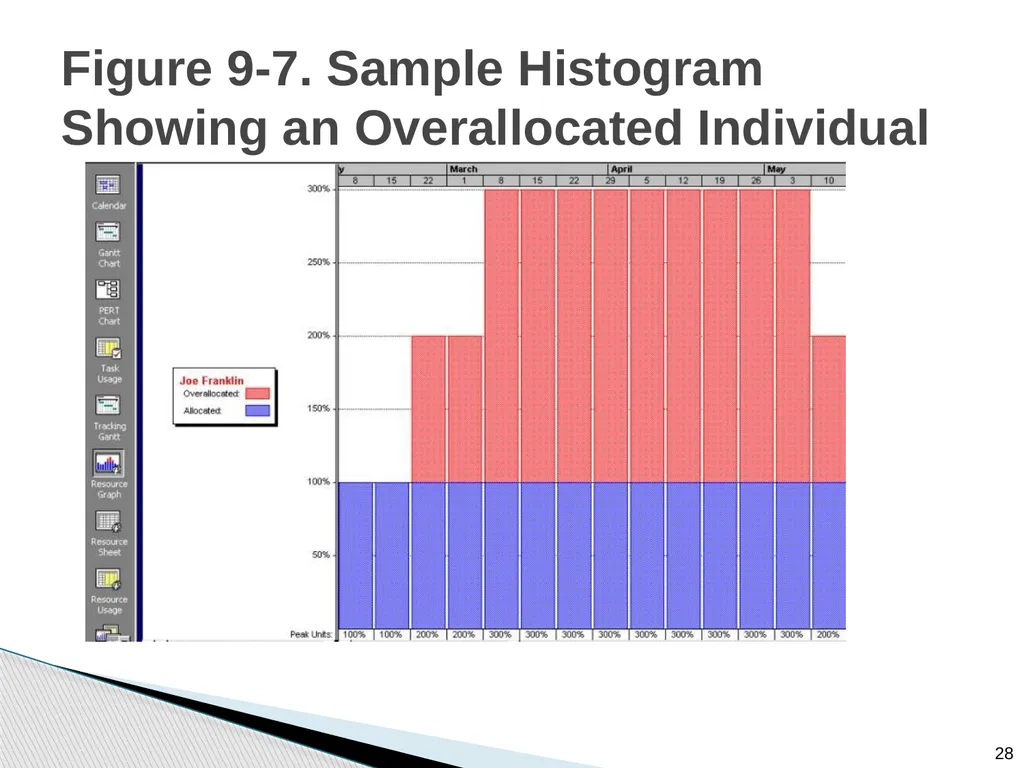
Overallocation means that not enough resources are available to perform the assigned work during a given time period. Figure 9-7 shows a sample resource histogram created in Microsoft Project. 3.2 Resource Loading 27<br>
Project managers often use resource histograms, like the one shown in Figure 9-6, to depict period-by-period variations in resource loading. A resource histogram can be very helpful in determining resource needs or in identifying staffing problems.
Overallocation means that not enough resources are available to perform the assigned work during a given time period. Figure 9-7 shows a sample resource histogram created in Microsoft Project. 3.2 Resource Loading 27<br>
28
Figure 9-7. Sample Histogram Showing an Overallocated Individual 28<br>
29
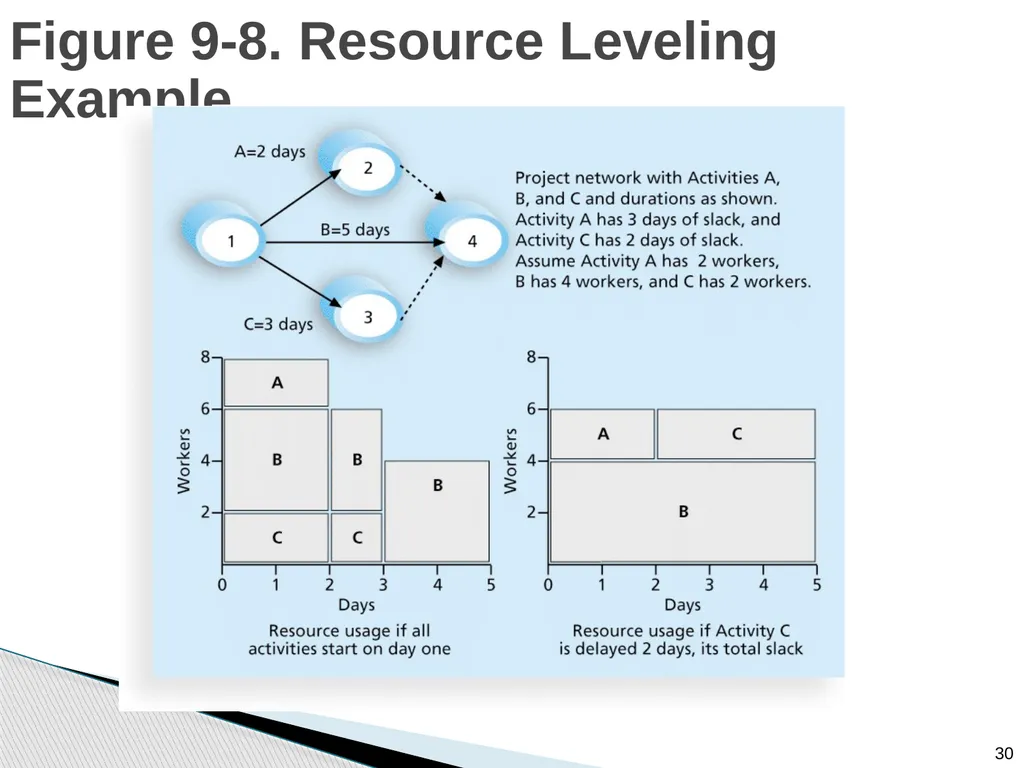
Resource leveling is a technique for resolving resource conflicts by delaying tasks
The main purpose of resource leveling is to create a smoother distribution of resource usage and reduce overallocation
Overallocation is one type of resource conflict. If a certain resource is overallocated, the project manager can change the schedule to remove resource overallocation. If a certain resource is underallocated, the project manager can change the schedule to try to improve the use of the resource. 3.3 Resource Leveling 29<br>
The main purpose of resource leveling is to create a smoother distribution of resource usage and reduce overallocation
Overallocation is one type of resource conflict. If a certain resource is overallocated, the project manager can change the schedule to remove resource overallocation. If a certain resource is underallocated, the project manager can change the schedule to try to improve the use of the resource. 3.3 Resource Leveling 29<br>
30
Figure 9-8. Resource Leveling Example 30<br>
31
When resources are used on a more constant basis, they require less management
It may enable project managers to use a just-in-time inventory type of policy for using subcontractors or other expensive resources
It results in fewer problems for project personnel and accounting department
It often improves morale People like to have stability in their jobs. It is very stressful for people not to know what projects they will be working on from week to week or even from day to day. 3.3 Benefits of Resource Leveling 31<br>
It may enable project managers to use a just-in-time inventory type of policy for using subcontractors or other expensive resources
It results in fewer problems for project personnel and accounting department
It often improves morale People like to have stability in their jobs. It is very stressful for people not to know what projects they will be working on from week to week or even from day to day. 3.3 Benefits of Resource Leveling 31<br>
32
The main goal of team development is to help people work together more effectively to improve project performance
It takes teamwork to successfully complete most projects
Tools and techniques for team development, include: training, team-building activities, and reward and recognition systems. 4. Developing the Project Team 32<br>
It takes teamwork to successfully complete most projects
Tools and techniques for team development, include: training, team-building activities, and reward and recognition systems. 4. Developing the Project Team 32<br>
33
Project managers often recommend that people take specific training courses to improve individual and team development.
Training can help people understand themselves, each other, and how to work better in teams 4.2 Training 33<br>
Training can help people understand themselves, each other, and how to work better in teams 4.2 Training 33<br>
34
Project managers must lead their teams in performing various project activities
After assessing team performance and related information, the project manager must decide
if changes should be requested to the project
if corrective or preventive actions should be recommended
if updates are needed to the project management plan or organizational process assets.
Project managers must use their soft skills to find the best way to motivate and manage each team member. 5. Managing the Project Team 34<br>
After assessing team performance and related information, the project manager must decide
if changes should be requested to the project
if corrective or preventive actions should be recommended
if updates are needed to the project management plan or organizational process assets.
Project managers must use their soft skills to find the best way to motivate and manage each team member. 5. Managing the Project Team 34<br>
35
Observation and conversation
Project performance appraisals
Interpersonal skills
Conflict management 5.1 Tools and Techniques for Managing Project Teams 35<br>
Project performance appraisals
Interpersonal skills
Conflict management 5.1 Tools and Techniques for Managing Project Teams 35<br>
36
Patrick Lencioni, author of several books on teams, says that “Teamwork remains the one sustainable competitive advantage that has been large untapped”*
The five dysfunctions of teams are
Absence of trust
Fear of conflict
Lack of commitment
Avoidance of accountability
Inattention to results 5.3Five Dysfunctions of a Team 36 *Lencioni, Patrick, “Overcoming the Five Dysfunctions of a Team,” Jossey-Bass: San Francisco, CA (2005), p. 3.<br>
The five dysfunctions of teams are
Absence of trust
Fear of conflict
Lack of commitment
Avoidance of accountability
Inattention to results 5.3Five Dysfunctions of a Team 36 *Lencioni, Patrick, “Overcoming the Five Dysfunctions of a Team,” Jossey-Bass: San Francisco, CA (2005), p. 3.<br>
37
Be patient and kind with your team
Fix the problem instead of blaming people
Establish regular, effective meetings
Allow time for teams to go through the basic team-building stages
Limit the size of work teams to three to seven members 5.4General Advice on Teams 37<br>
Fix the problem instead of blaming people
Establish regular, effective meetings
Allow time for teams to go through the basic team-building stages
Limit the size of work teams to three to seven members 5.4General Advice on Teams 37<br>
38
Plan some social activities to help project team members and other stakeholders get to know each other better
Stress team identity
Nurture team members and encourage them to help each other
Take additional actions to work with virtual team members 5.4 General Advice on Teams (cont’d) 38<br>
Stress team identity
Nurture team members and encourage them to help each other
Take additional actions to work with virtual team members 5.4 General Advice on Teams (cont’d) 38<br>
39
Controlling resources involves ensuring that the physical resources assigned to the project are available as planned.
It also involves monitoring the planned versus actual resources utilization and taking corrective actions as needed.
Key outputs include work performance information, change requests, project management plan updates, and project documents updates. 6. Controlling Resources 39<br>
It also involves monitoring the planned versus actual resources utilization and taking corrective actions as needed.
Key outputs include work performance information, change requests, project management plan updates, and project documents updates. 6. Controlling Resources 39<br>
40
Software can help in producing RAMS and resource histograms
Project management software includes several features related to human resource management such as
Assigning resources
Identifying potential resource shortages or underutilization
Leveling resources Using Software to Assist in Human Resource Management 40<br>
Project management software includes several features related to human resource management such as
Assigning resources
Identifying potential resource shortages or underutilization
Leveling resources Using Software to Assist in Human Resource Management 40<br>
41
People are the most important asset on most projects, and human resources are very different from other resources. You cannot simply replace people in the same way that you replace a piece of equipment.
Project managers must
Treat people with consideration and respect
Understand what motivates them
Communicate carefully with them Project Resource Management Involves Much More Than Using Software 41<br>
Project managers must
Treat people with consideration and respect
Understand what motivates them
Communicate carefully with them Project Resource Management Involves Much More Than Using Software 41<br>