
CHAPTER ONE INTRODUCTION Chapter objectives: After
TG
Published · 71 slides · 0 views
1 / 1












Description
CHAPTER ONE INTRODUCTION Chapter objectives: After reading this chapter you must be able to know The meaning and scope of industrial economics The definitions and elementary description of some basic concepts used in industrial economics
Related Topics
Share
Embed code
Download this presentation From Below
"CHAPTER ONE INTRODUCTION Chapter objectives: After" is the property of its rightful owner. Permission is granted to download and print the materials on this website for personal, non-commercial use only, and to display it on your personal computer provided you do not modify the materials and that you retain all copyright notices contained in the materials. By downloading content from our website, you accept the terms of this agreement.
Presentation Transcript
01
CHAPTER ONE
INTRODUCTION Chapter objectives: After reading this chapter you must be able to know
The meaning and scope of industrial economics
The definitions and elementary description of some basic concepts used in industrial economics
The paradigm of SCP
The framework for the study of industrial economics 1 Compiled by: Abdi T.<br>
The meaning and scope of industrial economics
The definitions and elementary description of some basic concepts used in industrial economics
The paradigm of SCP
The framework for the study of industrial economics 1 Compiled by: Abdi T.<br>
02
Definition and Scope of Industrial Economics What is industrial economics?
It is one of the disciplines in economics that deals with the economic problems of firms and industries, and their relationship with society.
It is also called:
‘Economics of Industry’
“Industry and Trade”
‘Industrial Organisation and Policy’
“Commerce and Business Economics’ and so on. 2 Compiled by: Abdi T.<br>
It is one of the disciplines in economics that deals with the economic problems of firms and industries, and their relationship with society.
It is also called:
‘Economics of Industry’
“Industry and Trade”
‘Industrial Organisation and Policy’
“Commerce and Business Economics’ and so on. 2 Compiled by: Abdi T.<br>
03
1.0. Overview on historical Evolution of Industrial Economics The early theory of the firm which we might regard as the mother of the contemporary industrial economics was born as at this stage as an integral part of the classical economics. Many of the issues in this area of economics date back to Adam Smith in the eighteenth century.
More recently, Cournot in the first half, and Marshall in the 2nd half of the nineteenth century laid foundations that which , remain appropriate concerns in industrial economics of today. Compiled by: Abdi T. 3<br>
More recently, Cournot in the first half, and Marshall in the 2nd half of the nineteenth century laid foundations that which , remain appropriate concerns in industrial economics of today. Compiled by: Abdi T. 3<br>
04
There have been two major traditional concerns of industrial economics.
First, there has been a focus on the functioning of firms, and their performance; the determinants and consequences of different market structures”, and the relationship between behavior and performance of firms) and the market structure within which firms operate.
Second, the role of government in influencing the organization of industry. Compiled by: Abdi T. 4<br>
First, there has been a focus on the functioning of firms, and their performance; the determinants and consequences of different market structures”, and the relationship between behavior and performance of firms) and the market structure within which firms operate.
Second, the role of government in influencing the organization of industry. Compiled by: Abdi T. 4<br>
05
Although difficult to know the true beginning of industrial economics because of non-availability of data, it has come up to the present stage mainly during the last 40 to 50 years.
The subject has not yet grown to its maturity. In recent years, industrial economics has changed dramatically. Theories have been extended & developed, partly in response to new ideas such as commitment, to new empirical findings and partly to the arrival of new tools such as computer simulations. Compiled by: Abdi T. 5<br>
The subject has not yet grown to its maturity. In recent years, industrial economics has changed dramatically. Theories have been extended & developed, partly in response to new ideas such as commitment, to new empirical findings and partly to the arrival of new tools such as computer simulations. Compiled by: Abdi T. 5<br>
06
How decision-making problems arise in industries? To answer this question, we have to go back to the core of Economics.
Economics is the science that studies human behavior as a relationship between ends and scarce means that have alternative uses.
As implicit in this definition, an economic problem arises because of scarcity of means and their alternative uses in relation to the needs of an individual or a group or society as a whole. Compiled by: Abdi T. 6<br>
Economics is the science that studies human behavior as a relationship between ends and scarce means that have alternative uses.
As implicit in this definition, an economic problem arises because of scarcity of means and their alternative uses in relation to the needs of an individual or a group or society as a whole. Compiled by: Abdi T. 6<br>
07
For example, the income of a consumer is generally limited but his/her wants are unlimited. In this situation he/she has to adopt some criterion to achieve maximum gain from his/her limited income. This is the problem of utility maximization in the theory of consumer behavior.
Similarly, for a producer, the resources like land, raw materials, labor, capital, etc., are scarce. 7 Compiled by: Abdi T.<br>
Similarly, for a producer, the resources like land, raw materials, labor, capital, etc., are scarce. 7 Compiled by: Abdi T.<br>
08
Given such scarcity, the producer has to take decisions about production and distribution. There are several basic issues on which the producer will be taking decisions such as:
what commodities he/she should produce,
what should be the level output of each input,
what type of technology he/she should adopt,
where should he/she produce the goods, 8 Compiled by: Abdi T.<br>
what commodities he/she should produce,
what should be the level output of each input,
what type of technology he/she should adopt,
where should he/she produce the goods, 8 Compiled by: Abdi T.<br>
09
what should be the size of his/her factory,
what price he/she should charge,
how much wages should pay,
how much he/she should spend on advertisement,
should he/she borrow from banks or elsewhere, etc…
All such decisions explain the producer's behavior in the different market situations, which we endeavor to study in industrial economics. 9 Compiled by: Abdi T.<br>
what price he/she should charge,
how much wages should pay,
how much he/she should spend on advertisement,
should he/she borrow from banks or elsewhere, etc…
All such decisions explain the producer's behavior in the different market situations, which we endeavor to study in industrial economics. 9 Compiled by: Abdi T.<br>
10
In microeconomics also we study producer’s behavior in relation to scarcity of resources. Because of this fact, some economists would regard industrial economics as being primarily an elaboration of, and development from, the traditional theory of the firm taught under microeconomics.
Industrial economics is best defined as the application of micro economic theory to the analysis of firms, markets and industries. Compiled by: Abdi T. 10<br>
Industrial economics is best defined as the application of micro economic theory to the analysis of firms, markets and industries. Compiled by: Abdi T. 10<br>
11
Stigler (1968) argues that industrial economics does not really exist as a separate discipline, that it is simply differentiated microeconomics. But this misses some points. The distinction arises from the overriding emphasis, in industrial economics, on empirical work and on implications for policy. Compiled by: Abdi T. 11<br>
12
What makes industrial economics different from microeconomics?
Of course to view industrial economics as a development of microeconomics is quite understandable. Both are concerned with the economic aspects of firms and industries seeking to analyses their behavior and draw normative implications.
However, there are some differences between the two. Compiled by: Abdi T. 12<br>
Of course to view industrial economics as a development of microeconomics is quite understandable. Both are concerned with the economic aspects of firms and industries seeking to analyses their behavior and draw normative implications.
However, there are some differences between the two. Compiled by: Abdi T. 12<br>
13
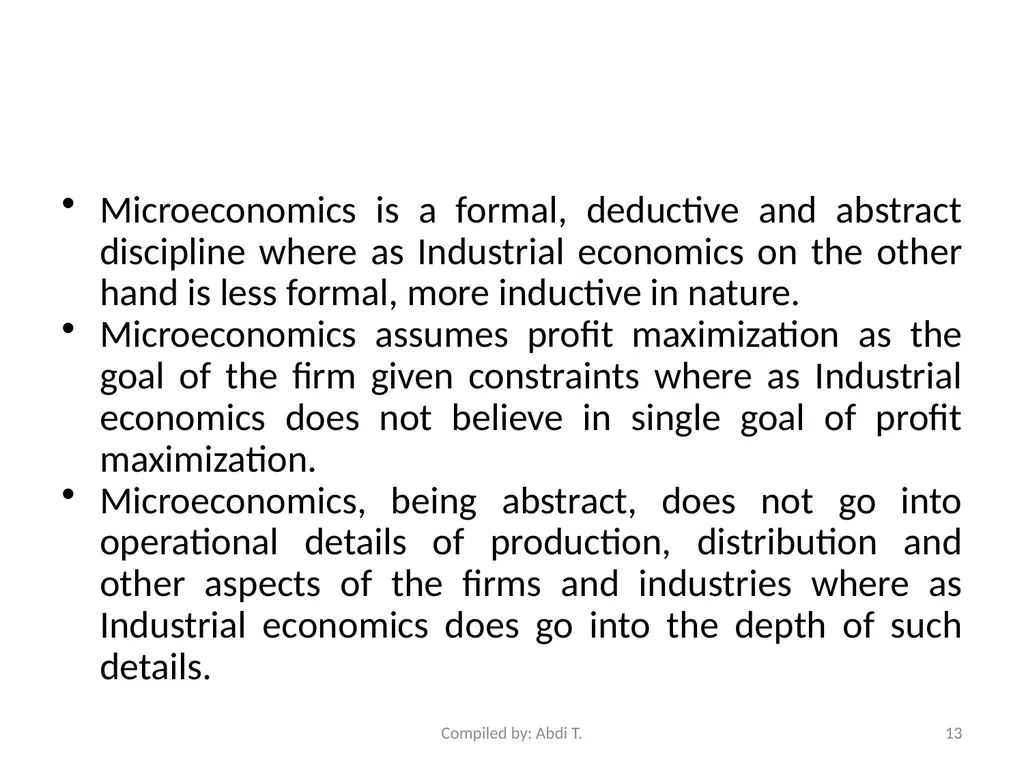
Microeconomics is a formal, deductive and abstract discipline where as Industrial economics on the other hand is less formal, more inductive in nature.
Microeconomics assumes profit maximization as the goal of the firm given constraints where as Industrial economics does not believe in single goal of profit maximization.
Microeconomics, being abstract, does not go into operational details of production, distribution and other aspects of the firms and industries where as Industrial economics does go into the depth of such details. Compiled by: Abdi T. 13<br>
Microeconomics assumes profit maximization as the goal of the firm given constraints where as Industrial economics does not believe in single goal of profit maximization.
Microeconomics, being abstract, does not go into operational details of production, distribution and other aspects of the firms and industries where as Industrial economics does go into the depth of such details. Compiled by: Abdi T. 13<br>
14
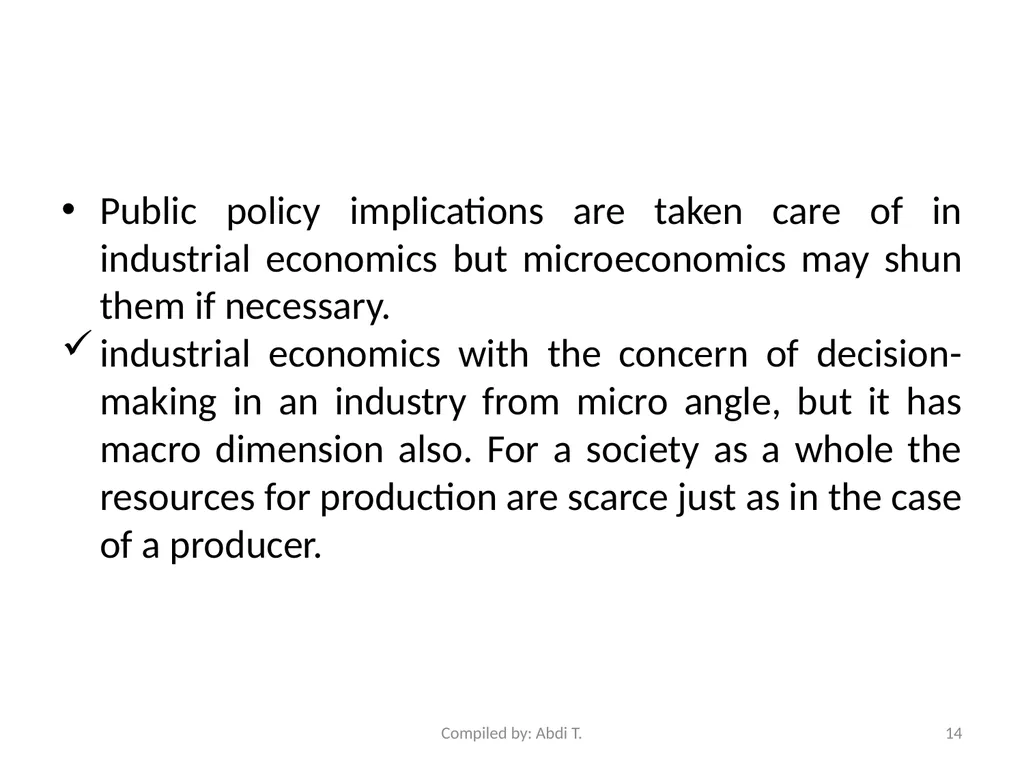
Public policy implications are taken care of in industrial economics but microeconomics may shun them if necessary.
industrial economics with the concern of decision-making in an industry from micro angle, but it has macro dimension also. For a society as a whole the resources for production are scarce just as in the case of a producer. Compiled by: Abdi T. 14<br>
industrial economics with the concern of decision-making in an industry from micro angle, but it has macro dimension also. For a society as a whole the resources for production are scarce just as in the case of a producer. Compiled by: Abdi T. 14<br>
15
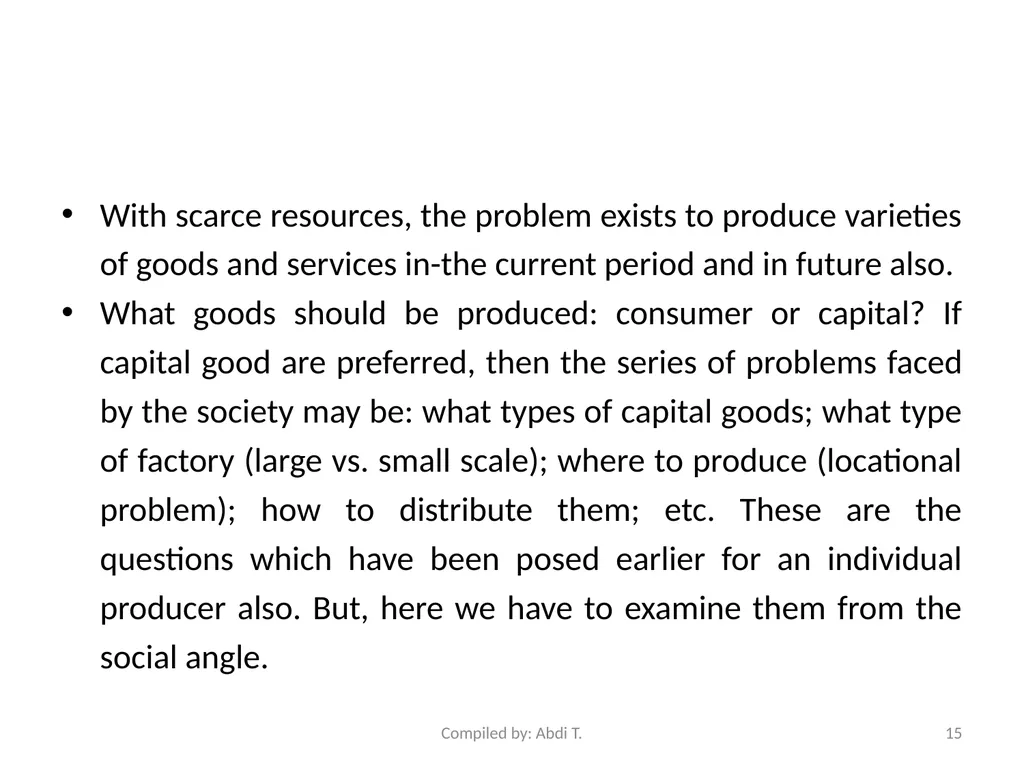
With scarce resources, the problem exists to produce varieties of goods and services in-the current period and in future also.
What goods should be produced: consumer or capital? If capital good are preferred, then the series of problems faced by the society may be: what types of capital goods; what type of factory (large vs. small scale); where to produce (locational problem); how to distribute them; etc. These are the questions which have been posed earlier for an individual producer also. But, here we have to examine them from the social angle. Compiled by: Abdi T. 15<br>
What goods should be produced: consumer or capital? If capital good are preferred, then the series of problems faced by the society may be: what types of capital goods; what type of factory (large vs. small scale); where to produce (locational problem); how to distribute them; etc. These are the questions which have been posed earlier for an individual producer also. But, here we have to examine them from the social angle. Compiled by: Abdi T. 15<br>
16
The term industrial organization is commonly viewed as synonymous with industrial economics.
But,Carlsson (1989) made clear distinction between them. He reasons that the main concern of industrial organization has become the structure of industries at a particular point of time.
By contrast, industrial economics encompasses both industrial organization and industrial dynamics.
Industrial dynamics is primarily concerned with the evolution of industry as a process in time both at the macro level, the sector or industry level, and the firm level. Compiled by: Abdi T. 16<br>
But,Carlsson (1989) made clear distinction between them. He reasons that the main concern of industrial organization has become the structure of industries at a particular point of time.
By contrast, industrial economics encompasses both industrial organization and industrial dynamics.
Industrial dynamics is primarily concerned with the evolution of industry as a process in time both at the macro level, the sector or industry level, and the firm level. Compiled by: Abdi T. 16<br>
17
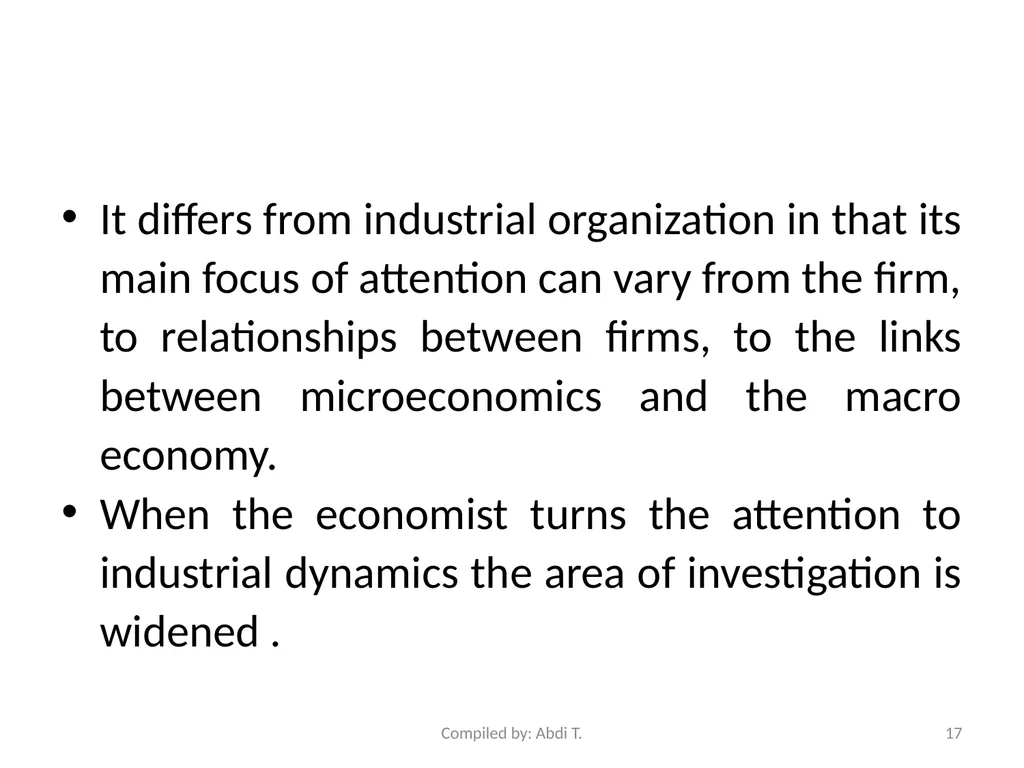
It differs from industrial organization in that its main focus of attention can vary from the firm, to relationships between firms, to the links between microeconomics and the macro economy.
When the economist turns the attention to industrial dynamics the area of investigation is widened . 17 Compiled by: Abdi T.<br>
When the economist turns the attention to industrial dynamics the area of investigation is widened . 17 Compiled by: Abdi T.<br>
18
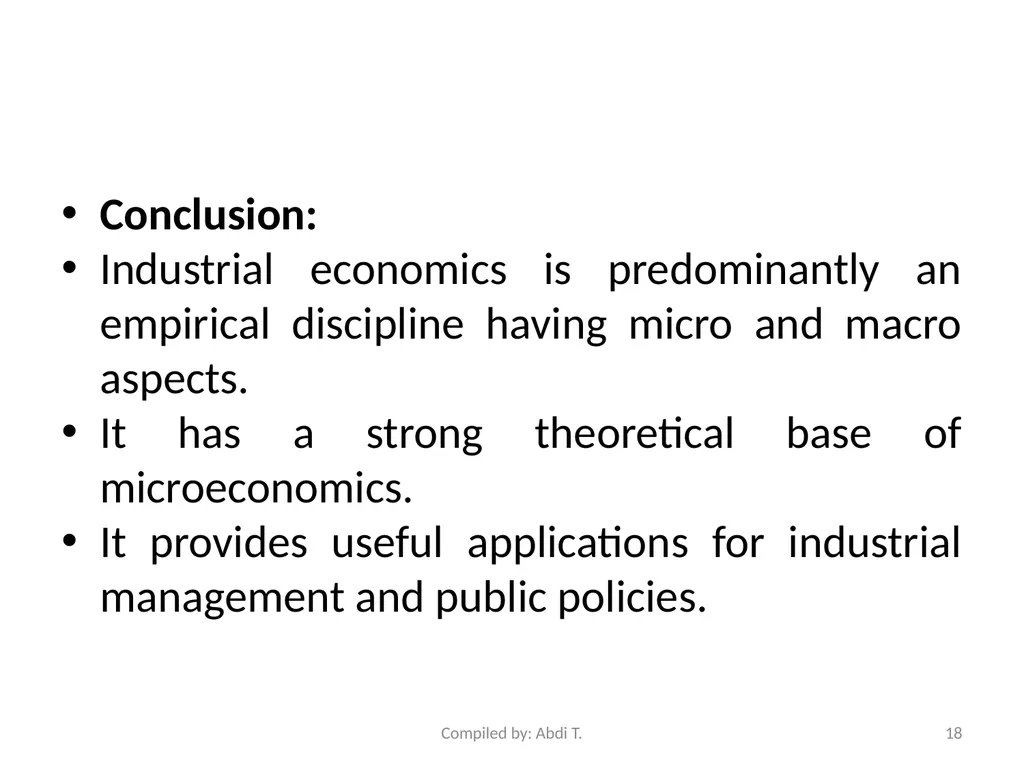
Conclusion:
Industrial economics is predominantly an empirical discipline having micro and macro aspects.
It has a strong theoretical base of microeconomics.
It provides useful applications for industrial management and public policies. Compiled by: Abdi T. 18<br>
Industrial economics is predominantly an empirical discipline having micro and macro aspects.
It has a strong theoretical base of microeconomics.
It provides useful applications for industrial management and public policies. Compiled by: Abdi T. 18<br>
19
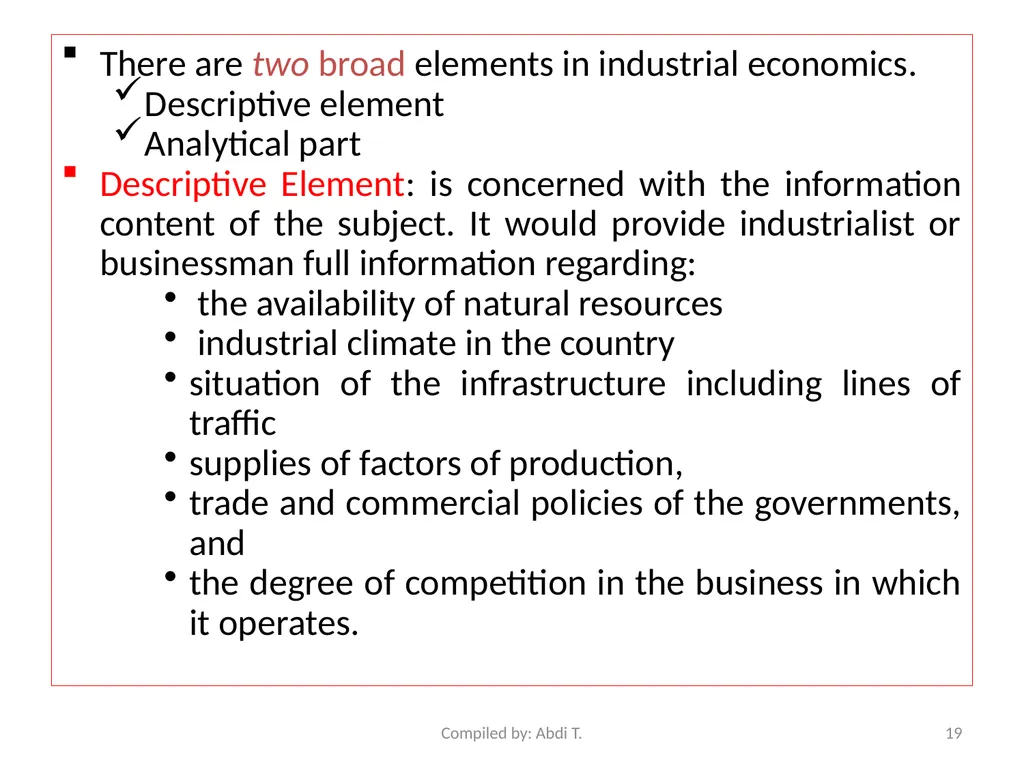
There are two broad elements in industrial economics.
Descriptive element
Analytical part
Descriptive Element: is concerned with the information content of the subject. It would provide industrialist or businessman full information regarding:
the availability of natural resources
industrial climate in the country
situation of the infrastructure including lines of traffic
supplies of factors of production,
trade and commercial policies of the governments, and
the degree of competition in the business in which it operates. 19 Compiled by: Abdi T.<br>
Descriptive element
Analytical part
Descriptive Element: is concerned with the information content of the subject. It would provide industrialist or businessman full information regarding:
the availability of natural resources
industrial climate in the country
situation of the infrastructure including lines of traffic
supplies of factors of production,
trade and commercial policies of the governments, and
the degree of competition in the business in which it operates. 19 Compiled by: Abdi T.<br>
20
In short, it deals with the information about the competitors, natural resources and factors of production and government rules and regulations related to the concerned industry.
Analytical element:is concerned with business policy and decision making.
market analysis
Pricing
choice of techniques
location of plants
investment planning
hiring and firing of labour
financial decisions
product diversification and so on. Compiled by: Abdi T. 20<br>
Analytical element:is concerned with business policy and decision making.
market analysis
Pricing
choice of techniques
location of plants
investment planning
hiring and firing of labour
financial decisions
product diversification and so on. Compiled by: Abdi T. 20<br>
21
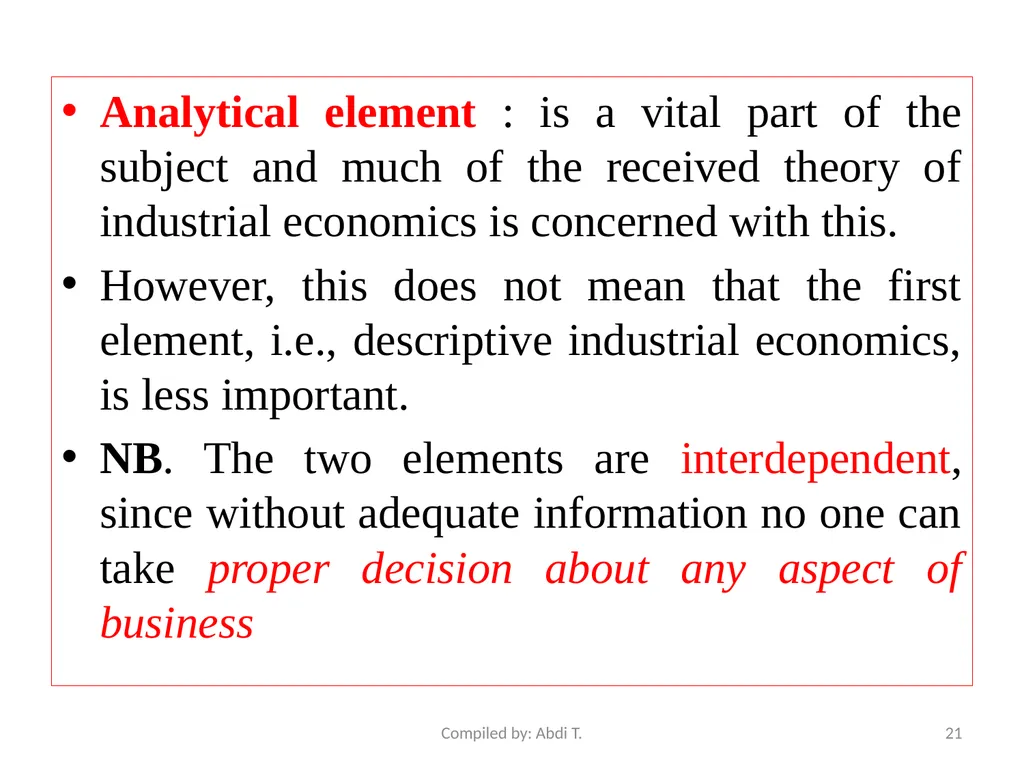
Analytical element : is a vital part of the subject and much of the received theory of industrial economics is concerned with this.
However, this does not mean that the first element, i.e., descriptive industrial economics, is less important.
NB. The two elements are interdependent, since without adequate information no one can take proper decision about any aspect of business 21 Compiled by: Abdi T.<br>
However, this does not mean that the first element, i.e., descriptive industrial economics, is less important.
NB. The two elements are interdependent, since without adequate information no one can take proper decision about any aspect of business 21 Compiled by: Abdi T.<br>
22
While the descriptive element of industrial economics is concerned with the information content of the subject, the analytical element is concerned with the business policy and decision making. Compiled by: Abdi T. 22<br>
23
Moreover, industrial economics:
analyses industries, markets, and the behaviour of firms within those markets.
It deals with supply side economics.
Thus, it is concerned with the economic problems of the firms and their economic behaviour in utilising economic resources at their disposal.
The interdependence between firms within markets and the links that exist between market conditions and firm’s performance 23 Compiled by: Abdi T.<br>
analyses industries, markets, and the behaviour of firms within those markets.
It deals with supply side economics.
Thus, it is concerned with the economic problems of the firms and their economic behaviour in utilising economic resources at their disposal.
The interdependence between firms within markets and the links that exist between market conditions and firm’s performance 23 Compiled by: Abdi T.<br>
24
Industrial Economics addresses the basic question of:
what to produce
for whom to produce and
how to produce in the context of industries or firms
Industries face such problems because resources are scarce and hence the industrialist has to take decisions about production and distributions of goods and/or services as they cannot produce everything they want to produce at single firm level or at higher aggregate level of the economy. 24 Compiled by: Abdi T.<br>
what to produce
for whom to produce and
how to produce in the context of industries or firms
Industries face such problems because resources are scarce and hence the industrialist has to take decisions about production and distributions of goods and/or services as they cannot produce everything they want to produce at single firm level or at higher aggregate level of the economy. 24 Compiled by: Abdi T.<br>
25
The Rationale for Studying Industrial Economics i. It is instrumental to the formulation and implementation of industrial policies that are essential for sustainable development of a nation.
For example, it helps us:
to choose between private and public enterprises
to design strategies to promote investment in industrial sector
to regulate and/or deregulate public utility industries
It also assists policy makers as how they can stimulate technological progress through patent rights and subsidies. 25 Compiled by: Abdi T.<br>
For example, it helps us:
to choose between private and public enterprises
to design strategies to promote investment in industrial sector
to regulate and/or deregulate public utility industries
It also assists policy makers as how they can stimulate technological progress through patent rights and subsidies. 25 Compiled by: Abdi T.<br>
26
ii. Studying industrial economics is useful for generating research questions such as:
why do some firms advertise their products while others do not?
Why do some firms expand while others contract or keep their size constant?
Are barriers to entry more serious in some branches of industry than in others?
The questions are essential for further research and development and hence deserve attention. 26 Compiled by: Abdi T.<br>
why do some firms advertise their products while others do not?
Why do some firms expand while others contract or keep their size constant?
Are barriers to entry more serious in some branches of industry than in others?
The questions are essential for further research and development and hence deserve attention. 26 Compiled by: Abdi T.<br>
27
1.2. Some Basic Concepts in the study of Industrial Economics i. The Firm
A firm is an organization owned by one or jointly by a few or many individuals which is engaged in productive activity of any kind for the sake of profit or some other well-defined aim.
Most of the firms owned by private individuals in manufacturing trade and services will aspire for profits but there may be some other such as government companies where profit motivation will be secondary or missing altogether. Compiled by: Abdi T. 27<br>
A firm is an organization owned by one or jointly by a few or many individuals which is engaged in productive activity of any kind for the sake of profit or some other well-defined aim.
Most of the firms owned by private individuals in manufacturing trade and services will aspire for profits but there may be some other such as government companies where profit motivation will be secondary or missing altogether. Compiled by: Abdi T. 27<br>
28
ii. The industry
The conventional definition of the term industry is a group of firms producing a single homogeneous product and selling it in a common market. However, the restriction of a single homogeneous product is not met in practice.
Most of the firms produce many outputs which may or may not be substitutable for each other. In this situation, the conventional definition has no operational sense. Compiled by: Abdi T. 28<br>
The conventional definition of the term industry is a group of firms producing a single homogeneous product and selling it in a common market. However, the restriction of a single homogeneous product is not met in practice.
Most of the firms produce many outputs which may or may not be substitutable for each other. In this situation, the conventional definition has no operational sense. Compiled by: Abdi T. 28<br>
29
A better approach to define the industry is to call it “a group of sellers or of close substitute outputs who supply to a common group of buyers”.
In other words, we may take it in simpler terms as a group of firms producing closely substitute goods for a common group of buyers.
In the terminology of the monopolistic competition we are essentially talking about the “product group" as a substitute word for the industry. Compiled by: Abdi T. 29<br>
In other words, we may take it in simpler terms as a group of firms producing closely substitute goods for a common group of buyers.
In the terminology of the monopolistic competition we are essentially talking about the “product group" as a substitute word for the industry. Compiled by: Abdi T. 29<br>
30
iii. The Market
This is defined as a closely interrelated group of sellers and buyers for a commodity. The term is not equivalent to the industry since in the latter case we are looking only at the seller’s side of the market.
By including the buyer's side, the term becomes more comprehensive connoting the composition of the buyers and their geographical location along with the industry.
A heterogeneous group of closely substitute goods will have a market, but there may be markets within the market for every homogeneous good. Compiled by: Abdi T. 30<br>
This is defined as a closely interrelated group of sellers and buyers for a commodity. The term is not equivalent to the industry since in the latter case we are looking only at the seller’s side of the market.
By including the buyer's side, the term becomes more comprehensive connoting the composition of the buyers and their geographical location along with the industry.
A heterogeneous group of closely substitute goods will have a market, but there may be markets within the market for every homogeneous good. Compiled by: Abdi T. 30<br>
31
Contestable market: is a market where barriers to entry and exit, not market structure, determine price and output decisions and a competitive price is set.
It is a market in which competitive outcomes can be observed.
Its fundamental feature is low barriers to entry and exit;
A perfectly contestable market would have no barriers to entry or exit. Compiled by: Abdi T. 31<br>
It is a market in which competitive outcomes can be observed.
Its fundamental feature is low barriers to entry and exit;
A perfectly contestable market would have no barriers to entry or exit. Compiled by: Abdi T. 31<br>
32
iv. Market power
Market power- refers to the influence that any particular buyer or seller can exercise over the price of a product.
It indicates the degree to which a business firm is able to earn larger than normal profits.
Market structures range from highly competitive, in which there are so many buyers or sellers that none can influence the market price, to the other extreme in which a single buyer or seller faces no competition and therefore wields great market power.
Market power is inversely related to both the degree of competition in the market and the ease of entry and exit. Compiled by: Abdi T. 32<br>
Market power- refers to the influence that any particular buyer or seller can exercise over the price of a product.
It indicates the degree to which a business firm is able to earn larger than normal profits.
Market structures range from highly competitive, in which there are so many buyers or sellers that none can influence the market price, to the other extreme in which a single buyer or seller faces no competition and therefore wields great market power.
Market power is inversely related to both the degree of competition in the market and the ease of entry and exit. Compiled by: Abdi T. 32<br>
33
1.3.Approaches to Industrial Economics 1.3.1.The Market Structure-Conduct- Performance paradigm (SCP paradigm)
Joe Bain and Edward Mason developed the concept “Structure-Conduct- Performance” paradigm in 1936, dealing with the pricing policies of large-scale enterprises.
It is also called Harvard tradition
According to this paradigm, there is a priori relationship between the three concepts of industrial economics, market structure, market conduct and market performance. 33 Compiled by: Abdi T.<br>
Joe Bain and Edward Mason developed the concept “Structure-Conduct- Performance” paradigm in 1936, dealing with the pricing policies of large-scale enterprises.
It is also called Harvard tradition
According to this paradigm, there is a priori relationship between the three concepts of industrial economics, market structure, market conduct and market performance. 33 Compiled by: Abdi T.<br>
34
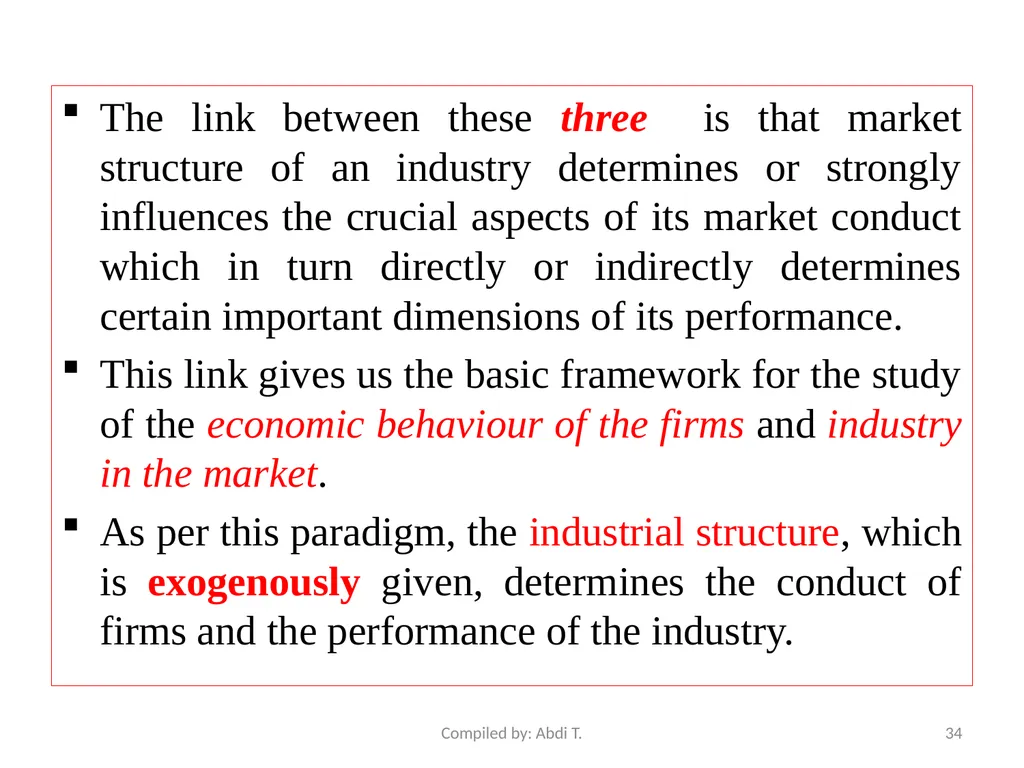
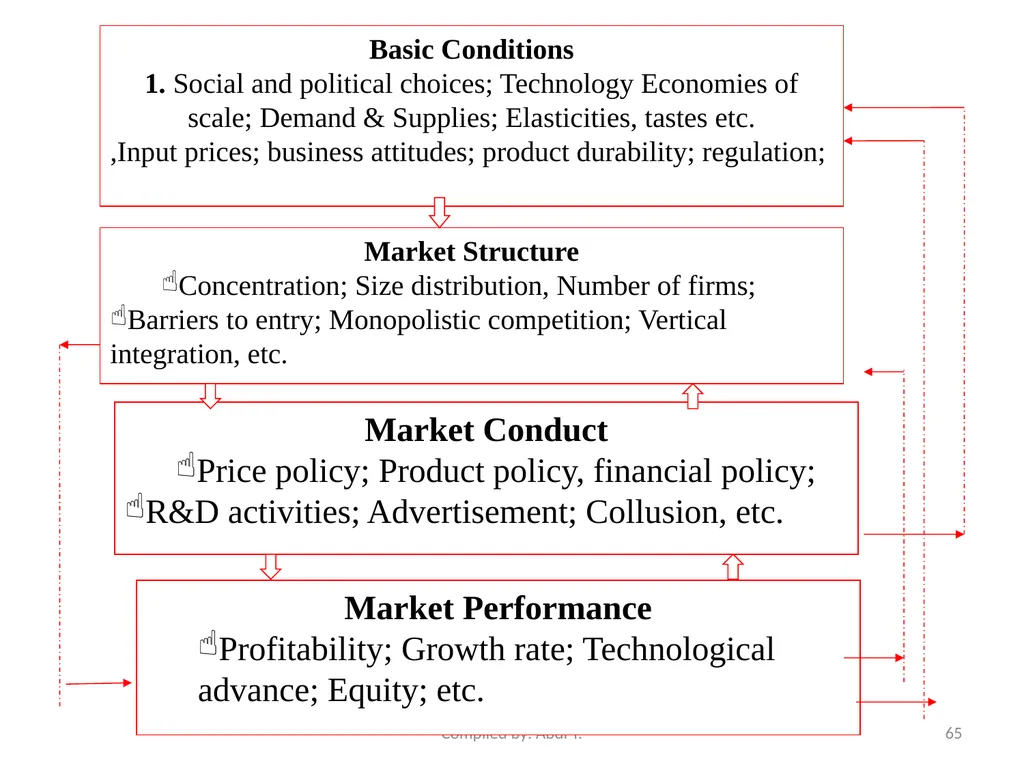
The link between these three is that market structure of an industry determines or strongly influences the crucial aspects of its market conduct which in turn directly or indirectly determines certain important dimensions of its performance.
This link gives us the basic framework for the study of the economic behaviour of the firms and industry in the market.
As per this paradigm, the industrial structure, which is exogenously given, determines the conduct of firms and the performance of the industry. 34 Compiled by: Abdi T.<br>
This link gives us the basic framework for the study of the economic behaviour of the firms and industry in the market.
As per this paradigm, the industrial structure, which is exogenously given, determines the conduct of firms and the performance of the industry. 34 Compiled by: Abdi T.<br>
35
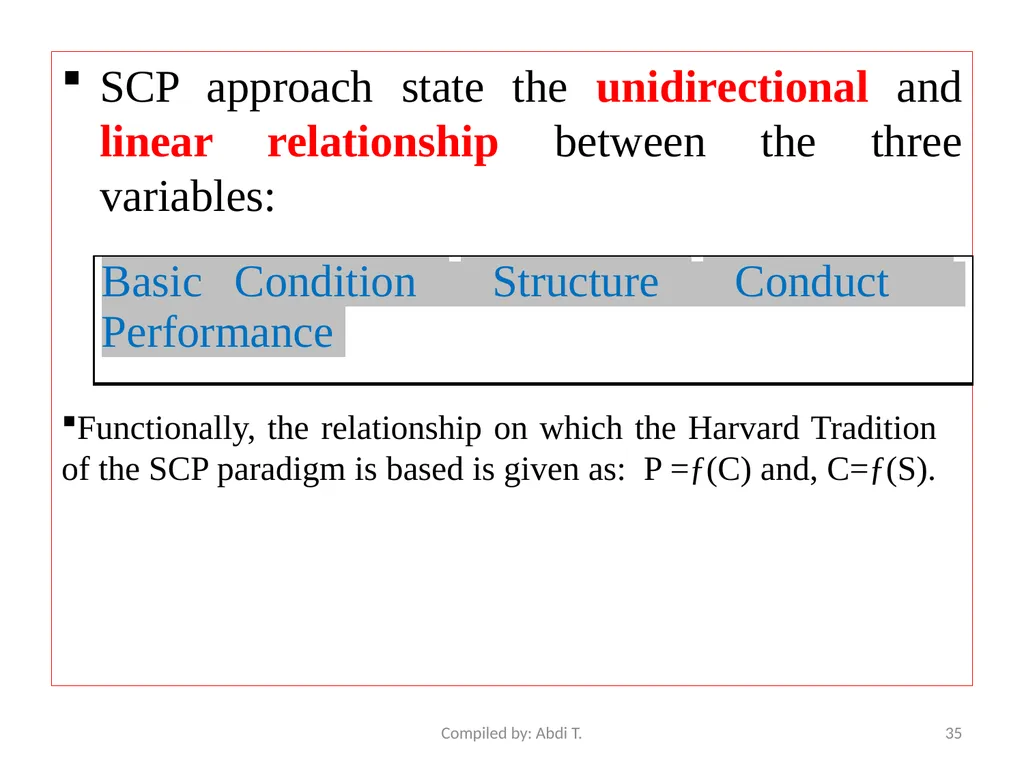
SCP approach state the unidirectional and linear relationship between the three variables: Functionally, the relationship on which the Harvard Tradition of the SCP paradigm is based is given as: P =ƒ(C) and, C=ƒ(S). 35 Compiled by: Abdi T.<br>
36
Basic Conditions
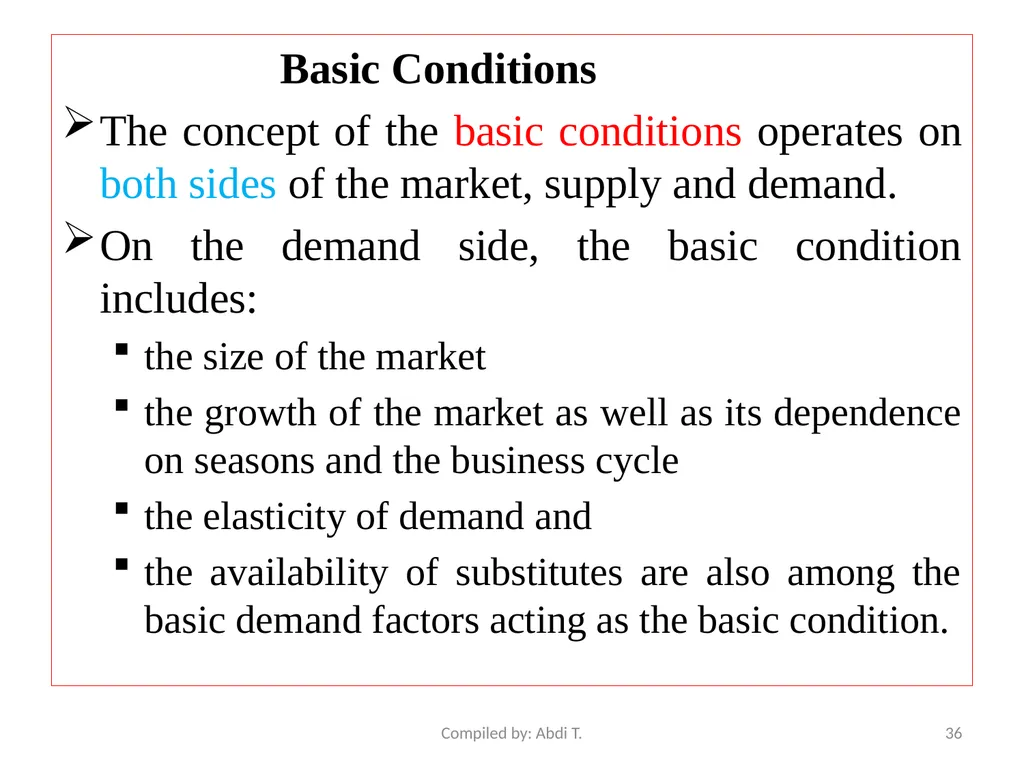
The concept of the basic conditions operates on both sides of the market, supply and demand.
On the demand side, the basic condition includes:
the size of the market
the growth of the market as well as its dependence on seasons and the business cycle
the elasticity of demand and
the availability of substitutes are also among the basic demand factors acting as the basic condition. 36 Compiled by: Abdi T.<br>
The concept of the basic conditions operates on both sides of the market, supply and demand.
On the demand side, the basic condition includes:
the size of the market
the growth of the market as well as its dependence on seasons and the business cycle
the elasticity of demand and
the availability of substitutes are also among the basic demand factors acting as the basic condition. 36 Compiled by: Abdi T.<br>
37
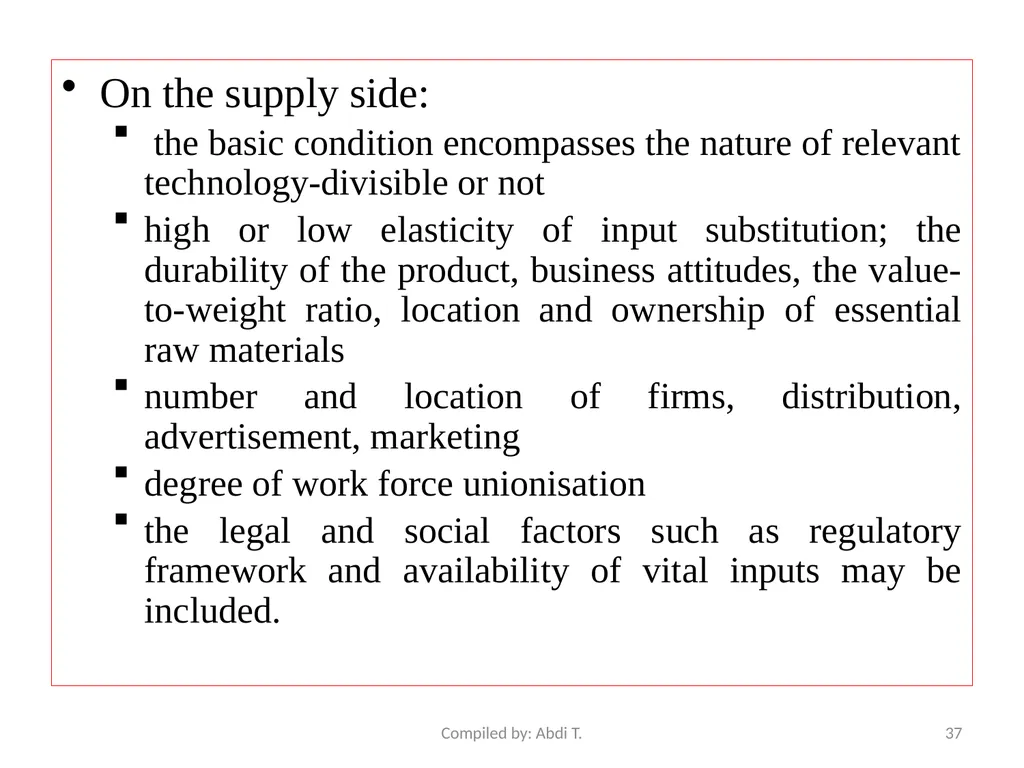
On the supply side:
the basic condition encompasses the nature of relevant technology-divisible or not
high or low elasticity of input substitution; the durability of the product, business attitudes, the value-to-weight ratio, location and ownership of essential raw materials
number and location of firms, distribution, advertisement, marketing
degree of work force unionisation
the legal and social factors such as regulatory framework and availability of vital inputs may be included. 37 Compiled by: Abdi T.<br>
the basic condition encompasses the nature of relevant technology-divisible or not
high or low elasticity of input substitution; the durability of the product, business attitudes, the value-to-weight ratio, location and ownership of essential raw materials
number and location of firms, distribution, advertisement, marketing
degree of work force unionisation
the legal and social factors such as regulatory framework and availability of vital inputs may be included. 37 Compiled by: Abdi T.<br>
38
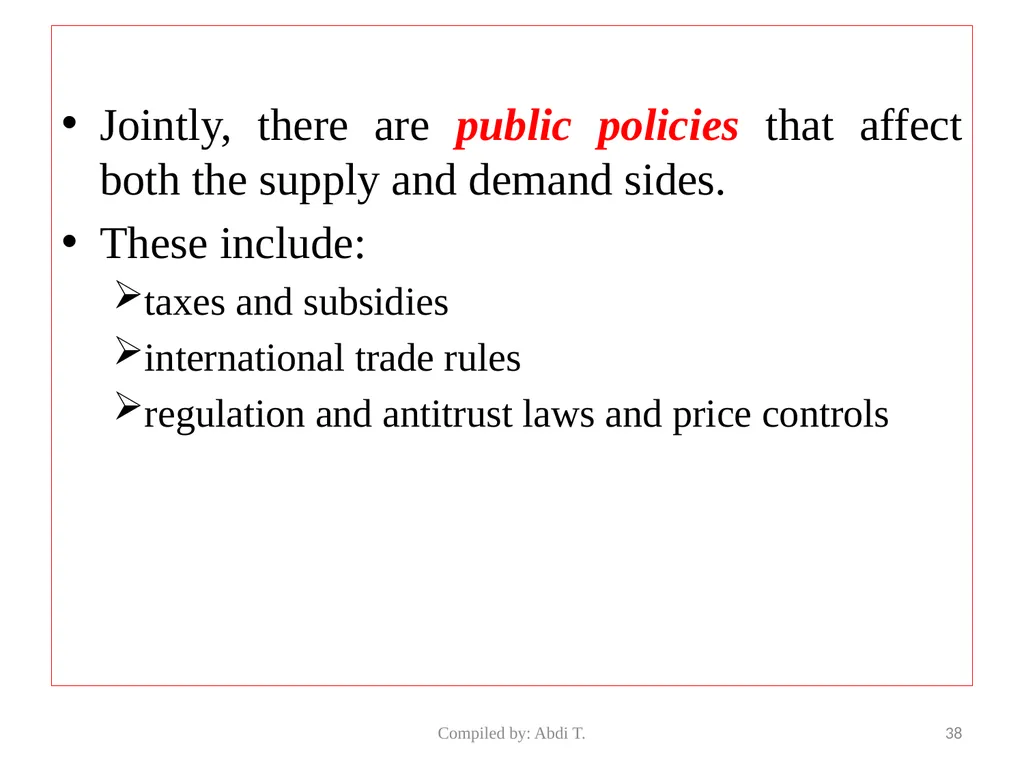
Jointly, there are public policies that affect both the supply and demand sides.
These include:
taxes and subsidies
international trade rules
regulation and antitrust laws and price controls 38 Compiled by: Abdi T.<br>
These include:
taxes and subsidies
international trade rules
regulation and antitrust laws and price controls 38 Compiled by: Abdi T.<br>
39
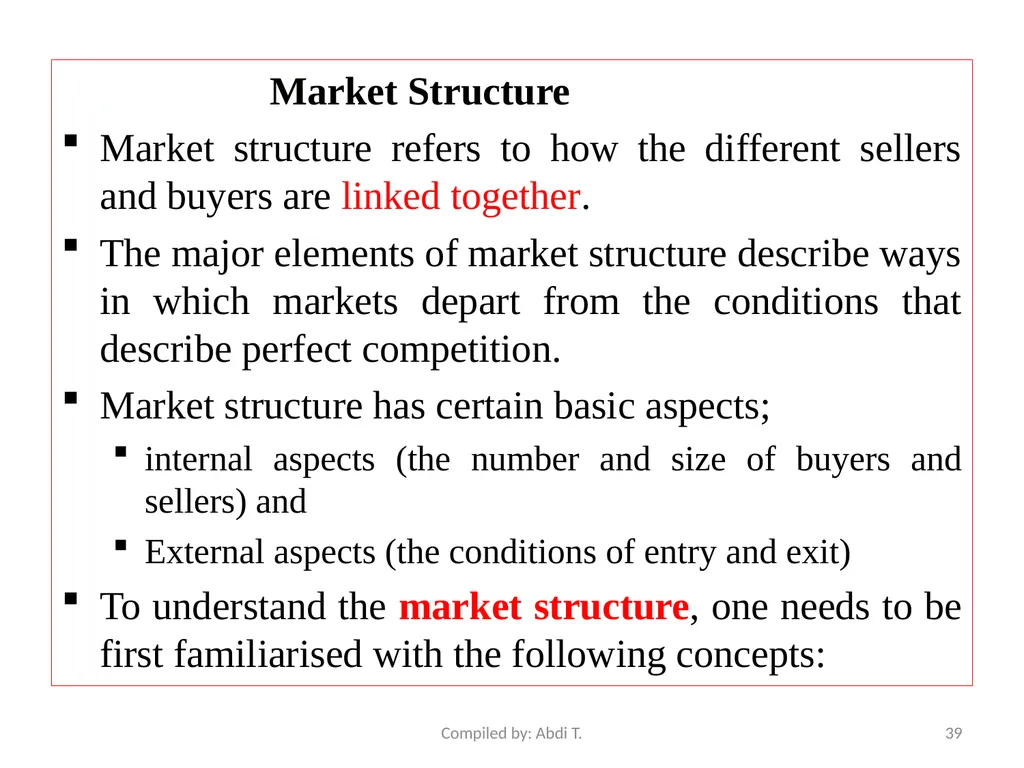
Market Structure
Market structure refers to how the different sellers and buyers are linked together.
The major elements of market structure describe ways in which markets depart from the conditions that describe perfect competition.
Market structure has certain basic aspects;
internal aspects (the number and size of buyers and sellers) and
External aspects (the conditions of entry and exit)
To understand the market structure, one needs to be first familiarised with the following concepts: 39 Compiled by: Abdi T.<br>
Market structure refers to how the different sellers and buyers are linked together.
The major elements of market structure describe ways in which markets depart from the conditions that describe perfect competition.
Market structure has certain basic aspects;
internal aspects (the number and size of buyers and sellers) and
External aspects (the conditions of entry and exit)
To understand the market structure, one needs to be first familiarised with the following concepts: 39 Compiled by: Abdi T.<br>
40
The degree of seller concentration: this refers to the number and size distribution of firms producing a particular commodity or types of commodities in a market.
In perfectly competitive market model, we assume that there are very large number of buyers and sellers, standardized product, free entry, free exit and complete and perfect knowledge.
Thus, no single firm is able to influence the price of the product in such a market.
A competitive industry will in the long run supply a product at a price equal to its average cost and marginal cost. That is, P = AC=MC. 40 Compiled by: Abdi T.<br>
In perfectly competitive market model, we assume that there are very large number of buyers and sellers, standardized product, free entry, free exit and complete and perfect knowledge.
Thus, no single firm is able to influence the price of the product in such a market.
A competitive industry will in the long run supply a product at a price equal to its average cost and marginal cost. That is, P = AC=MC. 40 Compiled by: Abdi T.<br>
41
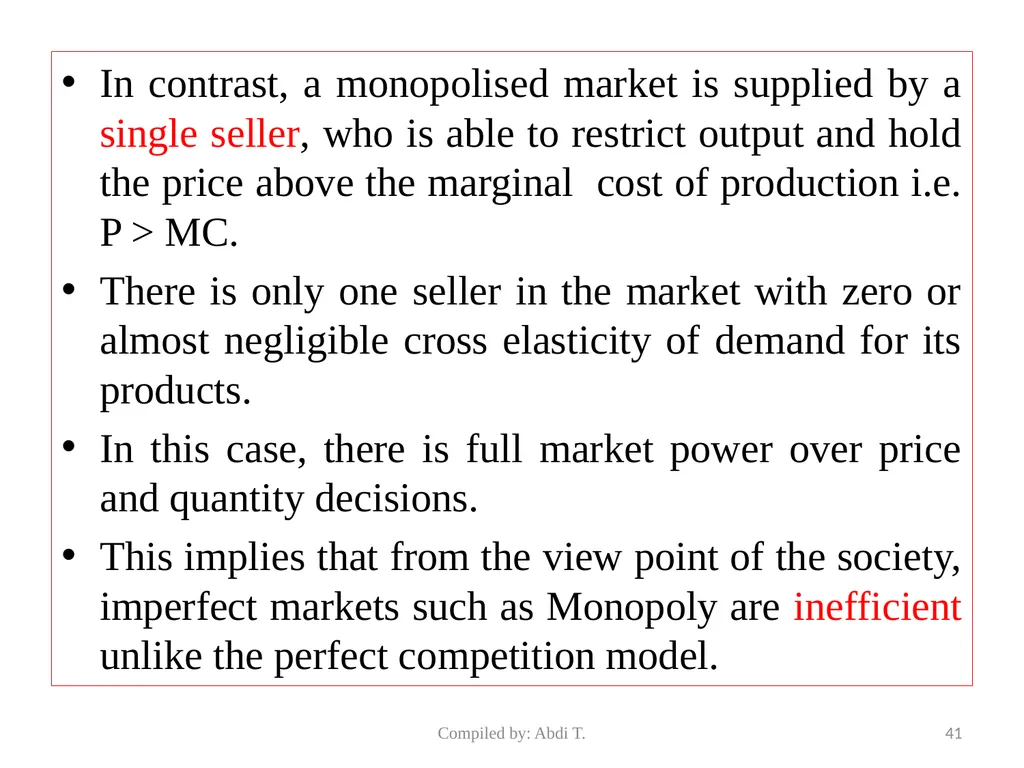
In contrast, a monopolised market is supplied by a single seller, who is able to restrict output and hold the price above the marginal cost of production i.e. P > MC.
There is only one seller in the market with zero or almost negligible cross elasticity of demand for its products.
In this case, there is full market power over price and quantity decisions.
This implies that from the view point of the society, imperfect markets such as Monopoly are inefficient unlike the perfect competition model. 41 Compiled by: Abdi T.<br>
There is only one seller in the market with zero or almost negligible cross elasticity of demand for its products.
In this case, there is full market power over price and quantity decisions.
This implies that from the view point of the society, imperfect markets such as Monopoly are inefficient unlike the perfect competition model. 41 Compiled by: Abdi T.<br>
42
The degree of buyer concentration:
this shows the number and size distribution of buyers of the commodities in the market.
The essence of the matter is that concentration of power in one part of a market will evoke balancing concentrations of power in other parts of the market.
When a few large buyers bargain with a few large sellers, it will be more difficult for sellers to hold the price above the cost, keeping all other factors constant. 42 Compiled by: Abdi T.<br>
this shows the number and size distribution of buyers of the commodities in the market.
The essence of the matter is that concentration of power in one part of a market will evoke balancing concentrations of power in other parts of the market.
When a few large buyers bargain with a few large sellers, it will be more difficult for sellers to hold the price above the cost, keeping all other factors constant. 42 Compiled by: Abdi T.<br>
43
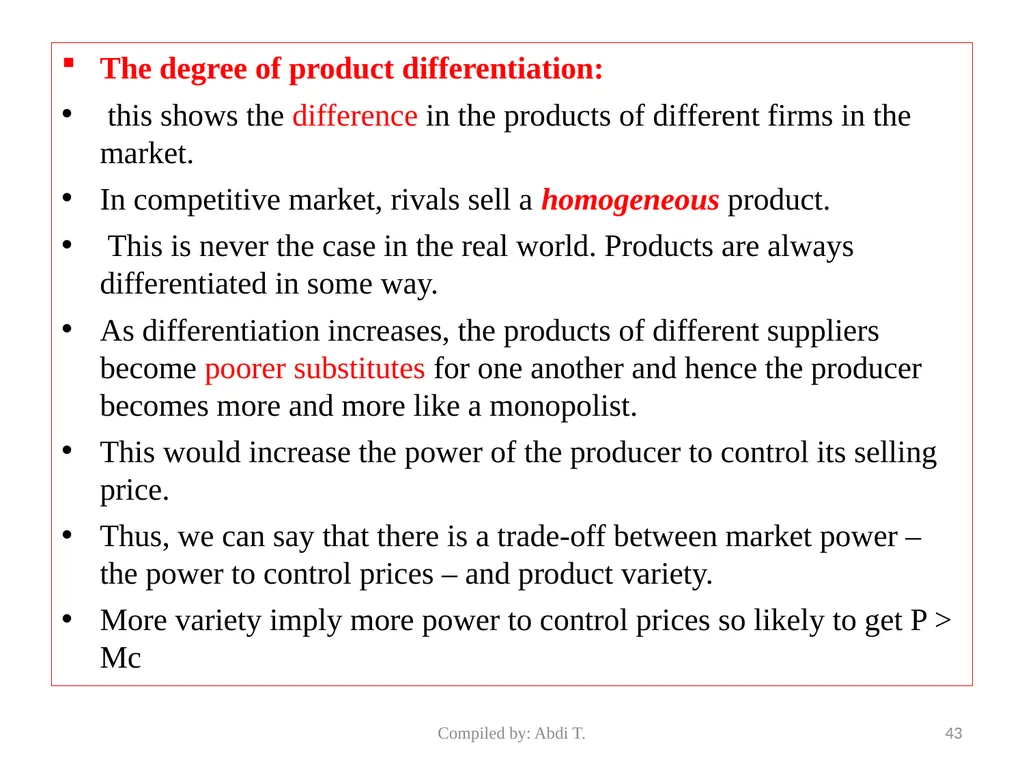
The degree of product differentiation:
this shows the difference in the products of different firms in the market.
In competitive market, rivals sell a homogeneous product.
This is never the case in the real world. Products are always differentiated in some way.
As differentiation increases, the products of different suppliers become poorer substitutes for one another and hence the producer becomes more and more like a monopolist.
This would increase the power of the producer to control its selling price.
Thus, we can say that there is a trade-off between market power – the power to control prices – and product variety.
More variety imply more power to control prices so likely to get P > Mc 43 Compiled by: Abdi T.<br>
this shows the difference in the products of different firms in the market.
In competitive market, rivals sell a homogeneous product.
This is never the case in the real world. Products are always differentiated in some way.
As differentiation increases, the products of different suppliers become poorer substitutes for one another and hence the producer becomes more and more like a monopolist.
This would increase the power of the producer to control its selling price.
Thus, we can say that there is a trade-off between market power – the power to control prices – and product variety.
More variety imply more power to control prices so likely to get P > Mc 43 Compiled by: Abdi T.<br>
44
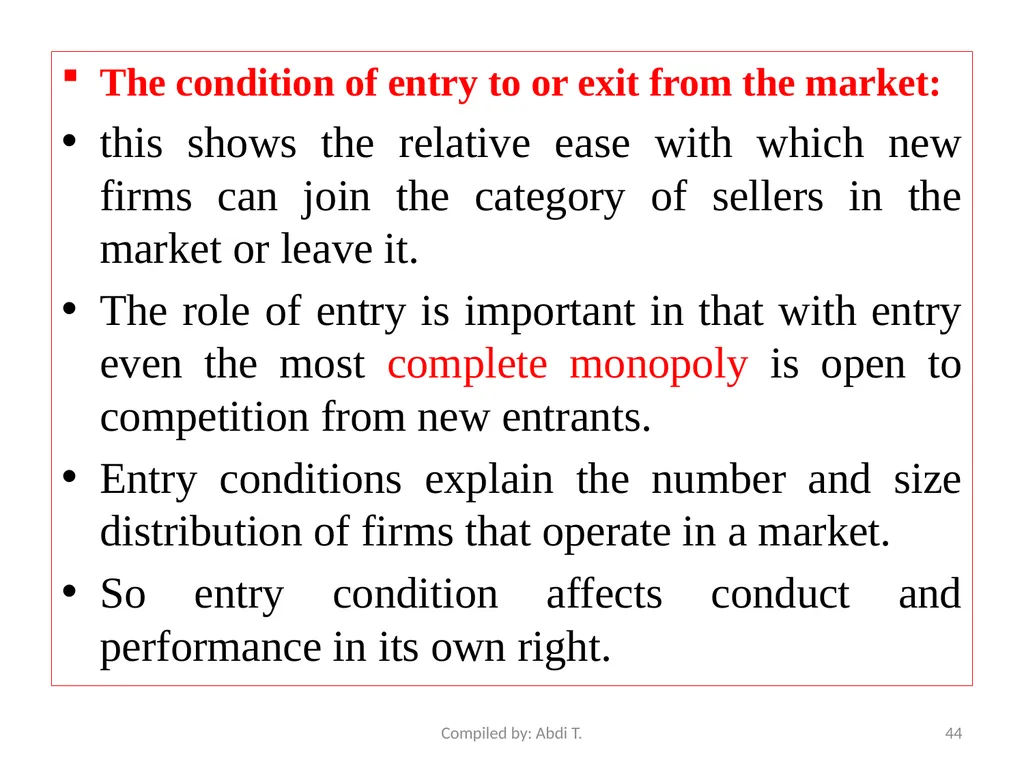
The condition of entry to or exit from the market:
this shows the relative ease with which new firms can join the category of sellers in the market or leave it.
The role of entry is important in that with entry even the most complete monopoly is open to competition from new entrants.
Entry conditions explain the number and size distribution of firms that operate in a market.
So entry condition affects conduct and performance in its own right. 44 Compiled by: Abdi T.<br>
this shows the relative ease with which new firms can join the category of sellers in the market or leave it.
The role of entry is important in that with entry even the most complete monopoly is open to competition from new entrants.
Entry conditions explain the number and size distribution of firms that operate in a market.
So entry condition affects conduct and performance in its own right. 44 Compiled by: Abdi T.<br>
45
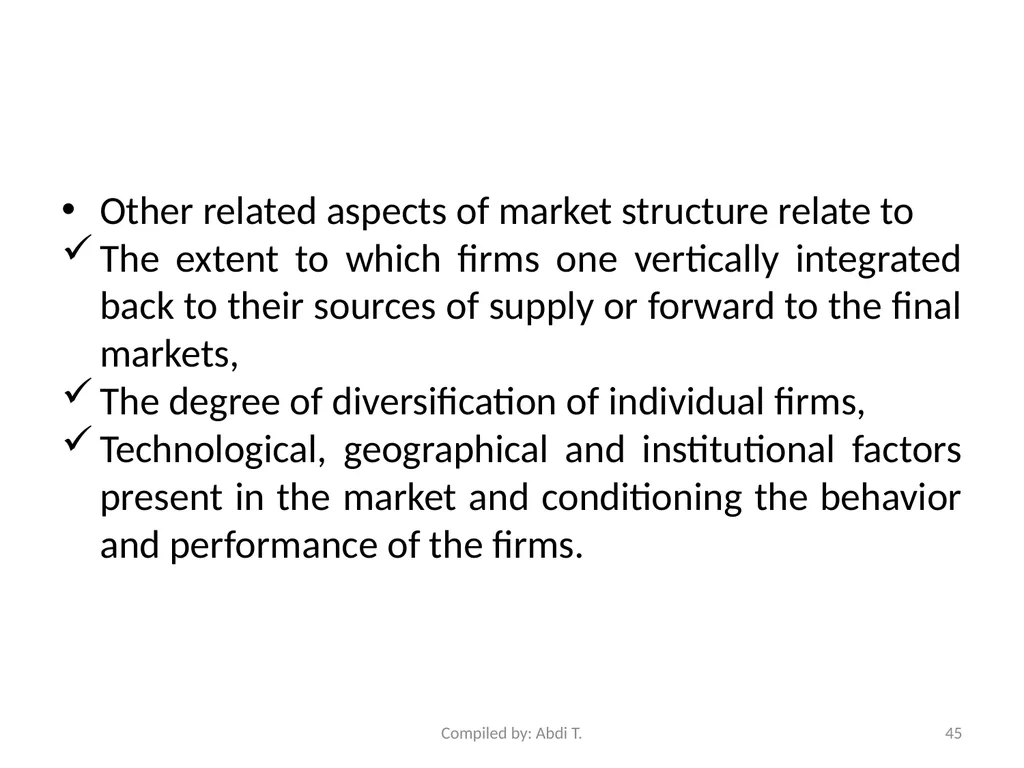
Other related aspects of market structure relate to
The extent to which firms one vertically integrated back to their sources of supply or forward to the final markets,
The degree of diversification of individual firms,
Technological, geographical and institutional factors present in the market and conditioning the behavior and performance of the firms. Compiled by: Abdi T. 45<br>
The extent to which firms one vertically integrated back to their sources of supply or forward to the final markets,
The degree of diversification of individual firms,
Technological, geographical and institutional factors present in the market and conditioning the behavior and performance of the firms. Compiled by: Abdi T. 45<br>
46
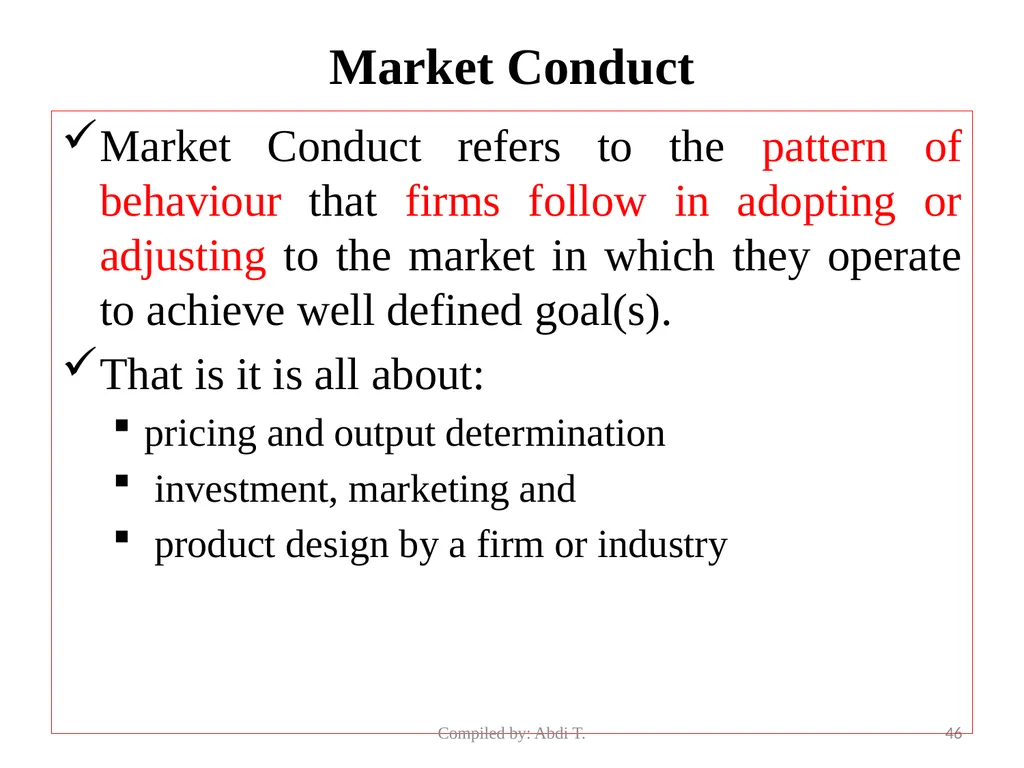
Market Conduct Market Conduct refers to the pattern of behaviour that firms follow in adopting or adjusting to the market in which they operate to achieve well defined goal(s).
That is it is all about:
pricing and output determination
investment, marketing and
product design by a firm or industry 46 Compiled by: Abdi T.<br>
That is it is all about:
pricing and output determination
investment, marketing and
product design by a firm or industry 46 Compiled by: Abdi T.<br>
47
Given the market conditions and the goals to be pursued, the firm will be acting alone or jointly to decide about:
the price levels for the products
the types of products and their quantities
their design and quality standards
advertisements and so on.
Generally, market conduct refers to:
the decisions, policies and strategies of firms and or
producers with regards to pricing behaviour and or
policies, investment, Research and Development and various forms of strategic alliances with other firms. 47 Compiled by: Abdi T.<br>
the price levels for the products
the types of products and their quantities
their design and quality standards
advertisements and so on.
Generally, market conduct refers to:
the decisions, policies and strategies of firms and or
producers with regards to pricing behaviour and or
policies, investment, Research and Development and various forms of strategic alliances with other firms. 47 Compiled by: Abdi T.<br>
48
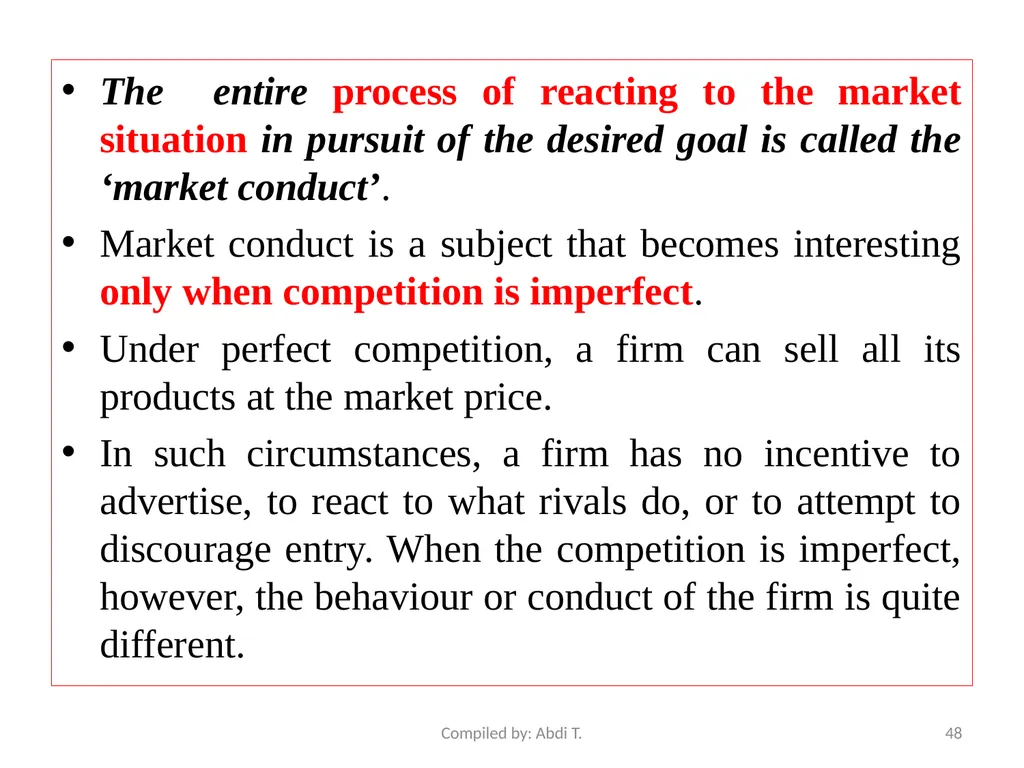
The entire process of reacting to the market situation in pursuit of the desired goal is called the ‘market conduct’.
Market conduct is a subject that becomes interesting only when competition is imperfect.
Under perfect competition, a firm can sell all its products at the market price.
In such circumstances, a firm has no incentive to advertise, to react to what rivals do, or to attempt to discourage entry. When the competition is imperfect, however, the behaviour or conduct of the firm is quite different. 48 Compiled by: Abdi T.<br>
Market conduct is a subject that becomes interesting only when competition is imperfect.
Under perfect competition, a firm can sell all its products at the market price.
In such circumstances, a firm has no incentive to advertise, to react to what rivals do, or to attempt to discourage entry. When the competition is imperfect, however, the behaviour or conduct of the firm is quite different. 48 Compiled by: Abdi T.<br>
49
In general, market conduct includes the pattern of behavior followed by firms in the industry when adapting to a particular market situation. It includes:
i. Pricing behaviors of the firm or group of firms:- This includes a consideration of whether price charged tend to maximize individual profits, whether collusive practices in use tend to result in maximum group profits or whether price discrimination is followed.
ii. Product policy of the firm or group of firms - For example, is product design frequently changed? Is product quality consistent or variable? What variety of products is made available? Compiled by: Abdi T. 49<br>
i. Pricing behaviors of the firm or group of firms:- This includes a consideration of whether price charged tend to maximize individual profits, whether collusive practices in use tend to result in maximum group profits or whether price discrimination is followed.
ii. Product policy of the firm or group of firms - For example, is product design frequently changed? Is product quality consistent or variable? What variety of products is made available? Compiled by: Abdi T. 49<br>
50
iii. Sales promotion and advertising policy of the firm or group of firms – how important are sales promotions and advertising in the firm or industry’s market policy? How is the volume of this activity determined?
iv.Research, development, and innovation strategies employed in the firm or group- how substantial are expenditures for these purposes? To what extent is new technology available to smaller firms?
v. Legal tactics used by the firm or group- Legal actions to gain competitive advantage. Are patent and trade mark rights strictly enforced or defended? Are patent rights licensed to others at fair rates? Compiled by: Abdi T. 50<br>
iv.Research, development, and innovation strategies employed in the firm or group- how substantial are expenditures for these purposes? To what extent is new technology available to smaller firms?
v. Legal tactics used by the firm or group- Legal actions to gain competitive advantage. Are patent and trade mark rights strictly enforced or defended? Are patent rights licensed to others at fair rates? Compiled by: Abdi T. 50<br>
51
Market performance Market performance is the end result of the activities under taken by the firms in pursuit of their goals.
Market performance is all about allocative efficiency, profitability, equity, employment effects and rate of innovation of a firm.
Society wants good performance from producers of goods and services.
Good performance is multidimensional embodying many variables.
Performance refers to whether or not firm’s operations enhance economic welfare – Pareto optimality where firms set prices equal to marginal cost. 51 Compiled by: Abdi T.<br>
Market performance is all about allocative efficiency, profitability, equity, employment effects and rate of innovation of a firm.
Society wants good performance from producers of goods and services.
Good performance is multidimensional embodying many variables.
Performance refers to whether or not firm’s operations enhance economic welfare – Pareto optimality where firms set prices equal to marginal cost. 51 Compiled by: Abdi T.<br>
52
Generally, good market performance is a multidimensional concept which includes the following elements:
Resources should be allocated in an efficient manner within and among firms such that these resources are not needlessly wasted and that they are responsive to consumer desires. How effectively are resources allocated across industries and products? Compiled by: Abdi T. 52<br>
Resources should be allocated in an efficient manner within and among firms such that these resources are not needlessly wasted and that they are responsive to consumer desires. How effectively are resources allocated across industries and products? Compiled by: Abdi T. 52<br>
53
2. Technical or operational efficiency--how closely do existing firms, as a group, achieve lowest possible costs?
Are they large enough to capture scale economies?
Is there too much unused capacity?
Are they located to minimize transport costs?
Is there labor efficiency? Compiled by: Abdi T. 53<br>
Are they large enough to capture scale economies?
Is there too much unused capacity?
Are they located to minimize transport costs?
Is there labor efficiency? Compiled by: Abdi T. 53<br>
54
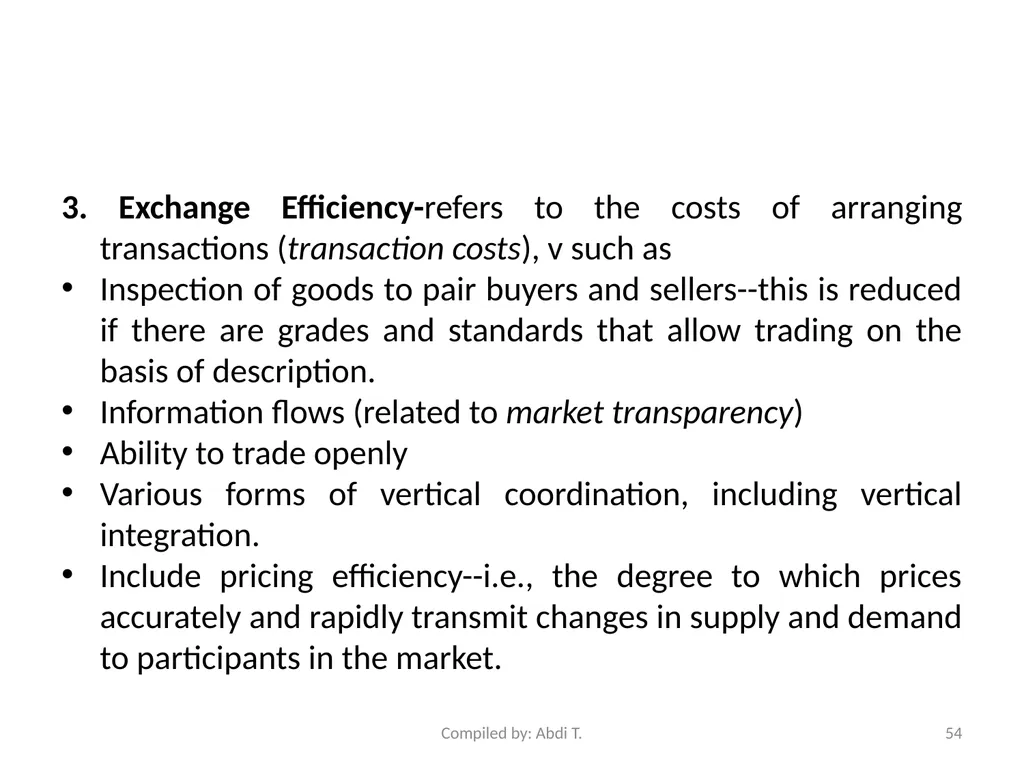
3. Exchange Efficiency-refers to the costs of arranging transactions (transaction costs), v such as
Inspection of goods to pair buyers and sellers--this is reduced if there are grades and standards that allow trading on the basis of description.
Information flows (related to market transparency)
Ability to trade openly
Various forms of vertical coordination, including vertical integration.
Include pricing efficiency--i.e., the degree to which prices accurately and rapidly transmit changes in supply and demand to participants in the market. Compiled by: Abdi T. 54<br>
Inspection of goods to pair buyers and sellers--this is reduced if there are grades and standards that allow trading on the basis of description.
Information flows (related to market transparency)
Ability to trade openly
Various forms of vertical coordination, including vertical integration.
Include pricing efficiency--i.e., the degree to which prices accurately and rapidly transmit changes in supply and demand to participants in the market. Compiled by: Abdi T. 54<br>
55
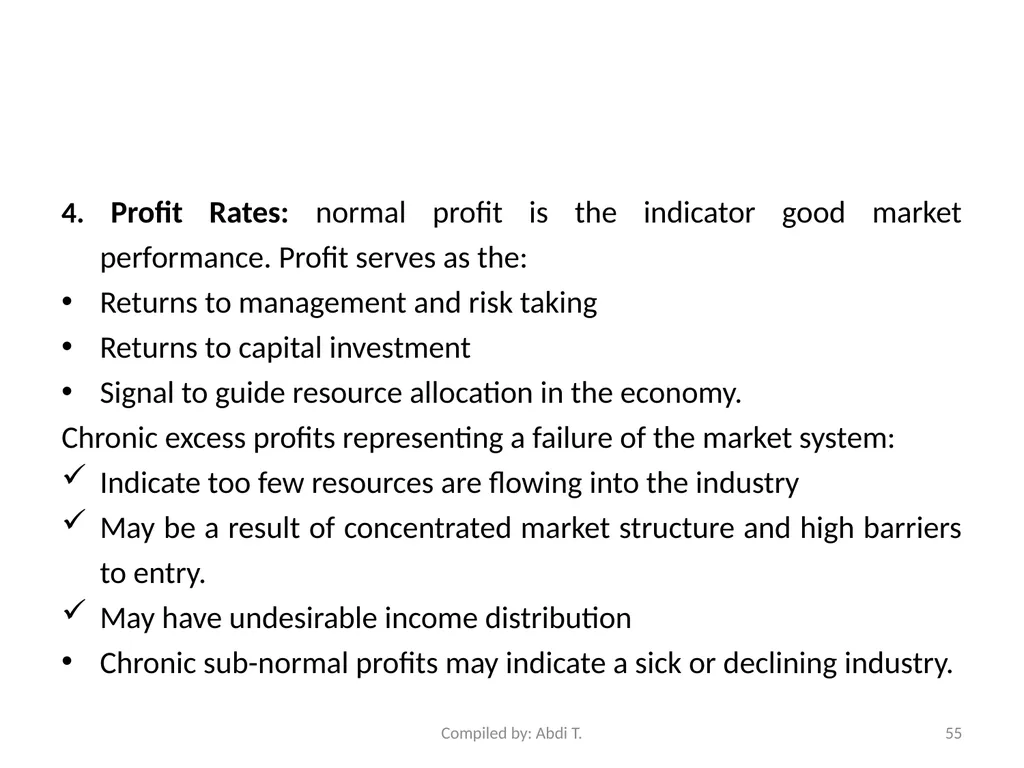
4. Profit Rates: normal profit is the indicator good market performance. Profit serves as the:
Returns to management and risk taking
Returns to capital investment
Signal to guide resource allocation in the economy.
Chronic excess profits representing a failure of the market system:
Indicate too few resources are flowing into the industry
May be a result of concentrated market structure and high barriers to entry.
May have undesirable income distribution
Chronic sub-normal profits may indicate a sick or declining industry. Compiled by: Abdi T. 55<br>
Returns to management and risk taking
Returns to capital investment
Signal to guide resource allocation in the economy.
Chronic excess profits representing a failure of the market system:
Indicate too few resources are flowing into the industry
May be a result of concentrated market structure and high barriers to entry.
May have undesirable income distribution
Chronic sub-normal profits may indicate a sick or declining industry. Compiled by: Abdi T. 55<br>
56
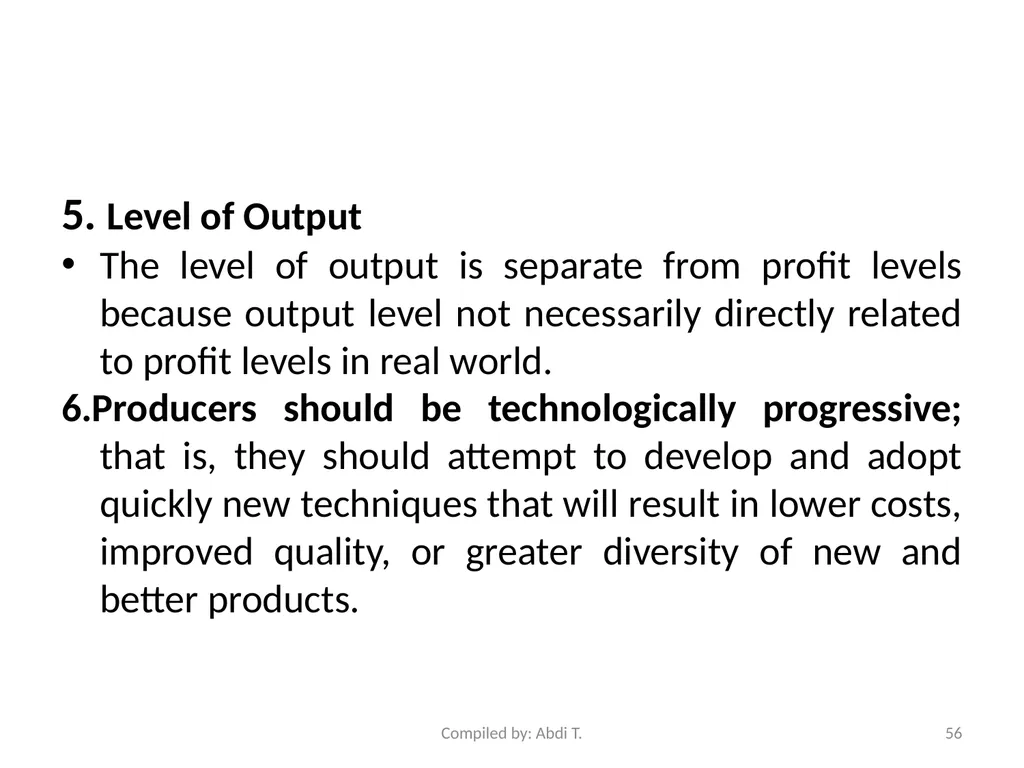
5. Level of Output
The level of output is separate from profit levels because output level not necessarily directly related to profit levels in real world.
6.Producers should be technologically progressive; that is, they should attempt to develop and adopt quickly new techniques that will result in lower costs, improved quality, or greater diversity of new and better products. Compiled by: Abdi T. 56<br>
The level of output is separate from profit levels because output level not necessarily directly related to profit levels in real world.
6.Producers should be technologically progressive; that is, they should attempt to develop and adopt quickly new techniques that will result in lower costs, improved quality, or greater diversity of new and better products. Compiled by: Abdi T. 56<br>
57
7. Product Suitability- involves matching products with consumer preferences.
The quality level of products should be neither too high nor too low relative to consumer desires. It is also related to progressiveness--designing new products and new handling methods to satisfy better changing consumer demands.
For example for Food industry
Freshness condition of food--food not deteriorated if consumers are willing to pay for the extra care to assure the freshness.
Safety of food products
Nutritional integrity of products Compiled by: Abdi T. 57<br>
The quality level of products should be neither too high nor too low relative to consumer desires. It is also related to progressiveness--designing new products and new handling methods to satisfy better changing consumer demands.
For example for Food industry
Freshness condition of food--food not deteriorated if consumers are willing to pay for the extra care to assure the freshness.
Safety of food products
Nutritional integrity of products Compiled by: Abdi T. 57<br>
58
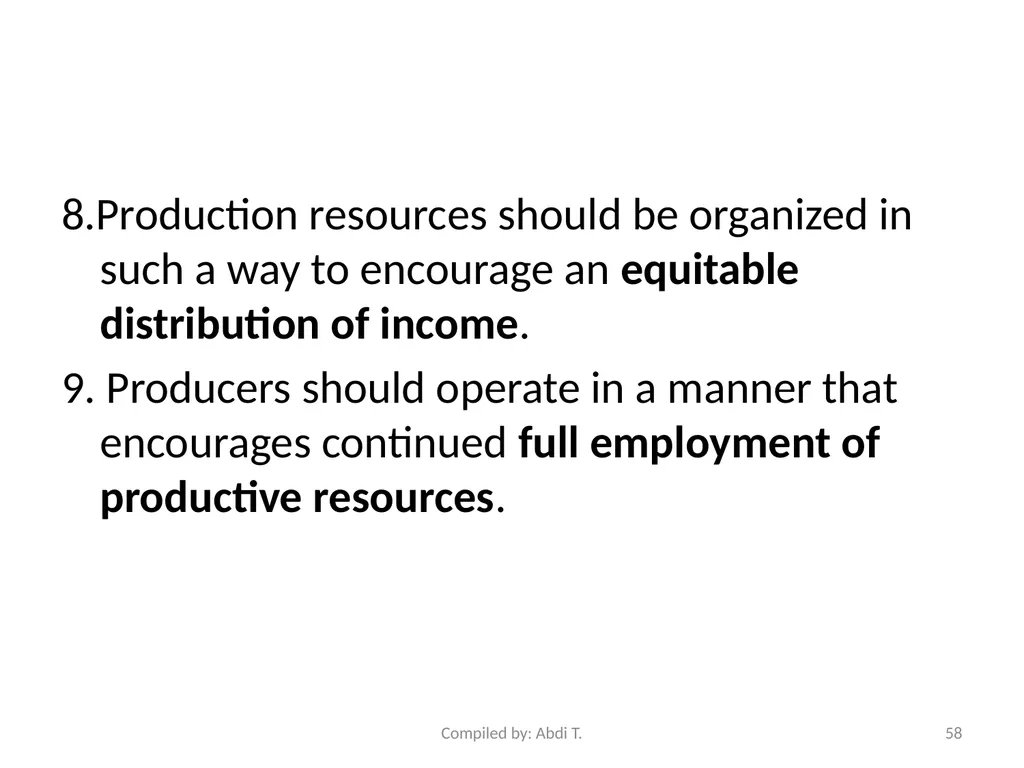
8.Production resources should be organized in such a way to encourage an equitable distribution of income.
9. Producers should operate in a manner that encourages continued full employment of productive resources. Compiled by: Abdi T. 58<br>
9. Producers should operate in a manner that encourages continued full employment of productive resources. Compiled by: Abdi T. 58<br>
59
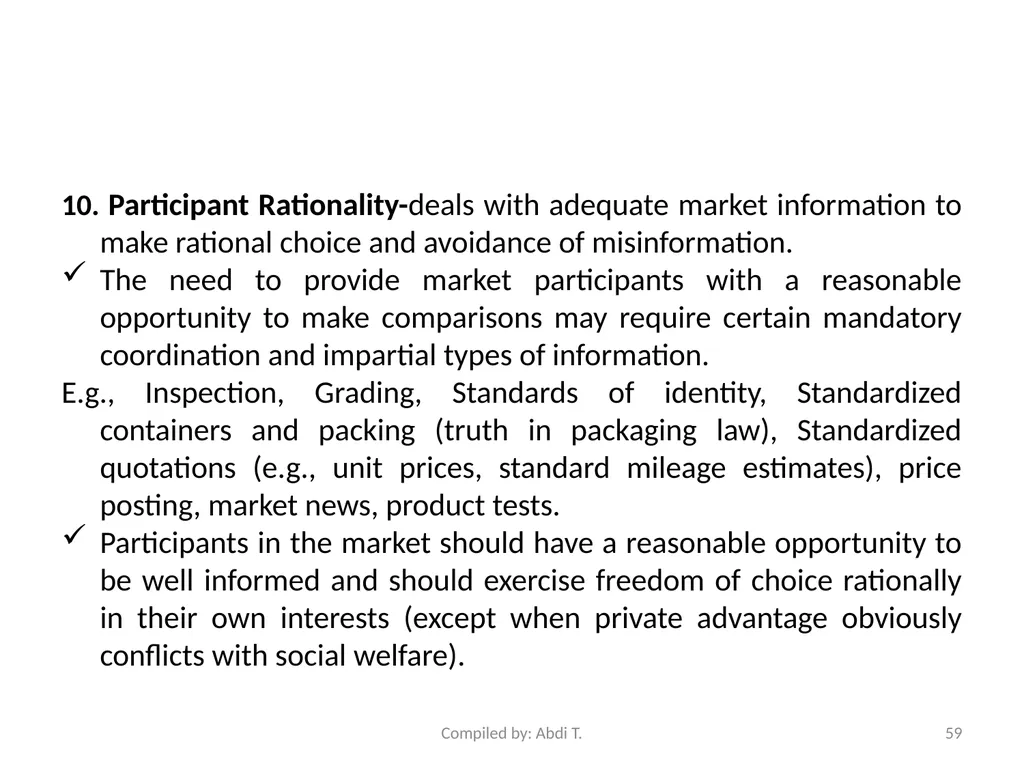
10. Participant Rationality-deals with adequate market information to make rational choice and avoidance of misinformation.
The need to provide market participants with a reasonable opportunity to make comparisons may require certain mandatory coordination and impartial types of information.
E.g., Inspection, Grading, Standards of identity, Standardized containers and packing (truth in packaging law), Standardized quotations (e.g., unit prices, standard mileage estimates), price posting, market news, product tests.
Participants in the market should have a reasonable opportunity to be well informed and should exercise freedom of choice rationally in their own interests (except when private advantage obviously conflicts with social welfare). Compiled by: Abdi T. 59<br>
The need to provide market participants with a reasonable opportunity to make comparisons may require certain mandatory coordination and impartial types of information.
E.g., Inspection, Grading, Standards of identity, Standardized containers and packing (truth in packaging law), Standardized quotations (e.g., unit prices, standard mileage estimates), price posting, market news, product tests.
Participants in the market should have a reasonable opportunity to be well informed and should exercise freedom of choice rationally in their own interests (except when private advantage obviously conflicts with social welfare). Compiled by: Abdi T. 59<br>
60
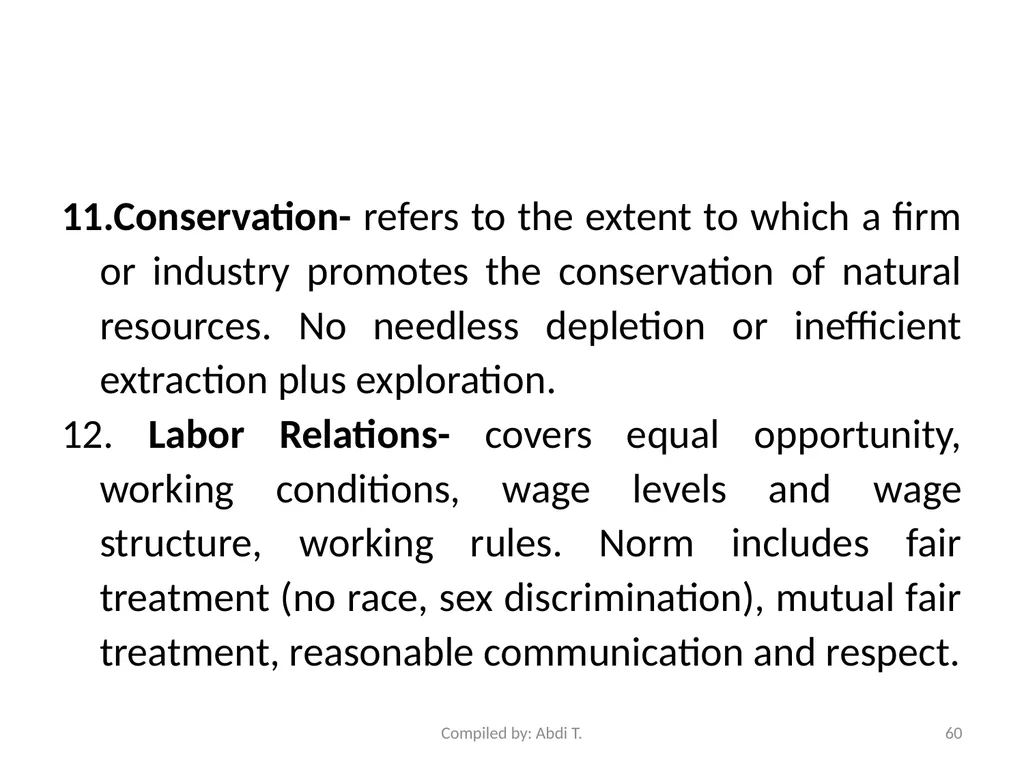
11.Conservation- refers to the extent to which a firm or industry promotes the conservation of natural resources. No needless depletion or inefficient extraction plus exploration.
12. Labor Relations- covers equal opportunity, working conditions, wage levels and wage structure, working rules. Norm includes fair treatment (no race, sex discrimination), mutual fair treatment, reasonable communication and respect. Compiled by: Abdi T. 60<br>
12. Labor Relations- covers equal opportunity, working conditions, wage levels and wage structure, working rules. Norm includes fair treatment (no race, sex discrimination), mutual fair treatment, reasonable communication and respect. Compiled by: Abdi T. 60<br>
61
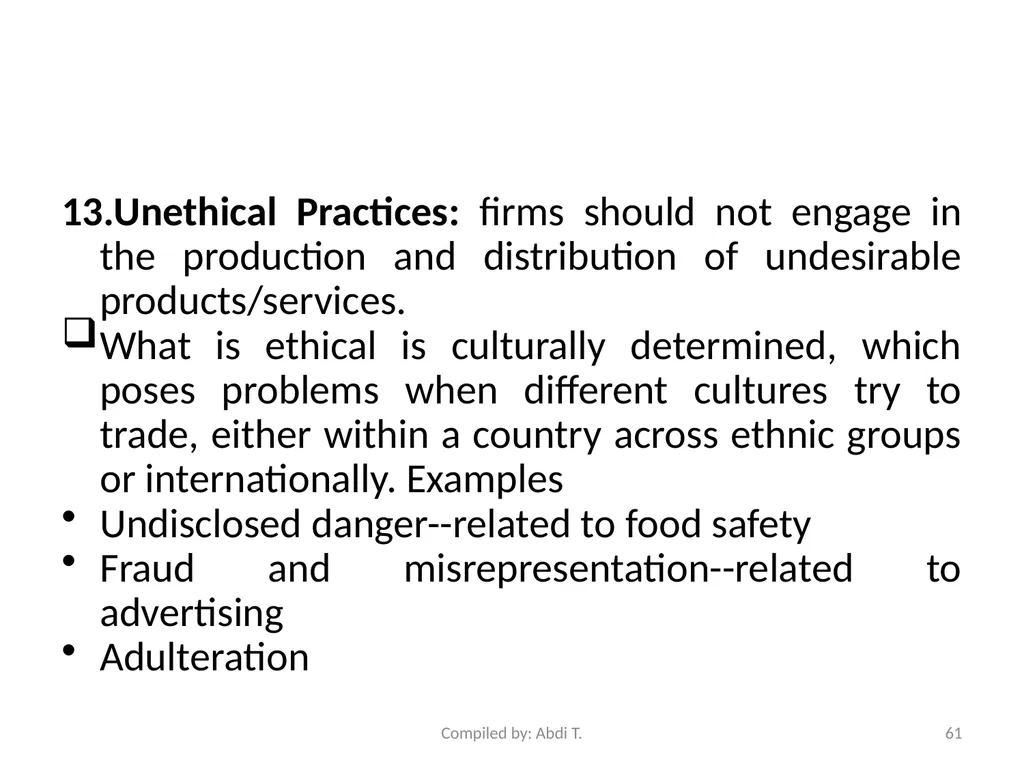
13.Unethical Practices: firms should not engage in the production and distribution of undesirable products/services.
What is ethical is culturally determined, which poses problems when different cultures try to trade, either within a country across ethnic groups or internationally. Examples
Undisclosed danger--related to food safety
Fraud and misrepresentation--related to advertising
Adulteration Compiled by: Abdi T. 61<br>
What is ethical is culturally determined, which poses problems when different cultures try to trade, either within a country across ethnic groups or internationally. Examples
Undisclosed danger--related to food safety
Fraud and misrepresentation--related to advertising
Adulteration Compiled by: Abdi T. 61<br>
62
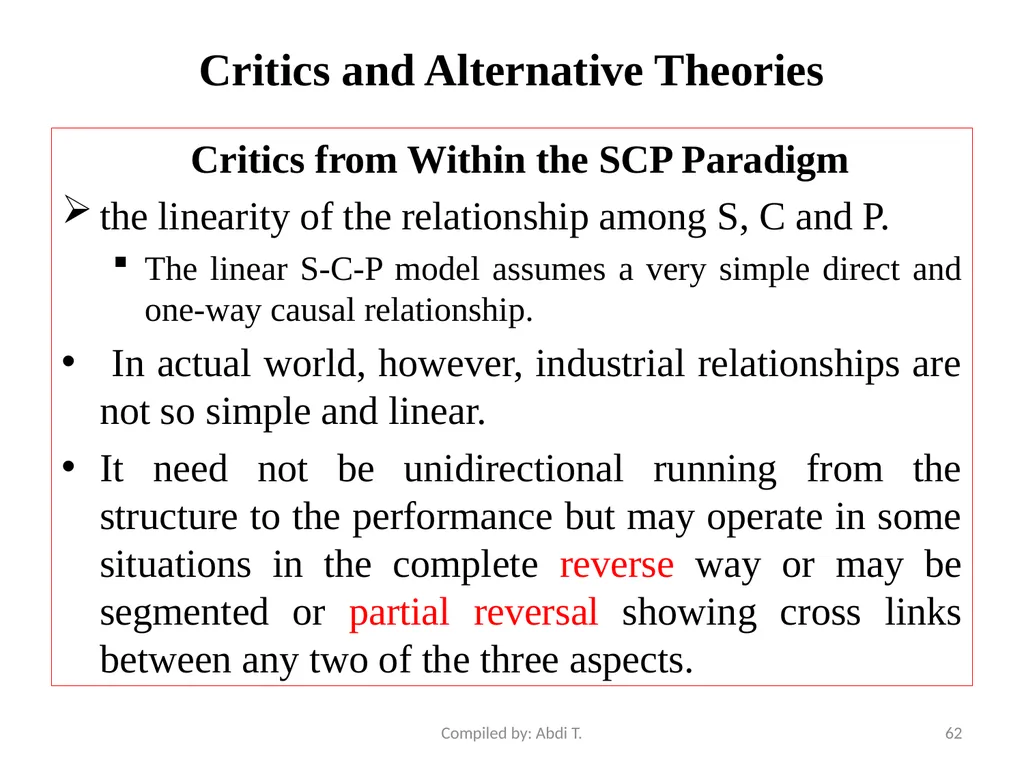
Critics and Alternative Theories Critics from Within the SCP Paradigm
the linearity of the relationship among S, C and P.
The linear S-C-P model assumes a very simple direct and one-way causal relationship.
In actual world, however, industrial relationships are not so simple and linear.
It need not be unidirectional running from the structure to the performance but may operate in some situations in the complete reverse way or may be segmented or partial reversal showing cross links between any two of the three aspects. 62 Compiled by: Abdi T.<br>
the linearity of the relationship among S, C and P.
The linear S-C-P model assumes a very simple direct and one-way causal relationship.
In actual world, however, industrial relationships are not so simple and linear.
It need not be unidirectional running from the structure to the performance but may operate in some situations in the complete reverse way or may be segmented or partial reversal showing cross links between any two of the three aspects. 62 Compiled by: Abdi T.<br>
63
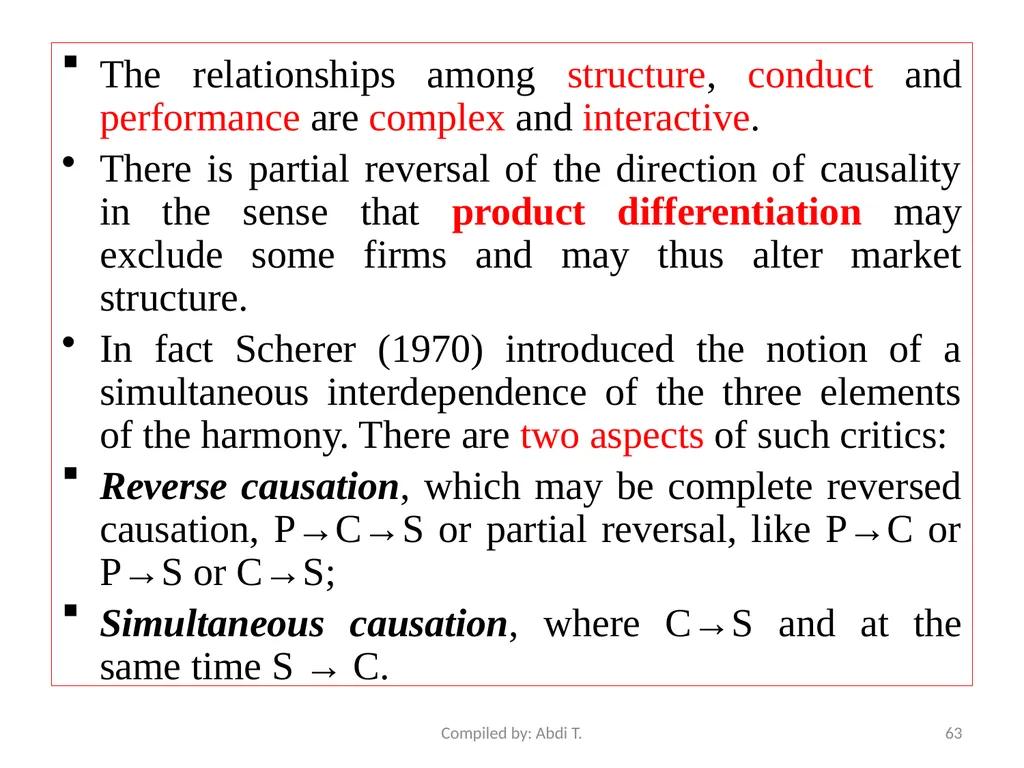
The relationships among structure, conduct and performance are complex and interactive.
There is partial reversal of the direction of causality in the sense that product differentiation may exclude some firms and may thus alter market structure.
In fact Scherer (1970) introduced the notion of a simultaneous interdependence of the three elements of the harmony. There are two aspects of such critics:
Reverse causation, which may be complete reversed causation, P→C→S or partial reversal, like P→C or P→S or C→S;
Simultaneous causation, where C→S and at the same time S → C. 63 Compiled by: Abdi T.<br>
There is partial reversal of the direction of causality in the sense that product differentiation may exclude some firms and may thus alter market structure.
In fact Scherer (1970) introduced the notion of a simultaneous interdependence of the three elements of the harmony. There are two aspects of such critics:
Reverse causation, which may be complete reversed causation, P→C→S or partial reversal, like P→C or P→S or C→S;
Simultaneous causation, where C→S and at the same time S → C. 63 Compiled by: Abdi T.<br>
64
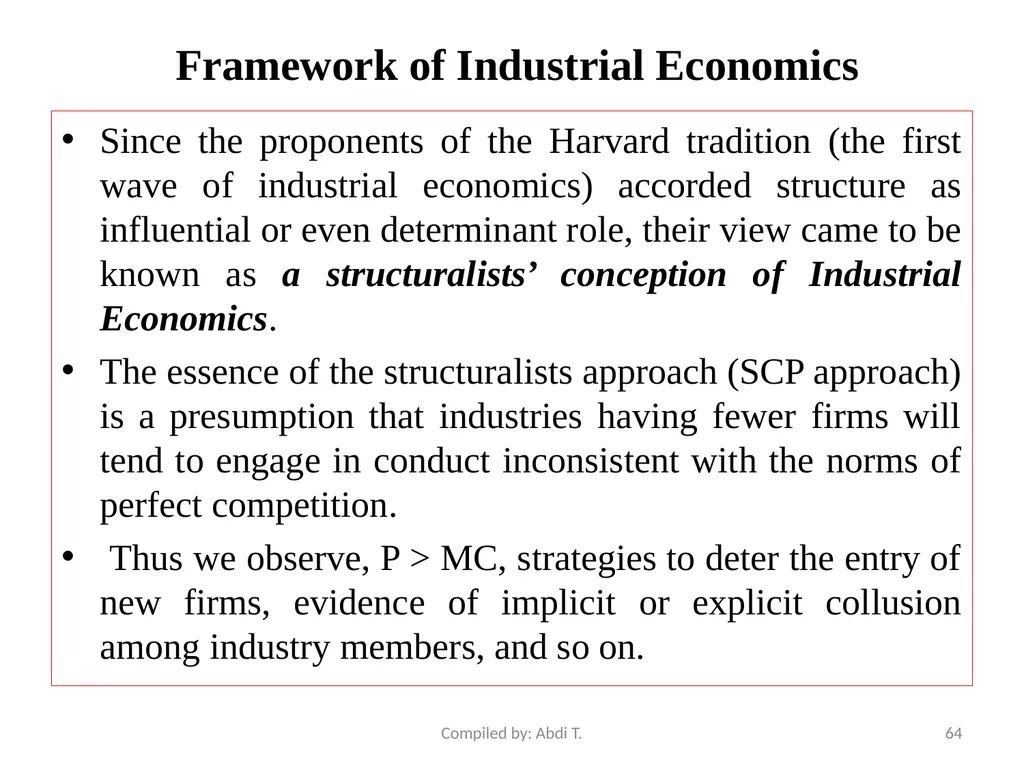
Framework of Industrial Economics Since the proponents of the Harvard tradition (the first wave of industrial economics) accorded structure as influential or even determinant role, their view came to be known as a structuralists’ conception of Industrial Economics.
The essence of the structuralists approach (SCP approach) is a presumption that industries having fewer firms will tend to engage in conduct inconsistent with the norms of perfect competition.
Thus we observe, P > MC, strategies to deter the entry of new firms, evidence of implicit or explicit collusion among industry members, and so on. 64 Compiled by: Abdi T.<br>
The essence of the structuralists approach (SCP approach) is a presumption that industries having fewer firms will tend to engage in conduct inconsistent with the norms of perfect competition.
Thus we observe, P > MC, strategies to deter the entry of new firms, evidence of implicit or explicit collusion among industry members, and so on. 64 Compiled by: Abdi T.<br>
65
65 Compiled by: Abdi T.<br>
66
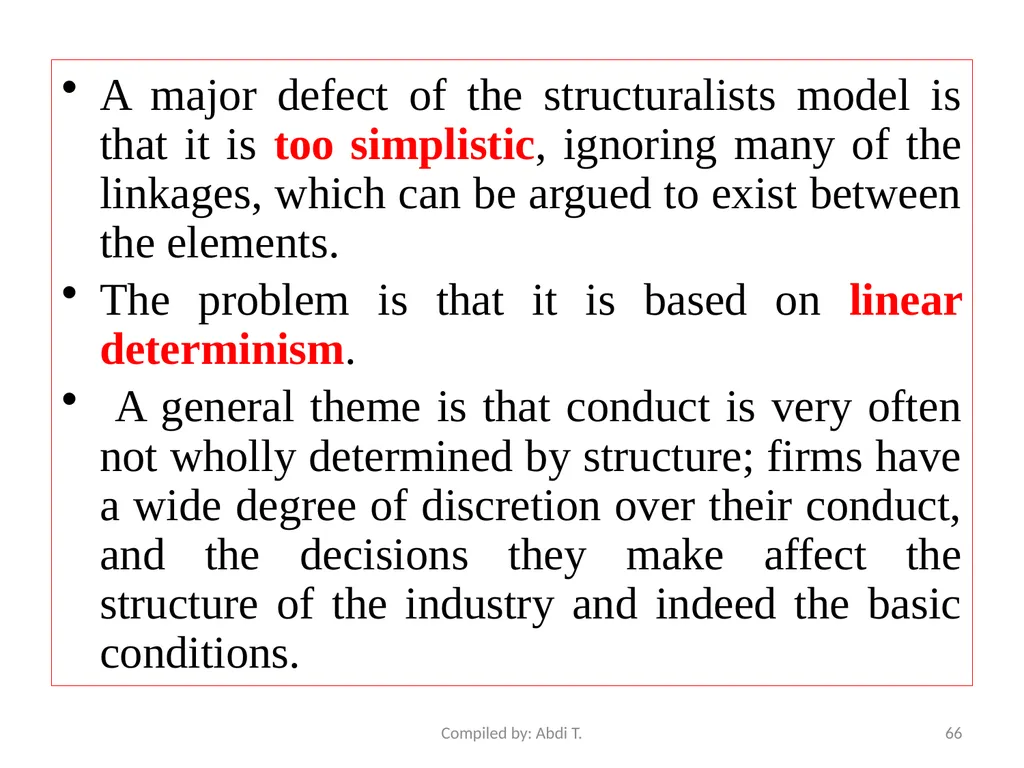
A major defect of the structuralists model is that it is too simplistic, ignoring many of the linkages, which can be argued to exist between the elements.
The problem is that it is based on linear determinism.
A general theme is that conduct is very often not wholly determined by structure; firms have a wide degree of discretion over their conduct, and the decisions they make affect the structure of the industry and indeed the basic conditions. 66 Compiled by: Abdi T.<br>
The problem is that it is based on linear determinism.
A general theme is that conduct is very often not wholly determined by structure; firms have a wide degree of discretion over their conduct, and the decisions they make affect the structure of the industry and indeed the basic conditions. 66 Compiled by: Abdi T.<br>
67
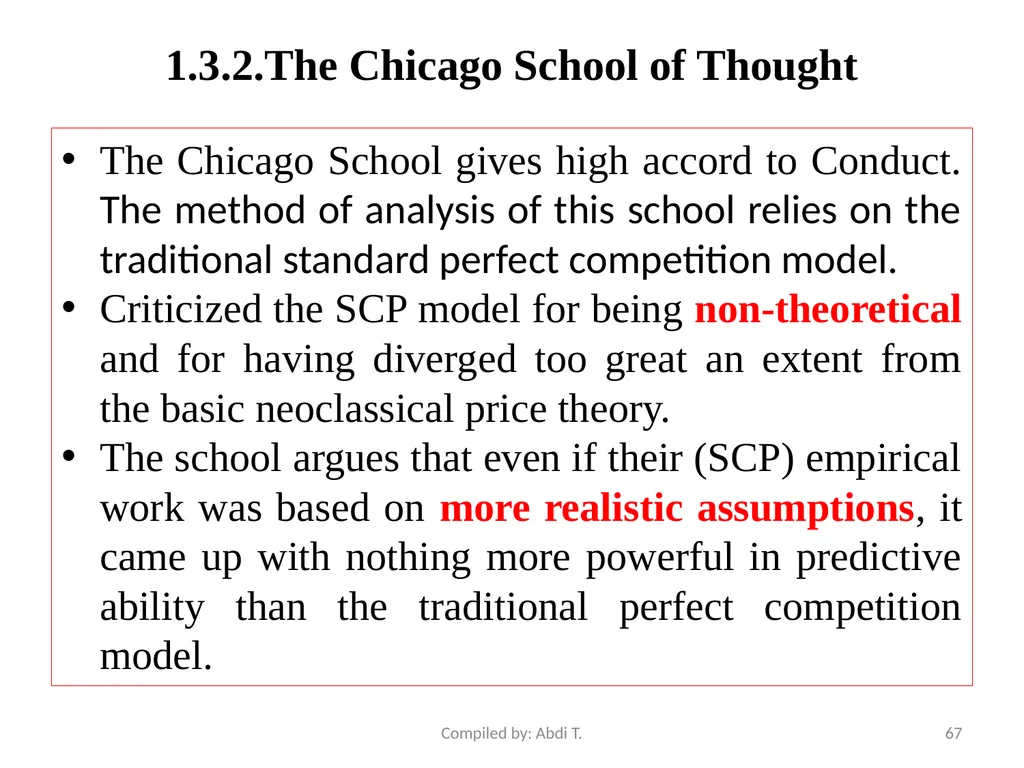
1.3.2.The Chicago School of Thought The Chicago School gives high accord to Conduct. The method of analysis of this school relies on the traditional standard perfect competition model.
Criticized the SCP model for being non-theoretical and for having diverged too great an extent from the basic neoclassical price theory.
The school argues that even if their (SCP) empirical work was based on more realistic assumptions, it came up with nothing more powerful in predictive ability than the traditional perfect competition model. 67 Compiled by: Abdi T.<br>
Criticized the SCP model for being non-theoretical and for having diverged too great an extent from the basic neoclassical price theory.
The school argues that even if their (SCP) empirical work was based on more realistic assumptions, it came up with nothing more powerful in predictive ability than the traditional perfect competition model. 67 Compiled by: Abdi T.<br>
68
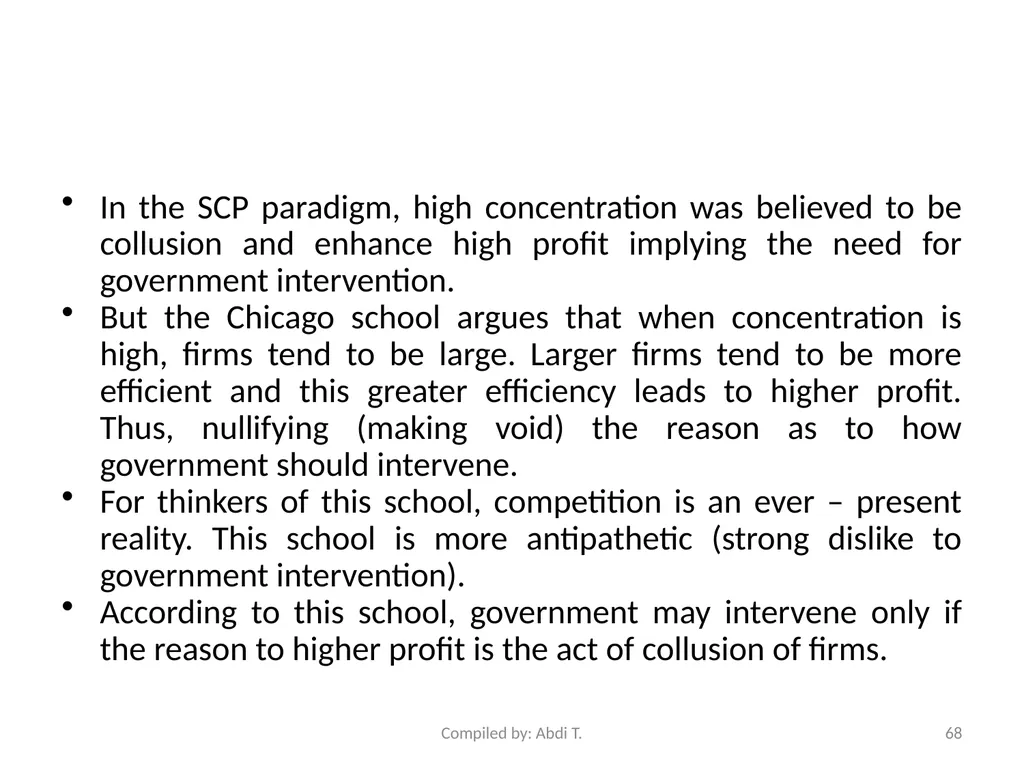
In the SCP paradigm, high concentration was believed to be collusion and enhance high profit implying the need for government intervention.
But the Chicago school argues that when concentration is high, firms tend to be large. Larger firms tend to be more efficient and this greater efficiency leads to higher profit. Thus, nullifying (making void) the reason as to how government should intervene.
For thinkers of this school, competition is an ever – present reality. This school is more antipathetic (strong dislike to government intervention).
According to this school, government may intervene only if the reason to higher profit is the act of collusion of firms. Compiled by: Abdi T. 68<br>
But the Chicago school argues that when concentration is high, firms tend to be large. Larger firms tend to be more efficient and this greater efficiency leads to higher profit. Thus, nullifying (making void) the reason as to how government should intervene.
For thinkers of this school, competition is an ever – present reality. This school is more antipathetic (strong dislike to government intervention).
According to this school, government may intervene only if the reason to higher profit is the act of collusion of firms. Compiled by: Abdi T. 68<br>
69
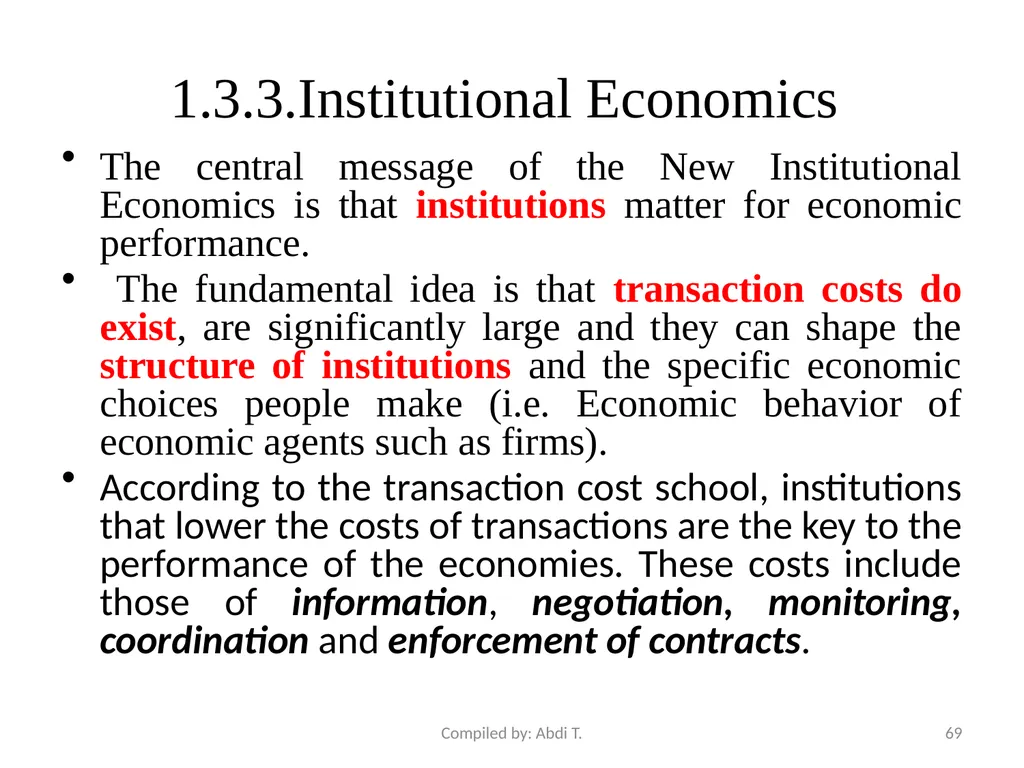
1.3.3.Institutional Economics The central message of the New Institutional Economics is that institutions matter for economic performance.
The fundamental idea is that transaction costs do exist, are significantly large and they can shape the structure of institutions and the specific economic choices people make (i.e. Economic behavior of economic agents such as firms).
According to the transaction cost school, institutions that lower the costs of transactions are the key to the performance of the economies. These costs include those of information, negotiation, monitoring, coordination and enforcement of contracts. 69 Compiled by: Abdi T.<br>
The fundamental idea is that transaction costs do exist, are significantly large and they can shape the structure of institutions and the specific economic choices people make (i.e. Economic behavior of economic agents such as firms).
According to the transaction cost school, institutions that lower the costs of transactions are the key to the performance of the economies. These costs include those of information, negotiation, monitoring, coordination and enforcement of contracts. 69 Compiled by: Abdi T.<br>
70
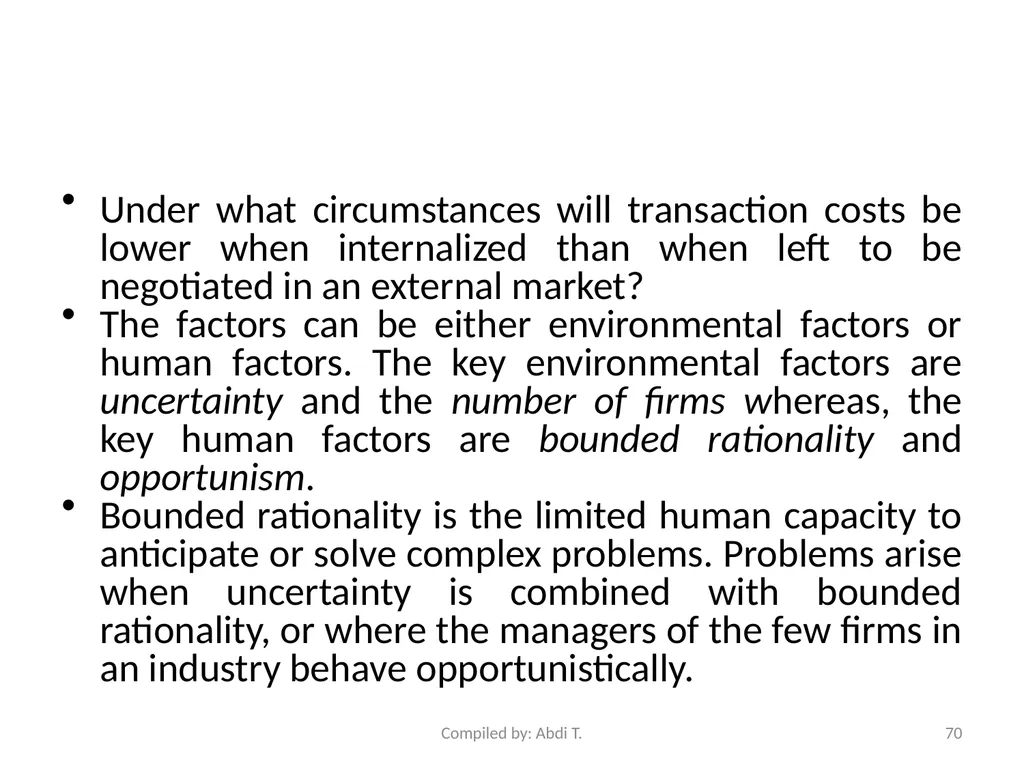
Under what circumstances will transaction costs be lower when internalized than when left to be negotiated in an external market?
The factors can be either environmental factors or human factors. The key environmental factors are uncertainty and the number of firms whereas, the key human factors are bounded rationality and opportunism.
Bounded rationality is the limited human capacity to anticipate or solve complex problems. Problems arise when uncertainty is combined with bounded rationality, or where the managers of the few firms in an industry behave opportunistically. Compiled by: Abdi T. 70<br>
The factors can be either environmental factors or human factors. The key environmental factors are uncertainty and the number of firms whereas, the key human factors are bounded rationality and opportunism.
Bounded rationality is the limited human capacity to anticipate or solve complex problems. Problems arise when uncertainty is combined with bounded rationality, or where the managers of the few firms in an industry behave opportunistically. Compiled by: Abdi T. 70<br>
71
Thank you for your stay @being committed!!!! 71 Compiled by: Abdi T.<br>