Characters Before you begin writing your play script, you will need to think about who your characters are. Play scripts usually begin with a list of characters and a little bit of information about each one. Here is an example of a
"Characters Before you begin writing your play" is the property of its rightful owner. Permission is granted to
download and print the materials on this website for personal, non-commercial use only, and to display it
on your personal computer provided you do not modify the materials and that you retain all copyright
notices contained in the materials. By downloading content from our website, you accept the terms of this
agreement.
Presentation Transcript
01
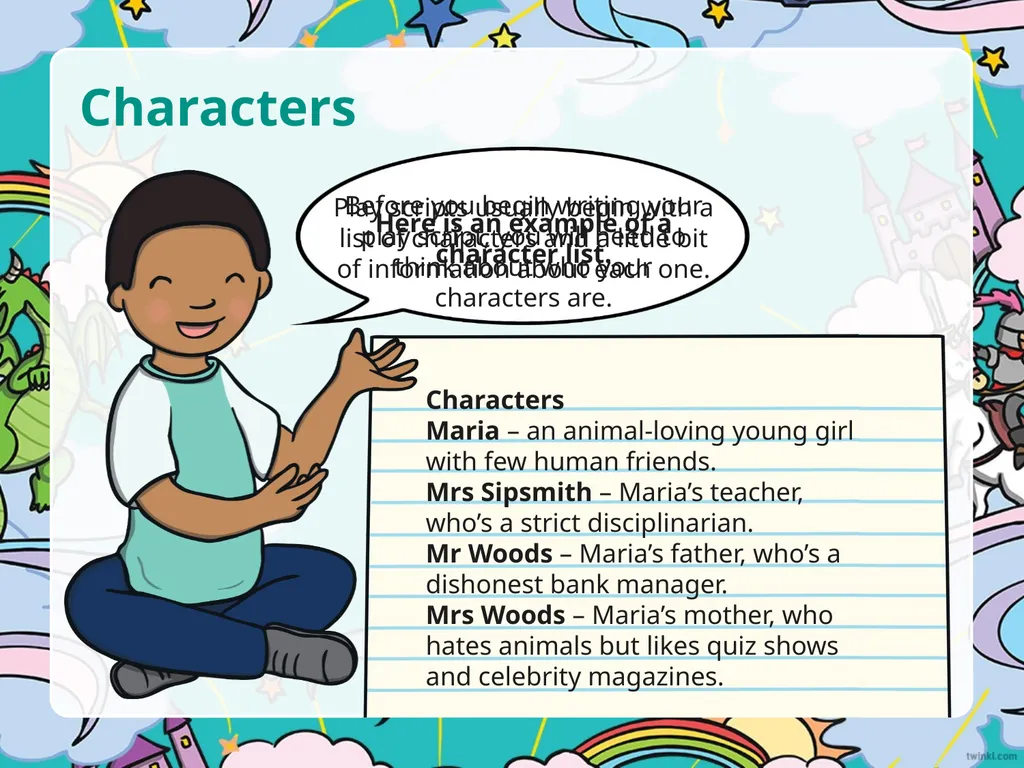
Characters Before you begin writing your play script, you will need to think about who your characters are. Play scripts usually begin with a list of characters and a little bit of information about each one. Here is an example of a character list. Characters
Maria – an animal-loving young girl with few human friends.
Mrs Sipsmith – Maria’s teacher, who’s a strict disciplinarian.
Mr Woods – Maria’s father, who’s a dishonest bank manager.
Mrs Woods – Maria’s mother, who hates animals but likes quiz shows and celebrity magazines.<br>
02
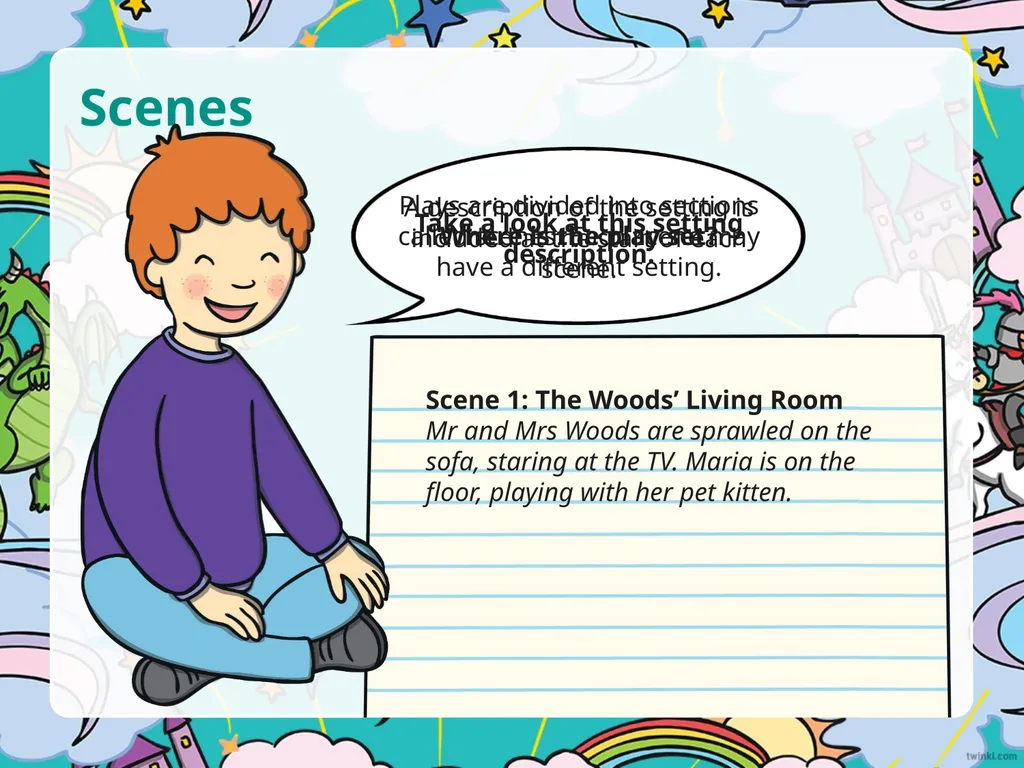
Scenes Scene 1: The Woods’ Living Room
Mr and Mrs Woods are sprawled on the sofa, staring at the TV. Maria is on the floor, playing with her pet kitten. Where is the play set? Plays are divided into sections called scenes. Each scene may have a different setting. A description of the setting is included at the start of each scene. Take a look at this setting description.<br>
03
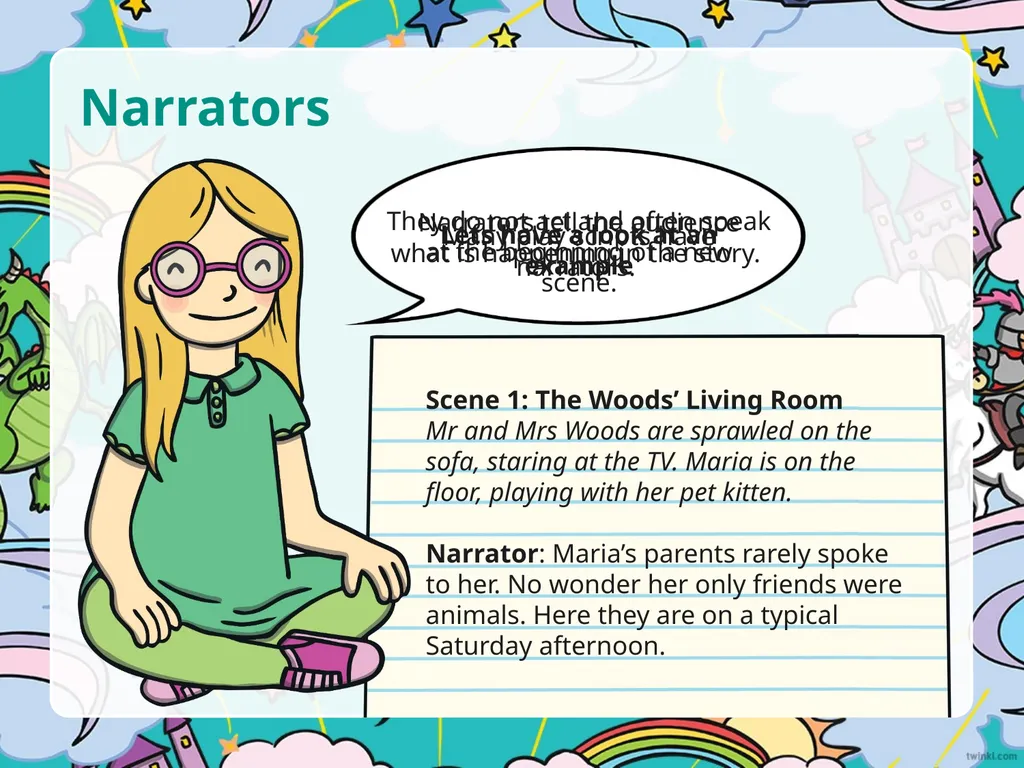
Narrators Scene 1: The Woods’ Living Room
Mr and Mrs Woods are sprawled on the sofa, staring at the TV. Maria is on the floor, playing with her pet kitten.
Narrator: Maria’s parents rarely spoke to her. No wonder her only friends were animals. Here they are on a typical Saturday afternoon. Many play scripts have narrators. Narrators tell the audience what is happening in the story. They do not act and often speak at the beginning of a new scene. Lets have a look at an example<br>
04
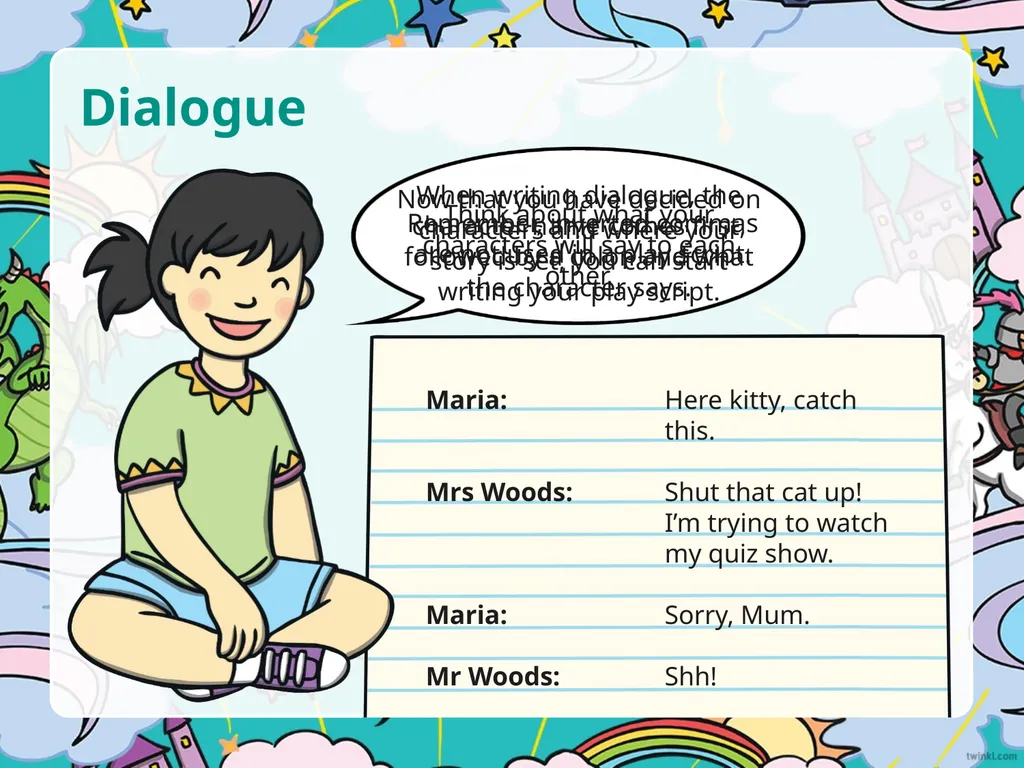
Dialogue Maria:
Mrs Woods:
Maria:
Mr Woods:
Here kitty, catch this.
Shut that cat up! I’m trying to watch my quiz show.
Sorry, Mum.
Shh! Now that you have decided on characters and where your story is set, you can start writing your play script. Think about what your characters will say to each other. When writing dialogue, the character name comes first, followed by a colon and what the character says. Remember, inverted commas are not used in a play script.<br>
05
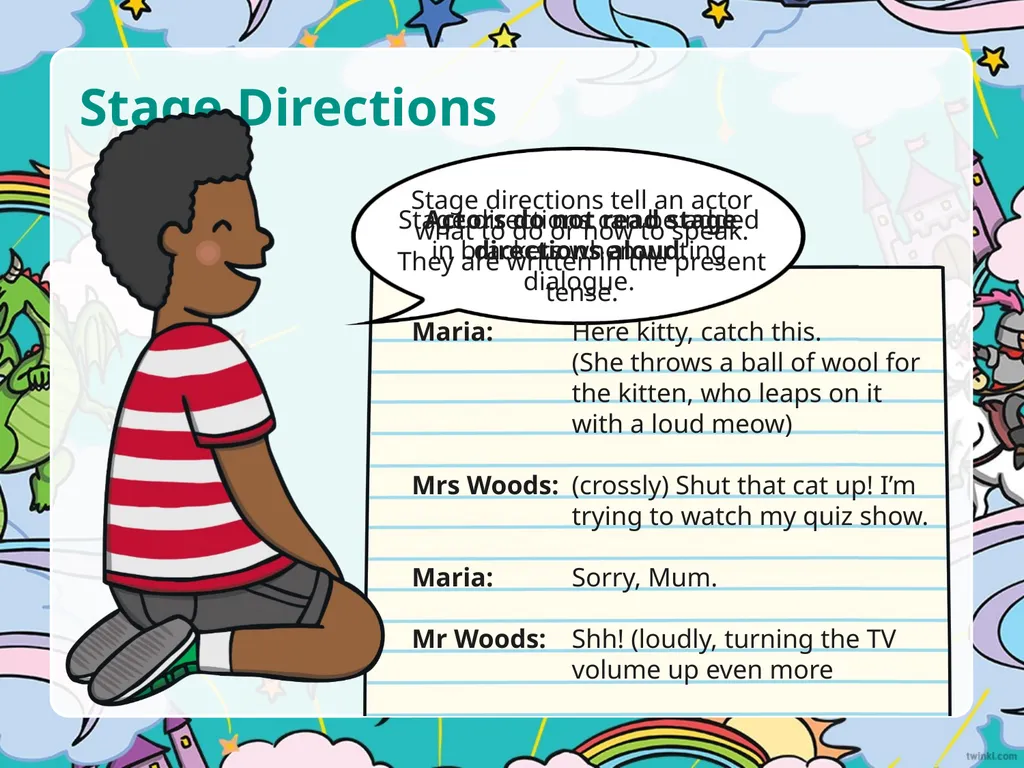
Stage Directions Maria:
Mrs Woods:
Maria:
Mr Woods: Stage directions can be added in brackets when writing dialogue. Stage directions tell an actor what to do or how to speak. They are written in the present tense. Actors do not read stage directions aloud. Here kitty, catch this.
(She throws a ball of wool for the kitten, who leaps on it with a loud meow)
(crossly) Shut that cat up! I’m trying to watch my quiz show.
Sorry, Mum.
Shh! (loudly, turning the TV volume up even more<br>
06
Writing Your Play Script Now you are ready to write your own play script.
Remember to include:
a list of the characters;
narrators (optional);
a scene description;
dialogue;
stage directions in brackets. Good luck or, as they say in the theatre, ‘break a leg!’<br>