
Cheating and Plagiarism in Higher Education:
EM
Published · 60 slides · 0 views
1 / 1
Description
Cheating and Plagiarism in Higher Education: Practical Guidance for How to Respond Lawfully An EducationAdminWebAdvisor Webinar Presented by: Dr. Jim Castagnera Managing Director KC Human Resource Enterprises 2 EducationAdminWebAdvisor
Related Topics
Share
Embed code
Download this presentation From Below
"Cheating and Plagiarism in Higher Education:" is the property of its rightful owner. Permission is granted to download and print the materials on this website for personal, non-commercial use only, and to display it on your personal computer provided you do not modify the materials and that you retain all copyright notices contained in the materials. By downloading content from our website, you accept the terms of this agreement.
Presentation Transcript
01
Cheating and Plagiarism
in Higher Education:
Practical Guidance for How to Respond
Lawfully An EducationAdminWebAdvisor Webinar
Presented by:
Dr. Jim Castagnera
Managing Director
K&C Human Resource Enterprises<br>
in Higher Education:
Practical Guidance for How to Respond
Lawfully An EducationAdminWebAdvisor Webinar
Presented by:
Dr. Jim Castagnera
Managing Director
K&C Human Resource Enterprises<br>
02
2 EducationAdminWebAdvisor Webinar: Cheating and Plagiarism in Higher Education Our webinars are designed to be accurate and authoritative, but we do
not provide legal, accounting, or similar professional services.
Customer remains solely responsible for compliance with all applicable
laws, regulations, and accounting standards. If legal, accounting, or
other expert advice is desired, Customer should retain the services of
an appropriate professional.
Photocopying, distributing or using these copyrighted materials
electronically without the copyright owner’s express written consent is
strictly prohibited. Consent is granted for the use of purchasers of
webinars and then solely for the use of registered attendees of the
webinars. No right or license is given to reproduce the materials in
any form or format or to place the materials in any format on any
website or blog or to otherwise republish it in any manner without the
express written permission of the copyright holder.<br>
not provide legal, accounting, or similar professional services.
Customer remains solely responsible for compliance with all applicable
laws, regulations, and accounting standards. If legal, accounting, or
other expert advice is desired, Customer should retain the services of
an appropriate professional.
Photocopying, distributing or using these copyrighted materials
electronically without the copyright owner’s express written consent is
strictly prohibited. Consent is granted for the use of purchasers of
webinars and then solely for the use of registered attendees of the
webinars. No right or license is given to reproduce the materials in
any form or format or to place the materials in any format on any
website or blog or to otherwise republish it in any manner without the
express written permission of the copyright holder.<br>
03
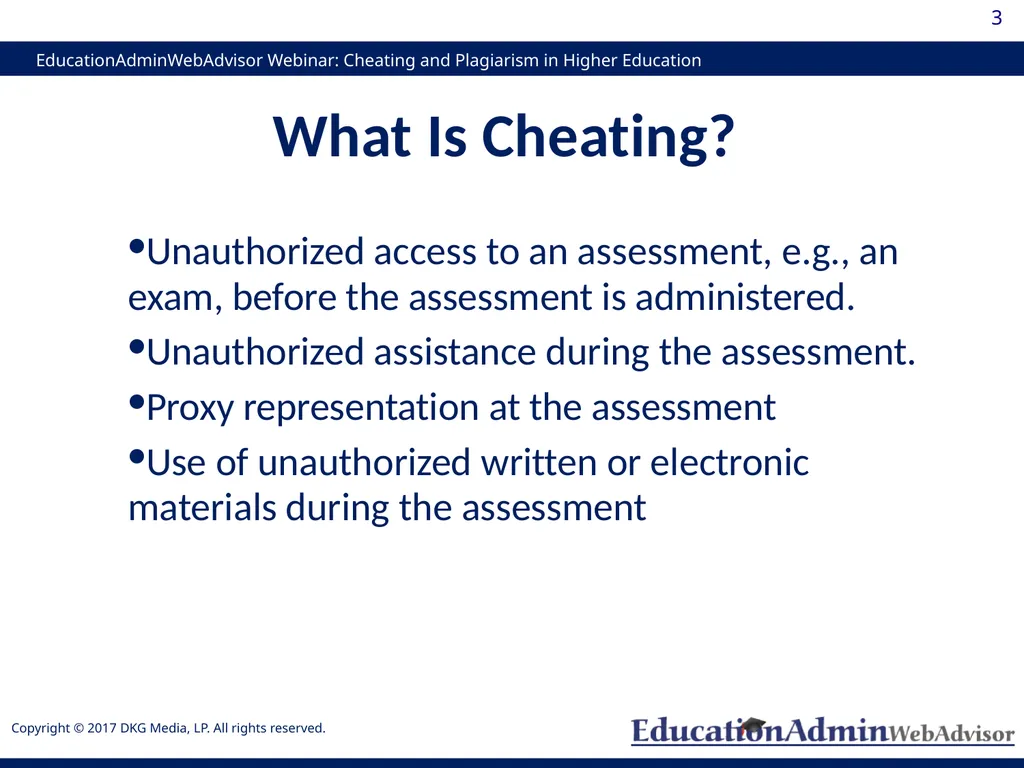
3 EducationAdminWebAdvisor Webinar: Cheating and Plagiarism in Higher Education What Is Cheating? Unauthorized access to an assessment, e.g., an
exam, before the assessment is administered.
Unauthorized assistance during the assessment.
Proxy representation at the assessment
Use of unauthorized written or electronic
materials during the assessment<br>
exam, before the assessment is administered.
Unauthorized assistance during the assessment.
Proxy representation at the assessment
Use of unauthorized written or electronic
materials during the assessment<br>
04
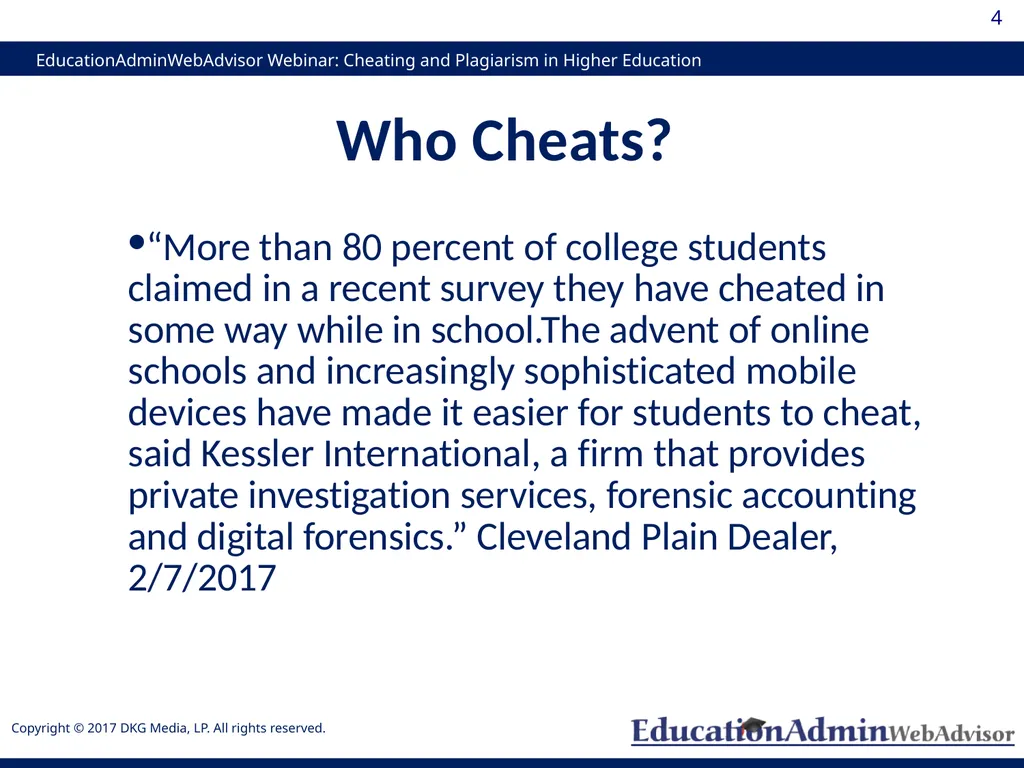
4 EducationAdminWebAdvisor Webinar: Cheating and Plagiarism in Higher Education Who Cheats? “More than 80 percent of college students
claimed in a recent survey they have cheated in
some way while in school.The advent of online
schools and increasingly sophisticated mobile
devices have made it easier for students to cheat,
said Kessler International, a firm that provides
private investigation services, forensic accounting
and digital forensics.” Cleveland Plain Dealer,
2/7/2017<br>
claimed in a recent survey they have cheated in
some way while in school.The advent of online
schools and increasingly sophisticated mobile
devices have made it easier for students to cheat,
said Kessler International, a firm that provides
private investigation services, forensic accounting
and digital forensics.” Cleveland Plain Dealer,
2/7/2017<br>
05
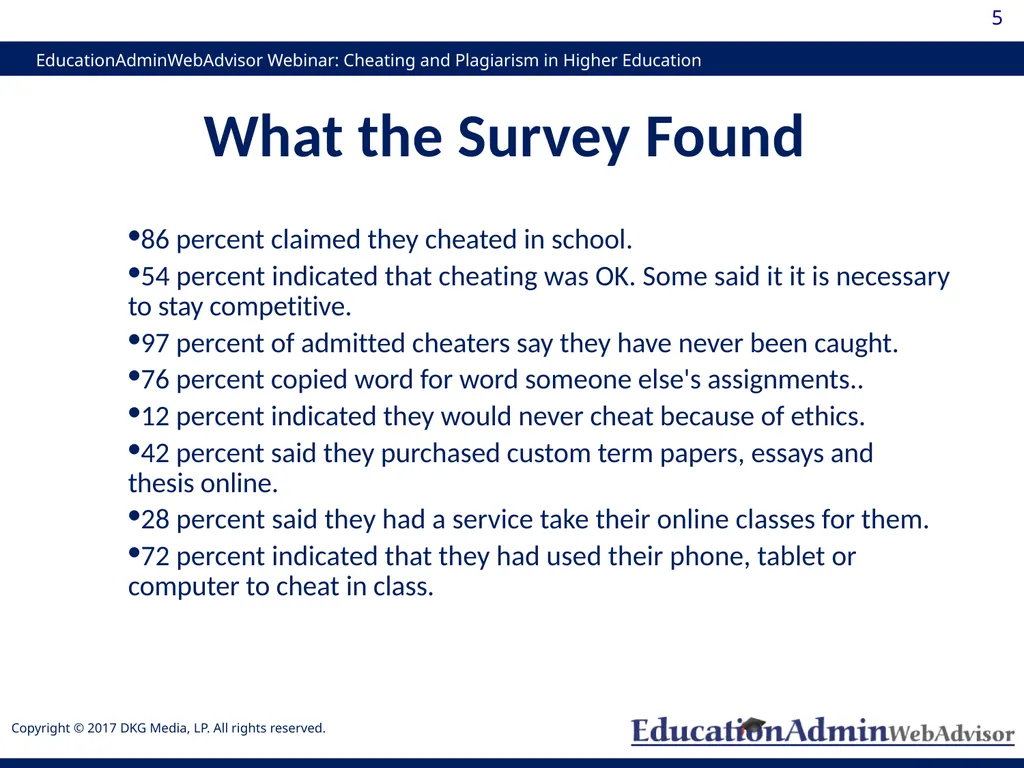
5 EducationAdminWebAdvisor Webinar: Cheating and Plagiarism in Higher Education What the Survey Found 86 percent claimed they cheated in school.
54 percent indicated that cheating was OK. Some said it it is necessary
to stay competitive.
97 percent of admitted cheaters say they have never been caught.
76 percent copied word for word someone else's assignments..
12 percent indicated they would never cheat because of ethics.
42 percent said they purchased custom term papers, essays and
thesis online.
28 percent said they had a service take their online classes for them.
72 percent indicated that they had used their phone, tablet or
computer to cheat in class.<br>
54 percent indicated that cheating was OK. Some said it it is necessary
to stay competitive.
97 percent of admitted cheaters say they have never been caught.
76 percent copied word for word someone else's assignments..
12 percent indicated they would never cheat because of ethics.
42 percent said they purchased custom term papers, essays and
thesis online.
28 percent said they had a service take their online classes for them.
72 percent indicated that they had used their phone, tablet or
computer to cheat in class.<br>
06
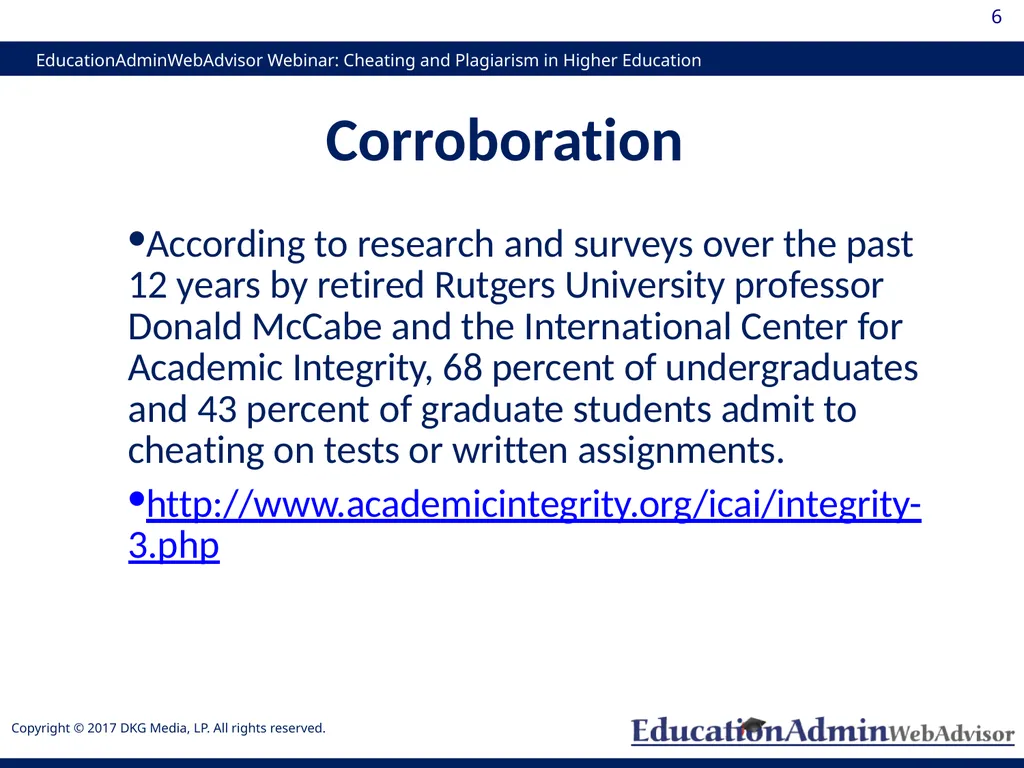
6 EducationAdminWebAdvisor Webinar: Cheating and Plagiarism in Higher Education Corroboration According to research and surveys over the past
12 years by retired Rutgers University professor
Donald McCabe and the International Center for
Academic Integrity, 68 percent of undergraduates
and 43 percent of graduate students admit to
cheating on tests or written assignments.
http://www.academicintegrity.org/icai/integrity-
3.php<br>
12 years by retired Rutgers University professor
Donald McCabe and the International Center for
Academic Integrity, 68 percent of undergraduates
and 43 percent of graduate students admit to
cheating on tests or written assignments.
http://www.academicintegrity.org/icai/integrity-
3.php<br>
07
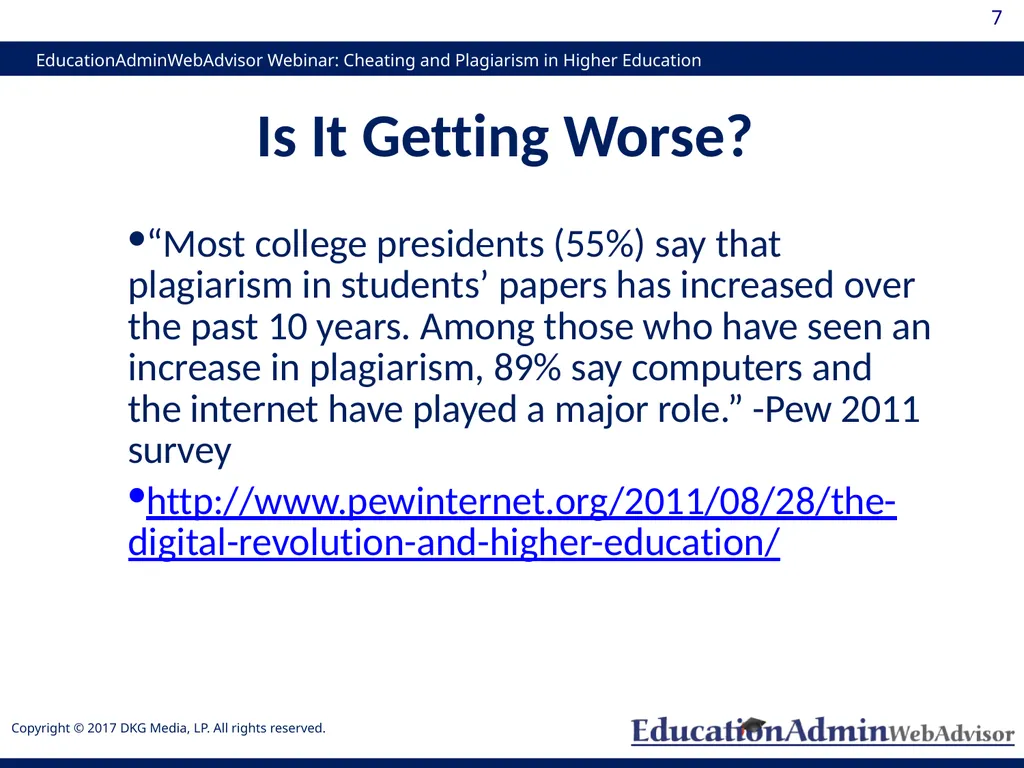
7 EducationAdminWebAdvisor Webinar: Cheating and Plagiarism in Higher Education Is It Getting Worse? “Most college presidents (55%) say that
plagiarism in students’ papers has increased over
the past 10 years. Among those who have seen an
increase in plagiarism, 89% say computers and
the internet have played a major role.” -Pew 2011
survey
http://www.pewinternet.org/2011/08/28/the-
digital-revolution-and-higher-education/<br>
plagiarism in students’ papers has increased over
the past 10 years. Among those who have seen an
increase in plagiarism, 89% say computers and
the internet have played a major role.” -Pew 2011
survey
http://www.pewinternet.org/2011/08/28/the-
digital-revolution-and-higher-education/<br>
08
8 EducationAdminWebAdvisor Webinar: Cheating and Plagiarism in Higher Education Who Cheats? “We are a generation of cheaters. We are constantly looking for the most
efficient, least stressful way to handle anything that’s put in front of us. When
we cheat on an exam, we don’t just want a B, we want an A even though the
test looks like it’s in another language. Sure, you can call us lazy or a group of
people that doesn’t care about the future but we just like to call it
improvising.Let’s all be very honest with ourselves. We all cheat to get our
way to the top or to even survive in this dog-eat-dog world. Through middle
school and into high school, every student has cheated to excel academically.
If everyone took every test with no help from an external source, we would
be looked at as the dumbest generation known to man.” --- “Cheating Has
Become a Culture in College,” Elite Daily,accessed at
http://elitedaily.com/news/world/cheating-culture-college/<br>
efficient, least stressful way to handle anything that’s put in front of us. When
we cheat on an exam, we don’t just want a B, we want an A even though the
test looks like it’s in another language. Sure, you can call us lazy or a group of
people that doesn’t care about the future but we just like to call it
improvising.Let’s all be very honest with ourselves. We all cheat to get our
way to the top or to even survive in this dog-eat-dog world. Through middle
school and into high school, every student has cheated to excel academically.
If everyone took every test with no help from an external source, we would
be looked at as the dumbest generation known to man.” --- “Cheating Has
Become a Culture in College,” Elite Daily,accessed at
http://elitedaily.com/news/world/cheating-culture-college/<br>
09
9 EducationAdminWebAdvisor Webinar: Cheating and Plagiarism in Higher Education Students at Elite Schools
Cheat “Stanford University's honor code dates to 1921, written by students
to help guide them through the minefield of plagiarism, forbidden
collaboration, copying and other chicaneries that have tempted
undergraduates since they first arrived on college campuses.
“But there appears to have been a massive breakdown during the
recent winter quarter, culminating in ‘an unusually high number of
troubling allegations of academic dishonesty reported to officials,
according to a letter to faculty from Provost John Etchemendy.”
L.A. Times, April 16, 2015<br>
Cheat “Stanford University's honor code dates to 1921, written by students
to help guide them through the minefield of plagiarism, forbidden
collaboration, copying and other chicaneries that have tempted
undergraduates since they first arrived on college campuses.
“But there appears to have been a massive breakdown during the
recent winter quarter, culminating in ‘an unusually high number of
troubling allegations of academic dishonesty reported to officials,
according to a letter to faculty from Provost John Etchemendy.”
L.A. Times, April 16, 2015<br>
10
10 EducationAdminWebAdvisor Webinar: Cheating and Plagiarism in Higher Education Students at Public
Universities Cheat “In February, officials at the Ohio State University College of
Veterinary Medicine, which is ranked fifth in the country by U.S. News
and World Report, investigated allegations that students were sharing
answers for online take-home tests. Officials were able to determine
whether students had collaborated on the online exams by looking at
patterns of right and wrong answers, and looked to see how long it
took them to complete the exams. Because of federal student-privacy
laws, university officials would not disclose which classes were
involved or the specific punishments.”
The Atlantic, June 7, 2016<br>
Universities Cheat “In February, officials at the Ohio State University College of
Veterinary Medicine, which is ranked fifth in the country by U.S. News
and World Report, investigated allegations that students were sharing
answers for online take-home tests. Officials were able to determine
whether students had collaborated on the online exams by looking at
patterns of right and wrong answers, and looked to see how long it
took them to complete the exams. Because of federal student-privacy
laws, university officials would not disclose which classes were
involved or the specific punishments.”
The Atlantic, June 7, 2016<br>
11
11 EducationAdminWebAdvisor Webinar: Cheating and Plagiarism in Higher Education Even Some Colleges and
Universities Cheat! “A former football player at the University of North Carolina at Chapel
Hill has filed a federal lawsuit against the university, saying it failed to
provide him and other athletes with a quality education by steering
them toward sham classes that never met and had no instruction, the
Associated Press reports.” ---
Charles Huckabee, Chronicle of Higher Education, November 10,
2014, accessed at http://chronicle.com/blogs/ticker/former-football-
player-sues-u-of-north-carolina-over-sham-courses/89299<br>
Universities Cheat! “A former football player at the University of North Carolina at Chapel
Hill has filed a federal lawsuit against the university, saying it failed to
provide him and other athletes with a quality education by steering
them toward sham classes that never met and had no instruction, the
Associated Press reports.” ---
Charles Huckabee, Chronicle of Higher Education, November 10,
2014, accessed at http://chronicle.com/blogs/ticker/former-football-
player-sues-u-of-north-carolina-over-sham-courses/89299<br>
12
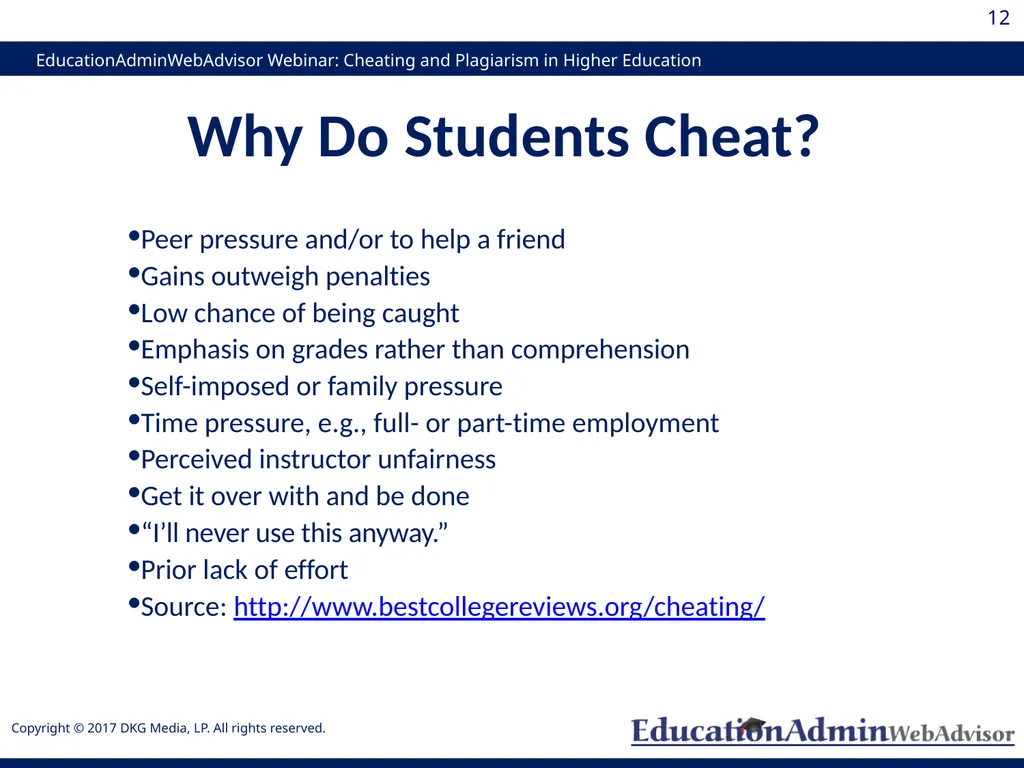
12 EducationAdminWebAdvisor Webinar: Cheating and Plagiarism in Higher Education Why Do Students Cheat? Peer pressure and/or to help a friend
Gains outweigh penalties
Low chance of being caught
Emphasis on grades rather than comprehension
Self-imposed or family pressure
Time pressure, e.g., full- or part-time employment
Perceived instructor unfairness
Get it over with and be done
“I’ll never use this anyway.”
Prior lack of effort
Source: http://www.bestcollegereviews.org/cheating/<br>
Gains outweigh penalties
Low chance of being caught
Emphasis on grades rather than comprehension
Self-imposed or family pressure
Time pressure, e.g., full- or part-time employment
Perceived instructor unfairness
Get it over with and be done
“I’ll never use this anyway.”
Prior lack of effort
Source: http://www.bestcollegereviews.org/cheating/<br>
13
13 EducationAdminWebAdvisor Webinar: Cheating and Plagiarism in Higher Education How Do Students Cheat? “Whether you are simply unprepared, lazy, or
otherwise unable to successfully pass an
exam, you may feel compelled to use
cheating as a strategy to get through a test.
Here are some steps and tips to help you
accomplish your goal.”
WikiHow to do anything,
http://www.wikihow.com/Cheat-On-a-Test<br>
otherwise unable to successfully pass an
exam, you may feel compelled to use
cheating as a strategy to get through a test.
Here are some steps and tips to help you
accomplish your goal.”
WikiHow to do anything,
http://www.wikihow.com/Cheat-On-a-Test<br>
14
14 EducationAdminWebAdvisor Webinar: Cheating and Plagiarism in Higher Education WikiHow (Continued) Cheat Sheets:
The body-parts cheat sheet
The water-bottle cheat sheet
The “stashed” cheat sheet: “Hide a cheat-sheet
in a separate place all together to avoid it
getting connected back to you. This includes
on a bulletin board in the classroom, in a
bathroom stall or on someone's chair.”<br>
The body-parts cheat sheet
The water-bottle cheat sheet
The “stashed” cheat sheet: “Hide a cheat-sheet
in a separate place all together to avoid it
getting connected back to you. This includes
on a bulletin board in the classroom, in a
bathroom stall or on someone's chair.”<br>
15
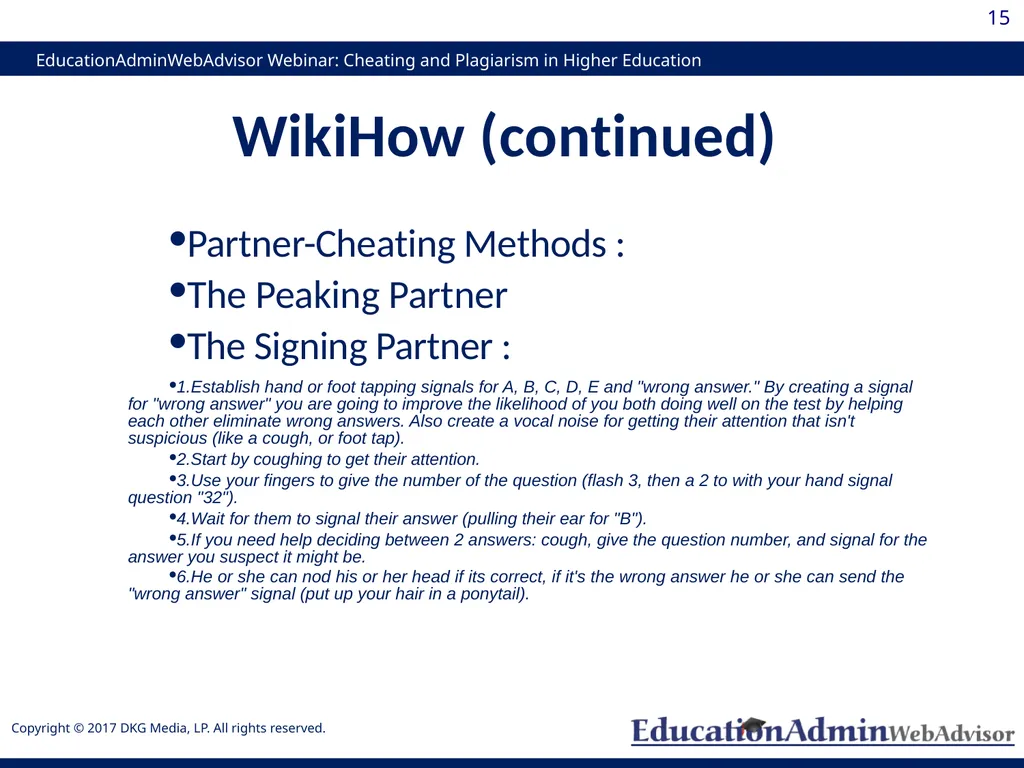
15 EducationAdminWebAdvisor Webinar: Cheating and Plagiarism in Higher Education WikiHow (continued) Partner-Cheating Methods :
The Peaking Partner
The Signing Partner : 1.Establish hand or foot tapping signals for A, B, C, D, E and "wrong answer." By creating a signal for "wrong answer" you are going to improve the likelihood of you both doing well on the test by helping each other eliminate wrong answers. Also create a vocal noise for getting their attention that isn't suspicious (like a cough, or foot tap).
2.Start by coughing to get their attention.
3.Use your fingers to give the number of the question (flash 3, then a 2 to with your hand signal question "32").
4.Wait for them to signal their answer (pulling their ear for "B").
5.If you need help deciding between 2 answers: cough, give the question number, and signal for the answer you suspect it might be.
6.He or she can nod his or her head if its correct, if it's the wrong answer he or she can send the "wrong answer" signal (put up your hair in a ponytail).<br>
The Peaking Partner
The Signing Partner : 1.Establish hand or foot tapping signals for A, B, C, D, E and "wrong answer." By creating a signal for "wrong answer" you are going to improve the likelihood of you both doing well on the test by helping each other eliminate wrong answers. Also create a vocal noise for getting their attention that isn't suspicious (like a cough, or foot tap).
2.Start by coughing to get their attention.
3.Use your fingers to give the number of the question (flash 3, then a 2 to with your hand signal question "32").
4.Wait for them to signal their answer (pulling their ear for "B").
5.If you need help deciding between 2 answers: cough, give the question number, and signal for the answer you suspect it might be.
6.He or she can nod his or her head if its correct, if it's the wrong answer he or she can send the "wrong answer" signal (put up your hair in a ponytail).<br>
16
16 EducationAdminWebAdvisor Webinar: Cheating and Plagiarism in Higher Education Assigned Seats? A study by Dr. Steven Levitt, author of
“Freakonomics,” indicates that use of a
seating chart to randomly distribute
students will reduce copying.
See: Chronicle of Higher Education, October
14, 2015.<br>
“Freakonomics,” indicates that use of a
seating chart to randomly distribute
students will reduce copying.
See: Chronicle of Higher Education, October
14, 2015.<br>
17
17 EducationAdminWebAdvisor Webinar: Cheating and Plagiarism in Higher Education Cheating in the Age of the
Cell Phone “Cell phones are nearly ubiquitous among the student population.
According to a 2013 report by PewResearch, 78% of teens own a cell
phone, and 47% of those devices are smartphones. The percentage of
teenage smartphone owners is also rising. In 2011 only 23% of teens
owned a smartphone, in 2013 that number rose to 37%. The report
found 74% of respondents aged 12-17 used the Internet on mobile
devices at least occasionally.” ---Scott Schober, Linked-In, 4/23/2015
https://www.linkedin.com/pulse/cell-phones-students-temptation-
cheat-scott-schober<br>
Cell Phone “Cell phones are nearly ubiquitous among the student population.
According to a 2013 report by PewResearch, 78% of teens own a cell
phone, and 47% of those devices are smartphones. The percentage of
teenage smartphone owners is also rising. In 2011 only 23% of teens
owned a smartphone, in 2013 that number rose to 37%. The report
found 74% of respondents aged 12-17 used the Internet on mobile
devices at least occasionally.” ---Scott Schober, Linked-In, 4/23/2015
https://www.linkedin.com/pulse/cell-phones-students-temptation-
cheat-scott-schober<br>
18
18 EducationAdminWebAdvisor Webinar: Cheating and Plagiarism in Higher Education Cheating in the Age of the
Cell Phone
“While some schools have attempted to cope by
de-emphasizing test results and placing more
emphasis on learning, testing is still an important
part of student evaluation. Even tests most
students find easy present a temptation to cheat.
In 2012, 69 students were disciplined at the
prestigious Stuyvesant High School in NYC for
using cell phones to cheat on subjects that almost
every student in the school passes.” - Ibid.<br>
Cell Phone
“While some schools have attempted to cope by
de-emphasizing test results and placing more
emphasis on learning, testing is still an important
part of student evaluation. Even tests most
students find easy present a temptation to cheat.
In 2012, 69 students were disciplined at the
prestigious Stuyvesant High School in NYC for
using cell phones to cheat on subjects that almost
every student in the school passes.” - Ibid.<br>
19
19 EducationAdminWebAdvisor Webinar: Cheating and Plagiarism in Higher Education Cheating in the Age of the
Cell Phone “The BVS PocketHound is a portable cell phone detector that helps
teachers find cheaters by sniffing out cell phones. It can detect
activity from any phone on any carrier in North America. When a
student sends or receives a text or access the Internet, the
PocketHound can detect the wireless signal and alert the instructor
with a silent vibration. Signal strength indicator lights on the unit help
the operator zero in on the source. At approximately $500 with
package discounts available, the PocketHound is within reach of any
school district that wants to put the bite on cheating students using
cell phones. www.pockethound.com” - Ibid.<br>
Cell Phone “The BVS PocketHound is a portable cell phone detector that helps
teachers find cheaters by sniffing out cell phones. It can detect
activity from any phone on any carrier in North America. When a
student sends or receives a text or access the Internet, the
PocketHound can detect the wireless signal and alert the instructor
with a silent vibration. Signal strength indicator lights on the unit help
the operator zero in on the source. At approximately $500 with
package discounts available, the PocketHound is within reach of any
school district that wants to put the bite on cheating students using
cell phones. www.pockethound.com” - Ibid.<br>
20
20 EducationAdminWebAdvisor Webinar: Cheating and Plagiarism in Higher Education What Is Plagiarism? Ghostwriting
Word-for-Word Plagiarism
Patchwork (cut-and-paste)
Unacknowledged Paraphrasing<br>
Word-for-Word Plagiarism
Patchwork (cut-and-paste)
Unacknowledged Paraphrasing<br>
21
21 EducationAdminWebAdvisor Webinar: Cheating and Plagiarism in Higher Education Enter the Internet “Solid Papers is the premiere writing agency that handles academic
and professional writing/research projects over the Internet. We have
a sophisticated facility and maintain our own team of certified writers
who work remotely through our on-line network to provide around
the clock services. There is a plethora of websites that claim to be just
as professional as we are, yet 90% of such start-ups are managed by
Internet entrepreneurs in non-English speaking countries who hire
local writers at a fraction of the cost. They neither have a real facility
nor employ competent writers. Just give it a shot and you will see just
how solid and superior our writers are.”
http://www.solidpapers.com/<br>
and professional writing/research projects over the Internet. We have
a sophisticated facility and maintain our own team of certified writers
who work remotely through our on-line network to provide around
the clock services. There is a plethora of websites that claim to be just
as professional as we are, yet 90% of such start-ups are managed by
Internet entrepreneurs in non-English speaking countries who hire
local writers at a fraction of the cost. They neither have a real facility
nor employ competent writers. Just give it a shot and you will see just
how solid and superior our writers are.”
http://www.solidpapers.com/<br>
22
22 EducationAdminWebAdvisor Webinar: Cheating and Plagiarism in Higher Education SolidPapers.com (continued) academic projects:
▪Term papers or research papers in all citation styles (MLA, APA, Turabian, Chicago, Harvard, AMA, etc.)
▪Essays (basic 5 paragraph essays, argumentative essays, cause-and-effect essays, critical essays, descriptive essays, compare-and-contrast essays, expository essays, narrative papers, process essays, etc.)
▪Book reports and reviews on all major books that can be accessed through libraries,
▪Article or movie reviews and critique (you can upload or fax the full-text article or specify the movie to be watched and analyzed),
▪Artwork reviews/critique (you may need to upload or fax the image)
▪Case-studies, literary analysis papers,
▪Thesis papers and dissertations,
▪Reaction papers, position papers, capstone projects
▪Admission essays,
▪Annotated bibliographies,
▪Calculations, problems and quantitative projects on Accounting/Corporate Finance/Economics/Math/Statistics.<br>
▪Term papers or research papers in all citation styles (MLA, APA, Turabian, Chicago, Harvard, AMA, etc.)
▪Essays (basic 5 paragraph essays, argumentative essays, cause-and-effect essays, critical essays, descriptive essays, compare-and-contrast essays, expository essays, narrative papers, process essays, etc.)
▪Book reports and reviews on all major books that can be accessed through libraries,
▪Article or movie reviews and critique (you can upload or fax the full-text article or specify the movie to be watched and analyzed),
▪Artwork reviews/critique (you may need to upload or fax the image)
▪Case-studies, literary analysis papers,
▪Thesis papers and dissertations,
▪Reaction papers, position papers, capstone projects
▪Admission essays,
▪Annotated bibliographies,
▪Calculations, problems and quantitative projects on Accounting/Corporate Finance/Economics/Math/Statistics.<br>
23
23 EducationAdminWebAdvisor Webinar: Cheating and Plagiarism in Higher Education Turnitin.com “Turnitin analyzed more than 55 million student
papers from 1003 higher education institutions in
the United States to understand the change in
levels of unoriginal content in student papers and
the impact of digital grading over time.”
“Trusted by 15,000 institutions and 30 million
students.” (140 countries)
http://www.turnitin.com/<br>
papers from 1003 higher education institutions in
the United States to understand the change in
levels of unoriginal content in student papers and
the impact of digital grading over time.”
“Trusted by 15,000 institutions and 30 million
students.” (140 countries)
http://www.turnitin.com/<br>
24
24 EducationAdminWebAdvisor Webinar: Cheating and Plagiarism in Higher Education Turnitin Expands “Improve Student Writing with Instant Feedback
as They Revise
“Revision is essential to great writing. Help
students become better writers with specific,
actionable feedback throughout the writing
process. Engage students in a supportive writing
space that extends the reach of instruction and
aligns with learning outcomes.”<br>
as They Revise
“Revision is essential to great writing. Help
students become better writers with specific,
actionable feedback throughout the writing
process. Engage students in a supportive writing
space that extends the reach of instruction and
aligns with learning outcomes.”<br>
25
25 EducationAdminWebAdvisor Webinar: Cheating and Plagiarism in Higher Education “Sell an Essay” “Here's how it works...Essays made available on this site
are original and have come from regular individuals like
you. You name your own price and getting paid for the
papers you sell is painless. Only essays you (the original
author) have written and have never made available to
any other source, Internet or other, are eligible. For
more information, see our Usage Policy and Buyer Safety
information for exact details.”
http://www.myessays.com/sell.php<br>
are original and have come from regular individuals like
you. You name your own price and getting paid for the
papers you sell is painless. Only essays you (the original
author) have written and have never made available to
any other source, Internet or other, are eligible. For
more information, see our Usage Policy and Buyer Safety
information for exact details.”
http://www.myessays.com/sell.php<br>
26
26 EducationAdminWebAdvisor Webinar: Cheating and Plagiarism in Higher Education Social-Media Cheating “Along with banning cell phones from test
environments, the state of California has gone so
far as to deploy a team from the state education
department and the national Educational Testing
Service to check social media sites ‘every 15
minutes’ to see if students have snapped pictures
of tests and posted them online.”
The Journal, August 2013, accessed at
http://thejournal.com/Articles/2013/09/02/From-Texting-to-
Plagiarism-How-to-Stop-High-Tech-Cheating.aspx?Page=2<br>
environments, the state of California has gone so
far as to deploy a team from the state education
department and the national Educational Testing
Service to check social media sites ‘every 15
minutes’ to see if students have snapped pictures
of tests and posted them online.”
The Journal, August 2013, accessed at
http://thejournal.com/Articles/2013/09/02/From-Texting-to-
Plagiarism-How-to-Stop-High-Tech-Cheating.aspx?Page=2<br>
27
27 EducationAdminWebAdvisor Webinar: Cheating and Plagiarism in Higher Education On-Line Cheating Regional Testing Centers
Probably the most effective method, but
It’s expensive, and
Students who have jobs and other responsibilities
complain of the inconvenience.
http://thejournal.com/Articles/2013/09/02/From
-Texting-to-Plagiarism-How-to-Stop-High-Tech-
Cheating.aspx?Page=2<br>
Probably the most effective method, but
It’s expensive, and
Students who have jobs and other responsibilities
complain of the inconvenience.
http://thejournal.com/Articles/2013/09/02/From
-Texting-to-Plagiarism-How-to-Stop-High-Tech-
Cheating.aspx?Page=2<br>
28
28 EducationAdminWebAdvisor Webinar: Cheating and Plagiarism in Higher Education On-Line Cheating Thomas Edison State College
Perceptions and
Questionmark
University of North Texas
Examsoft Worldwide<br>
Perceptions and
Questionmark
University of North Texas
Examsoft Worldwide<br>
29
29 EducationAdminWebAdvisor Webinar: Cheating and Plagiarism in Higher Education Questionmark Online
Proctoring “Questionmark Secure is a locked-down browser designed
to help you provide secure environment in which to
deliver high stakes assessments such as tests and exams.
Delivering assessments via Questionmark Secure can help
significantly reduce the risk of cheating when deployed
along with other defenses to combat impersonation and
content theft. Available for Windows, Mac, and iPad.”
https://www.questionmark.com/content/online-
proctoring-service<br>
Proctoring “Questionmark Secure is a locked-down browser designed
to help you provide secure environment in which to
deliver high stakes assessments such as tests and exams.
Delivering assessments via Questionmark Secure can help
significantly reduce the risk of cheating when deployed
along with other defenses to combat impersonation and
content theft. Available for Windows, Mac, and iPad.”
https://www.questionmark.com/content/online-
proctoring-service<br>
30
30 EducationAdminWebAdvisor Webinar: Cheating and Plagiarism in Higher Education Examsoft “One platform from start to finish—bank your
questions, create and deliver exams, grade, and
report on student learning. Here’s how ExamSoft
works to help educators make assessment more
efficient.”
http://learn.examsoft.com/exam-software-
products<br>
questions, create and deliver exams, grade, and
report on student learning. Here’s how ExamSoft
works to help educators make assessment more
efficient.”
http://learn.examsoft.com/exam-software-
products<br>
31
31 EducationAdminWebAdvisor Webinar: Cheating and Plagiarism in Higher Education On-Line Cheating Webcam Proctoring
Students display ID and are observed while
taking the test.
Less expensive than regional centers
Still requires proctors, either live or to
review video<br>
Students display ID and are observed while
taking the test.
Less expensive than regional centers
Still requires proctors, either live or to
review video<br>
32
32 EducationAdminWebAdvisor Webinar: Cheating and Plagiarism in Higher Education Keystroke Recognition The behavioral biometric of Keystroke Dynamics uses the manner and
rhythm in which an individual types characters on a keyboard or
keypad. The keystroke rhythms of a user are measured to develop a
unique biometric template of the user's typing pattern for future
authentication. Raw measurements available from almost every
keyboard can be recorded to determine Dwell time (the time a key
pressed) and Flight time (the time between "key up" and the next
"key down"). The recorded keystroke timing data is then processed
through a unique neural algorithm, which determines a primary
pattern for future comparison. Similarly, vibration information may be
used to create a pattern for future use in both identification and
authentication tasks.- Wikipedia
https://en.wikipedia.org/wiki/Keystroke dynamics<br>
rhythm in which an individual types characters on a keyboard or
keypad. The keystroke rhythms of a user are measured to develop a
unique biometric template of the user's typing pattern for future
authentication. Raw measurements available from almost every
keyboard can be recorded to determine Dwell time (the time a key
pressed) and Flight time (the time between "key up" and the next
"key down"). The recorded keystroke timing data is then processed
through a unique neural algorithm, which determines a primary
pattern for future comparison. Similarly, vibration information may be
used to create a pattern for future use in both identification and
authentication tasks.- Wikipedia
https://en.wikipedia.org/wiki/Keystroke dynamics<br>
33
33 EducationAdminWebAdvisor Webinar: Cheating and Plagiarism in Higher Education Keystroke Recognition Data needed to analyze keystroke dynamics is obtained by keystroke logging.
Normally, all that is retained when logging a typing session is the sequence of
characters corresponding to the order in which keys were pressed and timing
information is discarded. When reading email, the receiver cannot tell from
reading the phrase "I saw 3 zebras!" whether:
that was typed rapidly or slowly
the sender used the left shift key, the right shift key, or the caps-lock key to
make the "i" turn into a capitalized letter "I"
the letters were all typed at the same pace, or if there was a long pause
before the letter "z" or the numeral "3" while you were looking for that key
the sender typed any letters wrong initially and then went back and corrected
them, or if they got them right the first time
Ibid.<br>
Normally, all that is retained when logging a typing session is the sequence of
characters corresponding to the order in which keys were pressed and timing
information is discarded. When reading email, the receiver cannot tell from
reading the phrase "I saw 3 zebras!" whether:
that was typed rapidly or slowly
the sender used the left shift key, the right shift key, or the caps-lock key to
make the "i" turn into a capitalized letter "I"
the letters were all typed at the same pace, or if there was a long pause
before the letter "z" or the numeral "3" while you were looking for that key
the sender typed any letters wrong initially and then went back and corrected
them, or if they got them right the first time
Ibid.<br>
34
34 EducationAdminWebAdvisor Webinar: Cheating and Plagiarism in Higher Education Keystroke Recognition The time to get to and depress a key (seek-time), and the time the key
is held-down (hold-time) may be very characteristic for a person,
regardless of how fast they are going overall. Most people have
specific letters that take them longer to find or get to than their
average seek-time over all letters, but which letters those are may
vary dramatically but consistently for different people. Right-handed
people may be statistically faster in getting to keys they hit with their
right hand fingers than they are with their left hand fingers. Index
fingers may be characteristically faster than other fingers to a degree
that is consistent for a person day-to-day regardless of their overall
speed that day. - Ibid.<br>
is held-down (hold-time) may be very characteristic for a person,
regardless of how fast they are going overall. Most people have
specific letters that take them longer to find or get to than their
average seek-time over all letters, but which letters those are may
vary dramatically but consistently for different people. Right-handed
people may be statistically faster in getting to keys they hit with their
right hand fingers than they are with their left hand fingers. Index
fingers may be characteristically faster than other fingers to a degree
that is consistent for a person day-to-day regardless of their overall
speed that day. - Ibid.<br>
35
35 EducationAdminWebAdvisor Webinar: Cheating and Plagiarism in Higher Education Keystone Recognition In addition, sequences of letters may have characteristic properties
for a person. In English, the word "the" is very common, and those
three letters may be known as a rapid-fire sequence and not as just
three meaningless letters hit in that order. Common endings, such as
"ing", may be entered far faster than, say, the same letters in reverse
order ("gni") to a degree that varies consistently by person. This
consistency may hold and may reveal the person's native language's
common sequences even when they are writing entirely in a different
language, just as revealing as an accent might in spoken English. - Ibid.<br>
for a person. In English, the word "the" is very common, and those
three letters may be known as a rapid-fire sequence and not as just
three meaningless letters hit in that order. Common endings, such as
"ing", may be entered far faster than, say, the same letters in reverse
order ("gni") to a degree that varies consistently by person. This
consistency may hold and may reveal the person's native language's
common sequences even when they are writing entirely in a different
language, just as revealing as an accent might in spoken English. - Ibid.<br>
36
36 EducationAdminWebAdvisor Webinar: Cheating and Plagiarism in Higher Education Keystroke Recognition Common "errors" may also be quite characteristic of a
person, and there is an entire taxonomy of errors, such as
this person's most common "substitutions", "reversals",
"drop-outs", "double-strikes", "adjacent letter hits",
"homonyms", hold-length-errors (for a shift key held down
too short or too long a time). Even without knowing what
language a person is working in, by looking at the rest of
the text and what letters the person goes back and
replaces, these errors might be detected. Again, the
patterns of errors might be sufficiently different to
distinguish two people.- Ibid.<br>
person, and there is an entire taxonomy of errors, such as
this person's most common "substitutions", "reversals",
"drop-outs", "double-strikes", "adjacent letter hits",
"homonyms", hold-length-errors (for a shift key held down
too short or too long a time). Even without knowing what
language a person is working in, by looking at the rest of
the text and what letters the person goes back and
replaces, these errors might be detected. Again, the
patterns of errors might be sufficiently different to
distinguish two people.- Ibid.<br>
37
37 EducationAdminWebAdvisor Webinar: Cheating and Plagiarism in Higher Education Behavioral Biometrics Keystroke dynamics is part of a larger class of
biometrics known as behavioral biometrics; their
patterns are statistical in nature. It is a commonly
held belief that behavioral biometrics are not as
reliable as physical biometrics used for
authentication such as fingerprints or retinal
scans or DNA. The reality here is that behavioral
biometrics use a confidence measurement
instead of the traditional pass/fail
measurements.- Ibid.<br>
biometrics known as behavioral biometrics; their
patterns are statistical in nature. It is a commonly
held belief that behavioral biometrics are not as
reliable as physical biometrics used for
authentication such as fingerprints or retinal
scans or DNA. The reality here is that behavioral
biometrics use a confidence measurement
instead of the traditional pass/fail
measurements.- Ibid.<br>
38
38 EducationAdminWebAdvisor Webinar: Cheating and Plagiarism in Higher Education Early Example “Pace University’s Seidenberg School of Computer
Science and Information Systems has developed
the Pace Keystroke Biometric System (PKBS),
which can be used for both identifying and
authenticating users via their typing rhythms and
patterns through the monitoring and capturing of
keyboard events.”
http://www.devicespace.com/news_story.aspx?N
ewsEntityId=221517<br>
Science and Information Systems has developed
the Pace Keystroke Biometric System (PKBS),
which can be used for both identifying and
authenticating users via their typing rhythms and
patterns through the monitoring and capturing of
keyboard events.”
http://www.devicespace.com/news_story.aspx?N
ewsEntityId=221517<br>
39
39 EducationAdminWebAdvisor Webinar: Cheating and Plagiarism in Higher Education Current Contender The way you type on your current keyboard is unique and
suitable for information security enforcement.
TypingDNA records keystroke dynamics statistics about
pressed keys of a user and turns them into typing
patterns.
Our API engine analyses and verifies the recorded typing
patterns/keystroke patterns against previous patterns
from the real owner.
http://typingdna.com/?gclid=CO3K48TYzNICFUxWDQodTa
IGYg<br>
suitable for information security enforcement.
TypingDNA records keystroke dynamics statistics about
pressed keys of a user and turns them into typing
patterns.
Our API engine analyses and verifies the recorded typing
patterns/keystroke patterns against previous patterns
from the real owner.
http://typingdna.com/?gclid=CO3K48TYzNICFUxWDQodTa
IGYg<br>
40
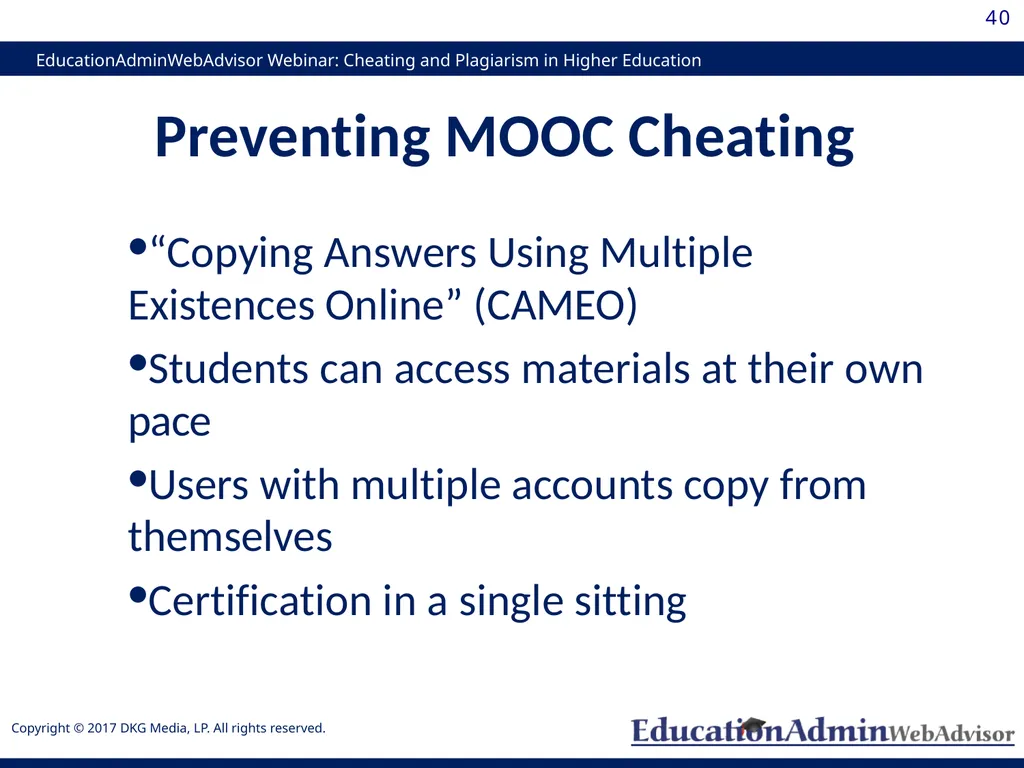
40 EducationAdminWebAdvisor Webinar: Cheating and Plagiarism in Higher Education Preventing MOOC Cheating “Copying Answers Using Multiple
Existences Online” (CAMEO)
Students can access materials at their own
pace
Users with multiple accounts copy from
themselves
Certification in a single sitting<br>
Existences Online” (CAMEO)
Students can access materials at their own
pace
Users with multiple accounts copy from
themselves
Certification in a single sitting<br>
41
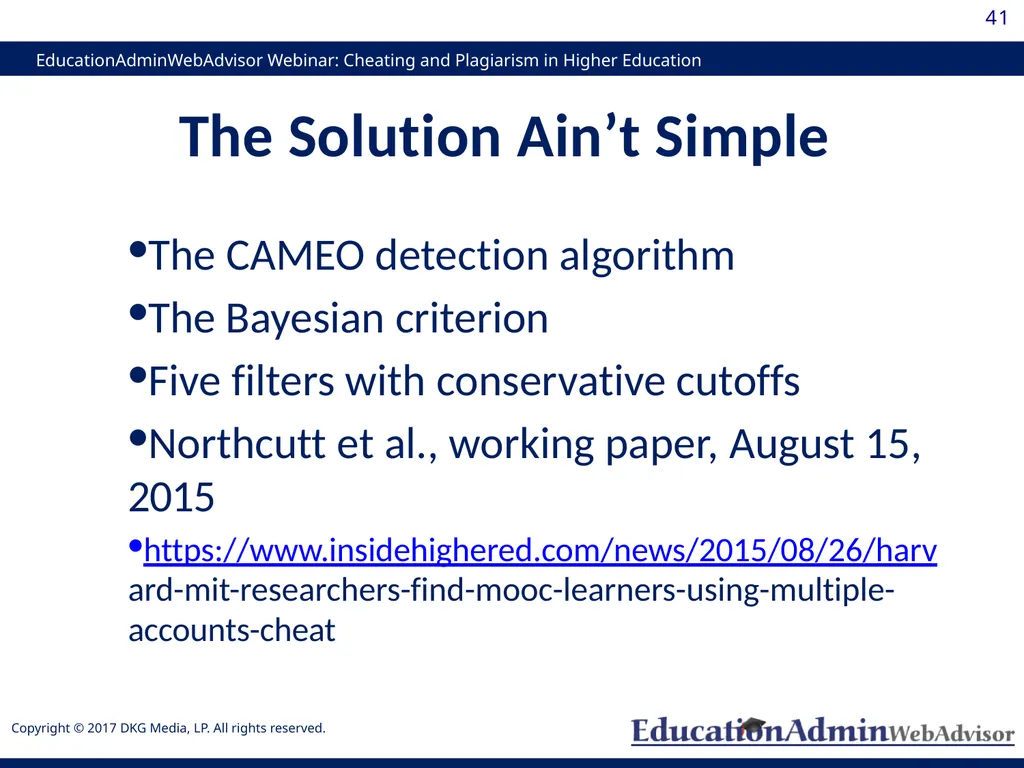
41 EducationAdminWebAdvisor Webinar: Cheating and Plagiarism in Higher Education The Solution Ain’t Simple The CAMEO detection algorithm
The Bayesian criterion
Five filters with conservative cutoffs
Northcutt et al., working paper, August 15,
2015
https://www.insidehighered.com/news/2015/08/26/harv
ard-mit-researchers-find-mooc-learners-using-multiple-
accounts-cheat<br>
The Bayesian criterion
Five filters with conservative cutoffs
Northcutt et al., working paper, August 15,
2015
https://www.insidehighered.com/news/2015/08/26/harv
ard-mit-researchers-find-mooc-learners-using-multiple-
accounts-cheat<br>
42
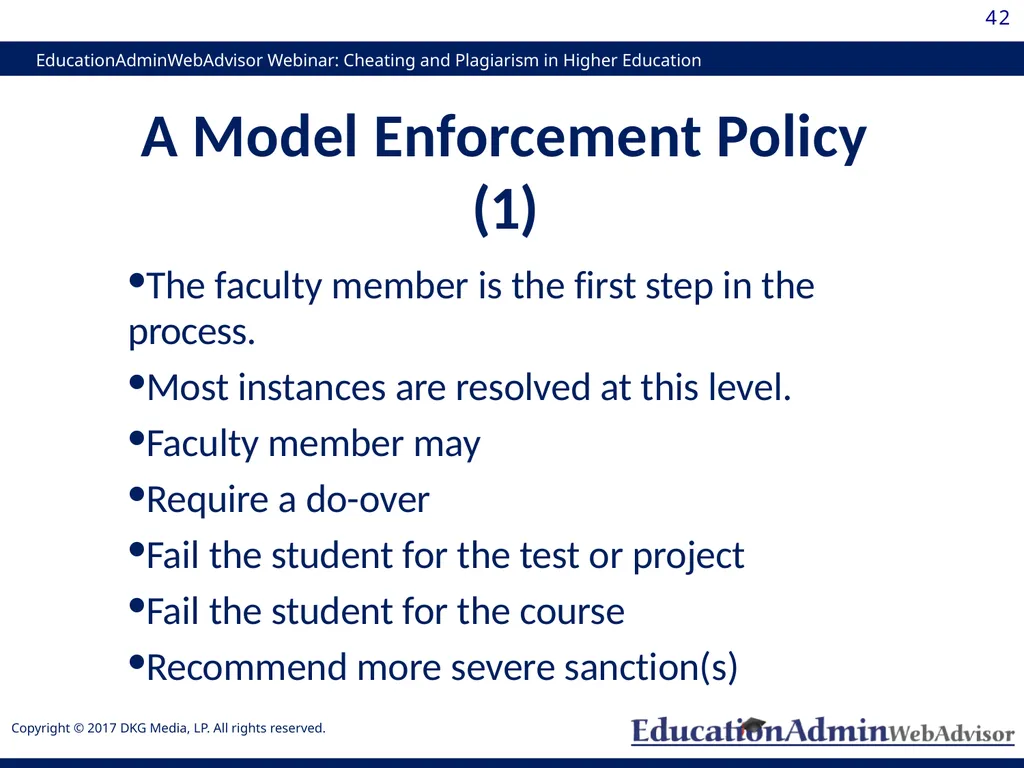
42 EducationAdminWebAdvisor Webinar: Cheating and Plagiarism in Higher Education A Model Enforcement Policy
(1) The faculty member is the first step in the
process.
Most instances are resolved at this level.
Faculty member may
Require a do-over
Fail the student for the test or project
Fail the student for the course
Recommend more severe sanction(s)<br>
(1) The faculty member is the first step in the
process.
Most instances are resolved at this level.
Faculty member may
Require a do-over
Fail the student for the test or project
Fail the student for the course
Recommend more severe sanction(s)<br>
43
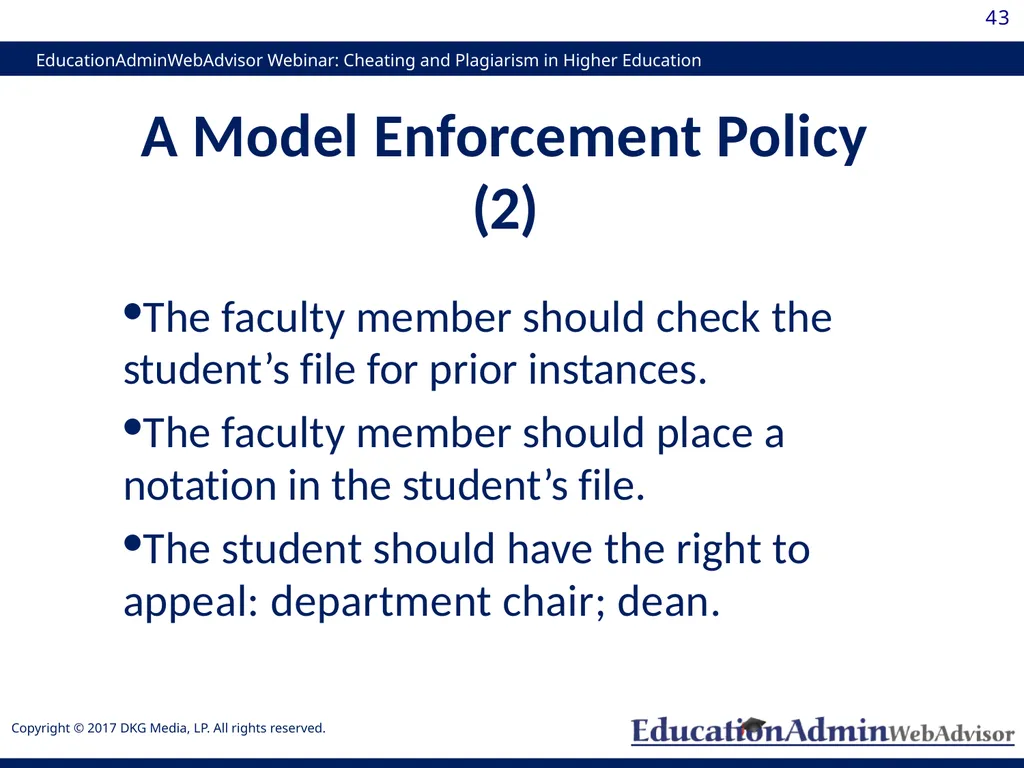
43 EducationAdminWebAdvisor Webinar: Cheating and Plagiarism in Higher Education A Model Enforcement Policy
(2) The faculty member should check the
student’s file for prior instances.
The faculty member should place a
notation in the student’s file.
The student should have the right to
appeal: department chair; dean.<br>
(2) The faculty member should check the
student’s file for prior instances.
The faculty member should place a
notation in the student’s file.
The student should have the right to
appeal: department chair; dean.<br>
44
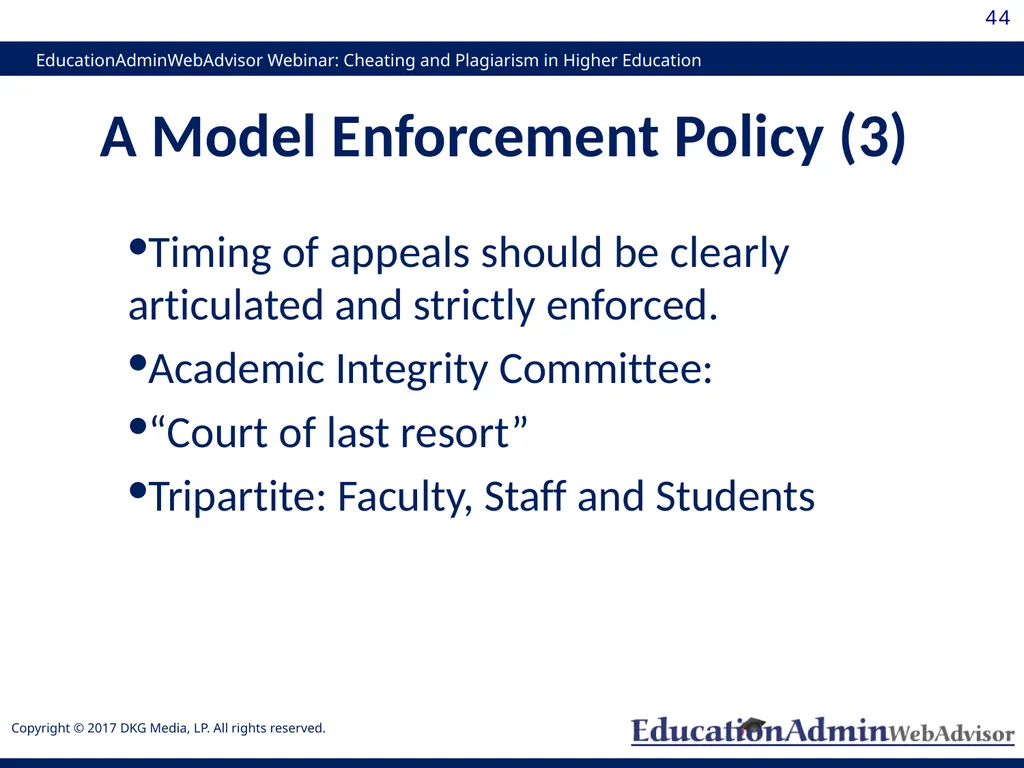
44 EducationAdminWebAdvisor Webinar: Cheating and Plagiarism in Higher Education A Model Enforcement Policy (3) Timing of appeals should be clearly
articulated and strictly enforced.
Academic Integrity Committee:
“Court of last resort”
Tripartite: Faculty, Staff and Students<br>
articulated and strictly enforced.
Academic Integrity Committee:
“Court of last resort”
Tripartite: Faculty, Staff and Students<br>
45
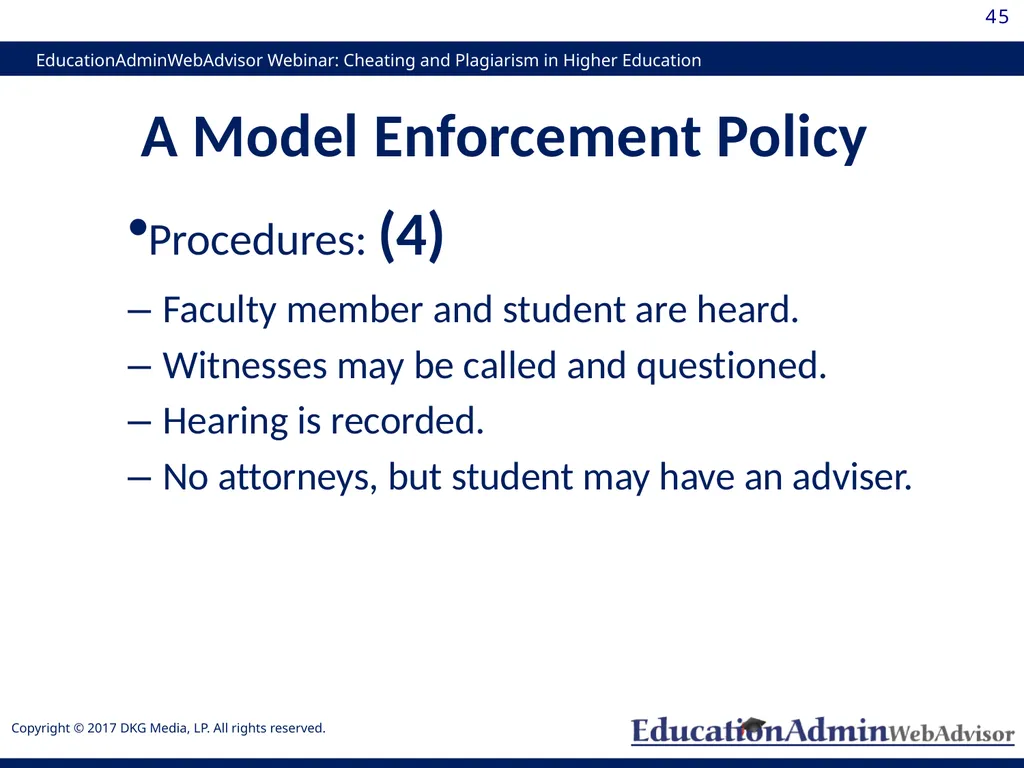
45 EducationAdminWebAdvisor Webinar: Cheating and Plagiarism in Higher Education A Model Enforcement Policy
Procedures: (4)
– Faculty member and student are heard.
– Witnesses may be called and questioned.
– Hearing is recorded.
– No attorneys, but student may have an adviser.<br>
Procedures: (4)
– Faculty member and student are heard.
– Witnesses may be called and questioned.
– Hearing is recorded.
– No attorneys, but student may have an adviser.<br>
46
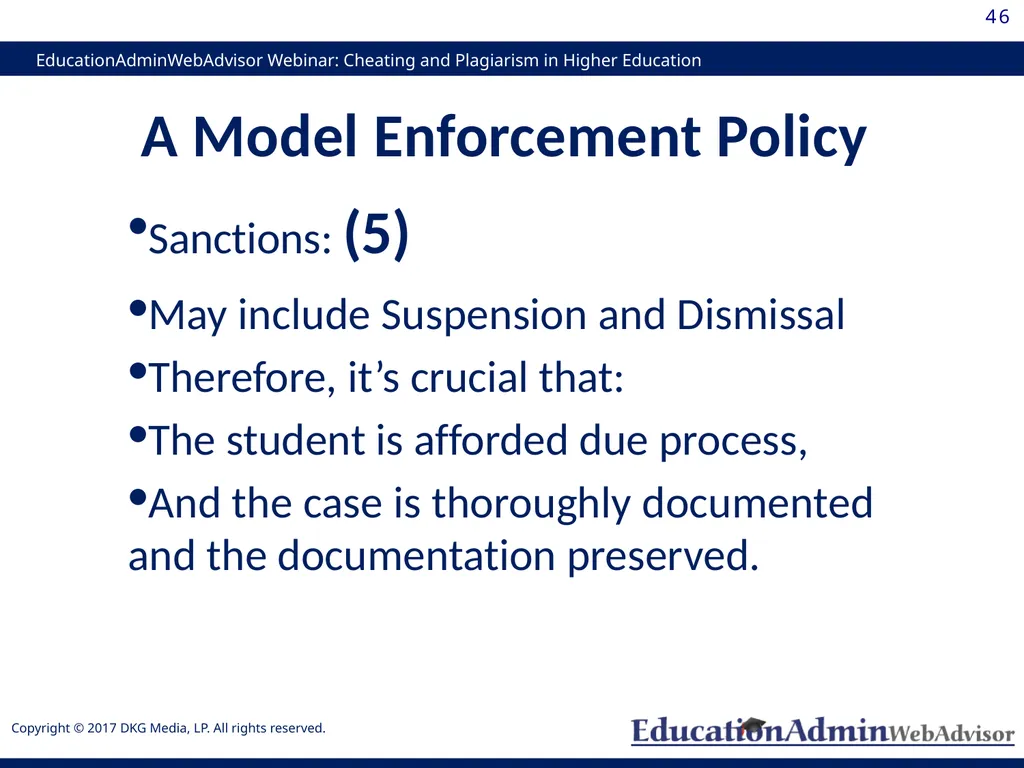
46 EducationAdminWebAdvisor Webinar: Cheating and Plagiarism in Higher Education A Model Enforcement Policy
Sanctions: (5)
May include Suspension and Dismissal
Therefore, it’s crucial that:
The student is afforded due process,
And the case is thoroughly documented
and the documentation preserved.<br>
Sanctions: (5)
May include Suspension and Dismissal
Therefore, it’s crucial that:
The student is afforded due process,
And the case is thoroughly documented
and the documentation preserved.<br>
47
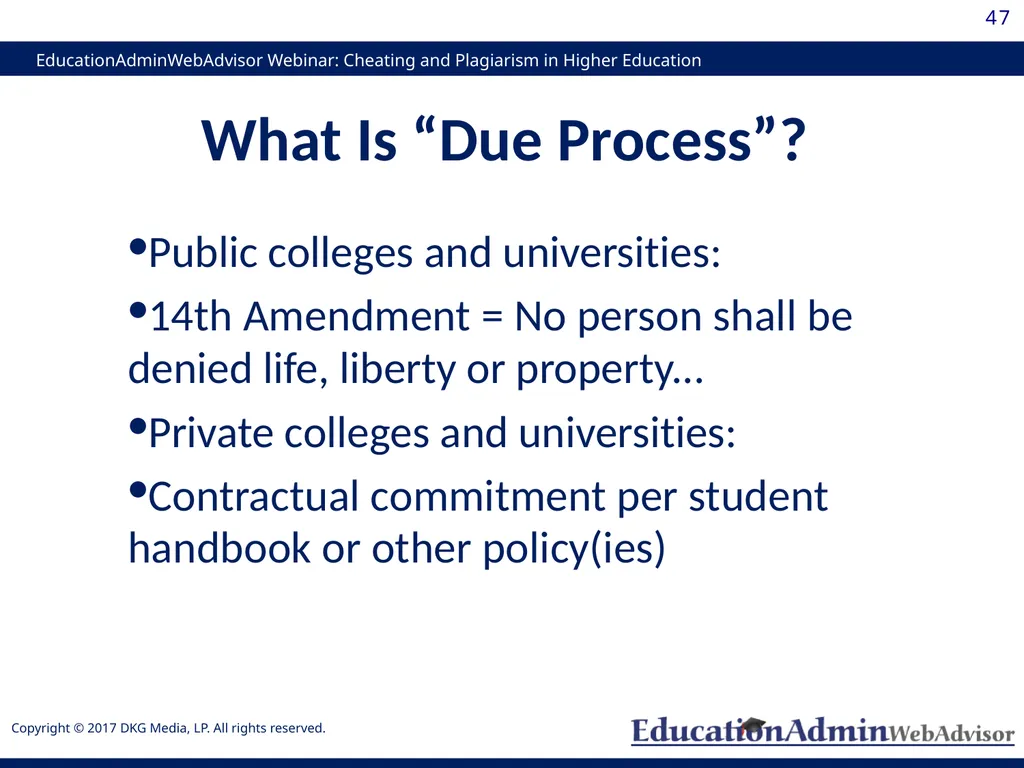
47 EducationAdminWebAdvisor Webinar: Cheating and Plagiarism in Higher Education What Is “Due Process”? Public colleges and universities:
14th Amendment = No person shall be
denied life, liberty or property...
Private colleges and universities:
Contractual commitment per student
handbook or other policy(ies)<br>
14th Amendment = No person shall be
denied life, liberty or property...
Private colleges and universities:
Contractual commitment per student
handbook or other policy(ies)<br>
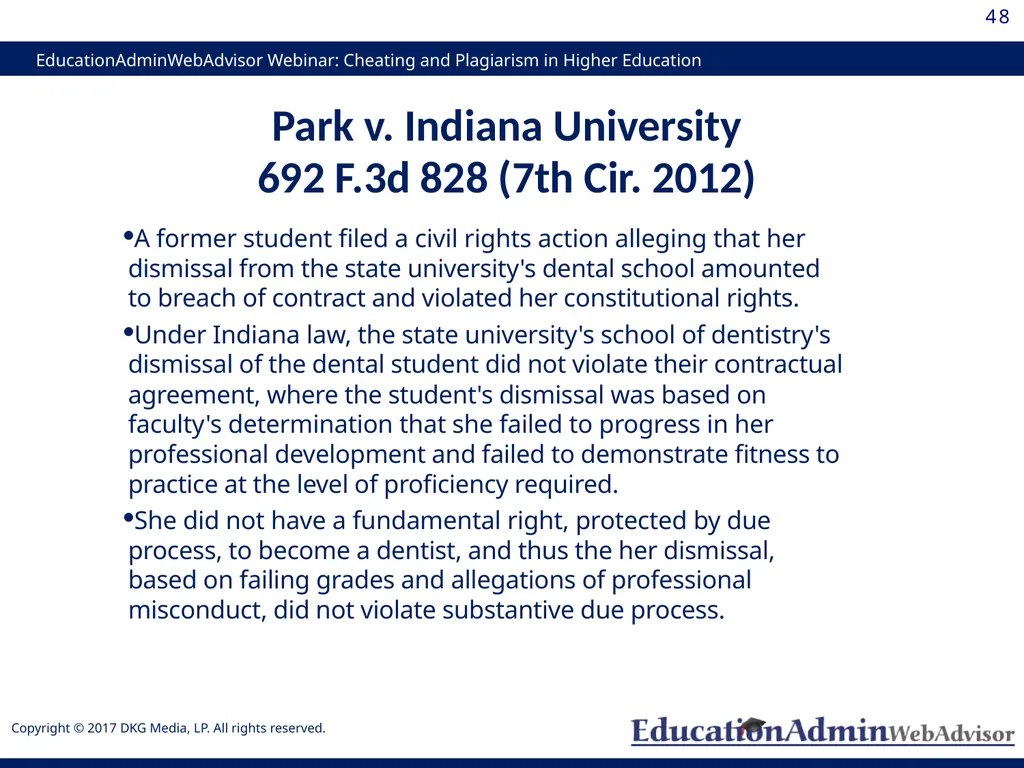
48
48 EducationAdminWebAdvisor Webinar: Cheating and Plagiarism in Higher Education Park v. Indiana University
692 F.3d 828 (7th Cir. 2012)
A former student filed a civil rights action alleging that her
dismissal from the state university's dental school amounted
to breach of contract and violated her constitutional rights.
Under Indiana law, the state university's school of dentistry's
dismissal of the dental student did not violate their contractual
agreement, where the student's dismissal was based on
faculty's determination that she failed to progress in her
professional development and failed to demonstrate fitness to
practice at the level of proficiency required.
She did not have a fundamental right, protected by due
process, to become a dentist, and thus the her dismissal,
based on failing grades and allegations of professional
misconduct, did not violate substantive due process.<br>
692 F.3d 828 (7th Cir. 2012)
A former student filed a civil rights action alleging that her
dismissal from the state university's dental school amounted
to breach of contract and violated her constitutional rights.
Under Indiana law, the state university's school of dentistry's
dismissal of the dental student did not violate their contractual
agreement, where the student's dismissal was based on
faculty's determination that she failed to progress in her
professional development and failed to demonstrate fitness to
practice at the level of proficiency required.
She did not have a fundamental right, protected by due
process, to become a dentist, and thus the her dismissal,
based on failing grades and allegations of professional
misconduct, did not violate substantive due process.<br>
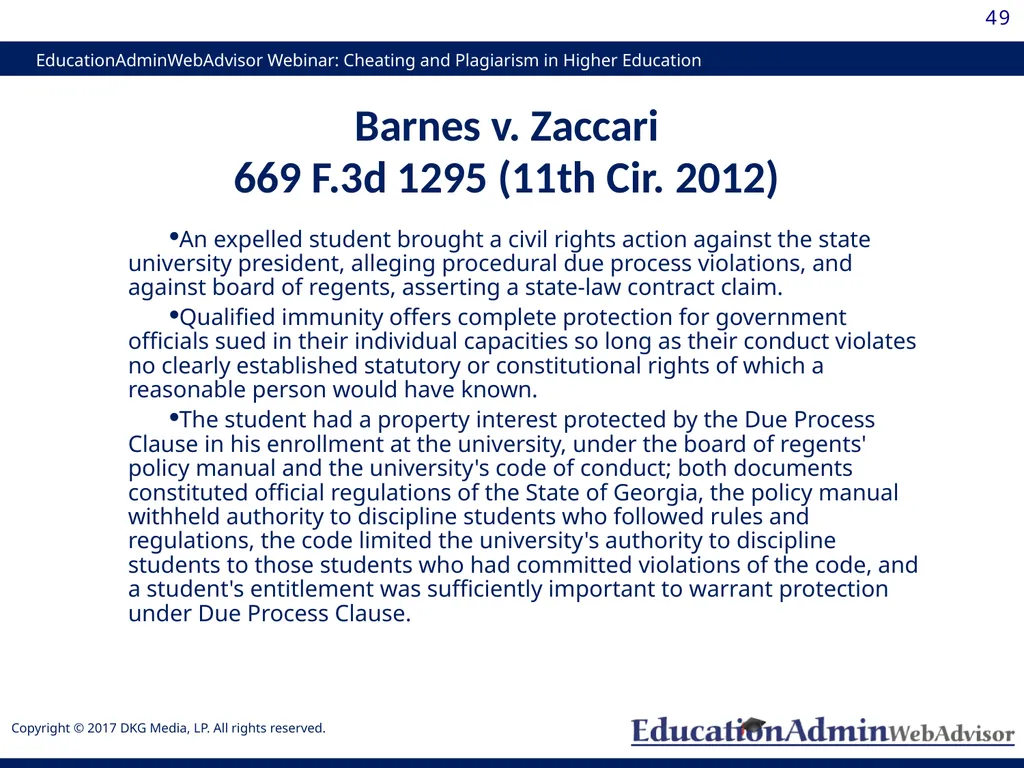
49
49 EducationAdminWebAdvisor Webinar: Cheating and Plagiarism in Higher Education Barnes v. Zaccari
669 F.3d 1295 (11th Cir. 2012) An expelled student brought a civil rights action against the state university president, alleging procedural due process violations, and against board of regents, asserting a state-law contract claim.
Qualified immunity offers complete protection for government officials sued in their individual capacities so long as their conduct violates no clearly established statutory or constitutional rights of which a reasonable person would have known.
The student had a property interest protected by the Due Process Clause in his enrollment at the university, under the board of regents' policy manual and the university's code of conduct; both documents constituted official regulations of the State of Georgia, the policy manual withheld authority to discipline students who followed rules and regulations, the code limited the university's authority to discipline students to those students who had committed violations of the code, and a student's entitlement was sufficiently important to warrant protection under Due Process Clause.<br>
669 F.3d 1295 (11th Cir. 2012) An expelled student brought a civil rights action against the state university president, alleging procedural due process violations, and against board of regents, asserting a state-law contract claim.
Qualified immunity offers complete protection for government officials sued in their individual capacities so long as their conduct violates no clearly established statutory or constitutional rights of which a reasonable person would have known.
The student had a property interest protected by the Due Process Clause in his enrollment at the university, under the board of regents' policy manual and the university's code of conduct; both documents constituted official regulations of the State of Georgia, the policy manual withheld authority to discipline students who followed rules and regulations, the code limited the university's authority to discipline students to those students who had committed violations of the code, and a student's entitlement was sufficiently important to warrant protection under Due Process Clause.<br>
50
50 EducationAdminWebAdvisor Webinar: Cheating and Plagiarism in Higher Education This Case Has a Little Bit of
Everything!
SEALS V. MISSISSIPPI
998 F. SUPP. 2D 509
(N.D. MISS. 2014)<br>
Everything!
SEALS V. MISSISSIPPI
998 F. SUPP. 2D 509
(N.D. MISS. 2014)<br>
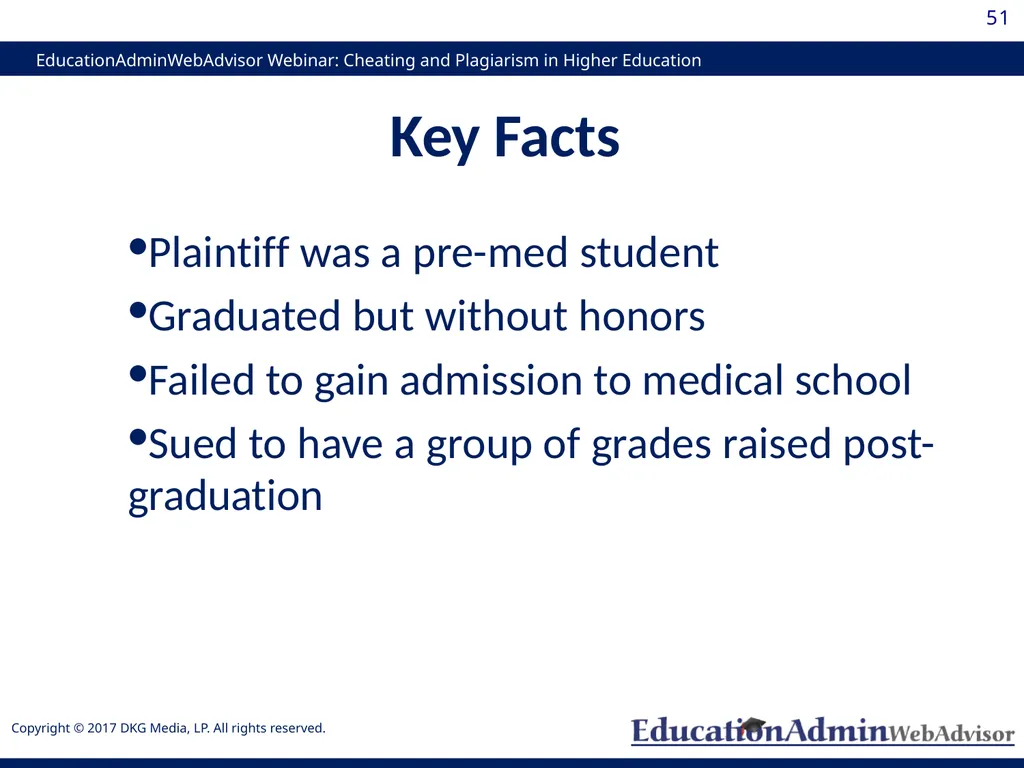
51
51 EducationAdminWebAdvisor Webinar: Cheating and Plagiarism in Higher Education Key Facts Plaintiff was a pre-med student
Graduated but without honors
Failed to gain admission to medical school
Sued to have a group of grades raised post-
graduation<br>
Graduated but without honors
Failed to gain admission to medical school
Sued to have a group of grades raised post-
graduation<br>
52
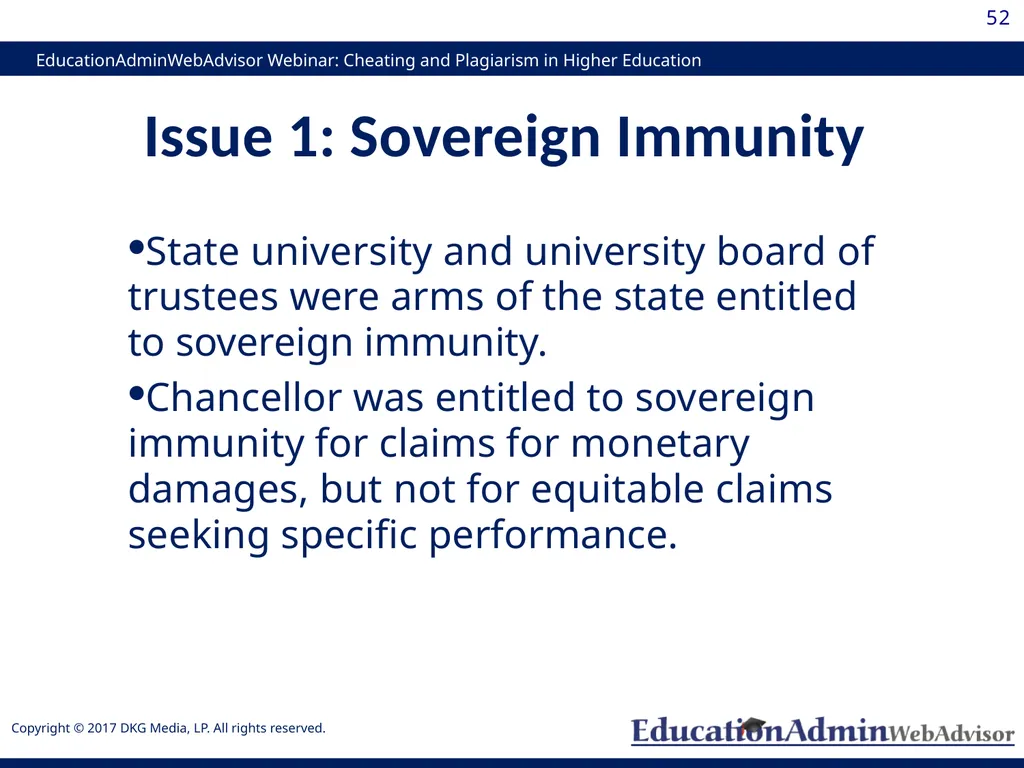
52 EducationAdminWebAdvisor Webinar: Cheating and Plagiarism in Higher Education Issue 1: Sovereign Immunity State university and university board of
trustees were arms of the state entitled
to sovereign immunity.
Chancellor was entitled to sovereign
immunity for claims for monetary
damages, but not for equitable claims
seeking specific performance.<br>
trustees were arms of the state entitled
to sovereign immunity.
Chancellor was entitled to sovereign
immunity for claims for monetary
damages, but not for equitable claims
seeking specific performance.<br>
53
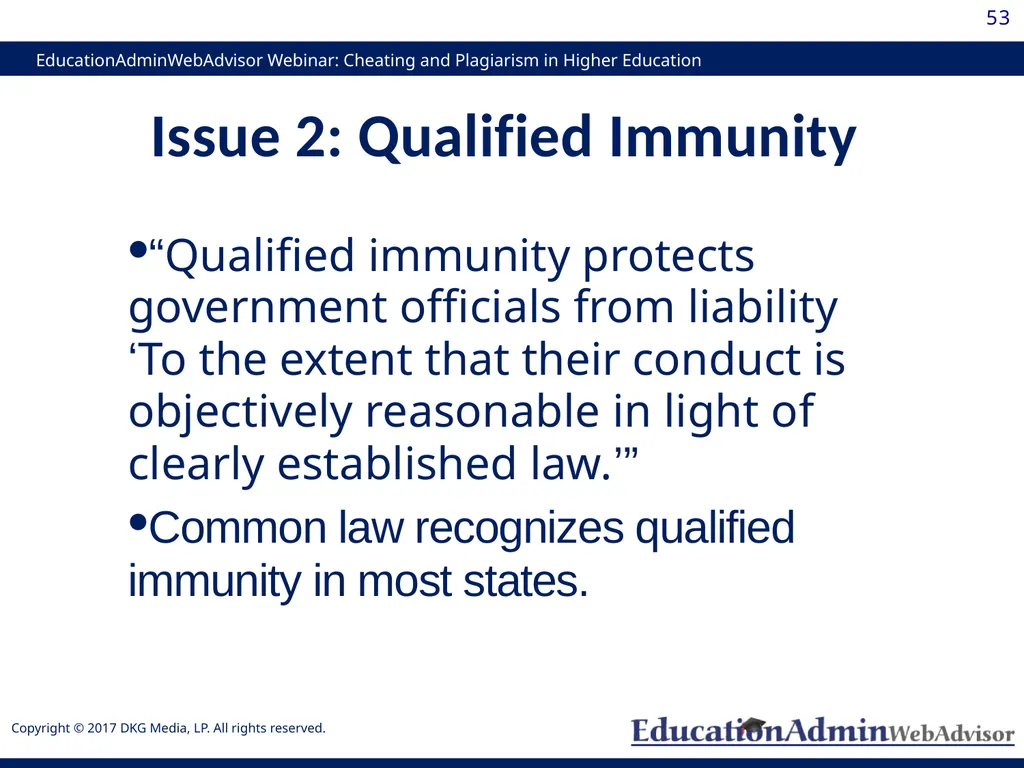
53 EducationAdminWebAdvisor Webinar: Cheating and Plagiarism in Higher Education Issue 2: Qualified Immunity “Qualified immunity protects
government officials from liability
‘To the extent that their conduct is
objectively reasonable in light of
clearly established law.’”
Common law recognizes qualified
immunity in most states.<br>
government officials from liability
‘To the extent that their conduct is
objectively reasonable in light of
clearly established law.’”
Common law recognizes qualified
immunity in most states.<br>
54
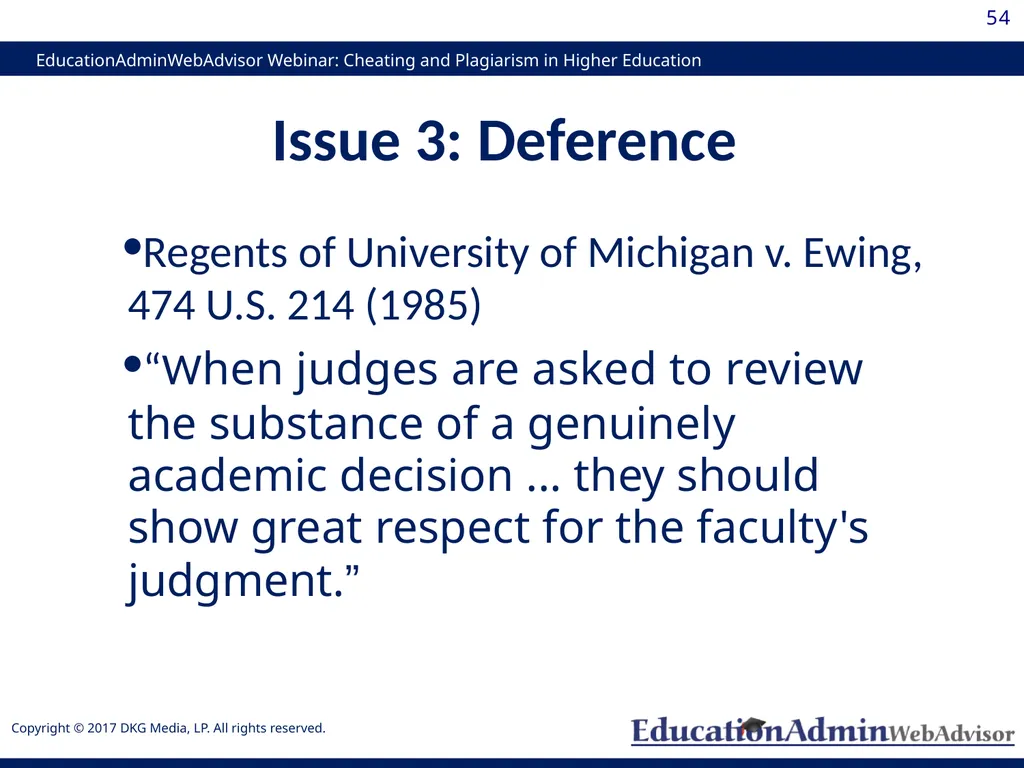
54 EducationAdminWebAdvisor Webinar: Cheating and Plagiarism in Higher Education Issue 3: Deference Regents of University of Michigan v. Ewing,
474 U.S. 214 (1985)
“When judges are asked to review
the substance of a genuinely
academic decision ... they should
show great respect for the faculty's
judgment.”<br>
474 U.S. 214 (1985)
“When judges are asked to review
the substance of a genuinely
academic decision ... they should
show great respect for the faculty's
judgment.”<br>
55
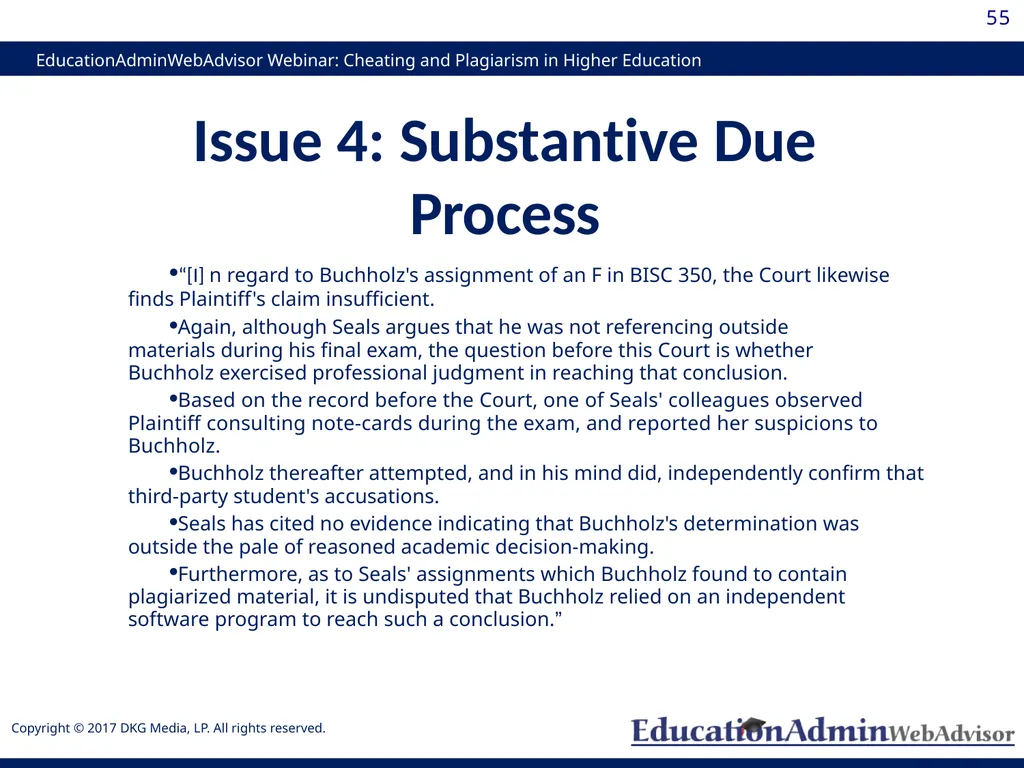
55 EducationAdminWebAdvisor Webinar: Cheating and Plagiarism in Higher Education Issue 4: Substantive Due
Process “[I] n regard to Buchholz's assignment of an F in BISC 350, the Court likewise finds Plaintiff's claim insufficient.
Again, although Seals argues that he was not referencing outside materials during his final exam, the question before this Court is whether Buchholz exercised professional judgment in reaching that conclusion.
Based on the record before the Court, one of Seals' colleagues observed Plaintiff consulting note-cards during the exam, and reported her suspicions to Buchholz.
Buchholz thereafter attempted, and in his mind did, independently confirm that third-party student's accusations.
Seals has cited no evidence indicating that Buchholz's determination was outside the pale of reasoned academic decision-making.
Furthermore, as to Seals' assignments which Buchholz found to contain plagiarized material, it is undisputed that Buchholz relied on an independent software program to reach such a conclusion.”<br>
Process “[I] n regard to Buchholz's assignment of an F in BISC 350, the Court likewise finds Plaintiff's claim insufficient.
Again, although Seals argues that he was not referencing outside materials during his final exam, the question before this Court is whether Buchholz exercised professional judgment in reaching that conclusion.
Based on the record before the Court, one of Seals' colleagues observed Plaintiff consulting note-cards during the exam, and reported her suspicions to Buchholz.
Buchholz thereafter attempted, and in his mind did, independently confirm that third-party student's accusations.
Seals has cited no evidence indicating that Buchholz's determination was outside the pale of reasoned academic decision-making.
Furthermore, as to Seals' assignments which Buchholz found to contain plagiarized material, it is undisputed that Buchholz relied on an independent software program to reach such a conclusion.”<br>
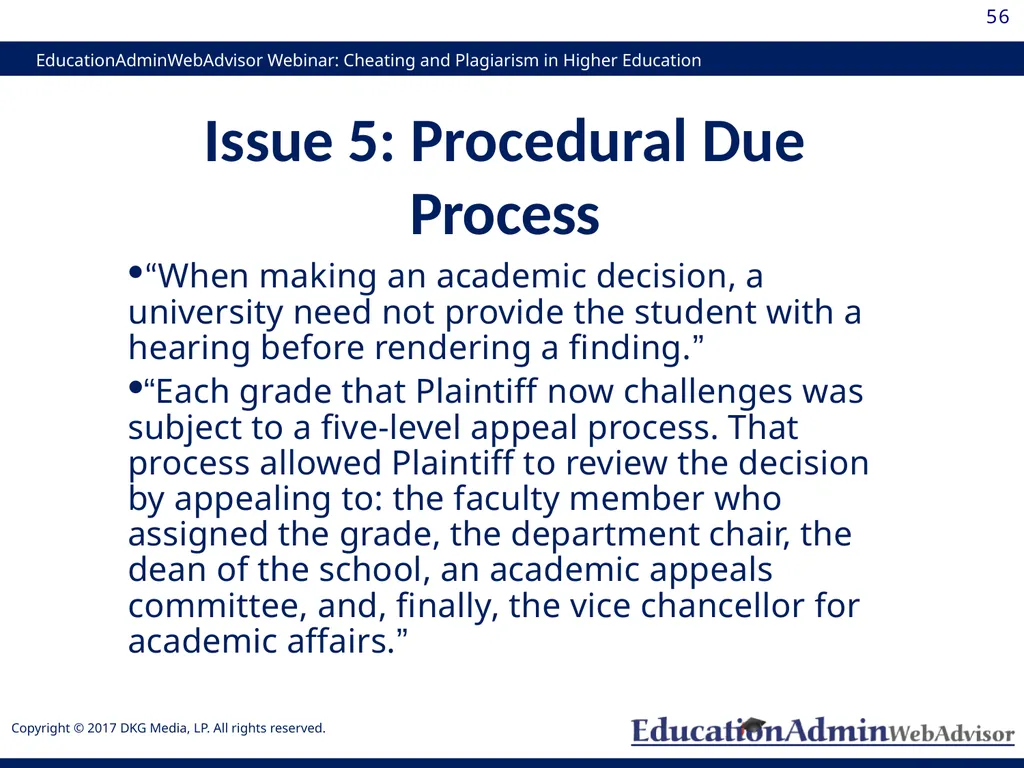
56
56 EducationAdminWebAdvisor Webinar: Cheating and Plagiarism in Higher Education Issue 5: Procedural Due
Process
“When making an academic decision, a
university need not provide the student with a
hearing before rendering a finding.”
“Each grade that Plaintiff now challenges was
subject to a five-level appeal process. That
process allowed Plaintiff to review the decision
by appealing to: the faculty member who
assigned the grade, the department chair, the
dean of the school, an academic appeals
committee, and, finally, the vice chancellor for
academic affairs.”<br>
Process
“When making an academic decision, a
university need not provide the student with a
hearing before rendering a finding.”
“Each grade that Plaintiff now challenges was
subject to a five-level appeal process. That
process allowed Plaintiff to review the decision
by appealing to: the faculty member who
assigned the grade, the department chair, the
dean of the school, an academic appeals
committee, and, finally, the vice chancellor for
academic affairs.”<br>
57
57 EducationAdminWebAdvisor Webinar: Cheating and Plagiarism in Higher Education Cultural Considerations? Societies in which emulation is the highest
form of adulation
Community colleges that offer little
opportunity to research and write
Or just plain bad behavior on an
international scale?<br>
form of adulation
Community colleges that offer little
opportunity to research and write
Or just plain bad behavior on an
international scale?<br>
58
58 EducationAdminWebAdvisor Webinar: Cheating and Plagiarism in Higher Education East v. West It is important to remember that plagiarism is a
Western ideal. For example, “... the notion of
‘stealing’ another’s work has its origins in the
peculiarly Western conjunction between the
‘growth of the notion of human right’ (freedom of
speech) and the ‘stress on individual property’
(copyright)” (Duff et al., 2006, p. 675).
The Mentor, March 2, 2012<br>
Western ideal. For example, “... the notion of
‘stealing’ another’s work has its origins in the
peculiarly Western conjunction between the
‘growth of the notion of human right’ (freedom of
speech) and the ‘stress on individual property’
(copyright)” (Duff et al., 2006, p. 675).
The Mentor, March 2, 2012<br>
59
59 EducationAdminWebAdvisor Webinar: Cheating and Plagiarism in Higher Education East v. West Scollon (1999) explains that students from Confucian-heritage countries, such
as China, Japan, Korea, and Vietnam, value their source with the utmost
authority, yet do not believe in citing their sources as expected in Western
society (Duff et al., 2006). In addition, in the Confucian culture, using an
author’s own words is a form of respect, making it difficult for students to
understand Western standards and change their perspectives on this matter
(Hayes & Introna, 2005). Furthermore, Hayes and Introna (2005) documented
the case of an Indian student who declared that in his undergraduate
institution more points were awarded to students who could reproduce from
class notes and textbooks than to those who paraphrased. Lastly, researchers
have proposed that students from overseas feel they cannot improve on what
has already been said (Hayes & Introna, 2005). - Ibid.,
https://dus.psu.edu/mentor/2012/03/guide-to-advising-international-
students-about-academic-integrity/<br>
as China, Japan, Korea, and Vietnam, value their source with the utmost
authority, yet do not believe in citing their sources as expected in Western
society (Duff et al., 2006). In addition, in the Confucian culture, using an
author’s own words is a form of respect, making it difficult for students to
understand Western standards and change their perspectives on this matter
(Hayes & Introna, 2005). Furthermore, Hayes and Introna (2005) documented
the case of an Indian student who declared that in his undergraduate
institution more points were awarded to students who could reproduce from
class notes and textbooks than to those who paraphrased. Lastly, researchers
have proposed that students from overseas feel they cannot improve on what
has already been said (Hayes & Introna, 2005). - Ibid.,
https://dus.psu.edu/mentor/2012/03/guide-to-advising-international-
students-about-academic-integrity/<br>
60
60 EducationAdminWebAdvisor Webinar: Cheating and Plagiarism in Higher Education QUESTIONS? Dr. Jim Castagnera
Managing Director
K&C Human Resource Enterprises
Feel free to email me with additional comments,
suggestions or questions:
Drcastagnera@gmail.com<br>
Managing Director
K&C Human Resource Enterprises
Feel free to email me with additional comments,
suggestions or questions:
Drcastagnera@gmail.com<br>