
CHECK IN CODE 1008 Roles and Responsibilities of
YM
Published · 55 slides · 0 views
1 / 1







Description
CHECK IN CODE 1008 Roles and Responsibilities of Trustees Pamela L. Beach General Counsel Authorized local agencies to assume administration of MHMR services Created Texas Department of MHMR Established partnerships between local agencies,
Related Topics
Share
Embed code
Download this presentation From Below
"CHECK IN CODE 1008 Roles and Responsibilities of" is the property of its rightful owner. Permission is granted to download and print the materials on this website for personal, non-commercial use only, and to display it on your personal computer provided you do not modify the materials and that you retain all copyright notices contained in the materials. By downloading content from our website, you accept the terms of this agreement.
Presentation Transcript
01
CHECK IN CODE
1008<br>
02
Roles and Responsibilities of Trustees Pamela L. Beach
General Counsel<br>
General Counsel<br>
03
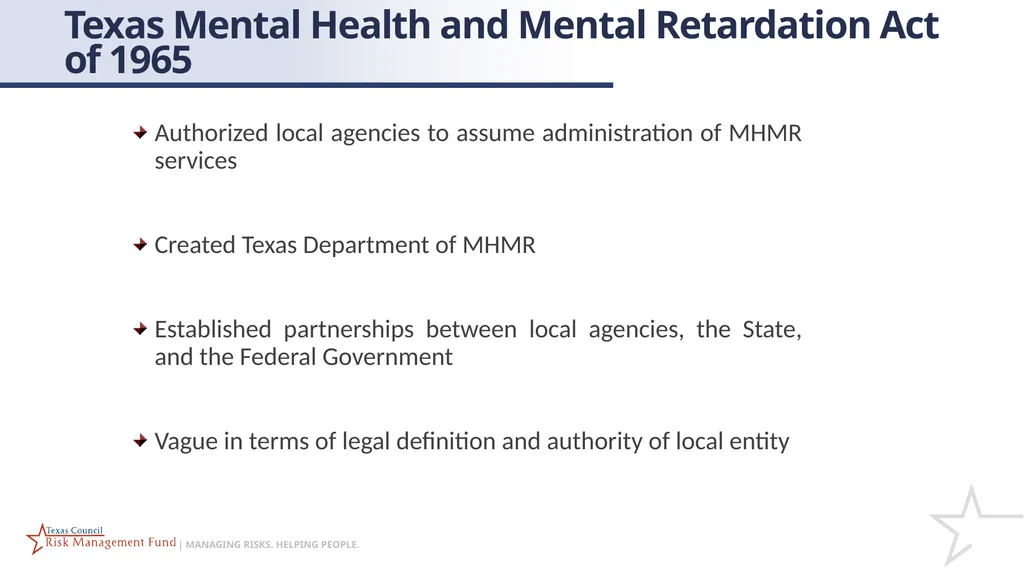
Authorized local agencies to assume administration of MHMR services
Created Texas Department of MHMR
Established partnerships between local agencies, the State, and the Federal Government
Vague in terms of legal definition and authority of local entity Texas Mental Health and Mental Retardation Act of 1965<br>
Created Texas Department of MHMR
Established partnerships between local agencies, the State, and the Federal Government
Vague in terms of legal definition and authority of local entity Texas Mental Health and Mental Retardation Act of 1965<br>
04
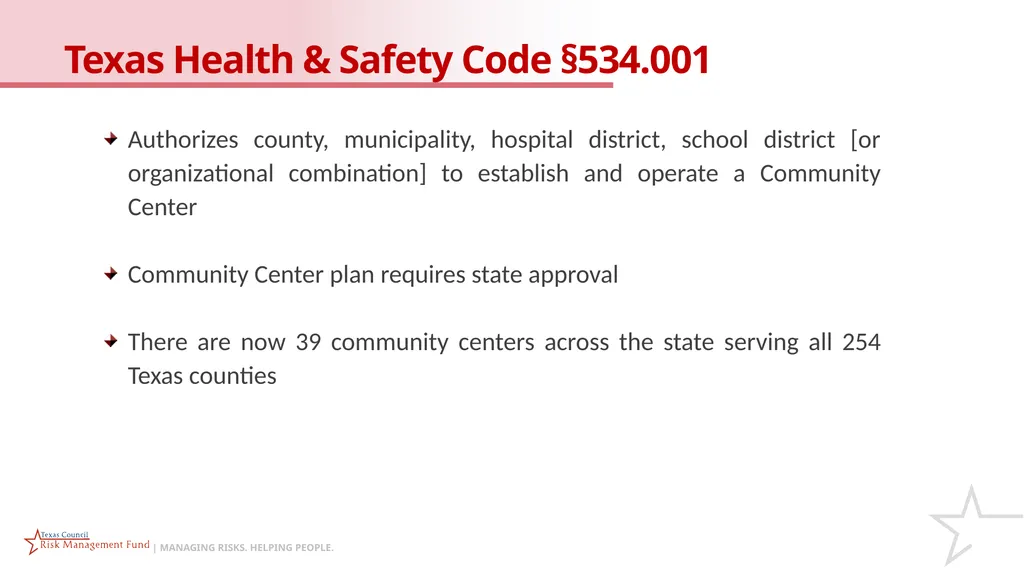
Authorizes county, municipality, hospital district, school district [or organizational combination] to establish and operate a Community Center
Community Center plan requires state approval
There are now 39 community centers across the state serving all 254 Texas counties Texas Health & Safety Code §534.001<br>
Community Center plan requires state approval
There are now 39 community centers across the state serving all 254 Texas counties Texas Health & Safety Code §534.001<br>
05
What is a community center?<br>
06
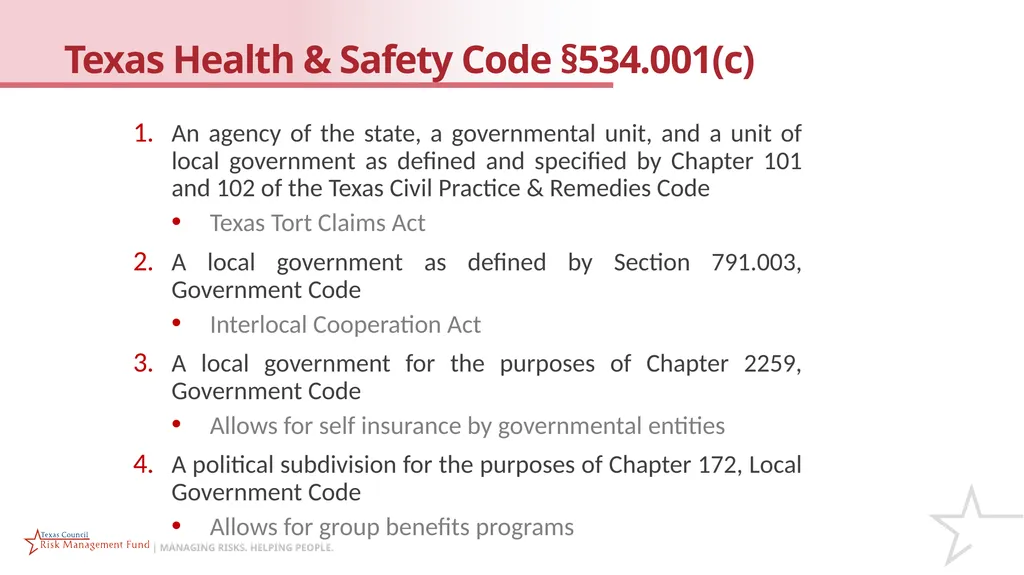
An agency of the state, a governmental unit, and a unit of local government as defined and specified by Chapter 101 and 102 of the Texas Civil Practice & Remedies Code
Texas Tort Claims Act
A local government as defined by Section 791.003, Government Code
Interlocal Cooperation Act
A local government for the purposes of Chapter 2259, Government Code
Allows for self insurance by governmental entities
A political subdivision for the purposes of Chapter 172, Local Government Code
Allows for group benefits programs Texas Health & Safety Code §534.001(c)<br>
Texas Tort Claims Act
A local government as defined by Section 791.003, Government Code
Interlocal Cooperation Act
A local government for the purposes of Chapter 2259, Government Code
Allows for self insurance by governmental entities
A political subdivision for the purposes of Chapter 172, Local Government Code
Allows for group benefits programs Texas Health & Safety Code §534.001(c)<br>
07
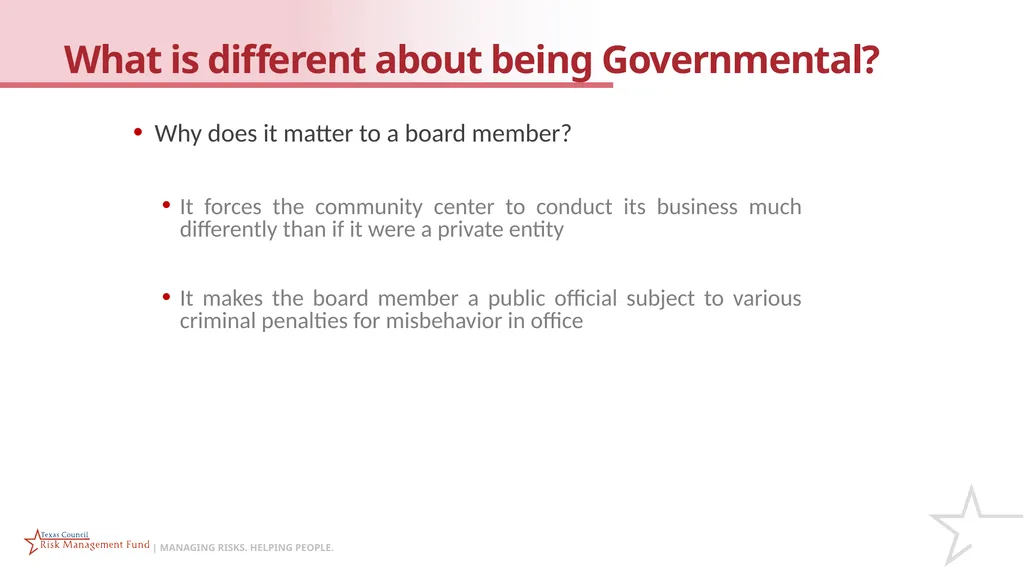
Why does it matter to a board member?
It forces the community center to conduct its business much differently than if it were a private entity
It makes the board member a public official subject to various criminal penalties for misbehavior in office What is different about being Governmental?<br>
It forces the community center to conduct its business much differently than if it were a private entity
It makes the board member a public official subject to various criminal penalties for misbehavior in office What is different about being Governmental?<br>
08
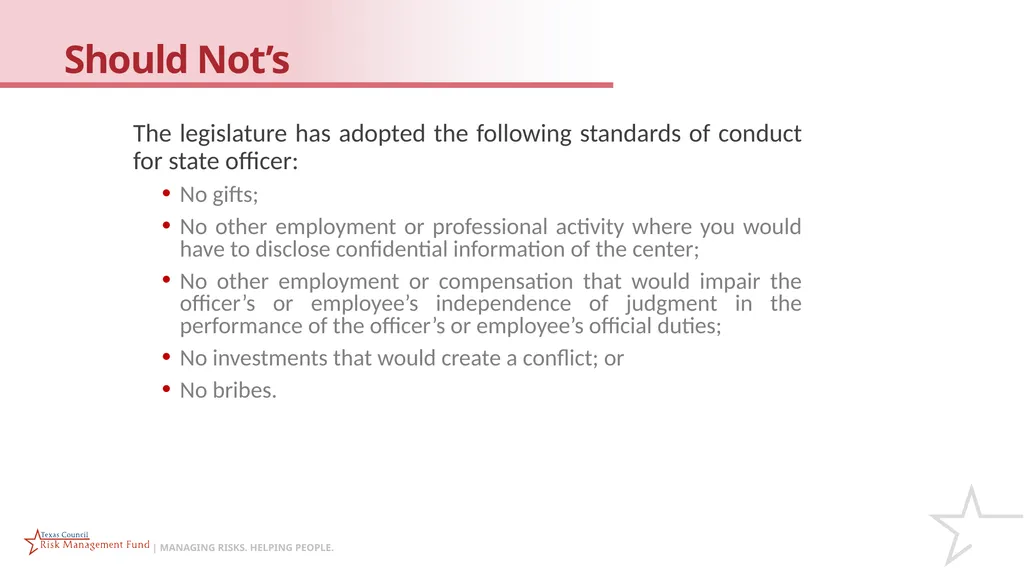
The legislature has adopted the following standards of conduct for state officer:
No gifts;
No other employment or professional activity where you would have to disclose confidential information of the center;
No other employment or compensation that would impair the officer’s or employee’s independence of judgment in the performance of the officer’s or employee’s official duties;
No investments that would create a conflict; or
No bribes. Should Not’s<br>
No gifts;
No other employment or professional activity where you would have to disclose confidential information of the center;
No other employment or compensation that would impair the officer’s or employee’s independence of judgment in the performance of the officer’s or employee’s official duties;
No investments that would create a conflict; or
No bribes. Should Not’s<br>
09
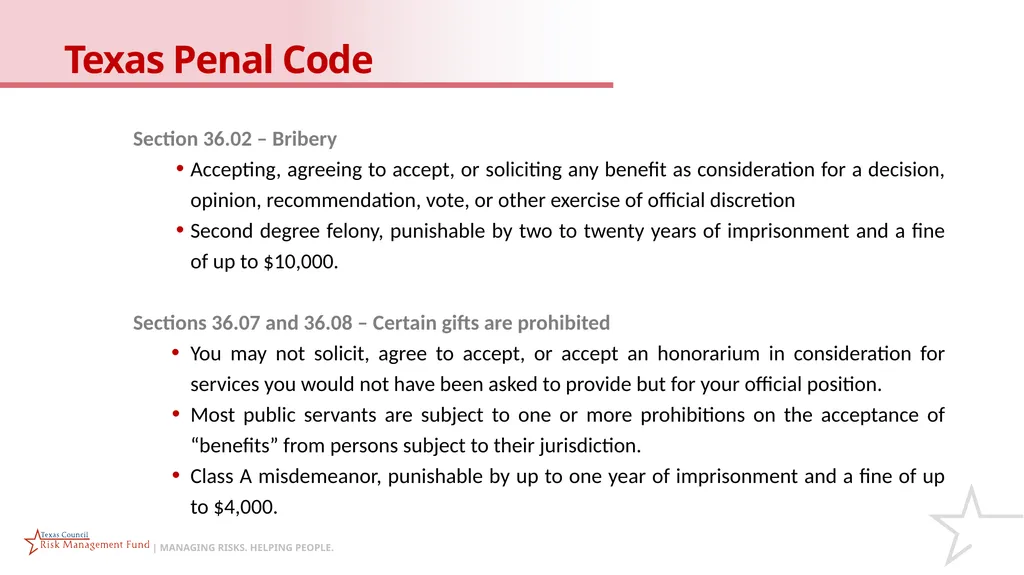
Section 36.02 – Bribery
Accepting, agreeing to accept, or soliciting any benefit as consideration for a decision, opinion, recommendation, vote, or other exercise of official discretion
Second degree felony, punishable by two to twenty years of imprisonment and a fine of up to $10,000.
Sections 36.07 and 36.08 – Certain gifts are prohibited
You may not solicit, agree to accept, or accept an honorarium in consideration for services you would not have been asked to provide but for your official position.
Most public servants are subject to one or more prohibitions on the acceptance of “benefits” from persons subject to their jurisdiction.
Class A misdemeanor, punishable by up to one year of imprisonment and a fine of up to $4,000. Texas Penal Code<br>
Accepting, agreeing to accept, or soliciting any benefit as consideration for a decision, opinion, recommendation, vote, or other exercise of official discretion
Second degree felony, punishable by two to twenty years of imprisonment and a fine of up to $10,000.
Sections 36.07 and 36.08 – Certain gifts are prohibited
You may not solicit, agree to accept, or accept an honorarium in consideration for services you would not have been asked to provide but for your official position.
Most public servants are subject to one or more prohibitions on the acceptance of “benefits” from persons subject to their jurisdiction.
Class A misdemeanor, punishable by up to one year of imprisonment and a fine of up to $4,000. Texas Penal Code<br>
10
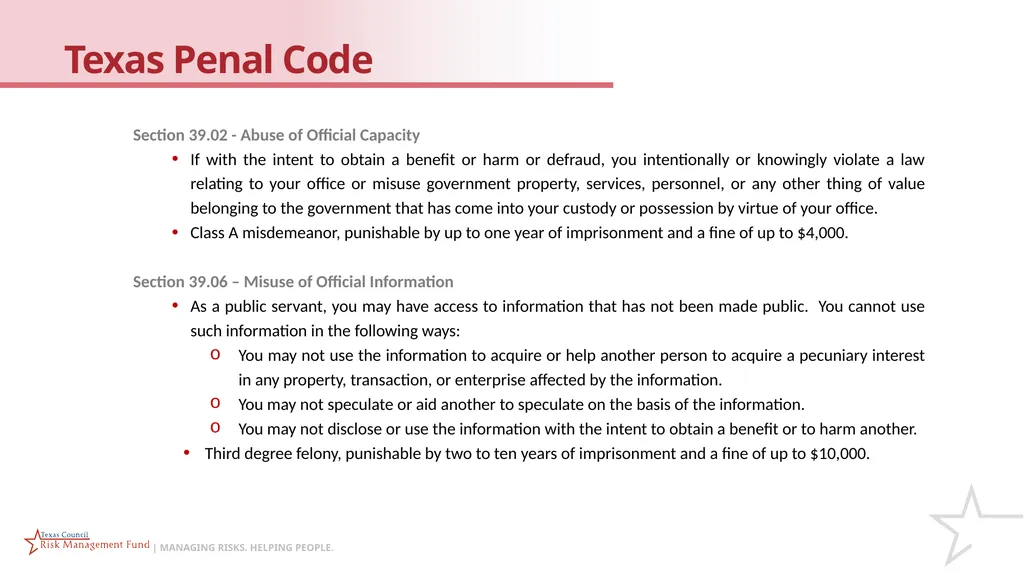
Section 39.02 - Abuse of Official Capacity
If with the intent to obtain a benefit or harm or defraud, you intentionally or knowingly violate a law relating to your office or misuse government property, services, personnel, or any other thing of value belonging to the government that has come into your custody or possession by virtue of your office.
Class A misdemeanor, punishable by up to one year of imprisonment and a fine of up to $4,000.
Section 39.06 – Misuse of Official Information
As a public servant, you may have access to information that has not been made public. You cannot use such information in the following ways:
You may not use the information to acquire or help another person to acquire a pecuniary interest in any property, transaction, or enterprise affected by the information.
You may not speculate or aid another to speculate on the basis of the information.
You may not disclose or use the information with the intent to obtain a benefit or to harm another.
Third degree felony, punishable by two to ten years of imprisonment and a fine of up to $10,000. Texas Penal Code<br>
If with the intent to obtain a benefit or harm or defraud, you intentionally or knowingly violate a law relating to your office or misuse government property, services, personnel, or any other thing of value belonging to the government that has come into your custody or possession by virtue of your office.
Class A misdemeanor, punishable by up to one year of imprisonment and a fine of up to $4,000.
Section 39.06 – Misuse of Official Information
As a public servant, you may have access to information that has not been made public. You cannot use such information in the following ways:
You may not use the information to acquire or help another person to acquire a pecuniary interest in any property, transaction, or enterprise affected by the information.
You may not speculate or aid another to speculate on the basis of the information.
You may not disclose or use the information with the intent to obtain a benefit or to harm another.
Third degree felony, punishable by two to ten years of imprisonment and a fine of up to $10,000. Texas Penal Code<br>
11
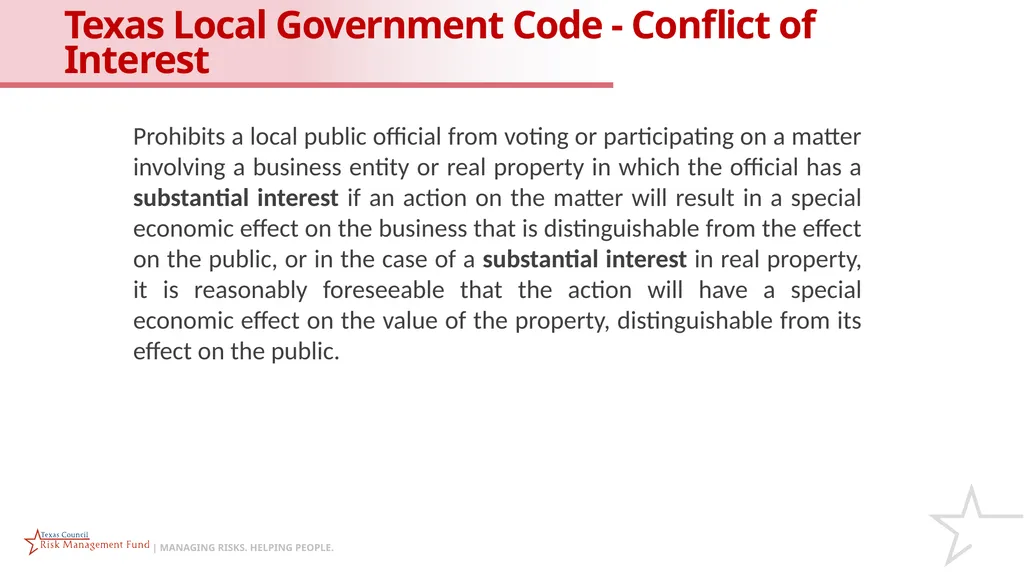
Prohibits a local public official from voting or participating on a matter involving a business entity or real property in which the official has a substantial interest if an action on the matter will result in a special economic effect on the business that is distinguishable from the effect on the public, or in the case of a substantial interest in real property, it is reasonably foreseeable that the action will have a special economic effect on the value of the property, distinguishable from its effect on the public. Texas Local Government Code - Conflict of Interest<br>
12
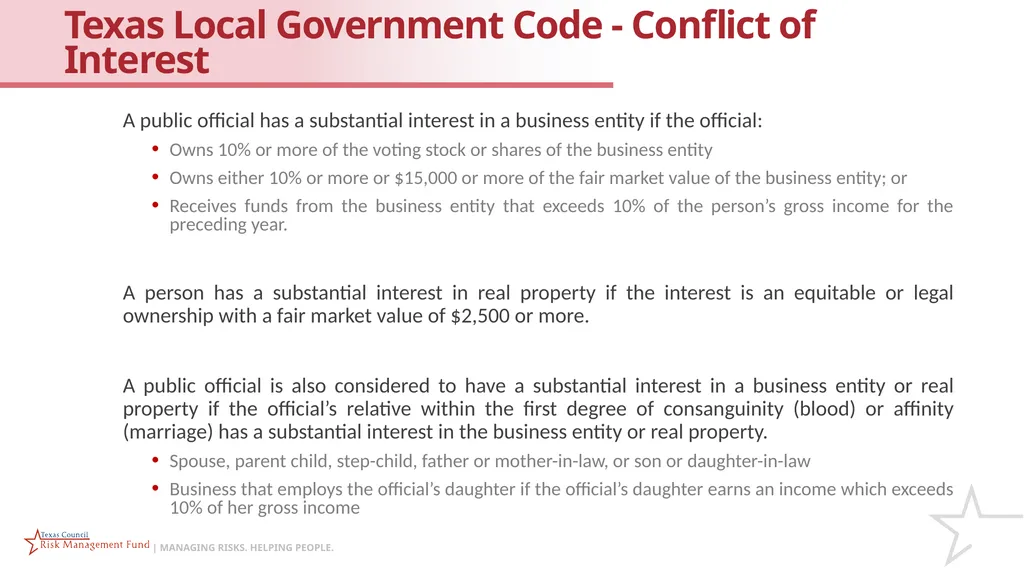
A public official has a substantial interest in a business entity if the official:
Owns 10% or more of the voting stock or shares of the business entity
Owns either 10% or more or $15,000 or more of the fair market value of the business entity; or
Receives funds from the business entity that exceeds 10% of the person’s gross income for the preceding year.
A person has a substantial interest in real property if the interest is an equitable or legal ownership with a fair market value of $2,500 or more.
A public official is also considered to have a substantial interest in a business entity or real property if the official’s relative within the first degree of consanguinity (blood) or affinity (marriage) has a substantial interest in the business entity or real property.
Spouse, parent child, step-child, father or mother-in-law, or son or daughter-in-law
Business that employs the official’s daughter if the official’s daughter earns an income which exceeds 10% of her gross income Texas Local Government Code - Conflict of Interest<br>
Owns 10% or more of the voting stock or shares of the business entity
Owns either 10% or more or $15,000 or more of the fair market value of the business entity; or
Receives funds from the business entity that exceeds 10% of the person’s gross income for the preceding year.
A person has a substantial interest in real property if the interest is an equitable or legal ownership with a fair market value of $2,500 or more.
A public official is also considered to have a substantial interest in a business entity or real property if the official’s relative within the first degree of consanguinity (blood) or affinity (marriage) has a substantial interest in the business entity or real property.
Spouse, parent child, step-child, father or mother-in-law, or son or daughter-in-law
Business that employs the official’s daughter if the official’s daughter earns an income which exceeds 10% of her gross income Texas Local Government Code - Conflict of Interest<br>
13
A public official who has such interest is required to file, before a vote or decision on any matter involving the business entity or real property, an affidavit with the official record keeper, stating the nature and extent of the interest.
In addition, a public official is required to abstain from further participation in the matter.
However, a public official that is required to file an affidavit is not required to abstain from participating in the matter if a majority of the members of the governing body have a substantial interest and are required to file and do file affidavits of similar interests on the same official matter. Texas Local Government Code - Conflict of Interest<br>
In addition, a public official is required to abstain from further participation in the matter.
However, a public official that is required to file an affidavit is not required to abstain from participating in the matter if a majority of the members of the governing body have a substantial interest and are required to file and do file affidavits of similar interests on the same official matter. Texas Local Government Code - Conflict of Interest<br>
14
14 You’re a health care board!<br>
15
Keeping your Board informed
Education during each Board meeting
Status of Strategic Planning and Measurement
Keeping Board Bylaws (and Board policies) current
Adherence to contracting procedures
Sharing Opportunities for Board Education and Training
Training for New Board Members
Annual Texas Council Board and Staff Conference
Annual Board Retreat
Practical Guidance for Health Care Governing Boards on Compliance Oversight 15 OIG Audits Information for Boards<br>
Education during each Board meeting
Status of Strategic Planning and Measurement
Keeping Board Bylaws (and Board policies) current
Adherence to contracting procedures
Sharing Opportunities for Board Education and Training
Training for New Board Members
Annual Texas Council Board and Staff Conference
Annual Board Retreat
Practical Guidance for Health Care Governing Boards on Compliance Oversight 15 OIG Audits Information for Boards<br>
16
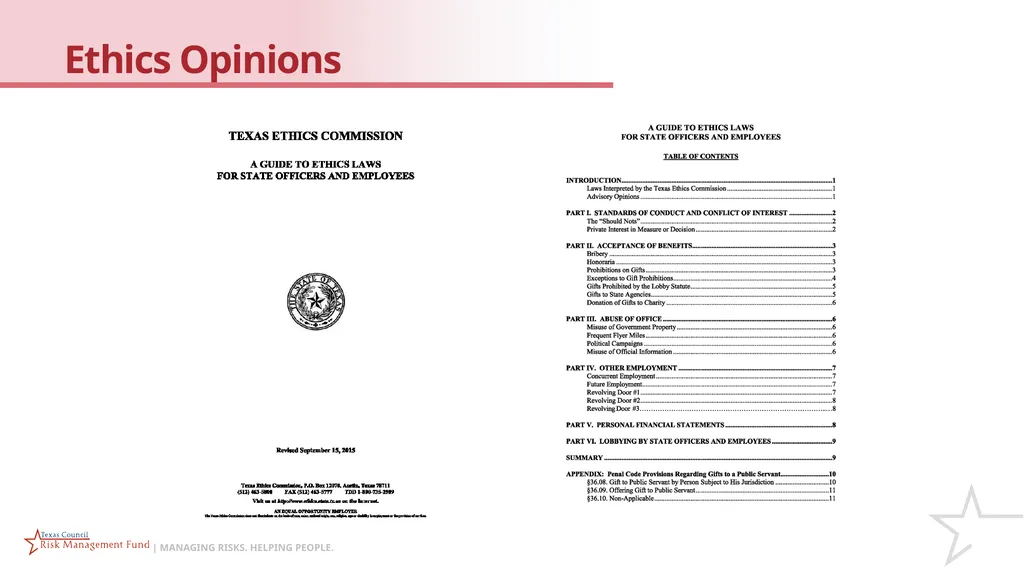
Ethics Opinions<br>
17
Texas Tort Claims Act
Texas Civil Practice & Remedies Code, §101.001, et seq
Provides immunity from suit for the Community Center unless expressly waived
Limitations on damages
For bodily injury or death - $100,000 for each person and $300,000 for each occurrence
For property damage - $100,000 for each occurrence
Texas Payday Act
Governmental entities are exempt from provisions of the Pay Day Act
Texas Labor Code §61.003
Equal Employment Opportunity Commission (EEOC)
Governmental entities are exempt from suit by EEOC
Only Department of Justice can sue governmental entities
Politely answer the charges, but ALWAYS briefly state you are a governmental entity Other Relevant Laws<br>
Texas Civil Practice & Remedies Code, §101.001, et seq
Provides immunity from suit for the Community Center unless expressly waived
Limitations on damages
For bodily injury or death - $100,000 for each person and $300,000 for each occurrence
For property damage - $100,000 for each occurrence
Texas Payday Act
Governmental entities are exempt from provisions of the Pay Day Act
Texas Labor Code §61.003
Equal Employment Opportunity Commission (EEOC)
Governmental entities are exempt from suit by EEOC
Only Department of Justice can sue governmental entities
Politely answer the charges, but ALWAYS briefly state you are a governmental entity Other Relevant Laws<br>
18
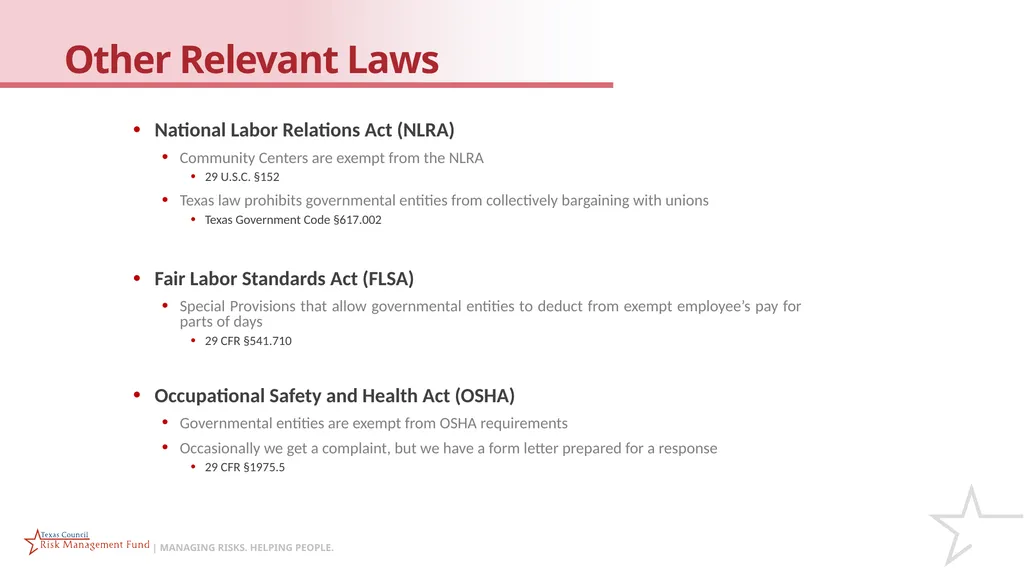
National Labor Relations Act (NLRA)
Community Centers are exempt from the NLRA
29 U.S.C. §152
Texas law prohibits governmental entities from collectively bargaining with unions
Texas Government Code §617.002
Fair Labor Standards Act (FLSA)
Special Provisions that allow governmental entities to deduct from exempt employee’s pay for parts of days
29 CFR §541.710
Occupational Safety and Health Act (OSHA)
Governmental entities are exempt from OSHA requirements
Occasionally we get a complaint, but we have a form letter prepared for a response
29 CFR §1975.5 Other Relevant Laws<br>
Community Centers are exempt from the NLRA
29 U.S.C. §152
Texas law prohibits governmental entities from collectively bargaining with unions
Texas Government Code §617.002
Fair Labor Standards Act (FLSA)
Special Provisions that allow governmental entities to deduct from exempt employee’s pay for parts of days
29 CFR §541.710
Occupational Safety and Health Act (OSHA)
Governmental entities are exempt from OSHA requirements
Occasionally we get a complaint, but we have a form letter prepared for a response
29 CFR §1975.5 Other Relevant Laws<br>
19
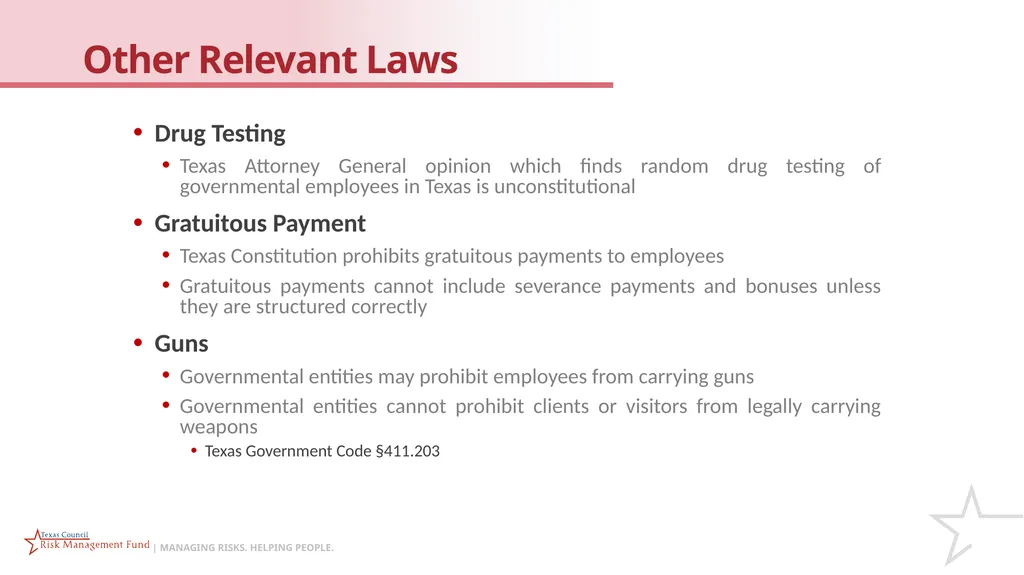
Drug Testing
Texas Attorney General opinion which finds random drug testing of governmental employees in Texas is unconstitutional
Gratuitous Payment
Texas Constitution prohibits gratuitous payments to employees
Gratuitous payments cannot include severance payments and bonuses unless they are structured correctly
Guns
Governmental entities may prohibit employees from carrying guns
Governmental entities cannot prohibit clients or visitors from legally carrying weapons
Texas Government Code §411.203 Other Relevant Laws<br>
Texas Attorney General opinion which finds random drug testing of governmental employees in Texas is unconstitutional
Gratuitous Payment
Texas Constitution prohibits gratuitous payments to employees
Gratuitous payments cannot include severance payments and bonuses unless they are structured correctly
Guns
Governmental entities may prohibit employees from carrying guns
Governmental entities cannot prohibit clients or visitors from legally carrying weapons
Texas Government Code §411.203 Other Relevant Laws<br>
20
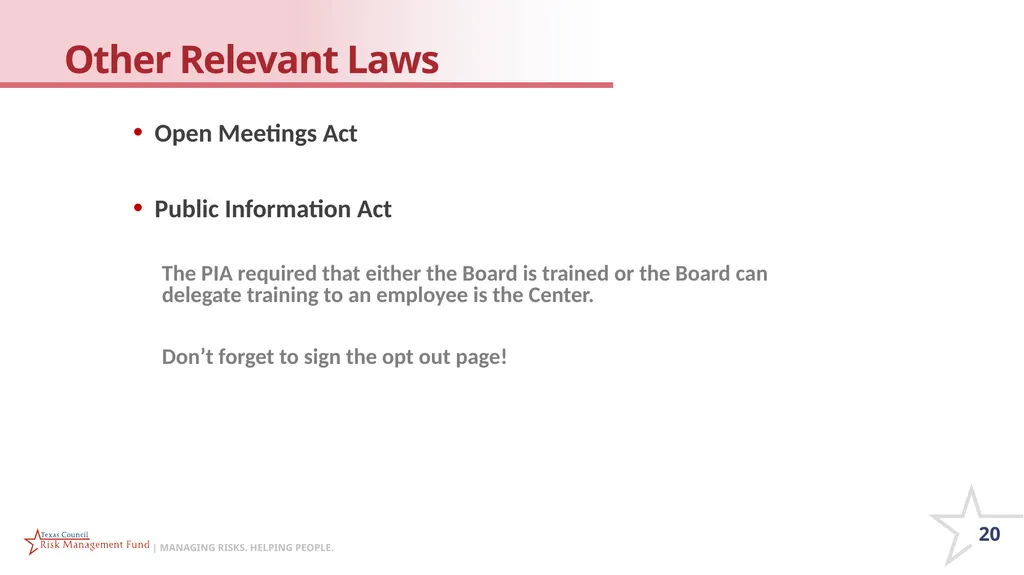
Open Meetings Act
Public Information Act
The PIA required that either the Board is trained or the Board can delegate training to an employee is the Center.
Don’t forget to sign the opt out page! 20 Other Relevant Laws<br>
Public Information Act
The PIA required that either the Board is trained or the Board can delegate training to an employee is the Center.
Don’t forget to sign the opt out page! 20 Other Relevant Laws<br>
21
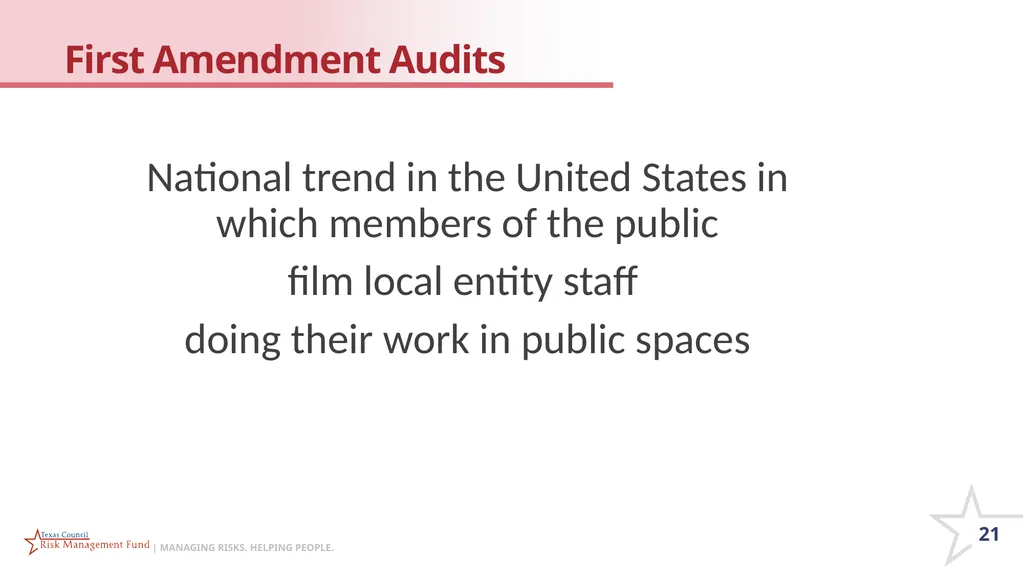
National trend in the United States in which members of the public
film local entity staff
doing their work in public spaces 21 First Amendment Audits<br>
film local entity staff
doing their work in public spaces 21 First Amendment Audits<br>
22
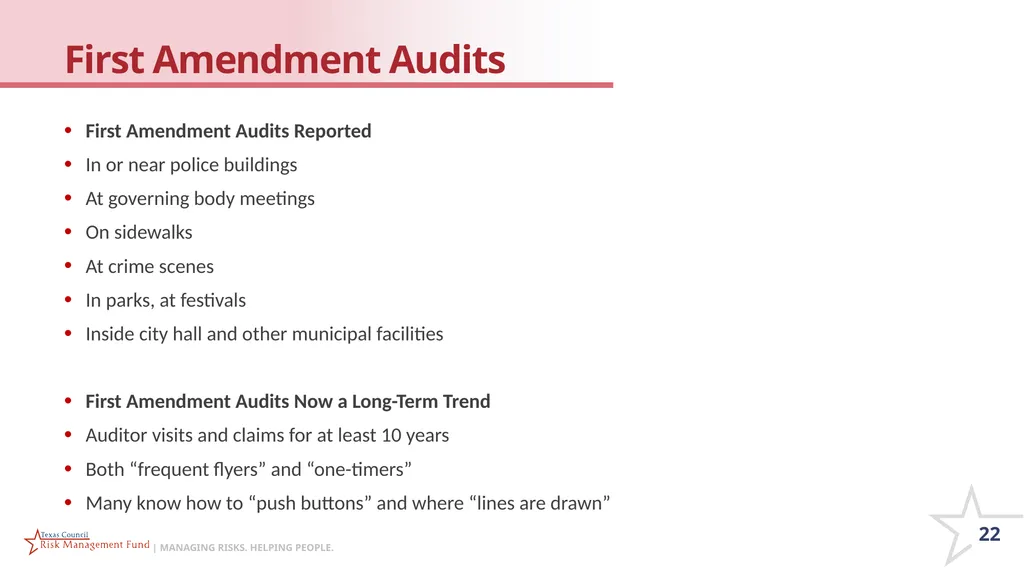
First Amendment Audits Reported
In or near police buildings
At governing body meetings
On sidewalks
At crime scenes
In parks, at festivals
Inside city hall and other municipal facilities
First Amendment Audits Now a Long-Term Trend
Auditor visits and claims for at least 10 years
Both “frequent flyers” and “one-timers”
Many know how to “push buttons” and where “lines are drawn” 22 First Amendment Audits<br>
In or near police buildings
At governing body meetings
On sidewalks
At crime scenes
In parks, at festivals
Inside city hall and other municipal facilities
First Amendment Audits Now a Long-Term Trend
Auditor visits and claims for at least 10 years
Both “frequent flyers” and “one-timers”
Many know how to “push buttons” and where “lines are drawn” 22 First Amendment Audits<br>
23
National trend in the United States in which members of the public
film local entity staff
doing their work in public spaces 23 First Amendment Audits<br>
film local entity staff
doing their work in public spaces 23 First Amendment Audits<br>
24
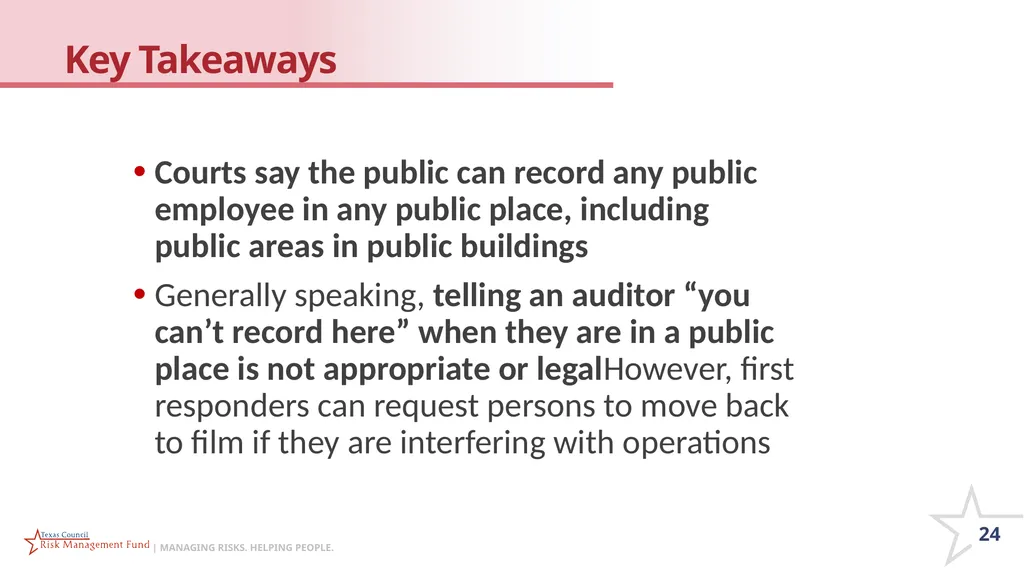
Courts say the public can record any public employee in any public place, including public areas in public buildings
Generally speaking, telling an auditor “you can’t record here” when they are in a public place is not appropriate or legalHowever, first responders can request persons to move back to film if they are interfering with operations 24 Key Takeaways<br>
Generally speaking, telling an auditor “you can’t record here” when they are in a public place is not appropriate or legalHowever, first responders can request persons to move back to film if they are interfering with operations 24 Key Takeaways<br>
25
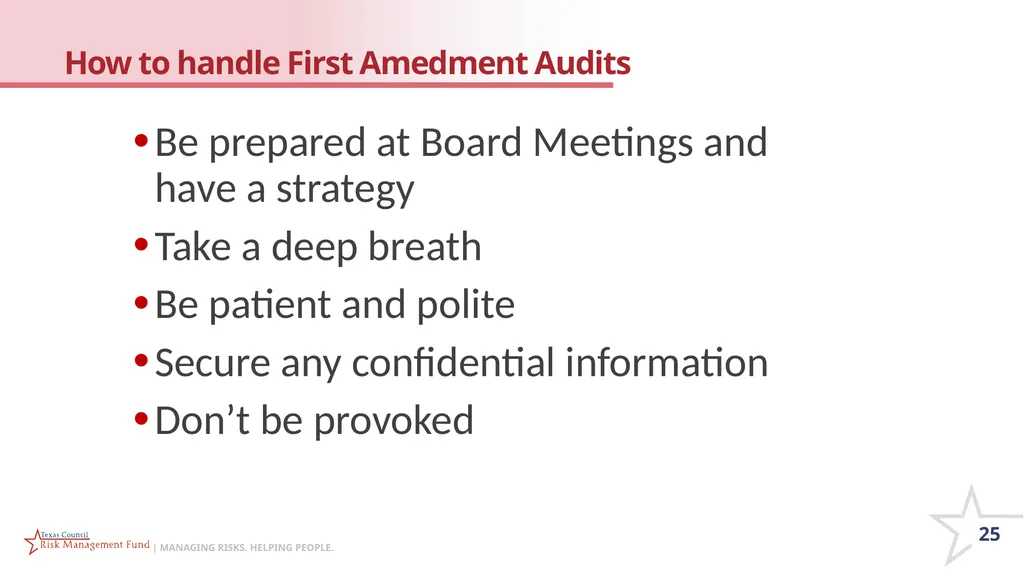
Be prepared at Board Meetings and have a strategy
Take a deep breath
Be patient and polite
Secure any confidential information
Don’t be provoked 25 How to handle First Amedment Audits<br>
Take a deep breath
Be patient and polite
Secure any confidential information
Don’t be provoked 25 How to handle First Amedment Audits<br>
26
The Center is a health care entity. It’s important as board members that you ask three questions:
Does the Center have a compliance plan?
Does the Center have a Compliance officer?
Has the board adopted the center Code of Conduct? 26 Health Care Entity<br>
Does the Center have a compliance plan?
Does the Center have a Compliance officer?
Has the board adopted the center Code of Conduct? 26 Health Care Entity<br>
27
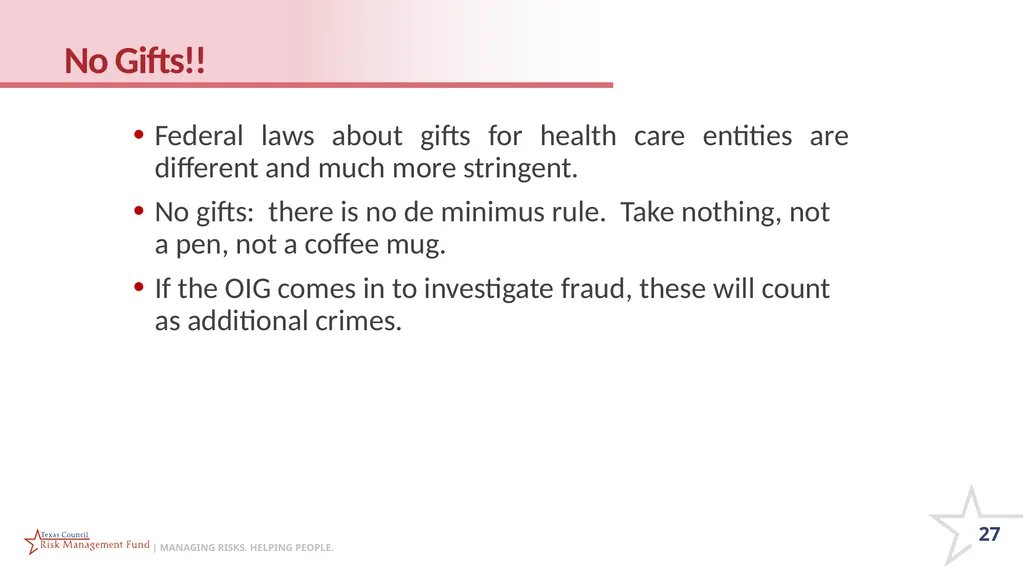
Federal laws about gifts for health care entities are different and much more stringent.
No gifts: there is no de minimus rule. Take nothing, not a pen, not a coffee mug.
If the OIG comes in to investigate fraud, these will count as additional crimes. 27 No Gifts!!<br>
No gifts: there is no de minimus rule. Take nothing, not a pen, not a coffee mug.
If the OIG comes in to investigate fraud, these will count as additional crimes. 27 No Gifts!!<br>
28
Community Center Governance<br>
29
Texas Health and Safety Code, §534.001, et seq
Standards of Administration for Board of Trustees
Department of State Health Services
25 Texas Administrative Cod §411.310
Department of Aging and Disability Services
40 Texas Administrative Code §1.310
Center By-Laws and Center Plan
Texas Government Code §551.001, et seq
Texas Open Meeting Act Applicable Statutes, Codes, Rules, etc.<br>
Standards of Administration for Board of Trustees
Department of State Health Services
25 Texas Administrative Cod §411.310
Department of Aging and Disability Services
40 Texas Administrative Code §1.310
Center By-Laws and Center Plan
Texas Government Code §551.001, et seq
Texas Open Meeting Act Applicable Statutes, Codes, Rules, etc.<br>
30
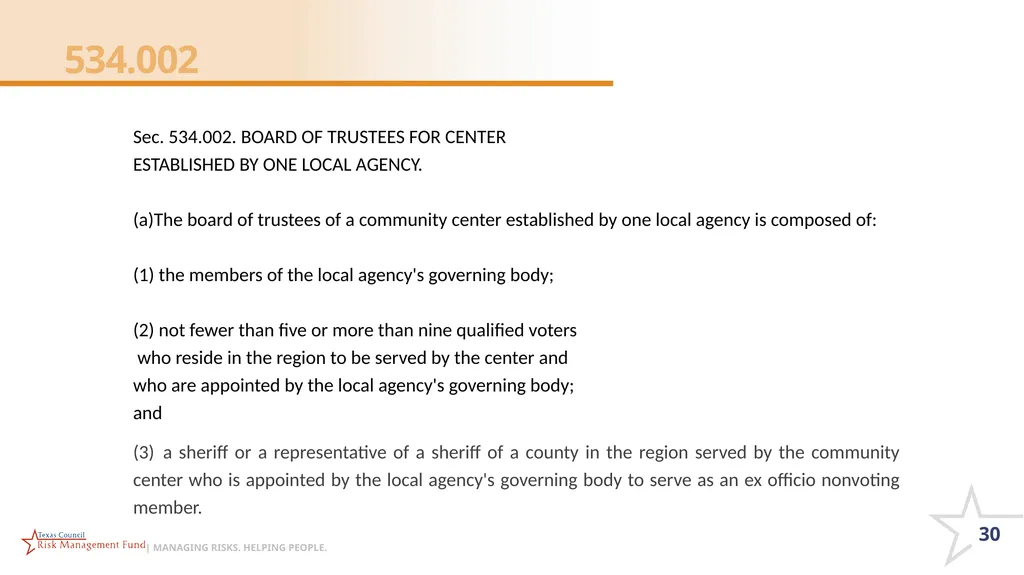
Sec. 534.002. BOARD OF TRUSTEES FOR CENTER
ESTABLISHED BY ONE LOCAL AGENCY.
(a)The board of trustees of a community center established by one local agency is composed of:
(1) the members of the local agency's governing body;
(2) not fewer than five or more than nine qualified voters
who reside in the region to be served by the center and
who are appointed by the local agency's governing body;
and
(3) a sheriff or a representative of a sheriff of a county in the region served by the community center who is appointed by the local agency's governing body to serve as an ex officio nonvoting member. 30 534.002<br>
ESTABLISHED BY ONE LOCAL AGENCY.
(a)The board of trustees of a community center established by one local agency is composed of:
(1) the members of the local agency's governing body;
(2) not fewer than five or more than nine qualified voters
who reside in the region to be served by the center and
who are appointed by the local agency's governing body;
and
(3) a sheriff or a representative of a sheriff of a county in the region served by the community center who is appointed by the local agency's governing body to serve as an ex officio nonvoting member. 30 534.002<br>
31
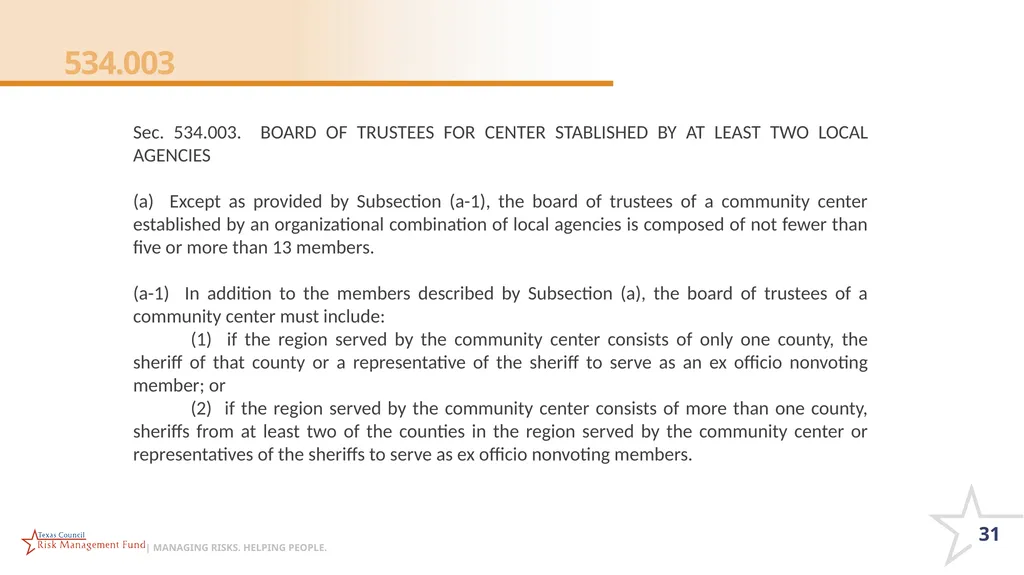
Sec. 534.003. BOARD OF TRUSTEES FOR CENTER STABLISHED BY AT LEAST TWO LOCAL AGENCIES
(a) Except as provided by Subsection (a-1), the board of trustees of a community center established by an organizational combination of local agencies is composed of not fewer than five or more than 13 members.
(a-1) In addition to the members described by Subsection (a), the board of trustees of a community center must include:
(1) if the region served by the community center consists of only one county, the sheriff of that county or a representative of the sheriff to serve as an ex officio nonvoting member; or
(2) if the region served by the community center consists of more than one county, sheriffs from at least two of the counties in the region served by the community center or representatives of the sheriffs to serve as ex officio nonvoting members. 31 534.003<br>
(a) Except as provided by Subsection (a-1), the board of trustees of a community center established by an organizational combination of local agencies is composed of not fewer than five or more than 13 members.
(a-1) In addition to the members described by Subsection (a), the board of trustees of a community center must include:
(1) if the region served by the community center consists of only one county, the sheriff of that county or a representative of the sheriff to serve as an ex officio nonvoting member; or
(2) if the region served by the community center consists of more than one county, sheriffs from at least two of the counties in the region served by the community center or representatives of the sheriffs to serve as ex officio nonvoting members. 31 534.003<br>
32
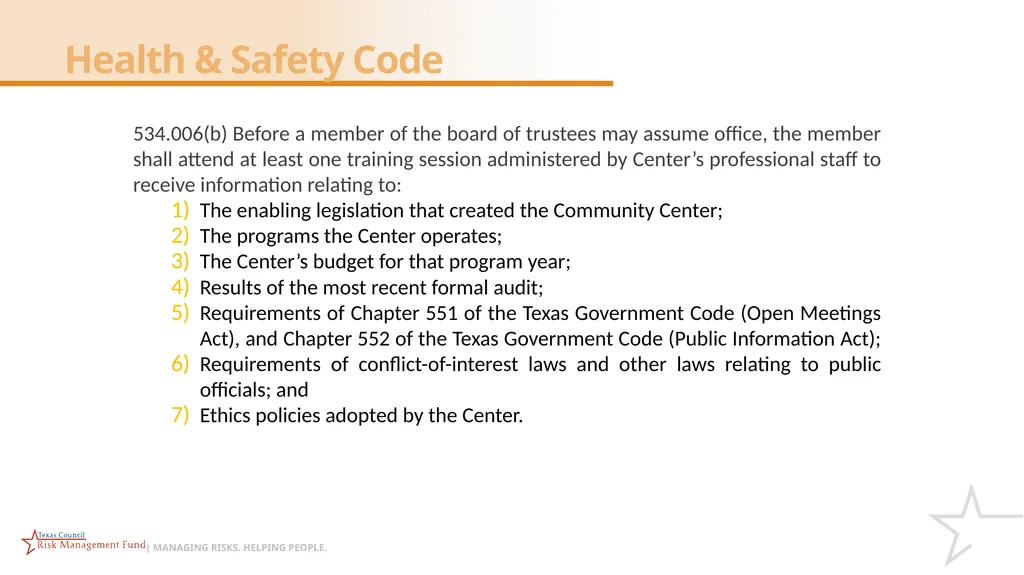
534.006(b) Before a member of the board of trustees may assume office, the member shall attend at least one training session administered by Center’s professional staff to receive information relating to:
The enabling legislation that created the Community Center;
The programs the Center operates;
The Center’s budget for that program year;
Results of the most recent formal audit;
Requirements of Chapter 551 of the Texas Government Code (Open Meetings Act), and Chapter 552 of the Texas Government Code (Public Information Act);
Requirements of conflict-of-interest laws and other laws relating to public officials; and
Ethics policies adopted by the Center. Health & Safety Code<br>
The enabling legislation that created the Community Center;
The programs the Center operates;
The Center’s budget for that program year;
Results of the most recent formal audit;
Requirements of Chapter 551 of the Texas Government Code (Open Meetings Act), and Chapter 552 of the Texas Government Code (Public Information Act);
Requirements of conflict-of-interest laws and other laws relating to public officials; and
Ethics policies adopted by the Center. Health & Safety Code<br>
33
Annual training:
Training methodologies may include:
presentations by staff at regular board sessions;
on-site program visits;
statewide and regional training conferences;
seminars to enhance team building skills;
regional and cross-training with other community centers and their boards of trustees; and
formal and informal meetings with tenured trustee members. Standards of Administration for Board of Trustees<br>
Training methodologies may include:
presentations by staff at regular board sessions;
on-site program visits;
statewide and regional training conferences;
seminars to enhance team building skills;
regional and cross-training with other community centers and their boards of trustees; and
formal and informal meetings with tenured trustee members. Standards of Administration for Board of Trustees<br>
34
Topics may include:
risk management;
budget analysis;
consumer rights;
strategic planning; and
new legislative and contractual requirements of community centers. Standards of Administration for Board of Trustees<br>
risk management;
budget analysis;
consumer rights;
strategic planning; and
new legislative and contractual requirements of community centers. Standards of Administration for Board of Trustees<br>
35
35 Health & Safety Code 534.0065 QUALIFICATIONS; CONFLICT OF INTEREST; REMOVAL.
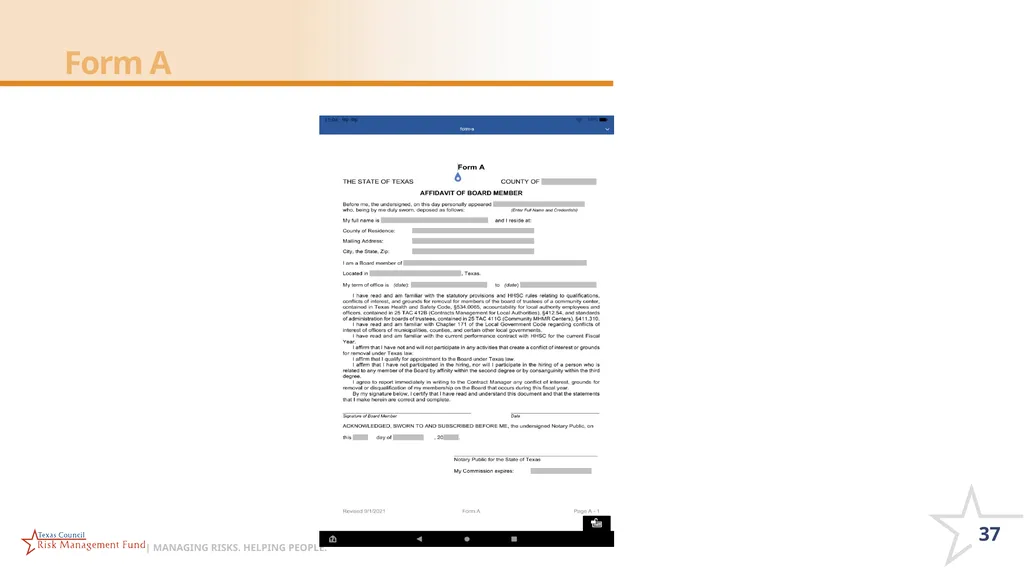
(f) Not later than the date on which a member of the board of trustees takes office by appointment or reappointment and not later than the anniversary of that date, each member shall annually execute and file with the community center an affidavit acknowledging that the member has read the requirements for qualification, conflict of interest, and removal prescribed by this chapter.<br>
(f) Not later than the date on which a member of the board of trustees takes office by appointment or reappointment and not later than the anniversary of that date, each member shall annually execute and file with the community center an affidavit acknowledging that the member has read the requirements for qualification, conflict of interest, and removal prescribed by this chapter.<br>
36
https://www.hhs.texas.gov/providers/behavioral-health-services-providers/behavioral-health-provider-resources/community-mental-health-contracts 36 Form A<br>
37
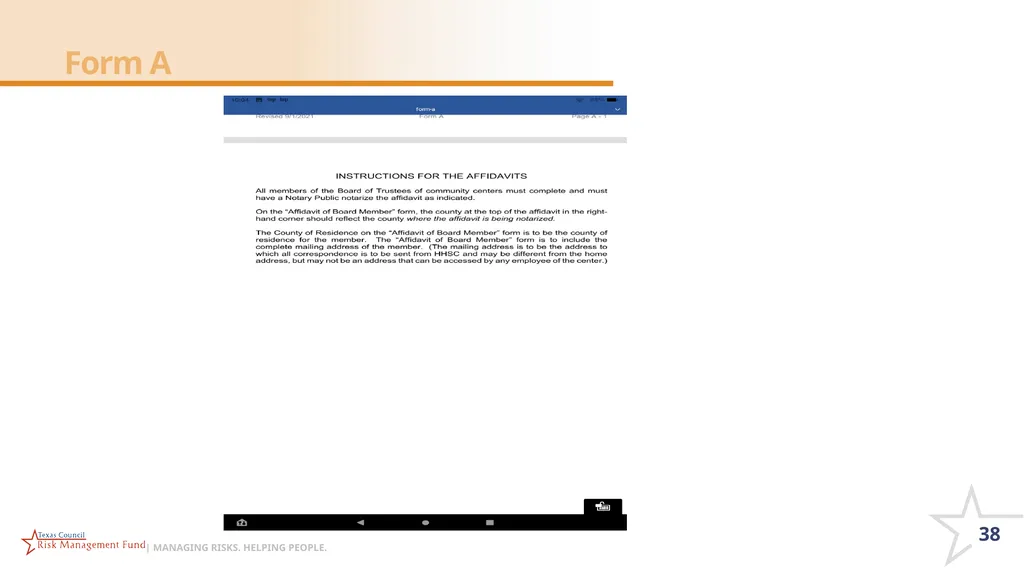
37 Form A<br>
38
38 Form A<br>
39
534.008 – Administration of Board
The board of trustees is responsible for the effective administration of the community center.
The board of trustees shall make policies that are consistent with the department’s rules and standards.
534.009 – Board Meetings
The board of trustees shall adopt rules regarding the holding of regular and special meetings.
Board meetings are open to the public to extent required by and in accordance with Chapter 551, Government Code.
The board of trustees shall keep a record of its proceedings in accordance with Chapter 551, Government Code. The record is open for public inspection in accordance with that law.
Board of Trustees shall send to the department of each appointing local agency a copy of approved board meeting minutes. Texas Health & Safety Code<br>
The board of trustees is responsible for the effective administration of the community center.
The board of trustees shall make policies that are consistent with the department’s rules and standards.
534.009 – Board Meetings
The board of trustees shall adopt rules regarding the holding of regular and special meetings.
Board meetings are open to the public to extent required by and in accordance with Chapter 551, Government Code.
The board of trustees shall keep a record of its proceedings in accordance with Chapter 551, Government Code. The record is open for public inspection in accordance with that law.
Board of Trustees shall send to the department of each appointing local agency a copy of approved board meeting minutes. Texas Health & Safety Code<br>
40
534.010 – Executive Director
The board of trustees shall appoint an executive director for the community center
534.011 – Personnel
The executive director, in accordance with the policies of the board of trustees, shall employ and train personnel to administer the community center's programs and services. The community center may recruit those personnel and contract for recruiting and training purposes.
The board of trustees shall provide employees of the community center with appropriate rights, privileges, and benefits.
The board of trustees may provide workers' compensation benefits. Texas Health & Safety Code<br>
The board of trustees shall appoint an executive director for the community center
534.011 – Personnel
The executive director, in accordance with the policies of the board of trustees, shall employ and train personnel to administer the community center's programs and services. The community center may recruit those personnel and contract for recruiting and training purposes.
The board of trustees shall provide employees of the community center with appropriate rights, privileges, and benefits.
The board of trustees may provide workers' compensation benefits. Texas Health & Safety Code<br>
41
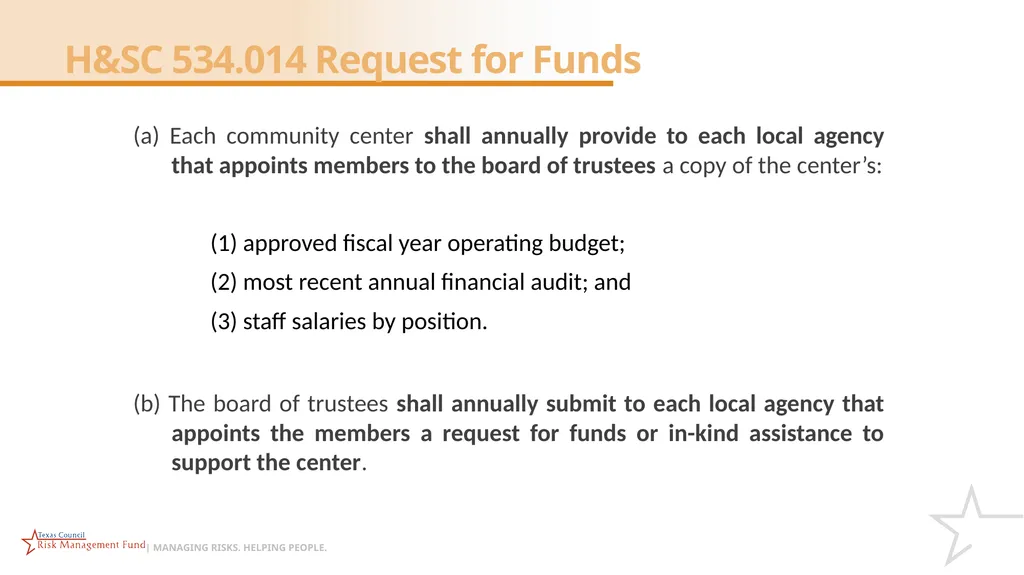
(a) Each community center shall annually provide to each local agency that appoints members to the board of trustees a copy of the center’s:
(1) approved fiscal year operating budget;
(2) most recent annual financial audit; and
(3) staff salaries by position.
(b) The board of trustees shall annually submit to each local agency that appoints the members a request for funds or in-kind assistance to support the center. H&SC 534.014 Request for Funds<br>
(1) approved fiscal year operating budget;
(2) most recent annual financial audit; and
(3) staff salaries by position.
(b) The board of trustees shall annually submit to each local agency that appoints the members a request for funds or in-kind assistance to support the center. H&SC 534.014 Request for Funds<br>
42
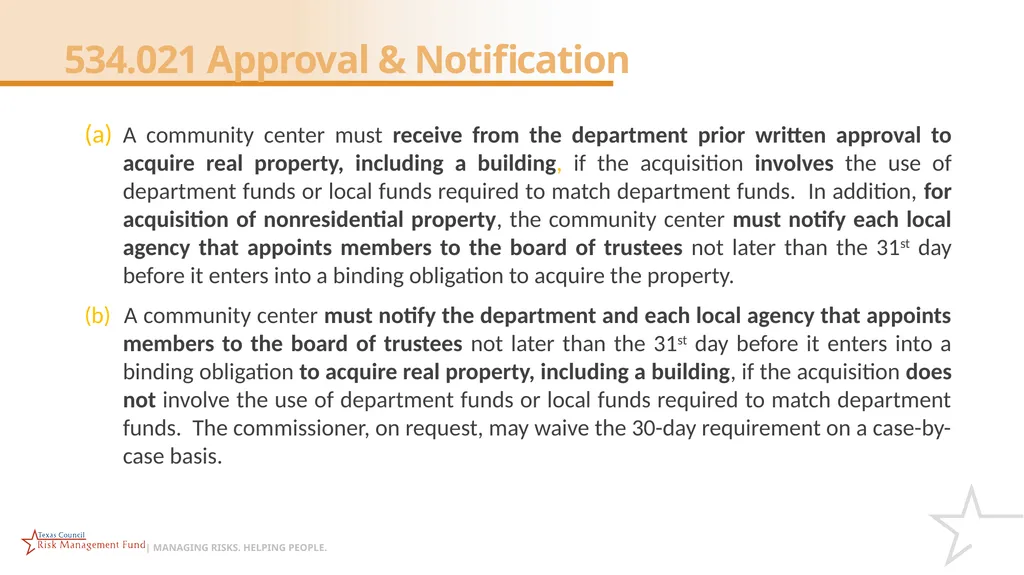
A community center must receive from the department prior written approval to acquire real property, including a building, if the acquisition involves the use of department funds or local funds required to match department funds. In addition, for acquisition of nonresidential property, the community center must notify each local agency that appoints members to the board of trustees not later than the 31st day before it enters into a binding obligation to acquire the property.
(b) A community center must notify the department and each local agency that appoints members to the board of trustees not later than the 31st day before it enters into a binding obligation to acquire real property, including a building, if the acquisition does not involve the use of department funds or local funds required to match department funds. The commissioner, on request, may waive the 30-day requirement on a case-by-case basis. 534.021 Approval & Notification<br>
(b) A community center must notify the department and each local agency that appoints members to the board of trustees not later than the 31st day before it enters into a binding obligation to acquire real property, including a building, if the acquisition does not involve the use of department funds or local funds required to match department funds. The commissioner, on request, may waive the 30-day requirement on a case-by-case basis. 534.021 Approval & Notification<br>
43
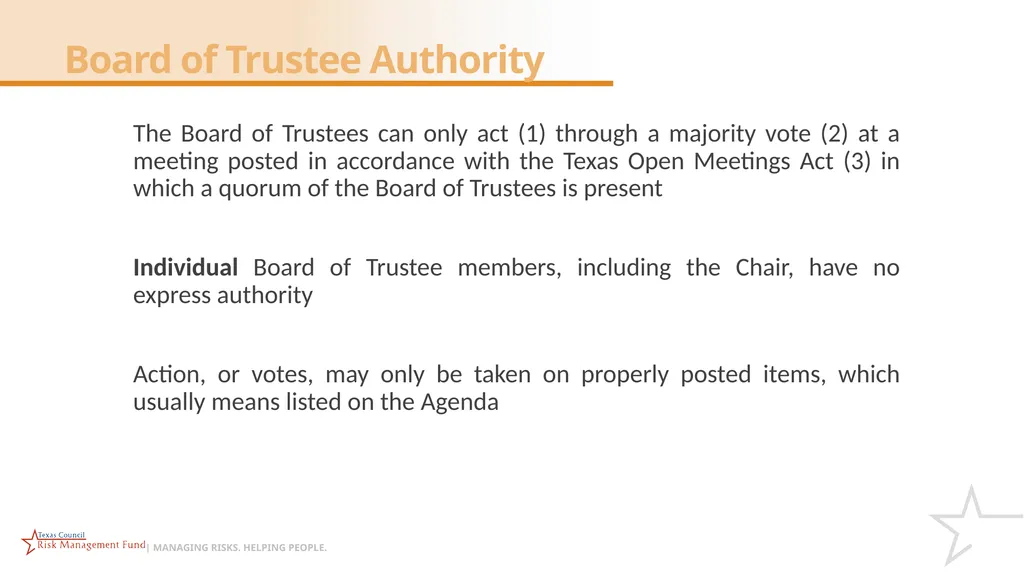
The Board of Trustees can only act (1) through a majority vote (2) at a meeting posted in accordance with the Texas Open Meetings Act (3) in which a quorum of the Board of Trustees is present
Individual Board of Trustee members, including the Chair, have no express authority
Action, or votes, may only be taken on properly posted items, which usually means listed on the Agenda Board of Trustee Authority<br>
Individual Board of Trustee members, including the Chair, have no express authority
Action, or votes, may only be taken on properly posted items, which usually means listed on the Agenda Board of Trustee Authority<br>
44
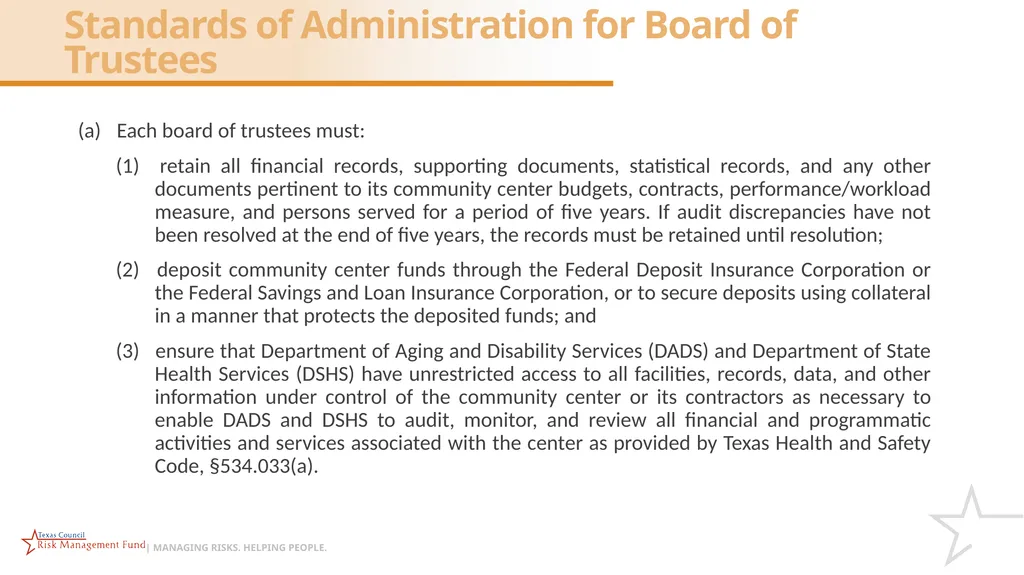
(a) Each board of trustees must:
(1) retain all financial records, supporting documents, statistical records, and any other documents pertinent to its community center budgets, contracts, performance/workload measure, and persons served for a period of five years. If audit discrepancies have not been resolved at the end of five years, the records must be retained until resolution;
(2) deposit community center funds through the Federal Deposit Insurance Corporation or the Federal Savings and Loan Insurance Corporation, or to secure deposits using collateral in a manner that protects the deposited funds; and
(3) ensure that Department of Aging and Disability Services (DADS) and Department of State Health Services (DSHS) have unrestricted access to all facilities, records, data, and other information under control of the community center or its contractors as necessary to enable DADS and DSHS to audit, monitor, and review all financial and programmatic activities and services associated with the center as provided by Texas Health and Safety Code, §534.033(a). Standards of Administration for Board of Trustees<br>
(1) retain all financial records, supporting documents, statistical records, and any other documents pertinent to its community center budgets, contracts, performance/workload measure, and persons served for a period of five years. If audit discrepancies have not been resolved at the end of five years, the records must be retained until resolution;
(2) deposit community center funds through the Federal Deposit Insurance Corporation or the Federal Savings and Loan Insurance Corporation, or to secure deposits using collateral in a manner that protects the deposited funds; and
(3) ensure that Department of Aging and Disability Services (DADS) and Department of State Health Services (DSHS) have unrestricted access to all facilities, records, data, and other information under control of the community center or its contractors as necessary to enable DADS and DSHS to audit, monitor, and review all financial and programmatic activities and services associated with the center as provided by Texas Health and Safety Code, §534.033(a). Standards of Administration for Board of Trustees<br>
45
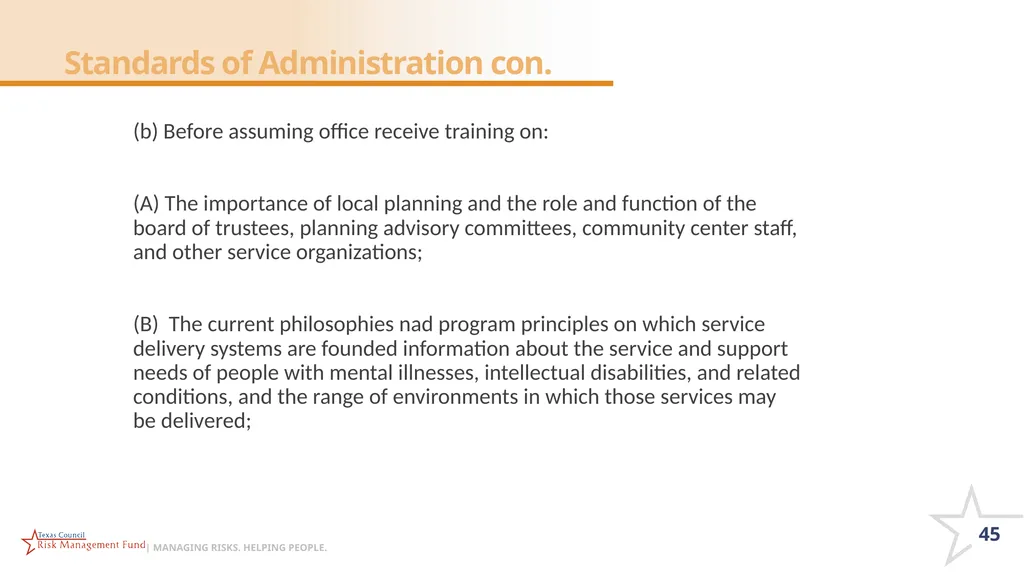
(b) Before assuming office receive training on:
(A) The importance of local planning and the role and function of the board of trustees, planning advisory committees, community center staff, and other service organizations;
(B) The current philosophies nad program principles on which service delivery systems are founded information about the service and support needs of people with mental illnesses, intellectual disabilities, and related conditions, and the range of environments in which those services may be delivered; 45 Standards of Administration con.<br>
(A) The importance of local planning and the role and function of the board of trustees, planning advisory committees, community center staff, and other service organizations;
(B) The current philosophies nad program principles on which service delivery systems are founded information about the service and support needs of people with mental illnesses, intellectual disabilities, and related conditions, and the range of environments in which those services may be delivered; 45 Standards of Administration con.<br>
46
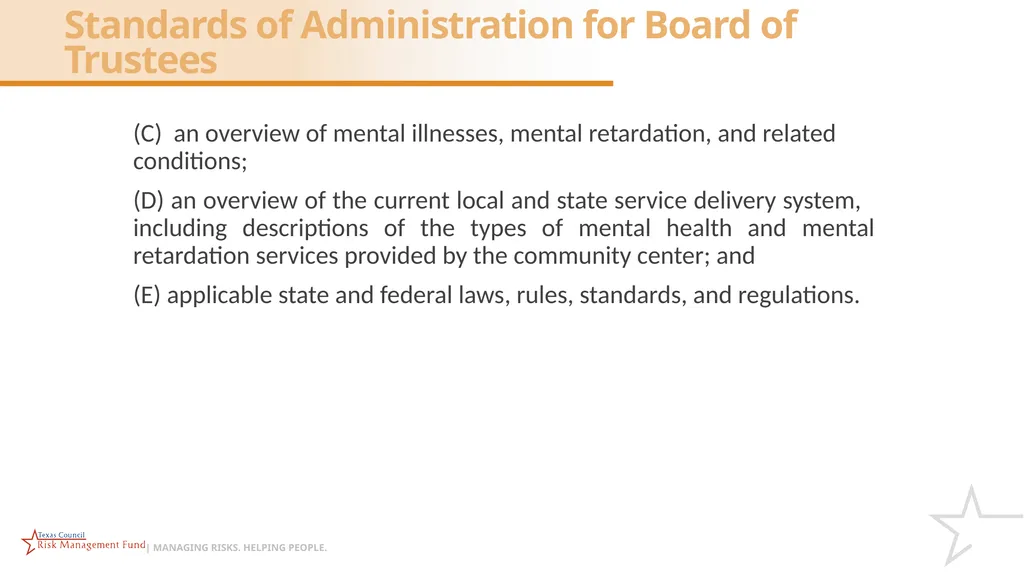
(C) an overview of mental illnesses, mental retardation, and related conditions;
(D) an overview of the current local and state service delivery system, including descriptions of the types of mental health and mental retardation services provided by the community center; and
(E) applicable state and federal laws, rules, standards, and regulations. Standards of Administration for Board of Trustees<br>
(D) an overview of the current local and state service delivery system, including descriptions of the types of mental health and mental retardation services provided by the community center; and
(E) applicable state and federal laws, rules, standards, and regulations. Standards of Administration for Board of Trustees<br>
47
Three types of immunity apply to public officials
Legislative
Judicial
Qualified/Official Individual Immunity<br>
Legislative
Judicial
Qualified/Official Individual Immunity<br>
48
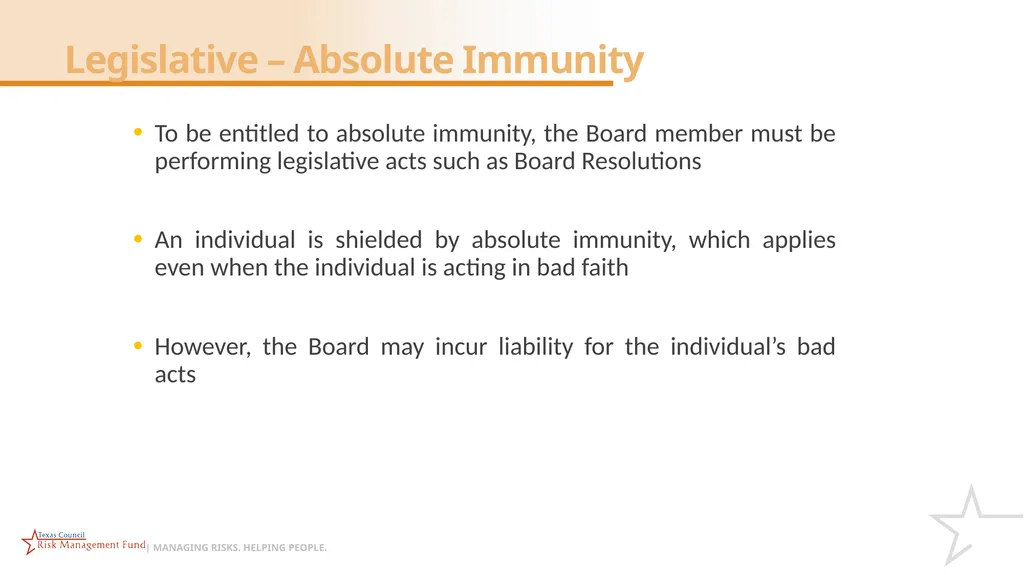
To be entitled to absolute immunity, the Board member must be performing legislative acts such as Board Resolutions
An individual is shielded by absolute immunity, which applies even when the individual is acting in bad faith
However, the Board may incur liability for the individual’s bad acts Legislative – Absolute Immunity<br>
An individual is shielded by absolute immunity, which applies even when the individual is acting in bad faith
However, the Board may incur liability for the individual’s bad acts Legislative – Absolute Immunity<br>
49
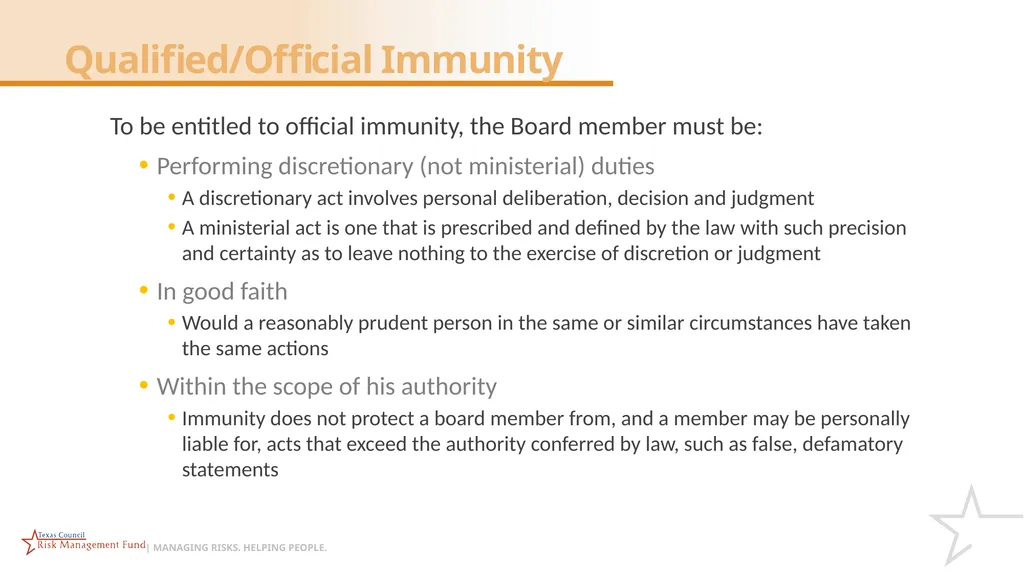
To be entitled to official immunity, the Board member must be:
Performing discretionary (not ministerial) duties
A discretionary act involves personal deliberation, decision and judgment
A ministerial act is one that is prescribed and defined by the law with such precision and certainty as to leave nothing to the exercise of discretion or judgment
In good faith
Would a reasonably prudent person in the same or similar circumstances have taken the same actions
Within the scope of his authority
Immunity does not protect a board member from, and a member may be personally liable for, acts that exceed the authority conferred by law, such as false, defamatory statements Qualified/Official Immunity<br>
Performing discretionary (not ministerial) duties
A discretionary act involves personal deliberation, decision and judgment
A ministerial act is one that is prescribed and defined by the law with such precision and certainty as to leave nothing to the exercise of discretion or judgment
In good faith
Would a reasonably prudent person in the same or similar circumstances have taken the same actions
Within the scope of his authority
Immunity does not protect a board member from, and a member may be personally liable for, acts that exceed the authority conferred by law, such as false, defamatory statements Qualified/Official Immunity<br>
50
Open Meetings Act Quick Tips 50<br>
51
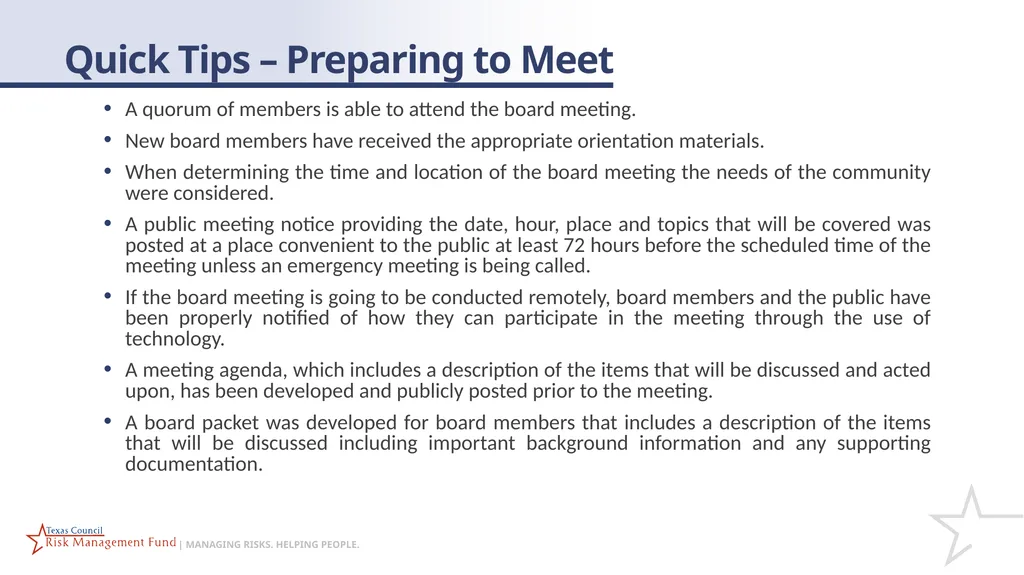
A quorum of members is able to attend the board meeting.
New board members have received the appropriate orientation materials.
When determining the time and location of the board meeting the needs of the community were considered.
A public meeting notice providing the date, hour, place and topics that will be covered was posted at a place convenient to the public at least 72 hours before the scheduled time of the meeting unless an emergency meeting is being called.
If the board meeting is going to be conducted remotely, board members and the public have been properly notified of how they can participate in the meeting through the use of technology.
A meeting agenda, which includes a description of the items that will be discussed and acted upon, has been developed and publicly posted prior to the meeting.
A board packet was developed for board members that includes a description of the items that will be discussed including important background information and any supporting documentation. Quick Tips – Preparing to Meet<br>
New board members have received the appropriate orientation materials.
When determining the time and location of the board meeting the needs of the community were considered.
A public meeting notice providing the date, hour, place and topics that will be covered was posted at a place convenient to the public at least 72 hours before the scheduled time of the meeting unless an emergency meeting is being called.
If the board meeting is going to be conducted remotely, board members and the public have been properly notified of how they can participate in the meeting through the use of technology.
A meeting agenda, which includes a description of the items that will be discussed and acted upon, has been developed and publicly posted prior to the meeting.
A board packet was developed for board members that includes a description of the items that will be discussed including important background information and any supporting documentation. Quick Tips – Preparing to Meet<br>
52
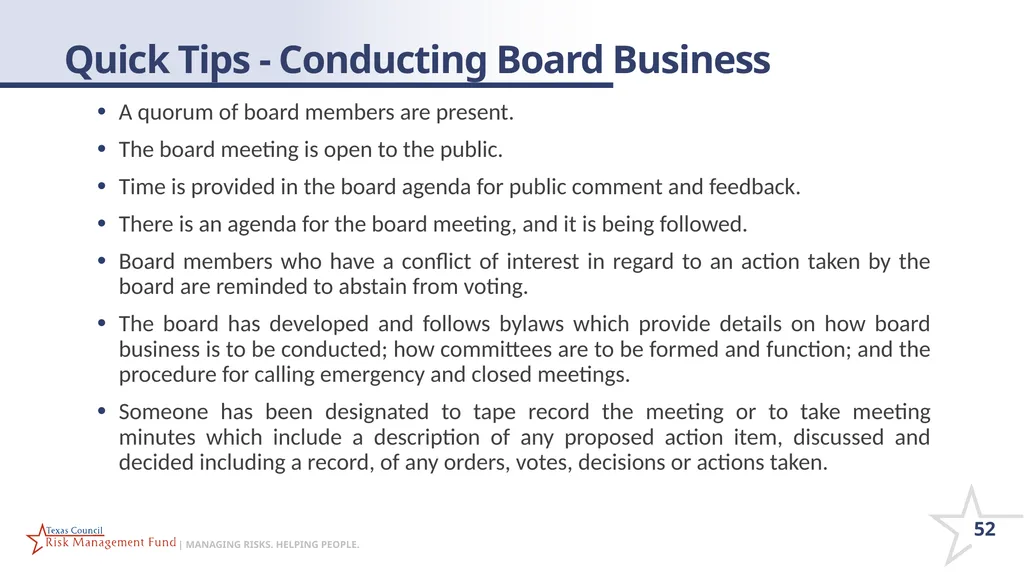
A quorum of board members are present.
The board meeting is open to the public.
Time is provided in the board agenda for public comment and feedback.
There is an agenda for the board meeting, and it is being followed.
Board members who have a conflict of interest in regard to an action taken by the board are reminded to abstain from voting.
The board has developed and follows bylaws which provide details on how board business is to be conducted; how committees are to be formed and function; and the procedure for calling emergency and closed meetings.
Someone has been designated to tape record the meeting or to take meeting minutes which include a description of any proposed action item, discussed and decided including a record, of any orders, votes, decisions or actions taken. 52 Quick Tips - Conducting Board Business<br>
The board meeting is open to the public.
Time is provided in the board agenda for public comment and feedback.
There is an agenda for the board meeting, and it is being followed.
Board members who have a conflict of interest in regard to an action taken by the board are reminded to abstain from voting.
The board has developed and follows bylaws which provide details on how board business is to be conducted; how committees are to be formed and function; and the procedure for calling emergency and closed meetings.
Someone has been designated to tape record the meeting or to take meeting minutes which include a description of any proposed action item, discussed and decided including a record, of any orders, votes, decisions or actions taken. 52 Quick Tips - Conducting Board Business<br>
53
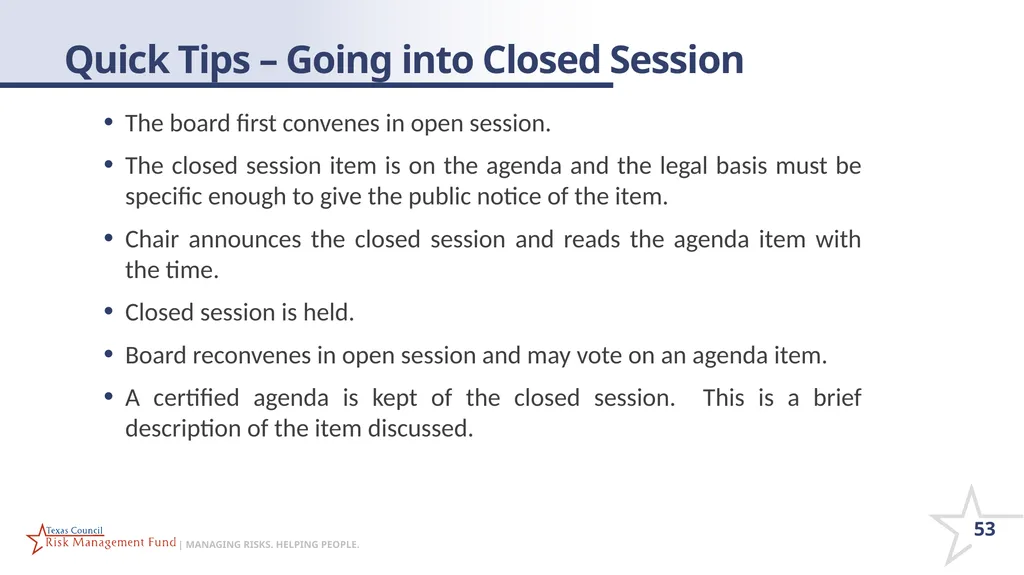
The board first convenes in open session.
The closed session item is on the agenda and the legal basis must be specific enough to give the public notice of the item.
Chair announces the closed session and reads the agenda item with the time.
Closed session is held.
Board reconvenes in open session and may vote on an agenda item.
A certified agenda is kept of the closed session. This is a brief description of the item discussed. 53 Quick Tips – Going into Closed Session<br>
The closed session item is on the agenda and the legal basis must be specific enough to give the public notice of the item.
Chair announces the closed session and reads the agenda item with the time.
Closed session is held.
Board reconvenes in open session and may vote on an agenda item.
A certified agenda is kept of the closed session. This is a brief description of the item discussed. 53 Quick Tips – Going into Closed Session<br>
54
A tape recording of the board meeting or meeting minutes are made available to the public for their review upon request.
Committees are working to prepare for future meetings.
The board chair is gathering input for future agenda items.
Action items from the meeting are assigned and follow up is monitored 54 Quick Tips – After the meeting<br>
Committees are working to prepare for future meetings.
The board chair is gathering input for future agenda items.
Action items from the meeting are assigned and follow up is monitored 54 Quick Tips – After the meeting<br>
55
Questions?<br>