
Child Development Revision Guide CNAT OCR Name:



Description: Child Development Revision Guide CNAT OCR Name: Introduction Welcome to your TA1 Child Development Revision Booklet! This booklet is designed to be your comprehensive guide to preparing for the OCR Child Development TA1 exam. Inside, youll
Related Topics
Download Presentation
"Child Development Revision Guide CNAT OCR Name:" is the property of its rightful owner. Permission is granted to download and print the materials on this website for personal, non-commercial use only, and to display it on your personal computer provided you do not modify the materials and that you retain all copyright notices contained in the materials. By downloading content from our website, you accept the terms of this agreement.
Presentation Transcript
slide1. Child Development Revision Guide
CNAT OCR Name:<br>
slide2. Introduction Welcome to your TA1 Child Development Revision Booklet! This booklet is designed to be your comprehensive guide to preparing for the OCR Child Development TA1 exam. Inside, you'll find everything you need to confidently tackle the assessment.
To help you organise your revision, we've included helpful checklists to break down the information into manageable chunks. Each section of the TA1 specification is covered, providing a clear and concise overview of the key concepts. We've also included QR codes throughout the booklet that link to helpful websites, offering supplementary information and different perspectives on the topics.
To really get you thinking and applying your knowledge, each section concludes with activities designed to address common misconceptions and challenge your understanding. You'll also find practice exam questions, complete with model answers, to give you a feel for the exam format and the level of detail required.
Finally, a comprehensive glossary of key terms is provided at the back of the booklet.
Don't forget to check the very back for a complete answer section for all the activities.
Good luck with your revision!<br>
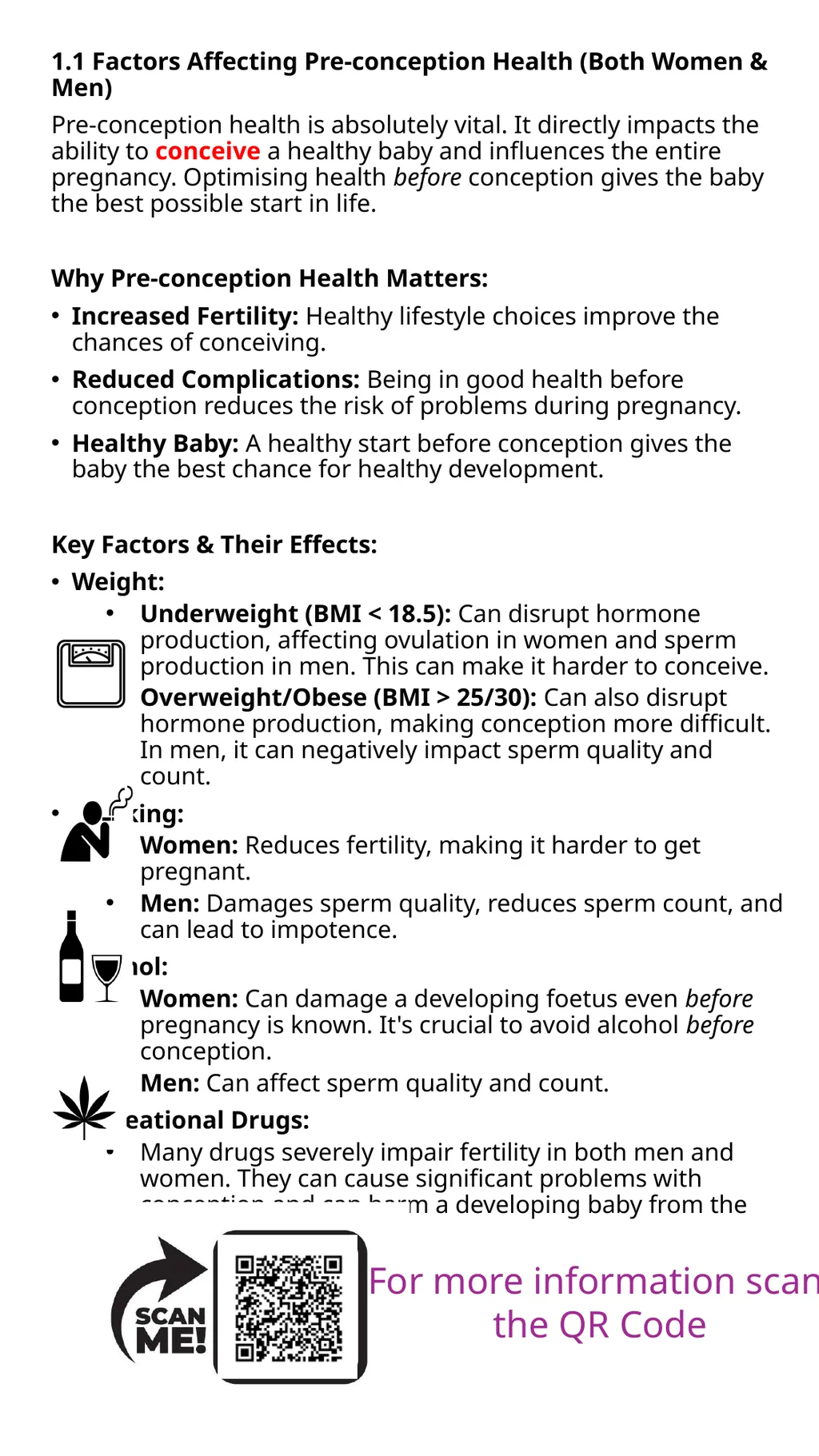
slide4. 1.1 Factors Affecting Pre-conception Health (Both Women & Men)
Pre-conception health is absolutely vital. It directly impacts the ability to conceive a healthy baby and influences the entire pregnancy. Optimising health before conception gives the baby the best possible start in life.
Why Pre-conception Health Matters:
Increased Fertility: Healthy lifestyle choices improve the chances of conceiving.
Reduced Complications: Being in good health before conception reduces the risk of problems during pregnancy.
Healthy Baby: A healthy start before conception gives the baby the best chance for healthy development.
Key Factors & Their Effects:
Weight:
Underweight (BMI < 18.5): Can disrupt hormone production, affecting ovulation in women and sperm production in men. This can make it harder to conceive.
Overweight/Obese (BMI > 25/30): Can also disrupt hormone production, making conception more difficult. In men, it can negatively impact sperm quality and count.
Smoking:
Women: Reduces fertility, making it harder to get pregnant.
Men: Damages sperm quality, reduces sperm count, and can lead to impotence.
Alcohol:
Women: Can damage a developing foetus even before pregnancy is known. It's crucial to avoid alcohol before conception.
Men: Can affect sperm quality and count.
Recreational Drugs:
Many drugs severely impair fertility in both men and women. They can cause significant problems with conception and can harm a developing baby from the moment of conception. For more information scan
the QR Code<br>
slide5. For more information scan
the QR Code<br>
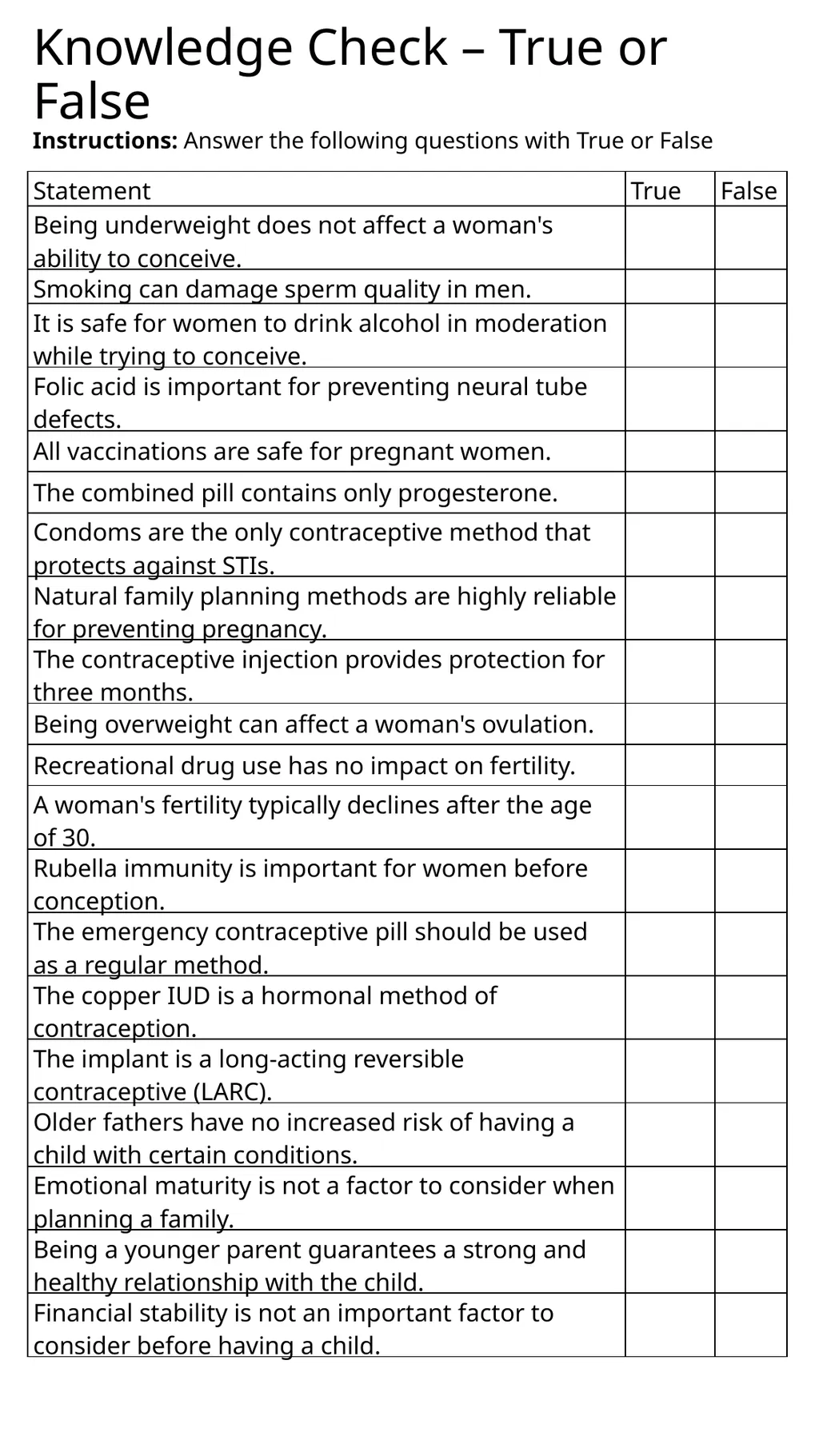
slide6. Knowledge Check – True or False Instructions: Answer the following questions with True or False<br>
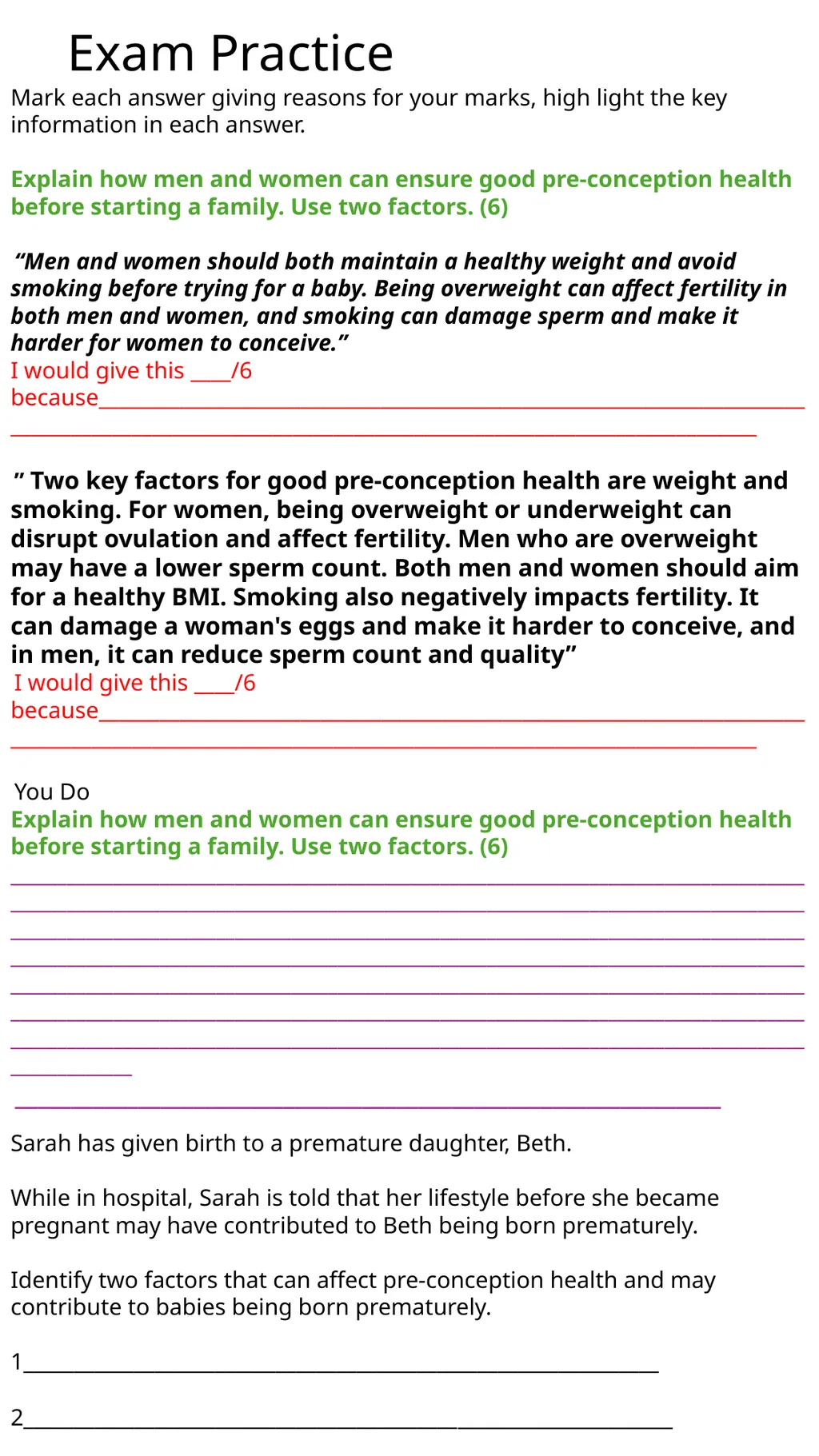
slide7. Exam Practice Mark each answer giving reasons for your marks, high light the key information in each answer.
Explain how men and women can ensure good pre-conception health before starting a family. Use two factors. (6)
“Men and women should both maintain a healthy weight and avoid smoking before trying for a baby. Being overweight can affect fertility in both men and women, and smoking can damage sperm and make it harder for women to conceive.”
I would give this ____/6 because________________________________________________________________________________________________________________________________________________
” Two key factors for good pre-conception health are weight and smoking. For women, being overweight or underweight can disrupt ovulation and affect fertility. Men who are overweight may have a lower sperm count. Both men and women should aim for a healthy BMI. Smoking also negatively impacts fertility. It can damage a woman's eggs and make it harder to conceive, and in men, it can reduce sperm count and quality”
I would give this ____/6 because________________________________________________________________________________________________________________________________________________
You Do Explain how men and women can ensure good pre-conception health before starting a family. Use two factors. (6) ________________________________________________________________________________________________________________________________________________________________________________________________________________________________________________________________________________________________________________________________________________________________________________________________________________________________________________________________________________________________________________________________________________________________________________________________________________________________
_______________________________________________________________ Sarah has given birth to a premature daughter, Beth.
While in hospital, Sarah is told that her lifestyle before she became pregnant may have contributed to Beth being born prematurely.
Identify two factors that can affect pre-conception health and may contribute to babies being born prematurely.
1_______________________________________________________________
2_______________________________________________________________<br>
slide8. Emma and Liam want to start a family together. Emma and Liam want to make sure that their pre-conception health is the best it can be, before Emma becomes pregnant. Explain what they could do to ensure good pre-conception health
(8 marks)
This is an 8/8 answer, highlight all the key words this answer has used
A balanced diet and regular exercise are important. Emma and Liam should try and stick to guidelines, such as the Eatwell Guide, consuming at least five portions of fruit and vegetables daily to get necessary vitamins and minerals.
Reducing sugar intake is also important to prevent the development of diabetes, a condition that can present complications during pregnancy. Emma should commence folic acid before conception, as it is essential for preventing neural tube defects, such as spina bifida, in the developing foetus.
Regular physical activity is beneficial for both Emma and Liam. It assists Emma in maintaining a healthy weight and enhances her overall fitness, which will be good for labour. For Liam, exercise promotes general well-being and supports healthy sperm production. Maintaining a healthy weight is important, as being overweight or underweight can negatively impact fertility in both men and women. In Emma's case, it can stop ovulation, therefore preventing conception, and can increase the risk of pregnancy-related complications. For Liam, excess weight can result in a a smaller sperm count.
Smoking and alcohol consumption should also be considered. Both Emma and Liam should stop smoking well in advance conception, as it can impairs fertility in both men and women. Smoking damages sperm, reducing both the count and quality, and increases the risk of miscarriage and other pregnancy complications.
Liam should reduce or ideally stop drinking alcohol as it can lower sperm count. Emma is advised to refrain from alcohol entirely when trying to conceive, as it can be detrimental to the developing foetus, even before pregnancy is confirmed.<br>
slide9. Emma and Liam want to start a family together. Emma and Liam want to make sure that their pre-conception health is the best it can be, before Emma becomes pregnant. Explain what they could do to ensure good pre-conception health
Can you do two paragraphs on why Emma and Liam should consider both prescription and recreational drugs as well keeping up to date with immunisations.
_______________________________________________________________________________________________________________________________________________________________________________________________________________________________________________________________________________________________________________________________________________________________________________________________________________________________________________________________________________________________________________________________________________________________________________________________________________________________________________________________________________________________________________________________________________________________________________________________________________________________________________________________________________________________________________________________________________________________________________________________________________________________________________________________________________________________________________________________________________________________________________________________________________________________________________________________________________________.<br>
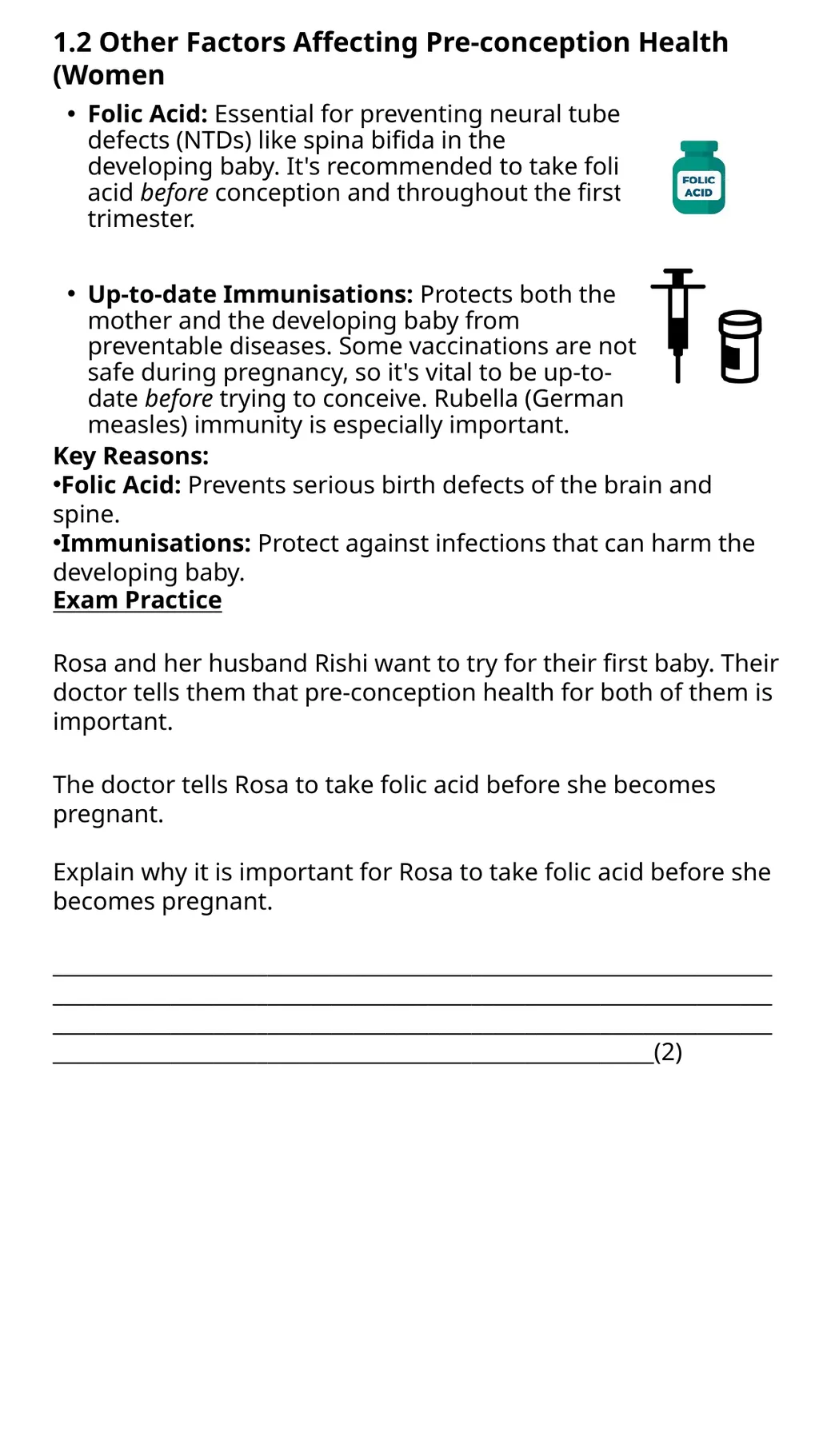
slide10. Folic Acid: Essential for preventing neural tube defects (NTDs) like spina bifida in the developing baby. It's recommended to take folic acid before conception and throughout the first trimester.
Up-to-date Immunisations: Protects both the mother and the developing baby from preventable diseases. Some vaccinations are not safe during pregnancy, so it's vital to be up-to-date before trying to conceive. Rubella (German measles) immunity is especially important. 1.2 Other Factors Affecting Pre-conception Health (Women Key Reasons:
Folic Acid: Prevents serious birth defects of the brain and spine.
Immunisations: Protect against infections that can harm the developing baby. Exam Practice
Rosa and her husband Rishi want to try for their first baby. Their doctor tells them that pre-conception health for both of them is important.
The doctor tells Rosa to take folic acid before she becomes pregnant. Explain why it is important for Rosa to take folic acid before she becomes pregnant.
_________________________________________________________________________________________________________________________________________________________________________________________________________________________________________________________________(2)<br>
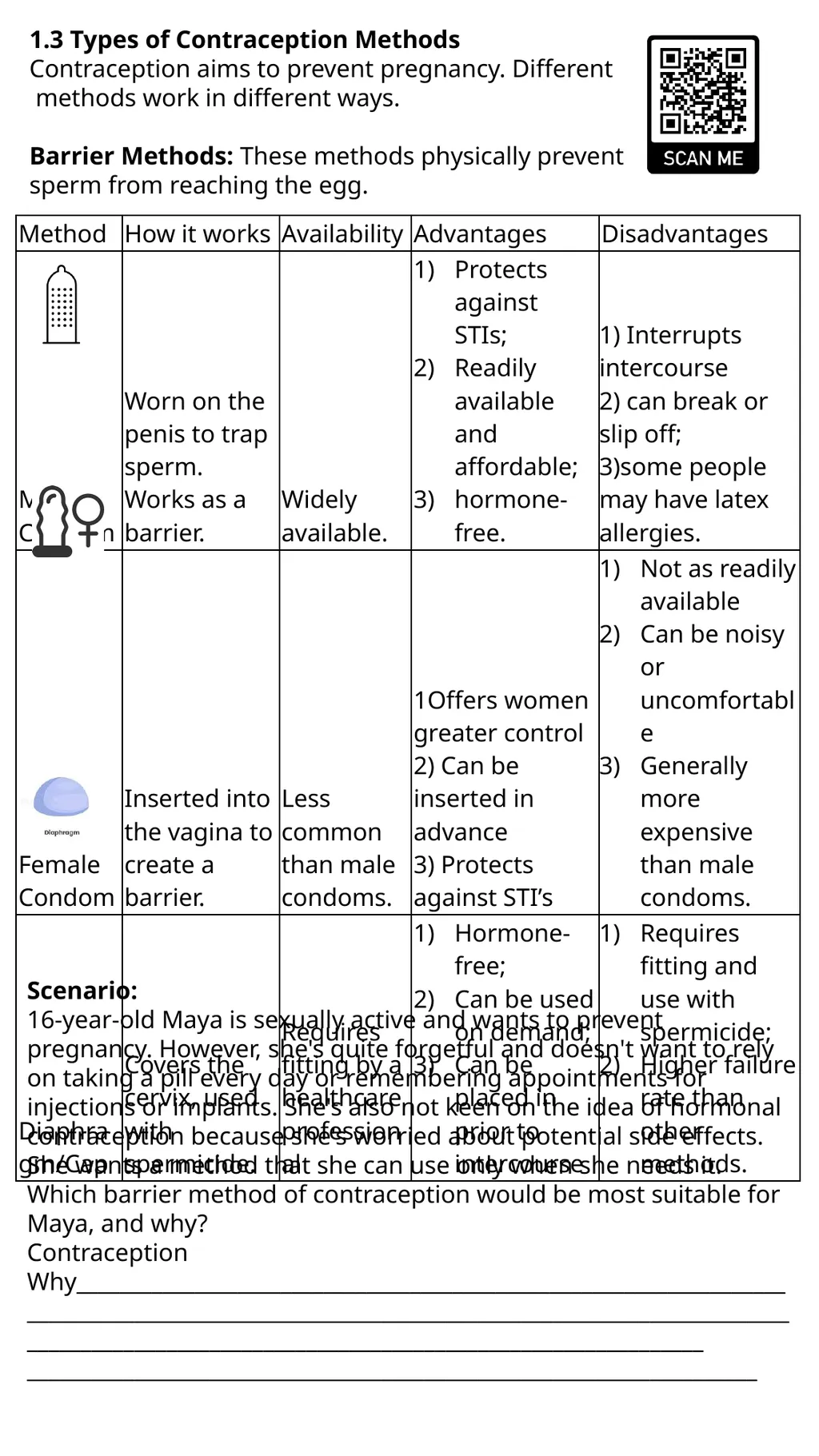
slide11. 1.3 Types of Contraception Methods
Contraception aims to prevent pregnancy. Different
methods work in different ways.
Barrier Methods: These methods physically prevent
sperm from reaching the egg. Scenario:
16-year-old Maya is sexually active and wants to prevent pregnancy. However, she's quite forgetful and doesn't want to rely on taking a pill every day or remembering appointments for injections or implants. She's also not keen on the idea of hormonal contraception because she's worried about potential side effects. She wants a method that she can use only when she needs it.
Which barrier method of contraception would be most suitable for Maya, and why?
Contraception
Why________________________________________________________________________________________________________________________________________________________________________________________________________
____________________________________________________________________<br>
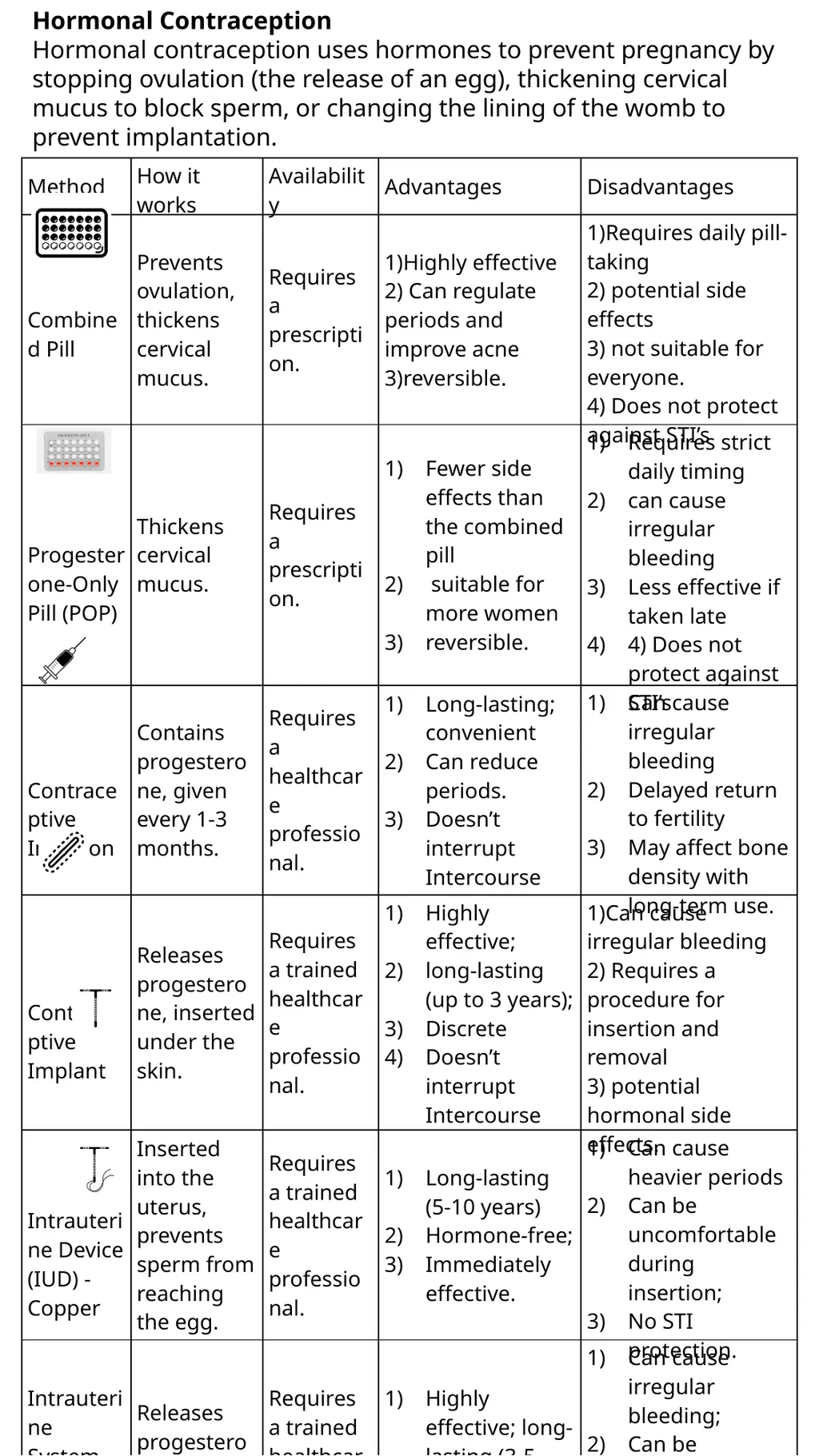
slide12. Hormonal Contraception
Hormonal contraception uses hormones to prevent pregnancy by stopping ovulation (the release of an egg), thickening cervical mucus to block sperm, or changing the lining of the womb to prevent implantation.<br>
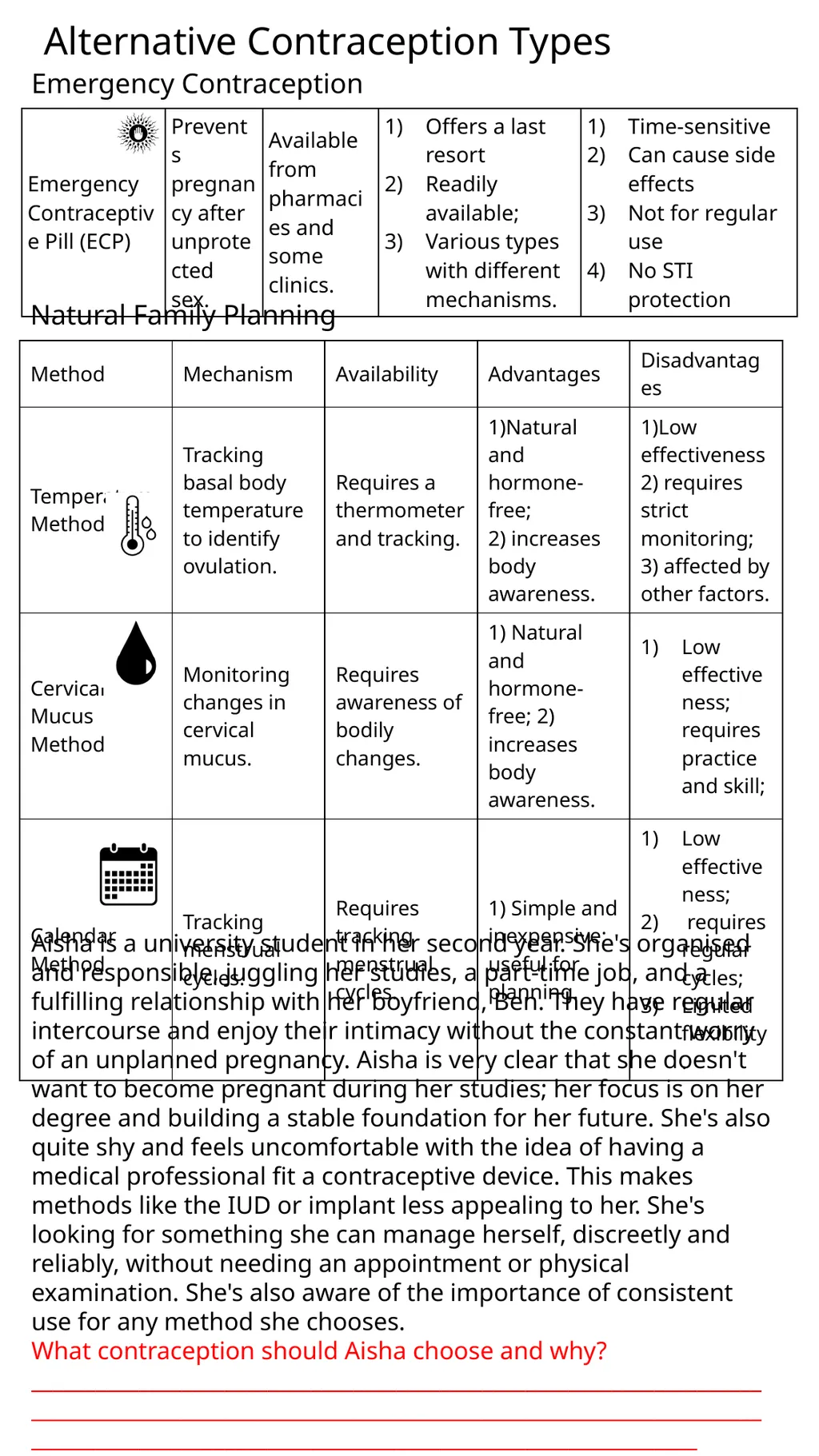
slide13. Alternative Contraception Types Natural Family Planning Emergency Contraception Aisha is a university student in her second year. She's organised and responsible, juggling her studies, a part-time job, and a fulfilling relationship with her boyfriend, Ben. They have regular intercourse and enjoy their intimacy without the constant worry of an unplanned pregnancy. Aisha is very clear that she doesn't want to become pregnant during her studies; her focus is on her degree and building a stable foundation for her future. She's also quite shy and feels uncomfortable with the idea of having a medical professional fit a contraceptive device. This makes methods like the IUD or implant less appealing to her. She's looking for something she can manage herself, discreetly and reliably, without needing an appointment or physical examination. She's also aware of the importance of consistent use for any method she chooses.
What contraception should Aisha choose and why?
______________________________________________________________________________________________________________________________________________________________________________________________________<br>
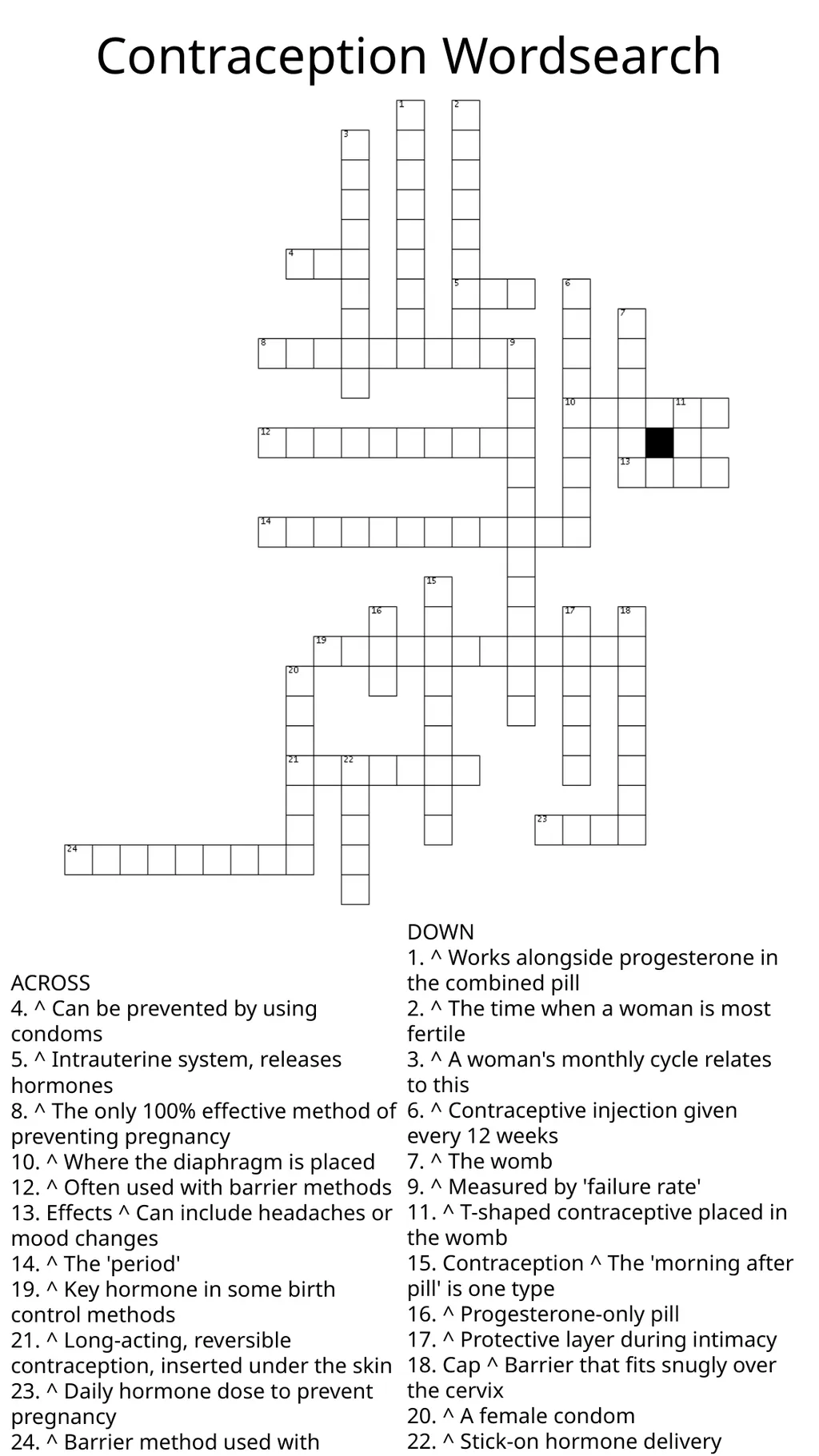
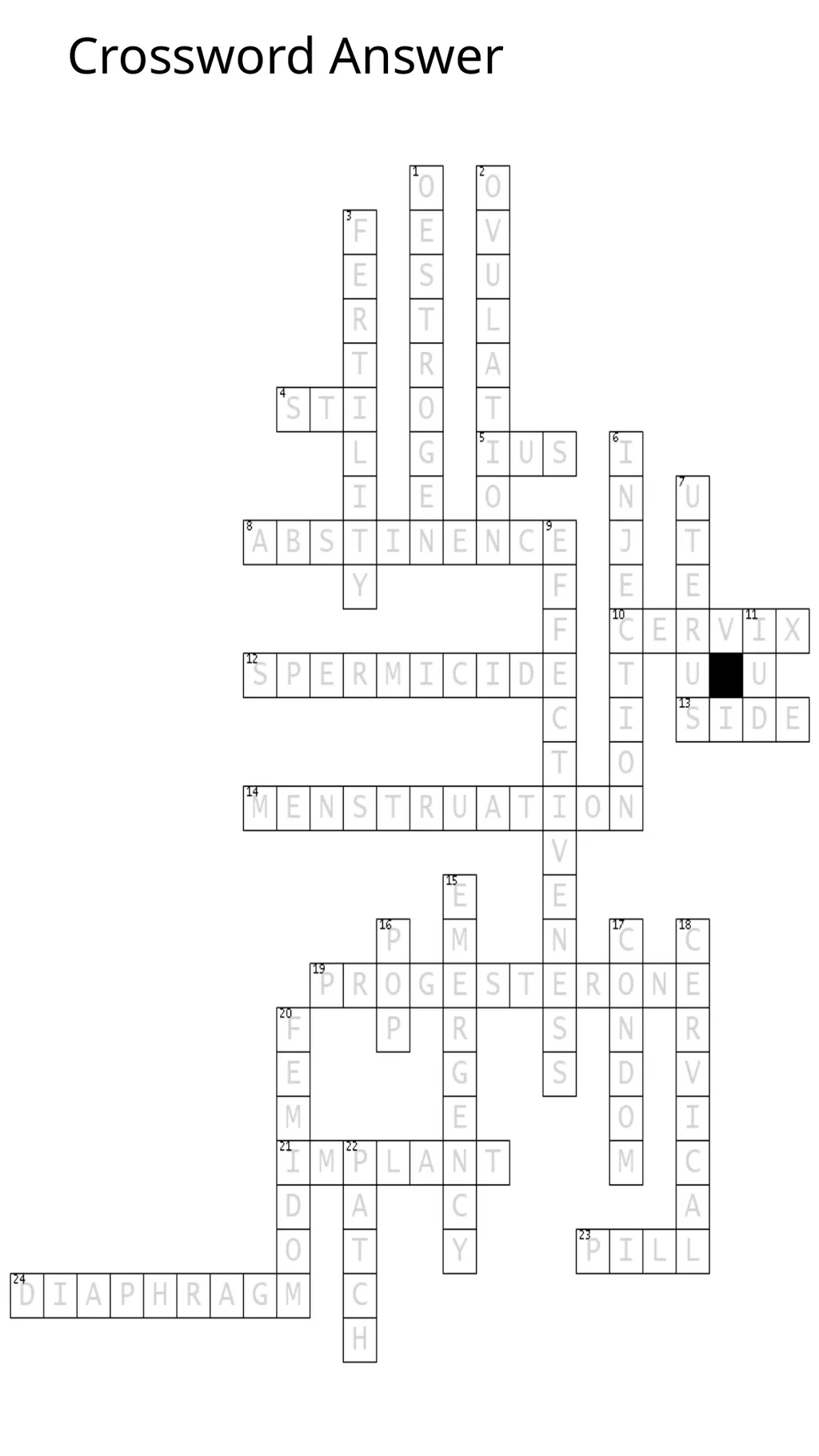
slide14. Contraception Wordsearch ACROSS 4. ^ Can be prevented by using condoms 5. ^ Intrauterine system, releases hormones 8. ^ The only 100% effective method of preventing pregnancy 10. ^ Where the diaphragm is placed 12. ^ Often used with barrier methods 13. Effects ^ Can include headaches or mood changes 14. ^ The 'period' 19. ^ Key hormone in some birth control methods 21. ^ Long-acting, reversible contraception, inserted under the skin 23. ^ Daily hormone dose to prevent pregnancy 24. ^ Barrier method used with spermicide DOWN 1. ^ Works alongside progesterone in the combined pill 2. ^ The time when a woman is most fertile 3. ^ A woman's monthly cycle relates to this 6. ^ Contraceptive injection given every 12 weeks 7. ^ The womb 9. ^ Measured by 'failure rate' 11. ^ T-shaped contraceptive placed in the womb 15. Contraception ^ The 'morning after pill' is one type 16. ^ Progesterone-only pill 17. ^ Protective layer during intimacy 18. Cap ^ Barrier that fits snugly over the cervix 20. ^ A female condom 22. ^ Stick-on hormone delivery<br>
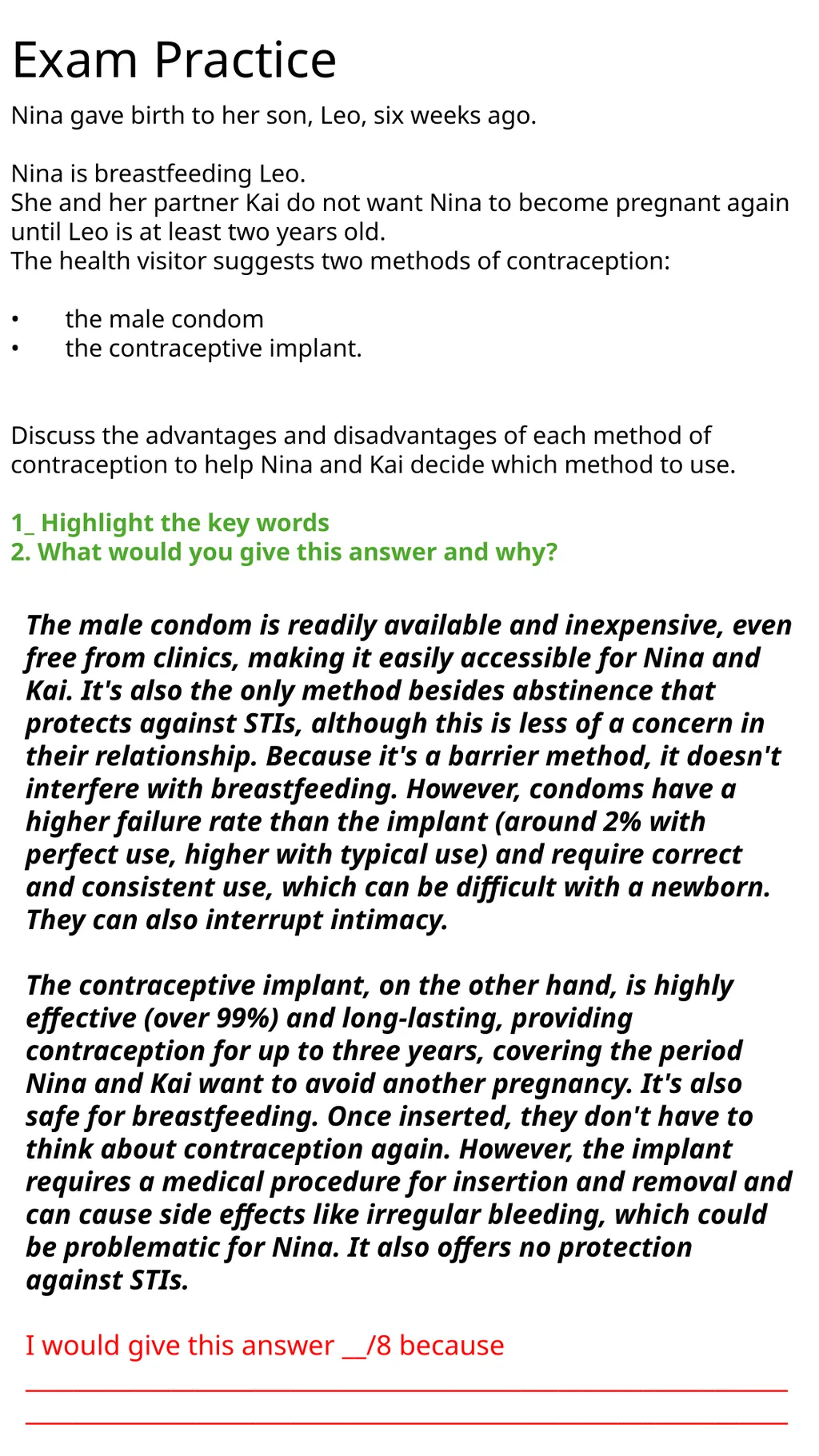
slide15. Exam Practice Nina gave birth to her son, Leo, six weeks ago.
Nina is breastfeeding Leo.
She and her partner Kai do not want Nina to become pregnant again until Leo is at least two years old.
The health visitor suggests two methods of contraception:
• the male condom
• the contraceptive implant.
Discuss the advantages and disadvantages of each method of contraception to help Nina and Kai decide which method to use.
1_ Highlight the key words
2. What would you give this answer and why? The male condom is readily available and inexpensive, even free from clinics, making it easily accessible for Nina and Kai. It's also the only method besides abstinence that protects against STIs, although this is less of a concern in their relationship. Because it's a barrier method, it doesn't interfere with breastfeeding. However, condoms have a higher failure rate than the implant (around 2% with perfect use, higher with typical use) and require correct and consistent use, which can be difficult with a newborn. They can also interrupt intimacy.
The contraceptive implant, on the other hand, is highly effective (over 99%) and long-lasting, providing contraception for up to three years, covering the period Nina and Kai want to avoid another pregnancy. It's also safe for breastfeeding. Once inserted, they don't have to think about contraception again. However, the implant requires a medical procedure for insertion and removal and can cause side effects like irregular bleeding, which could be problematic for Nina. It also offers no protection against STIs.
I would give this answer __/8 because ____________________________________________________________________________________________________________________________________________________________________________________________________________________________________________________<br>
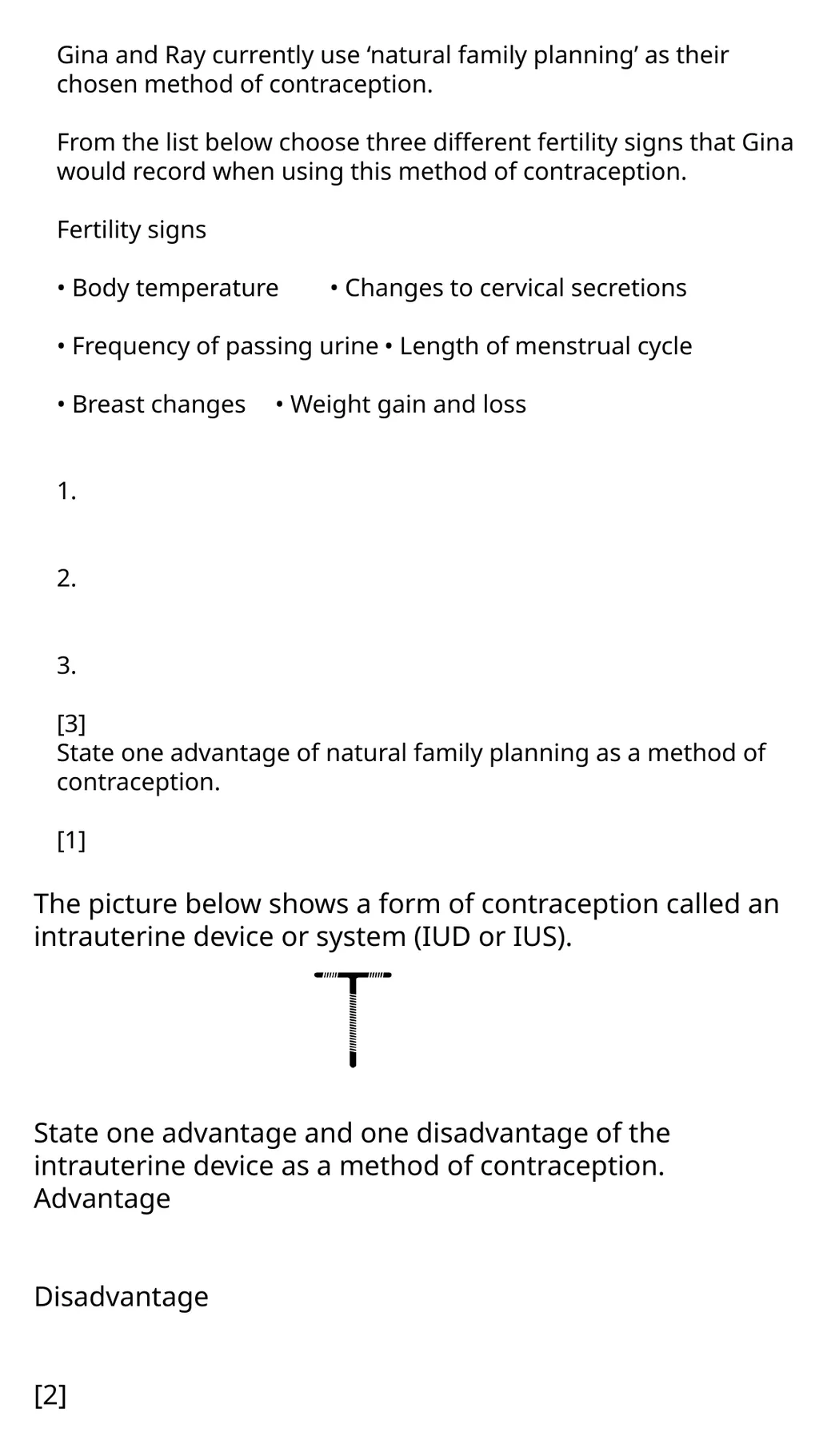
slide16. Gina and Ray currently use ‘natural family planning’ as their chosen method of contraception.
From the list below choose three different fertility signs that Gina would record when using this method of contraception.
Fertility signs
• Body temperature • Changes to cervical secretions
• Frequency of passing urine • Length of menstrual cycle
• Breast changes • Weight gain and loss
1.
2.
3.
[3]
State one advantage of natural family planning as a method of contraception.
[1] The picture below shows a form of contraception called an intrauterine device or system (IUD or IUS).
State one advantage and one disadvantage of the intrauterine device as a method of contraception.
Advantage
Disadvantage
[2]<br>
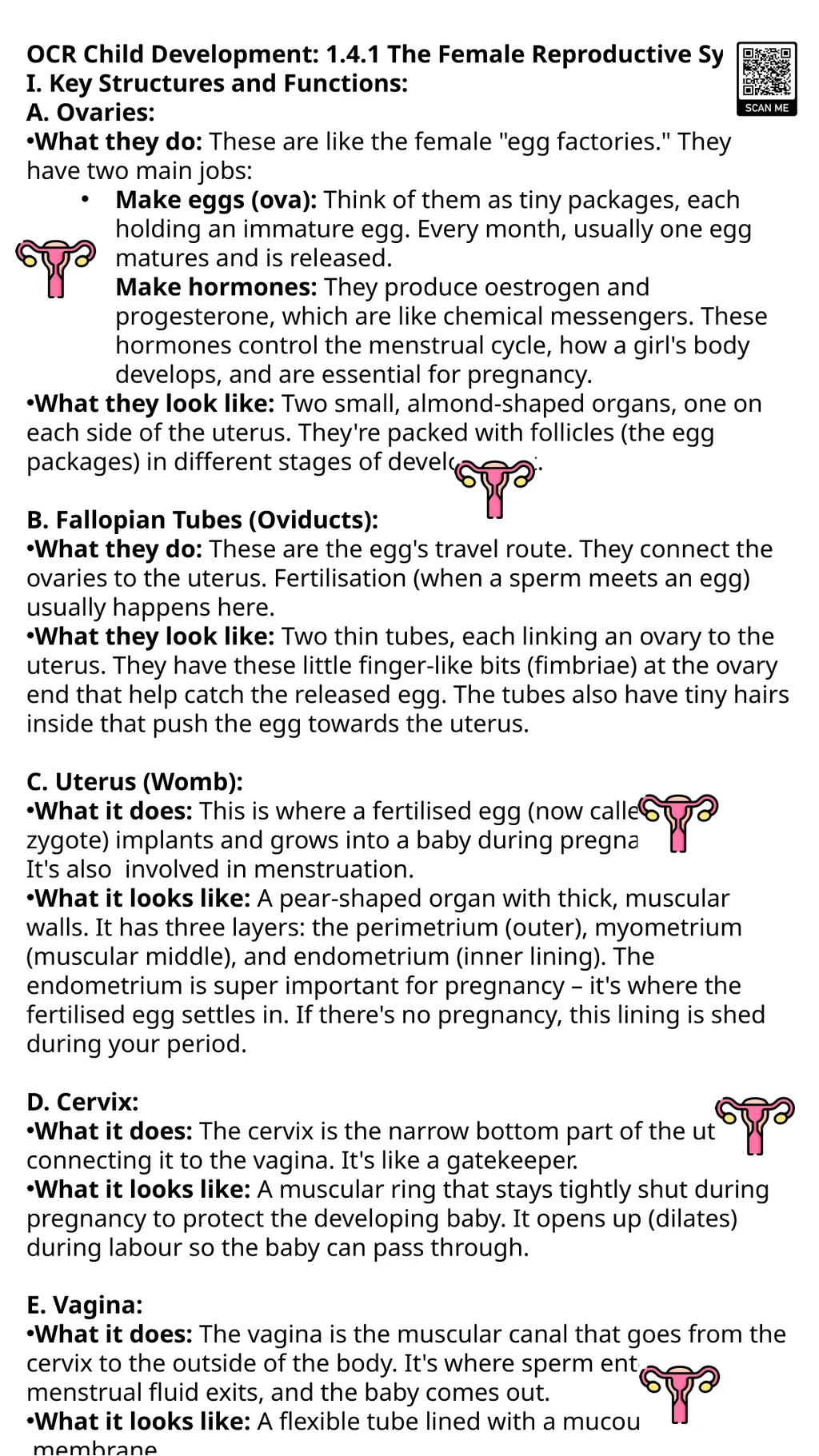
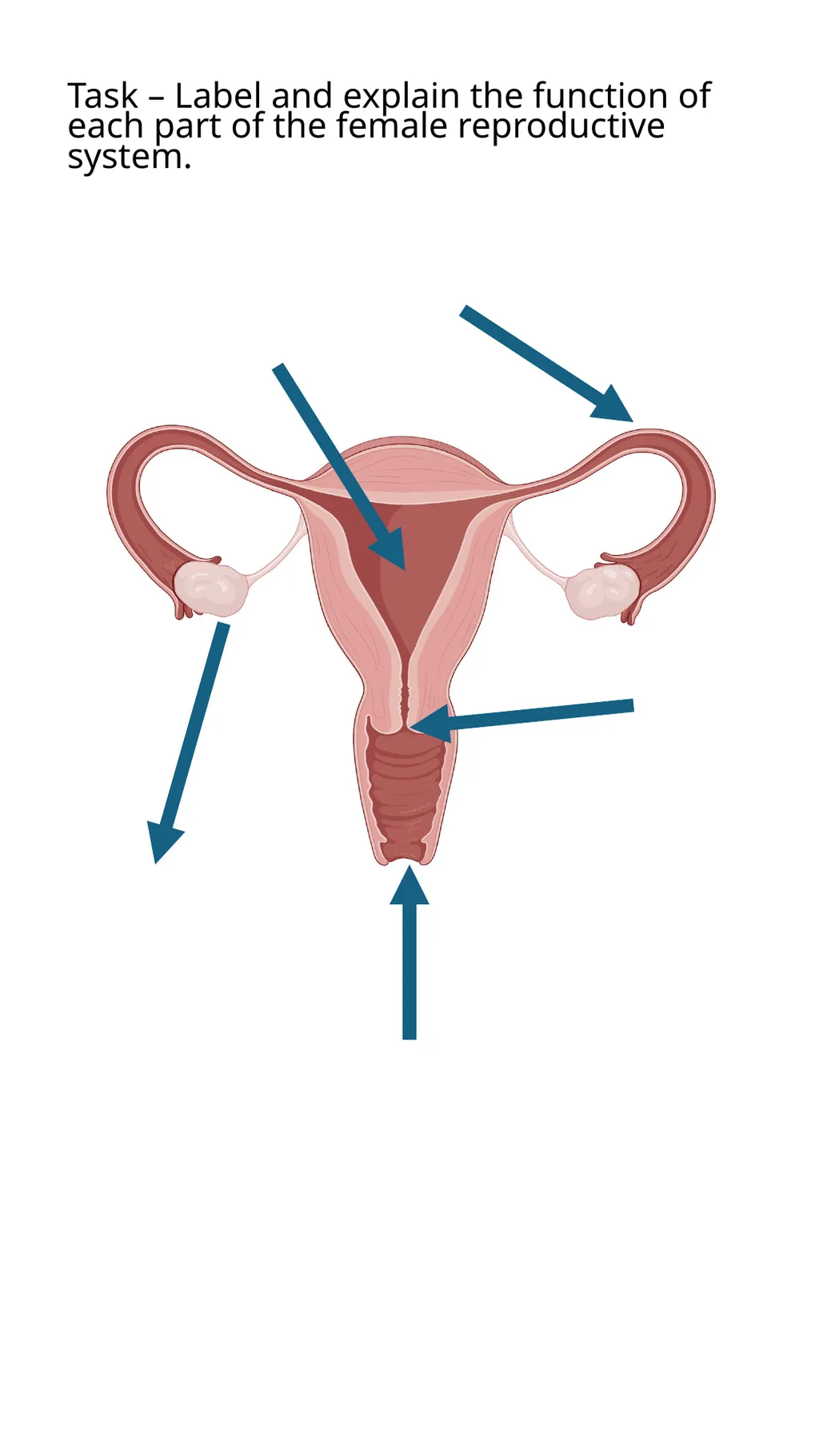
slide17. OCR Child Development: 1.4.1 The Female Reproductive System
I. Key Structures and Functions:
A. Ovaries:
What they do: These are like the female "egg factories." They have two main jobs:
Make eggs (ova): Think of them as tiny packages, each holding an immature egg. Every month, usually one egg matures and is released.
Make hormones: They produce oestrogen and progesterone, which are like chemical messengers. These hormones control the menstrual cycle, how a girl's body develops, and are essential for pregnancy.
What they look like: Two small, almond-shaped organs, one on each side of the uterus. They're packed with follicles (the egg packages) in different stages of development.
B. Fallopian Tubes (Oviducts):
What they do: These are the egg's travel route. They connect the ovaries to the uterus. Fertilisation (when a sperm meets an egg) usually happens here.
What they look like: Two thin tubes, each linking an ovary to the uterus. They have these little finger-like bits (fimbriae) at the ovary end that help catch the released egg. The tubes also have tiny hairs inside that push the egg towards the uterus.
C. Uterus (Womb):
What it does: This is where a fertilised egg (now called a
zygote) implants and grows into a baby during pregnancy.
It's also involved in menstruation.
What it looks like: A pear-shaped organ with thick, muscular walls. It has three layers: the perimetrium (outer), myometrium (muscular middle), and endometrium (inner lining). The endometrium is super important for pregnancy – it's where the fertilised egg settles in. If there's no pregnancy, this lining is shed during your period.
D. Cervix:
What it does: The cervix is the narrow bottom part of the uterus, connecting it to the vagina. It's like a gatekeeper.
What it looks like: A muscular ring that stays tightly shut during pregnancy to protect the developing baby. It opens up (dilates) during labour so the baby can pass through.
E. Vagina:
What it does: The vagina is the muscular canal that goes from the cervix to the outside of the body. It's where sperm enters, menstrual fluid exits, and the baby comes out.
What it looks like: A flexible tube lined with a mucous
membrane<br>
slide18. Task – Label and explain the function of each part of the female reproductive system.<br>
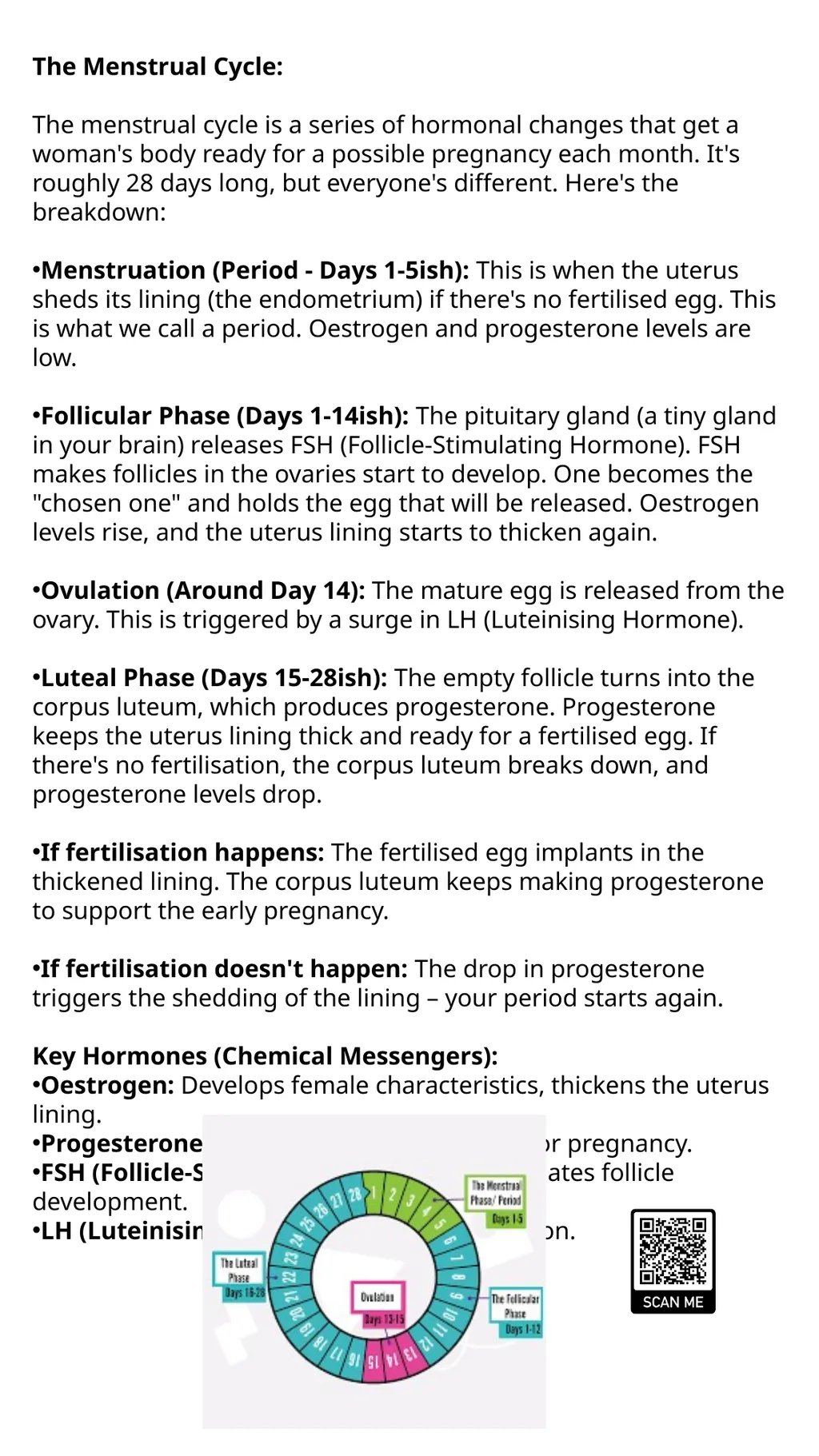
slide19. The Menstrual Cycle:
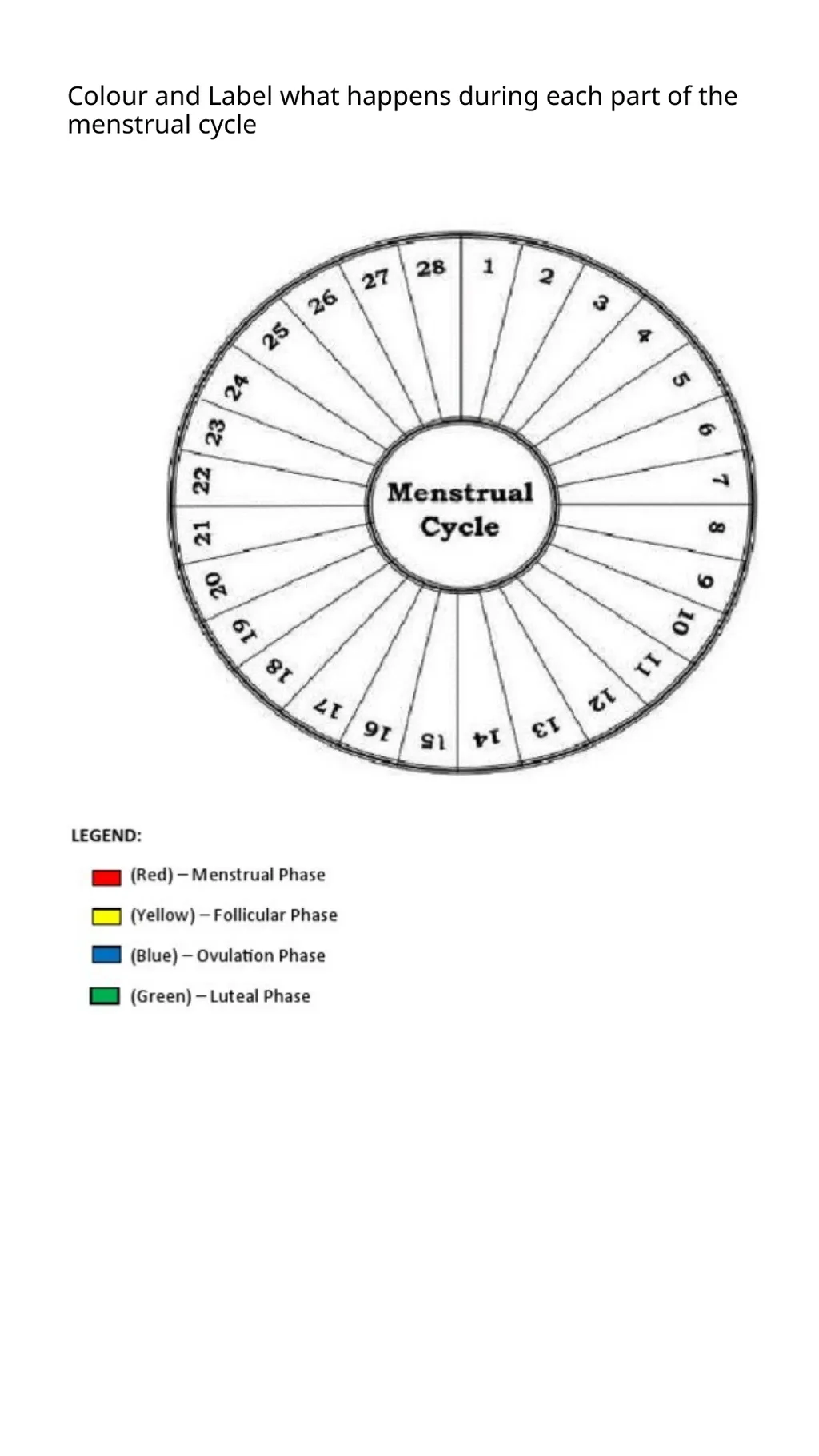
The menstrual cycle is a series of hormonal changes that get a woman's body ready for a possible pregnancy each month. It's roughly 28 days long, but everyone's different. Here's the breakdown:
Menstruation (Period - Days 1-5ish): This is when the uterus sheds its lining (the endometrium) if there's no fertilised egg. This is what we call a period. Oestrogen and progesterone levels are low.
Follicular Phase (Days 1-14ish): The pituitary gland (a tiny gland in your brain) releases FSH (Follicle-Stimulating Hormone). FSH makes follicles in the ovaries start to develop. One becomes the "chosen one" and holds the egg that will be released. Oestrogen levels rise, and the uterus lining starts to thicken again.
Ovulation (Around Day 14): The mature egg is released from the ovary. This is triggered by a surge in LH (Luteinising Hormone).
Luteal Phase (Days 15-28ish): The empty follicle turns into the corpus luteum, which produces progesterone. Progesterone keeps the uterus lining thick and ready for a fertilised egg. If there's no fertilisation, the corpus luteum breaks down, and progesterone levels drop.
If fertilisation happens: The fertilised egg implants in the thickened lining. The corpus luteum keeps making progesterone to support the early pregnancy.
If fertilisation doesn't happen: The drop in progesterone triggers the shedding of the lining – your period starts again.
Key Hormones (Chemical Messengers):
Oestrogen: Develops female characteristics, thickens the uterus lining.
Progesterone: Maintains the uterus lining for pregnancy.
FSH (Follicle-Stimulating Hormone): Stimulates follicle development.
LH (Luteinising Hormone): Triggers ovulation.<br>
slide20. Colour and Label what happens during each part of the menstrual cycle<br>
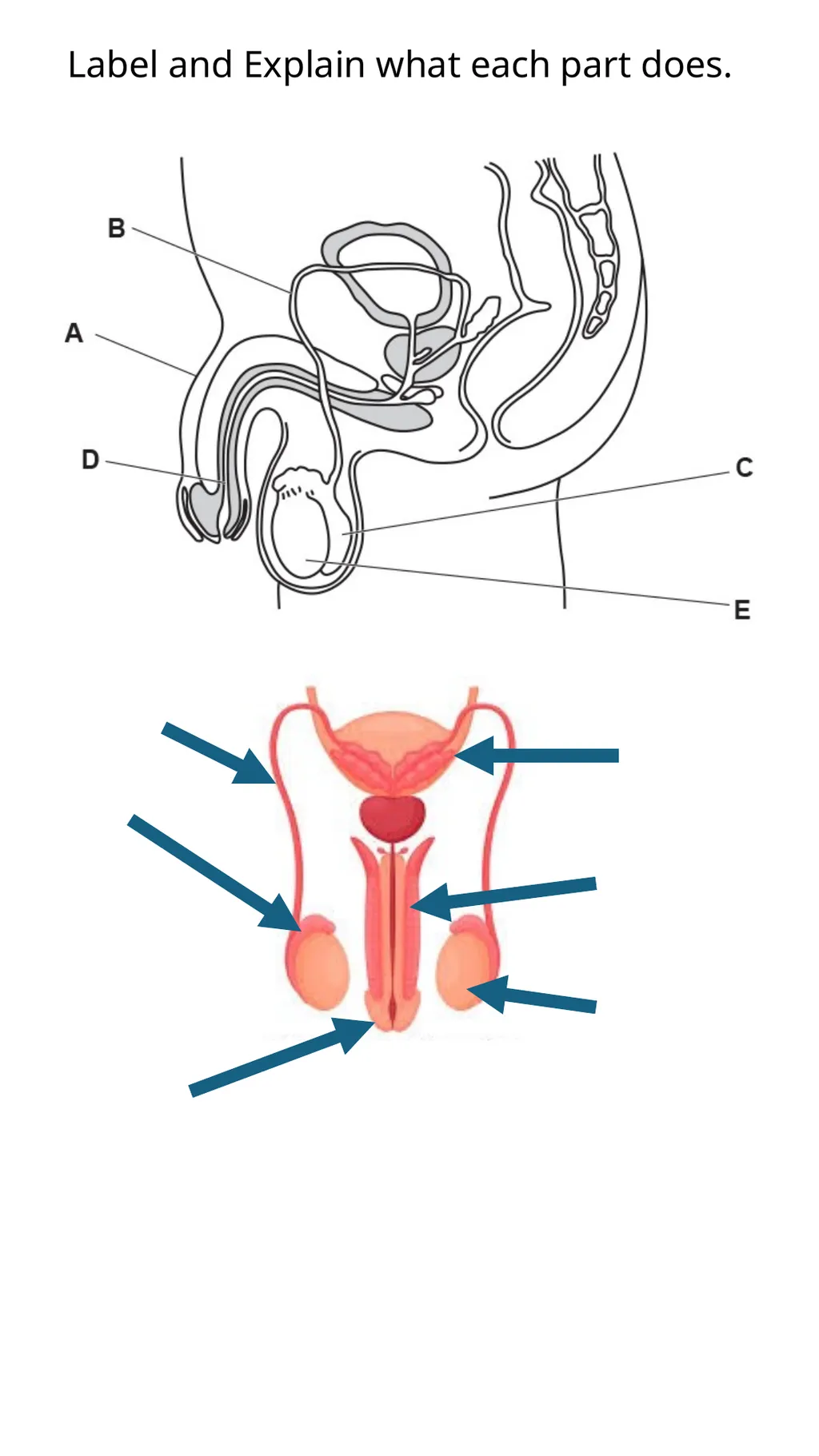
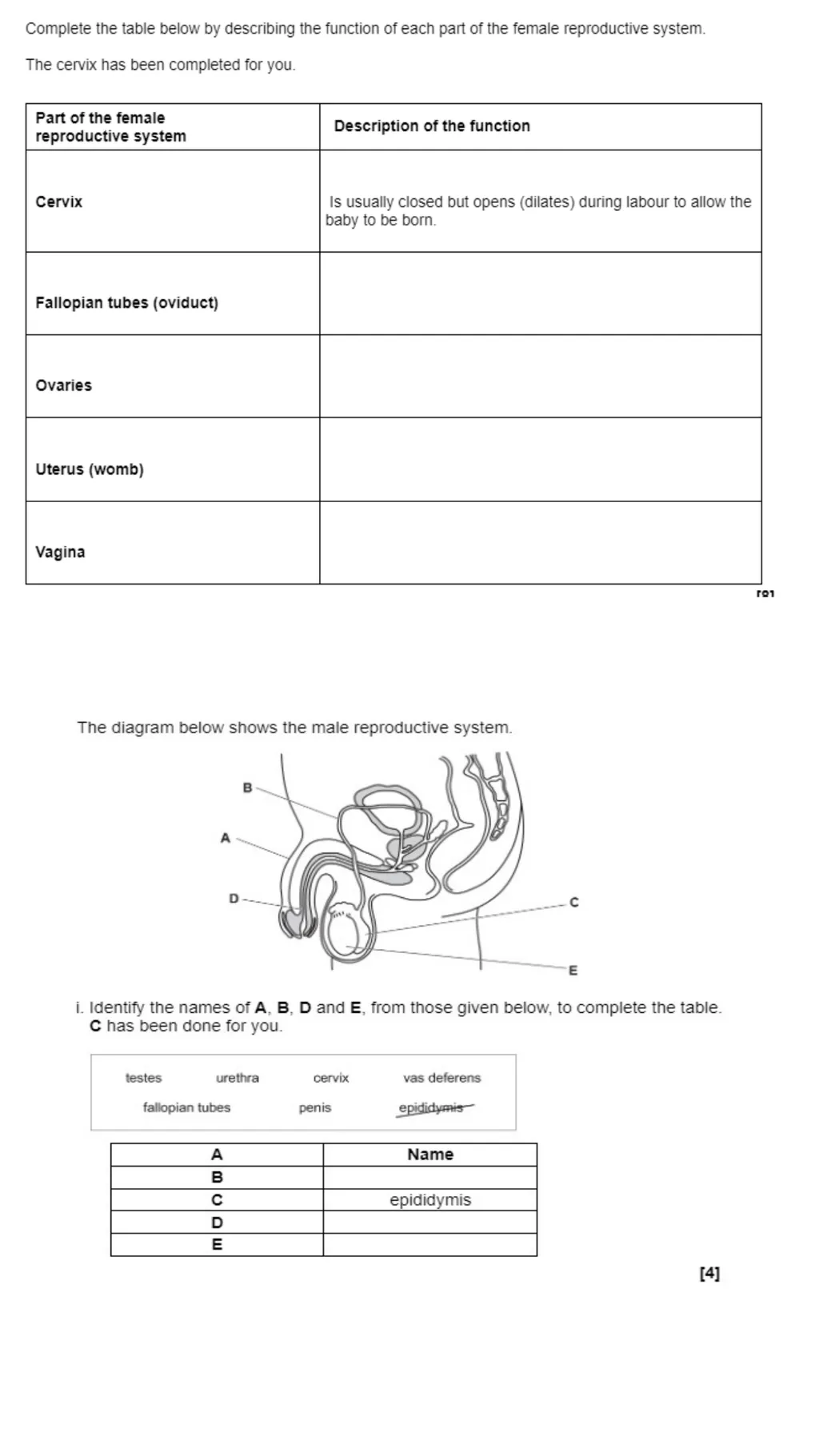
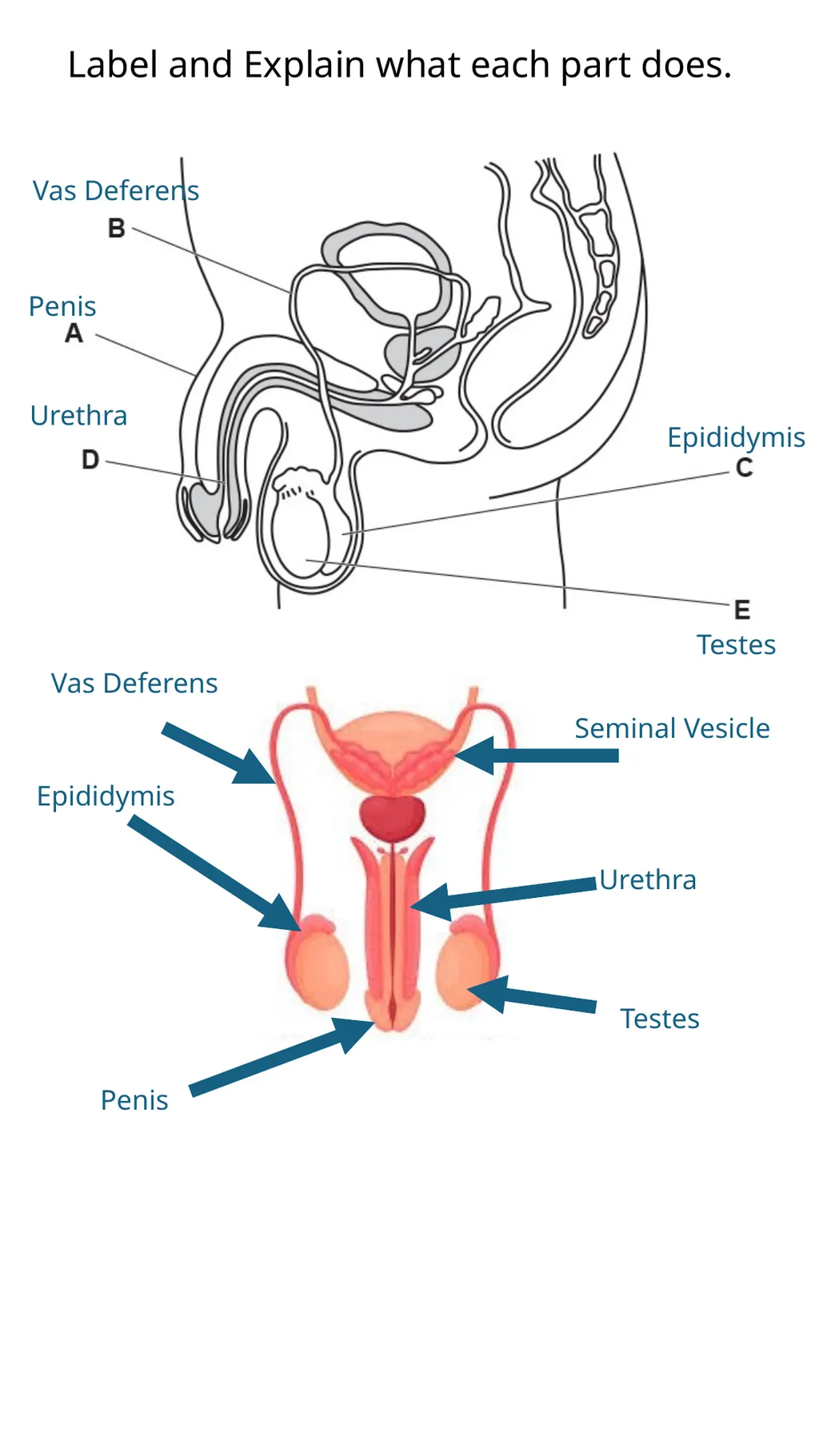
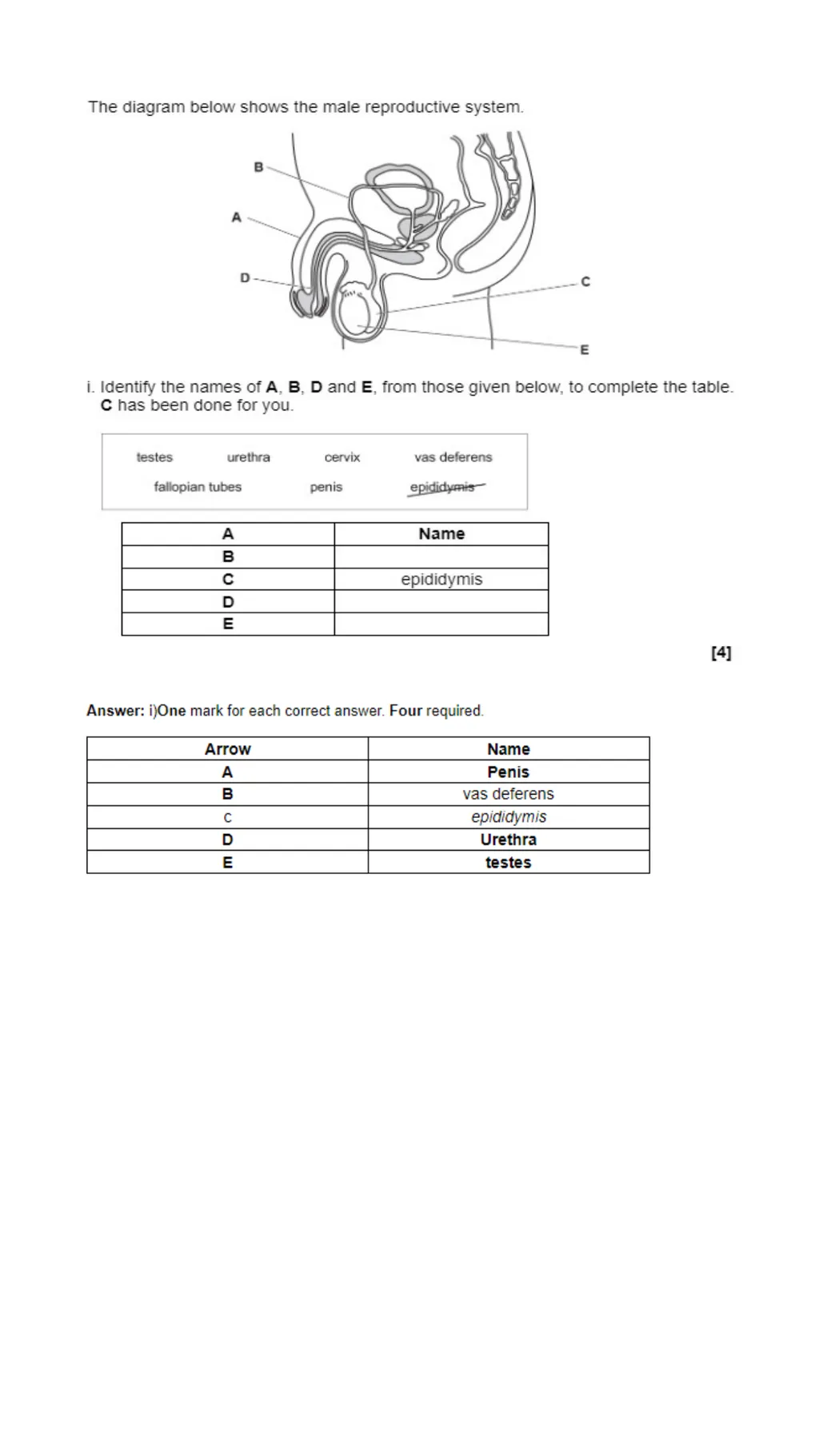
slide21. OCR Child Development: 1.4.2 The Male Reproductive System
Key Structures and Functions:
A. Testes (Testicles):
What they do: These are the male "sperm factories." They have two main jobs:
Make sperm: Tiny cells that carry genetic information to fertilise an egg.
Make testosterone: This is the main male sex hormone. It controls male development, like muscle growth and facial hair, and is also important for sperm production.
What they look like: Two oval-shaped organs that hang in a pouch called the scrotum. The scrotum keeps the testes at a slightly cooler temperature, which is ideal for sperm production.
B. Sperm Duct/Epididymis:
What they do: The epididymis is like a storage and maturation centre for sperm. Sperm are made in the testes and then travel to the epididymis, where they mature and are stored until they're ready to leave the body.
What it looks like: A coiled tube attached to the back of each testis
.
C. Vas Deferens:
What it does: This is a tube that carries sperm from the epididymis to the urethra. It's like the main highway for sperm transport.
What it looks like: A muscular tube that connects the epididymis to the urethra.
D. Seminal Vesicles:
What they do: These glands produce a sugary fluid that mixes with the sperm. This fluid provides energy for the sperm to swim. It's like fuel for the sperm.
What they look like: Glands located near the prostate gland.
E. Urethra:
What it does: This tube carries both urine and semen out of the body through the penis. It's like a dual-purpose pipeline.
What it looks like: The tube that runs through the penis.
F. Penis:
What it does: The penis is the male organ for sexual intercourse. It delivers sperm into the female reproductive tract.
What it looks like: The external male reproductive organ.<br>
slide22. Label and Explain what each part does.<br>
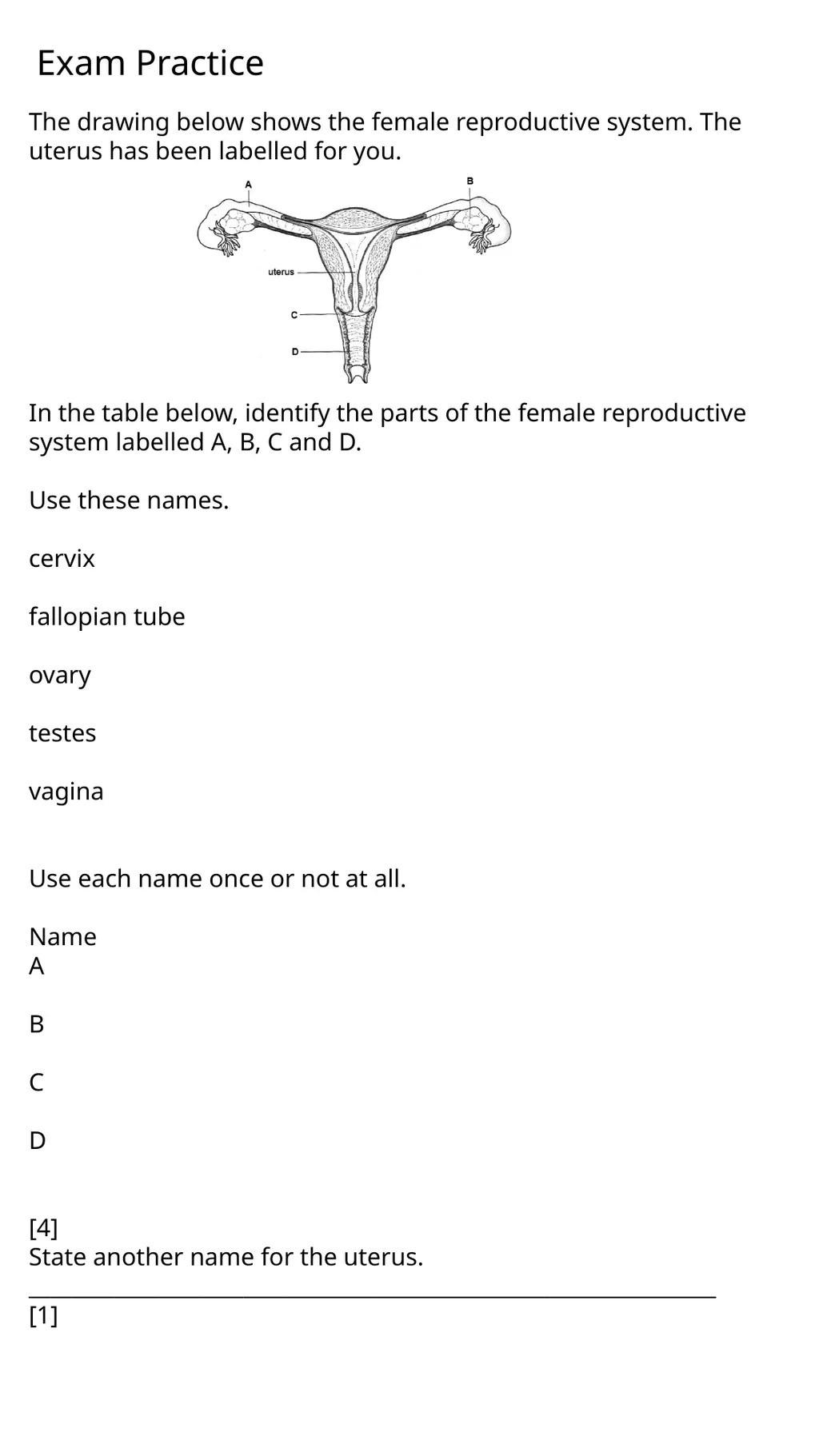
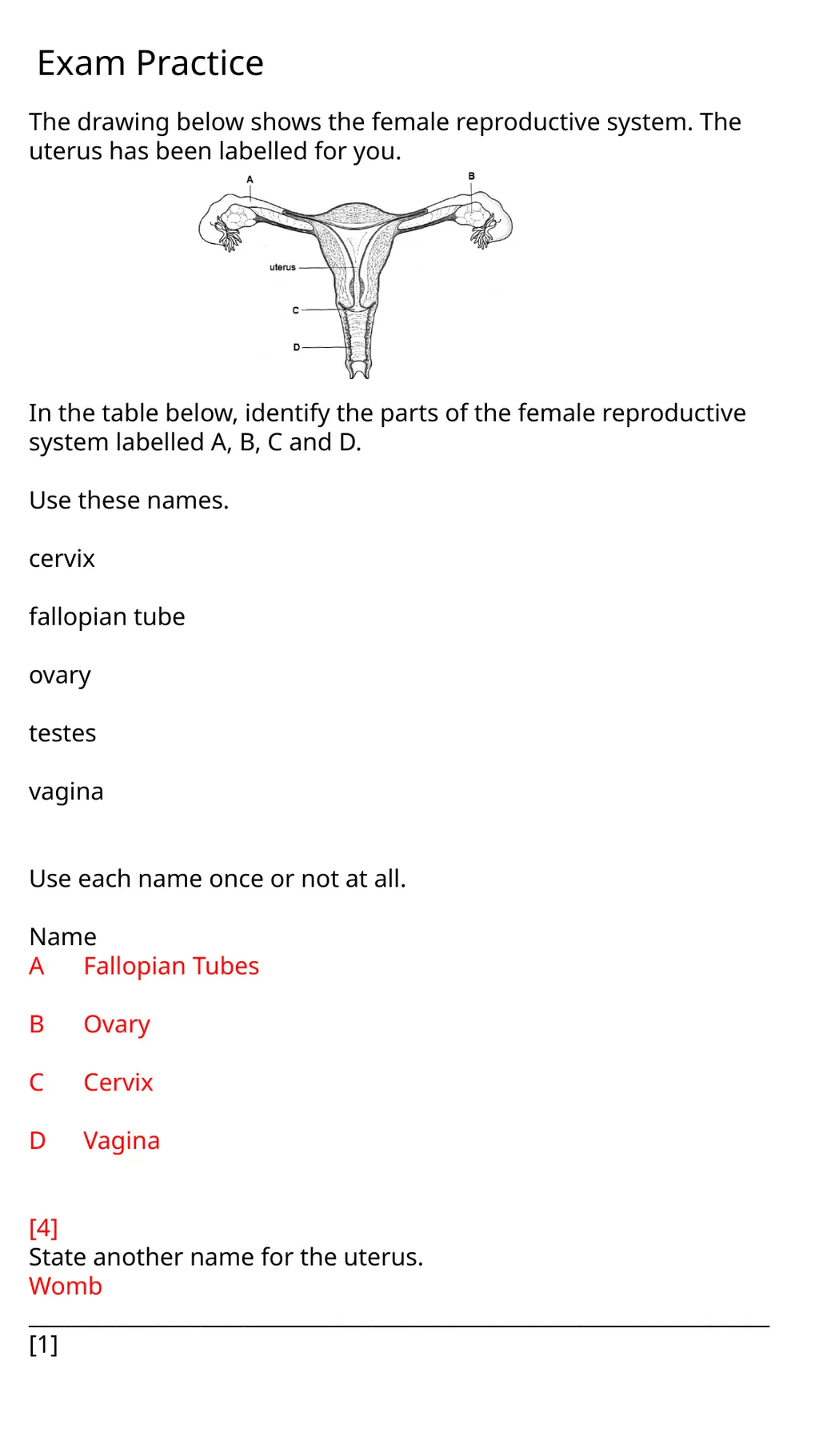
slide23. Exam Practice The drawing below shows the female reproductive system. The uterus has been labelled for you.
In the table below, identify the parts of the female reproductive system labelled A, B, C and D.
Use these names.
cervix
fallopian tube
ovary
testes
vagina
Use each name once or not at all.
Name
A
B
C
D
[4]
State another name for the uterus.
________________________________________________________________
[1]<br>
slide25. OCR Child Development: 1.5 How Reproduction
Takes Place
I. The Journey to a Baby:
Ovulation:
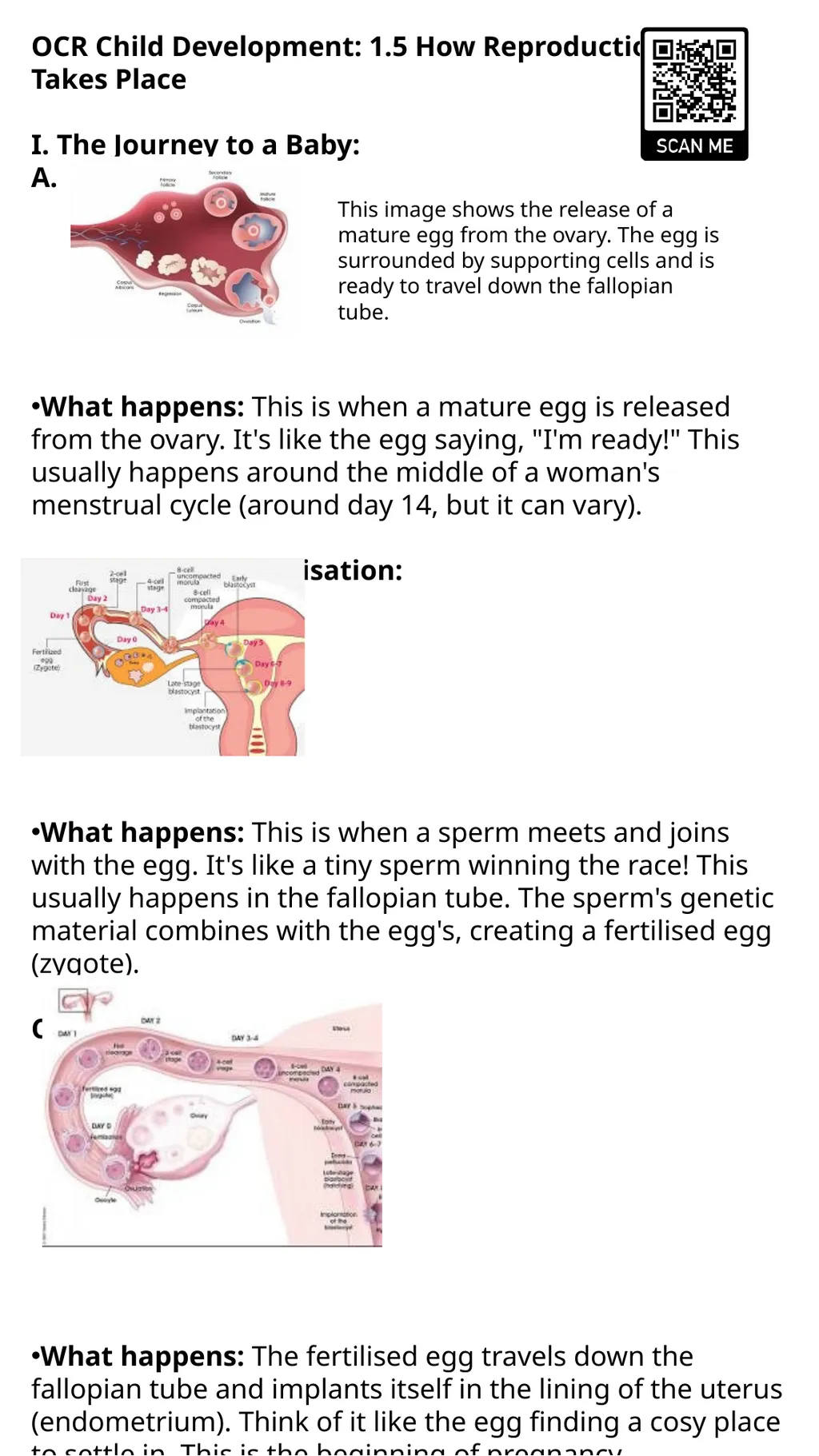
What happens: This is when a mature egg is released from the ovary. It's like the egg saying, "I'm ready!" This usually happens around the middle of a woman's menstrual cycle (around day 14, but it can vary).
B. Conception/Fertilisation:
What happens: This is when a sperm meets and joins with the egg. It's like a tiny sperm winning the race! This usually happens in the fallopian tube. The sperm's genetic material combines with the egg's, creating a fertilised egg (zygote).
C. Implantation:
What happens: The fertilised egg travels down the fallopian tube and implants itself in the lining of the uterus (endometrium). Think of it like the egg finding a cosy place to settle in. This is the beginning of pregnancy This image shows the release of a mature egg from the ovary. The egg is surrounded by supporting cells and is ready to travel down the fallopian tube.<br>
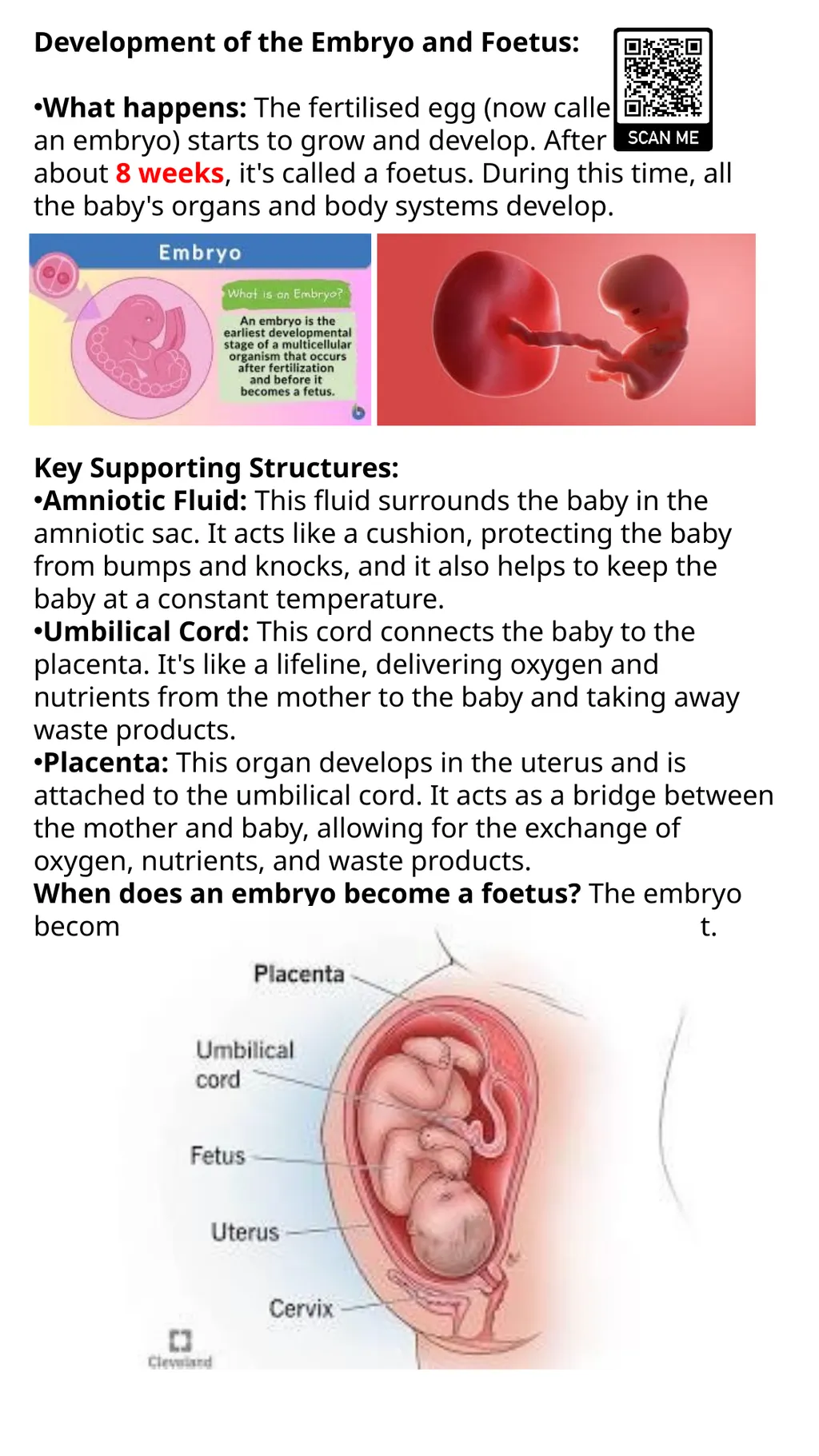
slide26. Development of the Embryo and Foetus:
What happens: The fertilised egg (now called
an embryo) starts to grow and develop. After
about 8 weeks, it's called a foetus. During this time, all the baby's organs and body systems develop.
Key Supporting Structures:
Amniotic Fluid: This fluid surrounds the baby in the amniotic sac. It acts like a cushion, protecting the baby from bumps and knocks, and it also helps to keep the baby at a constant temperature.
Umbilical Cord: This cord connects the baby to the placenta. It's like a lifeline, delivering oxygen and nutrients from the mother to the baby and taking away waste products.
Placenta: This organ develops in the uterus and is attached to the umbilical cord. It acts as a bridge between the mother and baby, allowing for the exchange of oxygen, nutrients, and waste products.
When does an embryo become a foetus? The embryo becomes a foetus at around 8 weeks of development.<br>
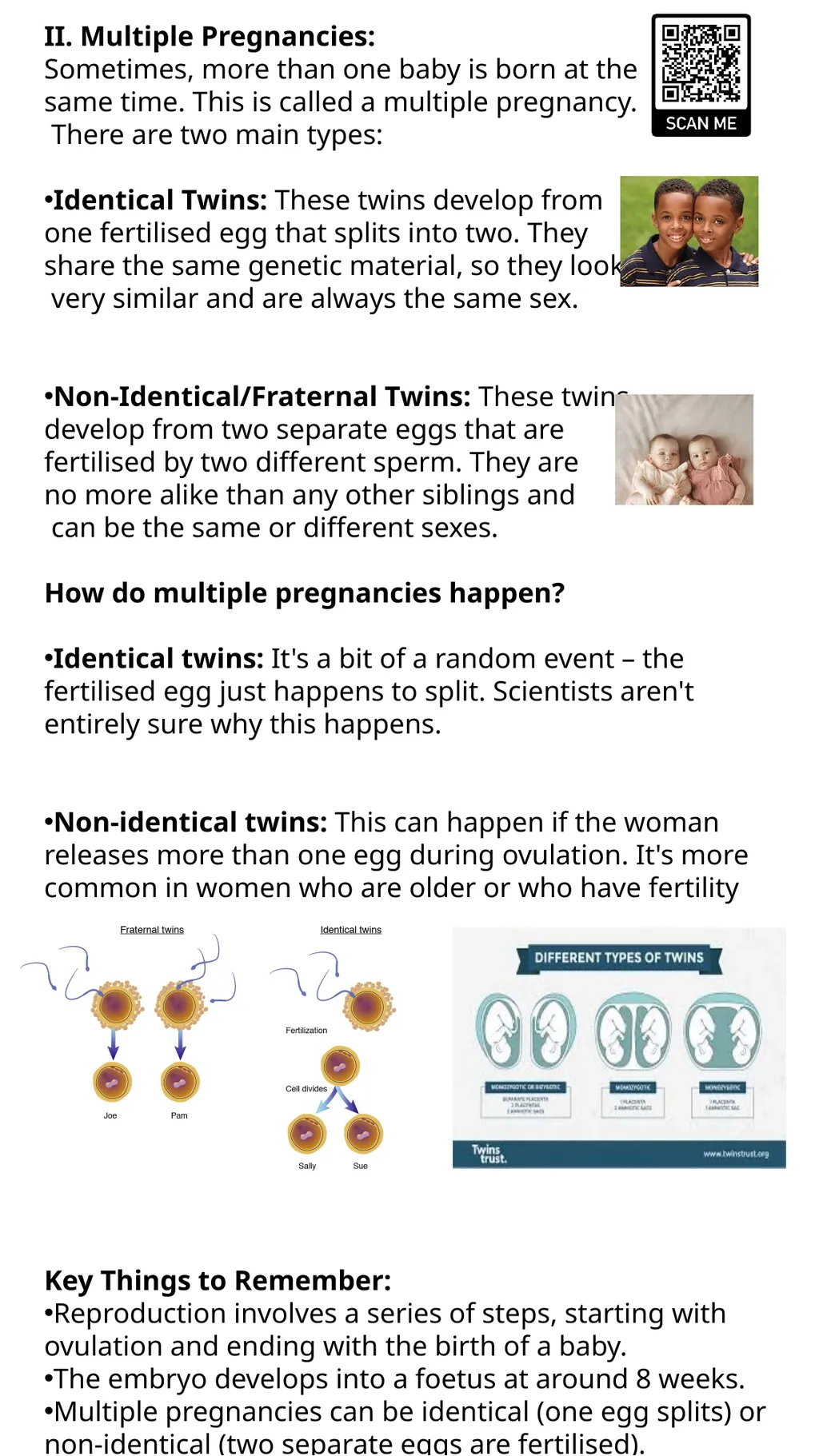
slide27. II. Multiple Pregnancies:
Sometimes, more than one baby is born at the
same time. This is called a multiple pregnancy.
There are two main types:
Identical Twins: These twins develop from
one fertilised egg that splits into two. They
share the same genetic material, so they look
very similar and are always the same sex.
Non-Identical/Fraternal Twins: These twins
develop from two separate eggs that are
fertilised by two different sperm. They are
no more alike than any other siblings and
can be the same or different sexes.
How do multiple pregnancies happen?
Identical twins: It's a bit of a random event – the fertilised egg just happens to split. Scientists aren't entirely sure why this happens.
Non-identical twins: This can happen if the woman releases more than one egg during ovulation. It's more common in women who are older or who have fertility treatment.
Key Things to Remember:
Reproduction involves a series of steps, starting with ovulation and ending with the birth of a baby.
The embryo develops into a foetus at around 8 weeks.
Multiple pregnancies can be identical (one egg splits) or non-identical (two separate eggs are fertilised).<br>
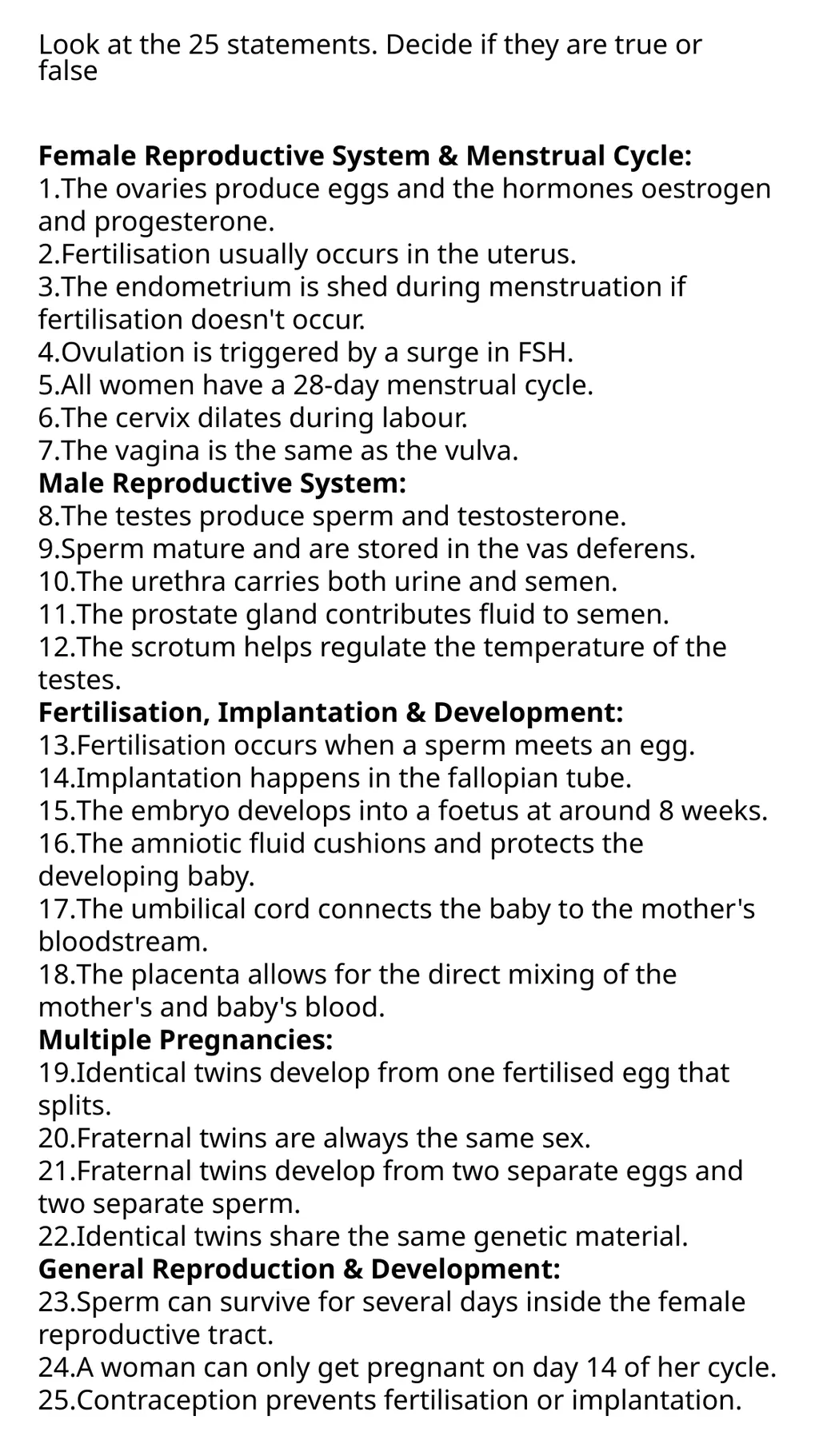
slide28. Look at the 25 statements. Decide if they are true or false Female Reproductive System & Menstrual Cycle:
The ovaries produce eggs and the hormones oestrogen and progesterone.
Fertilisation usually occurs in the uterus.
The endometrium is shed during menstruation if fertilisation doesn't occur.
Ovulation is triggered by a surge in FSH.
All women have a 28-day menstrual cycle.
The cervix dilates during labour.
The vagina is the same as the vulva.
Male Reproductive System:
The testes produce sperm and testosterone.
Sperm mature and are stored in the vas deferens.
The urethra carries both urine and semen.
The prostate gland contributes fluid to semen.
The scrotum helps regulate the temperature of the testes.
Fertilisation, Implantation & Development:
Fertilisation occurs when a sperm meets an egg.
Implantation happens in the fallopian tube.
The embryo develops into a foetus at around 8 weeks.
The amniotic fluid cushions and protects the developing baby.
The umbilical cord connects the baby to the mother's bloodstream.
The placenta allows for the direct mixing of the mother's and baby's blood.
Multiple Pregnancies:
Identical twins develop from one fertilised egg that splits.
Fraternal twins are always the same sex.
Fraternal twins develop from two separate eggs and two separate sperm.
Identical twins share the same genetic material.
General Reproduction & Development:
Sperm can survive for several days inside the female reproductive tract.
A woman can only get pregnant on day 14 of her cycle.
Contraception prevents fertilisation or implantation.<br>
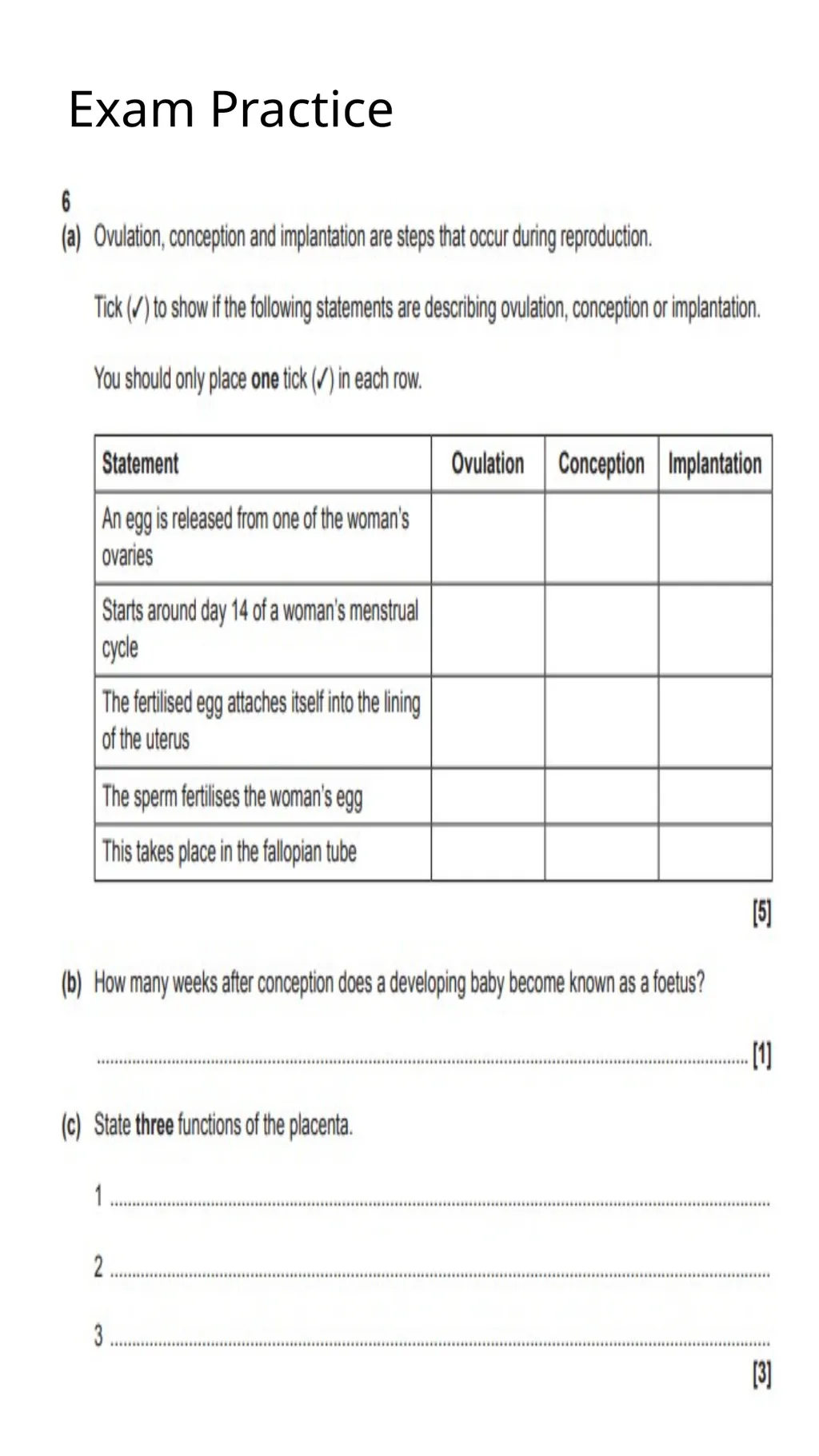
slide29. Exam Practice<br>
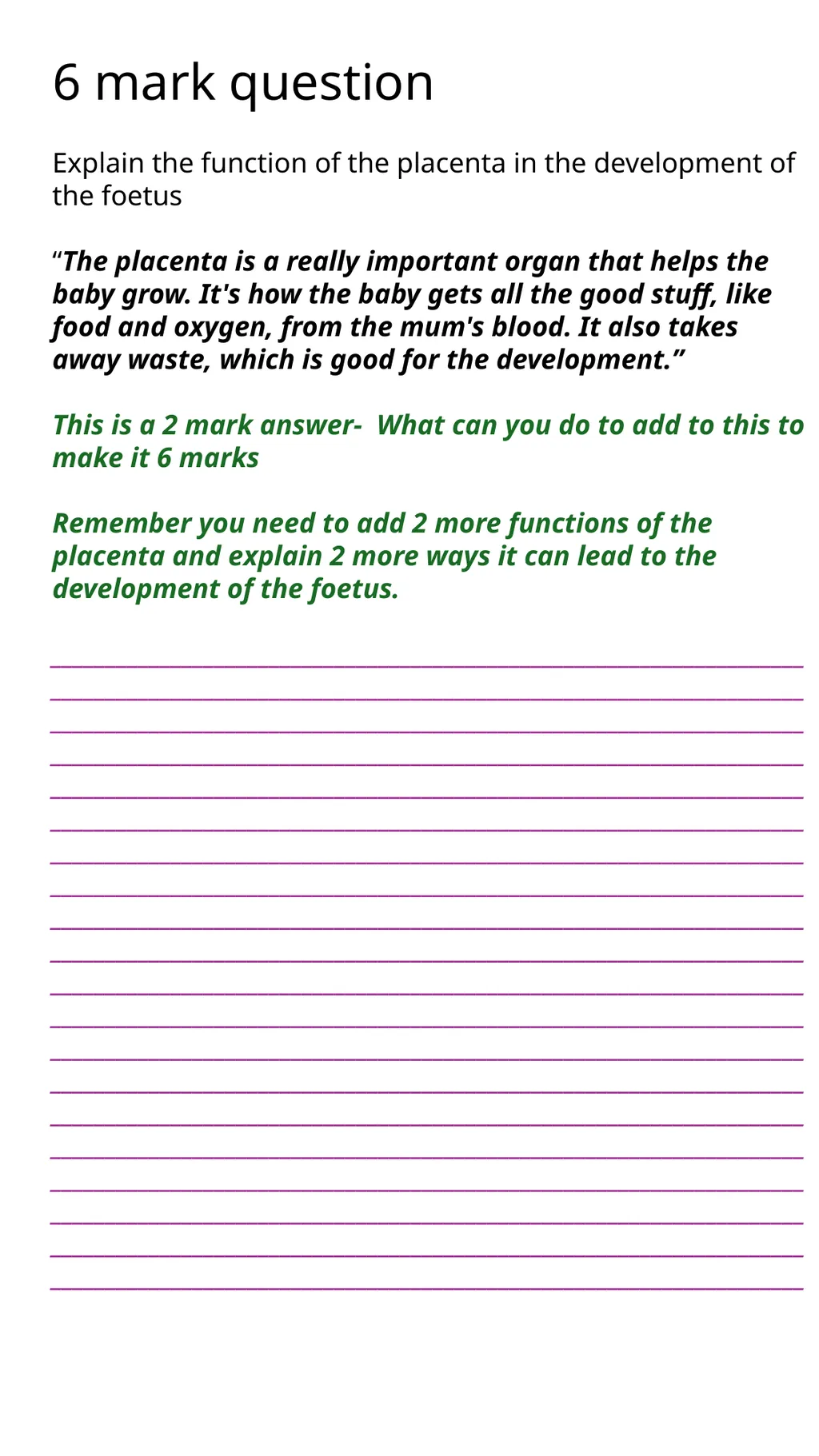
slide30. 6 mark question Explain the function of the placenta in the development of the foetus
“The placenta is a really important organ that helps the baby grow. It's how the baby gets all the good stuff, like food and oxygen, from the mum's blood. It also takes away waste, which is good for the development.”
This is a 2 mark answer- What can you do to add to this to make it 6 marks
Remember you need to add 2 more functions of the placenta and explain 2 more ways it can lead to the development of the foetus.
____________________________________________________________________________________________________________________________________________________________________________________________________________________________________________________________________________________________________________________________________________________________________________________________________________________________________________________________________________________________________________________________________________________________________________________________________________________________________________________________________________________________________________________________________________________________________________________________________________________________________________________________________________________________________________________________________________________________________________________________________________________________________________________________________________________________________________________________________________________________________________________________________________________________________________________________________________________________________________________________________________________________________________________________________________________________________
[6]<br>
slide31. 1.6 The Signs and Symptoms of Pregnancy
This section focuses on the common signs and symptoms a woman might experience in early pregnancy. It's important to remember that these symptoms can vary from person to person, and some may be indicative of other conditions. A pregnancy test and consultation with a healthcare professional are essential for confirmation.
Checklist:
[ ] Breast changes
[ ] Missed period
[ ] Nausea
[ ] Passing urine frequently
[ ] Tiredness
Common Signs and Symptoms:
Breast Changes: One of the earliest signs can be changes in the breasts. These may include tenderness, soreness, swelling, or a feeling of fullness. The nipples might also become more sensitive and the areola (the area around the nipple) may darken.
Missed Period: A missed period is often the most noticeable sign and the reason many women first suspect they are pregnant. However, it's important to note that a missed period can also be caused by other factors, such as stress, changes in diet, or certain medical conditions.
Nausea: Often referred to as "morning sickness," nausea can occur at any time of the day or night. Some women experience mild nausea, while others may have more severe symptoms, including vomiting.
Passing Urine Frequently: The need to urinate more often than usual is a common symptom due to hormonal changes that increase blood flow to the kidneys. This increased blood flow causes the kidneys to produce more urine.
Tiredness: Fatigue is a very common symptom in early pregnancy. The body is working hard to support the developing embryo, which can lead to feelings of exhaustion.<br>
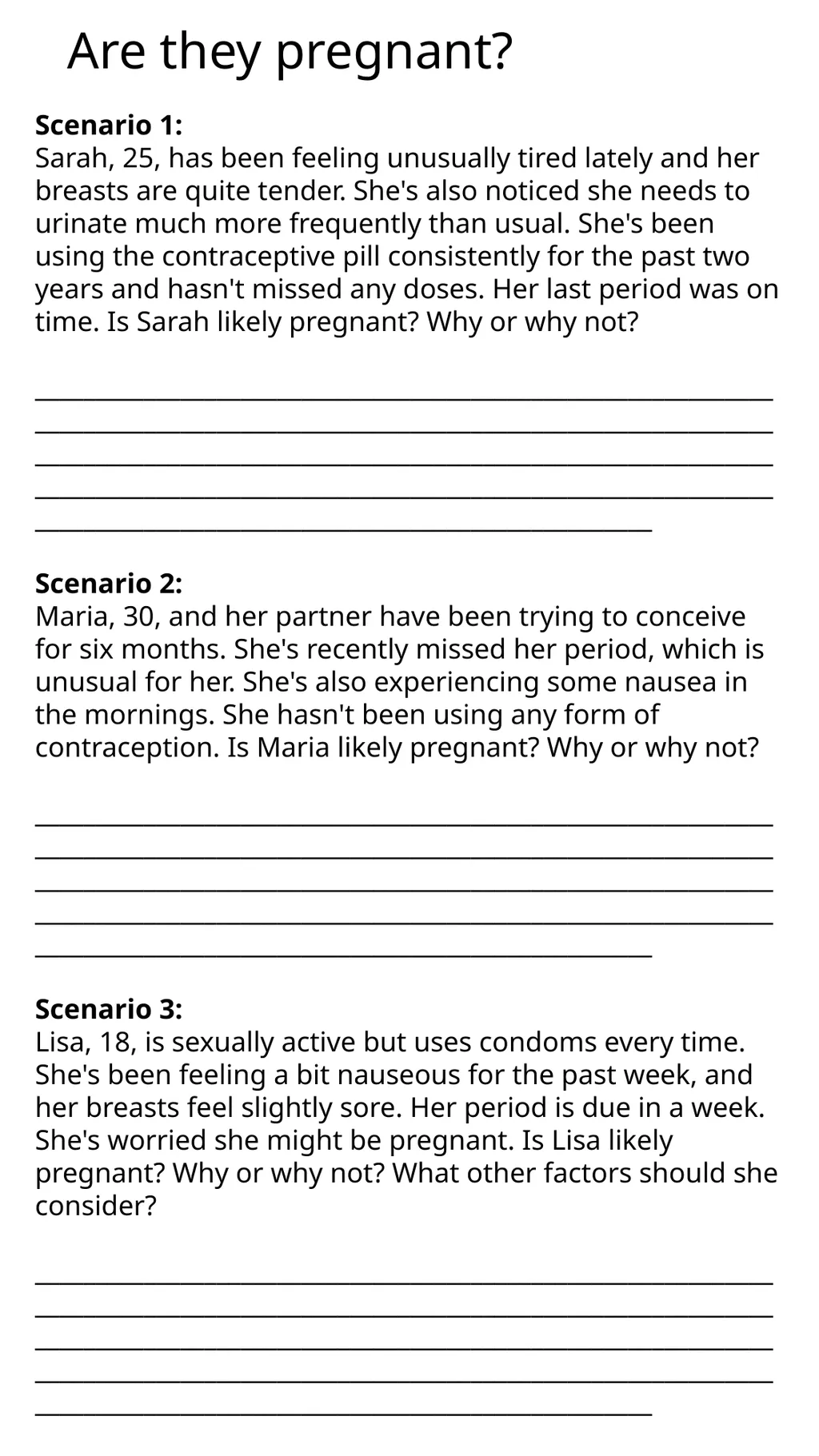
slide32. Are they pregnant? Scenario 1:
Sarah, 25, has been feeling unusually tired lately and her breasts are quite tender. She's also noticed she needs to urinate much more frequently than usual. She's been using the contraceptive pill consistently for the past two years and hasn't missed any doses. Her last period was on time. Is Sarah likely pregnant? Why or why not?
_______________________________________________________________________________________________________________________________________________________________________________________________________________________________________________________________________________________________________
Scenario 2:
Maria, 30, and her partner have been trying to conceive for six months. She's recently missed her period, which is unusual for her. She's also experiencing some nausea in the mornings. She hasn't been using any form of contraception. Is Maria likely pregnant? Why or why not?
_______________________________________________________________________________________________________________________________________________________________________________________________________________________________________________________________________________________________________
Scenario 3:
Lisa, 18, is sexually active but uses condoms every time. She's been feeling a bit nauseous for the past week, and her breasts feel slightly sore. Her period is due in a week. She's worried she might be pregnant. Is Lisa likely pregnant? Why or why not? What other factors should she consider?
_______________________________________________________________________________________________________________________________________________________________________________________________________________________________________________________________________________________________________<br>
slide33. Answers to Tasks Do not peek until you have completed all questions!<br>
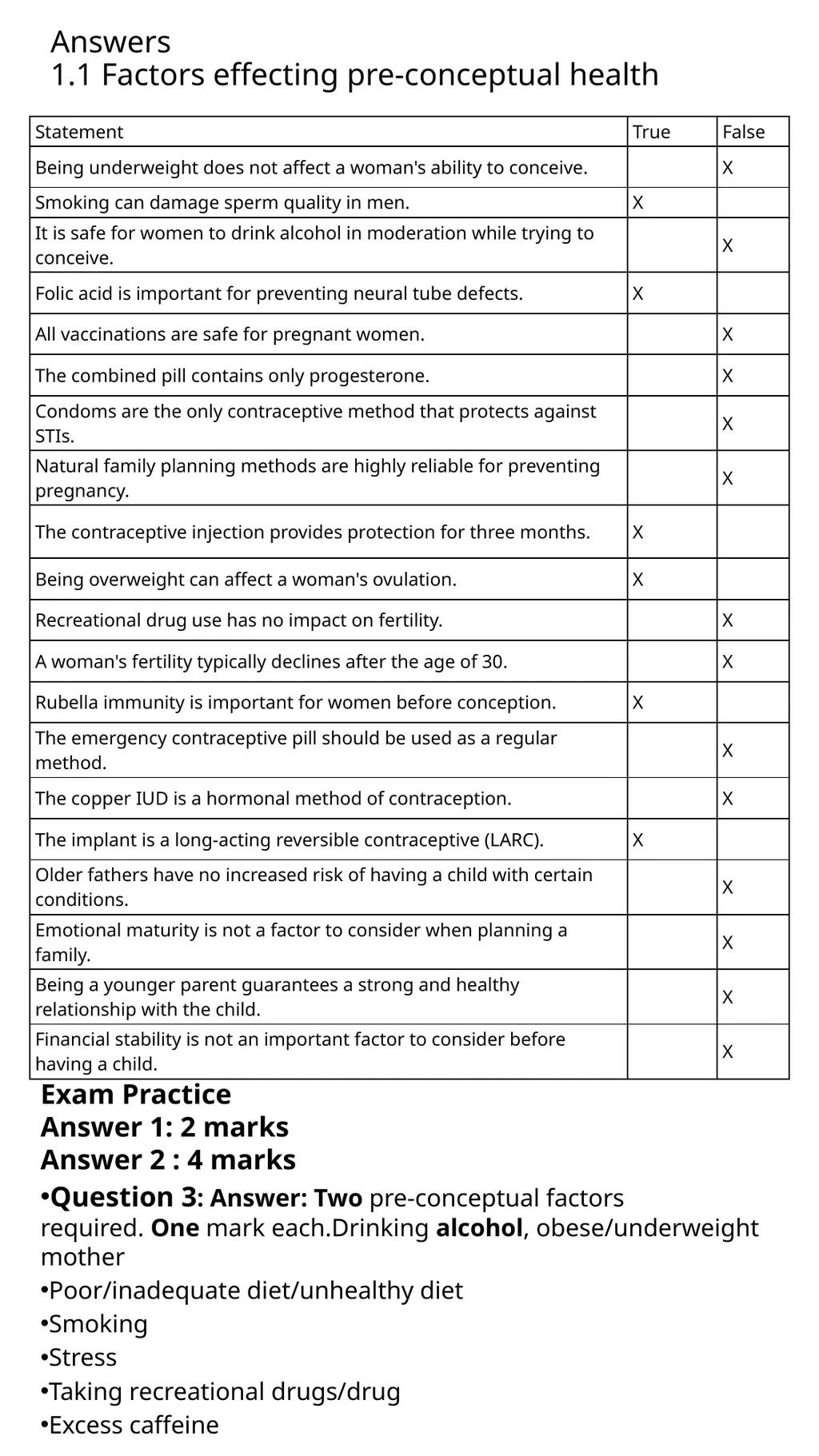
slide34. Answers 1.1 Factors effecting pre-conceptual health Exam Practice
Answer 1: 2 marks
Answer 2 : 4 marks
Question 3: Answer: Two pre-conceptual factors required. One mark each.Drinking alcohol, obese/underweight mother
Poor/inadequate diet/unhealthy diet
Smoking
Stress
Taking recreational drugs/drug
Excess caffeine<br>
slide35. 1.2 Other Factors Affecting Pre-conception Health (Women) Explain why it is important for Rosa to take folic acid before she becomes pregnant.
Answer: Up to two marks an explanation e.g.:to prevent her baby being born with birth defects (1)
neural tube birth defects (1)
spina bifida (1)
Marks: 2 1.3 Contraception
Maya Scenario
Male Condoms: Readily available, affordable, and protect against STIs. However, they rely on the male partner being willing to use them and can reduce spontaneity.
Female Condoms: Give Maya more control, can be inserted in advance, and offer some STI protection. However, they are less readily available and can be more expensive.
Diaphragm/Cap: Can be inserted a few hours before intercourse, is hormone-free, and relatively inexpensive. However, it requires a fitting by a healthcare professional, must be used with spermicide, and has a higher failure rate than other methods.<br>
slide36. Crossword Answer<br>
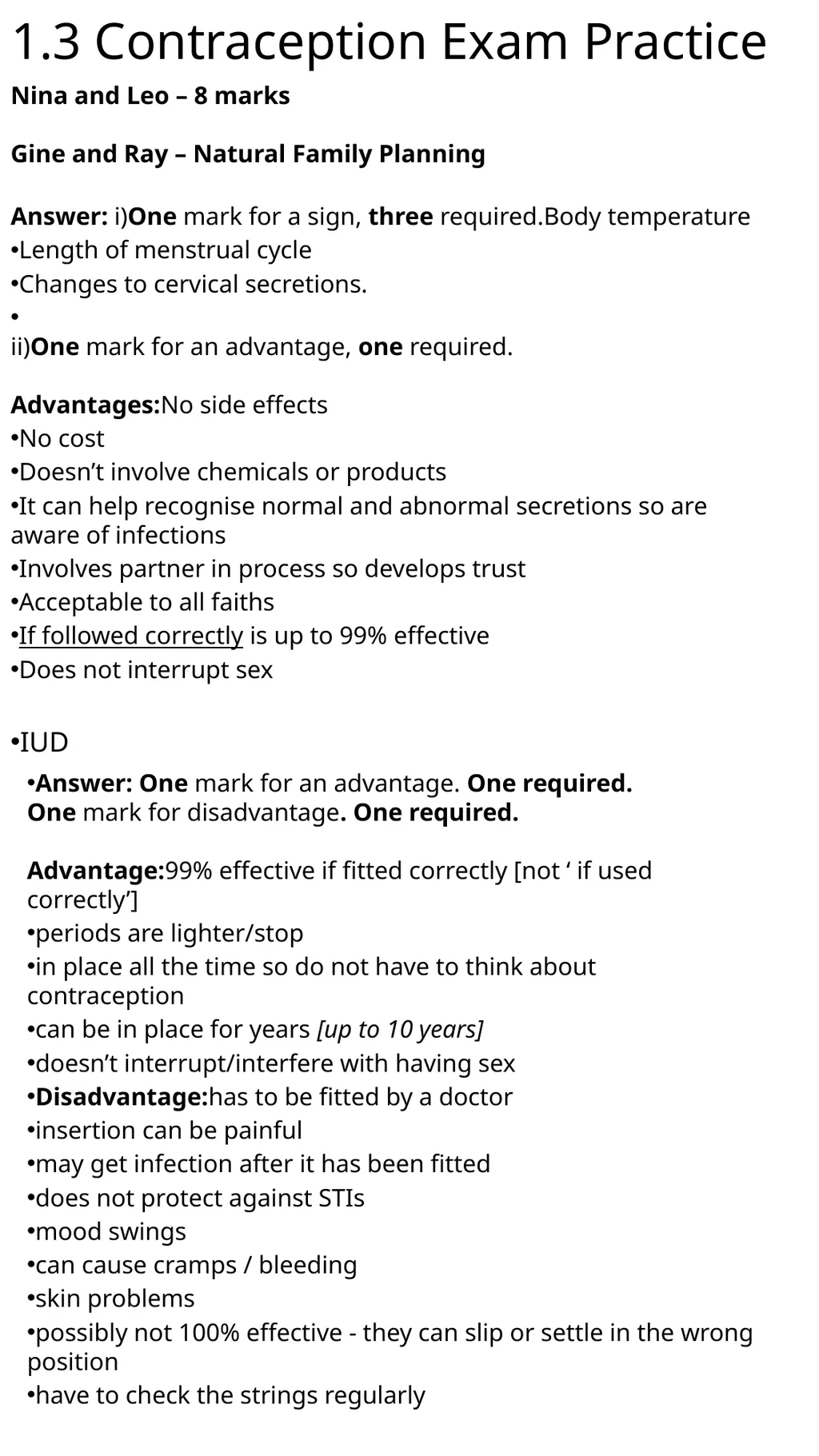
slide37. 1.3 Contraception Exam Practice Nina and Leo – 8 marks
Gine and Ray – Natural Family Planning
Answer: i)One mark for a sign, three required.Body temperature
Length of menstrual cycle
Changes to cervical secretions.
ii)One mark for an advantage, one required. Advantages:No side effects
No cost
Doesn’t involve chemicals or products
It can help recognise normal and abnormal secretions so are aware of infections
Involves partner in process so develops trust
Acceptable to all faiths
If followed correctly is up to 99% effective
Does not interrupt sex
IUD Answer: One mark for an advantage. One required. One mark for disadvantage. One required. Advantage:99% effective if fitted correctly [not ‘ if used correctly’]
periods are lighter/stop
in place all the time so do not have to think about contraception
can be in place for years [up to 10 years]
doesn’t interrupt/interfere with having sex
Disadvantage:has to be fitted by a doctor
insertion can be painful
may get infection after it has been fitted
does not protect against STIs
mood swings
can cause cramps / bleeding
skin problems
possibly not 100% effective - they can slip or settle in the wrong position
have to check the strings regularly<br>
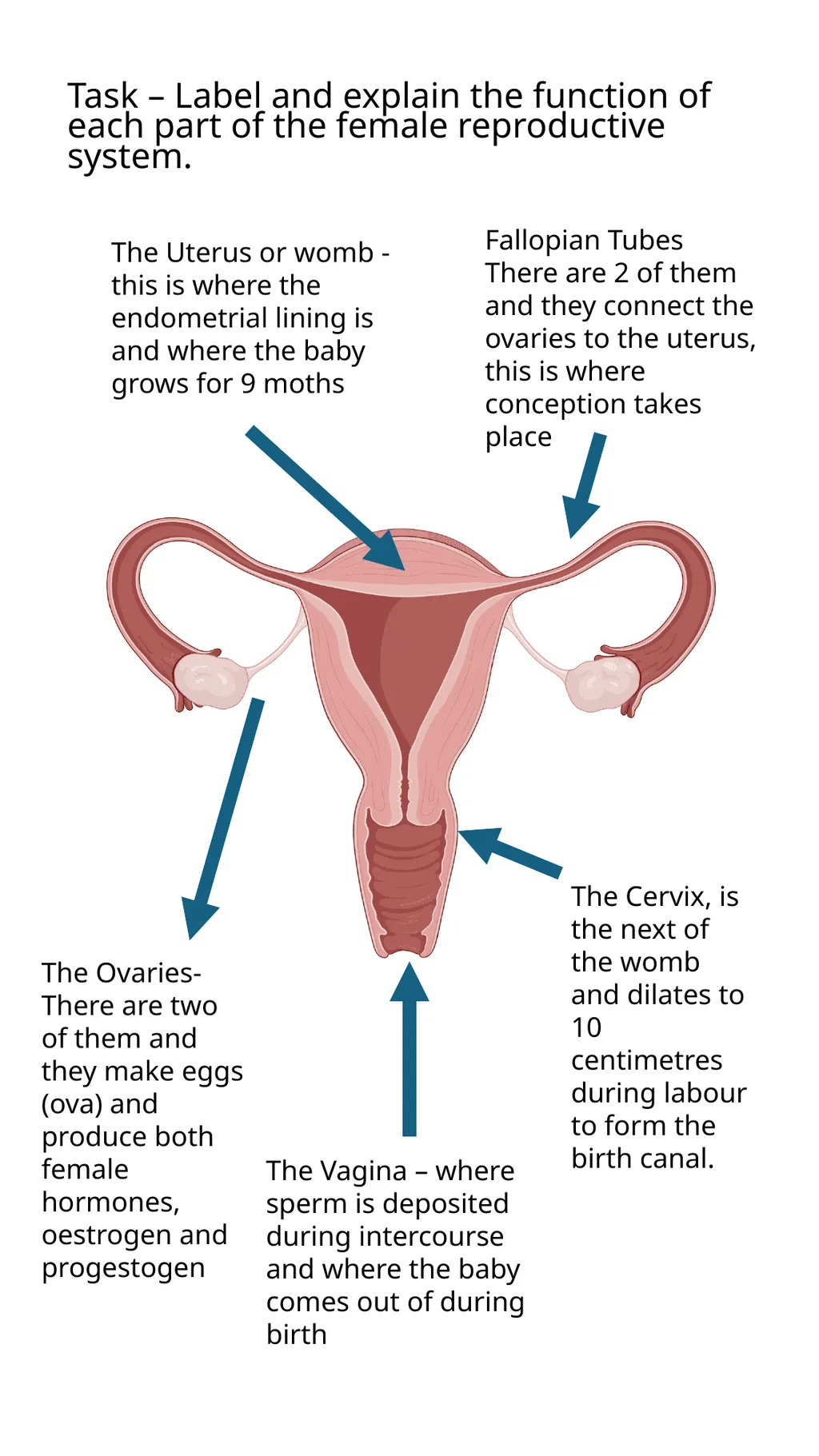
slide38. Task – Label and explain the function of each part of the female reproductive system. The Uterus or womb - this is where the endometrial lining is and where the baby grows for 9 moths Fallopian Tubes
There are 2 of them and they connect the ovaries to the uterus, this is where conception takes place The Cervix, is the next of the womb and dilates to 10 centimetres during labour to form the birth canal. The Vagina – where sperm is deposited during intercourse and where the baby comes out of during birth The Ovaries- There are two of them and they make eggs (ova) and produce both female hormones, oestrogen and progestogen<br>
slide39. Label and Explain what each part does. Penis Urethra Vas Deferens Epididymis Testes Urethra Penis Vas Deferens Testes Epididymis Seminal Vesicle<br>
slide40. Exam Practice The drawing below shows the female reproductive system. The uterus has been labelled for you.
In the table below, identify the parts of the female reproductive system labelled A, B, C and D.
Use these names.
cervix
fallopian tube
ovary
testes
vagina
Use each name once or not at all.
Name
A Fallopian Tubes
B Ovary
C Cervix
D Vagina
[4]
State another name for the uterus.
Womb
_____________________________________________________________________
[1]<br>
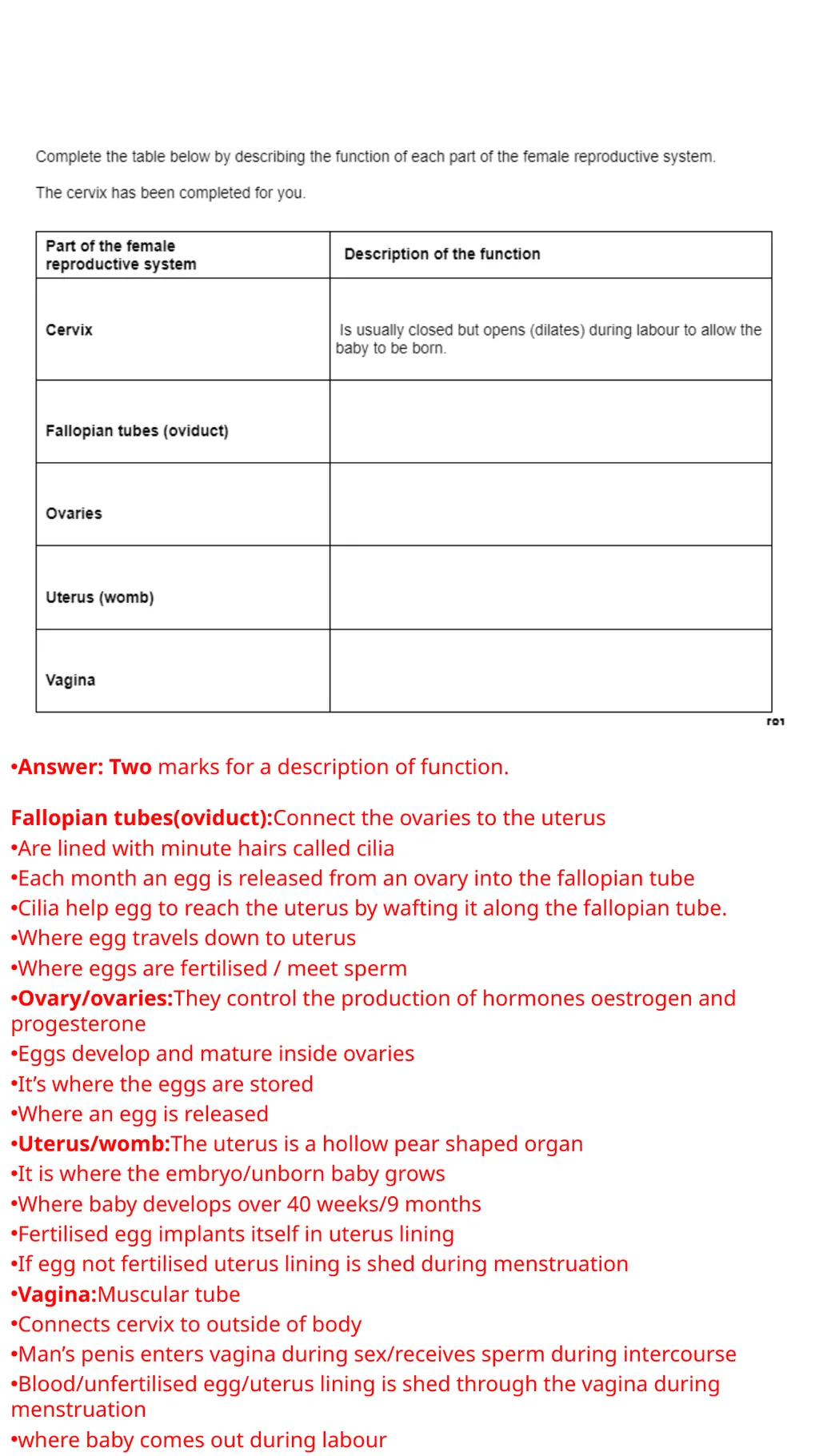
slide41. Answer: Two marks for a description of function. Fallopian tubes(oviduct):Connect the ovaries to the uterus
Are lined with minute hairs called cilia
Each month an egg is released from an ovary into the fallopian tube
Cilia help egg to reach the uterus by wafting it along the fallopian tube.
Where egg travels down to uterus
Where eggs are fertilised / meet sperm
Ovary/ovaries:They control the production of hormones oestrogen and progesterone
Eggs develop and mature inside ovaries
It’s where the eggs are stored
Where an egg is released
Uterus/womb:The uterus is a hollow pear shaped organ
It is where the embryo/unborn baby grows
Where baby develops over 40 weeks/9 months
Fertilised egg implants itself in uterus lining
If egg not fertilised uterus lining is shed during menstruation
Vagina:Muscular tube
Connects cervix to outside of body
Man’s penis enters vagina during sex/receives sperm during intercourse
Blood/unfertilised egg/uterus lining is shed through the vagina during menstruation
where baby comes out during labour Marks: 8 (4x2)<br>
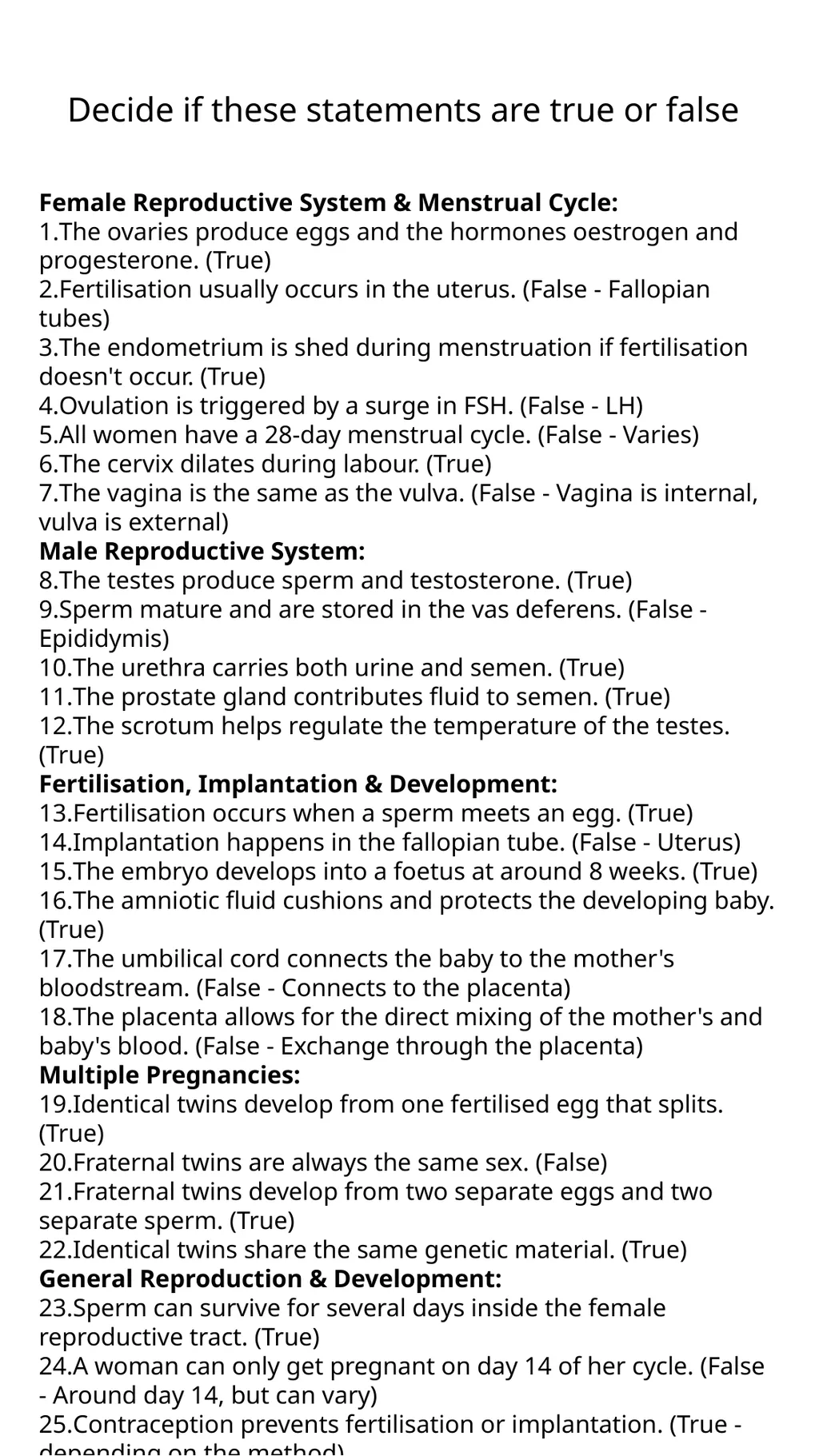
slide43. Decide if these statements are true or false Female Reproductive System & Menstrual Cycle:
The ovaries produce eggs and the hormones oestrogen and progesterone. (True)
Fertilisation usually occurs in the uterus. (False - Fallopian tubes)
The endometrium is shed during menstruation if fertilisation doesn't occur. (True)
Ovulation is triggered by a surge in FSH. (False - LH)
All women have a 28-day menstrual cycle. (False - Varies)
The cervix dilates during labour. (True)
The vagina is the same as the vulva. (False - Vagina is internal, vulva is external)
Male Reproductive System:
The testes produce sperm and testosterone. (True)
Sperm mature and are stored in the vas deferens. (False - Epididymis)
The urethra carries both urine and semen. (True)
The prostate gland contributes fluid to semen. (True)
The scrotum helps regulate the temperature of the testes. (True)
Fertilisation, Implantation & Development:
Fertilisation occurs when a sperm meets an egg. (True)
Implantation happens in the fallopian tube. (False - Uterus)
The embryo develops into a foetus at around 8 weeks. (True)
The amniotic fluid cushions and protects the developing baby. (True)
The umbilical cord connects the baby to the mother's bloodstream. (False - Connects to the placenta)
The placenta allows for the direct mixing of the mother's and baby's blood. (False - Exchange through the placenta)
Multiple Pregnancies:
Identical twins develop from one fertilised egg that splits. (True)
Fraternal twins are always the same sex. (False)
Fraternal twins develop from two separate eggs and two separate sperm. (True)
Identical twins share the same genetic material. (True)
General Reproduction & Development:
Sperm can survive for several days inside the female reproductive tract. (True)
A woman can only get pregnant on day 14 of her cycle. (False - Around day 14, but can vary)
Contraception prevents fertilisation or implantation. (True - depending on the method)<br>
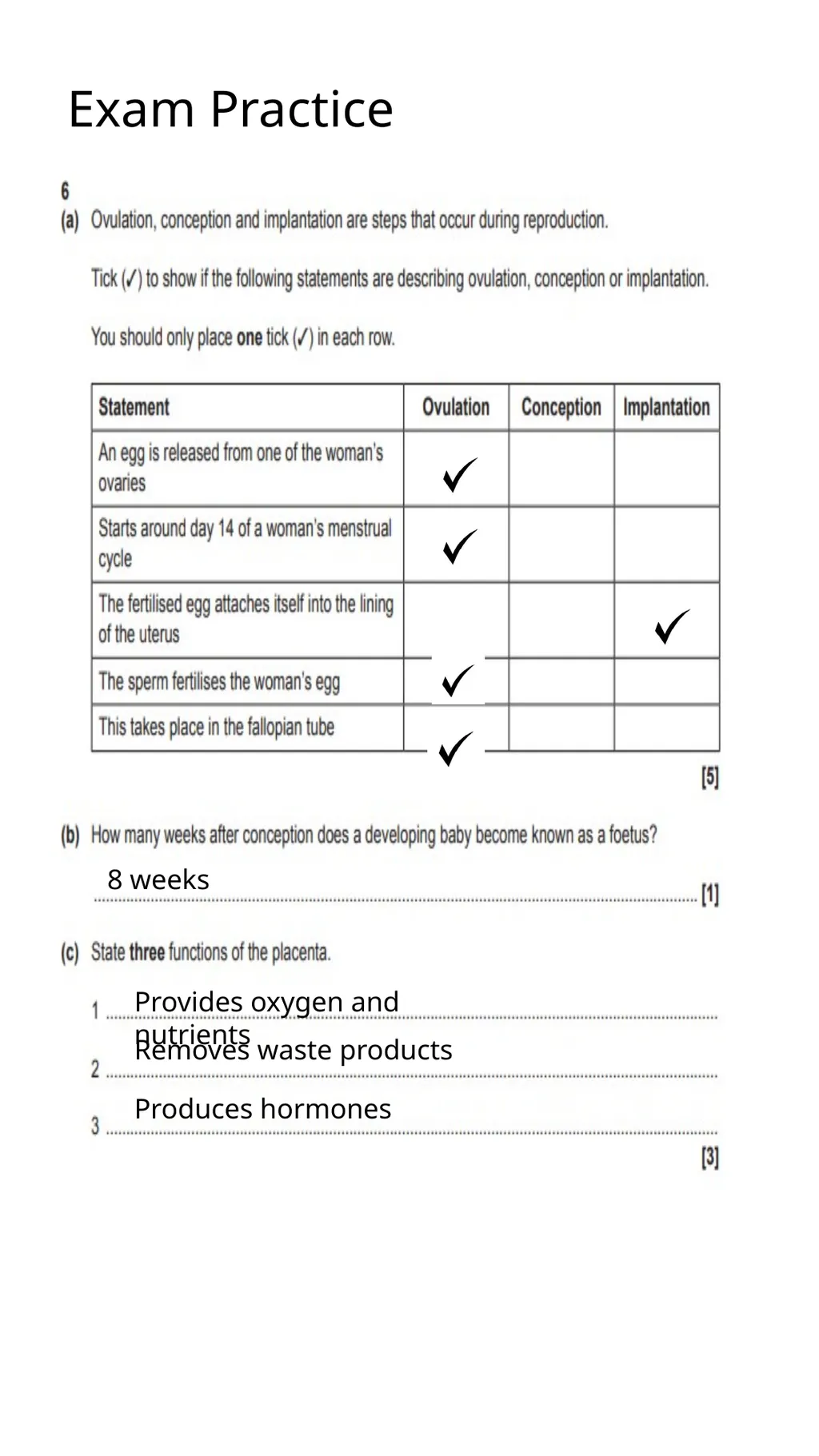
slide44. Exam Practice 8 weeks Provides oxygen and nutrients Removes waste products Produces hormones<br>
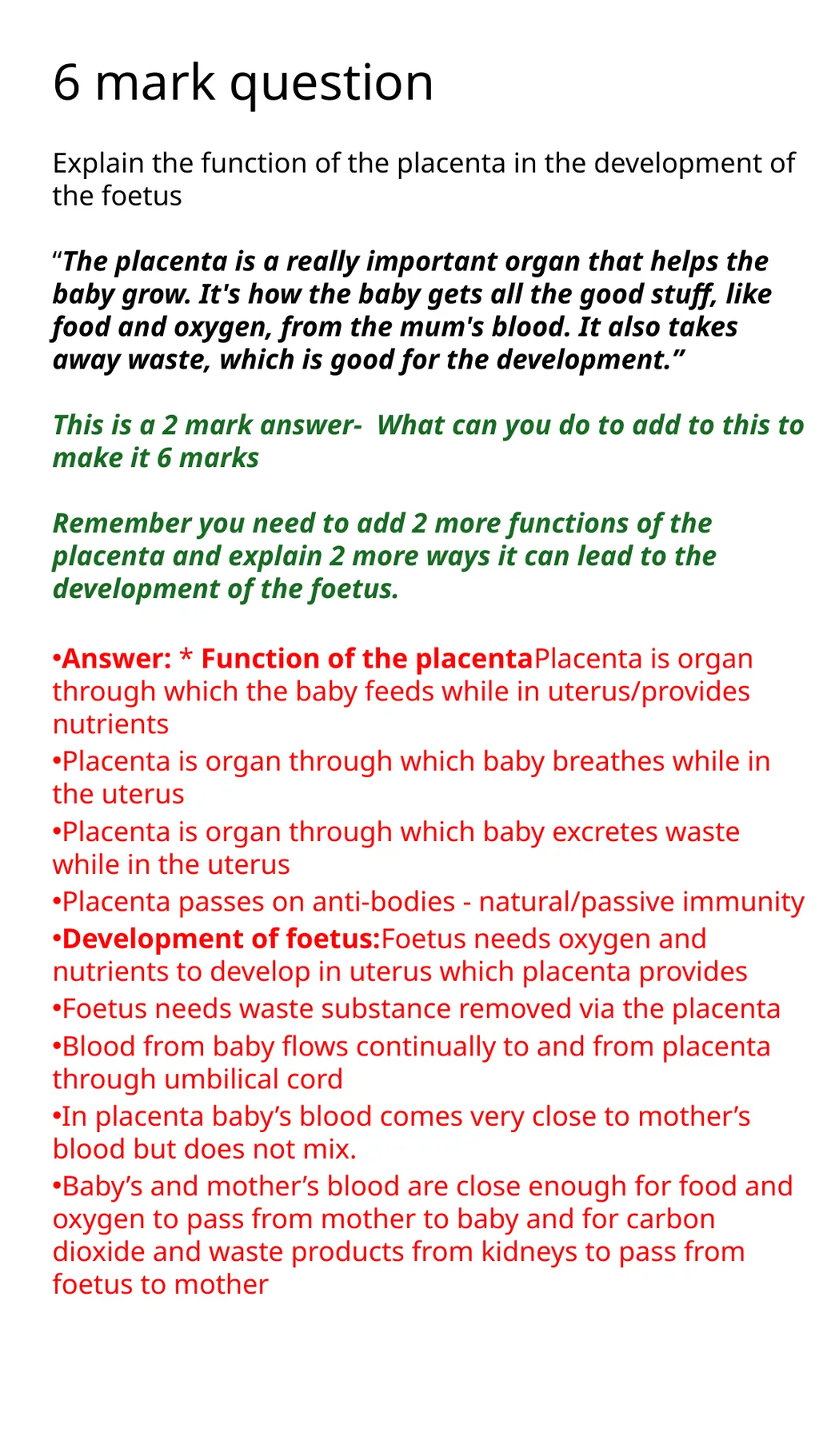
slide45. 6 mark question Explain the function of the placenta in the development of the foetus
“The placenta is a really important organ that helps the baby grow. It's how the baby gets all the good stuff, like food and oxygen, from the mum's blood. It also takes away waste, which is good for the development.”
This is a 2 mark answer- What can you do to add to this to make it 6 marks
Remember you need to add 2 more functions of the placenta and explain 2 more ways it can lead to the development of the foetus.
Answer: * Function of the placentaPlacenta is organ through which the baby feeds while in uterus/provides nutrients
Placenta is organ through which baby breathes while in the uterus
Placenta is organ through which baby excretes waste while in the uterus
Placenta passes on anti-bodies - natural/passive immunity
Development of foetus:Foetus needs oxygen and nutrients to develop in uterus which placenta provides
Foetus needs waste substance removed via the placenta
Blood from baby flows continually to and from placenta through umbilical cord
In placenta baby’s blood comes very close to mother’s blood but does not mix.
Baby’s and mother’s blood are close enough for food and oxygen to pass from mother to baby and for carbon dioxide and waste products from kidneys to pass from foetus to mother
[6]<br>
slide2. Introduction Welcome to your TA1 Child Development Revision Booklet! This booklet is designed to be your comprehensive guide to preparing for the OCR Child Development TA1 exam. Inside, you'll find everything you need to confidently tackle the assessment.
To help you organise your revision, we've included helpful checklists to break down the information into manageable chunks. Each section of the TA1 specification is covered, providing a clear and concise overview of the key concepts. We've also included QR codes throughout the booklet that link to helpful websites, offering supplementary information and different perspectives on the topics.
To really get you thinking and applying your knowledge, each section concludes with activities designed to address common misconceptions and challenge your understanding. You'll also find practice exam questions, complete with model answers, to give you a feel for the exam format and the level of detail required.
Finally, a comprehensive glossary of key terms is provided at the back of the booklet.
Don't forget to check the very back for a complete answer section for all the activities.
Good luck with your revision!<br>
slide4. 1.1 Factors Affecting Pre-conception Health (Both Women & Men)
Pre-conception health is absolutely vital. It directly impacts the ability to conceive a healthy baby and influences the entire pregnancy. Optimising health before conception gives the baby the best possible start in life.
Why Pre-conception Health Matters:
Increased Fertility: Healthy lifestyle choices improve the chances of conceiving.
Reduced Complications: Being in good health before conception reduces the risk of problems during pregnancy.
Healthy Baby: A healthy start before conception gives the baby the best chance for healthy development.
Key Factors & Their Effects:
Weight:
Underweight (BMI < 18.5): Can disrupt hormone production, affecting ovulation in women and sperm production in men. This can make it harder to conceive.
Overweight/Obese (BMI > 25/30): Can also disrupt hormone production, making conception more difficult. In men, it can negatively impact sperm quality and count.
Smoking:
Women: Reduces fertility, making it harder to get pregnant.
Men: Damages sperm quality, reduces sperm count, and can lead to impotence.
Alcohol:
Women: Can damage a developing foetus even before pregnancy is known. It's crucial to avoid alcohol before conception.
Men: Can affect sperm quality and count.
Recreational Drugs:
Many drugs severely impair fertility in both men and women. They can cause significant problems with conception and can harm a developing baby from the moment of conception. For more information scan
the QR Code<br>
slide5. For more information scan
the QR Code<br>
slide6. Knowledge Check – True or False Instructions: Answer the following questions with True or False<br>
slide7. Exam Practice Mark each answer giving reasons for your marks, high light the key information in each answer.
Explain how men and women can ensure good pre-conception health before starting a family. Use two factors. (6)
“Men and women should both maintain a healthy weight and avoid smoking before trying for a baby. Being overweight can affect fertility in both men and women, and smoking can damage sperm and make it harder for women to conceive.”
I would give this ____/6 because________________________________________________________________________________________________________________________________________________
” Two key factors for good pre-conception health are weight and smoking. For women, being overweight or underweight can disrupt ovulation and affect fertility. Men who are overweight may have a lower sperm count. Both men and women should aim for a healthy BMI. Smoking also negatively impacts fertility. It can damage a woman's eggs and make it harder to conceive, and in men, it can reduce sperm count and quality”
I would give this ____/6 because________________________________________________________________________________________________________________________________________________
You Do Explain how men and women can ensure good pre-conception health before starting a family. Use two factors. (6) ________________________________________________________________________________________________________________________________________________________________________________________________________________________________________________________________________________________________________________________________________________________________________________________________________________________________________________________________________________________________________________________________________________________________________________________________________________________________
_______________________________________________________________ Sarah has given birth to a premature daughter, Beth.
While in hospital, Sarah is told that her lifestyle before she became pregnant may have contributed to Beth being born prematurely.
Identify two factors that can affect pre-conception health and may contribute to babies being born prematurely.
1_______________________________________________________________
2_______________________________________________________________<br>
slide8. Emma and Liam want to start a family together. Emma and Liam want to make sure that their pre-conception health is the best it can be, before Emma becomes pregnant. Explain what they could do to ensure good pre-conception health
(8 marks)
This is an 8/8 answer, highlight all the key words this answer has used
A balanced diet and regular exercise are important. Emma and Liam should try and stick to guidelines, such as the Eatwell Guide, consuming at least five portions of fruit and vegetables daily to get necessary vitamins and minerals.
Reducing sugar intake is also important to prevent the development of diabetes, a condition that can present complications during pregnancy. Emma should commence folic acid before conception, as it is essential for preventing neural tube defects, such as spina bifida, in the developing foetus.
Regular physical activity is beneficial for both Emma and Liam. It assists Emma in maintaining a healthy weight and enhances her overall fitness, which will be good for labour. For Liam, exercise promotes general well-being and supports healthy sperm production. Maintaining a healthy weight is important, as being overweight or underweight can negatively impact fertility in both men and women. In Emma's case, it can stop ovulation, therefore preventing conception, and can increase the risk of pregnancy-related complications. For Liam, excess weight can result in a a smaller sperm count.
Smoking and alcohol consumption should also be considered. Both Emma and Liam should stop smoking well in advance conception, as it can impairs fertility in both men and women. Smoking damages sperm, reducing both the count and quality, and increases the risk of miscarriage and other pregnancy complications.
Liam should reduce or ideally stop drinking alcohol as it can lower sperm count. Emma is advised to refrain from alcohol entirely when trying to conceive, as it can be detrimental to the developing foetus, even before pregnancy is confirmed.<br>
slide9. Emma and Liam want to start a family together. Emma and Liam want to make sure that their pre-conception health is the best it can be, before Emma becomes pregnant. Explain what they could do to ensure good pre-conception health
Can you do two paragraphs on why Emma and Liam should consider both prescription and recreational drugs as well keeping up to date with immunisations.
_______________________________________________________________________________________________________________________________________________________________________________________________________________________________________________________________________________________________________________________________________________________________________________________________________________________________________________________________________________________________________________________________________________________________________________________________________________________________________________________________________________________________________________________________________________________________________________________________________________________________________________________________________________________________________________________________________________________________________________________________________________________________________________________________________________________________________________________________________________________________________________________________________________________________________________________________________________________.<br>
slide10. Folic Acid: Essential for preventing neural tube defects (NTDs) like spina bifida in the developing baby. It's recommended to take folic acid before conception and throughout the first trimester.
Up-to-date Immunisations: Protects both the mother and the developing baby from preventable diseases. Some vaccinations are not safe during pregnancy, so it's vital to be up-to-date before trying to conceive. Rubella (German measles) immunity is especially important. 1.2 Other Factors Affecting Pre-conception Health (Women Key Reasons:
Folic Acid: Prevents serious birth defects of the brain and spine.
Immunisations: Protect against infections that can harm the developing baby. Exam Practice
Rosa and her husband Rishi want to try for their first baby. Their doctor tells them that pre-conception health for both of them is important.
The doctor tells Rosa to take folic acid before she becomes pregnant. Explain why it is important for Rosa to take folic acid before she becomes pregnant.
_________________________________________________________________________________________________________________________________________________________________________________________________________________________________________________________________(2)<br>
slide11. 1.3 Types of Contraception Methods
Contraception aims to prevent pregnancy. Different
methods work in different ways.
Barrier Methods: These methods physically prevent
sperm from reaching the egg. Scenario:
16-year-old Maya is sexually active and wants to prevent pregnancy. However, she's quite forgetful and doesn't want to rely on taking a pill every day or remembering appointments for injections or implants. She's also not keen on the idea of hormonal contraception because she's worried about potential side effects. She wants a method that she can use only when she needs it.
Which barrier method of contraception would be most suitable for Maya, and why?
Contraception
Why________________________________________________________________________________________________________________________________________________________________________________________________________
____________________________________________________________________<br>
slide12. Hormonal Contraception
Hormonal contraception uses hormones to prevent pregnancy by stopping ovulation (the release of an egg), thickening cervical mucus to block sperm, or changing the lining of the womb to prevent implantation.<br>
slide13. Alternative Contraception Types Natural Family Planning Emergency Contraception Aisha is a university student in her second year. She's organised and responsible, juggling her studies, a part-time job, and a fulfilling relationship with her boyfriend, Ben. They have regular intercourse and enjoy their intimacy without the constant worry of an unplanned pregnancy. Aisha is very clear that she doesn't want to become pregnant during her studies; her focus is on her degree and building a stable foundation for her future. She's also quite shy and feels uncomfortable with the idea of having a medical professional fit a contraceptive device. This makes methods like the IUD or implant less appealing to her. She's looking for something she can manage herself, discreetly and reliably, without needing an appointment or physical examination. She's also aware of the importance of consistent use for any method she chooses.
What contraception should Aisha choose and why?
______________________________________________________________________________________________________________________________________________________________________________________________________<br>
slide14. Contraception Wordsearch ACROSS 4. ^ Can be prevented by using condoms 5. ^ Intrauterine system, releases hormones 8. ^ The only 100% effective method of preventing pregnancy 10. ^ Where the diaphragm is placed 12. ^ Often used with barrier methods 13. Effects ^ Can include headaches or mood changes 14. ^ The 'period' 19. ^ Key hormone in some birth control methods 21. ^ Long-acting, reversible contraception, inserted under the skin 23. ^ Daily hormone dose to prevent pregnancy 24. ^ Barrier method used with spermicide DOWN 1. ^ Works alongside progesterone in the combined pill 2. ^ The time when a woman is most fertile 3. ^ A woman's monthly cycle relates to this 6. ^ Contraceptive injection given every 12 weeks 7. ^ The womb 9. ^ Measured by 'failure rate' 11. ^ T-shaped contraceptive placed in the womb 15. Contraception ^ The 'morning after pill' is one type 16. ^ Progesterone-only pill 17. ^ Protective layer during intimacy 18. Cap ^ Barrier that fits snugly over the cervix 20. ^ A female condom 22. ^ Stick-on hormone delivery<br>
slide15. Exam Practice Nina gave birth to her son, Leo, six weeks ago.
Nina is breastfeeding Leo.
She and her partner Kai do not want Nina to become pregnant again until Leo is at least two years old.
The health visitor suggests two methods of contraception:
• the male condom
• the contraceptive implant.
Discuss the advantages and disadvantages of each method of contraception to help Nina and Kai decide which method to use.
1_ Highlight the key words
2. What would you give this answer and why? The male condom is readily available and inexpensive, even free from clinics, making it easily accessible for Nina and Kai. It's also the only method besides abstinence that protects against STIs, although this is less of a concern in their relationship. Because it's a barrier method, it doesn't interfere with breastfeeding. However, condoms have a higher failure rate than the implant (around 2% with perfect use, higher with typical use) and require correct and consistent use, which can be difficult with a newborn. They can also interrupt intimacy.
The contraceptive implant, on the other hand, is highly effective (over 99%) and long-lasting, providing contraception for up to three years, covering the period Nina and Kai want to avoid another pregnancy. It's also safe for breastfeeding. Once inserted, they don't have to think about contraception again. However, the implant requires a medical procedure for insertion and removal and can cause side effects like irregular bleeding, which could be problematic for Nina. It also offers no protection against STIs.
I would give this answer __/8 because ____________________________________________________________________________________________________________________________________________________________________________________________________________________________________________________<br>
slide16. Gina and Ray currently use ‘natural family planning’ as their chosen method of contraception.
From the list below choose three different fertility signs that Gina would record when using this method of contraception.
Fertility signs
• Body temperature • Changes to cervical secretions
• Frequency of passing urine • Length of menstrual cycle
• Breast changes • Weight gain and loss
1.
2.
3.
[3]
State one advantage of natural family planning as a method of contraception.
[1] The picture below shows a form of contraception called an intrauterine device or system (IUD or IUS).
State one advantage and one disadvantage of the intrauterine device as a method of contraception.
Advantage
Disadvantage
[2]<br>
slide17. OCR Child Development: 1.4.1 The Female Reproductive System
I. Key Structures and Functions:
A. Ovaries:
What they do: These are like the female "egg factories." They have two main jobs:
Make eggs (ova): Think of them as tiny packages, each holding an immature egg. Every month, usually one egg matures and is released.
Make hormones: They produce oestrogen and progesterone, which are like chemical messengers. These hormones control the menstrual cycle, how a girl's body develops, and are essential for pregnancy.
What they look like: Two small, almond-shaped organs, one on each side of the uterus. They're packed with follicles (the egg packages) in different stages of development.
B. Fallopian Tubes (Oviducts):
What they do: These are the egg's travel route. They connect the ovaries to the uterus. Fertilisation (when a sperm meets an egg) usually happens here.
What they look like: Two thin tubes, each linking an ovary to the uterus. They have these little finger-like bits (fimbriae) at the ovary end that help catch the released egg. The tubes also have tiny hairs inside that push the egg towards the uterus.
C. Uterus (Womb):
What it does: This is where a fertilised egg (now called a
zygote) implants and grows into a baby during pregnancy.
It's also involved in menstruation.
What it looks like: A pear-shaped organ with thick, muscular walls. It has three layers: the perimetrium (outer), myometrium (muscular middle), and endometrium (inner lining). The endometrium is super important for pregnancy – it's where the fertilised egg settles in. If there's no pregnancy, this lining is shed during your period.
D. Cervix:
What it does: The cervix is the narrow bottom part of the uterus, connecting it to the vagina. It's like a gatekeeper.
What it looks like: A muscular ring that stays tightly shut during pregnancy to protect the developing baby. It opens up (dilates) during labour so the baby can pass through.
E. Vagina:
What it does: The vagina is the muscular canal that goes from the cervix to the outside of the body. It's where sperm enters, menstrual fluid exits, and the baby comes out.
What it looks like: A flexible tube lined with a mucous
membrane<br>
slide18. Task – Label and explain the function of each part of the female reproductive system.<br>
slide19. The Menstrual Cycle:
The menstrual cycle is a series of hormonal changes that get a woman's body ready for a possible pregnancy each month. It's roughly 28 days long, but everyone's different. Here's the breakdown:
Menstruation (Period - Days 1-5ish): This is when the uterus sheds its lining (the endometrium) if there's no fertilised egg. This is what we call a period. Oestrogen and progesterone levels are low.
Follicular Phase (Days 1-14ish): The pituitary gland (a tiny gland in your brain) releases FSH (Follicle-Stimulating Hormone). FSH makes follicles in the ovaries start to develop. One becomes the "chosen one" and holds the egg that will be released. Oestrogen levels rise, and the uterus lining starts to thicken again.
Ovulation (Around Day 14): The mature egg is released from the ovary. This is triggered by a surge in LH (Luteinising Hormone).
Luteal Phase (Days 15-28ish): The empty follicle turns into the corpus luteum, which produces progesterone. Progesterone keeps the uterus lining thick and ready for a fertilised egg. If there's no fertilisation, the corpus luteum breaks down, and progesterone levels drop.
If fertilisation happens: The fertilised egg implants in the thickened lining. The corpus luteum keeps making progesterone to support the early pregnancy.
If fertilisation doesn't happen: The drop in progesterone triggers the shedding of the lining – your period starts again.
Key Hormones (Chemical Messengers):
Oestrogen: Develops female characteristics, thickens the uterus lining.
Progesterone: Maintains the uterus lining for pregnancy.
FSH (Follicle-Stimulating Hormone): Stimulates follicle development.
LH (Luteinising Hormone): Triggers ovulation.<br>
slide20. Colour and Label what happens during each part of the menstrual cycle<br>
slide21. OCR Child Development: 1.4.2 The Male Reproductive System
Key Structures and Functions:
A. Testes (Testicles):
What they do: These are the male "sperm factories." They have two main jobs:
Make sperm: Tiny cells that carry genetic information to fertilise an egg.
Make testosterone: This is the main male sex hormone. It controls male development, like muscle growth and facial hair, and is also important for sperm production.
What they look like: Two oval-shaped organs that hang in a pouch called the scrotum. The scrotum keeps the testes at a slightly cooler temperature, which is ideal for sperm production.
B. Sperm Duct/Epididymis:
What they do: The epididymis is like a storage and maturation centre for sperm. Sperm are made in the testes and then travel to the epididymis, where they mature and are stored until they're ready to leave the body.
What it looks like: A coiled tube attached to the back of each testis
.
C. Vas Deferens:
What it does: This is a tube that carries sperm from the epididymis to the urethra. It's like the main highway for sperm transport.
What it looks like: A muscular tube that connects the epididymis to the urethra.
D. Seminal Vesicles:
What they do: These glands produce a sugary fluid that mixes with the sperm. This fluid provides energy for the sperm to swim. It's like fuel for the sperm.
What they look like: Glands located near the prostate gland.
E. Urethra:
What it does: This tube carries both urine and semen out of the body through the penis. It's like a dual-purpose pipeline.
What it looks like: The tube that runs through the penis.
F. Penis:
What it does: The penis is the male organ for sexual intercourse. It delivers sperm into the female reproductive tract.
What it looks like: The external male reproductive organ.<br>
slide22. Label and Explain what each part does.<br>
slide23. Exam Practice The drawing below shows the female reproductive system. The uterus has been labelled for you.
In the table below, identify the parts of the female reproductive system labelled A, B, C and D.
Use these names.
cervix
fallopian tube
ovary
testes
vagina
Use each name once or not at all.
Name
A
B
C
D
[4]
State another name for the uterus.
________________________________________________________________
[1]<br>
slide25. OCR Child Development: 1.5 How Reproduction
Takes Place
I. The Journey to a Baby:
Ovulation:
What happens: This is when a mature egg is released from the ovary. It's like the egg saying, "I'm ready!" This usually happens around the middle of a woman's menstrual cycle (around day 14, but it can vary).
B. Conception/Fertilisation:
What happens: This is when a sperm meets and joins with the egg. It's like a tiny sperm winning the race! This usually happens in the fallopian tube. The sperm's genetic material combines with the egg's, creating a fertilised egg (zygote).
C. Implantation:
What happens: The fertilised egg travels down the fallopian tube and implants itself in the lining of the uterus (endometrium). Think of it like the egg finding a cosy place to settle in. This is the beginning of pregnancy This image shows the release of a mature egg from the ovary. The egg is surrounded by supporting cells and is ready to travel down the fallopian tube.<br>
slide26. Development of the Embryo and Foetus:
What happens: The fertilised egg (now called
an embryo) starts to grow and develop. After
about 8 weeks, it's called a foetus. During this time, all the baby's organs and body systems develop.
Key Supporting Structures:
Amniotic Fluid: This fluid surrounds the baby in the amniotic sac. It acts like a cushion, protecting the baby from bumps and knocks, and it also helps to keep the baby at a constant temperature.
Umbilical Cord: This cord connects the baby to the placenta. It's like a lifeline, delivering oxygen and nutrients from the mother to the baby and taking away waste products.
Placenta: This organ develops in the uterus and is attached to the umbilical cord. It acts as a bridge between the mother and baby, allowing for the exchange of oxygen, nutrients, and waste products.
When does an embryo become a foetus? The embryo becomes a foetus at around 8 weeks of development.<br>
slide27. II. Multiple Pregnancies:
Sometimes, more than one baby is born at the
same time. This is called a multiple pregnancy.
There are two main types:
Identical Twins: These twins develop from
one fertilised egg that splits into two. They
share the same genetic material, so they look
very similar and are always the same sex.
Non-Identical/Fraternal Twins: These twins
develop from two separate eggs that are
fertilised by two different sperm. They are
no more alike than any other siblings and
can be the same or different sexes.
How do multiple pregnancies happen?
Identical twins: It's a bit of a random event – the fertilised egg just happens to split. Scientists aren't entirely sure why this happens.
Non-identical twins: This can happen if the woman releases more than one egg during ovulation. It's more common in women who are older or who have fertility treatment.
Key Things to Remember:
Reproduction involves a series of steps, starting with ovulation and ending with the birth of a baby.
The embryo develops into a foetus at around 8 weeks.
Multiple pregnancies can be identical (one egg splits) or non-identical (two separate eggs are fertilised).<br>
slide28. Look at the 25 statements. Decide if they are true or false Female Reproductive System & Menstrual Cycle:
The ovaries produce eggs and the hormones oestrogen and progesterone.
Fertilisation usually occurs in the uterus.
The endometrium is shed during menstruation if fertilisation doesn't occur.
Ovulation is triggered by a surge in FSH.
All women have a 28-day menstrual cycle.
The cervix dilates during labour.
The vagina is the same as the vulva.
Male Reproductive System:
The testes produce sperm and testosterone.
Sperm mature and are stored in the vas deferens.
The urethra carries both urine and semen.
The prostate gland contributes fluid to semen.
The scrotum helps regulate the temperature of the testes.
Fertilisation, Implantation & Development:
Fertilisation occurs when a sperm meets an egg.
Implantation happens in the fallopian tube.
The embryo develops into a foetus at around 8 weeks.
The amniotic fluid cushions and protects the developing baby.
The umbilical cord connects the baby to the mother's bloodstream.
The placenta allows for the direct mixing of the mother's and baby's blood.
Multiple Pregnancies:
Identical twins develop from one fertilised egg that splits.
Fraternal twins are always the same sex.
Fraternal twins develop from two separate eggs and two separate sperm.
Identical twins share the same genetic material.
General Reproduction & Development:
Sperm can survive for several days inside the female reproductive tract.
A woman can only get pregnant on day 14 of her cycle.
Contraception prevents fertilisation or implantation.<br>
slide29. Exam Practice<br>
slide30. 6 mark question Explain the function of the placenta in the development of the foetus
“The placenta is a really important organ that helps the baby grow. It's how the baby gets all the good stuff, like food and oxygen, from the mum's blood. It also takes away waste, which is good for the development.”
This is a 2 mark answer- What can you do to add to this to make it 6 marks
Remember you need to add 2 more functions of the placenta and explain 2 more ways it can lead to the development of the foetus.
____________________________________________________________________________________________________________________________________________________________________________________________________________________________________________________________________________________________________________________________________________________________________________________________________________________________________________________________________________________________________________________________________________________________________________________________________________________________________________________________________________________________________________________________________________________________________________________________________________________________________________________________________________________________________________________________________________________________________________________________________________________________________________________________________________________________________________________________________________________________________________________________________________________________________________________________________________________________________________________________________________________________________________________________________________________________________
[6]<br>
slide31. 1.6 The Signs and Symptoms of Pregnancy
This section focuses on the common signs and symptoms a woman might experience in early pregnancy. It's important to remember that these symptoms can vary from person to person, and some may be indicative of other conditions. A pregnancy test and consultation with a healthcare professional are essential for confirmation.
Checklist:
[ ] Breast changes
[ ] Missed period
[ ] Nausea
[ ] Passing urine frequently
[ ] Tiredness
Common Signs and Symptoms:
Breast Changes: One of the earliest signs can be changes in the breasts. These may include tenderness, soreness, swelling, or a feeling of fullness. The nipples might also become more sensitive and the areola (the area around the nipple) may darken.
Missed Period: A missed period is often the most noticeable sign and the reason many women first suspect they are pregnant. However, it's important to note that a missed period can also be caused by other factors, such as stress, changes in diet, or certain medical conditions.
Nausea: Often referred to as "morning sickness," nausea can occur at any time of the day or night. Some women experience mild nausea, while others may have more severe symptoms, including vomiting.
Passing Urine Frequently: The need to urinate more often than usual is a common symptom due to hormonal changes that increase blood flow to the kidneys. This increased blood flow causes the kidneys to produce more urine.
Tiredness: Fatigue is a very common symptom in early pregnancy. The body is working hard to support the developing embryo, which can lead to feelings of exhaustion.<br>
slide32. Are they pregnant? Scenario 1:
Sarah, 25, has been feeling unusually tired lately and her breasts are quite tender. She's also noticed she needs to urinate much more frequently than usual. She's been using the contraceptive pill consistently for the past two years and hasn't missed any doses. Her last period was on time. Is Sarah likely pregnant? Why or why not?
_______________________________________________________________________________________________________________________________________________________________________________________________________________________________________________________________________________________________________
Scenario 2:
Maria, 30, and her partner have been trying to conceive for six months. She's recently missed her period, which is unusual for her. She's also experiencing some nausea in the mornings. She hasn't been using any form of contraception. Is Maria likely pregnant? Why or why not?
_______________________________________________________________________________________________________________________________________________________________________________________________________________________________________________________________________________________________________
Scenario 3:
Lisa, 18, is sexually active but uses condoms every time. She's been feeling a bit nauseous for the past week, and her breasts feel slightly sore. Her period is due in a week. She's worried she might be pregnant. Is Lisa likely pregnant? Why or why not? What other factors should she consider?
_______________________________________________________________________________________________________________________________________________________________________________________________________________________________________________________________________________________________________<br>
slide33. Answers to Tasks Do not peek until you have completed all questions!<br>
slide34. Answers 1.1 Factors effecting pre-conceptual health Exam Practice
Answer 1: 2 marks
Answer 2 : 4 marks
Question 3: Answer: Two pre-conceptual factors required. One mark each.Drinking alcohol, obese/underweight mother
Poor/inadequate diet/unhealthy diet
Smoking
Stress
Taking recreational drugs/drug
Excess caffeine<br>
slide35. 1.2 Other Factors Affecting Pre-conception Health (Women) Explain why it is important for Rosa to take folic acid before she becomes pregnant.
Answer: Up to two marks an explanation e.g.:to prevent her baby being born with birth defects (1)
neural tube birth defects (1)
spina bifida (1)
Marks: 2 1.3 Contraception
Maya Scenario
Male Condoms: Readily available, affordable, and protect against STIs. However, they rely on the male partner being willing to use them and can reduce spontaneity.
Female Condoms: Give Maya more control, can be inserted in advance, and offer some STI protection. However, they are less readily available and can be more expensive.
Diaphragm/Cap: Can be inserted a few hours before intercourse, is hormone-free, and relatively inexpensive. However, it requires a fitting by a healthcare professional, must be used with spermicide, and has a higher failure rate than other methods.<br>
slide36. Crossword Answer<br>
slide37. 1.3 Contraception Exam Practice Nina and Leo – 8 marks
Gine and Ray – Natural Family Planning
Answer: i)One mark for a sign, three required.Body temperature
Length of menstrual cycle
Changes to cervical secretions.
ii)One mark for an advantage, one required. Advantages:No side effects
No cost
Doesn’t involve chemicals or products
It can help recognise normal and abnormal secretions so are aware of infections
Involves partner in process so develops trust
Acceptable to all faiths
If followed correctly is up to 99% effective
Does not interrupt sex
IUD Answer: One mark for an advantage. One required. One mark for disadvantage. One required. Advantage:99% effective if fitted correctly [not ‘ if used correctly’]
periods are lighter/stop
in place all the time so do not have to think about contraception
can be in place for years [up to 10 years]
doesn’t interrupt/interfere with having sex
Disadvantage:has to be fitted by a doctor
insertion can be painful
may get infection after it has been fitted
does not protect against STIs
mood swings
can cause cramps / bleeding
skin problems
possibly not 100% effective - they can slip or settle in the wrong position
have to check the strings regularly<br>
slide38. Task – Label and explain the function of each part of the female reproductive system. The Uterus or womb - this is where the endometrial lining is and where the baby grows for 9 moths Fallopian Tubes
There are 2 of them and they connect the ovaries to the uterus, this is where conception takes place The Cervix, is the next of the womb and dilates to 10 centimetres during labour to form the birth canal. The Vagina – where sperm is deposited during intercourse and where the baby comes out of during birth The Ovaries- There are two of them and they make eggs (ova) and produce both female hormones, oestrogen and progestogen<br>
slide39. Label and Explain what each part does. Penis Urethra Vas Deferens Epididymis Testes Urethra Penis Vas Deferens Testes Epididymis Seminal Vesicle<br>
slide40. Exam Practice The drawing below shows the female reproductive system. The uterus has been labelled for you.
In the table below, identify the parts of the female reproductive system labelled A, B, C and D.
Use these names.
cervix
fallopian tube
ovary
testes
vagina
Use each name once or not at all.
Name
A Fallopian Tubes
B Ovary
C Cervix
D Vagina
[4]
State another name for the uterus.
Womb
_____________________________________________________________________
[1]<br>
slide41. Answer: Two marks for a description of function. Fallopian tubes(oviduct):Connect the ovaries to the uterus
Are lined with minute hairs called cilia
Each month an egg is released from an ovary into the fallopian tube
Cilia help egg to reach the uterus by wafting it along the fallopian tube.
Where egg travels down to uterus
Where eggs are fertilised / meet sperm
Ovary/ovaries:They control the production of hormones oestrogen and progesterone
Eggs develop and mature inside ovaries
It’s where the eggs are stored
Where an egg is released
Uterus/womb:The uterus is a hollow pear shaped organ
It is where the embryo/unborn baby grows
Where baby develops over 40 weeks/9 months
Fertilised egg implants itself in uterus lining
If egg not fertilised uterus lining is shed during menstruation
Vagina:Muscular tube
Connects cervix to outside of body
Man’s penis enters vagina during sex/receives sperm during intercourse
Blood/unfertilised egg/uterus lining is shed through the vagina during menstruation
where baby comes out during labour Marks: 8 (4x2)<br>
slide43. Decide if these statements are true or false Female Reproductive System & Menstrual Cycle:
The ovaries produce eggs and the hormones oestrogen and progesterone. (True)
Fertilisation usually occurs in the uterus. (False - Fallopian tubes)
The endometrium is shed during menstruation if fertilisation doesn't occur. (True)
Ovulation is triggered by a surge in FSH. (False - LH)
All women have a 28-day menstrual cycle. (False - Varies)
The cervix dilates during labour. (True)
The vagina is the same as the vulva. (False - Vagina is internal, vulva is external)
Male Reproductive System:
The testes produce sperm and testosterone. (True)
Sperm mature and are stored in the vas deferens. (False - Epididymis)
The urethra carries both urine and semen. (True)
The prostate gland contributes fluid to semen. (True)
The scrotum helps regulate the temperature of the testes. (True)
Fertilisation, Implantation & Development:
Fertilisation occurs when a sperm meets an egg. (True)
Implantation happens in the fallopian tube. (False - Uterus)
The embryo develops into a foetus at around 8 weeks. (True)
The amniotic fluid cushions and protects the developing baby. (True)
The umbilical cord connects the baby to the mother's bloodstream. (False - Connects to the placenta)
The placenta allows for the direct mixing of the mother's and baby's blood. (False - Exchange through the placenta)
Multiple Pregnancies:
Identical twins develop from one fertilised egg that splits. (True)
Fraternal twins are always the same sex. (False)
Fraternal twins develop from two separate eggs and two separate sperm. (True)
Identical twins share the same genetic material. (True)
General Reproduction & Development:
Sperm can survive for several days inside the female reproductive tract. (True)
A woman can only get pregnant on day 14 of her cycle. (False - Around day 14, but can vary)
Contraception prevents fertilisation or implantation. (True - depending on the method)<br>
slide44. Exam Practice 8 weeks Provides oxygen and nutrients Removes waste products Produces hormones<br>
slide45. 6 mark question Explain the function of the placenta in the development of the foetus
“The placenta is a really important organ that helps the baby grow. It's how the baby gets all the good stuff, like food and oxygen, from the mum's blood. It also takes away waste, which is good for the development.”
This is a 2 mark answer- What can you do to add to this to make it 6 marks
Remember you need to add 2 more functions of the placenta and explain 2 more ways it can lead to the development of the foetus.
Answer: * Function of the placentaPlacenta is organ through which the baby feeds while in uterus/provides nutrients
Placenta is organ through which baby breathes while in the uterus
Placenta is organ through which baby excretes waste while in the uterus
Placenta passes on anti-bodies - natural/passive immunity
Development of foetus:Foetus needs oxygen and nutrients to develop in uterus which placenta provides
Foetus needs waste substance removed via the placenta
Blood from baby flows continually to and from placenta through umbilical cord
In placenta baby’s blood comes very close to mother’s blood but does not mix.
Baby’s and mother’s blood are close enough for food and oxygen to pass from mother to baby and for carbon dioxide and waste products from kidneys to pass from foetus to mother
[6]<br>