
Childhood experiences are powerful determinants of
DJ
Published · 23 slides · 0 views

1 / 1




Description
Childhood experiences are powerful determinants of who we become as adults Adverse Childhood Experiences (ACEs and Trauma) James Docherty So If we could possibly suspend Judgement, blame, shame and accusation from the whole
Related Topics
Share
Embed code
Download this presentation From Below
"Childhood experiences are powerful determinants of" is the property of its rightful owner. Permission is granted to download and print the materials on this website for personal, non-commercial use only, and to display it on your personal computer provided you do not modify the materials and that you retain all copyright notices contained in the materials. By downloading content from our website, you accept the terms of this agreement.
Presentation Transcript
01
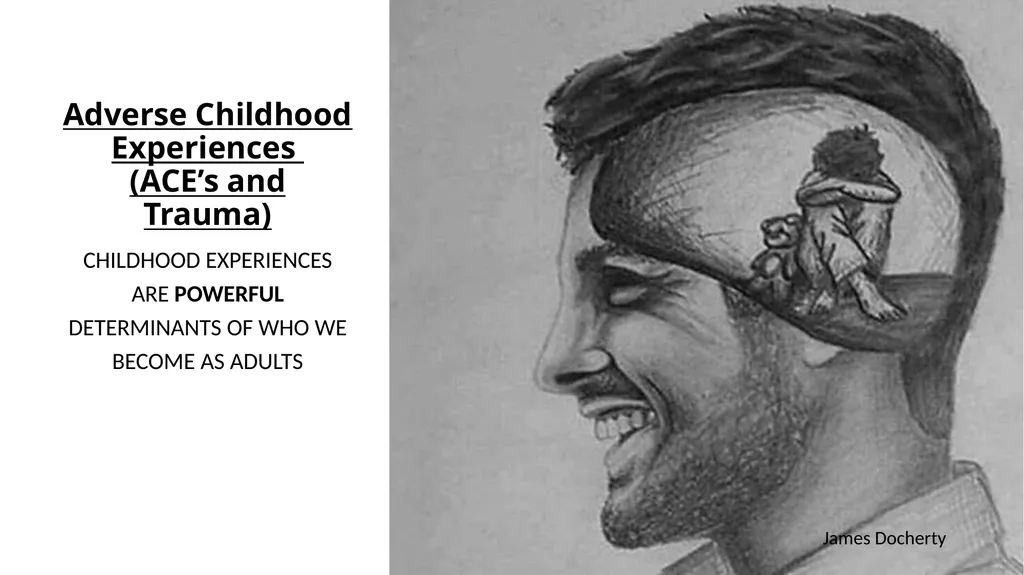
Childhood experiences are powerful determinants of who we become as adults Adverse Childhood Experiences
(ACE’s and Trauma) James Docherty<br>
(ACE’s and Trauma) James Docherty<br>
02
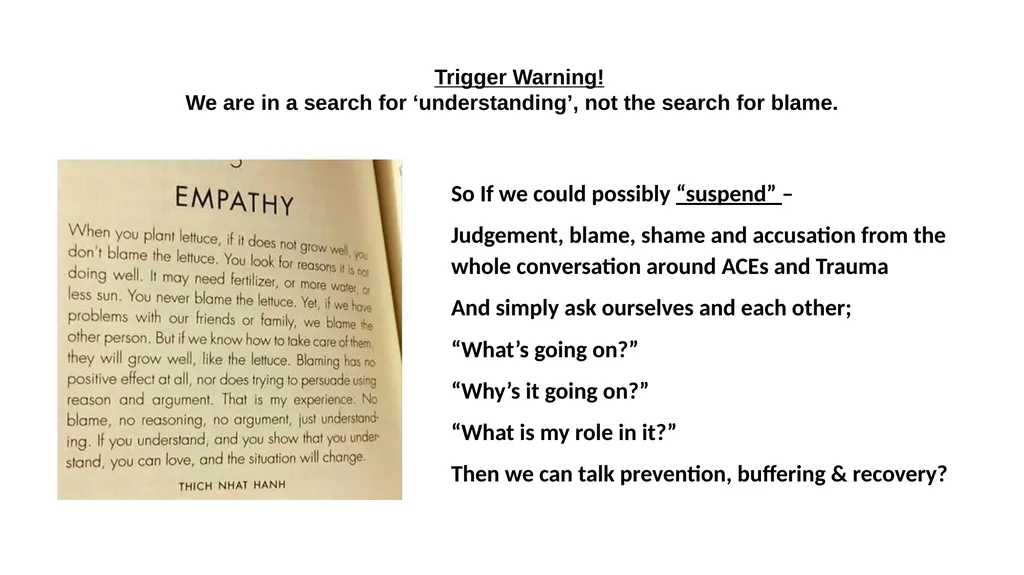
So If we could possibly “suspend” –
Judgement, blame, shame and accusation from the whole conversation around ACEs and Trauma
And simply ask ourselves and each other;
“What’s going on?”
“Why’s it going on?”
“What is my role in it?”
Then we can talk prevention, buffering & recovery? Trigger Warning!
We are in a search for ‘understanding’, not the search for blame.<br>
Judgement, blame, shame and accusation from the whole conversation around ACEs and Trauma
And simply ask ourselves and each other;
“What’s going on?”
“Why’s it going on?”
“What is my role in it?”
Then we can talk prevention, buffering & recovery? Trigger Warning!
We are in a search for ‘understanding’, not the search for blame.<br>
03
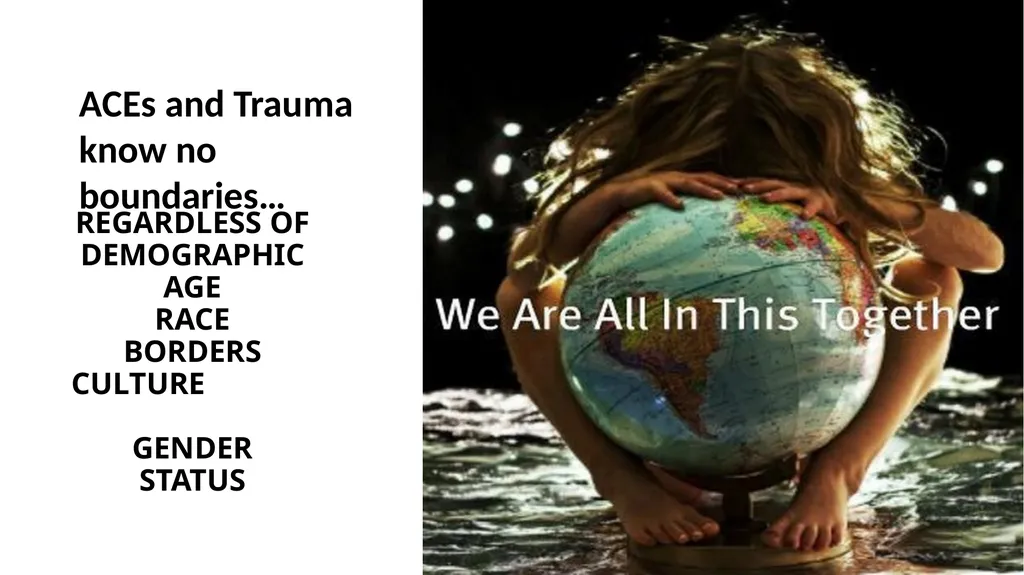
ACEs and Trauma know no boundaries… Regardless of
demographic
Age
Race
Borders
Culture
Gender
Status<br>
04
“As the ACE study has shown, child abuse and neglect is the single most preventable cause of mental illness, the single most common cause of drug and alcohol abuse, and a significant contributor to leading causes of death such as diabetes, heart disease, cancer, stroke, and suicide.”
― Bessel A. van der Kolk. The Healing of Trauma<br>
― Bessel A. van der Kolk. The Healing of Trauma<br>
05
Psychoeducation
Psychoeducation is an evidence-based therapeutic intervention and education tool for individuals and their loved ones that provides information and support to better understand and cope with living with trauma (Toxic stress) and or supporting recovery.
It can provide a more thorough understanding on the nature of Adverse Childhood Experiences/trauma prevention and recovery. “Get this information to the general population and they will invent very wise actions”<br>
Psychoeducation is an evidence-based therapeutic intervention and education tool for individuals and their loved ones that provides information and support to better understand and cope with living with trauma (Toxic stress) and or supporting recovery.
It can provide a more thorough understanding on the nature of Adverse Childhood Experiences/trauma prevention and recovery. “Get this information to the general population and they will invent very wise actions”<br>
06
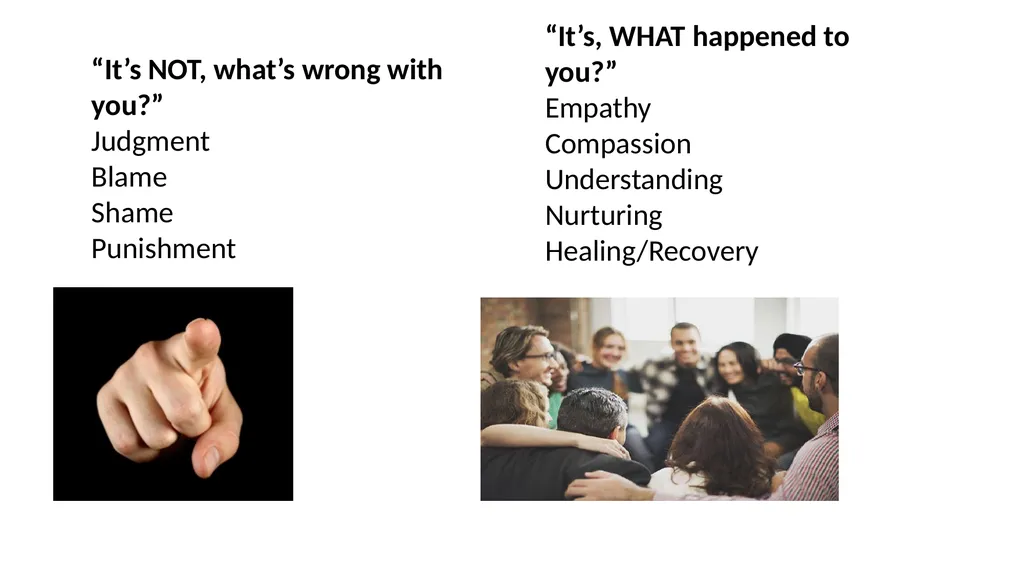
“It’s NOT, what’s wrong with you?”
Judgment
Blame
Shame
Punishment “It’s, WHAT happened to you?”
Empathy
Compassion
Understanding
Nurturing
Healing/Recovery<br>
Judgment
Blame
Shame
Punishment “It’s, WHAT happened to you?”
Empathy
Compassion
Understanding
Nurturing
Healing/Recovery<br>
07
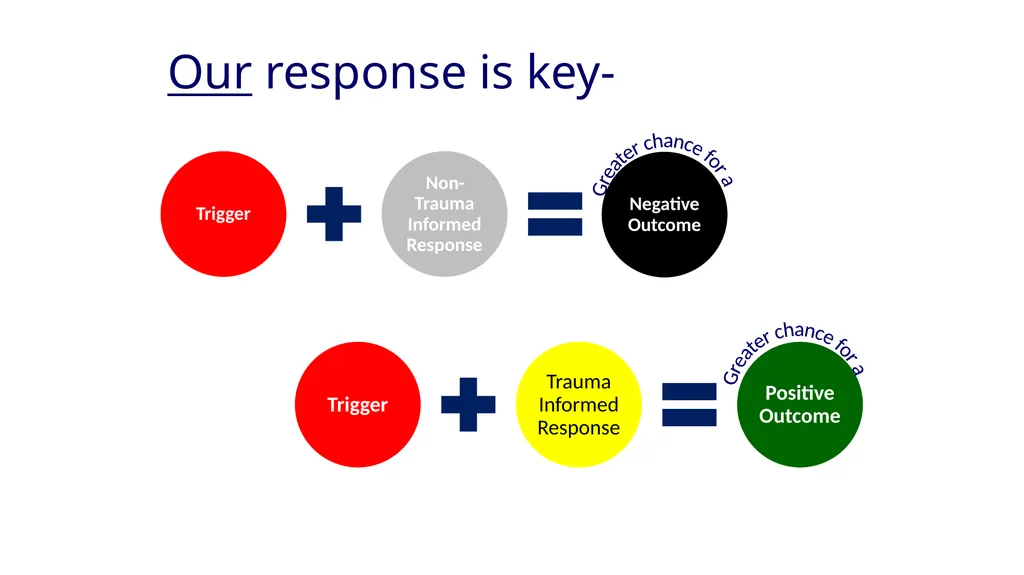
Our response is key- Greater chance for a Greater chance for a<br>
08
Triggers include seeing, feeling, or hearing something that remind us of past trauma. (Coercive energy)
Triggers activate the alarm system. (Stress Response)
When the alarm system is activated, but there is no danger, it is a false alarm.
The response is as if there is current danger. Triggers<br>
Triggers activate the alarm system. (Stress Response)
When the alarm system is activated, but there is no danger, it is a false alarm.
The response is as if there is current danger. Triggers<br>
09
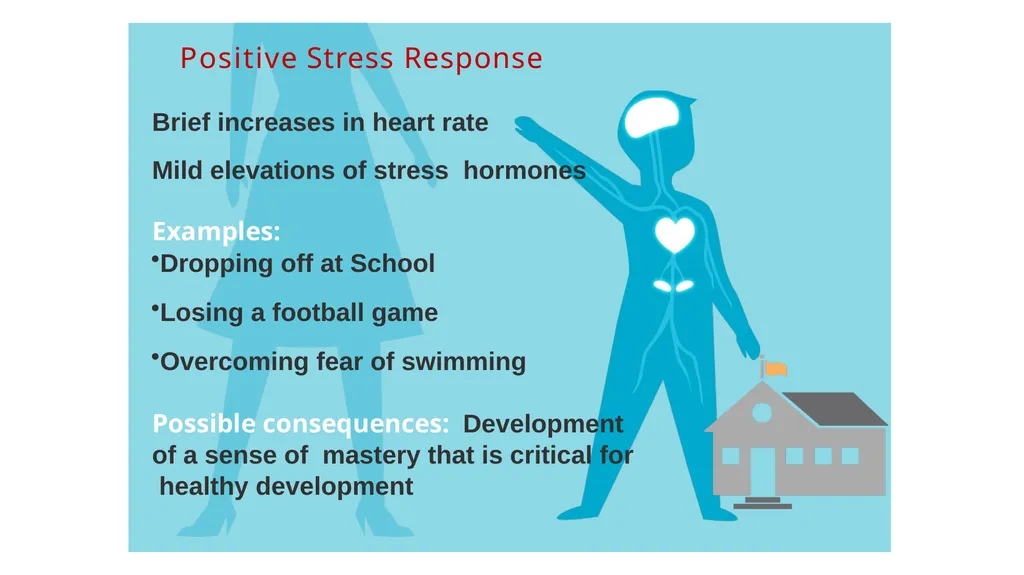
Brief increases in heart rate
Mild elevations of stress hormones
Examples:
Dropping off at School
Losing a football game
Overcoming fear of swimming
Possible consequences: Development of a sense of mastery that is critical for healthy development Positive Stress Response<br>
Mild elevations of stress hormones
Examples:
Dropping off at School
Losing a football game
Overcoming fear of swimming
Possible consequences: Development of a sense of mastery that is critical for healthy development Positive Stress Response<br>
10
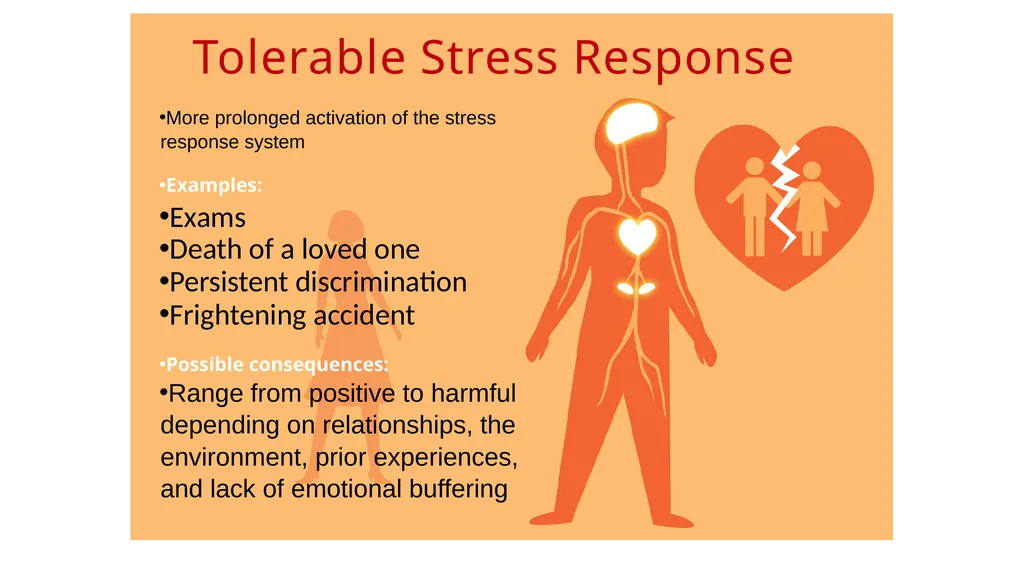
Tolerable Stress Response More prolonged activation of the stress response system
Examples:
Exams
Death of a loved one
Persistent discrimination
Frightening accident
Possible consequences:
Range from positive to harmful depending on relationships, the environment, prior experiences, and lack of emotional buffering<br>
Examples:
Exams
Death of a loved one
Persistent discrimination
Frightening accident
Possible consequences:
Range from positive to harmful depending on relationships, the environment, prior experiences, and lack of emotional buffering<br>
11
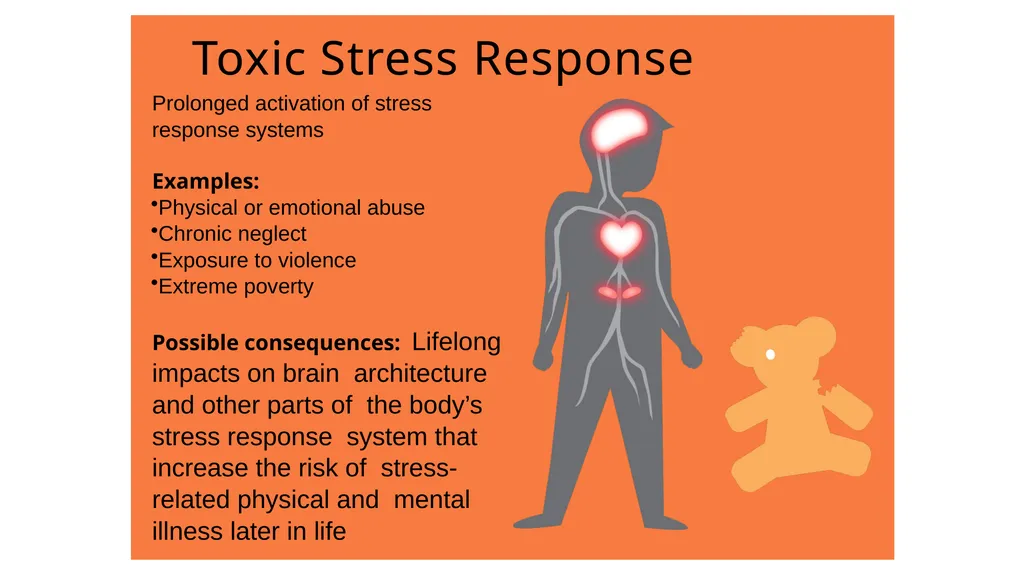
Toxic Stress Response Prolonged activation of stress response systems
Examples:
Physical or emotional abuse
Chronic neglect
Exposure to violence
Extreme poverty
Possible consequences: Lifelong impacts on brain architecture and other parts of the body’s stress response system that increase the risk of stress-related physical and mental illness later in life<br>
Examples:
Physical or emotional abuse
Chronic neglect
Exposure to violence
Extreme poverty
Possible consequences: Lifelong impacts on brain architecture and other parts of the body’s stress response system that increase the risk of stress-related physical and mental illness later in life<br>
12
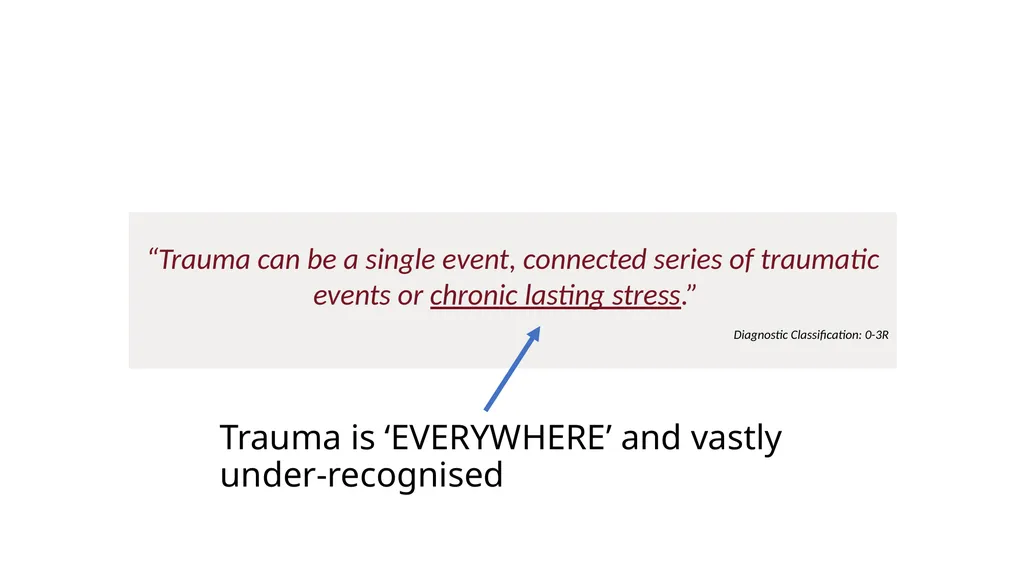
“Trauma can be a single event, connected series of traumatic events or chronic lasting stress.”
Diagnostic Classification: 0-3R Trauma is ‘EVERYWHERE’ and vastly under-recognised<br>
Diagnostic Classification: 0-3R Trauma is ‘EVERYWHERE’ and vastly under-recognised<br>
13
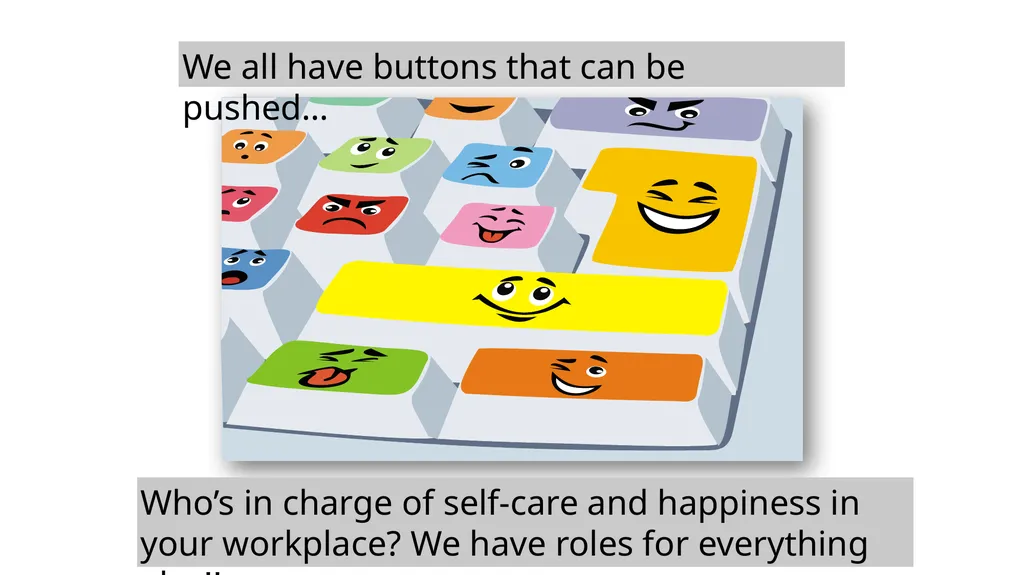
We all have buttons that can be pushed… Who’s in charge of self-care and happiness in your workplace? We have roles for everything else!!<br>
14
Physical fitness
Nutrition and hydration
Sleep and rest
Assertiveness skills
Centering and solitude
Creative activities
Fun and enjoyment
Support provided
Support received
Set and monitored goals
Meditation/Yoga/Pilates
What else? Taking care of yourself Self-care checklist: ---- Emotional supervision<br>
Nutrition and hydration
Sleep and rest
Assertiveness skills
Centering and solitude
Creative activities
Fun and enjoyment
Support provided
Support received
Set and monitored goals
Meditation/Yoga/Pilates
What else? Taking care of yourself Self-care checklist: ---- Emotional supervision<br>
15
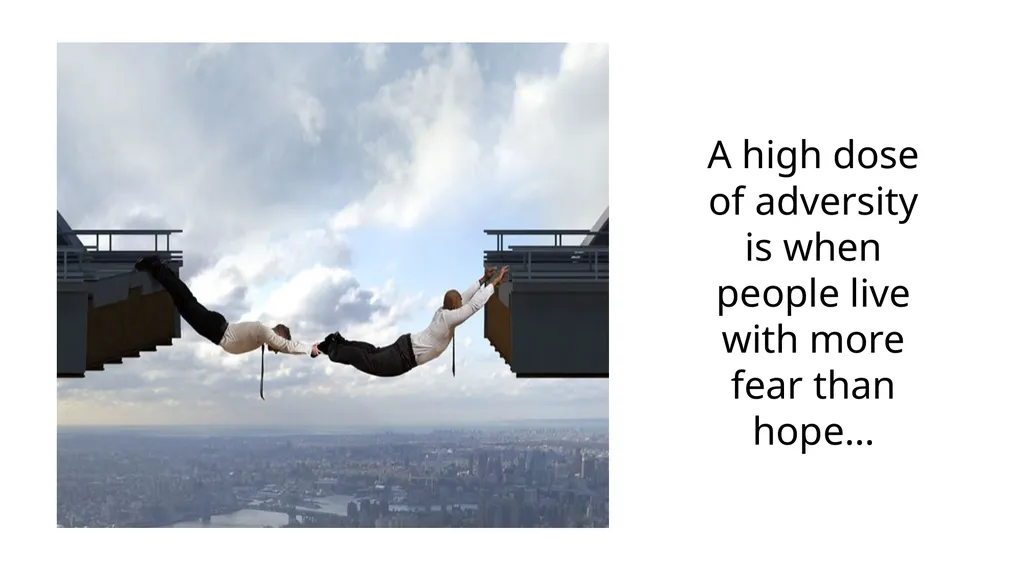
A high dose of adversity is when people live with more fear than hope…<br>
16
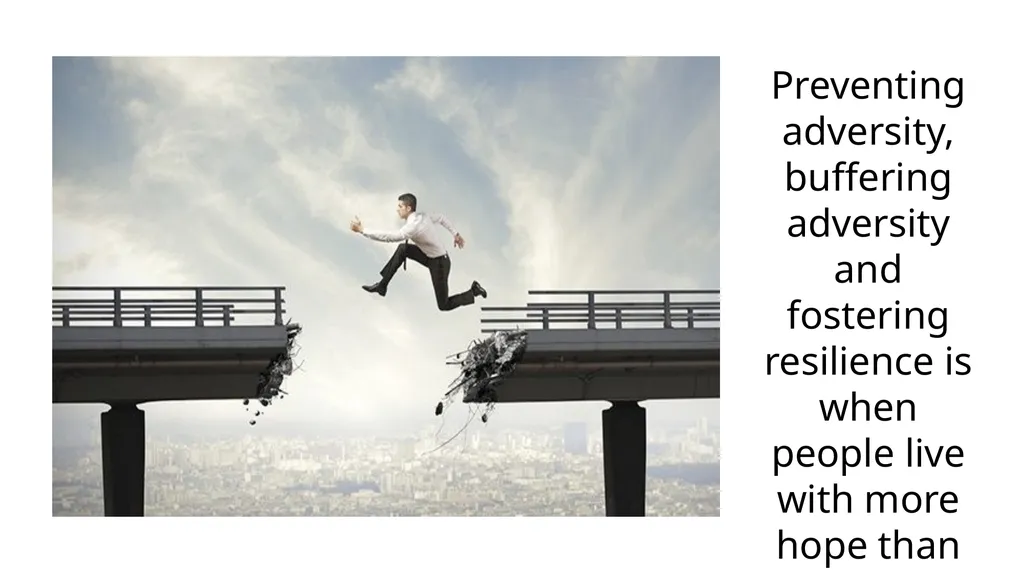
Preventing adversity, buffering adversity and fostering resilience is when people live with more hope than fear…<br>
17
The presence of an emotionally available, non-stressed, attuned, non-distracted safe care givers (Preferably Adults) is a reason why kids with high ACE scores are doing better than some with a low score!
It’s not always what happened, it’s what was missing when it did happen! The Great British Child Psychiatrist D.W. Winnicott said:
That fundamentally two things go wrong in childhood. One is when things happen that shouldn’t happen and then there’s things that should have happened but didn’t.
“It’s all about relationships” Look for who’s doing relationship? “Don’t get trapped in what happened, provide what is often missing!”<br>
It’s not always what happened, it’s what was missing when it did happen! The Great British Child Psychiatrist D.W. Winnicott said:
That fundamentally two things go wrong in childhood. One is when things happen that shouldn’t happen and then there’s things that should have happened but didn’t.
“It’s all about relationships” Look for who’s doing relationship? “Don’t get trapped in what happened, provide what is often missing!”<br>
18
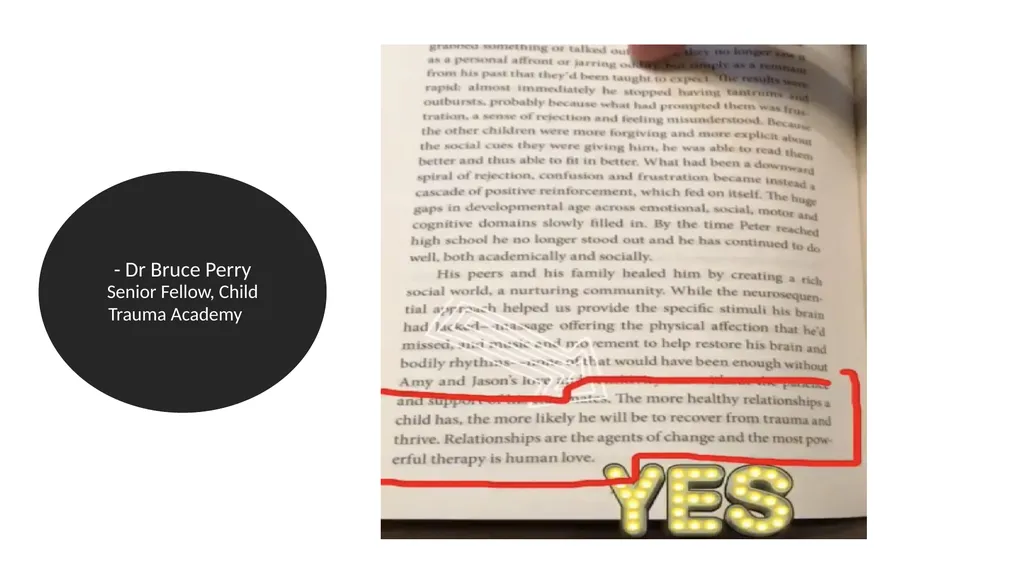
- Dr Bruce Perry Senior Fellow, Child Trauma Academy<br>
19
What can we learn from listening to the voices of people who have experienced trauma? That adversity is not destiny
That recovery and healing is possible with the right support in the right environments (That’s where our collective power lies as a society)
That each individual is unique
That trauma informed is a “way of being” in the world, it’s not a qualification or a tick box exercise
That trauma informed practice is not informed unless it’s informed by survivors. If we are not doing it with them, then we are doing it to them. (A dynamic that breeds conflict, and damages trust in relationship)
We are inside your organisations, there is “no us and them”. Share experience of people places and things that enabled resilience and recovery
That trauma is a wound that can heal, but it leaves a scar! There’s no fully moving on from a trauma wound. Life, smells, sounds, noises, people, and events always remind you… it was real!<br>
That recovery and healing is possible with the right support in the right environments (That’s where our collective power lies as a society)
That each individual is unique
That trauma informed is a “way of being” in the world, it’s not a qualification or a tick box exercise
That trauma informed practice is not informed unless it’s informed by survivors. If we are not doing it with them, then we are doing it to them. (A dynamic that breeds conflict, and damages trust in relationship)
We are inside your organisations, there is “no us and them”. Share experience of people places and things that enabled resilience and recovery
That trauma is a wound that can heal, but it leaves a scar! There’s no fully moving on from a trauma wound. Life, smells, sounds, noises, people, and events always remind you… it was real!<br>
20
If we don’t intervene early in the prevention, recovery and buffering of Adverse Childhood Experiences, then we will continue to see the “symptoms” played out in devastating fashion, in our homes, our schools, our streets, our prisons, in our hospitals, our bodies, our emotions and our minds.
“We need to get it right for the parent’s in order to get it right for the children.”
- James Docherty<br>
21
Investing The issue is not are we going to pay - - - it’s are we going to pay now, up front, or are we going to pay a whole lot more later on.
- Marian Wright Edelman<br>
- Marian Wright Edelman<br>
22
More health visitors for pregnant women and families with new-borns Family support programs, group work. Prevention must involve identifying and working with young children and adolescents at risk High quality child care, Prevention should involve providing emotionally nourishing environments in day-care nurseries, primary and high schools Teenage support programs for teens and teen pregnancy, Sufficient Income support for lower income families. Poverty a major cause of stress on family system Intimate partner violence prevention Social support for parents - enhances quality of life and provides a buffer against adverse life events Mental illness and substance abuse treatment Basic cause of drug addiction is experience-dependent, not substance-dependent The prevention of ACE's needs to begin at the first prenatal visit. Stresses on pregnant women already a predictor in shaping the brain of a developing child. Psychoeducation on toxic stress! Voluntary home visit programmes support by strengthening maternal parenting practices. Quality of home environment essential to healthy child development The social and health consequences that underscore the importance of preventing and buffering ACEs are glaring. We require a complete paradigm-shift, a way of seeing ACEs not as a moral issue or parental failure, and certainly not a legal concern, but as a fundamentally human problem whose roots go back to our core experiences and needs as human beings. Safe, stable and nurturing relationships and environments that enable people to reach their full potential. Strategies that address these needs include: What can ‘We Do’? “It Takes a Community”<br>
23
Reference:
ACES Publications (from the CDC ACE Study Web site, where you can search this list by year or health outcomes.)
https://acestoohigh.com/research/
Childhood Disrupted: How Your Biography Becomes Your Biology and How You Can Heal, by Donna Jackson Nakazawa.
The Body Keeps the Score: Brain, Mind and Body in the Healing of Trauma, by Bessel Van Der Kolk.
The Deepest Well: Healing the Long-Term Effects of Childhood Adversity, by Dr Nadine Burke Harris, 2018.
Dr Gabor Maté: A New Understanding Of Addiction.
Https://networkmagazine.Ie/articles/gabor-mat%c3%a9-new-understanding-addiction
IT’S NOT THE DRUGS. IT’S THE (ACEs) ADVERSE CHILDHOOD EXPERIENCES.
https://acestoohigh.com/2017/05/02/addiction-doc-says-stop-chasing-the-drug-focus-on-aces-people-can-recover/
The Boy who was Raised as a Dog: And Other Stories from a Child Psychiatrist's Notebook : What Traumatised Children Can Teach Us about Loss, Love, and Healing. – Dr Bruce Perry https://books.google.co.uk/books/about/The_Boy_Who_Was_Raised_as_a_Dog.html?id=WW5uDgAAQBAJ&printsec=frontcover&source=kp_read_button&redir_esc=y#v=onepage&q&f=false
https://www.amazon.co.uk/Hold-Your-Kids-Parents-Matter-ebook/dp/B07DK2CZ2V/ref=dp_kinw_strp_1
Hold on to Your Kids: Why Parents Need to Matter More Than Peers – Dr Gordon Neufeld and Gabor Maté
J.L, Herman. Trauma and Recovery, 1992, New York Books
https://www.amazon.co.uk/Trauma-Recovery-Aftermath-Violence-Political/dp/0465061710<br>
ACES Publications (from the CDC ACE Study Web site, where you can search this list by year or health outcomes.)
https://acestoohigh.com/research/
Childhood Disrupted: How Your Biography Becomes Your Biology and How You Can Heal, by Donna Jackson Nakazawa.
The Body Keeps the Score: Brain, Mind and Body in the Healing of Trauma, by Bessel Van Der Kolk.
The Deepest Well: Healing the Long-Term Effects of Childhood Adversity, by Dr Nadine Burke Harris, 2018.
Dr Gabor Maté: A New Understanding Of Addiction.
Https://networkmagazine.Ie/articles/gabor-mat%c3%a9-new-understanding-addiction
IT’S NOT THE DRUGS. IT’S THE (ACEs) ADVERSE CHILDHOOD EXPERIENCES.
https://acestoohigh.com/2017/05/02/addiction-doc-says-stop-chasing-the-drug-focus-on-aces-people-can-recover/
The Boy who was Raised as a Dog: And Other Stories from a Child Psychiatrist's Notebook : What Traumatised Children Can Teach Us about Loss, Love, and Healing. – Dr Bruce Perry https://books.google.co.uk/books/about/The_Boy_Who_Was_Raised_as_a_Dog.html?id=WW5uDgAAQBAJ&printsec=frontcover&source=kp_read_button&redir_esc=y#v=onepage&q&f=false
https://www.amazon.co.uk/Hold-Your-Kids-Parents-Matter-ebook/dp/B07DK2CZ2V/ref=dp_kinw_strp_1
Hold on to Your Kids: Why Parents Need to Matter More Than Peers – Dr Gordon Neufeld and Gabor Maté
J.L, Herman. Trauma and Recovery, 1992, New York Books
https://www.amazon.co.uk/Trauma-Recovery-Aftermath-Violence-Political/dp/0465061710<br>