Christian Humanism, Thomas More and Erasmus of Rotterdam Local Saint, St Gennaro (Naples), 19 September .Indulgences? Christian or Renaissance Humanism The German word Humanismus first appeared in 1808. It referred to education which
"Christian Humanism, Thomas More and Erasmus of" is the property of its rightful owner. Permission is granted to
download and print the materials on this website for personal, non-commercial use only, and to display it
on your personal computer provided you do not modify the materials and that you retain all copyright
notices contained in the materials. By downloading content from our website, you accept the terms of this
agreement.
Presentation Transcript
01
Christian Humanism, Thomas More and Erasmus of Rotterdam<br>
02
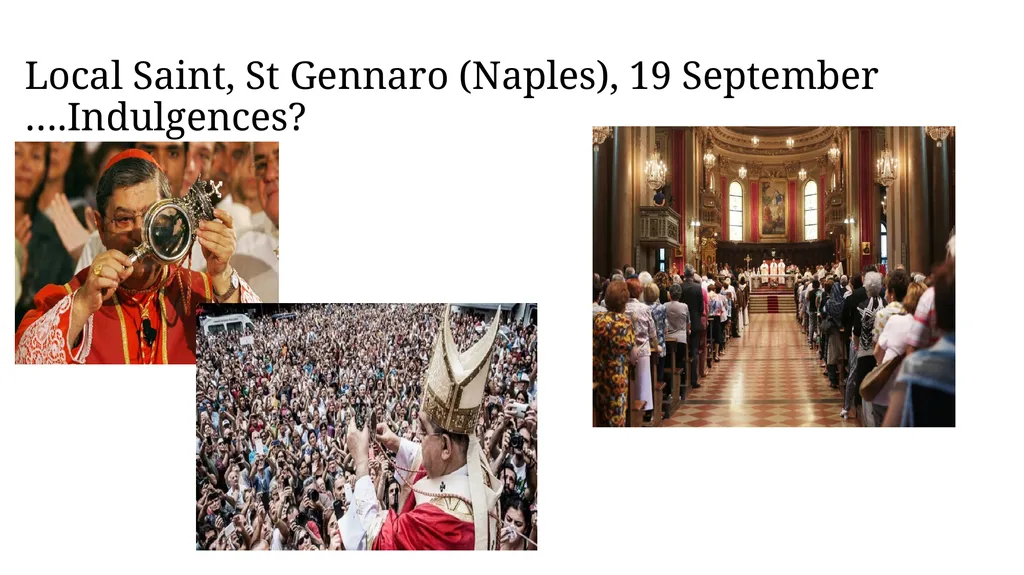
Local Saint, St Gennaro (Naples), 19 September ….Indulgences?<br>
03
Christian or Renaissance Humanism The German word Humanismus first appeared in 1808. It referred to education which focused on ancient Greek and Latin works.
Christian humanism, the humanists who did believe in Christianity.
Studia Humanitatis (humanist studies): grammar, rhetoric, poetry, moral philosophy, and history.
Ad fontes (back to the sources). purer editions of the Bible and of the Church Fathers’ writings.
Humanism: ‘causes’ or ‘preconditions’ of the Reformation:
encourages climate of criticism of received wisdom and traditional authority;
Christian humanism often hostile to popular religion.
shared emphasis on authority of the Bible.<br>
04
Italy and the North of Europe Some of the earliest centres of Renaissance humanism were Italian cities like Padua, Florence, Rome, and Venice.
1) Italian humanists visited northern Europe as secretaries.
2) Students from northern Europe went to Italy either to study or to work as diplomats.
3) A third way in which northern Europe was influenced by Italy was via letters and via books.
Empire: From the late 15th c. humanists began to appear at German universities.
France: Late Middle Ages, origins of the Renaissance and Humanism in France; the Italian invasions (1494) gave a further stimulus to a process already well under way. Erasmus studied in France.<br>
05
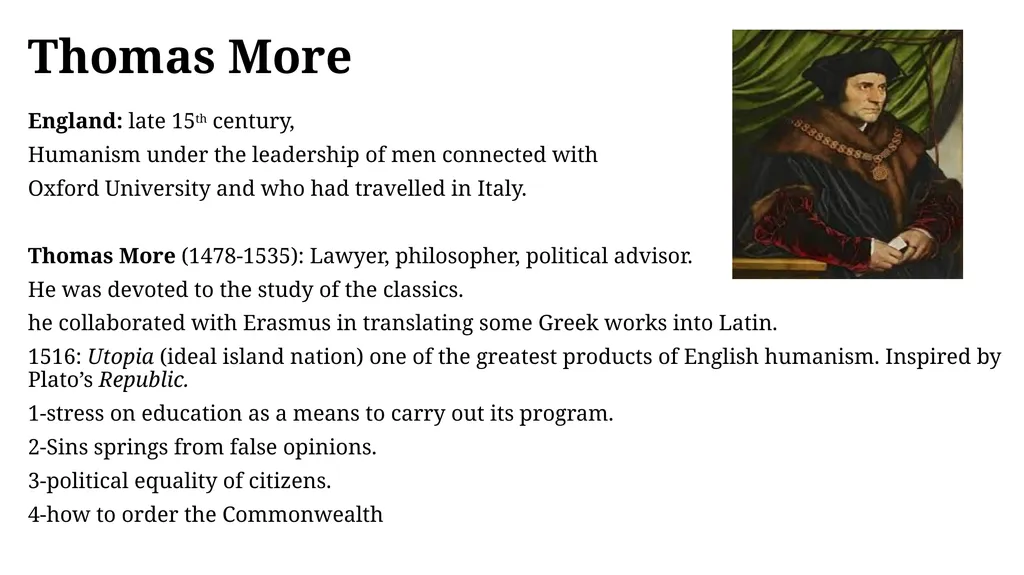
Thomas More England: late 15th century,
Humanism under the leadership of men connected with
Oxford University and who had travelled in Italy.
Thomas More (1478-1535): Lawyer, philosopher, political advisor.
He was devoted to the study of the classics.
he collaborated with Erasmus in translating some Greek works into Latin.
1516: Utopia (ideal island nation) one of the greatest products of English humanism. Inspired by Plato’s Republic.
1-stress on education as a means to carry out its program.
2-Sins springs from false opinions.
3-political equality of citizens.
4-how to order the Commonwealth<br>
06
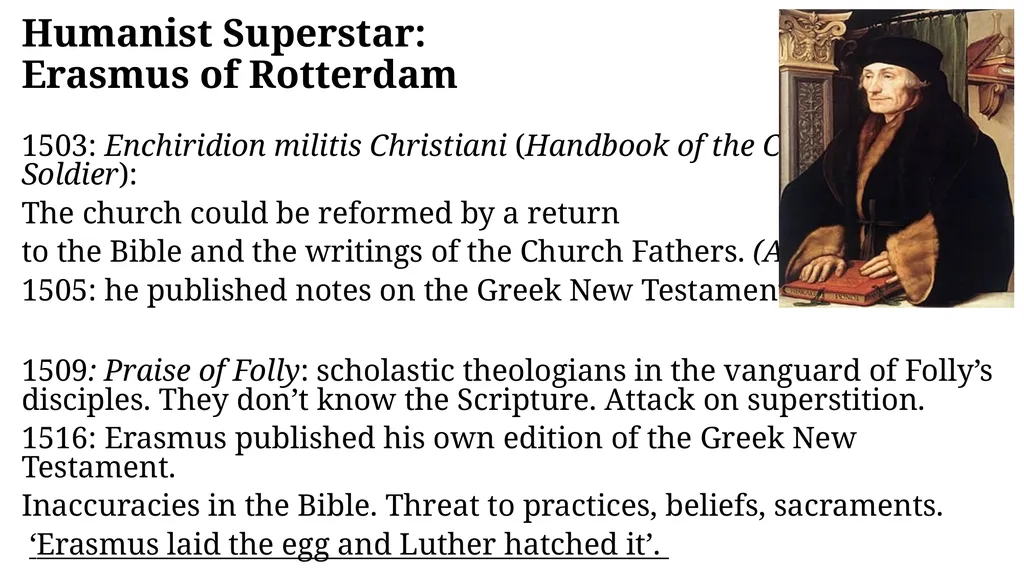
Humanist Superstar: Erasmus of Rotterdam 1503: Enchiridion militis Christiani (Handbook of the Christian Soldier):
The church could be reformed by a return
to the Bible and the writings of the Church Fathers. (Ad fontes).
1505: he published notes on the Greek New Testament
1509: Praise of Folly: scholastic theologians in the vanguard of Folly’s disciples. They don’t know the Scripture. Attack on superstition.
1516: Erasmus published his own edition of the Greek New Testament.
Inaccuracies in the Bible. Threat to practices, beliefs, sacraments.
‘Erasmus laid the egg and Luther hatched it’.<br>