Christian Lancaster, Reva Vaidya, William Avery MobileNet DPU Accelerated Inference System EE382N-4 Advanced Embedded Systems Spring 2024 Problem Statement Accelerating deep neural networks for pose estimation using the Zynq Deep Learning
"Christian Lancaster, Reva Vaidya, William Avery" is the property of its rightful owner. Permission is granted to
download and print the materials on this website for personal, non-commercial use only, and to display it
on your personal computer provided you do not modify the materials and that you retain all copyright
notices contained in the materials. By downloading content from our website, you accept the terms of this
agreement.
Presentation Transcript
01
Christian Lancaster, Reva Vaidya, William Avery MobileNet DPU Accelerated Inference System EE382N-4 Advanced Embedded Systems Spring 2024<br>
02
Problem Statement Accelerating deep neural networks for pose estimation using the Zynq Deep Learning Processing Unit (DPU)
Optimizing for the split between CPU and DPU utilization<br>
03
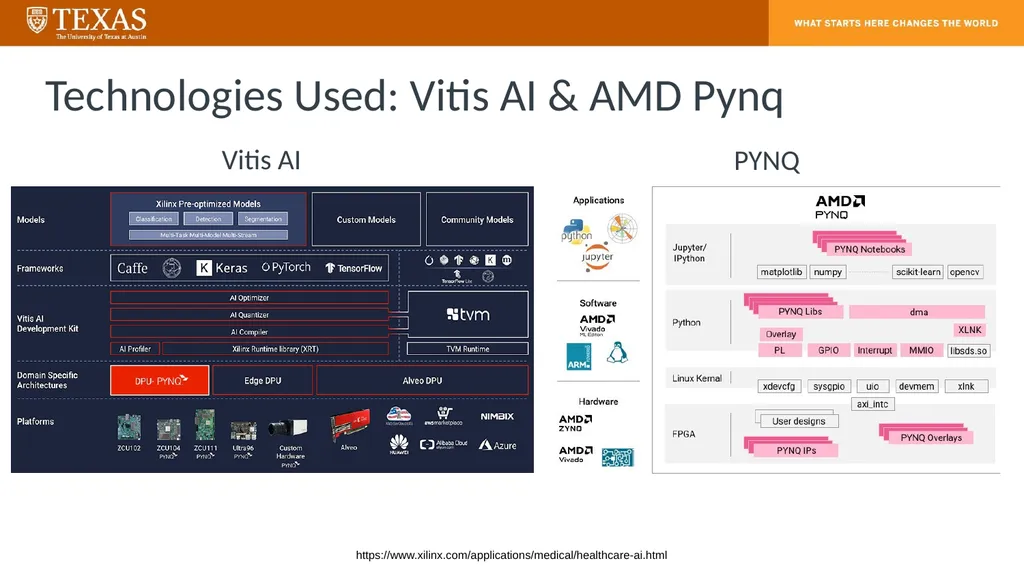
Technologies Used: Vitis AI & AMD Pynq Vitis AI PYNQ https://www.xilinx.com/applications/medical/healthcare-ai.html<br>
04
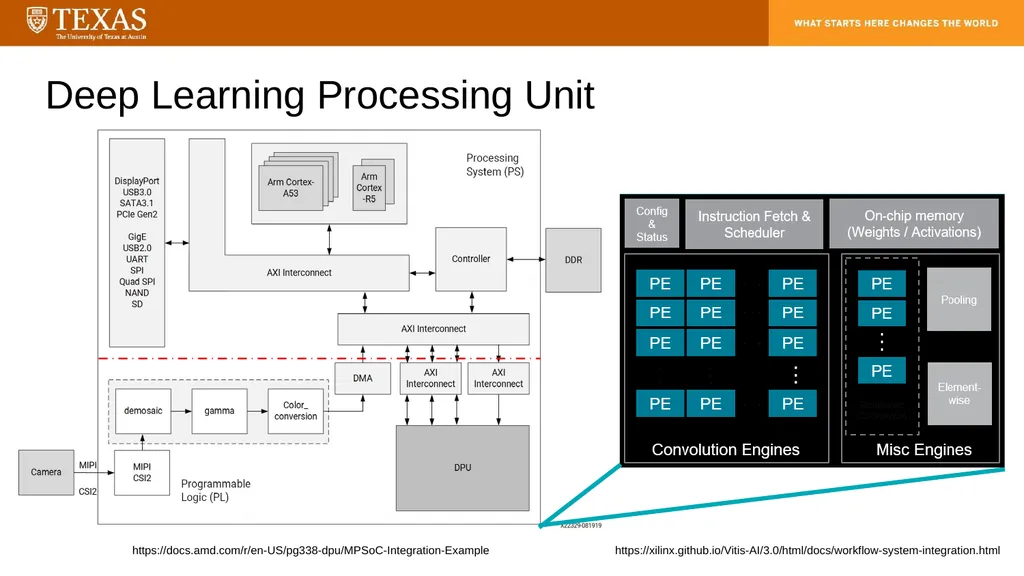
Deep Learning Processing Unit https://xilinx.github.io/Vitis-AI/3.0/html/docs/workflow-system-integration.html https://docs.amd.com/r/en-US/pg338-dpu/MPSoC-Integration-Example<br>
05
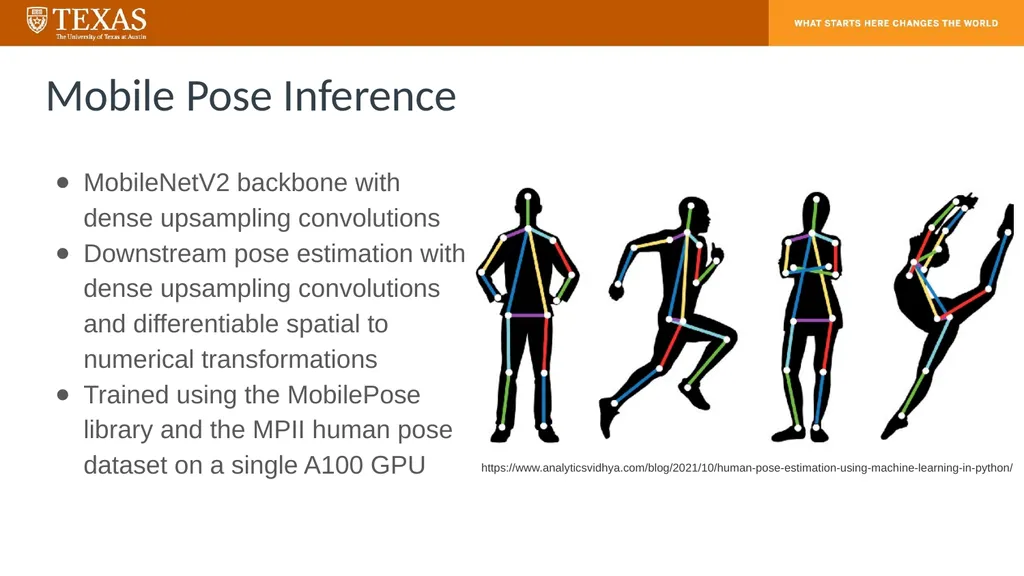
Mobile Pose Inference MobileNetV2 backbone with dense upsampling convolutions
Downstream pose estimation with dense upsampling convolutions and differentiable spatial to numerical transformations
Trained using the MobilePose library and the MPII human pose dataset on a single A100 GPU https://www.analyticsvidhya.com/blog/2021/10/human-pose-estimation-using-machine-learning-in-python/<br>
06
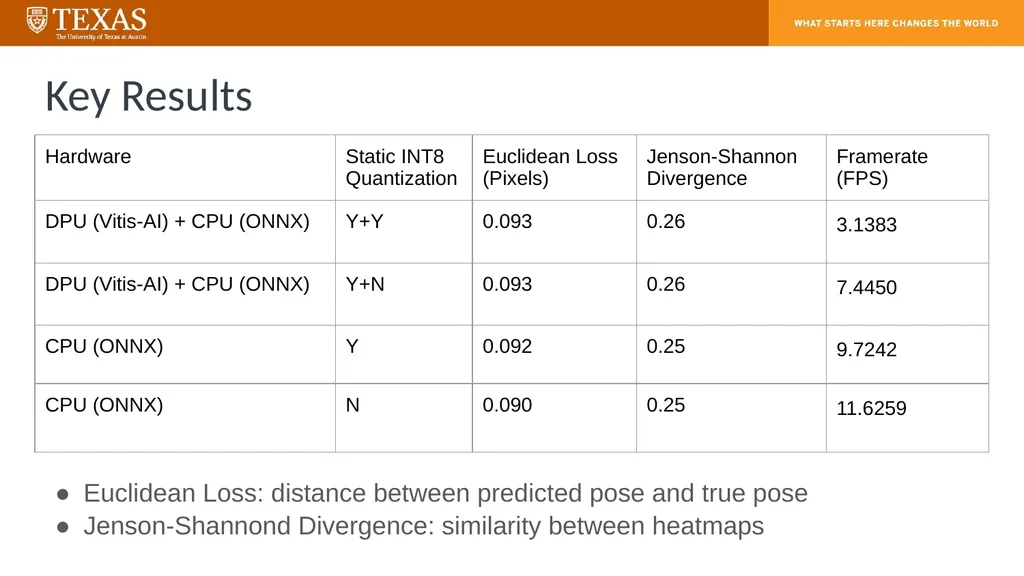
Key Results Euclidean Loss: distance between predicted pose and true pose
Jenson-Shannond Divergence: similarity between heatmaps<br>
07
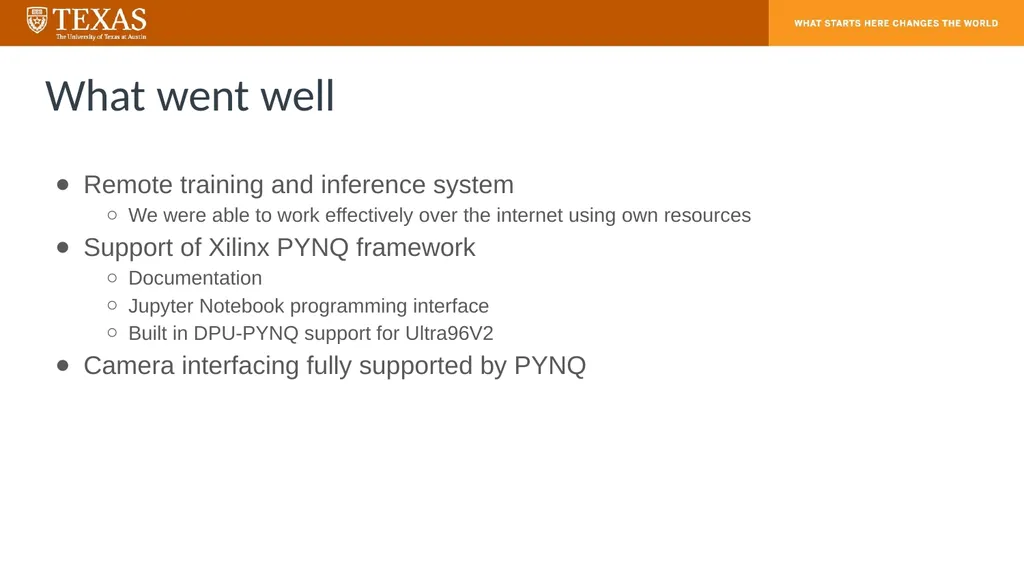
What went well Remote training and inference system
We were able to work effectively over the internet using own resources
Support of Xilinx PYNQ framework
Documentation
Jupyter Notebook programming interface
Built in DPU-PYNQ support for Ultra96V2
Camera interfacing fully supported by PYNQ<br>
08
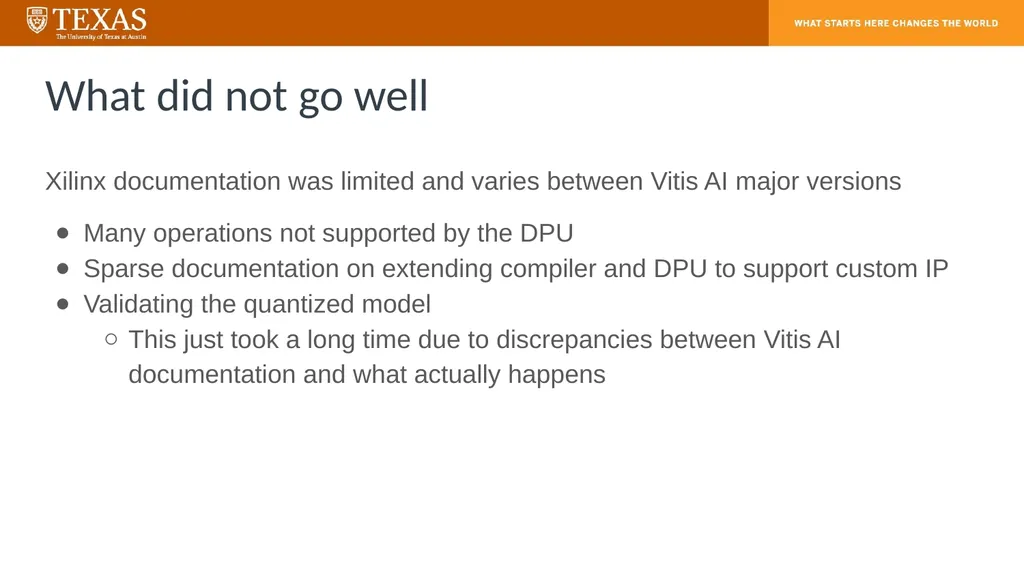
What did not go well Xilinx documentation was limited and varies between Vitis AI major versions
Many operations not supported by the DPU
Sparse documentation on extending compiler and DPU to support custom IP
Validating the quantized model
This just took a long time due to discrepancies between Vitis AI documentation and what actually happens<br>
09
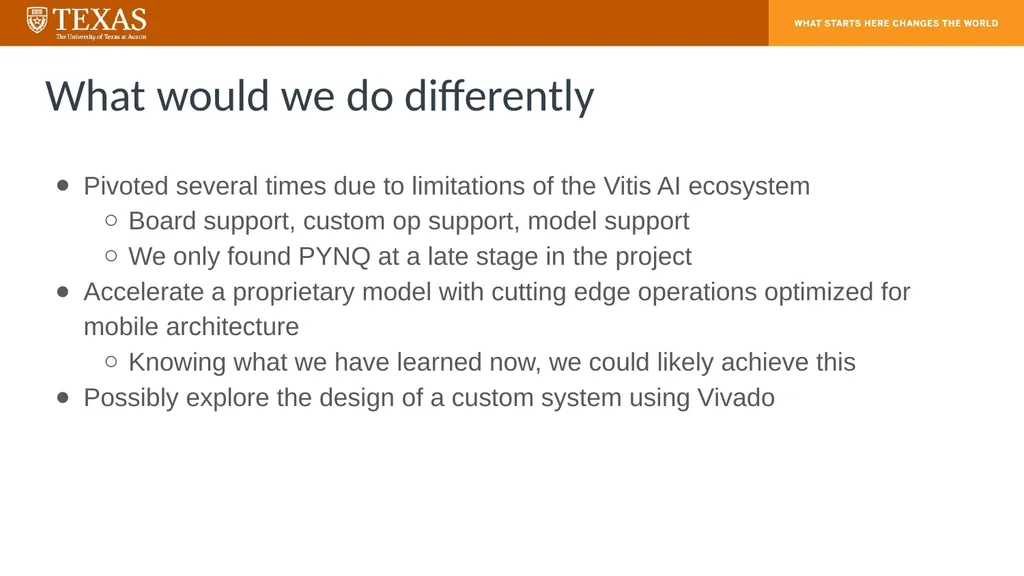
What would we do differently Pivoted several times due to limitations of the Vitis AI ecosystem
Board support, custom op support, model support
We only found PYNQ at a late stage in the project
Accelerate a proprietary model with cutting edge operations optimized for mobile architecture
Knowing what we have learned now, we could likely achieve this
Possibly explore the design of a custom system using Vivado<br>