"Christological Controversies 1 Lecture 19:" is the property of its rightful owner. Permission is granted to
download and print the materials on this website for personal, non-commercial use only, and to display it
on your personal computer provided you do not modify the materials and that you retain all copyright
notices contained in the materials. By downloading content from our website, you accept the terms of this
agreement.
Presentation Transcript
01
Christological Controversies 1 Lecture 19: Christological Controversies and Councils 7 November 2019<br>
02
Christological Controversies 2 Introduction Refresher: 4th C Christological Controversies Arians and Apollinarians
Nestorian Controversy
Cyril of Alexandria
Monophysites
Pope St. Leo the Great
Council of Chalcedon
Councils after Chalcedon<br>
03
Christological Controversies 3 Arianism Arius, presbyter in Alexandria
Christ the First Fruit of Creation;
“there was when he was not”
Opposed by Athanasius, Cappadocians
Council of Nicaea
Homoousia, Christ one in being with the Father
But Arianism has great staying power in East and among Germanic tribes<br>
04
Christological Controversies 4 Apollinarius: Heretical Reaction to Arius Apollinarius,
bishop of Laodicea,
proposed notion that Jesus had a physically human body, but mind and will were not human but divine.
Gregory of Nazianzus rejects this completely;
Supports “what is not assumed is not saved”<br>
05
Christological Controversies 5 Recall Political Problems for John Chrysostom Patriarch of Constantinople
Opposed by Patriarch of Alexandria, Theophilus
Opposed by Emperor (and Empress)
Pope sides with Chrysostom<br>
06
Christological Controversies 6 Nestorius (400-451) Born in Antioch; became Patriarch in Constantinople in 428
Opposed Arians and Apollinarians
Theology based upon Theodore of Mopsuestia and Diodorus, Antiochenes
Human and Divine joined, but separate in Jesus Christ
Mary gave birth to human Jesus, not to Word; rejects Mary as Theotokos (God bearer)
The Word of God did not suffer on the cross
Human Jesus is raised by power of the Word and perfected at the Resurrection
Seemed to be way to solve “Son of God” and “Son of Man” references in Gospels<br>
07
Christological Controversies 7 Cyril of Alexandria (375-444) Issues between Constantinople and Alexandria
Economic, political and social tensions between Alexandria and Constantinople
Scriptural interpretation tension between Antiochene and Alexandrian hermeneutics
Ecclesial hierarchical issues over precedence of Constantinople over Alexandria
Cyril succeeded his uncle, Theophilus, as patriarch (pope) of Alexandria in 412
Actively persecuted non-orthodox Christians in Alexandria, mostly because of city politics
Novatian Christians
Jews
Pagan Neo-Platonists; torture and death of Hypathia<br>
08
Christological Controversies 8 Cyril’s Christology Hypostatic union of God and man
Not two persons in Christ
Both God and man fully present from the moment of the Incarnation
Mary gave birth to God; i.e. Theotokos
Recall Athanasius also had a great devotion to the Incarnation
Recall, Origen used term theotokos<br>
09
Christological Controversies 9 Bitter conflict between Nestorius and Cyril Nestorius’ Letter to Pope Celestine (Christology of Later Fathers, p. 346-348)
Starts asking what to do about Julian of Eclanum who is seeking support for Pelagainism from Emperor
Complains against those who like Arius and Apollinarius have their Christology wrong
Says now there are some who mix together Divinity and humanity; who even call Mary Theotokos
Christ’s human and divine nature unconfused; tries to maintain reality of Christ’s humanity;
Cyril’s Reply to Nestorius (p. 349-354)
Word took flesh from the Virgin in the womb
Word and flesh are united in one hypostasis; Virgin is Theotokos
Whoever does not believe this should be anathema
Christ’s human and divine nature undivided; tries to maintain reality of Christ’s divinity
Relies heavily on Athanasius<br>
10
Christological Controversies 10 Council of Ephesus, 431 Council called by Emperor Theodosius II
Gathering of Bishops from around Eastern Empire, including Cyril and Nestorius
Pope Celestine supported Cyril
Cyril presides at Council in the place of Celestine
In fact, Celestine sent Nestorius’ letter to Cyril for a response
Nestorius condemned and removed as Patriarch of Constantinople
Council formally declares Mary Theotokos
Nestorians still found in Jacobin Syrian Churches (which usually also call themselves Orthodox); also sometimes refer to themselves as Antiochene
Note: St. Mary Major in Rome is built to honor Mary as Theotokos after the council
Theodore of Mopsuestia condemned at Second Council of Constantinople (553)<br>
11
Christological Controversies 11 Monophysitism: Eutyches and Dioscursus Eutyches
Head of large monastery in Constantinople
Adamantly opposed to Nestorius
Seemed to renew Apollinarian heresy
Christ had one nature : Divine with a human body
Dioscursus
Succeeded Cyril as Patriarch of Alexandria in 444
Also adamantly opposed to Nestorianism
Supports Eutyches against patriarch of Constantinople, Flavian
“Robber” council of Ephesus 449<br>
12
Christological Controversies 12 Opposition to Monophysitism (Single Nature) Flavian, Patriarch of Constantinople
Succeeds Nestorius
Opposed to Eutyches
Pope St. Leo
Supports two natures, one hypostasis (person)
Pulcharia, Empress
Daughter of Theodosius II
Calls Council of Chalcedon to confirm support of Flavian and Leo<br>
13
Christological Controversies 13 Pope St. Leo the Great Born in Tuscany; deacon under Pope Celestine
Pope 440-461
Fought against Pelagians and Manicheans
Deeply influenced by Augustine
Concerned for Church discipline,
Proper forms for Latin liturgies
Papal control over appointment of bishops; conflict with St. Hilary of Arles
Managed to convince barbarians not to sack Rome
Attila the Hun
Genseric the Vandal
Most famous for Christological formula, “One person, two natures”<br>
14
Christological Controversies 14 Leo’s Tome Letter written to St. Flavian
Relies on Scripture and Nicene Creed for arguments against monophysites
Distinction of both natures meets in one Person
Similar views expressed in Letter XXXI to Empress, St. Pucharia<br>
15
Christological Controversies 15 Council of Chalcedon, 451 Called by Pulcharia and Marcian
Establishes the Christological formula that Leo suggested
Primarily bishops from the East, with a representative from Rome
Dioscursus and much of the Alexandrian Church refuse to accept Chalcedon
Politically this remained a divisive issue in the East until rise of Islam
Theologically it remains a divisive issue to the present day; Coptic Christians<br>
16
Alexandrian Monophysites Monophysite = ‘one nature’
Those Christians, primarily in Alexandria, who believed Christ had only one, divine, nature
Interpreted Cyril’s hypostatic union as the human nature being complete subsumed into the divine nature of Christ
Political issues between Alexandria and Constantinople
Justinian the Great called the 2nd Council of Constantinople in 553 to try win Egyptian monophysites back to Orthodox (Byzantine) Christianity)
Condemns both Origen and Theodore of Mopsuestia
Not effective Christological Controversies 16<br>
17
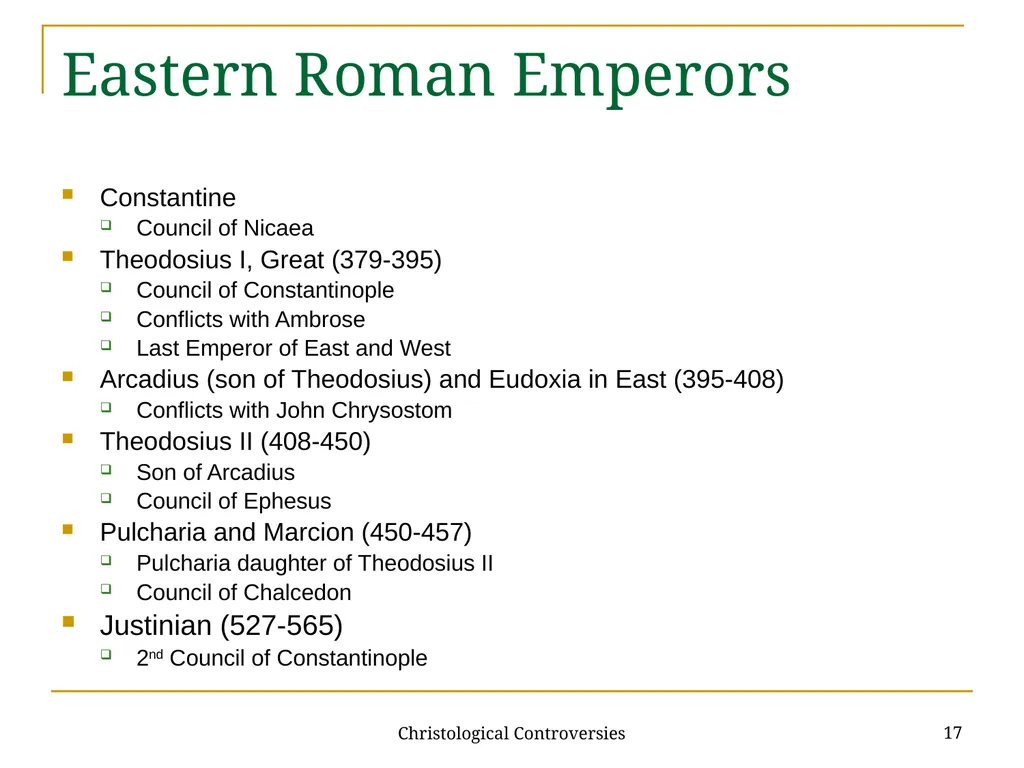
Christological Controversies 17 Eastern Roman Emperors Constantine
Council of Nicaea
Theodosius I, Great (379-395)
Council of Constantinople
Conflicts with Ambrose
Last Emperor of East and West
Arcadius (son of Theodosius) and Eudoxia in East (395-408)
Conflicts with John Chrysostom
Theodosius II (408-450)
Son of Arcadius
Council of Ephesus
Pulcharia and Marcion (450-457)
Pulcharia daughter of Theodosius II
Council of Chalcedon
Justinian (527-565)
2nd Council of Constantinople<br>
18
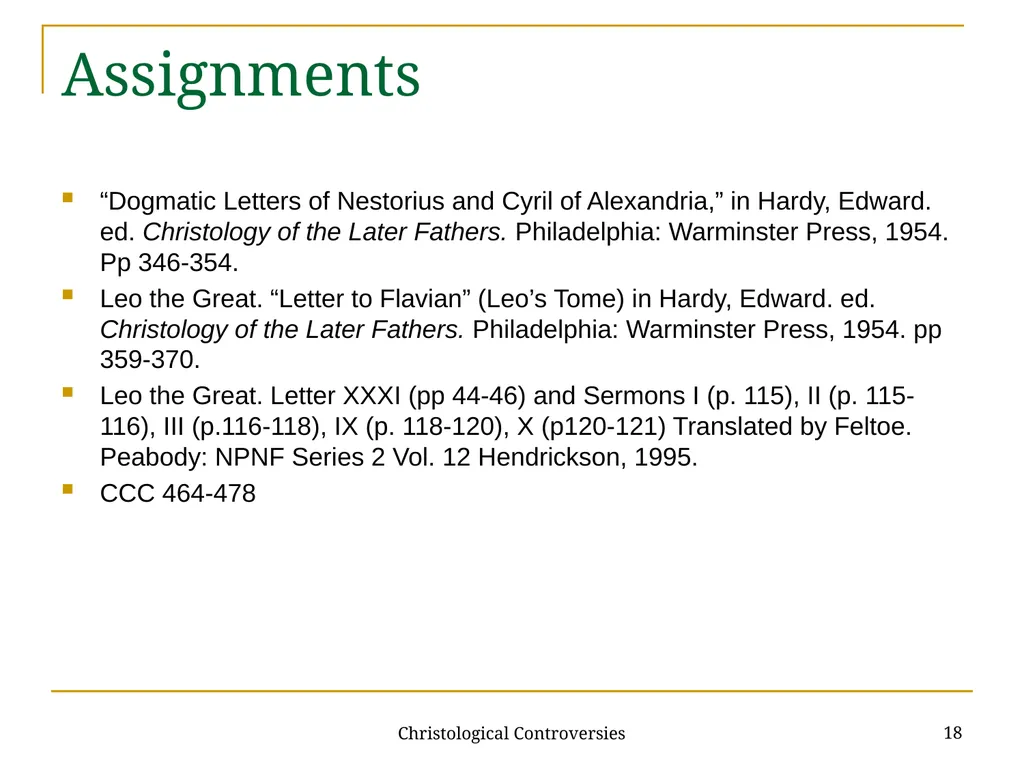
Christological Controversies 18 Assignments “Dogmatic Letters of Nestorius and Cyril of Alexandria,” in Hardy, Edward. ed. Christology of the Later Fathers. Philadelphia: Warminster Press, 1954. Pp 346-354.
Leo the Great. “Letter to Flavian” (Leo’s Tome) in Hardy, Edward. ed. Christology of the Later Fathers. Philadelphia: Warminster Press, 1954. pp 359-370.
Leo the Great. Letter XXXI (pp 44-46) and Sermons I (p. 115), II (p. 115-116), III (p.116-118), IX (p. 118-120), X (p120-121) Translated by Feltoe. Peabody: NPNF Series 2 Vol. 12 Hendrickson, 1995.
CCC 464-478<br>