
Christopher B. Barrett and Michael R. Carter

Description: Christopher B. Barrett and Michael R. Carter Seminar at University of California at Riverside May 24, 2012 The Economics of Poverty Traps and Persistent Poverty: Policy and Empirical Implications Persistent poverty is a 1st order
Related Topics
Download Presentation
"Christopher B. Barrett and Michael R. Carter" is the property of its rightful owner. Permission is granted to download and print the materials on this website for personal, non-commercial use only, and to display it on your personal computer provided you do not modify the materials and that you retain all copyright notices contained in the materials. By downloading content from our website, you accept the terms of this agreement.
Presentation Transcript
slide1. Christopher B. Barrett and Michael R. Carter
Seminar at
University of California at Riverside
May 24, 2012 The Economics of Poverty Traps and Persistent Poverty:
Policy and Empirical Implications<br>
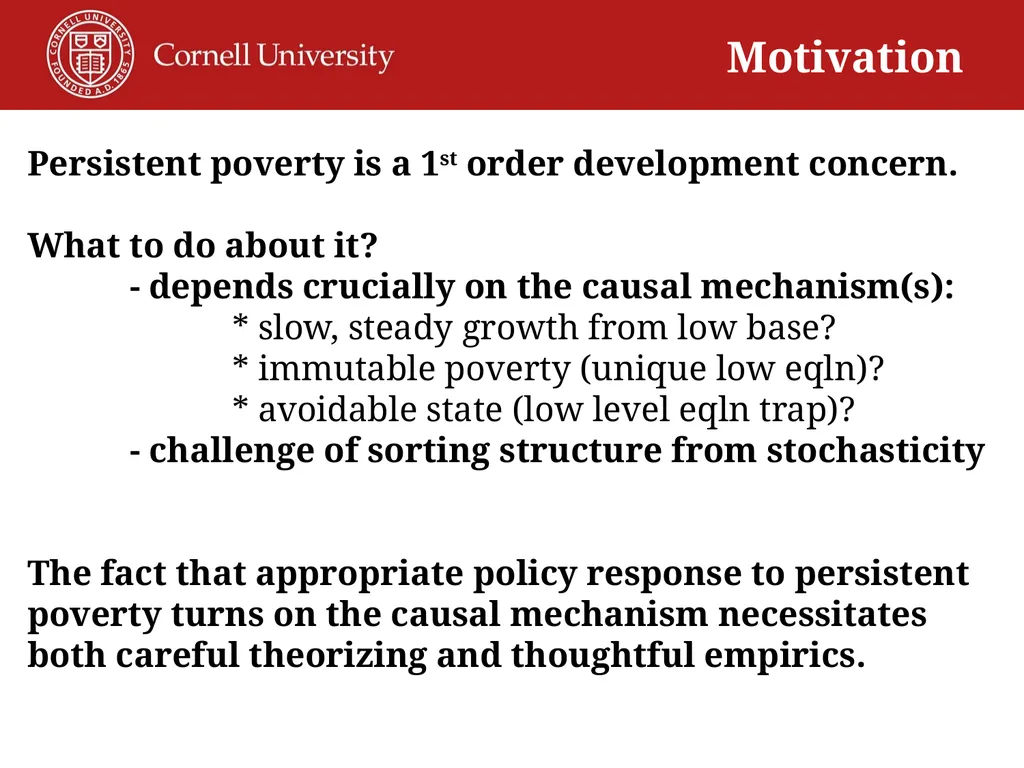
slide2. Persistent poverty is a 1st order development concern.
What to do about it?
- depends crucially on the causal mechanism(s):
* slow, steady growth from low base?
* immutable poverty (unique low eqln)?
* avoidable state (low level eqln trap)?
- challenge of sorting structure from stochasticity
The fact that appropriate policy response to persistent poverty turns on the causal mechanism necessitates both careful theorizing and thoughtful empirics. Motivation<br>
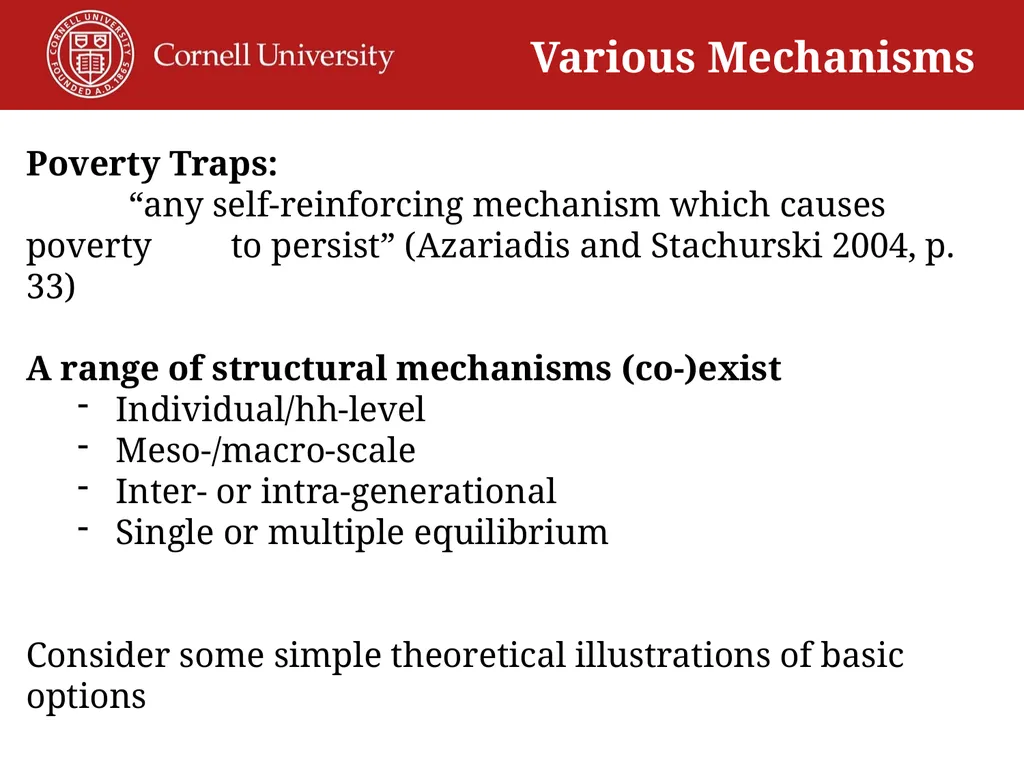
slide3. Poverty Traps:
“any self-reinforcing mechanism which causes poverty to persist” (Azariadis and Stachurski 2004, p. 33)
A range of structural mechanisms (co-)exist
Individual/hh-level
Meso-/macro-scale
Inter- or intra-generational
Single or multiple equilibrium
Consider some simple theoretical illustrations of basic options Various Mechanisms<br>
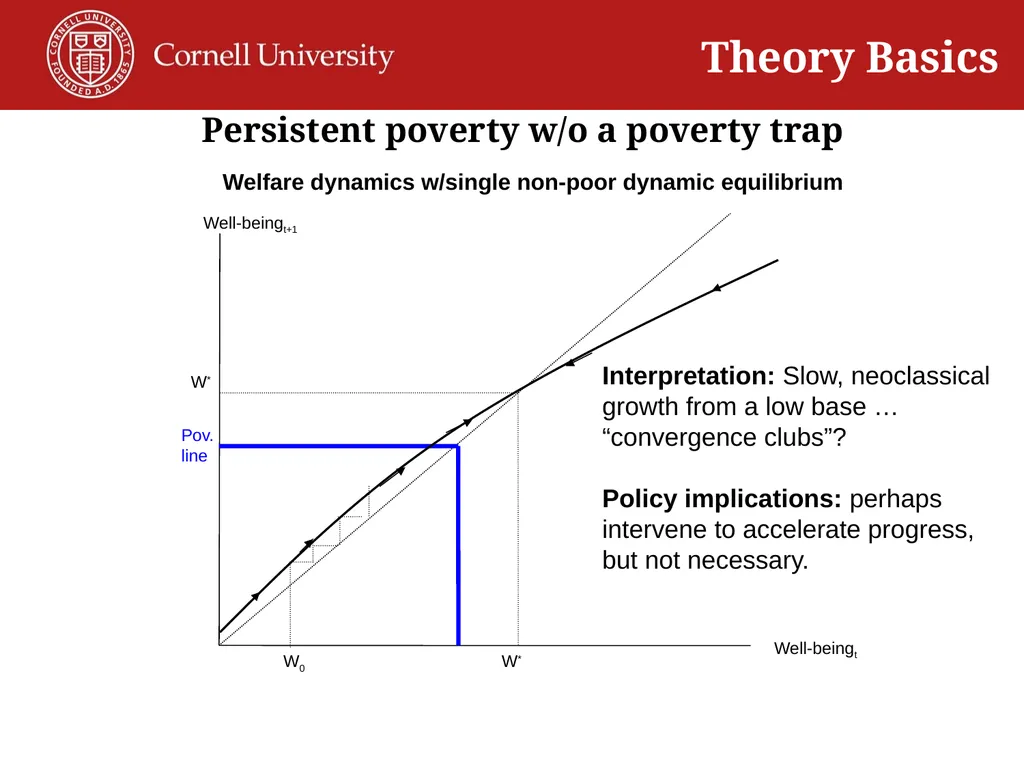
slide4. W* Welfare Dynamics With Unconditional Convergence Welfare Dynamics With Conditional Convergence Welfare dynamics w/single non-poor dynamic equilibrium Persistent poverty w/o a poverty trap Theory Basics Interpretation: Slow, neoclassical growth from a low base … “convergence clubs”?
Policy implications: perhaps intervene to accelerate progress, but not necessary.<br>
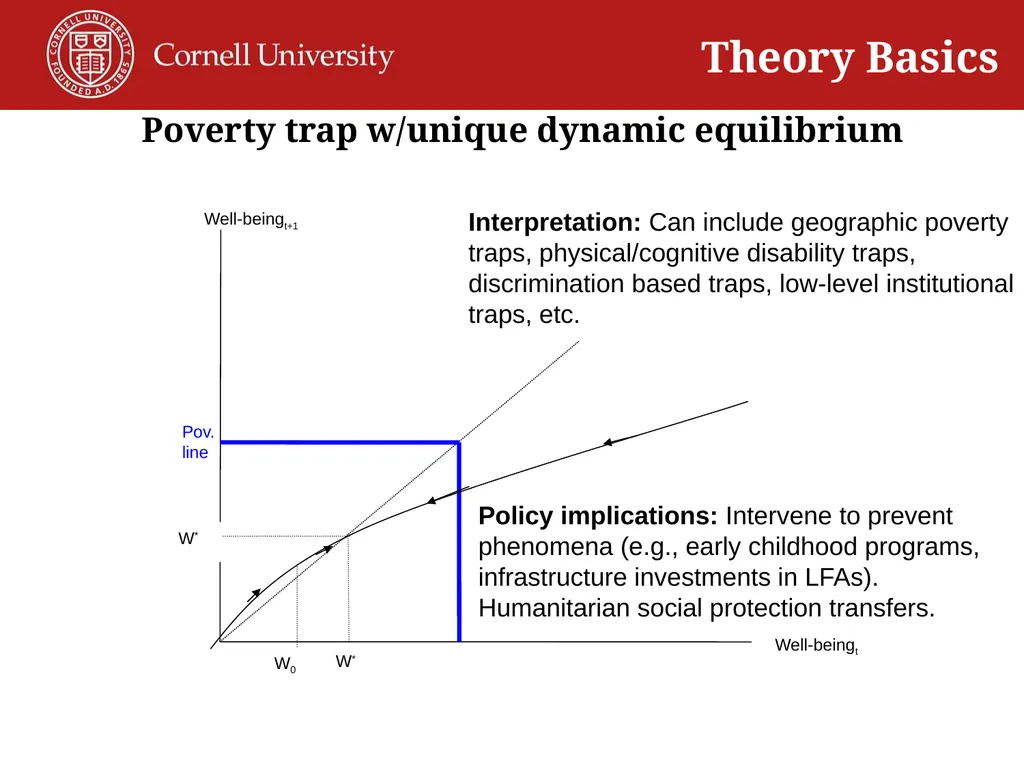
slide5. W* Welfare Dynamics With Unconditional Convergence Welfare Dynamics With Conditional Convergence Welfare dynamics w/single poor dynamic equilibrium Poverty trap w/unique dynamic equilibrium W* W* W0 Interpretation: Can include geographic poverty traps, physical/cognitive disability traps, discrimination based traps, low-level institutional traps, etc. Theory Basics Policy implications: Intervene to prevent phenomena (e.g., early childhood programs, infrastructure investments in LFAs). Humanitarian social protection transfers.<br>
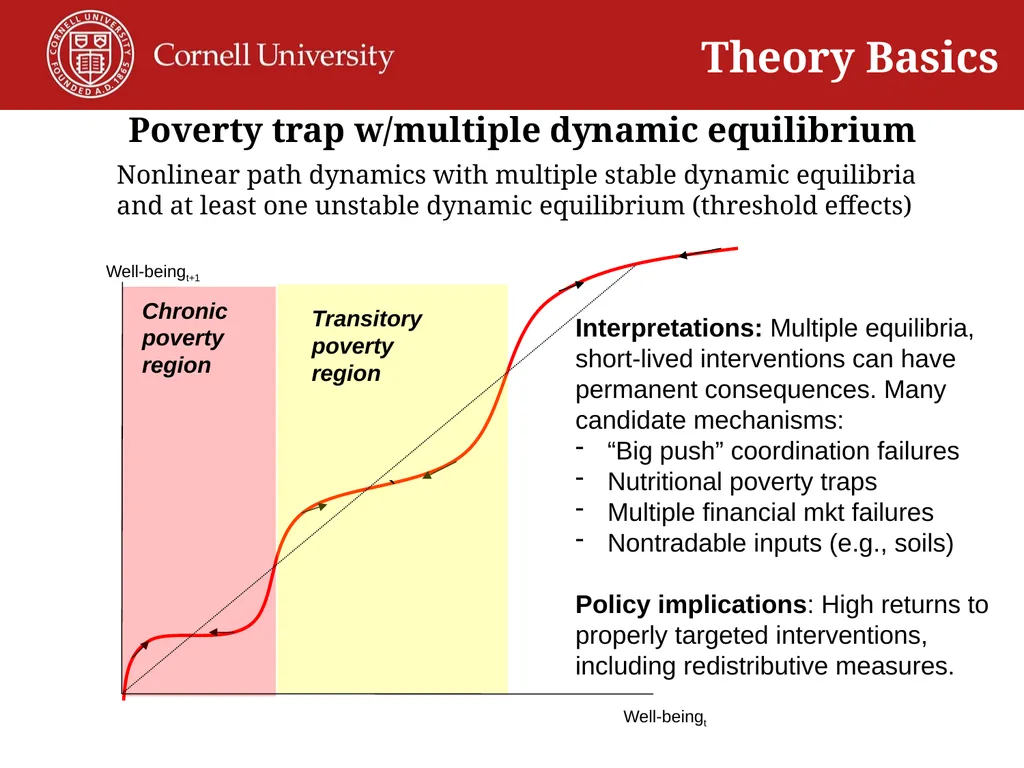
slide6. Well-beingt+1 Chronic poverty region ` Transitory poverty region Nonlinear path dynamics with multiple stable dynamic equilibria and at least one unstable dynamic equilibrium (threshold effects) Well-beingt Poverty trap w/multiple dynamic equilibrium Interpretations: Multiple equilibria, short-lived interventions can have permanent consequences. Many candidate mechanisms:
“Big push” coordination failures
Nutritional poverty traps
Multiple financial mkt failures
Nontradable inputs (e.g., soils)
Policy implications: High returns to properly targeted interventions, including redistributive measures. Theory Basics<br>
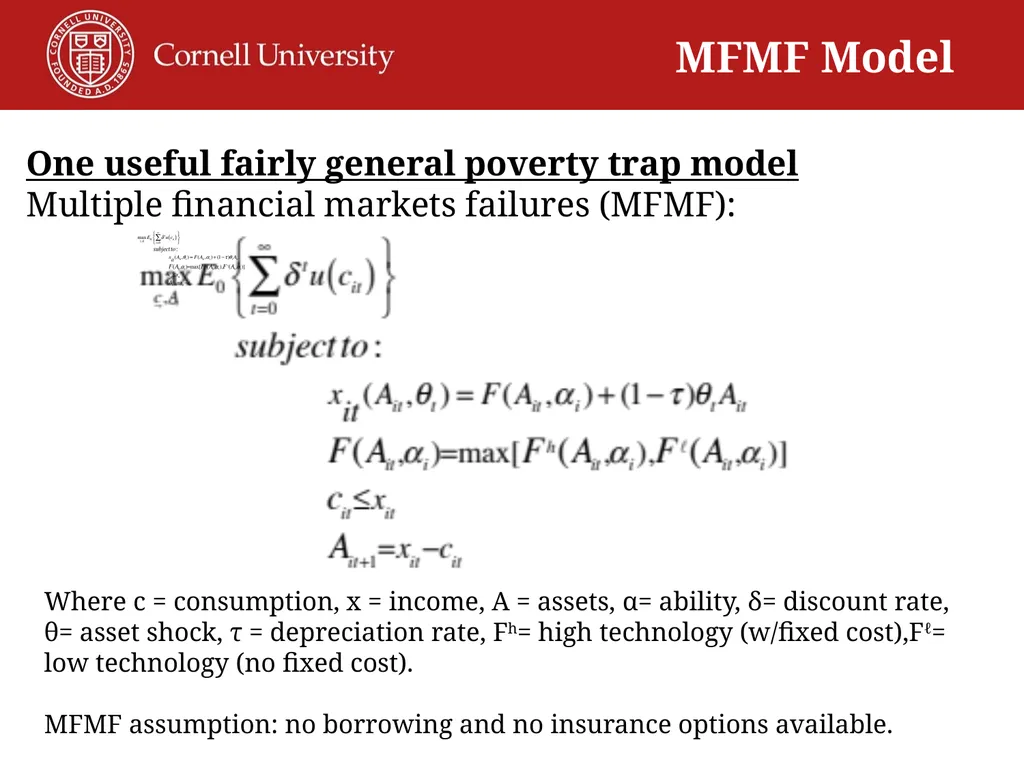
slide7. One useful fairly general poverty trap model
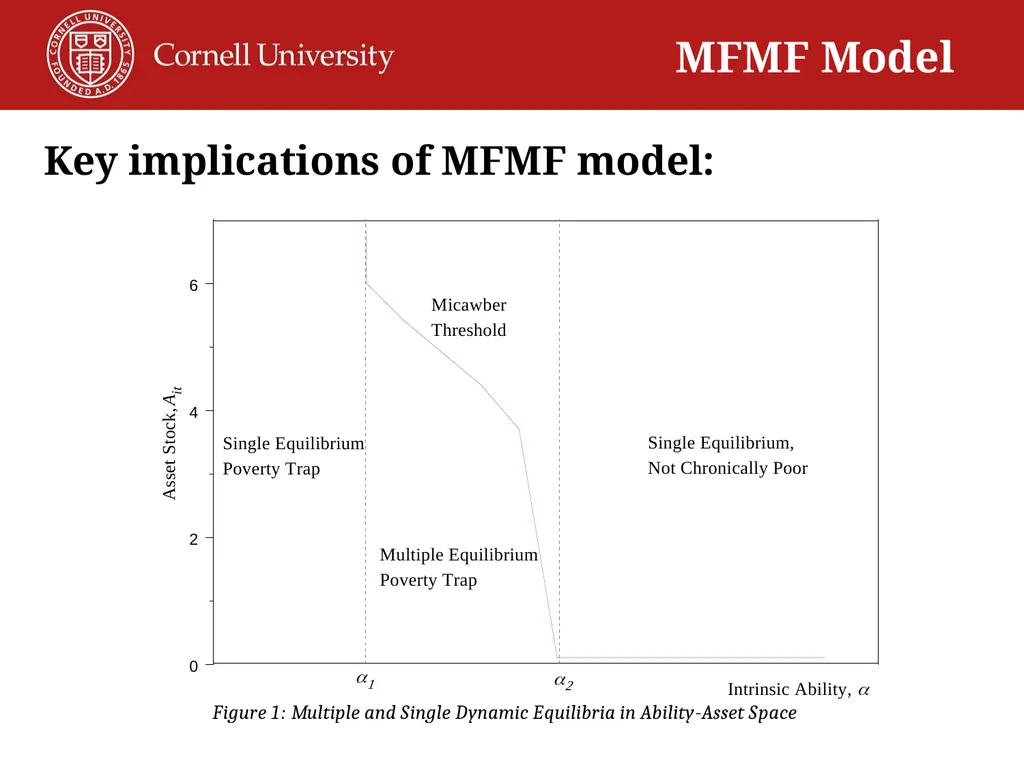
Multiple financial markets failures (MFMF): MFMF Model Where c = consumption, x = income, A = assets, α= ability, δ= discount rate, θ= asset shock, τ = depreciation rate, Fh= high technology (w/fixed cost),Fℓ= low technology (no fixed cost).
MFMF assumption: no borrowing and no insurance options available.<br>
slide8. Key implications of MFMF model: MFMF Model<br>
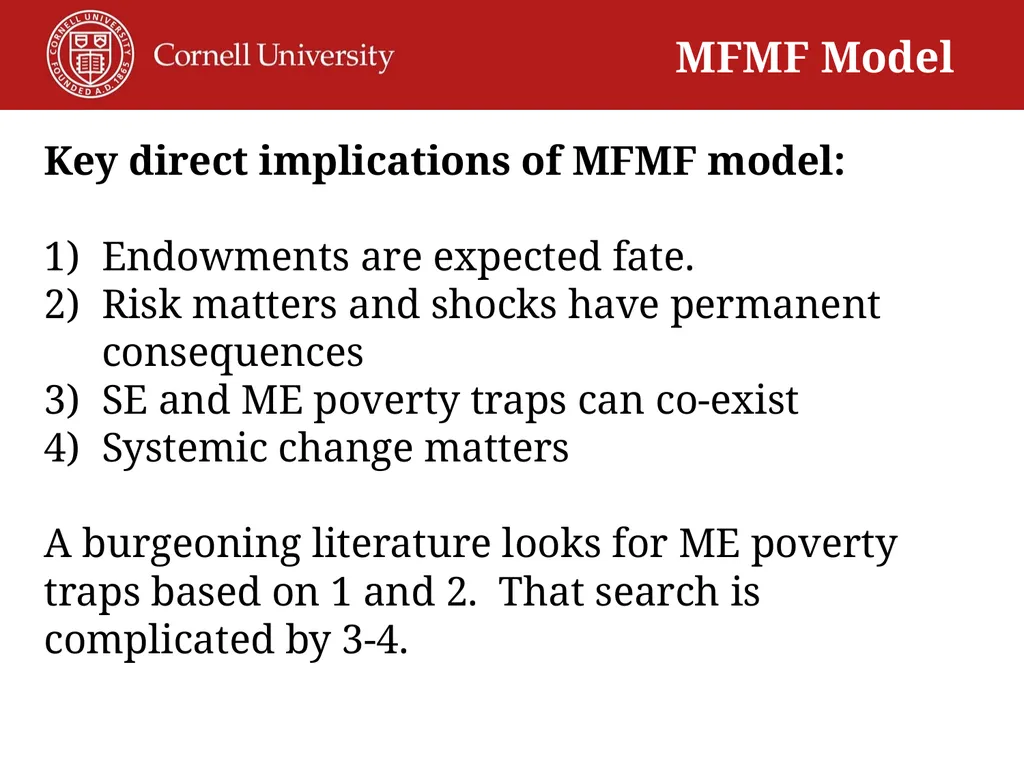
slide9. Key direct implications of MFMF model:
Endowments are expected fate.
Risk matters and shocks have permanent consequences
SE and ME poverty traps can co-exist
Systemic change matters
A burgeoning literature looks for ME poverty traps based on 1 and 2. That search is complicated by 3-4. MFMF Model<br>
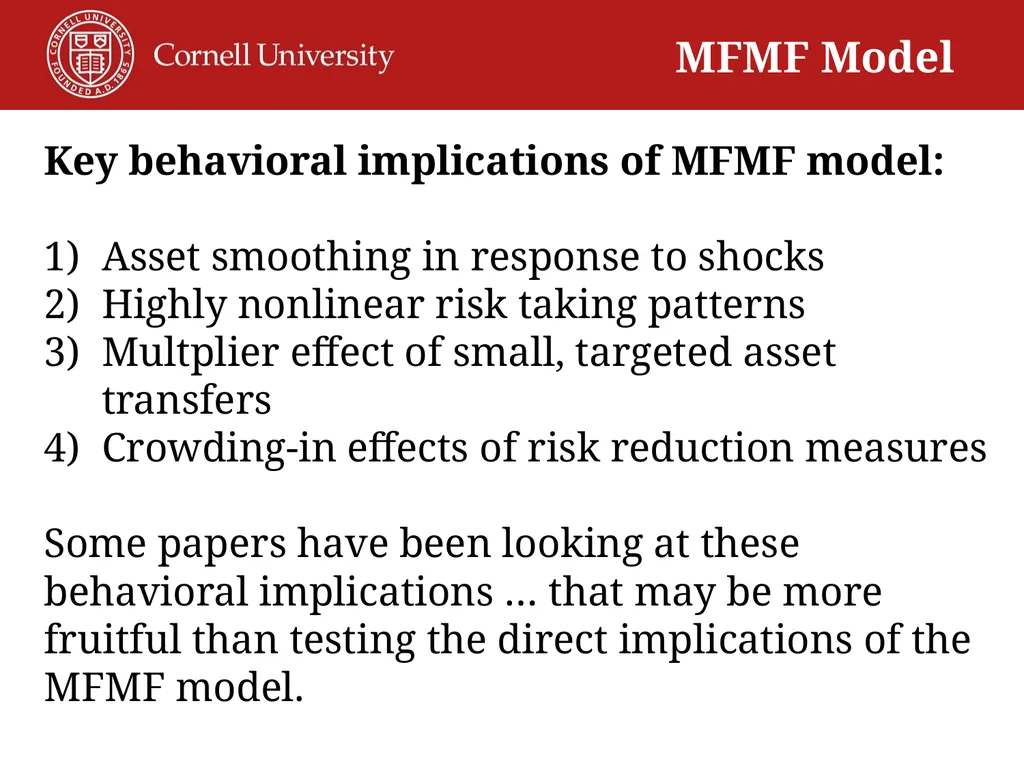
slide10. Key behavioral implications of MFMF model:
Asset smoothing in response to shocks
Highly nonlinear risk taking patterns
Multplier effect of small, targeted asset transfers
Crowding-in effects of risk reduction measures
Some papers have been looking at these behavioral implications … that may be more fruitful than testing the direct implications of the MFMF model. MFMF Model<br>
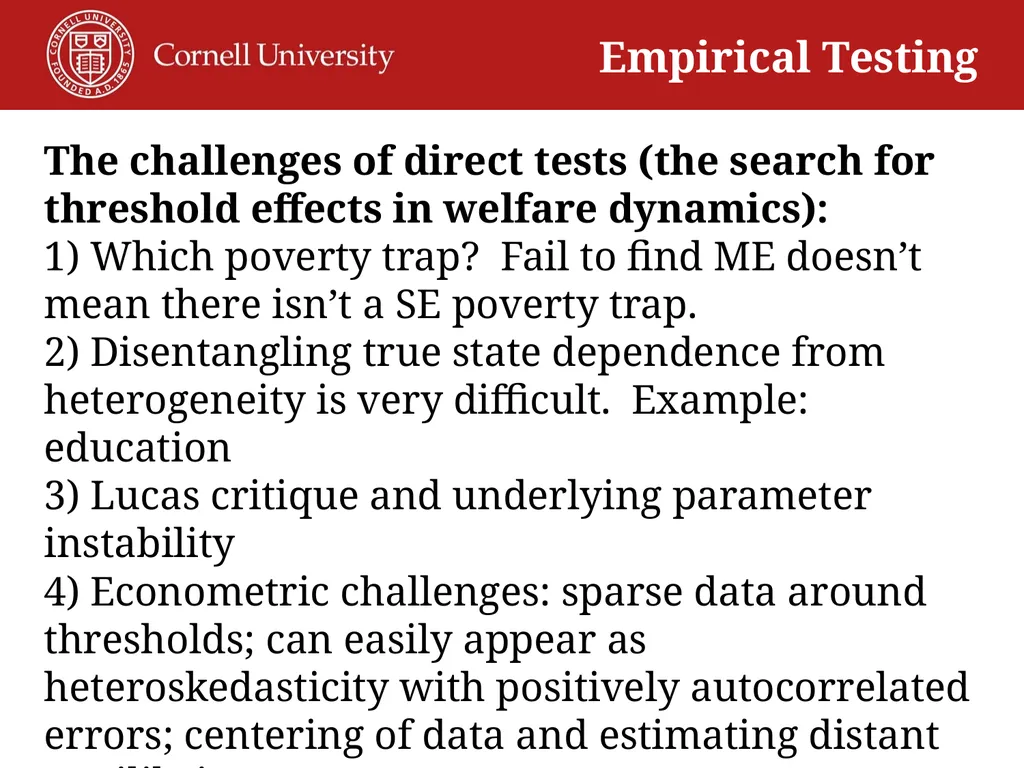
slide11. The challenges of direct tests (the search for threshold effects in welfare dynamics):
1) Which poverty trap? Fail to find ME doesn’t mean there isn’t a SE poverty trap.
2) Disentangling true state dependence from heterogeneity is very difficult. Example: education
3) Lucas critique and underlying parameter instability
4) Econometric challenges: sparse data around thresholds; can easily appear as heteroskedasticity with positively autocorrelated errors; centering of data and estimating distant equilibria, etc.
5) Asset index construction sensitivity
Etc., etc. Empirical Testing<br>
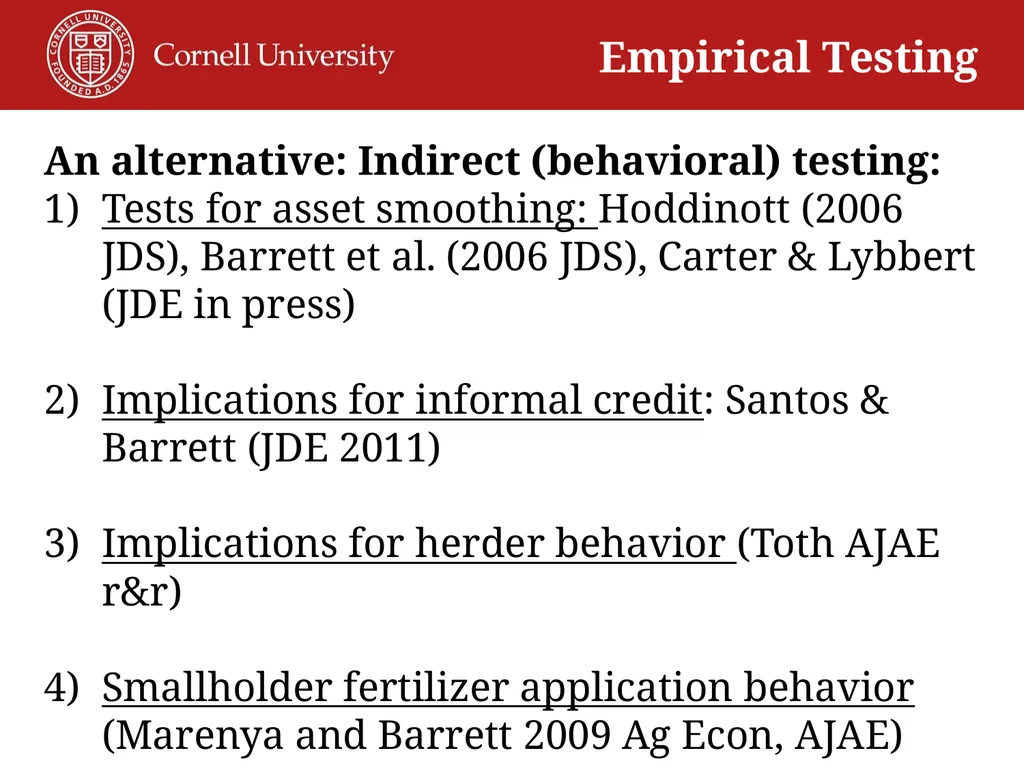
slide12. An alternative: Indirect (behavioral) testing:
Tests for asset smoothing: Hoddinott (2006 JDS), Barrett et al. (2006 JDS), Carter & Lybbert (JDE in press)
Implications for informal credit: Santos & Barrett (JDE 2011)
Implications for herder behavior (Toth AJAE r&r)
Smallholder fertilizer application behavior (Marenya and Barrett 2009 Ag Econ, AJAE) Empirical Testing<br>
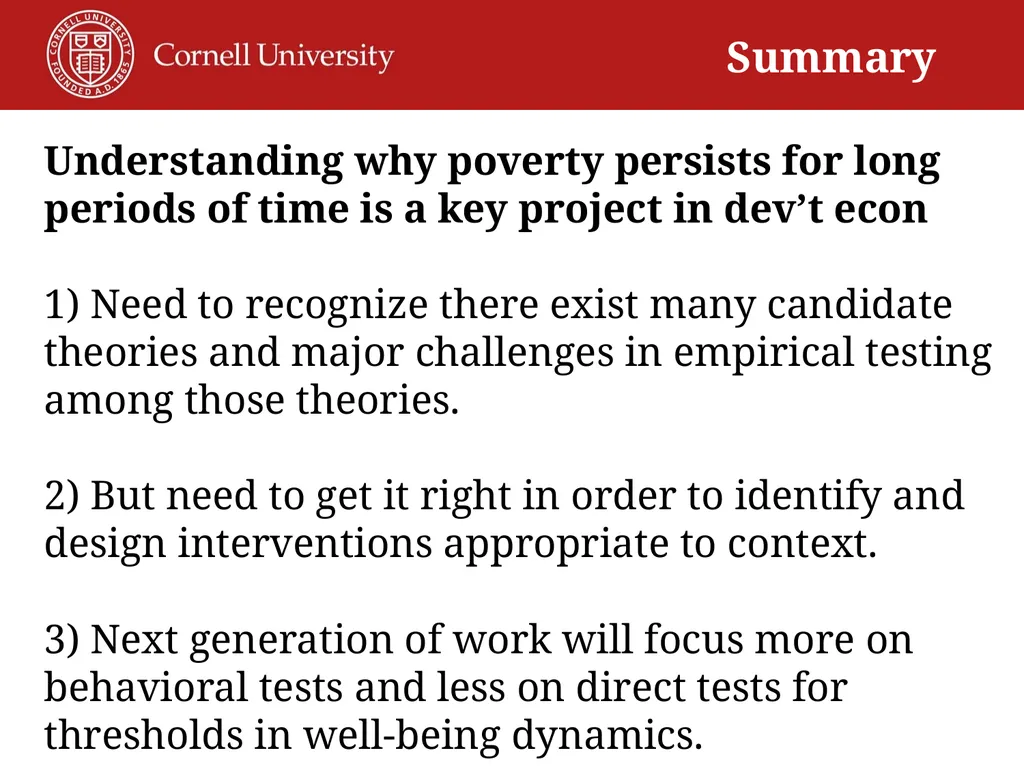
slide13. Understanding why poverty persists for long periods of time is a key project in dev’t econ
1) Need to recognize there exist many candidate theories and major challenges in empirical testing among those theories.
2) But need to get it right in order to identify and design interventions appropriate to context.
3) Next generation of work will focus more on behavioral tests and less on direct tests for thresholds in well-being dynamics. Summary<br>
slide14. Thank you for your time, interest and comments! Thank you<br>
Policy and Empirical Implications<br>
slide2. Persistent poverty is a 1st order development concern.
What to do about it?
- depends crucially on the causal mechanism(s):
* slow, steady growth from low base?
* immutable poverty (unique low eqln)?
* avoidable state (low level eqln trap)?
- challenge of sorting structure from stochasticity
The fact that appropriate policy response to persistent poverty turns on the causal mechanism necessitates both careful theorizing and thoughtful empirics. Motivation<br>
slide3. Poverty Traps:
“any self-reinforcing mechanism which causes poverty to persist” (Azariadis and Stachurski 2004, p. 33)
A range of structural mechanisms (co-)exist
Individual/hh-level
Meso-/macro-scale
Inter- or intra-generational
Single or multiple equilibrium
Consider some simple theoretical illustrations of basic options Various Mechanisms<br>
slide4. W* Welfare Dynamics With Unconditional Convergence Welfare Dynamics With Conditional Convergence Welfare dynamics w/single non-poor dynamic equilibrium Persistent poverty w/o a poverty trap Theory Basics Interpretation: Slow, neoclassical growth from a low base … “convergence clubs”?
Policy implications: perhaps intervene to accelerate progress, but not necessary.<br>
slide5. W* Welfare Dynamics With Unconditional Convergence Welfare Dynamics With Conditional Convergence Welfare dynamics w/single poor dynamic equilibrium Poverty trap w/unique dynamic equilibrium W* W* W0 Interpretation: Can include geographic poverty traps, physical/cognitive disability traps, discrimination based traps, low-level institutional traps, etc. Theory Basics Policy implications: Intervene to prevent phenomena (e.g., early childhood programs, infrastructure investments in LFAs). Humanitarian social protection transfers.<br>
slide6. Well-beingt+1 Chronic poverty region ` Transitory poverty region Nonlinear path dynamics with multiple stable dynamic equilibria and at least one unstable dynamic equilibrium (threshold effects) Well-beingt Poverty trap w/multiple dynamic equilibrium Interpretations: Multiple equilibria, short-lived interventions can have permanent consequences. Many candidate mechanisms:
“Big push” coordination failures
Nutritional poverty traps
Multiple financial mkt failures
Nontradable inputs (e.g., soils)
Policy implications: High returns to properly targeted interventions, including redistributive measures. Theory Basics<br>
slide7. One useful fairly general poverty trap model
Multiple financial markets failures (MFMF): MFMF Model Where c = consumption, x = income, A = assets, α= ability, δ= discount rate, θ= asset shock, τ = depreciation rate, Fh= high technology (w/fixed cost),Fℓ= low technology (no fixed cost).
MFMF assumption: no borrowing and no insurance options available.<br>
slide8. Key implications of MFMF model: MFMF Model<br>
slide9. Key direct implications of MFMF model:
Endowments are expected fate.
Risk matters and shocks have permanent consequences
SE and ME poverty traps can co-exist
Systemic change matters
A burgeoning literature looks for ME poverty traps based on 1 and 2. That search is complicated by 3-4. MFMF Model<br>
slide10. Key behavioral implications of MFMF model:
Asset smoothing in response to shocks
Highly nonlinear risk taking patterns
Multplier effect of small, targeted asset transfers
Crowding-in effects of risk reduction measures
Some papers have been looking at these behavioral implications … that may be more fruitful than testing the direct implications of the MFMF model. MFMF Model<br>
slide11. The challenges of direct tests (the search for threshold effects in welfare dynamics):
1) Which poverty trap? Fail to find ME doesn’t mean there isn’t a SE poverty trap.
2) Disentangling true state dependence from heterogeneity is very difficult. Example: education
3) Lucas critique and underlying parameter instability
4) Econometric challenges: sparse data around thresholds; can easily appear as heteroskedasticity with positively autocorrelated errors; centering of data and estimating distant equilibria, etc.
5) Asset index construction sensitivity
Etc., etc. Empirical Testing<br>
slide12. An alternative: Indirect (behavioral) testing:
Tests for asset smoothing: Hoddinott (2006 JDS), Barrett et al. (2006 JDS), Carter & Lybbert (JDE in press)
Implications for informal credit: Santos & Barrett (JDE 2011)
Implications for herder behavior (Toth AJAE r&r)
Smallholder fertilizer application behavior (Marenya and Barrett 2009 Ag Econ, AJAE) Empirical Testing<br>
slide13. Understanding why poverty persists for long periods of time is a key project in dev’t econ
1) Need to recognize there exist many candidate theories and major challenges in empirical testing among those theories.
2) But need to get it right in order to identify and design interventions appropriate to context.
3) Next generation of work will focus more on behavioral tests and less on direct tests for thresholds in well-being dynamics. Summary<br>
slide14. Thank you for your time, interest and comments! Thank you<br>