01
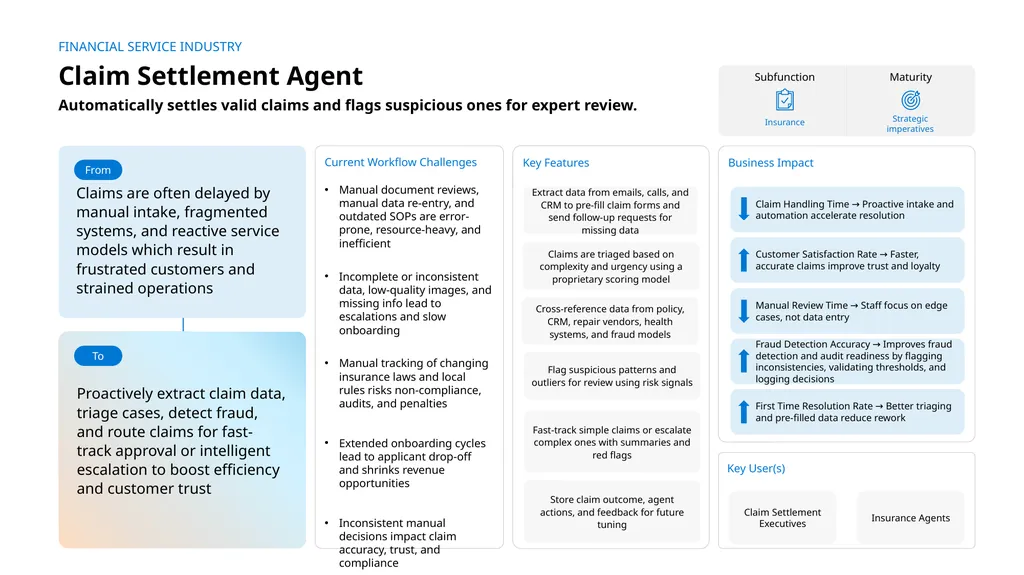
Claims are often delayed by manual intake, fragmented systems, and reactive service models which result in frustrated customers and strained operations From Current Workflow Challenges
Manual document reviews, manual data re-entry, and outdated SOPs are error-prone, resource-heavy, and inefficient�
Incomplete or inconsistent data, low-quality images, and missing info lead to escalations and slow onboarding�
Manual tracking of changing insurance laws and local rules risks non-compliance, audits, and penalties
Extended onboarding cycles lead to applicant drop-off and shrinks revenue opportunities
Inconsistent manual decisions impact claim accuracy, trust, and compliance Key Features AI Agent drives real-time intent identification, intelligent routing, and hyper-personalized recommendations Key User(s) Claim Settlement Executives Business Impact Subfunction Maturity FINANCIAL SERVICE INDUSTRY Claim Settlement Agent Automatically settles valid claims and flags suspicious ones for expert review. Proactively extract claim data, triage cases, detect fraud, and route claims for fast-track approval or intelligent escalation to boost efficiency and customer trust To Claim Handling Time → Proactive intake and automation accelerate resolution Customer Satisfaction Rate → Faster, accurate claims improve trust and loyalty Manual Review Time → Staff focus on edge cases, not data entry Insurance Agents Extract data from emails, calls, and CRM to pre-fill claim forms and send follow-up requests for missing data Fast-track simple claims or escalate complex ones with summaries and red flags Cross-reference data from policy, CRM, repair vendors, health systems, and fraud models Claims are triaged based on complexity and urgency using a proprietary scoring model Flag suspicious patterns and outliers for review using risk signals Insurance Strategic imperatives Store claim outcome, agent actions, and feedback for future tuning Fraud Detection Accuracy → Improves fraud detection and audit readiness by flagging inconsistencies, validating thresholds, and logging decisions First Time Resolution Rate → Better triaging and pre-filled data reduce rework<br>
02
Claim settlement agent Available with:
Copilot Studio Financial Service Scenario level:
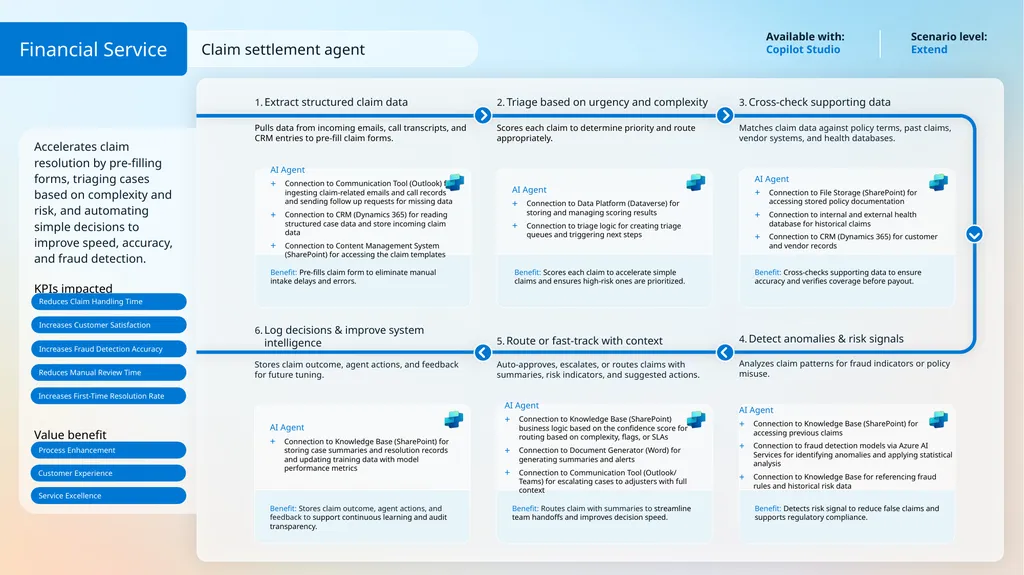
Extend Triage based on urgency and complexity Scores each claim to determine priority and route appropriately. Increases Customer Satisfaction Increases Fraud Detection Accuracy Process Enhancement Extract structured claim data Pulls data from incoming emails, call transcripts, and CRM entries to pre-fill claim forms. AI Agent
Connection to Communication Tool (Outlook) for ingesting claim-related emails and call records and sending follow up requests for missing data
Connection to CRM (Dynamics 365) for reading structured case data and store incoming claim data
Connection to Content Management System (SharePoint) for accessing the claim templates Cross-check supporting data Matches claim data against policy terms, past claims, vendor systems, and health databases. Detect anomalies & risk signals Analyzes claim patterns for fraud indicators or policy misuse. Customer Experience Reduces Manual Review Time AI Agent
Connection to Data Platform (Dataverse) for storing and managing scoring results
Connection to triage logic for creating triage queues and triggering next steps AI Agent
Connection to File Storage (SharePoint) for accessing stored policy documentation
Connection to internal and external health database for historical claims
Connection to CRM (Dynamics 365) for customer and vendor records Benefit: Pre-fills claim form to eliminate manual intake delays and errors. Benefit: Scores each claim to accelerate simple claims and ensures high-risk ones are prioritized. Benefit: Cross-checks supporting data to ensure accuracy and verifies coverage before payout. Route or fast-track with context Auto-approves, escalates, or routes claims with summaries, risk indicators, and suggested actions. Service Excellence Reduces Claim Handling Time Increases First-Time Resolution Rate Stores claim outcome, agent actions, and feedback for future tuning. Log decisions & improve system intelligence<br>
03
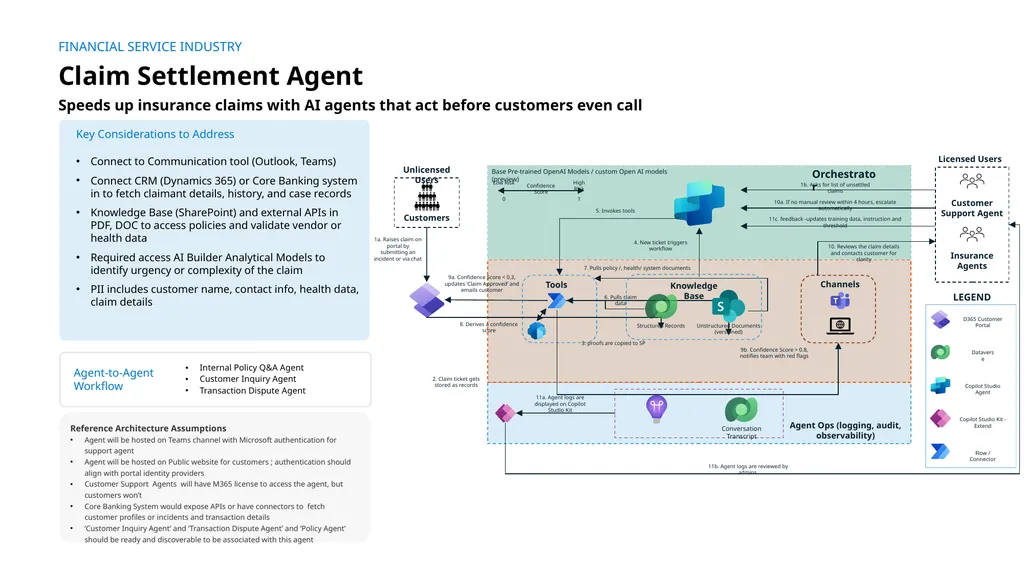
Key Considerations to Address
Connect to Communication tool (Outlook, Teams)
Connect CRM (Dynamics 365) or Core Banking system in to fetch claimant details, history, and case records
Knowledge Base (SharePoint) and external APIs in PDF, DOC to access policies and validate vendor or health data
Required access AI Builder Analytical Models to identify urgency or complexity of the claim
PII includes customer name, contact info, health data, claim details Agent-to-Agent
Workflow Internal Policy Q&A Agent
Customer Inquiry Agent
Transaction Dispute Agent Reference Architecture Assumptions
Agent will be hosted on Teams channel with Microsoft authentication for support agent
Agent will be hosted on Public website for customers ; authentication should align with portal identity providers
Customer Support Agents will have M365 license to access the agent, but customers won’t
Core Banking System would expose APIs or have connectors to fetch customer profiles or incidents and transaction details
‘Customer Inquiry Agent’ and ‘Transaction Dispute Agent’ and ‘Policy Agent’ should be ready and discoverable to be associated with this agent FINANCIAL SERVICE INDUSTRY Claim Settlement Agent Speeds up insurance claims with AI agents that act before customers even call Orchestrator Agent Ops (logging, audit, observability) Structured Records Tools Channels Customers Unlicensed Users Licensed Users Customer Support Agent Insurance Agents D365 Customer Portal Dataverse Copilot Studio Agent Copilot Studio Kit - Extend Flow / Connector LEGEND Base Pre-trained OpenAI Models / custom Open AI models (preview) 11a. Agent logs are displayed on Copilot Studio Kit 1a. Raises claim on portal by submitting an incident or via chat 1b. Asks for list of unsettled claims 3. proofs are copied to SP 4. New ticket triggers workflow 5. Invokes tools 6. Pulls claim data 7. Pulls policy /, health/ system documents 8. Derives a confidence score 9a. Confidence Score < 0.3, updates ‘Claim Approved’ and emails customer 9b. Confidence Score > 0.8, notifies team with red flags 10. Reviews the claim details and contacts customer for clarity 10a. If no manual review within 4 hours, escalate automatically 11c. feedback -updates training data, instruction and threshold Confidence Score High Risk Low Risk 0 1 Knowledge Base Structured Records Unstructured Documents (versioned) 2. Claim ticket gets stored as records Conversation Transcript 11b. Agent logs are reviewed by admins<br>