Class Project: Focused Investigation Astro 289: Adaptive Optics February 6, 2020 Thanks to Katie Morzinski for developing this series of activities 2 Purpose of Starter: To introduce existing AO systems and get you thinking about science
"Class Project: Focused Investigation Astro 289:" is the property of its rightful owner. Permission is granted to
download and print the materials on this website for personal, non-commercial use only, and to display it
on your personal computer provided you do not modify the materials and that you retain all copyright
notices contained in the materials. By downloading content from our website, you accept the terms of this
agreement.
Presentation Transcript
01
Class Project: Focused Investigation Astro 289: Adaptive Optics
February 6, 2020
Thanks to Katie Morzinski for developing this series of activities<br>
02
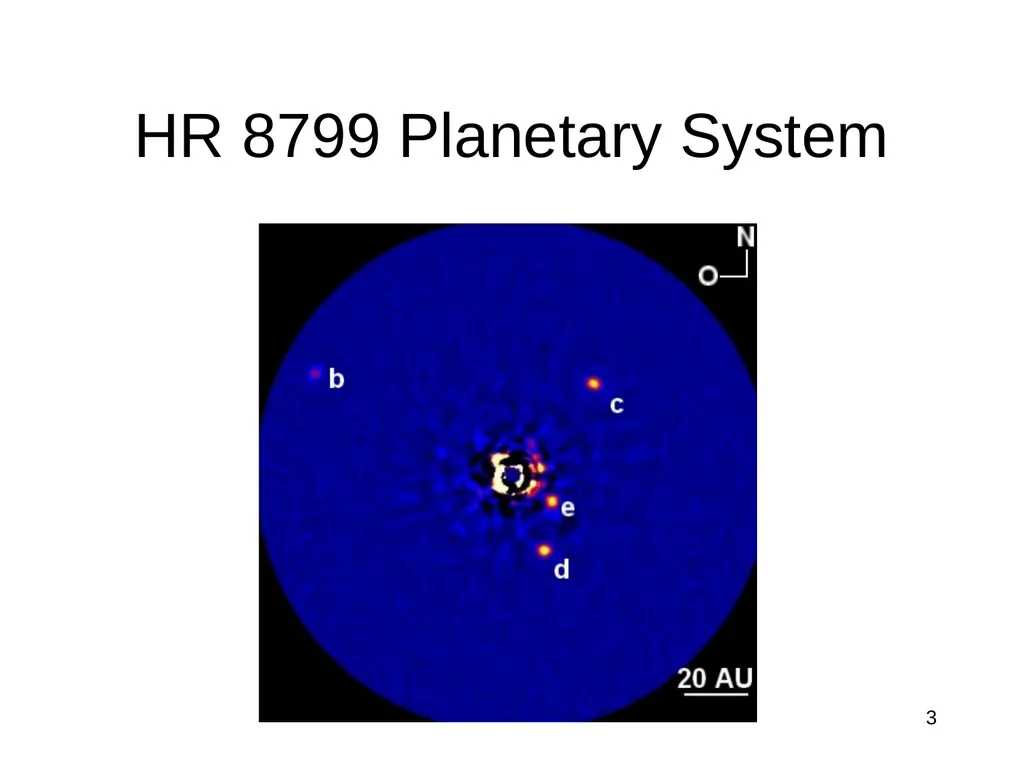
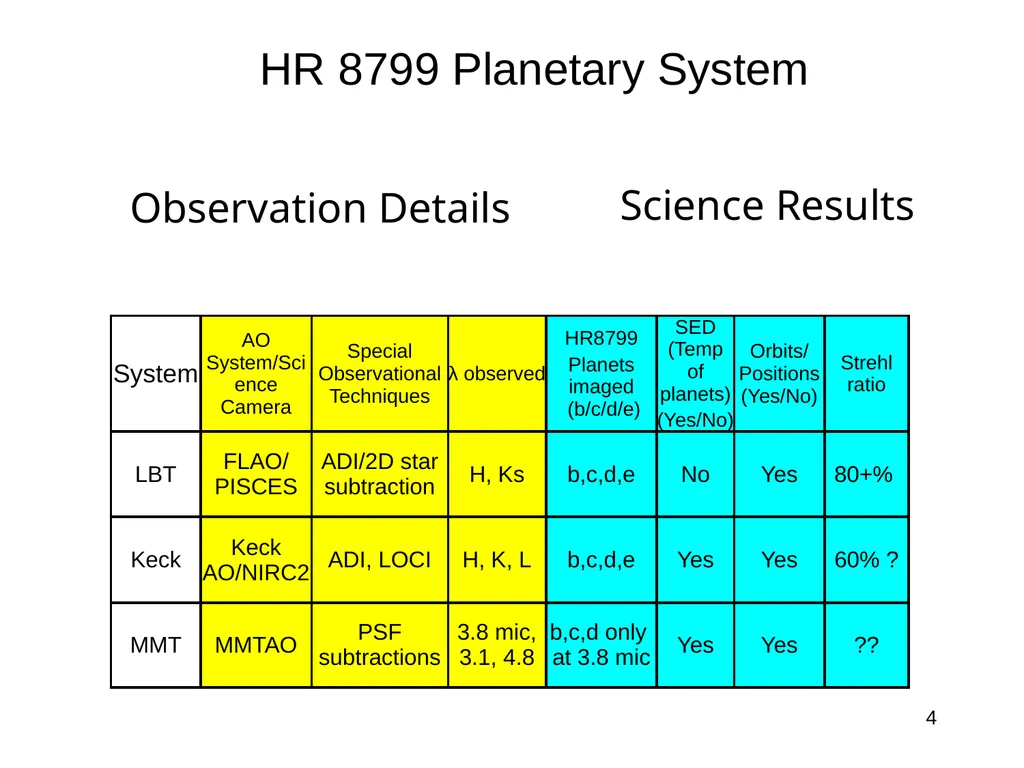
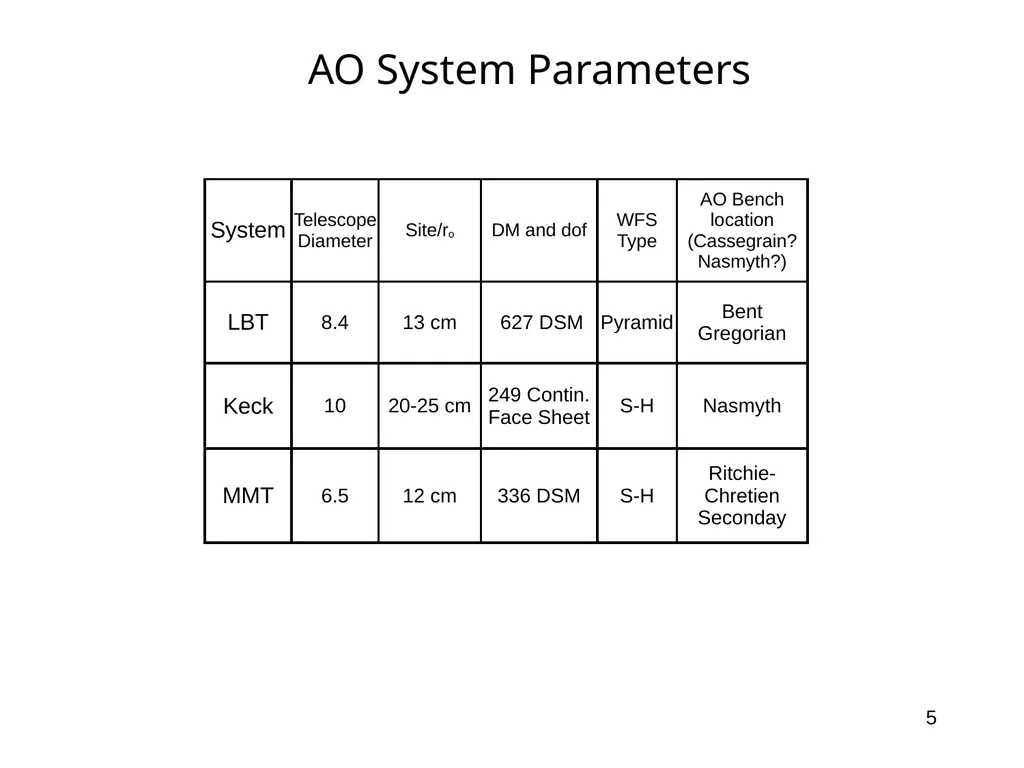
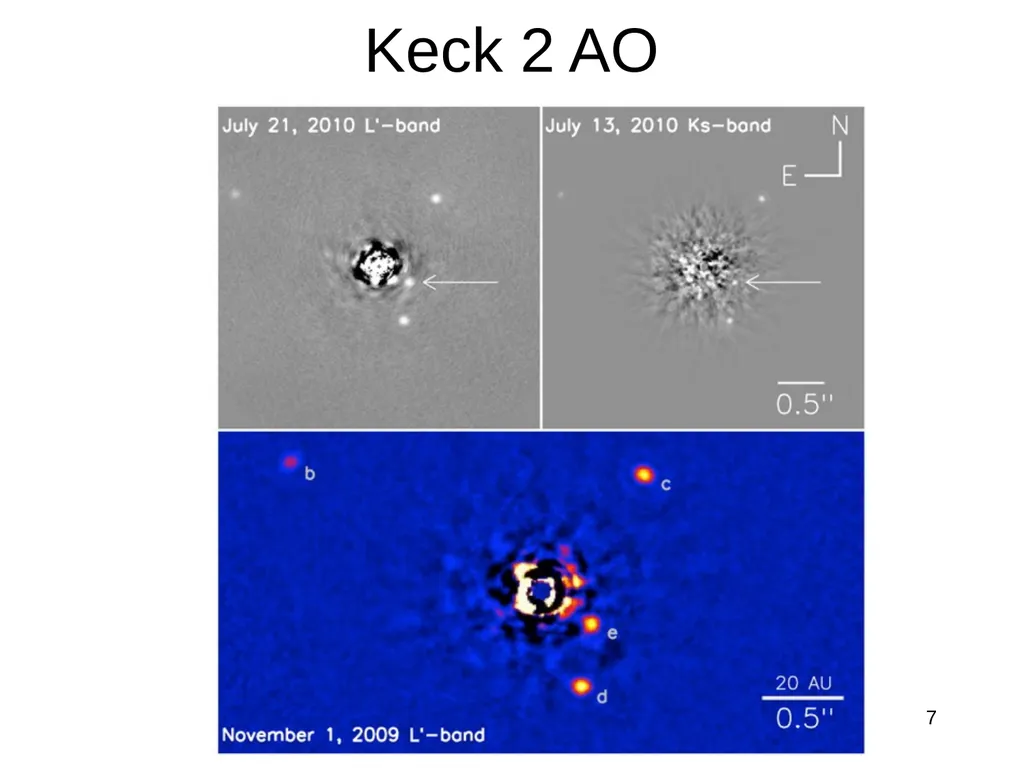
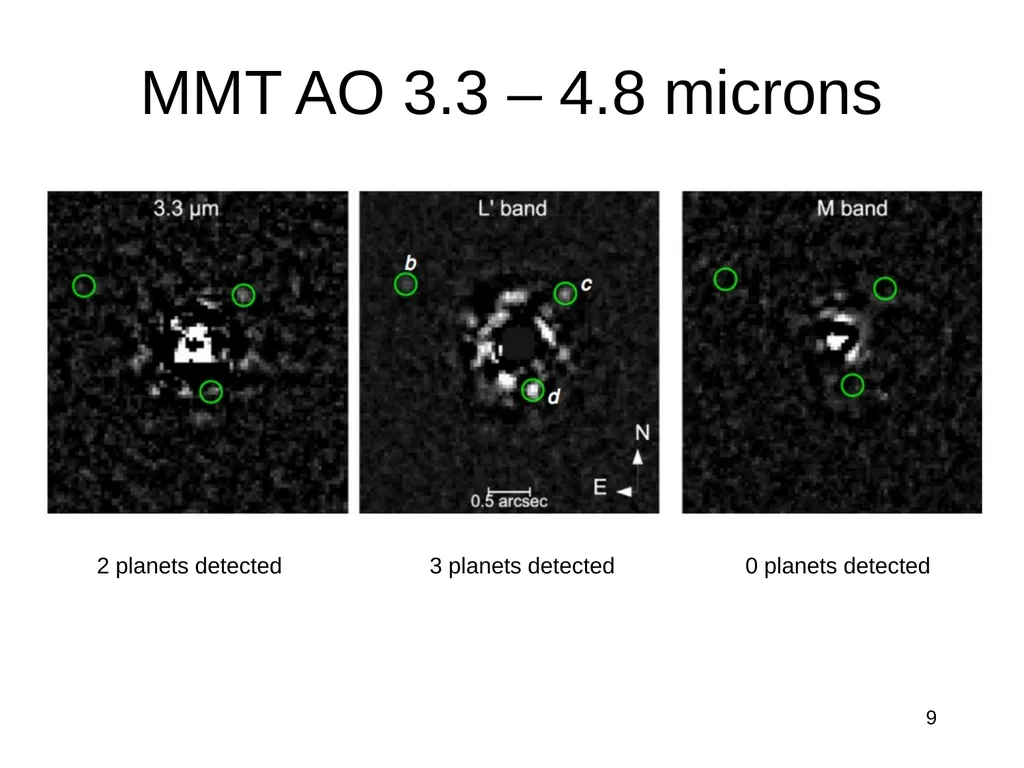
2 Purpose of Starter: To introduce existing AO systems and get you thinking about science goals and design choices Comparing/contrasting several different AO systems and their results when imaging the same extrasolar planetary system (HR 8799)
Discussion
Goal-driven design: iterative
Science Case Performance Requirements
Expectations for final presentation / mini-CoDR
A bit about Project Management<br>
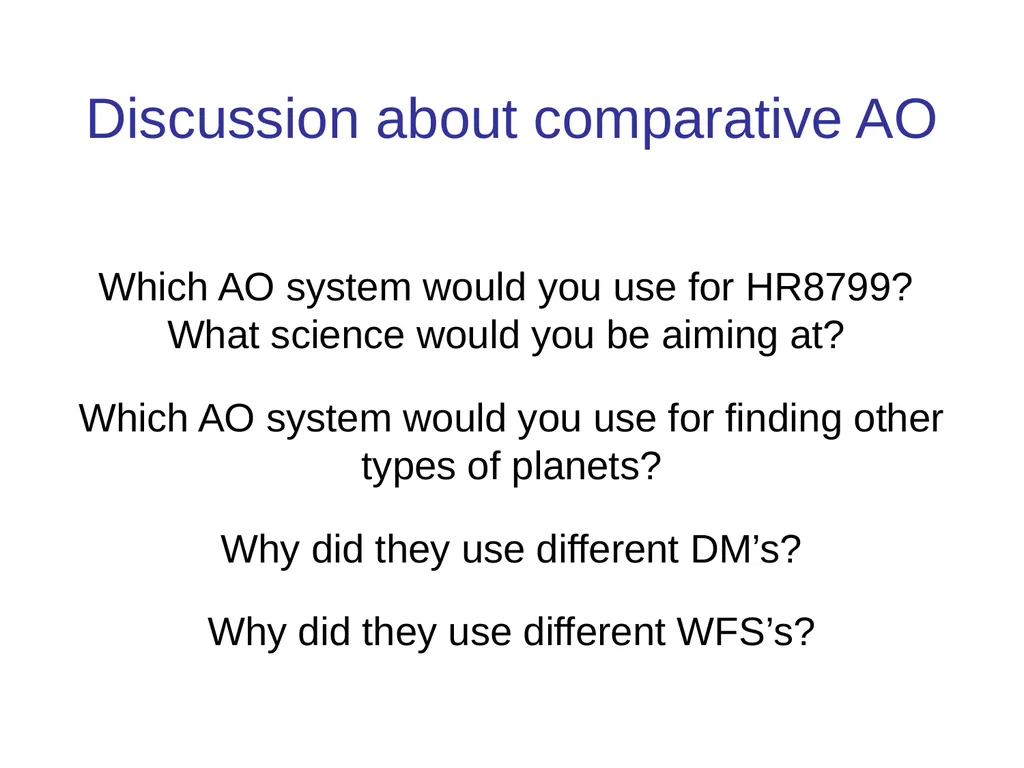
Discussion about comparative AO Which AO system would you use for HR8799? What science would you be aiming at?
Which AO system would you use for finding other types of planets?
Why did they use different DM’s?
Why did they use different WFS’s?<br>
11
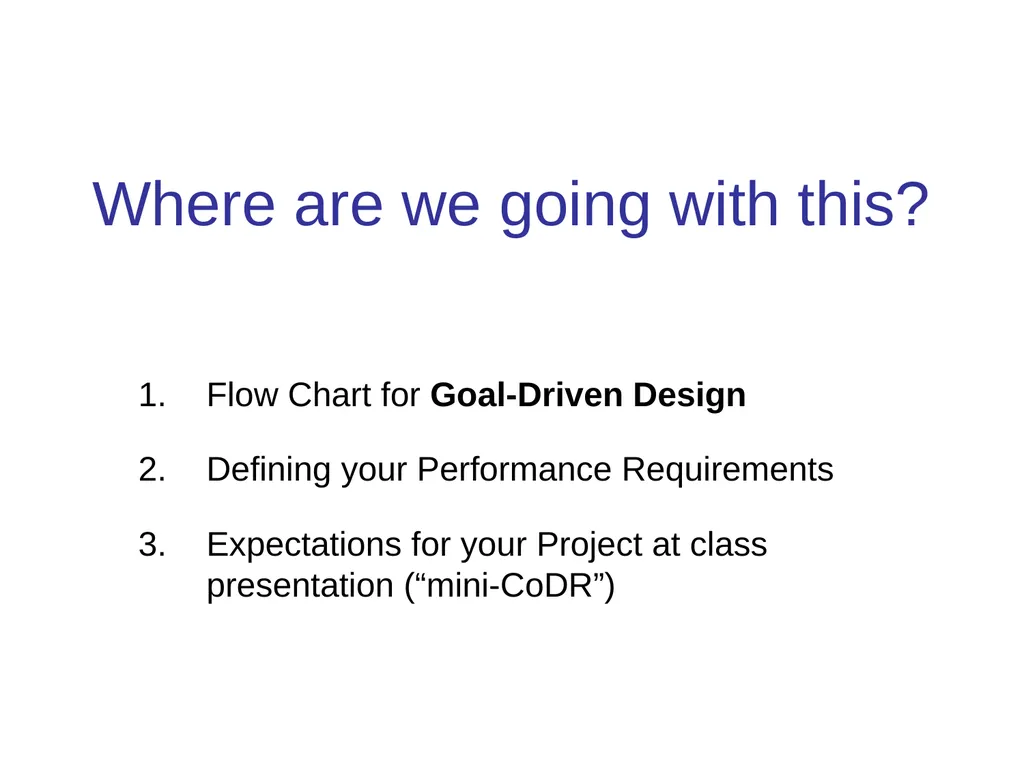
Where are we going with this? Flow Chart for Goal-Driven Design
Defining your Performance Requirements
Expectations for your Project at class presentation (“mini-CoDR”)<br>
12
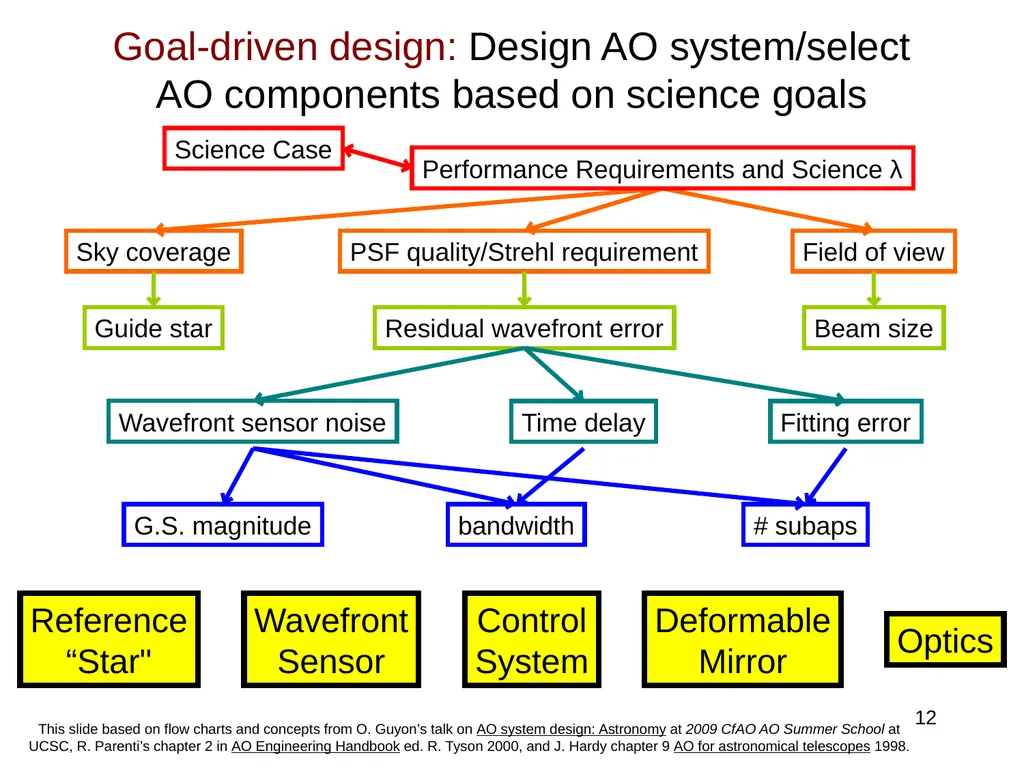
12 This slide based on flow charts and concepts from O. Guyon’s talk on AO system design: Astronomy at 2009 CfAO AO Summer School at UCSC, R. Parenti’s chapter 2 in AO Engineering Handbook ed. R. Tyson 2000, and J. Hardy chapter 9 AO for astronomical telescopes 1998. Goal-driven design: Design AO system/select AO components based on science goals<br>
13
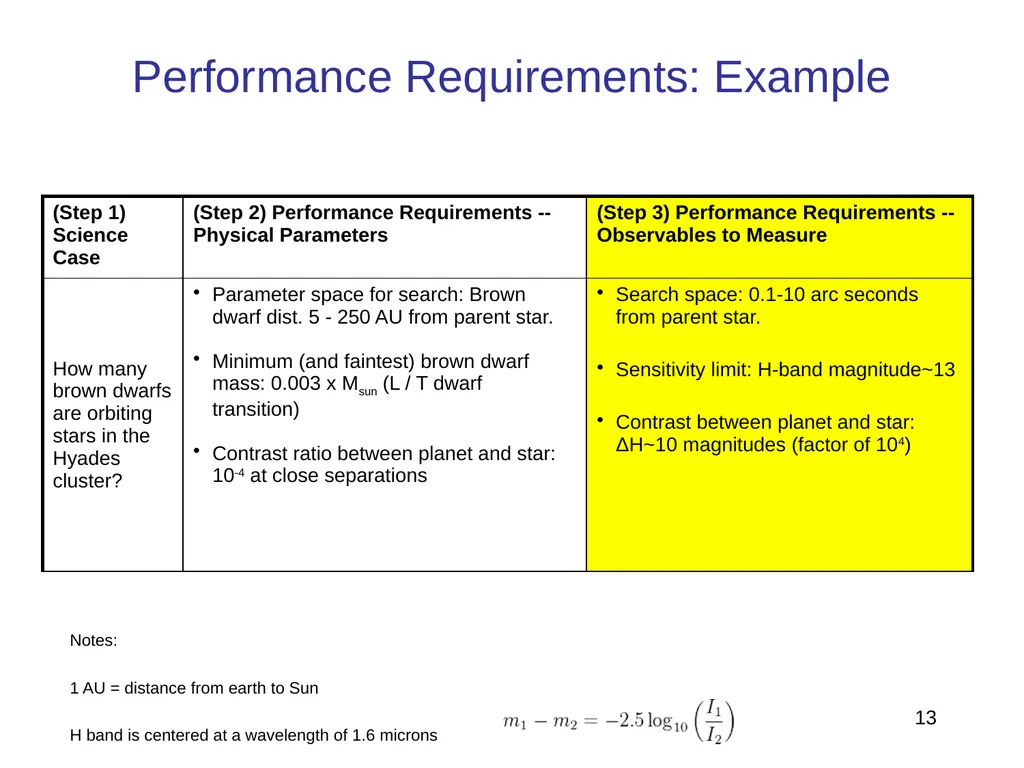
13 Performance Requirements: Example Notes:
1 AU = distance from earth to Sun
H band is centered at a wavelength of 1.6 microns
Magnitude: “Faintness" as viewed from Earth.<br>
14
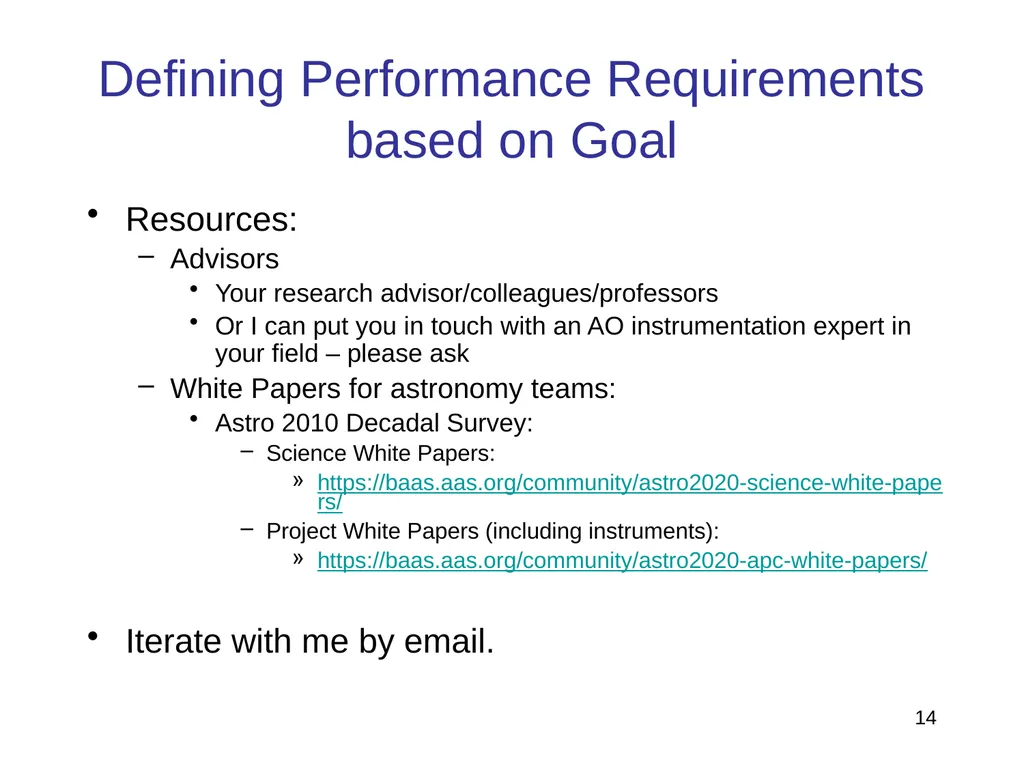
14 Defining Performance Requirements based on Goal Resources:
Advisors
Your research advisor/colleagues/professors
Or I can put you in touch with an AO instrumentation expert in your field – please ask
White Papers for astronomy teams:
Astro 2010 Decadal Survey:
Science White Papers:
https://baas.aas.org/community/astro2020-science-white-papers/
Project White Papers (including instruments):
https://baas.aas.org/community/astro2020-apc-white-papers/
Iterate with me by email.<br>
15
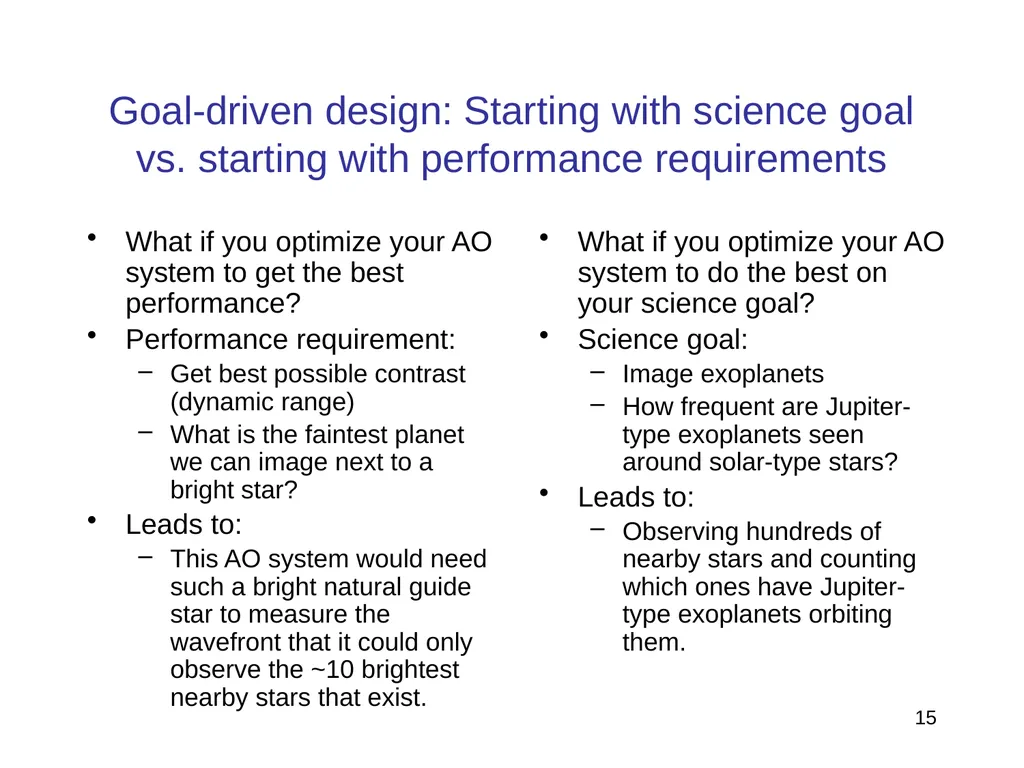
15 Goal-driven design: Starting with science goal vs. starting with performance requirements What if you optimize your AO system to do the best on your science goal?
Science goal:
Image exoplanets
How frequent are Jupiter-type exoplanets seen around solar-type stars?
Leads to:
Observing hundreds of nearby stars and counting which ones have Jupiter-type exoplanets orbiting them. What if you optimize your AO system to get the best performance?
Performance requirement:
Get best possible contrast (dynamic range)
What is the faintest planet we can image next to a bright star?
Leads to:
This AO system would need such a bright natural guide star to measure the wavefront that it could only observe the ~10 brightest nearby stars that exist.<br>
16
Expectations for Final Project Presentations: mini-CoDR (CoDR = Conceptual Design Review)<br>
17
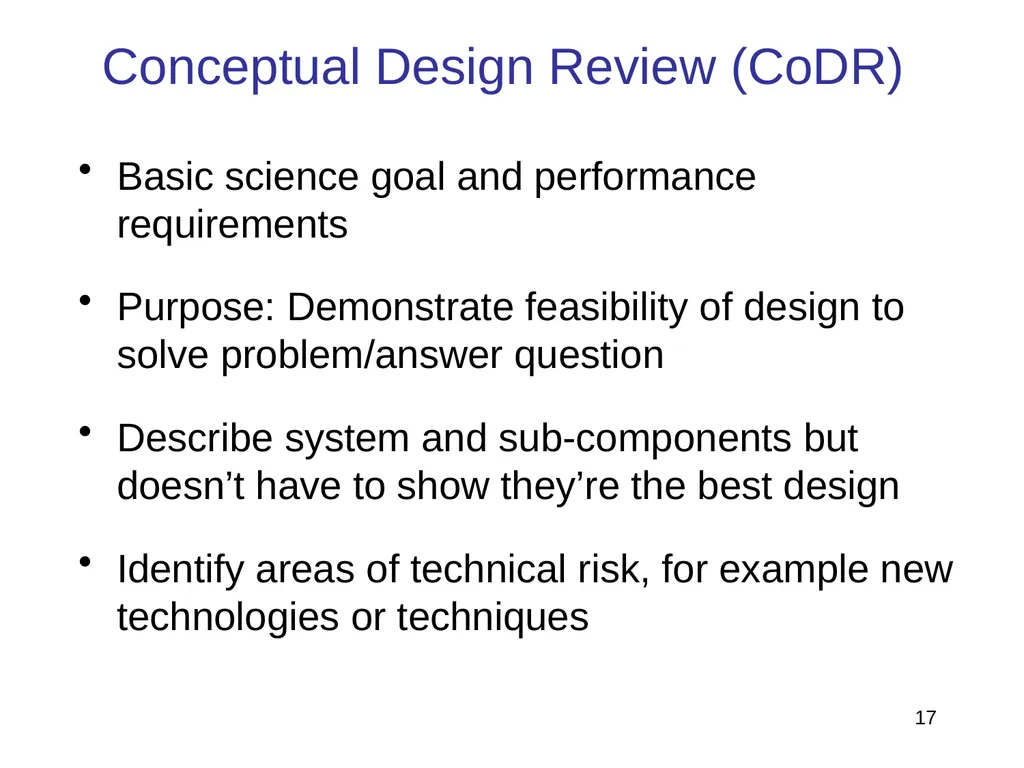
17 Conceptual Design Review (CoDR) Basic science goal and performance requirements
Purpose: Demonstrate feasibility of design to solve problem/answer question
Describe system and sub-components but doesn’t have to show they’re the best design
Identify areas of technical risk, for example new technologies or techniques<br>
18
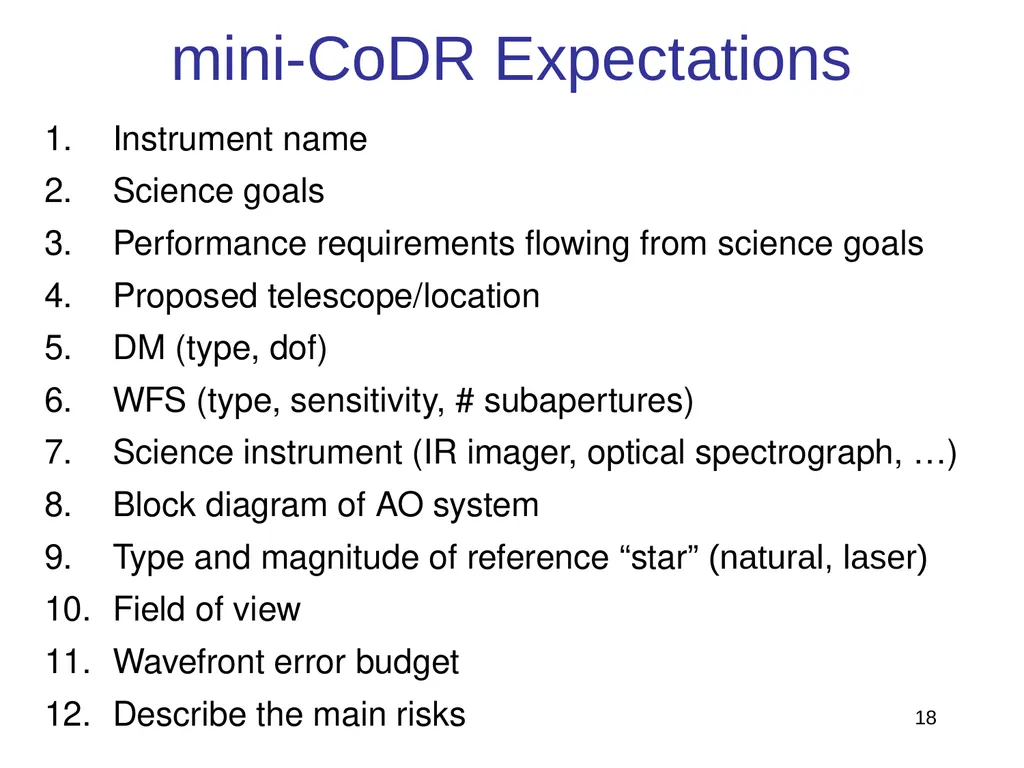
18 mini-CoDR Expectations Instrument name
Science goals
Performance requirements flowing from science goals
Proposed telescope/location
DM (type, dof)
WFS (type, sensitivity, # subapertures)
Science instrument (IR imager, optical spectrograph, …)
Block diagram of AO system
Type and magnitude of reference “star” (natural, laser)
Field of view
Wavefront error budget
Describe the main risks<br>
19
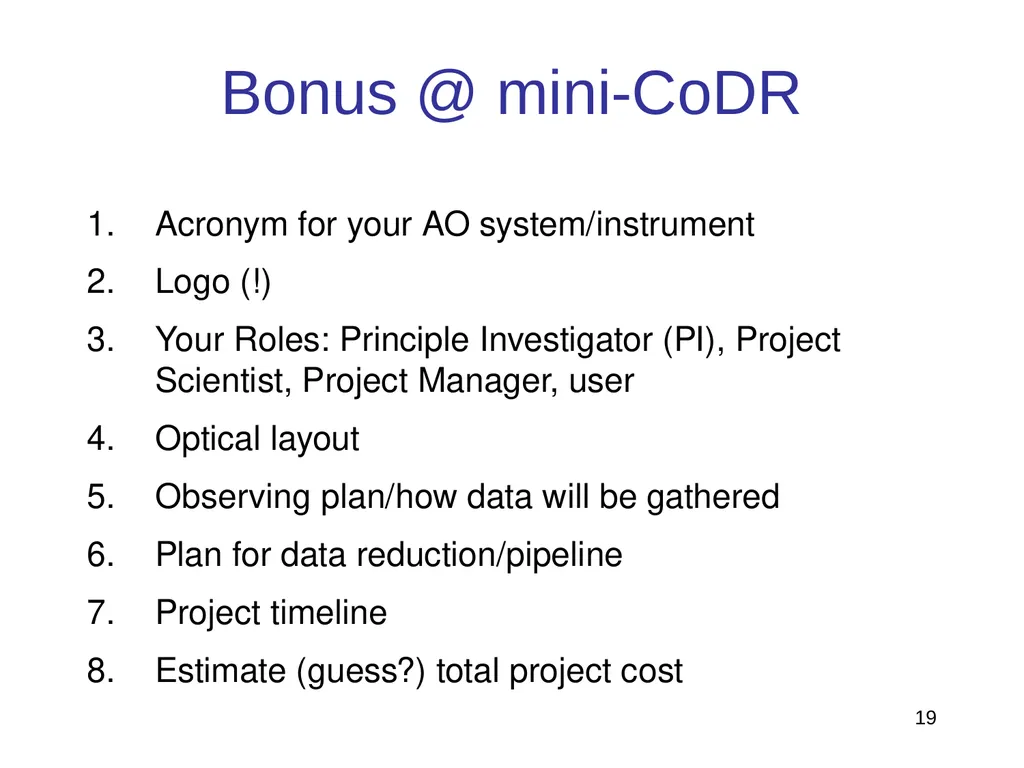
19 Bonus @ mini-CoDR Acronym for your AO system/instrument
Logo (!)
Your Roles: Principle Investigator (PI), Project Scientist, Project Manager, user
Optical layout
Observing plan/how data will be gathered
Plan for data reduction/pipeline
Project timeline
Estimate (guess?) total project cost<br>
20
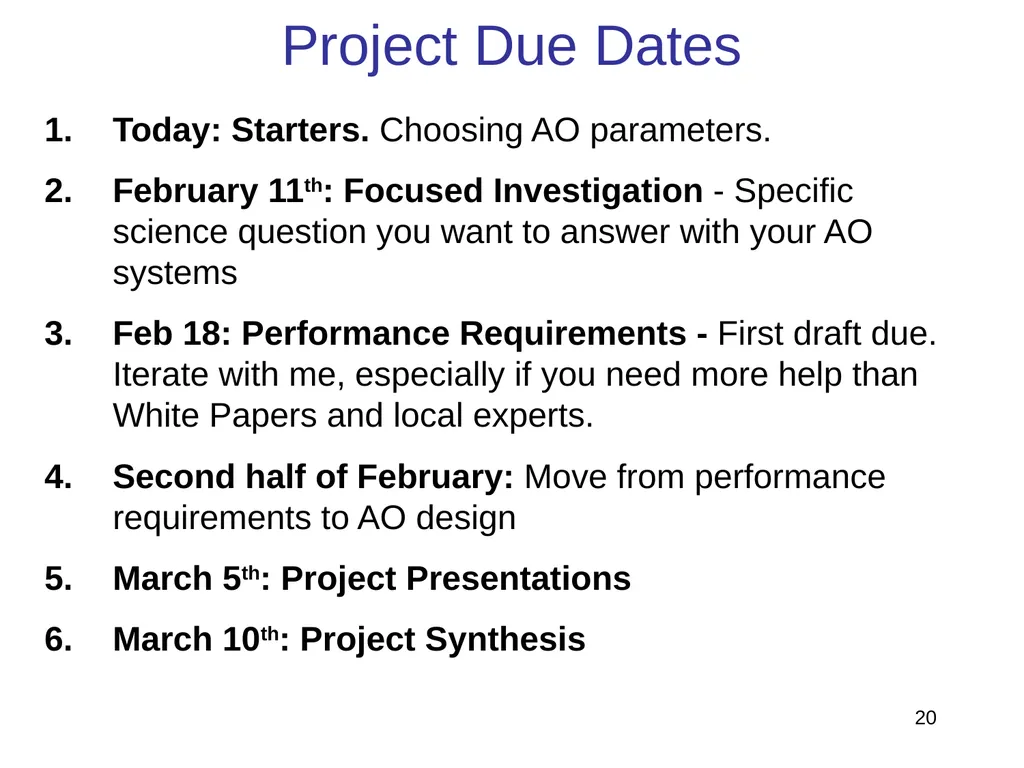
20 Project Due Dates Today: Starters. Choosing AO parameters.
February 11th: Focused Investigation - Specific science question you want to answer with your AO systems
Feb 18: Performance Requirements - First draft due. Iterate with me, especially if you need more help than White Papers and local experts.
Second half of February: Move from performance requirements to AO design
March 5th: Project Presentations
March 10th: Project Synthesis<br>
21
21<br>
22
FYI Project Management Overview<br>
23
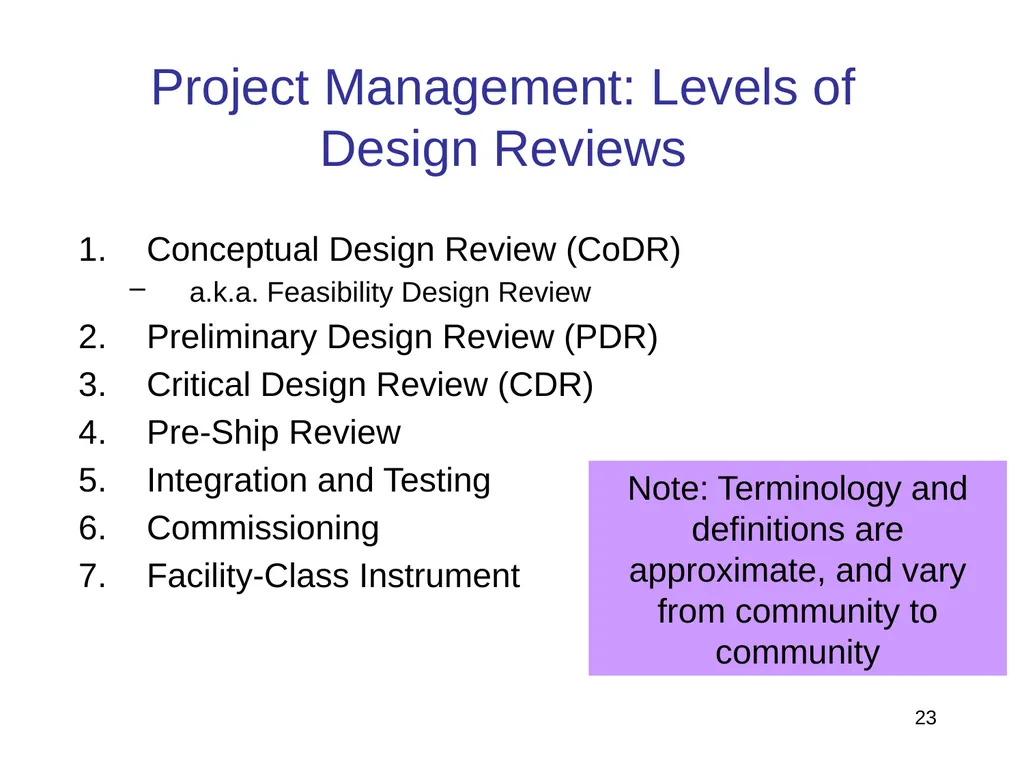
23 Project Management: Levels of Design Reviews Conceptual Design Review (CoDR)
a.k.a. Feasibility Design Review
Preliminary Design Review (PDR)
Critical Design Review (CDR)
Pre-Ship Review
Integration and Testing
Commissioning
Facility-Class Instrument Note: Terminology and definitions are approximate, and vary from community to community<br>
24
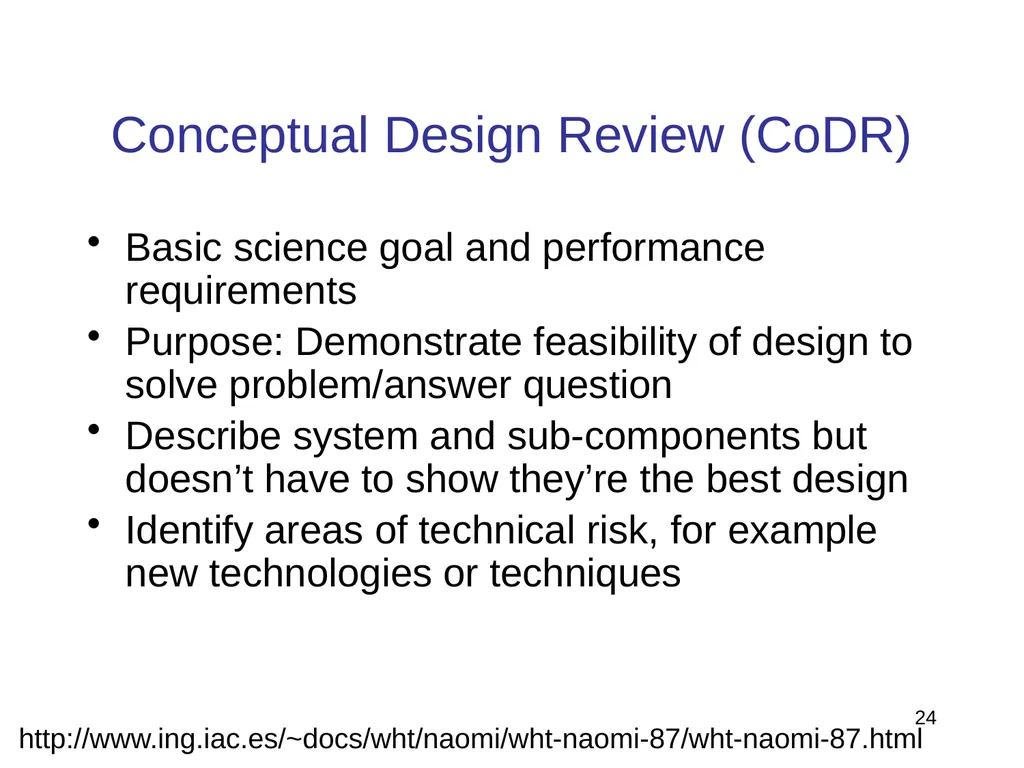
24 Conceptual Design Review (CoDR) Basic science goal and performance requirements
Purpose: Demonstrate feasibility of design to solve problem/answer question
Describe system and sub-components but doesn’t have to show they’re the best design
Identify areas of technical risk, for example new technologies or techniques http://www.ing.iac.es/~docs/wht/naomi/wht-naomi-87/wht-naomi-87.html<br>
25
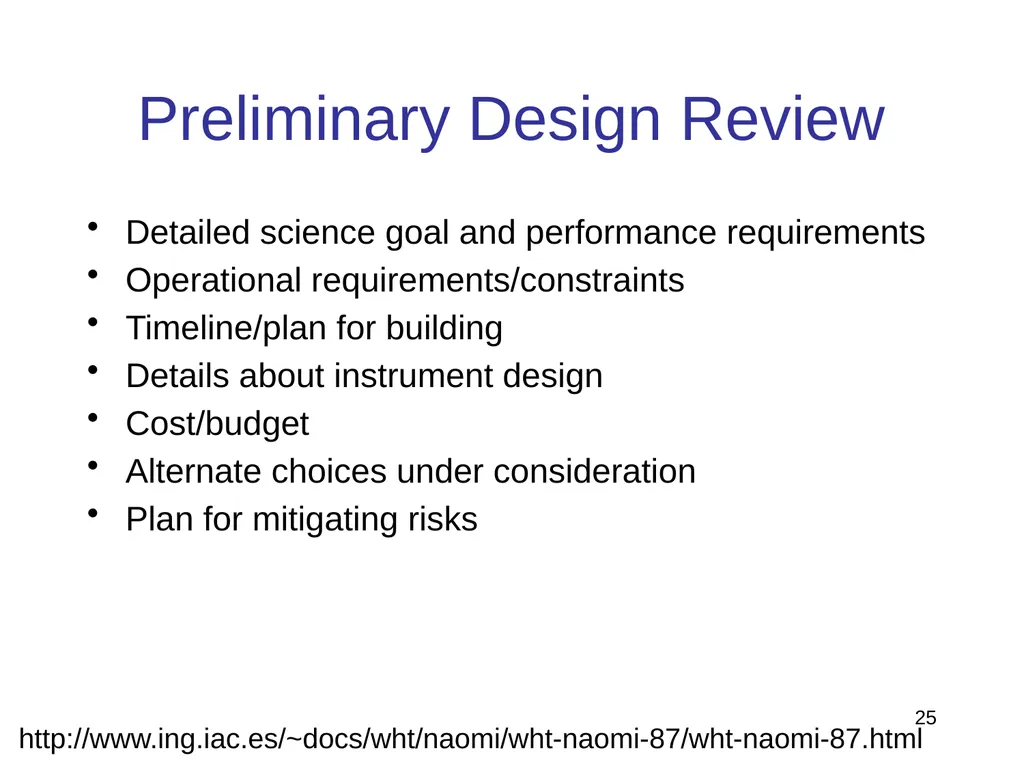
25 Preliminary Design Review Detailed science goal and performance requirements
Operational requirements/constraints
Timeline/plan for building
Details about instrument design
Cost/budget
Alternate choices under consideration
Plan for mitigating risks http://www.ing.iac.es/~docs/wht/naomi/wht-naomi-87/wht-naomi-87.html<br>
26
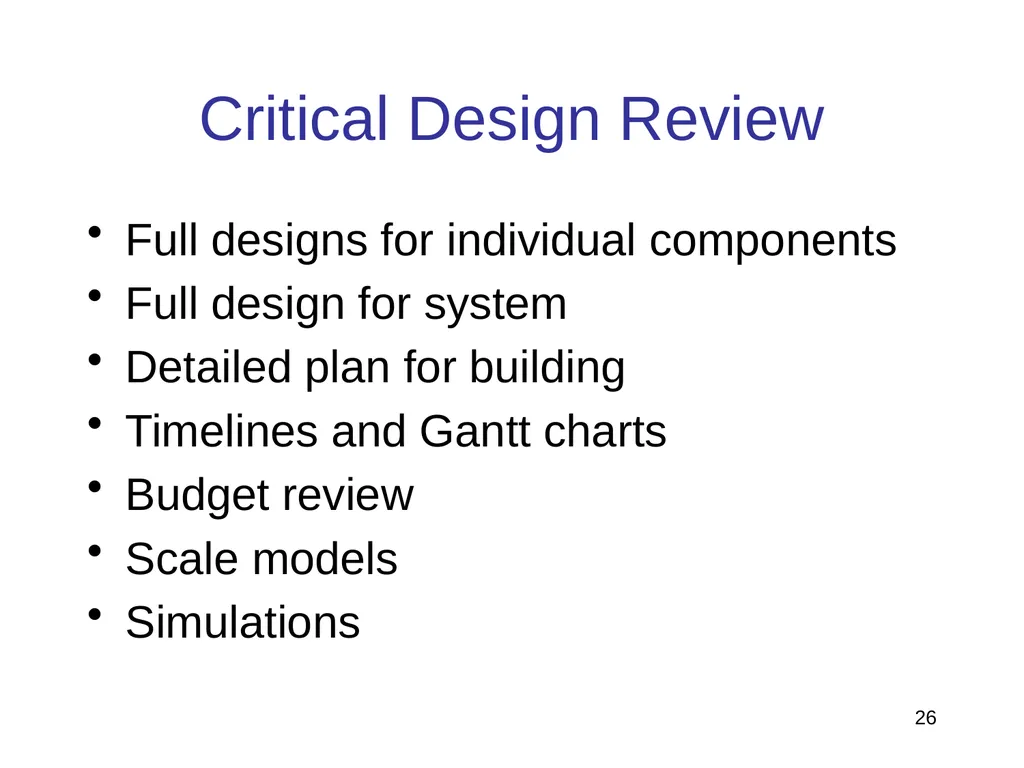
26 Critical Design Review Full designs for individual components
Full design for system
Detailed plan for building
Timelines and Gantt charts
Budget review
Scale models
Simulations<br>
27
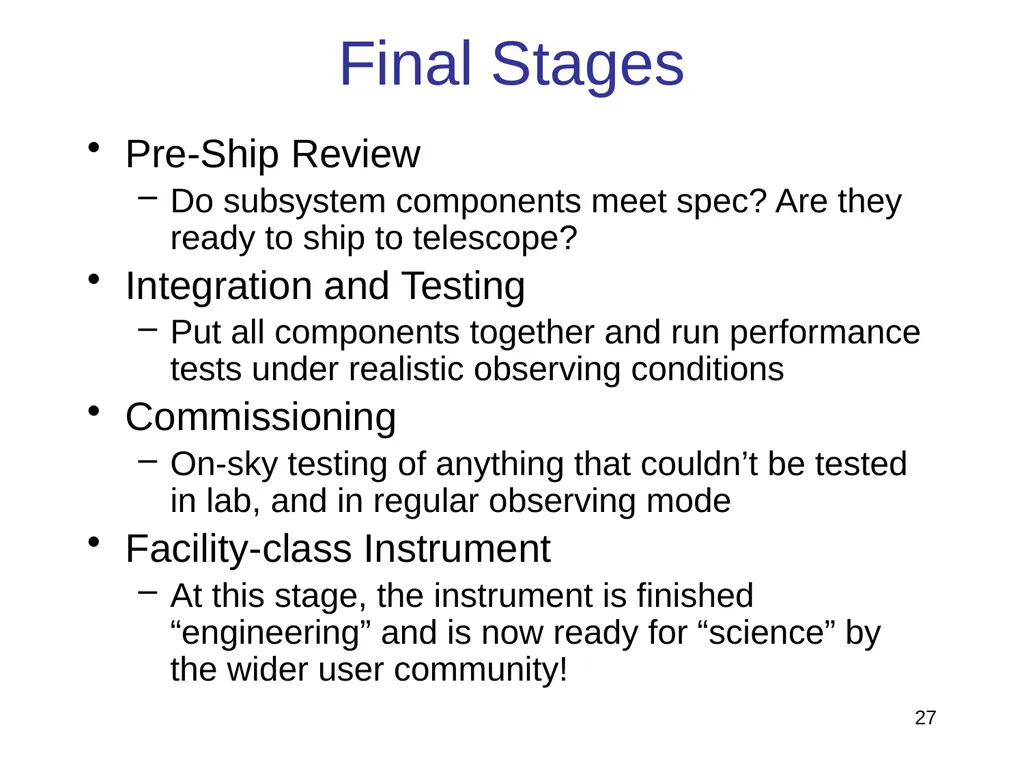
27 Final Stages Pre-Ship Review
Do subsystem components meet spec? Are they ready to ship to telescope?
Integration and Testing
Put all components together and run performance tests under realistic observing conditions
Commissioning
On-sky testing of anything that couldn’t be tested in lab, and in regular observing mode
Facility-class Instrument
At this stage, the instrument is finished “engineering” and is now ready for “science” by the wider user community!<br>