
CLASS-VIII SCIENCE METALS AND NON METALS There are
GB
Published · 31 slides · 0 views

1 / 1



Description
CLASS-VIII SCIENCE METALS AND NON METALS There are about 115 elements known at present. It is difficult to study and describe all the properties of these elements separately. The elements are thus, grouped together on the basis of
Related Topics
Share
Embed code
Download this presentation From Below
"CLASS-VIII SCIENCE METALS AND NON METALS There are" is the property of its rightful owner. Permission is granted to download and print the materials on this website for personal, non-commercial use only, and to display it on your personal computer provided you do not modify the materials and that you retain all copyright notices contained in the materials. By downloading content from our website, you accept the terms of this agreement.
Presentation Transcript
01
CLASS-VIII SCIENCE METALS AND NON METALS<br>
02
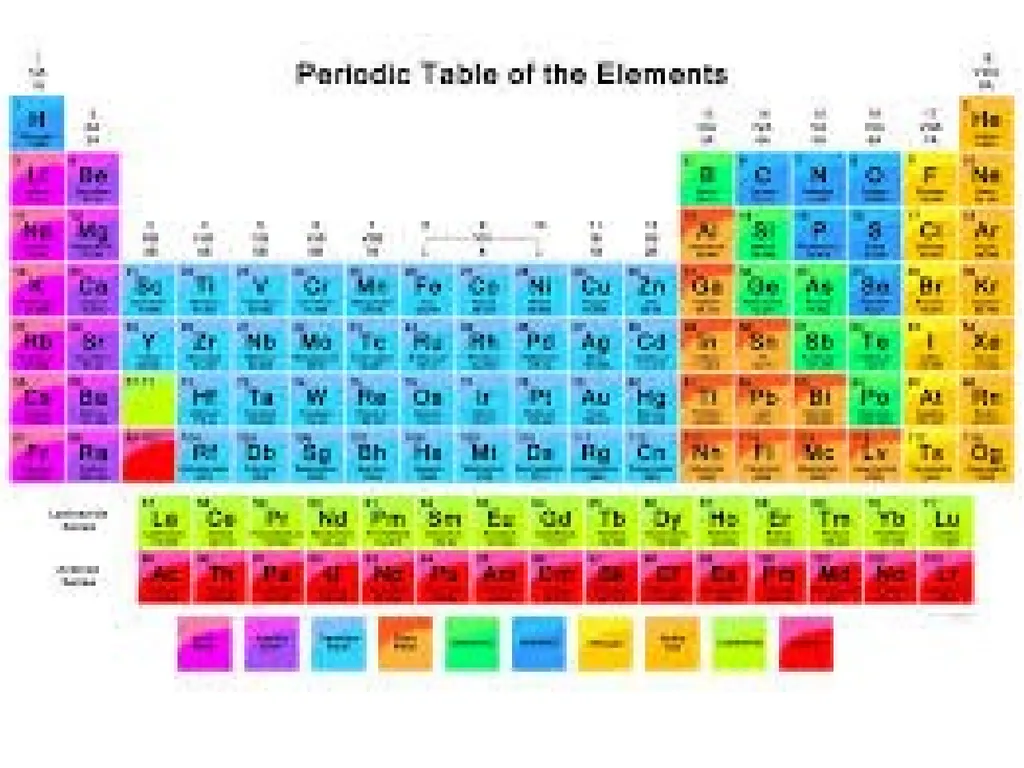
There are about 115 elements known at present. It is difficult to study and describe all the properties of these elements separately. The elements are thus, grouped together on the basis of similarity of properties. They are placed in a periodic table. This is called classification of elements.
Elements are classified into – Metals, Non Metals and Metalloids.
Metals- Those metals which are hard, lustrous, malleable, ductile are called as metals. Metals can loose electrons and are electropositive in nature.
Non metals- Those elements which are brittle, non lustrous, non malleable and non ductile are non metals. Non metals can accept electrons and are electronegative in nature.
Metalloids- A metalloid is a chemical element that exhibits some properties of metals and some of nonmetals. They are the elements with properties intermediate between metals and nonmetals. Boron, silicon, germanium, arsenic, antimony, tellurium, and polonium are metalloids. Classification of elements<br>
03
.<br>
04
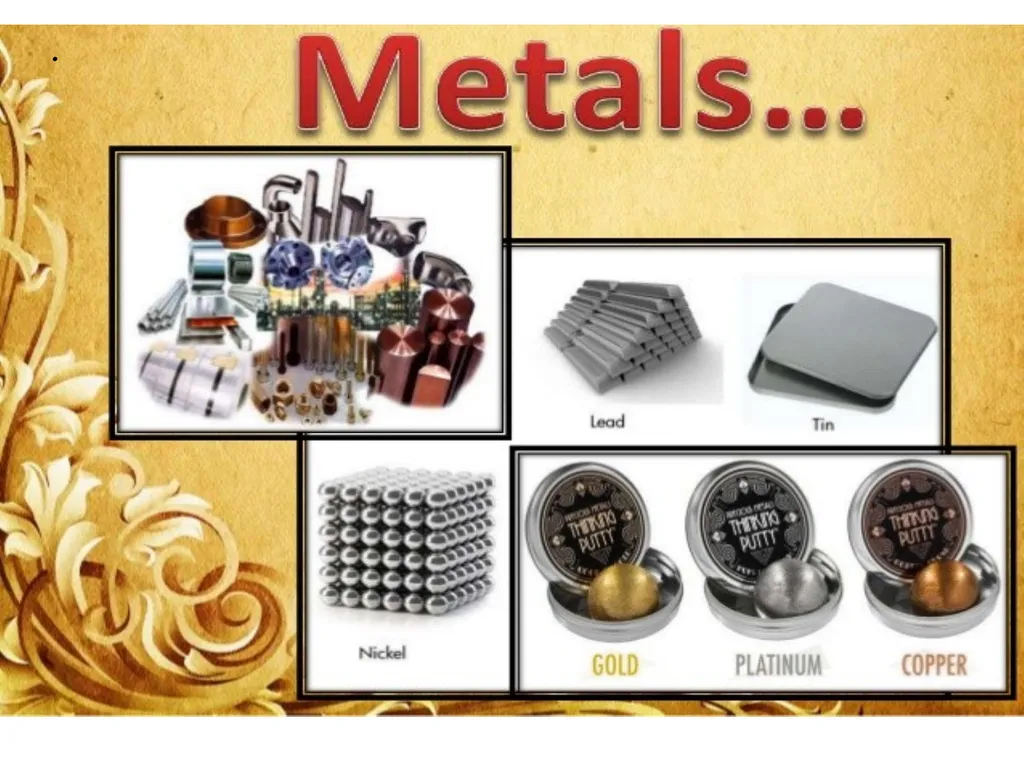
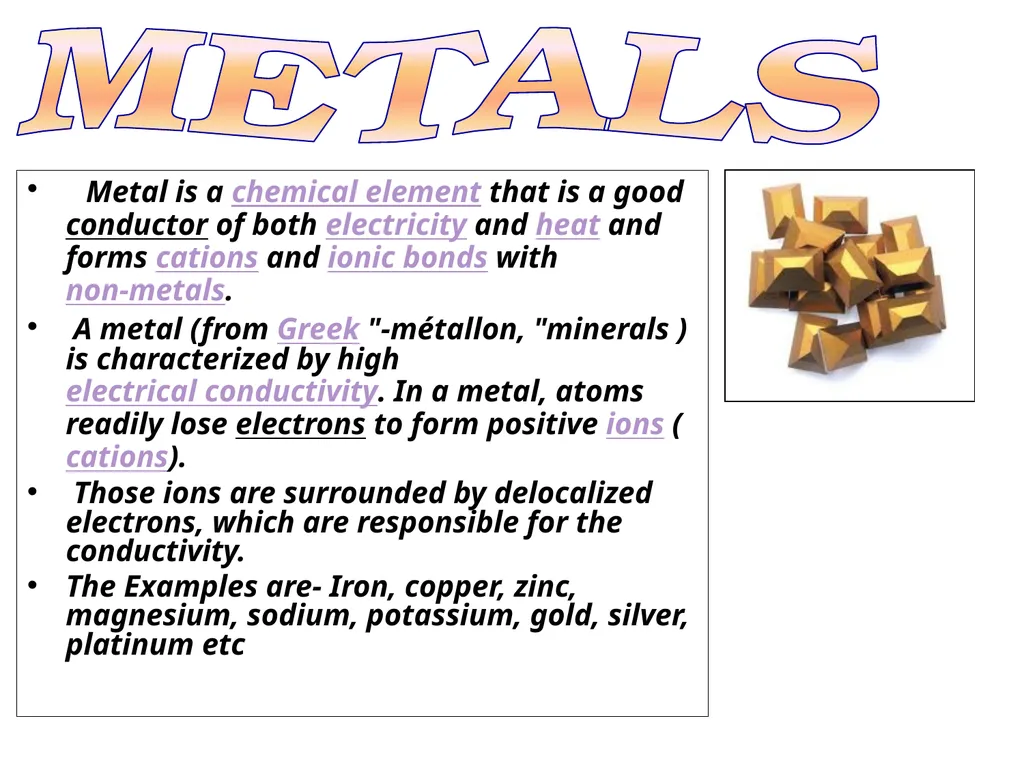
Metal is a chemical element that is a good conductor of both electricity and heat and forms cations and ionic bonds with non-metals.
A metal (from Greek "-métallon, "minerals ) is characterized by high electrical conductivity. In a metal, atoms readily lose electrons to form positive ions (cations).
Those ions are surrounded by delocalized electrons, which are responsible for the conductivity.
The Examples are- Iron, copper, zinc, magnesium, sodium, potassium, gold, silver, platinum etc METALS<br>
05
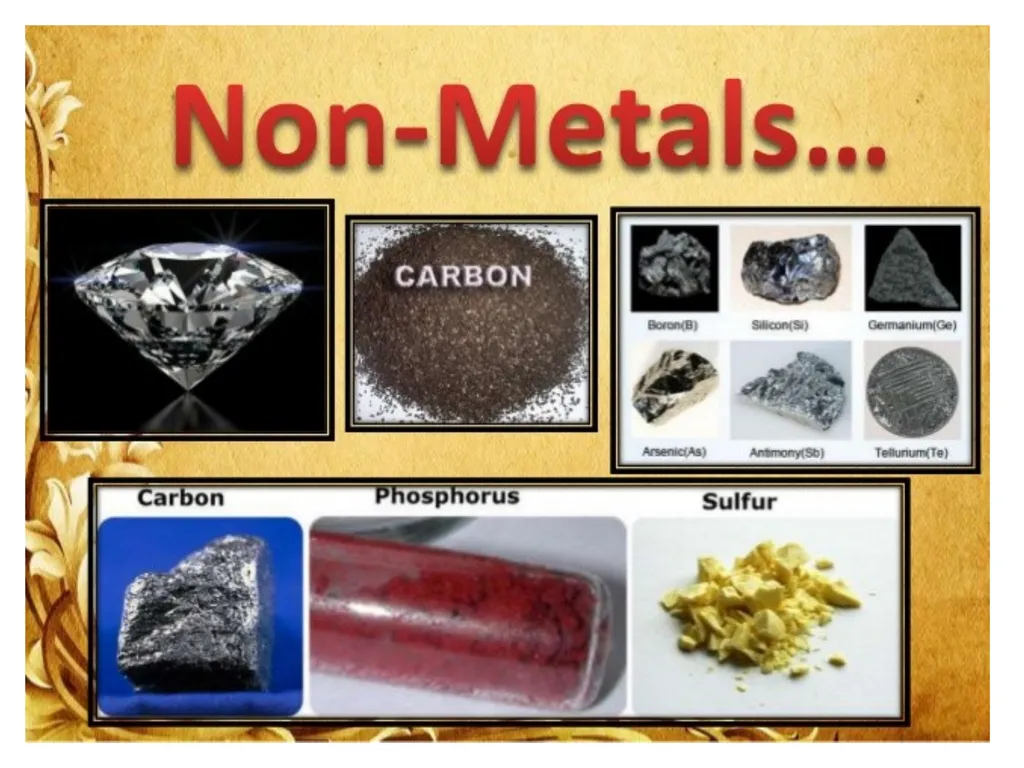
Non metal is a chemical element that bad conductor of both electricity and heat and forms anions and ionic bonds with metals.
Non metals are readily accept electrons to form negatively charged ions ( anions)
The examples of non-metals are sulphur, carbon, oxygen, phosphorus, hydrogen, oxygen, nitrogen etc NON METALS<br>
Non metals are readily accept electrons to form negatively charged ions ( anions)
The examples of non-metals are sulphur, carbon, oxygen, phosphorus, hydrogen, oxygen, nitrogen etc NON METALS<br>
06
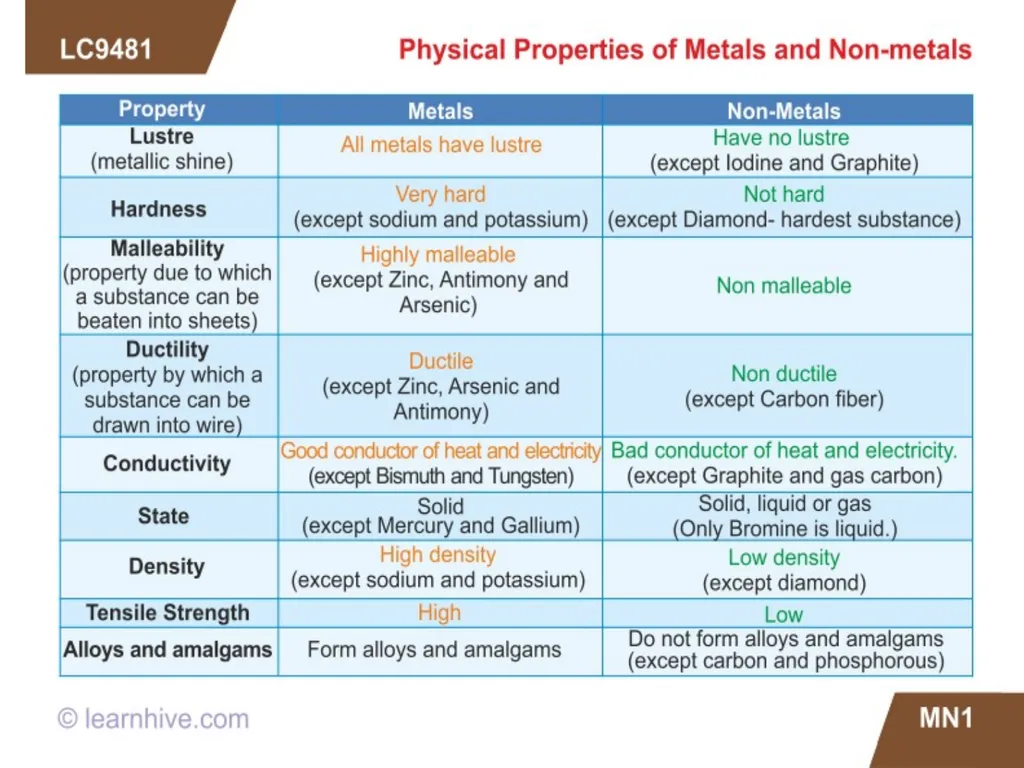
PHYSICAL PROPERTIES - METALS PHYSICAL STATE:- All metals are solid at room temperature except mercury which is liquid.
HARDNESS:- Most metals are very hard. They can withstand the high pressure without getting distorted. But metals such as Sodium and potassium are soft metals and they can be cut by a knife.
DENSITY:- Metals generally have high density than non metals. That is why they are very hard.
TENSILE STRENGTH:- Metals have high tensile strength, ie they can be stretched to some degree without breaking. Metals like tungsten has high tensile strength
LUSTRE:- Metals have a shining surface. This is known as metallic lustre. All metals have metallic lusture. Iodine is the only non-metal which has a lustre.
MALLEABILITY:- The property by which metals can be beaten into thin sheets is called malleability. Metals are highly malleable and the can be beaten into thin sheets. Ex- Aluminium foil used to pack food items, Silver and gold foils are used on sweets<br>
07
PHYSICAL PROPERTIES - METALS DUCTILITY:- The property by which metals can be drawn into thin duct/wires is called ductility. Metals are highly ductile and the can be drawn into thin wires. Ex- Copper wires, Nichrome wires are used to coduct electricity
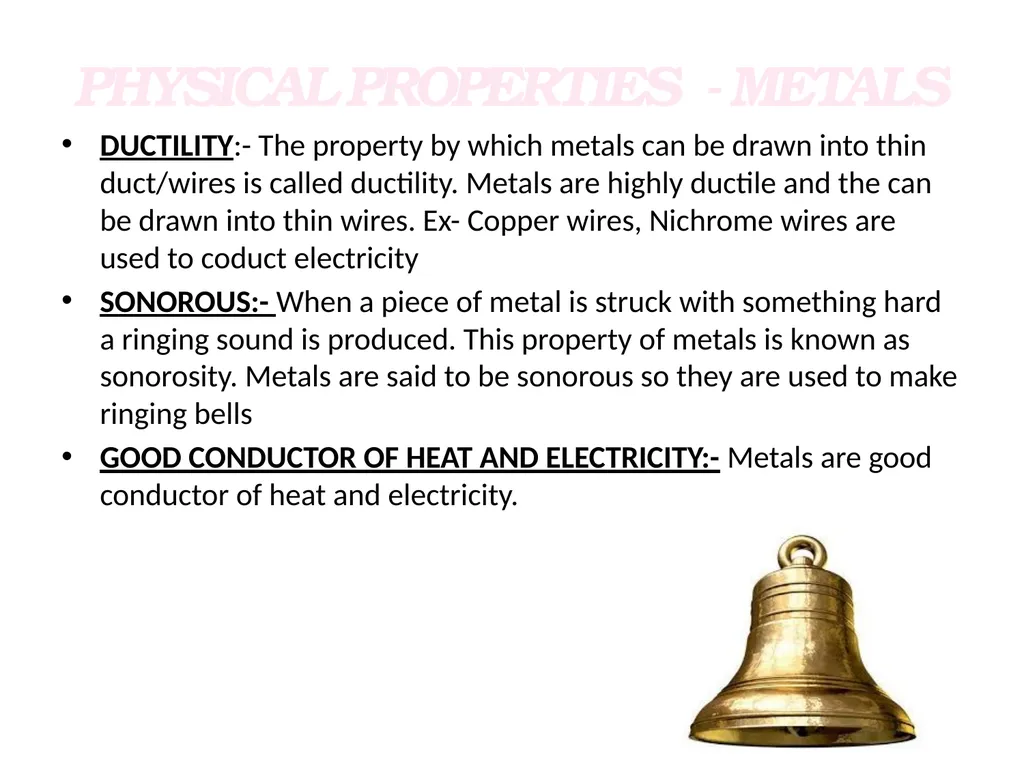
SONOROUS:- When a piece of metal is struck with something hard a ringing sound is produced. This property of metals is known as sonorosity. Metals are said to be sonorous so they are used to make ringing bells
GOOD CONDUCTOR OF HEAT AND ELECTRICITY:- Metals are good conductor of heat and electricity.<br>
08
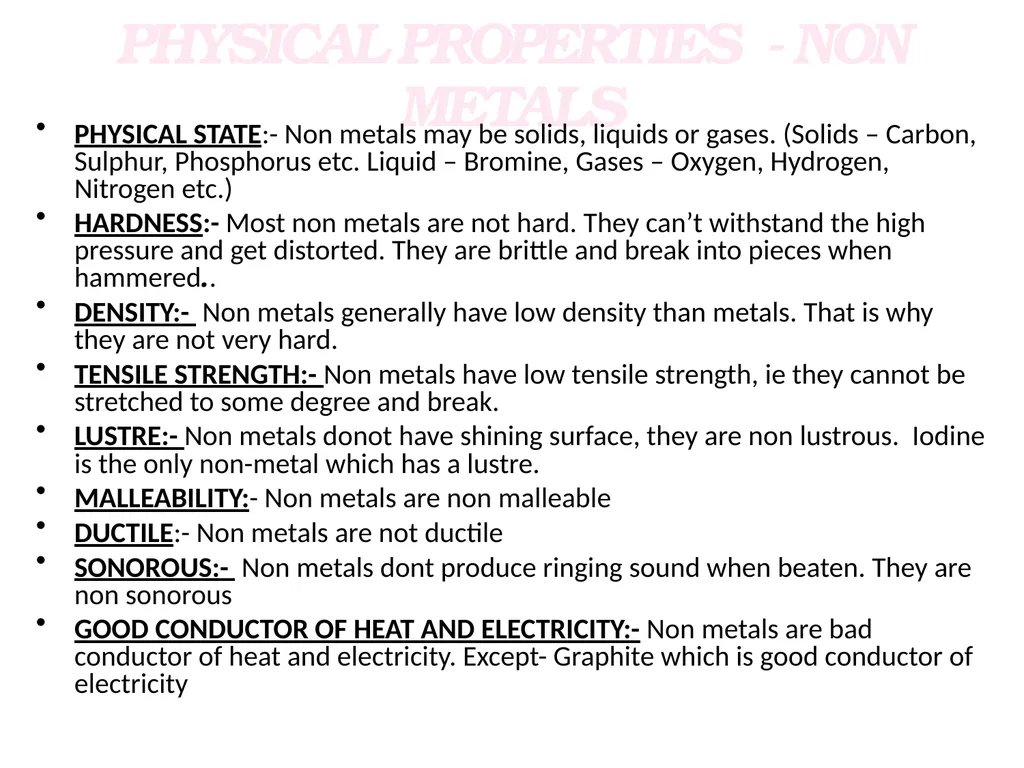
PHYSICAL PROPERTIES - NON METALS PHYSICAL STATE:- Non metals may be solids, liquids or gases. (Solids – Carbon, Sulphur, Phosphorus etc. Liquid – Bromine, Gases – Oxygen, Hydrogen, Nitrogen etc.)
HARDNESS:- Most non metals are not hard. They can’t withstand the high pressure and get distorted. They are brittle and break into pieces when hammered..
DENSITY:- Non metals generally have low density than metals. That is why they are not very hard.
TENSILE STRENGTH:- Non metals have low tensile strength, ie they cannot be stretched to some degree and break.
LUSTRE:- Non metals donot have shining surface, they are non lustrous. Iodine is the only non-metal which has a lustre.
MALLEABILITY:- Non metals are non malleable
DUCTILE:- Non metals are not ductile
SONOROUS:- Non metals dont produce ringing sound when beaten. They are non sonorous
GOOD CONDUCTOR OF HEAT AND ELECTRICITY:- Non metals are bad conductor of heat and electricity. Except- Graphite which is good conductor of electricity<br>
09
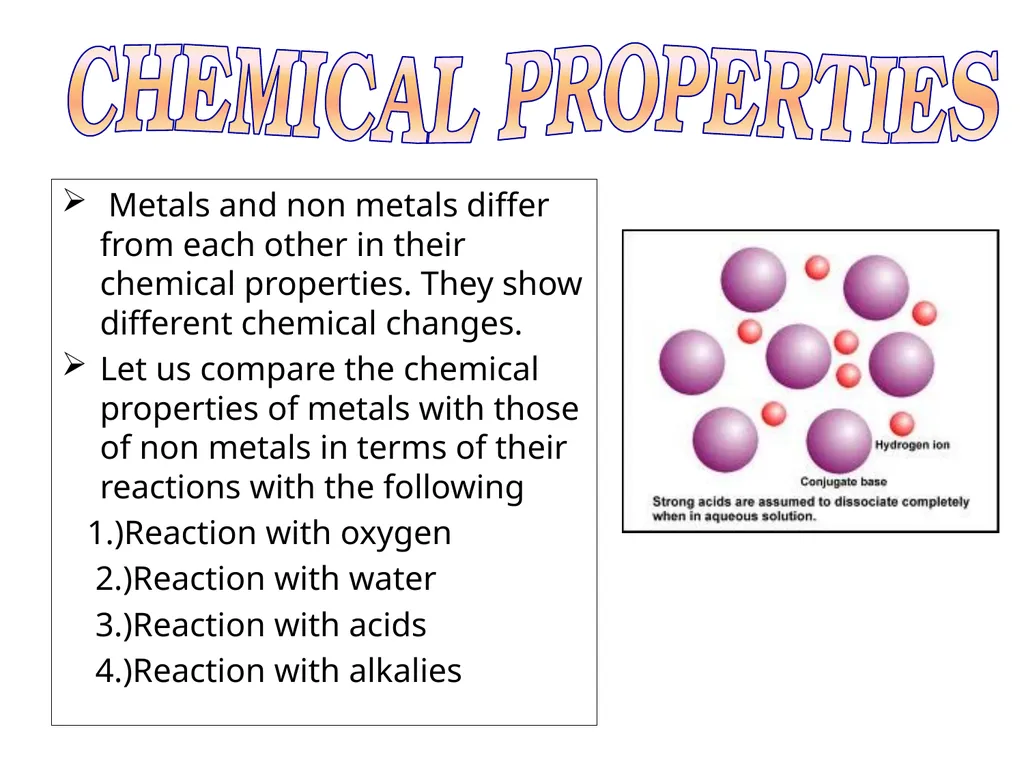
Metals and non metals differ from each other in their chemical properties. They show different chemical changes.
Let us compare the chemical properties of metals with those of non metals in terms of their reactions with the following
1.)Reaction with oxygen
2.)Reaction with water
3.)Reaction with acids
4.)Reaction with alkalies CHEMICAL PROPERTIES<br>
Let us compare the chemical properties of metals with those of non metals in terms of their reactions with the following
1.)Reaction with oxygen
2.)Reaction with water
3.)Reaction with acids
4.)Reaction with alkalies CHEMICAL PROPERTIES<br>
10
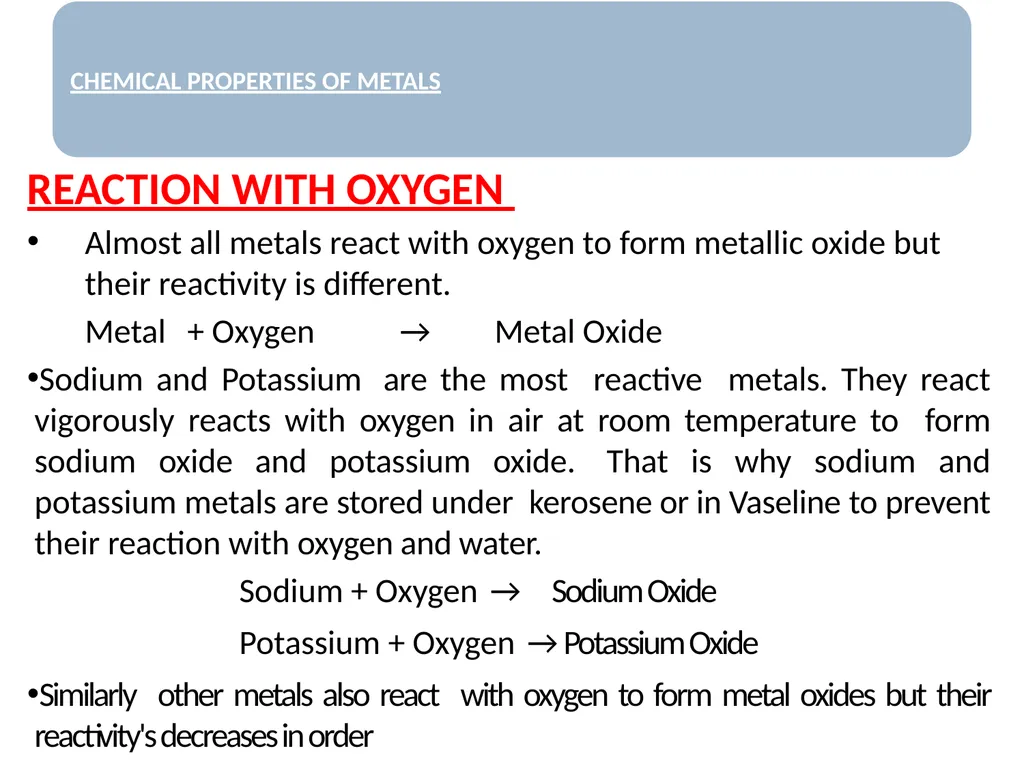
REACTION WITH OXYGEN
Almost all metals react with oxygen to form metallic oxide but their reactivity is different.
Metal + Oxygen → Metal Oxide
Sodium and Potassium are the most reactive metals. They react vigorously reacts with oxygen in air at room temperature to form sodium oxide and potassium oxide. That is why sodium and potassium metals are stored under kerosene or in Vaseline to prevent their reaction with oxygen and water.
Sodium + Oxygen → Sodium Oxide
Potassium + Oxygen → Potassium Oxide
Similarly other metals also react with oxygen to form metal oxides but their reactivity's decreases in order<br>
11
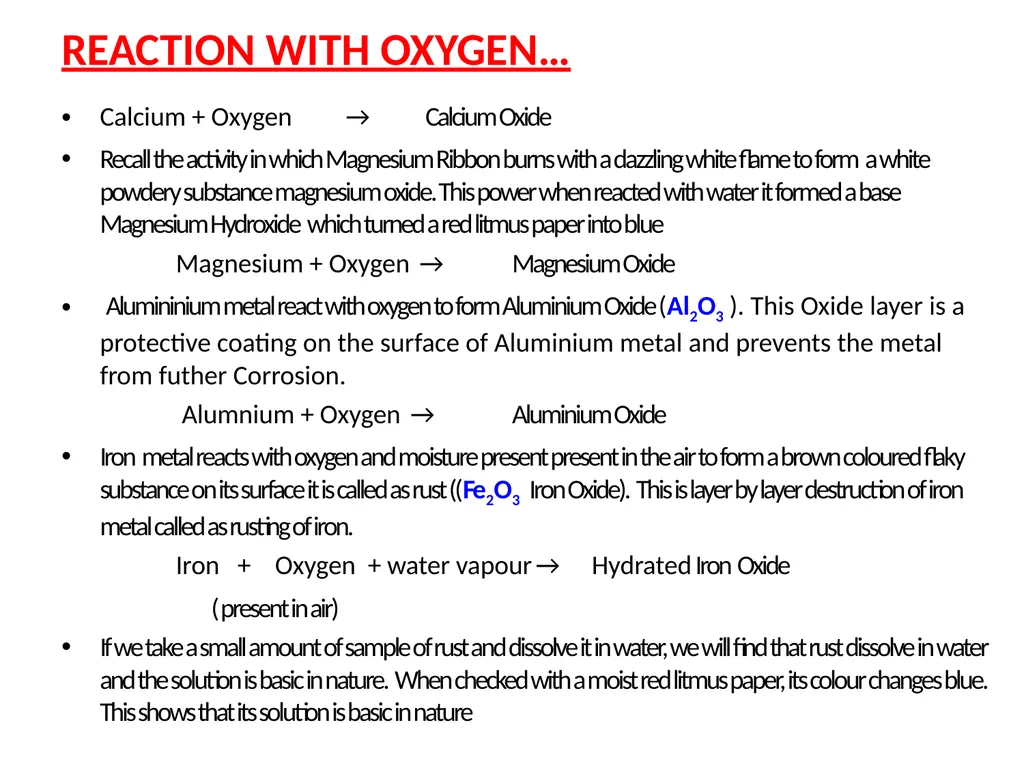
REACTION WITH OXYGEN… Calcium + Oxygen → Calcium Oxide
Recall the activity in which Magnesium Ribbon burns with a dazzling white flame to form a white powdery substance magnesium oxide. This power when reacted with water it formed a base Magnesium Hydroxide which turned a red litmus paper into blue
Magnesium + Oxygen → Magnesium Oxide
Alumininium metal react with oxygen to form Aluminium Oxide (Al2O3 ). This Oxide layer is a protective coating on the surface of Aluminium metal and prevents the metal from futher Corrosion.
Alumnium + Oxygen → Aluminium Oxide
Iron metal reacts with oxygen and moisture present present in the air to form a brown coloured flaky substance on its surface it is called as rust ((Fe2O3 Iron Oxide). This is layer by layer destruction of iron metal called as rusting of iron.
Iron + Oxygen + water vapour → Hydrated Iron Oxide
( present in air)
If we take a small amount of sample of rust and dissolve it in water, we will find that rust dissolve in water and the solution is basic in nature. When checked with a moist red litmus paper, its colour changes blue. This shows that its solution is basic in nature<br>
12
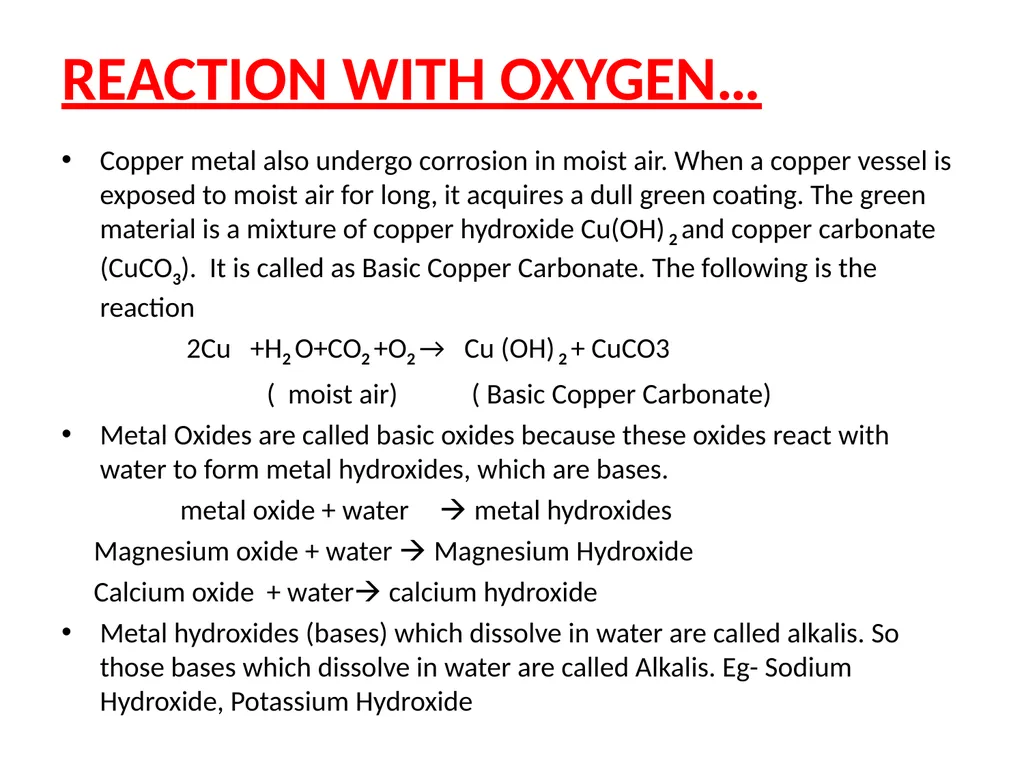
REACTION WITH OXYGEN… Copper metal also undergo corrosion in moist air. When a copper vessel is exposed to moist air for long, it acquires a dull green coating. The green material is a mixture of copper hydroxide Cu(OH) 2 and copper carbonate (CuCO3). It is called as Basic Copper Carbonate. The following is the reaction
2Cu +H2 O+CO2 +O2 → Cu (OH) 2 + CuCO3
( moist air) ( Basic Copper Carbonate)
Metal Oxides are called basic oxides because these oxides react with water to form metal hydroxides, which are bases.
metal oxide + water metal hydroxides
Magnesium oxide + water Magnesium Hydroxide
Calcium oxide + water calcium hydroxide
Metal hydroxides (bases) which dissolve in water are called alkalis. So those bases which dissolve in water are called Alkalis. Eg- Sodium Hydroxide, Potassium Hydroxide<br>
13
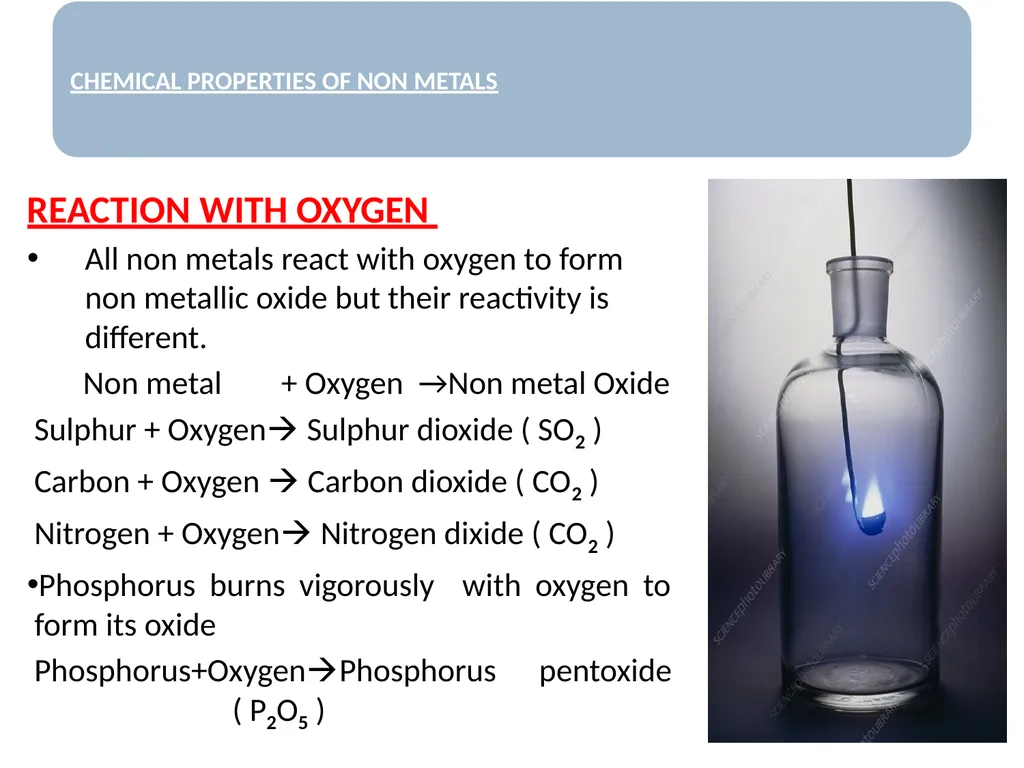
REACTION WITH OXYGEN
All non metals react with oxygen to form non metallic oxide but their reactivity is different.
Non metal + Oxygen →Non metal Oxide
Sulphur + Oxygen Sulphur dioxide ( SO2 )
Carbon + Oxygen Carbon dioxide ( CO2 )
Nitrogen + Oxygen Nitrogen dixide ( CO2 )
Phosphorus burns vigorously with oxygen to form its oxide
Phosphorus+OxygenPhosphorus pentoxide ( P2O5 )<br>
14
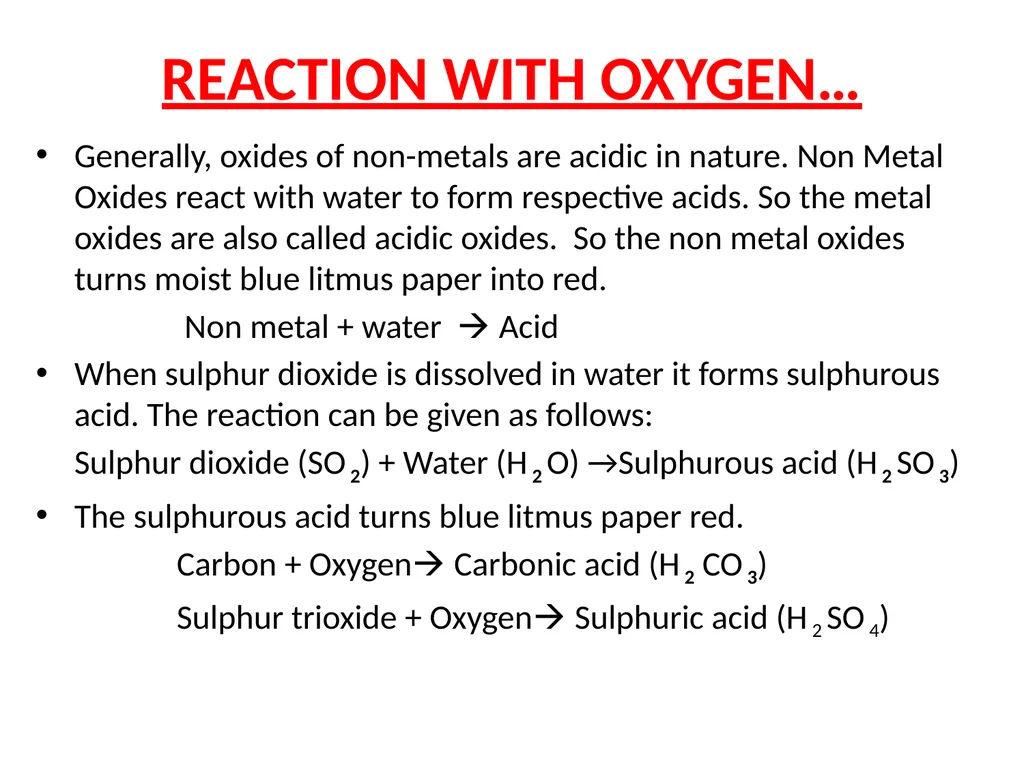
REACTION WITH OXYGEN… Generally, oxides of non-metals are acidic in nature. Non Metal Oxides react with water to form respective acids. So the metal oxides are also called acidic oxides. So the non metal oxides turns moist blue litmus paper into red.
Non metal + water Acid
When sulphur dioxide is dissolved in water it forms sulphurous acid. The reaction can be given as follows:
Sulphur dioxide (SO 2) + Water (H 2 O) →Sulphurous acid (H 2 SO 3)
The sulphurous acid turns blue litmus paper red.
Carbon + Oxygen Carbonic acid (H 2 CO 3)
Sulphur trioxide + Oxygen Sulphuric acid (H 2 SO 4)<br>
15
REACTION OF METALS WITH WATER REACTION OF METALS WITH WATER
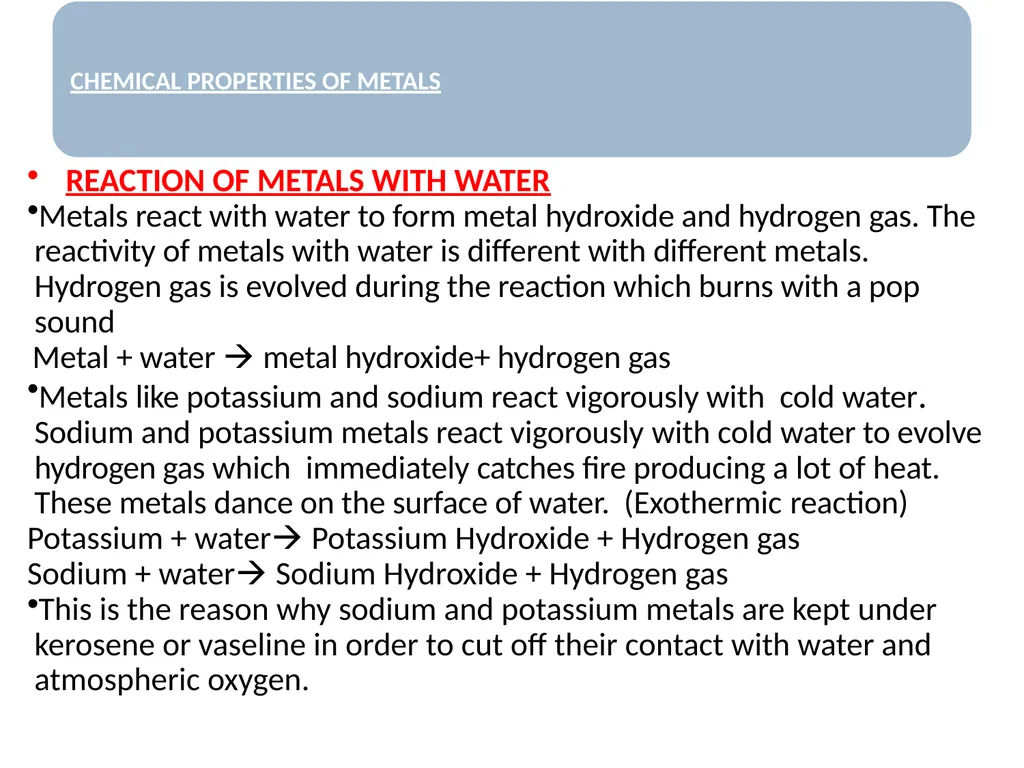
Metals react with water to form metal hydroxide and hydrogen gas. The reactivity of metals with water is different with different metals. Hydrogen gas is evolved during the reaction which burns with a pop sound
Metal + water metal hydroxide+ hydrogen gas
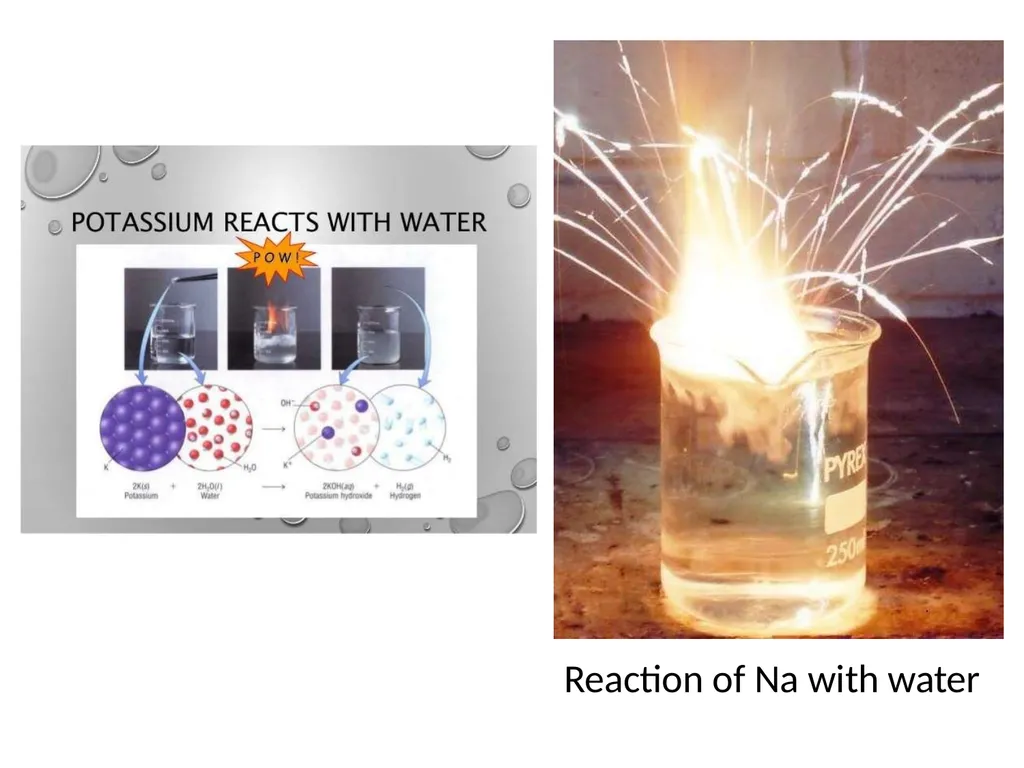
Metals like potassium and sodium react vigorously with cold water. Sodium and potassium metals react vigorously with cold water to evolve hydrogen gas which immediately catches fire producing a lot of heat. These metals dance on the surface of water. (Exothermic reaction)
Potassium + water Potassium Hydroxide + Hydrogen gas
Sodium + water Sodium Hydroxide + Hydrogen gas
This is the reason why sodium and potassium metals are kept under kerosene or vaseline in order to cut off their contact with water and atmospheric oxygen.<br>
16
Reaction of Na with water<br>
17
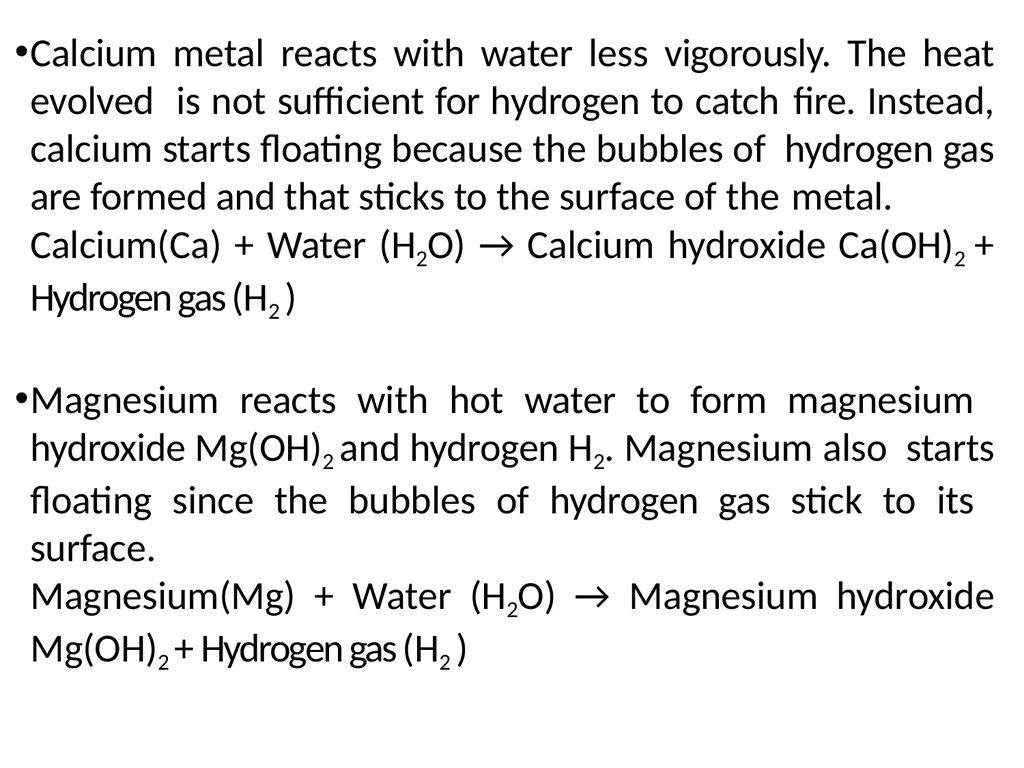
Calcium metal reacts with water less vigorously. The heat evolved is not sufficient for hydrogen to catch fire. Instead, calcium starts floating because the bubbles of hydrogen gas are formed and that sticks to the surface of the metal.
Calcium(Ca) + Water (H2O) → Calcium hydroxide Ca(OH)2 + Hydrogen gas (H2 )
Magnesium reacts with hot water to form magnesium hydroxide Mg(OH)2 and hydrogen H2. Magnesium also starts floating since the bubbles of hydrogen gas stick to its surface.
Magnesium(Mg) + Water (H2O) → Magnesium hydroxide Mg(OH)2 + Hydrogen gas (H2 )<br>
18
Iron and Aluminium do not react with cold water and boiling water. They react with Steam to form metal oxides.
Iron + water Iron oxide(Fe3O4) + Hydrogen gas
Aluminium + water Aluminium oxide(Al2O3) + Hydrogen gas
Metals like gold, silver, and copper do not react with water at all<br>
Iron + water Iron oxide(Fe3O4) + Hydrogen gas
Aluminium + water Aluminium oxide(Al2O3) + Hydrogen gas
Metals like gold, silver, and copper do not react with water at all<br>
19
REACTION OF METALS WITH WATER REACTION OF NON METALS WITH WATER
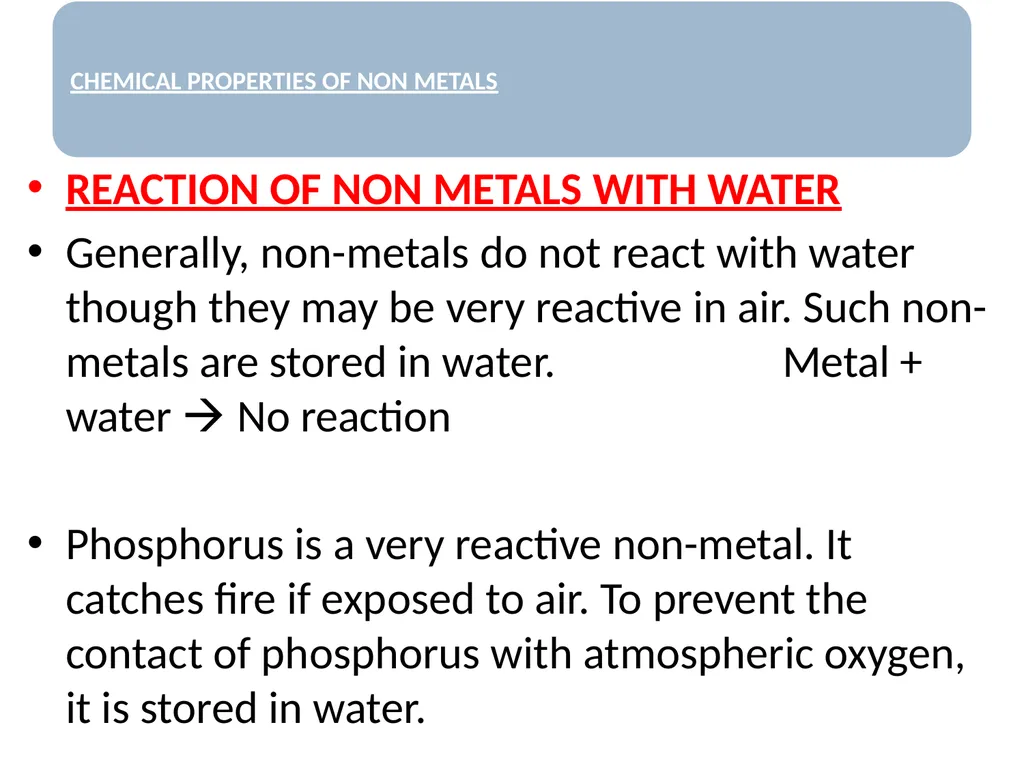
Generally, non-metals do not react with water though they may be very reactive in air. Such non-metals are stored in water. Metal + water No reaction
Phosphorus is a very reactive non-metal. It catches fire if exposed to air. To prevent the contact of phosphorus with atmospheric oxygen, it is stored in water.<br>
20
REACTION OF METALS WITH WATER REACTION OF METALS WITH ACIDS
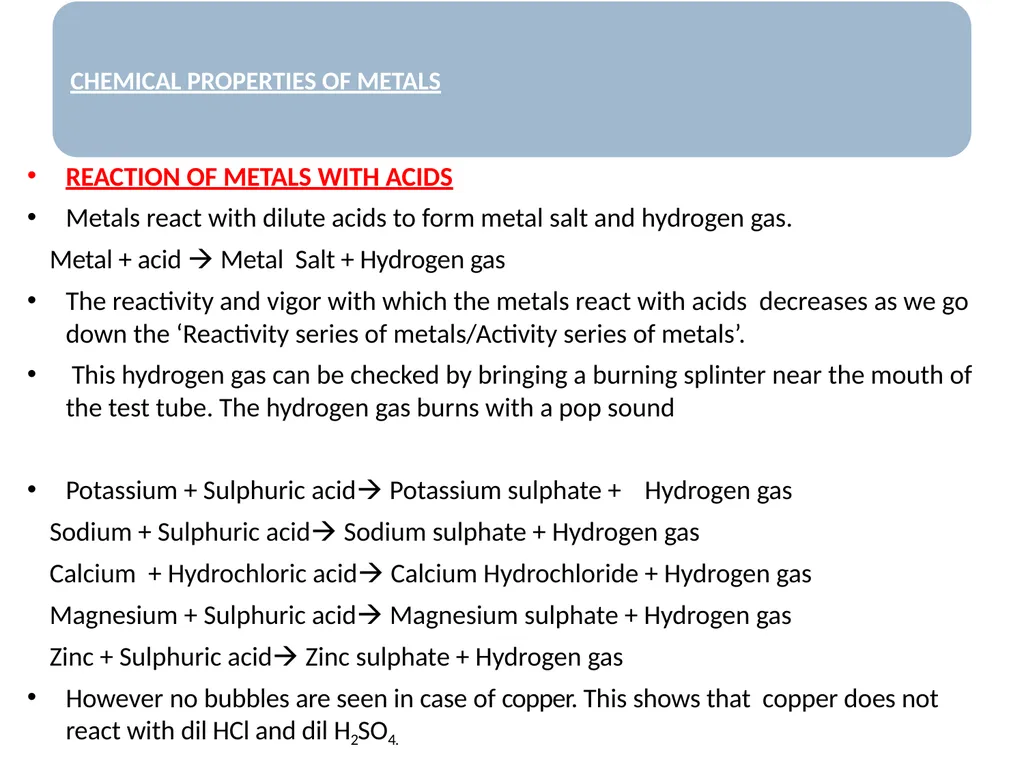
Metals react with dilute acids to form metal salt and hydrogen gas.
Metal + acid Metal Salt + Hydrogen gas
The reactivity and vigor with which the metals react with acids decreases as we go down the ‘Reactivity series of metals/Activity series of metals’.
This hydrogen gas can be checked by bringing a burning splinter near the mouth of the test tube. The hydrogen gas burns with a pop sound
Potassium + Sulphuric acid Potassium sulphate + Hydrogen gas
Sodium + Sulphuric acid Sodium sulphate + Hydrogen gas
Calcium + Hydrochloric acid Calcium Hydrochloride + Hydrogen gas
Magnesium + Sulphuric acid Magnesium sulphate + Hydrogen gas
Zinc + Sulphuric acid Zinc sulphate + Hydrogen gas
However no bubbles are seen in case of copper. This shows that copper does not react with dil HCl and dil H2SO4.<br>
21
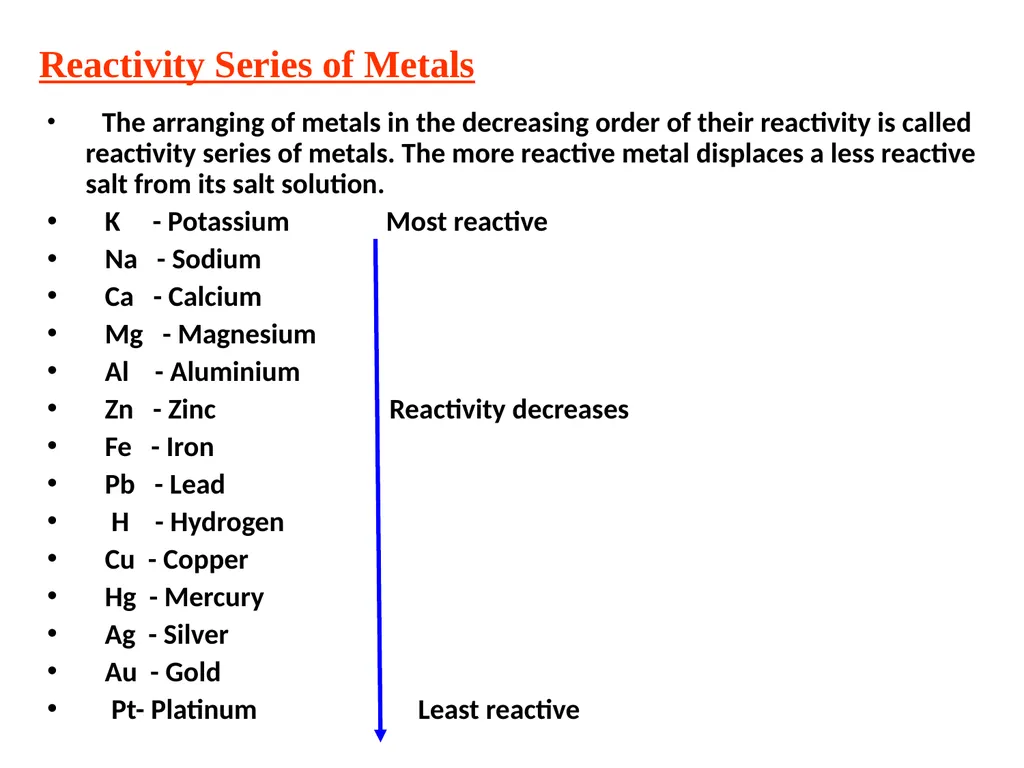
Reactivity Series of Metals The arranging of metals in the decreasing order of their reactivity is called reactivity series of metals. The more reactive metal displaces a less reactive salt from its salt solution.
K - Potassium Most reactive
Na - Sodium
Ca - Calcium
Mg - Magnesium
Al - Aluminium
Zn - Zinc Reactivity decreases
Fe - Iron
Pb - Lead
H - Hydrogen
Cu - Copper
Hg - Mercury
Ag - Silver
Au - Gold
Pt- Platinum Least reactive<br>
K - Potassium Most reactive
Na - Sodium
Ca - Calcium
Mg - Magnesium
Al - Aluminium
Zn - Zinc Reactivity decreases
Fe - Iron
Pb - Lead
H - Hydrogen
Cu - Copper
Hg - Mercury
Ag - Silver
Au - Gold
Pt- Platinum Least reactive<br>
22
REACTION OF METALS WITH WATER REACTION OF METALS WITH BASES
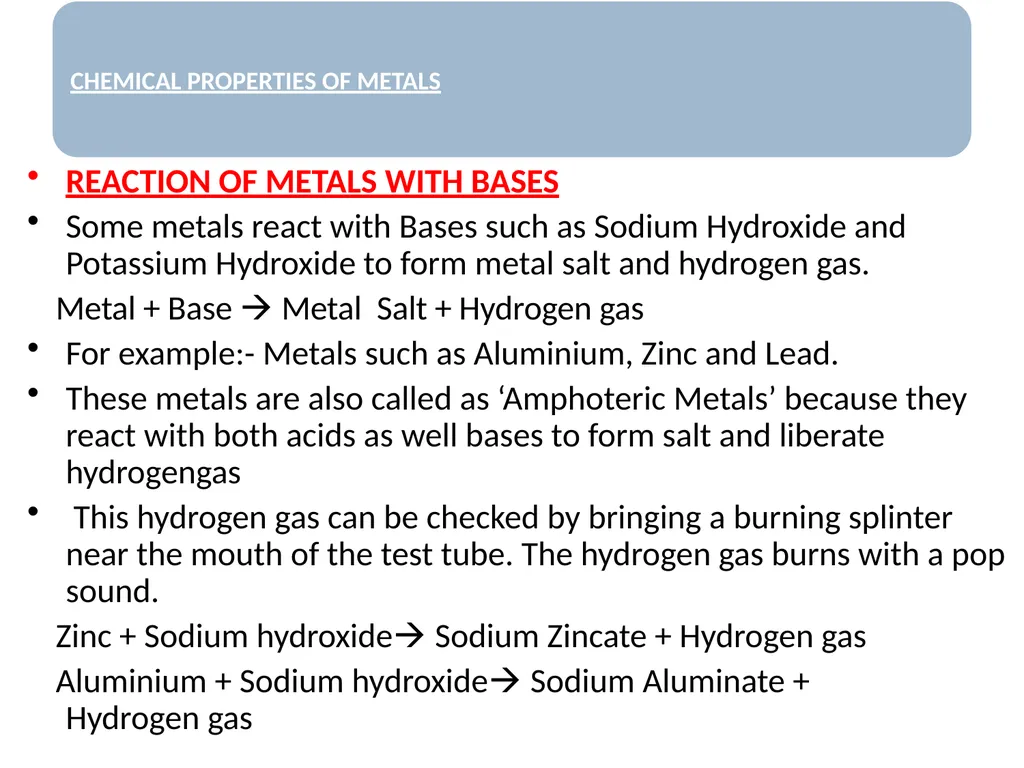
Some metals react with Bases such as Sodium Hydroxide and Potassium Hydroxide to form metal salt and hydrogen gas.
Metal + Base Metal Salt + Hydrogen gas
For example:- Metals such as Aluminium, Zinc and Lead.
These metals are also called as ‘Amphoteric Metals’ because they react with both acids as well bases to form salt and liberate hydrogengas
This hydrogen gas can be checked by bringing a burning splinter near the mouth of the test tube. The hydrogen gas burns with a pop sound.
Zinc + Sodium hydroxide Sodium Zincate + Hydrogen gas
Aluminium + Sodium hydroxide Sodium Aluminate + Hydrogen gas<br>
23
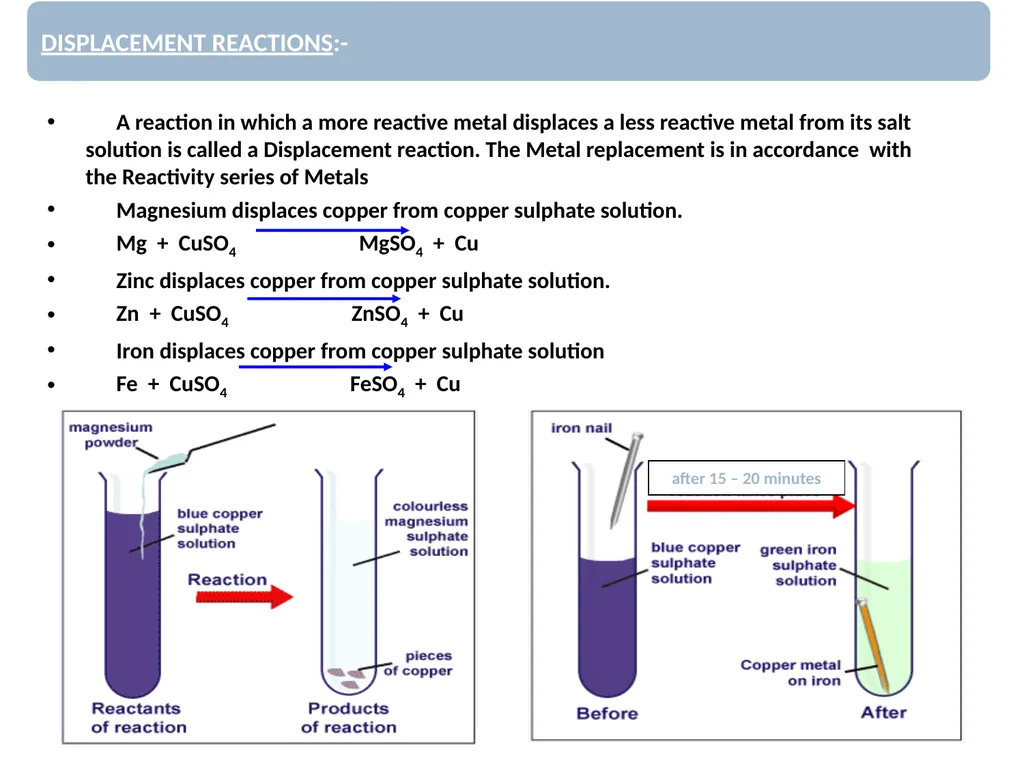
A reaction in which a more reactive metal displaces a less reactive metal from its salt solution is called a Displacement reaction. The Metal replacement is in accordance with the Reactivity series of Metals
Magnesium displaces copper from copper sulphate solution.
Mg + CuSO4 MgSO4 + Cu
Zinc displaces copper from copper sulphate solution.
Zn + CuSO4 ZnSO4 + Cu
Iron displaces copper from copper sulphate solution
Fe + CuSO4 FeSO4 + Cu after 15 – 20 minutes<br>
Magnesium displaces copper from copper sulphate solution.
Mg + CuSO4 MgSO4 + Cu
Zinc displaces copper from copper sulphate solution.
Zn + CuSO4 ZnSO4 + Cu
Iron displaces copper from copper sulphate solution
Fe + CuSO4 FeSO4 + Cu after 15 – 20 minutes<br>
24
DISPLACEMENT REACTION…
Put an iron nail in the solution of coppersulphate
Fe(s) + CuSO4(aq) → Cu(s) + FeSO4(aq)
What we see….
The iron nail gets coated with a reddish brown colour copper and the blue colour of copper sulphate solution fades out
In this reaction more reactive iron has displaced copper which is less reactive from the copper sulphate solution<br>
25
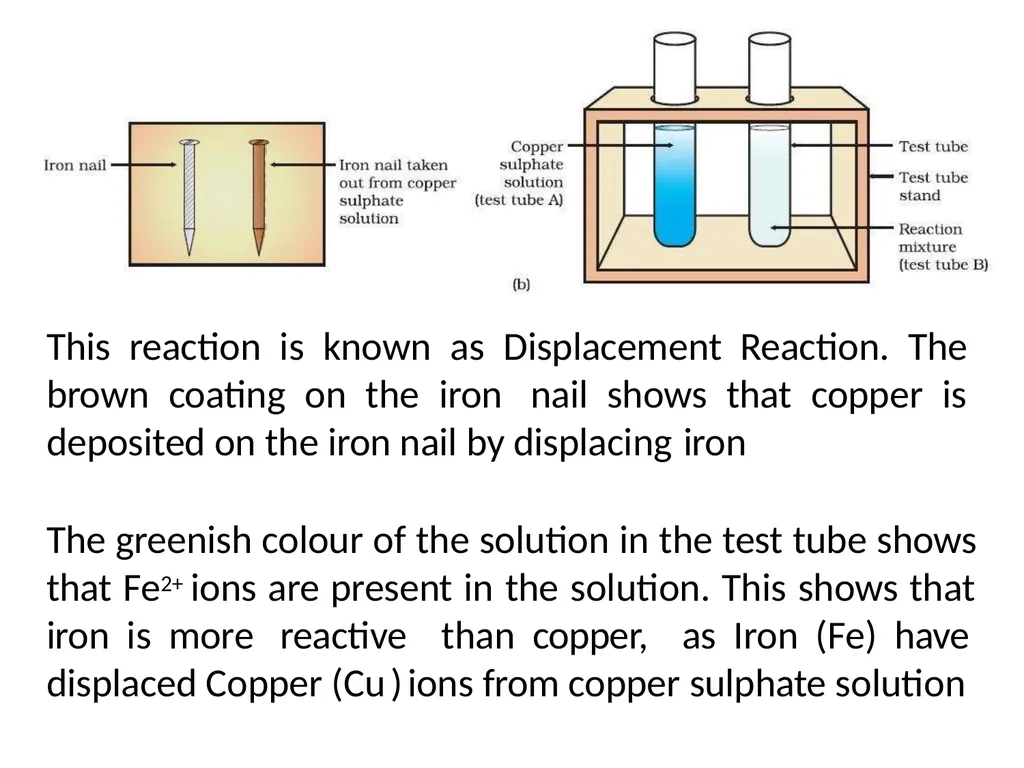
This reaction is known as Displacement Reaction. The brown coating on the iron nail shows that copper is deposited on the iron nail by displacing iron
The greenish colour of the solution in the test tube shows that Fe2+ ions are present in the solution. This shows that iron is more reactive than copper, as Iron (Fe) have displaced Copper (Cu ) ions from copper sulphate solution<br>
The greenish colour of the solution in the test tube shows that Fe2+ ions are present in the solution. This shows that iron is more reactive than copper, as Iron (Fe) have displaced Copper (Cu ) ions from copper sulphate solution<br>
26
Metals have been an integral part of our daily life since ancient times. They have played an important part in the development of various civilisations.
Iron is the most widely used metal. It is used for making cooking vessels, water boilers, builing bridges, railways etc.
Aluminium being a very light metal. It used for making aircraft bodies , used to make aluminium foils.
Copper is used to make electric conduction wires
Mercury is used in Thermometers
Tungsten is used to make filament in electric bulbs
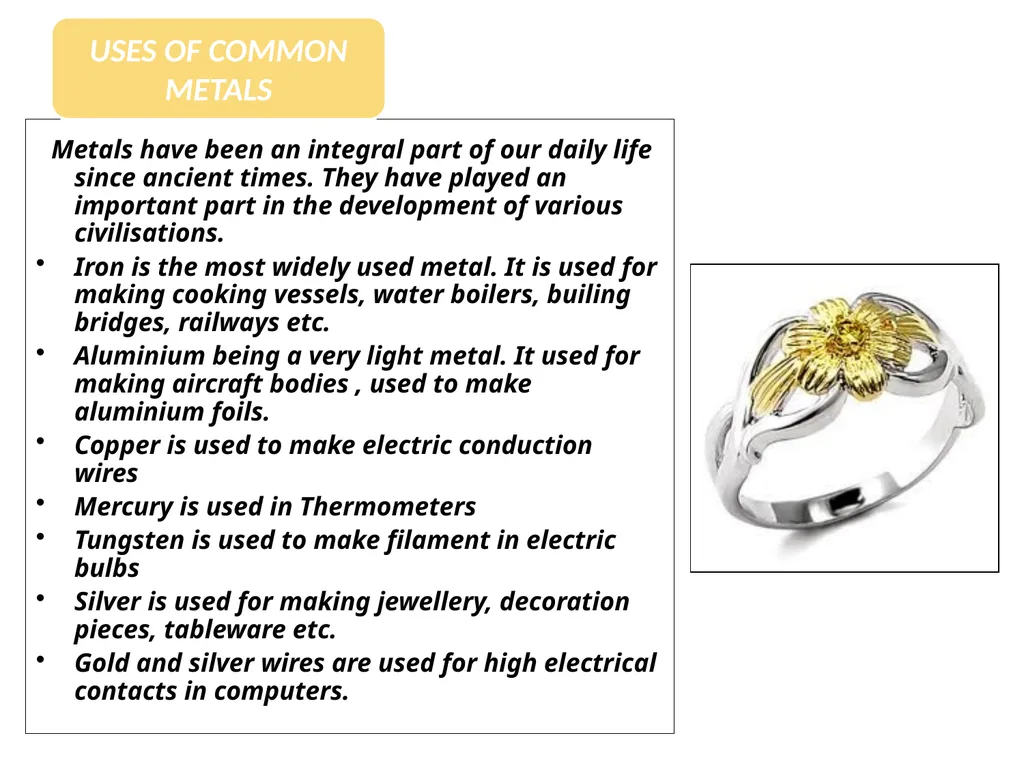
Silver is used for making jewellery, decoration pieces, tableware etc.
Gold and silver wires are used for high electrical contacts in computers.<br>
27
Non metals too are very important and Some of common uses of non metals are-
1.)Iodine is used as antiseptic. So it is used on wounds as red medicine - ‘ Tincture Iodine’ by dissolving in alcohol
2.)Oxygen is essential for all living beings for breathing.
3.)Sulphur is used in tyre industry in vulcanisation of rubber. It is also used in several skin ointments.
4.)Phosphorous is used in match box industry and fertilizers.
5) Chlorine gas kills germs so it is used in water purification systems, cleaning of swimming pools.
6) Nitrogen gas is essentential for all living beings. It is contained in amino acids. It is required for plant growth. So it is used for making fertillizers such as urea, NPK etc<br>