Classification and Identification of Soils for General Engineering Purposes (Unified Soil Classification System) IS-1498-1970 Y. Narasimha Rao, B.E. (Hons) Civil Engineering, M.Tech (Computer Science) Superintending Engineer (Retd), PR,
"Classification and Identification of Soils for" is the property of its rightful owner. Permission is granted to
download and print the materials on this website for personal, non-commercial use only, and to display it
on your personal computer provided you do not modify the materials and that you retain all copyright
notices contained in the materials. By downloading content from our website, you accept the terms of this
agreement.
Presentation Transcript
01
Classification and Identification of Soils for General Engineering Purposes (Unified Soil Classification System) IS-1498-1970 Y. Narasimha Rao, B.E. (Hons) [Civil Engineering], M.Tech (Computer Science)
Superintending Engineer (Retd), PR, Govt of AP
Project Advisor, APRRP, PR, Govt of AP<br>
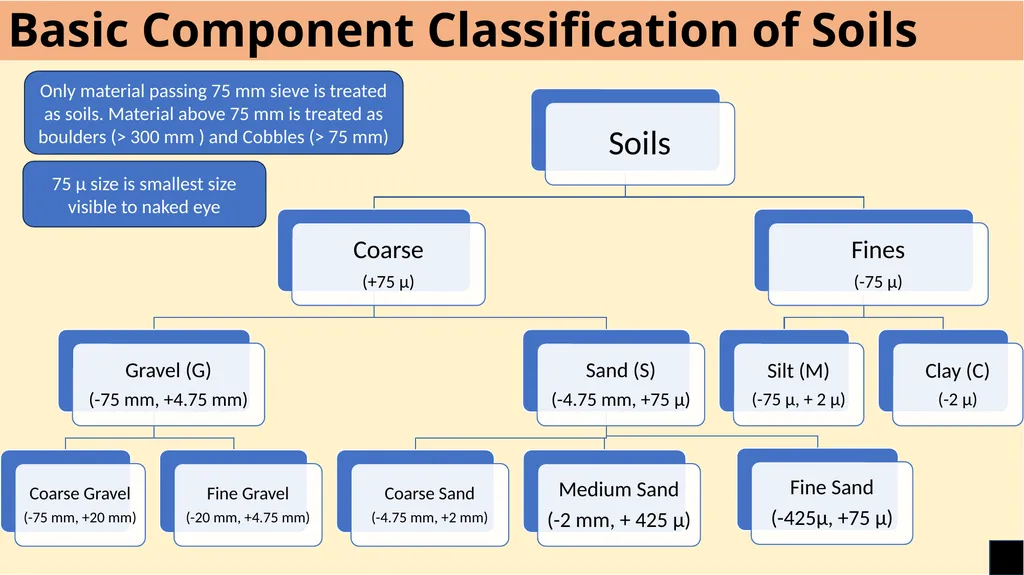
Basic Component Classification of Soils Only material passing 75 mm sieve is treated as soils. Material above 75 mm is treated as boulders (> 300 mm ) and Cobbles (> 75 mm) 75 μ size is smallest size visible to naked eye<br>
04
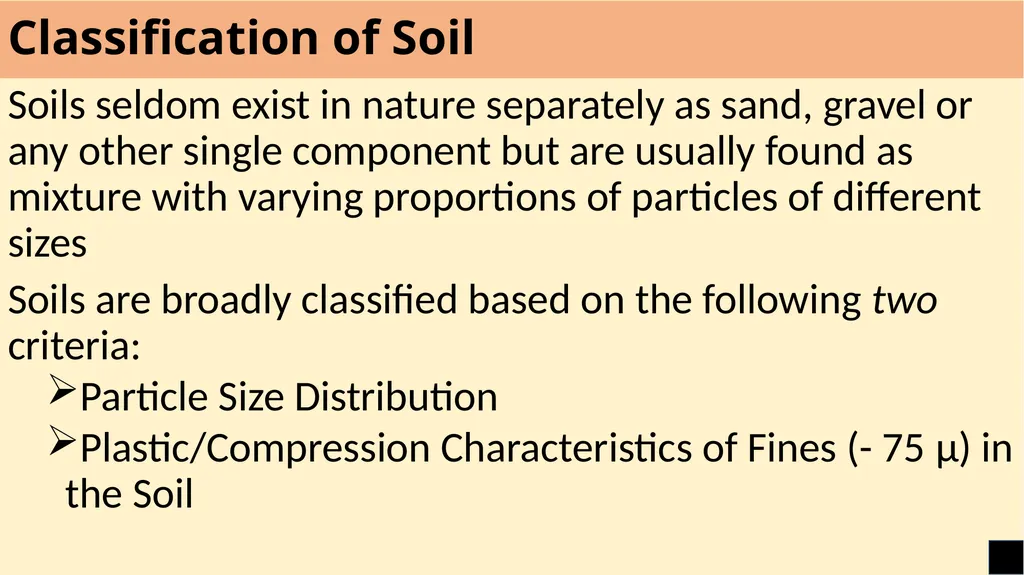
Classification of Soil Soils seldom exist in nature separately as sand, gravel or any other single component but are usually found as mixture with varying proportions of particles of different sizes
Soils are broadly classified based on the following two criteria:
Particle Size Distribution
Plastic/Compression Characteristics of Fines (- 75 μ) in the Soil<br>
05
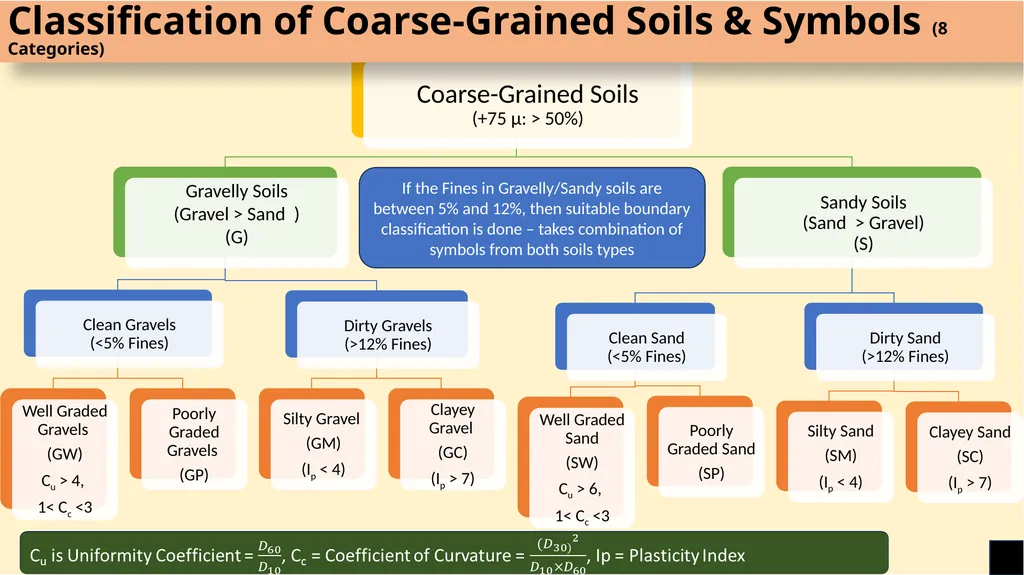
Classification of Coarse-Grained Soils & Symbols (8 Categories) If the Fines in Gravelly/Sandy soils are between 5% and 12%, then suitable boundary classification is done – takes combination of symbols from both soils types<br>
06
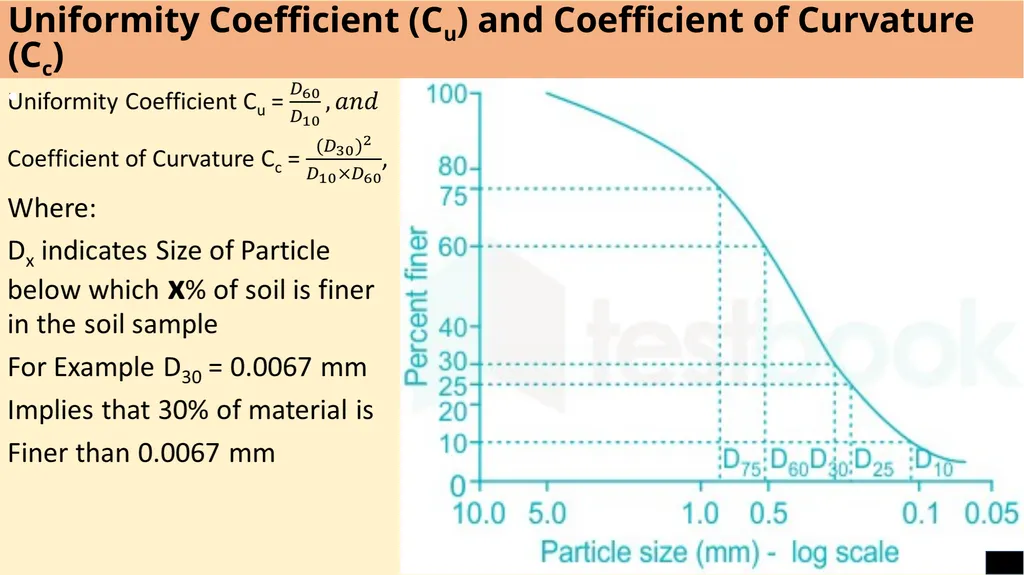
Uniformity Coefficient (Cu) and Coefficient of Curvature (Cc)<br>
07
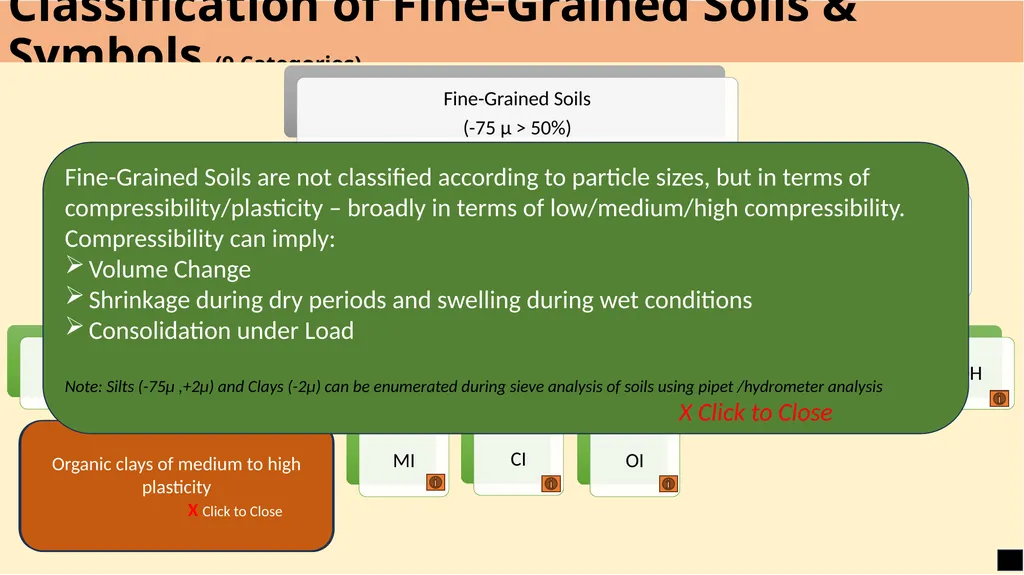
Classification of Fine-Grained Soils & Symbols (9 Categories) ML – Low Plastic Silts - Inorganic silts and very fine sands rock flour, silty or clayey fine sands or clayey silts with none to low plasticity
X Click to Close CL – Low Plastic Clays - Inorganic clays, gravelly clays, sandy clays, silty clays, lean clays of low plasticity
X Click to Close OL – Low Plastic Organic Silts/Silty Clays/Clays
X Click to Close MI – Medium Plastic Silts - Inorganic silts, silty or clayey fine sands or clayey silts of medium plasticity
X Click to Close CI – Medium Plastic Clays-- Inorganic clays, gravelly clays, sandy clays, silty clays, lean clays of medium plasticity
X Click to Close OI – Medium Plastic Organic Silts/Silty Clays
X Click to Close MH – High Plastic Silts - Inorganic silts of high compressibility, micaceous or diatomaceous fine sandy or silty soils, elastic silts
X Click to Close CH – High Plastic Clays - Inorganic clays of high plasticity, fat clays
X Click to Close Organic clays of medium to high plasticity
X Click to Close Fine-Grained Soils are not classified according to particle sizes, but in terms of compressibility/plasticity – broadly in terms of low/medium/high compressibility.
Compressibility can imply:
Volume Change
Shrinkage during dry periods and swelling during wet conditions
Consolidation under Load
Note: Silts (-75μ ,+2μ) and Clays (-2μ) can be enumerated during sieve analysis of soils using pipet /hydrometer analysis
X Click to Close<br>
08
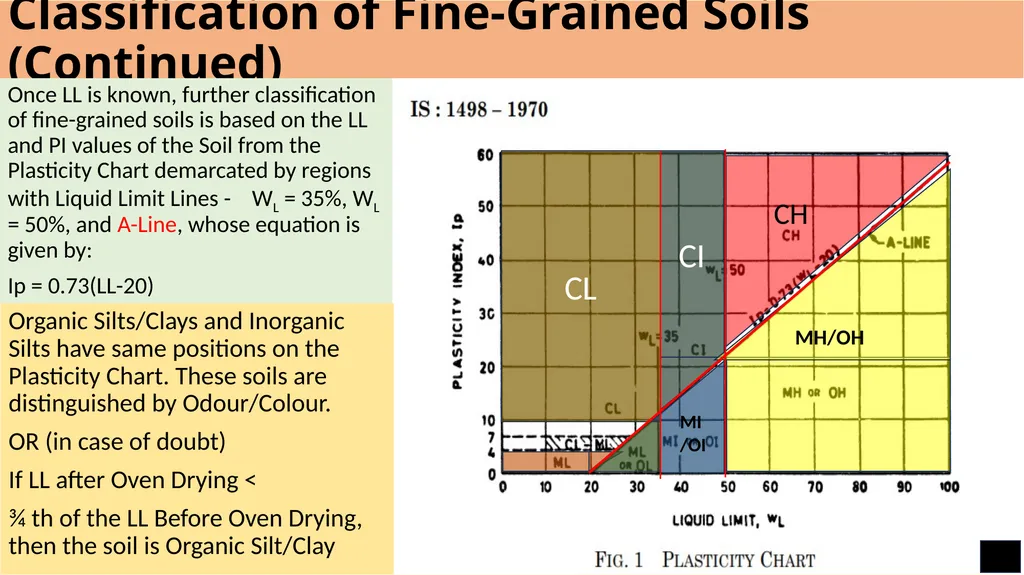
Classification of Fine-Grained Soils (Continued) Once LL is known, further classification of fine-grained soils is based on the LL and PI values of the Soil from the Plasticity Chart demarcated by regions with Liquid Limit Lines - WL = 35%, WL = 50%, and A-Line, whose equation is given by:
Ip = 0.73(LL-20) CL Organic Silts/Clays and Inorganic Silts have same positions on the Plasticity Chart. These soils are distinguished by Odour/Colour.
OR (in case of doubt)
If LL after Oven Drying <
¾ th of the LL Before Oven Drying, then the soil is Organic Silt/Clay<br>
09
Boundary Classification of Fine-Grained Soils The fine-grained soils, whose plot on the Plasticity chart falls on, or practically on:
‘A’ Line
wL = 35 Line
wL = 50 Line
Shall be assigned proper boundary classification<br>
10
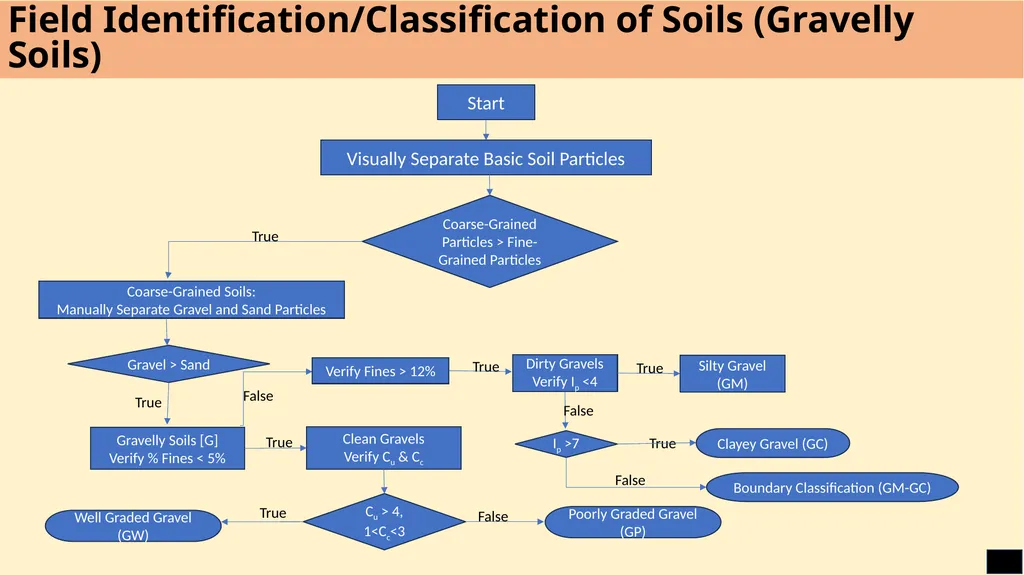
Field Identification/Classification of Soils (Gravelly Soils) Start Visually Separate Basic Soil Particles Coarse-Grained Particles > Fine-Grained Particles Coarse-Grained Soils:
Manually Separate Gravel and Sand Particles Gravel > Sand True True Gravelly Soils [G]
Verify % Fines < 5% Clean Gravels
Verify Cu & Cc Cu > 4, 1<Cc<3 True Well Graded Gravel (GW) False Poorly Graded Gravel (GP) True False Verify Fines > 12% True Dirty Gravels
Verify Ip <4 Silty Gravel (GM) True False Ip >7 True False Clayey Gravel (GC) Boundary Classification (GM-GC)<br>
11
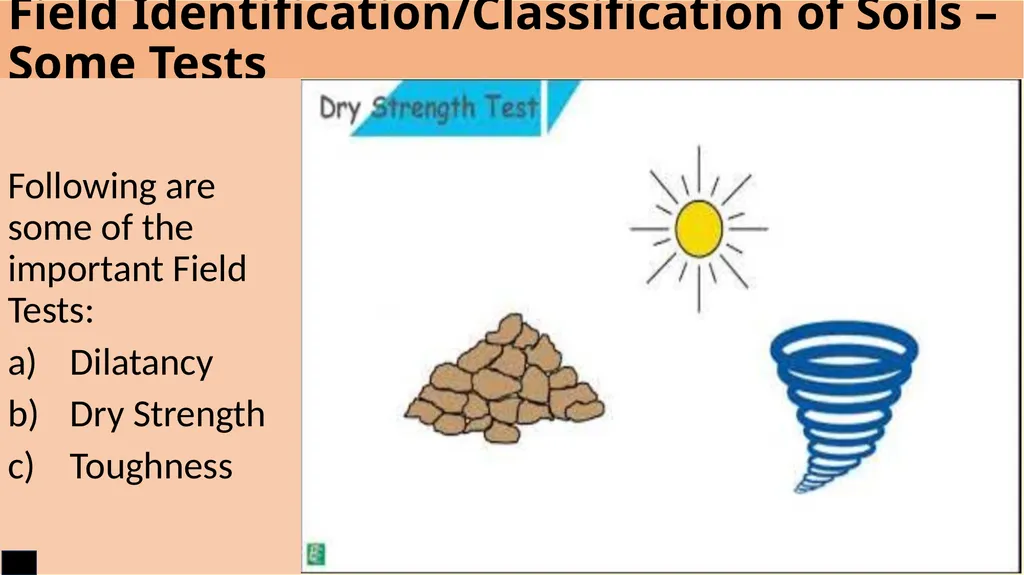
Field Identification/Classification of Soils – Some Tests Following are some of the important Field Tests:
Dilatancy
Dry Strength
Toughness<br>
12
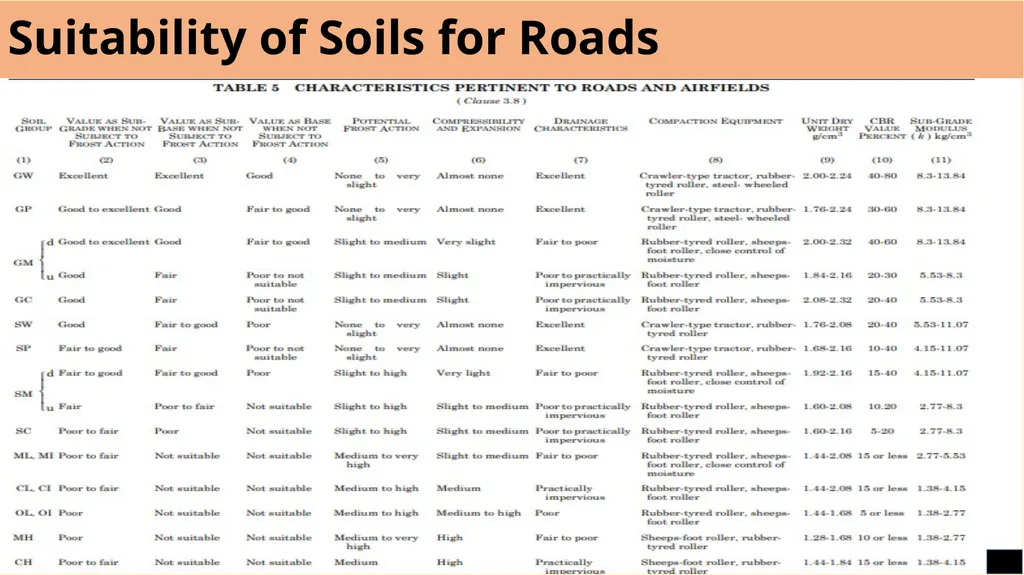
Suitability of Soils for Roads<br>
13
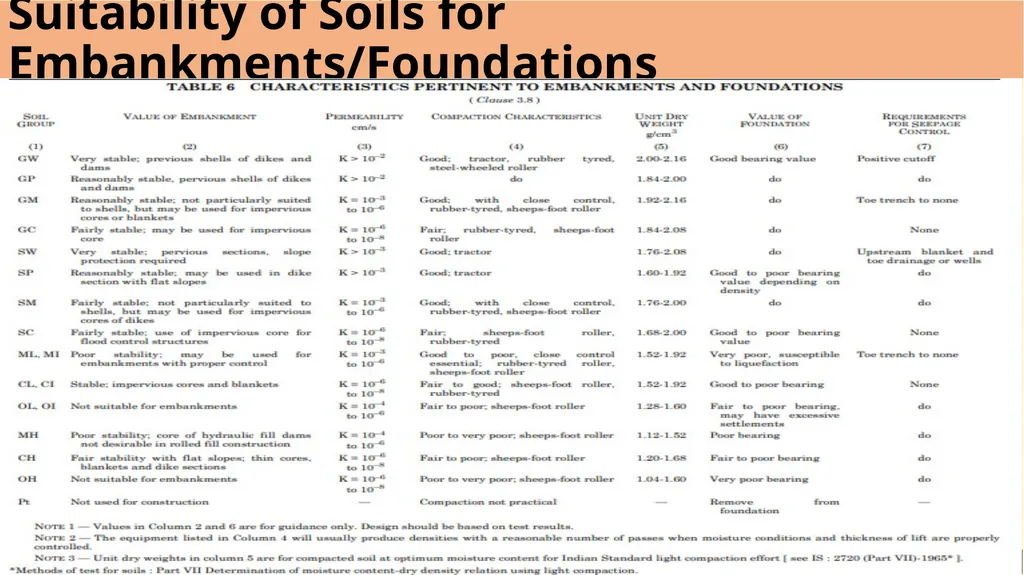
Suitability of Soils for Embankments/Foundations<br>
14
Thanks for your Patience Forum Open for Discussion<br>