
Client Mobility Risk Assessment SASWH acknowledges
SN
Published · 31 slides · 0 views
1 / 1
Description
Client Mobility Risk Assessment SASWH acknowledges the Saskatchewan Health Authority-Saskatoon for the concept to develop this PowerPoint to further support TLR Client Mobility Risk Assessment (Oct20) Material Required Participant Handbook
Related Topics
Share
Embed code
Download this presentation From Below
"Client Mobility Risk Assessment SASWH acknowledges" is the property of its rightful owner. Permission is granted to download and print the materials on this website for personal, non-commercial use only, and to display it on your personal computer provided you do not modify the materials and that you retain all copyright notices contained in the materials. By downloading content from our website, you accept the terms of this agreement.
Presentation Transcript
01
Client Mobility
Risk Assessment SASWH acknowledges the Saskatchewan Health Authority-Saskatoon
for the concept to develop this PowerPoint to further
support TLR Client Mobility Risk Assessment
(Oct/20)<br>
Risk Assessment SASWH acknowledges the Saskatchewan Health Authority-Saskatoon
for the concept to develop this PowerPoint to further
support TLR Client Mobility Risk Assessment
(Oct/20)<br>
02
Material Required Participant Handbook
Mobility Record
Quick Reference Card
Bed or Chair
Transfer Belt<br>
Mobility Record
Quick Reference Card
Bed or Chair
Transfer Belt<br>
03
Learning outcomes:
identify risks in the client’s ability to mobilize
Initial client mobility risk assessment (provides baseline)
documenting the assessment
eliminate or manage risks
selecting appropriate moving technique
evaluate and communicate
In the Moment risk assessment<br>
identify risks in the client’s ability to mobilize
Initial client mobility risk assessment (provides baseline)
documenting the assessment
eliminate or manage risks
selecting appropriate moving technique
evaluate and communicate
In the Moment risk assessment<br>
04
Initial Client Mobility
Risk Assessment conducted when the client is assessed for their care plan to determine their baseline mobility
completed face to face with the client
a focused approach that requires listening, observing and documenting
conducted prior to moving the client
documented on a TLR Mobility Record (or an employer’s comparable form) and becomes part of the client’s chart<br>
completed face to face with the client
a focused approach that requires listening, observing and documenting
conducted prior to moving the client
documented on a TLR Mobility Record (or an employer’s comparable form) and becomes part of the client’s chart<br>
05
Conducting the Assessment the worker considers their approach and attitude
introduces themselves by providing name and job title
worker explains the assessment process and why it is necessary
worker considers the potential for assaultive, aggressive or violent behaviour
considers any existing mobility devices the client may have<br>
introduces themselves by providing name and job title
worker explains the assessment process and why it is necessary
worker considers the potential for assaultive, aggressive or violent behaviour
considers any existing mobility devices the client may have<br>
06
Part A
Verbal, Written and Observation<br>
Verbal, Written and Observation<br>
07
Areas of risk: Communication Status How do we communicate?
Is language a barrier?
Will vision and hearing impact the move?<br>
Is language a barrier?
Will vision and hearing impact the move?<br>
08
Managing risks of Communication Status How do we communicate?
Use of sign language, interpreter or devices
For non verbal – may require other methods of communication e.g. pen and paper, hand gestures, nods
If there is a decreased level of consciousness, move may need to be delayed.
Is language a barrier?
May need interpreter/ family member
Use of cue cards<br>
Use of sign language, interpreter or devices
For non verbal – may require other methods of communication e.g. pen and paper, hand gestures, nods
If there is a decreased level of consciousness, move may need to be delayed.
Is language a barrier?
May need interpreter/ family member
Use of cue cards<br>
09
Managing risks of Communication Status Will vision and hearing impact the move?
Ensure hearing aides are in the ears and functioning
Glasses are on and clean<br>
Ensure hearing aides are in the ears and functioning
Glasses are on and clean<br>
10
Areas of risk: Cognitive Status Is short-term memory part of the diagnosis?
Does client exhibit appropriate judgement?
Is client’s ability to make decisions compromised?
Alertness? (May depend on many factors)<br>
Does client exhibit appropriate judgement?
Is client’s ability to make decisions compromised?
Alertness? (May depend on many factors)<br>
11
Managing Risks of Cognitive Status Is short-term memory part of the diagnosis? Do they exhibit appropriate judgement? Is their ability to make decisions compromised?
Give short, clear, step by step instructions to decrease frustration or confusion
Allow client time to process the instructions, before moving to next task
Gauge clients response to ensure the appropriate decision is being made
Move may need to be delayed if client exhibits poor judgement<br>
Give short, clear, step by step instructions to decrease frustration or confusion
Allow client time to process the instructions, before moving to next task
Gauge clients response to ensure the appropriate decision is being made
Move may need to be delayed if client exhibits poor judgement<br>
12
Managing Risks of Cognitive Status Alertness? (May depend on many factors)
Diagnosis
Time of day (e.g. sundowning)
Side effects from medications
Move may need to be delayed if there is a decreased level of consciousness<br>
Diagnosis
Time of day (e.g. sundowning)
Side effects from medications
Move may need to be delayed if there is a decreased level of consciousness<br>
13
Areas of risk: Emotional & Behavioural Status Will their mood affect a safe move?
Does the client display stable moods?
Does the client display predictable/cooperative behaviours?
Is there history of mood variances, aggressive, or abusive behaviour?<br>
Does the client display stable moods?
Does the client display predictable/cooperative behaviours?
Is there history of mood variances, aggressive, or abusive behaviour?<br>
14
Managing Risks of Emotional & Behavioural Status Will their mood affect a safe move?
Check for any client history of mood variances as certain diagnosis can alter a clients mood
Mood can vary throughout the day (e.g. sundowning)
Delay move if client is uncooperative<br>
Check for any client history of mood variances as certain diagnosis can alter a clients mood
Mood can vary throughout the day (e.g. sundowning)
Delay move if client is uncooperative<br>
15
Managing Risks of Emotional & Behavioural Status Does the client display stable moods? Does the client display predictable/cooperative behaviours? Is there history of mood variances, aggressive, or abusive behaviour?
Delay move in order to allow a cooling down period
Involve a worker or family member who has an approach that the client may respond favorably to
Assess the reason for the behavior e.g. pain, fatigue, depression<br>
Delay move in order to allow a cooling down period
Involve a worker or family member who has an approach that the client may respond favorably to
Assess the reason for the behavior e.g. pain, fatigue, depression<br>
16
Areas of risk: Medical Status Are there medical conditions, diagnosis or skin integrity concerns?
Is body awareness/weight distribution an area of concern?
Will an attachment/appliance affect a safe move?
Will pain/fatigue affect a safe move?
What medications are being taken that may interfere with a safe move?
Are any mobility assistive devices used by the client?<br>
Is body awareness/weight distribution an area of concern?
Will an attachment/appliance affect a safe move?
Will pain/fatigue affect a safe move?
What medications are being taken that may interfere with a safe move?
Are any mobility assistive devices used by the client?<br>
17
Managing Risks of Medical Status Are there medical conditions, diagnosis or skin integrity issues? Are there body awareness or weight distribution issues?
The level of assistance may need to be increased
Consider a specialized client mobility risk assessment<br>
The level of assistance may need to be increased
Consider a specialized client mobility risk assessment<br>
18
Managing Risks of Medical Status Will an attachment/appliance affect a safe move?
Ensure training needed for proper application of devices is provided
Consider a specialized client mobility risk assessment
Will pain/fatigue affect a safe move?
Clients with stiffness from arthritis may need a slower pace
Daily activities that tire clients may require additional workers to assist with the moving task after activities
Timing of specific medications may need to be considered<br>
Ensure training needed for proper application of devices is provided
Consider a specialized client mobility risk assessment
Will pain/fatigue affect a safe move?
Clients with stiffness from arthritis may need a slower pace
Daily activities that tire clients may require additional workers to assist with the moving task after activities
Timing of specific medications may need to be considered<br>
19
Managing Risks of Medical Status What medications are being taken?
Understanding potential side affects
Additional workers may be required for assistance
Move may need to be delayed
Are mobility assistive devices used by client?
Ensure device is used during Part B testing<br>
Understanding potential side affects
Additional workers may be required for assistance
Move may need to be delayed
Are mobility assistive devices used by client?
Ensure device is used during Part B testing<br>
20
Part B
Testing and Observation<br>
Testing and Observation<br>
21
Physical and Functional Status Pre-mobilization testing
Upper limb tests
Lower limb tests
Core tests
Mobilization testing
Sitting tests
Standing tests (transfer belt required)
Walking tests (transfer belt required)<br>
Upper limb tests
Lower limb tests
Core tests
Mobilization testing
Sitting tests
Standing tests (transfer belt required)
Walking tests (transfer belt required)<br>
22
Physical and functional status: Pre-mobilization testing
Requires hands on approach by the worker completing the risk assessment
The client can be assessed either in a seated or supine position
Mobilization testing
Requires hands on approach by the worker completing the risk assessment and use of a transfer belt
The client requires a degree of mobility
A second worker must be immediately available<br>
Requires hands on approach by the worker completing the risk assessment
The client can be assessed either in a seated or supine position
Mobilization testing
Requires hands on approach by the worker completing the risk assessment and use of a transfer belt
The client requires a degree of mobility
A second worker must be immediately available<br>
23
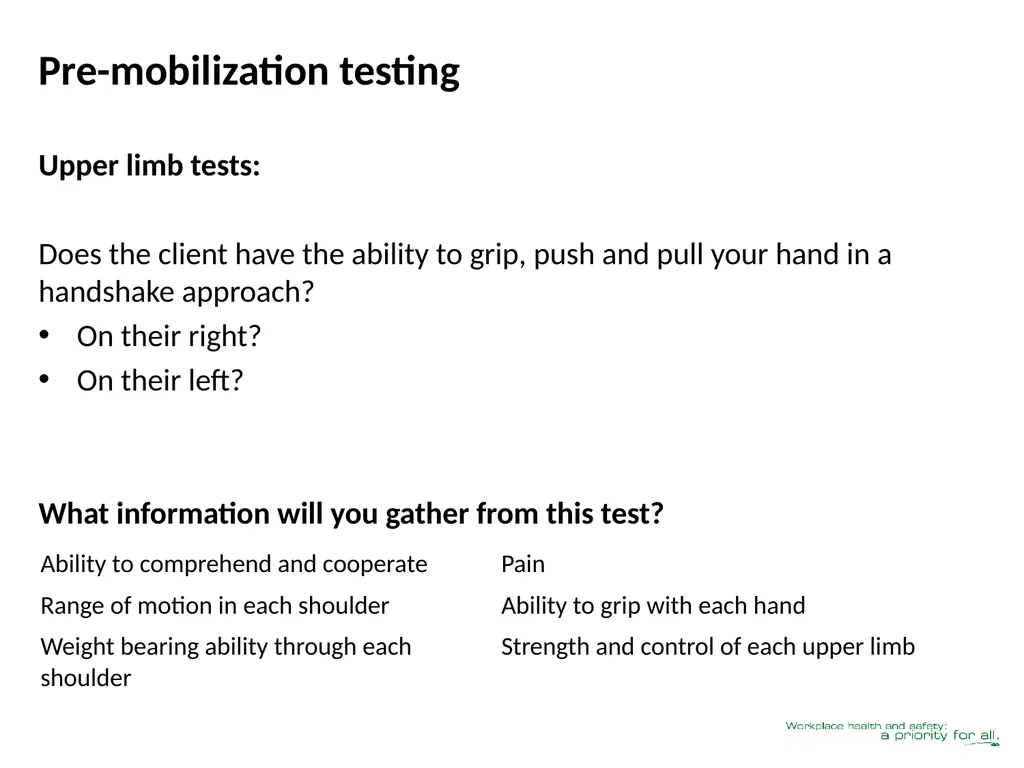
Pre-mobilization testing
Upper limb tests:
Does the client have the ability to grip, push and pull your hand in a handshake approach?
On their right?
On their left?
What information will you gather from this test?<br>
Upper limb tests:
Does the client have the ability to grip, push and pull your hand in a handshake approach?
On their right?
On their left?
What information will you gather from this test?<br>
24
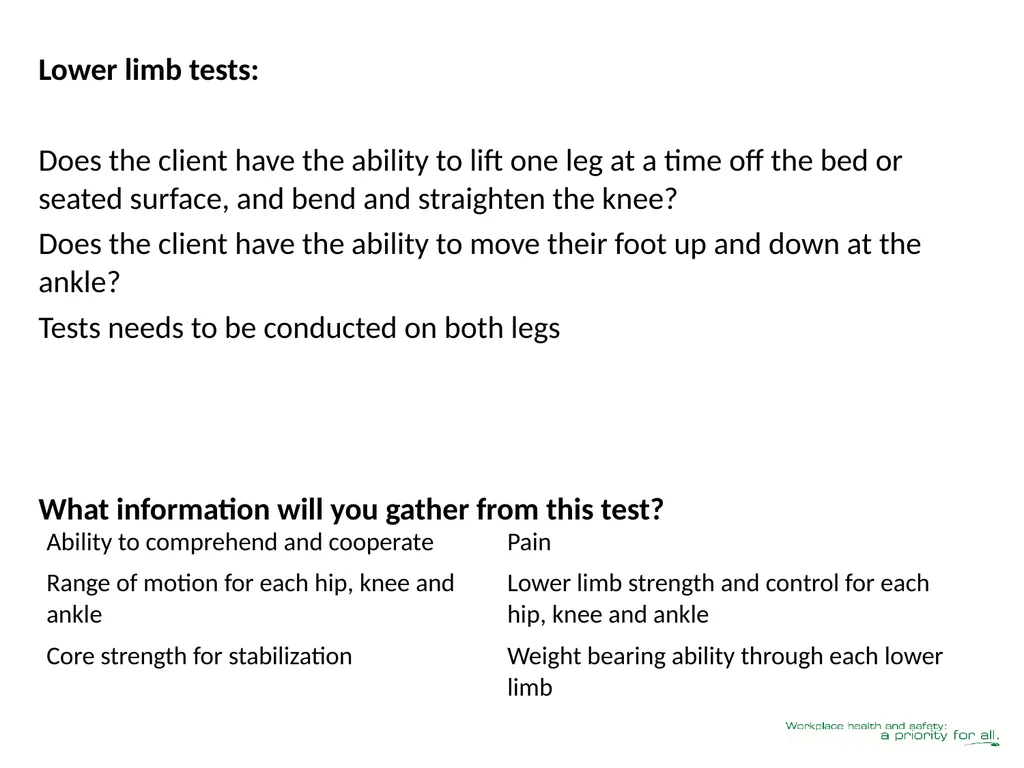
Lower limb tests:
Does the client have the ability to lift one leg at a time off the bed or seated surface, and bend and straighten the knee?
Does the client have the ability to move their foot up and down at the ankle?
Tests needs to be conducted on both legs
What information will you gather from this test?<br>
Does the client have the ability to lift one leg at a time off the bed or seated surface, and bend and straighten the knee?
Does the client have the ability to move their foot up and down at the ankle?
Tests needs to be conducted on both legs
What information will you gather from this test?<br>
25
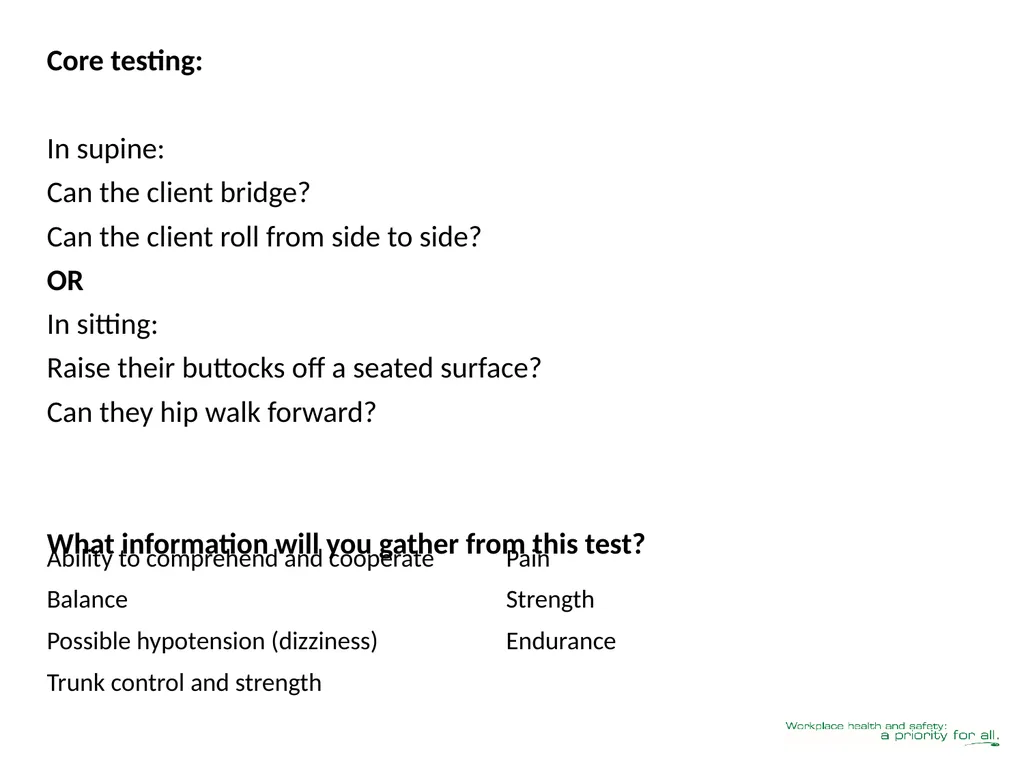
Core testing:
In supine:
Can the client bridge?
Can the client roll from side to side?
OR
In sitting:
Raise their buttocks off a seated surface?
Can they hip walk forward?
What information will you gather from this test?<br>
In supine:
Can the client bridge?
Can the client roll from side to side?
OR
In sitting:
Raise their buttocks off a seated surface?
Can they hip walk forward?
What information will you gather from this test?<br>
26
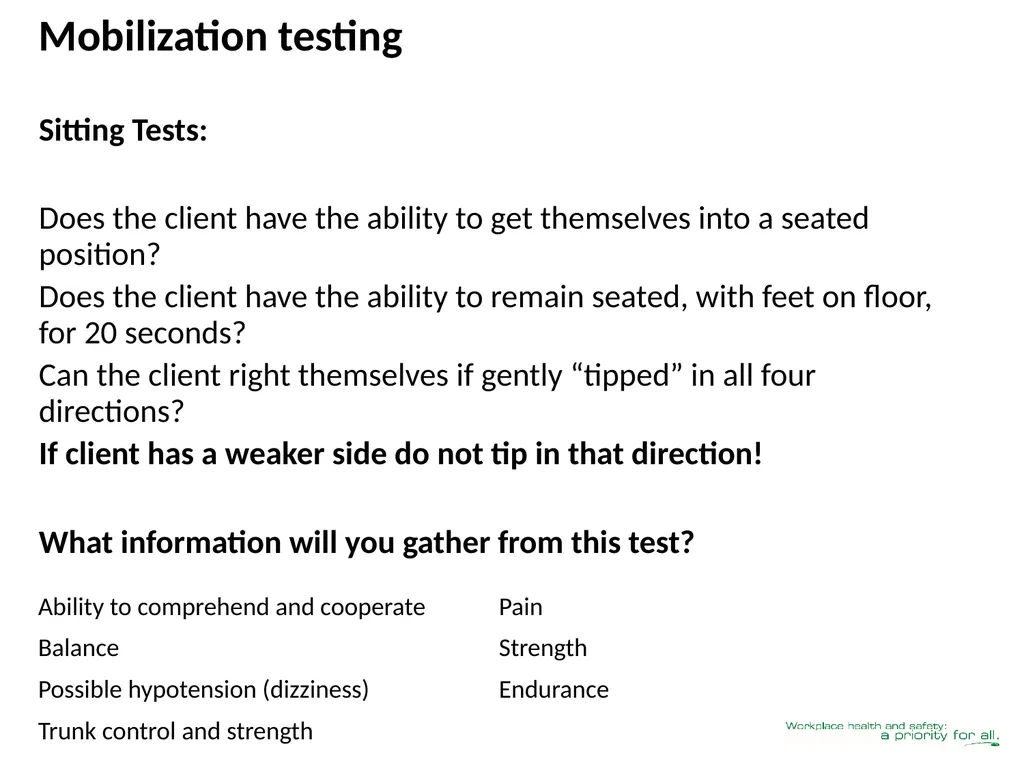
Mobilization testing
Sitting Tests:
Does the client have the ability to get themselves into a seated position?
Does the client have the ability to remain seated, with feet on floor, for 20 seconds?
Can the client right themselves if gently “tipped” in all four directions?
If client has a weaker side do not tip in that direction!
What information will you gather from this test?<br>
Sitting Tests:
Does the client have the ability to get themselves into a seated position?
Does the client have the ability to remain seated, with feet on floor, for 20 seconds?
Can the client right themselves if gently “tipped” in all four directions?
If client has a weaker side do not tip in that direction!
What information will you gather from this test?<br>
27
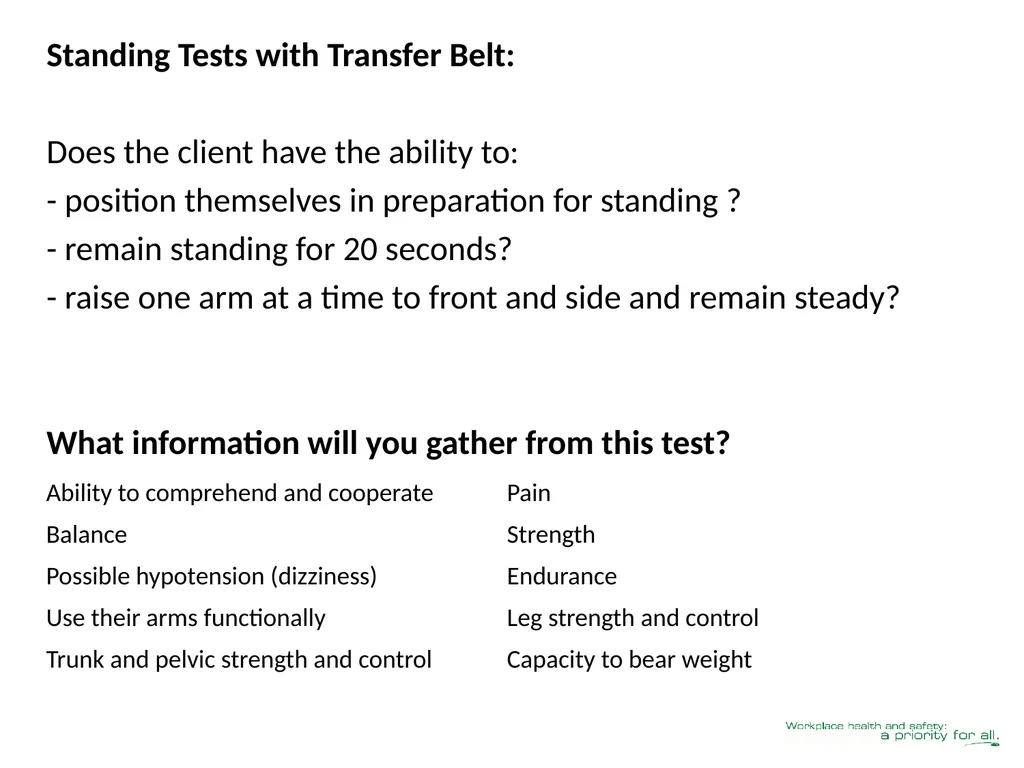
Standing Tests with Transfer Belt:
Does the client have the ability to:
- position themselves in preparation for standing ?
- remain standing for 20 seconds?
- raise one arm at a time to front and side and remain steady?
What information will you gather from this test?<br>
Does the client have the ability to:
- position themselves in preparation for standing ?
- remain standing for 20 seconds?
- raise one arm at a time to front and side and remain steady?
What information will you gather from this test?<br>
28
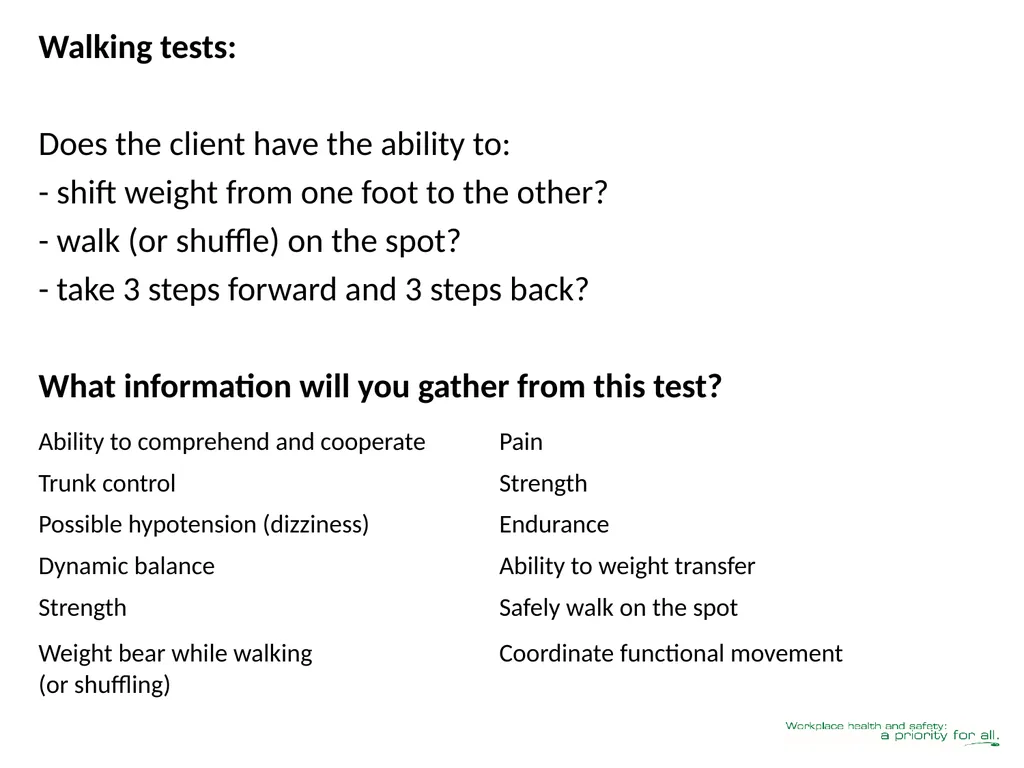
Walking tests:
Does the client have the ability to:
- shift weight from one foot to the other?
- walk (or shuffle) on the spot?
- take 3 steps forward and 3 steps back?
What information will you gather from this test?<br>
Does the client have the ability to:
- shift weight from one foot to the other?
- walk (or shuffle) on the spot?
- take 3 steps forward and 3 steps back?
What information will you gather from this test?<br>
29
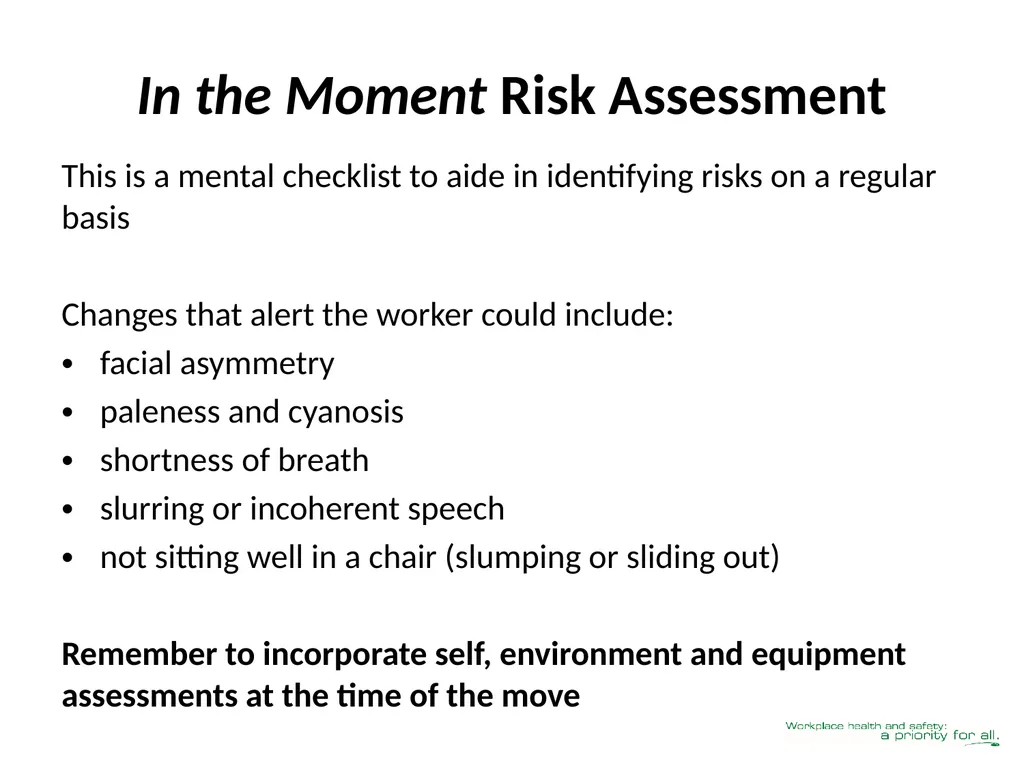
In the Moment Risk Assessment This is a mental checklist to aide in identifying risks on a regular basis
Changes that alert the worker could include:
facial asymmetry
paleness and cyanosis
shortness of breath
slurring or incoherent speech
not sitting well in a chair (slumping or sliding out)
Remember to incorporate self, environment and equipment assessments at the time of the move<br>
Changes that alert the worker could include:
facial asymmetry
paleness and cyanosis
shortness of breath
slurring or incoherent speech
not sitting well in a chair (slumping or sliding out)
Remember to incorporate self, environment and equipment assessments at the time of the move<br>
30
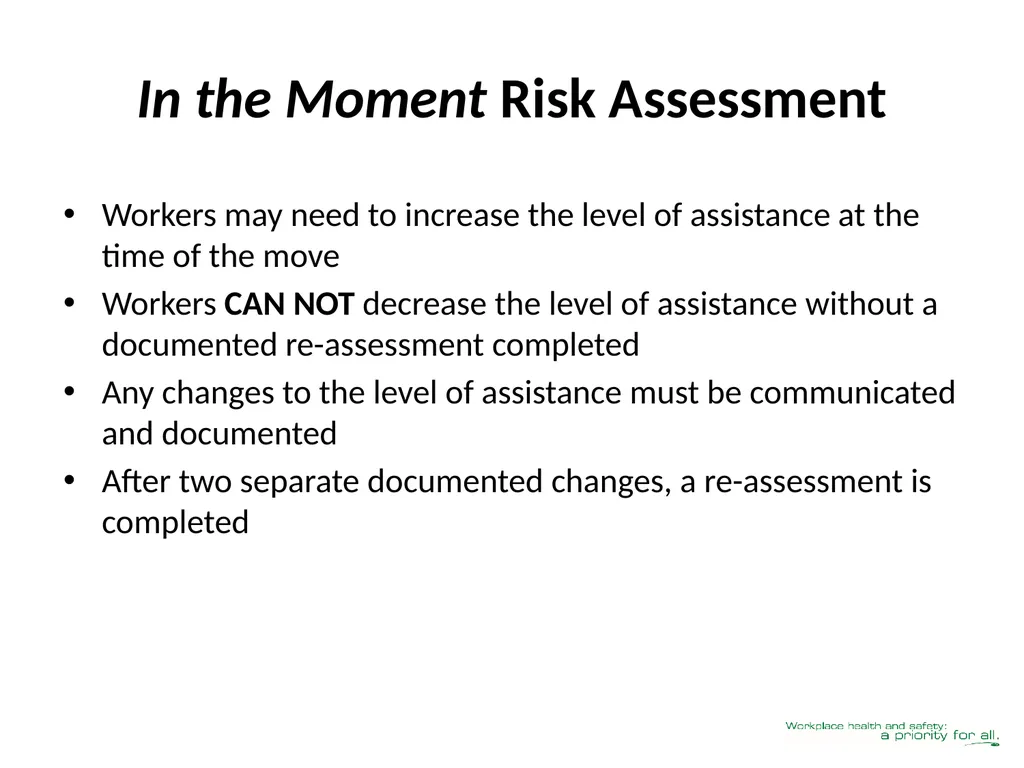
Workers may need to increase the level of assistance at the time of the move
Workers CAN NOT decrease the level of assistance without a documented re-assessment completed
Any changes to the level of assistance must be communicated and documented
After two separate documented changes, a re-assessment is completed In the Moment Risk Assessment<br>
Workers CAN NOT decrease the level of assistance without a documented re-assessment completed
Any changes to the level of assistance must be communicated and documented
After two separate documented changes, a re-assessment is completed In the Moment Risk Assessment<br>
31
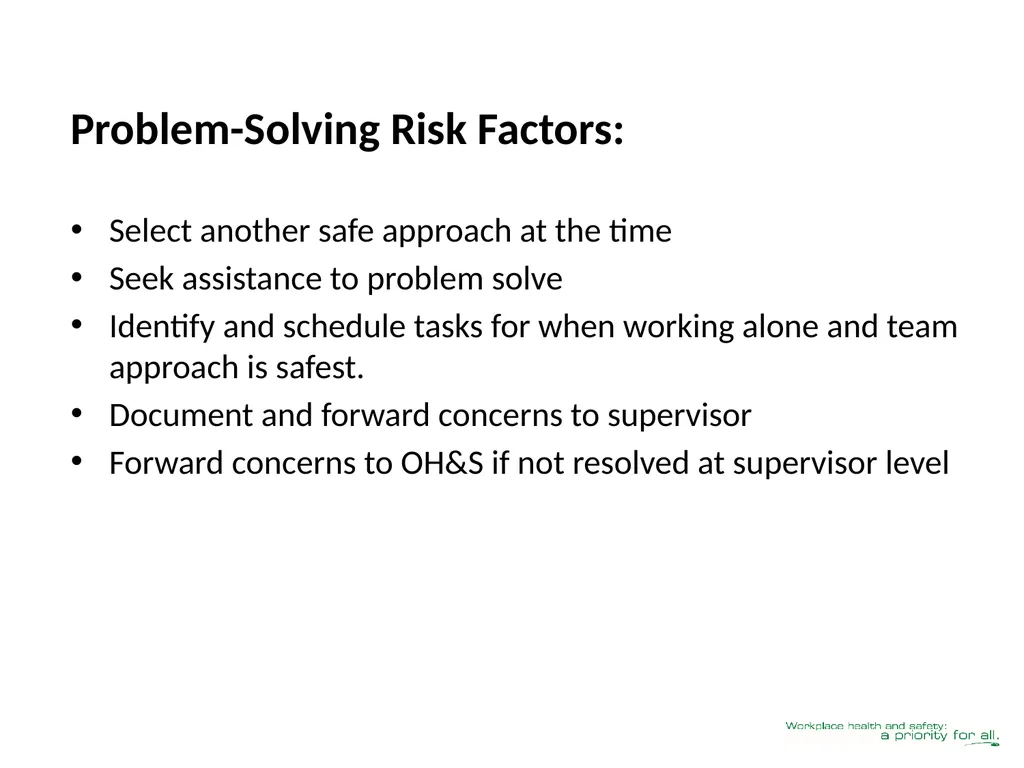
Problem-Solving Risk Factors:
Select another safe approach at the time
Seek assistance to problem solve
Identify and schedule tasks for when working alone and team approach is safest.
Document and forward concerns to supervisor
Forward concerns to OH&S if not resolved at supervisor level<br>
Select another safe approach at the time
Seek assistance to problem solve
Identify and schedule tasks for when working alone and team approach is safest.
Document and forward concerns to supervisor
Forward concerns to OH&S if not resolved at supervisor level<br>