
Client NVMeTM SSD Objectives and Opportunities
AM
Published · 25 slides · 0 views
1 / 1


Description
Client NVMeTM SSD Objectives and Opportunities Sponsored by NVM Express organization, the owner of NVMe, NVMe-oF and NVMe-MI standards Speakers Lee Zaretsky Shivashekar Muralishankar Romesh Trivedi Client NVMeTM SSD Objectives and
Related Topics
Share
Embed code
Download this presentation From Below
"Client NVMeTM SSD Objectives and Opportunities" is the property of its rightful owner. Permission is granted to download and print the materials on this website for personal, non-commercial use only, and to display it on your personal computer provided you do not modify the materials and that you retain all copyright notices contained in the materials. By downloading content from our website, you accept the terms of this agreement.
Presentation Transcript
01
Client NVMeTM SSD Objectives and Opportunities Sponsored by NVM Express™ organization, the owner of NVMe™, NVMe-oF™ and NVMe-MI™ standards<br>
02
Speakers Lee Zaretsky Shivashekar Muralishankar Romesh Trivedi<br>
03
Client NVMeTM SSD Objectives and Opportunities Lee Zaretsky, Distinguished Engineer, Dell<br>
04
Agenda Client storage strategic vision
Industry trends impacting client storage
Client classes of SSDs
Relevant form factors
Emergence of PCIe® 4.0
Dell view of different NVMeTM SSD classes
Summary
Epilogue: NVMe SSDs and hard drives<br>
Industry trends impacting client storage
Client classes of SSDs
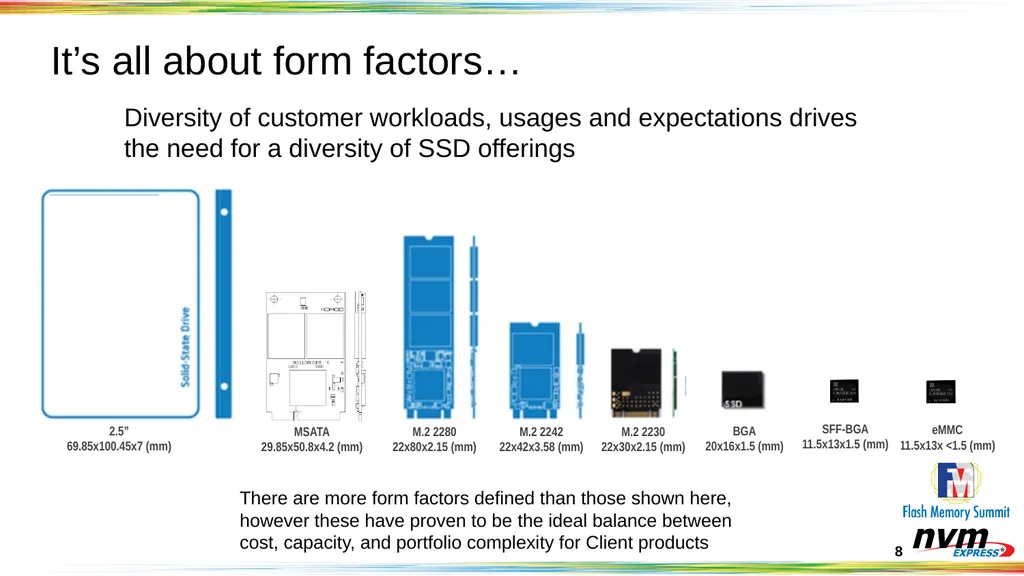
Relevant form factors
Emergence of PCIe® 4.0
Dell view of different NVMeTM SSD classes
Summary
Epilogue: NVMe SSDs and hard drives<br>
05
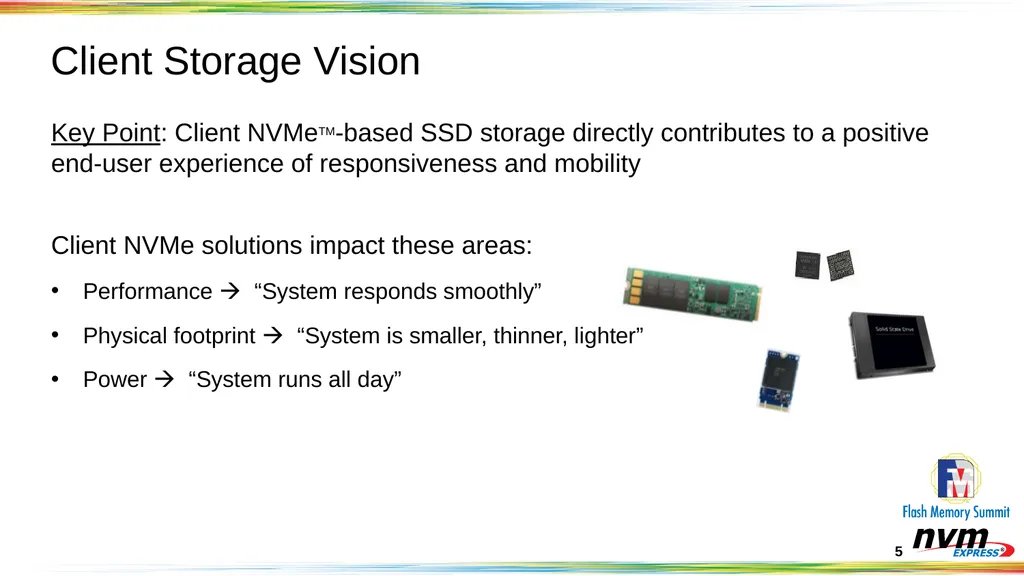
Client Storage Vision Key Point: Client NVMeTM-based SSD storage directly contributes to a positive end-user experience of responsiveness and mobility
Client NVMe solutions impact these areas:
Performance “System responds smoothly”
Physical footprint “System is smaller, thinner, lighter”
Power “System runs all day”<br>
Client NVMe solutions impact these areas:
Performance “System responds smoothly”
Physical footprint “System is smaller, thinner, lighter”
Power “System runs all day”<br>
06
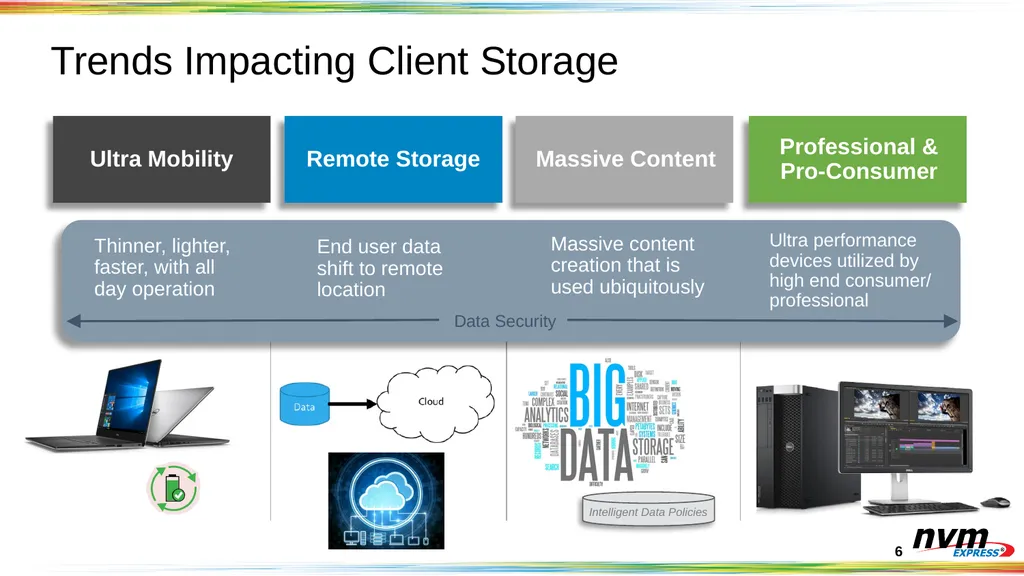
Trends Impacting Client Storage Remote Storage Massive Content Ultra Mobility Professional & Pro-Consumer Thinner, lighter, faster, with all day operation End user data shift to remote location Massive content creation that is used ubiquitously Ultra performance devices utilized by high end consumer/ professional Data Security Intelligent Data Policies<br>
07
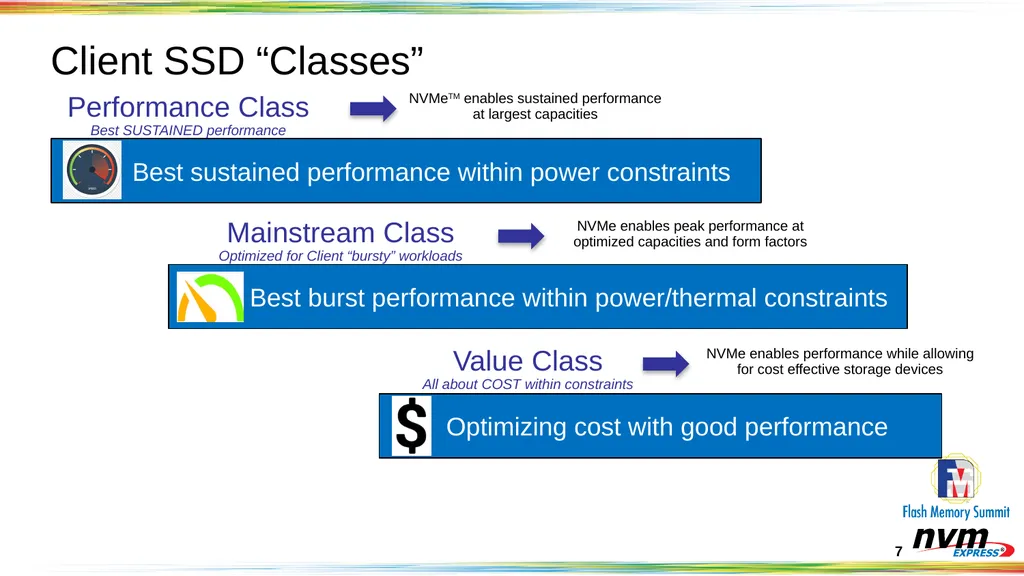
Client SSD “Classes” Value Class
All about COST within constraints Mainstream Class
Optimized for Client “bursty” workloads Performance Class
Best SUSTAINED performance Optimizing cost with good performance Best burst performance within power/thermal constraints Best sustained performance within power constraints NVMe enables performance while allowing for cost effective storage devices NVMe enables peak performance at optimized capacities and form factors NVMeTM enables sustained performance at largest capacities<br>
08
It’s all about form factors… Diversity of customer workloads, usages and expectations drives the need for a diversity of SSD offerings There are more form factors defined than those shown here, however these have proven to be the ideal balance between cost, capacity, and portfolio complexity for Client products<br>
09
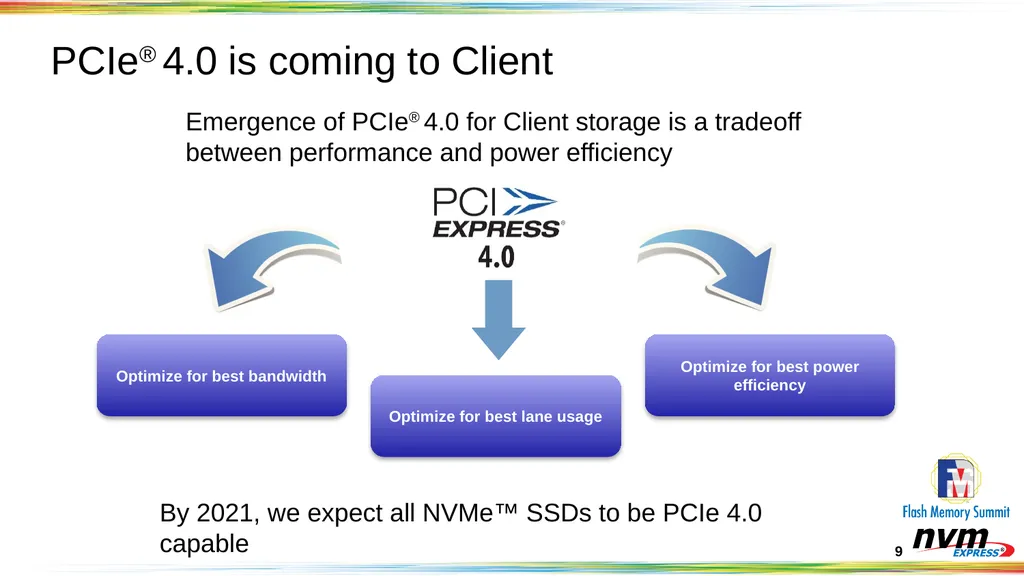
PCIe® 4.0 is coming to Client Emergence of PCIe® 4.0 for Client storage is a tradeoff between performance and power efficiency Optimize for best bandwidth Optimize for best lane usage Optimize for best power efficiency By 2021, we expect all NVMe™ SSDs to be PCIe 4.0 capable<br>
10
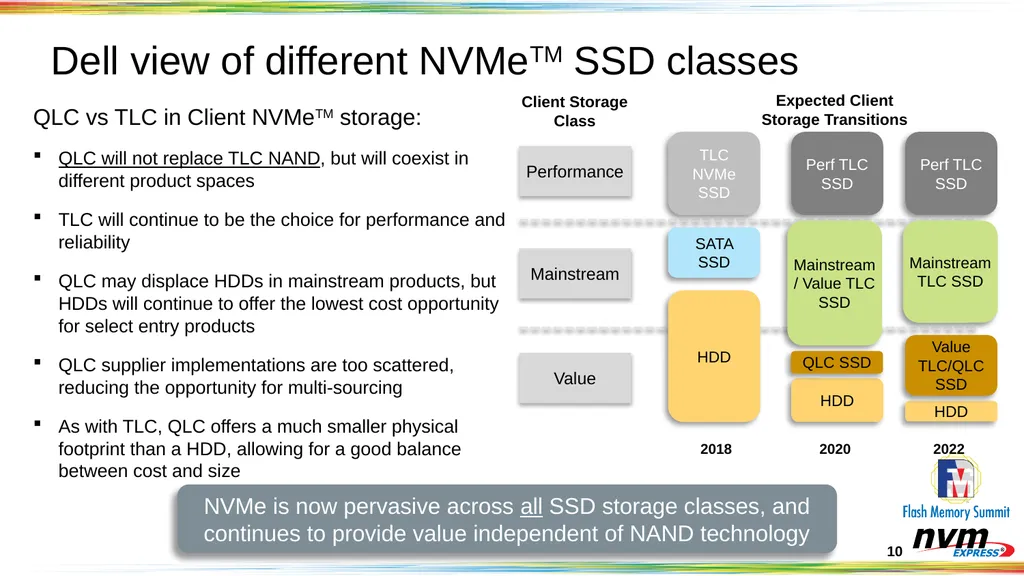
Dell view of different NVMeTM SSD classes QLC vs TLC in Client NVMeTM storage:
QLC will not replace TLC NAND, but will coexist in different product spaces
TLC will continue to be the choice for performance and reliability
QLC may displace HDDs in mainstream products, but HDDs will continue to offer the lowest cost opportunity for select entry products
QLC supplier implementations are too scattered, reducing the opportunity for multi-sourcing
As with TLC, QLC offers a much smaller physical footprint than a HDD, allowing for a good balance between cost and size Client Storage Class Expected Client Storage Transitions Performance Mainstream Value TLC NVMe SSD SATA SSD HDD 2018 2020 2022 Perf TLC SSD HDD Mainstream/ Value TLC SSD Perf TLC SSD HDD Mainstream TLC SSD Value TLC/QLC SSD QLC SSD NVMe is now pervasive across all SSD storage classes, and continues to provide value independent of NAND technology<br>
QLC will not replace TLC NAND, but will coexist in different product spaces
TLC will continue to be the choice for performance and reliability
QLC may displace HDDs in mainstream products, but HDDs will continue to offer the lowest cost opportunity for select entry products
QLC supplier implementations are too scattered, reducing the opportunity for multi-sourcing
As with TLC, QLC offers a much smaller physical footprint than a HDD, allowing for a good balance between cost and size Client Storage Class Expected Client Storage Transitions Performance Mainstream Value TLC NVMe SSD SATA SSD HDD 2018 2020 2022 Perf TLC SSD HDD Mainstream/ Value TLC SSD Perf TLC SSD HDD Mainstream TLC SSD Value TLC/QLC SSD QLC SSD NVMe is now pervasive across all SSD storage classes, and continues to provide value independent of NAND technology<br>
11
Summary There is a wide diversity of Client NVMeTM products based on varied customer needs
Responsiveness matters to the end-user
NVMe SSDs offer value in performance, physical size (mobility) and power efficiency (battery runtime)
Smaller SSD form factors provide space for additional system features and capabilities
Interface and media technologies continue to evolve, offering new benefits and challenges<br>
Responsiveness matters to the end-user
NVMe SSDs offer value in performance, physical size (mobility) and power efficiency (battery runtime)
Smaller SSD form factors provide space for additional system features and capabilities
Interface and media technologies continue to evolve, offering new benefits and challenges<br>
12
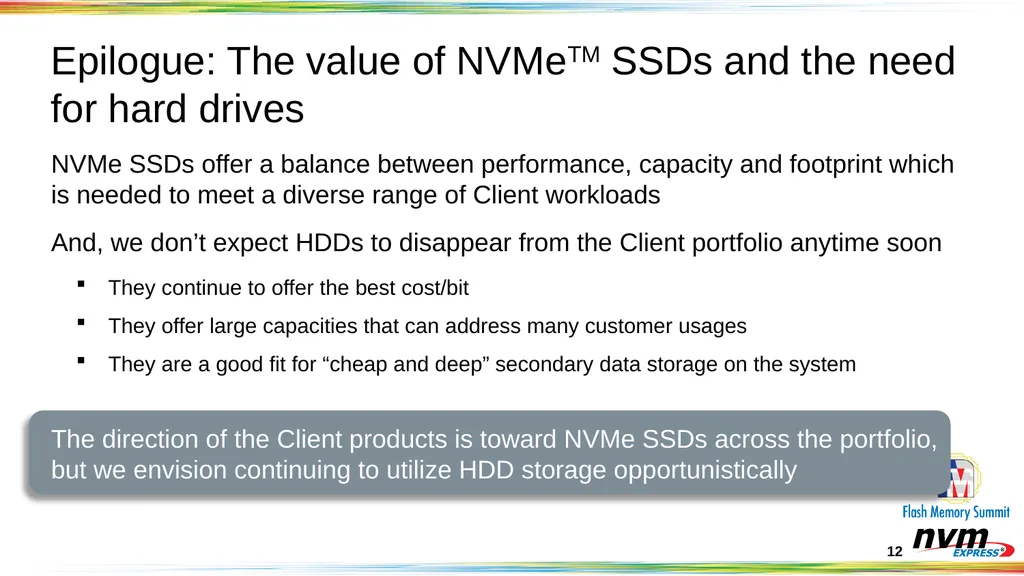
Epilogue: The value of NVMeTM SSDs and the need for hard drives NVMe SSDs offer a balance between performance, capacity and footprint which is needed to meet a diverse range of Client workloads
And, we don’t expect HDDs to disappear from the Client portfolio anytime soon
They continue to offer the best cost/bit
They offer large capacities that can address many customer usages
They are a good fit for “cheap and deep” secondary data storage on the system
The direction of the Client products is toward NVMe SSDs across the portfolio, but we envision continuing to utilize HDD storage opportunistically<br>
And, we don’t expect HDDs to disappear from the Client portfolio anytime soon
They continue to offer the best cost/bit
They offer large capacities that can address many customer usages
They are a good fit for “cheap and deep” secondary data storage on the system
The direction of the Client products is toward NVMe SSDs across the portfolio, but we envision continuing to utilize HDD storage opportunistically<br>
13
SSDs in Client Platform: What should be the design focus? Arijit Chattopadhyay, Client Storage Solution Architect, Intel
Shivashekar Muralishankar, Systems Engineer, Intel
Romesh Trivedi , Principal Engineer , Intel<br>
Shivashekar Muralishankar, Systems Engineer, Intel
Romesh Trivedi , Principal Engineer , Intel<br>
14
Legal Disclaimer All information provided here is subject to change without notice. Contact your Intel representative to obtain the latest Intel product specifications and roadmaps.
The products described in this document may contain design defects or errors known as errata which may cause the product to deviate from published specifications. Current characterized errata are available on request.
Intel technologies’ features and benefits depend on system configuration and may require enabled hardware, software or service activation. Performance varies depending on system configuration. No computer system can be absolutely secure. Check with your system manufacturer or retailer or learn more at intel.com.
Intel disclaims all express and implied warranties, including without limitation, the implied warranties of merchantability, fitness for a particular purpose, and non-infringement, as well as any warranty arising from course of performance, course of dealing, or usage in trade.
Tests document performance of components on a particular test, in specific systems. Differences in hardware, software, or configuration will affect actual performance. Consult other sources of information to evaluate performance as you consider your purchase. For more complete information about performance and benchmark results, visit www.intel.com/benchmarks
Cost reduction scenarios described are intended as examples of how a given Intel-based product, in the specified circumstances and configurations, may affect future costs and provide cost savings. Circumstances will vary. Intel does not guarantee any costs or cost reduction.
Intel does not control or audit third-party data. You should review this content, consult other sources, and confirm whether referenced data are accurate.
Intel, Intel Optane, and others are trademarks of Intel Corporation in the U.S. and/or other countries.
© Intel Corporation.
*Other names and brands may be claimed as the property of others.<br>
The products described in this document may contain design defects or errors known as errata which may cause the product to deviate from published specifications. Current characterized errata are available on request.
Intel technologies’ features and benefits depend on system configuration and may require enabled hardware, software or service activation. Performance varies depending on system configuration. No computer system can be absolutely secure. Check with your system manufacturer or retailer or learn more at intel.com.
Intel disclaims all express and implied warranties, including without limitation, the implied warranties of merchantability, fitness for a particular purpose, and non-infringement, as well as any warranty arising from course of performance, course of dealing, or usage in trade.
Tests document performance of components on a particular test, in specific systems. Differences in hardware, software, or configuration will affect actual performance. Consult other sources of information to evaluate performance as you consider your purchase. For more complete information about performance and benchmark results, visit www.intel.com/benchmarks
Cost reduction scenarios described are intended as examples of how a given Intel-based product, in the specified circumstances and configurations, may affect future costs and provide cost savings. Circumstances will vary. Intel does not guarantee any costs or cost reduction.
Intel does not control or audit third-party data. You should review this content, consult other sources, and confirm whether referenced data are accurate.
Intel, Intel Optane, and others are trademarks of Intel Corporation in the U.S. and/or other countries.
© Intel Corporation.
*Other names and brands may be claimed as the property of others.<br>
15
Agenda Overview
Workload Analysis
Summary & Conclusion<br>
Workload Analysis
Summary & Conclusion<br>
16
Overview<br>
17
Overview Key Client Platform segment requirements:
Most laptops – Responsiveness (Performance) and Battery Life (Power) for common real-life client workloads
High-end Desktop (HEDT) & high-performance laptops (HENB: gaming, content creation) – Performance and higher capacity
Storage subsystem in these platforms are expected to be tuned accordingly
Most client SSDs in market today are tuned for performance, especially at high Queue Depth
With ever-increasing adoption of SSD in laptops, is this the right design choice?
How important is high Queue Depth for real-life client workloads?<br>
Most laptops – Responsiveness (Performance) and Battery Life (Power) for common real-life client workloads
High-end Desktop (HEDT) & high-performance laptops (HENB: gaming, content creation) – Performance and higher capacity
Storage subsystem in these platforms are expected to be tuned accordingly
Most client SSDs in market today are tuned for performance, especially at high Queue Depth
With ever-increasing adoption of SSD in laptops, is this the right design choice?
How important is high Queue Depth for real-life client workloads?<br>
18
Workload Analysis PCMark8* benchmark and other real-life client workloads *Other names and brands may be claimed as the property of others.<br>
19
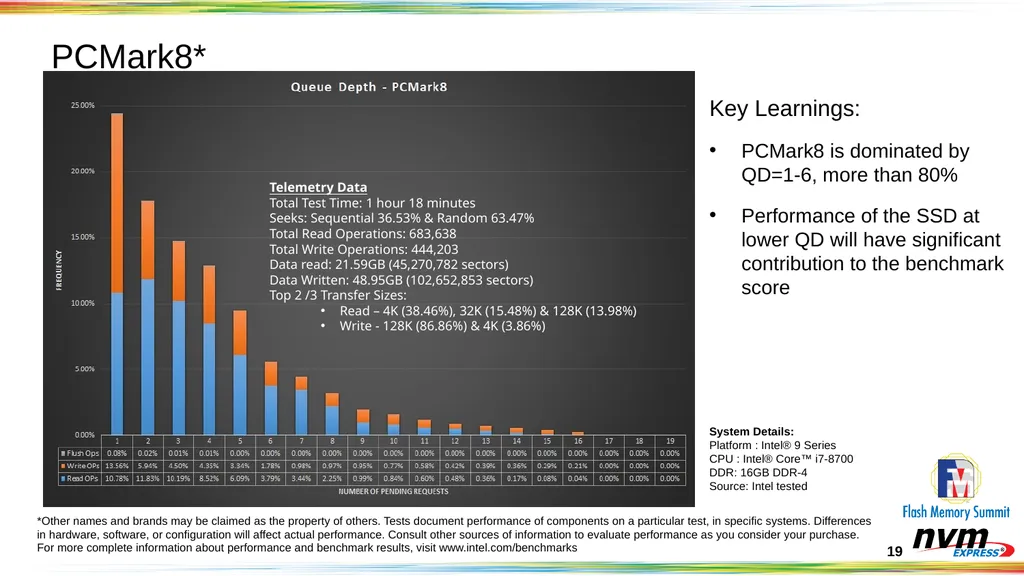
PCMark8* Key Learnings:
PCMark8 is dominated by QD=1-6, more than 80%
Performance of the SSD at lower QD will have significant contribution to the benchmark score Telemetry Data
Total Test Time: 1 hour 18 minutes
Seeks: Sequential 36.53% & Random 63.47%
Total Read Operations: 683,638
Total Write Operations: 444,203
Data read: 21.59GB (45,270,782 sectors)
Data Written: 48.95GB (102,652,853 sectors)
Top 2 /3 Transfer Sizes:
Read – 4K (38.46%), 32K (15.48%) & 128K (13.98%)
Write - 128K (86.86%) & 4K (3.86%) *Other names and brands may be claimed as the property of others. Tests document performance of components on a particular test, in specific systems. Differences in hardware, software, or configuration will affect actual performance. Consult other sources of information to evaluate performance as you consider your purchase. For more complete information about performance and benchmark results, visit www.intel.com/benchmarks System Details:
Platform : Intel® 9 Series
CPU : Intel® Core™ i7-8700
DDR: 16GB DDR-4
Source: Intel tested<br>
PCMark8 is dominated by QD=1-6, more than 80%
Performance of the SSD at lower QD will have significant contribution to the benchmark score Telemetry Data
Total Test Time: 1 hour 18 minutes
Seeks: Sequential 36.53% & Random 63.47%
Total Read Operations: 683,638
Total Write Operations: 444,203
Data read: 21.59GB (45,270,782 sectors)
Data Written: 48.95GB (102,652,853 sectors)
Top 2 /3 Transfer Sizes:
Read – 4K (38.46%), 32K (15.48%) & 128K (13.98%)
Write - 128K (86.86%) & 4K (3.86%) *Other names and brands may be claimed as the property of others. Tests document performance of components on a particular test, in specific systems. Differences in hardware, software, or configuration will affect actual performance. Consult other sources of information to evaluate performance as you consider your purchase. For more complete information about performance and benchmark results, visit www.intel.com/benchmarks System Details:
Platform : Intel® 9 Series
CPU : Intel® Core™ i7-8700
DDR: 16GB DDR-4
Source: Intel tested<br>
20
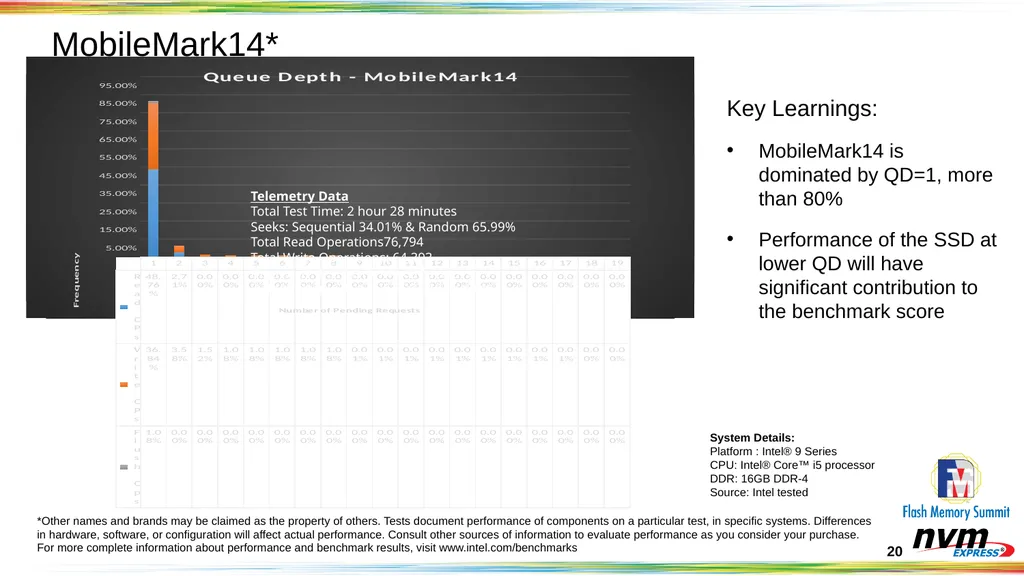
MobileMark14* Key Learnings:
MobileMark14 is dominated by QD=1, more than 80%
Performance of the SSD at lower QD will have significant contribution to the benchmark score Telemetry Data
Total Test Time: 1 hour 18 minutes
Seeks: Sequential 36.53% & Random 63.47%
Total Read Operations: 683,638
Total Write Operations: 444,203
Data read: 21.59GB (45,270,782 sectors)
Data Written: 48.95GB (102,652,853 sectors)
Top 2 /3 Transfer Sizes:
Read – 4K (38.46%), 32K (15.48%) & 128K (13.98%)
Write - 128K (86.86%) & 4K (3.86%) Telemetry Data
Total Test Time: 2 hour 28 minutes
Seeks: Sequential 34.01% & Random 65.99%
Total Read Operations76,794
Total Write Operations: 64,393
Data read: 1.97GB (4,140,697 sectors)
Data Written: 2.81GB (5,893,318 sectors) System Details:
Platform : Intel® 9 Series
CPU: Intel® Core™ i5 processor
DDR: 16GB DDR-4
Source: Intel tested *Other names and brands may be claimed as the property of others. Tests document performance of components on a particular test, in specific systems. Differences in hardware, software, or configuration will affect actual performance. Consult other sources of information to evaluate performance as you consider your purchase. For more complete information about performance and benchmark results, visit www.intel.com/benchmarks<br>
MobileMark14 is dominated by QD=1, more than 80%
Performance of the SSD at lower QD will have significant contribution to the benchmark score Telemetry Data
Total Test Time: 1 hour 18 minutes
Seeks: Sequential 36.53% & Random 63.47%
Total Read Operations: 683,638
Total Write Operations: 444,203
Data read: 21.59GB (45,270,782 sectors)
Data Written: 48.95GB (102,652,853 sectors)
Top 2 /3 Transfer Sizes:
Read – 4K (38.46%), 32K (15.48%) & 128K (13.98%)
Write - 128K (86.86%) & 4K (3.86%) Telemetry Data
Total Test Time: 2 hour 28 minutes
Seeks: Sequential 34.01% & Random 65.99%
Total Read Operations76,794
Total Write Operations: 64,393
Data read: 1.97GB (4,140,697 sectors)
Data Written: 2.81GB (5,893,318 sectors) System Details:
Platform : Intel® 9 Series
CPU: Intel® Core™ i5 processor
DDR: 16GB DDR-4
Source: Intel tested *Other names and brands may be claimed as the property of others. Tests document performance of components on a particular test, in specific systems. Differences in hardware, software, or configuration will affect actual performance. Consult other sources of information to evaluate performance as you consider your purchase. For more complete information about performance and benchmark results, visit www.intel.com/benchmarks<br>
21
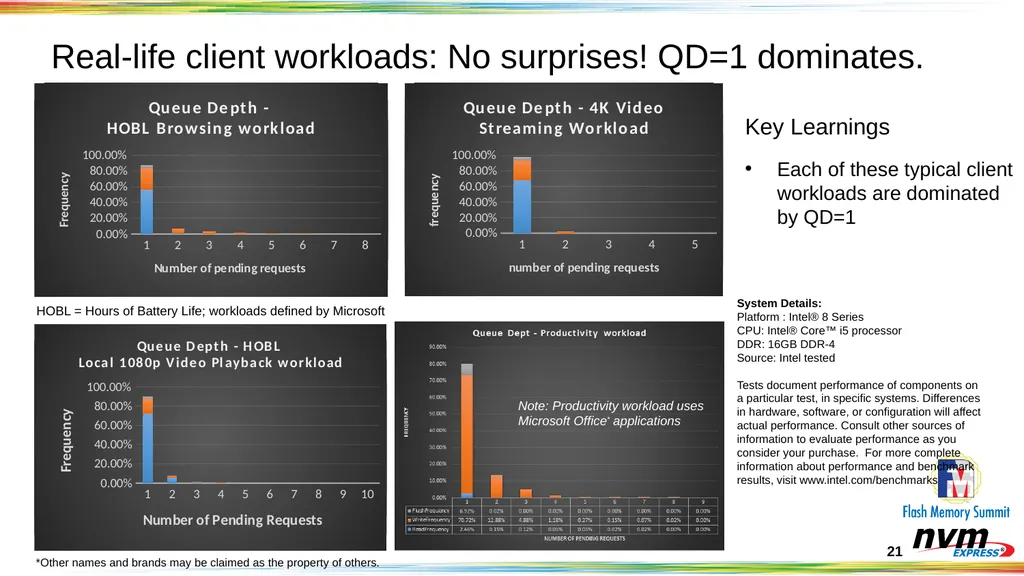
Real-life client workloads: No surprises! QD=1 dominates. Key Learnings
Each of these typical client workloads are dominated by QD=1 Telemetry Data
Seeks: Sequential 36.53% & Random 63.47%
Total Read Operations: 683,638
Total Write Operations: 444,203
Data read: 21.59GB (45,270,782 sectors)
Data Written: 48.95GB (102,652,853 sectors)
Top 2 /3 Transfer Sizes:
Read – 4K (38.46%), 32K (15.48%) & 128K (13.98%)
Write - 128K (86.86%) & 4K (3.86%) Telemetry Data
Total Test Time: 3 minutes
Seeks: Sequential 4.13% & Random 95.87%
Total Read Operations: 2659 (57.43%)
Total Write Operations: 1831 (39.55%)
Data Moved:
Read: 71,777 sectors
Write: 78,904 sectors HOBL = Hours of Battery Life; workloads defined by Microsoft Note: Productivity workload uses Microsoft Office* applications *Other names and brands may be claimed as the property of others. System Details:
Platform : Intel® 8 Series
CPU: Intel® Core™ i5 processor
DDR: 16GB DDR-4
Source: Intel tested
Tests document performance of components on a particular test, in specific systems. Differences in hardware, software, or configuration will affect actual performance. Consult other sources of information to evaluate performance as you consider your purchase. For more complete information about performance and benchmark results, visit www.intel.com/benchmarks<br>
Each of these typical client workloads are dominated by QD=1 Telemetry Data
Seeks: Sequential 36.53% & Random 63.47%
Total Read Operations: 683,638
Total Write Operations: 444,203
Data read: 21.59GB (45,270,782 sectors)
Data Written: 48.95GB (102,652,853 sectors)
Top 2 /3 Transfer Sizes:
Read – 4K (38.46%), 32K (15.48%) & 128K (13.98%)
Write - 128K (86.86%) & 4K (3.86%) Telemetry Data
Total Test Time: 3 minutes
Seeks: Sequential 4.13% & Random 95.87%
Total Read Operations: 2659 (57.43%)
Total Write Operations: 1831 (39.55%)
Data Moved:
Read: 71,777 sectors
Write: 78,904 sectors HOBL = Hours of Battery Life; workloads defined by Microsoft Note: Productivity workload uses Microsoft Office* applications *Other names and brands may be claimed as the property of others. System Details:
Platform : Intel® 8 Series
CPU: Intel® Core™ i5 processor
DDR: 16GB DDR-4
Source: Intel tested
Tests document performance of components on a particular test, in specific systems. Differences in hardware, software, or configuration will affect actual performance. Consult other sources of information to evaluate performance as you consider your purchase. For more complete information about performance and benchmark results, visit www.intel.com/benchmarks<br>
22
Conclusion<br>
23
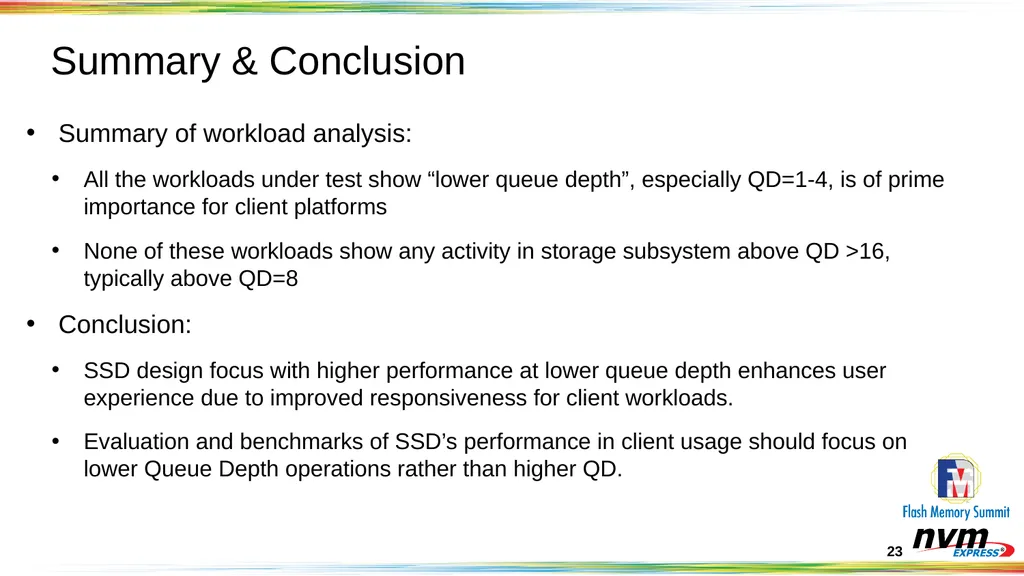
Summary & Conclusion Summary of workload analysis:
All the workloads under test show “lower queue depth”, especially QD=1-4, is of prime importance for client platforms
None of these workloads show any activity in storage subsystem above QD >16, typically above QD=8
Conclusion:
SSD design focus with higher performance at lower queue depth enhances user experience due to improved responsiveness for client workloads.
Evaluation and benchmarks of SSD’s performance in client usage should focus on lower Queue Depth operations rather than higher QD.<br>
All the workloads under test show “lower queue depth”, especially QD=1-4, is of prime importance for client platforms
None of these workloads show any activity in storage subsystem above QD >16, typically above QD=8
Conclusion:
SSD design focus with higher performance at lower queue depth enhances user experience due to improved responsiveness for client workloads.
Evaluation and benchmarks of SSD’s performance in client usage should focus on lower Queue Depth operations rather than higher QD.<br>
24
Questions?<br>