
Climate Change Litigation Rowan Clapp, Asitha
EM
Published · 24 slides · 0 views
1 / 1


Description
Climate Change Litigation Rowan Clapp, Asitha Ranatunga, and Estelle Dehon Climate change policy in the UK Climate change policy in the UK Climate Change Act 2008 (CCA 2008) CCA 2008 (as amended by The Climate Change Act 2008 (2050 Target
Related Topics
Share
Embed code
Download this presentation From Below
"Climate Change Litigation Rowan Clapp, Asitha" is the property of its rightful owner. Permission is granted to download and print the materials on this website for personal, non-commercial use only, and to display it on your personal computer provided you do not modify the materials and that you retain all copyright notices contained in the materials. By downloading content from our website, you accept the terms of this agreement.
Presentation Transcript
01
Climate Change Litigation Rowan Clapp, Asitha Ranatunga, and Estelle Dehon<br>
02
Climate change policy in the UK<br>
03
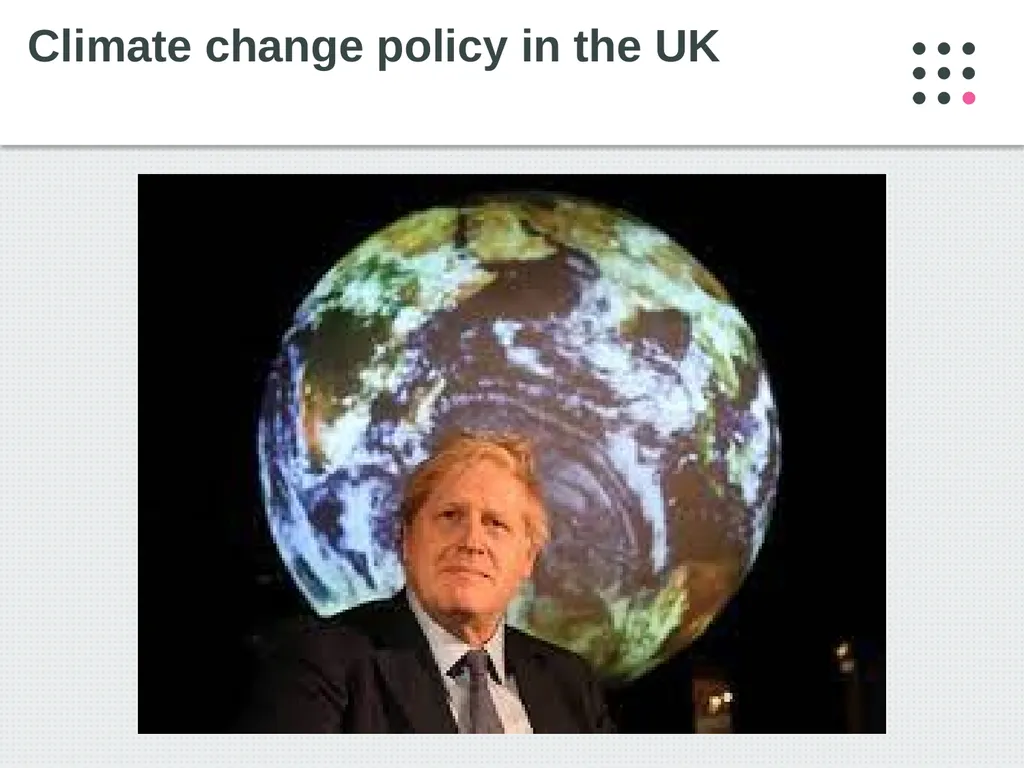
Climate change policy in the UK<br>
04
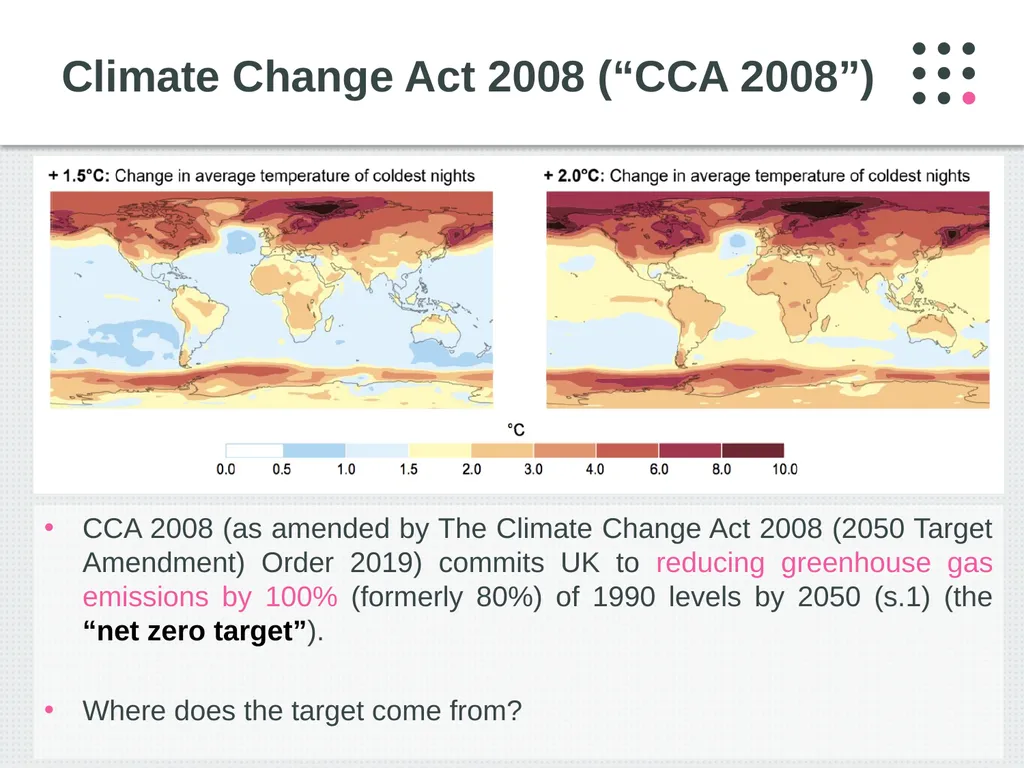
Climate Change Act 2008 (“CCA 2008”) CCA 2008 (as amended by The Climate Change Act 2008 (2050 Target Amendment) Order 2019) commits UK to reducing greenhouse gas emissions by 100% (formerly 80%) of 1990 levels by 2050 (s.1) (the “net zero target”).
Where does the target come from?<br>
Where does the target come from?<br>
05
The 2oC warming target<br>
06
The Paris Agreement Commits signatories to hold increase in global average temperature to “well below” 2oC above pre-industrial levels.
Pursue efforts to limit the temperature increase to 1.5oC above pre-industrial levels.
Boris Johnson to UN General Assembly on 22 September 2021: “we must limit the rise in temperatures – whose appalling effects were visible even this summer – to 1.5 degrees.”<br>
Pursue efforts to limit the temperature increase to 1.5oC above pre-industrial levels.
Boris Johnson to UN General Assembly on 22 September 2021: “we must limit the rise in temperatures – whose appalling effects were visible even this summer – to 1.5 degrees.”<br>
07
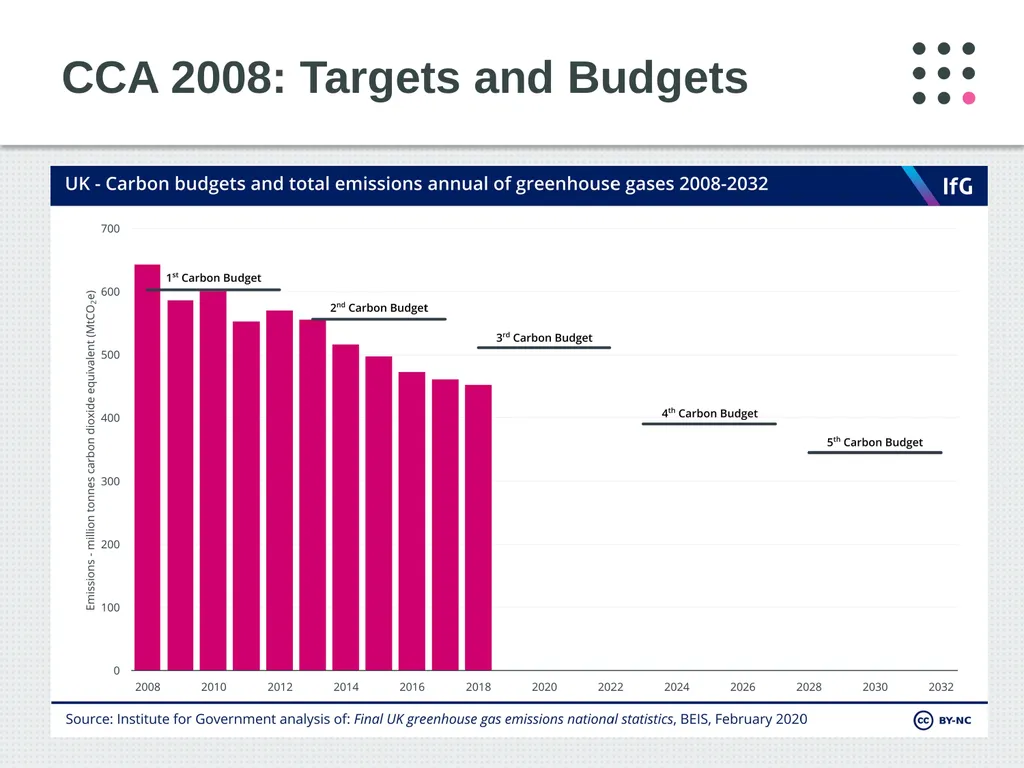
CCA 2008: Targets and Budgets CCA 2008 requires ‘carbon budgets’ as stepping stones to the net zero target (s.4(1)(a)).
SoS has obligation to ensure carbon account for any period does not exceed the budget (s.4(1)(b)).
Committee on Climate Change (“CCC”) established to advise on the correct total carbon reduction target (s.33), on the level of each carbon budget (s.34) and on annual progress (s.36).
Sixth Carbon Budget: 78% emissions reduction by 2035 (The Carbon Budget Order 2021, Art. 2).
An aspect of “Nationally Determined Contributions” (NDCs) under the Paris Agreement. Latest NDC is to reduce greenhouse gas emissions by at least 68% by 2030 (vs 1990 levels) to meet 1.5oC warming goal.<br>
SoS has obligation to ensure carbon account for any period does not exceed the budget (s.4(1)(b)).
Committee on Climate Change (“CCC”) established to advise on the correct total carbon reduction target (s.33), on the level of each carbon budget (s.34) and on annual progress (s.36).
Sixth Carbon Budget: 78% emissions reduction by 2035 (The Carbon Budget Order 2021, Art. 2).
An aspect of “Nationally Determined Contributions” (NDCs) under the Paris Agreement. Latest NDC is to reduce greenhouse gas emissions by at least 68% by 2030 (vs 1990 levels) to meet 1.5oC warming goal.<br>
08
CCA 2008: Targets and Budgets<br>
09
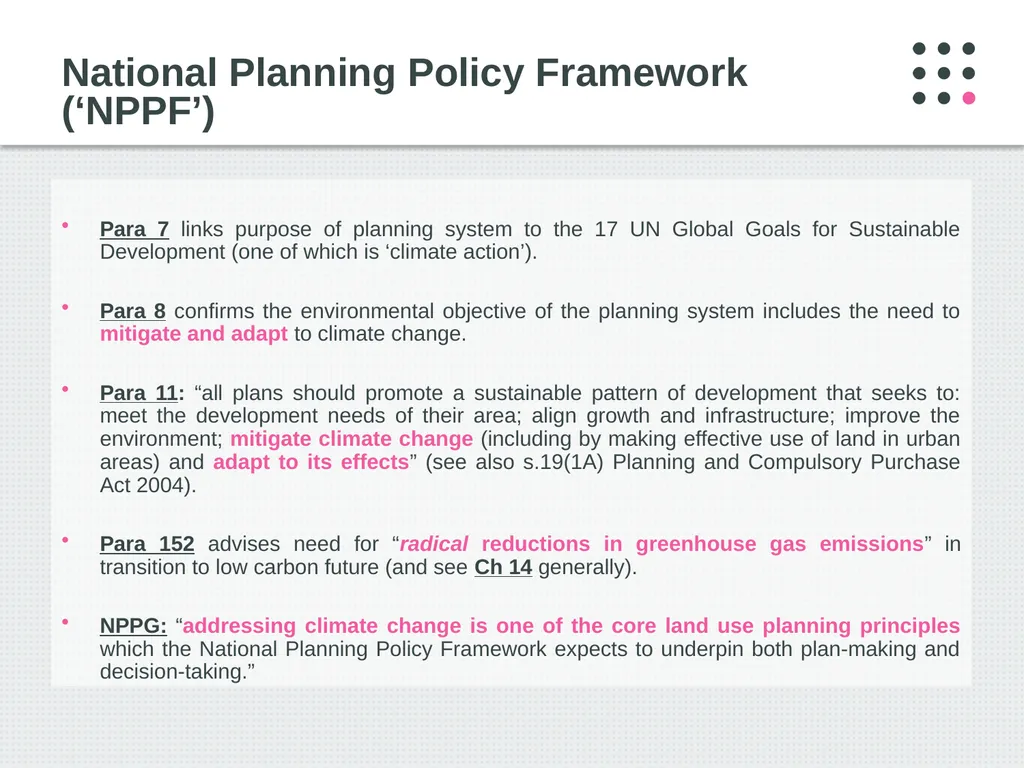
National Planning Policy Framework (‘NPPF’) Para 7 links purpose of planning system to the 17 UN Global Goals for Sustainable Development (one of which is ‘climate action’).
Para 8 confirms the environmental objective of the planning system includes the need to mitigate and adapt to climate change.
Para 11: “all plans should promote a sustainable pattern of development that seeks to: meet the development needs of their area; align growth and infrastructure; improve the environment; mitigate climate change (including by making effective use of land in urban areas) and adapt to its effects” (see also s.19(1A) Planning and Compulsory Purchase Act 2004).
Para 152 advises need for “radical reductions in greenhouse gas emissions” in transition to low carbon future (and see Ch 14 generally).
NPPG: “addressing climate change is one of the core land use planning principles which the National Planning Policy Framework expects to underpin both plan-making and decision-taking.”<br>
Para 8 confirms the environmental objective of the planning system includes the need to mitigate and adapt to climate change.
Para 11: “all plans should promote a sustainable pattern of development that seeks to: meet the development needs of their area; align growth and infrastructure; improve the environment; mitigate climate change (including by making effective use of land in urban areas) and adapt to its effects” (see also s.19(1A) Planning and Compulsory Purchase Act 2004).
Para 152 advises need for “radical reductions in greenhouse gas emissions” in transition to low carbon future (and see Ch 14 generally).
NPPG: “addressing climate change is one of the core land use planning principles which the National Planning Policy Framework expects to underpin both plan-making and decision-taking.”<br>
10
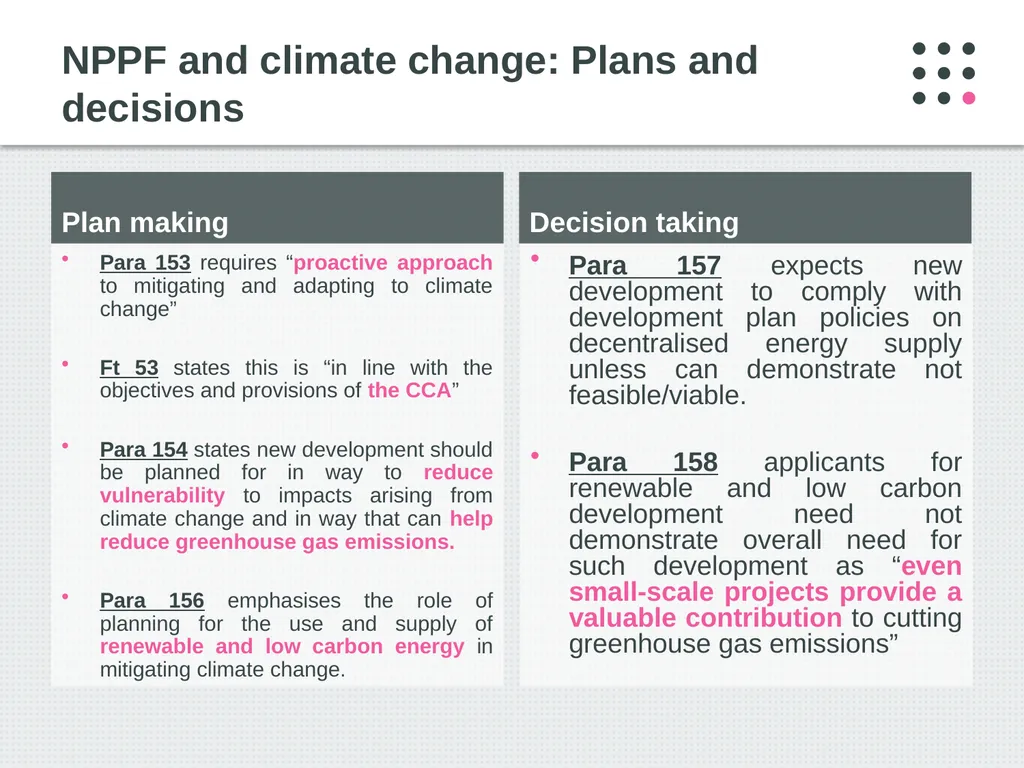
NPPF and climate change: Plans and decisions Plan making Para 153 requires “proactive approach to mitigating and adapting to climate change”
Ft 53 states this is “in line with the objectives and provisions of the CCA”
Para 154 states new development should be planned for in way to reduce vulnerability to impacts arising from climate change and in way that can help reduce greenhouse gas emissions.
Para 156 emphasises the role of planning for the use and supply of renewable and low carbon energy in mitigating climate change. Decision taking Para 157 expects new development to comply with development plan policies on decentralised energy supply unless can demonstrate not feasible/viable.
Para 158 applicants for renewable and low carbon development need not demonstrate overall need for such development as “even small-scale projects provide a valuable contribution to cutting greenhouse gas emissions”<br>
Ft 53 states this is “in line with the objectives and provisions of the CCA”
Para 154 states new development should be planned for in way to reduce vulnerability to impacts arising from climate change and in way that can help reduce greenhouse gas emissions.
Para 156 emphasises the role of planning for the use and supply of renewable and low carbon energy in mitigating climate change. Decision taking Para 157 expects new development to comply with development plan policies on decentralised energy supply unless can demonstrate not feasible/viable.
Para 158 applicants for renewable and low carbon development need not demonstrate overall need for such development as “even small-scale projects provide a valuable contribution to cutting greenhouse gas emissions”<br>
11
Climate change policy: appeal decisions<br>
12
The reach of climate change policy At a high level, climate action is an integral part of achieving sustainable development (NPPF, 7).
Environmental Objective: ‘.. mitigating and adapting to climate change, including moving to a low carbon economy.’ (NPPF, 8(c))
But the means to achieve that objective is plan-making and policy formulation (NPPF, 153-155); less so decision making:
‘.. local planning authorities should expect new development to take account of landform, layout, building orientation, massing and landscaping to minimise energy consumption.’ (NPPF, 157(b))<br>
Environmental Objective: ‘.. mitigating and adapting to climate change, including moving to a low carbon economy.’ (NPPF, 8(c))
But the means to achieve that objective is plan-making and policy formulation (NPPF, 153-155); less so decision making:
‘.. local planning authorities should expect new development to take account of landform, layout, building orientation, massing and landscaping to minimise energy consumption.’ (NPPF, 157(b))<br>
13
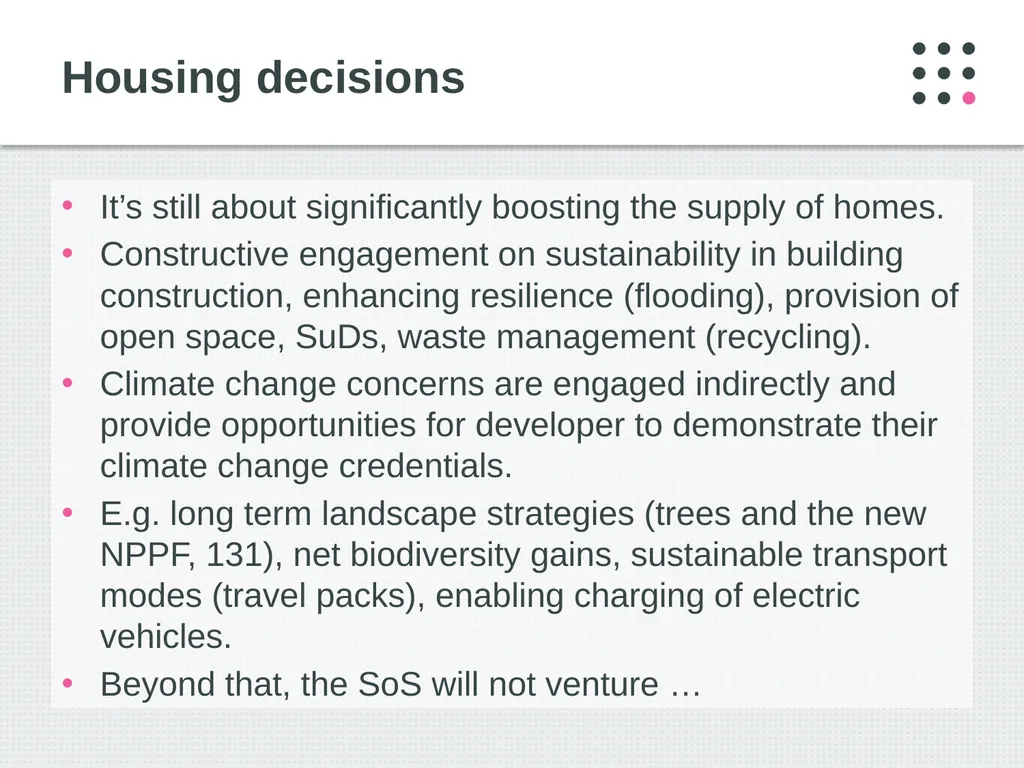
Housing decisions It’s still about significantly boosting the supply of homes.
Constructive engagement on sustainability in building construction, enhancing resilience (flooding), provision of open space, SuDs, waste management (recycling).
Climate change concerns are engaged indirectly and provide opportunities for developer to demonstrate their climate change credentials.
E.g. long term landscape strategies (trees and the new NPPF, 131), net biodiversity gains, sustainable transport modes (travel packs), enabling charging of electric vehicles.
Beyond that, the SoS will not venture …<br>
Constructive engagement on sustainability in building construction, enhancing resilience (flooding), provision of open space, SuDs, waste management (recycling).
Climate change concerns are engaged indirectly and provide opportunities for developer to demonstrate their climate change credentials.
E.g. long term landscape strategies (trees and the new NPPF, 131), net biodiversity gains, sustainable transport modes (travel packs), enabling charging of electric vehicles.
Beyond that, the SoS will not venture …<br>
14
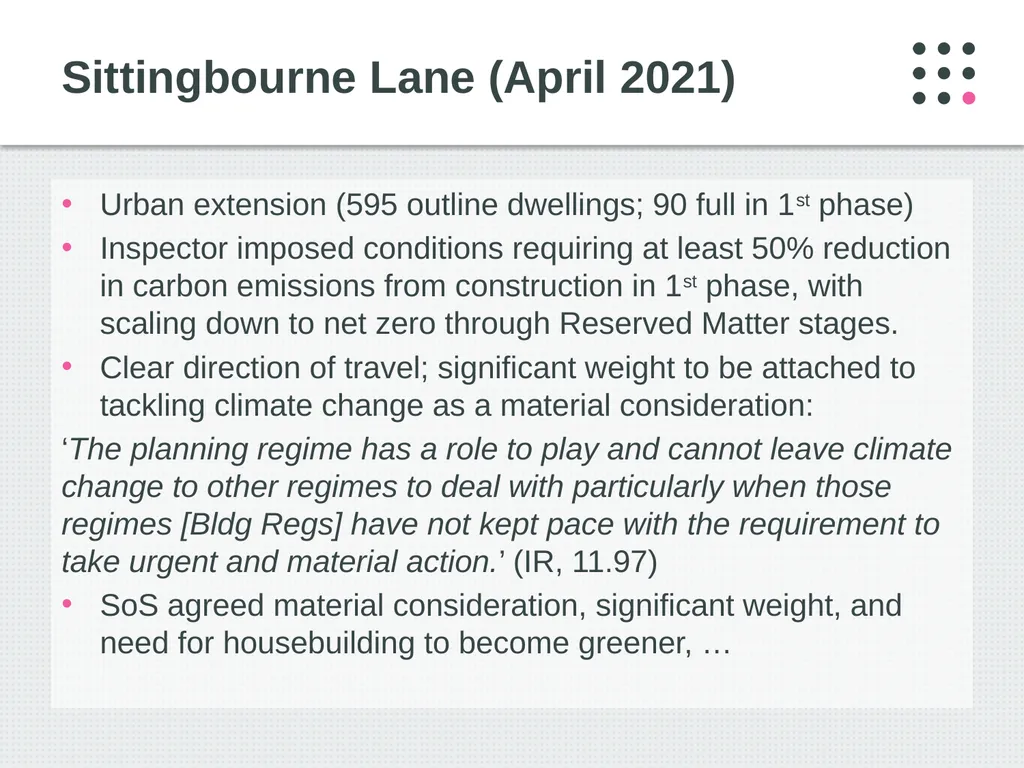
Sittingbourne Lane (April 2021) Urban extension (595 outline dwellings; 90 full in 1st phase)
Inspector imposed conditions requiring at least 50% reduction in carbon emissions from construction in 1st phase, with scaling down to net zero through Reserved Matter stages.
Clear direction of travel; significant weight to be attached to tackling climate change as a material consideration:
‘The planning regime has a role to play and cannot leave climate change to other regimes to deal with particularly when those regimes [Bldg Regs] have not kept pace with the requirement to take urgent and material action.’ (IR, 11.97)
SoS agreed material consideration, significant weight, and need for housebuilding to become greener, …<br>
Inspector imposed conditions requiring at least 50% reduction in carbon emissions from construction in 1st phase, with scaling down to net zero through Reserved Matter stages.
Clear direction of travel; significant weight to be attached to tackling climate change as a material consideration:
‘The planning regime has a role to play and cannot leave climate change to other regimes to deal with particularly when those regimes [Bldg Regs] have not kept pace with the requirement to take urgent and material action.’ (IR, 11.97)
SoS agreed material consideration, significant weight, and need for housebuilding to become greener, …<br>
15
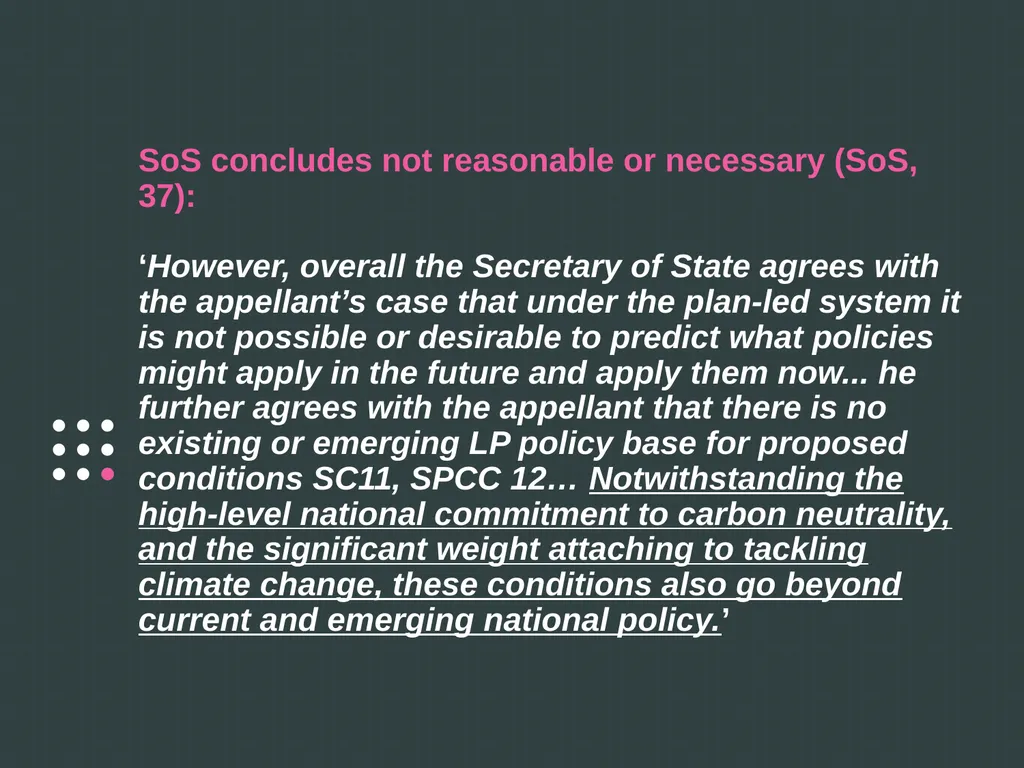
SoS concludes not reasonable or necessary (SoS, 37):
‘However, overall the Secretary of State agrees with the appellant’s case that under the plan-led system it is not possible or desirable to predict what policies might apply in the future and apply them now... he further agrees with the appellant that there is no existing or emerging LP policy base for proposed conditions SC11, SPCC 12… Notwithstanding the high-level national commitment to carbon neutrality, and the significant weight attaching to tackling climate change, these conditions also go beyond current and emerging national policy.’<br>
16
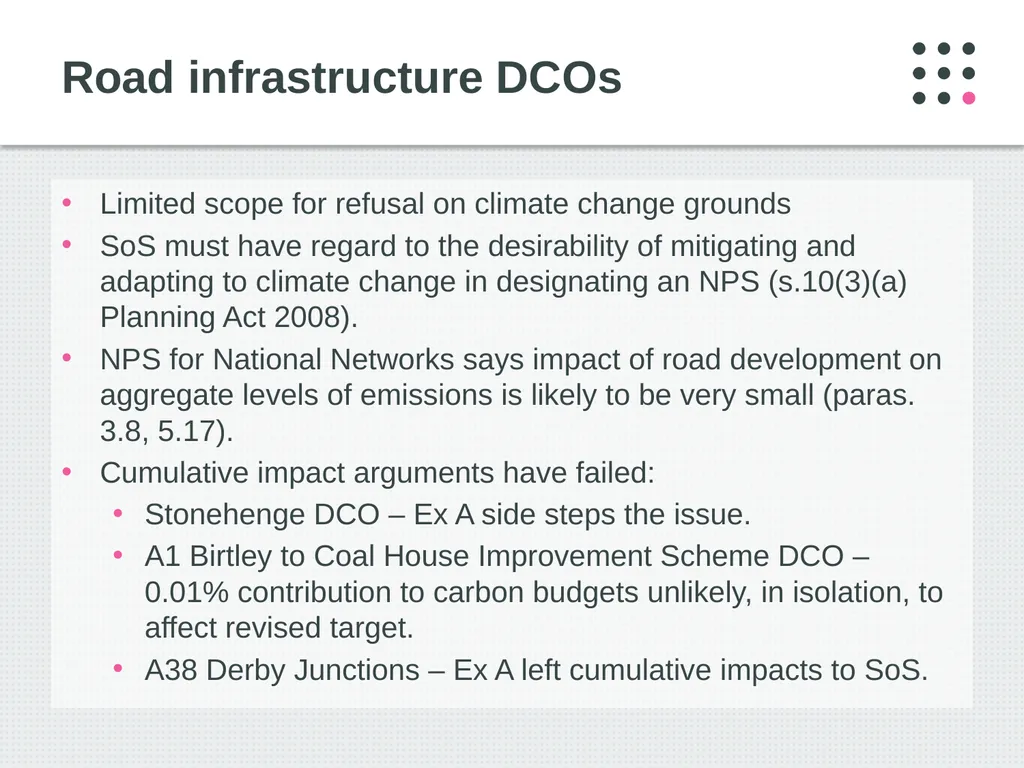
Road infrastructure DCOs Limited scope for refusal on climate change grounds
SoS must have regard to the desirability of mitigating and adapting to climate change in designating an NPS (s.10(3)(a) Planning Act 2008).
NPS for National Networks says impact of road development on aggregate levels of emissions is likely to be very small (paras. 3.8, 5.17).
Cumulative impact arguments have failed:
Stonehenge DCO – Ex A side steps the issue.
A1 Birtley to Coal House Improvement Scheme DCO – 0.01% contribution to carbon budgets unlikely, in isolation, to affect revised target.
A38 Derby Junctions – Ex A left cumulative impacts to SoS.<br>
SoS must have regard to the desirability of mitigating and adapting to climate change in designating an NPS (s.10(3)(a) Planning Act 2008).
NPS for National Networks says impact of road development on aggregate levels of emissions is likely to be very small (paras. 3.8, 5.17).
Cumulative impact arguments have failed:
Stonehenge DCO – Ex A side steps the issue.
A1 Birtley to Coal House Improvement Scheme DCO – 0.01% contribution to carbon budgets unlikely, in isolation, to affect revised target.
A38 Derby Junctions – Ex A left cumulative impacts to SoS.<br>
17
Airport expansion Aviation is not exempt from NPPF objectives, but aviation specific policy is broadly supportive of expansion.
“Recent” national policy supports making best use of existing runways (complementing policy supporting the 3rd runway at Heathrow) (MBU, ANPS – June 2018)
But neither are calibrated to net zero, and specifically the June 2019 amendment to the CCA 2008.
LPAs dealing with < 10mppa increases have had to grapple with their own resolutions to tackle the climate emergency, the long term effects of airport expansion, and the direction of travel of emerging policy on carbon emissions, including strong statements from the CCC.
CCC formally recommended that there should be no net expansion of capacity unless the aviation sector is on track to outperform its net emissions trajectory and can accommodate the additional demand (Recommendations for 6th CB)<br>
“Recent” national policy supports making best use of existing runways (complementing policy supporting the 3rd runway at Heathrow) (MBU, ANPS – June 2018)
But neither are calibrated to net zero, and specifically the June 2019 amendment to the CCA 2008.
LPAs dealing with < 10mppa increases have had to grapple with their own resolutions to tackle the climate emergency, the long term effects of airport expansion, and the direction of travel of emerging policy on carbon emissions, including strong statements from the CCC.
CCC formally recommended that there should be no net expansion of capacity unless the aviation sector is on track to outperform its net emissions trajectory and can accommodate the additional demand (Recommendations for 6th CB)<br>
18
The Government’s response to CCC (Oct 2021, A6):
‘Flying is a social and economic good, and one that we wholeheartedly support as a key part of building a global Britain. We currently believe that the aviation sector, even if returning to a preCOVID-19 demand trajectory, can achieve Jet Zero without the government needing to intervene directly to limit aviation growth. DfT analysis shows that there are scenarios where we can achieve our net zero targets by focusing on new fuels and technology, rather than capping demand, with knock-on economic and social benefits.
As a responsible government, we recognise that we will need to keep our strategy under review. As such, we intend to assess progress on the sector’s CO2 emission reduction pathway and our strategy for delivering through five-year reviews.’<br>
19
Airport expansion: examples Stansted (May 2021, 8mppa increase)
At appeal, LPA sought a condition tying actual passenger growth to demonstration that levels derived from ES (including carbon emission reductions) had actually been met. Assessment against carbon emissions targets at time of actual expansion.
Basis - sharing the benefits of aviation growth (APF), and direction of travel of emerging climate change policy.
Rejected by Inspector Panel on facts (assessed effects) and policy (MBU).
Manston Airport DCO (Oct 2019, freight hub)
Ex A recommended refusal. On carbon emissions, took account of direction of travel of emerging climate change policy and concluded that emissions (1.9% of carbon budget) would have a material impact on ability of Government to meet targets.
SoS’s grant of DCO was quashed on unrelated reasons grounds<br>
At appeal, LPA sought a condition tying actual passenger growth to demonstration that levels derived from ES (including carbon emission reductions) had actually been met. Assessment against carbon emissions targets at time of actual expansion.
Basis - sharing the benefits of aviation growth (APF), and direction of travel of emerging climate change policy.
Rejected by Inspector Panel on facts (assessed effects) and policy (MBU).
Manston Airport DCO (Oct 2019, freight hub)
Ex A recommended refusal. On carbon emissions, took account of direction of travel of emerging climate change policy and concluded that emissions (1.9% of carbon budget) would have a material impact on ability of Government to meet targets.
SoS’s grant of DCO was quashed on unrelated reasons grounds<br>
20
Recent climate change litigation in the higher courts<br>
21
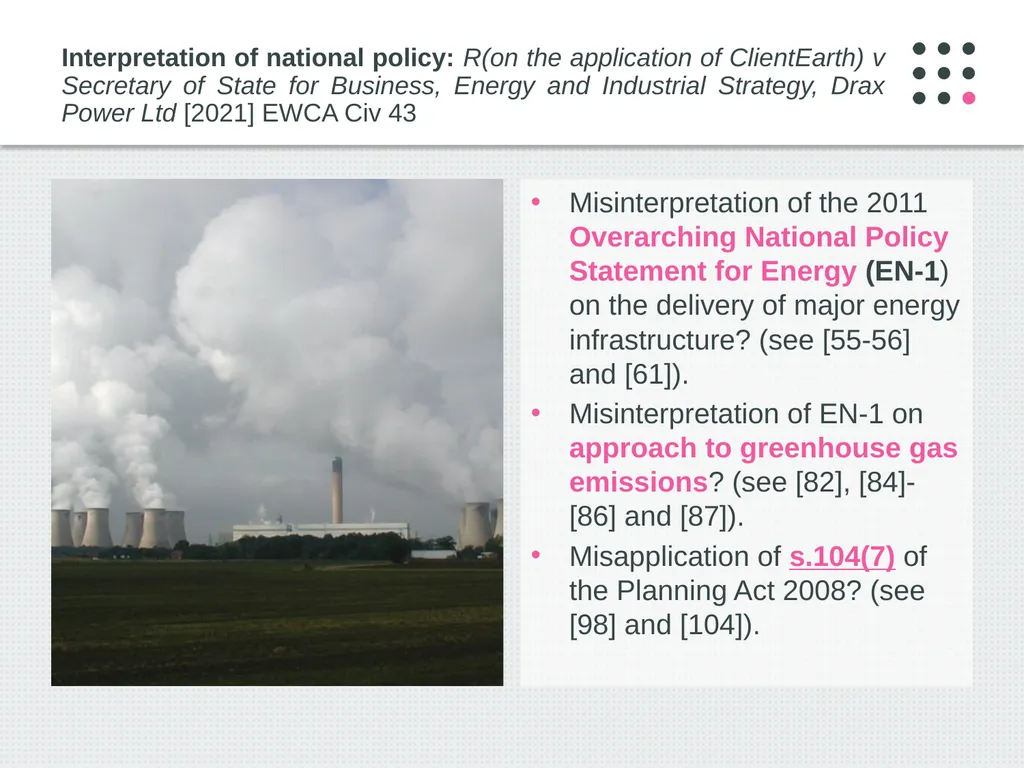
Interpretation of national policy: R(on the application of ClientEarth) v Secretary of State for Business, Energy and Industrial Strategy, Drax Power Ltd [2021] EWCA Civ 43 Misinterpretation of the 2011 Overarching National Policy Statement for Energy (EN-1) on the delivery of major energy infrastructure? (see [55-56] and [61]).
Misinterpretation of EN-1 on approach to greenhouse gas emissions? (see [82], [84]-[86] and [87]).
Misapplication of s.104(7) of the Planning Act 2008? (see [98] and [104]).<br>
Misinterpretation of EN-1 on approach to greenhouse gas emissions? (see [82], [84]-[86] and [87]).
Misapplication of s.104(7) of the Planning Act 2008? (see [98] and [104]).<br>
22
Scope of what must be assessed under the EIA regulations 2017: R(Finch) v Surrey County Council [2020] EWHC 3566 (Admin) What were the requirements for assessment under the Town and Country Planning (Environmental Impact Assessment) Regulations 2017 (“EIA Regs”)?
Regulation 18(b) of the EIA regs requires the ES to include (at least) “a description of the likely significant effects of the proposed development on the environment”
Para 5 of Sch 4 to the EIA Regs requires a “description of the likely significant effects of the development on the environment resulting from, inter alia, (a) the construction and existence of the development […] (f) the impact of the project on climate (for example the nature and magnitude of greenhouse gas emissions) and the vulnerability of the project to climate change.”
Were downstream greenhouse gas emissions “likely significant effects of the development” forming part of the “impact of the project on climate”? See Holgate J at [101].
Appeal to be heard in mid-November 2021.
Key distinction between technical requirements of EIA regs and whether downstream emissions can be material considerations at all.<br>
Regulation 18(b) of the EIA regs requires the ES to include (at least) “a description of the likely significant effects of the proposed development on the environment”
Para 5 of Sch 4 to the EIA Regs requires a “description of the likely significant effects of the development on the environment resulting from, inter alia, (a) the construction and existence of the development […] (f) the impact of the project on climate (for example the nature and magnitude of greenhouse gas emissions) and the vulnerability of the project to climate change.”
Were downstream greenhouse gas emissions “likely significant effects of the development” forming part of the “impact of the project on climate”? See Holgate J at [101].
Appeal to be heard in mid-November 2021.
Key distinction between technical requirements of EIA regs and whether downstream emissions can be material considerations at all.<br>
23
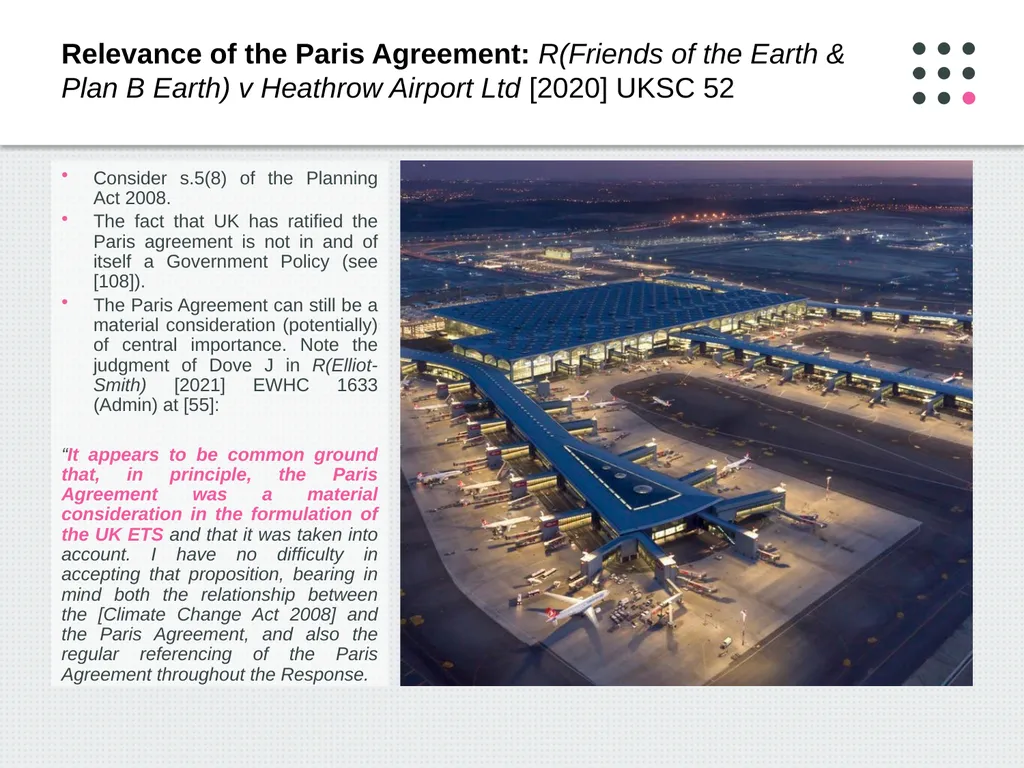
Consider s.5(8) of the Planning Act 2008.
The fact that UK has ratified the Paris agreement is not in and of itself a Government Policy (see [108]).
The Paris Agreement can still be a material consideration (potentially) of central importance. Note the judgment of Dove J in R(Elliot-Smith) [2021] EWHC 1633 (Admin) at [55]:
“It appears to be common ground that, in principle, the Paris Agreement was a material consideration in the formulation of the UK ETS and that it was taken into account. I have no difficulty in accepting that proposition, bearing in mind both the relationship between the [Climate Change Act 2008] and the Paris Agreement, and also the regular referencing of the Paris Agreement throughout the Response. Relevance of the Paris Agreement: R(Friends of the Earth & Plan B Earth) v Heathrow Airport Ltd [2020] UKSC 52<br>
The fact that UK has ratified the Paris agreement is not in and of itself a Government Policy (see [108]).
The Paris Agreement can still be a material consideration (potentially) of central importance. Note the judgment of Dove J in R(Elliot-Smith) [2021] EWHC 1633 (Admin) at [55]:
“It appears to be common ground that, in principle, the Paris Agreement was a material consideration in the formulation of the UK ETS and that it was taken into account. I have no difficulty in accepting that proposition, bearing in mind both the relationship between the [Climate Change Act 2008] and the Paris Agreement, and also the regular referencing of the Paris Agreement throughout the Response. Relevance of the Paris Agreement: R(Friends of the Earth & Plan B Earth) v Heathrow Airport Ltd [2020] UKSC 52<br>
24
Thank you. Rowan Clapp, Asitha Ranatunga, and Estelle Dehon Email:
rclapp@cornerstonebarristers.com
ar@cornerstonebarristers.com estelled@cornerstonebarristers.com<br>
rclapp@cornerstonebarristers.com
ar@cornerstonebarristers.com estelled@cornerstonebarristers.com<br>