
Climate Justice: Pacific Northwest Indigenous
TG
Published · 16 slides · 0 views

1 / 1
Description
Climate Justice: Pacific Northwest Indigenous Culture and the importance of Western Redcedar https:cdn.britannica.com8342183-050-3D867EF1totem-pole-Tlingit-community-house-Totem-Bight.jpg?w300
Related Topics
Share
Embed code
Download this presentation From Below
"Climate Justice: Pacific Northwest Indigenous" is the property of its rightful owner. Permission is granted to download and print the materials on this website for personal, non-commercial use only, and to display it on your personal computer provided you do not modify the materials and that you retain all copyright notices contained in the materials. By downloading content from our website, you accept the terms of this agreement.
Presentation Transcript
01
Climate Justice: Pacific Northwest Indigenous Culture and the importance of Western Redcedar https://cdn.britannica.com/83/42183-050-3D867EF1/totem-pole-Tlingit-community-house-Totem-Bight.jpg?w=300 https://cdn.britannica.com/31/213531-050-6F414192/Hiker-Western-red-cedar-trees-Thuja-plicata-British-Columbia-Candada.jpg?w=400&h=300&c=crop On this slide, I show a picture of a cedar tree found in the link below On this slide, I show a picture of a totem pole and a Tlingit community house found in the link below<br>
02
Why are cedars dying in the PNW? Unpacking the science What did you learn from your readings? Why are cedar trees dying? Discuss
Short answer: summer drought is becoming more stressful!
Long answer: Andrus et. al have learned:
Tree mortality was preceded by 4-5 years of declining secondary or “radial” growth.
Warmer, drier conditions in May and June caused poor radial growth.
Coastal WRC had a hard time recovering from extended drought into the Fall.
“Failure of hydraulic systems and dehydration of tissues may result in partial canopy dieback and mortality if unfavorable conditions persist.”
?Which means? Let’s unpack each term<br>
Short answer: summer drought is becoming more stressful!
Long answer: Andrus et. al have learned:
Tree mortality was preceded by 4-5 years of declining secondary or “radial” growth.
Warmer, drier conditions in May and June caused poor radial growth.
Coastal WRC had a hard time recovering from extended drought into the Fall.
“Failure of hydraulic systems and dehydration of tissues may result in partial canopy dieback and mortality if unfavorable conditions persist.”
?Which means? Let’s unpack each term<br>
03
“WRC trees close their stomata to limit water loss during periods of low soil moisture availability (Grossnickle et al. 2005) and are more vulnerable to cavitation for some organs and can have smaller root systems than co-occurring species (e.g., Douglas-fir) (Mcculloh et al. 2014). Warm and dry conditions during the recovery period may have slowed recovery of water transport capacity (due to cavitation) and lengthened the period of stomatal closure, thereby lowering photosynthesis and reducing carbon gain, as has been observed for other conifers”
Let’s step out the mechanism<br>
Let’s step out the mechanism<br>
04
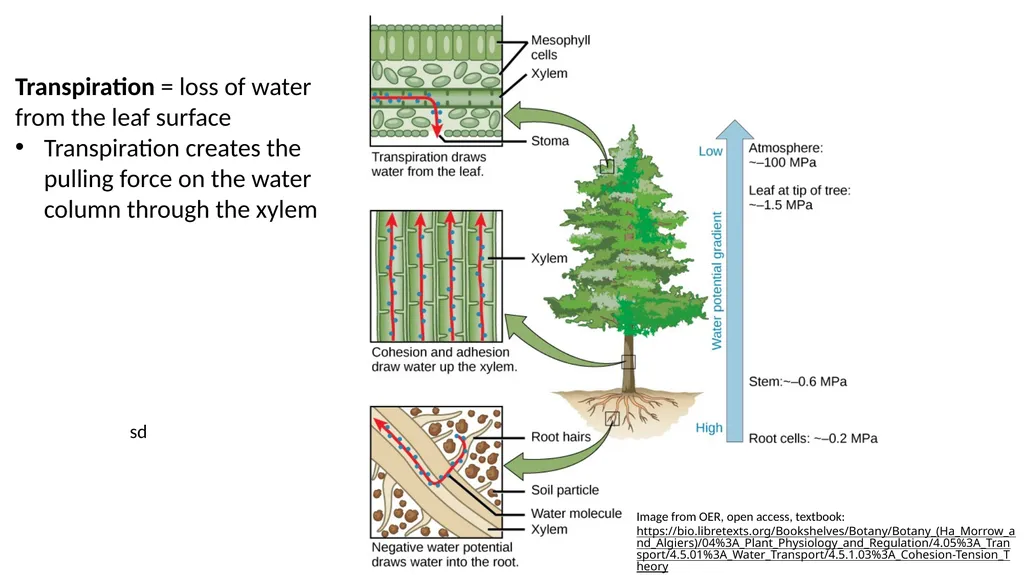
Transpiration = loss of water from the leaf surface
Transpiration creates the pulling force on the water column through the xylem Image from OER, open access, textbook:
https://bio.libretexts.org/Bookshelves/Botany/Botany_(Ha_Morrow_and_Algiers)/04%3A_Plant_Physiology_and_Regulation/4.05%3A_Transport/4.5.01%3A_Water_Transport/4.5.1.03%3A_Cohesion-Tension_Theory sd<br>
Transpiration creates the pulling force on the water column through the xylem Image from OER, open access, textbook:
https://bio.libretexts.org/Bookshelves/Botany/Botany_(Ha_Morrow_and_Algiers)/04%3A_Plant_Physiology_and_Regulation/4.05%3A_Transport/4.5.01%3A_Water_Transport/4.5.1.03%3A_Cohesion-Tension_Theory sd<br>
05
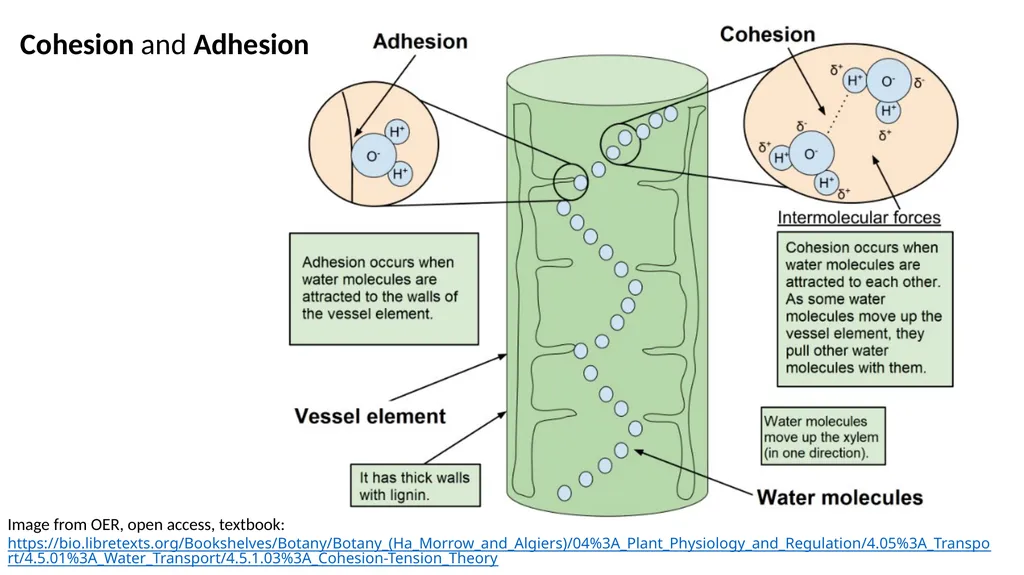
Cohesion and Adhesion Image from OER, open access, textbook: https://bio.libretexts.org/Bookshelves/Botany/Botany_(Ha_Morrow_and_Algiers)/04%3A_Plant_Physiology_and_Regulation/4.05%3A_Transport/4.5.01%3A_Water_Transport/4.5.1.03%3A_Cohesion-Tension_Theory<br>
06
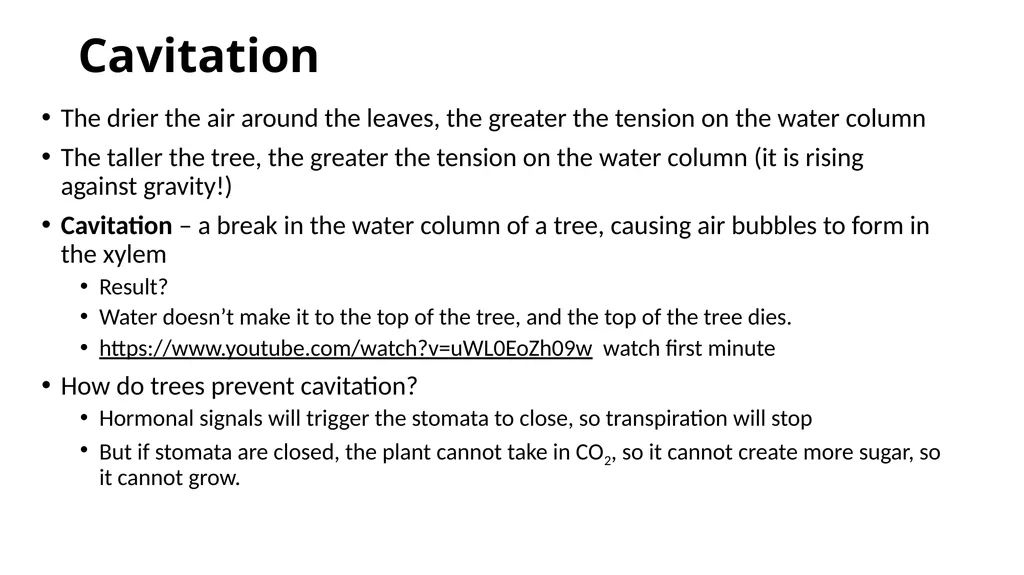
Cavitation The drier the air around the leaves, the greater the tension on the water column
The taller the tree, the greater the tension on the water column (it is rising against gravity!)
Cavitation – a break in the water column of a tree, causing air bubbles to form in the xylem
Result?
Water doesn’t make it to the top of the tree, and the top of the tree dies.
https://www.youtube.com/watch?v=uWL0EoZh09w watch first minute
How do trees prevent cavitation?
Hormonal signals will trigger the stomata to close, so transpiration will stop
But if stomata are closed, the plant cannot take in CO2, so it cannot create more sugar, so it cannot grow.<br>
The taller the tree, the greater the tension on the water column (it is rising against gravity!)
Cavitation – a break in the water column of a tree, causing air bubbles to form in the xylem
Result?
Water doesn’t make it to the top of the tree, and the top of the tree dies.
https://www.youtube.com/watch?v=uWL0EoZh09w watch first minute
How do trees prevent cavitation?
Hormonal signals will trigger the stomata to close, so transpiration will stop
But if stomata are closed, the plant cannot take in CO2, so it cannot create more sugar, so it cannot grow.<br>
07
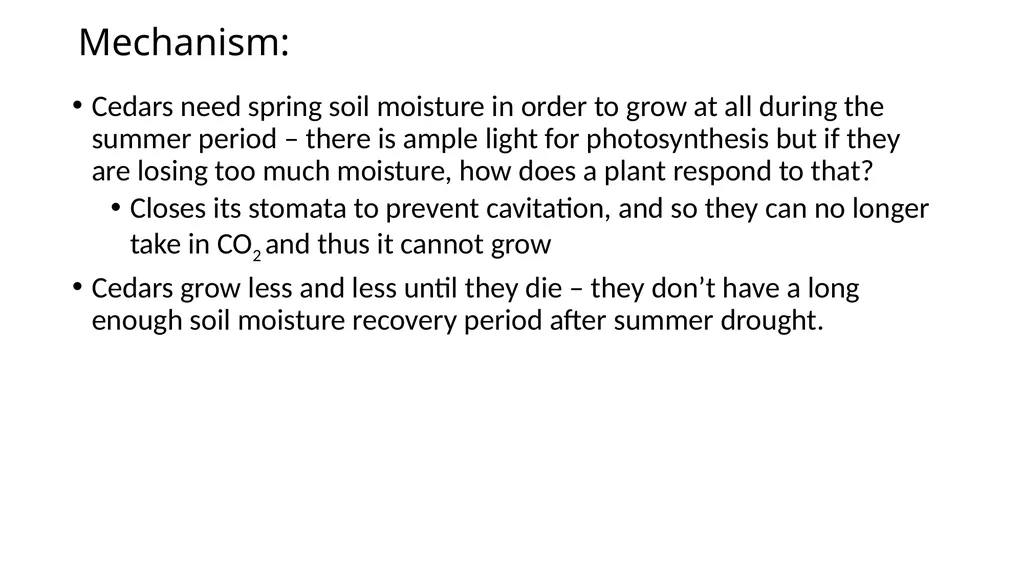
Mechanism: Cedars need spring soil moisture in order to grow at all during the summer period – there is ample light for photosynthesis but if they are losing too much moisture, how does a plant respond to that?
Closes its stomata to prevent cavitation, and so they can no longer take in CO2 and thus it cannot grow
Cedars grow less and less until they die – they don’t have a long enough soil moisture recovery period after summer drought.<br>
Closes its stomata to prevent cavitation, and so they can no longer take in CO2 and thus it cannot grow
Cedars grow less and less until they die – they don’t have a long enough soil moisture recovery period after summer drought.<br>
08
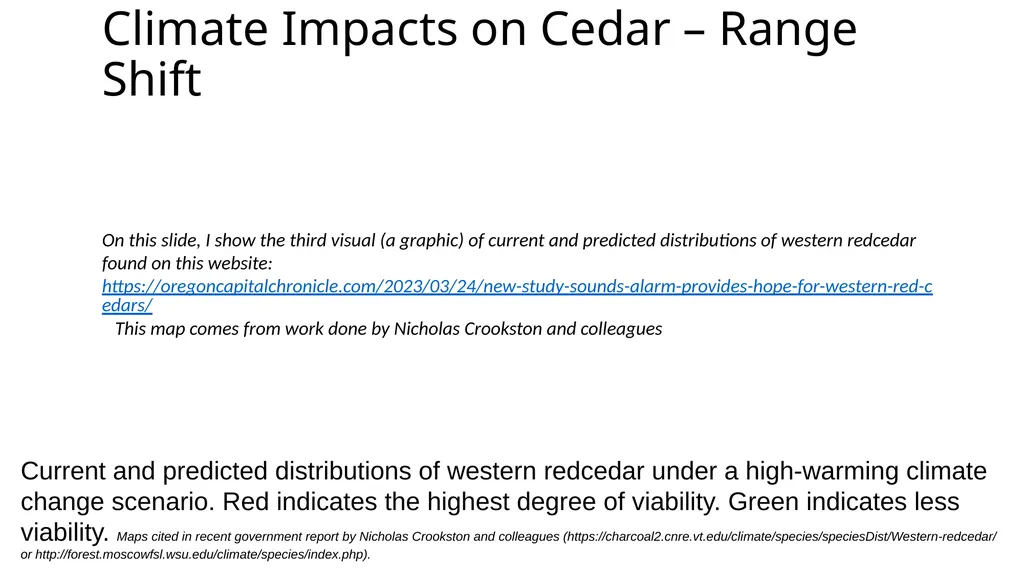
Climate Impacts on Cedar – Range Shift Current and predicted distributions of western redcedar under a high-warming climate change scenario. Red indicates the highest degree of viability. Green indicates less viability. Maps cited in recent government report by Nicholas Crookston and colleagues (https://charcoal2.cnre.vt.edu/climate/species/speciesDist/Western-redcedar/ or http://forest.moscowfsl.wsu.edu/climate/species/index.php). On this slide, I show the third visual (a graphic) of current and predicted distributions of western redcedar found on this website: https://oregoncapitalchronicle.com/2023/03/24/new-study-sounds-alarm-provides-hope-for-western-red-cedars/ This map comes from work done by Nicholas Crookston and colleagues<br>
09
Loss of Cedar trees will disproportionally effect the people of Pacific Northwest Indigenous tribes. Video on the importance of cedar to PNW tribes:
https://www.youtube.com/watch?v=WIcT9Jx0T7g The Story of Cedar (up to about 4:30 min)
Throughout the video, make a list of the many ways that Northwest Tribes use Western redcedar. Note that these “uses” are viewed as gifts that the cedar provides.
Click HERE to hear how cedar is pronounced in Lushootseed, the language spoken by the coast Salish tribes<br>
https://www.youtube.com/watch?v=WIcT9Jx0T7g The Story of Cedar (up to about 4:30 min)
Throughout the video, make a list of the many ways that Northwest Tribes use Western redcedar. Note that these “uses” are viewed as gifts that the cedar provides.
Click HERE to hear how cedar is pronounced in Lushootseed, the language spoken by the coast Salish tribes<br>
10
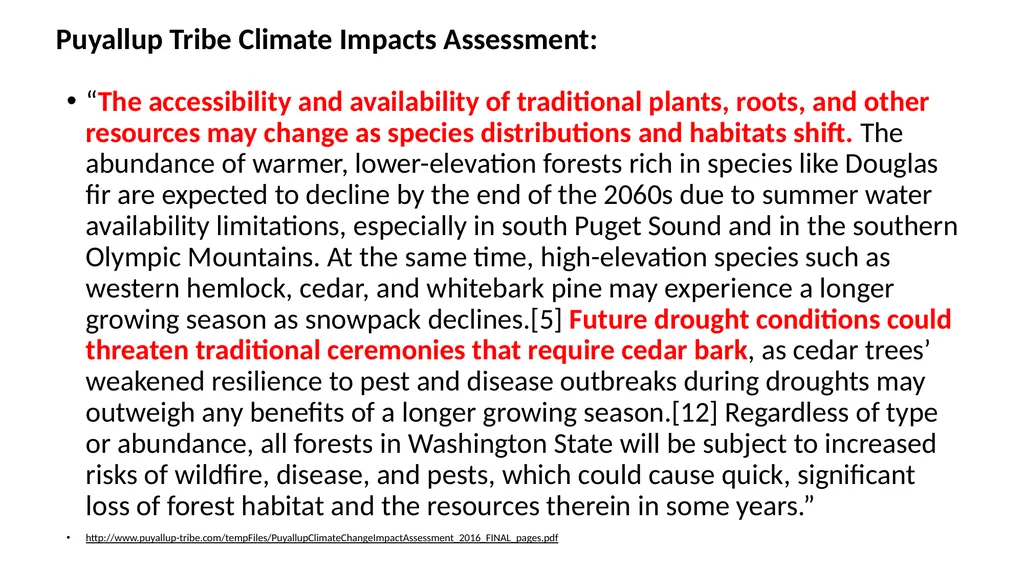
“The accessibility and availability of traditional plants, roots, and other resources may change as species distributions and habitats shift. The abundance of warmer, lower-elevation forests rich in species like Douglas fir are expected to decline by the end of the 2060s due to summer water availability limitations, especially in south Puget Sound and in the southern Olympic Mountains. At the same time, high-elevation species such as western hemlock, cedar, and whitebark pine may experience a longer growing season as snowpack declines.[5] Future drought conditions could threaten traditional ceremonies that require cedar bark, as cedar trees’ weakened resilience to pest and disease outbreaks during droughts may outweigh any benefits of a longer growing season.[12] Regardless of type or abundance, all forests in Washington State will be subject to increased risks of wildfire, disease, and pests, which could cause quick, significant loss of forest habitat and the resources therein in some years.”
http://www.puyallup-tribe.com/tempFiles/PuyallupClimateChangeImpactAssessment_2016_FINAL_pages.pdf Puyallup Tribe Climate Impacts Assessment:<br>
http://www.puyallup-tribe.com/tempFiles/PuyallupClimateChangeImpactAssessment_2016_FINAL_pages.pdf Puyallup Tribe Climate Impacts Assessment:<br>
11
Blog post from Indigenous Leadership Academy NW:
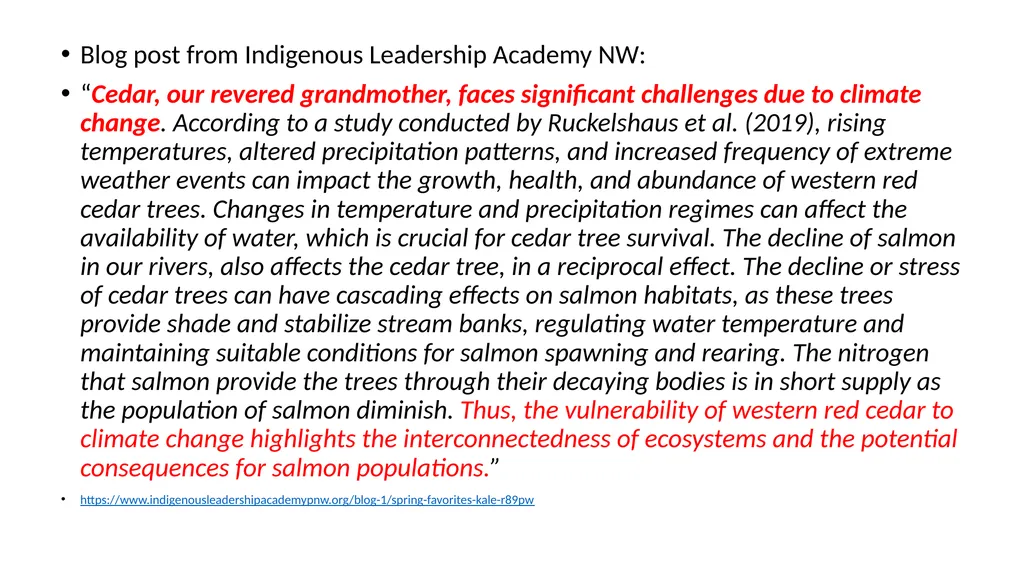
“Cedar, our revered grandmother, faces significant challenges due to climate change. According to a study conducted by Ruckelshaus et al. (2019), rising temperatures, altered precipitation patterns, and increased frequency of extreme weather events can impact the growth, health, and abundance of western red cedar trees. Changes in temperature and precipitation regimes can affect the availability of water, which is crucial for cedar tree survival. The decline of salmon in our rivers, also affects the cedar tree, in a reciprocal effect. The decline or stress of cedar trees can have cascading effects on salmon habitats, as these trees provide shade and stabilize stream banks, regulating water temperature and maintaining suitable conditions for salmon spawning and rearing. The nitrogen that salmon provide the trees through their decaying bodies is in short supply as the population of salmon diminish. Thus, the vulnerability of western red cedar to climate change highlights the interconnectedness of ecosystems and the potential consequences for salmon populations.”
https://www.indigenousleadershipacademypnw.org/blog-1/spring-favorites-kale-r89pw<br>
“Cedar, our revered grandmother, faces significant challenges due to climate change. According to a study conducted by Ruckelshaus et al. (2019), rising temperatures, altered precipitation patterns, and increased frequency of extreme weather events can impact the growth, health, and abundance of western red cedar trees. Changes in temperature and precipitation regimes can affect the availability of water, which is crucial for cedar tree survival. The decline of salmon in our rivers, also affects the cedar tree, in a reciprocal effect. The decline or stress of cedar trees can have cascading effects on salmon habitats, as these trees provide shade and stabilize stream banks, regulating water temperature and maintaining suitable conditions for salmon spawning and rearing. The nitrogen that salmon provide the trees through their decaying bodies is in short supply as the population of salmon diminish. Thus, the vulnerability of western red cedar to climate change highlights the interconnectedness of ecosystems and the potential consequences for salmon populations.”
https://www.indigenousleadershipacademypnw.org/blog-1/spring-favorites-kale-r89pw<br>
12
Climate change is a consequence of the injustice of colonization and urbanization Video: https://www.youtube.com/watch?v=OIjAR3f9c60 (12 min)
And https://www.youtube.com/watch?v=D6ocDfoF3Qg (12 min)
Discuss the following in your groups and add to the jamboard
What would it mean to the Puyallup people (and all Pacific Northwest tribes) if cedar went extinct?
What can we do to protect cedar trees, “our revered grandmothers” from climate change? What can we do as individuals, communities, citizens, TCC students?
Climate change has the greatest impact on BIPOC communities – how can we minimize impact to our Northwest tribes?
As we attempt to transition away from fossil fuels, how can we keep our Northwest tribes at the forefront? How can we ensure that this transition does not further harm our indigenous communities?<br>
And https://www.youtube.com/watch?v=D6ocDfoF3Qg (12 min)
Discuss the following in your groups and add to the jamboard
What would it mean to the Puyallup people (and all Pacific Northwest tribes) if cedar went extinct?
What can we do to protect cedar trees, “our revered grandmothers” from climate change? What can we do as individuals, communities, citizens, TCC students?
Climate change has the greatest impact on BIPOC communities – how can we minimize impact to our Northwest tribes?
As we attempt to transition away from fossil fuels, how can we keep our Northwest tribes at the forefront? How can we ensure that this transition does not further harm our indigenous communities?<br>
13
Take Action Show 5 min video on the project: https://ppo.puyallup.wsu.edu/plant-health-concerns/redcedar/ (5:32)
Download the iNaturalist app and join the “ Western redcedar dieback map” project.
https://foresthealth.org/map/
Let’s head outside!<br>
Download the iNaturalist app and join the “ Western redcedar dieback map” project.
https://foresthealth.org/map/
Let’s head outside!<br>
14
Science + Civic Engagement => Change Civic engagement = individual and collective actions designed to identify and address issues of public concern.
Scientists regularly share the results of their work with the public (Forest Health Watch!) and city, state, and national policy makers.
Here is a local example: White River restoration project: https://connects.sumnerwa.gov/white-river-restoration-project (3 min)
In your group, choose a civic engagement. You can do different things or choose to do something as a group. Here are some options:
Write an email to the TCC Board of Directors or TCC President
Write an email to the Tacoma City Council
Create a social media post about what you did/learned and post it.
Share what you learned/did in another class
Create a poster or flier to share on campus or in our building
Artwork?
Other ideas? Please run by me.
Proof of your civic engagement is due in Canvas by Thursday Nov 9<br>
Scientists regularly share the results of their work with the public (Forest Health Watch!) and city, state, and national policy makers.
Here is a local example: White River restoration project: https://connects.sumnerwa.gov/white-river-restoration-project (3 min)
In your group, choose a civic engagement. You can do different things or choose to do something as a group. Here are some options:
Write an email to the TCC Board of Directors or TCC President
Write an email to the Tacoma City Council
Create a social media post about what you did/learned and post it.
Share what you learned/did in another class
Create a poster or flier to share on campus or in our building
Artwork?
Other ideas? Please run by me.
Proof of your civic engagement is due in Canvas by Thursday Nov 9<br>
15
What can be done about this problem? Is there any hope? Second article:
“If drought is to blame, Kohler said, reducing competition by thinning the understory could help red cedars get more water. But if it's a combination of drought and heat, the solution might require a more tailored approach.”
“red cedars undergoing dieback appeared to be more often exposed to sunlight. Trees under the canopy were more often healthier than those receiving direct sunlight.”
From Forest Health.org:
Assisted population migration – select the best genotypes of trees for restoration under a climate change scenario – ex. “Oregon’s environmental conditions now may be better suited for future climates in Washington”
Seed lot selection: selection certain trees for the seeds that you will use the in restoration processes.<br>
“If drought is to blame, Kohler said, reducing competition by thinning the understory could help red cedars get more water. But if it's a combination of drought and heat, the solution might require a more tailored approach.”
“red cedars undergoing dieback appeared to be more often exposed to sunlight. Trees under the canopy were more often healthier than those receiving direct sunlight.”
From Forest Health.org:
Assisted population migration – select the best genotypes of trees for restoration under a climate change scenario – ex. “Oregon’s environmental conditions now may be better suited for future climates in Washington”
Seed lot selection: selection certain trees for the seeds that you will use the in restoration processes.<br>
16
And what can we do? Become a community scientist! Go back to forest health watch website and show where you can sign up to become a community scientist and help contribute to this and other research: https://foresthealth.org/scientists/<br>