05
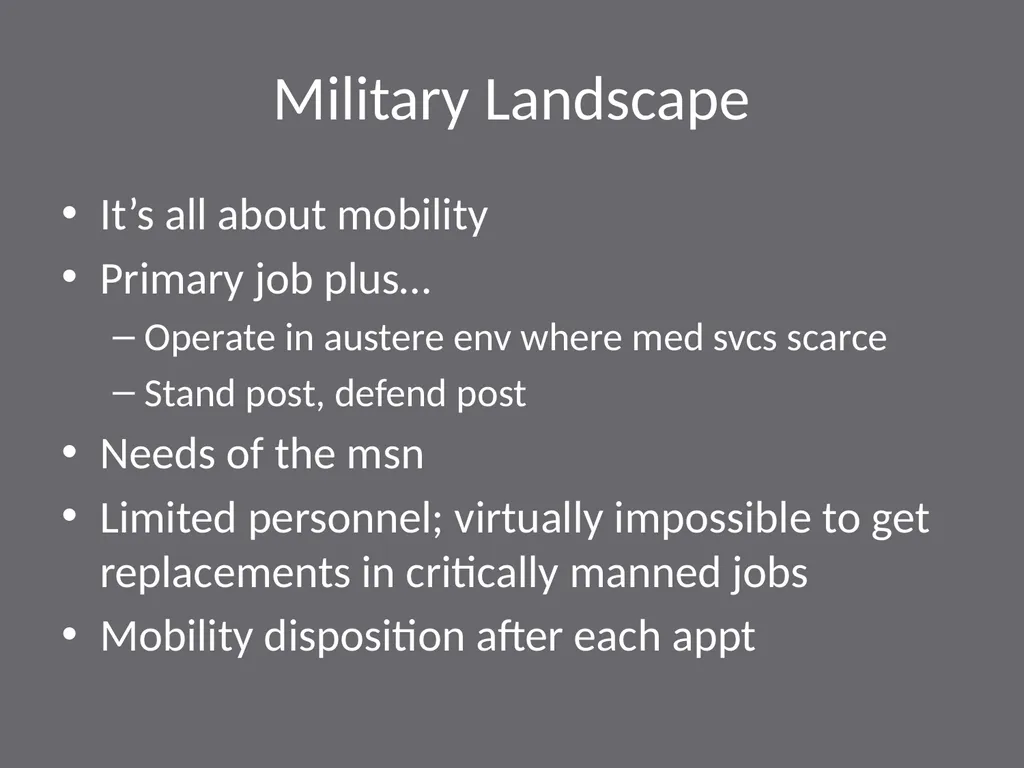
Military Landscape It’s all about mobility
Primary job plus…
Operate in austere env where med svcs scarce
Stand post, defend post
Needs of the msn
Limited personnel; virtually impossible to get replacements in critically manned jobs
Mobility disposition after each appt<br>
06
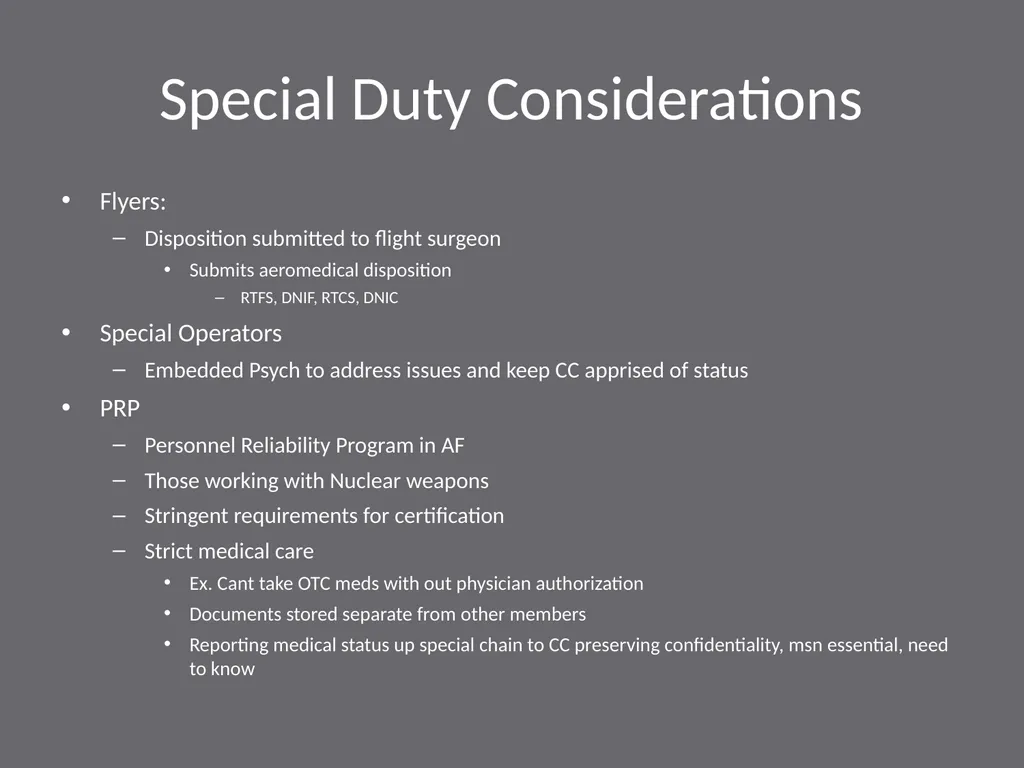
Special Duty Considerations Flyers:
Disposition submitted to flight surgeon
Submits aeromedical disposition
RTFS, DNIF, RTCS, DNIC
Special Operators
Embedded Psych to address issues and keep CC apprised of status
PRP
Personnel Reliability Program in AF
Those working with Nuclear weapons
Stringent requirements for certification
Strict medical care
Ex. Cant take OTC meds with out physician authorization
Documents stored separate from other members
Reporting medical status up special chain to CC preserving confidentiality, msn essential, need to know<br>
07
Fitness for Duty Evaluations Evals: job clearance, security clearance, special school, admin sep, conscientious objector, VA, malingering, forensics
Commander Directed Evaluation (CDE)
Emergent
Non-emergent
Outcomes: RTD, RTD w tx, MEB, Admin Discharge
Conducted only by Doctoral lvl providers<br>
08
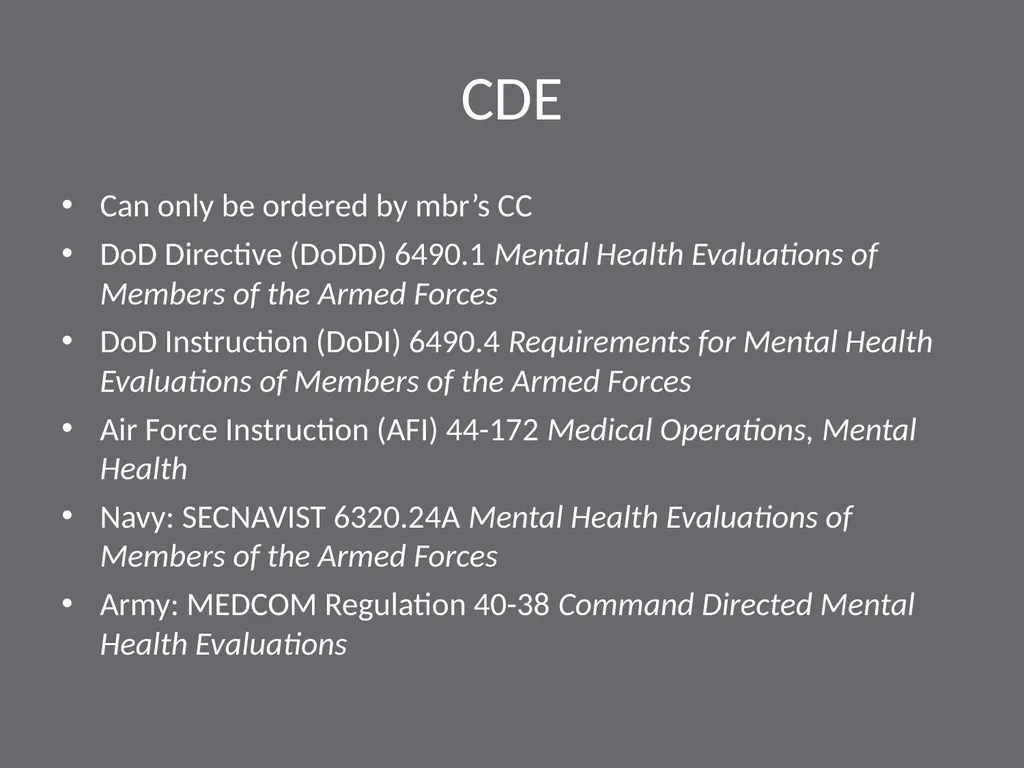
CDE Can only be ordered by mbr’s CC
DoD Directive (DoDD) 6490.1 Mental Health Evaluations of Members of the Armed Forces
DoD Instruction (DoDI) 6490.4 Requirements for Mental Health Evaluations of Members of the Armed Forces
Air Force Instruction (AFI) 44-172 Medical Operations, Mental Health
Navy: SECNAVIST 6320.24A Mental Health Evaluations of Members of the Armed Forces
Army: MEDCOM Regulation 40-38 Command Directed Mental Health Evaluations<br>
09
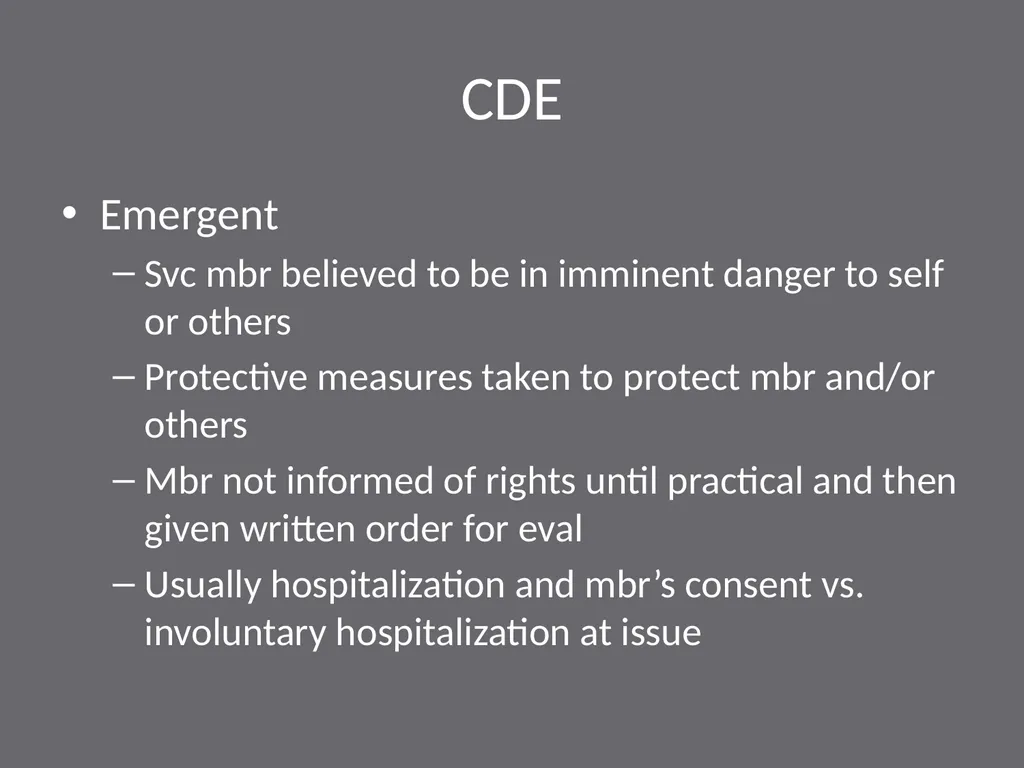
CDE Emergent
Svc mbr believed to be in imminent danger to self or others
Protective measures taken to protect mbr and/or others
Mbr not informed of rights until practical and then given written order for eval
Usually hospitalization and mbr’s consent vs. involuntary hospitalization at issue<br>
10
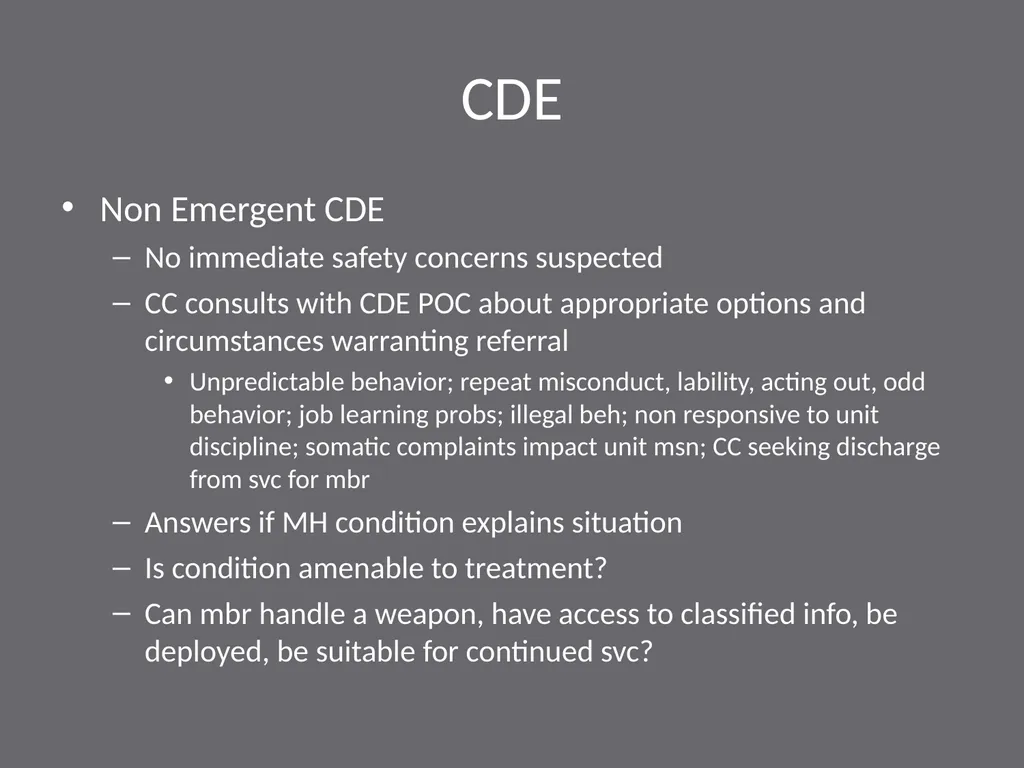
CDE Non Emergent CDE
No immediate safety concerns suspected
CC consults with CDE POC about appropriate options and circumstances warranting referral
Unpredictable behavior; repeat misconduct, lability, acting out, odd behavior; job learning probs; illegal beh; non responsive to unit discipline; somatic complaints impact unit msn; CC seeking discharge from svc for mbr
Answers if MH condition explains situation
Is condition amenable to treatment?
Can mbr handle a weapon, have access to classified info, be deployed, be suitable for continued svc?<br>
11
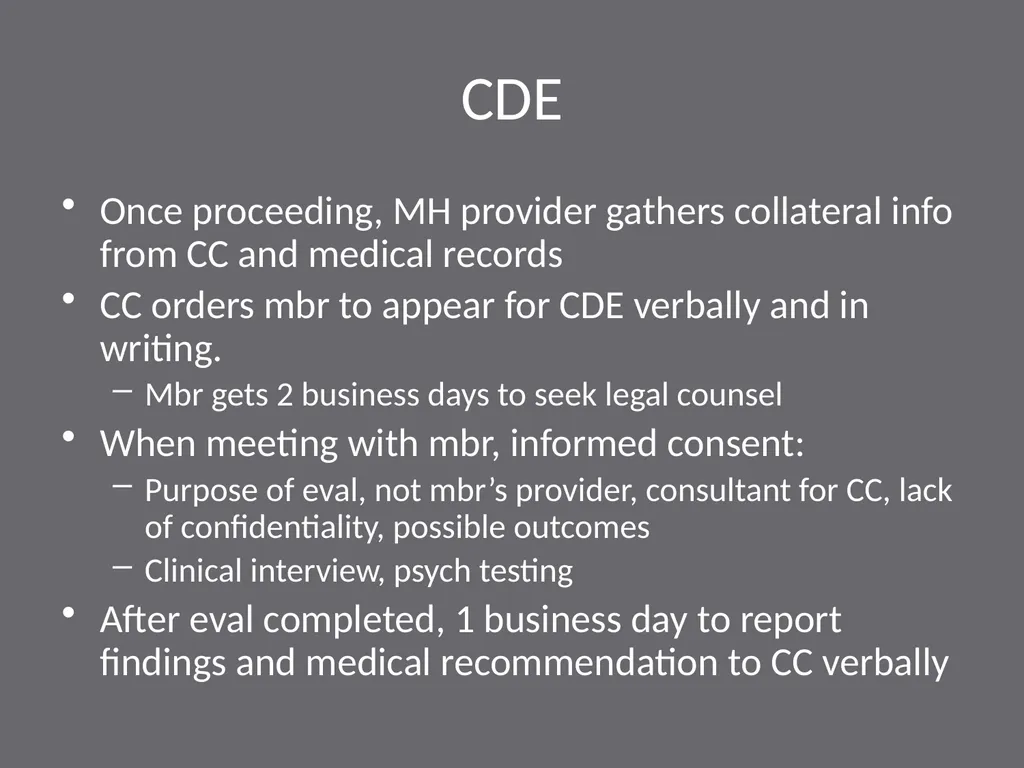
CDE Once proceeding, MH provider gathers collateral info from CC and medical records
CC orders mbr to appear for CDE verbally and in writing.
Mbr gets 2 business days to seek legal counsel
When meeting with mbr, informed consent:
Purpose of eval, not mbr’s provider, consultant for CC, lack of confidentiality, possible outcomes
Clinical interview, psych testing
After eval completed, 1 business day to report findings and medical recommendation to CC verbally<br>
12
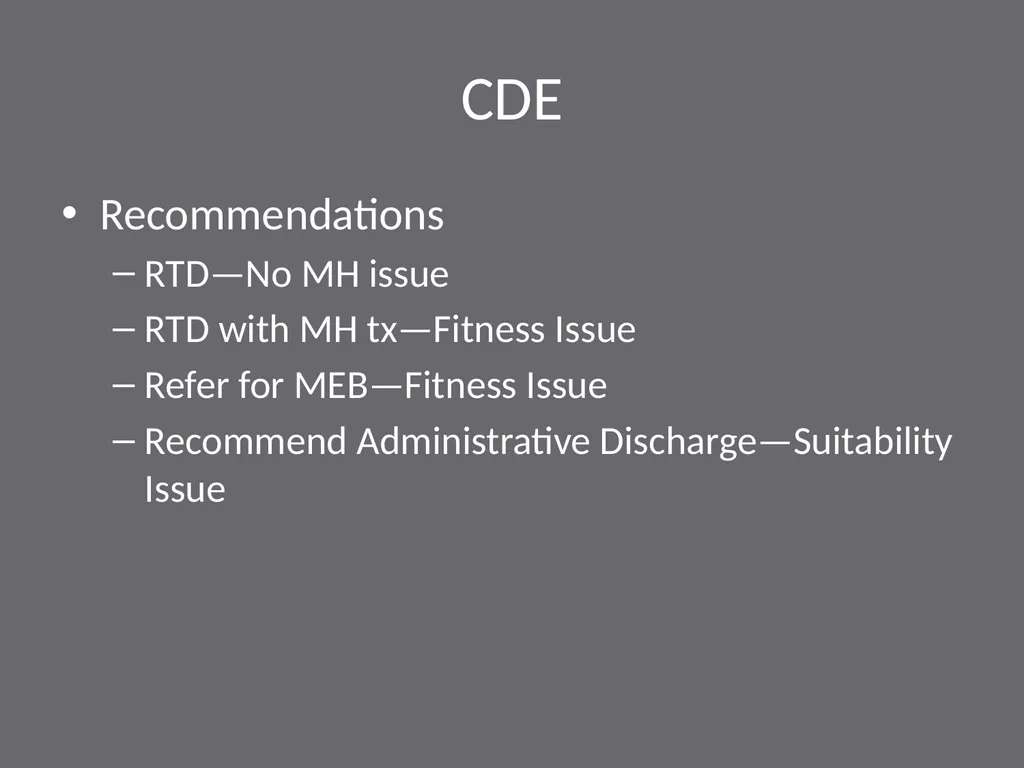
CDE Recommendations
RTD—No MH issue
RTD with MH tx—Fitness Issue
Refer for MEB—Fitness Issue
Recommend Administrative Discharge—Suitability Issue<br>
13
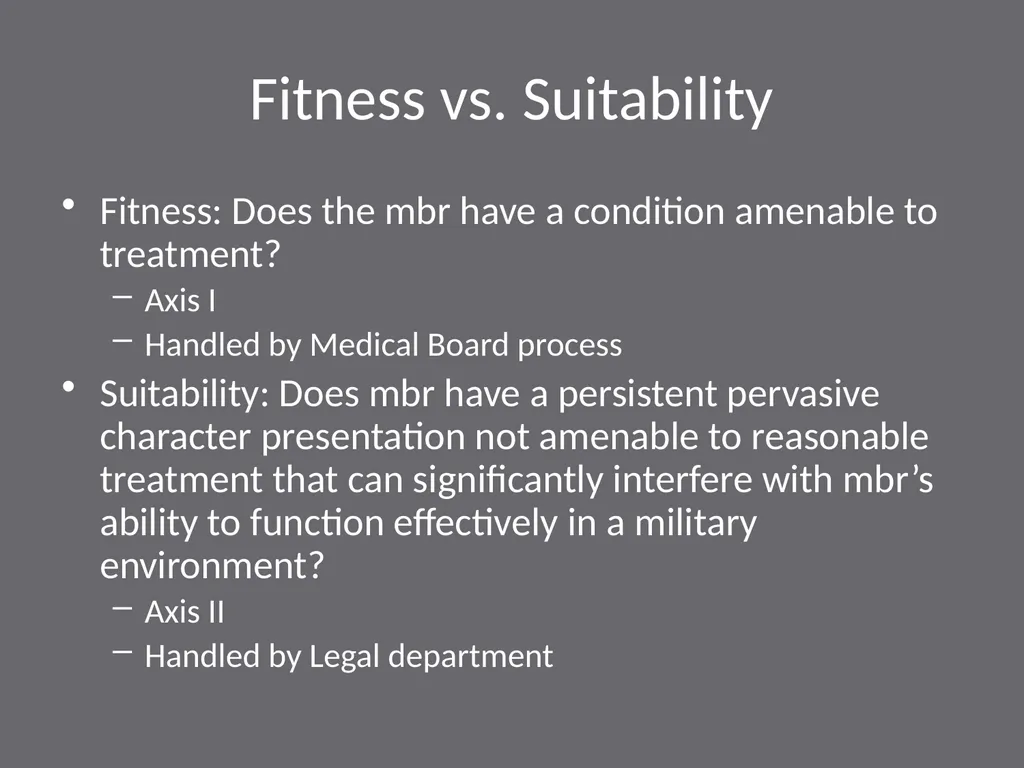
Fitness vs. Suitability Fitness: Does the mbr have a condition amenable to treatment?
Axis I
Handled by Medical Board process
Suitability: Does mbr have a persistent pervasive character presentation not amenable to reasonable treatment that can significantly interfere with mbr’s ability to function effectively in a military environment?
Axis II
Handled by Legal department<br>
14
Clinical Considerations<br>
15
Your Role: Occupational Mental Health Military setting: Obligation to mission requirements, ability to function effectively in the military environment
Civilian setting: Obligation to patient first
When Axis I or Axis II dx made, fitness and suitability for duty determination required
Guidelines for decisions dictated by policy<br>
16
Rank Dynamics in Treatment Most junior svc mbrs aware of rank
Ingrained in training
As pts, some sit at attention, highly formal, not relaxed, detracts from developing alliance
Resolve by clinician behavior, body language, and addressing issue casually<br>
17
Rank Dynamics in Treatment As clinicians, some discomfort about confronting higher ranking pt; asking and discussing super private info
Resolved by developing rapport, good working alliance, and building pt’s confidence in provider
As MH techs, lower confidence starting out since they don’t have rank or pro qualifications providers do
All staff in MTF incl MHTs work under the authority of the medical group CC who’s usually an O-6<br>
18
Who is your client? For therapy—patient is your client
Msn impacting issues reported to CC
For CC directed evaluations—CC and svc branch are the clients
For duty evaluations, assessment/selection, special schools, security clearances—military branch is your client, make recommendations for the good of the service<br>
19
Ethics Confidentiality
Must apply APA ethics code in context of mil instructions, federal and state laws
Mandatory civilian and mil reporting requirements
Pt informed verbally and in writing prior to svcs
Rights/Interests of individual weighed against group’s
Significant factor in Stigma
Mission Impact
CC need to know
CC has responsibility to know whereabouts of troops
Usually no more detail than “at a medical appt”
Will not disclose whether mbr is a pt in clinic or not unless msn impacting issue present or pt gives consent<br>
20
Ethics Mission Impact
~50% who have seen a mil MHP and ~66% who have not, believe there is negative career impact
Generally pt case surveys show overwhelming majority do not have career impact
Small percentage that does usually CC referred or waited until problem was severe to seek help<br>
21
Ethics Multiple Relationships
Limited MH assets
Small/ remote locations
Address with pt how to handle encounters outside of med setting to preserve confidentiality
Be a professional at all times
Case in point: pt is also CC of another pt<br>
22
Ethics Multiculturalism
Population as diverse as US
Non-citizens serving
Allied country services
Spouses, dependents
Overcome dearth of knowledge of a particular culture by learning from pt<br>
23
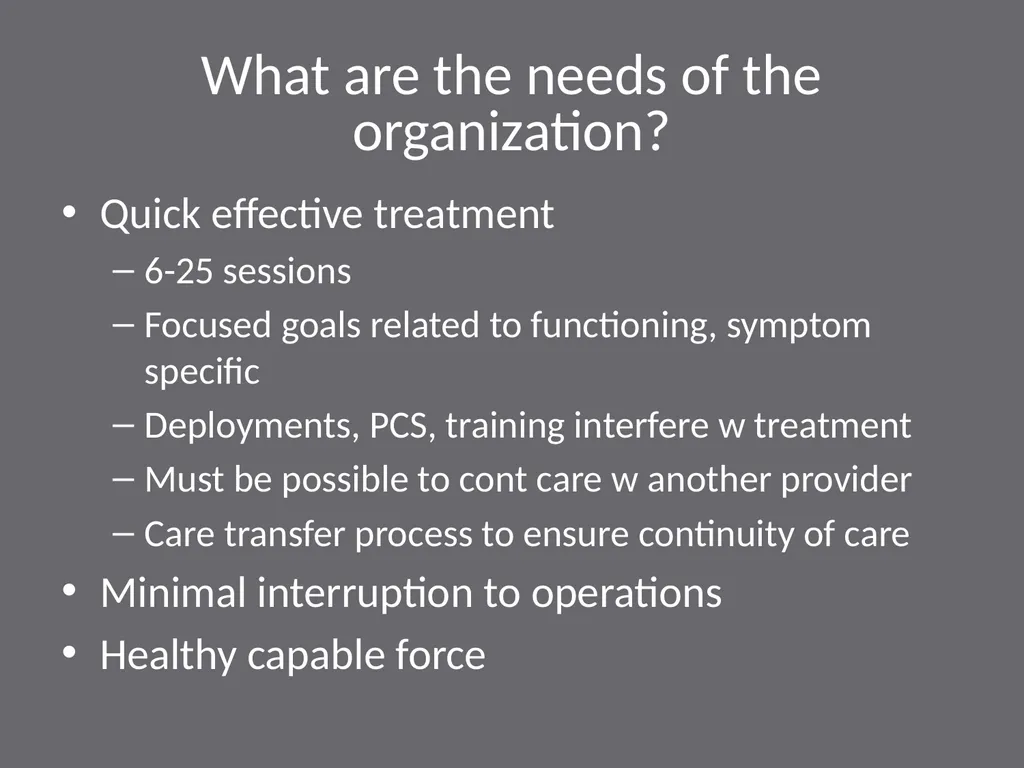
What are the needs of the organization? Quick effective treatment
6-25 sessions
Focused goals related to functioning, symptom specific
Deployments, PCS, training interfere w treatment
Must be possible to cont care w another provider
Care transfer process to ensure continuity of care
Minimal interruption to operations
Healthy capable force<br>
24
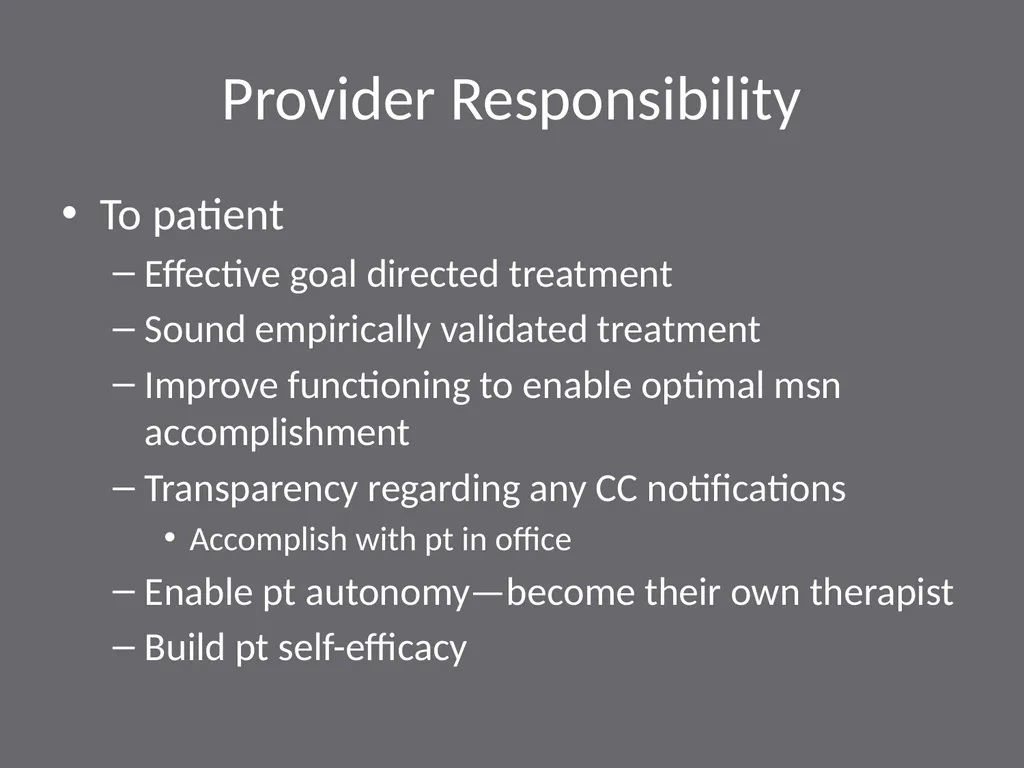
Provider Responsibility To patient
Effective goal directed treatment
Sound empirically validated treatment
Improve functioning to enable optimal msn accomplishment
Transparency regarding any CC notifications
Accomplish with pt in office
Enable pt autonomy—become their own therapist
Build pt self-efficacy<br>
25
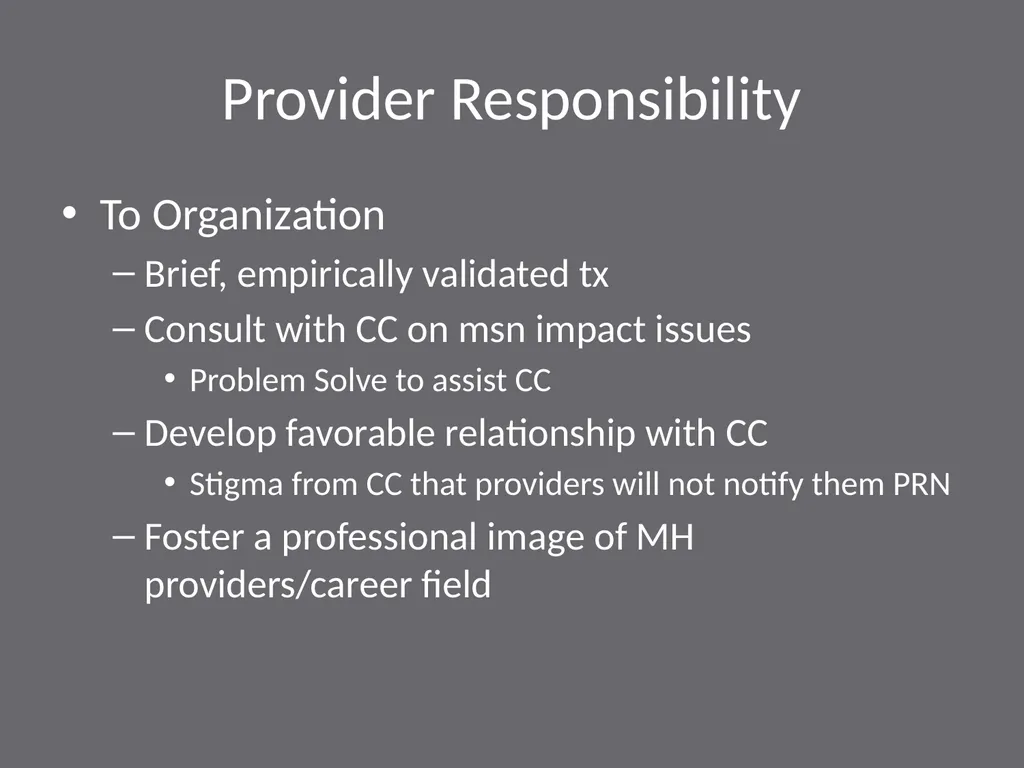
Provider Responsibility To Organization
Brief, empirically validated tx
Consult with CC on msn impact issues
Problem Solve to assist CC
Develop favorable relationship with CC
Stigma from CC that providers will not notify them PRN
Foster a professional image of MH providers/career field<br>
26
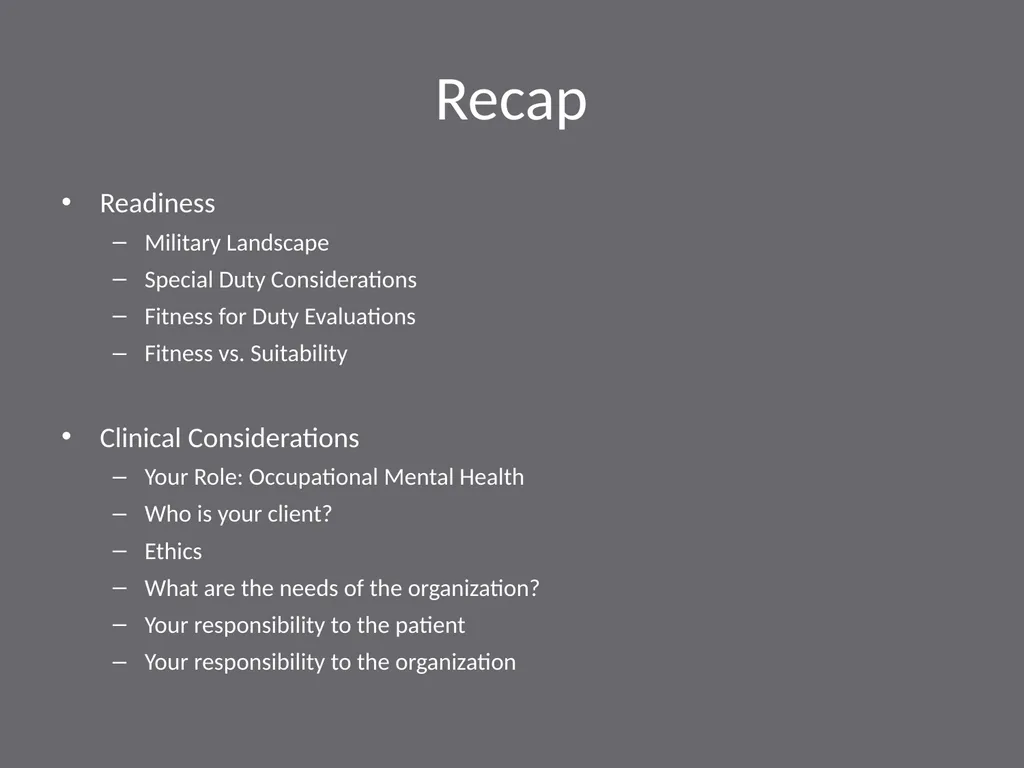
Recap Readiness
Military Landscape
Special Duty Considerations
Fitness for Duty Evaluations
Fitness vs. Suitability
Clinical Considerations
Your Role: Occupational Mental Health
Who is your client?
Ethics
What are the needs of the organization?
Your responsibility to the patient
Your responsibility to the organization<br>