
Cloudward Bound: Planning for Beneficial Migration
Description: Cloudward Bound: Planning for Beneficial Migration of Enterprise Applications to the Cloud Mohammad Hajjat , Xin Sun, Yu-Wei Sung (Purdue University) David Maltz (Microsoft Research), Sanjay Rao (Purdue University), Kunwadee Sripanidkulchai
Related Topics
Download Presentation
"Cloudward Bound: Planning for Beneficial Migration" is the property of its rightful owner. Permission is granted to download and print the materials on this website for personal, non-commercial use only, and to display it on your personal computer provided you do not modify the materials and that you retain all copyright notices contained in the materials. By downloading content from our website, you accept the terms of this agreement.
Presentation Transcript
slide1. Cloudward Bound:
Planning for Beneficial Migration of Enterprise Applications to the Cloud Mohammad Hajjat , Xin Sun, Yu-Wei Sung (Purdue University)
David Maltz (Microsoft Research),
Sanjay Rao (Purdue University),
Kunwadee Sripanidkulchai (IBM T.J. Watson)
Mohit Tawarmalani (Purdue University) 1<br>
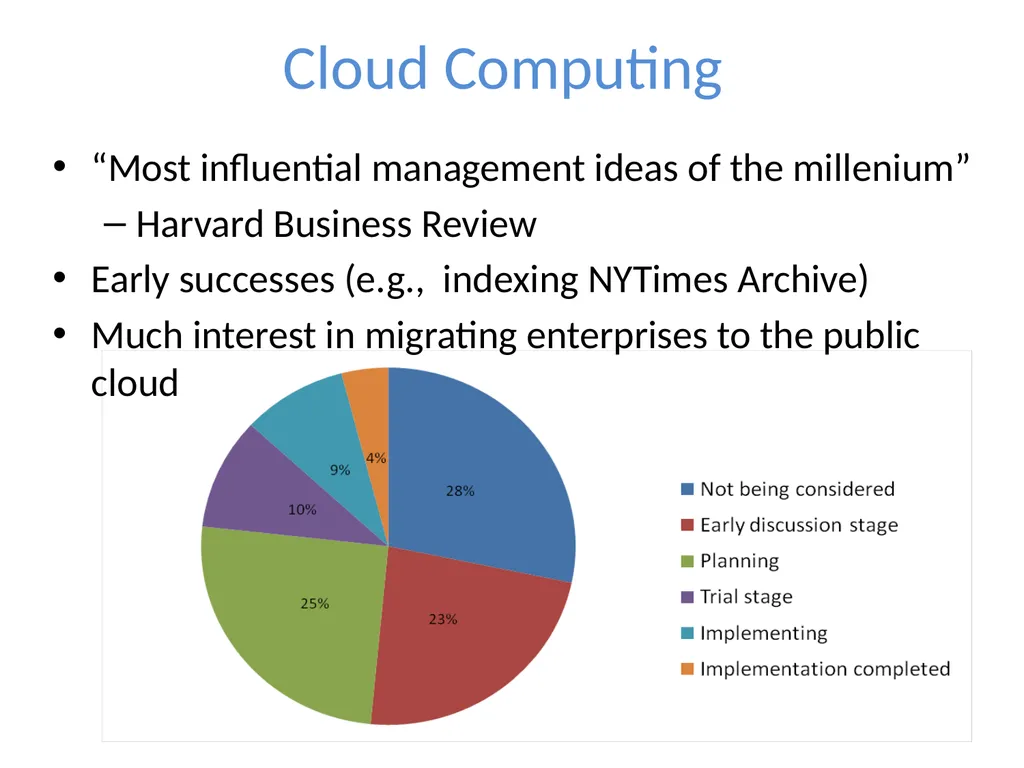
slide2. Cloud Computing “Most influential management ideas of the millenium”
Harvard Business Review
Early successes (e.g., indexing NYTimes Archive)
Much interest in migrating enterprises to the public cloud 2<br>
slide3. Concerns with cloud computing Data privacy
National Privacy Laws
Industry-specific privacy laws (e.g., Health Care)
SLA Requirements
Application response time
Availability 3<br>
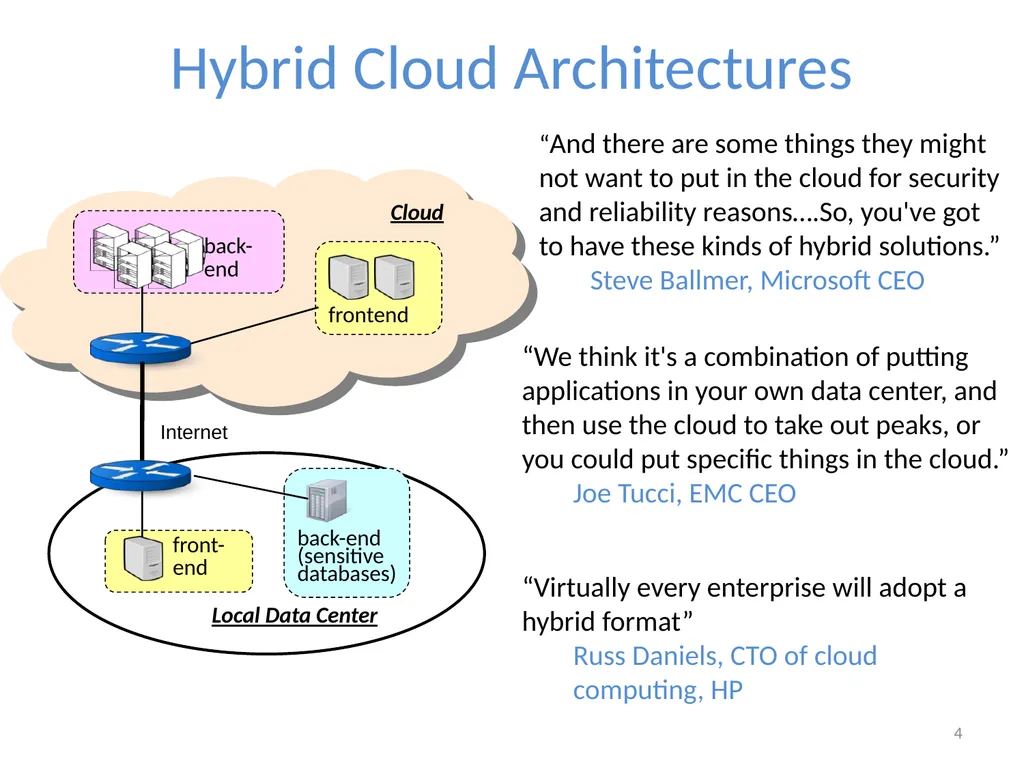
slide4. Hybrid Cloud Architectures “And there are some things they might not want to put in the cloud for security and reliability reasons….So, you've got
to have these kinds of hybrid solutions.”
Steve Ballmer, Microsoft CEO “We think it's a combination of putting applications in your own data center, and then use the cloud to take out peaks, or you could put specific things in the cloud.”
Joe Tucci, EMC CEO “Virtually every enterprise will adopt a hybrid format”
Russ Daniels, CTO of cloud computing, HP 4<br>
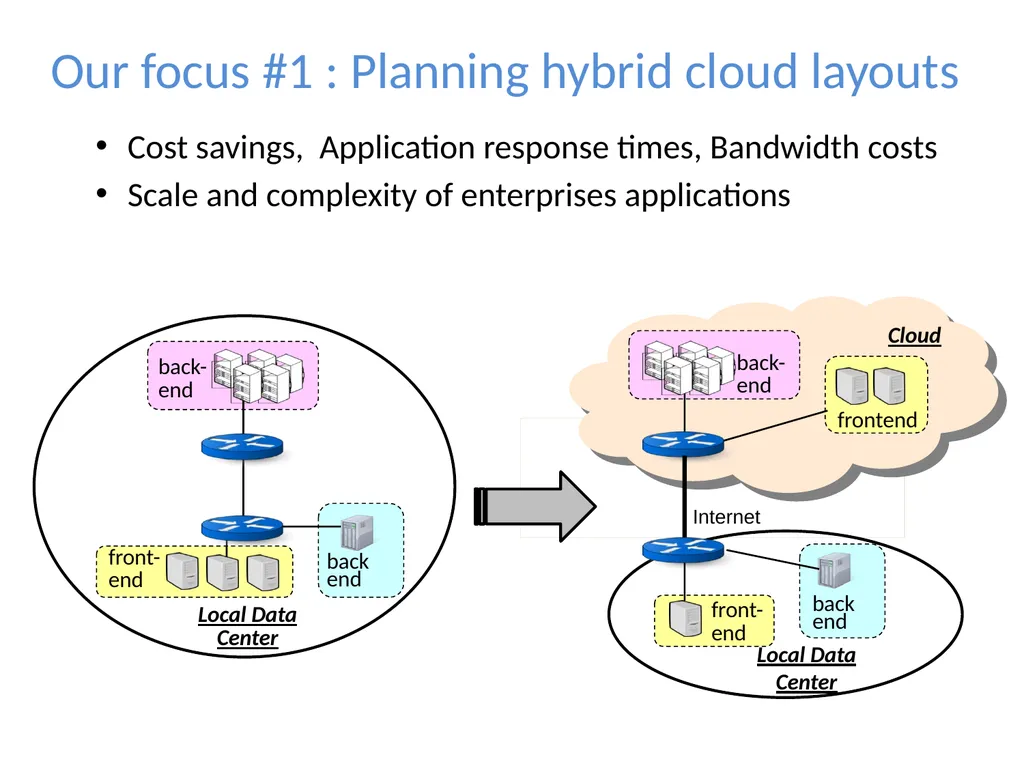
slide5. Our focus #1 : Planning hybrid cloud layouts Cost savings, Application response times, Bandwidth costs
Scale and complexity of enterprises applications<br>
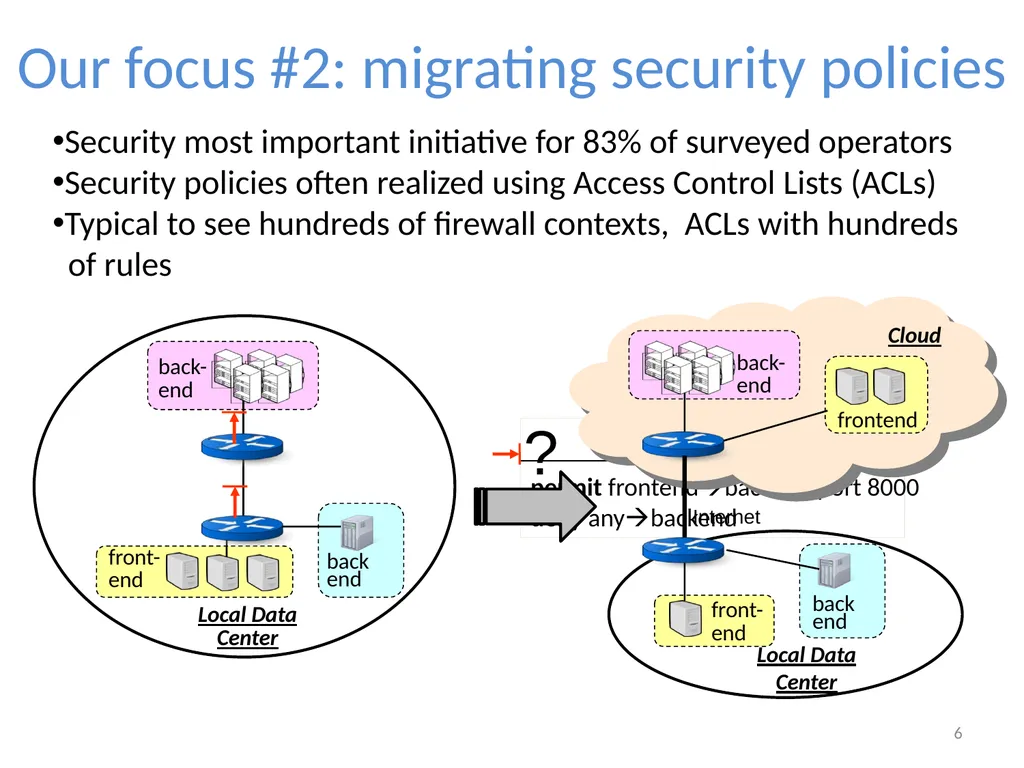
slide6. Our focus #2: migrating security policies an ACL permit frontendbackend port 8000 deny anybackend Local Data Center Cloud ? Security most important initiative for 83% of surveyed operators
Security policies often realized using Access Control Lists (ACLs)
Typical to see hundreds of firewall contexts, ACLs with hundreds
of rules 6<br>
slide7. Contributions of this paper Highlight complexity of enterprise applications, data-center policies
Framing and providing first-cut solutions for two key challenges in migrating enterprises to hybrid cloud
Models for planning hybrid cloud deployments
Abstractions and algorithms for assurable migration of security policies
Validations using real enterprise applications, Azure-based cloud deployments<br>
slide8. Talk Outline Enterprise Applications
Models for planning hybrid cloud deployments
Assurable migration of security policies
Evaluation and Results
Related Work and Conclusion<br>
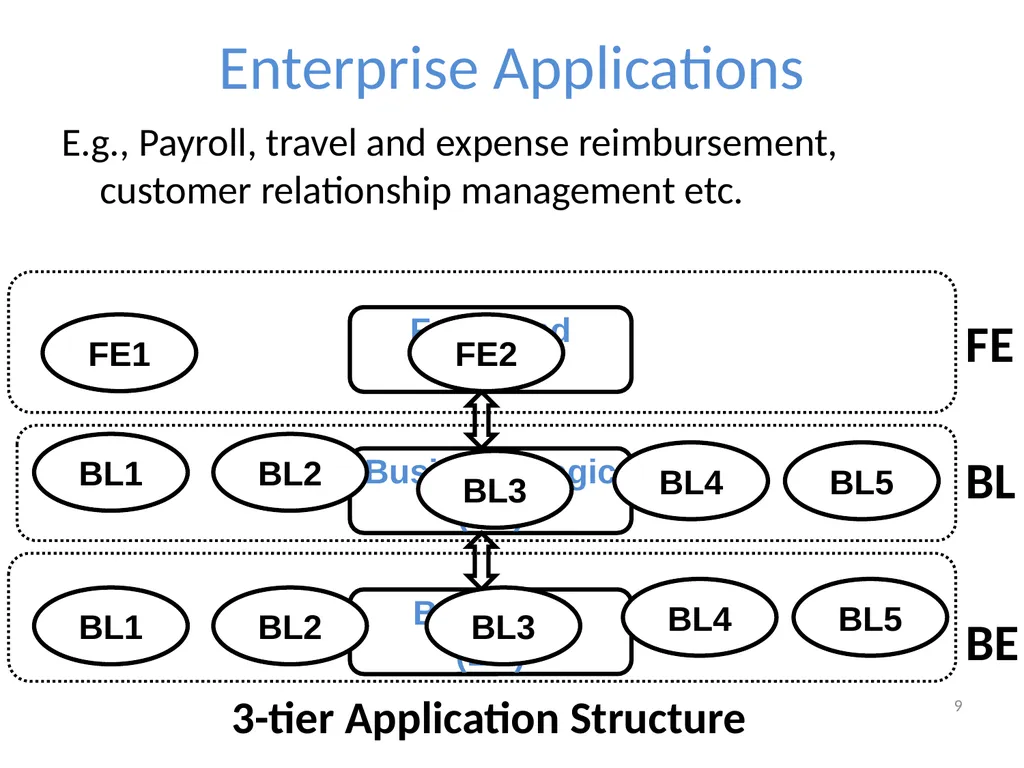
slide9. Enterprise Applications E.g., Payroll, travel and expense reimbursement, customer relationship management etc. BE FE BL 9 FE1 FE2 BL1 BL2 BL3 BL4 BL5 BL1 BL2 BL3 BL4 BL5<br>
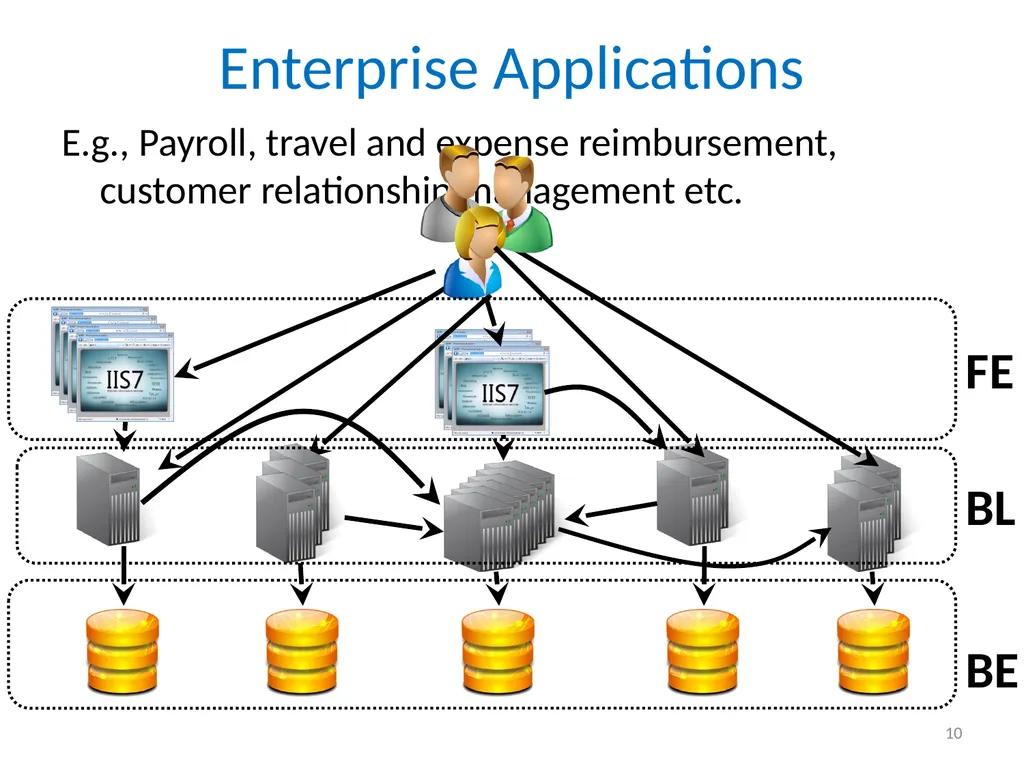
slide10. Enterprise Applications E.g., Payroll, travel and expense reimbursement, customer relationship management etc. 10<br>
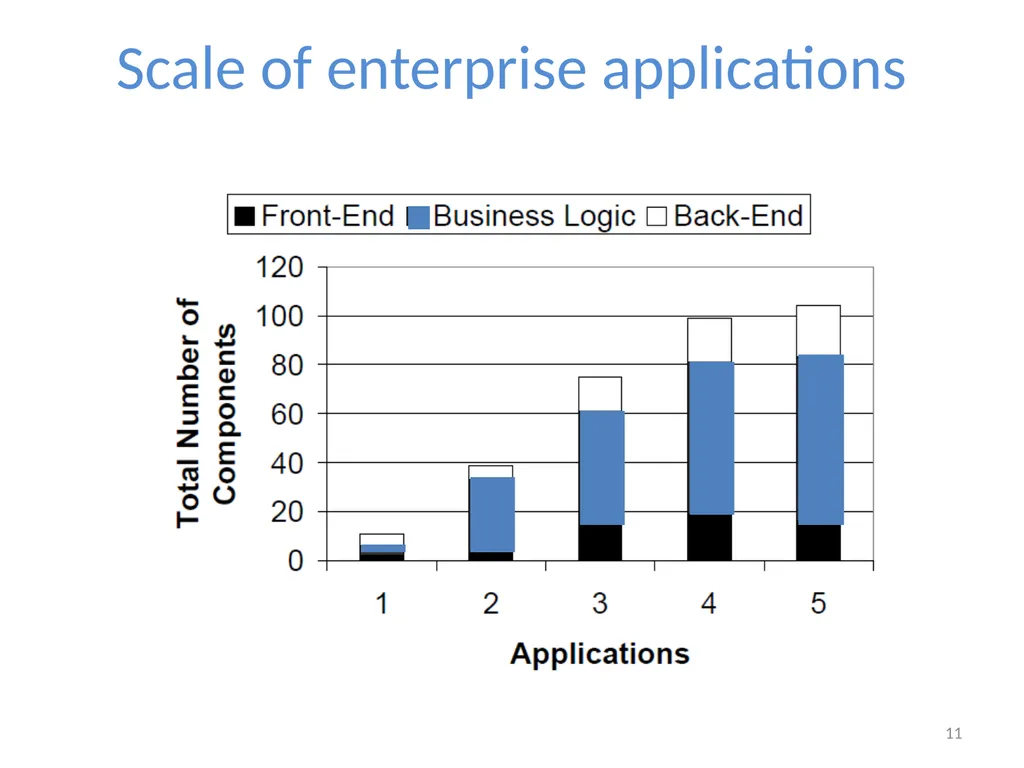
slide11. Scale of enterprise applications 11<br>
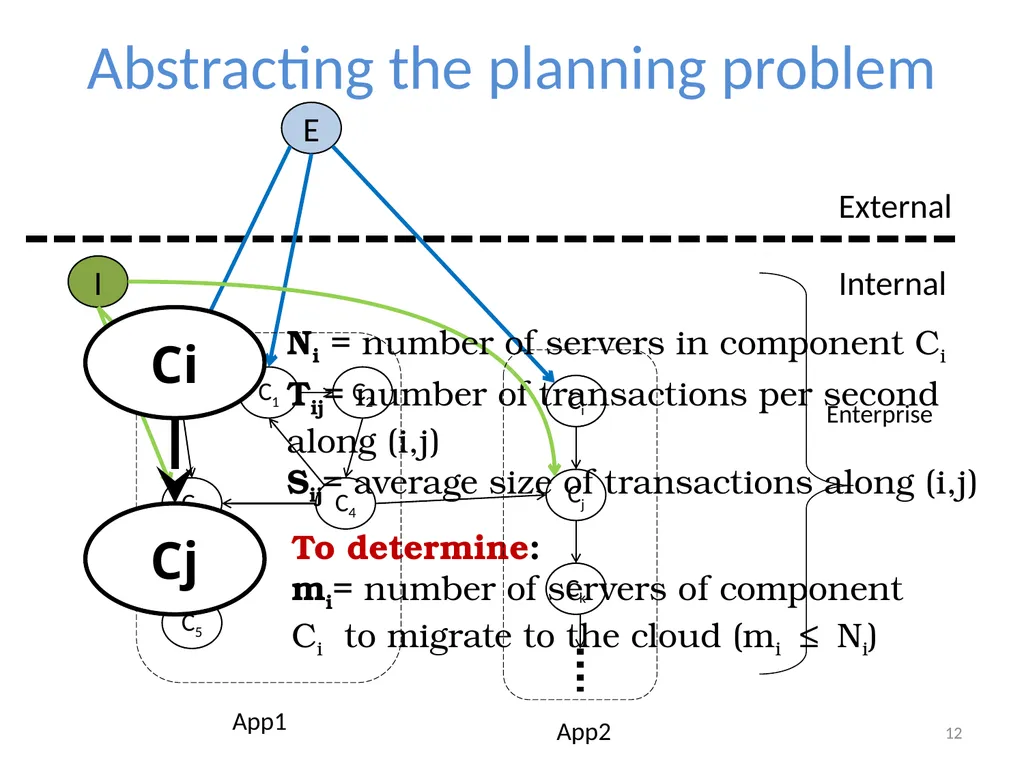
slide12. To determine:
mi= number of servers of component Ci to migrate to the cloud (mi ≤ Ni) Tij= number of transactions per second along (i,j)
Sij= average size of transactions along (i,j) C0 C1 C2 C3 C4 C5 Ci Cj Ck I E Enterprise App1 App2 Abstracting the planning problem Internal External Ni = number of servers in component Ci 12<br>
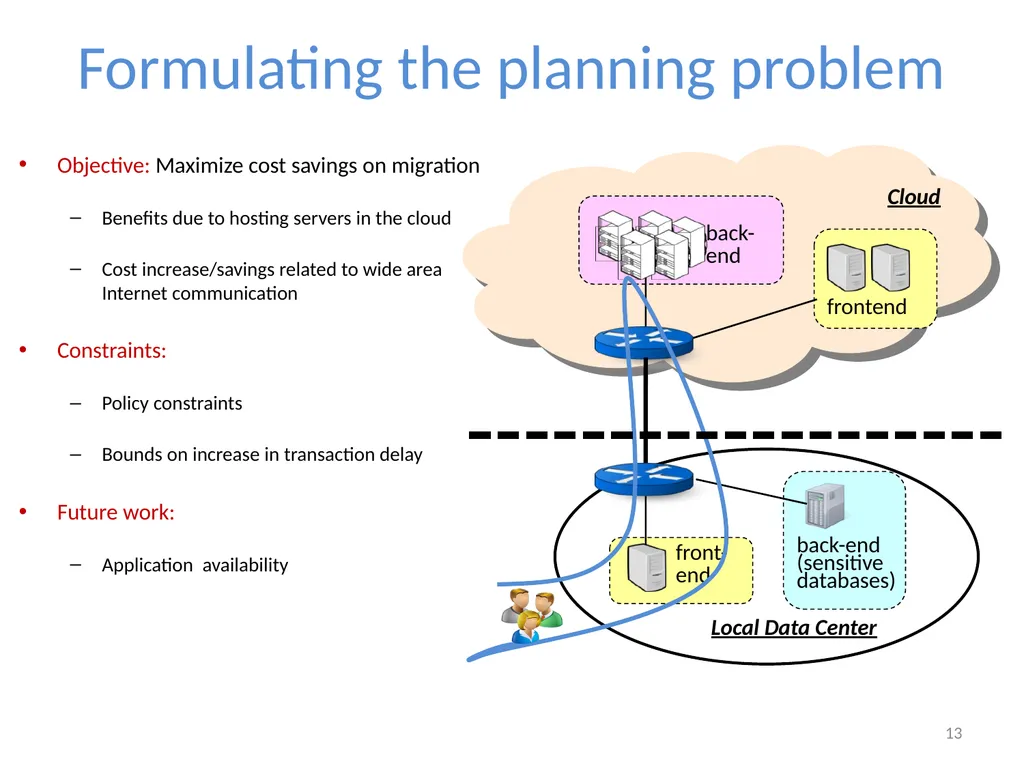
slide13. Formulating the planning problem 13 Objective: Maximize cost savings on migration
Benefits due to hosting servers in the cloud
Cost increase/savings related to wide area Internet communication
Constraints:
Policy constraints
Bounds on increase in transaction delay
Future work:
Application availability<br>
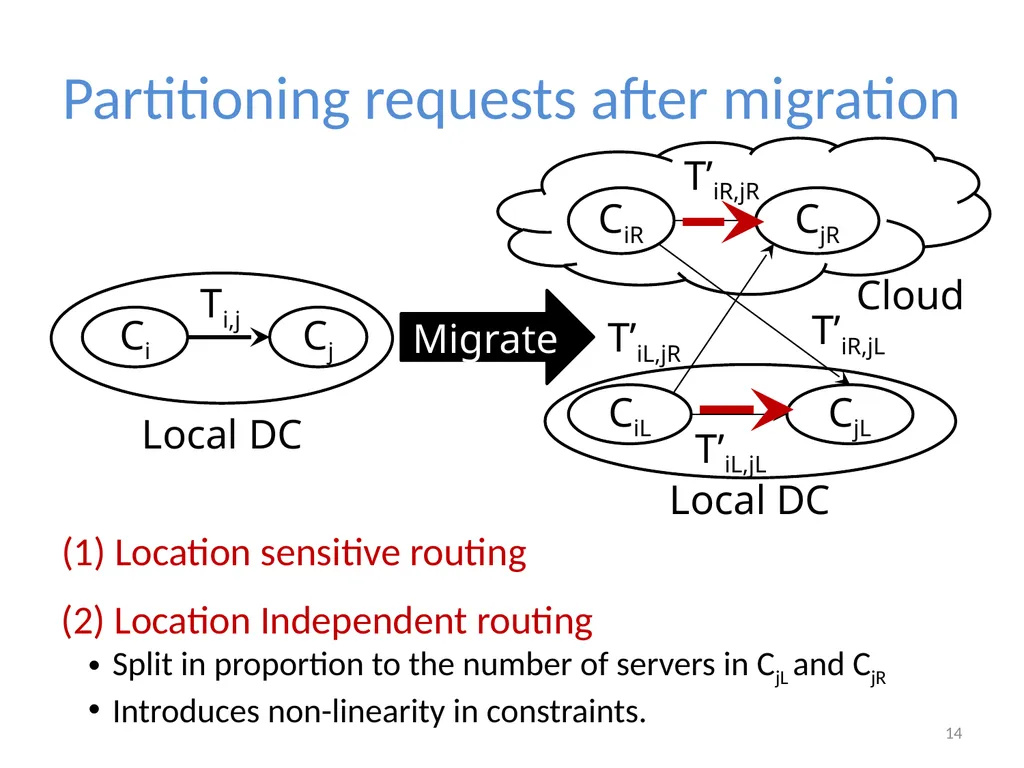
slide14. Partitioning requests after migration (1) Location sensitive routing Migrate CiL CjL CiR CjR T’iR,jL T’iL,jR T’iL,jL T’iR,jR (2) Location Independent routing
Split in proportion to the number of servers in CjL and CjR
Introduces non-linearity in constraints. 14<br>
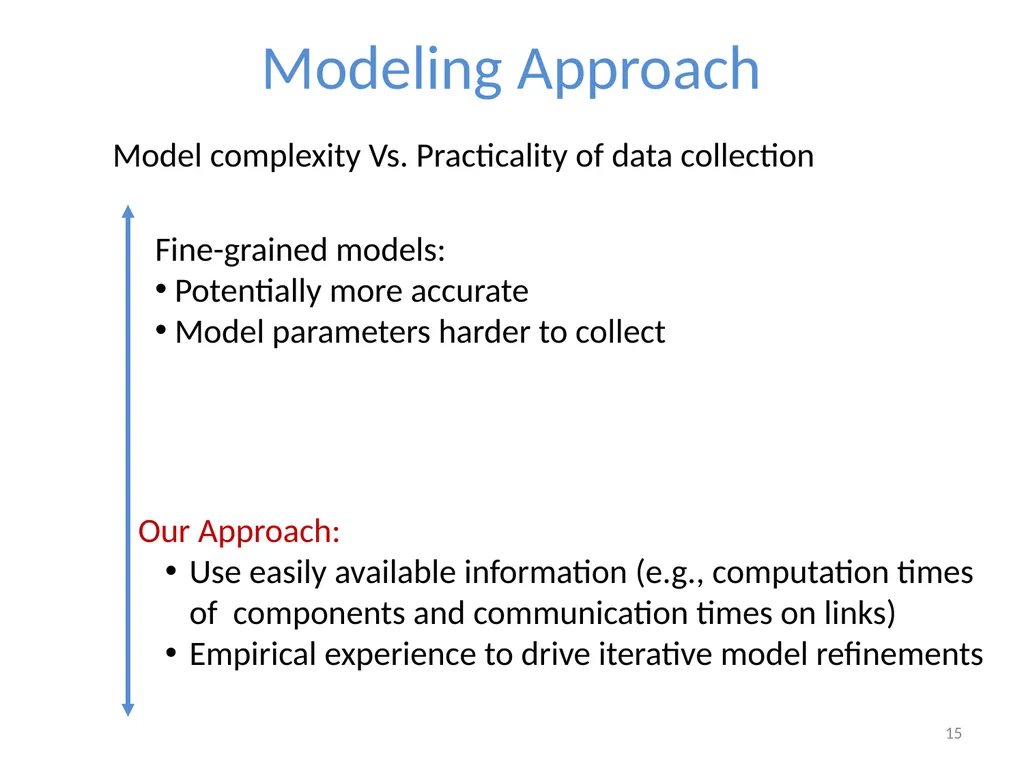
slide15. Modeling Approach 15 Model complexity Vs. Practicality of data collection Fine-grained models:
Potentially more accurate
Model parameters harder to collect Our Approach:
Use easily available information (e.g., computation times of components and communication times on links)
Empirical experience to drive iterative model refinements<br>
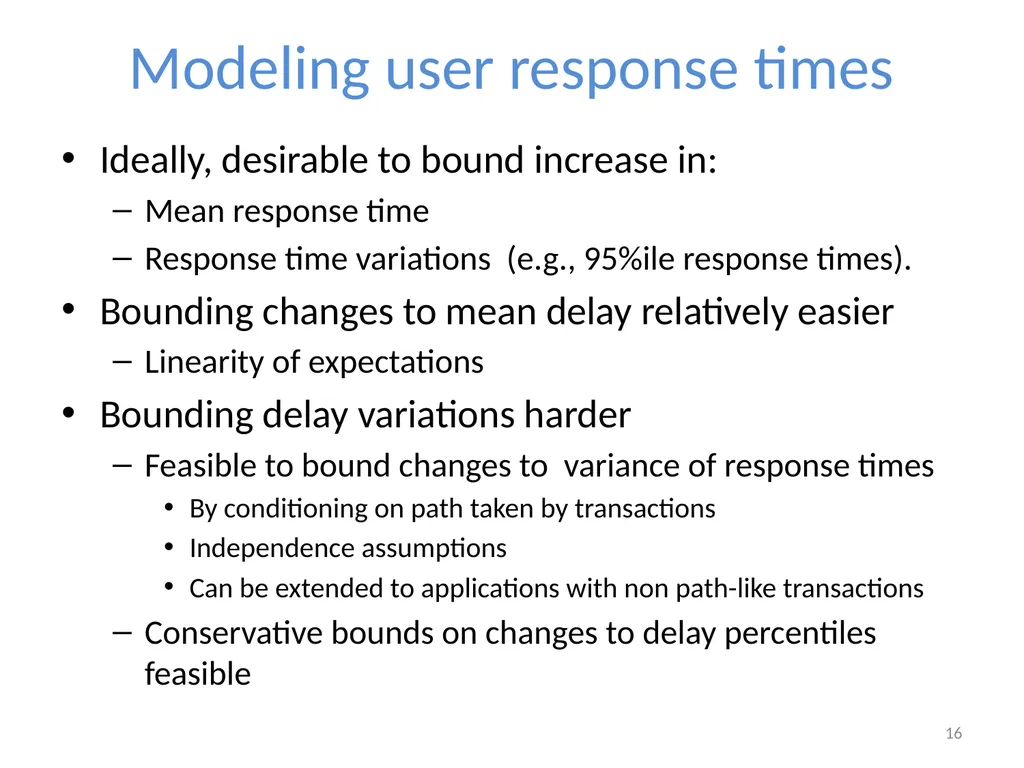
slide16. Modeling user response times Ideally, desirable to bound increase in:
Mean response time
Response time variations (e.g., 95%ile response times).
Bounding changes to mean delay relatively easier
Linearity of expectations
Bounding delay variations harder
Feasible to bound changes to variance of response times
By conditioning on path taken by transactions
Independence assumptions
Can be extended to applications with non path-like transactions
Conservative bounds on changes to delay percentiles feasible 16<br>
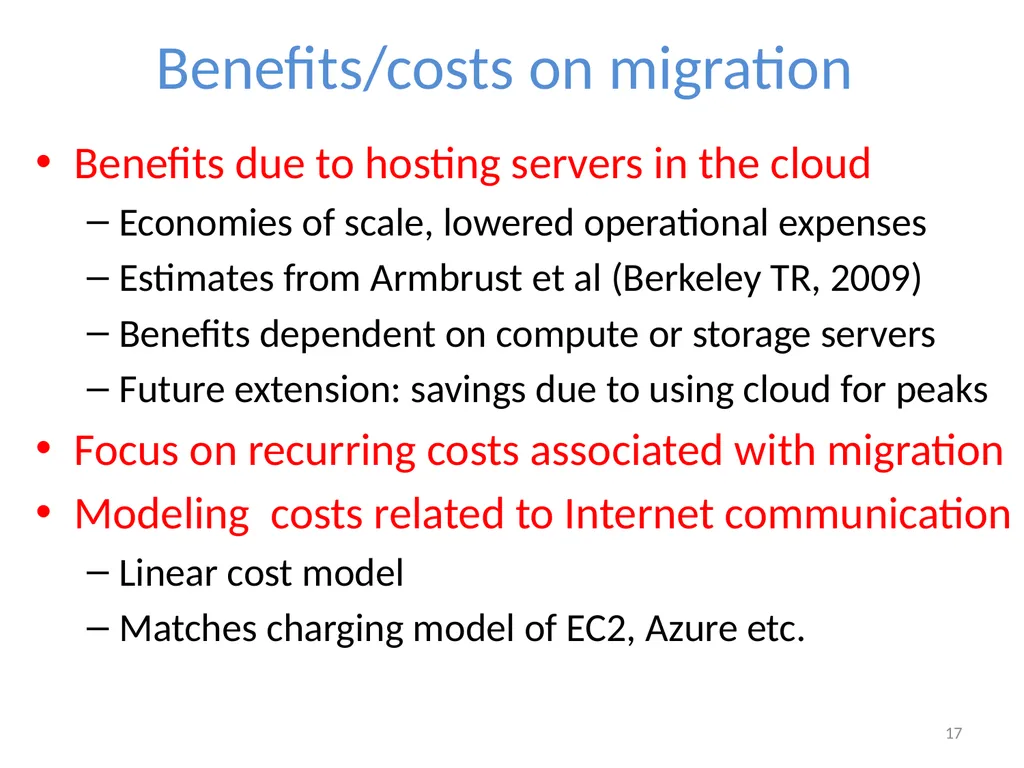
slide17. Benefits/costs on migration Benefits due to hosting servers in the cloud
Economies of scale, lowered operational expenses
Estimates from Armbrust et al (Berkeley TR, 2009)
Benefits dependent on compute or storage servers
Future extension: savings due to using cloud for peaks
Focus on recurring costs associated with migration
Modeling costs related to Internet communication
Linear cost model
Matches charging model of EC2, Azure etc. 17<br>
slide18. Talk Outline Enterprise Applications
Models for planning hybrid cloud deployments
Assurable migration of security policies
Evaluation and Results
Related Work and Conclusion<br>
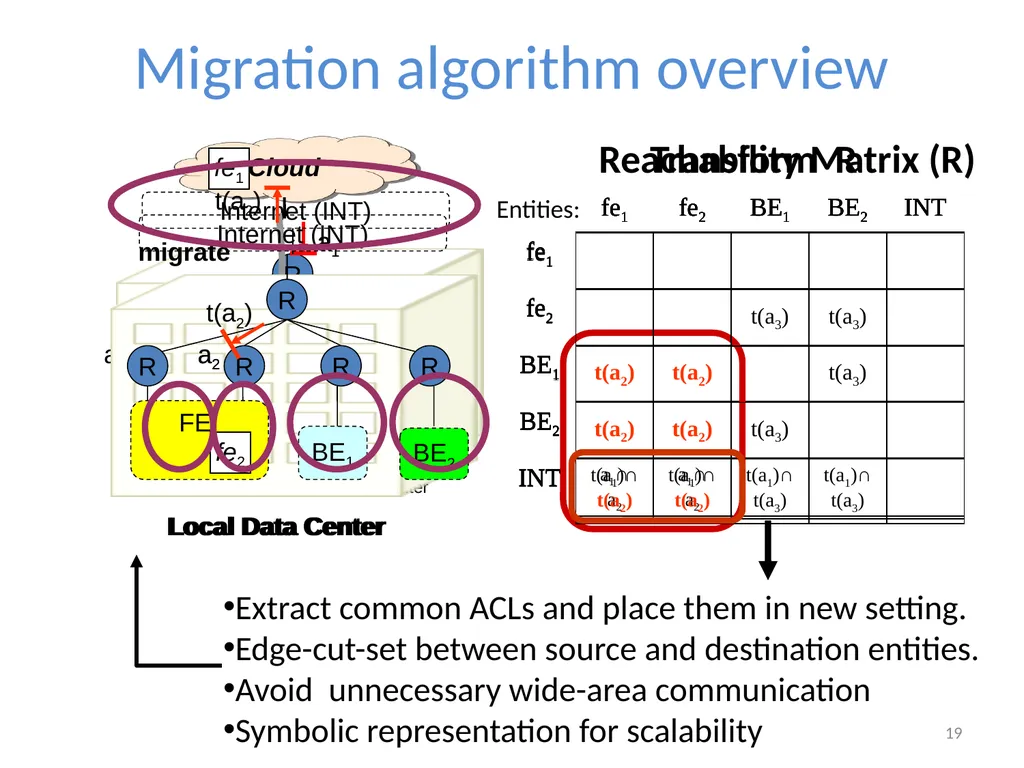
slide19. BE2 R R R R R BE1 a3 a3 a2 Local Data Center Internet (INT) BR = Border Router, AR = Access Router fe2 FE fe1 Migration algorithm overview t(a3) t(a1)∩ t(a2) t(a3) a3 a1∩ a2 a3 Extract common ACLs and place them in new setting.
Edge-cut-set between source and destination entities.
Avoid unnecessary wide-area communication
Symbolic representation for scalability Entities: a1 a2 a1 a2 Reachability Matrix (R) Transform R 19 t(a2)<br>
slide20. Evaluation Evaluation Goals:
Are there scenarios where a hybrid approach makes sense?
Is it feasible to achieve cost savings with the cloud while meeting performance targets and policy constraints?
How effective are our planning models?
Case Studies:
Windows Azure SDK application
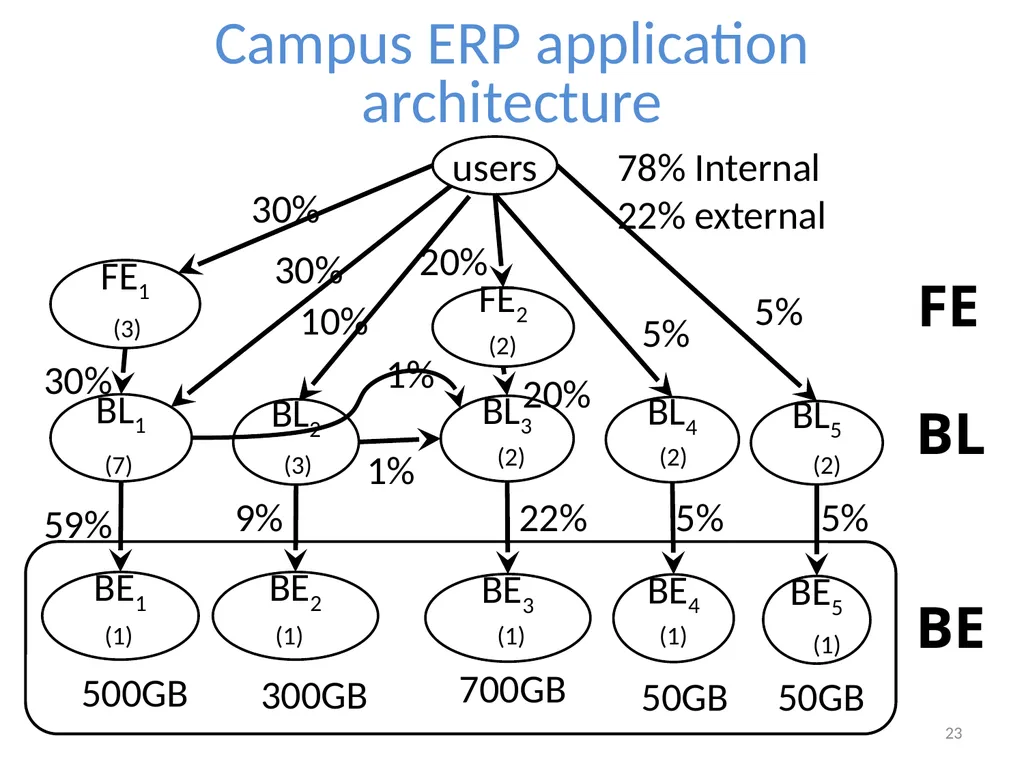
Campus Enterprise Resource Planning (ERP) application 20<br>
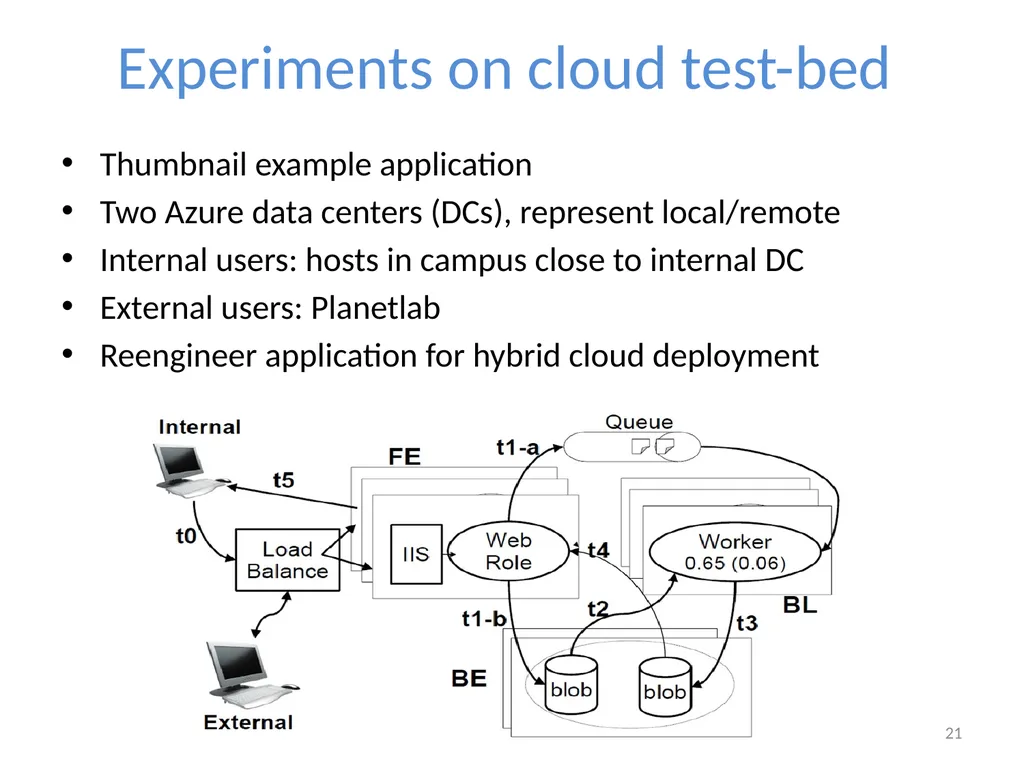
slide21. Experiments on cloud test-bed Thumbnail example application
Two Azure data centers (DCs), represent local/remote
Internal users: hosts in campus close to internal DC
External users: Planetlab
Reengineer application for hybrid cloud deployment 21<br>
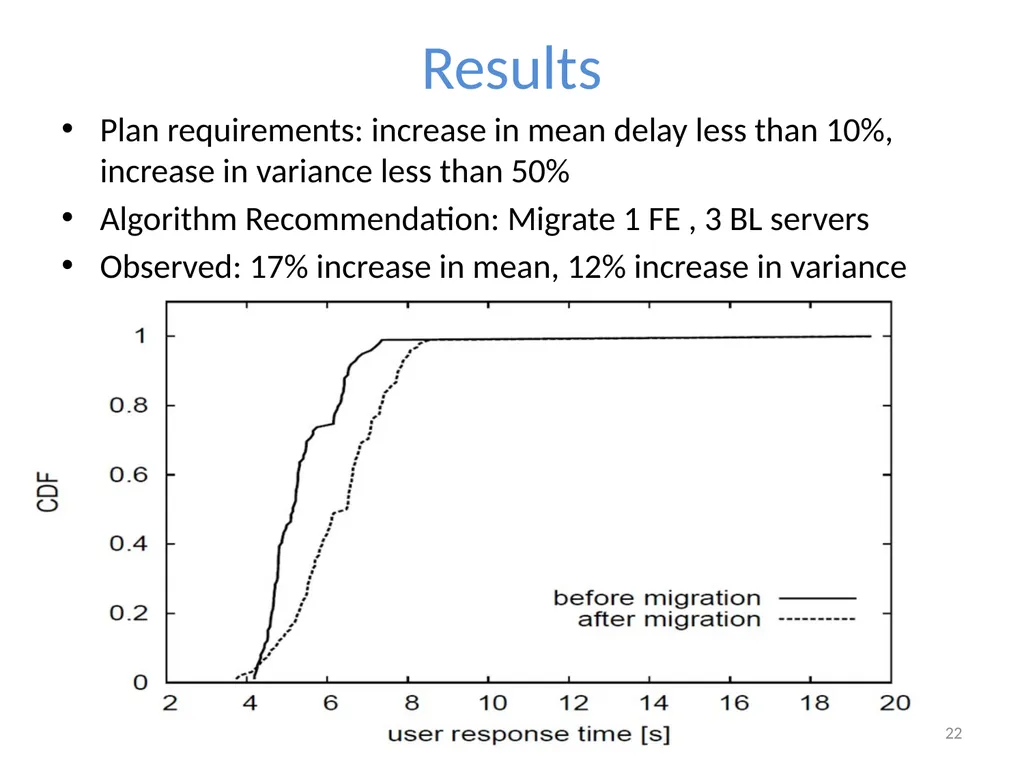
slide22. Results Plan requirements: increase in mean delay less than 10%, increase in variance less than 50%
Algorithm Recommendation: Migrate 1 FE , 3 BL servers
Observed: 17% increase in mean, 12% increase in variance 22<br>
slide23. users FE1 BL1 BL3 BL2 FE2 BL4 BL5 BE3 78% Internal 22% external 30% 30% 30% 10% 20% 20% 5% 5% 59% 1% 1% 9% 22% 5% 5% BE1 BE2 BE5 BE4 500GB 300GB 700GB 50GB 50GB Campus ERP application architecture (3) (7) (3) (2) (2) (2) (2) (1) (1) (1) (1) (1) BE BL FE 23<br>
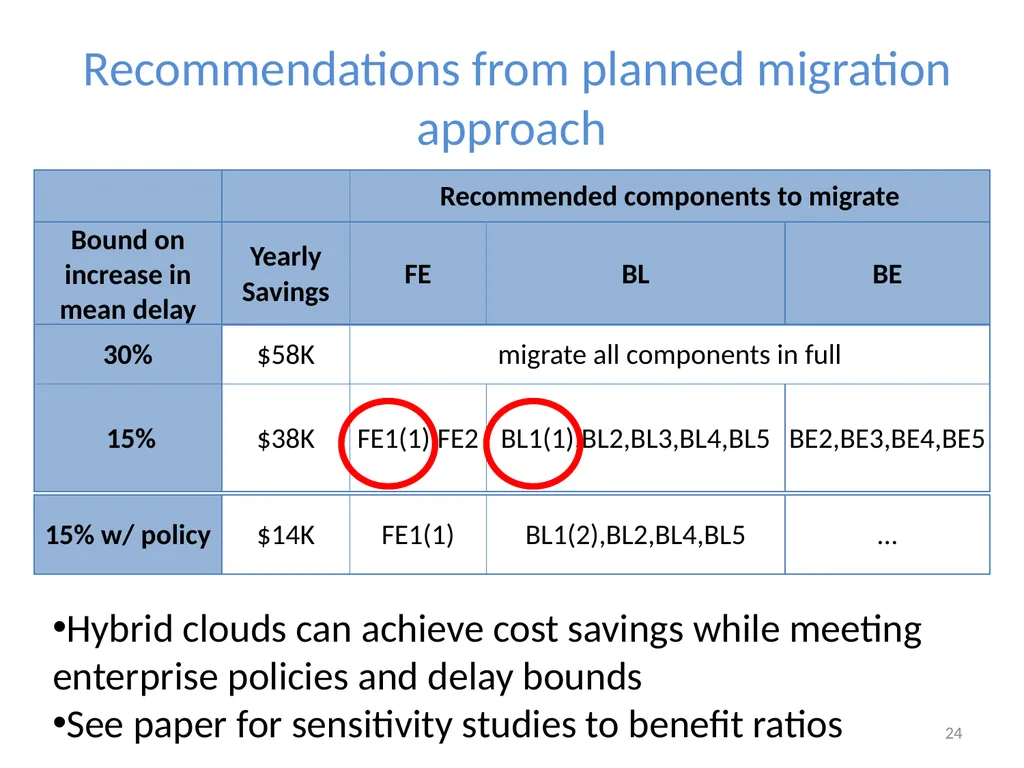
slide24. Recommendations from planned migration approach Hybrid clouds can achieve cost savings while meeting enterprise policies and delay bounds
See paper for sensitivity studies to benefit ratios 24<br>
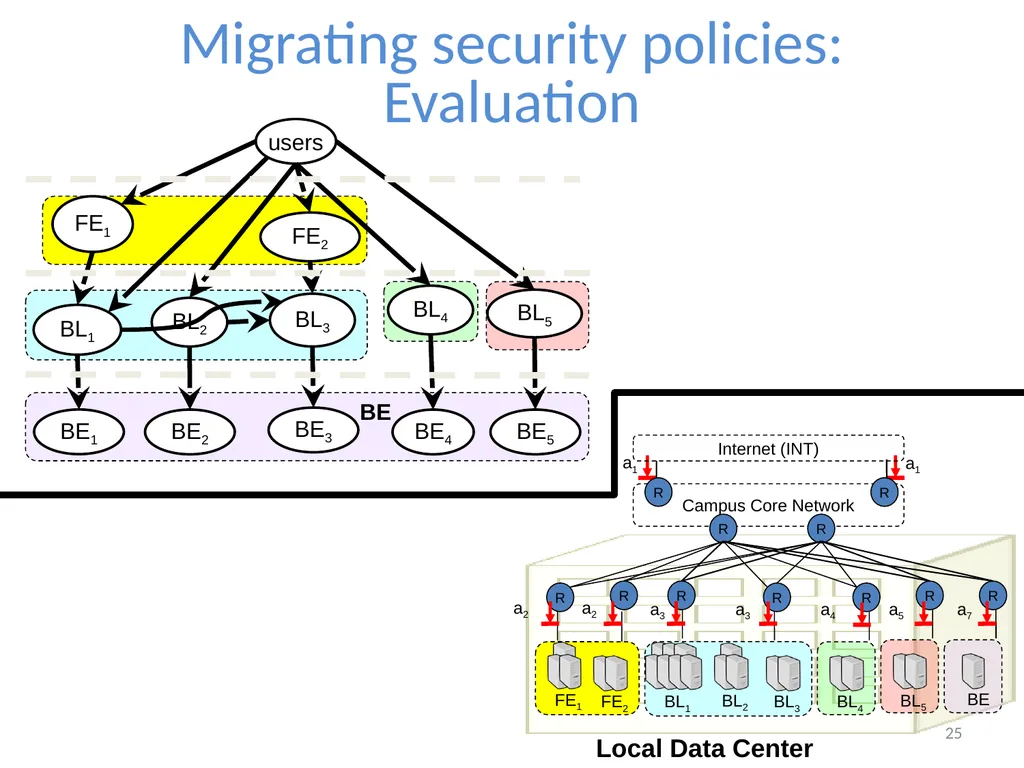
slide25. Migrating security policies: Evaluation Local Data Center BE2 BE3 BE4 BE5 25 BE<br>
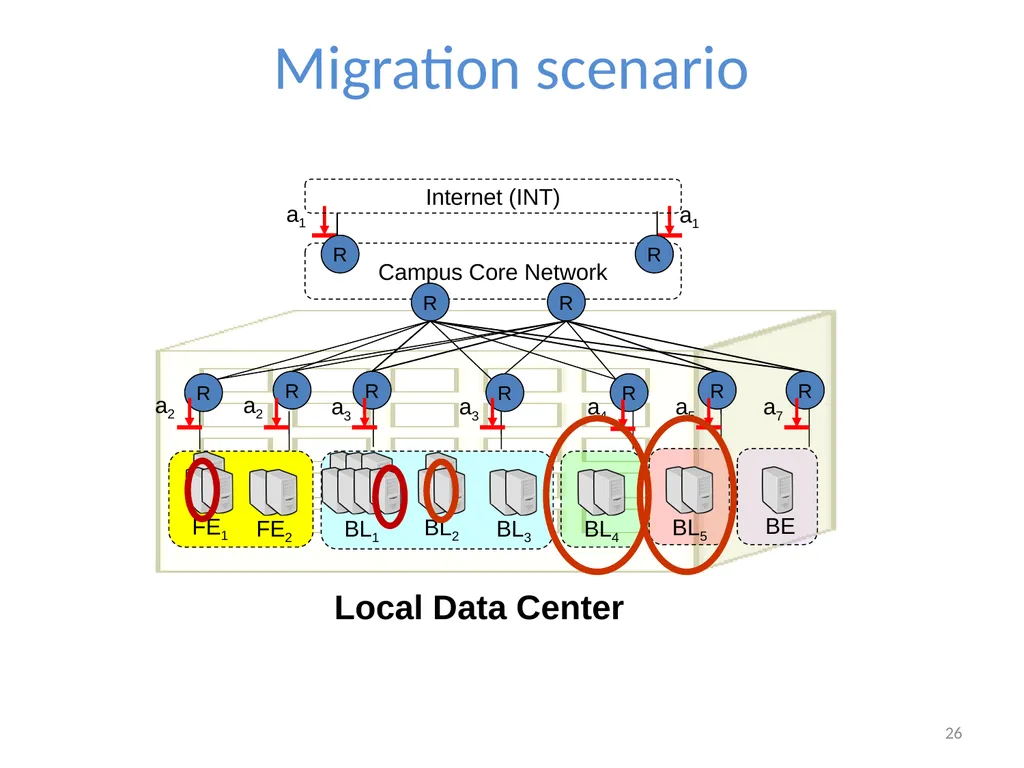
slide26. Migration scenario Campus Core Network R R R R R R a3 a4 a2 a1 a1 a2 Internet (INT) BL1 BL2 BL3 BL4 FE2 FE1 R a5 BL5 R a7 BE R R R a3 Local Data Center 26<br>
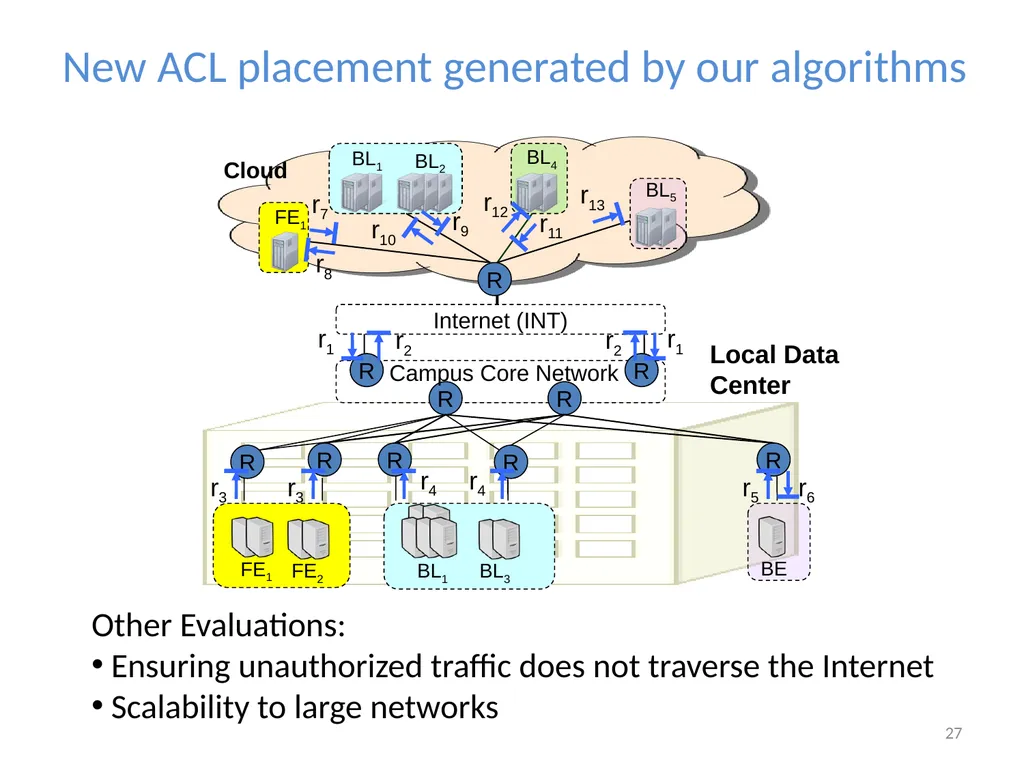
slide27. New ACL placement generated by our algorithms Local Data
Center 27 Other Evaluations:
Ensuring unauthorized traffic does not traverse the Internet
Scalability to large networks<br>
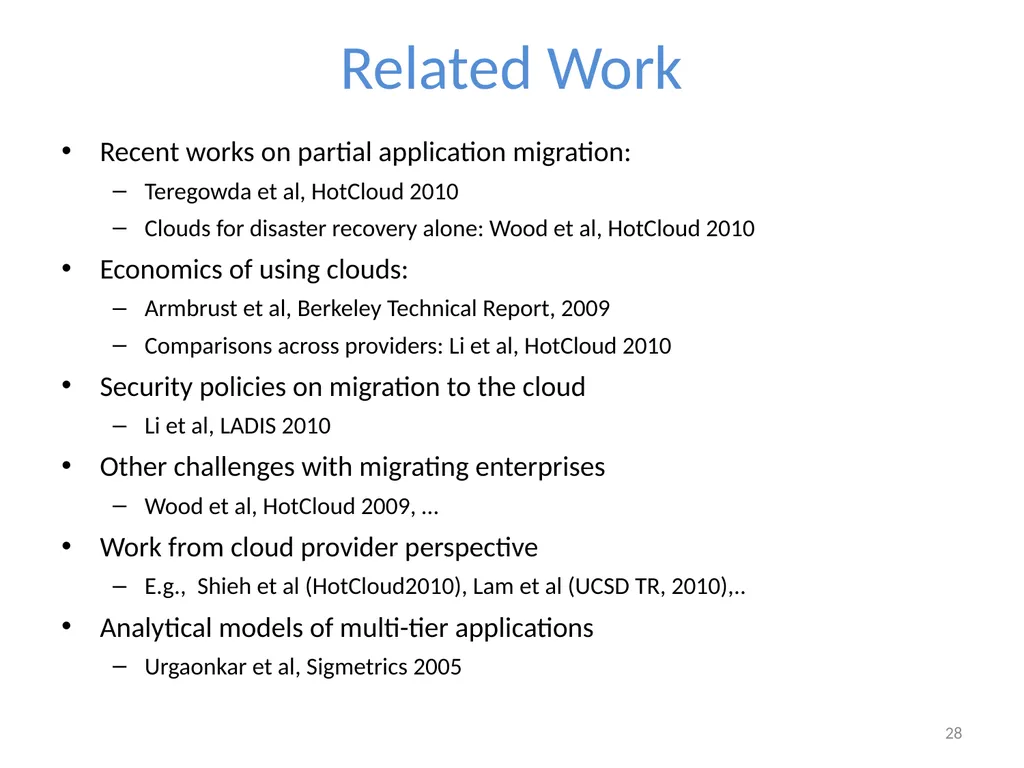
slide28. Related Work Recent works on partial application migration:
Teregowda et al, HotCloud 2010
Clouds for disaster recovery alone: Wood et al, HotCloud 2010
Economics of using clouds:
Armbrust et al, Berkeley Technical Report, 2009
Comparisons across providers: Li et al, HotCloud 2010
Security policies on migration to the cloud
Li et al, LADIS 2010
Other challenges with migrating enterprises
Wood et al, HotCloud 2009, …
Work from cloud provider perspective
E.g., Shieh et al (HotCloud2010), Lam et al (UCSD TR, 2010),..
Analytical models of multi-tier applications
Urgaonkar et al, Sigmetrics 2005 28<br>
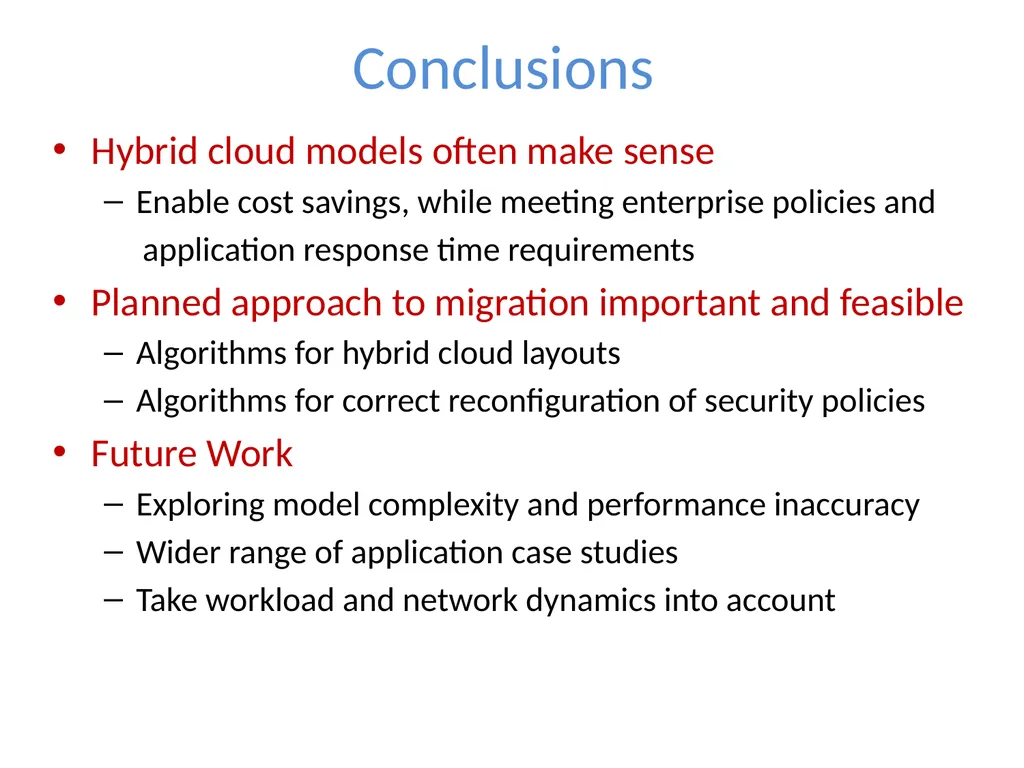
slide29. Conclusions Hybrid cloud models often make sense
Enable cost savings, while meeting enterprise policies and
application response time requirements
Planned approach to migration important and feasible
Algorithms for hybrid cloud layouts
Algorithms for correct reconfiguration of security policies
Future Work
Exploring model complexity and performance inaccuracy
Wider range of application case studies
Take workload and network dynamics into account<br>
David Maltz (Microsoft Research),
Sanjay Rao (Purdue University),
Kunwadee Sripanidkulchai (IBM T.J. Watson)
Mohit Tawarmalani (Purdue University) 1<br>
slide2. Cloud Computing “Most influential management ideas of the millenium”
Harvard Business Review
Early successes (e.g., indexing NYTimes Archive)
Much interest in migrating enterprises to the public cloud 2<br>
slide3. Concerns with cloud computing Data privacy
National Privacy Laws
Industry-specific privacy laws (e.g., Health Care)
SLA Requirements
Application response time
Availability 3<br>
slide4. Hybrid Cloud Architectures “And there are some things they might not want to put in the cloud for security and reliability reasons….So, you've got
to have these kinds of hybrid solutions.”
Steve Ballmer, Microsoft CEO “We think it's a combination of putting applications in your own data center, and then use the cloud to take out peaks, or you could put specific things in the cloud.”
Joe Tucci, EMC CEO “Virtually every enterprise will adopt a hybrid format”
Russ Daniels, CTO of cloud computing, HP 4<br>
slide5. Our focus #1 : Planning hybrid cloud layouts Cost savings, Application response times, Bandwidth costs
Scale and complexity of enterprises applications<br>
slide6. Our focus #2: migrating security policies an ACL permit frontendbackend port 8000 deny anybackend Local Data Center Cloud ? Security most important initiative for 83% of surveyed operators
Security policies often realized using Access Control Lists (ACLs)
Typical to see hundreds of firewall contexts, ACLs with hundreds
of rules 6<br>
slide7. Contributions of this paper Highlight complexity of enterprise applications, data-center policies
Framing and providing first-cut solutions for two key challenges in migrating enterprises to hybrid cloud
Models for planning hybrid cloud deployments
Abstractions and algorithms for assurable migration of security policies
Validations using real enterprise applications, Azure-based cloud deployments<br>
slide8. Talk Outline Enterprise Applications
Models for planning hybrid cloud deployments
Assurable migration of security policies
Evaluation and Results
Related Work and Conclusion<br>
slide9. Enterprise Applications E.g., Payroll, travel and expense reimbursement, customer relationship management etc. BE FE BL 9 FE1 FE2 BL1 BL2 BL3 BL4 BL5 BL1 BL2 BL3 BL4 BL5<br>
slide10. Enterprise Applications E.g., Payroll, travel and expense reimbursement, customer relationship management etc. 10<br>
slide11. Scale of enterprise applications 11<br>
slide12. To determine:
mi= number of servers of component Ci to migrate to the cloud (mi ≤ Ni) Tij= number of transactions per second along (i,j)
Sij= average size of transactions along (i,j) C0 C1 C2 C3 C4 C5 Ci Cj Ck I E Enterprise App1 App2 Abstracting the planning problem Internal External Ni = number of servers in component Ci 12<br>
slide13. Formulating the planning problem 13 Objective: Maximize cost savings on migration
Benefits due to hosting servers in the cloud
Cost increase/savings related to wide area Internet communication
Constraints:
Policy constraints
Bounds on increase in transaction delay
Future work:
Application availability<br>
slide14. Partitioning requests after migration (1) Location sensitive routing Migrate CiL CjL CiR CjR T’iR,jL T’iL,jR T’iL,jL T’iR,jR (2) Location Independent routing
Split in proportion to the number of servers in CjL and CjR
Introduces non-linearity in constraints. 14<br>
slide15. Modeling Approach 15 Model complexity Vs. Practicality of data collection Fine-grained models:
Potentially more accurate
Model parameters harder to collect Our Approach:
Use easily available information (e.g., computation times of components and communication times on links)
Empirical experience to drive iterative model refinements<br>
slide16. Modeling user response times Ideally, desirable to bound increase in:
Mean response time
Response time variations (e.g., 95%ile response times).
Bounding changes to mean delay relatively easier
Linearity of expectations
Bounding delay variations harder
Feasible to bound changes to variance of response times
By conditioning on path taken by transactions
Independence assumptions
Can be extended to applications with non path-like transactions
Conservative bounds on changes to delay percentiles feasible 16<br>
slide17. Benefits/costs on migration Benefits due to hosting servers in the cloud
Economies of scale, lowered operational expenses
Estimates from Armbrust et al (Berkeley TR, 2009)
Benefits dependent on compute or storage servers
Future extension: savings due to using cloud for peaks
Focus on recurring costs associated with migration
Modeling costs related to Internet communication
Linear cost model
Matches charging model of EC2, Azure etc. 17<br>
slide18. Talk Outline Enterprise Applications
Models for planning hybrid cloud deployments
Assurable migration of security policies
Evaluation and Results
Related Work and Conclusion<br>
slide19. BE2 R R R R R BE1 a3 a3 a2 Local Data Center Internet (INT) BR = Border Router, AR = Access Router fe2 FE fe1 Migration algorithm overview t(a3) t(a1)∩ t(a2) t(a3) a3 a1∩ a2 a3 Extract common ACLs and place them in new setting.
Edge-cut-set between source and destination entities.
Avoid unnecessary wide-area communication
Symbolic representation for scalability Entities: a1 a2 a1 a2 Reachability Matrix (R) Transform R 19 t(a2)<br>
slide20. Evaluation Evaluation Goals:
Are there scenarios where a hybrid approach makes sense?
Is it feasible to achieve cost savings with the cloud while meeting performance targets and policy constraints?
How effective are our planning models?
Case Studies:
Windows Azure SDK application
Campus Enterprise Resource Planning (ERP) application 20<br>
slide21. Experiments on cloud test-bed Thumbnail example application
Two Azure data centers (DCs), represent local/remote
Internal users: hosts in campus close to internal DC
External users: Planetlab
Reengineer application for hybrid cloud deployment 21<br>
slide22. Results Plan requirements: increase in mean delay less than 10%, increase in variance less than 50%
Algorithm Recommendation: Migrate 1 FE , 3 BL servers
Observed: 17% increase in mean, 12% increase in variance 22<br>
slide23. users FE1 BL1 BL3 BL2 FE2 BL4 BL5 BE3 78% Internal 22% external 30% 30% 30% 10% 20% 20% 5% 5% 59% 1% 1% 9% 22% 5% 5% BE1 BE2 BE5 BE4 500GB 300GB 700GB 50GB 50GB Campus ERP application architecture (3) (7) (3) (2) (2) (2) (2) (1) (1) (1) (1) (1) BE BL FE 23<br>
slide24. Recommendations from planned migration approach Hybrid clouds can achieve cost savings while meeting enterprise policies and delay bounds
See paper for sensitivity studies to benefit ratios 24<br>
slide25. Migrating security policies: Evaluation Local Data Center BE2 BE3 BE4 BE5 25 BE<br>
slide26. Migration scenario Campus Core Network R R R R R R a3 a4 a2 a1 a1 a2 Internet (INT) BL1 BL2 BL3 BL4 FE2 FE1 R a5 BL5 R a7 BE R R R a3 Local Data Center 26<br>
slide27. New ACL placement generated by our algorithms Local Data
Center 27 Other Evaluations:
Ensuring unauthorized traffic does not traverse the Internet
Scalability to large networks<br>
slide28. Related Work Recent works on partial application migration:
Teregowda et al, HotCloud 2010
Clouds for disaster recovery alone: Wood et al, HotCloud 2010
Economics of using clouds:
Armbrust et al, Berkeley Technical Report, 2009
Comparisons across providers: Li et al, HotCloud 2010
Security policies on migration to the cloud
Li et al, LADIS 2010
Other challenges with migrating enterprises
Wood et al, HotCloud 2009, …
Work from cloud provider perspective
E.g., Shieh et al (HotCloud2010), Lam et al (UCSD TR, 2010),..
Analytical models of multi-tier applications
Urgaonkar et al, Sigmetrics 2005 28<br>
slide29. Conclusions Hybrid cloud models often make sense
Enable cost savings, while meeting enterprise policies and
application response time requirements
Planned approach to migration important and feasible
Algorithms for hybrid cloud layouts
Algorithms for correct reconfiguration of security policies
Future Work
Exploring model complexity and performance inaccuracy
Wider range of application case studies
Take workload and network dynamics into account<br>