
Co-Production and Beyond Working together with


Description: Co-Production and Beyond Working together with children, young people, families and expert by experiences Parent Carer Forums Essex Family Forum is a Parent Carer Forum (PCF). Each Local area has a PCF. There are 152 PCFs, representing
Related Topics
Download Presentation
"Co-Production and Beyond Working together with" is the property of its rightful owner. Permission is granted to download and print the materials on this website for personal, non-commercial use only, and to display it on your personal computer provided you do not modify the materials and that you retain all copyright notices contained in the materials. By downloading content from our website, you accept the terms of this agreement.
Presentation Transcript
slide1. Co-Production and Beyond
Working together with children, young people, families and expert by experiences’<br>
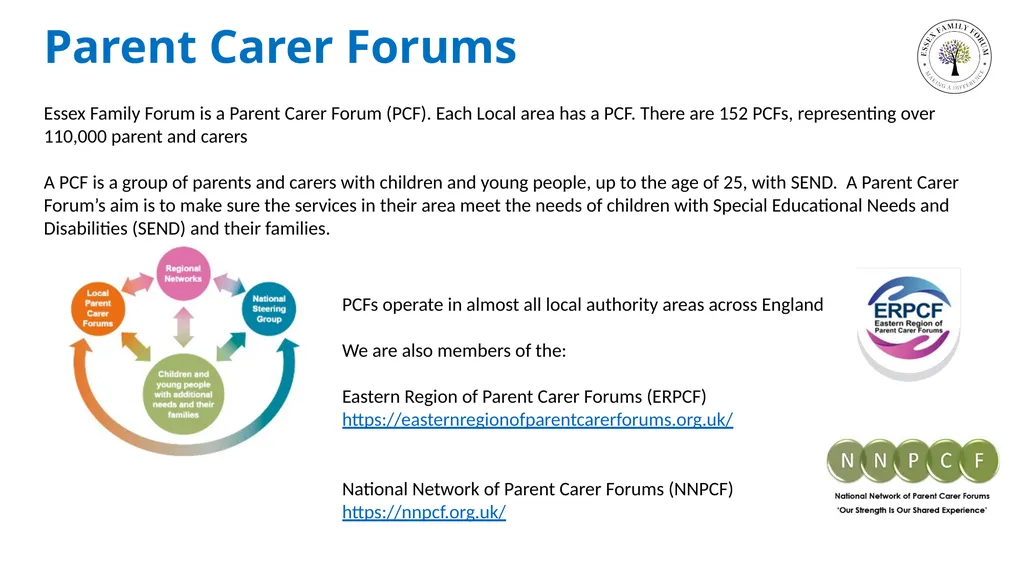
slide2. Parent Carer Forums Essex Family Forum is a Parent Carer Forum (PCF). Each Local area has a PCF. There are 152 PCFs, representing over 110,000 parent and carers
A PCF is a group of parents and carers with children and young people, up to the age of 25, with SEND. A Parent Carer Forum’s aim is to make sure the services in their area meet the needs of children with Special Educational Needs and Disabilities (SEND) and their families. PCFs operate in almost all local authority areas across England
We are also members of the:
Eastern Region of Parent Carer Forums (ERPCF) https://easternregionofparentcarerforums.org.uk/
National Network of Parent Carer Forums (NNPCF) https://nnpcf.org.uk/<br>
slide3. The Impact of Co-Production Co-production is not always easy and can take time, but when approached with genuine curiosity and a desire to work collaboratively to solve problems, it is a powerfully effective way to design and deliver health and social care.
Co-production allows every voice to be heard equally. It is important to have the right people involved in the process and create an environment which removes any power dynamics which may prevent everyone from having parity of contribution. Working co-productively can:
improve outcomes for service users
helps maintain a person-centered approach
Offer value for money, by ensuring services effectively meet need and provide a better use of resources
Improve the experiences and lives of service users
provide commissioners and service providers the confidence services meet the needs of the service users
increase the confidence in the community
can led to the identification of new ways of working and creative solutions or using existing resources in a more effective way.<br>
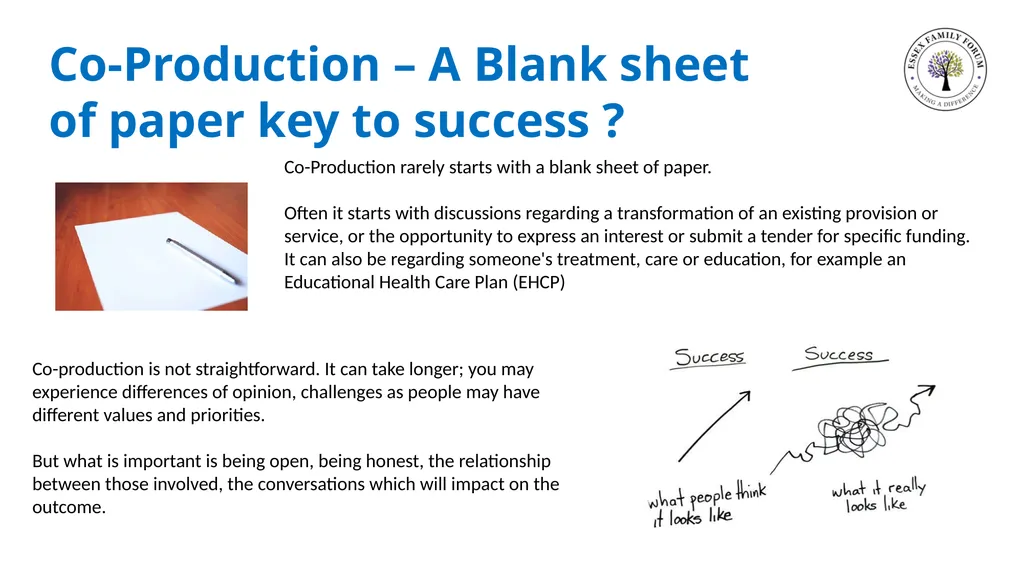
slide4. Co-Production – A Blank sheet of paper key to success ? Co-Production rarely starts with a blank sheet of paper.
Often it starts with discussions regarding a transformation of an existing provision or service, or the opportunity to express an interest or submit a tender for specific funding. It can also be regarding someone's treatment, care or education, for example an Educational Health Care Plan (EHCP) Co-production is not straightforward. It can take longer; you may experience differences of opinion, challenges as people may have different values and priorities.
But what is important is being open, being honest, the relationship between those involved, the conversations which will impact on the outcome.<br>
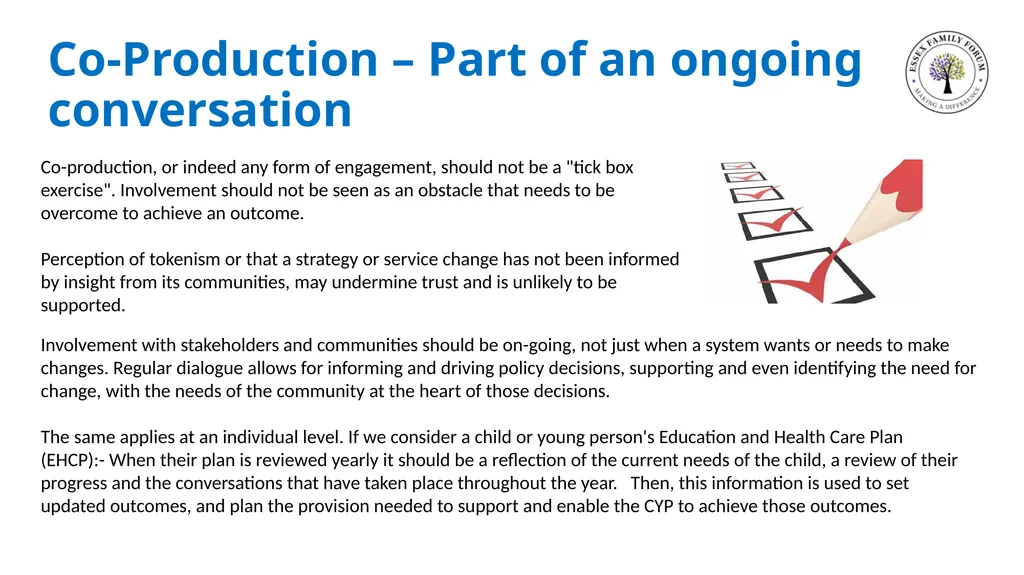
slide5. Co-Production – Part of an ongoing conversation Co-production, or indeed any form of engagement, should not be a "tick box exercise". Involvement should not be seen as an obstacle that needs to be overcome to achieve an outcome.
Perception of tokenism or that a strategy or service change has not been informed by insight from its communities, may undermine trust and is unlikely to be supported. Involvement with stakeholders and communities should be on-going, not just when a system wants or needs to make changes. Regular dialogue allows for informing and driving policy decisions, supporting and even identifying the need for change, with the needs of the community at the heart of those decisions.
The same applies at an individual level. If we consider a child or young person's Education and Health Care Plan (EHCP):- When their plan is reviewed yearly it should be a reflection of the current needs of the child, a review of their progress and the conversations that have taken place throughout the year. Then, this information is used to set updated outcomes, and plan the provision needed to support and enable the CYP to achieve those outcomes.<br>
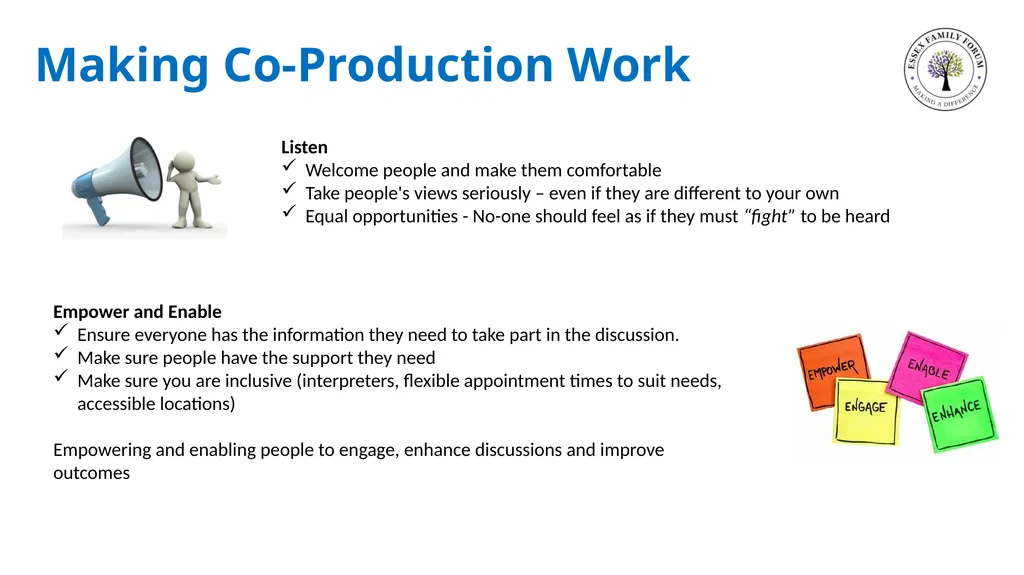
slide6. Making Co-Production Work Listen
Welcome people and make them comfortable
Take people's views seriously – even if they are different to your own
Equal opportunities - No-one should feel as if they must “fight” to be heard Empower and Enable
Ensure everyone has the information they need to take part in the discussion.
Make sure people have the support they need
Make sure you are inclusive (interpreters, flexible appointment times to suit needs, accessible locations)
Empowering and enabling people to engage, enhance discussions and improve outcomes<br>
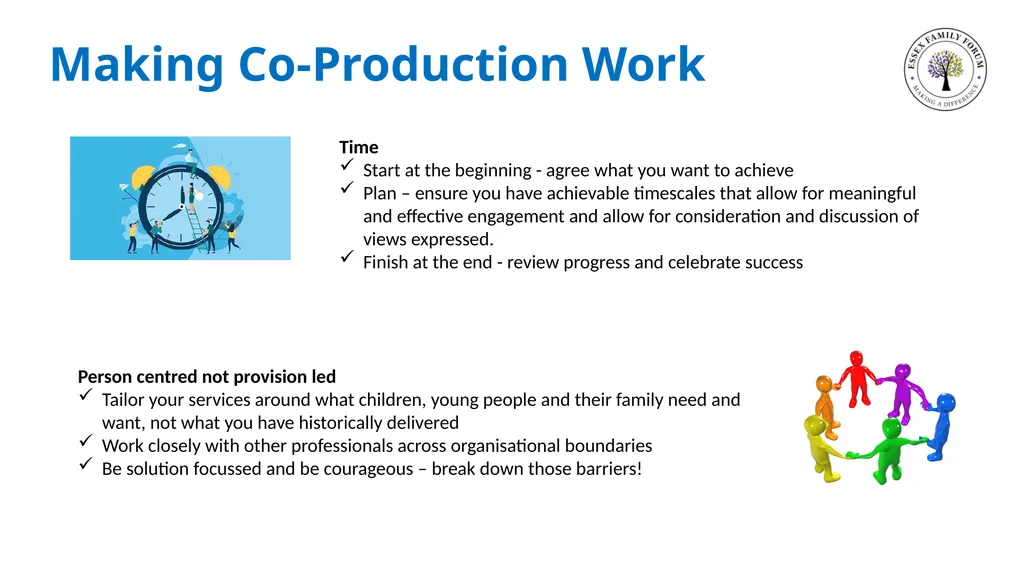
slide7. Making Co-Production Work Time
Start at the beginning - agree what you want to achieve
Plan – ensure you have achievable timescales that allow for meaningful and effective engagement and allow for consideration and discussion of views expressed.
Finish at the end - review progress and celebrate success Person centred not provision led
Tailor your services around what children, young people and their family need and want, not what you have historically delivered
Work closely with other professionals across organisational boundaries
Be solution focussed and be courageous – break down those barriers!<br>
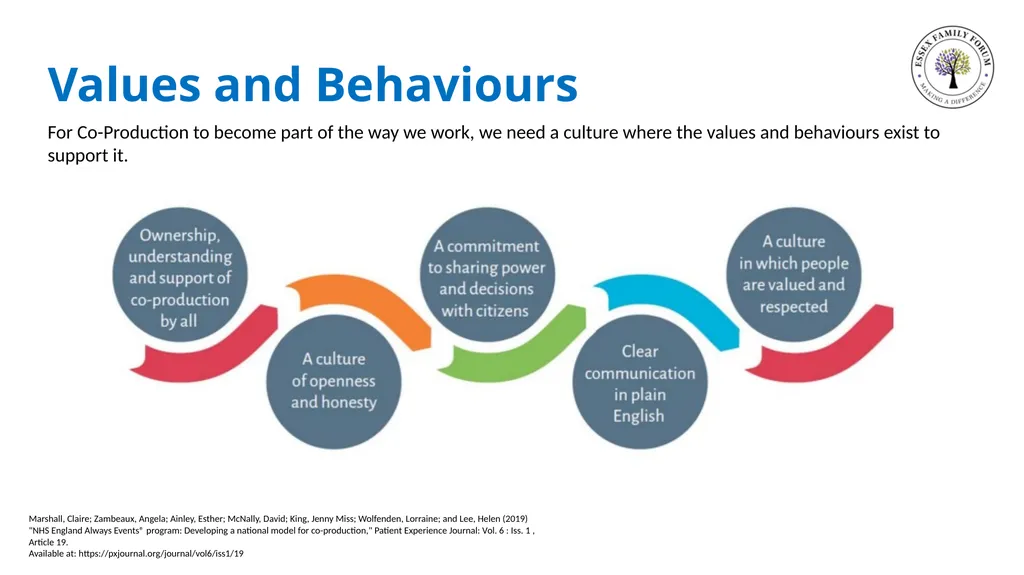
slide8. Values and Behaviours For Co-Production to become part of the way we work, we need a culture where the values and behaviours exist to support it. Marshall, Claire; Zambeaux, Angela; Ainley, Esther; McNally, David; King, Jenny Miss; Wolfenden, Lorraine; and Lee, Helen (2019)
"NHS England Always Events® program: Developing a national model for co-production," Patient Experience Journal: Vol. 6 : Iss. 1 ,
Article 19.
Available at: https://pxjournal.org/journal/vol6/iss1/19<br>
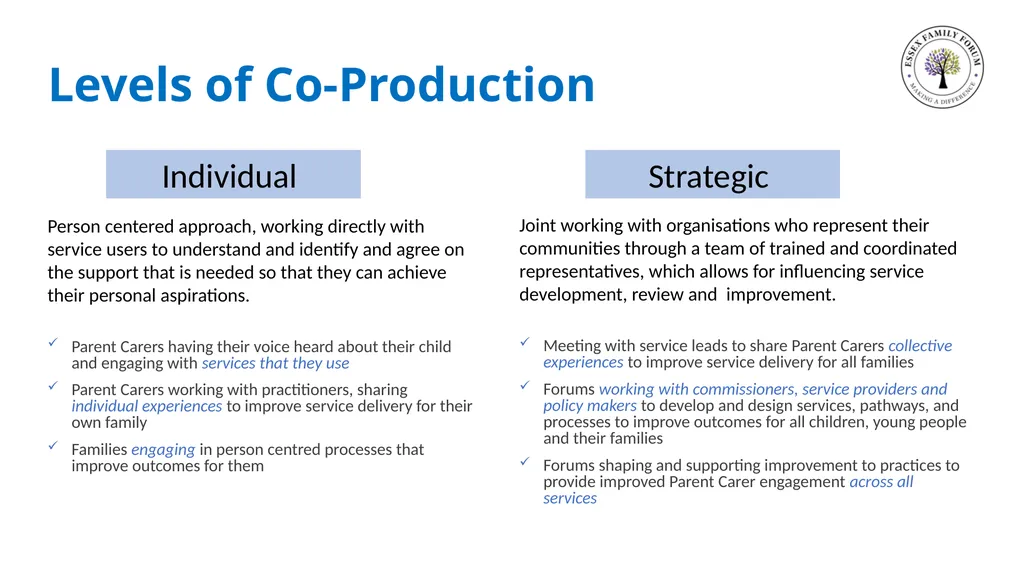
slide9. Levels of Co-Production Individual Strategic Person centered approach, working directly with service users to understand and identify and agree on the support that is needed so that they can achieve their personal aspirations.
Parent Carers having their voice heard about their child and engaging with services that they use
Parent Carers working with practitioners, sharing individual experiences to improve service delivery for their own family
Families engaging in person centred processes that improve outcomes for them Joint working with organisations who represent their communities through a team of trained and coordinated representatives, which allows for influencing service development, review and improvement.
Meeting with service leads to share Parent Carers collective experiences to improve service delivery for all families
Forums working with commissioners, service providers and policy makers to develop and design services, pathways, and processes to improve outcomes for all children, young people and their families
Forums shaping and supporting improvement to practices to provide improved Parent Carer engagement across all services<br>
slide10. Co-Production – Just a buzz word? Coproduction is a “buzz word” and is increasingly used as a term to describe any form of engagement with people with lived experience.
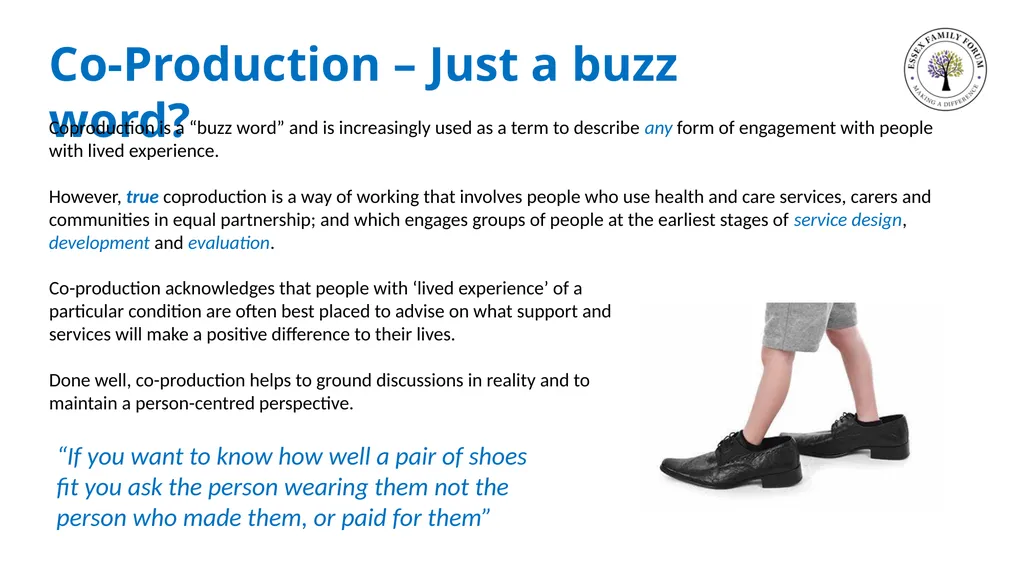
However, true coproduction is a way of working that involves people who use health and care services, carers and communities in equal partnership; and which engages groups of people at the earliest stages of service design, development and evaluation. “If you want to know how well a pair of shoes fit you ask the person wearing them not the person who made them, or paid for them” Co-production acknowledges that people with ‘lived experience’ of a particular condition are often best placed to advise on what support and services will make a positive difference to their lives.
Done well, co-production helps to ground discussions in reality and to maintain a person-centred perspective.<br>
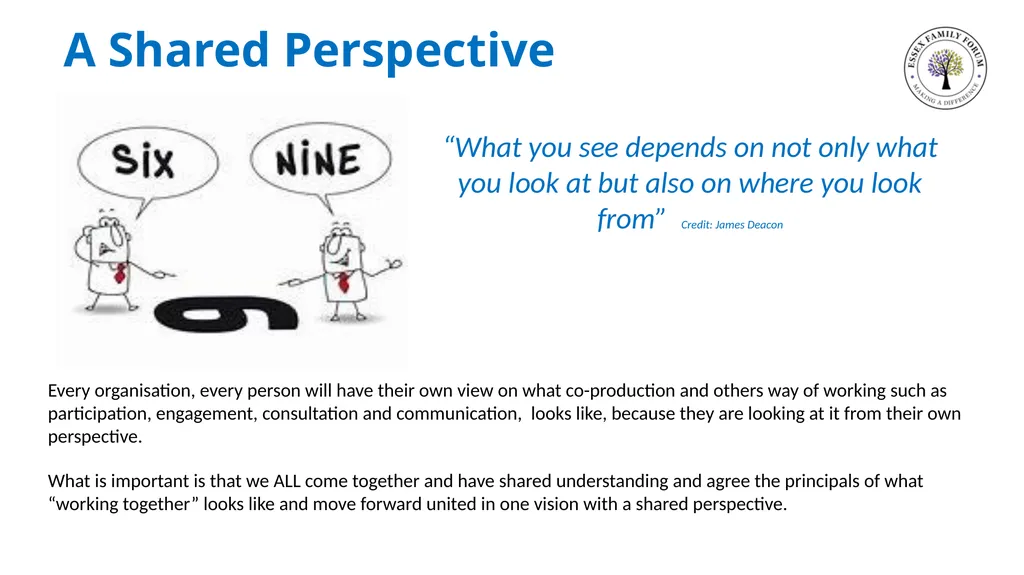
slide11. A Shared Perspective “What you see depends on not only what you look at but also on where you look from” Credit: James Deacon Every organisation, every person will have their own view on what co-production and others way of working such as participation, engagement, consultation and communication, looks like, because they are looking at it from their own perspective. What is important is that we ALL come together and have shared understanding and agree the principals of what “working together” looks like and move forward united in one vision with a shared perspective.<br>
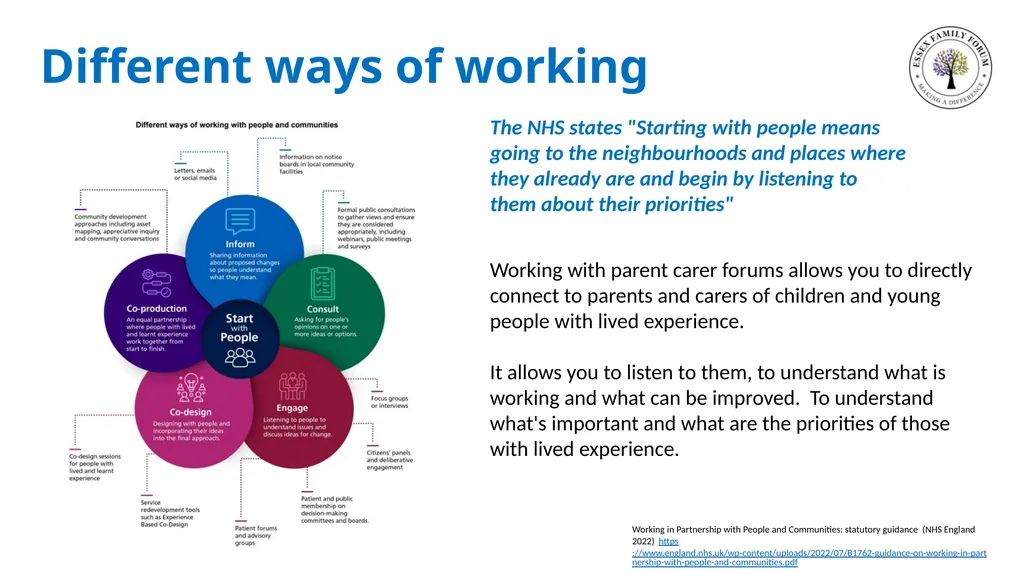
slide12. Different ways of working The NHS states "Starting with people means going to the neighbourhoods and places where they already are and begin by listening to them about their priorities" Working with parent carer forums allows you to directly connect to parents and carers of children and young people with lived experience.
It allows you to listen to them, to understand what is working and what can be improved. To understand what's important and what are the priorities of those with lived experience. Working in Partnership with People and Communities: statutory guidance (NHS England 2022) https://www.england.nhs.uk/wp-content/uploads/2022/07/B1762-guidance-on-working-in-partnership-with-people-and-communities.pdf<br>
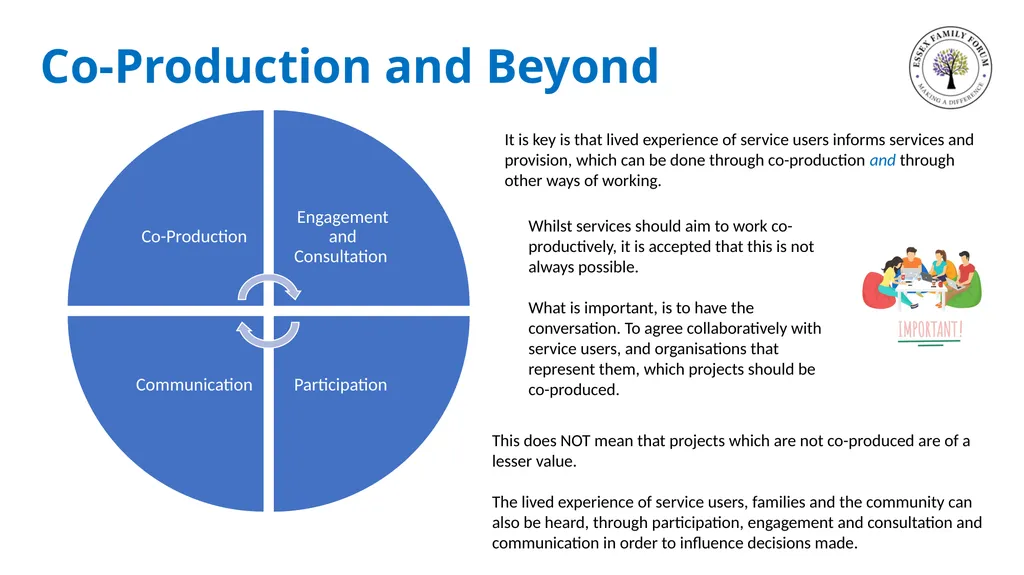
slide13. Co-Production and Beyond It is key is that lived experience of service users informs services and provision, which can be done through co-production and through other ways of working. This does NOT mean that projects which are not co-produced are of a lesser value.
The lived experience of service users, families and the community can also be heard, through participation, engagement and consultation and communication in order to influence decisions made. Whilst services should aim to work co-productively, it is accepted that this is not always possible.
What is important, is to have the conversation. To agree collaboratively with service users, and organisations that represent them, which projects should be co-produced.<br>
slide14. Children, young people and families are involved in designing services or making decisions with professionals, based on their experiences.
Children, young people adults and families can make valid contributions that professionals will decide upon and implement.
Children, young people adults and families have influence over decision making and service provision, which is made by professionals.
Decisions: Strategic decisions will be influenced by those with lived experience. Children, young people and families’ services are given opportunities to express their views in a variety of ways.
Children, young people and families may be able to influence some decisions, as the professionals will use this information gathered when making strategic and service provision decisions.
Decisions: Service providers make decisions, but those with lived experience may be able to influence some decisions. Explaining to children, young people and families how the services work.
Explaining to children, young people and families what decisions have been made about the services design and delivery, and why.
Empowering the children, young people and families with the knowledge they need about the services they use.
Decisions: Service providers make decisions, but those with lived experience are informed about decisions made. Children, young people, families and professionals work together on an equal basis to create a service or decision which works for everyone.
Start with an idea and work together, with a shared responsibility to create solutions.
Start from earliest stages of service design (or re-design) through to development and evaluation.
Strategic, service and individual decisions are shared by children, young people, families and professionals.
Decisions: Strategic decisions are shared throughout the process.<br>
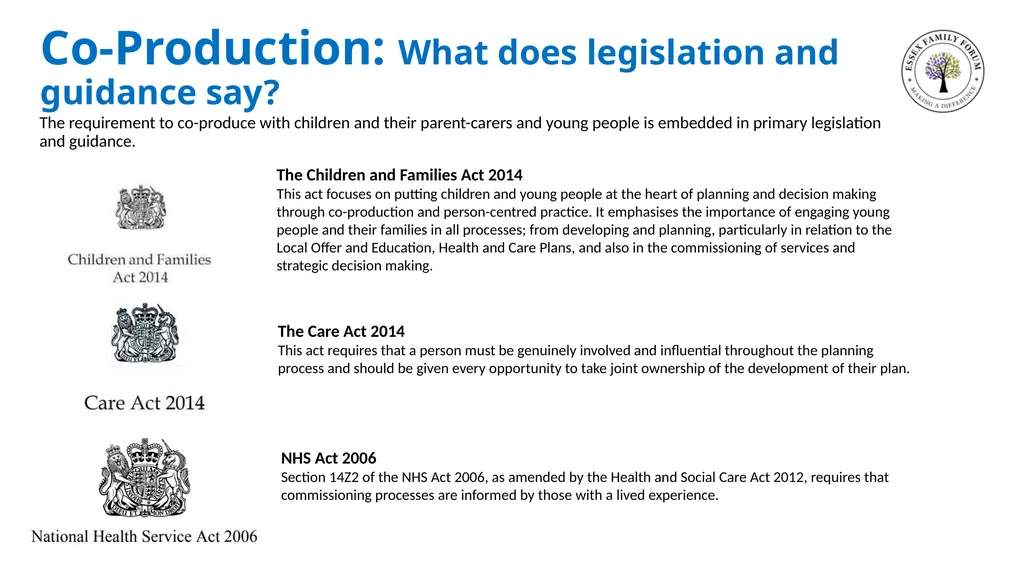
slide15. Co-Production: What does legislation and guidance say? The requirement to co-produce with children and their parent-carers and young people is embedded in primary legislation and guidance. The Children and Families Act 2014
This act focuses on putting children and young people at the heart of planning and decision making through co-production and person-centred practice. It emphasises the importance of engaging young people and their families in all processes; from developing and planning, particularly in relation to the Local Offer and Education, Health and Care Plans, and also in the commissioning of services and strategic decision making. The Care Act 2014
This act requires that a person must be genuinely involved and influential throughout the planning process and should be given every opportunity to take joint ownership of the development of their plan. NHS Act 2006
Section 14Z2 of the NHS Act 2006, as amended by the Health and Social Care Act 2012, requires that commissioning processes are informed by those with a lived experience.<br>
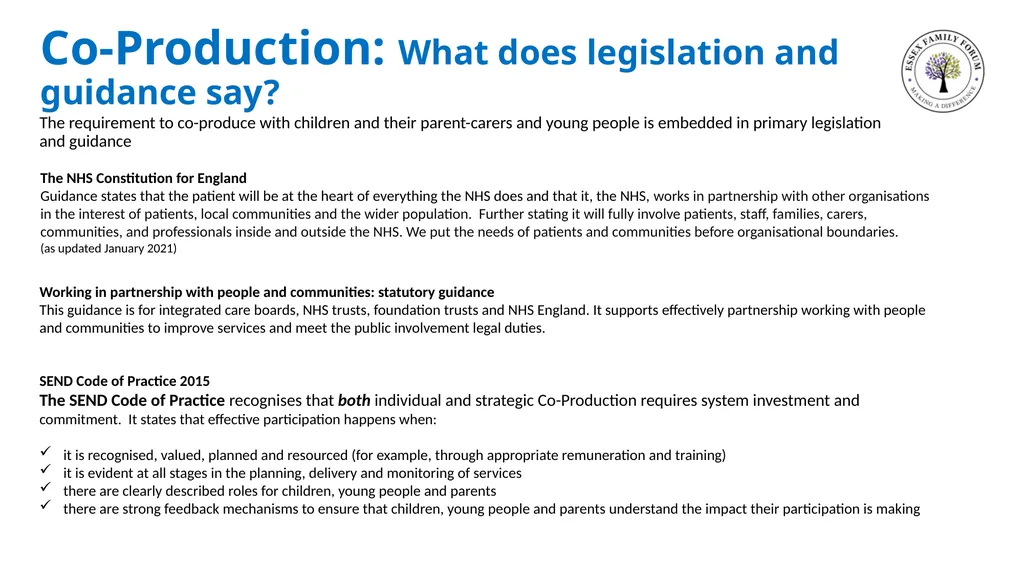
slide16. Co-Production: What does legislation and guidance say? The requirement to co-produce with children and their parent-carers and young people is embedded in primary legislation and guidance SEND Code of Practice 2015
The SEND Code of Practice recognises that both individual and strategic Co-Production requires system investment and commitment. It states that effective participation happens when:
it is recognised, valued, planned and resourced (for example, through appropriate remuneration and training)
it is evident at all stages in the planning, delivery and monitoring of services
there are clearly described roles for children, young people and parents
there are strong feedback mechanisms to ensure that children, young people and parents understand the impact their participation is making The NHS Constitution for England
Guidance states that the patient will be at the heart of everything the NHS does and that it, the NHS, works in partnership with other organisations in the interest of patients, local communities and the wider population. Further stating it will fully involve patients, staff, families, carers, communities, and professionals inside and outside the NHS. We put the needs of patients and communities before organisational boundaries.
(as updated January 2021) Working in partnership with people and communities: statutory guidance
This guidance is for integrated care boards, NHS trusts, foundation trusts and NHS England. It supports effectively partnership working with people and communities to improve services and meet the public involvement legal duties.<br>
slide2. Parent Carer Forums Essex Family Forum is a Parent Carer Forum (PCF). Each Local area has a PCF. There are 152 PCFs, representing over 110,000 parent and carers
A PCF is a group of parents and carers with children and young people, up to the age of 25, with SEND. A Parent Carer Forum’s aim is to make sure the services in their area meet the needs of children with Special Educational Needs and Disabilities (SEND) and their families. PCFs operate in almost all local authority areas across England
We are also members of the:
Eastern Region of Parent Carer Forums (ERPCF) https://easternregionofparentcarerforums.org.uk/
National Network of Parent Carer Forums (NNPCF) https://nnpcf.org.uk/<br>
slide3. The Impact of Co-Production Co-production is not always easy and can take time, but when approached with genuine curiosity and a desire to work collaboratively to solve problems, it is a powerfully effective way to design and deliver health and social care.
Co-production allows every voice to be heard equally. It is important to have the right people involved in the process and create an environment which removes any power dynamics which may prevent everyone from having parity of contribution. Working co-productively can:
improve outcomes for service users
helps maintain a person-centered approach
Offer value for money, by ensuring services effectively meet need and provide a better use of resources
Improve the experiences and lives of service users
provide commissioners and service providers the confidence services meet the needs of the service users
increase the confidence in the community
can led to the identification of new ways of working and creative solutions or using existing resources in a more effective way.<br>
slide4. Co-Production – A Blank sheet of paper key to success ? Co-Production rarely starts with a blank sheet of paper.
Often it starts with discussions regarding a transformation of an existing provision or service, or the opportunity to express an interest or submit a tender for specific funding. It can also be regarding someone's treatment, care or education, for example an Educational Health Care Plan (EHCP) Co-production is not straightforward. It can take longer; you may experience differences of opinion, challenges as people may have different values and priorities.
But what is important is being open, being honest, the relationship between those involved, the conversations which will impact on the outcome.<br>
slide5. Co-Production – Part of an ongoing conversation Co-production, or indeed any form of engagement, should not be a "tick box exercise". Involvement should not be seen as an obstacle that needs to be overcome to achieve an outcome.
Perception of tokenism or that a strategy or service change has not been informed by insight from its communities, may undermine trust and is unlikely to be supported. Involvement with stakeholders and communities should be on-going, not just when a system wants or needs to make changes. Regular dialogue allows for informing and driving policy decisions, supporting and even identifying the need for change, with the needs of the community at the heart of those decisions.
The same applies at an individual level. If we consider a child or young person's Education and Health Care Plan (EHCP):- When their plan is reviewed yearly it should be a reflection of the current needs of the child, a review of their progress and the conversations that have taken place throughout the year. Then, this information is used to set updated outcomes, and plan the provision needed to support and enable the CYP to achieve those outcomes.<br>
slide6. Making Co-Production Work Listen
Welcome people and make them comfortable
Take people's views seriously – even if they are different to your own
Equal opportunities - No-one should feel as if they must “fight” to be heard Empower and Enable
Ensure everyone has the information they need to take part in the discussion.
Make sure people have the support they need
Make sure you are inclusive (interpreters, flexible appointment times to suit needs, accessible locations)
Empowering and enabling people to engage, enhance discussions and improve outcomes<br>
slide7. Making Co-Production Work Time
Start at the beginning - agree what you want to achieve
Plan – ensure you have achievable timescales that allow for meaningful and effective engagement and allow for consideration and discussion of views expressed.
Finish at the end - review progress and celebrate success Person centred not provision led
Tailor your services around what children, young people and their family need and want, not what you have historically delivered
Work closely with other professionals across organisational boundaries
Be solution focussed and be courageous – break down those barriers!<br>
slide8. Values and Behaviours For Co-Production to become part of the way we work, we need a culture where the values and behaviours exist to support it. Marshall, Claire; Zambeaux, Angela; Ainley, Esther; McNally, David; King, Jenny Miss; Wolfenden, Lorraine; and Lee, Helen (2019)
"NHS England Always Events® program: Developing a national model for co-production," Patient Experience Journal: Vol. 6 : Iss. 1 ,
Article 19.
Available at: https://pxjournal.org/journal/vol6/iss1/19<br>
slide9. Levels of Co-Production Individual Strategic Person centered approach, working directly with service users to understand and identify and agree on the support that is needed so that they can achieve their personal aspirations.
Parent Carers having their voice heard about their child and engaging with services that they use
Parent Carers working with practitioners, sharing individual experiences to improve service delivery for their own family
Families engaging in person centred processes that improve outcomes for them Joint working with organisations who represent their communities through a team of trained and coordinated representatives, which allows for influencing service development, review and improvement.
Meeting with service leads to share Parent Carers collective experiences to improve service delivery for all families
Forums working with commissioners, service providers and policy makers to develop and design services, pathways, and processes to improve outcomes for all children, young people and their families
Forums shaping and supporting improvement to practices to provide improved Parent Carer engagement across all services<br>
slide10. Co-Production – Just a buzz word? Coproduction is a “buzz word” and is increasingly used as a term to describe any form of engagement with people with lived experience.
However, true coproduction is a way of working that involves people who use health and care services, carers and communities in equal partnership; and which engages groups of people at the earliest stages of service design, development and evaluation. “If you want to know how well a pair of shoes fit you ask the person wearing them not the person who made them, or paid for them” Co-production acknowledges that people with ‘lived experience’ of a particular condition are often best placed to advise on what support and services will make a positive difference to their lives.
Done well, co-production helps to ground discussions in reality and to maintain a person-centred perspective.<br>
slide11. A Shared Perspective “What you see depends on not only what you look at but also on where you look from” Credit: James Deacon Every organisation, every person will have their own view on what co-production and others way of working such as participation, engagement, consultation and communication, looks like, because they are looking at it from their own perspective. What is important is that we ALL come together and have shared understanding and agree the principals of what “working together” looks like and move forward united in one vision with a shared perspective.<br>
slide12. Different ways of working The NHS states "Starting with people means going to the neighbourhoods and places where they already are and begin by listening to them about their priorities" Working with parent carer forums allows you to directly connect to parents and carers of children and young people with lived experience.
It allows you to listen to them, to understand what is working and what can be improved. To understand what's important and what are the priorities of those with lived experience. Working in Partnership with People and Communities: statutory guidance (NHS England 2022) https://www.england.nhs.uk/wp-content/uploads/2022/07/B1762-guidance-on-working-in-partnership-with-people-and-communities.pdf<br>
slide13. Co-Production and Beyond It is key is that lived experience of service users informs services and provision, which can be done through co-production and through other ways of working. This does NOT mean that projects which are not co-produced are of a lesser value.
The lived experience of service users, families and the community can also be heard, through participation, engagement and consultation and communication in order to influence decisions made. Whilst services should aim to work co-productively, it is accepted that this is not always possible.
What is important, is to have the conversation. To agree collaboratively with service users, and organisations that represent them, which projects should be co-produced.<br>
slide14. Children, young people and families are involved in designing services or making decisions with professionals, based on their experiences.
Children, young people adults and families can make valid contributions that professionals will decide upon and implement.
Children, young people adults and families have influence over decision making and service provision, which is made by professionals.
Decisions: Strategic decisions will be influenced by those with lived experience. Children, young people and families’ services are given opportunities to express their views in a variety of ways.
Children, young people and families may be able to influence some decisions, as the professionals will use this information gathered when making strategic and service provision decisions.
Decisions: Service providers make decisions, but those with lived experience may be able to influence some decisions. Explaining to children, young people and families how the services work.
Explaining to children, young people and families what decisions have been made about the services design and delivery, and why.
Empowering the children, young people and families with the knowledge they need about the services they use.
Decisions: Service providers make decisions, but those with lived experience are informed about decisions made. Children, young people, families and professionals work together on an equal basis to create a service or decision which works for everyone.
Start with an idea and work together, with a shared responsibility to create solutions.
Start from earliest stages of service design (or re-design) through to development and evaluation.
Strategic, service and individual decisions are shared by children, young people, families and professionals.
Decisions: Strategic decisions are shared throughout the process.<br>
slide15. Co-Production: What does legislation and guidance say? The requirement to co-produce with children and their parent-carers and young people is embedded in primary legislation and guidance. The Children and Families Act 2014
This act focuses on putting children and young people at the heart of planning and decision making through co-production and person-centred practice. It emphasises the importance of engaging young people and their families in all processes; from developing and planning, particularly in relation to the Local Offer and Education, Health and Care Plans, and also in the commissioning of services and strategic decision making. The Care Act 2014
This act requires that a person must be genuinely involved and influential throughout the planning process and should be given every opportunity to take joint ownership of the development of their plan. NHS Act 2006
Section 14Z2 of the NHS Act 2006, as amended by the Health and Social Care Act 2012, requires that commissioning processes are informed by those with a lived experience.<br>
slide16. Co-Production: What does legislation and guidance say? The requirement to co-produce with children and their parent-carers and young people is embedded in primary legislation and guidance SEND Code of Practice 2015
The SEND Code of Practice recognises that both individual and strategic Co-Production requires system investment and commitment. It states that effective participation happens when:
it is recognised, valued, planned and resourced (for example, through appropriate remuneration and training)
it is evident at all stages in the planning, delivery and monitoring of services
there are clearly described roles for children, young people and parents
there are strong feedback mechanisms to ensure that children, young people and parents understand the impact their participation is making The NHS Constitution for England
Guidance states that the patient will be at the heart of everything the NHS does and that it, the NHS, works in partnership with other organisations in the interest of patients, local communities and the wider population. Further stating it will fully involve patients, staff, families, carers, communities, and professionals inside and outside the NHS. We put the needs of patients and communities before organisational boundaries.
(as updated January 2021) Working in partnership with people and communities: statutory guidance
This guidance is for integrated care boards, NHS trusts, foundation trusts and NHS England. It supports effectively partnership working with people and communities to improve services and meet the public involvement legal duties.<br>